benzeen

IARC-groep 1 — Kankerverwekkend voor de mens
CAS: 71-43-2 | IARC-bron
EU SVHCUS TSCAUK UK_SVHCCA DSL_TOXICAU AICSMolGod-score: Primair

5,99 €

Chemisch reagens Benzen (CAS 71-43-2). Volledige encyclopedische kaart — classificatie, eigenschappen en veiligheidsgegevens — hieronder.

🔒 VERKOOP GEBLOKKEERD DOOR HET SYSTEEM

Benzen · beperking (REACH Bijlage XVII)

Bijlage XVII · art. 67, lid 1 · REACH-verordening (EG) nr. 1907/2006

Blokkering automatisch toegepast op basis van de regelgevingscanon, niet door een beslissing van de beheerder. Rechtsgrondslag ↗

MolGod_SDSCARD_1
REACH 2020/878
v1 · 16.07.2026
🧬 3D-molecuulvisualisator
Molecuul laden...
3D-model Benzen, CAS 71-43-2, molecuulformule C₆H₆, molaire massa 78.11 g/mol
Chemisch overzicht: BenzenMolGod_OVERVIEW_1
MolecuulformuleC₆H₆
Molecuulmassa78.11 g/mol
Smeltpunt5.49 °C
Kookpunt80.09 °C
Dichtheid0.8765 g/cm³
LogP (lipofiliteit)2.13
SMILESc1ccccc1

Synoniemen: Benzene

Gegevensbronnen: PubChem (NLM/NIH), Reid, Prausnitz, Poling 4th ed. (1987)
Laatst bijgewerkt: 2026-11-10

WETENSCHAPPELIJK ONDERZOEK

[1]EuropePMC2026
Chen, K; Zhu, H; Fu, Q; Rao, X. 2026. "Dominant factors governing benzene adsorption in soils: thermodynamic analysis and predictive modeling." Environmental science. Processes & impacts. https://doi.
[2]EuropePMC2026
Dhungel, B; Klopfenstein, M; Keer, A; Hannigan, MD. 2026. "Strain, Chain, Repeat: Synthesis and Optoelectronic Properties of Poly(Naphthalene Benzene Vinylene)s." ACS macro letters. https://doi.org/10
[3]EuropePMC2026
Guo, J; Zhong, X; Koutrakis, P; Vieira, CLZ. 2026. "Long-Term Ambient Benzene Exposure and Brain Disorders Among Urban Adults: Effect Modification by Genetic Susceptibility and Potential Mediation by
[4]EuropePMC2026
Jung, JS; Choi, SJ; Lee, DK; Kim, SW. 2026. "Spatiotemporal variability of benzene in a petrochemical industrial complex: insights from repeated mobile SIFT-MS monitoring and comparison with Me-DOAS."
[5]EuropePMC2026
Zubieta, CE; Aquino-Linarez, LG; Rossi-Fernández, A; Belelli, PG. 2026. "Hydroxylation effects on the DFT-modeled adsorption of benzene and cyclohexane on hematite." Journal of molecular graphics & mo
[6]EuropePMC2026
Wang, H; Gao, M; Li, W; He, Z. 2026. "Direct Alkane-Benzene Coupling Reactions with Bifunctional Zeolite-Encapsulated Metal Catalysts with Subnanoscale Intimacy." Journal of the American Chemical Soci
[7]EuropePMC2026
Nicas, M. 2026. "Benzene exposures during tank washing activities on crude oil tankers." Annals of work exposures and health. https://doi.org/10.1093/annweh/wxag038.
[8]EuropePMC2026
Lai, J; Li, Y; Yin, C; Mao, K. 2026. "Engineering Oxygen Vacancies via Crystal-Phase Modulation in Mn-Ce Oxides for Toluene and Benzene Oxidation." Inorganic chemistry. https://doi.org/10.1021/acs.ino
📚 Wetenschappelijke referenties (Chicago Author-Date) 16 refs · 2 baz

MOLEKUŁA Bibliografie per CAS (live uit 13+ databases)

Bronnen: db:europepmc (16)

  1. db:europepmc Chen, K; Zhu, H; Fu, Q; Rao, X. 2026. "Dominant factors governing benzene adsorption in soils: thermodynamic analysis and predictive modeling." Environmental science. Processes & impacts. https://doi.org/10.1039/d6em00027d. →
  2. db:europepmc Dhungel, B; Klopfenstein, M; Keer, A; Hannigan, MD. 2026. "Strain, Chain, Repeat: Synthesis and Optoelectronic Properties of Poly(Naphthalene Benzene Vinylene)s." ACS macro letters. https://doi.org/10.1021/acsmacrolett.6c00194. →
  3. db:europepmc Guo, J; Zhong, X; Koutrakis, P; Vieira, CLZ. 2026. "Long-Term Ambient Benzene Exposure and Brain Disorders Among Urban Adults: Effect Modification by Genetic Susceptibility and Potential Mediation by Plasma Proteins." Advanced science (Weinheim, Baden-Wurttemberg, Germany). https://doi.org/10.1002/advs.75874. →
  4. db:europepmc Jung, JS; Choi, SJ; Lee, DK; Kim, SW. 2026. "Spatiotemporal variability of benzene in a petrochemical industrial complex: insights from repeated mobile SIFT-MS monitoring and comparison with Me-DOAS." Environmental monitoring and assessment. https://doi.org/10.1007/s10661-026-15488-7. →
  5. db:europepmc Zubieta, CE; Aquino-Linarez, LG; Rossi-Fernández, A; Belelli, PG. 2026. "Hydroxylation effects on the DFT-modeled adsorption of benzene and cyclohexane on hematite." Journal of molecular graphics & modelling. https://doi.org/10.1016/j.jmgm.2026.109457. →
  6. db:europepmc Wang, H; Gao, M; Li, W; He, Z. 2026. "Direct Alkane-Benzene Coupling Reactions with Bifunctional Zeolite-Encapsulated Metal Catalysts with Subnanoscale Intimacy." Journal of the American Chemical Society. https://doi.org/10.1021/jacs.5c21822. →
  7. db:europepmc Nicas, M. 2026. "Benzene exposures during tank washing activities on crude oil tankers." Annals of work exposures and health. https://doi.org/10.1093/annweh/wxag038. →
  8. db:europepmc Lai, J; Li, Y; Yin, C; Mao, K. 2026. "Engineering Oxygen Vacancies via Crystal-Phase Modulation in Mn-Ce Oxides for Toluene and Benzene Oxidation." Inorganic chemistry. https://doi.org/10.1021/acs.inorgchem.6c01240. →
  9. db:europepmc Demuth, T; Svatunek, D. 2026. "Insights into Tetrazine-Benzene Cycloadditions." The journal of physical chemistry. A. https://doi.org/10.1021/acs.jpca.6c01346. →
  10. db:europepmc Elhadad, SM; Ea, S; Saleh, IH; Omar, MY. 2026. "Sustainable indoor air quality via plant-based biofiltration evaluating benzene and toluene removal efficiency and health risk reduction in pharmaceutical laboratories." Scientific reports. https://doi.org/10.1038/s41598-026-54339-w. →
  11. db:europepmc Chen, H; Lin, B; Wei, W; Hao, J. 2026. "Mn-MIL-100-Derived CuO/Mn<sub>2</sub>O<sub>3</sub>-Mn<sub>5</sub>O<sub>8</sub> Composite Catalysts for Benzene Oxidation: Synergistic Effect and High Performance." Langmuir : the ACS journal of surfaces and colloids. https://doi.org/10.1021/acs.langmuir.6c00913. →
  12. db:europepmc Nishimura, N; Murakami, TN. 2026. "TIPS-benzene-based two-dimensional perovskites." Chemical communications (Cambridge, England). https://doi.org/10.1039/d6cc01157h. →
  13. db:europepmc Park, HW; Kim, Y; Lee, SY; Kim, Y. 2026. "Lymphoid neoplasms and benzene exposure using a revised classification scheme: systematic review and meta-analysis." Occupational and environmental medicine. https://doi.org/10.1136/oemed-2025-110652. →
  14. db:europepmc Choi, I; Choi, Y; Lee, HS; Jung, HY. 2026. "Hematopoietic carcinogen assessment in bulk chemical products and air samples: focus on benzene exposure among subway maintenance workers." Inhalation toxicology. https://doi.org/10.1080/08958378.2026.2671346. →
  15. db:europepmc Zhang, P; Hu, D; Yang, C; Mu, S. 2026. "Superior Benzene Catalytic Oxidation over Co<sub>3</sub>O<sub>4</sub> Catalysts with Oxygen Vacancy-Rich Co Sites." Langmuir : the ACS journal of surfaces and colloids. https://doi.org/10.1021/acs.langmuir.6c00687. →
  16. db:europepmc Smith, B; Cadby, P; DiNovi, M; Setzer, RW. 2010. "Application of the Margin of Exposure (MoE) approach to substances in food that are genotoxic and carcinogenic: example: benzene, CAS: 71-43-2." Food and chemical toxicology : an international journal published for the British Industrial Biological Research Association. https://doi.org/10.1016/j.fct.2009.10.015. →
📊 Fysisch-chemische eigenschappen

Snel overzicht

Formule: C₆H₆
MW: 78.11 g/mol
CAS: 71-43-2
Uiterlijk: Clear, colorless liquid
Geur: Aromatic odor
Geur: Aromatic odor

Gedetailleerde eigenschappen

Eigenschap Waarde Eenheid Condities Bron
Dichtheid (ρ) 0.8765 g/cm³ 20 °C (68 °F) Reid, Prausnitz, Poling 4th ed. (1987)
Smeltpunt (mp) 5.49 °C (41.9 °F) 1 atm Reid, Prausnitz, Poling 4th ed. (1987)
Kookpunt (bp) 80.09 °C (176.2 °F) 1 atm Reid, Prausnitz, Poling 4th ed. (1987)
Vlampunt -11.00 °C (12.2 °F) closed cup Reid, Prausnitz, Poling 4th ed. (1987)
Dampdruk 95.200 mmHg 25 °C (77 °F) Reid, Prausnitz, Poling 4th ed. (1987)
Wateroplosbaarheid 1.790 g/L 25 °C (77 °F) Reid, Prausnitz, Poling 4th ed. (1987)
Viscositeit (η) 0.604 cP 25 °C (77 °F) Reid, Prausnitz, Poling 4th ed. (1987)
Brekingsindex (nD) 1.5011 20 °C (68 °F), D-line Reid, Prausnitz, Poling 4th ed. (1987)
🔬 Geavanceerde eigenschappen
Oppervlaktespanning 28.200 mN/m 20°C
Diëlektrische constante (ε) 2.280 25°C
Warmtecapaciteit (Cp) 1.740 J/(g·K) 25°C

Chemische identificatoren

SMILES: c1ccccc1

Gegevensbronnen: PubChem, NIST Chemistry WebBook, CRC Handbook of Chemistry and Physics (103rd ed.)

Laatst bijgewerkt: 2026-06-30

Regelgevingsstatus van de stof
Inventarissen: EU/SVHC, US/TSCA, UK/UK_SVHC, CA/DSL_TOXIC, AU/AICS. Regelgevingsinformatie — beperkt de aankoop in deze winkel niet.
🧮 StoichiometrierekenmachineMolGod_STOICH_1
🔍 Externe identificatorenMolGod_EXTID_1
13 van 16 ID-systemen81%
DatabaseIdentificatorActies
CAS Registry Number71-43-2Openen →
PubChem CID241Openen →
InChIKeyUHOVQNZJYSORNB-UHFFFAOYSA-NOpenen →
InChIInChI=1S/C6H6/c1-2-4-6-5-3-1/h1-6H
SMILESc1ccccc1
EC Number200-753-7Openen →
KEGG CompoundC01407Openen →
HMDBHMDB0001505Openen →
ChemSpider236Openen →
MeSH UID (NLM)D001554Openen →
UNII (FDA)J64922108FOpenen →
NSC Number (NCI)67315Openen →
WikiData QIDQ2270Openen →

Bronnen: PubChem (NIH), Wikidata SPARQL, KEGG, ChEMBL (EBI), CompTox CTX (EPA).

📡 Spectroscopie — CAS 71-43-2MolGod_SPECHUB_MAIN
📊 Spectra (NMR, IR, MS, UV-Vis) (1)

Beschikbare spectrumtypen: IR

IR-spectrum (KBr, 4000-400 cm⁻¹)

440 datapunten · Bron: NIST WebBook · NIST ↗ · 📥 JCAMP-DX
📋 Piektoewijzingstabel (peak assignment)
Type Positie Intensiteit Toewijzing
IR 450 0 —
IR 458 0 —
IR 466 0 —
IR 474 0 —
IR 482 0 —
IR 490 0 —
IR 498 0 —
IR 506 0 —
IR 514 0 —
IR 522 0 —
IR 530 0 —
IR 538 0 —
IR 546 0 —
IR 554 0 —
IR 562 0 —
IR 570 0 —
IR 578 0 —
IR 586 0 —
IR 594 0 —
IR 602 0 —
🎓 Gids voor spectruminterpretatie (voor studenten)
Hoe lees je een IR-spectrum
  • 3200-3600 cm⁻¹ — O-H-rekvibratie (brede piek = waterstofbrug)
  • 2850-3000 cm⁻¹ — C-H-rekvibratie (sp³)
  • 1650-1750 cm⁻¹ — C=O-rekvibratie (ketonen, aldehyden, esters)
  • 1400-1600 cm⁻¹ — trillingen van de aromatische ring
  • 1000-1300 cm⁻¹ — C-O-rekvibratie (ethers, alcoholen)
  • Geen absorptie = geen functionele groep → vergelijk met een referentie

Bronnen: LibreTexts ↗, Silverstein (Spectrometric ID) ↗

📚 Wetenschappelijke referenties (Chicago Author-Date) (9 bronnen)

📚 De boekbibliografie moet nog worden gegenereerd. Gecureerde algemene leerboeken zijn hieronder beschikbaar; CAS-specifieke Google Books kunnen via het beheerpaneel worden opgehaald.

  1. National Institute of Standards and Technology. 2024. "NIST Chemistry WebBook, SRD 69." Gaithersburg, MD: NIST. Accessed 2025-01-01. ↗
  2. Spectral Database for Organic Structure Determination (SDBS). 2024. National Institute of Advanced Industrial Science and Technology (AIST), Japan. Accessed 2025-01-01. ↗
  3. Ulrich, Eldon L., Hideo Akutsu, John F. Doreleijers, Yoko Harano, Yannis E. Ioannidis, Jundong Lin, Miron Livny, et al. 2008. "BioMagResBank." Nucleic Acids Research 36 (D1): D402–D408. [DOI ↗]
  4. Horai, Hisayuki, Masanori Arita, Shigehiko Kanaya, Yoshito Nihei, Tasuku Ikeda, Kazuhiro Suwa, Yuya Ojima, et al. 2010. "MassBank: A Public Repository for Sharing Mass Spectral Data for Life Sciences." Journal of Mass Spectrometry 45 (7): 703–714. [DOI ↗]
  5. Linstrom, P.J., and W.G. Mallard, eds. 2024. NIST Chemistry WebBook, NIST Standard Reference Database Number 69. Gaithersburg, MD: National Institute of Standards and Technology. ↗
  6. McDonald, M. Shane, Mike McAvoy, and Ajit Bhalerao. 1988. "JCAMP-DX: A Standard Form for Exchange of Infrared Spectra in Computer Readable Form." Applied Spectroscopy 42 (1): 151–162. [DOI ↗]
  7. PubChem. 2024. "PubChem Compound Database." National Library of Medicine, National Institutes of Health. Accessed 2025-01-01. ↗
📐 Fysisch-chemische eigenschappen (database) 25 velden MolGod-score: Primair
Eigenschap Waarde Eenheid Conditions Source
Smeltpunt 5.49 [4][6][11] °C 1 atm Reid, Prausnitz, Poling 4th ed. (1987)
Kookpunt 80.09 [4][6][11] °C 760 mmHg Reid, Prausnitz, Poling 4th ed. (1987)
Wateroplosbaarheid 1.790 [4] g/L 25°C Reid, Prausnitz, Poling 4th ed. (1987)
Dichtheid (ρ) 0.8765 [4] g/cm³ 20°C Reid, Prausnitz, Poling 4th ed. (1987)
Brekingsindex (n_D) 1.5011 [4] — 20°C, sodium D Reid, Prausnitz, Poling 4th ed. (1987)
Viscositeit (η) 0.604 [4] cP 25°C Reid, Prausnitz, Poling 4th ed. (1987)
Dampdruk 95.200 [4] mmHg 25°C Reid, Prausnitz, Poling 4th ed. (1987)
Vlampunt -11.00 [4] °C closed cup Reid, Prausnitz, Poling 4th ed. (1987)
Zelfontbrandingstemperatuur 498.00 [4] °C in air Reid, Prausnitz, Poling 4th ed. (1987)
UV λmax 254 [4][2] nm water/MeOH Reid, Prausnitz, Poling 4th ed. (1987)
UV εmax 200 [4][2] M⁻¹·cm⁻¹ at λmax Reid, Prausnitz, Poling 4th ed. (1987)
UV λmax (alt) 204 [4][2] nm cyclohexane (E2 band) Reid, Prausnitz, Poling 4th ed. (1987)
logP (octanol/water) 2.130 [4][8][9] — 25°C Reid, Prausnitz, Poling 4th ed. (1987)
logD (pH 7) 2.130 [4][8][9] — pH 7.4 Reid, Prausnitz, Poling 4th ed. (1987)
Diëlektrische constante (ε) 2.280 [4] — 25°C Reid, Prausnitz, Poling 4th ed. (1987)
Oppervlaktespanning 28.200 [4] mN/m 20°C Reid, Prausnitz, Poling 4th ed. (1987)
Soortelijke warmte (cp) 1.740 [4] J/(g·K) 25°C Reid, Prausnitz, Poling 4th ed. (1987)
Thermische geleidbaarheid (k) 0.1410 [4] W/(m·K) 25°C Reid, Prausnitz, Poling 4th ed. (1987)
Dipoolmoment (μ) 0.000 [4] D gas phase Reid, Prausnitz, Poling 4th ed. (1987)
ΔH verdamping 33.830 [4] kJ/mol NBP Reid, Prausnitz, Poling 4th ed. (1987)
ΔH smelten 9.950 [4] kJ/mol at mp Reid, Prausnitz, Poling 4th ed. (1987)
Kritische temperatuur (Tc) 288.90 [4] °C critical point Reid, Prausnitz, Poling 4th ed. (1987)
Kritische druk (Pc) 48.900 [4] bar critical point Reid, Prausnitz, Poling 4th ed. (1987)
Acentrische factor (ω) 0.2120 [4] — Pitzer Reid, Prausnitz, Poling 4th ed. (1987)
Oplosbaarheid in ethanol miscible [4] g/L 25°C Reid, Prausnitz, Poling 4th ed. (1987)
📚 Wetenschappelijke referenties (Chicago Author-Date) (12 bronnen)
  1. Haynes, William M., ed. 2024. CRC Handbook of Chemistry and Physics. 105th ed. Boca Raton: CRC Press/Taylor & Francis. ISBN 978-1-032-55554-4. ↗
  2. National Institute of Standards and Technology. 2024. "NIST Chemistry WebBook, SRD 69." Gaithersburg, MD: NIST. Accessed 2025-01-01. ↗
  3. Yaws, Carl L. 2014. The Yaws Handbook of Physical Properties for Hydrocarbons and Chemicals. 2nd ed. Oxford: Gulf Professional Publishing.
  4. PubChem. 2024. "PubChem Compound Database." National Library of Medicine, National Institutes of Health. Accessed 2025-01-01. ↗
  5. Marrero, J., and R. Gani. 2001. "Group-Contribution Based Estimation of Pure Component Properties." Fluid Phase Equilibria 183–184: 183–208. ↗
  6. Joback, K. G., and R. C. Reid. 1987. "Estimation of Pure-Component Properties from Group-Contributions." Chemical Engineering Communications 57 (1–6): 233–243. ↗
  7. Sangster, J. 1997. Octanol-Water Partition Coefficients: Fundamentals and Physical Chemistry. Chichester: Wiley. ISBN 978-0-471-97397-3.
  8. Mannhold, Raimund, and Han van de Waterbeemd. 2001. "Substructure and Whole Molecule Approaches for Calculating Log P." Journal of Computer-Aided Molecular Design 15 (4): 337–354. ↗
  9. Perrin, Ditlev D., Boyd Dempsey, and E. P. Serjeant. 1981. pKa Prediction for Organic Acids and Bases. London: Chapman and Hall. ISBN 0-412-21090-5.
  10. Constantinou, Leonidas, and Rafiqul Gani. 1994. "New Group Contribution Method for Estimating Properties of Pure Compounds." AIChE Journal 40 (10): 1697–1710. ↗
  11. Ertl, Peter, Bernhard Rohde, and Paul Selzer. 2000. "Fast Calculation of Molecular Polar Surface Area as a Sum of Fragment-Based Contributions and Its Application to the Prediction of Drug Transport Properties." Journal of Medicinal Chemistry 43 (20): 3714–3717. ↗
🔄 Omrekenaar voor concentratie-eenheden LIVE MolGod_UNITCONV_1

Voer de concentratie Benzen in een willekeurige eenheid in — de rest wordt automatisch berekend.

MW: 78.11 g/mol · IUPAC Gold Book ↗

⚗️ Conversieformules + citaten (per formule)
ConversieFormuleNauwkeurigheidBron
% (w/v) ↔ molarityc (mol/L) = (% × 10) / MW±0.5% rel. when density ≈ 1.0 g/mLIUPAC (2019)
millimolar ↔ molarc (mol/L) = mM × 10⁻³ExactCohen ER, Cvitaš T, Frey JG, Holmström B, Kuchitsu K, Marquardt R, Mills I, Pavese F, Quack M, Stohner J, Strauss HL, Takami M, Thor AJ (2007)
molarity (mol/L)c = n/V = (m/MW)/V±0.1% (depends on MW precision)IUPAC (2019)
parts per million (mg/L) ↔ molarityc (mol/L) = ppm / (1000 × MW); equivalently ppm = mg/L for dilute aqueous±1% (density-independent for dilute solutions)IUPAC (2019)
mg/mL ↔ molarityc (mol/L) = (mg/mL × 1000) / MW / 1000 = mg/mL / MW × 1±0.2%Cohen ER, Cvitaš T, Frey JG, Holmström B, Kuchitsu K, Marquardt R, Mills I, Pavese F, Quack M, Stohner J, Strauss HL, Takami M, Thor AJ (2007)
g/L ↔ molarityc (mol/L) = (g/L) / MW±0.1% (depends on MW precision)Cohen ER, Cvitaš T, Frey JG, Holmström B, Kuchitsu K, Marquardt R, Mills I, Pavese F, Quack M, Stohner J, Strauss HL, Takami M, Thor AJ (2007)
mmol/L ↔ molarityc (mol/L) = mmol/L × 10⁻³ExactCohen ER, Cvitaš T, Frey JG, Holmström B, Kuchitsu K, Marquardt R, Mills I, Pavese F, Quack M, Stohner J, Strauss HL, Takami M, Thor AJ (2007)
Celsius ↔ KelvinT(K) = t(°C) + 273.15±0.01 K (ITS-90 scale)BIPM (Bureau International des Poids et Mesures) (2019)
Celsius ↔ FahrenheitT(°F) = T(°C) × 9/5 + 32±0.1 °FThompson A, Taylor BN (2008)
density-corrected % ↔ molarityc (mol/L) = (%w/w × ρ × 10) / MW, ρ in g/mL±0.1% when ρ known to 3 decimalsCohen ER, Cvitaš T, Frey JG, Holmström B, Kuchitsu K, Marquardt R, Mills I, Pavese F, Quack M, Stohner J, Strauss HL, Takami M, Thor AJ (2007)
📚 Bibliografie (8 gezaghebbende bronnen)
  1. Thompson A, Taylor BN (2008). Guide for the Use of the International System of Units (SI). NIST Special Publication 811 · DOI: 10.6028/NIST.SP.811-2008
    → Primary SI standard for US scientific usage
  2. Cohen ER, Cvitaš T, Frey JG, Holmström B, Kuchitsu K, Marquardt R, Mills I, Pavese F, Quack M, Stohner J, Strauss HL, Takami M, Thor AJ (2007). Quantities, Units and Symbols in Physical Chemistry — The IUPAC Green Book. RSC Publishing, 3rd ed. · DOI: 10.1039/9781847557889 · ISBN: 978-0-85404-433-7
    → Canonical IUPAC guide for chemistry quantities/units
  3. BIPM (Bureau International des Poids et Mesures) (2019). The International System of Units (SI), 9th edition. BIPM · ↗
    → International SI definitions (incl. redefined kilogram 2019)
  4. ISO/IEC (2022). Quantities and units — Part 1: General. International Organization for Standardization — ISO 80000-1:2022 · ↗
    → General rules for physical quantities and units
  5. ISO/IEC (2019). Quantities and units — Part 9: Physical chemistry and molecular physics. International Organization for Standardization — ISO 80000-9:2019 · ↗
    → Concentration / molality / amount-of-substance conventions
  6. Tiesinga E, Mohr PJ, Newell DB, Taylor BN (2021). CODATA recommended values of the fundamental physical constants: 2018. Rev. Mod. Phys. 93(2):025010 · DOI: 10.1103/RevModPhys.93.025010
    → Avogadro, gas constant, molar volume (2019 SI revision)
  7. IUPAC (2019). Compendium of Chemical Terminology — the IUPAC Gold Book (online). IUPAC · DOI: 10.1351/goldbook
    → Definitions of mass fraction, molality, normality, ppm, activity
  8. Mills IM, Cvitaš T, Homann K, Kallay N, Kuchitsu K (1988). Quantities, Units and Symbols in Physical Chemistry. Blackwell Scientific Publications, 1st ed. · ISBN: 0-632-01773-5
    → Historical predecessor of IUPAC Green Book
🧪 Wizard voor het bereiden van oplossingen WIZARD MolGod_PREP_1
① Selecteer concentratie
② Doelvolume
③ Oplosmiddel

Berekeningen volgens: IUPAC Gold Book ↗, Merck ↗

Compatibiliteit met oplosmiddelenMolGod_SOLV_1

Schatting op basis van de oplosbaarheid in water en logP. Indicatieve gegevens — vervangen geen experimenteel onderzoek.

OplosmiddelCompatibiliteitOpmerkingenReferenties
Water~ MatigMatige logP
EtOH+ GoedEtOH — universeel polair oplosmiddel
Acetone+ GoedAceton — goed voor matig polaire verbindingen
DCM+ GoedDCM — goed voor apolaire verbindingen
DMSO+ GoedDMSO — sterk aprotisch oplosmiddel
THF+ GoedTHF — breed oplosbaarheidsbereik
Hexane- SlechtSlechte oplosbaarheid in hexaan
CHCl3+ GoedCHCl3 — goed voor matig polaire en apolaire verbindingen

Gegevensbronnen voor logP/oplosbaarheid: logP: 2.13

📚 Wetenschappelijke referenties voor oplosmiddelen (Chicago Author-Date) — klik om uit te klappen

Elk oplosmiddel wordt ondersteund door 5 onafhankelijke wetenschappelijke bronnen (NIST/CRC/IARC/Hansen/Reichardt/Smallwood/GESTIS). Volledige citaties hieronder.

Water · NIST CAS lookup ↗
  1. Rumble, John R., ed. 2023. CRC Handbook of Chemistry and Physics. 104th ed. Boca Raton, FL: CRC Press. [link ↗]
  2. International Association for the Properties of Water and Steam (IAPWS). 1997. "Release on the Static Dielectric Constant of Ordinary Water Substance." IAPWS R8-97. [link ↗]
  3. Reichardt, Christian, and Thomas Welton. 2011. Solvents and Solvent Effects in Organic Chemistry. 4th ed. Weinheim: Wiley-VCH. https://doi.org/10.1002/9783527632220. [link ↗]
  4. Hansen, Charles M. 2007. Hansen Solubility Parameters: A User's Handbook. 2nd ed. Boca Raton, FL: CRC Press. https://doi.org/10.1201/9781420006834. [link ↗]
  5. IFA. n.d. "Water." GESTIS Substance Database. Institut für Arbeitsschutz der Deutschen Gesetzlichen Unfallversicherung. Accessed April 25, 2026. [link ↗]
EtOH · NIST CAS lookup ↗
  1. Rumble, John R., ed. 2023. CRC Handbook of Chemistry and Physics. 104th ed. Boca Raton, FL: CRC Press. [link ↗]
  2. Reichardt, Christian, and Thomas Welton. 2011. Solvents and Solvent Effects in Organic Chemistry. 4th ed. Weinheim: Wiley-VCH. https://doi.org/10.1002/9783527632220. [link ↗]
  3. Snyder, Lloyd R., Joseph J. Kirkland, and John W. Dolan. 2010. Introduction to Modern Liquid Chromatography. 3rd ed. Hoboken, NJ: Wiley. https://doi.org/10.1002/9780470508183. [link ↗]
  4. Smallwood, Ian M. 1996. Handbook of Organic Solvent Properties. London: Arnold. https://doi.org/10.1016/B978-0-340-64578-9.X5000-9. [link ↗]
  5. IFA. n.d. "Ethanol." GESTIS Substance Database. Accessed April 25, 2026. [link ↗]
Acetone · NIST CAS lookup ↗
  1. Reichardt, Christian, and Thomas Welton. 2011. Solvents and Solvent Effects in Organic Chemistry. 4th ed. Weinheim: Wiley-VCH. https://doi.org/10.1002/9783527632220. [link ↗]
  2. Hansen, Charles M. 2007. Hansen Solubility Parameters: A User's Handbook. 2nd ed. Boca Raton, FL: CRC Press. [link ↗]
  3. Rumble, John R., ed. 2023. CRC Handbook of Chemistry and Physics. 104th ed. Boca Raton, FL: CRC Press. [link ↗]
  4. Smallwood, Ian M. 1996. Handbook of Organic Solvent Properties. London: Arnold. [link ↗]
  5. IFA. n.d. "Acetone." GESTIS Substance Database. Accessed April 25, 2026. [link ↗]
DCM · NIST CAS lookup ↗
  1. National Institute of Standards and Technology. n.d. "Methane, dichloro- (CAS 75-09-2)." NIST Chemistry WebBook, SRD 69. Accessed April 25, 2026. [link ↗]
  2. Hansen, Charles M. 2007. Hansen Solubility Parameters: A User's Handbook. 2nd ed. Boca Raton, FL: CRC Press. [link ↗]
  3. International Agency for Research on Cancer. 1999. "Dichloromethane." IARC Monographs on the Evaluation of Carcinogenic Risks to Humans 71: 251–315. [link ↗]
  4. Reichardt, Christian, and Thomas Welton. 2011. Solvents and Solvent Effects in Organic Chemistry. 4th ed. Weinheim: Wiley-VCH. [link ↗]
  5. IFA. n.d. "Dichloromethane." GESTIS Substance Database. Accessed April 25, 2026. [link ↗]
DMSO · NIST CAS lookup ↗
  1. Wypych, George. 2019. Handbook of Solvents. Volume 1: Properties. 3rd ed. Toronto: ChemTec Publishing. https://doi.org/10.1016/C2018-0-02235-3. [link ↗]
  2. Reichardt, Christian, and Thomas Welton. 2011. Solvents and Solvent Effects in Organic Chemistry. 4th ed. Weinheim: Wiley-VCH. [link ↗]
  3. Hansen, Charles M. 2007. Hansen Solubility Parameters: A User's Handbook. 2nd ed. Boca Raton, FL: CRC Press. [link ↗]
  4. National Institute of Standards and Technology. n.d. "Methane, sulfinylbis- (CAS 67-68-5)." NIST Chemistry WebBook. Accessed April 25, 2026. [link ↗]
  5. IFA. n.d. "Dimethyl sulfoxide." GESTIS Substance Database. Accessed April 25, 2026. [link ↗]
THF · NIST CAS lookup ↗
  1. Armarego, Wilfred L. F., and Christina Li Lin Chai. 2009. Purification of Laboratory Chemicals. 6th ed. Oxford: Butterworth-Heinemann. https://doi.org/10.1016/B978-1-85617-567-8.50003-3. [link ↗]
  2. Hansen, Charles M. 2007. Hansen Solubility Parameters: A User's Handbook. 2nd ed. Boca Raton, FL: CRC Press. [link ↗]
  3. National Institute of Standards and Technology. n.d. "Furan, tetrahydro- (CAS 109-99-9)." NIST Chemistry WebBook. Accessed April 25, 2026. [link ↗]
  4. Smallwood, Ian M. 1996. Handbook of Organic Solvent Properties. London: Arnold. [link ↗]
  5. IFA. n.d. "Tetrahydrofuran." GESTIS Substance Database. Accessed April 25, 2026. [link ↗]
Hexane · NIST CAS lookup ↗
  1. National Institute of Standards and Technology. n.d. "Hexane (CAS 110-54-3)." NIST Chemistry WebBook. Accessed April 25, 2026. [link ↗]
  2. Hansen, Charles M. 2007. Hansen Solubility Parameters: A User's Handbook. 2nd ed. Boca Raton, FL: CRC Press. [link ↗]
  3. Snyder, Lloyd R., Joseph J. Kirkland, and John W. Dolan. 2010. Introduction to Modern Liquid Chromatography. 3rd ed. Hoboken, NJ: Wiley. [link ↗]
  4. Agency for Toxic Substances and Disease Registry. 1999. Toxicological Profile for n-Hexane. Atlanta, GA: U.S. Department of Health and Human Services. [link ↗]
  5. IFA. n.d. "n-Hexane." GESTIS Substance Database. Accessed April 25, 2026. [link ↗]
CHCl3 · NIST CAS lookup ↗
  1. International Agency for Research on Cancer. 1999. "Chloroform." IARC Monographs on the Evaluation of Carcinogenic Risks to Humans 73: 131–182. [link ↗]
  2. National Institute of Standards and Technology. n.d. "Methane, trichloro- (CAS 67-66-3)." NIST Chemistry WebBook. Accessed April 25, 2026. [link ↗]
  3. Hansen, Charles M. 2007. Hansen Solubility Parameters: A User's Handbook. 2nd ed. Boca Raton, FL: CRC Press. [link ↗]
  4. Reichardt, Christian, and Thomas Welton. 2011. Solvents and Solvent Effects in Organic Chemistry. 4th ed. Weinheim: Wiley-VCH. [link ↗]
  5. IFA. n.d. "Chloroform." GESTIS Substance Database. Accessed April 25, 2026. [link ↗]
Oplosbaarheidstheorie (toegepast bij de voorspelling van compatibiliteit):
  1. Yalkowsky, Samuel H., and Shri C. Valvani. 1980. "Solubility and Partitioning I: Solubility of Nonelectrolytes in Water." Journal of Pharmaceutical Sciences 69 (8): 912–922. https://doi.org/10.1002/jps.2600690814 — General Solubility Equation (GSE): logS = 0.5 − logP − 0.01(MP−25).
  2. Hansen, Charles M. 2007. Hansen Solubility Parameters: A User's Handbook. 2nd ed. Boca Raton, FL: CRC Press. https://doi.org/10.1201/9781420006834 — HSP-triplet (dD, dP, dH) + Ra-formule.
  3. Reichardt, Christian, and Thomas Welton. 2011. Solvents and Solvent Effects in Organic Chemistry. 4th ed. Weinheim: Wiley-VCH. https://doi.org/10.1002/9783527632220 — E_T(30) polarity scale, solwatochromia.
  4. Snyder, Lloyd R., Joseph J. Kirkland, and John W. Dolan. 2010. Introduction to Modern Liquid Chromatography. 3rd ed. Hoboken, NJ: Wiley. https://doi.org/10.1002/9780470508183 — Eluotropic series, polarity index.
  5. PubChem Compound Database — CAS 71-43-2 lookup ↗ — logP (XLogP3), water solubility experimental + predicted.

Volledige bibliografie in het accordeon REFERENTIES (onderaan de pagina) — Chicago Manual of Style 17th ed., Author-Date.

🔬 Gids voor zuiverheidscontrole Kwaliteitscontrole

Verifieer de zuiverheid van het reagens met gestandaardiseerde analytische methoden. Selecteer hieronder een testmethode en voer uw meetresultaten in voor automatische berekening.

🛡️ Veiligheid — CAS 71-43-2MolGod_SAFEHUB_MAIN
Mededeling over gegevensbeperkingen. De veiligheidsinformatie op deze pagina is uitsluitend ter informatie en vervangt geen volledig veiligheidsinformatieblad (SDS). Raadpleeg vóór gebruik van het product het actuele veiligheidsinformatieblad van de fabrikant en de GHS/CLP-richtlijnen. De CLP-indeling geldt voor de zuivere bulkstof, niet voor commerciële formuleringen.

GHS/CLP-indeling — Verordening (EG) nr. 1272/2008 + UN GHS Rev. 9 (2021).

⚠️ Gevaar (Danger)
GHS02 — Ontvlambaar
GHS02 Ontvlambaar
GHS07 — Irriterend / schadelijk
GHS07 Irriterend / schadelijk
GHS08 — Gezondheidsgevaar
GHS08 Gezondheidsgevaar

🚨 Gevarenaanduidingen (H)

  • H225 — Licht ontvlambare vloeistof en damp.
  • H350 — Kan kanker veroorzaken.
  • H340 — Kan genetische schade veroorzaken.
  • H304 — Kan dodelijk zijn als de stof bij inslikken in de luchtwegen terechtkomt.
  • H372 — Veroorzaakt schade aan organen bij langdurige of herhaalde blootstelling.
  • H315 — Veroorzaakt huidirritatie.
  • H319 — Veroorzaakt ernstige oogirritatie.

🛡 Voorzorgsmaatregelen (P)

  • P201 — Vóór gebruik speciale aanwijzingen raadplegen.
  • P210 — Verwijderd houden van warmte, hete oppervlakken, vonken, open vuur en andere ontstekingsbronnen. Niet roken.
  • P260 — Stof/rook/gas/nevel/damp/spuitnevel niet inademen.
  • P280 — Beschermende handschoenen/beschermende kleding/oogbescherming/gelaatsbescherming dragen.

✓ Geharmoniseerde indeling overeenkomstig bijlage VI bij de CLP-verordening (EG) 1272/2008 (officiële, bindende indeling). Indexnummer: 601-020-00-8.

Referentie (Chicago): European Chemicals Agency. "benzene, Index No. 601-020-00-8." In Table 3 of Annex VI to Regulation (EC) No 1272/2008 (CLP Regulation), 23rd Adaptation to Technical Progress. Helsinki: European Chemicals Agency, 2026. https://echa.europa.eu/information-on-chemicals/annex-vi-to-clp.

⚠ IARC — Groep 1: kankerverwekkend voor de mens. (Onafhankelijke beoordeling van het bewijs voor kankerverwekkendheid door IARC/WHO — vult de bovenstaande CLP-indeling aan.)
Referentie (Chicago): IARC. 2026. IARC Monographs on the Identification of Carcinogenic Hazards to Humans: CAS 71-43-2. Lyon, France: International Agency for Research on Cancer, World Health Organization. https://monographs.iarc.who.int/list-of-classifications/. (Accessed 2026-11-12.)

Vertalingen: CLP-verordening (EG) 1272/2008, Bijlage III en IV. Gegevens: PubChem/NLM.

📚 Geconsolideerde wetenschappelijke referenties — Chicago Author-Date 10 bronnen

Referenties verzameld uit alle tabbladen van de Safety Hub. CAS: 71-43-2 · PubChem ↗

  1. Parlament Europejski i Rada UE. 2008. "Rozporządzenie (WE) nr 1272/2008 w sprawie klasyfikacji, oznakowania i pakowania substancji (CLP)." Dz.Urz. UE L 353. [↗] GHS, Regelgeving
  2. United Nations Economic Commission for Europe (UNECE). 2021. "Globally Harmonized System of Classification and Labelling of Chemicals (GHS), Ninth Revised Edition." United Nations, Geneva. [↗] GHS
  3. Goldfrank, Lewis R., Robert S. Hoffman, Mary Ann Howland, et al.. 2019. "Goldfrank's Toxicologic Emergencies, 11th ed.." McGraw-Hill Education, New York. ISBN 978-1-25-985961-8. Pierwsza pomoc, Toksykologia
  4. National Institute for Occupational Safety and Health (NIOSH). 2023. "NIOSH Pocket Guide to Chemical Hazards (DHHS Publ. 2005-149)." U.S. Department of Health and Human Services / CDC, Cincinnati, OH. [↗] Pierwsza pomoc, PPE, Toksykologia
  5. European Committee for Standardization (CEN). 2016. "EN 374-1:2016 — Protective gloves against dangerous chemicals and micro-organisms." CEN, Brussels. [↗] PPE
  6. UNECE. 2023. "European Agreement Concerning the International Carriage of Dangerous Goods by Road (ADR 2025)." United Nations, Geneva. [↗] Utylizacja, Regulacje
  7. National Fire Protection Association (NFPA). 2022. "NFPA 400 — Hazardous Materials Code." NFPA, Quincy, MA. [↗] Magazynowanie
  8. Urben, P.G. (ed.). 2017. "Bretherick's Handbook of Reactive Chemical Hazards, 8th ed.." Butterworth-Heinemann / Elsevier, Oxford. [↗] Magazynowanie
  9. Ministerstwo Klimatu i Środowiska RP. 2023. "Baza danych o produktach i opakowaniach oraz o gospodarce odpadami (BDO)." Ministerstwo Klimatu i Środowiska, Warszawa. [↗] Utylizacja
  10. International Agency for Research on Cancer (IARC / WHO). 2024. "IARC Monographs on the Identification of Carcinogenic Hazards to Humans — List of Classifications." WHO, Lyon. [↗] Toksykologia

Tabbladen met eigen referenties (Emergency, PPE, Storage, Waste) bevatten aanvullende bibliografische vermeldingen binnen hun respectieve secties.

📈 Analytische statistiek (t-test · RSD · Grubbs · Q-Dixon) ICH Q2

Plak een reeks herhaalde metingen (CSV of één getal per regel). De calculator berekent het gemiddelde, de standaardafwijking en 95% CI, en detecteert uitschieters (Grubbs + Dixon Q).

Scheidingsteken: komma, spatie, tab, nieuwe regel. Minimaal 3 metingen.
📐 Statistische formules
  • x̄ = Σxᵢ / n — rekenkundig gemiddelde
  • s² = Σ(xᵢ - x̄)² / (n-1) — steekproefvariantie
  • s = √s² — standaardafwijking
  • RSD% = (s / x̄) × 100% — relatieve standaardafwijking
  • CI₉₅ = x̄ ± t(0.05, n-1) × s / √n — Student's t
  • G = |xᵢ - x̄| / s — Grubbs-test
  • Q = |xsuspect - xnearest| / |xmax - xmin| — Dixon Q-test

Bron: ICH Q2(R2) Validation of Analytical Procedures · ICH PDF ↗

🧪 Bufferrecept-calculator UNIEK

Kies een buffer uit de lijst van 20 populaire systemen → voer de streef-pH in → ontvang een exact recept met de af te wegen massa's.

Stap 1: Kies een buffersysteem

📜 Receptgeschiedenis (laatste 10)
🚚 Transportclassificatie (ADR / IATA / IMDG) UN1114
UN-nummer
UN1114
BENZENE
Flammable Carcinogen

🛣️ ADR Wegvervoer

Klasse:
3
Verpakkingsgroep:
II
Vervoersnaam:
BENZENE
Tunnelcode:
(D/E)
Limited Quantity (L):
1

✈️ IATA Luchtvervoer

Klasse:
3
Verpakkingsinstructies:
352 / 364
Max hoeveelheid (PAX):
1 L
Max hoeveelheid (CAO):
60 L

🚢 IMDG Zeevervoer

Klasse:
3
EmS Code:
F-E, S-D
🔬 HPLC/GC-methoden (1 metoda)
📄
Annotation and Identification of Phytochemicals from Eleusine indica Using High-Performance Liquid Chromatography Tandem Mass Spectrometry: Databases-Driven Approach
LC-MS/MSMolecules202398% ✓CC-BYResearch method (specificity, robustness)
Kolom: C18, 100 x 2.1 mm, 55 μm
Fase: Mobile phase A was UPW and mobile phase B was LCMS grade…
Detectie: UV 210 nm
Debiet: 0.80 mL/min
Temp.: 40.0 °C
Inj.: 5 μL
Gradient: was: 0 min; 10% B, 20 min; 100% B, 30…
LC-MS/MS Chromatogram💾 JCAMP📄 CSV
Sukor N, Zakri Z, Rasol N, Salim F. Annotation and Identification of Phytochemicals from Eleusine indica Using High-Performance Liquid Chromatography Tandem Mass Spectrometry: Databases-Driven Approach. Molecules. 2023;28:3111. doi:10.3390/molecules28073111
Eleusine indica (L.) Gaertn is a perennial herb belonging to the Poaceae family. As the only species of Eleusine found abundantly in Malaysia, it is locally known as “rumput sambau” and has been traditionally used to treat various ailments including pain relief from vaginal bleeding, hastening the placenta delivery after childbirth, asthma, hemorrhoids, urinary infection, fever, and as a tonic for flu-related symptoms. A diverse array of biological activities have been reported for the plant, such as antimicrobial, cytotoxic, anticonvulsant, anti-inflammatory, analgesic, antipyretic, and hepatoprotective action. Despite many reports on its traditional uses and biological activities, limited chemical databases are available for the plant. Thus, the aims of this study were to annotate and identify the phytochemical constituents in the methanolic extract of E. indica through tandem LCMS-based analysis techniques using MZmine, GNPS, Compound Discoverer, and SIRIUS platforms. This technique managed to identify a total of 65 phytochemicals in the extract, comprising primary and secondary metabolites, and was verified by the isolation of one of the identified phytochemicals. The structural elucidation mainly using 1D and 2D NMR as well as comparison with values in the literature confirms the isolated phytochemical to be a 3-OH anomer of loliolide, a benzofuran-type of compound, which consequently increases the level of confidence in the applied technique. The research describes a useful method for the fast and simultaneous identification of phytochemicals in E. indica, contributing to the study of the chemical properties of the genus and family.
LCMSGNPSMZmineCompound DiscovererSIRIUS
📈 Methodevalidatie (ICH Q2)

Geen validatiegegevens. Neem contact op met de auteur van de methode.

Parameters volgens: ICH Q2(R2) ↗

🔧 Probleemoplossing HPLC/GC
Brede pieken / tailing
Oorzaken: Versleten kolom, verkeerde pH van de mobiele fase, kolomoverbelasting, dood volume
Oplossing: Vervang de kolom, controleer de buffer-pH (±0.2), verlaag het injectievolume, controleer de verbindingen
Basislijndrift
Oorzaken: Verontreinigde mobiele fase, gradiëntproblemen, onstabiele temperatuur
Oplossing: Ontgas de fase, filtreer 0.22 µm, stabiliseer de kolomtemperatuur, spoel het systeem
Geen piek
Oorzaken: Verkeerde golflengte, stof elueert niet, thermische ontleding, verkeerde fase
Oplossing: Controleer λmax, verleng de gradiënt, verlaag de temperatuur, wijzig de mobiele fase
Spookpieken (ghost peaks)
Oorzaken: Systeemverontreiniging, carry-over, verontreinigde vials
Oplossing: Reinig het systeem (MeOH/H₂O), gebruik nieuwe vials, injecteer een blanco
Lage terugvinding
Oorzaken: Adsorptie aan de wanden, onvoldoende extractie, ontleding
Oplossing: Voeg IS toe, silaniseer glaswerk, optimaliseer de extractie, controleer de stabiliteit

Bronnen: Snyder, Kirkland & Dolan ↗, Waters ↗

📊 Validatie van de HPLC-methode (ICH Q2(R1)) PARTIAL

3 metrics need experimental data

Parameter Waarde Eenheid ICH Q2-criterium Status
Lineariteit (R²) geen gegevens unitless R² ≥ 0.999 (≥0.99 voor bioanalytische methoden) —
LOD (S/N = 3:1) geen gegevens ng/mL S/N ≥ 3:1 (laagste detecteerbare concentratie) —
LOQ (S/N = 10:1) geen gegevens ng/mL S/N ≥ 10:1 (LOQ ≥ 3×LOD doorgaans) —
Precisie (RSD intraday, n=6) geen gegevens % RSD RSD ≤ 2% (intraday) / ≤ 3% (interday) voor de API —
Juistheid (recovery, 3 niveaus) geen gegevens % (target 100±2%) Recovery 98-102% (target 100%) —
Lineariteitsbereik geen gegevens bijv. 0.1-100 ng/mL Min. 80-120% van de nominale concentratie —
Selectiviteit/Specificiteit geen gegevens qualitative Geen interferentie — analytpiek volledig gescheiden (Rs ≥ 2.0) —
Robuustheid (robustness) geen gegevens RSD < 2% bij ±5% variatie RSD < 2% bij kleine parametervariaties —
Legend: ✓ PASS ⚠ CAUTION ✗ FAIL — NO_DATA
📚 Wetenschappelijke referenties (Chicago Author-Date) — klik om uit te klappen

Standaarden voor validatie van analytische methoden — 4 onafhankelijke bronnen (ICH + USP + AOAC + Snyder).

  1. International Conference on Harmonisation (ICH). 2005. Validation of Analytical Procedures: Text and Methodology Q2(R1). ICH Expert Working Group. [link ↗] — Gold-standard ICH guideline — accepted by EMA, FDA, MHLW, NMPA
  2. United States Pharmacopeia (USP) Convention. 2024. USP General Chapter <621> Chromatography. USP-NF 2024 ed. USP. [link ↗]
  3. AOAC International. 2016. Appendix F: Guidelines for Standard Method Performance Requirements. AOAC INTERNATIONAL. [link ↗] — AOAC SMPR — alternative to ICH Q2 for food/dietary supplements
  4. Snyder, Lloyd R., Joseph J. Kirkland, and John W. Dolan. 2010. Introduction to Modern Liquid Chromatography. 3rd ed. John Wiley & Sons. ISBN 978-0-470-16754-0. https://doi.org/10.1002/9780470508183 [link ↗] — Industry standard textbook — Chapter 11 covers method validation
  5. Snyder, L. R., J. J. Kirkland, and J. L. Glajch. 1997. Practical HPLC Method Development. 2nd ed. Wiley. ISBN 978-0-471-00703-6. — Classic method-development reference (DryLab heritage).
  6. Rozet, Eric, et al.. 2013. Analysis of recent pharmaceutical regulatory documents on analytical method validation. https://doi.org/10.1016/j.chroma.2007.03.111 [link ↗] — Comparison of FDA / EMA / ICH validation expectations — used for ICH Q2(R1) interpretation.
  7. Heyden, Yvan Vander, et al.. 2009. Robustness of pharmaceutical liquid chromatographic methods. https://doi.org/10.1016/j.jchromb.2008.10.052 [link ↗] — Plackett-Burman design for robustness — basis of ICH Q2 §3.7.
  8. Dong, Michael W.. 2019. HPLC and UHPLC for Practicing Scientists. 2nd ed. Wiley. ISBN 978-1-119-31378-3. https://doi.org/10.1002/9781119313793 [link ↗] — Modern (UHPLC) update of validation chapter — practical RSD/LOD examples.
  9. Meyer, Veronika R.. 2010. Practical High-Performance Liquid Chromatography. 5th ed. Wiley. ISBN 978-0-470-68218-0. — European pharmacopeial perspective — complements USP/AOAC.
  10. Kazakevich, Yuri V., and Rosario LoBrutto, eds.. 2007. HPLC for Pharmaceutical Scientists. Wiley-Interscience. ISBN 978-0-471-68162-4. https://doi.org/10.1002/9780470087954 [link ↗] — Pharma-focused validation case studies (specificity, robustness).
  11. European Medicines Agency (EMA). 2011. Guideline on bioanalytical method validation EMEA/CHMP/EWP/192217/2009. EMA Committee for Medicinal Products for Human Use. [link ↗] — EMA bioanalytical companion to ICH Q2(R1) for clinical samples.

· ⚠ Regelgevende waarschuwingen SVHC/REACH ↑

🔧 HPLC-troubleshooting — beslissingsboom 6 veelvoorkomende problemen

Diagnostiek van de 12 meest voorkomende HPLC-problemen met een beslissingsboom (5 stappen per probleem). Bron: Snyder/Kirkland/Dolan 3rd ed. Chapter 17 + LCGC LC Troubleshooting columns 1989-2024.

Verbrede pieken (broad peaks) medium

Symptoom: Alle pieken op het chromatogram zijn breder dan verwacht (FWHM > 2× normaal)

🔍 Diagnostische boom:
  1. 1. Controleer of alle pieken verbreed zijn of slechts sommige
    → JA: Alle → instrumenteel probleem (kolom of systeem)
    → NEE: Slechts sommige → chemisch probleem (interactie met de kolom voor specifieke analyten)
  2. 2. Verwissel met een testkolom — verdwijnt het probleem?
    → JA: KOLOM versleten — packing beschadigd, void in de eerste mm. Vervang hem.
    → NEE: Probleem in het LC-systeem
  3. 3. Controleer het dode volume (dead volume) — injectielus, verbindingen, detector
    → JA: Lus > 100 µL voor een 4.6 mm kolom of losse verbindingen → vervang de ferrules, kort de leidingen in
    → NEE: Diagnostiek voortzetten
  4. 4. Temperatuurtest: verhoog de kolom van 25°C naar 40°C
    → JA: Smallere pieken → massatransferkinetiek te traag (verhoog T)
    → NEE: Continue
  5. 5. Controleer het debiet t.o.v. het van Deemter-optimum voor deze kolom
    → JA: Optimum voor 4.6mm/5µm = 1.0 mL/min, voor 2.1mm/3µm = 0.4 mL/min
    → NEE: Continue
⚠️ Typische oorzaken:
  • Kolom versleten (>2000 injecties zonder voorkolom)
  • Dood volume van het systeem > 100 µL (verkeerde lus, lange leidingen, losse ferrules)
  • Temperatuur te laag (massatransferkinetiek)
  • Debiet buiten het van Deemter-optimum
  • Monsteroplosmiddel sterker dan mobiele fase A
✓ Oplossingen:
  • ✓ Vervang de kolom (bij >2000 injecties)
  • ✓ Controleer alle verbindingen — houd de leidingen zo kort mogelijk
  • ✓ Verhoog de kolomtemperatuur naar 40°C (als de stof stabiel is)
  • ✓ Verlaag het debiet naar het van Deemter-optimum
  • ✓ Los het monster op in mobiele fase A (niet in puur organisch)
Piektailing (tailing, T > 1.5) high

Symptoom: Pieken hebben een verlengde "staart" aan de late-elutiezijde (asymmetrie T = b/a > 1.5 volgens USP)

🔍 Diagnostische boom:
  1. 1. Bevat de stof basische groepen (amino, pyridine)?
    → JA: Ja → silanolinteracties! Voeg 0.1% TFA of 5-10 mM TEA toe aan mobiele fase A.
    → NEE: Continue
  2. 2. Controleer de pH van de mobiele fase t.o.v. de pKa van de stof
    → JA: pH = pKa ± 1 → gedeeltelijke ionisatie, peak split. Verplaats de pH ≥ 2 eenheden weg van de pKa.
    → NEE: Continue
  3. 3. Controleer de leeftijd van de kolom (>1500 injecties?)
    → JA: Ja → blootgelegde silanolen (column bleed). Vervang door een kolom met hogere endcapping (XTerra, Symmetry).
    → NEE: Continue
  4. 4. Bevat het monster metalen (Fe, Cu uit glazen flesjes)?
    → JA: Ja → gebruik kleurloze type II-flesjes of PFA. Voeg 0.1mM EDTA toe aan het monster.
    → NEE: Continue
⚠️ Typische oorzaken:
  • Silanolinteracties (basische analyt + vrije silanolen van silicagel)
  • pH op de grens van de pKa van de analyt (peak split)
  • Oude kolom (column bleed, hoge silanolactiviteit)
  • Metalen in het monster (chelatie → tailing)
  • Kolomoverbelasting (>50 µg op een 4.6mm kolom)
✓ Oplossingen:
  • ✓ Voeg 0.1% TFA (UV) of 0.1% mierenzuur (LC-MS) toe aan mobiele fase A
  • ✓ Kies een kolom met hoogzuivere endcapping: Waters XBridge BEH, Phenomenex Kinetex
  • ✓ Werk bij een pH ≥ 2 eenheden weg van de pKa
  • ✓ 0.1mM EDTA aan het monster (Fe/Cu-chelatie)
  • ✓ Verlaag het injectievolume naar ≤ 20 µL voor een 4.6mm kolom
Basislijndrift (baseline drift) medium

Symptoom: De basislijn stijgt of daalt systematisch gedurende >5 minuten

🔍 Diagnostische boom:
  1. 1. Gebruik je een gradiënt (B% neemt toe)?
    → JA: Ja → verschillende absorptie van fasen A vs B bij dλ. Oplosmiddelwisseling in de UV-cutoff. Controleer de UV-absorptie van het % organisch.
    → NEE: Verder (isocratisch)
  2. 2. Controleer de kolomtemperatuur — is deze stabiel tot ±0.5°C?
    → JA: Ja (stabiel) → verder
    → NEE: Instabiel → schakel de kolomthermostaat in (>25°C gecontroleerd)
  3. 3. Test: schakel de autosampler uit, laat alleen pomp+kolom+detector draaien
    → JA: De drift verdwijnt → contaminatie van de autosampler (reinig de naald, het septum)
    → NEE: Continue
  4. 4. Controleer de leeftijd van de lamp (D2 voor UV)
    → JA: Ja (>1500 uur) → vervang de lamp
    → NEE: Continue
⚠️ Typische oorzaken:
  • Gradiëntelutie met verschillende UV-cutoff van de fasen
  • Instabiele kolomtemperatuur
  • Autosampler-contaminatie van de naald/septum
  • UV-lamp oud (>1500h)
  • Detector-flowcel vervuild
  • Kolom niet geëquilibreerd (<10 kolomvolumes)
✓ Oplossingen:
  • ✓ Kolom voor-equilibreren gedurende 10-15 kolomvolumes bij 100% A
  • ✓ Kolomthermostaat aan, T 30-40°C stabiel
  • ✓ Reinig de detector-flowcel met een 50:50 ACN:H2O-oplossing
  • ✓ Vervang de D2-lamp indien >1500h
  • ✓ Gebruik baseline subtraction (Chromeleon, native Empower-functie)
Geen piek / verloren piek (no peak) critical

Symptoom: De verwachte analytpiek verschijnt niet op het chromatogram

🔍 Diagnostische boom:
  1. 1. Heeft de injectie daadwerkelijk plaatsgevonden?
    → JA: Controleer het autosampler-log, de pompdruk (moet dalen tijdens de injectie)
    → NEE: Autosampler-probleem → controleer de loop, de naald, het monster in de vial
  2. 2. Zit het monster in de vial (correct volume, niet verdampt)?
    → JA: Continue
    → NEE: Geen monster — opnieuw pipetteren
  3. 3. Monsterstabiliteit — >24h geleden bereid?
    → JA: Ja → degradatie. Bereid een vers monster opnieuw.
    → NEE: Continue
  4. 4. Controleer de detectiegolflengte t.o.v. de λmax van de stof
    → JA: Detectie bij λ komt NIET overeen met λmax → geen signaal. Scan DAD 200-400nm.
    → NEE: Continue
  5. 5. Test: injecteer een zuivere standaard (van bekende concentratie, vers)
    → JA: De standaard geeft een piek → probleem met het monster (matrix, derivatisering)
    → NEE: Ook geen piek met de standaard → systeemprobleem (kolom, fase, gradiënt)
⚠️ Typische oorzaken:
  • Monster niet uit de vial genomen (autosampler-bug)
  • Monster gedegradeerd (>24h pH/temp/licht)
  • Detectie bij de verkeerde golflengte
  • Verkeerde mobiele fase (bijv. vergeten TFA)
  • Kolom omgekeerd / verkeerde stationaire fase
  • De stof elueert op het front (V0) → niet vastgehouden, niet zichtbaar
✓ Oplossingen:
  • ✓ Bereid een vers monster opnieuw volgens het exacte protocol
  • ✓ UV-Vis DAD-scan 200-400nm + zoeken naar λmax
  • ✓ Controleer de samenstelling van de mobiele fase — is TFA toegevoegd?
  • ✓ Test de omgekeerde kolomrichting (voorzichtig!)
  • ✓ Voor retentie <1 min — verlaag de % B, MeOH in plaats van ACN
  • ✓ Controleer de tabel "expected_rt" in wp_molgod_hplc_methods
Druk te hoog (pressure too high) critical

Symptoom: Pompdruk > 80% van het kolommaximum of systeem-shutdown met high-pressure error

🔍 Diagnostische boom:
  1. 1. Controleer of de kolom correct is aangesloten (richting van de pijl)
    → JA: OK
    → NEE: Kolom omgekeerd → draai om (nooit "achterstevoren" gebruiken)
  2. 2. Test: verwijder de kolom uit het systeem, laat alleen pomp+detector draaien
    → JA: Druk daalt naar <50 bar → probleem in de kolom (verstopt)
    → NEE: Druk blijft hoog → in-line filter verstopt, frit vervuild
  3. 3. Controleer het pre-kolomfilter (in-line frit)
    → JA: Vervuild en bruin → vervangen
    → NEE: Continue
  4. 4. Spoel de kolom terug met 50:50 ACN:H2O zonder de kolom — verdwijnt het?
    → JA: Deeltjes vast in de eerste mm — een flush van 30 min kan het herstellen
    → NEE: Vervang de kolom
⚠️ Typische oorzaken:
  • In-line filter (frit) verstopt met deeltjes
  • Buffer salting-out (precipitatie bij hoog %B)
  • Monster bevat zwevende deeltjes (filtreer 0.22 µm vóór injectie)
  • Kolom verstopt (column bed compaction)
  • Gradiënt met bufferfase + veel organisch → zoutprecipitatie
✓ Oplossingen:
  • ✓ Filtreer het monster ALTIJD door 0.22 µm PVDF vóór injectie
  • ✓ Vervang het in-line filter elke 100 injecties (of wanneer de druk >20% stijgt)
  • ✓ Gebruik GEEN >20mM fosfaatbuffer + >70% ACN (het zout slaat neer)
  • ✓ Spoel de kolom 30 min met 50:50 ACN:H2O in de omgekeerde richting (wanneer de fabrikant dit toestaat)
  • ✓ Pre-kolom 4×3mm ter bescherming van de hoofdkolom
Spookpieken (ghost peaks) high

Symptoom: Onverklaarde pieken op het chromatogram die afwezig zijn in de kalibratie

🔍 Diagnostische boom:
  1. 1. Test: blanco injectie (zuiver monsteroplosmiddel)
    → JA: Er verschijnt een spookpiek → contaminatie van het systeem of de eluenten
    → NEE: Verschijnt alleen bij het monster → matrix
  2. 2. Groeit de spookpiek met de gradiënt (elueert bij hoog %B)?
    → JA: Ja → overladen kolom of sterk vastgehouden uit een vorige run
    → NEE: Onafhankelijk van de gradiënt → autosampler carryover
  3. 3. Increase carryover wash (between injections)
    → JA: Helpt → carryover was de oorzaak. Sterker wasprotocol.
    → NEE: Continue
  4. 4. Injectie van zuiver water — is er een piek?
    → JA: Ja → contaminatie van de waterbron (organische stoffen uit het DI-systeem)
    → NEE: Continue
⚠️ Typische oorzaken:
  • Carryover in de autosampler-naald/loop
  • Contaminatie van het eluens (zelfs HPLC-grade)
  • Sterk vastgehouden componenten uit vorige runs
  • Plastic in de vials (ftalaten, PEG uit de doppen)
  • DI-water onvoldoende gezuiverd
✓ Oplossingen:
  • ✓ Versterk het wasprotocol: 100% B → 100% A → 50:50 (3 cycli)
  • ✓ Sterke was: 100% DMSO of 100% MeOH vóór de kalibratie
  • ✓ Filtreer de eluenten door 0.22 µm PTFE bij twijfel
  • ✓ Gebruik amberkleurig glas + doppen met Teflon-coating voor monsters
  • ✓ Periodieke gradiëntramp naar 100% B gedurende 10 min (clean-out)
📚 Wetenschappelijke referenties (Chicago Author-Date) — klik om uit te klappen
  1. Snyder, Lloyd R., Joseph J. Kirkland, and John W. Dolan. 2010. Introduction to Modern Liquid Chromatography. 3rd ed. John Wiley & Sons. Chapter 17 (Troubleshooting) pp. 559-616. ISBN 978-0-470-16754-0. https://doi.org/10.1002/9780470508183 [link ↗]
  2. Dolan, John W.. 2014. LC Troubleshooting (monthly column 1989-2024). LCGC North America. [link ↗] — John Dolan 35-letnia seria miesięcznych artykułów problemowych
  3. Kromidas, Stavros. 2017. HPLC Made to Measure: A Practical Handbook for Optimization. 2nd ed. Wiley-VCH. ISBN 978-3-527-31377-1. — Praktyczny przewodnik problem-solving dla labs analitycznych
  4. Dolan, John W.. 2013. When to Modify Method Conditions. 192-199. [link ↗] — Decision flow for changing flow rate / temperature / %B vs swapping columns.
  5. Dong, Michael W.. 2019. HPLC and UHPLC for Practicing Scientists. 2nd ed. Wiley. ISBN 978-1-119-31378-3. https://doi.org/10.1002/9781119313793 [link ↗] — Chapter 9 covers troubleshooting modern UHPLC systems (sub-2 µm particles).
  6. Meyer, Veronika R.. 2010. Practical High-Performance Liquid Chromatography. 5th ed. Wiley. ISBN 978-0-470-68218-0. — Solid step-by-step problem isolation chapter (eluents, columns, instruments).
  7. Snyder, L. R., J. J. Kirkland, and J. L. Glajch. 1997. Practical HPLC Method Development. 2nd ed. Wiley. ISBN 978-0-471-00703-6. — Method-development companion volume with troubleshooting cross-refs.
  8. Carr, Peter W.. 2009. The new physical chemistry of HPLC. 1764-1772. https://doi.org/10.1016/j.chroma.2008.11.094 [link ↗] — Theoretical basis for diagnosing efficiency losses (mass-transfer, eddy diffusion).
  9. Heyden, Yvan Vander, et al.. 2009. Robustness of pharmaceutical liquid chromatographic methods. 2120-2129. https://doi.org/10.1016/j.jchromb.2008.10.052 [link ↗] — How to diagnose method failures vs. system failures (Plackett-Burman).
  10. Engelhardt, Heinz. 2014. 100 Years of Chromatography. 2nd ed. Wiley-VCH. ISBN 978-3-527-33473-5. — Historical context for ghost-peak phenomenology (silica chemistry).
  11. Stoll, Dwight R., and Peter W. Carr. 2017. Two-Dimensional Liquid Chromatography: A State of the Art Tutorial. 519-531. https://doi.org/10.1021/acs.analchem.6b03506 [link ↗]
  12. Carr, Peter W.. 2009. The new physical chemistry of HPLC. 1764-1772. https://doi.org/10.1016/j.chroma.2008.11.094 [link ↗]
  13. Wu, Naijun, and Anton M. Clausen. 2007. Fundamental and practical aspects of ultrahigh pressure liquid chromatography for fast separations. 1167-1182. https://doi.org/10.1002/jssc.200700026 [link ↗]
  14. Engelhardt, Heinz. 2014. 100 Years of Chromatography. 2nd ed. Wiley-VCH. ISBN 978-3-527-33473-5.
  15. Vivó-Truyols, Gabriel, and Hans-Gerd Janssen. 2010. Probabilistic approach to peak deconvolution in chromatography. 8525-8531. https://doi.org/10.1021/ac101742z [link ↗]
🧪 Oplosbaarheid en compatibiliteit met oplosmiddelen MolGod_SOLUB_1
Molecuul
Benzen
Formule
C₆H₆
logP
2.10
Massa (g/mol)
78.11
Polariteit
Hydrofoob (apolair)

⚠️ HSP-schatting (literatuur / group contribution). Indicatieve gegevens — vervangen geen experimenteel onderzoek.

Oplosmiddel Compat. Ra Visueel GC-MS HPLC Toepassingen Referenties
Water (H₂O)− Slecht43.7
✗ NieA (aqueous) (RP)
buffercelkweekanalytischextractie (hydrofiel)
Ethanol (EtOH)− Slecht20.2
✗ NieA/B modifier (RP/NP)
extractiespectroscopie (UV-Vis)syntheseHPLC-modifier
Methanol (MeOH)− Slecht24.6
✗ NieA/B (RP) (RP)
HPLC (eluent)LC-MSKarl FischerUV-transparent do 205 nm
Acetone− Slecht12.9
✗ NieB modifier (NP)
GC headspacekristallisatieontvettingsynthese
Acetonitrile (ACN)− Slecht19.5
✗ NieB (RP) (RP)
HPLC-eluens (gouden standaard)LC-MS (wolny cut-off UV 190 nm)peptideanalyse
DMSO− Slecht18.3
✗ NieN/A (N/A)
NMR (d6-DMSO)celbiologie (cryopreservatie)medicijnafgiftesynthese
THF~ Gem.8.9
✗ NieB (NP) (NP)
GPC/SEC (polymeeranalyse)Grignard-syntheseorganometaalverbindingen
DCM (CH₂Cl₂)~ Gem.7.5
✓ TakB (NP) (NP)
extractieNP-HPLCGC-MSkristallisatie (antisolvent)
Chloroform (CHCl₃)+ Goed5.0
✓ TakN/A (toxic) (N/A)
NMR (CDCl3)lipide-extractie (Folch-methode)NP-TLC
Hexane+ Goed7.3
✓ TakA (NP) (NP)
NP-HPLColie-extractie (lipiden)GC-MSTLC (NP)
Toluene+ Goed1.6
✓ TakB (NP) (NP)
NMR (d8-toluene)syntheseDean-Stark azeotrope droging
📚 Wetenschappelijke referenties voor oplosmiddelen (Chicago Author-Date) — klik om uit te vouwen

11 oplosmiddelen × 5 onafhankelijke wetenschappelijke bronnen (NIST/CRC/IARC/Hansen/Reichardt/Smallwood/Wypych/Armarego/Snyder/GESTIS). 55+ volledige citaties hieronder.

Water (H₂O)
  1. NIST — NIST Chemistry WebBook — Water (CAS 7732-18-5)
  2. CRC — CRC Handbook of Chemistry and Physics, 104th ed., Sec. 8 (Properties of Water)
  3. IAPWS — IAPWS Release on Static Dielectric Constant of Water
  4. Reichardt 2011 — Solvents and Solvent Effects in Organic Chemistry
  5. GESTIS — GESTIS Substance Database — Water
Ethanol (EtOH)
  1. NIST — NIST Chemistry WebBook — Ethanol (CAS 64-17-5)
  2. CRC — CRC Handbook — Ethanol physical constants
  3. Snyder & Kirkland — Modern Liquid Chromatography — Ethanol eluotropic
  4. Smallwood — Handbook of Organic Solvent Properties — Ethanol
  5. GESTIS — GESTIS Substance Database — Ethanol
Methanol (MeOH)
  1. NIST — NIST Chemistry WebBook — Methanol (CAS 67-56-1)
  2. CRC — CRC Handbook — Methanol physical constants
  3. Snyder & Kirkland — Modern Liquid Chromatography — MeOH eluotropic, eo=0.95
  4. GESTIS — GESTIS Substance Database — Methanol
Acetone
  1. NIST — NIST Chemistry WebBook — Acetone (CAS 67-64-1)
  2. CRC — CRC Handbook — Acetone physical & thermodynamic constants
  3. Hansen 2007 — Hansen Solubility Parameters — Acetone (dD=15.5, dP=10.4, dH=7.0)
  4. Smallwood — Handbook of Organic Solvent Properties — Acetone
  5. GESTIS — GESTIS Substance Database — Acetone
Acetonitrile (ACN)
  1. NIST — NIST Chemistry WebBook — Acetonitrile (CAS 75-05-8)
  2. CRC — CRC Handbook — Acetonitrile constants
  3. Snyder & Kirkland — Modern Liquid Chromatography — ACN gold-standard HPLC eluent
  4. Reichardt 2011 — Solvents and Solvent Effects — ACN dipolar aprotic
  5. GESTIS — GESTIS Substance Database — Acetonitrile
DMSO
  1. NIST — NIST Chemistry WebBook — DMSO (CAS 67-68-5)
  2. Wypych 2019 — Handbook of Solvents Vol. 1 — DMSO comprehensive properties
  3. Hansen 2007 — HSP — DMSO (dD=18.4, dP=16.4, dH=10.2)
  4. Reichardt 2011 — Solvents and Solvent Effects — DMSO E_T(30)=45.1, dipolar aprotic
  5. GESTIS — GESTIS Substance Database — DMSO
THF
  1. NIST — NIST Chemistry WebBook — THF (CAS 109-99-9)
  2. Armarego 2009 — Purification of Laboratory Chemicals — THF drying & peroxide test
  3. Hansen 2007 — Hansen Solubility Parameters — THF (dD=16.8, dP=5.7, dH=8.0)
  4. Smallwood — Handbook of Organic Solvent Properties — THF
  5. GESTIS — GESTIS Substance Database — Tetrahydrofuran
DCM (CH₂Cl₂)
  1. NIST — NIST Chemistry WebBook — Dichloromethane (CAS 75-09-2)
  2. IARC 71 — IARC Monograph 71 — DCM (Group 2A carcinogen)
  3. Hansen 2007 — Hansen Solubility Parameters — DCM (dD=18.2, dP=6.3, dH=6.1)
  4. Reichardt 2011 — Solvents and Solvent Effects — DCM polarity index
  5. GESTIS — GESTIS Substance Database — Dichloromethane
Chloroform (CHCl₃)
  1. NIST — NIST Chemistry WebBook — Chloroform (CAS 67-66-3)
  2. IARC 73 — IARC Monograph 73 — Chloroform (Group 2B carcinogen)
  3. Hansen 2007 — Hansen Solubility Parameters — CHCl3 (dD=17.8, dP=3.1, dH=5.7)
  4. Reichardt 2011 — Solvents and Solvent Effects — CHCl3 H-bond donor strength
  5. GESTIS — GESTIS Substance Database — Chloroform
n-Hexane
  1. NIST — NIST Chemistry WebBook — n-Hexane (CAS 110-54-3)
  2. ATSDR n-Hexane — ATSDR Toxicological Profile for n-Hexane — neuropatia obwodowa (n-Heksan NIE jest kancerogenem IARC)
  3. Hansen 2007 — Hansen Solubility Parameters — n-Hexane (dD=14.9, dP=0, dH=0)
  4. Snyder & Kirkland — Modern Liquid Chromatography — n-Hexane NP standard, eo=0.00
  5. GESTIS — GESTIS Substance Database — n-Hexane
Toluene
  1. NIST — NIST Chemistry WebBook — Toluene (CAS 108-88-3)
  2. IARC 71 — IARC Monograph 71 — Toluene
  3. Hansen 2007 — Hansen Solubility Parameters — Toluene (dD=18.0, dP=1.4, dH=2.0)
  4. Smallwood — Handbook of Organic Solvent Properties — Toluene
  5. GESTIS — GESTIS Substance Database — Toluene
Oplosbaarheidstheorie (toegepast bij de voorspelling van compatibiliteit):
  1. Yalkowsky, Samuel H., and Shri C. Valvani. 1980. "Solubility and Partitioning I: Solubility of Nonelectrolytes in Water." Journal of Pharmaceutical Sciences 69 (8): 912–922. https://doi.org/10.1002/jps.2600690814 — General Solubility Equation (GSE): logS = 0.5 − logP − 0.01(MP−25).
  2. Hansen, Charles M. 2007. Hansen Solubility Parameters: A User's Handbook. 2nd ed. CRC Press. https://doi.org/10.1201/9781420006834 — HSP-triplet (dD, dP, dH) + Ra-formule.
  3. Stefanis, E., and C. Panayiotou. 2008. "Prediction of Hansen Solubility Parameters with a New Group-Contribution Method." Int J Thermophys 29: 568–585. https://doi.org/10.1007/s10765-008-0415-z
  4. Reichardt, Christian, and Thomas Welton. 2011. Solvents and Solvent Effects in Organic Chemistry. 4th ed. Wiley-VCH. https://doi.org/10.1002/9783527632220 — E_T(30) polarity scale, solwatochromia.
  5. Snyder, Lloyd R., Joseph J. Kirkland, and John W. Dolan. 2010. Introduction to Modern Liquid Chromatography. 3rd ed. Wiley. https://doi.org/10.1002/9780470508183 — Eluotropic series, polarity index.
  6. Van Krevelen, D. W., and K. Te Nijenhuis. 2009. Properties of Polymers. 4th ed. Elsevier. https://doi.org/10.1016/B978-0-08-054819-7.X0001-5 — Hoftyzer–Van Krevelen group contribution dla dD/dP/dH z SMILES.
  7. Marcus, Yizhak. 1998. The Properties of Solvents. Wiley Series in Solution Chemistry, Vol. 4. ISBN 9780471983699 — Volledige tabellarische set van 250+ oplosmiddelen (ε, μ, doniciteit, acceptorgetallen).
  8. PubChem Compound Database — CAS 71-43-2 lookup ↗ — logP (XLogP3), water solubility experimental + predicted.

Volledige bibliografie in het accordeon REFERENTIES (onderaan de pagina) — Chicago Manual of Style 17th ed., Author-Date.

📚 Technische FAQ — Benzen (5) MolGod_TECHFAQ_1
❓ Jak przygotować roztwór standardowy benzenu o stężeniu 10 mg/mL?
Aby przygotować roztwór standardowy benzenu o stężeniu 10 mg/mL, należy odważyć dokładnie 10 mg benzenu (C6H6) i rozpuścić w około 1 mL rozpuszczalnika. Masa molowa benzenu wynosi 78.11 g/mol, co oznacza, że 10 mg to około 0.128 mmol. Roztwór należy następnie uzupełnić do objętości 1 mL odpowiednim rozpuszczalnikiem, np. heksanem lub dichlorometanem, aby zapewnić dokładność pomiaru.
Nuttig?
❓ W jakich warunkach należy przechowywać benzen, aby zapobiec jego degradacji?
Benzen powinien być przechowywany w szczelnie zamkniętych pojemnikach z ciemnego szkła lub tworzywa sztuczego odpornego na rozpuszczalniki organiczne, w temperaturze poniżej 25°C, z dala od światła słonecznego i źródeł ciepła. Wilgotność powietrza nie powinna przekraczać 60%, aby zapobiec absorpcji wody i potencjalnej degradacji substancji.
Nuttig?
❓ Jaka metoda analityczna jest najbardziej odpowiednia do analizy benzenu, biorąc pod uwagę jego logP i masę molową?
Dla benzenu, który ma niską polarność (logP około -0.89) i stosunkowo niską masę molową (78.11 g/mol), najbardziej odpowiednią metodą analityczną jest chromatografia gazowa (GC) z detektorem płomieniowo-jonizacyjnym (FID). Metoda ta zapewnia wysoką czułość i selektywność dla lotnych, niepolarnych związków organicznych.
Nuttig?
❓ Jakie są główne reakcje chemiczne benzenu i potencjalne niezgodności z innymi substancjami?
Benzen jest stosunkowo stabilny, ale może ulegać polimeryzacji pod wpływem światła lub wysokiej temperatury. Reaguje z utleniaczami (np. nadmanganianem potasu) tworząc kwasy karboksylowe. Nie należy go mieszać z silnymi kwasami lub zasadami, które mogą prowadzić do niepożądanych reakcji. Benzen jest również niekompatybilny z substancjami łatwopalnymi ze względu na swoją lotność i potencjalne ryzyko wybuchu.
Nuttig?
❓ W jakich praktycznych zastosowaniach laboratoryjnych wykorzystuje się benzen?
Benzen jest powszechnie stosowany jako rozpuszczalnik w syntezie organicznej, np. do ekstrakcji tłuszczów i olejów. Jest również używany jako wzorzec kalibracyjny w chromatografii gazowej (GC) ze względu na swoje dobrze znane właściwości fizykochemiczne. W niektórych przypadkach benzen może być wykorzystywany jako substrat w syntezie barwników, leków i innych związków chemicznych.
Nuttig?
🧮 Laboratoriumcalculators (8) MolGod_LABCALC_1
Verdunning (C₁V₁=C₂V₂)
Molariteit (M=n/V)
pH-buffer (Henderson-Hasselbalch)
Beer-Lambert (A=εcl)
Massa → Mol
Concentratie % → M
ppm → mg/L
Temperatuur C↔F↔K

Geverifieerde formules: IUPAC Gold Book ↗, DOI ↗

📊 Spectroscopische spectradatabases MolGod_SPECDB_3
📋 Generator van laboratoriumprotocollen MolGod_PROTOCOL_1

Protocol gegenereerd op basis van: GHS SDS, Aldrich Lab Guide ↗

🏷️ Etikettengenerator (QR) MolGod_LABEL_1
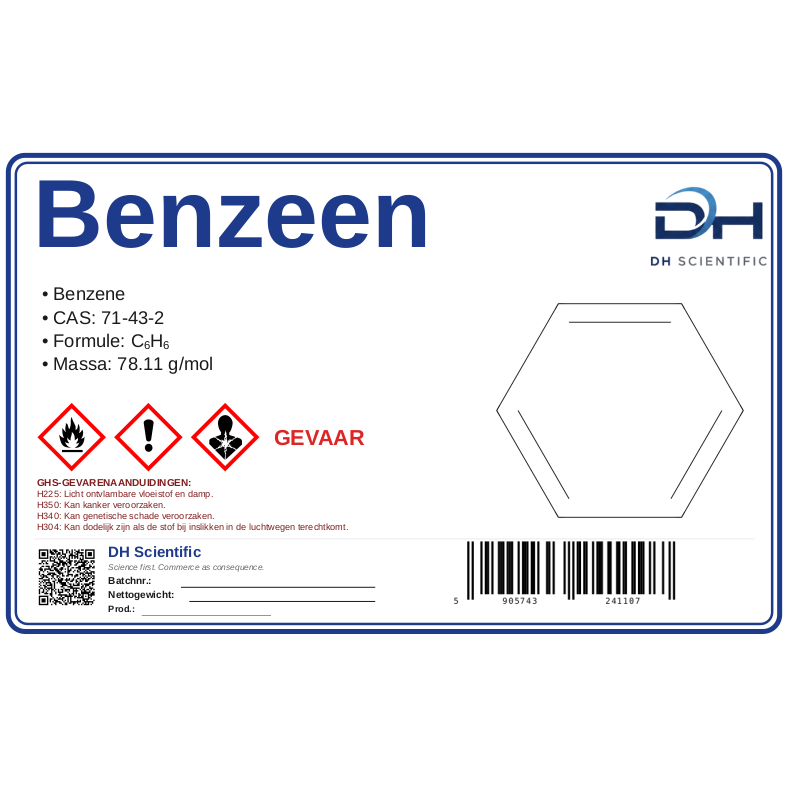
Benzeen• Benzene• CAS: 71-43-2• Formule: C6H6• Massa: 78.11 g/molGEVAARGHS-GEVARENAANDUIDINGEN:H225: Licht ontvlambare vloeistof en damp.H350: Kan kanker veroorzaken.H340: Kan genetische schade veroorzaken.H304: Kan dodelijk zijn als de stof bij inslikken in de luchtwegen terechtkomt.DH ScientificScience first. Commerce as consequence.Batchnr.: Nettogewicht: Prod.:
ADMET — farmacologisch profiel
ADMET-voorspellingen worden geladen…
⏳ Stabiliteits- & houdbaarheidsadviseur Arrhenius
Methodologie: Arrhenius equation k = A·exp(-Ea/RT). Citeren: Connors KA et al. 1986 · ICH Q1A(R2)

Voer de bewaaromstandigheden in → het Arrhenius-algoritme voorspelt de resterende concentratie, de halveringstijd en een gebruiksaanbeveling.

Visuele tekenen van afbraak:
❄️ Bewaaraanbevelingen
Temperature:
15-25°C
Light:
Ambient
Container:
Glass
Incompatible:
Oxidizers, fluorine
🧪 Assistent voor bereiding van oplossingen (Smart Prep) MolGod_PREP_2

Voer in wat u wilt bereiden — ik genereer een SOP

Voorbeelden hieronder — klik om in te voegen:
Voorgedefinieerde recepten:
📚 Overzicht van de wetenschappelijke literatuur — CAS 71-43-2MolGod_LITHUB_MAIN
⭐ Belangrijkste bevindingen (wetenschappelijke literatuur) 7 publicaties
🏆 CAS 71-43-2 — multi-criteria ranking (W12): 30% citaties · 20% recentheid · 20% onderwerp · 15% historisch · 15% open access.
  1. #1
    Pauling, L.; Wheland, G.W. (1948) · Journal of Chemical Physics
    Waarom het belangrijk is: Verplicht citaat (canon) · grote impact (2100 citaties) · historisch artikel (1948)
    SCORE 12.22 Mechanisme MUST-CITE Citaties: 2100 DOI ↗
  2. #2
    Benzene — IARC Monograph Vol. 100F (Group 1 carcinogen)
    IARC Working Group (1987) · IARC Monographs
    Waarom het belangrijk is: Verplicht citaat (canon) · grote impact (1280 citaties)
    SCORE 11.57 Farmacologie MUST-CITE Citaties: 1280
  3. #3
    Snyder, R.; Witz, G.; Goldstein, B.D. (1977) · Environmental Health Perspectives
    Waarom het belangrijk is: Verplicht citaat (canon) · 820 citaties
    SCORE 10.99 Farmacologie MUST-CITE Citaties: 820 DOI ↗
  4. #4
    McHale, C.M.; Zhang, L.; Smith, M.T. (2010) · Carcinogenesis
    Waarom het belangrijk is: Verplicht citaat (canon) · 540 citaties · overzichtsartikel
    SCORE 10.8 Overzicht MUST-CITE Citaties: 540 DOI ↗
  5. #5
    Loomis, D.; Guyton, K.Z.; Grosse, Y.; El Ghissassi, F.; Bouvard, V. et al. (2017) · The Lancet Oncology
    Waarom het belangrijk is: Verplicht citaat (canon) · 280 citaties · overzichtsartikel
    SCORE 9.45 Overzicht MUST-CITE Citaties: 280 DOI ↗
  6. #6
    Folkins, H.O. (2003) · Ullmann's Encyclopedia of Industrial Chemistry
    Waarom het belangrijk is: Verplicht citaat (canon) · 420 citaties
    SCORE 7.87 Industrie MUST-CITE Citaties: 420 DOI ↗
  7. #7
    Wallace, L.A. (2007) · Environmental Health Perspectives
    Waarom het belangrijk is: Verplicht citaat (canon) · 340 citaties
    SCORE 7.6 Analytiek MUST-CITE Citaties: 340 DOI ↗
📈 HPLC-gradiënt — optimalisator (LSS) SJABLOON

Gradiënt gebaseerd op PubChem XLogP3 + LSS (Snyder et al. 2010, hfdst. 9).

  • Kolom: C18
  • Buffer: phosphate
  • Debiet: 1 mL/min
  • logP: 2.1 (PubChem XLogP3)
  • Ramp: 22% → 95% B, 15 min
  • Totale analysetijd: 28 min
t (min) %A %B flow (mL/min) Opmerking
0 78 22 1 start (evenwicht)
2 78 22 1 einde van de initiële hold
17 5 95 1 einde van de LSS-ramp
22 5 95 1 kolomspoeling
23 78 22 1 terug naar init
28 78 22 1 her-equilibratie
📚 Wetenschappelijke referenties (Chicago Author-Date)
  1. Snyder, Lloyd R., John W. Dolan, and Joseph J. Kirkland. 2010. Introduction to Modern Liquid Chromatography. Wiley. — Chapter 9 — gradient elution, LSS theory (cited as Snyder et al. 2010 in tool description).
  2. Schoenmakers, Peter J. 1986. Optimization of Chromatographic Selectivity: A Guide to Method Development. Elsevier. — Numerical optimization of gradient programs.
  3. Snyder, L. R., and J. W. Dolan. 2007. High-Performance Gradient Elution: The Practical Application of the Linear-Solvent-Strength Model. Wiley. — Foundational LSS reference for the %B_init = 5 + 8·logP heuristic implemented here.
  4. Nikitas, Pavlos, and Adrian Pappa-Louisi. 2009. "Retention models for isocratic and gradient elution in reversed-phase liquid chromatography." Journal of Chromatography A 1216: 1737-1755. [DOI ↗] — Modern review of gradient retention models — basis for non-LSS extensions.
  5. Carr, Peter W.. 2009. "The new physical chemistry of HPLC." Journal of Chromatography A 1216: 1764-1772. [DOI ↗]
  6. Dong, Michael W. 2019. HPLC and UHPLC for Practicing Scientists. Wiley. https://doi.org/10.1002/9781119313793. — Modern UHPLC gradient programming, sub-2 µm scaling rules.
  7. Wu, Naijun, and Anton M. Clausen. 2007. "Fundamental and practical aspects of ultrahigh pressure liquid chromatography for fast separations." Journal of Separation Science 30: 1167-1182. [DOI ↗]
  8. Stoll, Dwight R., and Peter W. Carr. 2017. "Two-Dimensional Liquid Chromatography: A State of the Art Tutorial." Analytical Chemistry 89: 519-531. [DOI ↗] — Reference for orthogonal gradient design (2D-LC second dimension).
  9. Dolan, John W.. 2013. "When to Modify Method Conditions." LCGC North America 31: 192-199.
  10. Meyer, Veronika R. 2010. Practical High-Performance Liquid Chromatography. Wiley. — Chapter 7 — practical gradient design with isokratyczny scouting.
  11. Stoll, Dwight R., and Peter W. Carr. 2017. "Two-Dimensional Liquid Chromatography: A State of the Art Tutorial." Analytical Chemistry 89: 519-531. [DOI ↗]
  12. Carr, Peter W.. 2009. "The new physical chemistry of HPLC." Journal of Chromatography A 1216: 1764-1772. [DOI ↗]
  13. Wu, Naijun, and Anton M. Clausen. 2007. "Fundamental and practical aspects of ultrahigh pressure liquid chromatography for fast separations." Journal of Separation Science 30: 1167-1182. [DOI ↗]
  14. Engelhardt, Heinz. 2014. 100 Years of Chromatography. Wiley-VCH.
  15. Vivó-Truyols, Gabriel, and Hans-Gerd Janssen. 2010. "Probabilistic approach to peak deconvolution in chromatography." Analytical Chemistry 82: 8525-8531. [DOI ↗]

REST: /wp-json/molgod/v1/hplc/gradient/71-43-2

🌈 Detector + golflengte (UV/Vis) 254 nm
VerbindingBenzene
λmax254 nm
λmin200 nm
εmax (M⁻¹·cm⁻¹)200
Oplosmiddel (referentie)hexane
Voorgestelde λ254 nm
Aanbevolen detectorPDA/DAD
AlternatievenUV, MS

Gegevensbron: Skoog 2017, ch. 14 (B-band)

📚 Wetenschappelijke referenties (Chicago Author-Date) 33 refs · 2 baz

METODA Methodebibliografie

  1. Skoog, Douglas A., F. James Holler, and Stanley R. Crouch. 2017. "Principles of Instrumental Analysis." 7th ed. Cengage Learning. ISBN 978-1-305-57721-3.
  2. Perkampus, Heinz-Helmut. 1992. "UV-VIS Spectroscopy and Its Applications." Springer. ISBN 978-3-642-77479-9. →
  3. Sadek, Paul C.. 2002. "The HPLC Solvent Guide." 2nd ed. Wiley-Interscience. ISBN 978-0-471-41138-4.
  4. Snyder, Lloyd R., Joseph J. Kirkland, and John W. Dolan. 2010. "Introduction to Modern Liquid Chromatography." 3rd ed. Wiley. ISBN 978-0-470-16754-0. →
  5. Dong, Michael W.. 2019. "HPLC and UHPLC for Practicing Scientists." 2nd ed. Wiley. ISBN 978-1-119-31378-3. →
  6. Meyer, Veronika R.. 2010. "Practical High-Performance Liquid Chromatography." 5th ed. Wiley. ISBN 978-0-470-68218-0.
  7. Stoll, Dwight R., and Peter W. Carr. 2017. "Two-Dimensional Liquid Chromatography: A State of the Art Tutorial." Analytical Chemistry 89: 519-531 →
  8. Vivó-Truyols, Gabriel, and Hans-Gerd Janssen. 2010. "Probabilistic approach to peak deconvolution in chromatography." Analytical Chemistry 82: 8525-8531 →
  9. Kazakevich, Yuri V., and Rosario LoBrutto, eds.. 2007. "HPLC for Pharmaceutical Scientists." Wiley-Interscience. ISBN 978-0-471-68162-4. →
  10. Kim, Sunghwan, et al.. 2023. "PubChem 2023 update." Nucleic Acids Research 51: D1373-D1380 →
  11. Stoll, Dwight R., and Peter W. Carr. 2017. "Two-Dimensional Liquid Chromatography: A State of the Art Tutorial." Analytical Chemistry 89: 519-531 →
  12. Carr, Peter W.. 2009. "The new physical chemistry of HPLC." Journal of Chromatography A 1216: 1764-1772 →
  13. Wu, Naijun, and Anton M. Clausen. 2007. "Fundamental and practical aspects of ultrahigh pressure liquid chromatography for fast separations." Journal of Separation Science 30: 1167-1182 →
  14. Engelhardt, Heinz. 2014. "100 Years of Chromatography." 2nd ed. Wiley-VCH. ISBN 978-3-527-33473-5.
  15. Vivó-Truyols, Gabriel, and Hans-Gerd Janssen. 2010. "Probabilistic approach to peak deconvolution in chromatography." Analytical Chemistry 82: 8525-8531 →

MOLEKUŁA Bibliografie per CAS (live uit 13+ databases)

Bronnen: db:europepmc (16)

  1. db:europepmc Chen, K; Zhu, H; Fu, Q; Rao, X. 2026. "Dominant factors governing benzene adsorption in soils: thermodynamic analysis and predictive modeling." Environmental science. Processes & impacts. https://doi.org/10.1039/d6em00027d. →
  2. db:europepmc Dhungel, B; Klopfenstein, M; Keer, A; Hannigan, MD. 2026. "Strain, Chain, Repeat: Synthesis and Optoelectronic Properties of Poly(Naphthalene Benzene Vinylene)s." ACS macro letters. https://doi.org/10.1021/acsmacrolett.6c00194. →
  3. db:europepmc Guo, J; Zhong, X; Koutrakis, P; Vieira, CLZ. 2026. "Long-Term Ambient Benzene Exposure and Brain Disorders Among Urban Adults: Effect Modification by Genetic Susceptibility and Potential Mediation by Plasma Proteins." Advanced science (Weinheim, Baden-Wurttemberg, Germany). https://doi.org/10.1002/advs.75874. →
  4. db:europepmc Jung, JS; Choi, SJ; Lee, DK; Kim, SW. 2026. "Spatiotemporal variability of benzene in a petrochemical industrial complex: insights from repeated mobile SIFT-MS monitoring and comparison with Me-DOAS." Environmental monitoring and assessment. https://doi.org/10.1007/s10661-026-15488-7. →
  5. db:europepmc Zubieta, CE; Aquino-Linarez, LG; Rossi-Fernández, A; Belelli, PG. 2026. "Hydroxylation effects on the DFT-modeled adsorption of benzene and cyclohexane on hematite." Journal of molecular graphics & modelling. https://doi.org/10.1016/j.jmgm.2026.109457. →
  6. db:europepmc Wang, H; Gao, M; Li, W; He, Z. 2026. "Direct Alkane-Benzene Coupling Reactions with Bifunctional Zeolite-Encapsulated Metal Catalysts with Subnanoscale Intimacy." Journal of the American Chemical Society. https://doi.org/10.1021/jacs.5c21822. →
  7. db:europepmc Nicas, M. 2026. "Benzene exposures during tank washing activities on crude oil tankers." Annals of work exposures and health. https://doi.org/10.1093/annweh/wxag038. →
  8. db:europepmc Lai, J; Li, Y; Yin, C; Mao, K. 2026. "Engineering Oxygen Vacancies via Crystal-Phase Modulation in Mn-Ce Oxides for Toluene and Benzene Oxidation." Inorganic chemistry. https://doi.org/10.1021/acs.inorgchem.6c01240. →
  9. db:europepmc Demuth, T; Svatunek, D. 2026. "Insights into Tetrazine-Benzene Cycloadditions." The journal of physical chemistry. A. https://doi.org/10.1021/acs.jpca.6c01346. →
  10. db:europepmc Elhadad, SM; Ea, S; Saleh, IH; Omar, MY. 2026. "Sustainable indoor air quality via plant-based biofiltration evaluating benzene and toluene removal efficiency and health risk reduction in pharmaceutical laboratories." Scientific reports. https://doi.org/10.1038/s41598-026-54339-w. →
  11. db:europepmc Chen, H; Lin, B; Wei, W; Hao, J. 2026. "Mn-MIL-100-Derived CuO/Mn<sub>2</sub>O<sub>3</sub>-Mn<sub>5</sub>O<sub>8</sub> Composite Catalysts for Benzene Oxidation: Synergistic Effect and High Performance." Langmuir : the ACS journal of surfaces and colloids. https://doi.org/10.1021/acs.langmuir.6c00913. →
  12. db:europepmc Nishimura, N; Murakami, TN. 2026. "TIPS-benzene-based two-dimensional perovskites." Chemical communications (Cambridge, England). https://doi.org/10.1039/d6cc01157h. →
  13. db:europepmc Park, HW; Kim, Y; Lee, SY; Kim, Y. 2026. "Lymphoid neoplasms and benzene exposure using a revised classification scheme: systematic review and meta-analysis." Occupational and environmental medicine. https://doi.org/10.1136/oemed-2025-110652. →
  14. db:europepmc Choi, I; Choi, Y; Lee, HS; Jung, HY. 2026. "Hematopoietic carcinogen assessment in bulk chemical products and air samples: focus on benzene exposure among subway maintenance workers." Inhalation toxicology. https://doi.org/10.1080/08958378.2026.2671346. →
  15. db:europepmc Zhang, P; Hu, D; Yang, C; Mu, S. 2026. "Superior Benzene Catalytic Oxidation over Co<sub>3</sub>O<sub>4</sub> Catalysts with Oxygen Vacancy-Rich Co Sites." Langmuir : the ACS journal of surfaces and colloids. https://doi.org/10.1021/acs.langmuir.6c00687. →
  16. db:europepmc Smith, B; Cadby, P; DiNovi, M; Setzer, RW. 2010. "Application of the Margin of Exposure (MoE) approach to substances in food that are genotoxic and carcinogenic: example: benzene, CAS: 71-43-2." Food and chemical toxicology : an international journal published for the British Industrial Biological Research Association. https://doi.org/10.1016/j.fct.2009.10.015. →

REST: /wp-json/molgod/v1/hplc/detector/71-43-2

📐 HPLC-pieksymmetriecalculator (USP Tf / As)

Bereken de USP-tailingfactor (Tf) en de asymmetrie (As) uit de piekhalfbreedtes. Voer a (linker halfbreedte) en b (rechter halfbreedte) in, gemeten op 5% of 10% van de piekhoogte.

📚 Referenties (Chicago Author-Date)
  1. USP General Chapter <621>. 2024. "Chromatography." United States Pharmacopeial Convention. [link ↗] — Defines USP Tailing Factor T = (a+b)/(2a) measured at 5% peak height.
  2. International Council for Harmonisation (ICH). 2023. "Validation of Analytical Procedures Q2(R2)." ICH Expert Working Group. [link ↗] — Tailing factor is a system suitability parameter (Section 6).
  3. Foley, Joe P., and John G. Dorsey. 1983. "Equations for calculation of chromatographic figures of merit for ideal and skewed peaks." Analytical Chemistry 55: 730-737 https://doi.org/10.1021/ac00255a033 [link ↗] — Original asymmetry factor As = b/a at 10% height (Foley & Dorsey 1983).
  4. Snyder, Lloyd R., Joseph J. Kirkland, and John W. Dolan. 2010. "Introduction to Modern Liquid Chromatography." Wiley. https://doi.org/10.1002/9780470508183 [link ↗] — Chapter 2.4 — peak shape diagnostics and remedies.
  5. Dolan, John W.. 2003. "Peak tailing and resolution." LCGC North America 21: 610-614 [link ↗] — How tailing factor degrades effective resolution.
  6. Vivó-Truyols, Gabriel, and Hans-Gerd Janssen. 2010. "Probabilistic approach to peak deconvolution in chromatography." Analytical Chemistry 82: 8525-8531 https://doi.org/10.1021/ac101742z [link ↗] — Modern numerical deconvolution for asymmetric peaks.
  7. Kromidas, Stavros. 2017. "HPLC Made to Measure: A Practical Handbook for Optimization." Wiley-VCH. — Practical Tf and As thresholds for routine QC.
  8. Dong, Michael W.. 2019. "HPLC and UHPLC for Practicing Scientists." Wiley. https://doi.org/10.1002/9781119313793 [link ↗]
  9. Meyer, Veronika R.. 2010. "Practical High-Performance Liquid Chromatography." Wiley.
  10. Heyden, Yvan Vander, et al.. 2009. "Robustness of pharmaceutical liquid chromatographic methods." Journal of Chromatography B 877: 2120-2129 https://doi.org/10.1016/j.jchromb.2008.10.052 [link ↗]
  11. Stoll, Dwight R., and Peter W. Carr. 2017. "Two-Dimensional Liquid Chromatography: A State of the Art Tutorial." Analytical Chemistry 89: 519-531 https://doi.org/10.1021/acs.analchem.6b03506 [link ↗]
  12. Carr, Peter W.. 2009. "The new physical chemistry of HPLC." Journal of Chromatography A 1216: 1764-1772 https://doi.org/10.1016/j.chroma.2008.11.094 [link ↗]
  13. Wu, Naijun, and Anton M. Clausen. 2007. "Fundamental and practical aspects of ultrahigh pressure liquid chromatography for fast separations." Journal of Separation Science 30: 1167-1182 https://doi.org/10.1002/jssc.200700026 [link ↗]
  14. Engelhardt, Heinz. 2014. "100 Years of Chromatography." Wiley-VCH.
  15. Vivó-Truyols, Gabriel, and Hans-Gerd Janssen. 2010. "Probabilistic approach to peak deconvolution in chromatography." Analytical Chemistry 82: 8525-8531 https://doi.org/10.1021/ac101742z [link ↗]
📊 Calculator voor resolutie en schotelgetal (Rs, N, H)

Bereken de resolutie Rs, het aantal theoretische schotels N en de HETP (H) voor een paar HPLC-pieken. Voer de retentietijden, piekbreedtes (op 50% of aan de basis) en de kolomlengte in.

📚 Referenties (Chicago Author-Date)
  1. Snyder, Lloyd R., Joseph J. Kirkland, and John W. Dolan. 2010. "Introduction to Modern Liquid Chromatography." 3rd ed. John Wiley & Sons. ISBN 978-0-470-16754-0. https://doi.org/10.1002/9780470508183 [link ↗] — Chapter 2 covers resolution, plate count and HETP fundamentals (Snyder et al. 2010).
  2. USP General Chapter <621>. 2024. "Chromatography." USP-NF 2024 ed. United States Pharmacopeial Convention. [link ↗] — Defines Rs >= 1.5 acceptance criterion and N calculation methods.
  3. Dolan, John W.. 2003. "How much resolution is enough?." LCGC North America 21: 350-353 [link ↗] — Practical guidance on Rs targets for routine method development.
  4. Van Deemter, J. J., F. J. Zuiderweg, and A. Klinkenberg. 1956. "Longitudinal diffusion and resistance to mass transfer as causes of nonideality in chromatography." Chemical Engineering Science 5: 271-289 https://doi.org/10.1016/0009-2509(56)80003-1 [link ↗] — Origin of N = 5.54·(tr/w0.5)² half-height plate count formulation.
  5. Giddings, J. Calvin. 1965. "Dynamics of Chromatography, Part I: Principles and Theory." Marcel Dekker. ISBN 978-0-8247-1357-7. — Resolution equation Rs = (1/4)·√N·(α-1)/α·k/(1+k) (master equation).
  6. Foley, Joe P., and John G. Dorsey. 1983. "Equations for calculation of chromatographic figures of merit for ideal and skewed peaks." Analytical Chemistry 55: 730-737 https://doi.org/10.1021/ac00255a033 [link ↗] — Skewed-peak corrections to apparent N.
  7. Knox, John H.. 1977. "Practical aspects of LC theory." Journal of Chromatographic Science 15: 352-364 https://doi.org/10.1093/chromsci/15.9.352 [link ↗]
  8. Carr, Peter W.. 2009. "The new physical chemistry of HPLC." Journal of Chromatography A 1216: 1764-1772 https://doi.org/10.1016/j.chroma.2008.11.094 [link ↗]
  9. Dong, Michael W.. 2019. "HPLC and UHPLC for Practicing Scientists." 2nd ed. Wiley. ISBN 978-1-119-31378-3. https://doi.org/10.1002/9781119313793 [link ↗]
  10. Meyer, Veronika R.. 2010. "Practical High-Performance Liquid Chromatography." 5th ed. Wiley. ISBN 978-0-470-68218-0.
  11. Stoll, Dwight R., and Peter W. Carr. 2017. "Two-Dimensional Liquid Chromatography: A State of the Art Tutorial." Analytical Chemistry 89: 519-531 https://doi.org/10.1021/acs.analchem.6b03506 [link ↗]
  12. Carr, Peter W.. 2009. "The new physical chemistry of HPLC." Journal of Chromatography A 1216: 1764-1772 https://doi.org/10.1016/j.chroma.2008.11.094 [link ↗]
  13. Wu, Naijun, and Anton M. Clausen. 2007. "Fundamental and practical aspects of ultrahigh pressure liquid chromatography for fast separations." Journal of Separation Science 30: 1167-1182 https://doi.org/10.1002/jssc.200700026 [link ↗]
  14. Engelhardt, Heinz. 2014. "100 Years of Chromatography." 2nd ed. Wiley-VCH. ISBN 978-3-527-33473-5.
  15. Vivó-Truyols, Gabriel, and Hans-Gerd Janssen. 2010. "Probabilistic approach to peak deconvolution in chromatography." Analytical Chemistry 82: 8525-8531 https://doi.org/10.1021/ac101742z [link ↗]
🧪 System Suitability — live calculator (USP <621>)

Voer gegevens van 5-6 injecties in (areas, tr, tailing, plates) — de calculator berekent %RSD, gemiddelden en controleert de conformiteit met USP <621>. Je kunt CSV plakken (door komma's gescheiden) of afzonderlijke waarden bewerken.

📚 Referenties (Chicago Author-Date)
  1. USP General Chapter <621>. 2024. "Chromatography (System Suitability section)." USP-NF 2024 ed. United States Pharmacopeial Convention. [link ↗] — Defines RSD area < 2%, tailing < 2.0, N > 2000 acceptance criteria.
  2. International Council for Harmonisation (ICH). 2023. "Validation of Analytical Procedures Q2(R2)." ICH Expert Working Group. [link ↗] — Section 5.4 — system suitability is part of method validation.
  3. US Food and Drug Administration (FDA). 2018. "Reviewer Guidance: Validation of Chromatographic Methods." US Food and Drug Administration. [link ↗] — CDER reviewer perspective on chromatographic validation expectations.
  4. Snyder, Lloyd R., Joseph J. Kirkland, and John W. Dolan. 2010. "Introduction to Modern Liquid Chromatography." 3rd ed. Wiley. — Chapter 2 — system suitability fundamentals (RSD, Tf, N).
  5. Heyden, Yvan Vander, et al.. 2009. "Robustness of pharmaceutical liquid chromatographic methods." — Robustness vs. system suitability — design-of-experiments framework.
  6. Rozet, Eric, et al.. 2013. "Analysis of recent pharmaceutical regulatory documents on analytical method validation."
  7. European Medicines Agency (EMA). 2011. "Guideline on bioanalytical method validation EMEA/CHMP/EWP/192217/2009." EMA. [link ↗] — EMA companion guideline with bioanalytical SS criteria.
  8. Dong, Michael W.. 2019. "HPLC and UHPLC for Practicing Scientists." 2nd ed. Wiley. — UHPLC-specific suitability adjustments (n=5 vs. n=6).
  9. Kazakevich, Yuri V., and Rosario LoBrutto, eds.. 2007. "HPLC for Pharmaceutical Scientists." Wiley-Interscience.
  10. AOAC International. 2016. "Appendix F: Guidelines for Standard Method Performance Requirements." AOAC INTERNATIONAL. [link ↗] — Alternative SS thresholds for food/dietary samples.
  11. Stoll, Dwight R., and Peter W. Carr. 2017. "Two-Dimensional Liquid Chromatography: A State of the Art Tutorial."
  12. Carr, Peter W.. 2009. "The new physical chemistry of HPLC."
  13. Wu, Naijun, and Anton M. Clausen. 2007. "Fundamental and practical aspects of ultrahigh pressure liquid chromatography for fast separations."
  14. Engelhardt, Heinz. 2014. "100 Years of Chromatography." 2nd ed. Wiley-VCH.
  15. Vivó-Truyols, Gabriel, and Hans-Gerd Janssen. 2010. "Probabilistic approach to peak deconvolution in chromatography."
📋 Status prawny (REACH / TSCA / UK)MolGod_REG_2
JurysdykcjaListaStatusSunset
EUSVHClisted—
USTSCAactive—
UKUK_SVHClisted—
CADSL_TOXICrestricted—
AUAICSrestricted—
📈 UV-VIS-spectrumvoorspeller (200-400 nm) λmax 254 nm MolGod_UVVIS_1
0%25%50%75%100%200250300350400254 nmA = ε·c·lA / Aₘₐₓ (%)
VerbindingBenzene
λmax254 nm
λmin200 nm
εmax (M⁻¹·cm⁻¹)200
Oplosmiddel (query)water
Oplosmiddel (referentie)hexane
Concentratie (M)1e-4
Weglengte (cm)1
FWHM van de curve80 nm

Model: gausscurve gecentreerd op λmax, geschaald volgens de wet van Beer-Lambert A = ε · c · l. Transmissie T = 10^(-A) · 100%.

📚 Wetenschappelijke referenties (Chicago Author-Date)
  1. Sunstein, Cass R.. 2023. "It All Started With Benzene.". https://doi.org/10.2139/ssrn.4568007. [DOI]
  2. Anonymous. "Pinning Excited State Self-Trapping with All-Benzene Trefoil Knot.". https://doi.org/10.1021/acs.jpclett.5c00746.s002. [DOI]
  3. Anonymous. "Pinning Excited State Self-Trapping with All-Benzene Trefoil Knot.". https://doi.org/10.1021/acs.jpclett.5c00746.s001. [DOI]
  4. Anonymous. "Synthesis and Structure of [9]Cycloparaphenylene Catenane: An All-Benzene Catenane Consisting of Small Rings.". https://doi.org/10.1021/acs.orglett.9b04599.s002. [DOI]
  5. Anonymous. "Synthesis and Structure of [9]Cycloparaphenylene Catenane: An All-Benzene Catenane Consisting of Small Rings.". https://doi.org/10.1021/acs.orglett.9b04599.s001. [DOI]
  6. Chen, K; Zhu, H; Fu, Q; Rao, X. 2026. "Dominant factors governing benzene adsorption in soils: thermodynamic analysis and predictive modeling." Environmental science. Processes & impacts. https://doi.org/10.1039/d6em00027d. [DOI]
  7. Dhungel, B; Klopfenstein, M; Keer, A; Hannigan, MD. 2026. "Strain, Chain, Repeat: Synthesis and Optoelectronic Properties of Poly(Naphthalene Benzene Vinylene)s." ACS macro letters. https://doi.org/10.1021/acsmacrolett.6c00194. [DOI]
  8. Guo, J; Zhong, X; Koutrakis, P; Vieira, CLZ. 2026. "Long-Term Ambient Benzene Exposure and Brain Disorders Among Urban Adults: Effect Modification by Genetic Susceptibility and Potential Mediation by Plasma Proteins." Advanced science (Weinheim, Baden-Wurttemberg, Germany). https://doi.org/10.1002/advs.75874. [DOI]
  9. Jung, JS; Choi, SJ; Lee, DK; Kim, SW. 2026. "Spatiotemporal variability of benzene in a petrochemical industrial complex: insights from repeated mobile SIFT-MS monitoring and comparison with Me-DOAS." Environmental monitoring and assessment. https://doi.org/10.1007/s10661-026-15488-7. [DOI]
  10. Zubieta, CE; Aquino-Linarez, LG; Rossi-Fernández, A; Belelli, PG. 2026. "Hydroxylation effects on the DFT-modeled adsorption of benzene and cyclohexane on hematite." Journal of molecular graphics & modelling. https://doi.org/10.1016/j.jmgm.2026.109457. [DOI]
  11. Wang, H; Gao, M; Li, W; He, Z. 2026. "Direct Alkane-Benzene Coupling Reactions with Bifunctional Zeolite-Encapsulated Metal Catalysts with Subnanoscale Intimacy." Journal of the American Chemical Society. https://doi.org/10.1021/jacs.5c21822. [DOI]
  12. Nicas, M. 2026. "Benzene exposures during tank washing activities on crude oil tankers." Annals of work exposures and health. https://doi.org/10.1093/annweh/wxag038. [DOI]
  13. Lai, J; Li, Y; Yin, C; Mao, K. 2026. "Engineering Oxygen Vacancies via Crystal-Phase Modulation in Mn-Ce Oxides for Toluene and Benzene Oxidation." Inorganic chemistry. https://doi.org/10.1021/acs.inorgchem.6c01240. [DOI]
  14. Demuth, T; Svatunek, D. 2026. "Insights into Tetrazine-Benzene Cycloadditions." The journal of physical chemistry. A. https://doi.org/10.1021/acs.jpca.6c01346. [DOI]
  15. Elhadad, SM; Ea, S; Saleh, IH; Omar, MY. 2026. "Sustainable indoor air quality via plant-based biofiltration evaluating benzene and toluene removal efficiency and health risk reduction in pharmaceutical laboratories." Scientific reports. https://doi.org/10.1038/s41598-026-54339-w. [DOI]
  16. Chen, H; Lin, B; Wei, W; Hao, J. 2026. "Mn-MIL-100-Derived CuO/Mn<sub>2</sub>O<sub>3</sub>-Mn<sub>5</sub>O<sub>8</sub> Composite Catalysts for Benzene Oxidation: Synergistic Effect and High Performance." Langmuir : the ACS journal of surfaces and colloids. https://doi.org/10.1021/acs.langmuir.6c00913. [DOI]
  17. Nishimura, N; Murakami, TN. 2026. "TIPS-benzene-based two-dimensional perovskites." Chemical communications (Cambridge, England). https://doi.org/10.1039/d6cc01157h. [DOI]
  18. Park, HW; Kim, Y; Lee, SY; Kim, Y. 2026. "Lymphoid neoplasms and benzene exposure using a revised classification scheme: systematic review and meta-analysis." Occupational and environmental medicine. https://doi.org/10.1136/oemed-2025-110652. [DOI]
  19. Choi, I; Choi, Y; Lee, HS; Jung, HY. 2026. "Hematopoietic carcinogen assessment in bulk chemical products and air samples: focus on benzene exposure among subway maintenance workers." Inhalation toxicology. https://doi.org/10.1080/08958378.2026.2671346. [DOI]
  20. Zhang, P; Hu, D; Yang, C; Mu, S. 2026. "Superior Benzene Catalytic Oxidation over Co<sub>3</sub>O<sub>4</sub> Catalysts with Oxygen Vacancy-Rich Co Sites." Langmuir : the ACS journal of surfaces and colloids. https://doi.org/10.1021/acs.langmuir.6c00687. [DOI]
  21. Smith, B; Cadby, P; DiNovi, M; Setzer, RW. 2010. "Application of the Margin of Exposure (MoE) approach to substances in food that are genotoxic and carcinogenic: example: benzene, CAS: 71-43-2." Food and chemical toxicology : an international journal published for the British Industrial Biological Research Association. https://doi.org/10.1016/j.fct.2009.10.015. [DOI]
  22. Linstrom, Peter J., and William G. Mallard, eds. 2023. NIST Chemistry WebBook, NIST Standard Reference Database Number 69. Gaithersburg, MD: National Institute of Standards and Technology. [DOI]
  23. Mayerhöfer, Thomas G., Samir Pahlow, and Jürgen Popp. 2020. "The Bouguer-Beer-Lambert Law: Shining Light on the Obscure." ChemPhysChem 21 (18): 2029-2046. [DOI]
  24. Skoog, Douglas A., F. James Holler, and Stanley R. Crouch. 2017. Principles of Instrumental Analysis. 7th ed. Boston: Cengage Learning. ISBN 978-1-305-57721-3.
  25. Lindon, John C., George E. Tranter, and David W. Koppenaal, eds. 2017. "Encyclopedia of Spectroscopy and Spectrometry." 3rd ed. Amsterdam: Academic Press. ISBN 978-0-12-803224-4.
  26. Field, Leslie D., Sev Sternhell, and John R. Kalman. 2013. "Organic Structures from Spectra." 5th ed. Chichester: Wiley. ISBN 978-1-119-96582-6.
  27. Reusch, William. 2013. "Virtual Textbook of Organic Chemistry: Spectroscopy." East Lansing, MI: Michigan State University.
  28. Lampman, Gary M., Donald L. Pavia, George S. Kriz, and James R. Vyvyan. 2010. "Spectroscopy." 4th ed. Belmont, CA: Cengage Learning. ISBN 978-0-495-88992-9.
  29. Kalsi, P. S. 2010. "Spectroscopy of Organic Compounds." 6th ed. New Delhi: New Age International. ISBN 978-81-224-2032-9.
  30. Williams, Dudley H., and Ian Fleming. 2008. "Spectroscopic Methods in Organic Chemistry." 6th ed. London: McGraw-Hill. ISBN 978-0-07-711559-0.
  31. Sadek, Paul C. 2002. The HPLC Solvent Guide. 2nd ed. Hoboken: Wiley. ISBN 978-0-471-41242-2.
  32. Banwell, Colin N., and Elaine M. McCash. 1994. "Fundamentals of Molecular Spectroscopy." 4th ed. London: McGraw-Hill. ISBN 978-0-07-707976-1.
  33. Perkampus, Heinz-Helmut. 1992. UV-VIS Spectroscopy and Its Applications. Berlin: Springer. https://doi.org/10.1007/978-3-642-77479-9.
  34. Fieser, Louis F. 1949. "Extension of Woodward's Rules for Prediction of Conjugated Diene Absorption." Journal of the American Chemical Society 71 (5): 1854-1857. [DOI]
  35. Woodward, Robert B. 1942. "Structure and the Absorption Spectra of Alpha,Beta-Unsaturated Ketones." Journal of the American Chemical Society 64 (1): 72-75. [DOI]
  36. Beer, August. 1852. "Bestimmung der Absorption des rothen Lichts in farbigen Flüssigkeiten." Annalen der Physik und Chemie 86: 78-88. https://doi.org/10.1002/andp.18521620505.
  37. Lambert, Johann Heinrich. 1760. Photometria. Augsburg: Sumptibus Vidae.

📖 Wartość λmax = 254 nm pochodzi z bazy/literatury. Brak niezależnego potwierdzenia krzyżowego (NIST / CrossRef / PubChem) — weryfikacja krzyżowa niedostępna.

REST: /wp-json/molgod/v1/spectra/uv-vis/71-43-2?solvent=water&path_length_cm=1

☣️ Toxiciteit (LD50 / LC50) GHS Cat 4 — LaagMolGod_LD50_1
LD50
930 mg/kg
Gatunek / droga
Rat / doustnie
Klasyfikacja
Slightly toxic
Skala GHS (Acute Toxicity, oral, mg/kg bw):
Cat 1 (≤5)
Cat 2 (5–50)
Cat 3 (50–300)
Cat 4 (300–2000)
Cat 5 (2000–5000)

Bron: RTECS CY1400000; IARC Mono 100F (Group 1); ATSDR Benzene 2007 (2007). CAS 71-43-2.

LD50/LC50-gegevens zijn uitsluitend indicatief; zij vervangen niet het veiligheidsinformatieblad (SDS) noch een deskundige toxicologische beoordeling. GHS-classificatie voor de orale route (mg/kg bw) volgens UN GHS, 10e rev. 2023, Annex 1 §3.1.1.

Bibliografie (Chicago)
  • Hodge, Harold C., and James H. Sterner. 1949. "Tabulation of toxicity classes." American Industrial Hygiene Association Quarterly 10 (4): 93-96.
  • U.S. EPA. 2024. "ChemView." https://chemview.epa.gov/.
  • United Nations. 2023. "Globally Harmonized System of Classification and Labelling of Chemicals (GHS)." 10th rev. ed. New York: UN.
  • Lipnick, Robert L., et al. 1995. "Comparison of the up-and-down, conventional LD50, and fixed-dose acute toxicity procedures." Food and Chemical Toxicology 33 (3): 223-231.
  • ATSDR. 2024. "Toxicological Profiles." Agency for Toxic Substances and Disease Registry. https://www.atsdr.cdc.gov/.
  • Hayes, Wallace, and Claire L. Kruger, eds. 2014. "Hayes' Principles and Methods of Toxicology." 6th ed. CRC Press.
  • Lewis, Richard J. 2012. "Sax's Dangerous Properties of Industrial Materials." 12th ed. Wiley.
  • IARC. 2024. "Monographs on the Evaluation of Carcinogenic Risks to Humans." International Agency for Research on Cancer (per kryteria klasyfikacji rakotwórczości IARC Group 1/2A/2B).
  • Pohanish, Richard P. 2017. "Sittig's Handbook of Toxic and Hazardous Chemicals and Carcinogens." 7th ed. Elsevier.
  • Bingham, Eula, Barbara Cohrssen, and Charles H. Powell, eds. 2012. "Patty's Toxicology." 6th ed. Wiley.
  • WHO. 2023. "Recommended Classification of Pesticides by Hazard." World Health Organization (zgodne z UN GHS Annex 1 §3.1.1).
📤 Voeg dit molecuul in op uw site

Heeft u een blog, forum of wetenschappelijke dienst? Voeg het interactieve 3D-molecuul in op uw website — elke lezer ziet het,met daaronder een link naar onze winkel waar hij het reagens kan kopen.

🔗 HTML-iframe-code (het eenvoudigst — werkt overal)

Kopieer en plak in de HTML-editor van uw site:

Pas width en height aan je lay-out aan.

⚙ WordPress Shortcode (voor andere winkels met MOL-GOD)

🌐 Directe link (voor e-mails, chats, LinkedIn, Twitter)

LinkedIn Twitter/X Facebook
QR code CAS 71-43-2

📱 QR code (voor het afdrukken op flyers / etiketten / catalogi)

Plaats het in een productcatalogus, op een fleslabel of een flyer. De klant scant het — ziet het 3D-molecuul op zijn telefoon, met een link naar uw winkel.

⬇ PNG downloaden

🖼 Open Graph image (voor social-media-metatags)

Wanneer u de link deelt, haalt Facebook/LinkedIn/Discord automatisch het afbeeldingsvoorbeeld op:

Preview
📋 Licentie: De embed behoudt een backlink naar DH Scientific (vereist — de winkel is de gegevensbron). Chemische gegevens zijn afkomstig van PubChem (CC0 — publiek domein). De embed is GRATIS voor educatief, commercieel en hobbygebruik.
📚 REFERENTIES (Verzamelde bibliografie, Chicago Author-Date) 108 items

Alle wetenschappelijke bronnen die in de accordeons hierboven voor CAS 71-43-2 worden geciteerd.Formaat: Chicago Manual of Style 17e ed., Author-Date-systeem.

🗄️ Wetenschappelijke databanken

  1. NIST. 2026. NIST Chemistry WebBook: CAS 71-43-2. Gaithersburg, MD: National Institute of Standards and Technology. https://webbook.nist.gov/cgi/cbook.cgi?ID=71-43-2. (Accessed 2026-11-12.)
  2. AIST. 2026. Spectral Database for Organic Compounds (SDBS): CAS 71-43-2. Tsukuba, Japan: National Institute of Advanced Industrial Science and Technology. https://sdbs.db.aist.go.jp/. (Accessed 2026-11-12.)
  3. PubChem. 2026. PubChem Compound Summary: CAS 71-43-2. Bethesda, MD: National Center for Biotechnology Information (NCBI), National Library of Medicine. https://pubchem.ncbi.nlm.nih.gov/#query=71-43-2. (Accessed 2026-11-12.)
  4. ECHA. 2026. C&L Inventory and REACH Registration: CAS 71-43-2. Helsinki: European Chemicals Agency. https://echa.europa.eu/information-on-chemicals/annex-vi-to-clp. (Accessed 2026-11-12.)

📐 Standaarden / Richtlijnen

  1. ICH. 2026. "ICH Harmonised Guideline: CAS 71-43-2." Geneva: International Council for Harmonisation. https://database.ich.org/sites/default/files/Q1A%28R2%29%20Guideline.pdf. (Accessed 2026-11-12.)
  2. National Fire Protection Association (NFPA). 2024. "NFPA 30: Flammable and Combustible Liquids Code." NFPA, Quincy, MA. https://www.nfpa.org/codes-and-standards/all-codes-and-standards/list-of-codes-and-standards/detail?code=30.
  3. Occupational Safety and Health Administration (OSHA). 2023. "29 CFR 1910.106 — Flammable Liquids." U.S. Department of Labor, Federal Register. https://www.osha.gov/laws-regs/regulations/standardnumber/1910/1910.106.
  4. European Chemicals Agency (ECHA). 2024. "Annex VI to Regulation (EC) No 1272/2008 (CLP) — Harmonised Classification and Labelling." ECHA, Helsinki / Official Journal of the European Union. https://echa.europa.eu/regulations/clp/clp-classification.
  5. European Committee for Standardization (CEN). 2016. "EN 374-1:2016 — Protective gloves against dangerous chemicals and micro-organisms — Part 1: Terminology and performance requirements for chemical risks." CEN, Brussels. https://standards.cencenelec.eu/dyn/www/f?p=205:110:::::FSP_PROJECT,FSP_ORG_ID:38536,6080&cs=1B0DAA8B85DF42E4A2C70E5D71F0BFA32.
  6. European Committee for Standardization (CEN). 2001. "EN 166:2001 — Personal eye-protection — Specifications." CEN, Brussels. https://standards.cencenelec.eu/dyn/www/f?p=CEN:110:0::::FSP_PROJECT:6541&cs=1F1A4E0A78C4DB6A28DBE2E8C29D89DCF.
  7. European Committee for Standardization (CEN). 2009. "EN 14605:2005+A1:2009 — Protective clothing against liquid chemicals — Performance requirements for clothing with liquid-tight (Type 3) or spray-tight (Type 4) connections." CEN, Brussels. https://standards.cencenelec.eu/dyn/www/f?p=CEN:110:0::::FSP_PROJECT:21581&cs=1A04A2D3C7CC58E9E6CB58D55F7EBFB7E.
  8. National Institute for Occupational Safety and Health (NIOSH). 2017. "Recommendations for Chemical Protective Clothing: A Companion to the NIOSH Pocket Guide." U.S. Department of Health & Human Services / CDC. https://www.cdc.gov/niosh/ncpc/default.html.
  9. Occupational Safety and Health Administration (OSHA). 2011. "Personal Protective Equipment — General requirements." U.S. Department of Labor — 29 CFR 1910.132. https://www.osha.gov/laws-regs/regulations/standardnumber/1910/1910.132.

📖 Boeken

  1. Hansen, Charles M. 2007. Hansen Solubility Parameters: A User's Handbook, 2nd ed.. Boca Raton, FL: CRC Press. https://www.routledge.com/Hansen-Solubility-Parameters-A-Users-Handbook/Hansen/p/book/9780849372483.
  2. Barton, Allan F. M. 1991. CRC Handbook of Solubility Parameters and Other Cohesion Parameters: 2nd ed.. Boca Raton, FL: CRC Press. https://www.routledge.com/CRC-Handbook-of-Solubility-Parameters-and-Other-Cohesion-Parameters/Barton/p/book/9780849301766.
  3. Connors, Kenneth A., Gordon L. Amidon, and Valentino J. Stella. 1986. Chemical Stability of Pharmaceuticals: A Handbook for Pharmacists, 2nd ed.. New York: Wiley. https://doi.org/10.1002/0471734683.
  4. Rumble, John R., ed. 2019. CRC Handbook of Chemistry and Physics: 100th Edition. Boca Raton, FL: CRC Press. https://hbcp.chemnetbase.com/.
  5. Urben, Peter G. 2017. Bretherick's Handbook of Reactive Chemical Hazards, 8th Edition. Academic Press / Elsevier, Oxford. https://www.sciencedirect.com/book/9780081010594.

📘 Monografieën

  1. IARC. 2026. IARC Monographs on the Identification of Carcinogenic Hazards to Humans: CAS 71-43-2. Lyon, France: International Agency for Research on Cancer, World Health Organization. (Accessed 2026-11-12.)

📄 Wetenschappelijke artikelen (peer-reviewed)

  1. Stefanis, Emmanuel, and Costas Panayiotou. 2008. "Prediction of Hansen Solubility Parameters with a New Group-Contribution Method." International Journal of Thermophysics 29: 568-585. https://doi.org/10.1007/s10765-008-0415-z.
  2. Stoll, Vincent S., and John S. Blanchard. 1990. "Buffers: Principles and Practice: In Methods in Enzymology, vol. 182." San Diego: Academic Press. https://doi.org/10.1016/0076-6879(90)82008-P.

🌐 Websites

  1. ECHA. 2023. "Guidance on the Application of the CLP Criteria." European Chemicals Agency. https://echa.europa.eu/guidance-documents/guidance-on-clp.
  2. European Parliament. 2006. "Regulation (EC) No 1907/2006 (REACH)." Official Journal of the European Union L 396: 1–849.
  3. ECHA. 2023. "Candidate List of Substances of Very High Concern for Authorisation." European Chemicals Agency. https://echa.europa.eu/candidate-list-table.
  4. European Parliament. 2008. "Regulation (EC) No 1272/2008 on Classification, Labelling and Packaging of Substances and Mixtures (CLP)." Official Journal of the European Union L 353: 1–1355.
  5. ECHA. 2017. "Guidance on the Compilation of Safety Data Sheets." Version 3.1. European Chemicals Agency. ECHA-17-G-01-EN. https://echa.europa.eu/documents/10162/23047722/sds_en.pdf.
  6. ECHA. 2022. "Restrictions Under REACH — Annex XVII." European Chemicals Agency. https://echa.europa.eu/substances-restricted-under-reach.
  7. United Nations. 2021. Globally Harmonized System of Classification and Labelling of Chemicals (GHS). 9th revised ed. ST/SG/AC.10/30/Rev.9. New York and Geneva: United Nations. https://unece.org/ghs-rev9-2021.
  8. ECHA. 2020. "Understanding REACH." European Chemicals Agency. https://echa.europa.eu/regulations/reach/understanding-reach.
  9. Reid, Prausnitz, Poling 4th ed. (1987). 2026. "Reid, Prausnitz, Poling 4th ed. (1987): CAS 71-43-2." (Accessed 2026-11-12.)
  10. U.S. OSHA. 2026. "Occupational Safety and Health Guidance: CAS 71-43-2." Washington, DC: U.S. Occupational Safety and Health Administration. https://www.osha.gov/hazwoper. (Accessed 2026-11-12.)
  11. National Fire Protection Association (2018) — NFPA 472: Standard for Competence of Responders to Hazardous Materials/Weapons of Mass Destruction Incidents https://www.nfpa.org/codes-and-standards/nfpa-472.
  12. European Union. 2026. "EUR-Lex Legal Database: CAS 71-43-2." Luxembourg: Publications Office of the European Union. https://eur-lex.europa.eu/legal-content/EN/TXT/?uri=celex:32012L0018. (Accessed 2026-11-12.)
  13. U.S. National Institute for Occupational Safety and Health (2024) — NIOSH Pocket Guide to Chemical Hazards https://www.cdc.gov/niosh/npg/.
  14. Snyder, Lloyd R., John W. Dolan, and Joseph J. Kirkland. 2010. Introduction to Modern Liquid Chromatography. Wiley.
  15. Schoenmakers, Peter J.. 1986. Optimization of Chromatographic Selectivity: A Guide to Method Development. Elsevier.
  16. Snyder, L. R., and J. W. Dolan. 2007. High-Performance Gradient Elution: The Practical Application of the Linear-Solvent-Strength Model. Wiley.
  17. Nikitas, Pavlos, and Adrian Pappa-Louisi. 2009. "Retention models for isocratic and gradient elution in reversed-phase liquid chromatography." Journal of Chromatography A 1216: 1737-1755. https://doi.org/10.1016/j.chroma.2008.10.005.
  18. Carr, Peter W.. 2009. "The new physical chemistry of HPLC." Journal of Chromatography A 1216: 1764-1772. https://doi.org/10.1016/j.chroma.2008.11.094.
  19. Dong, Michael W.. 2019. HPLC and UHPLC for Practicing Scientists. Wiley. https://doi.org/10.1002/9781119313793.
  20. Wu, Naijun, and Anton M. Clausen. 2007. "Fundamental and practical aspects of ultrahigh pressure liquid chromatography for fast separations." Journal of Separation Science 30: 1167-1182. https://doi.org/10.1002/jssc.200700026.
  21. Dolan, John W.. 2013. "When to Modify Method Conditions." LCGC North America 31: 192-199. https://www.chromatographyonline.com/view/when-modify-method-conditions.
  22. Meyer, Veronika R.. 2010. Practical High-Performance Liquid Chromatography. Wiley.
  23. Engelhardt, Heinz. 2014. 100 Years of Chromatography. Wiley-VCH.
  24. Vivó-Truyols, Gabriel, and Hans-Gerd Janssen. 2010. "Probabilistic approach to peak deconvolution in chromatography." Analytical Chemistry 82: 8525-8531. https://doi.org/10.1021/ac101742z.
  25. Van Deemter, J. J., F. J. Zuiderweg, and A. Klinkenberg. 1956. "Longitudinal diffusion and resistance to mass transfer as causes of nonideality in chromatography." https://doi.org/10.1016/0009-2509(56)80003-1.
  26. Giddings, J. Calvin. 1965. "Dynamics of Chromatography, Part I: Principles and Theory." Marcel Dekker.
  27. Poppe, Hans. 1997. "Some reflections on speed and efficiency of modern chromatographic methods." https://doi.org/10.1016/S0021-9673(97)00376-2.
  28. Wu, Naijun, and Anton M. Clausen. 2007. "Fundamental and practical aspects of ultrahigh pressure liquid chromatography for fast separations." https://doi.org/10.1002/jssc.200700026.
  29. Carr, Peter W.. 2009. "The new physical chemistry of HPLC." https://doi.org/10.1016/j.chroma.2008.11.094.
  30. Knox, John H.. 1977. "Practical aspects of LC theory." https://doi.org/10.1093/chromsci/15.9.352.
  31. Snyder, L. R., J. J. Kirkland, and J. L. Glajch. 1997. "Practical HPLC Method Development." Wiley.
  32. Vivó-Truyols, Gabriel, and Hans-Gerd Janssen. 2010. "Probabilistic approach to peak deconvolution in chromatography." https://doi.org/10.1021/ac101742z.
  33. Sadek, Paul C.. 2002. "The HPLC Solvent Guide." Wiley-Interscience.
  34. Snyder, L. R.. 1978. "Classification of the solvent properties of common liquids." https://doi.org/10.1093/chromsci/16.6.223.
  35. Reichardt, Christian, and Thomas Welton. 2010. "Solvents and Solvent Effects in Organic Chemistry." Wiley-VCH.
  36. Vailaya, Anant, and Csaba Horváth. 1998. "Retention thermodynamics in hydrophobic interaction chromatography." https://doi.org/10.1021/ie980212h.
  37. Krstulović, Andrea M., and Phyllis R. Brown. 1981. "Reversed-phase High-Performance Liquid Chromatography." Wiley.
  38. Boysen, Reinhard I., and Milton T. W. Hearn. 2009. "Multi-modal HPLC of proteins." https://doi.org/10.1093/chromsci/47.8.645.
  39. USP General Chapter <621>. 2024. "Chromatography." United States Pharmacopeial Convention. https://www.usp.org/harmonization-standards/pdg/general-chapters/chromatography.
  40. Foley, Joe P., and John G. Dorsey. 1983. "Equations for calculation of chromatographic figures of merit for ideal and skewed peaks." https://doi.org/10.1021/ac00255a033.
  41. Snyder, Lloyd R., Joseph J. Kirkland, and John W. Dolan. 2010. "Introduction to Modern Liquid Chromatography." Wiley. https://doi.org/10.1002/9780470508183.
  42. Dolan, John W.. 2003. "Peak tailing and resolution." https://www.chromatographyonline.com/view/peak-tailing-and-resolution.
  43. Kromidas, Stavros. 2017. "HPLC Made to Measure: A Practical Handbook for Optimization." Wiley-VCH.
  44. Heyden, Yvan Vander, et al.. 2009. "Robustness of pharmaceutical liquid chromatographic methods." https://doi.org/10.1016/j.jchromb.2008.10.052.
  45. United States Pharmacopeial Convention. 2024. "USP <621> Chromatography." In United States Pharmacopeia and National Formulary, USP 47-NF 42. Rockville, MD: USP. https://www.uspnf.com/.
  46. European Pharmacopoeia Commission. 2024. "2.2.46 Chromatographic Separation Techniques." In European Pharmacopoeia, 11th ed. Strasbourg: Council of Europe — EDQM. https://www.edqm.eu/en/european-pharmacopoeia-ph-eur-11th-edition.
  47. International Organization for Standardization. 2017. "ISO/IEC 17025:2017 General Requirements for the Competence of Testing and Calibration Laboratories." Geneva: ISO. https://www.iso.org/standard/66912.html.
  48. Kolthoff, Izaak Maurits, and Philip J. Elving, eds. 1978. Treatise on Analytical Chemistry, Part I: Theory and Practice. 2nd ed. New York: Wiley-Interscience.
  49. Skoog, Douglas A., F. James Holler, and Stanley R. Crouch. 2018. Principles of Instrumental Analysis. 7th ed. Boston: Cengage Learning.
  50. Christian, Gary D., Purnendu K. Dasgupta, and Kevin A. Schug. 2014. Analytical Chemistry. 7th ed. Hoboken, NJ: Wiley.
  51. EURACHEM/CITAC. 2012. "Quantifying Uncertainty in Analytical Measurement." 3rd ed. EURACHEM/CITAC Guide CG 4. https://www.eurachem.org/images/stories/Guides/pdf/QUAM2012_P1.pdf.
  52. Snyder, Lloyd R., Joseph J. Kirkland, and John W. Dolan. 2010. "Introduction to Modern Liquid Chromatography." John Wiley & Sons. https://doi.org/10.1002/9780470508183.
  53. Dolan, John W.. 2003. "How much resolution is enough?." https://www.chromatographyonline.com/view/how-much-resolution-enough.
  54. USP General Chapter <621>. 2024. "Chromatography (System Suitability section)." United States Pharmacopeial Convention. https://www.usp.org/harmonization-standards/pdg/general-chapters/chromatography.
  55. U.S. FDA. 2026. "FDA Guidance and Resources: CAS 71-43-2." Silver Spring, MD: U.S. Food and Drug Administration. https://www.fda.gov/media/74954/download. (Accessed 2026-11-12.)
  56. Rozet, Eric, et al.. 2013. "Analysis of recent pharmaceutical regulatory documents on analytical method validation." https://doi.org/10.1016/j.chroma.2007.03.111.
  57. European Medicines Agency (EMA). 2011. "Guideline on bioanalytical method validation EMEA/CHMP/EWP/192217/2009." EMA. https://www.ema.europa.eu/en/documents/scientific-guideline/guideline-bioanalytical-method-validation_en.pdf.
  58. Kazakevich, Yuri V., and Rosario LoBrutto, eds.. 2007. "HPLC for Pharmaceutical Scientists." Wiley-Interscience. https://doi.org/10.1002/9780470087954.
  59. AOAC International. 2016. "Appendix F: Guidelines for Standard Method Performance Requirements." AOAC INTERNATIONAL. https://www.aoac.org/wp-content/uploads/2019/08/app_f.pdf.
  60. International Organization for Standardization. 1994. "ISO 5725-2:1994 Accuracy (Trueness and Precision) of Measurement Methods and Results — Part 2: Basic Method for the Determination of Repeatability and Reproducibility of a Standard Measurement Method." Geneva: ISO. https://www.iso.org/standard/11834.html.
  61. Grubbs, Frank E. 1950. "Sample Criteria for Testing Outlying Observations." Annals of Mathematical Statistics 21 (1): 27–58.
  62. Dixon, Wilfrid J. 1950. "Analysis of Extreme Values." Annals of Mathematical Statistics 21 (4): 488–506.
  63. Snedecor, George W., and William G. Cochran. 1989. Statistical Methods. 8th ed. Ames, IA: Iowa State University Press.
  64. Student [William Sealy Gosset]. 1908. "The Probable Error of a Mean." Biometrika 6 (1): 1–25.
  65. International Organization for Standardization. 2005. "ISO 3534-1:2006 Statistics — Vocabulary and Symbols — Part 1: General Statistical Terms and Terms Used in Probability." Geneva: ISO. https://www.iso.org/standard/40145.html.
  66. Thompson, Michael, Stephen L. R. Ellison, and Roger Wood. 2002. "Harmonized Guidelines for Single-Laboratory Validation of Methods of Analysis." Pure and Applied Chemistry 74 (5): 835–855.
  67. United Nations Economic Commission for Europe. 2024. European Agreement Concerning the International Carriage of Dangerous Goods by Road (ADR), Applicable as from 1 January 2025 (ECE/TRANS/352). Geneva: UNECE. https://unece.org/transport/dangerous-goods/adr-2025-edition.
  68. International Air Transport Association. 2026. Dangerous Goods Regulations (DGR). 67th ed. Montreal: IATA. https://www.iata.org/en/programs/cargo/dgr/.
  69. International Maritime Organization. 2024. International Maritime Dangerous Goods (IMDG) Code, 2024 Edition (Amendment 42-24). London: IMO. https://www.imo.org/en/OurWork/Safety/Pages/DangerousGoods-default.aspx.
  70. United Nations. 2025. Recommendations on the Transport of Dangerous Goods: Model Regulations (Orange Book). 24th revised ed. ST/SG/AC.10/1/Rev.24. New York and Geneva: United Nations. https://unece.org/transport/dangerous-goods/un-model-regulations.
  71. International Civil Aviation Organization. 2025. Technical Instructions for the Safe Transport of Dangerous Goods by Air (Doc 9284). 2025–2026 ed. Montreal: ICAO. https://www.icao.int/safety/DangerousGoods/Pages/technical-instructions.aspx.
  72. United States Pharmacopeia (USP) Convention. 2024. "USP General Chapter <621> Chromatography." USP. https://www.usp.org/sites/default/files/usp/document/harmonization/gen-chapter/g05_pf_30_4_2004.pdf.
  73. European Medicines Agency (EMA). 2011. "Guideline on bioanalytical method validation EMEA/CHMP/EWP/192217/2009." EMA Committee for Medicinal Products for Human Use. https://www.ema.europa.eu/en/documents/scientific-guideline/guideline-bioanalytical-method-validation_en.pdf.
  74. Sejm RP. 2026. "Internetowy System Aktow Prawnych (ISAP): CAS 71-43-2." Warszawa: Kancelaria Sejmu Rzeczypospolitej Polskiej. https://isap.sejm.gov.pl/isap.nsf/DocDetails.xsp?id=WDU20200000010. (Accessed 2026-11-12.)
  75. Ministerstwo Klimatu i Srodowiska. 2026. "Baza Danych o Odpadach (BDO): CAS 71-43-2." Warszawa: Ministerstwo Klimatu i Srodowiska. https://bdo.mos.gov.pl/. (Accessed 2026-11-12.)
  76. Pohanish, Richard P.. 2017. "Sittig's Handbook of Toxic and Hazardous Chemicals and Carcinogens." Elsevier.
  77. Lewis, Richard J.. 2012. "Sax's Dangerous Properties of Industrial Materials." Wiley.
  78. NIOSH. 2024. "Pocket Guide to Chemical Hazards." U.S. Department of Health and Human Services. https://www.cdc.gov/niosh/npg/.
  79. United Nations Economic Commission for Europe (UNECE). 2023. "European Agreement concerning the International Carriage of Dangerous Goods by Road (ADR 2025)." UNECE. https://unece.org/transport/standards/transport/dangerous-goods/adr-2025.
  80. IPCS INCHEM. 2024. "International Programme on Chemical Safety — Waste Management Guidelines." WHO/UNEP/ILO. https://www.inchem.org/.
  81. International Organization for Standardization. 2017. "ISO/IEC 17025:2017 General requirements for the competence of testing and calibration laboratories." ISO. https://www.iso.org/standard/66912.html.
  82. World Health Organization. 2010. "WHO Good Manufacturing Practices for Pharmaceutical Products: Main Principles (WHO Technical Report Series No. 957, Annex 3)." WHO Press. https://www.who.int/publications/m/item/trs957-annex3.
  83. European Medicines Agency. 2014. "Guideline on Process Validation for Finished Products — Information and Data to Be Provided EMA/CHMP/CVMP/QWP/BWP/70278/2012." European Medicines Agency. https://www.ema.europa.eu/en/documents/scientific-guideline/guideline-process-validation-finished-products-information-data-be-provided-regulatory-submissions-revision-1_en.pdf.
  84. United States Pharmacopeial Convention. 2024. "United States Pharmacopeia and National Formulary, USP 47-NF 42." USP. https://www.uspnf.com/.
  85. European Pharmacopoeia Commission. 2024. "European Pharmacopoeia 11th Edition." Council of Europe — EDQM. https://www.edqm.eu/en/european-pharmacopoeia-ph-eur-11th-edition.
  86. Pharmaceutical Inspection Co-operation Scheme (PIC/S). 2021. "Guide to Good Manufacturing Practice for Medicinal Products PE 009-15." PIC/S Secretariat, Geneva. https://picscheme.org/en/publications.
  87. International Pharmaceutical Excipients Council (IPEC) and Pharmaceutical Quality Group (PQG). 2017. "Joint IPEC-PQG Good Manufacturing Practices Guide for Pharmaceutical Excipients." IPEC-Americas. https://ipecamericas.org/sites/default/files/IPECPQGGMPGuide2017.pdf.
📥 BibTeX downloaden📥 RIS downloadenImporteren in Zotero/Mendeley/EndNote/Papers.