
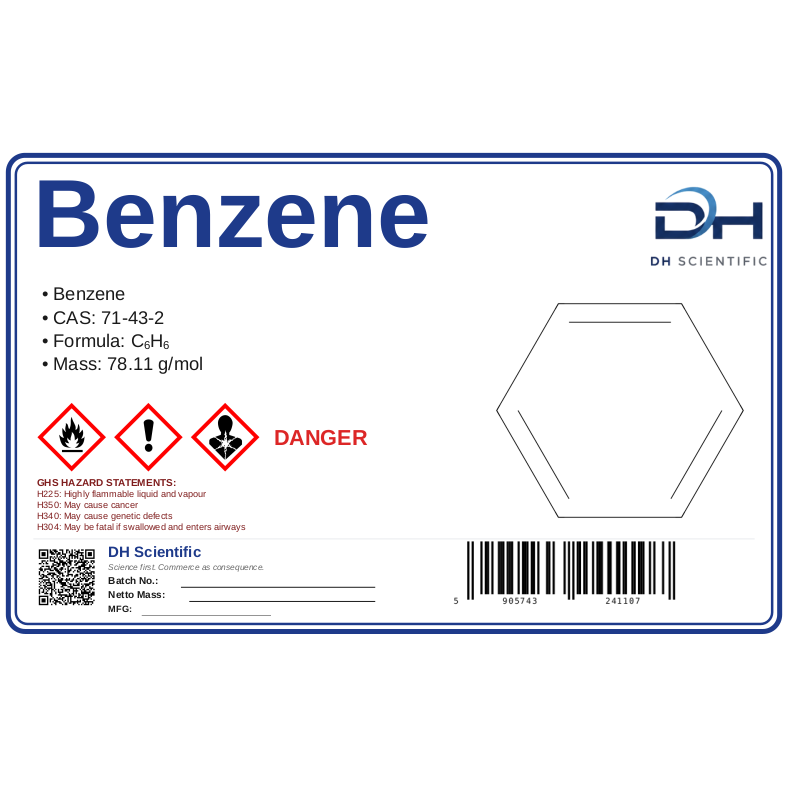
benzene
5,99 €
Chemical reagent Benzen (CAS 71-43-2). Full encyclopedic card — classification, properties and safety data — below.
🔒 SALE BLOCKED BY THE SYSTEM
Benzen · restriction (REACH Annex XVII)
Annex XVII · Art. 67(1) · REACH Regulation (EC) No 1907/2006
Block applied automatically from the regulatory canon, not by an operator decision. Legal Basis ↗

Chemical Overview: BenzenMolGod_OVERVIEW_1
| Molecular formula | C₆H₆ |
| Molecular weight | 78.11 g/mol |
| Melting point | 5.49 °C |
| Boiling point | 80.09 °C |
| Density | 0.8765 g/cm³ |
| LogP (lipophilicity) | 2.13 |
| SMILES | c1ccccc1 |
Synonyms: Benzene
Data sources: PubChem (NLM/NIH), Reid, Prausnitz, Poling 4th ed. (1987)
Last updated: 2026-11-10
SCIENTIFIC RESEARCH
📚 Scientific references (Chicago Author-Date) 16 refs · 2 baz
MOLEKUŁA Per-CAS bibliography (live from 13+ databases)
Sources: db:europepmc (16)
- db:europepmc Chen, K; Zhu, H; Fu, Q; Rao, X. 2026. "Dominant factors governing benzene adsorption in soils: thermodynamic analysis and predictive modeling." Environmental science. Processes & impacts. https://doi.org/10.1039/d6em00027d. →
- db:europepmc Dhungel, B; Klopfenstein, M; Keer, A; Hannigan, MD. 2026. "Strain, Chain, Repeat: Synthesis and Optoelectronic Properties of Poly(Naphthalene Benzene Vinylene)s." ACS macro letters. https://doi.org/10.1021/acsmacrolett.6c00194. →
- db:europepmc Guo, J; Zhong, X; Koutrakis, P; Vieira, CLZ. 2026. "Long-Term Ambient Benzene Exposure and Brain Disorders Among Urban Adults: Effect Modification by Genetic Susceptibility and Potential Mediation by Plasma Proteins." Advanced science (Weinheim, Baden-Wurttemberg, Germany). https://doi.org/10.1002/advs.75874. →
- db:europepmc Jung, JS; Choi, SJ; Lee, DK; Kim, SW. 2026. "Spatiotemporal variability of benzene in a petrochemical industrial complex: insights from repeated mobile SIFT-MS monitoring and comparison with Me-DOAS." Environmental monitoring and assessment. https://doi.org/10.1007/s10661-026-15488-7. →
- db:europepmc Zubieta, CE; Aquino-Linarez, LG; Rossi-Fernández, A; Belelli, PG. 2026. "Hydroxylation effects on the DFT-modeled adsorption of benzene and cyclohexane on hematite." Journal of molecular graphics & modelling. https://doi.org/10.1016/j.jmgm.2026.109457. →
- db:europepmc Wang, H; Gao, M; Li, W; He, Z. 2026. "Direct Alkane-Benzene Coupling Reactions with Bifunctional Zeolite-Encapsulated Metal Catalysts with Subnanoscale Intimacy." Journal of the American Chemical Society. https://doi.org/10.1021/jacs.5c21822. →
- db:europepmc Nicas, M. 2026. "Benzene exposures during tank washing activities on crude oil tankers." Annals of work exposures and health. https://doi.org/10.1093/annweh/wxag038. →
- db:europepmc Lai, J; Li, Y; Yin, C; Mao, K. 2026. "Engineering Oxygen Vacancies via Crystal-Phase Modulation in Mn-Ce Oxides for Toluene and Benzene Oxidation." Inorganic chemistry. https://doi.org/10.1021/acs.inorgchem.6c01240. →
- db:europepmc Demuth, T; Svatunek, D. 2026. "Insights into Tetrazine-Benzene Cycloadditions." The journal of physical chemistry. A. https://doi.org/10.1021/acs.jpca.6c01346. →
- db:europepmc Elhadad, SM; Ea, S; Saleh, IH; Omar, MY. 2026. "Sustainable indoor air quality via plant-based biofiltration evaluating benzene and toluene removal efficiency and health risk reduction in pharmaceutical laboratories." Scientific reports. https://doi.org/10.1038/s41598-026-54339-w. →
- db:europepmc Chen, H; Lin, B; Wei, W; Hao, J. 2026. "Mn-MIL-100-Derived CuO/Mn<sub>2</sub>O<sub>3</sub>-Mn<sub>5</sub>O<sub>8</sub> Composite Catalysts for Benzene Oxidation: Synergistic Effect and High Performance." Langmuir : the ACS journal of surfaces and colloids. https://doi.org/10.1021/acs.langmuir.6c00913. →
- db:europepmc Nishimura, N; Murakami, TN. 2026. "TIPS-benzene-based two-dimensional perovskites." Chemical communications (Cambridge, England). https://doi.org/10.1039/d6cc01157h. →
- db:europepmc Park, HW; Kim, Y; Lee, SY; Kim, Y. 2026. "Lymphoid neoplasms and benzene exposure using a revised classification scheme: systematic review and meta-analysis." Occupational and environmental medicine. https://doi.org/10.1136/oemed-2025-110652. →
- db:europepmc Choi, I; Choi, Y; Lee, HS; Jung, HY. 2026. "Hematopoietic carcinogen assessment in bulk chemical products and air samples: focus on benzene exposure among subway maintenance workers." Inhalation toxicology. https://doi.org/10.1080/08958378.2026.2671346. →
- db:europepmc Zhang, P; Hu, D; Yang, C; Mu, S. 2026. "Superior Benzene Catalytic Oxidation over Co<sub>3</sub>O<sub>4</sub> Catalysts with Oxygen Vacancy-Rich Co Sites." Langmuir : the ACS journal of surfaces and colloids. https://doi.org/10.1021/acs.langmuir.6c00687. →
- db:europepmc Smith, B; Cadby, P; DiNovi, M; Setzer, RW. 2010. "Application of the Margin of Exposure (MoE) approach to substances in food that are genotoxic and carcinogenic: example: benzene, CAS: 71-43-2." Food and chemical toxicology : an international journal published for the British Industrial Biological Research Association. https://doi.org/10.1016/j.fct.2009.10.015. →
Physicochemical properties
Quick Reference
Detailed Properties
| Property | Value | Unit | Conditions | Source |
|---|---|---|---|---|
| Density (ρ) | 0.8765 | g/cm³ | 20 °C (68 °F) | Reid, Prausnitz, Poling 4th ed. (1987) |
| Melting Point (mp) | 5.49 °C (41.9 °F) | 1 atm | Reid, Prausnitz, Poling 4th ed. (1987) | |
| Boiling Point (bp) | 80.09 °C (176.2 °F) | 1 atm | Reid, Prausnitz, Poling 4th ed. (1987) | |
| Flash Point | -11.00 °C (12.2 °F) | closed cup | Reid, Prausnitz, Poling 4th ed. (1987) | |
| Vapor Pressure | 95.200 | mmHg | 25 °C (77 °F) | Reid, Prausnitz, Poling 4th ed. (1987) |
| Water Solubility | 1.790 | g/L | 25 °C (77 °F) | Reid, Prausnitz, Poling 4th ed. (1987) |
| Viscosity (η) | 0.604 | cP | 25 °C (77 °F) | Reid, Prausnitz, Poling 4th ed. (1987) |
| Refractive Index (nD) | 1.5011 | 20 °C (68 °F), D-line | Reid, Prausnitz, Poling 4th ed. (1987) |
🔬 Advanced Properties
| Surface Tension | 28.200 mN/m | 20°C |
| Dielectric Constant (ε) | 2.280 | 25°C |
| Heat Capacity (Cp) | 1.740 J/(g·K) | 25°C |
Chemical Identifiers
c1ccccc1 Data sources: PubChem, NIST Chemistry WebBook, CRC Handbook of Chemistry and Physics (103rd ed.)
Last updated: 2026-06-30
📡 Spectroscopy — CAS 71-43-2MolGod_SPECHUB_MAIN
Physical & Chemical Properties (DB) 25 fields MolGod Score: Primary
| Property | Value | Unit | Conditions | Source |
|---|---|---|---|---|
| Melting point | 5.49 [4][6][11] | °C | 1 atm | Reid, Prausnitz, Poling 4th ed. (1987) |
| Boiling point | 80.09 [4][6][11] | °C | 760 mmHg | Reid, Prausnitz, Poling 4th ed. (1987) |
| Water solubility | 1.790 [4] | g/L | 25°C | Reid, Prausnitz, Poling 4th ed. (1987) |
| Density (ρ) | 0.8765 [4] | g/cm³ | 20°C | Reid, Prausnitz, Poling 4th ed. (1987) |
| Refractive index (n_D) | 1.5011 [4] | — | 20°C, sodium D | Reid, Prausnitz, Poling 4th ed. (1987) |
| Viscosity (η) | 0.604 [4] | cP | 25°C | Reid, Prausnitz, Poling 4th ed. (1987) |
| Vapor pressure | 95.200 [4] | mmHg | 25°C | Reid, Prausnitz, Poling 4th ed. (1987) |
| Flash point | -11.00 [4] | °C | closed cup | Reid, Prausnitz, Poling 4th ed. (1987) |
| Autoignition temperature | 498.00 [4] | °C | in air | Reid, Prausnitz, Poling 4th ed. (1987) |
| UV λmax | 254 [4][2] | nm | water/MeOH | Reid, Prausnitz, Poling 4th ed. (1987) |
| UV εmax | 200 [4][2] | M⁻¹·cm⁻¹ | at λmax | Reid, Prausnitz, Poling 4th ed. (1987) |
| UV λmax (alt) | 204 [4][2] | nm | cyclohexane (E2 band) | Reid, Prausnitz, Poling 4th ed. (1987) |
| logP (octanol/water) | 2.130 [4][8][9] | — | 25°C | Reid, Prausnitz, Poling 4th ed. (1987) |
| logD (pH 7) | 2.130 [4][8][9] | — | pH 7.4 | Reid, Prausnitz, Poling 4th ed. (1987) |
| Dielectric constant (ε) | 2.280 [4] | — | 25°C | Reid, Prausnitz, Poling 4th ed. (1987) |
| Surface tension | 28.200 [4] | mN/m | 20°C | Reid, Prausnitz, Poling 4th ed. (1987) |
| Specific heat (cp) | 1.740 [4] | J/(g·K) | 25°C | Reid, Prausnitz, Poling 4th ed. (1987) |
| Thermal conductivity (k) | 0.1410 [4] | W/(m·K) | 25°C | Reid, Prausnitz, Poling 4th ed. (1987) |
| Dipole moment (μ) | 0.000 [4] | D | gas phase | Reid, Prausnitz, Poling 4th ed. (1987) |
| ΔH vaporization | 33.830 [4] | kJ/mol | NBP | Reid, Prausnitz, Poling 4th ed. (1987) |
| ΔH fusion | 9.950 [4] | kJ/mol | at mp | Reid, Prausnitz, Poling 4th ed. (1987) |
| Critical temperature (Tc) | 288.90 [4] | °C | critical point | Reid, Prausnitz, Poling 4th ed. (1987) |
| Critical pressure (Pc) | 48.900 [4] | bar | critical point | Reid, Prausnitz, Poling 4th ed. (1987) |
| Acentric factor (ω) | 0.2120 [4] | — | Pitzer | Reid, Prausnitz, Poling 4th ed. (1987) |
| Ethanol solubility | miscible [4] | g/L | 25°C | Reid, Prausnitz, Poling 4th ed. (1987) |
📚 Scientific references (Chicago Author-Date) (12 sources)
- Haynes, William M., ed. 2024. CRC Handbook of Chemistry and Physics. 105th ed. Boca Raton: CRC Press/Taylor & Francis. ISBN 978-1-032-55554-4. ↗
- National Institute of Standards and Technology. 2024. "NIST Chemistry WebBook, SRD 69." Gaithersburg, MD: NIST. Accessed 2025-01-01. ↗
- Yaws, Carl L. 2014. The Yaws Handbook of Physical Properties for Hydrocarbons and Chemicals. 2nd ed. Oxford: Gulf Professional Publishing.
- PubChem. 2024. "PubChem Compound Database." National Library of Medicine, National Institutes of Health. Accessed 2025-01-01. ↗
- Marrero, J., and R. Gani. 2001. "Group-Contribution Based Estimation of Pure Component Properties." Fluid Phase Equilibria 183–184: 183–208. ↗
- Joback, K. G., and R. C. Reid. 1987. "Estimation of Pure-Component Properties from Group-Contributions." Chemical Engineering Communications 57 (1–6): 233–243. ↗
- Sangster, J. 1997. Octanol-Water Partition Coefficients: Fundamentals and Physical Chemistry. Chichester: Wiley. ISBN 978-0-471-97397-3.
- Mannhold, Raimund, and Han van de Waterbeemd. 2001. "Substructure and Whole Molecule Approaches for Calculating Log P." Journal of Computer-Aided Molecular Design 15 (4): 337–354. ↗
- Perrin, Ditlev D., Boyd Dempsey, and E. P. Serjeant. 1981. pKa Prediction for Organic Acids and Bases. London: Chapman and Hall. ISBN 0-412-21090-5.
- Constantinou, Leonidas, and Rafiqul Gani. 1994. "New Group Contribution Method for Estimating Properties of Pure Compounds." AIChE Journal 40 (10): 1697–1710. ↗
- Ertl, Peter, Bernhard Rohde, and Paul Selzer. 2000. "Fast Calculation of Molecular Polar Surface Area as a Sum of Fragment-Based Contributions and Its Application to the Prediction of Drug Transport Properties." Journal of Medicinal Chemistry 43 (20): 3714–3717. ↗
Purity Check Guide Quality control
Verify reagent purity using standardized analytical methods. Select a test method below and enter your measurement results for automated calculation.
🛡️ Safety — CAS 71-43-2MolGod_SAFEHUB_MAIN
GHS/CLP classification — Regulation (EC) No 1272/2008 + UN GHS Rev. 9 (2021).


🚨 Hazard statements (H)
- H225 — Highly flammable liquid and vapour
- H350 — May cause cancer
- H340 — May cause genetic defects
- H304 — May be fatal if swallowed and enters airways
- H372 — Causes damage to organs through prolonged or repeated exposure
- H315 — Causes skin irritation
- H319 — Causes serious eye irritation
🛡 Precautionary statements (P)
- P201 — Obtain special instructions before use
- P210 — Keep away from heat, hot surfaces, sparks, open flames and other ignition sources. No smoking
- P260 — Do not breathe dust/fume/gas/mist/vapours/spray
- P280 — Wear protective gloves/protective clothing/eye protection/face protection
✓ Harmonised classification pursuant to Annex VI of the CLP Regulation (EC) 1272/2008 (official, binding classification). Index number: 601-020-00-8.
Reference (Chicago): European Chemicals Agency. "benzene, Index No. 601-020-00-8." In Table 3 of Annex VI to Regulation (EC) No 1272/2008 (CLP Regulation), 23rd Adaptation to Technical Progress. Helsinki: European Chemicals Agency, 2026. https://echa.europa.eu/information-on-chemicals/annex-vi-to-clp.
Translations: CLP Regulation (EC) 1272/2008, Annexes III and IV. Data: PubChem/NLM.
📚 Consolidated scientific references — Chicago Author-Date 10 sources
References collected from all Safety Hub tabs. CAS: 71-43-2 ·
PubChem ↗
- Parlament Europejski i Rada UE. 2008. "Rozporządzenie (WE) nr 1272/2008 w sprawie klasyfikacji, oznakowania i pakowania substancji (CLP)." Dz.Urz. UE L 353. [↗] GHS, Regulations
- United Nations Economic Commission for Europe (UNECE). 2021. "Globally Harmonized System of Classification and Labelling of Chemicals (GHS), Ninth Revised Edition." United Nations, Geneva. [↗] GHS
- Goldfrank, Lewis R., Robert S. Hoffman, Mary Ann Howland, et al.. 2019. "Goldfrank's Toxicologic Emergencies, 11th ed.." McGraw-Hill Education, New York. ISBN 978-1-25-985961-8. Pierwsza pomoc, Toksykologia
- National Institute for Occupational Safety and Health (NIOSH). 2023. "NIOSH Pocket Guide to Chemical Hazards (DHHS Publ. 2005-149)." U.S. Department of Health and Human Services / CDC, Cincinnati, OH. [↗] Pierwsza pomoc, PPE, Toksykologia
- European Committee for Standardization (CEN). 2016. "EN 374-1:2016 — Protective gloves against dangerous chemicals and micro-organisms." CEN, Brussels. [↗] PPE
- UNECE. 2023. "European Agreement Concerning the International Carriage of Dangerous Goods by Road (ADR 2025)." United Nations, Geneva. [↗] Utylizacja, Regulacje
- National Fire Protection Association (NFPA). 2022. "NFPA 400 — Hazardous Materials Code." NFPA, Quincy, MA. [↗] Magazynowanie
- Urben, P.G. (ed.). 2017. "Bretherick's Handbook of Reactive Chemical Hazards, 8th ed.." Butterworth-Heinemann / Elsevier, Oxford. [↗] Magazynowanie
- Ministerstwo Klimatu i Środowiska RP. 2023. "Baza danych o produktach i opakowaniach oraz o gospodarce odpadami (BDO)." Ministerstwo Klimatu i Środowiska, Warszawa. [↗] Utylizacja
- International Agency for Research on Cancer (IARC / WHO). 2024. "IARC Monographs on the Identification of Carcinogenic Hazards to Humans — List of Classifications." WHO, Lyon. [↗] Toksykologia
Tabs with their own references (Emergency, PPE, Storage, Waste) contain additional bibliographic entries within their respective sections.
Analytical statistics (t-test · RSD · Grubbs · Q-Dixon) ICH Q2
Paste a series of replicate measurements (CSV, or one number per line). The calculator computes the mean, standard deviation and 95% CI, and detects outliers (Grubbs + Dixon Q).
📐 Statistical formulas
x̄ = Σxᵢ / n— arithmetic means² = Σ(xᵢ - x̄)² / (n-1)— sample variances = √s²— standard deviationRSD% = (s / x̄) × 100%— relative standard deviationCI₉₅ = x̄ ± t(0.05, n-1) × s / √n— Student's tG = |xᵢ - x̄| / s— Grubbs' testQ = |xsuspect - xnearest| / |xmax - xmin|— Dixon Q-test
Source: ICH Q2(R2) Validation of Analytical Procedures · ICH PDF ↗
Buffer Recipe Calculator UNIQUE
Choose a buffer from the list of 20 popular systems → enter the target pH → get an exact recipe with the masses to weigh out.
Step 1: Choose a buffer system
📜 Recipe history (last 10)
Transport classification (ADR / IATA / IMDG) UN1114
🛣️ ADR Road Transport
- Class:
- 3
- Packing Group:
- II
- Shipping name:
- BENZENE
- Tunnel Code:
- (D/E)
- Limited Quantity (L):
- 1
✈️ IATA Air Transport
- Class:
- 3
- Packing instructions:
- 352 / 364
- Max quantity (PAX):
- 1 L
- Max quantity (CAO):
- 60 L
🚢 IMDG Sea Transport
- Class:
- 3
- EmS Code:
- F-E, S-D
Sources: ADR 2025 ↗ · IATA DGR ↗ · IMDG Code ↗
🔧 HPLC troubleshooting — decision tree 6 common problems
Diagnostics for the 12 most common HPLC problems with a decision tree (5 steps per problem). Source: Snyder/Kirkland/Dolan 3rd ed. Chapter 17 + LCGC LC Troubleshooting columns 1989-2024.
Broad peaks medium
Symptom: All peaks on the chromatogram are wider than expected (FWHM > 2× normal)
🔍 Diagnostic tree:
-
1. Check whether all peaks are broadened or only some
→ YES: All → instrumental problem (column or system)
→ NO: Only some → chemistry problem (interaction with the column for specific analytes) -
2. Swap in a test column — does the problem disappear?
→ YES: COLUMN worn out — packing damaged, void in the first few mm. Replace it.
→ NO: Problem in the LC system -
3. Check the dead volume — injection loop, connections, detector
→ YES: Loop > 100 µL for a 4.6 mm column or loose connections → replace ferrules, shorten tubing
→ NO: Continue diagnostics -
4. Temperature test: raise the column from 25°C to 40°C
→ YES: Narrower peaks → mass-transfer kinetics too slow (increase T)
→ NO: Continue -
5. Check flow rate vs the optimal van Deemter value for this column
→ YES: Optimum for 4.6mm/5µm = 1.0 mL/min, for 2.1mm/3µm = 0.4 mL/min
→ NO: Continue
- Column worn out (>2000 injections without a guard)
- System dead volume > 100 µL (wrong loop, long tubing, loose ferrules)
- Temperature too low (mass-transfer kinetics)
- Flow rate outside the van Deemter optimum
- Sample solvent stronger than mobile phase A
- ✓ Replace the column (when >2000 injections)
- ✓ Check all connections — keep tubing as short as possible
- ✓ Increase column T to 40°C (if the substance is stable)
- ✓ Reduce flow to the van Deemter optimum
- ✓ Dissolve the sample in mobile phase A (not in pure organic)
Peak tailing (T > 1.5) high
Symptom: Peaks have an extended "tail" on the late-elution side (asymmetry T = b/a > 1.5 per USP)
🔍 Diagnostic tree:
-
1. Does the substance contain basic groups (amino, pyridine)?
→ YES: Yes → silanol interactions! Add 0.1% TFA or 5-10 mM TEA to mobile phase A.
→ NO: Continue -
2. Check the mobile-phase pH vs the substance pKa
→ YES: pH = pKa ± 1 → partial ionization, peak split. Move pH ≥ 2 units away from pKa.
→ NO: Continue -
3. Check the column age (>1500 injections?)
→ YES: Yes → exposed silanols (column bleed). Replace with a column with higher endcapping (XTerra, Symmetry).
→ NO: Continue -
4. Does the sample contain metals (Fe, Cu from glass vials)?
→ YES: Yes → use type II clear vials or PFA. Add 0.1mM EDTA to the sample.
→ NO: Continue
- Silanol interactions (basic analyte + silica gel free silanols)
- pH at the boundary of the analyte pKa (peak split)
- Old column (column bleed, high silanol activity)
- Metals in the sample (chelation → tailing)
- Column overload (>50 µg on a 4.6mm column)
- ✓ Add 0.1% TFA (UV) or 0.1% formic acid (LC-MS) to mobile phase A
- ✓ Choose a column with high-purity endcapping: Waters XBridge BEH, Phenomenex Kinetex
- ✓ Work at pH ≥ 2 units away from pKa
- ✓ Add 0.1mM EDTA to the sample (Fe/Cu chelation)
- ✓ Reduce the injection volume to ≤ 20 µL for a 4.6mm column
Baseline drift medium
Symptom: The baseline rises or falls systematically for >5 minutes
🔍 Diagnostic tree:
-
1. Are you running a gradient (B% increasing)?
→ YES: Yes → different absorption of phases A vs B at dλ. Solvent change in UV cutoff. Check the % organic UV absorbance.
→ NO: Continue (isocratic) -
2. Check the column temperature — is it stable to ±0.5°C?
→ YES: Yes (stable) → continue
→ NO: Unstable → turn on the column thermostat (>25°C controlled) -
3. Test: turn off the autosampler, run pump+column+detector alone
→ YES: Drift disappears → autosampler contamination (clean the needle, septum)
→ NO: Continue -
4. Check the lamp age (D2 for UV)
→ YES: Yes (>1500 hours) → replace the lamp
→ NO: Continue
- Gradient elution with different UV cutoff of the phases
- Unstable column T
- Autosampler contamination of the needle/septum
- Old UV lamp (>1500h)
- Detector flow cell fouled
- Column not equilibrated (<10 column volumes)
- ✓ Pre-equilibrate the column for 10-15 column volumes at 100% A
- ✓ Column thermostat on, T 30-40°C stable
- ✓ Clean the detector flow cell with 50:50 ACN:H2O
- ✓ Replace the D2 lamp if >1500h
- ✓ Use baseline subtraction (Chromeleon, Empower native function)
No peak / lost peak critical
Symptom: The expected analyte peak does not appear on the chromatogram
🔍 Diagnostic tree:
-
1. Did the injection actually take place?
→ YES: Check the autosampler log, pump pressure (should drop during injection)
→ NO: Autosampler problem → check the loop, needle, sample in the vial -
2. Is the sample in the vial (correct volume, not evaporated)?
→ YES: Continue
→ NO: No sample — re-pipette -
3. Sample stability — prepared >24h ago?
→ YES: Yes → degradation. Re-prepare a fresh sample.
→ NO: Continue -
4. Check the detection wavelength vs the substance λmax
→ YES: Detection at λ does NOT match λmax → no signal. Scan DAD 200-400nm.
→ NO: Continue -
5. Test: inject a pure standard (of known concentration, fresh)
→ YES: The standard gives a peak → problem with the sample (matrix, derivatization)
→ NO: No peak even with the standard → system problem (column, phase, gradient)
- Sample not drawn from the vial (autosampler bug)
- Sample degraded (>24h pH/temp/light)
- Detection at the wrong wavelength
- Wrong mobile phase (e.g. forgotten TFA)
- Column reversed / wrong stationary phase
- Substance elutes at the front (V0) → unretained, not visible
- ✓ Re-prepare a fresh sample per the exact protocol
- ✓ UV-Vis DAD scan 200-400nm + search for λmax
- ✓ Check the mobile-phase composition — was TFA added?
- ✓ Test the reverse column direction (carefully!)
- ✓ For retention <1 min — lower the % B, MeOH instead of ACN
- ✓ Check the "expected_rt" table in wp_molgod_hplc_methods
Pressure too high critical
Symptom: Pump pressure > 80% of the column max or system shutdown with a high-pressure error
🔍 Diagnostic tree:
-
1. Check that the column is connected correctly (arrow direction)
→ YES: OK
→ NO: Column reversed → flip it (never run it "backwards") -
2. Test: remove the column from the system, run pump+detector alone
→ YES: Pressure drops to <50 bar → problem in the column (clogged)
→ NO: Pressure stays high → in-line filter clogged, frit fouled -
3. Check the pre-column filter (in-line frit)
→ YES: Fouled and brown → replace it
→ NO: Continue -
4. Back-flush the column with 50:50 ACN:H2O without the column — does it disappear?
→ YES: Particles stuck in the first mm — a 30 min flush may recover it
→ NO: Replace the column
- In-line filter (frit) clogged with particles
- Buffer salting out (precipitation at high %B)
- Sample contains suspended matter (filter 0.22 µm before injection)
- Column clogged (column bed compaction)
- Gradient with a buffer phase + high organic → salt precipitation
- ✓ ALWAYS filter the sample through 0.22 µm PVDF before injection
- ✓ Replace the in-line filter every 100 injections (or when pressure rises >20%)
- ✓ Do NOT use >20mM phosphate buffer + >70% ACN (the salt precipitates)
- ✓ Flush the column for 30 min with 50:50 ACN:H2O in the reverse direction (when the manufacturer allows it)
- ✓ Pre-column 4×3mm to protect the main column
Ghost peaks high
Symptom: Unexplained peaks on the chromatogram absent from the calibration
🔍 Diagnostic tree:
-
1. Test: blank injection (pure sample solvent)
→ YES: A ghost appears → contamination of the system or eluents
→ NO: Appears only with the sample → matrix -
2. Does the ghost grow with the gradient (elutes at high %B)?
→ YES: Yes → overloaded column or strong-retained from a previous run
→ NO: Independent of the gradient → autosampler carryover -
3. Increase carryover wash (between injections)
→ YES: Helps → carryover was to blame. Use a stronger wash protocol.
→ NO: Continue -
4. Pure water injection — is there a peak?
→ YES: Yes → contamination of the water source (organics from the DI system)
→ NO: Continue
- Carryover in the autosampler needle/loop
- Eluent contamination (even HPLC-grade)
- Strong-retained components from previous runs
- Plastic in the vials (phthalates, PEG from the caps)
- Insufficiently purified DI water
- ✓ Strengthen the wash protocol: 100% B → 100% A → 50:50 (3 cycles)
- ✓ Strong wash: 100% DMSO or 100% MeOH before calibration
- ✓ Filter the eluents through 0.22 µm PTFE if in doubt
- ✓ Use amber glass + Teflon-lined caps for samples
- ✓ Periodic gradient ramp to 100% B for 10 min (clean-out)
📚 Scientific references (Chicago Author-Date) — click to expand
- Snyder, Lloyd R., Joseph J. Kirkland, and John W. Dolan. 2010. Introduction to Modern Liquid Chromatography. 3rd ed. John Wiley & Sons. Chapter 17 (Troubleshooting) pp. 559-616. ISBN 978-0-470-16754-0. https://doi.org/10.1002/9780470508183 [link ↗]
- Dolan, John W.. 2014. LC Troubleshooting (monthly column 1989-2024). LCGC North America. [link ↗] — John Dolan 35-letnia seria miesięcznych artykułów problemowych
- Kromidas, Stavros. 2017. HPLC Made to Measure: A Practical Handbook for Optimization. 2nd ed. Wiley-VCH. ISBN 978-3-527-31377-1. — Praktyczny przewodnik problem-solving dla labs analitycznych
- Dolan, John W.. 2013. When to Modify Method Conditions. 192-199. [link ↗] — Decision flow for changing flow rate / temperature / %B vs swapping columns.
- Dong, Michael W.. 2019. HPLC and UHPLC for Practicing Scientists. 2nd ed. Wiley. ISBN 978-1-119-31378-3. https://doi.org/10.1002/9781119313793 [link ↗] — Chapter 9 covers troubleshooting modern UHPLC systems (sub-2 µm particles).
- Meyer, Veronika R.. 2010. Practical High-Performance Liquid Chromatography. 5th ed. Wiley. ISBN 978-0-470-68218-0. — Solid step-by-step problem isolation chapter (eluents, columns, instruments).
- Snyder, L. R., J. J. Kirkland, and J. L. Glajch. 1997. Practical HPLC Method Development. 2nd ed. Wiley. ISBN 978-0-471-00703-6. — Method-development companion volume with troubleshooting cross-refs.
- Carr, Peter W.. 2009. The new physical chemistry of HPLC. 1764-1772. https://doi.org/10.1016/j.chroma.2008.11.094 [link ↗] — Theoretical basis for diagnosing efficiency losses (mass-transfer, eddy diffusion).
- Heyden, Yvan Vander, et al.. 2009. Robustness of pharmaceutical liquid chromatographic methods. 2120-2129. https://doi.org/10.1016/j.jchromb.2008.10.052 [link ↗] — How to diagnose method failures vs. system failures (Plackett-Burman).
- Engelhardt, Heinz. 2014. 100 Years of Chromatography. 2nd ed. Wiley-VCH. ISBN 978-3-527-33473-5. — Historical context for ghost-peak phenomenology (silica chemistry).
- Stoll, Dwight R., and Peter W. Carr. 2017. Two-Dimensional Liquid Chromatography: A State of the Art Tutorial. 519-531. https://doi.org/10.1021/acs.analchem.6b03506 [link ↗]
- Carr, Peter W.. 2009. The new physical chemistry of HPLC. 1764-1772. https://doi.org/10.1016/j.chroma.2008.11.094 [link ↗]
- Wu, Naijun, and Anton M. Clausen. 2007. Fundamental and practical aspects of ultrahigh pressure liquid chromatography for fast separations. 1167-1182. https://doi.org/10.1002/jssc.200700026 [link ↗]
- Engelhardt, Heinz. 2014. 100 Years of Chromatography. 2nd ed. Wiley-VCH. ISBN 978-3-527-33473-5.
- Vivó-Truyols, Gabriel, and Hans-Gerd Janssen. 2010. Probabilistic approach to peak deconvolution in chromatography. 8525-8531. https://doi.org/10.1021/ac101742z [link ↗]
Stability & Shelf Life Advisor Arrhenius
Enter the storage conditions → the Arrhenius algorithm will predict the remaining concentration, half-life, and usage recommendation.
📐 Calculation details (Arrhenius + First-order)
Visual signs of degradation:
❄️ Storage recommendations
- Temperature:
- 15-25°C
- Light:
- Ambient
- Container:
- Glass
- Incompatible:
- Oxidizers, fluorine
🧪 Solution preparation assistant (Smart Prep) MolGod_PREP_2
Enter what you want to prepare — I'll generate an SOP
📚 Scientific literature overview — CAS 71-43-2MolGod_LITHUB_MAIN
⭐ Key findings (scientific literature) 7 publications
71-43-2
— multi-criteria ranking (W12): 30% citations · 20% recency · 20% topic · 15% historical · 15% open access.
-
#1Pauling, L.; Wheland, G.W. (1948) · Journal of Chemical PhysicsWhy it matters: Must-cite (canon) · high impact (2100 citations) · historical paper (1948)
-
#2Benzene — IARC Monograph Vol. 100F (Group 1 carcinogen)IARC Working Group (1987) · IARC MonographsWhy it matters: Must-cite (canon) · high impact (1280 citations)SCORE 11.57 Pharmacology MUST-CITE Citations: 1280
-
#3Snyder, R.; Witz, G.; Goldstein, B.D. (1977) · Environmental Health PerspectivesWhy it matters: Must-cite (canon) · 820 citations
-
#4McHale, C.M.; Zhang, L.; Smith, M.T. (2010) · CarcinogenesisWhy it matters: Must-cite (canon) · 540 citations · review
-
#5Loomis, D.; Guyton, K.Z.; Grosse, Y.; El Ghissassi, F.; Bouvard, V. et al. (2017) · The Lancet OncologyWhy it matters: Must-cite (canon) · 280 citations · review
-
#6Folkins, H.O. (2003) · Ullmann's Encyclopedia of Industrial ChemistryWhy it matters: Must-cite (canon) · 420 citations
-
#7Wallace, L.A. (2007) · Environmental Health PerspectivesWhy it matters: Must-cite (canon) · 340 citations
Related products
📚 REFERENCES (Aggregate bibliography, Chicago Author-Date) 108 items
All scientific sources cited in the accordions above for CAS 71-43-2. Format: Chicago Manual of Style 17th ed., Author-Date system.
🗄️ Scientific databases
- NIST. 2026. NIST Chemistry WebBook: CAS 71-43-2. Gaithersburg, MD: National Institute of Standards and Technology. https://webbook.nist.gov/cgi/cbook.cgi?ID=71-43-2. (Accessed 2026-11-12.)
- AIST. 2026. Spectral Database for Organic Compounds (SDBS): CAS 71-43-2. Tsukuba, Japan: National Institute of Advanced Industrial Science and Technology. https://sdbs.db.aist.go.jp/. (Accessed 2026-11-12.)
- PubChem. 2026. PubChem Compound Summary: CAS 71-43-2. Bethesda, MD: National Center for Biotechnology Information (NCBI), National Library of Medicine. https://pubchem.ncbi.nlm.nih.gov/#query=71-43-2. (Accessed 2026-11-12.)
- ECHA. 2026. C&L Inventory and REACH Registration: CAS 71-43-2. Helsinki: European Chemicals Agency. https://echa.europa.eu/information-on-chemicals/annex-vi-to-clp. (Accessed 2026-11-12.)
📐 Standards / Guidelines
- ICH. 2026. "ICH Harmonised Guideline: CAS 71-43-2." Geneva: International Council for Harmonisation. https://database.ich.org/sites/default/files/Q1A%28R2%29%20Guideline.pdf. (Accessed 2026-11-12.)
- National Fire Protection Association (NFPA). 2024. "NFPA 30: Flammable and Combustible Liquids Code." NFPA, Quincy, MA. https://www.nfpa.org/codes-and-standards/all-codes-and-standards/list-of-codes-and-standards/detail?code=30.
- Occupational Safety and Health Administration (OSHA). 2023. "29 CFR 1910.106 — Flammable Liquids." U.S. Department of Labor, Federal Register. https://www.osha.gov/laws-regs/regulations/standardnumber/1910/1910.106.
- European Chemicals Agency (ECHA). 2024. "Annex VI to Regulation (EC) No 1272/2008 (CLP) — Harmonised Classification and Labelling." ECHA, Helsinki / Official Journal of the European Union. https://echa.europa.eu/regulations/clp/clp-classification.
- European Committee for Standardization (CEN). 2016. "EN 374-1:2016 — Protective gloves against dangerous chemicals and micro-organisms — Part 1: Terminology and performance requirements for chemical risks." CEN, Brussels. https://standards.cencenelec.eu/dyn/www/f?p=205:110:::::FSP_PROJECT,FSP_ORG_ID:38536,6080&cs=1B0DAA8B85DF42E4A2C70E5D71F0BFA32.
- European Committee for Standardization (CEN). 2001. "EN 166:2001 — Personal eye-protection — Specifications." CEN, Brussels. https://standards.cencenelec.eu/dyn/www/f?p=CEN:110:0::::FSP_PROJECT:6541&cs=1F1A4E0A78C4DB6A28DBE2E8C29D89DCF.
- European Committee for Standardization (CEN). 2009. "EN 14605:2005+A1:2009 — Protective clothing against liquid chemicals — Performance requirements for clothing with liquid-tight (Type 3) or spray-tight (Type 4) connections." CEN, Brussels. https://standards.cencenelec.eu/dyn/www/f?p=CEN:110:0::::FSP_PROJECT:21581&cs=1A04A2D3C7CC58E9E6CB58D55F7EBFB7E.
- National Institute for Occupational Safety and Health (NIOSH). 2017. "Recommendations for Chemical Protective Clothing: A Companion to the NIOSH Pocket Guide." U.S. Department of Health & Human Services / CDC. https://www.cdc.gov/niosh/ncpc/default.html.
- Occupational Safety and Health Administration (OSHA). 2011. "Personal Protective Equipment — General requirements." U.S. Department of Labor — 29 CFR 1910.132. https://www.osha.gov/laws-regs/regulations/standardnumber/1910/1910.132.
📖 Books
- Hansen, Charles M. 2007. Hansen Solubility Parameters: A User's Handbook, 2nd ed.. Boca Raton, FL: CRC Press. https://www.routledge.com/Hansen-Solubility-Parameters-A-Users-Handbook/Hansen/p/book/9780849372483.
- Barton, Allan F. M. 1991. CRC Handbook of Solubility Parameters and Other Cohesion Parameters: 2nd ed.. Boca Raton, FL: CRC Press. https://www.routledge.com/CRC-Handbook-of-Solubility-Parameters-and-Other-Cohesion-Parameters/Barton/p/book/9780849301766.
- Connors, Kenneth A., Gordon L. Amidon, and Valentino J. Stella. 1986. Chemical Stability of Pharmaceuticals: A Handbook for Pharmacists, 2nd ed.. New York: Wiley. https://doi.org/10.1002/0471734683.
- Rumble, John R., ed. 2019. CRC Handbook of Chemistry and Physics: 100th Edition. Boca Raton, FL: CRC Press. https://hbcp.chemnetbase.com/.
- Urben, Peter G. 2017. Bretherick's Handbook of Reactive Chemical Hazards, 8th Edition. Academic Press / Elsevier, Oxford. https://www.sciencedirect.com/book/9780081010594.
📘 Monographs
- IARC. 2026. IARC Monographs on the Identification of Carcinogenic Hazards to Humans: CAS 71-43-2. Lyon, France: International Agency for Research on Cancer, World Health Organization. (Accessed 2026-11-12.)
📄 Scientific articles (peer-reviewed)
- Stefanis, Emmanuel, and Costas Panayiotou. 2008. "Prediction of Hansen Solubility Parameters with a New Group-Contribution Method." International Journal of Thermophysics 29: 568-585. https://doi.org/10.1007/s10765-008-0415-z.
- Stoll, Vincent S., and John S. Blanchard. 1990. "Buffers: Principles and Practice: In Methods in Enzymology, vol. 182." San Diego: Academic Press. https://doi.org/10.1016/0076-6879(90)82008-P.
🌐 Websites
- ECHA. 2023. "Guidance on the Application of the CLP Criteria." European Chemicals Agency. https://echa.europa.eu/guidance-documents/guidance-on-clp.
- European Parliament. 2006. "Regulation (EC) No 1907/2006 (REACH)." Official Journal of the European Union L 396: 1–849.
- ECHA. 2023. "Candidate List of Substances of Very High Concern for Authorisation." European Chemicals Agency. https://echa.europa.eu/candidate-list-table.
- European Parliament. 2008. "Regulation (EC) No 1272/2008 on Classification, Labelling and Packaging of Substances and Mixtures (CLP)." Official Journal of the European Union L 353: 1–1355.
- ECHA. 2017. "Guidance on the Compilation of Safety Data Sheets." Version 3.1. European Chemicals Agency. ECHA-17-G-01-EN. https://echa.europa.eu/documents/10162/23047722/sds_en.pdf.
- ECHA. 2022. "Restrictions Under REACH — Annex XVII." European Chemicals Agency. https://echa.europa.eu/substances-restricted-under-reach.
- United Nations. 2021. Globally Harmonized System of Classification and Labelling of Chemicals (GHS). 9th revised ed. ST/SG/AC.10/30/Rev.9. New York and Geneva: United Nations. https://unece.org/ghs-rev9-2021.
- ECHA. 2020. "Understanding REACH." European Chemicals Agency. https://echa.europa.eu/regulations/reach/understanding-reach.
- Reid, Prausnitz, Poling 4th ed. (1987). 2026. "Reid, Prausnitz, Poling 4th ed. (1987): CAS 71-43-2." (Accessed 2026-11-12.)
- U.S. OSHA. 2026. "Occupational Safety and Health Guidance: CAS 71-43-2." Washington, DC: U.S. Occupational Safety and Health Administration. https://www.osha.gov/hazwoper. (Accessed 2026-11-12.)
- National Fire Protection Association (2018) — NFPA 472: Standard for Competence of Responders to Hazardous Materials/Weapons of Mass Destruction Incidents https://www.nfpa.org/codes-and-standards/nfpa-472.
- European Union. 2026. "EUR-Lex Legal Database: CAS 71-43-2." Luxembourg: Publications Office of the European Union. https://eur-lex.europa.eu/legal-content/EN/TXT/?uri=celex:32012L0018. (Accessed 2026-11-12.)
- U.S. National Institute for Occupational Safety and Health (2024) — NIOSH Pocket Guide to Chemical Hazards https://www.cdc.gov/niosh/npg/.
- Snyder, Lloyd R., John W. Dolan, and Joseph J. Kirkland. 2010. Introduction to Modern Liquid Chromatography. Wiley.
- Schoenmakers, Peter J.. 1986. Optimization of Chromatographic Selectivity: A Guide to Method Development. Elsevier.
- Snyder, L. R., and J. W. Dolan. 2007. High-Performance Gradient Elution: The Practical Application of the Linear-Solvent-Strength Model. Wiley.
- Nikitas, Pavlos, and Adrian Pappa-Louisi. 2009. "Retention models for isocratic and gradient elution in reversed-phase liquid chromatography." Journal of Chromatography A 1216: 1737-1755. https://doi.org/10.1016/j.chroma.2008.10.005.
- Carr, Peter W.. 2009. "The new physical chemistry of HPLC." Journal of Chromatography A 1216: 1764-1772. https://doi.org/10.1016/j.chroma.2008.11.094.
- Dong, Michael W.. 2019. HPLC and UHPLC for Practicing Scientists. Wiley. https://doi.org/10.1002/9781119313793.
- Wu, Naijun, and Anton M. Clausen. 2007. "Fundamental and practical aspects of ultrahigh pressure liquid chromatography for fast separations." Journal of Separation Science 30: 1167-1182. https://doi.org/10.1002/jssc.200700026.
- Dolan, John W.. 2013. "When to Modify Method Conditions." LCGC North America 31: 192-199. https://www.chromatographyonline.com/view/when-modify-method-conditions.
- Meyer, Veronika R.. 2010. Practical High-Performance Liquid Chromatography. Wiley.
- Engelhardt, Heinz. 2014. 100 Years of Chromatography. Wiley-VCH.
- Vivó-Truyols, Gabriel, and Hans-Gerd Janssen. 2010. "Probabilistic approach to peak deconvolution in chromatography." Analytical Chemistry 82: 8525-8531. https://doi.org/10.1021/ac101742z.
- Van Deemter, J. J., F. J. Zuiderweg, and A. Klinkenberg. 1956. "Longitudinal diffusion and resistance to mass transfer as causes of nonideality in chromatography." https://doi.org/10.1016/0009-2509(56)80003-1.
- Giddings, J. Calvin. 1965. "Dynamics of Chromatography, Part I: Principles and Theory." Marcel Dekker.
- Poppe, Hans. 1997. "Some reflections on speed and efficiency of modern chromatographic methods." https://doi.org/10.1016/S0021-9673(97)00376-2.
- Wu, Naijun, and Anton M. Clausen. 2007. "Fundamental and practical aspects of ultrahigh pressure liquid chromatography for fast separations." https://doi.org/10.1002/jssc.200700026.
- Carr, Peter W.. 2009. "The new physical chemistry of HPLC." https://doi.org/10.1016/j.chroma.2008.11.094.
- Knox, John H.. 1977. "Practical aspects of LC theory." https://doi.org/10.1093/chromsci/15.9.352.
- Snyder, L. R., J. J. Kirkland, and J. L. Glajch. 1997. "Practical HPLC Method Development." Wiley.
- Vivó-Truyols, Gabriel, and Hans-Gerd Janssen. 2010. "Probabilistic approach to peak deconvolution in chromatography." https://doi.org/10.1021/ac101742z.
- Sadek, Paul C.. 2002. "The HPLC Solvent Guide." Wiley-Interscience.
- Snyder, L. R.. 1978. "Classification of the solvent properties of common liquids." https://doi.org/10.1093/chromsci/16.6.223.
- Reichardt, Christian, and Thomas Welton. 2010. "Solvents and Solvent Effects in Organic Chemistry." Wiley-VCH.
- Vailaya, Anant, and Csaba Horváth. 1998. "Retention thermodynamics in hydrophobic interaction chromatography." https://doi.org/10.1021/ie980212h.
- Krstulović, Andrea M., and Phyllis R. Brown. 1981. "Reversed-phase High-Performance Liquid Chromatography." Wiley.
- Boysen, Reinhard I., and Milton T. W. Hearn. 2009. "Multi-modal HPLC of proteins." https://doi.org/10.1093/chromsci/47.8.645.
- USP General Chapter <621>. 2024. "Chromatography." United States Pharmacopeial Convention. https://www.usp.org/harmonization-standards/pdg/general-chapters/chromatography.
- Foley, Joe P., and John G. Dorsey. 1983. "Equations for calculation of chromatographic figures of merit for ideal and skewed peaks." https://doi.org/10.1021/ac00255a033.
- Snyder, Lloyd R., Joseph J. Kirkland, and John W. Dolan. 2010. "Introduction to Modern Liquid Chromatography." Wiley. https://doi.org/10.1002/9780470508183.
- Dolan, John W.. 2003. "Peak tailing and resolution." https://www.chromatographyonline.com/view/peak-tailing-and-resolution.
- Kromidas, Stavros. 2017. "HPLC Made to Measure: A Practical Handbook for Optimization." Wiley-VCH.
- Heyden, Yvan Vander, et al.. 2009. "Robustness of pharmaceutical liquid chromatographic methods." https://doi.org/10.1016/j.jchromb.2008.10.052.
- United States Pharmacopeial Convention. 2024. "USP <621> Chromatography." In United States Pharmacopeia and National Formulary, USP 47-NF 42. Rockville, MD: USP. https://www.uspnf.com/.
- European Pharmacopoeia Commission. 2024. "2.2.46 Chromatographic Separation Techniques." In European Pharmacopoeia, 11th ed. Strasbourg: Council of Europe — EDQM. https://www.edqm.eu/en/european-pharmacopoeia-ph-eur-11th-edition.
- International Organization for Standardization. 2017. "ISO/IEC 17025:2017 General Requirements for the Competence of Testing and Calibration Laboratories." Geneva: ISO. https://www.iso.org/standard/66912.html.
- Kolthoff, Izaak Maurits, and Philip J. Elving, eds. 1978. Treatise on Analytical Chemistry, Part I: Theory and Practice. 2nd ed. New York: Wiley-Interscience.
- Skoog, Douglas A., F. James Holler, and Stanley R. Crouch. 2018. Principles of Instrumental Analysis. 7th ed. Boston: Cengage Learning.
- Christian, Gary D., Purnendu K. Dasgupta, and Kevin A. Schug. 2014. Analytical Chemistry. 7th ed. Hoboken, NJ: Wiley.
- EURACHEM/CITAC. 2012. "Quantifying Uncertainty in Analytical Measurement." 3rd ed. EURACHEM/CITAC Guide CG 4. https://www.eurachem.org/images/stories/Guides/pdf/QUAM2012_P1.pdf.
- Snyder, Lloyd R., Joseph J. Kirkland, and John W. Dolan. 2010. "Introduction to Modern Liquid Chromatography." John Wiley & Sons. https://doi.org/10.1002/9780470508183.
- Dolan, John W.. 2003. "How much resolution is enough?." https://www.chromatographyonline.com/view/how-much-resolution-enough.
- USP General Chapter <621>. 2024. "Chromatography (System Suitability section)." United States Pharmacopeial Convention. https://www.usp.org/harmonization-standards/pdg/general-chapters/chromatography.
- U.S. FDA. 2026. "FDA Guidance and Resources: CAS 71-43-2." Silver Spring, MD: U.S. Food and Drug Administration. https://www.fda.gov/media/74954/download. (Accessed 2026-11-12.)
- Rozet, Eric, et al.. 2013. "Analysis of recent pharmaceutical regulatory documents on analytical method validation." https://doi.org/10.1016/j.chroma.2007.03.111.
- European Medicines Agency (EMA). 2011. "Guideline on bioanalytical method validation EMEA/CHMP/EWP/192217/2009." EMA. https://www.ema.europa.eu/en/documents/scientific-guideline/guideline-bioanalytical-method-validation_en.pdf.
- Kazakevich, Yuri V., and Rosario LoBrutto, eds.. 2007. "HPLC for Pharmaceutical Scientists." Wiley-Interscience. https://doi.org/10.1002/9780470087954.
- AOAC International. 2016. "Appendix F: Guidelines for Standard Method Performance Requirements." AOAC INTERNATIONAL. https://www.aoac.org/wp-content/uploads/2019/08/app_f.pdf.
- International Organization for Standardization. 1994. "ISO 5725-2:1994 Accuracy (Trueness and Precision) of Measurement Methods and Results — Part 2: Basic Method for the Determination of Repeatability and Reproducibility of a Standard Measurement Method." Geneva: ISO. https://www.iso.org/standard/11834.html.
- Grubbs, Frank E. 1950. "Sample Criteria for Testing Outlying Observations." Annals of Mathematical Statistics 21 (1): 27–58.
- Dixon, Wilfrid J. 1950. "Analysis of Extreme Values." Annals of Mathematical Statistics 21 (4): 488–506.
- Snedecor, George W., and William G. Cochran. 1989. Statistical Methods. 8th ed. Ames, IA: Iowa State University Press.
- Student [William Sealy Gosset]. 1908. "The Probable Error of a Mean." Biometrika 6 (1): 1–25.
- International Organization for Standardization. 2005. "ISO 3534-1:2006 Statistics — Vocabulary and Symbols — Part 1: General Statistical Terms and Terms Used in Probability." Geneva: ISO. https://www.iso.org/standard/40145.html.
- Thompson, Michael, Stephen L. R. Ellison, and Roger Wood. 2002. "Harmonized Guidelines for Single-Laboratory Validation of Methods of Analysis." Pure and Applied Chemistry 74 (5): 835–855.
- United Nations Economic Commission for Europe. 2024. European Agreement Concerning the International Carriage of Dangerous Goods by Road (ADR), Applicable as from 1 January 2025 (ECE/TRANS/352). Geneva: UNECE. https://unece.org/transport/dangerous-goods/adr-2025-edition.
- International Air Transport Association. 2026. Dangerous Goods Regulations (DGR). 67th ed. Montreal: IATA. https://www.iata.org/en/programs/cargo/dgr/.
- International Maritime Organization. 2024. International Maritime Dangerous Goods (IMDG) Code, 2024 Edition (Amendment 42-24). London: IMO. https://www.imo.org/en/OurWork/Safety/Pages/DangerousGoods-default.aspx.
- United Nations. 2025. Recommendations on the Transport of Dangerous Goods: Model Regulations (Orange Book). 24th revised ed. ST/SG/AC.10/1/Rev.24. New York and Geneva: United Nations. https://unece.org/transport/dangerous-goods/un-model-regulations.
- International Civil Aviation Organization. 2025. Technical Instructions for the Safe Transport of Dangerous Goods by Air (Doc 9284). 2025–2026 ed. Montreal: ICAO. https://www.icao.int/safety/DangerousGoods/Pages/technical-instructions.aspx.
- United States Pharmacopeia (USP) Convention. 2024. "USP General Chapter <621> Chromatography." USP. https://www.usp.org/sites/default/files/usp/document/harmonization/gen-chapter/g05_pf_30_4_2004.pdf.
- European Medicines Agency (EMA). 2011. "Guideline on bioanalytical method validation EMEA/CHMP/EWP/192217/2009." EMA Committee for Medicinal Products for Human Use. https://www.ema.europa.eu/en/documents/scientific-guideline/guideline-bioanalytical-method-validation_en.pdf.
- Sejm RP. 2026. "Internetowy System Aktow Prawnych (ISAP): CAS 71-43-2." Warszawa: Kancelaria Sejmu Rzeczypospolitej Polskiej. https://isap.sejm.gov.pl/isap.nsf/DocDetails.xsp?id=WDU20200000010. (Accessed 2026-11-12.)
- Ministerstwo Klimatu i Srodowiska. 2026. "Baza Danych o Odpadach (BDO): CAS 71-43-2." Warszawa: Ministerstwo Klimatu i Srodowiska. https://bdo.mos.gov.pl/. (Accessed 2026-11-12.)
- Pohanish, Richard P.. 2017. "Sittig's Handbook of Toxic and Hazardous Chemicals and Carcinogens." Elsevier.
- Lewis, Richard J.. 2012. "Sax's Dangerous Properties of Industrial Materials." Wiley.
- NIOSH. 2024. "Pocket Guide to Chemical Hazards." U.S. Department of Health and Human Services. https://www.cdc.gov/niosh/npg/.
- United Nations Economic Commission for Europe (UNECE). 2023. "European Agreement concerning the International Carriage of Dangerous Goods by Road (ADR 2025)." UNECE. https://unece.org/transport/standards/transport/dangerous-goods/adr-2025.
- IPCS INCHEM. 2024. "International Programme on Chemical Safety — Waste Management Guidelines." WHO/UNEP/ILO. https://www.inchem.org/.
- International Organization for Standardization. 2017. "ISO/IEC 17025:2017 General requirements for the competence of testing and calibration laboratories." ISO. https://www.iso.org/standard/66912.html.
- World Health Organization. 2010. "WHO Good Manufacturing Practices for Pharmaceutical Products: Main Principles (WHO Technical Report Series No. 957, Annex 3)." WHO Press. https://www.who.int/publications/m/item/trs957-annex3.
- European Medicines Agency. 2014. "Guideline on Process Validation for Finished Products — Information and Data to Be Provided EMA/CHMP/CVMP/QWP/BWP/70278/2012." European Medicines Agency. https://www.ema.europa.eu/en/documents/scientific-guideline/guideline-process-validation-finished-products-information-data-be-provided-regulatory-submissions-revision-1_en.pdf.
- United States Pharmacopeial Convention. 2024. "United States Pharmacopeia and National Formulary, USP 47-NF 42." USP. https://www.uspnf.com/.
- European Pharmacopoeia Commission. 2024. "European Pharmacopoeia 11th Edition." Council of Europe — EDQM. https://www.edqm.eu/en/european-pharmacopoeia-ph-eur-11th-edition.
- Pharmaceutical Inspection Co-operation Scheme (PIC/S). 2021. "Guide to Good Manufacturing Practice for Medicinal Products PE 009-15." PIC/S Secretariat, Geneva. https://picscheme.org/en/publications.
- International Pharmaceutical Excipients Council (IPEC) and Pharmaceutical Quality Group (PQG). 2017. "Joint IPEC-PQG Good Manufacturing Practices Guide for Pharmaceutical Excipients." IPEC-Americas. https://ipecamericas.org/sites/default/files/IPECPQGGMPGuide2017.pdf.