
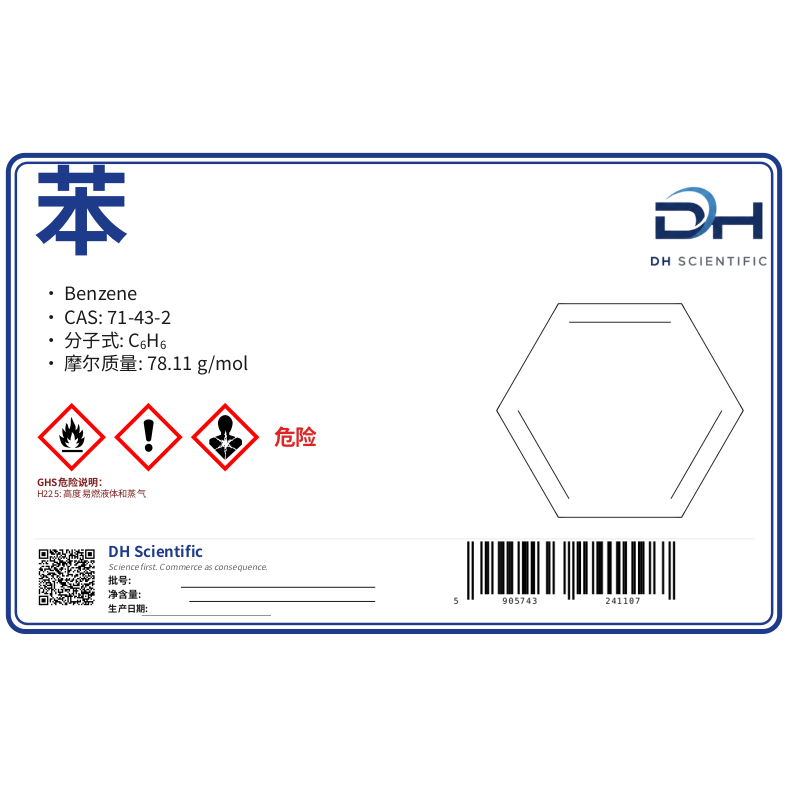
苯
5,99 €
化学品 Benzen (CAS 71-43-2)。完整百科卡片 — 分类、性质和安全数据 — 如下。
🔒 系统已阻止销售
Benzen · 限制(REACH 附件 XVII)
附件 XVII · 第 67 条第 1 款 · REACH 法规(EC)第 1907/2006 号
此拦截依据法规基准自动施加,而非运营者的决定。 法律依据 ↗

化学概述: BenzenMolGod_OVERVIEW_1
| 分子式 | C₆H₆ |
| 分子量 | 78.11 g/mol |
| 熔点 | 5.49 °C |
| 沸点 | 80.09 °C |
| 密度 | 0.8765 g/cm³ |
| LogP(亲脂性) | 2.13 |
| SMILES | c1ccccc1 |
同义词: Benzene
数据来源: PubChem (NLM/NIH), Reid, Prausnitz, Poling 4th ed. (1987)
最后更新: 2026-11-10
科学研究
📚 科学参考文献(芝加哥作者-日期格式) 16 refs · 2 baz
MOLEKUŁA 按CAS号参考文献(实时来自13+数据库)
来源: db:europepmc (16)
- db:europepmc Chen, K; Zhu, H; Fu, Q; Rao, X. 2026. "Dominant factors governing benzene adsorption in soils: thermodynamic analysis and predictive modeling." Environmental science. Processes & impacts. https://doi.org/10.1039/d6em00027d. →
- db:europepmc Dhungel, B; Klopfenstein, M; Keer, A; Hannigan, MD. 2026. "Strain, Chain, Repeat: Synthesis and Optoelectronic Properties of Poly(Naphthalene Benzene Vinylene)s." ACS macro letters. https://doi.org/10.1021/acsmacrolett.6c00194. →
- db:europepmc Guo, J; Zhong, X; Koutrakis, P; Vieira, CLZ. 2026. "Long-Term Ambient Benzene Exposure and Brain Disorders Among Urban Adults: Effect Modification by Genetic Susceptibility and Potential Mediation by Plasma Proteins." Advanced science (Weinheim, Baden-Wurttemberg, Germany). https://doi.org/10.1002/advs.75874. →
- db:europepmc Jung, JS; Choi, SJ; Lee, DK; Kim, SW. 2026. "Spatiotemporal variability of benzene in a petrochemical industrial complex: insights from repeated mobile SIFT-MS monitoring and comparison with Me-DOAS." Environmental monitoring and assessment. https://doi.org/10.1007/s10661-026-15488-7. →
- db:europepmc Zubieta, CE; Aquino-Linarez, LG; Rossi-Fernández, A; Belelli, PG. 2026. "Hydroxylation effects on the DFT-modeled adsorption of benzene and cyclohexane on hematite." Journal of molecular graphics & modelling. https://doi.org/10.1016/j.jmgm.2026.109457. →
- db:europepmc Wang, H; Gao, M; Li, W; He, Z. 2026. "Direct Alkane-Benzene Coupling Reactions with Bifunctional Zeolite-Encapsulated Metal Catalysts with Subnanoscale Intimacy." Journal of the American Chemical Society. https://doi.org/10.1021/jacs.5c21822. →
- db:europepmc Nicas, M. 2026. "Benzene exposures during tank washing activities on crude oil tankers." Annals of work exposures and health. https://doi.org/10.1093/annweh/wxag038. →
- db:europepmc Lai, J; Li, Y; Yin, C; Mao, K. 2026. "Engineering Oxygen Vacancies via Crystal-Phase Modulation in Mn-Ce Oxides for Toluene and Benzene Oxidation." Inorganic chemistry. https://doi.org/10.1021/acs.inorgchem.6c01240. →
- db:europepmc Demuth, T; Svatunek, D. 2026. "Insights into Tetrazine-Benzene Cycloadditions." The journal of physical chemistry. A. https://doi.org/10.1021/acs.jpca.6c01346. →
- db:europepmc Elhadad, SM; Ea, S; Saleh, IH; Omar, MY. 2026. "Sustainable indoor air quality via plant-based biofiltration evaluating benzene and toluene removal efficiency and health risk reduction in pharmaceutical laboratories." Scientific reports. https://doi.org/10.1038/s41598-026-54339-w. →
- db:europepmc Chen, H; Lin, B; Wei, W; Hao, J. 2026. "Mn-MIL-100-Derived CuO/Mn<sub>2</sub>O<sub>3</sub>-Mn<sub>5</sub>O<sub>8</sub> Composite Catalysts for Benzene Oxidation: Synergistic Effect and High Performance." Langmuir : the ACS journal of surfaces and colloids. https://doi.org/10.1021/acs.langmuir.6c00913. →
- db:europepmc Nishimura, N; Murakami, TN. 2026. "TIPS-benzene-based two-dimensional perovskites." Chemical communications (Cambridge, England). https://doi.org/10.1039/d6cc01157h. →
- db:europepmc Park, HW; Kim, Y; Lee, SY; Kim, Y. 2026. "Lymphoid neoplasms and benzene exposure using a revised classification scheme: systematic review and meta-analysis." Occupational and environmental medicine. https://doi.org/10.1136/oemed-2025-110652. →
- db:europepmc Choi, I; Choi, Y; Lee, HS; Jung, HY. 2026. "Hematopoietic carcinogen assessment in bulk chemical products and air samples: focus on benzene exposure among subway maintenance workers." Inhalation toxicology. https://doi.org/10.1080/08958378.2026.2671346. →
- db:europepmc Zhang, P; Hu, D; Yang, C; Mu, S. 2026. "Superior Benzene Catalytic Oxidation over Co<sub>3</sub>O<sub>4</sub> Catalysts with Oxygen Vacancy-Rich Co Sites." Langmuir : the ACS journal of surfaces and colloids. https://doi.org/10.1021/acs.langmuir.6c00687. →
- db:europepmc Smith, B; Cadby, P; DiNovi, M; Setzer, RW. 2010. "Application of the Margin of Exposure (MoE) approach to substances in food that are genotoxic and carcinogenic: example: benzene, CAS: 71-43-2." Food and chemical toxicology : an international journal published for the British Industrial Biological Research Association. https://doi.org/10.1016/j.fct.2009.10.015. →
物理化学性质
快速参考
详细性质
| 属性 | 值 | 单位 | 条件 | 来源 |
|---|---|---|---|---|
| 密度(ρ) | 0.8765 | g/cm³ | 20 °C (68 °F) | Reid, Prausnitz, Poling 4th ed. (1987) |
| 熔点(mp) | 5.49 °C (41.9 °F) | 1 atm | Reid, Prausnitz, Poling 4th ed. (1987) | |
| 沸点(bp) | 80.09 °C (176.2 °F) | 1 atm | Reid, Prausnitz, Poling 4th ed. (1987) | |
| 闪点 | -11.00 °C (12.2 °F) | closed cup | Reid, Prausnitz, Poling 4th ed. (1987) | |
| 蒸气压 | 95.200 | mmHg | 25 °C (77 °F) | Reid, Prausnitz, Poling 4th ed. (1987) |
| 水溶性 | 1.790 | g/L | 25 °C (77 °F) | Reid, Prausnitz, Poling 4th ed. (1987) |
| 黏度(η) | 0.604 | cP | 25 °C (77 °F) | Reid, Prausnitz, Poling 4th ed. (1987) |
| 折射率(nD) | 1.5011 | 20 °C (68 °F), D-line | Reid, Prausnitz, Poling 4th ed. (1987) |
🔬 高级属性
| 表面张力 | 28.200 mN/m | 20°C |
| 介电常数(ε) | 2.280 | 25°C |
| 热容(Cp) | 1.740 J/(g·K) | 25°C |
化学标识符
c1ccccc1 数据来源: PubChem, NIST Chemistry WebBook, CRC Handbook of Chemistry and Physics (103rd ed.)
最后更新: 2026-06-30
📡 光谱学 — CAS 71-43-2MolGod_SPECHUB_MAIN
理化性质(数据库) 25 字段 MolGod评分:主要
| 属性 | 值 | 单位 | 条件 | 来源 |
|---|---|---|---|---|
| 熔点 | 5.49 [4][6][11] | °C | 1 atm | Reid, Prausnitz, Poling 4th ed. (1987) |
| 沸点 | 80.09 [4][6][11] | °C | 760 mmHg | Reid, Prausnitz, Poling 4th ed. (1987) |
| 水溶性 | 1.790 [4] | g/L | 25°C | Reid, Prausnitz, Poling 4th ed. (1987) |
| 密度 (ρ) | 0.8765 [4] | g/cm³ | 20°C | Reid, Prausnitz, Poling 4th ed. (1987) |
| 折射率 (n_D) | 1.5011 [4] | — | 20°C, sodium D | Reid, Prausnitz, Poling 4th ed. (1987) |
| 黏度 (η) | 0.604 [4] | cP | 25°C | Reid, Prausnitz, Poling 4th ed. (1987) |
| 蒸气压 | 95.200 [4] | mmHg | 25°C | Reid, Prausnitz, Poling 4th ed. (1987) |
| 闪点 | -11.00 [4] | °C | closed cup | Reid, Prausnitz, Poling 4th ed. (1987) |
| 自燃温度 | 498.00 [4] | °C | in air | Reid, Prausnitz, Poling 4th ed. (1987) |
| UV λmax | 254 [4][2] | nm | water/MeOH | Reid, Prausnitz, Poling 4th ed. (1987) |
| UV εmax | 200 [4][2] | M⁻¹·cm⁻¹ | at λmax | Reid, Prausnitz, Poling 4th ed. (1987) |
| UV λmax (替代) | 204 [4][2] | nm | cyclohexane (E2 band) | Reid, Prausnitz, Poling 4th ed. (1987) |
| logP (辛醇/水) | 2.130 [4][8][9] | — | 25°C | Reid, Prausnitz, Poling 4th ed. (1987) |
| logD (pH 7) | 2.130 [4][8][9] | — | pH 7.4 | Reid, Prausnitz, Poling 4th ed. (1987) |
| 介电常数 (ε) | 2.280 [4] | — | 25°C | Reid, Prausnitz, Poling 4th ed. (1987) |
| 表面张力 | 28.200 [4] | mN/m | 20°C | Reid, Prausnitz, Poling 4th ed. (1987) |
| 比热容 (cp) | 1.740 [4] | J/(g·K) | 25°C | Reid, Prausnitz, Poling 4th ed. (1987) |
| 热导率 (k) | 0.1410 [4] | W/(m·K) | 25°C | Reid, Prausnitz, Poling 4th ed. (1987) |
| 偶极矩 (μ) | 0.000 [4] | D | gas phase | Reid, Prausnitz, Poling 4th ed. (1987) |
| ΔH 汽化 | 33.830 [4] | kJ/mol | NBP | Reid, Prausnitz, Poling 4th ed. (1987) |
| ΔH 熔化 | 9.950 [4] | kJ/mol | at mp | Reid, Prausnitz, Poling 4th ed. (1987) |
| 临界温度 (Tc) | 288.90 [4] | °C | critical point | Reid, Prausnitz, Poling 4th ed. (1987) |
| 临界压力 (Pc) | 48.900 [4] | bar | critical point | Reid, Prausnitz, Poling 4th ed. (1987) |
| 偏心因子 (ω) | 0.2120 [4] | — | Pitzer | Reid, Prausnitz, Poling 4th ed. (1987) |
| 乙醇溶解度 | miscible [4] | g/L | 25°C | Reid, Prausnitz, Poling 4th ed. (1987) |
📚 科学参考文献(芝加哥作者-日期格式) (12 来源)
- Haynes, William M., ed. 2024. CRC Handbook of Chemistry and Physics. 105th ed. Boca Raton: CRC Press/Taylor & Francis. ISBN 978-1-032-55554-4. ↗
- National Institute of Standards and Technology. 2024. "NIST Chemistry WebBook, SRD 69." Gaithersburg, MD: NIST. Accessed 2025-01-01. ↗
- Yaws, Carl L. 2014. The Yaws Handbook of Physical Properties for Hydrocarbons and Chemicals. 2nd ed. Oxford: Gulf Professional Publishing.
- PubChem. 2024. "PubChem Compound Database." National Library of Medicine, National Institutes of Health. Accessed 2025-01-01. ↗
- Marrero, J., and R. Gani. 2001. "Group-Contribution Based Estimation of Pure Component Properties." Fluid Phase Equilibria 183–184: 183–208. ↗
- Joback, K. G., and R. C. Reid. 1987. "Estimation of Pure-Component Properties from Group-Contributions." Chemical Engineering Communications 57 (1–6): 233–243. ↗
- Sangster, J. 1997. Octanol-Water Partition Coefficients: Fundamentals and Physical Chemistry. Chichester: Wiley. ISBN 978-0-471-97397-3.
- Mannhold, Raimund, and Han van de Waterbeemd. 2001. "Substructure and Whole Molecule Approaches for Calculating Log P." Journal of Computer-Aided Molecular Design 15 (4): 337–354. ↗
- Perrin, Ditlev D., Boyd Dempsey, and E. P. Serjeant. 1981. pKa Prediction for Organic Acids and Bases. London: Chapman and Hall. ISBN 0-412-21090-5.
- Constantinou, Leonidas, and Rafiqul Gani. 1994. "New Group Contribution Method for Estimating Properties of Pure Compounds." AIChE Journal 40 (10): 1697–1710. ↗
- Ertl, Peter, Bernhard Rohde, and Paul Selzer. 2000. "Fast Calculation of Molecular Polar Surface Area as a Sum of Fragment-Based Contributions and Its Application to the Prediction of Drug Transport Properties." Journal of Medicinal Chemistry 43 (20): 3714–3717. ↗
纯度检查指南 质量控制
使用标准化分析方法验证试剂纯度。选择下方的测试方法并输入您的测量结果,系统将自动计算。
🛡️ 安全 — CAS 71-43-2MolGod_SAFEHUB_MAIN
GHS/CLP分类——(EC) No 1272/2008法规 + UN GHS Rev. 9 (2021)。


🚨 危险说明(H)
- H225 — 高度易燃液体和蒸气
- H350 — 可能致癌(说明接触途径――如已确证无其他接触途径造成这一危害)
- H340 — 可能导致遗传性缺陷(说明接触途径――如已确证无其他接触途径造成这一危害)
- H304 — 吞咽并进入呼吸道可能致命
- H372 — 长期或反复接触会对器官造成伤害(说明已知的所有受影响器官)( 说明接触途径――如已确证无其他接触途径造成这一危害)
- H315 — 造成皮肤刺激
- H319 — 造成严重眼刺激
🛡 防范说明(P)
- P201 — 使用前取得专用说明。
- P210 — 远离热源、热表面、火花、明火和其他点火源。禁止吸烟。
- P260 — 不要吸入粉尘/烟/气体/气雾/蒸气/喷雾。
- P280 — 戴防护手套/穿防护服/戴防护眼罩/戴防护面具/戴听力保护装置……
✓ 根据CLP法规(EC) 1272/2008附件VI的统一分类(官方、具有约束力的分类)。 索引号:601-020-00-8。
参考文献(芝加哥格式): European Chemicals Agency. "benzene, Index No. 601-020-00-8." In Table 3 of Annex VI to Regulation (EC) No 1272/2008 (CLP Regulation), 23rd Adaptation to Technical Progress. Helsinki: European Chemicals Agency, 2026. https://echa.europa.eu/information-on-chemicals/annex-vi-to-clp.
翻译:CLP 法规 (EC) 1272/2008,附件 III 和 IV。数据:PubChem/NLM。
📚 综合科学参考文献 — Chicago Author-Date 10 来源
从所有Safety Hub选项卡收集的参考文献。CAS号: 71-43-2 ·
PubChem ↗
- Parlament Europejski i Rada UE. 2008. "Rozporządzenie (WE) nr 1272/2008 w sprawie klasyfikacji, oznakowania i pakowania substancji (CLP)." Dz.Urz. UE L 353. [↗] GHS,法规
- United Nations Economic Commission for Europe (UNECE). 2021. "Globally Harmonized System of Classification and Labelling of Chemicals (GHS), Ninth Revised Edition." United Nations, Geneva. [↗] GHS
- Goldfrank, Lewis R., Robert S. Hoffman, Mary Ann Howland, et al.. 2019. "Goldfrank's Toxicologic Emergencies, 11th ed.." McGraw-Hill Education, New York. ISBN 978-1-25-985961-8. Pierwsza pomoc, Toksykologia
- National Institute for Occupational Safety and Health (NIOSH). 2023. "NIOSH Pocket Guide to Chemical Hazards (DHHS Publ. 2005-149)." U.S. Department of Health and Human Services / CDC, Cincinnati, OH. [↗] Pierwsza pomoc, PPE, Toksykologia
- European Committee for Standardization (CEN). 2016. "EN 374-1:2016 — Protective gloves against dangerous chemicals and micro-organisms." CEN, Brussels. [↗] PPE
- UNECE. 2023. "European Agreement Concerning the International Carriage of Dangerous Goods by Road (ADR 2025)." United Nations, Geneva. [↗] Utylizacja, Regulacje
- National Fire Protection Association (NFPA). 2022. "NFPA 400 — Hazardous Materials Code." NFPA, Quincy, MA. [↗] Magazynowanie
- Urben, P.G. (ed.). 2017. "Bretherick's Handbook of Reactive Chemical Hazards, 8th ed.." Butterworth-Heinemann / Elsevier, Oxford. [↗] Magazynowanie
- Ministerstwo Klimatu i Środowiska RP. 2023. "Baza danych o produktach i opakowaniach oraz o gospodarce odpadami (BDO)." Ministerstwo Klimatu i Środowiska, Warszawa. [↗] Utylizacja
- International Agency for Research on Cancer (IARC / WHO). 2024. "IARC Monographs on the Identification of Carcinogenic Hazards to Humans — List of Classifications." WHO, Lyon. [↗] Toksykologia
具有自身参考文献的选项卡(紧急情况、个人防护装备、储存、废物)在其各自章节中包含额外的书目条目。
分析统计(t检验·RSD·Grubbs·Q-Dixon) ICH Q2
粘贴一系列重复测量结果(CSV或每行一个数字)。计算器将计算平均值、标准差和95%置信区间,并检测异常值(Grubbs + Dixon Q)。
📐 统计公式
x̄ = Σxᵢ / n— 算术平均值s² = Σ(xᵢ - x̄)² / (n-1)— 样本方差s = √s²— 标准差RSD% = (s / x̄) × 100%— 相对标准差CI₉₅ = x̄ ± t(0.05, n-1) × s / √n— Student's tG = |xᵢ - x̄| / s— Grubbs检验Q = |xsuspect - xnearest| / |xmax - xmin|— Dixon Q-test
来源:ICH Q2(R2) 分析方法验证 · ICH PDF ↗
缓冲液配方计算器 唯一
从 20 种常用缓冲体系列表中选择 → 输入目标 pH → 获得精确配方,包括称量质量。
步骤 1:选择缓冲体系
📜 配方历史记录(最近 10 条)
运输分类(ADR / IATA / IMDG) UN1114
🛣️ ADR 公路运输
- 类别:
- 3
- 包装组:
- II
- 运输名称:
- BENZENE
- 隧道代码:
- (D/E)
- Limited Quantity (L):
- 1
✈️ IATA 航空运输
- 类别:
- 3
- 包装说明:
- 352 / 364
- 最大数量(PAX):
- 1 L
- 最大数量 (CAO):
- 60 L
🚢 IMDG 海运
- 类别:
- 3
- EmS Code:
- F-E, S-D
来源: ADR 2025 ↗ · IATA DGR ↗ · IMDG Code ↗
🔧 HPLC故障排除——决策树 6 常见问题
12种最常见HPLC问题的诊断及决策树(每个问题5个步骤)。 来源: Snyder/Kirkland/Dolan 3rd ed. Chapter 17 + LCGC LC Troubleshooting columns 1989-2024.
宽峰 medium
症状: 色谱图上所有峰都比预期宽(半峰宽 > 2倍正常值)
🔍 诊断树:
-
1. 检查是所有峰变宽还是只有部分峰
→ 是: 所有峰→仪器问题(色谱柱或系统)
→ 否: 仅部分峰→化学问题(特定分析物与色谱柱的相互作用) -
2. 更换测试柱——问题是否消失?
→ 是: 色谱柱已耗尽——填料损坏,前几毫米有空隙。更换。
→ 否: 液相色谱系统问题 -
3. 检查死体积——进样环、连接件、检测器
→ 是: 对于4.6 mm色谱柱,进样环 > 100 µL或连接松动→更换卡套,缩短管路
→ 否: 继续诊断 -
4. 温度测试:将色谱柱从25°C升至40°C
→ 是: 峰变窄→传质动力学过慢(升高温度)
→ 否: Continue -
5. 检查流速与该色谱柱的最佳范德姆特值
→ 是: 4.6mm/5µm的最佳流速为1.0 mL/min,2.1mm/3µm的最佳流速为0.4 mL/min
→ 否: Continue
- 色谱柱已耗尽(无保护柱时超过2000次进样)
- 系统死体积 > 100 µL(错误的进样环、长管路、卡套松动)
- 温度过低(传质动力学)
- 流速超出范德姆特最佳值
- 样品溶剂比流动相A更强
- ✓ 更换色谱柱(当>2000次进样时)
- ✓ 检查所有连接——管路尽可能短
- ✓ 将色谱柱温度升至40°C(如果物质稳定)
- ✓ 将流速降至van Deemter最佳值
- ✓ 将样品溶解在流动相A中(而非纯有机相)
峰拖尾(拖尾因子T > 1.5) high
症状: 峰在晚洗脱侧有延伸的“拖尾”(根据USP,不对称度T = b/a > 1.5)
🔍 诊断树:
-
1. 物质是否含有碱性基团(氨基、吡啶)?
→ 是: 是 → 硅醇相互作用!向流动相A中添加0.1% TFA或5-10 mM TEA。
→ 否: Continue -
2. 检查流动相pH与物质pKa的关系
→ 是: pH = pKa ± 1 → 部分电离,峰分裂。使pH远离pKa ≥ 2个单位。
→ 否: Continue -
3. 检查色谱柱使用时间(>1500次进样?)
→ 是: 是 → 硅醇暴露(柱流失)。更换为具有更高封端度的色谱柱(XTerra、Symmetry)。
→ 否: Continue -
4. 样品是否含有金属(来自玻璃小瓶的Fe、Cu)?
→ 是: 是 → 使用II型无色小瓶或PFA小瓶。向样品中添加0.1mM EDTA。
→ 否: Continue
- 硅醇相互作用(碱性分析物 + 硅胶游离硅醇)
- pH处于分析物pKa边界(峰分裂)
- 旧色谱柱(柱流失,高硅醇活性)
- 样品中的金属(螯合 → 拖尾)
- 色谱柱过载(4.6mm色谱柱上>50 µg)
- ✓ 向流动相A中加入0.1% TFA(UV)或0.1%甲酸(LC-MS)
- ✓ 选择高纯度封端的色谱柱:Waters XBridge BEH、Phenomenex Kinetex
- ✓ 在pH值距离pKa ≥ 2个单位的条件下操作
- ✓ 向样品中加入0.1mM EDTA(螯合Fe/Cu)
- ✓ 对于4.6 mm色谱柱,将进样体积减少至≤ 20 µL
基线漂移 medium
症状: 基线在>5分钟内系统性上升或下降
🔍 诊断树:
-
1. 是否使用梯度(B%增加)?
→ 是: 是 → 流动相A与B在检测波长下吸收不同。溶剂更换导致UV截止波长变化。检查有机相UV吸光度百分比。
→ 否: 继续(等度) -
2. 检查色谱柱温度——是否稳定在±0.5°C?
→ 是: 是(稳定)→ 继续
→ 否: 不稳定 → 开启柱温箱(>25°C受控) -
3. 测试:关闭自动进样器,仅运行泵+色谱柱+检测器
→ 是: 漂移消失 → 自动进样器污染(清洁针头、隔垫)
→ 否: Continue -
4. 检查灯的使用时间(UV用D2灯)
→ 是: 是(>1500小时)→ 更换灯
→ 否: Continue
- 梯度洗脱,流动相UV截止值不同
- 色谱柱温度不稳定
- 自动进样器针头/隔垫污染
- UV灯老化(>1500h)
- 检测器流通池污染
- 色谱柱未平衡(<10个柱体积)
- ✓ 用100% A预平衡色谱柱10-15个柱体积
- ✓ 开启色谱柱恒温箱,温度30-40°C稳定
- ✓ 用50:50乙腈-水溶液清洗检测器流通池
- ✓ 如果D2灯使用时间>1500小时,请更换
- ✓ 使用基线扣除(Chromeleon、Empower原生功能)
无峰/丢失峰 critical
症状: 预期分析物峰未出现在色谱图上
🔍 诊断树:
-
1. 进样是否实际发生?
→ 是: 检查自动进样器日志、泵压力(进样时应下降)
→ 否: 自动进样器问题→检查定量环、进样针、样品瓶中的样品 -
2. 样品是否在样品瓶中(体积正确,未蒸发)?
→ 是: Continue
→ 否: 无样品——重新移液 -
3. 样品稳定性——制备时间是否超过24小时?
→ 是: 是→降解。重新制备新鲜样品。
→ 否: Continue -
4. 检查检测波长与物质的λmax是否匹配
→ 是: 检测波长与λmax不匹配→无信号。扫描DAD 200-400nm。
→ 否: Continue -
5. 测试:进样纯标准品(已知浓度,新鲜)
→ 是: 标准品出峰→样品问题(基质、衍生化)
→ 否: 标准品也无峰→系统问题(色谱柱、流动相、梯度)
- 样品未从样品瓶中抽取(自动进样器故障)
- 样品降解(超过24小时,pH/温度/光照)
- 检测波长错误
- 流动相错误(例如忘记加TFA)
- 色谱柱接反/固定相错误
- 物质在死时间(V0)洗脱→无保留,不可见
- ✓ 严格按照协议重新制备新鲜样品
- ✓ 紫外-可见DAD扫描200-400nm并搜索λmax
- ✓ 检查流动相组成——是否添加了TFA?
- ✓ 测试色谱柱反向(小心!)
- ✓ 对于保留时间<1分钟——降低B比例,用甲醇代替乙腈
- ✓ 检查wp_molgod_hplc_methods中的“expected_rt”表
压力过高 critical
症状: 泵压力>色谱柱最大压力的80%或系统因高压错误停机
🔍 诊断树:
-
1. 检查色谱柱是否连接正确(箭头方向)
→ 是: OK
→ 否: 色谱柱接反→将其翻转(切勿反向安装运行) -
2. 测试:从系统中移除色谱柱,仅运行泵+检测器
→ 是: 压力降至 <50 bar → 色谱柱问题(堵塞)
→ 否: 压力保持高位 → 在线过滤器堵塞,烧结滤片污染 -
3. 检查预柱过滤器(在线烧结滤片)
→ 是: 污染且变棕色 → 更换
→ 否: Continue -
4. 用 50:50 ACN:H2O 反向冲洗(不带色谱柱)——问题消失?
→ 是: 颗粒卡在第一毫米处——冲洗 30 分钟可能恢复
→ 否: 更换色谱柱
- 在线过滤器(烧结滤片)被颗粒堵塞
- 缓冲盐析(高 %B 时沉淀)
- 样品含有悬浮物(进样前用 0.22 µm 过滤)
- 色谱柱堵塞(柱床压实)
- 梯度含缓冲液相 + 高有机相 → 盐沉淀
- ✓ 进样前务必用0.22 µm PVDF过滤样品
- ✓ 每100次进样(或压力升高>20%时)更换在线过滤器
- ✓ 不要使用>20mM磷酸盐缓冲液+>70%乙腈(盐会析出)
- ✓ 用50:50乙腈:水反向冲洗色谱柱30分钟(如果制造商允许)
- ✓ 使用4×3mm预柱保护主色谱柱
鬼峰 high
症状: 色谱图上校准中不存在的无法解释的峰
🔍 诊断树:
-
1. 测试:空白进样(纯样品溶剂)
→ 是: 出现鬼峰 → 系统或洗脱液污染
→ 否: 仅与样品一起出现 → 基质 -
2. 鬼峰是否随梯度增大(在高 %B 下洗脱)?
→ 是: 是 → 色谱柱过载或前一次运行中的强保留物质
→ 否: 与梯度无关 → 自动进样器残留 -
3. Increase carryover wash (between injections)
→ 是: 有帮助 → 残留是原因。使用更强的清洗程序。
→ 否: Continue -
4. 纯水进样——是否有峰?
→ 是: 是 → 水源污染(来自 DI 系统的有机物)
→ 否: Continue
- 自动进样器针/定量环中的残留
- 洗脱液污染(即使是 HPLC 级)
- 前一次运行中的强保留组分
- 样品瓶中的塑料(邻苯二甲酸酯、来自瓶盖的 PEG)
- 纯化不充分的去离子水
- ✓ 加强清洗程序:100% B → 100% A → 50:50(3个循环)
- ✓ 校准前进行强清洗:100% DMSO或100%甲醇
- ✓ 如有疑问,用0.22 µm PTFE过滤洗脱液
- ✓ 使用琥珀色玻璃瓶和聚四氟乙烯内衬盖盛装样品
- ✓ 定期进行梯度升至100% B并持续10分钟(清洗)
📚 科学参考文献(芝加哥作者-日期格式)——点击展开
- Snyder, Lloyd R., Joseph J. Kirkland, and John W. Dolan. 2010. Introduction to Modern Liquid Chromatography. 3rd ed. John Wiley & Sons. Chapter 17 (Troubleshooting) pp. 559-616. ISBN 978-0-470-16754-0. https://doi.org/10.1002/9780470508183 [link ↗]
- Dolan, John W.. 2014. LC Troubleshooting (monthly column 1989-2024). LCGC North America. [link ↗] — John Dolan 35-letnia seria miesięcznych artykułów problemowych
- Kromidas, Stavros. 2017. HPLC Made to Measure: A Practical Handbook for Optimization. 2nd ed. Wiley-VCH. ISBN 978-3-527-31377-1. — Praktyczny przewodnik problem-solving dla labs analitycznych
- Dolan, John W.. 2013. When to Modify Method Conditions. 192-199. [link ↗] — Decision flow for changing flow rate / temperature / %B vs swapping columns.
- Dong, Michael W.. 2019. HPLC and UHPLC for Practicing Scientists. 2nd ed. Wiley. ISBN 978-1-119-31378-3. https://doi.org/10.1002/9781119313793 [link ↗] — Chapter 9 covers troubleshooting modern UHPLC systems (sub-2 µm particles).
- Meyer, Veronika R.. 2010. Practical High-Performance Liquid Chromatography. 5th ed. Wiley. ISBN 978-0-470-68218-0. — Solid step-by-step problem isolation chapter (eluents, columns, instruments).
- Snyder, L. R., J. J. Kirkland, and J. L. Glajch. 1997. Practical HPLC Method Development. 2nd ed. Wiley. ISBN 978-0-471-00703-6. — Method-development companion volume with troubleshooting cross-refs.
- Carr, Peter W.. 2009. The new physical chemistry of HPLC. 1764-1772. https://doi.org/10.1016/j.chroma.2008.11.094 [link ↗] — Theoretical basis for diagnosing efficiency losses (mass-transfer, eddy diffusion).
- Heyden, Yvan Vander, et al.. 2009. Robustness of pharmaceutical liquid chromatographic methods. 2120-2129. https://doi.org/10.1016/j.jchromb.2008.10.052 [link ↗] — How to diagnose method failures vs. system failures (Plackett-Burman).
- Engelhardt, Heinz. 2014. 100 Years of Chromatography. 2nd ed. Wiley-VCH. ISBN 978-3-527-33473-5. — Historical context for ghost-peak phenomenology (silica chemistry).
- Stoll, Dwight R., and Peter W. Carr. 2017. Two-Dimensional Liquid Chromatography: A State of the Art Tutorial. 519-531. https://doi.org/10.1021/acs.analchem.6b03506 [link ↗]
- Carr, Peter W.. 2009. The new physical chemistry of HPLC. 1764-1772. https://doi.org/10.1016/j.chroma.2008.11.094 [link ↗]
- Wu, Naijun, and Anton M. Clausen. 2007. Fundamental and practical aspects of ultrahigh pressure liquid chromatography for fast separations. 1167-1182. https://doi.org/10.1002/jssc.200700026 [link ↗]
- Engelhardt, Heinz. 2014. 100 Years of Chromatography. 2nd ed. Wiley-VCH. ISBN 978-3-527-33473-5.
- Vivó-Truyols, Gabriel, and Hans-Gerd Janssen. 2010. Probabilistic approach to peak deconvolution in chromatography. 8525-8531. https://doi.org/10.1021/ac101742z [link ↗]
ADMET — ADMET 性质
稳定性与保质期顾问 Arrhenius
输入储存条件 → Arrhenius算法将预测剩余浓度、半衰期和使用建议。
📐 计算详情(Arrhenius + 一级动力学)
视觉降解迹象:
❄️ 储存建议
- Temperature:
- 15-25°C
- Light:
- Ambient
- Container:
- Glass
- Incompatible:
- Oxidizers, fluorine
🧪 溶液配制助手(Smart Prep) MolGod_PREP_2
输入您要制备的内容——我将生成SOP
📚 科学文献概览 — CAS 71-43-2MolGod_LITHUB_MAIN
⭐ 关键发现(科学文献) 7 出版物
71-43-2
— multi-criteria ranking (W12): 30%引用·20%近期性·20%主题·15%历史·15%开放获取.
-
#1Pauling, L.; Wheland, G.W. (1948) · Journal of Chemical Physics重要性: 必引文献(经典) · 高影响力(2100次引用) · 历史论文(1948)
-
#2Benzene — IARC Monograph Vol. 100F (Group 1 carcinogen)IARC Working Group (1987) · IARC Monographs重要性: 必引文献(经典) · 高影响力(1280次引用)SCORE 11.57 药理学 MUST-CITE 引用次数: 1280
-
#3Snyder, R.; Witz, G.; Goldstein, B.D. (1977) · Environmental Health Perspectives重要性: 必引文献(经典) · 820次引用
-
#4McHale, C.M.; Zhang, L.; Smith, M.T. (2010) · Carcinogenesis重要性: 必引文献(经典) · 540次引用 · 综述
-
#5Loomis, D.; Guyton, K.Z.; Grosse, Y.; El Ghissassi, F.; Bouvard, V. et al. (2017) · The Lancet Oncology重要性: 必引文献(经典) · 280次引用 · 综述
-
#6Folkins, H.O. (2003) · Ullmann's Encyclopedia of Industrial Chemistry重要性: 必引文献(经典) · 420次引用
-
#7Wallace, L.A. (2007) · Environmental Health Perspectives重要性: 必引文献(经典) · 340次引用
Related products
📚 参考文献(综合书目,芝加哥作者-日期格式) 108 条目
以上折叠面板中针对CAS号71-43-2引用的所有科学来源。格式: 《芝加哥格式手册》第17版,作者-日期系统.
🗄️ 科学数据库
- NIST. 2026. NIST Chemistry WebBook: CAS 71-43-2. Gaithersburg, MD: National Institute of Standards and Technology. https://webbook.nist.gov/cgi/cbook.cgi?ID=71-43-2. (Accessed 2026-11-12.)
- AIST. 2026. Spectral Database for Organic Compounds (SDBS): CAS 71-43-2. Tsukuba, Japan: National Institute of Advanced Industrial Science and Technology. https://sdbs.db.aist.go.jp/. (Accessed 2026-11-12.)
- PubChem. 2026. PubChem Compound Summary: CAS 71-43-2. Bethesda, MD: National Center for Biotechnology Information (NCBI), National Library of Medicine. https://pubchem.ncbi.nlm.nih.gov/#query=71-43-2. (Accessed 2026-11-12.)
- ECHA. 2026. C&L Inventory and REACH Registration: CAS 71-43-2. Helsinki: European Chemicals Agency. https://echa.europa.eu/information-on-chemicals/annex-vi-to-clp. (Accessed 2026-11-12.)
📐 标准/指南
- ICH. 2026. "ICH Harmonised Guideline: CAS 71-43-2." Geneva: International Council for Harmonisation. https://database.ich.org/sites/default/files/Q1A%28R2%29%20Guideline.pdf. (Accessed 2026-11-12.)
- National Fire Protection Association (NFPA). 2024. "NFPA 30: Flammable and Combustible Liquids Code." NFPA, Quincy, MA. https://www.nfpa.org/codes-and-standards/all-codes-and-standards/list-of-codes-and-standards/detail?code=30.
- Occupational Safety and Health Administration (OSHA). 2023. "29 CFR 1910.106 — Flammable Liquids." U.S. Department of Labor, Federal Register. https://www.osha.gov/laws-regs/regulations/standardnumber/1910/1910.106.
- European Chemicals Agency (ECHA). 2024. "Annex VI to Regulation (EC) No 1272/2008 (CLP) — Harmonised Classification and Labelling." ECHA, Helsinki / Official Journal of the European Union. https://echa.europa.eu/regulations/clp/clp-classification.
- European Committee for Standardization (CEN). 2016. "EN 374-1:2016 — Protective gloves against dangerous chemicals and micro-organisms — Part 1: Terminology and performance requirements for chemical risks." CEN, Brussels. https://standards.cencenelec.eu/dyn/www/f?p=205:110:::::FSP_PROJECT,FSP_ORG_ID:38536,6080&cs=1B0DAA8B85DF42E4A2C70E5D71F0BFA32.
- European Committee for Standardization (CEN). 2001. "EN 166:2001 — Personal eye-protection — Specifications." CEN, Brussels. https://standards.cencenelec.eu/dyn/www/f?p=CEN:110:0::::FSP_PROJECT:6541&cs=1F1A4E0A78C4DB6A28DBE2E8C29D89DCF.
- European Committee for Standardization (CEN). 2009. "EN 14605:2005+A1:2009 — Protective clothing against liquid chemicals — Performance requirements for clothing with liquid-tight (Type 3) or spray-tight (Type 4) connections." CEN, Brussels. https://standards.cencenelec.eu/dyn/www/f?p=CEN:110:0::::FSP_PROJECT:21581&cs=1A04A2D3C7CC58E9E6CB58D55F7EBFB7E.
- National Institute for Occupational Safety and Health (NIOSH). 2017. "Recommendations for Chemical Protective Clothing: A Companion to the NIOSH Pocket Guide." U.S. Department of Health & Human Services / CDC. https://www.cdc.gov/niosh/ncpc/default.html.
- Occupational Safety and Health Administration (OSHA). 2011. "Personal Protective Equipment — General requirements." U.S. Department of Labor — 29 CFR 1910.132. https://www.osha.gov/laws-regs/regulations/standardnumber/1910/1910.132.
📖 书籍
- Hansen, Charles M. 2007. Hansen Solubility Parameters: A User's Handbook, 2nd ed.. Boca Raton, FL: CRC Press. https://www.routledge.com/Hansen-Solubility-Parameters-A-Users-Handbook/Hansen/p/book/9780849372483.
- Barton, Allan F. M. 1991. CRC Handbook of Solubility Parameters and Other Cohesion Parameters: 2nd ed.. Boca Raton, FL: CRC Press. https://www.routledge.com/CRC-Handbook-of-Solubility-Parameters-and-Other-Cohesion-Parameters/Barton/p/book/9780849301766.
- Connors, Kenneth A., Gordon L. Amidon, and Valentino J. Stella. 1986. Chemical Stability of Pharmaceuticals: A Handbook for Pharmacists, 2nd ed.. New York: Wiley. https://doi.org/10.1002/0471734683.
- Rumble, John R., ed. 2019. CRC Handbook of Chemistry and Physics: 100th Edition. Boca Raton, FL: CRC Press. https://hbcp.chemnetbase.com/.
- Urben, Peter G. 2017. Bretherick's Handbook of Reactive Chemical Hazards, 8th Edition. Academic Press / Elsevier, Oxford. https://www.sciencedirect.com/book/9780081010594.
📘 专著
- IARC. 2026. IARC Monographs on the Identification of Carcinogenic Hazards to Humans: CAS 71-43-2. Lyon, France: International Agency for Research on Cancer, World Health Organization. (Accessed 2026-11-12.)
📄 科学文章(同行评审)
- Stefanis, Emmanuel, and Costas Panayiotou. 2008. "Prediction of Hansen Solubility Parameters with a New Group-Contribution Method." International Journal of Thermophysics 29: 568-585. https://doi.org/10.1007/s10765-008-0415-z.
- Stoll, Vincent S., and John S. Blanchard. 1990. "Buffers: Principles and Practice: In Methods in Enzymology, vol. 182." San Diego: Academic Press. https://doi.org/10.1016/0076-6879(90)82008-P.
🌐 网站
- ECHA. 2023. "Guidance on the Application of the CLP Criteria." European Chemicals Agency. https://echa.europa.eu/guidance-documents/guidance-on-clp.
- European Parliament. 2006. "Regulation (EC) No 1907/2006 (REACH)." Official Journal of the European Union L 396: 1–849.
- ECHA. 2023. "Candidate List of Substances of Very High Concern for Authorisation." European Chemicals Agency. https://echa.europa.eu/candidate-list-table.
- European Parliament. 2008. "Regulation (EC) No 1272/2008 on Classification, Labelling and Packaging of Substances and Mixtures (CLP)." Official Journal of the European Union L 353: 1–1355.
- ECHA. 2017. "Guidance on the Compilation of Safety Data Sheets." Version 3.1. European Chemicals Agency. ECHA-17-G-01-EN. https://echa.europa.eu/documents/10162/23047722/sds_en.pdf.
- ECHA. 2022. "Restrictions Under REACH — Annex XVII." European Chemicals Agency. https://echa.europa.eu/substances-restricted-under-reach.
- United Nations. 2021. Globally Harmonized System of Classification and Labelling of Chemicals (GHS). 9th revised ed. ST/SG/AC.10/30/Rev.9. New York and Geneva: United Nations. https://unece.org/ghs-rev9-2021.
- ECHA. 2020. "Understanding REACH." European Chemicals Agency. https://echa.europa.eu/regulations/reach/understanding-reach.
- Reid, Prausnitz, Poling 4th ed. (1987). 2026. "Reid, Prausnitz, Poling 4th ed. (1987): CAS 71-43-2." (Accessed 2026-11-12.)
- U.S. OSHA. 2026. "Occupational Safety and Health Guidance: CAS 71-43-2." Washington, DC: U.S. Occupational Safety and Health Administration. https://www.osha.gov/hazwoper. (Accessed 2026-11-12.)
- National Fire Protection Association (2018) — NFPA 472: Standard for Competence of Responders to Hazardous Materials/Weapons of Mass Destruction Incidents https://www.nfpa.org/codes-and-standards/nfpa-472.
- European Union. 2026. "EUR-Lex Legal Database: CAS 71-43-2." Luxembourg: Publications Office of the European Union. https://eur-lex.europa.eu/legal-content/EN/TXT/?uri=celex:32012L0018. (Accessed 2026-11-12.)
- U.S. National Institute for Occupational Safety and Health (2024) — NIOSH Pocket Guide to Chemical Hazards https://www.cdc.gov/niosh/npg/.
- Snyder, Lloyd R., John W. Dolan, and Joseph J. Kirkland. 2010. Introduction to Modern Liquid Chromatography. Wiley.
- Schoenmakers, Peter J.. 1986. Optimization of Chromatographic Selectivity: A Guide to Method Development. Elsevier.
- Snyder, L. R., and J. W. Dolan. 2007. High-Performance Gradient Elution: The Practical Application of the Linear-Solvent-Strength Model. Wiley.
- Nikitas, Pavlos, and Adrian Pappa-Louisi. 2009. "Retention models for isocratic and gradient elution in reversed-phase liquid chromatography." Journal of Chromatography A 1216: 1737-1755. https://doi.org/10.1016/j.chroma.2008.10.005.
- Carr, Peter W.. 2009. "The new physical chemistry of HPLC." Journal of Chromatography A 1216: 1764-1772. https://doi.org/10.1016/j.chroma.2008.11.094.
- Dong, Michael W.. 2019. HPLC and UHPLC for Practicing Scientists. Wiley. https://doi.org/10.1002/9781119313793.
- Wu, Naijun, and Anton M. Clausen. 2007. "Fundamental and practical aspects of ultrahigh pressure liquid chromatography for fast separations." Journal of Separation Science 30: 1167-1182. https://doi.org/10.1002/jssc.200700026.
- Dolan, John W.. 2013. "When to Modify Method Conditions." LCGC North America 31: 192-199. https://www.chromatographyonline.com/view/when-modify-method-conditions.
- Meyer, Veronika R.. 2010. Practical High-Performance Liquid Chromatography. Wiley.
- Engelhardt, Heinz. 2014. 100 Years of Chromatography. Wiley-VCH.
- Vivó-Truyols, Gabriel, and Hans-Gerd Janssen. 2010. "Probabilistic approach to peak deconvolution in chromatography." Analytical Chemistry 82: 8525-8531. https://doi.org/10.1021/ac101742z.
- Van Deemter, J. J., F. J. Zuiderweg, and A. Klinkenberg. 1956. "Longitudinal diffusion and resistance to mass transfer as causes of nonideality in chromatography." https://doi.org/10.1016/0009-2509(56)80003-1.
- Giddings, J. Calvin. 1965. "Dynamics of Chromatography, Part I: Principles and Theory." Marcel Dekker.
- Poppe, Hans. 1997. "Some reflections on speed and efficiency of modern chromatographic methods." https://doi.org/10.1016/S0021-9673(97)00376-2.
- Wu, Naijun, and Anton M. Clausen. 2007. "Fundamental and practical aspects of ultrahigh pressure liquid chromatography for fast separations." https://doi.org/10.1002/jssc.200700026.
- Carr, Peter W.. 2009. "The new physical chemistry of HPLC." https://doi.org/10.1016/j.chroma.2008.11.094.
- Knox, John H.. 1977. "Practical aspects of LC theory." https://doi.org/10.1093/chromsci/15.9.352.
- Snyder, L. R., J. J. Kirkland, and J. L. Glajch. 1997. "Practical HPLC Method Development." Wiley.
- Vivó-Truyols, Gabriel, and Hans-Gerd Janssen. 2010. "Probabilistic approach to peak deconvolution in chromatography." https://doi.org/10.1021/ac101742z.
- Sadek, Paul C.. 2002. "The HPLC Solvent Guide." Wiley-Interscience.
- Snyder, L. R.. 1978. "Classification of the solvent properties of common liquids." https://doi.org/10.1093/chromsci/16.6.223.
- Reichardt, Christian, and Thomas Welton. 2010. "Solvents and Solvent Effects in Organic Chemistry." Wiley-VCH.
- Vailaya, Anant, and Csaba Horváth. 1998. "Retention thermodynamics in hydrophobic interaction chromatography." https://doi.org/10.1021/ie980212h.
- Krstulović, Andrea M., and Phyllis R. Brown. 1981. "Reversed-phase High-Performance Liquid Chromatography." Wiley.
- Boysen, Reinhard I., and Milton T. W. Hearn. 2009. "Multi-modal HPLC of proteins." https://doi.org/10.1093/chromsci/47.8.645.
- USP General Chapter <621>. 2024. "Chromatography." United States Pharmacopeial Convention. https://www.usp.org/harmonization-standards/pdg/general-chapters/chromatography.
- Foley, Joe P., and John G. Dorsey. 1983. "Equations for calculation of chromatographic figures of merit for ideal and skewed peaks." https://doi.org/10.1021/ac00255a033.
- Snyder, Lloyd R., Joseph J. Kirkland, and John W. Dolan. 2010. "Introduction to Modern Liquid Chromatography." Wiley. https://doi.org/10.1002/9780470508183.
- Dolan, John W.. 2003. "Peak tailing and resolution." https://www.chromatographyonline.com/view/peak-tailing-and-resolution.
- Kromidas, Stavros. 2017. "HPLC Made to Measure: A Practical Handbook for Optimization." Wiley-VCH.
- Heyden, Yvan Vander, et al.. 2009. "Robustness of pharmaceutical liquid chromatographic methods." https://doi.org/10.1016/j.jchromb.2008.10.052.
- United States Pharmacopeial Convention. 2024. "USP <621> Chromatography." In United States Pharmacopeia and National Formulary, USP 47-NF 42. Rockville, MD: USP. https://www.uspnf.com/.
- European Pharmacopoeia Commission. 2024. "2.2.46 Chromatographic Separation Techniques." In European Pharmacopoeia, 11th ed. Strasbourg: Council of Europe — EDQM. https://www.edqm.eu/en/european-pharmacopoeia-ph-eur-11th-edition.
- International Organization for Standardization. 2017. "ISO/IEC 17025:2017 General Requirements for the Competence of Testing and Calibration Laboratories." Geneva: ISO. https://www.iso.org/standard/66912.html.
- Kolthoff, Izaak Maurits, and Philip J. Elving, eds. 1978. Treatise on Analytical Chemistry, Part I: Theory and Practice. 2nd ed. New York: Wiley-Interscience.
- Skoog, Douglas A., F. James Holler, and Stanley R. Crouch. 2018. Principles of Instrumental Analysis. 7th ed. Boston: Cengage Learning.
- Christian, Gary D., Purnendu K. Dasgupta, and Kevin A. Schug. 2014. Analytical Chemistry. 7th ed. Hoboken, NJ: Wiley.
- EURACHEM/CITAC. 2012. "Quantifying Uncertainty in Analytical Measurement." 3rd ed. EURACHEM/CITAC Guide CG 4. https://www.eurachem.org/images/stories/Guides/pdf/QUAM2012_P1.pdf.
- Snyder, Lloyd R., Joseph J. Kirkland, and John W. Dolan. 2010. "Introduction to Modern Liquid Chromatography." John Wiley & Sons. https://doi.org/10.1002/9780470508183.
- Dolan, John W.. 2003. "How much resolution is enough?." https://www.chromatographyonline.com/view/how-much-resolution-enough.
- USP General Chapter <621>. 2024. "Chromatography (System Suitability section)." United States Pharmacopeial Convention. https://www.usp.org/harmonization-standards/pdg/general-chapters/chromatography.
- U.S. FDA. 2026. "FDA Guidance and Resources: CAS 71-43-2." Silver Spring, MD: U.S. Food and Drug Administration. https://www.fda.gov/media/74954/download. (Accessed 2026-11-12.)
- Rozet, Eric, et al.. 2013. "Analysis of recent pharmaceutical regulatory documents on analytical method validation." https://doi.org/10.1016/j.chroma.2007.03.111.
- European Medicines Agency (EMA). 2011. "Guideline on bioanalytical method validation EMEA/CHMP/EWP/192217/2009." EMA. https://www.ema.europa.eu/en/documents/scientific-guideline/guideline-bioanalytical-method-validation_en.pdf.
- Kazakevich, Yuri V., and Rosario LoBrutto, eds.. 2007. "HPLC for Pharmaceutical Scientists." Wiley-Interscience. https://doi.org/10.1002/9780470087954.
- AOAC International. 2016. "Appendix F: Guidelines for Standard Method Performance Requirements." AOAC INTERNATIONAL. https://www.aoac.org/wp-content/uploads/2019/08/app_f.pdf.
- International Organization for Standardization. 1994. "ISO 5725-2:1994 Accuracy (Trueness and Precision) of Measurement Methods and Results — Part 2: Basic Method for the Determination of Repeatability and Reproducibility of a Standard Measurement Method." Geneva: ISO. https://www.iso.org/standard/11834.html.
- Grubbs, Frank E. 1950. "Sample Criteria for Testing Outlying Observations." Annals of Mathematical Statistics 21 (1): 27–58.
- Dixon, Wilfrid J. 1950. "Analysis of Extreme Values." Annals of Mathematical Statistics 21 (4): 488–506.
- Snedecor, George W., and William G. Cochran. 1989. Statistical Methods. 8th ed. Ames, IA: Iowa State University Press.
- Student [William Sealy Gosset]. 1908. "The Probable Error of a Mean." Biometrika 6 (1): 1–25.
- International Organization for Standardization. 2005. "ISO 3534-1:2006 Statistics — Vocabulary and Symbols — Part 1: General Statistical Terms and Terms Used in Probability." Geneva: ISO. https://www.iso.org/standard/40145.html.
- Thompson, Michael, Stephen L. R. Ellison, and Roger Wood. 2002. "Harmonized Guidelines for Single-Laboratory Validation of Methods of Analysis." Pure and Applied Chemistry 74 (5): 835–855.
- United Nations Economic Commission for Europe. 2024. European Agreement Concerning the International Carriage of Dangerous Goods by Road (ADR), Applicable as from 1 January 2025 (ECE/TRANS/352). Geneva: UNECE. https://unece.org/transport/dangerous-goods/adr-2025-edition.
- International Air Transport Association. 2026. Dangerous Goods Regulations (DGR). 67th ed. Montreal: IATA. https://www.iata.org/en/programs/cargo/dgr/.
- International Maritime Organization. 2024. International Maritime Dangerous Goods (IMDG) Code, 2024 Edition (Amendment 42-24). London: IMO. https://www.imo.org/en/OurWork/Safety/Pages/DangerousGoods-default.aspx.
- United Nations. 2025. Recommendations on the Transport of Dangerous Goods: Model Regulations (Orange Book). 24th revised ed. ST/SG/AC.10/1/Rev.24. New York and Geneva: United Nations. https://unece.org/transport/dangerous-goods/un-model-regulations.
- International Civil Aviation Organization. 2025. Technical Instructions for the Safe Transport of Dangerous Goods by Air (Doc 9284). 2025–2026 ed. Montreal: ICAO. https://www.icao.int/safety/DangerousGoods/Pages/technical-instructions.aspx.
- United States Pharmacopeia (USP) Convention. 2024. "USP General Chapter <621> Chromatography." USP. https://www.usp.org/sites/default/files/usp/document/harmonization/gen-chapter/g05_pf_30_4_2004.pdf.
- European Medicines Agency (EMA). 2011. "Guideline on bioanalytical method validation EMEA/CHMP/EWP/192217/2009." EMA Committee for Medicinal Products for Human Use. https://www.ema.europa.eu/en/documents/scientific-guideline/guideline-bioanalytical-method-validation_en.pdf.
- Sejm RP. 2026. "Internetowy System Aktow Prawnych (ISAP): CAS 71-43-2." Warszawa: Kancelaria Sejmu Rzeczypospolitej Polskiej. https://isap.sejm.gov.pl/isap.nsf/DocDetails.xsp?id=WDU20200000010. (Accessed 2026-11-12.)
- Ministerstwo Klimatu i Srodowiska. 2026. "Baza Danych o Odpadach (BDO): CAS 71-43-2." Warszawa: Ministerstwo Klimatu i Srodowiska. https://bdo.mos.gov.pl/. (Accessed 2026-11-12.)
- Pohanish, Richard P.. 2017. "Sittig's Handbook of Toxic and Hazardous Chemicals and Carcinogens." Elsevier.
- Lewis, Richard J.. 2012. "Sax's Dangerous Properties of Industrial Materials." Wiley.
- NIOSH. 2024. "Pocket Guide to Chemical Hazards." U.S. Department of Health and Human Services. https://www.cdc.gov/niosh/npg/.
- United Nations Economic Commission for Europe (UNECE). 2023. "European Agreement concerning the International Carriage of Dangerous Goods by Road (ADR 2025)." UNECE. https://unece.org/transport/standards/transport/dangerous-goods/adr-2025.
- IPCS INCHEM. 2024. "International Programme on Chemical Safety — Waste Management Guidelines." WHO/UNEP/ILO. https://www.inchem.org/.
- International Organization for Standardization. 2017. "ISO/IEC 17025:2017 General requirements for the competence of testing and calibration laboratories." ISO. https://www.iso.org/standard/66912.html.
- World Health Organization. 2010. "WHO Good Manufacturing Practices for Pharmaceutical Products: Main Principles (WHO Technical Report Series No. 957, Annex 3)." WHO Press. https://www.who.int/publications/m/item/trs957-annex3.
- European Medicines Agency. 2014. "Guideline on Process Validation for Finished Products — Information and Data to Be Provided EMA/CHMP/CVMP/QWP/BWP/70278/2012." European Medicines Agency. https://www.ema.europa.eu/en/documents/scientific-guideline/guideline-process-validation-finished-products-information-data-be-provided-regulatory-submissions-revision-1_en.pdf.
- United States Pharmacopeial Convention. 2024. "United States Pharmacopeia and National Formulary, USP 47-NF 42." USP. https://www.uspnf.com/.
- European Pharmacopoeia Commission. 2024. "European Pharmacopoeia 11th Edition." Council of Europe — EDQM. https://www.edqm.eu/en/european-pharmacopoeia-ph-eur-11th-edition.
- Pharmaceutical Inspection Co-operation Scheme (PIC/S). 2021. "Guide to Good Manufacturing Practice for Medicinal Products PE 009-15." PIC/S Secretariat, Geneva. https://picscheme.org/en/publications.
- International Pharmaceutical Excipients Council (IPEC) and Pharmaceutical Quality Group (PQG). 2017. "Joint IPEC-PQG Good Manufacturing Practices Guide for Pharmaceutical Excipients." IPEC-Americas. https://ipecamericas.org/sites/default/files/IPECPQGGMPGuide2017.pdf.