dioxygène

1,00 

Tlen, CAS 7782-44-7

🔒 Mode démo — cet article n'est pas à vendre.

Substance légale. dhscientific.com est une démonstration de la plateforme MOL-GOD — nous ne vendons rien et aucune commande n'est traitée. Les substances interdites sont bloquées ici automatiquement à partir du canon réglementaire (comparez p. ex. l'heptachlore).

Audit de votre FDS — gratuit → · Contact

MolGod_SDSCARD_1
REACH 2020/878
v1 · 19.07.2026
Kategoria:
🧬 Visualiseur de molécule 3D
Chargement de la molécule...
Modèle 3D Oxygen, CAS 7782-44-7, formule brute O2, masse molaire 31.999 g/mol

Données transcrites à partir de registres réglementaires et de la littérature spécialisée, avec indication de la source et de l'édition. Elles ne remplacent pas la fiche de données de sécurité du fournisseur. Les champs sans source enregistrée sont signalés comme tels.

Aperçu chimique: OxygenMolGod_OVERVIEW_1
Formule bruteO2[1]
Masse moléculaire31.999 g/mol[1]
Point de fusion-218.4 °C[1]
Point d'ébullition-182.96 °C[1][2]
Densité1.14 g/cm³[1]
LogP (lipophilie)-1.1[1]
SMILESO=O[1]
InChIKeyMYMOFIZGZYHOMD-UHFFFAOYSA-N[1]

Synonymes: oxygen · Molecular oxygen · oxygen molecule · Dioxygen · 7782-44-7

Sources des données : PubChem (NLM/NIH)
Dernière mise à jour : 2026-07-30

📚 Références scientifiques (Chicago Author-Date) (2 sources)
  1. PubChem. National Center for Biotechnology Information (NIH/NLM), chemical compound database. dotyczy: Formule brute · Masse moléculaire · Point de fusion · Point d'ébullition · Densité · LogP (lipophilie) · SMILES · InChIKey
  2. Reichl, U., and J. Hengstenberg. 1x1 der Gase: Physikalische Daten fur Wissenschaft und Praxis. Munich: Carl Hanser Verlag. dotyczy: Point d'ébullition
📊 Propriétés physicochimiques

Aperçu rapide

Formule : O2
MW : 31.999 g/mol
CAS : 7782-44-7
Aspect : Gaz incolore
Odeur : Inodore
🔬 Propriétés avancées

Identifiants chimiques

SMILES: O=O

Dernière mise à jour : 2026-07-11

Statut réglementaire de la substance
Cette substance est soumise à des exigences réglementaires : gestion des déchets dangereux (BDO). Détails dans la section « Statut réglementaire (REACH/ECHA/CLP) » et sur la FDS. Information réglementaire — ne restreint pas l'achat dans la boutique.
🧮 Calculateur stœchiométriqueMolGod_STOICH_1
🔍 Identifiants externesMolGod_EXTID_1
8 sur 16 systèmes d'ID50%
Base de donnéesIdentifiantActions
CAS Registry Number7782-44-7Ouvrir →
PubChem CID977[1]Ouvrir →
InChIKeyMYMOFIZGZYHOMD-UHFFFAOYSA-N[1]Ouvrir →
InChIInChI=1S/O2/c1-2[1]
SMILESO=O[1]
EC Number231-956-9[2]Ouvrir →
ChEMBLCHEMBL1234886[3]Ouvrir →
WikiData QIDQ618153Ouvrir →

Sources : PubChem (NIH), Wikidata SPARQL, KEGG, ChEMBL (EBI), CompTox CTX (EPA).

📚 Références scientifiques (Chicago Author-Date) (3 sources)
  1. PubChem. National Center for Biotechnology Information (NIH/NLM), chemical compound database. dotyczy: PubChem CID · InChIKey · InChI · SMILES
  2. ECHA. EC Inventory — EINECS, ELINCS, NLP and List Numbers assigned under REACH. Helsinki: European Chemicals Agency. dotyczy: EC Number
  3. ChEMBL. European Bioinformatics Institute (EMBL-EBI), bioactivity database. dotyczy: ChEMBL
⚛ Visualisation de l'atome — Oxygène MolGod_ATOMVIZ_1
O
Oxygène
Oxygen
Z = 8 | non-métal
Masse atomique
15.999 u
T. de fusion
-218.79 °C
T. d'ébullition
-182.96 °C
Densité
0.00143 g/cm³
Électronégativité
3.44
Groupe / Période
16 / 2
8 protons
8 neutronów
K: 2e⁻ L: 6e⁻
[He] 2s² 2p⁴
📡 Spectroscopie — CAS 7782-44-7MolGod_SPECHUB_MAIN
📊 Bases de données de spectres spectroscopiques — données inline 8 sources MolGod_SPECDB_2

Les spectres sont récupérés à la demande depuis 9 sources. Chaque spectre est enregistré dans notre base — la prochaine ouverture = zéro requête vers l'API externe. Téléchargez JCAMP-DX / CSV / PNG pour chaque spectre sans avoir à chercher.

IR IR (Infrared) — NIST WebBook
Public domain (US Federal)
▶ Cliquez pour charger le spectre
🔗 Source
points
📚 NIST Chemistry WebBook, SRD 69
MS (NIST) Mass Spectrum (EI) — NIST WebBook
Public domain (US Federal)
▶ Cliquez pour charger le spectre
🔗 Source
points
📚 NIST Standard Reference Database 1A
UV-Vis UV/Visible Absorption — NIST WebBook
Public domain (US Federal)
▶ Cliquez pour charger le spectre
🔗 Source
points
📚 NIST Chemistry WebBook, SRD 69
MS (MoNA) MoNA — MassBank of North America
CC-BY 4.0
▶ Cliquez pour charger le spectre
🔗 Source
points
📚 MassBank of North America (UC Davis) DOI: 10.1002/jms.1777
IR/NMR/MS (SDBS) SDBS — Spectral Database for Organic Compounds (Japan AIST)
Free for non-commercial

Source de référence — pas d'API publique. Ouvrir dans une base externe :

🔗 IR/NMR/MS (SDBS) →
📚 SDBSWeb: https://sdbs.db.aist.go.jp (AIST, Japan)
JP Monograph Japanese Pharmacopoeia — Monographs
Reference only

Source de référence — pas d'API publique. Ouvrir dans une base externe :

🔗 JP Monograph →
📚 Japanese Pharmacopoeia 18th Edition (2021)
WHO INN WHO — International Nonproprietary Names
WHO Model Lists (free)

Source de référence — pas d'API publique. Ouvrir dans une base externe :

🔗 WHO INN →
📚 WHO INN Programme
DOAJ DOAJ — Directory of Open Access Journals
OA journal index (mixed)

Source de référence — pas d'API publique. Ouvrir dans une base externe :

🔗 DOAJ →
📚 DOAJ — doaj.org
🔬 Spectres interactifs (live — NIST / MoNA / NMRShiftDB / SDBS) (2)

Données récupérées en direct depuis plusieurs sources (priority-chain). JCAMP-DX / CSV / PNG disponibles au téléchargement sous chaque spectre.

IR — infrarouge à transformée de Fourier

Chargement de IR — infrarouge à transformée de Fourier…

MS — spectrométrie de masse (EI 70eV)

Chargement de MS — spectrométrie de masse (EI 70eV)…

📐 Propriétés physico-chimiques (base de données) 5 champs Score MolGod : Fiable
Propriété Valeur Unité Conditions Source
Point de fusion -218.4 [1] °C 1 atm PubChem PUG-View
Point d'ébullition -182.96 [1][2] °C PubChem PUG-View
Solubilité dans l'eau 37.5 [1][3] g/L 25°C PubChem PUG-View
Masse volumique (ρ) 1.14 [1] g/cm³ 147°C PubChem PUG-View
logP (octanol/eau) -1.1 [1] PubChem PUG-View
📚 Références scientifiques (Chicago Author-Date) (3 sources)
  1. PubChem. National Center for Biotechnology Information (NIH/NLM), chemical compound database. dotyczy: Point de fusion · Point d'ébullition · Solubilité dans l'eau · Masse volumique (ρ) · logP (octanol/eau)
  2. Reichl, U., and J. Hengstenberg. 1x1 der Gase: Physikalische Daten fur Wissenschaft und Praxis. Munich: Carl Hanser Verlag. dotyczy: Point d'ébullition
  3. International Organization for Standardization (ISO). Water quality - Determination of dissolved oxygen. Geneva: ISO. dotyczy: Solubilité dans l'eau

Les valeurs physicochimiques proviennent de sources indépendantes et évaluées par des pairs, mentionnées ci-dessus.

🔄 Convertisseur d'unités de concentration LIVE MolGod_UNITCONV_1

Saisissez la concentration Oxygen dans n'importe quelle unité — le reste sera calculé automatiquement.

MW : 31.999 g/mol · IUPAC Gold Book ↗

⚗️ Formules de conversion + citations (par formule)
ConversionFormulePrécisionSource
% (w/v) ↔ molarityc (mol/L) = (% × 10) / MW±0.5% rel. when density ≈ 1.0 g/mLIUPAC (2019)
millimolar ↔ molarc (mol/L) = mM × 10⁻³ExactCohen ER, Cvitaš T, Frey JG, Holmström B, Kuchitsu K, Marquardt R, Mills I, Pavese F, Quack M, Stohner J, Strauss HL, Takami M, Thor AJ (2007)
molarity (mol/L)c = n/V = (m/MW)/V±0.1% (depends on MW precision)IUPAC (2019)
parts per million (mg/L) ↔ molarityc (mol/L) = ppm / (1000 × MW); equivalently ppm = mg/L for dilute aqueous±1% (density-independent for dilute solutions)IUPAC (2019)
mg/mL ↔ molarityc (mol/L) = (mg/mL × 1000) / MW / 1000 = mg/mL / MW × 1±0.2%Cohen ER, Cvitaš T, Frey JG, Holmström B, Kuchitsu K, Marquardt R, Mills I, Pavese F, Quack M, Stohner J, Strauss HL, Takami M, Thor AJ (2007)
g/L ↔ molarityc (mol/L) = (g/L) / MW±0.1% (depends on MW precision)Cohen ER, Cvitaš T, Frey JG, Holmström B, Kuchitsu K, Marquardt R, Mills I, Pavese F, Quack M, Stohner J, Strauss HL, Takami M, Thor AJ (2007)
mmol/L ↔ molarityc (mol/L) = mmol/L × 10⁻³ExactCohen ER, Cvitaš T, Frey JG, Holmström B, Kuchitsu K, Marquardt R, Mills I, Pavese F, Quack M, Stohner J, Strauss HL, Takami M, Thor AJ (2007)
Celsius ↔ KelvinT(K) = t(°C) + 273.15±0.01 K (ITS-90 scale)BIPM (Bureau International des Poids et Mesures) (2019)
Celsius ↔ FahrenheitT(°F) = T(°C) × 9/5 + 32±0.1 °FThompson A, Taylor BN (2008)
density-corrected % ↔ molarityc (mol/L) = (%w/w × ρ × 10) / MW, ρ in g/mL±0.1% when ρ known to 3 decimalsCohen ER, Cvitaš T, Frey JG, Holmström B, Kuchitsu K, Marquardt R, Mills I, Pavese F, Quack M, Stohner J, Strauss HL, Takami M, Thor AJ (2007)
📚 Bibliographie (8 sources faisant autorité)
  1. Thompson A, Taylor BN (2008). Guide for the Use of the International System of Units (SI). NIST Special Publication 811 · DOI: 10.6028/NIST.SP.811-2008
    → Primary SI standard for US scientific usage
  2. Cohen ER, Cvitaš T, Frey JG, Holmström B, Kuchitsu K, Marquardt R, Mills I, Pavese F, Quack M, Stohner J, Strauss HL, Takami M, Thor AJ (2007). Quantities, Units and Symbols in Physical Chemistry — The IUPAC Green Book. RSC Publishing, 3rd ed. · DOI: 10.1039/9781847557889 · ISBN: 978-0-85404-433-7
    → Canonical IUPAC guide for chemistry quantities/units
  3. BIPM (Bureau International des Poids et Mesures) (2019). The International System of Units (SI), 9th edition. BIPM ·
    → International SI definitions (incl. redefined kilogram 2019)
  4. ISO/IEC (2022). Quantities and units — Part 1: General. International Organization for Standardization — ISO 80000-1:2022 ·
    → General rules for physical quantities and units
  5. ISO/IEC (2019). Quantities and units — Part 9: Physical chemistry and molecular physics. International Organization for Standardization — ISO 80000-9:2019 ·
    → Concentration / molality / amount-of-substance conventions
  6. Tiesinga E, Mohr PJ, Newell DB, Taylor BN (2021). CODATA recommended values of the fundamental physical constants: 2018. Rev. Mod. Phys. 93(2):025010 · DOI: 10.1103/RevModPhys.93.025010
    → Avogadro, gas constant, molar volume (2019 SI revision)
  7. IUPAC (2019). Compendium of Chemical Terminology — the IUPAC Gold Book (online). IUPAC · DOI: 10.1351/goldbook
    → Definitions of mass fraction, molality, normality, ppm, activity
  8. Mills IM, Cvitaš T, Homann K, Kallay N, Kuchitsu K (1988). Quantities, Units and Symbols in Physical Chemistry. Blackwell Scientific Publications, 1st ed. · ISBN: 0-632-01773-5
    → Historical predecessor of IUPAC Green Book
🛡️ Sécurité — CAS 7782-44-7MolGod_SAFEHUB_MAIN
Avis sur les limitations des données. Les informations de sécurité figurant sur cette page sont fournies à titre indicatif et ne remplacent pas une fiche de données de sécurité (SDS) complète. Avant d'utiliser le produit, consultez la fiche de données de sécurité actuelle du fabricant ainsi que les directives GHS/CLP. La classification CLP s'applique à la substance pure en vrac, et non aux préparations commerciales.

Classification GHS/CLP — Règlement (CE) n° 1272/2008 + UN GHS Rev. 9 (2021).

⚠️ Danger
GHS03 — Comburant
GHS03 Comburant
GHS04 — Gaz sous pression
GHS04 Gaz sous pression

🚨 Mentions de danger (H)

  • H270 — Peut provoquer ou aggraver un incendie; comburant.

🛡 Conseils de prudence (P)

  • P210 — Tenir à l'écart de la chaleur, des surfaces chaudes, des étincelles, des flammes nues et de toute autre source d'inflammation. Ne pas fumer.
  • P220 — Tenir/stocker à l'écart des vêtements/…/matières combustibles
  • P280 — Porter des gants de protection/des vêtements de protection/un équipement de protection des yeux/du visage.
  • P370+P378 — En cas d'incendie: Utiliser… pour l'extinction.
  • P501 — Éliminer le contenu/récipient dans …

✓ Classification harmonisée conformément à l'annexe VI du règlement CLP (CE) 1272/2008 (classification officielle, contraignante). Numéro d'index : 008-001-00-8.

Référence (Chicago) : European Chemicals Agency. "oxygen, Index No. 008-001-00-8." In Table 3 of Annex VI to Regulation (EC) No 1272/2008 (CLP Regulation), 23rd Adaptation to Technical Progress (harmonised list as of 2026-07-07). Helsinki: European Chemicals Agency, 2026. https://echa.europa.eu/information-on-chemicals/annex-vi-to-clp.

Traductions : Règlement CLP (CE) 1272/2008, Annexe III et IV. Données : PubChem/NLM.

📚 Références scientifiques consolidées — Chicago auteur-date 10 sources

Références collectées dans tous les onglets du Safety Hub. CAS : 7782-44-7 · PubChem ↗

  1. Parlament Europejski i Rada UE. 2008. "Rozporządzenie (WE) nr 1272/2008 w sprawie klasyfikacji, oznakowania i pakowania substancji (CLP)." Dz.Urz. UE L 353. [↗] GHS, Réglementations
  2. United Nations Economic Commission for Europe (UNECE). 2021. "Globally Harmonized System of Classification and Labelling of Chemicals (GHS), Ninth Revised Edition." United Nations, Geneva. [↗] GHS
  3. Goldfrank, Lewis R., Robert S. Hoffman, Mary Ann Howland, et al.. 2019. "Goldfrank's Toxicologic Emergencies, 11th ed.." McGraw-Hill Education, New York. ISBN 978-1-25-985961-8. Pierwsza pomoc, Toksykologia
  4. National Institute for Occupational Safety and Health (NIOSH). 2023. "NIOSH Pocket Guide to Chemical Hazards (DHHS Publ. 2005-149)." U.S. Department of Health and Human Services / CDC, Cincinnati, OH. [↗] Pierwsza pomoc, PPE, Toksykologia
  5. European Committee for Standardization (CEN). 2016. "EN 374-1:2016 — Protective gloves against dangerous chemicals and micro-organisms." CEN, Brussels. [↗] PPE
  6. UNECE. 2023. "European Agreement Concerning the International Carriage of Dangerous Goods by Road (ADR 2025)." United Nations, Geneva. [↗] Utylizacja, Regulacje
  7. National Fire Protection Association (NFPA). 2022. "NFPA 400 — Hazardous Materials Code." NFPA, Quincy, MA. [↗] Magazynowanie
  8. Urben, P.G. (ed.). 2017. "Bretherick's Handbook of Reactive Chemical Hazards, 8th ed.." Butterworth-Heinemann / Elsevier, Oxford. [↗] Magazynowanie
  9. Ministerstwo Klimatu i Środowiska RP. 2023. "Baza danych o produktach i opakowaniach oraz o gospodarce odpadami (BDO)." Ministerstwo Klimatu i Środowiska, Warszawa. [↗] Utylizacja
  10. International Agency for Research on Cancer (IARC / WHO). 2024. "IARC Monographs on the Identification of Carcinogenic Hazards to Humans — List of Classifications." WHO, Lyon. [↗] Toksykologia

Les onglets possédant leurs propres références (Emergency, PPE, Storage, Waste) contiennent des entrées bibliographiques supplémentaires au sein de leurs sections respectives.

📈 Statistiques analytiques (test t · RSD · Grubbs · Q-Dixon) ICH Q2

Collez une série de mesures répétées (CSV ou un nombre par ligne). Le calculateur calculera la moyenne, l'écart-type, l'IC à 95 %, et détectera les valeurs aberrantes (Grubbs + Dixon Q).

Séparateur : virgule, espace, tabulation, nouvelle ligne. Min. 3 mesures.
📐 Formules statistiques
  • x̄ = Σxᵢ / n — moyenne arithmétique
  • s² = Σ(xᵢ - x̄)² / (n-1) — variance de l'échantillon
  • s = √s² — écart-type
  • RSD% = (s / x̄) × 100% — écart-type relatif
  • CI₉₅ = x̄ ± t(0.05, n-1) × s / √n — Student's t
  • G = |xᵢ - x̄| / s — test de Grubbs
  • Q = |xsuspect - xnearest| / |xmax - xmin| — Dixon Q-test

Source : ICH Q2(R2) Validation of Analytical Procedures · ICH PDF ↗

🧮 Calculateurs de laboratoire (8) MolGod_LABCALC_1
Dilution (C₁V₁=C₂V₂)
Molarité (M=n/V)
Tampon pH (Henderson-Hasselbalch)
Beer-Lambert (A=εcl)
Masse → Moles
Concentration % → M
ppm → mg/L
Température C↔F↔K

Formules vérifiées : IUPAC Gold Book ↗, DOI ↗

📊 Bases de spectres spectroscopiques MolGod_SPECDB_3
🏷️ Générateur d'étiquette (QR) MolGod_LABEL_1
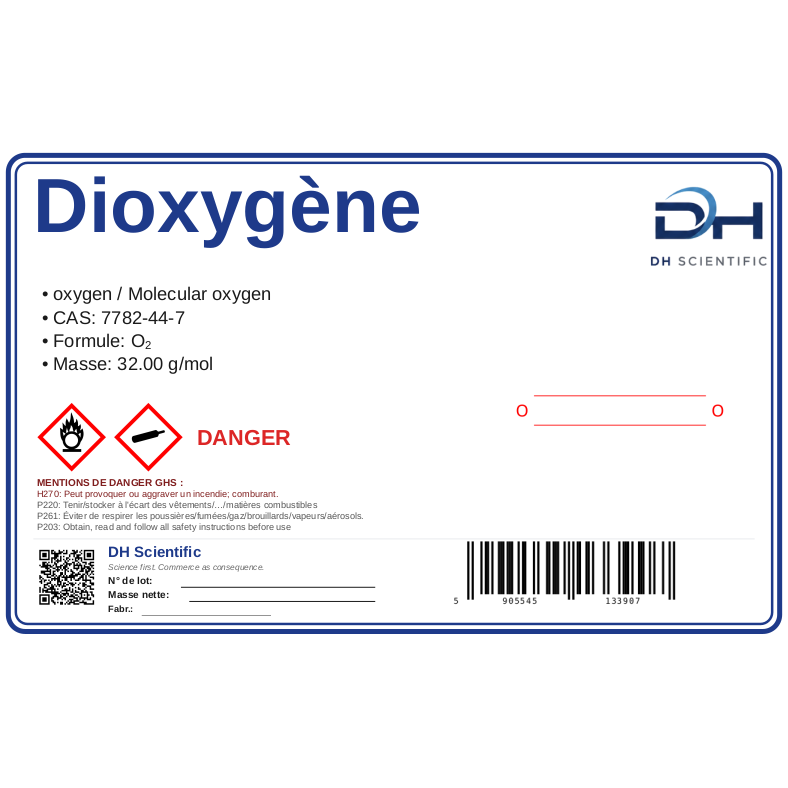
Dioxygène• oxygen / Molecular oxygen• CAS: 7782-44-7• Formule: O2• Masse: 31.999 g/molDANGERMENTIONS DE DANGER GHS :H270: Peut provoquer ou aggraver un incendie; comburant.P370+P378 P280 P501 P210 P220Réservé à un usage en laboratoire !DH ScientificScience first. Commerce as consequence.N° de lot: Masse nette: Fabr.:
Deskryptory Lipinskiego (struktura)
Chargement des prédictions ADMET…
Incidents historiques (CSB/EPA/Bretherick)

La base de données contient uniquement des incidents industriels et de laboratoire graves (CSB, EPA RMP, Bretherick). L'absence d'un enregistrement ne signifie PAS que la substance est sûre — la base de données est incomplète.

Incidents historiques (5)

  1. 2020-08-04 Beirut Port Hangar 12, Lebanon Catastrophique explosion
    Substances : Ammonium nitrate (high-density seized stockpile) (CAS 6484-52-2) + Welding sparks / ignition source (CAS 7782-44-7)
    218 ofiar smiertelnych 7000 rannych

    Detonacja ~2750 ton NH4NO3 (z konfiskaty statku Rhosus 2014, skladowanego niezgodnie z procedurami przez 6 lat). Pozar wywolany pracami spawalniczymi w sasiednim sektorze hangaru z fajerwerkami i innymi materialami. Wybuch sily 0.3-1.1 kT TNT (3.3 magnitude sejsmika), zniszczyl polowe miasta Bejrut.

    Cause profonde : Lata zaniedban administracyjnych: brak relokacji niebezpiecznego materialu mimo wielokrotnych ostrzezen. Spawanie w sasiedztwie niewlasciwie wentylowanego skladu NH4NO3. Wieloletnia korozja workow umozliwiajaca caking i wzrost reaktywnosci.
    Enseignements tirés : Konfiskaty NH4NO3 musza byc przeniesione do zatwierdzonych obiektow w ciagu 90 dni (UN ECOSOC rekomendacje 2021). Hot work permits obowiazkowe + monitoring 30 m promienia. Audity bezpieczenstwa portowego przez UE.
    Bibliographie (Chicago auteur-date)
    • Pilger, Christoph, Patrick Hupe, Peter Gaebler, and Lars Ceranna. 2021. "1001 Rocket Launches for Space Missions and Their Effects on the Seismoacoustic Environment." Geophysical Research Letters 48 (6): e2020GL092262.
    • Rigby, Sam E., et al. 2020. "Preliminary Yield Estimation of the 2020 Beirut Explosion Using Video Footage from Social Media." Shock Waves 30 (6): 671-675.
    • Yu, Guohui, Junjie Wang, Min Hu, Zhiwei Shang, and Jianjun Yu. 2022. "Investigation on the Beirut Explosion Accident Based on Numerical Simulation." Process Safety and Environmental Protection 159: 1010-1023.
  2. 2013-04-17 West, Texas, USA (West Fertilizer Company storage warehouse) Catastrophique explosion
    Substances : Ammonium nitrate (FGAN, fertilizer grade) (CAS 6484-52-2) + Atmospheric oxygen / fire (CAS 7782-44-7)
    15 ofiar smiertelnych 260 rannych

    Pozar drewnianego budynku magazynowego zawierajacego ~30 ton FGAN (azotanu amonu nawozowego) oraz dodatkowo seed-grade NH4NO3. Po ~22 minutach pozaru NH4NO3 zdetonowal, tworzac krater 28 m srednicy, niszczac 150 budynkow w promieniu 800 m, w tym dom opieki, szkolu i czesc miasta. 12 strazakow + 2 cywili zginelo.

    Cause profonde : Brak sprinklerów, drewniana konstrukcja, brak segregacji NH4NO3 od materialow palnych (nasiona, drewno). Zanieczyszczenia organiczne obnizajace temperature wybuchu. Brak federalnej regulacji magazynowania NH4NO3 cywilnego (luka pomiedzy OSHA a EPA RMP).
    Enseignements tirés : Niepalne konstrukcje + automatyczne sprinklery dla magazynow >5 ton NH4NO3. Wymog separacji od materialow palnych >15 m. ATF/OSHA jurisdiction gaps musza byc zamkniete legislacyjnie.
    Bibliographie (Chicago auteur-date)
    • U.S. Chemical Safety and Hazard Investigation Board. 2016. Investigation Report: West Fertilizer Company Fire and Explosion. Report No. 2013-02-I-TX. Washington, DC: CSB.
    • Marlair, Guy, and Marie-Astrid Kordek. 2005. "Safety and Security Issues Relating to Low Capacity Storage of AN-Based Fertilizers." Journal of Hazardous Materials 123 (1-3): 13-28.
    • U.S. Environmental Protection Agency. 2015. Chemical Safety Alert: Safe Storage, Handling, and Management of Solid Ammonium Nitrate Prills. EPA 550-F-15-001.
  3. 2005-12-11 Hemel Hempstead, Hertfordshire, UK (Buncefield Oil Storage Depot) Élevée explosion
    Substances : Atmospheric oxygen / ignition (pump house electrical) (CAS 7782-44-7) + Gasoline (unleaded petrol) (CAS 8006-61-9)
    43 rannych

    Przepelnienie zbiornika 912 (~6000 m3 gasoline) podczas nocnego transferu z rurociagu BPA. Mechanizm float-and-tape level gauge zacial sie, wysoko-poziomowy switch (IHLS) byl unsprawny. Powstala chmura ~250 ton parow benzyny rozplynela sie po terenie depo. Zaplon na pump house (electrical) wywolal rzadki overpressurized vapor cloud explosion w obszarze zalesionym (Buncefield Effect). Gigantyczny pozar 5 dni, 23 zbiorniki spalone.

    Cause profonde : Single-point of failure w level measurement. IHLS independent z poprawnymi procedurami test (last test 5 lat przed incydentem). Brak overfill prevention system zgodny z API 2350. Tank far overflowing w cichych warunkach (niska wiatry → akumulacja oparow zamiast dispersji).
    Enseignements tirés : Sil 1-2 IHLS + manual gauge redundancja (HSE COMAH guidance 2007). Bunding 110% dla cieczy palnych. Sprinklery i foam systems jako standard. ATEX zoning rewizja - benzyna w cichych warunkach generuje Zone 1 do 250 m.
    Bibliographie (Chicago auteur-date)
    • Buncefield Major Incident Investigation Board. 2008. The Buncefield Incident 11 December 2005: The Final Report of the Major Incident Investigation Board. Vol. 1. London: HSE Books.
    • Atkinson, Graham, and Laurence Cusco. 2011. "Buncefield: A Violent, Episodic Vapour Cloud Explosion." Process Safety and Environmental Protection 89 (6): 360-370.
    • Health and Safety Executive (HSE). 2011. Buncefield: Why Did It Happen? Bootle: HSE.
  4. 2005-03-23 Texas City, Texas, USA (BP Products North America refinery, ISOM unit) Catastrophique explosion
    Substances : Hydrocarbon raffinate (ethanol-grade isomerate) (CAS 64-17-5) + Oxygen / atmospheric air (CAS 7782-44-7)
    15 ofiar smiertelnych 180 rannych

    Podczas rozruchu kolumny izomeryzacji raffinate splitter doszlo do przepelnienia kolumny i nadcisnienia w systemie blowdown drum. Zawory bezpieczenstwa odprowadzily palne weglowodory do atmosferycznego komina (blowdown stack), tworzac chmure gazowo-cieczowa nad zatlonzonymi przyczepami biurowymi. Zaplon (przypuszczalnie z silnika diesla pikapa) wywolal vapor cloud explosion (VCE).

    Cause profonde : Atmosferyczny blowdown stack zamiast flare. Brak kalibracji wskaznikow poziomu w kolumnie. 5 dni przedluzonego rozruchu z brakiem snu obslugi. Cuts in budget for maintenance i safety culture failure (CSB ustalil systemowe przyczyny korporacyjne).
    Enseignements tirés : Eliminacja atmospheric blowdown stacks (zastapienie flare). Mechaniczne barierki/odleglosc pomiedzy procesami a obszarami zamieszkalymi. Process Safety Management (PSM) audity nie moga byc tylko papierowe.
    Bibliographie (Chicago auteur-date)
    • U.S. Chemical Safety and Hazard Investigation Board. 2007. Investigation Report: Refinery Explosion and Fire, BP Texas City. Report No. 2005-04-I-TX. Washington, DC: CSB.
    • Baker, James A., et al. 2007. The Report of the BP U.S. Refineries Independent Safety Review Panel. Houston: BP.
    • Hopkins, Andrew. 2008. Failure to Learn: The BP Texas City Refinery Disaster. Sydney: CCH Australia.
  5. 1989-10-23 Pasadena, Texas, USA (Phillips 66 Houston Chemical Complex, HCC) Catastrophique explosion
    Substances : Ethylene (high-pressure HDPE feed) (CAS 74-85-1) + Oxygen / atmospheric air ingress (CAS 7782-44-7)
    23 ofiar smiertelnych 314 rannych

    Podczas konserwacji reaktora HDPE settling leg (rurociag 22") doszlo do otwarcia zaworu DEMCO w trakcie procedury maintenance. Uwolnienie ~38 ton mieszaniny etylen/izobutan/wodor stworzylo chmure gazowo-powietrzna, ktora zaplonila po ~90 sekundach (zrodlo nieustalone definitywnie). VCE o sile 2.4 ton TNT, zniszczyl HDPE complex.

    Cause profonde : Single-block valve zamiast double-block-and-bleed. Procedury LO/TO niewlasciwe (compressed air zasilajacy aktuatory zaworow podlaczony do "open" zamiast "close" portow). Brak gas detection w okolicy reactora. Unauthorized work przy non-routine maintenance.
    Enseignements tirés : Double-block-and-bleed valve standard dla high-pressure reactor isolation. Kierunek pneumatic actuators musi byc fail-safe. OSHA PSM standard 29 CFR 1910.119 (1992) jest bezposrednim wynikiem tego incydentu.
    Bibliographie (Chicago auteur-date)
    • U.S. Department of Labor, Occupational Safety and Health Administration. 1990. The Phillips 66 Company Houston Chemical Complex Explosion and Fire. Washington, DC: OSHA.
    • Atherton, John, and Frederic Gil. 2008. Incidents That Define Process Safety. Hoboken, NJ: Wiley-AIChE.
    • Khan, Faisal I., and S. A. Abbasi. 1999. "Major Accidents in Process Industries and an Analysis of Causes and Consequences." Journal of Loss Prevention in the Process Industries 12 (5): 361-378.
📚 Sources des données sur les incidents
  1. U.S. Chemical Safety and Hazard Investigation Board (CSB). 2024. "CSB Incident Investigation Reports." Washington, DC: CSB. 🔗
  2. U.S. EPA / NOAA. 2024. "CAMEO Chemicals Database." Washington, DC: U.S. Environmental Protection Agency. 🔗
  3. BARPI (French Bureau for Analysis of Industrial Risks and Pollutions). 2024. "ARIA Database of Industrial Accident Reports." Saint-Denis: BARPI/DGPR. 🔗
  4. U.S. OSHA. 2024. "OSHA Accident Investigation Reports." Washington, DC: Occupational Safety and Health Administration. 🔗
  5. Urben, Peter G., ed. 2017. Bretherick's Handbook of Reactive Chemical Hazards. 8th ed. Oxford: Elsevier. ISBN 978-0-08-100971-2.
  6. Mannan, Sam, ed. 2005. Lees' Loss Prevention in the Process Industries. 3rd ed. Oxford: Elsevier. ISBN 978-0-7506-7555-0.
  7. Hollnagel, Erik. 2004. Barriers and Accident Prevention. Aldershot: Ashgate. ISBN 978-0-7546-2271-9.
  8. Kletz, Trevor A. 2003. "Lessons from Disasters — How Organizations Have No Memory and Accidents Recur." Process Safety and Environmental Protection 81 (4): 283–287. 🔗
📚 Aperçu de la littérature scientifique — CAS 7782-44-7MolGod_LITHUB_MAIN
⭐ Principales découvertes (littérature scientifique) 18 publications
🏆 CAS 7782-44-7 — multi-criteria ranking (W12): 30% citations · 20% actualité · 20% thème · 15% historique · 15% open access.
  1. #1
    Lun Zhang, Jiahui Li, Liang Zong et al. (2016) · Oxidative Medicine and Cellular Longevity
    Pourquoi c'est important : 128 citations · revue · open access
    SCORE 10.38 Revue Citations : 128 Open Access DOI ↗
  2. #2
    et al. (2024) · Smart Molecules
    Pourquoi c'est important : Récente (2024) · open access
    SCORE 10.18 Mécanisme Citations : 5 Open Access DOI ↗ PubMed ↗
  3. #3
    et al. (2024) · Nature Communications
    Pourquoi c'est important : Récente (2024) · open access
    SCORE 9.76 Mécanisme Citations : 7 Open Access DOI ↗ PubMed ↗
  4. #4
    et al. (2026) · Advanced Science
    Pourquoi c'est important : Récente (2026) · open access
    SCORE 9.55 Industrie Citations : 1 Open Access DOI ↗ PubMed ↗
  5. #5
    et al. (2025) · Nature Communications
    Pourquoi c'est important : Récente (2025) · open access
    SCORE 9.28 Mécanisme Citations : 2 Open Access DOI ↗ PubMed ↗
  6. #6
    et al. (2025) · Angewandte Chemie International Edition
    Pourquoi c'est important : Récente (2025) · open access
    SCORE 8.75 Mécanisme Citations : 1 Open Access DOI ↗ PubMed ↗
  7. #7
    et al. (2025) · Nature Communications
    Pourquoi c'est important : Récente (2025) · open access
    SCORE 7.95 Mécanisme Citations : 1 Open Access DOI ↗ PubMed ↗
  8. #8
    Wonjin Jeon, Ji-Yeon Park, Deog-Keun Kim (2026) · Energy Conversion and Management: X
    Pourquoi c'est important : Récente (2026) · open access
    SCORE 7.85 Mécanisme Open Access DOI ↗
  9. #9
    et al. (2026) · ChemSusChem
    Pourquoi c'est important : Récente (2026) · open access
    SCORE 7.05 Mécanisme Open Access DOI ↗ PubMed ↗
  10. #10
    et al. (2025) · Discover Nano
    Pourquoi c'est important : Récente (2025) · open access
    SCORE 7.05 Mécanisme Open Access DOI ↗ PubMed ↗
  11. #11
    Vladimir Pomogaev; Daniil Lukyanov; Elena Solovyeva (2025) · Molecules
    Pourquoi c'est important : Récente (2025) · open access
    SCORE 6.25 Mécanisme Open Access DOI ↗ PubMed ↗
  12. #12
    Jieling Song; Kaiyue Cai; Rongfu Huang (2026) · Water Research
    Pourquoi c'est important : Récente (2026)
    SCORE 5.7 Mécanisme Citations : 1 DOI ↗ PubMed ↗
  13. #13
    et al. (2026) · Chemistry – A European Journal
    Pourquoi c'est important : Récente (2026)
    SCORE 5.6 Mécanisme DOI ↗ PubMed ↗
  14. #14
    et al. (2026) · Physical Chemistry Chemical Physics
    Pourquoi c'est important : Récente (2026)
    SCORE 4.8 Pharmacologie DOI ↗ PubMed ↗
  15. #15
    et al. (2026) · Angewandte Chemie International Edition
    Pourquoi c'est important : Récente (2026)
    SCORE 4.8 Mécanisme DOI ↗ PubMed ↗
  16. #16
    Fischer MO (2026) · British journal of anaesthesia
    Pourquoi c'est important : Citation obligatoire (canon) · récente (2026) · revue
    SCORE 4 Revue MUST-CITE DOI ↗
  17. #17
    Brooks SE; Dammann CEL; Dammann O (2026) · Early human development
    Pourquoi c'est important : Citation obligatoire (canon) · récente (2026) · revue
    SCORE 4 Revue MUST-CITE DOI ↗
  18. #18
    et al. (2026) · Organic & Biomolecular Chemistry
    Pourquoi c'est important : Récente (2026)
    SCORE 4 Mécanisme DOI ↗ PubMed ↗
📐 Calculateur de symétrie de pic HPLC (USP Tf / As)

Calculez le facteur de traînée USP (T) et l'asymétrie (As) à partir des demi-largeurs du pic. Saisissez a (demi-largeur gauche) et b (demi-largeur droite) mesurées à 5% ou 10% de la hauteur du pic.

📚 Références (Chicago Author-Date)
  1. USP General Chapter <621>. 2024. "Chromatography." United States Pharmacopeial Convention. [link ↗] — Defines USP Tailing Factor T = (a+b)/(2a) measured at 5% peak height.
  2. International Council for Harmonisation (ICH). 2023. "Validation of Analytical Procedures Q2(R2)." ICH Expert Working Group. [link ↗] — Tailing factor is a system suitability parameter (Section 6).
  3. Foley, Joe P., and John G. Dorsey. 1983. "Equations for calculation of chromatographic figures of merit for ideal and skewed peaks." Analytical Chemistry 55: 730-737 https://doi.org/10.1021/ac00255a033 [link ↗] — Original asymmetry factor As = b/a at 10% height (Foley & Dorsey 1983).
  4. Snyder, Lloyd R., Joseph J. Kirkland, and John W. Dolan. 2010. "Introduction to Modern Liquid Chromatography." Wiley. https://doi.org/10.1002/9780470508183 [link ↗] — Chapter 2.4 — peak shape diagnostics and remedies.
  5. Dolan, John W.. 2003. "Peak tailing and resolution." LCGC North America 21: 610-614 [link ↗] — How tailing factor degrades effective resolution.
  6. Vivó-Truyols, Gabriel, and Hans-Gerd Janssen. 2010. "Probabilistic approach to peak deconvolution in chromatography." Analytical Chemistry 82: 8525-8531 https://doi.org/10.1021/ac101742z [link ↗] — Modern numerical deconvolution for asymmetric peaks.
  7. Kromidas, Stavros. 2017. "HPLC Made to Measure: A Practical Handbook for Optimization." Wiley-VCH. — Practical Tf and As thresholds for routine QC.
  8. Dong, Michael W.. 2019. "HPLC and UHPLC for Practicing Scientists." Wiley. https://doi.org/10.1002/9781119313793 [link ↗]
  9. Meyer, Veronika R.. 2010. "Practical High-Performance Liquid Chromatography." Wiley.
  10. Heyden, Yvan Vander, et al.. 2009. "Robustness of pharmaceutical liquid chromatographic methods." Journal of Chromatography B 877: 2120-2129 https://doi.org/10.1016/j.jchromb.2008.10.052 [link ↗]
📊 Calculateur de résolution et de nombre de plateaux (Rs, N, H)

Calculez la résolution Rs, le nombre de plateaux théoriques N et la HETP (H) pour une paire de pics HPLC. Saisissez les temps de rétention, les largeurs de pic (à 50% ou à la base) et la longueur de la colonne.

📚 Références (Chicago Author-Date)
  1. Snyder, Lloyd R., Joseph J. Kirkland, and John W. Dolan. 2010. "Introduction to Modern Liquid Chromatography." 3rd ed. John Wiley & Sons. ISBN 978-0-470-16754-0. https://doi.org/10.1002/9780470508183 [link ↗] — Chapter 2 covers resolution, plate count and HETP fundamentals (Snyder et al. 2010).
  2. USP General Chapter <621>. 2024. "Chromatography." USP-NF 2024 ed. United States Pharmacopeial Convention. [link ↗] — Defines Rs >= 1.5 acceptance criterion and N calculation methods.
  3. Dolan, John W.. 2003. "How much resolution is enough?." LCGC North America 21: 350-353 [link ↗] — Practical guidance on Rs targets for routine method development.
  4. Van Deemter, J. J., F. J. Zuiderweg, and A. Klinkenberg. 1956. "Longitudinal diffusion and resistance to mass transfer as causes of nonideality in chromatography." Chemical Engineering Science 5: 271-289 https://doi.org/10.1016/0009-2509(56)80003-1 [link ↗] — Origin of N = 5.54·(tr/w0.5)² half-height plate count formulation.
  5. Giddings, J. Calvin. 1965. "Dynamics of Chromatography, Part I: Principles and Theory." Marcel Dekker. ISBN 978-0-8247-1357-7. — Resolution equation Rs = (1/4)·√N·(α-1)/α·k/(1+k) (master equation).
  6. Foley, Joe P., and John G. Dorsey. 1983. "Equations for calculation of chromatographic figures of merit for ideal and skewed peaks." Analytical Chemistry 55: 730-737 https://doi.org/10.1021/ac00255a033 [link ↗] — Skewed-peak corrections to apparent N.
  7. Knox, John H.. 1977. "Practical aspects of LC theory." Journal of Chromatographic Science 15: 352-364 https://doi.org/10.1093/chromsci/15.9.352 [link ↗]
  8. Carr, Peter W.. 2009. "The new physical chemistry of HPLC." Journal of Chromatography A 1216: 1764-1772 https://doi.org/10.1016/j.chroma.2008.11.094 [link ↗]
  9. Dong, Michael W.. 2019. "HPLC and UHPLC for Practicing Scientists." 2nd ed. Wiley. ISBN 978-1-119-31378-3. https://doi.org/10.1002/9781119313793 [link ↗]
  10. Meyer, Veronika R.. 2010. "Practical High-Performance Liquid Chromatography." 5th ed. Wiley. ISBN 978-0-470-68218-0.
🧪 Conformité du système — calculateur en direct (USP <621>)

Saisissez les données de 5-6 injections (aires, tr, traînée, plateaux) — le calculateur calcule le %RSD, les moyennes et vérifie la conformité à l'USP <621>. Vous pouvez coller un CSV (séparé par des virgules) ou modifier des valeurs individuelles.

📚 Références (Chicago Author-Date)
  1. USP General Chapter <621>. 2024. "Chromatography (System Suitability section)." USP-NF 2024 ed. United States Pharmacopeial Convention. [link ↗] — Defines RSD area < 2%, tailing < 2.0, N > 2000 acceptance criteria.
  2. International Council for Harmonisation (ICH). 2023. "Validation of Analytical Procedures Q2(R2)." ICH Expert Working Group. [link ↗] — Section 5.4 — system suitability is part of method validation.
  3. US Food and Drug Administration (FDA). 2018. "Reviewer Guidance: Validation of Chromatographic Methods." US Food and Drug Administration. [link ↗] — CDER reviewer perspective on chromatographic validation expectations.
  4. Snyder, Lloyd R., Joseph J. Kirkland, and John W. Dolan. 2010. "Introduction to Modern Liquid Chromatography." 3rd ed. Wiley. — Chapter 2 — system suitability fundamentals (RSD, Tf, N).
  5. Heyden, Yvan Vander, et al.. 2009. "Robustness of pharmaceutical liquid chromatographic methods." — Robustness vs. system suitability — design-of-experiments framework.
  6. Rozet, Eric, et al.. 2013. "Analysis of recent pharmaceutical regulatory documents on analytical method validation."
  7. European Medicines Agency (EMA). 2011. "Guideline on bioanalytical method validation EMEA/CHMP/EWP/192217/2009." EMA. [link ↗] — EMA companion guideline with bioanalytical SS criteria.
  8. Dong, Michael W.. 2019. "HPLC and UHPLC for Practicing Scientists." 2nd ed. Wiley. — UHPLC-specific suitability adjustments (n=5 vs. n=6).
  9. Kazakevich, Yuri V., and Rosario LoBrutto, eds.. 2007. "HPLC for Pharmaceutical Scientists." Wiley-Interscience.
  10. AOAC International. 2016. "Appendix F: Guidelines for Standard Method Performance Requirements." AOAC INTERNATIONAL. [link ↗] — Alternative SS thresholds for food/dietary samples.
📤 Intégrez cette molécule sur votre site

Vous avez un blog, un forum ou un service scientifique ? Intégrez la molécule 3D interactive sur votre site — chacun de vos lecteurs la verra, avec en dessous un lien vers notre boutique où il peut acheter le réactif.

🔗 Code HTML iframe (le plus simple — fonctionne partout)

Copiez et collez dans l'éditeur HTML de votre site :

Ajustez width et height à votre mise en page.

⚙ WordPress Shortcode (pour d'autres boutiques avec MOL-GOD)

🌐 Lien direct (pour e-mails, chats, LinkedIn, Twitter)

LinkedIn Twitter/X Facebook
QR code CAS 7782-44-7

📱 QR code (pour l'impression sur flyers / étiquettes / catalogues)

Placez-le dans un catalogue de produits, sur une étiquette de flacon ou un flyer. Le client le scanne — il voit la molécule 3D sur son téléphone, avec un lien vers votre boutique.

⬇ Télécharger le PNG

🖼 Open Graph image (pour les balises meta des réseaux sociaux)

En partageant le lien, Facebook/LinkedIn/Discord récupérera automatiquement l'aperçu de l'image :

Preview
📋 Licence : L'intégration conserve un lien retour vers DH Scientific (requis — la boutique est la source des données). Les données chimiques proviennent de PubChem (CC0 — domaine public). L'intégration est GRATUITE pour un usage éducatif, commercial et de loisir.
📚 RÉFÉRENCES (Bibliographie agrégée, Chicago Author-Date) 127 éléments

Toutes les sources scientifiques citées dans les accordéons ci-dessus pour le CAS 7782-44-7. Format : Chicago Manual of Style, 17e éd., système Auteur-Date.

🗄️ Bases de données scientifiques

  1. NIST. n.d. NIST Chemistry WebBook: CAS 7782-44-7. Gaithersburg, MD: National Institute of Standards and Technology. https://webbook.nist.gov/cgi/cbook.cgi?ID=7782-44-7.
  2. AIST. n.d. Spectral Database for Organic Compounds (SDBS): CAS 7782-44-7. Tsukuba, Japan: National Institute of Advanced Industrial Science and Technology. https://sdbs.db.aist.go.jp/.
  3. Linstrom, Peter J., and William G. Mallard, eds. n.d. NIST Chemistry WebBook: NIST Standard Reference Database Number 69. Gaithersburg, MD: National Institute of Standards and Technology. https://doi.org/10.18434/T4D303.
  4. PubChem. n.d. PubChem Compound Summary: CAS 7782-44-7. Bethesda, MD: National Center for Biotechnology Information (NCBI), National Library of Medicine. https://pubchem.ncbi.nlm.nih.gov/#query=7782-44-7.
  5. U.S. EPA. n.d. CompTox Chemicals Dashboard: CAS 7782-44-7. Research Triangle Park, NC: U.S. Environmental Protection Agency. https://comptox.epa.gov/dashboard/chemical/details/DTXSID2037681.

📐 Normes / Lignes directrices

  1. ICH. 2003. "Stability Testing of New Drug Substances and Products: Q1A(R2)." Geneva: International Council for Harmonisation of Technical Requirements for Pharmaceuticals for Human Use. https://database.ich.org/sites/default/files/Q1A%28R2%29%20Guideline.pdf.
  2. National Fire Protection Association (NFPA). 2024. "NFPA 30: Flammable and Combustible Liquids Code." NFPA, Quincy, MA. https://www.nfpa.org/codes-and-standards/all-codes-and-standards/list-of-codes-and-standards/detail?code=30.
  3. Occupational Safety and Health Administration (OSHA). 2023. "29 CFR 1910.106 — Flammable Liquids." U.S. Department of Labor, Federal Register. https://www.osha.gov/laws-regs/regulations/standardnumber/1910/1910.106.
  4. European Chemicals Agency (ECHA). 2024. "Annex VI to Regulation (EC) No 1272/2008 (CLP) — Harmonised Classification and Labelling." ECHA, Helsinki / Official Journal of the European Union. https://echa.europa.eu/regulations/clp/clp-classification.
  5. European Committee for Standardization (CEN). 2016. "EN 374-1:2016 — Protective gloves against dangerous chemicals and micro-organisms — Part 1: Terminology and performance requirements for chemical risks." CEN, Brussels. https://standards.cencenelec.eu/dyn/www/f?p=205:110:::::FSP_PROJECT,FSP_ORG_ID:38536,6080&cs=1B0DAA8B85DF42E4A2C70E5D71F0BFA32.
  6. European Committee for Standardization (CEN). 2001. "EN 166:2001 — Personal eye-protection — Specifications." CEN, Brussels. https://standards.cencenelec.eu/dyn/www/f?p=CEN:110:0::::FSP_PROJECT:6541&cs=1F1A4E0A78C4DB6A28DBE2E8C29D89DCF.
  7. European Committee for Standardization (CEN). 2009. "EN 14605:2005+A1:2009 — Protective clothing against liquid chemicals — Performance requirements for clothing with liquid-tight (Type 3) or spray-tight (Type 4) connections." CEN, Brussels. https://standards.cencenelec.eu/dyn/www/f?p=CEN:110:0::::FSP_PROJECT:21581&cs=1A04A2D3C7CC58E9E6CB58D55F7EBFB7E.
  8. National Institute for Occupational Safety and Health (NIOSH). 2017. "Recommendations for Chemical Protective Clothing: A Companion to the NIOSH Pocket Guide." U.S. Department of Health & Human Services / CDC. https://www.cdc.gov/niosh/ncpc/default.html.
  9. Occupational Safety and Health Administration (OSHA). 2011. "Personal Protective Equipment — General requirements." U.S. Department of Labor — 29 CFR 1910.132. https://www.osha.gov/laws-regs/regulations/standardnumber/1910/1910.132.

📖 Livres

  1. Hansen, Charles M. 2007. Hansen Solubility Parameters: A User's Handbook, 2nd ed.. Boca Raton, FL: CRC Press. https://www.routledge.com/Hansen-Solubility-Parameters-A-Users-Handbook/Hansen/p/book/9780849372483.
  2. Barton, Allan F. M. 1991. CRC Handbook of Solubility Parameters and Other Cohesion Parameters: 2nd ed.. Boca Raton, FL: CRC Press. https://www.routledge.com/CRC-Handbook-of-Solubility-Parameters-and-Other-Cohesion-Parameters/Barton/p/book/9780849301766.
  3. Connors, Kenneth A., Gordon L. Amidon, and Valentino J. Stella. 1986. Chemical Stability of Pharmaceuticals: A Handbook for Pharmacists, 2nd ed.. New York: Wiley. https://doi.org/10.1002/0471734683.
  4. Rumble, John R., ed. 2019. CRC Handbook of Chemistry and Physics: 100th Edition. Boca Raton, FL: CRC Press. https://hbcp.chemnetbase.com/.
  5. Urben, Peter G. 2017. Bretherick's Handbook of Reactive Chemical Hazards, 8th Edition. Academic Press / Elsevier, Oxford. https://www.sciencedirect.com/book/9780081010594.

📄 Articles scientifiques (évalués par les pairs)

  1. Stefanis, Emmanuel, and Costas Panayiotou. 2008. "Prediction of Hansen Solubility Parameters with a New Group-Contribution Method." International Journal of Thermophysics 29: 568-585. https://doi.org/10.1007/s10765-008-0415-z.
  2. Stoll, Vincent S., and John S. Blanchard. 1990. "Buffers: Principles and Practice: In Methods in Enzymology, vol. 182." San Diego: Academic Press. https://doi.org/10.1016/0076-6879(90)82008-P.

🌐 Sites web

  1. ECHA. 2023. "Guidance on the Application of the CLP Criteria." European Chemicals Agency. https://echa.europa.eu/guidance-documents/guidance-on-clp.
  2. European Parliament. 2006. "Regulation (EC) No 1907/2006 (REACH)." Official Journal of the European Union L 396: 1–849.
  3. ECHA. 2023. "Candidate List of Substances of Very High Concern for Authorisation." European Chemicals Agency. https://echa.europa.eu/candidate-list-table.
  4. European Parliament. 2008. "Regulation (EC) No 1272/2008 on Classification, Labelling and Packaging of Substances and Mixtures (CLP)." Official Journal of the European Union L 353: 1–1355.
  5. ECHA. 2017. "Guidance on the Compilation of Safety Data Sheets." Version 3.1. European Chemicals Agency. ECHA-17-G-01-EN. https://echa.europa.eu/documents/10162/23047722/sds_en.pdf.
  6. ECHA. 2022. "Restrictions Under REACH — Annex XVII." European Chemicals Agency. https://echa.europa.eu/substances-restricted-under-reach.
  7. United Nations. 2021. Globally Harmonized System of Classification and Labelling of Chemicals (GHS). 9th revised ed. ST/SG/AC.10/30/Rev.9. New York and Geneva: United Nations. https://unece.org/ghs-rev9-2021.
  8. ECHA. 2020. "Understanding REACH." European Chemicals Agency. https://echa.europa.eu/regulations/reach/understanding-reach.
  9. ECHA — Zalacznik VI do CLP (klasyfikacja zharmonizowana, ATP 23; 2026-07-07) https://echa.europa.eu/information-on-chemicals/annex-vi-to-clp.
  10. U.S. Occupational Safety and Health Administration (2024) — 29 CFR 1910.120 — Hazardous Waste Operations and Emergency Response (HAZWOPER) https://www.osha.gov/hazwoper.
  11. National Fire Protection Association (2018) — NFPA 472: Standard for Competence of Responders to Hazardous Materials/Weapons of Mass Destruction Incidents https://www.nfpa.org/codes-and-standards/nfpa-472.
  12. European Parliament and Council (2012) — Directive 2012/18/EU on the Control of Major-Accident Hazards Involving Dangerous Substances (Seveso III) https://eur-lex.europa.eu/legal-content/EN/TXT/?uri=celex:32012L0018.
  13. U.S. National Institute for Occupational Safety and Health (2024) — NIOSH Pocket Guide to Chemical Hazards https://www.cdc.gov/niosh/npg/.
  14. European Chemicals Agency (2020) — Guidance on the Compilation of Safety Data Sheets (SDS), Version 3.1 https://echa.europa.eu/documents/10162/23047722/sds_en.pdf.
  15. Snyder, Lloyd R., John W. Dolan, and Joseph J. Kirkland. 2010. Introduction to Modern Liquid Chromatography. Wiley.
  16. Schoenmakers, Peter J.. 1986. Optimization of Chromatographic Selectivity: A Guide to Method Development. Elsevier.
  17. Snyder, L. R., and J. W. Dolan. 2007. High-Performance Gradient Elution: The Practical Application of the Linear-Solvent-Strength Model. Wiley.
  18. Nikitas, Pavlos, and Adrian Pappa-Louisi. 2009. "Retention models for isocratic and gradient elution in reversed-phase liquid chromatography." Journal of Chromatography A 1216: 1737-1755. https://doi.org/10.1016/j.chroma.2008.10.005.
  19. Carr, Peter W.. 2009. "The new physical chemistry of HPLC." Journal of Chromatography A 1216: 1764-1772. https://doi.org/10.1016/j.chroma.2008.11.094.
  20. Dong, Michael W.. 2019. HPLC and UHPLC for Practicing Scientists. Wiley. https://doi.org/10.1002/9781119313793.
  21. Wu, Naijun, and Anton M. Clausen. 2007. "Fundamental and practical aspects of ultrahigh pressure liquid chromatography for fast separations." Journal of Separation Science 30: 1167-1182. https://doi.org/10.1002/jssc.200700026.
  22. Stoll, Dwight R., and Peter W. Carr. 2017. "Two-Dimensional Liquid Chromatography: A State of the Art Tutorial." Analytical Chemistry 89: 519-531. https://doi.org/10.1021/acs.analchem.6b03506.
  23. Dolan, John W.. 2013. "When to Modify Method Conditions." LCGC North America 31: 192-199. https://www.chromatographyonline.com/view/when-modify-method-conditions.
  24. Meyer, Veronika R.. 2010. Practical High-Performance Liquid Chromatography. Wiley.
  25. Van Deemter, J. J., F. J. Zuiderweg, and A. Klinkenberg. 1956. "Longitudinal diffusion and resistance to mass transfer as causes of nonideality in chromatography." https://doi.org/10.1016/0009-2509(56)80003-1.
  26. Giddings, J. Calvin. 1965. "Dynamics of Chromatography, Part I: Principles and Theory." Marcel Dekker.
  27. Poppe, Hans. 1997. "Some reflections on speed and efficiency of modern chromatographic methods." https://doi.org/10.1016/S0021-9673(97)00376-2.
  28. Wu, Naijun, and Anton M. Clausen. 2007. "Fundamental and practical aspects of ultrahigh pressure liquid chromatography for fast separations." https://doi.org/10.1002/jssc.200700026.
  29. Carr, Peter W.. 2009. "The new physical chemistry of HPLC." https://doi.org/10.1016/j.chroma.2008.11.094.
  30. Knox, John H.. 1977. "Practical aspects of LC theory." https://doi.org/10.1093/chromsci/15.9.352.
  31. Snyder, L. R., J. J. Kirkland, and J. L. Glajch. 1997. "Practical HPLC Method Development." Wiley.
  32. Engelhardt, Heinz. 2014. "100 Years of Chromatography." Wiley-VCH.
  33. Sadek, Paul C.. 2002. "The HPLC Solvent Guide." Wiley-Interscience.
  34. Snyder, L. R.. 1978. "Classification of the solvent properties of common liquids." https://doi.org/10.1093/chromsci/16.6.223.
  35. Reichardt, Christian, and Thomas Welton. 2010. "Solvents and Solvent Effects in Organic Chemistry." Wiley-VCH.
  36. Vailaya, Anant, and Csaba Horváth. 1998. "Retention thermodynamics in hydrophobic interaction chromatography." https://doi.org/10.1021/ie980212h.
  37. Krstulović, Andrea M., and Phyllis R. Brown. 1981. "Reversed-phase High-Performance Liquid Chromatography." Wiley.
  38. Boysen, Reinhard I., and Milton T. W. Hearn. 2009. "Multi-modal HPLC of proteins." https://doi.org/10.1093/chromsci/47.8.645.
  39. USP General Chapter <621>. 2024. "Chromatography." United States Pharmacopeial Convention. https://www.usp.org/harmonization-standards/pdg/general-chapters/chromatography.
  40. International Council for Harmonisation (ICH). 2023. "Validation of Analytical Procedures Q2(R2)." ICH Expert Working Group. https://database.ich.org/sites/default/files/ICH_Q2-R2_Document_Step4_Guideline_2023_1101.pdf.
  41. Foley, Joe P., and John G. Dorsey. 1983. "Equations for calculation of chromatographic figures of merit for ideal and skewed peaks." https://doi.org/10.1021/ac00255a033.
  42. Snyder, Lloyd R., Joseph J. Kirkland, and John W. Dolan. 2010. "Introduction to Modern Liquid Chromatography." Wiley. https://doi.org/10.1002/9780470508183.
  43. Dolan, John W.. 2003. "Peak tailing and resolution." https://www.chromatographyonline.com/view/peak-tailing-and-resolution.
  44. Vivó-Truyols, Gabriel, and Hans-Gerd Janssen. 2010. "Probabilistic approach to peak deconvolution in chromatography." https://doi.org/10.1021/ac101742z.
  45. Kromidas, Stavros. 2017. "HPLC Made to Measure: A Practical Handbook for Optimization." Wiley-VCH.
  46. Heyden, Yvan Vander, et al.. 2009. "Robustness of pharmaceutical liquid chromatographic methods." https://doi.org/10.1016/j.jchromb.2008.10.052.
  47. United States Pharmacopeial Convention. 2024. "USP <621> Chromatography." In United States Pharmacopeia and National Formulary, USP 47-NF 42. Rockville, MD: USP. https://www.uspnf.com/.
  48. European Pharmacopoeia Commission. 2024. "2.2.46 Chromatographic Separation Techniques." In European Pharmacopoeia, 11th ed. Strasbourg: Council of Europe — EDQM. https://www.edqm.eu/en/european-pharmacopoeia-ph-eur-11th-edition.
  49. International Council for Harmonisation (ICH). 2022. "ICH Q2(R2): Validation of Analytical Procedures." International Council for Harmonisation. https://database.ich.org/sites/default/files/ICH_Q2%28R2%29_Guideline_2022_1130.pdf.
  50. International Council for Harmonisation (ICH). 1996. "ICH Q3A: Impurities in New Drug Substances." International Council for Harmonisation. https://database.ich.org/sites/default/files/Q3A%28R2%29%20Guideline.pdf.
  51. International Organization for Standardization. 2017. "ISO/IEC 17025:2017 General Requirements for the Competence of Testing and Calibration Laboratories." Geneva: ISO. https://www.iso.org/standard/66912.html.
  52. Kolthoff, Izaak Maurits, and Philip J. Elving, eds. 1978. Treatise on Analytical Chemistry, Part I: Theory and Practice. 2nd ed. New York: Wiley-Interscience.
  53. Skoog, Douglas A., F. James Holler, and Stanley R. Crouch. 2018. Principles of Instrumental Analysis. 7th ed. Boston: Cengage Learning.
  54. Christian, Gary D., Purnendu K. Dasgupta, and Kevin A. Schug. 2014. Analytical Chemistry. 7th ed. Hoboken, NJ: Wiley.
  55. EURACHEM/CITAC. 2012. "Quantifying Uncertainty in Analytical Measurement." 3rd ed. EURACHEM/CITAC Guide CG 4. https://www.eurachem.org/images/stories/Guides/pdf/QUAM2012_P1.pdf.
  56. Snyder, Lloyd R., Joseph J. Kirkland, and John W. Dolan. 2010. "Introduction to Modern Liquid Chromatography." John Wiley & Sons. https://doi.org/10.1002/9780470508183.
  57. Dolan, John W.. 2003. "How much resolution is enough?." https://www.chromatographyonline.com/view/how-much-resolution-enough.
  58. USP General Chapter <621>. 2024. "Chromatography (System Suitability section)." United States Pharmacopeial Convention. https://www.usp.org/harmonization-standards/pdg/general-chapters/chromatography.
  59. US Food and Drug Administration (FDA). 2018. "Reviewer Guidance: Validation of Chromatographic Methods." US Food and Drug Administration. https://www.fda.gov/media/74954/download.
  60. Rozet, Eric, et al.. 2013. "Analysis of recent pharmaceutical regulatory documents on analytical method validation." https://doi.org/10.1016/j.chroma.2007.03.111.
  61. European Medicines Agency (EMA). 2011. "Guideline on bioanalytical method validation EMEA/CHMP/EWP/192217/2009." EMA. https://www.ema.europa.eu/en/documents/scientific-guideline/guideline-bioanalytical-method-validation_en.pdf.
  62. Kazakevich, Yuri V., and Rosario LoBrutto, eds.. 2007. "HPLC for Pharmaceutical Scientists." Wiley-Interscience. https://doi.org/10.1002/9780470087954.
  63. AOAC International. 2016. "Appendix F: Guidelines for Standard Method Performance Requirements." AOAC INTERNATIONAL. https://www.aoac.org/wp-content/uploads/2019/08/app_f.pdf.
  64. International Organization for Standardization. 1994. "ISO 5725-2:1994 Accuracy (Trueness and Precision) of Measurement Methods and Results — Part 2: Basic Method for the Determination of Repeatability and Reproducibility of a Standard Measurement Method." Geneva: ISO. https://www.iso.org/standard/11834.html.
  65. Heckert, N. A., and J. J. Filliben. 2003. "NIST/SEMATECH e-Handbook of Statistical Methods." NIST Handbook 151. Gaithersburg, MD: National Institute of Standards and Technology. https://www.itl.nist.gov/div898/handbook/.
  66. Grubbs, Frank E. 1950. "Sample Criteria for Testing Outlying Observations." Annals of Mathematical Statistics 21 (1): 27–58.
  67. Dixon, Wilfrid J. 1950. "Analysis of Extreme Values." Annals of Mathematical Statistics 21 (4): 488–506.
  68. Snedecor, George W., and William G. Cochran. 1989. Statistical Methods. 8th ed. Ames, IA: Iowa State University Press.
  69. Student [William Sealy Gosset]. 1908. "The Probable Error of a Mean." Biometrika 6 (1): 1–25.
  70. International Organization for Standardization. 2005. "ISO 3534-1:2006 Statistics — Vocabulary and Symbols — Part 1: General Statistical Terms and Terms Used in Probability." Geneva: ISO. https://www.iso.org/standard/40145.html.
  71. Thompson, Michael, Stephen L. R. Ellison, and Roger Wood. 2002. "Harmonized Guidelines for Single-Laboratory Validation of Methods of Analysis." Pure and Applied Chemistry 74 (5): 835–855.
  72. United Nations Economic Commission for Europe. 2024. European Agreement Concerning the International Carriage of Dangerous Goods by Road (ADR), Applicable as from 1 January 2025 (ECE/TRANS/352). Geneva: UNECE. https://unece.org/transport/dangerous-goods/adr-2025-edition.
  73. International Air Transport Association. 2026. Dangerous Goods Regulations (DGR). 67th ed. Montreal: IATA. https://www.iata.org/en/programs/cargo/dgr/.
  74. International Maritime Organization. 2024. International Maritime Dangerous Goods (IMDG) Code, 2024 Edition (Amendment 42-24). London: IMO. https://www.imo.org/en/OurWork/Safety/Pages/DangerousGoods-default.aspx.
  75. United Nations. 2025. Recommendations on the Transport of Dangerous Goods: Model Regulations (Orange Book). 24th revised ed. ST/SG/AC.10/1/Rev.24. New York and Geneva: United Nations. https://unece.org/transport/dangerous-goods/un-model-regulations.
  76. International Civil Aviation Organization. 2025. Technical Instructions for the Safe Transport of Dangerous Goods by Air (Doc 9284). 2025–2026 ed. Montreal: ICAO. https://www.icao.int/safety/DangerousGoods/Pages/technical-instructions.aspx.
  77. International Conference on Harmonisation (ICH). 2005. "Validation of Analytical Procedures: Text and Methodology Q2(R1)." ICH Expert Working Group. https://database.ich.org/sites/default/files/Q2%28R1%29%20Guideline.pdf.
  78. United States Pharmacopeia (USP) Convention. 2024. "USP General Chapter <621> Chromatography." USP. https://www.usp.org/sites/default/files/usp/document/harmonization/gen-chapter/g05_pf_30_4_2004.pdf.
  79. European Medicines Agency (EMA). 2011. "Guideline on bioanalytical method validation EMEA/CHMP/EWP/192217/2009." EMA Committee for Medicinal Products for Human Use. https://www.ema.europa.eu/en/documents/scientific-guideline/guideline-bioanalytical-method-validation_en.pdf.
  80. European Commission. 2014. "Commission Decision 2014/955/EU on the list of waste pursuant to Directive 2008/98/EC." Official Journal of the European Union. https://eur-lex.europa.eu/legal-content/EN/TXT/?uri=CELEX:32014D0955.
  81. Ministerstwo Klimatu i Środowiska Rzeczypospolitej Polskiej. 2020. "Rozporządzenie Ministra Klimatu z dnia 2 stycznia 2020 r. w sprawie katalogu odpadów." Dziennik Ustaw RP 2020 poz. 10. https://isap.sejm.gov.pl/isap.nsf/DocDetails.xsp?id=WDU20200000010.
  82. Główny Inspektorat Ochrony Środowiska (GIOŚ). 2024. "Baza Danych O Odpadach (BDO) — System rejestracji firm utylizacyjnych." Ministerstwo Klimatu i Środowiska. https://bdo.mos.gov.pl/.
  83. Polska — Sejm RP. 2012. "Ustawa z dnia 14 grudnia 2012 r. o odpadach." Dz.U. 2013 poz. 21 (z późn. zm.). https://isap.sejm.gov.pl/isap.nsf/DocDetails.xsp?id=WDU20130000021.
  84. Furr, A. Keith, ed.. 2000. "CRC Handbook of Laboratory Safety." CRC Press.
  85. Pohanish, Richard P.. 2017. "Sittig's Handbook of Toxic and Hazardous Chemicals and Carcinogens." Elsevier.
  86. Lewis, Richard J.. 2012. "Sax's Dangerous Properties of Industrial Materials." Wiley.
  87. NIOSH. 2024. "Pocket Guide to Chemical Hazards." U.S. Department of Health and Human Services. https://www.cdc.gov/niosh/npg/.
  88. OSHA. 2024. "Occupational Chemical Database — Hazardous Waste Operations (HAZWOPER)." Occupational Safety and Health Administration. https://www.osha.gov/chemicaldata.
  89. European Parliament and Council. 2008. "Directive 2008/98/EC on waste (Waste Framework Directive)." Official Journal of the European Union L 312/3. https://eur-lex.europa.eu/legal-content/EN/TXT/?uri=CELEX:32008L0098.
  90. European Parliament and Council. 2009. "Regulation (EC) No 1272/2008 (CLP) on classification, labelling and packaging of substances and mixtures." Official Journal of the European Union L 353. https://eur-lex.europa.eu/legal-content/EN/TXT/?uri=CELEX:32008R1272.
  91. United Nations Economic Commission for Europe (UNECE). 2023. "European Agreement concerning the International Carriage of Dangerous Goods by Road (ADR 2025)." UNECE. https://unece.org/transport/standards/transport/dangerous-goods/adr-2025.
  92. IPCS INCHEM. 2024. "International Programme on Chemical Safety — Waste Management Guidelines." WHO/UNEP/ILO. https://www.inchem.org/.
  93. European Parliament and Council. 2006. "Regulation (EC) No 1013/2006 on Shipments of Waste." Official Journal of the European Union L 190: 1–98. https://eur-lex.europa.eu/legal-content/EN/TXT/?uri=CELEX:32006R1013.
  94. International Council for Harmonisation (ICH). 2000. "Q7 Good Manufacturing Practice Guide for Active Pharmaceutical Ingredients." ICH Expert Working Group. https://database.ich.org/sites/default/files/Q7%20Guideline.pdf.
  95. International Organization for Standardization. 2017. "ISO/IEC 17025:2017 General requirements for the competence of testing and calibration laboratories." ISO. https://www.iso.org/standard/66912.html.
  96. World Health Organization. 2010. "WHO Good Manufacturing Practices for Pharmaceutical Products: Main Principles (WHO Technical Report Series No. 957, Annex 3)." WHO Press. https://www.who.int/publications/m/item/trs957-annex3.
  97. International Council for Harmonisation (ICH). 2003. "ICH Q1A(R2): Stability Testing of New Drug Substances and Products." International Council for Harmonisation. https://database.ich.org/sites/default/files/Q1A%28R2%29%20Guideline.pdf.
  98. International Council for Harmonisation (ICH). 2006. "ICH Q3A(R2): Impurities in New Drug Substances." ICH. https://database.ich.org/sites/default/files/Q3A%28R2%29%20Guideline.pdf.
  99. International Council for Harmonisation (ICH). 1999. "ICH Q6A: Specifications for New Drug Substances and Products." ICH. https://database.ich.org/sites/default/files/Q6A%20Guideline.pdf.
  100. International Council for Harmonisation (ICH). 2008. "ICH Q10: Pharmaceutical Quality System." ICH. https://database.ich.org/sites/default/files/Q10%20Guideline.pdf.
  101. U.S. Food and Drug Administration. 2024. "21 CFR Part 211: Current Good Manufacturing Practice for Finished Pharmaceuticals." US Code of Federal Regulations. https://www.ecfr.gov/current/title-21/chapter-I/subchapter-C/part-211.
  102. European Medicines Agency. 2014. "Guideline on Process Validation for Finished Products — Information and Data to Be Provided EMA/CHMP/CVMP/QWP/BWP/70278/2012." European Medicines Agency. https://www.ema.europa.eu/en/documents/scientific-guideline/guideline-process-validation-finished-products-information-data-be-provided-regulatory-submissions-revision-1_en.pdf.
  103. United States Pharmacopeial Convention. 2024. "United States Pharmacopeia and National Formulary, USP 47-NF 42." USP. https://www.uspnf.com/.
  104. European Pharmacopoeia Commission. 2024. "European Pharmacopoeia 11th Edition." Council of Europe — EDQM. https://www.edqm.eu/en/european-pharmacopoeia-ph-eur-11th-edition.
  105. Pharmaceutical Inspection Co-operation Scheme (PIC/S). 2021. "Guide to Good Manufacturing Practice for Medicinal Products PE 009-15." PIC/S Secretariat, Geneva. https://picscheme.org/en/publications.
  106. International Pharmaceutical Excipients Council (IPEC) and Pharmaceutical Quality Group (PQG). 2017. "Joint IPEC-PQG Good Manufacturing Practices Guide for Pharmaceutical Excipients." IPEC-Americas. https://ipecamericas.org/sites/default/files/IPECPQGGMPGuide2017.pdf.
📥 Télécharger BibTeX📥 Télécharger RISImport dans Zotero/Mendeley/EndNote/Papers.

Opis

Tlen, CAS 7782-44-7
Opinie

Na razie nie ma opinii o produkcie.

Napisz pierwszą opinię o „dioxygène”