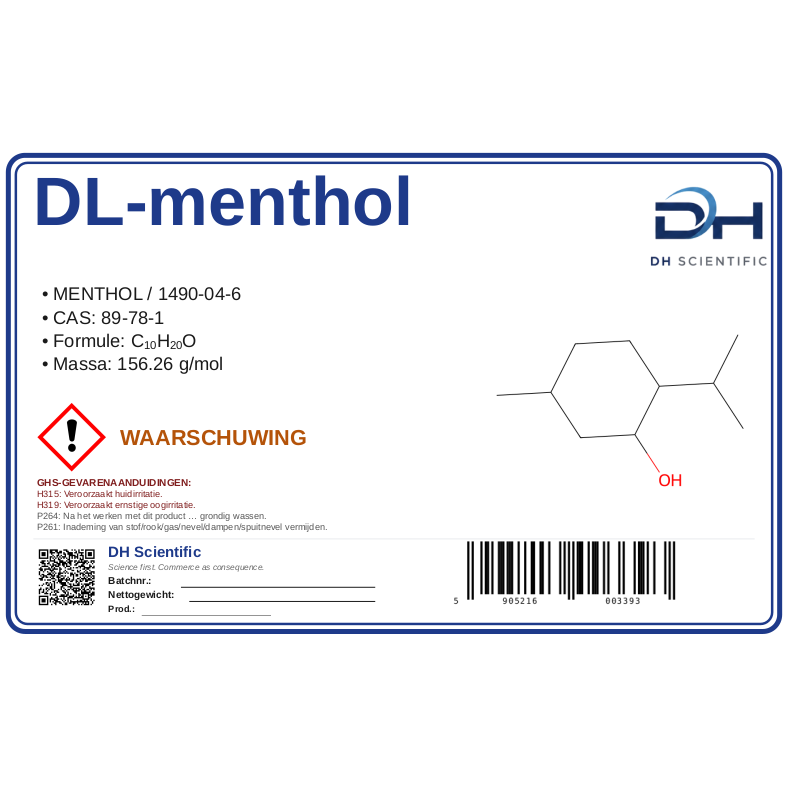
DL-menthol
0,99 €
Chemisch reagens Mentol (CAS 89-78-1). Volledige encyclopedische kaart — classificatie, eigenschappen en veiligheidsgegevens — hieronder.
🔒 Demomodus — dit artikel is niet te koop.
Legale stof. dhscientific.com is een demonstratie van het MOL-GOD-platform — wij verkopen niets en er worden geen bestellingen verwerkt. Verboden stoffen worden hier automatisch geblokkeerd op basis van de regelgevingscanon (vergelijk bijv. heptachloor).

Gegevens overgenomen uit regelgevende registers en vakliteratuur, met vermelding van bron en editie. Zij vervangen niet het veiligheidsinformatieblad van de leverancier. Velden zonder vastgelegde bron zijn als zodanig gemarkeerd.
Chemisch overzicht: MentholMolGod_OVERVIEW_1
| Molecuulformule | C10H20O[1] |
| Molecuulmassa | 156.26 g/mol[1] |
| Smeltpunt | 43 °C[1] |
| Kookpunt | 215 °C[1] |
| Dichtheid | 0.904 g/cm³[1] |
| LogP (lipofiliteit) | 3[1] |
| IUPAC-naam | 5-methyl-2-propan-2-ylcyclohexan-1-ol[1] |
| SMILES | CC1CCC(C(C1)O)C(C)C[1] |
| InChIKey | NOOLISFMXDJSKH-UHFFFAOYSA-N[1] |
Synoniemen: MENTHOL · 1490-04-6 · 2-Isopropyl-5-methylcyclohexanol · Menthyl alcohol · Mentholum
Gegevensbronnen: PubChem (NLM/NIH)
Laatst bijgewerkt: 2026-07-18
📚 Wetenschappelijke referenties (Chicago Author-Date) (1 bronnen)
- PubChem. National Center for Biotechnology Information (NIH/NLM), chemical compound database. ↗ dotyczy: Molecuulformule · Molecuulmassa · Smeltpunt · Kookpunt · Dichtheid · LogP (lipofiliteit) · IUPAC-naam · SMILES · InChIKey
WETENSCHAPPELIJK ONDERZOEK
📚 Wetenschappelijke referenties (Chicago Author-Date) 1 refs · 1 baz
MOLEKUŁA Bibliografie per CAS (live uit 13+ databases)
Bronnen: db:pubmed (1)
- db:pubmed Kazemi A, Iraji A, Esmaealzadeh N et al.. (2025). "Peppermint and menthol: a review on their biochemistry, pharmacological activities, clinical applications, and safety considerations.". Critical reviews in food science and nutrition. https://doi.org/10.1080/10408398.2023.2296991 →
Fysisch-chemische eigenschappen
Snel overzicht
🔬 Geavanceerde eigenschappen
Chemische identificatoren
CC1CCC(C(C1)O)C(C)C Laatst bijgewerkt: 2026-06-30
📡 Spectroscopie — CAS 89-78-1MolGod_SPECHUB_MAIN
Databases met spectroscopische spectra — inline-gegevens 9 bronnen MolGod_SPECDB_2
Spectra worden op aanvraag opgehaald uit 9 bronnen. Elk spectrum wordt opgeslagen in onze database — de volgende keer openen = geen enkele aanvraag naar de externe API. Download JCAMP-DX / CSV / PNG bij elk spectrum zonder te zoeken.
Referentiebron — geen openbare API. Openen in een externe database:
🔗 IR/NMR/MS (SDBS) →Referentiebron — geen openbare API. Openen in een externe database:
🔗 JP Monograph →Referentiebron — geen openbare API. Openen in een externe database:
🔗 WHO INN →Referentiebron — geen openbare API. Openen in een externe database:
🔗 DOAJ →Fysisch-chemische eigenschappen (database) 5 velden MolGod-score: Betrouwbaar
| Eigenschap | Waarde | Eenheid | Conditions | Source |
|---|---|---|---|---|
| Smeltpunt | 43 [1] | °C | 1 atm | PubChem PUG-View |
| Kookpunt | 215 [1] | °C | PubChem PUG-View | |
| Wateroplosbaarheid | 0.42 [1][2] | g/L | 25°C | PubChem PUG-View |
| Dichtheid (ρ) | 0.904 [1] | g/cm³ | 15°C | PubChem PUG-View |
| logP (octanol/water) | 3 [1] | — | PubChem PUG-View |
📚 Wetenschappelijke referenties (Chicago Author-Date) (2 bronnen)
De fysisch-chemische waarden zijn afkomstig van de onafhankelijke, peer-reviewed bronnen die hierboven zijn vermeld.
🛡️ Veiligheid — CAS 89-78-1MolGod_SAFEHUB_MAIN
GHS/CLP-indeling — Verordening (EG) nr. 1272/2008 + UN GHS Rev. 9 (2021).


🚨 Gevarenaanduidingen (H)
- H315 — Veroorzaakt huidirritatie.
- H319 — Veroorzaakt ernstige oogirritatie.
- H318 — Veroorzaakt ernstig oogletsel.
- H335 — Kan irritatie van de luchtwegen veroorzaken.
- H402 — Harmful to aquatic life
- H412 — Schadelijk voor in het water levende organismen, met langdurige gevolgen.
🛡 Voorzorgsmaatregelen (P)
- P264 — Na het werken met dit product … grondig wassen.
- P280 — Beschermende handschoenen/beschermende kleding/oogbescherming/gelaatsbescherming dragen.
- P302+P352 — BIJ CONTACT MET DE HUID: Met veel water/… wassen.
- P305+P351+P338 — BIJ CONTACT MET DE OGEN: Voorzichtig afspoelen met water gedurende een aantal minuten.; Contactlenzen verwijderen, indien mogelijk; blijven spoelen.
- P332+P313 — Bij huidirritatie: Een arts raadplegen.
- P337+P313 — Bij aanhoudende oogirritatie: Een arts raadplegen.
- P501 — Inhoud/verpakking afvoeren naar …
⚠ Indeling op basis van een consensus van bronnen (PubChem / kennisgevingen van leveranciers) — niet geverifieerd tegen de geharmoniseerde indeling in bijlage VI (CLP). De omvang van de gevaren kan ruimer zijn dan de officiële indeling; verifieer vóór gebruik aan de hand van het actuele veiligheidsinformatieblad van de leverancier.
Vertalingen: CLP-verordening (EG) 1272/2008, Bijlage III en IV. Gegevens: PubChem/NLM.
📚 Geconsolideerde wetenschappelijke referenties — Chicago Author-Date 10 bronnen
Referenties verzameld uit alle tabbladen van de Safety Hub. CAS: 89-78-1 ·
PubChem ↗
- Parlament Europejski i Rada UE. 2008. "Rozporządzenie (WE) nr 1272/2008 w sprawie klasyfikacji, oznakowania i pakowania substancji (CLP)." Dz.Urz. UE L 353. [↗] GHS, Regelgeving
- United Nations Economic Commission for Europe (UNECE). 2021. "Globally Harmonized System of Classification and Labelling of Chemicals (GHS), Ninth Revised Edition." United Nations, Geneva. [↗] GHS
- Goldfrank, Lewis R., Robert S. Hoffman, Mary Ann Howland, et al.. 2019. "Goldfrank's Toxicologic Emergencies, 11th ed.." McGraw-Hill Education, New York. ISBN 978-1-25-985961-8. Pierwsza pomoc, Toksykologia
- National Institute for Occupational Safety and Health (NIOSH). 2023. "NIOSH Pocket Guide to Chemical Hazards (DHHS Publ. 2005-149)." U.S. Department of Health and Human Services / CDC, Cincinnati, OH. [↗] Pierwsza pomoc, PPE, Toksykologia
- European Committee for Standardization (CEN). 2016. "EN 374-1:2016 — Protective gloves against dangerous chemicals and micro-organisms." CEN, Brussels. [↗] PPE
- UNECE. 2023. "European Agreement Concerning the International Carriage of Dangerous Goods by Road (ADR 2025)." United Nations, Geneva. [↗] Utylizacja, Regulacje
- National Fire Protection Association (NFPA). 2022. "NFPA 400 — Hazardous Materials Code." NFPA, Quincy, MA. [↗] Magazynowanie
- Urben, P.G. (ed.). 2017. "Bretherick's Handbook of Reactive Chemical Hazards, 8th ed.." Butterworth-Heinemann / Elsevier, Oxford. [↗] Magazynowanie
- Ministerstwo Klimatu i Środowiska RP. 2023. "Baza danych o produktach i opakowaniach oraz o gospodarce odpadami (BDO)." Ministerstwo Klimatu i Środowiska, Warszawa. [↗] Utylizacja
- International Agency for Research on Cancer (IARC / WHO). 2024. "IARC Monographs on the Identification of Carcinogenic Hazards to Humans — List of Classifications." WHO, Lyon. [↗] Toksykologia
Tabbladen met eigen referenties (Emergency, PPE, Storage, Waste) bevatten aanvullende bibliografische vermeldingen binnen hun respectieve secties.
Analytische statistiek (t-test · RSD · Grubbs · Q-Dixon) ICH Q2
Plak een reeks herhaalde metingen (CSV of één getal per regel). De calculator berekent het gemiddelde, de standaardafwijking en 95% CI, en detecteert uitschieters (Grubbs + Dixon Q).
📐 Statistische formules
x̄ = Σxᵢ / n— rekenkundig gemiddeldes² = Σ(xᵢ - x̄)² / (n-1)— steekproefvarianties = √s²— standaardafwijkingRSD% = (s / x̄) × 100%— relatieve standaardafwijkingCI₉₅ = x̄ ± t(0.05, n-1) × s / √n— Student's tG = |xᵢ - x̄| / s— Grubbs-testQ = |xsuspect - xnearest| / |xmax - xmin|— Dixon Q-test
Bron: ICH Q2(R2) Validation of Analytical Procedures · ICH PDF ↗
Bufferrecept-calculator UNIEK
Kies een buffer uit de lijst van 20 populaire systemen → voer de streef-pH in → ontvang een exact recept met de af te wegen massa's.
Stap 1: Kies een buffersysteem
📜 Receptgeschiedenis (laatste 10)
🔧 HPLC-troubleshooting — beslissingsboom 6 veelvoorkomende problemen
Diagnostiek van de 6 meest voorkomende HPLC-problemen met een beslissingsboom (5 stappen per probleem). Bron: Snyder/Kirkland/Dolan 3rd ed. Chapter 17 + LCGC LC Troubleshooting columns 1989-2024.
Verbrede pieken (broad peaks) medium
Symptoom: Alle pieken op het chromatogram zijn breder dan verwacht (FWHM > 2× normaal)
🔍 Diagnostische boom:
-
1. Controleer of alle pieken verbreed zijn of slechts sommige
→ JA: Alle → instrumenteel probleem (kolom of systeem)
→ NEE: Slechts sommige → chemisch probleem (interactie met de kolom voor specifieke analyten) -
2. Verwissel met een testkolom — verdwijnt het probleem?
→ JA: KOLOM versleten — packing beschadigd, void in de eerste mm. Vervang hem.
→ NEE: Probleem in het LC-systeem -
3. Controleer het dode volume (dead volume) — injectielus, verbindingen, detector
→ JA: Lus > 100 µL voor een 4.6 mm kolom of losse verbindingen → vervang de ferrules, kort de leidingen in
→ NEE: Diagnostiek voortzetten -
4. Temperatuurtest: verhoog de kolom van 25°C naar 40°C
→ JA: Smallere pieken → massatransferkinetiek te traag (verhoog T)
→ NEE: Continue -
5. Controleer het debiet t.o.v. het van Deemter-optimum voor deze kolom
→ JA: Optimum voor 4.6mm/5µm = 1.0 mL/min, voor 2.1mm/3µm = 0.4 mL/min
→ NEE: Continue
- Kolom versleten (>2000 injecties zonder voorkolom)
- Dood volume van het systeem > 100 µL (verkeerde lus, lange leidingen, losse ferrules)
- Temperatuur te laag (massatransferkinetiek)
- Debiet buiten het van Deemter-optimum
- Monsteroplosmiddel sterker dan mobiele fase A
- ✓ Vervang de kolom (bij >2000 injecties)
- ✓ Controleer alle verbindingen — houd de leidingen zo kort mogelijk
- ✓ Verhoog de kolomtemperatuur naar 40°C (als de stof stabiel is)
- ✓ Verlaag het debiet naar het van Deemter-optimum
- ✓ Los het monster op in mobiele fase A (niet in puur organisch)
Piektailing (tailing, T > 1.5) high
Symptoom: Pieken hebben een verlengde "staart" aan de late-elutiezijde (asymmetrie T = b/a > 1.5 volgens USP)
🔍 Diagnostische boom:
-
1. Bevat de stof basische groepen (amino, pyridine)?
→ JA: Ja → silanolinteracties! Voeg 0.1% TFA of 5-10 mM TEA toe aan mobiele fase A.
→ NEE: Continue -
2. Controleer de pH van de mobiele fase t.o.v. de pKa van de stof
→ JA: pH = pKa ± 1 → gedeeltelijke ionisatie, peak split. Verplaats de pH ≥ 2 eenheden weg van de pKa.
→ NEE: Continue -
3. Controleer de leeftijd van de kolom (>1500 injecties?)
→ JA: Ja → blootgelegde silanolen (column bleed). Vervang door een kolom met hogere endcapping (XTerra, Symmetry).
→ NEE: Continue -
4. Bevat het monster metalen (Fe, Cu uit glazen flesjes)?
→ JA: Ja → gebruik kleurloze type II-flesjes of PFA. Voeg 0.1mM EDTA toe aan het monster.
→ NEE: Continue
- Silanolinteracties (basische analyt + vrije silanolen van silicagel)
- pH op de grens van de pKa van de analyt (peak split)
- Oude kolom (column bleed, hoge silanolactiviteit)
- Metalen in het monster (chelatie → tailing)
- Kolomoverbelasting (>50 µg op een 4.6mm kolom)
- ✓ Voeg 0.1% TFA (UV) of 0.1% mierenzuur (LC-MS) toe aan mobiele fase A
- ✓ Kies een kolom met hoogzuivere endcapping: Waters XBridge BEH, Phenomenex Kinetex
- ✓ Werk bij een pH ≥ 2 eenheden weg van de pKa
- ✓ 0.1mM EDTA aan het monster (Fe/Cu-chelatie)
- ✓ Verlaag het injectievolume naar ≤ 20 µL voor een 4.6mm kolom
Basislijndrift (baseline drift) medium
Symptoom: De basislijn stijgt of daalt systematisch gedurende >5 minuten
🔍 Diagnostische boom:
-
1. Gebruik je een gradiënt (B% neemt toe)?
→ JA: Ja → verschillende absorptie van fasen A vs B bij dλ. Oplosmiddelwisseling in de UV-cutoff. Controleer de UV-absorptie van het % organisch.
→ NEE: Verder (isocratisch) -
2. Controleer de kolomtemperatuur — is deze stabiel tot ±0.5°C?
→ JA: Ja (stabiel) → verder
→ NEE: Instabiel → schakel de kolomthermostaat in (>25°C gecontroleerd) -
3. Test: schakel de autosampler uit, laat alleen pomp+kolom+detector draaien
→ JA: De drift verdwijnt → contaminatie van de autosampler (reinig de naald, het septum)
→ NEE: Continue -
4. Controleer de leeftijd van de lamp (D2 voor UV)
→ JA: Ja (>1500 uur) → vervang de lamp
→ NEE: Continue
- Gradiëntelutie met verschillende UV-cutoff van de fasen
- Instabiele kolomtemperatuur
- Autosampler-contaminatie van de naald/septum
- UV-lamp oud (>1500h)
- Detector-flowcel vervuild
- Kolom niet geëquilibreerd (<10 kolomvolumes)
- ✓ Kolom voor-equilibreren gedurende 10-15 kolomvolumes bij 100% A
- ✓ Kolomthermostaat aan, T 30-40°C stabiel
- ✓ Reinig de detector-flowcel met een 50:50 ACN:H2O-oplossing
- ✓ Vervang de D2-lamp indien >1500h
- ✓ Gebruik baseline subtraction (Chromeleon, native Empower-functie)
Geen piek / verloren piek (no peak) critical
Symptoom: De verwachte analytpiek verschijnt niet op het chromatogram
🔍 Diagnostische boom:
-
1. Heeft de injectie daadwerkelijk plaatsgevonden?
→ JA: Controleer het autosampler-log, de pompdruk (moet dalen tijdens de injectie)
→ NEE: Autosampler-probleem → controleer de loop, de naald, het monster in de vial -
2. Zit het monster in de vial (correct volume, niet verdampt)?
→ JA: Continue
→ NEE: Geen monster — opnieuw pipetteren -
3. Monsterstabiliteit — >24h geleden bereid?
→ JA: Ja → degradatie. Bereid een vers monster opnieuw.
→ NEE: Continue -
4. Controleer de detectiegolflengte t.o.v. de λmax van de stof
→ JA: Detectie bij λ komt NIET overeen met λmax → geen signaal. Scan DAD 200-400nm.
→ NEE: Continue -
5. Test: injecteer een zuivere standaard (van bekende concentratie, vers)
→ JA: De standaard geeft een piek → probleem met het monster (matrix, derivatisering)
→ NEE: Ook geen piek met de standaard → systeemprobleem (kolom, fase, gradiënt)
- Monster niet uit de vial genomen (autosampler-bug)
- Monster gedegradeerd (>24h pH/temp/licht)
- Detectie bij de verkeerde golflengte
- Verkeerde mobiele fase (bijv. vergeten TFA)
- Kolom omgekeerd / verkeerde stationaire fase
- De stof elueert op het front (V0) → niet vastgehouden, niet zichtbaar
- ✓ Bereid een vers monster opnieuw volgens het exacte protocol
- ✓ UV-Vis DAD-scan 200-400nm + zoeken naar λmax
- ✓ Controleer de samenstelling van de mobiele fase — is TFA toegevoegd?
- ✓ Test de omgekeerde kolomrichting (voorzichtig!)
- ✓ Voor retentie <1 min — verlaag de % B, MeOH in plaats van ACN
- ✓ Controleer de verwachte retentietijd in de methodedatabase van de plug-in
Druk te hoog (pressure too high) critical
Symptoom: Pompdruk > 80% van het kolommaximum of systeem-shutdown met high-pressure error
🔍 Diagnostische boom:
-
1. Controleer of de kolom correct is aangesloten (richting van de pijl)
→ JA: OK
→ NEE: Kolom omgekeerd → draai om (nooit "achterstevoren" gebruiken) -
2. Test: verwijder de kolom uit het systeem, laat alleen pomp+detector draaien
→ JA: Druk daalt naar <50 bar → probleem in de kolom (verstopt)
→ NEE: Druk blijft hoog → in-line filter verstopt, frit vervuild -
3. Controleer het pre-kolomfilter (in-line frit)
→ JA: Vervuild en bruin → vervangen
→ NEE: Continue -
4. Spoel de kolom terug met 50:50 ACN:H2O zonder de kolom — verdwijnt het?
→ JA: Deeltjes vast in de eerste mm — een flush van 30 min kan het herstellen
→ NEE: Vervang de kolom
- In-line filter (frit) verstopt met deeltjes
- Buffer salting-out (precipitatie bij hoog %B)
- Monster bevat zwevende deeltjes (filtreer 0.22 µm vóór injectie)
- Kolom verstopt (column bed compaction)
- Gradiënt met bufferfase + veel organisch → zoutprecipitatie
- ✓ Filtreer het monster ALTIJD door 0.22 µm PVDF vóór injectie
- ✓ Vervang het in-line filter elke 100 injecties (of wanneer de druk >20% stijgt)
- ✓ Gebruik GEEN >20mM fosfaatbuffer + >70% ACN (het zout slaat neer)
- ✓ Spoel de kolom 30 min met 50:50 ACN:H2O in de omgekeerde richting (wanneer de fabrikant dit toestaat)
- ✓ Pre-kolom 4×3mm ter bescherming van de hoofdkolom
Spookpieken (ghost peaks) high
Symptoom: Onverklaarde pieken op het chromatogram die afwezig zijn in de kalibratie
🔍 Diagnostische boom:
-
1. Test: blanco injectie (zuiver monsteroplosmiddel)
→ JA: Er verschijnt een spookpiek → contaminatie van het systeem of de eluenten
→ NEE: Verschijnt alleen bij het monster → matrix -
2. Groeit de spookpiek met de gradiënt (elueert bij hoog %B)?
→ JA: Ja → overladen kolom of sterk vastgehouden uit een vorige run
→ NEE: Onafhankelijk van de gradiënt → autosampler carryover -
3. Increase carryover wash (between injections)
→ JA: Helpt → carryover was de oorzaak. Sterker wasprotocol.
→ NEE: Continue -
4. Injectie van zuiver water — is er een piek?
→ JA: Ja → contaminatie van de waterbron (organische stoffen uit het DI-systeem)
→ NEE: Continue
- Carryover in de autosampler-naald/loop
- Contaminatie van het eluens (zelfs HPLC-grade)
- Sterk vastgehouden componenten uit vorige runs
- Plastic in de vials (ftalaten, PEG uit de doppen)
- DI-water onvoldoende gezuiverd
- ✓ Versterk het wasprotocol: 100% B → 100% A → 50:50 (3 cycli)
- ✓ Sterke was: 100% DMSO of 100% MeOH vóór de kalibratie
- ✓ Filtreer de eluenten door 0.22 µm PTFE bij twijfel
- ✓ Gebruik amberkleurig glas + doppen met Teflon-coating voor monsters
- ✓ Periodieke gradiëntramp naar 100% B gedurende 10 min (clean-out)
📚 Wetenschappelijke referenties (Chicago Author-Date) — klik om uit te klappen
- Snyder, Lloyd R., Joseph J. Kirkland, and John W. Dolan. 2010. Introduction to Modern Liquid Chromatography. 3rd ed. John Wiley & Sons. Chapter 17 (Troubleshooting) pp. 559-616. ISBN 978-0-470-16754-0. https://doi.org/10.1002/9780470508183 [link ↗]
- Dolan, John W.. 2014. LC Troubleshooting (monthly column 1989-2024). LCGC North America. [link ↗] — John Dolan 35-letnia seria miesięcznych artykułów problemowych
- Kromidas, Stavros. 2017. HPLC Made to Measure: A Practical Handbook for Optimization. 2nd ed. Wiley-VCH. ISBN 978-3-527-31377-1. — Praktyczny przewodnik problem-solving dla labs analitycznych
- Dolan, John W.. 2013. When to Modify Method Conditions. 192-199. [link ↗] — Decision flow for changing flow rate / temperature / %B vs swapping columns.
- Dong, Michael W.. 2019. HPLC and UHPLC for Practicing Scientists. 2nd ed. Wiley. ISBN 978-1-119-31378-3. https://doi.org/10.1002/9781119313793 [link ↗] — Chapter 9 covers troubleshooting modern UHPLC systems (sub-2 µm particles).
- Meyer, Veronika R.. 2010. Practical High-Performance Liquid Chromatography. 5th ed. Wiley. ISBN 978-0-470-68218-0. — Solid step-by-step problem isolation chapter (eluents, columns, instruments).
- Snyder, L. R., J. J. Kirkland, and J. L. Glajch. 1997. Practical HPLC Method Development. 2nd ed. Wiley. ISBN 978-0-471-00703-6. — Method-development companion volume with troubleshooting cross-refs.
- Carr, Peter W.. 2009. The new physical chemistry of HPLC. 1764-1772. https://doi.org/10.1016/j.chroma.2008.11.094 [link ↗] — Theoretical basis for diagnosing efficiency losses (mass-transfer, eddy diffusion).
- Heyden, Yvan Vander, et al.. 2009. Robustness of pharmaceutical liquid chromatographic methods. 2120-2129. https://doi.org/10.1016/j.jchromb.2008.10.052 [link ↗] — How to diagnose method failures vs. system failures (Plackett-Burman).
- Engelhardt, Heinz. 2014. 100 Years of Chromatography. 2nd ed. Wiley-VCH. ISBN 978-3-527-33473-5. — Historical context for ghost-peak phenomenology (silica chemistry).
Deskryptory Lipinskiego (struktura)
Radardiagram van drug-likeness (Lipinski Ro5 / Veber). Groene zone = overeenstemming met de criteria.
Voorspellende gegevens — eigenschappen berekend in silico (SMILES/RDKit). Deze vervangen geen klinische studies. Niet gebruiken voor de beoordeling van geneesmiddelen zonder experimentele verificatie.
| Eigenschap | Waarde | Beoordeling |
|---|---|---|
| Absorptie (GI) | hoog | ✓ |
| BBB-permeabiliteit | ja (dringt door) | |
| Biobeschikbaarheid (Daina 2017) | 55% | |
| CYP450-profiel | CYP1A2 inhibitorCYP2C9 non-inhibitorCYP2C19 non-inhibitorCYP2D6 inhibitorCYP3A4 non-inhibitor | |
| PAINS-waarschuwingen | 0 | ✓ |
| Brenk-waarschuwingen | 0 | ✓ |
| pKa (pH 7.4) | 16 (predicted) | |
| hERG (cardiotox.) | ✓ nee | |
| P-gp-substraat | — | |
| Ames-mutageniteit | ✓ nee | |
| DILI (hepatotox.) | — | |
| LogS (wateroplosb.) | — | |
Bronnen (ADMET-methodologie)
- Lipinski, Christopher A., Franco Lombardo, Beryl W. Dominy, and Paul J. Feeney. 1997. "Experimental and computational approaches to estimate solubility and permeability in drug discovery and development settings." Advanced Drug Delivery Reviews 23 (1-3): 3-25.
- Veber, Daniel F., Stephen R. Johnson, Hung-Yuan Cheng, et al. 2002. "Molecular properties that influence the oral bioavailability of drug candidates." Journal of Medicinal Chemistry 45 (12): 2615-2623.
- Daina, Antoine, Olivier Michielin, and Vincent Zoete. 2017. "SwissADME: a free web tool to evaluate pharmacokinetics, drug-likeness and medicinal chemistry friendliness." Scientific Reports 7: 42717.
- Egan, William J., and Gregory Lauri. 2002. "Prediction of intestinal permeability." Advanced Drug Delivery Reviews 54 (3): 273-289.
- Baell, Jonathan B., and Georgina A. Holloway. 2010. "New substructure filters for removal of pan assay interference compounds (PAINS) from screening libraries." Journal of Medicinal Chemistry 53 (7): 2719-2740.
- Brenk, Ruth, Alessandro Schipani, Daniel James, et al. 2008. "Lessons learnt from assembling screening libraries for drug discovery for neglected diseases." ChemMedChem 3 (3): 435-444.
- Ertl, Peter, and Ansgar Schuffenhauer. 2009. "Estimation of synthetic accessibility score of drug-like molecules based on molecular complexity and fragment contributions." Journal of Cheminformatics 1: 8.
- Bickerton, G. Richard, Gaia V. Paolini, Jérémy Besnard, Sorel Muresan, and Andrew L. Hopkins. 2012. "Quantifying the Chemical Beauty of Drugs." Nature Chemistry 4 (2): 90-98.
- Hopkins, Andrew L., and Colin R. Groom. 2002. "The Druggable Genome." Nature Reviews Drug Discovery 1 (9): 727-730.
- Ghose, Arup K., Vellarkad N. Viswanadhan, and John J. Wendoloski. 1999. "A Knowledge-Based Approach in Designing Combinatorial or Medicinal Chemistry Libraries for Drug Discovery." Journal of Combinatorial Chemistry 1 (1): 55-68.
- Tice, Raymond R., Christopher P. Austin, Robert J. Kavlock, and John R. Bucher. 2013. "Improving the Human Hazard Characterization of Chemicals: A Tox21 Update." Environmental Health Perspectives 121 (7): 756-765.
- Leeson, Paul D., and Brian Springthorpe. 2007. "The Influence of Drug-Like Concepts on Decision-Making in Medicinal Chemistry." Nature Reviews Drug Discovery 6 (11): 881-890.
- Hann, Michael M. 2011. "Molecular Obesity, Potency and Other Addictions in Drug Discovery." MedChemComm 2 (5): 349-355.
- Davies, Mark, Michał Nowotka, George Papadatos, et al. 2015. "ChEMBL Web Services: Streamlining Access to Drug Discovery Data and Utilities." Nucleic Acids Research 43 (W1): W612-W620.
- Walters, W. Patrick, and Mark A. Murcko. 2002. "Prediction of 'Drug-Likeness.'". Advanced Drug Delivery Reviews 54 (3): 255–271. https://doi.org/10.1016/S0169-409X(02)00003-0.
- Congreve, Miles, Robin Carr, Christopher Murray, and Harren Jhoti. 2003. "A 'Rule of Three' for Fragment-Based Lead Discovery?" Drug Discovery Today 8 (19): 876–877. https://doi.org/10.1016/S1359-6446(03)02831-9.
- Brenk, Ruth, Alessandro Schipani, Daniel James, Agata Krasowski, Iain Hugh Gilbert, Julie Frearson, and Paul Graham Wyatt. 2008. "Lessons Learnt from Assembling Screening Libraries for Drug Discovery for Neglected Diseases." ChemMedChem 3 (3): 435-444.
- Schomburg, Karen T., Sascha Bietz, Hans Briem, Andrea M. Henzler, Stefan Urbaczek, and Matthias Rarey. 2014. "Facing the Challenges of Structure-Based Target Prediction by Inverse Virtual Screening." Journal of Chemical Information and Modeling 54 (6): 1676-1686.
- Bemis, Guy W., and Mark A. Murcko. 1996. "The Properties of Known Drugs. 1. Molecular Frameworks." Journal of Medicinal Chemistry 39 (15): 2887-2893.
- Schomburg, Karen T., and Matthias Rarey. 2014. "What Is the Potential of Structure-Based Target Prediction Methods?" Future Medicinal Chemistry 6 (17): 1987-1989.
- Kazemi A, Iraji A, Esmaealzadeh N et al.. (2025). "Peppermint and menthol: a review on their biochemistry, pharmacological activities, clinical applications, and safety considerations.". Critical reviews in food science and nutrition. https://doi.org/10.1080/10408398.2023.2296991
- &NA;. 1993. "Menthol benefits not all in the mind." Inpharma Weekly &NA; (909): 20. https://doi.org/10.2165/00128413-199309090-00053. [DOI ↗]
- Bolton, Evan E., Yanli Wang, Paul A. Thiessen, and Stephen H. Bryant. 2008. "PubChem: Integrated Platform of Small Molecules and Biological Activities." Annual Reports in Computational Chemistry 4: 217-241. [DOI ↗]
- Kim, Sunghwan, Jie Chen, Tiejun Cheng, et al. 2023. "PubChem 2023 update." Nucleic Acids Research 51 (D1): D1373-D1380. [DOI ↗]
- Kim, Sunghwan, Tiejun Cheng, Jianyong He, Chen Cheng, et al. 2021. "PubChem Protein, Pathway, Reaction, and Disease Specifications." Journal of Cheminformatics 13: 16. [DOI ↗]
- Hähnke, Volker D., Sunghwan Kim, and Evan E. Bolton. 2018. "PubChem chemical structure standardization." Journal of Cheminformatics 10: 36. [DOI ↗]
- Wang, Yanli, Stephen H. Bryant, Tiejun Cheng, Jiyao Wang, et al. 2017. "PubChem BioAssay: 2017 update." Nucleic Acids Research 45 (D1): D955-D963. [DOI ↗]
- Cheng, Tiejun, et al. 2014. "Computation of Octanol-Water Partition Coefficients by Guiding an Additive Model with Knowledge." Journal of Chemical Information and Modeling 54 (3): 793-805. [DOI ↗]
- Wilkinson, Mark D., et al. 2016. "The FAIR Guiding Principles for scientific data management and stewardship." Scientific Data 3: 160018. [DOI ↗]
- Hersey, Anne, et al. 2015. "Chemical databases: curation or integration by user-defined equivalence?" Drug Discovery Today: Technologies 14: 17-24.
- Colby Flade. 2022. "Menthol." Flade, Colby. ↗
- United States. Food and Drug Administration. 2013. "Preliminary scientific evaluation of the possible public health effects of methol verson nonmenthol cigarettes." Food and Drug Administration. ↗
- United States. Food and Drug Administration. 2011. "Menthol cigarettes." Food and Drug Administration. ↗
- Veber, Daniel F., Stephen R. Johnson, Hung-Yuan Cheng, Brian R. Smith, Keith W. Ward, and Kenneth D. Kopple. 2002. "Molecular Properties That Influence the Oral Bioavailability of Drug Candidates." Journal of Medicinal Chemistry 45 (12): 2615-2623.
- ECHA. 2024. "REACH Guidance." European Chemicals Agency. ↗
- Groom, Colin R., Ian J. Bruno, Matthew P. Lightfoot, and Suzanna C. Ward. 2016. "The Cambridge Structural Database." Acta Crystallographica Section B 72 (2): 171-179. ↗
🧪 Assistent voor bereiding van oplossingen (Smart Prep) MolGod_PREP_2
Voer in wat u wilt bereiden — ik genereer een SOP
📚 Overzicht van de wetenschappelijke literatuur — CAS 89-78-1MolGod_LITHUB_MAIN
⭐ Belangrijkste bevindingen (wetenschappelijke literatuur) 2 publicaties
89-78-1
— multi-criteria ranking (W12): 30% citaties · 20% recentheid · 20% onderwerp · 15% historisch · 15% open access.
-
#1Gerloff J; Sundar IK; Freter R et al. (2017) · Applied in vitro toxicologyWaarom het belangrijk is: Verplicht citaat (canon) · 162 citaties
-
#2Kazemi A, Iraji A, Esmaealzadeh N et al. (2025) · Critical reviews in food science and nutritionWaarom het belangrijk is: Recent (2025) · overzichtsartikel
📚 REFERENTIES (Verzamelde bibliografie, Chicago Author-Date) 126 items
Alle wetenschappelijke bronnen die in de accordeons hierboven voor CAS 89-78-1 worden geciteerd.Formaat: Chicago Manual of Style 17e ed., Author-Date-systeem.
🗄️ Wetenschappelijke databanken
- NIST. n.d. NIST Chemistry WebBook: CAS 89-78-1. Gaithersburg, MD: National Institute of Standards and Technology. https://webbook.nist.gov/cgi/cbook.cgi?ID=89-78-1.
- AIST. n.d. Spectral Database for Organic Compounds (SDBS): CAS 89-78-1. Tsukuba, Japan: National Institute of Advanced Industrial Science and Technology. https://sdbs.db.aist.go.jp/.
- Linstrom, Peter J., and William G. Mallard, eds. n.d. NIST Chemistry WebBook: NIST Standard Reference Database Number 69. Gaithersburg, MD: National Institute of Standards and Technology. https://doi.org/10.18434/T4D303.
- PubChem. n.d. PubChem Compound Summary: CAS 89-78-1. Bethesda, MD: National Center for Biotechnology Information (NCBI), National Library of Medicine. https://pubchem.ncbi.nlm.nih.gov/#query=89-78-1.
- U.S. EPA. n.d. CompTox Chemicals Dashboard: CAS 89-78-1. Research Triangle Park, NC: U.S. Environmental Protection Agency. https://comptox.epa.gov/dashboard/chemical/details/DTXSID1020805.
📐 Standaarden / Richtlijnen
- ICH. 2003. "Stability Testing of New Drug Substances and Products: Q1A(R2)." Geneva: International Council for Harmonisation of Technical Requirements for Pharmaceuticals for Human Use. https://database.ich.org/sites/default/files/Q1A%28R2%29%20Guideline.pdf.
- National Fire Protection Association (NFPA). 2024. "NFPA 30: Flammable and Combustible Liquids Code." NFPA, Quincy, MA. https://www.nfpa.org/codes-and-standards/all-codes-and-standards/list-of-codes-and-standards/detail?code=30.
- Occupational Safety and Health Administration (OSHA). 2023. "29 CFR 1910.106 — Flammable Liquids." U.S. Department of Labor, Federal Register. https://www.osha.gov/laws-regs/regulations/standardnumber/1910/1910.106.
- European Chemicals Agency (ECHA). 2024. "Annex VI to Regulation (EC) No 1272/2008 (CLP) — Harmonised Classification and Labelling." ECHA, Helsinki / Official Journal of the European Union. https://echa.europa.eu/regulations/clp/clp-classification.
- European Committee for Standardization (CEN). 2016. "EN 374-1:2016 — Protective gloves against dangerous chemicals and micro-organisms — Part 1: Terminology and performance requirements for chemical risks." CEN, Brussels. https://standards.cencenelec.eu/dyn/www/f?p=205:110:::::FSP_PROJECT,FSP_ORG_ID:38536,6080&cs=1B0DAA8B85DF42E4A2C70E5D71F0BFA32.
- European Committee for Standardization (CEN). 2001. "EN 166:2001 — Personal eye-protection — Specifications." CEN, Brussels. https://standards.cencenelec.eu/dyn/www/f?p=CEN:110:0::::FSP_PROJECT:6541&cs=1F1A4E0A78C4DB6A28DBE2E8C29D89DCF.
- European Committee for Standardization (CEN). 2009. "EN 14605:2005+A1:2009 — Protective clothing against liquid chemicals — Performance requirements for clothing with liquid-tight (Type 3) or spray-tight (Type 4) connections." CEN, Brussels. https://standards.cencenelec.eu/dyn/www/f?p=CEN:110:0::::FSP_PROJECT:21581&cs=1A04A2D3C7CC58E9E6CB58D55F7EBFB7E.
- National Institute for Occupational Safety and Health (NIOSH). 2017. "Recommendations for Chemical Protective Clothing: A Companion to the NIOSH Pocket Guide." U.S. Department of Health & Human Services / CDC. https://www.cdc.gov/niosh/ncpc/default.html.
- Occupational Safety and Health Administration (OSHA). 2011. "Personal Protective Equipment — General requirements." U.S. Department of Labor — 29 CFR 1910.132. https://www.osha.gov/laws-regs/regulations/standardnumber/1910/1910.132.
📖 Boeken
- Hansen, Charles M. 2007. Hansen Solubility Parameters: A User's Handbook, 2nd ed.. Boca Raton, FL: CRC Press. https://www.routledge.com/Hansen-Solubility-Parameters-A-Users-Handbook/Hansen/p/book/9780849372483.
- Barton, Allan F. M. 1991. CRC Handbook of Solubility Parameters and Other Cohesion Parameters: 2nd ed.. Boca Raton, FL: CRC Press. https://www.routledge.com/CRC-Handbook-of-Solubility-Parameters-and-Other-Cohesion-Parameters/Barton/p/book/9780849301766.
- Connors, Kenneth A., Gordon L. Amidon, and Valentino J. Stella. 1986. Chemical Stability of Pharmaceuticals: A Handbook for Pharmacists, 2nd ed.. New York: Wiley. https://doi.org/10.1002/0471734683.
- Rumble, John R., ed. 2019. CRC Handbook of Chemistry and Physics: 100th Edition. Boca Raton, FL: CRC Press. https://hbcp.chemnetbase.com/.
- Urben, Peter G. 2017. Bretherick's Handbook of Reactive Chemical Hazards, 8th Edition. Academic Press / Elsevier, Oxford. https://www.sciencedirect.com/book/9780081010594.
📄 Wetenschappelijke artikelen (peer-reviewed)
- Stefanis, Emmanuel, and Costas Panayiotou. 2008. "Prediction of Hansen Solubility Parameters with a New Group-Contribution Method." International Journal of Thermophysics 29: 568-585. https://doi.org/10.1007/s10765-008-0415-z.
- Stoll, Vincent S., and John S. Blanchard. 1990. "Buffers: Principles and Practice: In Methods in Enzymology, vol. 182." San Diego: Academic Press. https://doi.org/10.1016/0076-6879(90)82008-P.
🌐 Websites
- ECHA. 2023. "Guidance on the Application of the CLP Criteria." European Chemicals Agency. https://echa.europa.eu/guidance-documents/guidance-on-clp.
- European Parliament. 2006. "Regulation (EC) No 1907/2006 (REACH)." Official Journal of the European Union L 396: 1–849.
- ECHA. 2023. "Candidate List of Substances of Very High Concern for Authorisation." European Chemicals Agency. https://echa.europa.eu/candidate-list-table.
- European Parliament. 2008. "Regulation (EC) No 1272/2008 on Classification, Labelling and Packaging of Substances and Mixtures (CLP)." Official Journal of the European Union L 353: 1–1355.
- ECHA. 2017. "Guidance on the Compilation of Safety Data Sheets." Version 3.1. European Chemicals Agency. ECHA-17-G-01-EN. https://echa.europa.eu/documents/10162/23047722/sds_en.pdf.
- ECHA. 2022. "Restrictions Under REACH — Annex XVII." European Chemicals Agency. https://echa.europa.eu/substances-restricted-under-reach.
- United Nations. 2021. Globally Harmonized System of Classification and Labelling of Chemicals (GHS). 9th revised ed. ST/SG/AC.10/30/Rev.9. New York and Geneva: United Nations. https://unece.org/ghs-rev9-2021.
- ECHA. 2020. "Understanding REACH." European Chemicals Agency. https://echa.europa.eu/regulations/reach/understanding-reach.
- U.S. Occupational Safety and Health Administration (2024) — 29 CFR 1910.120 — Hazardous Waste Operations and Emergency Response (HAZWOPER) https://www.osha.gov/hazwoper.
- National Fire Protection Association (2018) — NFPA 472: Standard for Competence of Responders to Hazardous Materials/Weapons of Mass Destruction Incidents https://www.nfpa.org/codes-and-standards/nfpa-472.
- European Parliament and Council (2012) — Directive 2012/18/EU on the Control of Major-Accident Hazards Involving Dangerous Substances (Seveso III) https://eur-lex.europa.eu/legal-content/EN/TXT/?uri=celex:32012L0018.
- U.S. National Institute for Occupational Safety and Health (2024) — NIOSH Pocket Guide to Chemical Hazards https://www.cdc.gov/niosh/npg/.
- European Chemicals Agency (2020) — Guidance on the Compilation of Safety Data Sheets (SDS), Version 3.1 https://echa.europa.eu/documents/10162/23047722/sds_en.pdf.
- Snyder, Lloyd R., John W. Dolan, and Joseph J. Kirkland. 2010. Introduction to Modern Liquid Chromatography. Wiley.
- Schoenmakers, Peter J.. 1986. Optimization of Chromatographic Selectivity: A Guide to Method Development. Elsevier.
- Snyder, L. R., and J. W. Dolan. 2007. High-Performance Gradient Elution: The Practical Application of the Linear-Solvent-Strength Model. Wiley.
- Nikitas, Pavlos, and Adrian Pappa-Louisi. 2009. "Retention models for isocratic and gradient elution in reversed-phase liquid chromatography." Journal of Chromatography A 1216: 1737-1755. https://doi.org/10.1016/j.chroma.2008.10.005.
- Carr, Peter W.. 2009. "The new physical chemistry of HPLC." Journal of Chromatography A 1216: 1764-1772. https://doi.org/10.1016/j.chroma.2008.11.094.
- Dong, Michael W.. 2019. HPLC and UHPLC for Practicing Scientists. Wiley. https://doi.org/10.1002/9781119313793.
- Wu, Naijun, and Anton M. Clausen. 2007. "Fundamental and practical aspects of ultrahigh pressure liquid chromatography for fast separations." Journal of Separation Science 30: 1167-1182. https://doi.org/10.1002/jssc.200700026.
- Stoll, Dwight R., and Peter W. Carr. 2017. "Two-Dimensional Liquid Chromatography: A State of the Art Tutorial." Analytical Chemistry 89: 519-531. https://doi.org/10.1021/acs.analchem.6b03506.
- Dolan, John W.. 2013. "When to Modify Method Conditions." LCGC North America 31: 192-199. https://www.chromatographyonline.com/view/when-modify-method-conditions.
- Meyer, Veronika R.. 2010. Practical High-Performance Liquid Chromatography. Wiley.
- Van Deemter, J. J., F. J. Zuiderweg, and A. Klinkenberg. 1956. "Longitudinal diffusion and resistance to mass transfer as causes of nonideality in chromatography." https://doi.org/10.1016/0009-2509(56)80003-1.
- Giddings, J. Calvin. 1965. "Dynamics of Chromatography, Part I: Principles and Theory." Marcel Dekker.
- Poppe, Hans. 1997. "Some reflections on speed and efficiency of modern chromatographic methods." https://doi.org/10.1016/S0021-9673(97)00376-2.
- Wu, Naijun, and Anton M. Clausen. 2007. "Fundamental and practical aspects of ultrahigh pressure liquid chromatography for fast separations." https://doi.org/10.1002/jssc.200700026.
- Carr, Peter W.. 2009. "The new physical chemistry of HPLC." https://doi.org/10.1016/j.chroma.2008.11.094.
- Knox, John H.. 1977. "Practical aspects of LC theory." https://doi.org/10.1093/chromsci/15.9.352.
- Snyder, L. R., J. J. Kirkland, and J. L. Glajch. 1997. "Practical HPLC Method Development." Wiley.
- Engelhardt, Heinz. 2014. "100 Years of Chromatography." Wiley-VCH.
- Sadek, Paul C.. 2002. "The HPLC Solvent Guide." Wiley-Interscience.
- Snyder, L. R.. 1978. "Classification of the solvent properties of common liquids." https://doi.org/10.1093/chromsci/16.6.223.
- Reichardt, Christian, and Thomas Welton. 2010. "Solvents and Solvent Effects in Organic Chemistry." Wiley-VCH.
- Vailaya, Anant, and Csaba Horváth. 1998. "Retention thermodynamics in hydrophobic interaction chromatography." https://doi.org/10.1021/ie980212h.
- Krstulović, Andrea M., and Phyllis R. Brown. 1981. "Reversed-phase High-Performance Liquid Chromatography." Wiley.
- Boysen, Reinhard I., and Milton T. W. Hearn. 2009. "Multi-modal HPLC of proteins." https://doi.org/10.1093/chromsci/47.8.645.
- USP General Chapter <621>. 2024. "Chromatography." United States Pharmacopeial Convention. https://www.usp.org/harmonization-standards/pdg/general-chapters/chromatography.
- International Council for Harmonisation (ICH). 2023. "Validation of Analytical Procedures Q2(R2)." ICH Expert Working Group. https://database.ich.org/sites/default/files/ICH_Q2-R2_Document_Step4_Guideline_2023_1101.pdf.
- Foley, Joe P., and John G. Dorsey. 1983. "Equations for calculation of chromatographic figures of merit for ideal and skewed peaks." https://doi.org/10.1021/ac00255a033.
- Snyder, Lloyd R., Joseph J. Kirkland, and John W. Dolan. 2010. "Introduction to Modern Liquid Chromatography." Wiley. https://doi.org/10.1002/9780470508183.
- Dolan, John W.. 2003. "Peak tailing and resolution." https://www.chromatographyonline.com/view/peak-tailing-and-resolution.
- Vivó-Truyols, Gabriel, and Hans-Gerd Janssen. 2010. "Probabilistic approach to peak deconvolution in chromatography." https://doi.org/10.1021/ac101742z.
- Kromidas, Stavros. 2017. "HPLC Made to Measure: A Practical Handbook for Optimization." Wiley-VCH.
- Heyden, Yvan Vander, et al.. 2009. "Robustness of pharmaceutical liquid chromatographic methods." https://doi.org/10.1016/j.jchromb.2008.10.052.
- United States Pharmacopeial Convention. 2024. "USP <621> Chromatography." In United States Pharmacopeia and National Formulary, USP 47-NF 42. Rockville, MD: USP. https://www.uspnf.com/.
- European Pharmacopoeia Commission. 2024. "2.2.46 Chromatographic Separation Techniques." In European Pharmacopoeia, 11th ed. Strasbourg: Council of Europe — EDQM. https://www.edqm.eu/en/european-pharmacopoeia-ph-eur-11th-edition.
- International Council for Harmonisation (ICH). 2022. "ICH Q2(R2): Validation of Analytical Procedures." International Council for Harmonisation. https://database.ich.org/sites/default/files/ICH_Q2%28R2%29_Guideline_2022_1130.pdf.
- International Council for Harmonisation (ICH). 1996. "ICH Q3A: Impurities in New Drug Substances." International Council for Harmonisation. https://database.ich.org/sites/default/files/Q3A%28R2%29%20Guideline.pdf.
- International Organization for Standardization. 2017. "ISO/IEC 17025:2017 General Requirements for the Competence of Testing and Calibration Laboratories." Geneva: ISO. https://www.iso.org/standard/66912.html.
- Kolthoff, Izaak Maurits, and Philip J. Elving, eds. 1978. Treatise on Analytical Chemistry, Part I: Theory and Practice. 2nd ed. New York: Wiley-Interscience.
- Skoog, Douglas A., F. James Holler, and Stanley R. Crouch. 2018. Principles of Instrumental Analysis. 7th ed. Boston: Cengage Learning.
- Christian, Gary D., Purnendu K. Dasgupta, and Kevin A. Schug. 2014. Analytical Chemistry. 7th ed. Hoboken, NJ: Wiley.
- EURACHEM/CITAC. 2012. "Quantifying Uncertainty in Analytical Measurement." 3rd ed. EURACHEM/CITAC Guide CG 4. https://www.eurachem.org/images/stories/Guides/pdf/QUAM2012_P1.pdf.
- Snyder, Lloyd R., Joseph J. Kirkland, and John W. Dolan. 2010. "Introduction to Modern Liquid Chromatography." John Wiley & Sons. https://doi.org/10.1002/9780470508183.
- Dolan, John W.. 2003. "How much resolution is enough?." https://www.chromatographyonline.com/view/how-much-resolution-enough.
- USP General Chapter <621>. 2024. "Chromatography (System Suitability section)." United States Pharmacopeial Convention. https://www.usp.org/harmonization-standards/pdg/general-chapters/chromatography.
- US Food and Drug Administration (FDA). 2018. "Reviewer Guidance: Validation of Chromatographic Methods." US Food and Drug Administration. https://www.fda.gov/media/74954/download.
- Rozet, Eric, et al.. 2013. "Analysis of recent pharmaceutical regulatory documents on analytical method validation." https://doi.org/10.1016/j.chroma.2007.03.111.
- European Medicines Agency (EMA). 2011. "Guideline on bioanalytical method validation EMEA/CHMP/EWP/192217/2009." EMA. https://www.ema.europa.eu/en/documents/scientific-guideline/guideline-bioanalytical-method-validation_en.pdf.
- Kazakevich, Yuri V., and Rosario LoBrutto, eds.. 2007. "HPLC for Pharmaceutical Scientists." Wiley-Interscience. https://doi.org/10.1002/9780470087954.
- AOAC International. 2016. "Appendix F: Guidelines for Standard Method Performance Requirements." AOAC INTERNATIONAL. https://www.aoac.org/wp-content/uploads/2019/08/app_f.pdf.
- International Organization for Standardization. 1994. "ISO 5725-2:1994 Accuracy (Trueness and Precision) of Measurement Methods and Results — Part 2: Basic Method for the Determination of Repeatability and Reproducibility of a Standard Measurement Method." Geneva: ISO. https://www.iso.org/standard/11834.html.
- Heckert, N. A., and J. J. Filliben. 2003. "NIST/SEMATECH e-Handbook of Statistical Methods." NIST Handbook 151. Gaithersburg, MD: National Institute of Standards and Technology. https://www.itl.nist.gov/div898/handbook/.
- Grubbs, Frank E. 1950. "Sample Criteria for Testing Outlying Observations." Annals of Mathematical Statistics 21 (1): 27–58.
- Dixon, Wilfrid J. 1950. "Analysis of Extreme Values." Annals of Mathematical Statistics 21 (4): 488–506.
- Snedecor, George W., and William G. Cochran. 1989. Statistical Methods. 8th ed. Ames, IA: Iowa State University Press.
- Student [William Sealy Gosset]. 1908. "The Probable Error of a Mean." Biometrika 6 (1): 1–25.
- International Organization for Standardization. 2005. "ISO 3534-1:2006 Statistics — Vocabulary and Symbols — Part 1: General Statistical Terms and Terms Used in Probability." Geneva: ISO. https://www.iso.org/standard/40145.html.
- Thompson, Michael, Stephen L. R. Ellison, and Roger Wood. 2002. "Harmonized Guidelines for Single-Laboratory Validation of Methods of Analysis." Pure and Applied Chemistry 74 (5): 835–855.
- United Nations Economic Commission for Europe. 2024. European Agreement Concerning the International Carriage of Dangerous Goods by Road (ADR), Applicable as from 1 January 2025 (ECE/TRANS/352). Geneva: UNECE. https://unece.org/transport/dangerous-goods/adr-2025-edition.
- International Air Transport Association. 2026. Dangerous Goods Regulations (DGR). 67th ed. Montreal: IATA. https://www.iata.org/en/programs/cargo/dgr/.
- International Maritime Organization. 2024. International Maritime Dangerous Goods (IMDG) Code, 2024 Edition (Amendment 42-24). London: IMO. https://www.imo.org/en/OurWork/Safety/Pages/DangerousGoods-default.aspx.
- United Nations. 2025. Recommendations on the Transport of Dangerous Goods: Model Regulations (Orange Book). 24th revised ed. ST/SG/AC.10/1/Rev.24. New York and Geneva: United Nations. https://unece.org/transport/dangerous-goods/un-model-regulations.
- International Civil Aviation Organization. 2025. Technical Instructions for the Safe Transport of Dangerous Goods by Air (Doc 9284). 2025–2026 ed. Montreal: ICAO. https://www.icao.int/safety/DangerousGoods/Pages/technical-instructions.aspx.
- International Conference on Harmonisation (ICH). 2005. "Validation of Analytical Procedures: Text and Methodology Q2(R1)." ICH Expert Working Group. https://database.ich.org/sites/default/files/Q2%28R1%29%20Guideline.pdf.
- United States Pharmacopeia (USP) Convention. 2024. "USP General Chapter <621> Chromatography." USP. https://www.usp.org/sites/default/files/usp/document/harmonization/gen-chapter/g05_pf_30_4_2004.pdf.
- European Medicines Agency (EMA). 2011. "Guideline on bioanalytical method validation EMEA/CHMP/EWP/192217/2009." EMA Committee for Medicinal Products for Human Use. https://www.ema.europa.eu/en/documents/scientific-guideline/guideline-bioanalytical-method-validation_en.pdf.
- European Commission. 2014. "Commission Decision 2014/955/EU on the list of waste pursuant to Directive 2008/98/EC." Official Journal of the European Union. https://eur-lex.europa.eu/legal-content/EN/TXT/?uri=CELEX:32014D0955.
- Ministerstwo Klimatu i Środowiska Rzeczypospolitej Polskiej. 2020. "Rozporządzenie Ministra Klimatu z dnia 2 stycznia 2020 r. w sprawie katalogu odpadów." Dziennik Ustaw RP 2020 poz. 10. https://isap.sejm.gov.pl/isap.nsf/DocDetails.xsp?id=WDU20200000010.
- Główny Inspektorat Ochrony Środowiska (GIOŚ). 2024. "Baza Danych O Odpadach (BDO) — System rejestracji firm utylizacyjnych." Ministerstwo Klimatu i Środowiska. https://bdo.mos.gov.pl/.
- Polska — Sejm RP. 2012. "Ustawa z dnia 14 grudnia 2012 r. o odpadach." Dz.U. 2013 poz. 21 (z późn. zm.). https://isap.sejm.gov.pl/isap.nsf/DocDetails.xsp?id=WDU20130000021.
- Furr, A. Keith, ed.. 2000. "CRC Handbook of Laboratory Safety." CRC Press.
- Pohanish, Richard P.. 2017. "Sittig's Handbook of Toxic and Hazardous Chemicals and Carcinogens." Elsevier.
- Lewis, Richard J.. 2012. "Sax's Dangerous Properties of Industrial Materials." Wiley.
- NIOSH. 2024. "Pocket Guide to Chemical Hazards." U.S. Department of Health and Human Services. https://www.cdc.gov/niosh/npg/.
- OSHA. 2024. "Occupational Chemical Database — Hazardous Waste Operations (HAZWOPER)." Occupational Safety and Health Administration. https://www.osha.gov/chemicaldata.
- European Parliament and Council. 2008. "Directive 2008/98/EC on waste (Waste Framework Directive)." Official Journal of the European Union L 312/3. https://eur-lex.europa.eu/legal-content/EN/TXT/?uri=CELEX:32008L0098.
- European Parliament and Council. 2009. "Regulation (EC) No 1272/2008 (CLP) on classification, labelling and packaging of substances and mixtures." Official Journal of the European Union L 353. https://eur-lex.europa.eu/legal-content/EN/TXT/?uri=CELEX:32008R1272.
- United Nations Economic Commission for Europe (UNECE). 2023. "European Agreement concerning the International Carriage of Dangerous Goods by Road (ADR 2025)." UNECE. https://unece.org/transport/standards/transport/dangerous-goods/adr-2025.
- IPCS INCHEM. 2024. "International Programme on Chemical Safety — Waste Management Guidelines." WHO/UNEP/ILO. https://www.inchem.org/.
- European Parliament and Council. 2006. "Regulation (EC) No 1013/2006 on Shipments of Waste." Official Journal of the European Union L 190: 1–98. https://eur-lex.europa.eu/legal-content/EN/TXT/?uri=CELEX:32006R1013.
- International Council for Harmonisation (ICH). 2000. "Q7 Good Manufacturing Practice Guide for Active Pharmaceutical Ingredients." ICH Expert Working Group. https://database.ich.org/sites/default/files/Q7%20Guideline.pdf.
- International Organization for Standardization. 2017. "ISO/IEC 17025:2017 General requirements for the competence of testing and calibration laboratories." ISO. https://www.iso.org/standard/66912.html.
- World Health Organization. 2010. "WHO Good Manufacturing Practices for Pharmaceutical Products: Main Principles (WHO Technical Report Series No. 957, Annex 3)." WHO Press. https://www.who.int/publications/m/item/trs957-annex3.
- International Council for Harmonisation (ICH). 2003. "ICH Q1A(R2): Stability Testing of New Drug Substances and Products." International Council for Harmonisation. https://database.ich.org/sites/default/files/Q1A%28R2%29%20Guideline.pdf.
- International Council for Harmonisation (ICH). 2006. "ICH Q3A(R2): Impurities in New Drug Substances." ICH. https://database.ich.org/sites/default/files/Q3A%28R2%29%20Guideline.pdf.
- International Council for Harmonisation (ICH). 1999. "ICH Q6A: Specifications for New Drug Substances and Products." ICH. https://database.ich.org/sites/default/files/Q6A%20Guideline.pdf.
- International Council for Harmonisation (ICH). 2008. "ICH Q10: Pharmaceutical Quality System." ICH. https://database.ich.org/sites/default/files/Q10%20Guideline.pdf.
- U.S. Food and Drug Administration. 2024. "21 CFR Part 211: Current Good Manufacturing Practice for Finished Pharmaceuticals." US Code of Federal Regulations. https://www.ecfr.gov/current/title-21/chapter-I/subchapter-C/part-211.
- European Medicines Agency. 2014. "Guideline on Process Validation for Finished Products — Information and Data to Be Provided EMA/CHMP/CVMP/QWP/BWP/70278/2012." European Medicines Agency. https://www.ema.europa.eu/en/documents/scientific-guideline/guideline-process-validation-finished-products-information-data-be-provided-regulatory-submissions-revision-1_en.pdf.
- United States Pharmacopeial Convention. 2024. "United States Pharmacopeia and National Formulary, USP 47-NF 42." USP. https://www.uspnf.com/.
- European Pharmacopoeia Commission. 2024. "European Pharmacopoeia 11th Edition." Council of Europe — EDQM. https://www.edqm.eu/en/european-pharmacopoeia-ph-eur-11th-edition.
- Pharmaceutical Inspection Co-operation Scheme (PIC/S). 2021. "Guide to Good Manufacturing Practice for Medicinal Products PE 009-15." PIC/S Secretariat, Geneva. https://picscheme.org/en/publications.
- International Pharmaceutical Excipients Council (IPEC) and Pharmaceutical Quality Group (PQG). 2017. "Joint IPEC-PQG Good Manufacturing Practices Guide for Pharmaceutical Excipients." IPEC-Americas. https://ipecamericas.org/sites/default/files/IPECPQGGMPGuide2017.pdf.