DL-Menthol
0,99 €
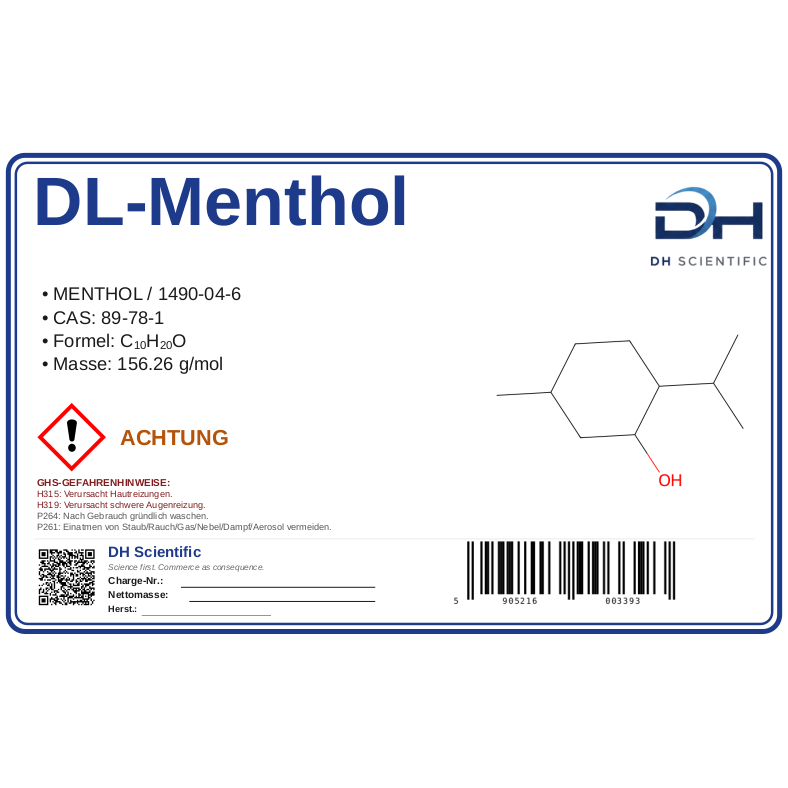
Chemisches Reagenz Mentol (CAS 89-78-1). Vollständige enzyklopädische Karte — Klassifizierung, Eigenschaften und Sicherheitsdaten — unten.
🔒 Demomodus — dieser Artikel steht nicht zum Verkauf.
Legale Substanz. dhscientific.com ist eine Demonstration der MOL-GOD-Plattform — wir verkaufen nichts und es werden keine Bestellungen ausgeführt. Verbotene Substanzen werden hier automatisch anhand des regulatorischen Kanons blockiert (vgl. z. B. Heptachlor).
Prüfung Ihres Sicherheitsdatenblatts — kostenlos → · Kontakt

Daten transkribiert aus regulatorischen Registern und Fachliteratur, unter Angabe von Quelle und Ausgabe. Sie ersetzen nicht das Sicherheitsdatenblatt des Lieferanten. Felder ohne hinterlegte Quelle sind als solche gekennzeichnet.
Chemische Übersicht: MentholMolGod_OVERVIEW_1
| Summenformel | C10H20O[1] |
| Molekulargewicht | 156.26 g/mol[1] |
| Schmelzpunkt | 43 °C[1] |
| Siedepunkt | 215 °C[1] |
| Dichte | 0.904 g/cm³[1] |
| LogP (Lipophilie) | 3[1] |
| IUPAC-Name | 5-methyl-2-propan-2-ylcyclohexan-1-ol[1] |
| SMILES | CC1CCC(C(C1)O)C(C)C[1] |
| InChIKey | NOOLISFMXDJSKH-UHFFFAOYSA-N[1] |
Synonyme: MENTHOL · 1490-04-6 · 2-Isopropyl-5-methylcyclohexanol · Menthyl alcohol · Mentholum
Datenquellen: PubChem (NLM/NIH)
Zuletzt aktualisiert: 2026-07-18
📚 Wissenschaftliche Referenzen (Chicago Author-Date) (1 Quellen)
- PubChem. National Center for Biotechnology Information (NIH/NLM), chemical compound database. ↗ dotyczy: Summenformel · Molekulargewicht · Schmelzpunkt · Siedepunkt · Dichte · LogP (Lipophilie) · IUPAC-Name · SMILES · InChIKey
WISSENSCHAFTLICHE FORSCHUNG
📚 Wissenschaftliche Referenzen (Chicago Author-Date) 1 refs · 1 baz
MOLEKUŁA Bibliografie pro CAS (live aus 13+ Datenbanken)
Quellen: db:pubmed (1)
- db:pubmed Kazemi A, Iraji A, Esmaealzadeh N et al.. (2025). "Peppermint and menthol: a review on their biochemistry, pharmacological activities, clinical applications, and safety considerations.". Critical reviews in food science and nutrition. https://doi.org/10.1080/10408398.2023.2296991 →
Physikochemische Eigenschaften
Kurzübersicht
🔬 Erweiterte Eigenschaften
Chemische Kennungen
CC1CCC(C(C1)O)C(C)C Zuletzt aktualisiert: 2026-06-30
📡 Spektroskopie — CAS 89-78-1MolGod_SPECHUB_MAIN
Spektroskopische Spektrendatenbanken — Inline-Daten 9 Quellen MolGod_SPECDB_2
Spektren werden bei Bedarf aus 9 Quellen abgerufen. Jedes Spektrum wird in unserer Datenbank gespeichert — beim nächsten Öffnen erfolgt keine Anfrage an die externe API. Laden Sie JCAMP-DX / CSV / PNG zu jedem Spektrum herunter, ohne zu suchen.
Referenzquelle — keine öffentliche API. In einer externen Datenbank öffnen:
🔗 IR/NMR/MS (SDBS) →Referenzquelle — keine öffentliche API. In einer externen Datenbank öffnen:
🔗 JP Monograph →Referenzquelle — keine öffentliche API. In einer externen Datenbank öffnen:
🔗 WHO INN →Referenzquelle — keine öffentliche API. In einer externen Datenbank öffnen:
🔗 DOAJ →Physikalisch-chemische Eigenschaften (DB) 5 Felder MolGod-Score: Zuverlässig
| Eigenschaft | Wert | Einheit | Bedingungen | Quelle |
|---|---|---|---|---|
| Schmelzpunkt | 43 [1] | °C | 1 atm | PubChem PUG-View |
| Siedepunkt | 215 [1] | °C | PubChem PUG-View | |
| Wasserlöslichkeit | 0.42 [1][2] | g/L | 25°C | PubChem PUG-View |
| Dichte (ρ) | 0.904 [1] | g/cm³ | 15°C | PubChem PUG-View |
| logP (Octanol/Wasser) | 3 [1] | — | PubChem PUG-View |
📚 Wissenschaftliche Referenzen (Chicago Author-Date) (2 Quellen)
Die physikochemischen Werte stammen aus den oben genannten unabhängigen, begutachteten Quellen.
🛡️ Sicherheit — CAS 89-78-1MolGod_SAFEHUB_MAIN
GHS/CLP-Einstufung — Verordnung (EG) Nr. 1272/2008 + UN GHS Rev. 9 (2021).


🚨 Gefahrenhinweise (H)
- H315 — Verursacht Hautreizungen.
- H319 — Verursacht schwere Augenreizung.
- H318 — Verursacht schwere Augenschäden.
- H335 — Kann die Atemwege reizen.
- H402 — Schädlich für Wasserorganismen.
- H412 — Schädlich für Wasserorganismen, mit langfristiger Wirkung.
🛡 Sicherheitshinweise (P)
- P264 — Nach Gebrauch gründlich waschen.
- P280 — Schutzhandschuhe/Schutzkleidung/Augenschutz/Gesichtsschutz tragen.
- P302+P352 — BEI BERÜHRUNG MIT DER HAUT: Mit viel Wasser waschen.
- P305+P351+P338 — BEI KONTAKT MIT DEN AUGEN: Einige Minuten lang behutsam mit Wasser ausspülen.; Eventuell vorhandene Kontaktlinsen nach Möglichkeit entfernen. Weiter ausspülen.
- P332+P313 — Bei Hautreizung: Ärztlichen Rat einholen/ärztliche Hilfe hinzuziehen.
- P337+P313 — Bei anhaltender Augenreizung: Ärztlichen Rat einholen/ärztliche Hilfe hinzuziehen.
- P501 — Inhalt/Behälter … zuführen.
⚠ Einstufung basierend auf einem Konsens der Quellen (PubChem / Meldungen der Lieferanten) — nicht gegen die harmonisierte Einstufung in Anhang VI (CLP) verifiziert. Der Gefahrenumfang kann breiter sein als die amtliche Einstufung; vor der Verwendung mit dem aktuellen Sicherheitsdatenblatt des Lieferanten verifizieren.
Übersetzungen: CLP-Verordnung (EG) 1272/2008, Anhang III und IV. Daten: PubChem/NLM.
📚 Konsolidierte wissenschaftliche Referenzen — Chicago Author-Date 10 Quellen
Referenzen aus allen Safety-Hub-Registerkarten gesammelt. CAS: 89-78-1 ·
PubChem ↗
- Parlament Europejski i Rada UE. 2008. "Rozporządzenie (WE) nr 1272/2008 w sprawie klasyfikacji, oznakowania i pakowania substancji (CLP)." Dz.Urz. UE L 353. [↗] GHS, Vorschriften
- United Nations Economic Commission for Europe (UNECE). 2021. "Globally Harmonized System of Classification and Labelling of Chemicals (GHS), Ninth Revised Edition." United Nations, Geneva. [↗] GHS
- Goldfrank, Lewis R., Robert S. Hoffman, Mary Ann Howland, et al.. 2019. "Goldfrank's Toxicologic Emergencies, 11th ed.." McGraw-Hill Education, New York. ISBN 978-1-25-985961-8. Pierwsza pomoc, Toksykologia
- National Institute for Occupational Safety and Health (NIOSH). 2023. "NIOSH Pocket Guide to Chemical Hazards (DHHS Publ. 2005-149)." U.S. Department of Health and Human Services / CDC, Cincinnati, OH. [↗] Pierwsza pomoc, PPE, Toksykologia
- European Committee for Standardization (CEN). 2016. "EN 374-1:2016 — Protective gloves against dangerous chemicals and micro-organisms." CEN, Brussels. [↗] PPE
- UNECE. 2023. "European Agreement Concerning the International Carriage of Dangerous Goods by Road (ADR 2025)." United Nations, Geneva. [↗] Utylizacja, Regulacje
- National Fire Protection Association (NFPA). 2022. "NFPA 400 — Hazardous Materials Code." NFPA, Quincy, MA. [↗] Magazynowanie
- Urben, P.G. (ed.). 2017. "Bretherick's Handbook of Reactive Chemical Hazards, 8th ed.." Butterworth-Heinemann / Elsevier, Oxford. [↗] Magazynowanie
- Ministerstwo Klimatu i Środowiska RP. 2023. "Baza danych o produktach i opakowaniach oraz o gospodarce odpadami (BDO)." Ministerstwo Klimatu i Środowiska, Warszawa. [↗] Utylizacja
- International Agency for Research on Cancer (IARC / WHO). 2024. "IARC Monographs on the Identification of Carcinogenic Hazards to Humans — List of Classifications." WHO, Lyon. [↗] Toksykologia
Registerkarten mit eigenen Referenzen (Emergency, PPE, Storage, Waste) enthalten zusätzliche bibliografische Einträge in ihren jeweiligen Abschnitten.
Analytische Statistik (t-Test · RSD · Grubbs · Q-Dixon) ICH Q2
Fügen Sie eine Serie von Messwiederholungen ein (CSV oder eine Zahl pro Zeile). Der Rechner berechnet Mittelwert, Standardabweichung und 95% CI und erkennt Ausreißer (Grubbs + Dixon Q).
📐 Statistische Formeln
x̄ = Σxᵢ / n— arithmetisches Mittels² = Σ(xᵢ - x̄)² / (n-1)— Stichprobenvarianzs = √s²— StandardabweichungRSD% = (s / x̄) × 100%— relative StandardabweichungCI₉₅ = x̄ ± t(0.05, n-1) × s / √n— Student's tG = |xᵢ - x̄| / s— Grubbs-TestQ = |xsuspect - xnearest| / |xmax - xmin|— Dixon Q-test
Quelle: ICH Q2(R2) Validation of Analytical Procedures · ICH PDF ↗
Puffer-Rezept-Rechner EINZIGARTIG
Wählen Sie einen Puffer aus der Liste von 20 gängigen Systemen → geben Sie den Ziel-pH-Wert ein → Sie erhalten ein exaktes Rezept mit den einzuwiegenden Massen.
Schritt 1: Puffersystem wählen
📜 Rezeptverlauf (letzte 10)
🔧 Fehlerbehebung HPLC — Entscheidungsbaum 6 häufige Probleme
Diagnose der 6 häufigsten HPLC-Probleme mit Entscheidungsbaum (5 Schritte pro Problem). Quelle: Snyder/Kirkland/Dolan 3rd ed. Chapter 17 + LCGC LC Troubleshooting columns 1989-2024.
Verbreiterte Peaks (broad peaks) medium
Symptom: Alle Peaks im Chromatogramm sind breiter als erwartet (FWHM > 2× normal)
🔍 Diagnosebaum:
-
1. Prüfen Sie, ob alle Peaks verbreitert sind oder nur einige
→ JA: Alle → instrumentelles Problem (Säule oder System)
→ NEIN: Nur einige → chemisches Problem (Wechselwirkung mit der Säule bei bestimmten Analyten) -
2. Tauschen Sie eine Testsäule ein — verschwindet das Problem?
→ JA: SÄULE verschlissen — Packung beschädigt, Void in den ersten mm. Ersetzen.
→ NEIN: Problem im LC-System -
3. Prüfen Sie das Totvolumen (dead volume) — Injektionsschleife, Verbindungen, Detektor
→ JA: Schleife > 100 µL für eine 4.6-mm-Säule oder lose Verbindungen → Ferrulen ersetzen, Kapillaren kürzen
→ NEIN: Diagnose fortsetzen -
4. Temperaturtest: Erhöhen Sie die Säule von 25°C auf 40°C
→ JA: Schmalere Peaks → Massentransferkinetik zu langsam (T erhöhen)
→ NEIN: Continue -
5. Prüfen Sie die Flussrate gegenüber dem van-Deemter-Optimum für diese Säule
→ JA: Optimum für 4.6mm/5µm = 1.0 mL/min, für 2.1mm/3µm = 0.4 mL/min
→ NEIN: Continue
- Säule verschlissen (>2000 Injektionen ohne Vorsäule)
- Totvolumen des Systems > 100 µL (falsche Schleife, lange Kapillaren, lose Ferrulen)
- Temperatur zu niedrig (Massentransferkinetik)
- Flussrate außerhalb des van-Deemter-Optimums
- Probenlösungsmittel stärker als mobile Phase A
- ✓ Säule ersetzen (bei >2000 Injektionen)
- ✓ Alle Verbindungen prüfen — Kapillaren so kurz wie möglich
- ✓ Säulentemperatur auf 40°C erhöhen (wenn die Substanz stabil ist)
- ✓ Fluss auf das van-Deemter-Optimum reduzieren
- ✓ Probe in mobiler Phase A lösen (nicht in reinem Organischem)
Peak-Tailing (Tailing, T > 1.5) high
Symptom: Peaks haben einen verlängerten "Schwanz" auf der Seite der späten Elution (Asymmetrie T = b/a > 1.5 gemäß USP)
🔍 Diagnosebaum:
-
1. Enthält die Substanz basische Gruppen (Amino, Pyridin)?
→ JA: Ja → Silanol-Wechselwirkungen! Fügen Sie 0.1% TFA oder 5-10 mM TEA zur mobilen Phase A hinzu.
→ NEIN: Continue -
2. Prüfen Sie den pH der mobilen Phase gegenüber dem pKa der Substanz
→ JA: pH = pKa ± 1 → teilweise Ionisierung, Peak-Split. Gehen Sie pH ≥ 2 Einheiten vom pKa weg.
→ NEIN: Continue -
3. Prüfen Sie das Alter der Säule (>1500 Injektionen?)
→ JA: Ja → freigelegte Silanole (Column Bleed). Ersetzen Sie die Säule durch eine mit höherem Endcapping (XTerra, Symmetry).
→ NEIN: Continue -
4. Enthält die Probe Metalle (Fe, Cu aus Glasfläschchen)?
→ JA: Ja → verwenden Sie klare Typ-II-Fläschchen oder PFA. 0.1mM EDTA zur Probe geben.
→ NEIN: Continue
- Silanol-Wechselwirkungen (basischer Analyt + freie Silanole des Kieselgels)
- pH an der Grenze des Analyt-pKa (Peak-Split)
- Alte Säule (Column Bleed, hohe Silanolaktivität)
- Metalle in der Probe (Chelatbildung → Tailing)
- Säulenüberladung (>50 µg auf einer 4.6mm-Säule)
- ✓ 0.1% TFA (UV) oder 0.1% Ameisensäure (LC-MS) zur mobilen Phase A hinzufügen
- ✓ Wählen Sie eine Säule mit hochreinem Endcapping: Waters XBridge BEH, Phenomenex Kinetex
- ✓ Arbeiten Sie bei pH ≥ 2 Einheiten vom pKa entfernt
- ✓ 0.1mM EDTA zur Probe (Fe/Cu-Chelatbildung)
- ✓ Injektionsvolumen auf ≤ 20 µL für eine 4.6mm-Säule reduzieren
Grundliniendrift (Baseline Drift) medium
Symptom: Die Grundlinie steigt oder fällt systematisch über >5 Minuten
🔍 Diagnosebaum:
-
1. Verwenden Sie einen Gradienten (B% steigt)?
→ JA: Ja → unterschiedliche Absorption der Phasen A vs. B bei dλ. Lösungsmittelwechsel im UV-Cutoff. Prüfen Sie die UV-Absorption des %-Organik-Anteils.
→ NEIN: Weiter (isokratisch) -
2. Prüfen Sie die Säulentemperatur — ist sie auf ±0.5°C stabil?
→ JA: Ja (stabil) → weiter
→ NEIN: Instabil → Säulenthermostat einschalten (>25°C kontrolliert) -
3. Test: Autosampler ausschalten, nur Pumpe+Säule+Detektor betreiben
→ JA: Drift verschwindet → Autosampler-Kontamination (Nadel, Septum reinigen)
→ NEIN: Continue -
4. Prüfen Sie das Alter der Lampe (D2 für UV)
→ JA: Ja (>1500 Stunden) → Lampe ersetzen
→ NEIN: Continue
- Gradientenelution mit unterschiedlichem UV-Cutoff der Phasen
- Instabile Säulentemperatur
- Autosampler-Kontamination von Nadel/Septum
- UV-Lampe alt (>1500h)
- Detektor-Durchflusszelle verschmutzt
- Säule nicht äquilibriert (<10 Säulenvolumina)
- ✓ Säule 10-15 Säulenvolumina bei 100% A voräquilibrieren
- ✓ Säulenthermostat ein, T 30-40°C stabil
- ✓ Detektor-Durchflusszelle mit 50:50 ACN:H2O reinigen
- ✓ D2-Lampe ersetzen, wenn >1500h
- ✓ Grundlinien-Subtraktion verwenden (Chromeleon, native Empower-Funktion)
Kein Peak / verlorener Peak (no peak) critical
Symptom: Der erwartete Analyt-Peak erscheint nicht im Chromatogramm
🔍 Diagnosebaum:
-
1. Hat die Injektion tatsächlich stattgefunden?
→ JA: Prüfen Sie das Autosampler-Log, den Pumpendruck (sollte bei der Injektion abfallen)
→ NEIN: Autosampler-Problem → Schleife, Nadel, Probe im Fläschchen prüfen -
2. Ist die Probe im Fläschchen (korrektes Volumen, nicht verdunstet)?
→ JA: Continue
→ NEIN: Keine Probe — erneut pipettieren -
3. Probenstabilität — vor >24h vorbereitet?
→ JA: Ja → Degradation. Bereiten Sie eine frische Probe vor.
→ NEIN: Continue -
4. Prüfen Sie die Detektionswellenlänge gegenüber dem λmax der Substanz
→ JA: Detektion bei λ entspricht NICHT dem λmax → kein Signal. DAD 200-400nm scannen.
→ NEIN: Continue -
5. Test: Injizieren Sie einen reinen Standard (bekannter Konzentration, frisch)
→ JA: Standard ergibt einen Peak → Problem mit der Probe (Matrix, Derivatisierung)
→ NEIN: Kein Peak auch mit dem Standard → Systemproblem (Säule, Phase, Gradient)
- Probe nicht aus dem Fläschchen entnommen (Autosampler-Fehler)
- Probe degradiert (>24h pH/Temp/Licht)
- Detektion bei falscher Wellenlänge
- Falsche mobile Phase (z. B. vergessenes TFA)
- Säule umgekehrt / falsche stationäre Phase
- Substanz eluiert an der Front (V0) → nicht retendiert, nicht sichtbar
- ✓ Frische Probe nach dem exakten Protokoll neu vorbereiten
- ✓ UV-Vis-DAD-Scan 200-400nm + Suche nach λmax
- ✓ Zusammensetzung der mobilen Phase prüfen — TFA hinzugefügt?
- ✓ Umgekehrte Säulenrichtung testen (vorsichtig!)
- ✓ Bei Retention <1 min — % B verringern, MeOH statt ACN
- ✓ Prüfen Sie die erwartete Retentionszeit in der Methodendatenbank des Plugins
Druck zu hoch (pressure too high) critical
Symptom: Pumpendruck > 80% des Säulenmaximums oder System-Shutdown mit High-Pressure-Fehler
🔍 Diagnosebaum:
-
1. Prüfen Sie, ob die Säule korrekt angeschlossen ist (Pfeilrichtung)
→ JA: OK
→ NEIN: Säule umgekehrt → umdrehen (niemals "rückwärts" betreiben) -
2. Test: Säule aus dem System entfernen, nur Pumpe+Detektor betreiben
→ JA: Druck fällt auf <50 bar → Problem in der Säule (verstopft)
→ NEIN: Druck bleibt hoch → In-Line-Filter verstopft, Fritte verschmutzt -
3. Prüfen Sie den Vorsäulenfilter (In-Line-Fritte)
→ JA: Verschmutzt und braun → ersetzen
→ NEIN: Continue -
4. Säule rückwärts mit 50:50 ACN:H2O spülen, ohne die Säule — verschwindet es?
→ JA: Partikel im ersten mm stecken geblieben — 30 min Spülung kann sie wiederherstellen
→ NEIN: Säule ersetzen
- In-Line-Filter (Fritte) mit Partikeln verstopft
- Puffer-Aussalzung (Ausfällung bei hohem %B)
- Probe enthält Schwebstoffe (0.22 µm vor der Injektion filtrieren)
- Säule verstopft (Column Bed Compaction)
- Gradient mit Pufferphase + viel Organik → Salzausfällung
- ✓ Probe IMMER durch 0.22 µm PVDF vor der Injektion filtrieren
- ✓ In-Line-Filter alle 100 Injektionen ersetzen (oder wenn der Druck >20% steigt)
- ✓ Verwenden Sie NICHT >20mM Phosphatpuffer + >70% ACN (das Salz fällt aus)
- ✓ Säule 30 min mit 50:50 ACN:H2O in umgekehrter Richtung spülen (wenn vom Hersteller zugelassen)
- ✓ Vorsäule 4×3mm zum Schutz der Hauptsäule
Geisterpeaks (Ghost Peaks) high
Symptom: Unerklärte Peaks im Chromatogramm, die in der Kalibrierung fehlen
🔍 Diagnosebaum:
-
1. Test: Blindinjektion (reines Probenlösungsmittel)
→ JA: Ein Geisterpeak erscheint → Kontamination des Systems oder der Eluenten
→ NEIN: Erscheint nur mit der Probe → Matrix -
2. Wächst der Geisterpeak mit dem Gradienten (eluiert bei hohem %B)?
→ JA: Ja → überladene Säule oder stark retendiert aus einem vorherigen Lauf
→ NEIN: Unabhängig vom Gradienten → Autosampler-Verschleppung -
3. Increase carryover wash (between injections)
→ JA: Hilft → Verschleppung war die Ursache. Stärkeres Waschprotokoll.
→ NEIN: Continue -
4. Reinwasser-Injektion — gibt es einen Peak?
→ JA: Ja → Kontamination der Wasserquelle (Organik aus dem DI-System)
→ NEIN: Continue
- Verschleppung in Autosampler-Nadel/-Schleife
- Eluent-Kontamination (auch in HPLC-Qualität)
- Stark retendierte Komponenten aus vorherigen Läufen
- Kunststoff in den Fläschchen (Phthalate, PEG aus den Kappen)
- DI-Wasser unzureichend gereinigt
- ✓ Waschprotokoll verstärken: 100% B → 100% A → 50:50 (3 Zyklen)
- ✓ Starke Wäsche: 100% DMSO oder 100% MeOH vor der Kalibrierung
- ✓ Eluenten im Zweifelsfall durch 0.22 µm PTFE filtrieren
- ✓ Braunglas + Teflon-beschichtete Kappen für Proben verwenden
- ✓ Periodische Gradientenrampe auf 100% B für 10 min (Reinigung)
📚 Wissenschaftliche Referenzen (Chicago Author-Date) — zum Aufklappen klicken
- Snyder, Lloyd R., Joseph J. Kirkland, and John W. Dolan. 2010. Introduction to Modern Liquid Chromatography. 3rd ed. John Wiley & Sons. Chapter 17 (Troubleshooting) pp. 559-616. ISBN 978-0-470-16754-0. https://doi.org/10.1002/9780470508183 [link ↗]
- Dolan, John W.. 2014. LC Troubleshooting (monthly column 1989-2024). LCGC North America. [link ↗] — John Dolan 35-letnia seria miesięcznych artykułów problemowych
- Kromidas, Stavros. 2017. HPLC Made to Measure: A Practical Handbook for Optimization. 2nd ed. Wiley-VCH. ISBN 978-3-527-31377-1. — Praktyczny przewodnik problem-solving dla labs analitycznych
- Dolan, John W.. 2013. When to Modify Method Conditions. 192-199. [link ↗] — Decision flow for changing flow rate / temperature / %B vs swapping columns.
- Dong, Michael W.. 2019. HPLC and UHPLC for Practicing Scientists. 2nd ed. Wiley. ISBN 978-1-119-31378-3. https://doi.org/10.1002/9781119313793 [link ↗] — Chapter 9 covers troubleshooting modern UHPLC systems (sub-2 µm particles).
- Meyer, Veronika R.. 2010. Practical High-Performance Liquid Chromatography. 5th ed. Wiley. ISBN 978-0-470-68218-0. — Solid step-by-step problem isolation chapter (eluents, columns, instruments).
- Snyder, L. R., J. J. Kirkland, and J. L. Glajch. 1997. Practical HPLC Method Development. 2nd ed. Wiley. ISBN 978-0-471-00703-6. — Method-development companion volume with troubleshooting cross-refs.
- Carr, Peter W.. 2009. The new physical chemistry of HPLC. 1764-1772. https://doi.org/10.1016/j.chroma.2008.11.094 [link ↗] — Theoretical basis for diagnosing efficiency losses (mass-transfer, eddy diffusion).
- Heyden, Yvan Vander, et al.. 2009. Robustness of pharmaceutical liquid chromatographic methods. 2120-2129. https://doi.org/10.1016/j.jchromb.2008.10.052 [link ↗] — How to diagnose method failures vs. system failures (Plackett-Burman).
- Engelhardt, Heinz. 2014. 100 Years of Chromatography. 2nd ed. Wiley-VCH. ISBN 978-3-527-33473-5. — Historical context for ghost-peak phenomenology (silica chemistry).
Deskryptory Lipinskiego (struktura)
Drug-Likeness-Radardiagramm (Lipinski Ro5 / Veber). Grüne Zone = Übereinstimmung mit den Kriterien.
Vorhersagedaten — in silico berechnete Eigenschaften (SMILES/RDKit). Sie ersetzen keine klinischen Studien. Nicht zur Arzneimittelbewertung ohne experimentelle Verifizierung verwenden.
| Eigenschaft | Wert | Bewertung |
|---|---|---|
| Resorption (GI) | hoch | ✓ |
| BHS-Permeabilität | ja (durchdringt) | |
| Bioverfügbarkeit (Daina 2017) | 55% | |
| CYP450-Profil | CYP1A2 inhibitorCYP2C9 non-inhibitorCYP2C19 non-inhibitorCYP2D6 inhibitorCYP3A4 non-inhibitor | |
| PAINS-Warnungen | 0 | ✓ |
| Brenk-Warnungen | 0 | ✓ |
| pKa (pH 7.4) | 16 (predicted) | |
| hERG (Kardiotox.) | ✓ nein | |
| P-gp-Substrat | — | |
| Ames-Mutagenität | ✓ nein | |
| DILI (Hepatotox.) | — | |
| LogS (Wasserlösl.) | — | |
Quellen (ADMET-Methodik)
- Lipinski, Christopher A., Franco Lombardo, Beryl W. Dominy, and Paul J. Feeney. 1997. "Experimental and computational approaches to estimate solubility and permeability in drug discovery and development settings." Advanced Drug Delivery Reviews 23 (1-3): 3-25.
- Veber, Daniel F., Stephen R. Johnson, Hung-Yuan Cheng, et al. 2002. "Molecular properties that influence the oral bioavailability of drug candidates." Journal of Medicinal Chemistry 45 (12): 2615-2623.
- Daina, Antoine, Olivier Michielin, and Vincent Zoete. 2017. "SwissADME: a free web tool to evaluate pharmacokinetics, drug-likeness and medicinal chemistry friendliness." Scientific Reports 7: 42717.
- Egan, William J., and Gregory Lauri. 2002. "Prediction of intestinal permeability." Advanced Drug Delivery Reviews 54 (3): 273-289.
- Baell, Jonathan B., and Georgina A. Holloway. 2010. "New substructure filters for removal of pan assay interference compounds (PAINS) from screening libraries." Journal of Medicinal Chemistry 53 (7): 2719-2740.
- Brenk, Ruth, Alessandro Schipani, Daniel James, et al. 2008. "Lessons learnt from assembling screening libraries for drug discovery for neglected diseases." ChemMedChem 3 (3): 435-444.
- Ertl, Peter, and Ansgar Schuffenhauer. 2009. "Estimation of synthetic accessibility score of drug-like molecules based on molecular complexity and fragment contributions." Journal of Cheminformatics 1: 8.
- Bickerton, G. Richard, Gaia V. Paolini, Jérémy Besnard, Sorel Muresan, and Andrew L. Hopkins. 2012. "Quantifying the Chemical Beauty of Drugs." Nature Chemistry 4 (2): 90-98.
- Hopkins, Andrew L., and Colin R. Groom. 2002. "The Druggable Genome." Nature Reviews Drug Discovery 1 (9): 727-730.
- Ghose, Arup K., Vellarkad N. Viswanadhan, and John J. Wendoloski. 1999. "A Knowledge-Based Approach in Designing Combinatorial or Medicinal Chemistry Libraries for Drug Discovery." Journal of Combinatorial Chemistry 1 (1): 55-68.
- Tice, Raymond R., Christopher P. Austin, Robert J. Kavlock, and John R. Bucher. 2013. "Improving the Human Hazard Characterization of Chemicals: A Tox21 Update." Environmental Health Perspectives 121 (7): 756-765.
- Leeson, Paul D., and Brian Springthorpe. 2007. "The Influence of Drug-Like Concepts on Decision-Making in Medicinal Chemistry." Nature Reviews Drug Discovery 6 (11): 881-890.
- Hann, Michael M. 2011. "Molecular Obesity, Potency and Other Addictions in Drug Discovery." MedChemComm 2 (5): 349-355.
- Davies, Mark, Michał Nowotka, George Papadatos, et al. 2015. "ChEMBL Web Services: Streamlining Access to Drug Discovery Data and Utilities." Nucleic Acids Research 43 (W1): W612-W620.
- Walters, W. Patrick, and Mark A. Murcko. 2002. "Prediction of 'Drug-Likeness.'". Advanced Drug Delivery Reviews 54 (3): 255–271. https://doi.org/10.1016/S0169-409X(02)00003-0.
- Congreve, Miles, Robin Carr, Christopher Murray, and Harren Jhoti. 2003. "A 'Rule of Three' for Fragment-Based Lead Discovery?" Drug Discovery Today 8 (19): 876–877. https://doi.org/10.1016/S1359-6446(03)02831-9.
- Brenk, Ruth, Alessandro Schipani, Daniel James, Agata Krasowski, Iain Hugh Gilbert, Julie Frearson, and Paul Graham Wyatt. 2008. "Lessons Learnt from Assembling Screening Libraries for Drug Discovery for Neglected Diseases." ChemMedChem 3 (3): 435-444.
- Schomburg, Karen T., Sascha Bietz, Hans Briem, Andrea M. Henzler, Stefan Urbaczek, and Matthias Rarey. 2014. "Facing the Challenges of Structure-Based Target Prediction by Inverse Virtual Screening." Journal of Chemical Information and Modeling 54 (6): 1676-1686.
- Bemis, Guy W., and Mark A. Murcko. 1996. "The Properties of Known Drugs. 1. Molecular Frameworks." Journal of Medicinal Chemistry 39 (15): 2887-2893.
- Schomburg, Karen T., and Matthias Rarey. 2014. "What Is the Potential of Structure-Based Target Prediction Methods?" Future Medicinal Chemistry 6 (17): 1987-1989.
- Kazemi A, Iraji A, Esmaealzadeh N et al.. (2025). "Peppermint and menthol: a review on their biochemistry, pharmacological activities, clinical applications, and safety considerations.". Critical reviews in food science and nutrition. https://doi.org/10.1080/10408398.2023.2296991
- &NA;. 1993. "Menthol benefits not all in the mind." Inpharma Weekly &NA; (909): 20. https://doi.org/10.2165/00128413-199309090-00053. [DOI ↗]
- Bolton, Evan E., Yanli Wang, Paul A. Thiessen, and Stephen H. Bryant. 2008. "PubChem: Integrated Platform of Small Molecules and Biological Activities." Annual Reports in Computational Chemistry 4: 217-241. [DOI ↗]
- Kim, Sunghwan, Jie Chen, Tiejun Cheng, et al. 2023. "PubChem 2023 update." Nucleic Acids Research 51 (D1): D1373-D1380. [DOI ↗]
- Kim, Sunghwan, Tiejun Cheng, Jianyong He, Chen Cheng, et al. 2021. "PubChem Protein, Pathway, Reaction, and Disease Specifications." Journal of Cheminformatics 13: 16. [DOI ↗]
- Hähnke, Volker D., Sunghwan Kim, and Evan E. Bolton. 2018. "PubChem chemical structure standardization." Journal of Cheminformatics 10: 36. [DOI ↗]
- Wang, Yanli, Stephen H. Bryant, Tiejun Cheng, Jiyao Wang, et al. 2017. "PubChem BioAssay: 2017 update." Nucleic Acids Research 45 (D1): D955-D963. [DOI ↗]
- Cheng, Tiejun, et al. 2014. "Computation of Octanol-Water Partition Coefficients by Guiding an Additive Model with Knowledge." Journal of Chemical Information and Modeling 54 (3): 793-805. [DOI ↗]
- Wilkinson, Mark D., et al. 2016. "The FAIR Guiding Principles for scientific data management and stewardship." Scientific Data 3: 160018. [DOI ↗]
- Hersey, Anne, et al. 2015. "Chemical databases: curation or integration by user-defined equivalence?" Drug Discovery Today: Technologies 14: 17-24.
- Colby Flade. 2022. "Menthol." Flade, Colby. ↗
- United States. Food and Drug Administration. 2013. "Preliminary scientific evaluation of the possible public health effects of methol verson nonmenthol cigarettes." Food and Drug Administration. ↗
- United States. Food and Drug Administration. 2011. "Menthol cigarettes." Food and Drug Administration. ↗
- Veber, Daniel F., Stephen R. Johnson, Hung-Yuan Cheng, Brian R. Smith, Keith W. Ward, and Kenneth D. Kopple. 2002. "Molecular Properties That Influence the Oral Bioavailability of Drug Candidates." Journal of Medicinal Chemistry 45 (12): 2615-2623.
- ECHA. 2024. "REACH Guidance." European Chemicals Agency. ↗
- Groom, Colin R., Ian J. Bruno, Matthew P. Lightfoot, and Suzanna C. Ward. 2016. "The Cambridge Structural Database." Acta Crystallographica Section B 72 (2): 171-179. ↗
🧪 Assistent zur Lösungsherstellung (Smart Prep) MolGod_PREP_2
Geben Sie ein, was Sie zubereiten möchten — ich erstelle eine SOP
📚 Überblick über die wissenschaftliche Literatur — CAS 89-78-1MolGod_LITHUB_MAIN
⭐ Wichtigste Erkenntnisse (wissenschaftliche Literatur) 2 Publikationen
89-78-1
— multi-criteria ranking (W12): 30% Zitierungen · 20% Aktualität · 20% Thema · 15% historisch · 15% Open Access.
-
#1Gerloff J; Sundar IK; Freter R et al. (2017) · Applied in vitro toxicologyWarum es wichtig ist: Pflichtzitat (Kanon) · 162 Zitierungen
-
#2Kazemi A, Iraji A, Esmaealzadeh N et al. (2025) · Critical reviews in food science and nutritionWarum es wichtig ist: Aktuell (2025) · Übersichtsarbeit
📚 REFERENZEN (Gesammelte Bibliografie, Chicago Author-Date) 126 Einträge
Alle wissenschaftlichen Quellen, die in den Akkordeons oben für CAS 89-78-1 zitiert werden.Format: Chicago Manual of Style, 17. Aufl., Autor-Datum-System.
🗄️ Wissenschaftliche Datenbanken
- NIST. n.d. NIST Chemistry WebBook: CAS 89-78-1. Gaithersburg, MD: National Institute of Standards and Technology. https://webbook.nist.gov/cgi/cbook.cgi?ID=89-78-1.
- AIST. n.d. Spectral Database for Organic Compounds (SDBS): CAS 89-78-1. Tsukuba, Japan: National Institute of Advanced Industrial Science and Technology. https://sdbs.db.aist.go.jp/.
- Linstrom, Peter J., and William G. Mallard, eds. n.d. NIST Chemistry WebBook: NIST Standard Reference Database Number 69. Gaithersburg, MD: National Institute of Standards and Technology. https://doi.org/10.18434/T4D303.
- PubChem. n.d. PubChem Compound Summary: CAS 89-78-1. Bethesda, MD: National Center for Biotechnology Information (NCBI), National Library of Medicine. https://pubchem.ncbi.nlm.nih.gov/#query=89-78-1.
- U.S. EPA. n.d. CompTox Chemicals Dashboard: CAS 89-78-1. Research Triangle Park, NC: U.S. Environmental Protection Agency. https://comptox.epa.gov/dashboard/chemical/details/DTXSID1020805.
📐 Standards / Richtlinien
- ICH. 2003. "Stability Testing of New Drug Substances and Products: Q1A(R2)." Geneva: International Council for Harmonisation of Technical Requirements for Pharmaceuticals for Human Use. https://database.ich.org/sites/default/files/Q1A%28R2%29%20Guideline.pdf.
- National Fire Protection Association (NFPA). 2024. "NFPA 30: Flammable and Combustible Liquids Code." NFPA, Quincy, MA. https://www.nfpa.org/codes-and-standards/all-codes-and-standards/list-of-codes-and-standards/detail?code=30.
- Occupational Safety and Health Administration (OSHA). 2023. "29 CFR 1910.106 — Flammable Liquids." U.S. Department of Labor, Federal Register. https://www.osha.gov/laws-regs/regulations/standardnumber/1910/1910.106.
- European Chemicals Agency (ECHA). 2024. "Annex VI to Regulation (EC) No 1272/2008 (CLP) — Harmonised Classification and Labelling." ECHA, Helsinki / Official Journal of the European Union. https://echa.europa.eu/regulations/clp/clp-classification.
- European Committee for Standardization (CEN). 2016. "EN 374-1:2016 — Protective gloves against dangerous chemicals and micro-organisms — Part 1: Terminology and performance requirements for chemical risks." CEN, Brussels. https://standards.cencenelec.eu/dyn/www/f?p=205:110:::::FSP_PROJECT,FSP_ORG_ID:38536,6080&cs=1B0DAA8B85DF42E4A2C70E5D71F0BFA32.
- European Committee for Standardization (CEN). 2001. "EN 166:2001 — Personal eye-protection — Specifications." CEN, Brussels. https://standards.cencenelec.eu/dyn/www/f?p=CEN:110:0::::FSP_PROJECT:6541&cs=1F1A4E0A78C4DB6A28DBE2E8C29D89DCF.
- European Committee for Standardization (CEN). 2009. "EN 14605:2005+A1:2009 — Protective clothing against liquid chemicals — Performance requirements for clothing with liquid-tight (Type 3) or spray-tight (Type 4) connections." CEN, Brussels. https://standards.cencenelec.eu/dyn/www/f?p=CEN:110:0::::FSP_PROJECT:21581&cs=1A04A2D3C7CC58E9E6CB58D55F7EBFB7E.
- National Institute for Occupational Safety and Health (NIOSH). 2017. "Recommendations for Chemical Protective Clothing: A Companion to the NIOSH Pocket Guide." U.S. Department of Health & Human Services / CDC. https://www.cdc.gov/niosh/ncpc/default.html.
- Occupational Safety and Health Administration (OSHA). 2011. "Personal Protective Equipment — General requirements." U.S. Department of Labor — 29 CFR 1910.132. https://www.osha.gov/laws-regs/regulations/standardnumber/1910/1910.132.
📖 Bücher
- Hansen, Charles M. 2007. Hansen Solubility Parameters: A User's Handbook, 2nd ed.. Boca Raton, FL: CRC Press. https://www.routledge.com/Hansen-Solubility-Parameters-A-Users-Handbook/Hansen/p/book/9780849372483.
- Barton, Allan F. M. 1991. CRC Handbook of Solubility Parameters and Other Cohesion Parameters: 2nd ed.. Boca Raton, FL: CRC Press. https://www.routledge.com/CRC-Handbook-of-Solubility-Parameters-and-Other-Cohesion-Parameters/Barton/p/book/9780849301766.
- Connors, Kenneth A., Gordon L. Amidon, and Valentino J. Stella. 1986. Chemical Stability of Pharmaceuticals: A Handbook for Pharmacists, 2nd ed.. New York: Wiley. https://doi.org/10.1002/0471734683.
- Rumble, John R., ed. 2019. CRC Handbook of Chemistry and Physics: 100th Edition. Boca Raton, FL: CRC Press. https://hbcp.chemnetbase.com/.
- Urben, Peter G. 2017. Bretherick's Handbook of Reactive Chemical Hazards, 8th Edition. Academic Press / Elsevier, Oxford. https://www.sciencedirect.com/book/9780081010594.
📄 Wissenschaftliche Artikel (peer-reviewed)
- Stefanis, Emmanuel, and Costas Panayiotou. 2008. "Prediction of Hansen Solubility Parameters with a New Group-Contribution Method." International Journal of Thermophysics 29: 568-585. https://doi.org/10.1007/s10765-008-0415-z.
- Stoll, Vincent S., and John S. Blanchard. 1990. "Buffers: Principles and Practice: In Methods in Enzymology, vol. 182." San Diego: Academic Press. https://doi.org/10.1016/0076-6879(90)82008-P.
🌐 Websites
- ECHA. 2023. "Guidance on the Application of the CLP Criteria." European Chemicals Agency. https://echa.europa.eu/guidance-documents/guidance-on-clp.
- European Parliament. 2006. "Regulation (EC) No 1907/2006 (REACH)." Official Journal of the European Union L 396: 1–849.
- ECHA. 2023. "Candidate List of Substances of Very High Concern for Authorisation." European Chemicals Agency. https://echa.europa.eu/candidate-list-table.
- European Parliament. 2008. "Regulation (EC) No 1272/2008 on Classification, Labelling and Packaging of Substances and Mixtures (CLP)." Official Journal of the European Union L 353: 1–1355.
- ECHA. 2017. "Guidance on the Compilation of Safety Data Sheets." Version 3.1. European Chemicals Agency. ECHA-17-G-01-EN. https://echa.europa.eu/documents/10162/23047722/sds_en.pdf.
- ECHA. 2022. "Restrictions Under REACH — Annex XVII." European Chemicals Agency. https://echa.europa.eu/substances-restricted-under-reach.
- United Nations. 2021. Globally Harmonized System of Classification and Labelling of Chemicals (GHS). 9th revised ed. ST/SG/AC.10/30/Rev.9. New York and Geneva: United Nations. https://unece.org/ghs-rev9-2021.
- ECHA. 2020. "Understanding REACH." European Chemicals Agency. https://echa.europa.eu/regulations/reach/understanding-reach.
- U.S. Occupational Safety and Health Administration (2024) — 29 CFR 1910.120 — Hazardous Waste Operations and Emergency Response (HAZWOPER) https://www.osha.gov/hazwoper.
- National Fire Protection Association (2018) — NFPA 472: Standard for Competence of Responders to Hazardous Materials/Weapons of Mass Destruction Incidents https://www.nfpa.org/codes-and-standards/nfpa-472.
- European Parliament and Council (2012) — Directive 2012/18/EU on the Control of Major-Accident Hazards Involving Dangerous Substances (Seveso III) https://eur-lex.europa.eu/legal-content/EN/TXT/?uri=celex:32012L0018.
- U.S. National Institute for Occupational Safety and Health (2024) — NIOSH Pocket Guide to Chemical Hazards https://www.cdc.gov/niosh/npg/.
- European Chemicals Agency (2020) — Guidance on the Compilation of Safety Data Sheets (SDS), Version 3.1 https://echa.europa.eu/documents/10162/23047722/sds_en.pdf.
- Snyder, Lloyd R., John W. Dolan, and Joseph J. Kirkland. 2010. Introduction to Modern Liquid Chromatography. Wiley.
- Schoenmakers, Peter J.. 1986. Optimization of Chromatographic Selectivity: A Guide to Method Development. Elsevier.
- Snyder, L. R., and J. W. Dolan. 2007. High-Performance Gradient Elution: The Practical Application of the Linear-Solvent-Strength Model. Wiley.
- Nikitas, Pavlos, and Adrian Pappa-Louisi. 2009. "Retention models for isocratic and gradient elution in reversed-phase liquid chromatography." Journal of Chromatography A 1216: 1737-1755. https://doi.org/10.1016/j.chroma.2008.10.005.
- Carr, Peter W.. 2009. "The new physical chemistry of HPLC." Journal of Chromatography A 1216: 1764-1772. https://doi.org/10.1016/j.chroma.2008.11.094.
- Dong, Michael W.. 2019. HPLC and UHPLC for Practicing Scientists. Wiley. https://doi.org/10.1002/9781119313793.
- Wu, Naijun, and Anton M. Clausen. 2007. "Fundamental and practical aspects of ultrahigh pressure liquid chromatography for fast separations." Journal of Separation Science 30: 1167-1182. https://doi.org/10.1002/jssc.200700026.
- Stoll, Dwight R., and Peter W. Carr. 2017. "Two-Dimensional Liquid Chromatography: A State of the Art Tutorial." Analytical Chemistry 89: 519-531. https://doi.org/10.1021/acs.analchem.6b03506.
- Dolan, John W.. 2013. "When to Modify Method Conditions." LCGC North America 31: 192-199. https://www.chromatographyonline.com/view/when-modify-method-conditions.
- Meyer, Veronika R.. 2010. Practical High-Performance Liquid Chromatography. Wiley.
- Van Deemter, J. J., F. J. Zuiderweg, and A. Klinkenberg. 1956. "Longitudinal diffusion and resistance to mass transfer as causes of nonideality in chromatography." https://doi.org/10.1016/0009-2509(56)80003-1.
- Giddings, J. Calvin. 1965. "Dynamics of Chromatography, Part I: Principles and Theory." Marcel Dekker.
- Poppe, Hans. 1997. "Some reflections on speed and efficiency of modern chromatographic methods." https://doi.org/10.1016/S0021-9673(97)00376-2.
- Wu, Naijun, and Anton M. Clausen. 2007. "Fundamental and practical aspects of ultrahigh pressure liquid chromatography for fast separations." https://doi.org/10.1002/jssc.200700026.
- Carr, Peter W.. 2009. "The new physical chemistry of HPLC." https://doi.org/10.1016/j.chroma.2008.11.094.
- Knox, John H.. 1977. "Practical aspects of LC theory." https://doi.org/10.1093/chromsci/15.9.352.
- Snyder, L. R., J. J. Kirkland, and J. L. Glajch. 1997. "Practical HPLC Method Development." Wiley.
- Engelhardt, Heinz. 2014. "100 Years of Chromatography." Wiley-VCH.
- Sadek, Paul C.. 2002. "The HPLC Solvent Guide." Wiley-Interscience.
- Snyder, L. R.. 1978. "Classification of the solvent properties of common liquids." https://doi.org/10.1093/chromsci/16.6.223.
- Reichardt, Christian, and Thomas Welton. 2010. "Solvents and Solvent Effects in Organic Chemistry." Wiley-VCH.
- Vailaya, Anant, and Csaba Horváth. 1998. "Retention thermodynamics in hydrophobic interaction chromatography." https://doi.org/10.1021/ie980212h.
- Krstulović, Andrea M., and Phyllis R. Brown. 1981. "Reversed-phase High-Performance Liquid Chromatography." Wiley.
- Boysen, Reinhard I., and Milton T. W. Hearn. 2009. "Multi-modal HPLC of proteins." https://doi.org/10.1093/chromsci/47.8.645.
- USP General Chapter <621>. 2024. "Chromatography." United States Pharmacopeial Convention. https://www.usp.org/harmonization-standards/pdg/general-chapters/chromatography.
- International Council for Harmonisation (ICH). 2023. "Validation of Analytical Procedures Q2(R2)." ICH Expert Working Group. https://database.ich.org/sites/default/files/ICH_Q2-R2_Document_Step4_Guideline_2023_1101.pdf.
- Foley, Joe P., and John G. Dorsey. 1983. "Equations for calculation of chromatographic figures of merit for ideal and skewed peaks." https://doi.org/10.1021/ac00255a033.
- Snyder, Lloyd R., Joseph J. Kirkland, and John W. Dolan. 2010. "Introduction to Modern Liquid Chromatography." Wiley. https://doi.org/10.1002/9780470508183.
- Dolan, John W.. 2003. "Peak tailing and resolution." https://www.chromatographyonline.com/view/peak-tailing-and-resolution.
- Vivó-Truyols, Gabriel, and Hans-Gerd Janssen. 2010. "Probabilistic approach to peak deconvolution in chromatography." https://doi.org/10.1021/ac101742z.
- Kromidas, Stavros. 2017. "HPLC Made to Measure: A Practical Handbook for Optimization." Wiley-VCH.
- Heyden, Yvan Vander, et al.. 2009. "Robustness of pharmaceutical liquid chromatographic methods." https://doi.org/10.1016/j.jchromb.2008.10.052.
- United States Pharmacopeial Convention. 2024. "USP <621> Chromatography." In United States Pharmacopeia and National Formulary, USP 47-NF 42. Rockville, MD: USP. https://www.uspnf.com/.
- European Pharmacopoeia Commission. 2024. "2.2.46 Chromatographic Separation Techniques." In European Pharmacopoeia, 11th ed. Strasbourg: Council of Europe — EDQM. https://www.edqm.eu/en/european-pharmacopoeia-ph-eur-11th-edition.
- International Council for Harmonisation (ICH). 2022. "ICH Q2(R2): Validation of Analytical Procedures." International Council for Harmonisation. https://database.ich.org/sites/default/files/ICH_Q2%28R2%29_Guideline_2022_1130.pdf.
- International Council for Harmonisation (ICH). 1996. "ICH Q3A: Impurities in New Drug Substances." International Council for Harmonisation. https://database.ich.org/sites/default/files/Q3A%28R2%29%20Guideline.pdf.
- International Organization for Standardization. 2017. "ISO/IEC 17025:2017 General Requirements for the Competence of Testing and Calibration Laboratories." Geneva: ISO. https://www.iso.org/standard/66912.html.
- Kolthoff, Izaak Maurits, and Philip J. Elving, eds. 1978. Treatise on Analytical Chemistry, Part I: Theory and Practice. 2nd ed. New York: Wiley-Interscience.
- Skoog, Douglas A., F. James Holler, and Stanley R. Crouch. 2018. Principles of Instrumental Analysis. 7th ed. Boston: Cengage Learning.
- Christian, Gary D., Purnendu K. Dasgupta, and Kevin A. Schug. 2014. Analytical Chemistry. 7th ed. Hoboken, NJ: Wiley.
- EURACHEM/CITAC. 2012. "Quantifying Uncertainty in Analytical Measurement." 3rd ed. EURACHEM/CITAC Guide CG 4. https://www.eurachem.org/images/stories/Guides/pdf/QUAM2012_P1.pdf.
- Snyder, Lloyd R., Joseph J. Kirkland, and John W. Dolan. 2010. "Introduction to Modern Liquid Chromatography." John Wiley & Sons. https://doi.org/10.1002/9780470508183.
- Dolan, John W.. 2003. "How much resolution is enough?." https://www.chromatographyonline.com/view/how-much-resolution-enough.
- USP General Chapter <621>. 2024. "Chromatography (System Suitability section)." United States Pharmacopeial Convention. https://www.usp.org/harmonization-standards/pdg/general-chapters/chromatography.
- US Food and Drug Administration (FDA). 2018. "Reviewer Guidance: Validation of Chromatographic Methods." US Food and Drug Administration. https://www.fda.gov/media/74954/download.
- Rozet, Eric, et al.. 2013. "Analysis of recent pharmaceutical regulatory documents on analytical method validation." https://doi.org/10.1016/j.chroma.2007.03.111.
- European Medicines Agency (EMA). 2011. "Guideline on bioanalytical method validation EMEA/CHMP/EWP/192217/2009." EMA. https://www.ema.europa.eu/en/documents/scientific-guideline/guideline-bioanalytical-method-validation_en.pdf.
- Kazakevich, Yuri V., and Rosario LoBrutto, eds.. 2007. "HPLC for Pharmaceutical Scientists." Wiley-Interscience. https://doi.org/10.1002/9780470087954.
- AOAC International. 2016. "Appendix F: Guidelines for Standard Method Performance Requirements." AOAC INTERNATIONAL. https://www.aoac.org/wp-content/uploads/2019/08/app_f.pdf.
- International Organization for Standardization. 1994. "ISO 5725-2:1994 Accuracy (Trueness and Precision) of Measurement Methods and Results — Part 2: Basic Method for the Determination of Repeatability and Reproducibility of a Standard Measurement Method." Geneva: ISO. https://www.iso.org/standard/11834.html.
- Heckert, N. A., and J. J. Filliben. 2003. "NIST/SEMATECH e-Handbook of Statistical Methods." NIST Handbook 151. Gaithersburg, MD: National Institute of Standards and Technology. https://www.itl.nist.gov/div898/handbook/.
- Grubbs, Frank E. 1950. "Sample Criteria for Testing Outlying Observations." Annals of Mathematical Statistics 21 (1): 27–58.
- Dixon, Wilfrid J. 1950. "Analysis of Extreme Values." Annals of Mathematical Statistics 21 (4): 488–506.
- Snedecor, George W., and William G. Cochran. 1989. Statistical Methods. 8th ed. Ames, IA: Iowa State University Press.
- Student [William Sealy Gosset]. 1908. "The Probable Error of a Mean." Biometrika 6 (1): 1–25.
- International Organization for Standardization. 2005. "ISO 3534-1:2006 Statistics — Vocabulary and Symbols — Part 1: General Statistical Terms and Terms Used in Probability." Geneva: ISO. https://www.iso.org/standard/40145.html.
- Thompson, Michael, Stephen L. R. Ellison, and Roger Wood. 2002. "Harmonized Guidelines for Single-Laboratory Validation of Methods of Analysis." Pure and Applied Chemistry 74 (5): 835–855.
- United Nations Economic Commission for Europe. 2024. European Agreement Concerning the International Carriage of Dangerous Goods by Road (ADR), Applicable as from 1 January 2025 (ECE/TRANS/352). Geneva: UNECE. https://unece.org/transport/dangerous-goods/adr-2025-edition.
- International Air Transport Association. 2026. Dangerous Goods Regulations (DGR). 67th ed. Montreal: IATA. https://www.iata.org/en/programs/cargo/dgr/.
- International Maritime Organization. 2024. International Maritime Dangerous Goods (IMDG) Code, 2024 Edition (Amendment 42-24). London: IMO. https://www.imo.org/en/OurWork/Safety/Pages/DangerousGoods-default.aspx.
- United Nations. 2025. Recommendations on the Transport of Dangerous Goods: Model Regulations (Orange Book). 24th revised ed. ST/SG/AC.10/1/Rev.24. New York and Geneva: United Nations. https://unece.org/transport/dangerous-goods/un-model-regulations.
- International Civil Aviation Organization. 2025. Technical Instructions for the Safe Transport of Dangerous Goods by Air (Doc 9284). 2025–2026 ed. Montreal: ICAO. https://www.icao.int/safety/DangerousGoods/Pages/technical-instructions.aspx.
- International Conference on Harmonisation (ICH). 2005. "Validation of Analytical Procedures: Text and Methodology Q2(R1)." ICH Expert Working Group. https://database.ich.org/sites/default/files/Q2%28R1%29%20Guideline.pdf.
- United States Pharmacopeia (USP) Convention. 2024. "USP General Chapter <621> Chromatography." USP. https://www.usp.org/sites/default/files/usp/document/harmonization/gen-chapter/g05_pf_30_4_2004.pdf.
- European Medicines Agency (EMA). 2011. "Guideline on bioanalytical method validation EMEA/CHMP/EWP/192217/2009." EMA Committee for Medicinal Products for Human Use. https://www.ema.europa.eu/en/documents/scientific-guideline/guideline-bioanalytical-method-validation_en.pdf.
- European Commission. 2014. "Commission Decision 2014/955/EU on the list of waste pursuant to Directive 2008/98/EC." Official Journal of the European Union. https://eur-lex.europa.eu/legal-content/EN/TXT/?uri=CELEX:32014D0955.
- Ministerstwo Klimatu i Środowiska Rzeczypospolitej Polskiej. 2020. "Rozporządzenie Ministra Klimatu z dnia 2 stycznia 2020 r. w sprawie katalogu odpadów." Dziennik Ustaw RP 2020 poz. 10. https://isap.sejm.gov.pl/isap.nsf/DocDetails.xsp?id=WDU20200000010.
- Główny Inspektorat Ochrony Środowiska (GIOŚ). 2024. "Baza Danych O Odpadach (BDO) — System rejestracji firm utylizacyjnych." Ministerstwo Klimatu i Środowiska. https://bdo.mos.gov.pl/.
- Polska — Sejm RP. 2012. "Ustawa z dnia 14 grudnia 2012 r. o odpadach." Dz.U. 2013 poz. 21 (z późn. zm.). https://isap.sejm.gov.pl/isap.nsf/DocDetails.xsp?id=WDU20130000021.
- Furr, A. Keith, ed.. 2000. "CRC Handbook of Laboratory Safety." CRC Press.
- Pohanish, Richard P.. 2017. "Sittig's Handbook of Toxic and Hazardous Chemicals and Carcinogens." Elsevier.
- Lewis, Richard J.. 2012. "Sax's Dangerous Properties of Industrial Materials." Wiley.
- NIOSH. 2024. "Pocket Guide to Chemical Hazards." U.S. Department of Health and Human Services. https://www.cdc.gov/niosh/npg/.
- OSHA. 2024. "Occupational Chemical Database — Hazardous Waste Operations (HAZWOPER)." Occupational Safety and Health Administration. https://www.osha.gov/chemicaldata.
- European Parliament and Council. 2008. "Directive 2008/98/EC on waste (Waste Framework Directive)." Official Journal of the European Union L 312/3. https://eur-lex.europa.eu/legal-content/EN/TXT/?uri=CELEX:32008L0098.
- European Parliament and Council. 2009. "Regulation (EC) No 1272/2008 (CLP) on classification, labelling and packaging of substances and mixtures." Official Journal of the European Union L 353. https://eur-lex.europa.eu/legal-content/EN/TXT/?uri=CELEX:32008R1272.
- United Nations Economic Commission for Europe (UNECE). 2023. "European Agreement concerning the International Carriage of Dangerous Goods by Road (ADR 2025)." UNECE. https://unece.org/transport/standards/transport/dangerous-goods/adr-2025.
- IPCS INCHEM. 2024. "International Programme on Chemical Safety — Waste Management Guidelines." WHO/UNEP/ILO. https://www.inchem.org/.
- European Parliament and Council. 2006. "Regulation (EC) No 1013/2006 on Shipments of Waste." Official Journal of the European Union L 190: 1–98. https://eur-lex.europa.eu/legal-content/EN/TXT/?uri=CELEX:32006R1013.
- International Council for Harmonisation (ICH). 2000. "Q7 Good Manufacturing Practice Guide for Active Pharmaceutical Ingredients." ICH Expert Working Group. https://database.ich.org/sites/default/files/Q7%20Guideline.pdf.
- International Organization for Standardization. 2017. "ISO/IEC 17025:2017 General requirements for the competence of testing and calibration laboratories." ISO. https://www.iso.org/standard/66912.html.
- World Health Organization. 2010. "WHO Good Manufacturing Practices for Pharmaceutical Products: Main Principles (WHO Technical Report Series No. 957, Annex 3)." WHO Press. https://www.who.int/publications/m/item/trs957-annex3.
- International Council for Harmonisation (ICH). 2003. "ICH Q1A(R2): Stability Testing of New Drug Substances and Products." International Council for Harmonisation. https://database.ich.org/sites/default/files/Q1A%28R2%29%20Guideline.pdf.
- International Council for Harmonisation (ICH). 2006. "ICH Q3A(R2): Impurities in New Drug Substances." ICH. https://database.ich.org/sites/default/files/Q3A%28R2%29%20Guideline.pdf.
- International Council for Harmonisation (ICH). 1999. "ICH Q6A: Specifications for New Drug Substances and Products." ICH. https://database.ich.org/sites/default/files/Q6A%20Guideline.pdf.
- International Council for Harmonisation (ICH). 2008. "ICH Q10: Pharmaceutical Quality System." ICH. https://database.ich.org/sites/default/files/Q10%20Guideline.pdf.
- U.S. Food and Drug Administration. 2024. "21 CFR Part 211: Current Good Manufacturing Practice for Finished Pharmaceuticals." US Code of Federal Regulations. https://www.ecfr.gov/current/title-21/chapter-I/subchapter-C/part-211.
- European Medicines Agency. 2014. "Guideline on Process Validation for Finished Products — Information and Data to Be Provided EMA/CHMP/CVMP/QWP/BWP/70278/2012." European Medicines Agency. https://www.ema.europa.eu/en/documents/scientific-guideline/guideline-process-validation-finished-products-information-data-be-provided-regulatory-submissions-revision-1_en.pdf.
- United States Pharmacopeial Convention. 2024. "United States Pharmacopeia and National Formulary, USP 47-NF 42." USP. https://www.uspnf.com/.
- European Pharmacopoeia Commission. 2024. "European Pharmacopoeia 11th Edition." Council of Europe — EDQM. https://www.edqm.eu/en/european-pharmacopoeia-ph-eur-11th-edition.
- Pharmaceutical Inspection Co-operation Scheme (PIC/S). 2021. "Guide to Good Manufacturing Practice for Medicinal Products PE 009-15." PIC/S Secretariat, Geneva. https://picscheme.org/en/publications.
- International Pharmaceutical Excipients Council (IPEC) and Pharmaceutical Quality Group (PQG). 2017. "Joint IPEC-PQG Good Manufacturing Practices Guide for Pharmaceutical Excipients." IPEC-Americas. https://ipecamericas.org/sites/default/files/IPECPQGGMPGuide2017.pdf.