acido citrico

Additivo alimentare: E330 (EU 1333/2008) | Codex: 330
quantum satis
Klasyfikacja CLP (H-statements): H315 (Skin corrosion/irritation), H319 (Serious eye damage/eye irritation), H335 (Specific target organ toxicity, single exposure) (PubChem GHS)

6,99 

czysty kwas cytrynowy do zastosowań kulinarnych i domowych, waga netto 1000g

🔒 Modalità demo — questo articolo non è in vendita.

Sostanza legale. dhscientific.com è una dimostrazione della piattaforma MOL-GOD — non vendiamo nulla e nessun ordine viene evaso. Le sostanze vietate vengono bloccate qui automaticamente dal canone normativo (confronta ad es. l'eptacloro).

Audit della tua SDS — gratuito → · Contatti

MolGod_SDSCARD_1
REACH 2020/878
v5 · 22.07.2026
🧬 Visualizzatore di molecole 3D
Caricamento molecola...
Modello 3D Citric Acid, CAS 77-92-9, formula molecolare C6H8O7, massa molare 192.12 g/mol

Dati trascritti da registri normativi e letteratura tecnica, con indicazione della fonte e dell'edizione. Non sostituiscono la scheda di dati di sicurezza del fornitore. I campi privi di fonte registrata sono contrassegnati come tali.

Panoramica chimica: Citric AcidMolGod_OVERVIEW_1
Formula molecolareC6H8O7[1]
Peso molecolare192.12 g/mol[1]
Punto di fusione153 °C[1][2][3]
Densità1.542 g/cm³[1][3]
LogP (lipofilia)-1.64[1][3]
pKa3.128[3]
Nome IUPAC2-hydroxypropane-1,2,3-tricarboxylic acid[1]
SMILESC(C(=O)O)C(CC(=O)O)(C(=O)O)O[1]
InChIKeyKRKNYBCHXYNGOX-UHFFFAOYSA-N[1]

Sinonimi: citric acid · 77-92-9 · 2-hydroxypropane-1,2,3-tricarboxylic acid · Citric acid, anhydrous · Aciletten

Fonti dei dati: PubChem (NLM/NIH), CRC Handbook 105th ed. (2024)
Ultimo aggiornamento: 2026-06-30

📚 Riferimenti scientifici (Chicago Author-Date) (3 sources)
  1. PubChem. National Center for Biotechnology Information (NIH/NLM), chemical compound database. dotyczy: Formula molecolare · Peso molecolare · Punto di fusione · Densità · LogP (lipofilia) · Nome IUPAC · SMILES · InChIKey
  2. O'Neil, M.J., ed. The Merck Index: An Encyclopedia of Chemicals, Drugs, and Biologicals. 15th ed. Cambridge: Royal Society of Chemistry, 2013. dotyczy: Punto di fusione
  3. Rumble, J.R., ed. CRC Handbook of Chemistry and Physics. 105th ed. Boca Raton: CRC Press, 2024. dotyczy: Punto di fusione · Densità · LogP (lipofilia) · pKa

RICERCA SCIENTIFICA

[1]EuropePMC2026
EFSA Panel on Additives and Products or Substances used in Animal Feed (FEEDAP), Villa RE, Azimonti G, Bonos E, Christensen H, Durjava M, Dusemund B, Gehring R, Glandorf B, Kouba M, López-Alonso M, Ma
[2]PubMed2025
York G; Kelly AW; Robison L; Iuzzolino L; Lee AY. 2025. "Revisiting the solid-state landscape of creatine citric acid: A salt or a cocrystal?." Journal of pharmaceutical sciences. https://doi.org/10.1
Analytical Research & Development
[3]PubMed2025
Ugarte-Pereyra C; Argyri SM; Bordes R; Vincent-Bonnieu S; Beaucé J; Binks BP. 2025. "Design of oleofoams from citric acid esters of mono-/diglycerides." Food research international (Ottawa, Ont.). htt
University Lille
📊 Proprietà fisico-chimiche

Riferimento rapido

Formula: C6H8O7
MW: 192.12 g/mol
CAS: 77-92-9
Aspetto: Cristalli; oloedri monoclini; cristallizza da soluzione acquosa concentrata calda
Odore: Inodore

Proprietà dettagliate

Uzupełnienie tabeli „Właściwości fizykochemiczne (baza danych)” poniżej — powtórzone wartości pokazujemy tylko raz.

Proprietà Valore Unità Conditions Source
Punto di ebollizione (bp) Decomposes (NTP, 1992) CAMEO Chemicals ↗
Punto di infiammabilità 100 °C[1] ILO-WHO International Chemical Safety Cards (ICSCs) ↗
Viscosità (η) 2.549 cP 30% aqueous solution at 20 °C[1][2] Hazardous Substances Data Bank (HSDB) ↗
Indice di rifrazione (nD) 1.493[1][3] 20 °C, D-line CRC Handbook 105th ed. (2024)
🔬 Proprietà avanzate

Identificatori chimici

SMILES: C(C(=O)O)C(CC(=O)O)(C(=O)O)O
InChI: InChI=1S/C6H8O7/c7-3(8)1-6(13,5(11)12)2-4(9)10/h13H,1-2H2,(H,7,8)(H,9,10)(H,11,12)
InChIKey: KRKNYBCHXYNGOX-UHFFFAOYSA-N

Fonti dei dati: CAMEO Chemicals, ILO-WHO International Chemical Safety Cards (ICSCs), Hazardous Substances Data Bank (HSDB), CRC Handbook 105th ed. (2024) (ISBN 9781032655628)

Ultimo aggiornamento: 2026-04-27

📚 Riferimenti scientifici (Chicago Author-Date) (3 sources)
  1. PubChem. National Center for Biotechnology Information (NIH/NLM), chemical compound database. dotyczy: Punto di infiammabilità · Viscosità (η) · Indice di rifrazione (nD)
  2. NLM. Hazardous Substances Data Bank (HSDB). National Library of Medicine. dotyczy: Viscosità (η)
  3. Rumble, J.R., ed. CRC Handbook of Chemistry and Physics. 105th ed. Boca Raton: CRC Press, 2024. dotyczy: Indice di rifrazione (nD)
Stato normativo della sostanza
Questa sostanza è soggetta a requisiti normativi: gestione dei rifiuti pericolosi (BDO). Dettagli nella sezione "Stato normativo (REACH/ECHA/CLP)" e nella scheda SDS. Informazione normativa — non limita l'acquisto nel negozio.
🧮 Calcolatore stechiometricoMolGod_STOICH_1
🔍 Identificatori esterniMolGod_EXTID_1
15 su 16 sistemi ID94%
DatabaseIdentificatoreAzioni
CAS Registry Number77-92-9Apri →
PubChem CID311[1]Apri →
InChIKeyKRKNYBCHXYNGOX-UHFFFAOYSA-N[1]Apri →
InChIInChI=1S/C6H8O7/c7-3(8)1-6(13,5(11)12)2-4(9)10/h…[1]
SMILESC(C(=O)O)C(CC(=O)O)(C(=O)O)O[1]
EC Number201-069-1[2]Apri →
DrugBankDB04272Apri →
KEGG CompoundD00037Apri →
HMDBHMDB0000094Apri →
ChemSpider305[3]Apri →
CompTox DTXSID (EPA)DTXSID3020332[4]Apri →
MeSH UID (NLM)D019343Apri →
UNII (FDA)XF417D3PSLApri →
NSC Number (NCI)30279Apri →
WikiData QIDQ159683Apri →

Fonti: PubChem (NIH), Wikidata SPARQL, KEGG, ChEMBL (EBI), CompTox CTX (EPA).

📚 Riferimenti scientifici (Chicago Author-Date) (4 sources)
  1. PubChem. National Center for Biotechnology Information (NIH/NLM), chemical compound database. dotyczy: PubChem CID · InChIKey · InChI · SMILES
  2. ECHA. EC Inventory — EINECS, ELINCS, NLP and List Numbers assigned under REACH. Helsinki: European Chemicals Agency. dotyczy: EC Number
  3. ChemSpider. Royal Society of Chemistry, chemical structure database. dotyczy: ChemSpider
  4. U.S. EPA. CompTox Chemicals Dashboard — ToxCast/Tox21 high-throughput screening bioactivity summary (testing coverage, not a hazard finding). Washington, DC: U.S. Environmental Protection Agency. dotyczy: CompTox DTXSID (EPA)
📡 Spettroscopia — CAS 77-92-9MolGod_SPECHUB_MAIN
📊 Spettri (NMR, IR, MS, UV-Vis) (1)

Tipi di spettri disponibili: IR

Spettro IR (KBr, 4000-400 cm⁻¹)

477 punti dati · Fonte: NIST WebBook · NIST ↗ · 📥 JCAMP-DX
🎓 Guida all'interpretazione degli spettri (per studenti)
Come leggere uno spettro IR
  • 3200-3600 cm⁻¹ — stiramento O-H (picco allargato = legame a idrogeno)
  • 2850-3000 cm⁻¹ — stiramento C-H (sp³)
  • 1650-1750 cm⁻¹ — stiramento C=O (chetoni, aldeidi, esteri)
  • 1400-1600 cm⁻¹ — vibrazioni dell'anello aromatico
  • 1000-1300 cm⁻¹ — stiramento C-O (eteri, alcoli)
  • Nessun assorbimento = gruppo funzionale assente → confrontare con un riferimento

Fonti: LibreTexts ↗, Silverstein (Spectrometric ID) ↗

📚 Riferimenti scientifici (Chicago Author-Date) (7 sources)
  1. National Institute of Standards and Technology. 2024. "NIST Chemistry WebBook, SRD 69." Gaithersburg, MD: NIST. Accessed 2025-01-01.
  2. Spectral Database for Organic Structure Determination (SDBS). 2024. National Institute of Advanced Industrial Science and Technology (AIST), Japan. Accessed 2025-01-01.
  3. Ulrich, Eldon L., Hideo Akutsu, John F. Doreleijers, Yoko Harano, Yannis E. Ioannidis, Jundong Lin, Miron Livny, et al. 2008. "BioMagResBank." Nucleic Acids Research 36 (D1): D402–D408. [DOI ↗]
  4. Horai, Hisayuki, Masanori Arita, Shigehiko Kanaya, Yoshito Nihei, Tasuku Ikeda, Kazuhiro Suwa, Yuya Ojima, et al. 2010. "MassBank: A Public Repository for Sharing Mass Spectral Data for Life Sciences." Journal of Mass Spectrometry 45 (7): 703–714. [DOI ↗]
  5. Linstrom, P.J., and W.G. Mallard, eds. 2024. NIST Chemistry WebBook, NIST Standard Reference Database Number 69. Gaithersburg, MD: National Institute of Standards and Technology.
  6. McDonald, M. Shane, Mike McAvoy, and Ajit Bhalerao. 1988. "JCAMP-DX: A Standard Form for Exchange of Infrared Spectra in Computer Readable Form." Applied Spectroscopy 42 (1): 151–162. [DOI ↗]
  7. PubChem. 2024. "PubChem Compound Database." National Library of Medicine, National Institutes of Health. Accessed 2025-01-01.
📐 Proprietà fisico-chimiche (database) 10 campi MolGod Score: Primario
Proprietà Valore Unità Conditions Source
Punto di fusione 153 [1][2][3] °C decomp. CRC Handbook 105th ed. (2024)
Punto di ebollizione rozkłada się [1] przed wrzeniem (decomp.) CRC Handbook 105th ed. (2024)
Solubilità in acqua 592 [1] g/L 20°C CRC Handbook 105th ed. (2024)
Densità (ρ) 1.542 [1][3] g/cm³ 20°C CRC Handbook 105th ed. (2024)
Indice di rifrazione (n_D) 1.493 [1][3] 20°C, sodium D CRC Handbook 105th ed. (2024)
pKa₁ 3.128 [1] CRC Handbook 105th ed. (2024)
pKa₂ 4.761 [1] CRC Handbook 105th ed. (2024)
pKa₃ 6.396 [1] CRC Handbook 105th ed. (2024)
logP (ottanolo/acqua) -1.64 [1][4] CRC Handbook 105th ed. (2024)
Calore specifico (cp) 1.135 [1] J/(g·K) CRC Handbook 105th ed. (2024)
📚 Riferimenti scientifici (Chicago Author-Date) (4 sources)
  1. Rumble, J.R., ed. CRC Handbook of Chemistry and Physics. 105th ed. Boca Raton: CRC Press, 2024. dotyczy: Punto di fusione · Punto di ebollizione · Solubilità in acqua · Densità (ρ) · Indice di rifrazione (n_D) · pKa₁ · pKa₂ · pKa₃ · logP (ottanolo/acqua) · Calore specifico (cp)
  2. O'Neil, M.J., ed. The Merck Index: An Encyclopedia of Chemicals, Drugs, and Biologicals. 15th ed. Cambridge: Royal Society of Chemistry, 2013. dotyczy: Punto di fusione
  3. PubChem. National Center for Biotechnology Information (NIH/NLM), chemical compound database. dotyczy: Punto di fusione · Densità (ρ) · Indice di rifrazione (n_D)
  4. Sangster, J. "Octanol-Water Partition Coefficients of Simple Organic Compounds." Journal of Physical and Chemical Reference Data 18, no. 3 (1989): 1111-1229. dotyczy: logP (ottanolo/acqua)

I valori fisico-chimici provengono da fonti indipendenti e sottoposte a revisione paritaria elencate sopra.

🔄 Convertitore di unità di concentrazione LIVE MolGod_UNITCONV_1

Inserisci la concentrazione Citric Acid in qualsiasi unità — il resto verrà calcolato automaticamente.

MW: 192.12 g/mol · IUPAC Gold Book ↗

⚗️ Formule di conversione + citazioni (per formula)
ConversionFormulaAccuratezzaSource
% (w/v) ↔ molarityc (mol/L) = (% × 10) / MW±0.5% rel. when density ≈ 1.0 g/mLIUPAC (2019)
millimolar ↔ molarc (mol/L) = mM × 10⁻³ExactCohen ER, Cvitaš T, Frey JG, Holmström B, Kuchitsu K, Marquardt R, Mills I, Pavese F, Quack M, Stohner J, Strauss HL, Takami M, Thor AJ (2007)
molarity (mol/L)c = n/V = (m/MW)/V±0.1% (depends on MW precision)IUPAC (2019)
parts per million (mg/L) ↔ molarityc (mol/L) = ppm / (1000 × MW); equivalently ppm = mg/L for dilute aqueous±1% (density-independent for dilute solutions)IUPAC (2019)
mg/mL ↔ molarityc (mol/L) = (mg/mL × 1000) / MW / 1000 = mg/mL / MW × 1±0.2%Cohen ER, Cvitaš T, Frey JG, Holmström B, Kuchitsu K, Marquardt R, Mills I, Pavese F, Quack M, Stohner J, Strauss HL, Takami M, Thor AJ (2007)
g/L ↔ molarityc (mol/L) = (g/L) / MW±0.1% (depends on MW precision)Cohen ER, Cvitaš T, Frey JG, Holmström B, Kuchitsu K, Marquardt R, Mills I, Pavese F, Quack M, Stohner J, Strauss HL, Takami M, Thor AJ (2007)
mmol/L ↔ molarityc (mol/L) = mmol/L × 10⁻³ExactCohen ER, Cvitaš T, Frey JG, Holmström B, Kuchitsu K, Marquardt R, Mills I, Pavese F, Quack M, Stohner J, Strauss HL, Takami M, Thor AJ (2007)
Celsius ↔ KelvinT(K) = t(°C) + 273.15±0.01 K (ITS-90 scale)BIPM (Bureau International des Poids et Mesures) (2019)
Celsius ↔ FahrenheitT(°F) = T(°C) × 9/5 + 32±0.1 °FThompson A, Taylor BN (2008)
density-corrected % ↔ molarityc (mol/L) = (%w/w × ρ × 10) / MW, ρ in g/mL±0.1% when ρ known to 3 decimalsCohen ER, Cvitaš T, Frey JG, Holmström B, Kuchitsu K, Marquardt R, Mills I, Pavese F, Quack M, Stohner J, Strauss HL, Takami M, Thor AJ (2007)
📚 Bibliografia (8 fonti autorevoli)
  1. Thompson A, Taylor BN (2008). Guide for the Use of the International System of Units (SI). NIST Special Publication 811 · DOI: 10.6028/NIST.SP.811-2008
    → Primary SI standard for US scientific usage
  2. Cohen ER, Cvitaš T, Frey JG, Holmström B, Kuchitsu K, Marquardt R, Mills I, Pavese F, Quack M, Stohner J, Strauss HL, Takami M, Thor AJ (2007). Quantities, Units and Symbols in Physical Chemistry — The IUPAC Green Book. RSC Publishing, 3rd ed. · DOI: 10.1039/9781847557889 · ISBN: 978-0-85404-433-7
    → Canonical IUPAC guide for chemistry quantities/units
  3. BIPM (Bureau International des Poids et Mesures) (2019). The International System of Units (SI), 9th edition. BIPM ·
    → International SI definitions (incl. redefined kilogram 2019)
  4. ISO/IEC (2022). Quantities and units — Part 1: General. International Organization for Standardization — ISO 80000-1:2022 ·
    → General rules for physical quantities and units
  5. ISO/IEC (2019). Quantities and units — Part 9: Physical chemistry and molecular physics. International Organization for Standardization — ISO 80000-9:2019 ·
    → Concentration / molality / amount-of-substance conventions
  6. Tiesinga E, Mohr PJ, Newell DB, Taylor BN (2021). CODATA recommended values of the fundamental physical constants: 2018. Rev. Mod. Phys. 93(2):025010 · DOI: 10.1103/RevModPhys.93.025010
    → Avogadro, gas constant, molar volume (2019 SI revision)
  7. IUPAC (2019). Compendium of Chemical Terminology — the IUPAC Gold Book (online). IUPAC · DOI: 10.1351/goldbook
    → Definitions of mass fraction, molality, normality, ppm, activity
  8. Mills IM, Cvitaš T, Homann K, Kallay N, Kuchitsu K (1988). Quantities, Units and Symbols in Physical Chemistry. Blackwell Scientific Publications, 1st ed. · ISBN: 0-632-01773-5
    → Historical predecessor of IUPAC Green Book
🧪 Procedura guidata di preparazione della soluzione WIZARD MolGod_PREP_1
① Seleziona la concentrazione
② Volume finale
③ Solvente

Calcoli secondo: IUPAC Gold Book ↗, Merck ↗

🛡️ Sicurezza — CAS 77-92-9MolGod_SAFEHUB_MAIN
Avviso sulle limitazioni dei dati. Le informazioni sulla sicurezza contenute in questa pagina hanno carattere informativo e non sostituiscono la scheda di dati di sicurezza (SDS) completa. Prima di utilizzare il prodotto, consultare la scheda di dati di sicurezza aggiornata del produttore e le linee guida GHS/CLP. La classificazione CLP riguarda la sostanza pura bulk, non i preparati commerciali.

Classificazione GHS/CLP — Regolamento (CE) n. 1272/2008 + UN GHS Rev. 9 (2021).

⚠ Attenzione (Warning)
GHS07 — Irritante / nocivo
GHS07 Irritante / nocivo

🚨 Indicazioni di pericolo (H)

  • H335 — Può irritare le vie respiratorie.
  • H319 — Provoca grave irritazione oculare.

🛡 Consigli di prudenza (P)

  • P261 — Evitare di respirare la polvere/i fumi/i gas/la nebbia/i vapori/gli aerosol.
  • P264 — Lavare accuratamente … dopo l’uso.
  • P271 — Utilizzare soltanto all’aperto o in luogo ben ventilato.
  • P280 — Indossare guanti/indumenti protettivi/Proteggere gli occhi/il viso.
  • P304+P340 — IN CASO DI INALAZIONE: Trasportare l’infortunato all’aria aperta e mantenerlo a riposo in posizione che favorisca la respirazione.
  • P305+P351+P338 — IN CASO DI CONTATTO CON GLI OCCHI: Sciacquare accuratamente per parecchi minuti.; Togliere le eventuali lenti a contatto se è agevole farlo. Continuare a sciacquare.
  • P312 — In caso di malessere, contattare un CENTRO ANTIVELENI/un medico/…
  • P337+P313 — Se l’irritazione degli occhi persiste: Consultare un medico.
  • P403+P233 — Conservare in luogo ben ventilato.: Tenere il recipiente ben chiuso.
  • P405 — Conservare sotto chiave.
  • P501 — Smaltire il prodotto/recipiente in …

✓ Classificazione armonizzata ai sensi dell'allegato VI del regolamento CLP (CE) 1272/2008 (classificazione ufficiale, vincolante). Numero indice: 607-750-00-3.

Riferimento (Chicago): European Chemicals Agency. "citric acid, Index No. 607-750-00-3." In Table 3 of Annex VI to Regulation (EC) No 1272/2008 (CLP Regulation), 23rd Adaptation to Technical Progress (harmonised list as of 2026-07-07). Helsinki: European Chemicals Agency, 2026. https://echa.europa.eu/information-on-chemicals/annex-vi-to-clp.

Traduzioni: Regolamento CLP (CE) 1272/2008, Allegato III e IV. Dati: PubChem/NLM.

📚 Riferimenti scientifici consolidati — Chicago Author-Date 10 sources

Riferimenti raccolti da tutte le schede del Safety Hub. CAS: 77-92-9 · PubChem ↗

  1. Parlament Europejski i Rada UE. 2008. "Rozporządzenie (WE) nr 1272/2008 w sprawie klasyfikacji, oznakowania i pakowania substancji (CLP)." Dz.Urz. UE L 353. [↗] GHS, Normative
  2. United Nations Economic Commission for Europe (UNECE). 2021. "Globally Harmonized System of Classification and Labelling of Chemicals (GHS), Ninth Revised Edition." United Nations, Geneva. [↗] GHS
  3. Goldfrank, Lewis R., Robert S. Hoffman, Mary Ann Howland, et al.. 2019. "Goldfrank's Toxicologic Emergencies, 11th ed.." McGraw-Hill Education, New York. ISBN 978-1-25-985961-8. Pierwsza pomoc, Toksykologia
  4. National Institute for Occupational Safety and Health (NIOSH). 2023. "NIOSH Pocket Guide to Chemical Hazards (DHHS Publ. 2005-149)." U.S. Department of Health and Human Services / CDC, Cincinnati, OH. [↗] Pierwsza pomoc, PPE, Toksykologia
  5. European Committee for Standardization (CEN). 2016. "EN 374-1:2016 — Protective gloves against dangerous chemicals and micro-organisms." CEN, Brussels. [↗] PPE
  6. UNECE. 2023. "European Agreement Concerning the International Carriage of Dangerous Goods by Road (ADR 2025)." United Nations, Geneva. [↗] Utylizacja, Regulacje
  7. National Fire Protection Association (NFPA). 2022. "NFPA 400 — Hazardous Materials Code." NFPA, Quincy, MA. [↗] Magazynowanie
  8. Urben, P.G. (ed.). 2017. "Bretherick's Handbook of Reactive Chemical Hazards, 8th ed.." Butterworth-Heinemann / Elsevier, Oxford. [↗] Magazynowanie
  9. Ministerstwo Klimatu i Środowiska RP. 2023. "Baza danych o produktach i opakowaniach oraz o gospodarce odpadami (BDO)." Ministerstwo Klimatu i Środowiska, Warszawa. [↗] Utylizacja
  10. International Agency for Research on Cancer (IARC / WHO). 2024. "IARC Monographs on the Identification of Carcinogenic Hazards to Humans — List of Classifications." WHO, Lyon. [↗] Toksykologia

Le schede con riferimenti propri (Emergency, PPE, Storage, Waste) contengono ulteriori voci bibliografiche all'interno delle rispettive sezioni.

📈 Statistica analitica (t-test · RSD · Grubbs · Q-Dixon) ICH Q2

Incolla una serie di misure replicate (CSV oppure un numero per riga). Il calcolatore calcolerà la media, la deviazione standard e il 95% CI, e rileverà gli outlier (Grubbs + Dixon Q).

Separatore: virgola, spazio, tab, nuova riga. Min 3 misurazioni.
📐 Formule statistiche
  • x̄ = Σxᵢ / n — media aritmetica
  • s² = Σ(xᵢ - x̄)² / (n-1) — varianza campionaria
  • s = √s² — deviazione standard
  • RSD% = (s / x̄) × 100% — deviazione standard relativa
  • CI₉₅ = x̄ ± t(0.05, n-1) × s / √n — Student's t
  • G = |xᵢ - x̄| / s — test di Grubbs
  • Q = |xsuspect - xnearest| / |xmax - xmin| — Dixon Q-test

Fonte: ICH Q2(R2) Validation of Analytical Procedures · ICH PDF ↗

🧪 Calcolatore di ricette per tamponi UNIQUE

Scegli un tampone dall'elenco di 20 sistemi popolari → inserisci il pH target → otterrai una ricetta esatta con le masse da pesare.

Passo 1: Scegli un sistema tampone

📜 Cronologia delle ricette (ultime 10)
🧪 Metodi HPLC (pronti per l'importazione) (3)

C18 · analytical · generic-rphplc

Method Summary

Kolumna: C18 150 × 4.6 mm, 5 μm

Runtime: 23 min · Rt: 2 min · λ: 220 nm

Column Selection

Typ: C18 · Wymiary: 150 × 4.6 mm, 5 μm

C18 daje wystarczającą retencję dla związków hydrofilowych

  • Agilent Zorbax Eclipse Plus C18
  • Waters Symmetry C18
  • Phenomenex Luna C18(2)
Mobile Phase

A: Woda + 0.1% kwas fosforowy (pH 2.5, bufor H3PO4)

B: Acetonitryl

🔬 Dostępność + substytuty
ℹ️ Single-CAS Integrity: I seguenti solventi sono strumenti analitici (fase mobile HPLC)NON sono la sostanza analizzata. I valori mostrati negli altri accordion (MW, GHS, tossicologia) si riferiscono alla molecola corrente, non a questi solventi. Eccezione: Single-CAS Integrity (categoria "solventi/tamponi/metodi analitici").
PhaseSolvente / CASStatoAzione
AWoda + 0.1% kwas fosforowy
CAS 7732-18-5
verifica in corso…
BAcetonitryl
CAS 75-05-8
verifica in corso…
Gradient Program
Time (min)% BFlow
0.005.01.00
2.005.01.00
15.0050.01.00
17.0050.01.00
18.005.01.00
23.005.01.00
Detection Settings

λ primary: 220 nm · reference: 320 nm · bandwidth: 4 nm

Validation Parameters

QC: Resolution ≥2.0 · Tailing ≤1.5 · RSD ≤2%

Uwagi:

  • Predykowany Rt < 3 min — rozważ wolniejszy gradient

Referencje:

  • USP <621> Chromatography
  • ICH Q2(R1) Validation of Analytical Procedures: Text and Methodology
  • Snyder LR, Kirkland JJ, Dolan JW (2010). Introduction to Modern Liquid Chromatography, 3rd ed.
  • Avdeef A. (2012). Absorption and Drug Development: Solubility, Permeability, and Charge State, 2nd ed. Wiley.
Download Method

C18 · analytical · generic-rphplc

Method Summary

Kolumna: C18 150 × 4.6 mm, 5 μm

Runtime: 23 min · Rt: 2 min · λ: 220 nm

Column Selection

Typ: C18 · Wymiary: 150 × 4.6 mm, 5 μm

C18 daje wystarczającą retencję dla związków hydrofilowych

  • Agilent Zorbax Eclipse Plus C18
  • Waters Symmetry C18
  • Phenomenex Luna C18(2)
Mobile Phase

A: Woda + 0.1% kwas fosforowy (pH 2.5, bufor H3PO4)

B: Acetonitryl

🔬 Dostępność + substytuty
ℹ️ Single-CAS Integrity: I seguenti solventi sono strumenti analitici (fase mobile HPLC)NON sono la sostanza analizzata. I valori mostrati negli altri accordion (MW, GHS, tossicologia) si riferiscono alla molecola corrente, non a questi solventi. Eccezione: Single-CAS Integrity (categoria "solventi/tamponi/metodi analitici").
PhaseSolvente / CASStatoAzione
AWoda + 0.1% kwas fosforowy
CAS 7732-18-5
verifica in corso…
BAcetonitryl
CAS 75-05-8
verifica in corso…
Gradient Program
Time (min)% BFlow
0.005.01.00
2.005.01.00
15.0050.01.00
17.0050.01.00
18.005.01.00
23.005.01.00
Detection Settings

λ primary: 220 nm · reference: 320 nm · bandwidth: 4 nm

Validation Parameters

QC: Resolution ≥2.0 · Tailing ≤1.5 · RSD ≤2%

Uwagi:

  • Predykowany Rt < 3 min — rozważ wolniejszy gradient

Referencje:

  • USP <621> Chromatography
  • ICH Q2(R1) Validation of Analytical Procedures
  • Snyder LR, Kirkland JJ, Dolan JW (2010). Introduction to Modern Liquid Chromatography, 3rd ed.
Download Method

C18 · purity · agilent

Method Summary

Kolumna: C18 150 × 4.6 mm, 5 μm

Runtime: 23 min · Rt: 2 min · λ: 210 nm

Column Selection

Typ: C18 · Wymiary: 150 × 4.6 mm, 5 μm

C18 daje wystarczającą retencję dla związków hydrofilowych

  • Agilent Zorbax Eclipse Plus C18
  • Waters Symmetry C18
  • Phenomenex Luna C18(2)
Mobile Phase

A: Woda + 10mM bufor wodorowęglanu amonu (pH 7, bufor NH4HCO3)

B: Acetonitryl

🔬 Dostępność + substytuty
ℹ️ Single-CAS Integrity: I seguenti solventi sono strumenti analitici (fase mobile HPLC)NON sono la sostanza analizzata. I valori mostrati negli altri accordion (MW, GHS, tossicologia) si riferiscono alla molecola corrente, non a questi solventi. Eccezione: Single-CAS Integrity (categoria "solventi/tamponi/metodi analitici").
PhaseSolvente / CASStatoAzione
AWoda + 10mM bufor wodorowęglanu amonu
CAS 7732-18-5
verifica in corso…
BAcetonitryl
CAS 75-05-8
verifica in corso…
Gradient Program
Time (min)% BFlow
0.005.01.00
2.005.01.00
15.0050.01.00
17.0050.01.00
18.005.01.00
23.005.01.00
Detection Settings

λ primary: 210 nm · reference: 310 nm · bandwidth: 4 nm

Validation Parameters

QC: Resolution ≥2.0 · Tailing ≤1.5 · RSD ≤2%

Uwagi:

  • Predykowany Rt < 3 min — rozważ wolniejszy gradient

Referencje:

  • USP <621> Chromatography
  • ICH Q2(R1) Validation of Analytical Procedures
  • Snyder LR, Kirkland JJ, Dolan JW (2010). Introduction to Modern Liquid Chromatography, 3rd ed.
Download Method
📊 Validazione del metodo HPLC (ICH Q2(R1)) PARTIAL

3 of 3 critical metrics need experimental data

Parametro Valore Unità Criterio ICH Q2 Status
Linearità (R²) nessun dato unitless R² ≥ 0.999 (≥0.99 per la bioanalitica)
LOD (S/N = 3:1) nessun dato ng/mL S/N ≥ 3:1 (concentrazione rilevabile più bassa)
LOQ (S/N = 10:1) nessun dato ng/mL S/N ≥ 10:1 (LOQ ≥ 3×LOD tipicamente)
Precisione (RSD intraday, n=6) nessun dato % RSD RSD ≤ 2% (intraday) / ≤ 3% (interday) per l'API
Accuratezza (recupero, 3 livelli) nessun dato % (target 100±2%) Recovery 98-102% (target 100%)
Intervallo di linearità nessun dato es. 0.1-100 ng/mL Min. 80-120% della concentrazione nominale
Selettività/Specificità nessun dato qualitative Nessuna interferenza — picco dell'analita completamente risolto (Rs ≥ 2.0)
Robustezza (robustness) nessun dato RSD < 2% con variazione del ±5% RSD < 2% con piccole variazioni dei parametri
Legend: ✓ PASS ⚠ CAUTION ✗ FAIL — NO_DATA
📚 Riferimenti scientifici (Chicago Author-Date) — fare clic per espandere

Standard di convalida dei metodi analitici — 4 fonti indipendenti (ICH + USP + AOAC + Snyder).

  1. International Conference on Harmonisation (ICH). 2005. Validation of Analytical Procedures: Text and Methodology Q2(R1). ICH Expert Working Group. [link ↗] — Gold-standard ICH guideline — accepted by EMA, FDA, MHLW, NMPA
  2. United States Pharmacopeia (USP) Convention. 2024. USP General Chapter <621> Chromatography. USP-NF 2024 ed. USP. [link ↗]
  3. AOAC International. 2016. Appendix F: Guidelines for Standard Method Performance Requirements. AOAC INTERNATIONAL. [link ↗] — AOAC SMPR — alternative to ICH Q2 for food/dietary supplements
  4. Snyder, Lloyd R., Joseph J. Kirkland, and John W. Dolan. 2010. Introduction to Modern Liquid Chromatography. 3rd ed. John Wiley & Sons. ISBN 978-0-470-16754-0. https://doi.org/10.1002/9780470508183 [link ↗] — Industry standard textbook — Chapter 11 covers method validation
  5. Snyder, L. R., J. J. Kirkland, and J. L. Glajch. 1997. Practical HPLC Method Development. 2nd ed. Wiley. ISBN 978-0-471-00703-6. — Classic method-development reference (DryLab heritage).
  6. Rozet, Eric, et al.. 2013. Analysis of recent pharmaceutical regulatory documents on analytical method validation. https://doi.org/10.1016/j.chroma.2007.03.111 [link ↗] — Comparison of FDA / EMA / ICH validation expectations — used for ICH Q2(R1) interpretation.
  7. Heyden, Yvan Vander, et al.. 2009. Robustness of pharmaceutical liquid chromatographic methods. https://doi.org/10.1016/j.jchromb.2008.10.052 [link ↗] — Plackett-Burman design for robustness — basis of ICH Q2 §3.7.
  8. Dong, Michael W.. 2019. HPLC and UHPLC for Practicing Scientists. 2nd ed. Wiley. ISBN 978-1-119-31378-3. https://doi.org/10.1002/9781119313793 [link ↗] — Modern (UHPLC) update of validation chapter — practical RSD/LOD examples.
  9. Meyer, Veronika R.. 2010. Practical High-Performance Liquid Chromatography. 5th ed. Wiley. ISBN 978-0-470-68218-0. — European pharmacopeial perspective — complements USP/AOAC.
  10. Kazakevich, Yuri V., and Rosario LoBrutto, eds.. 2007. HPLC for Pharmaceutical Scientists. Wiley-Interscience. ISBN 978-0-471-68162-4. https://doi.org/10.1002/9780470087954 [link ↗] — Pharma-focused validation case studies (specificity, robustness).
  11. European Medicines Agency (EMA). 2011. Guideline on bioanalytical method validation EMEA/CHMP/EWP/192217/2009. EMA Committee for Medicinal Products for Human Use. [link ↗] — EMA bioanalytical companion to ICH Q2(R1) for clinical samples.

· ⚠ Avvisi normativi SVHC/REACH ↑

🔧 Risoluzione dei problemi HPLC — albero decisionale 6 problemi comuni

Diagnostica dei 6 problemi HPLC più comuni con albero decisionale (5 passaggi per problema). Fonte: Snyder/Kirkland/Dolan 3rd ed. Chapter 17 + LCGC LC Troubleshooting columns 1989-2024.

Picchi allargati (broad peaks) medium

Sintomo: Tutti i picchi nel cromatogramma sono più larghi del previsto (FWHM > 2× della norma)

🔍 Albero diagnostico:
  1. 1. Verifica se tutti i picchi sono allargati o solo alcuni
    → SÌ: Tutti → problema strumentale (colonna o sistema)
    → NO: Solo alcuni → problema chimico (interazione con la colonna per analiti specifici)
  2. 2. Sostituisci con una colonna di prova — il problema scompare?
    → SÌ: COLONNA usurata — packing danneggiato, void nei primi mm. Sostituiscila.
    → NO: Problema nel sistema LC
  3. 3. Controllare il volume morto (dead volume) — loop di iniezione, connessioni, rivelatore
    → SÌ: Loop > 100 µL per una colonna da 4.6 mm o connessioni allentate → sostituire le ferrule, accorciare i tubi
    → NO: Continua diagnostica
  4. 4. Test di temperatura: aumentare la colonna da 25°C a 40°C
    → SÌ: Picchi più stretti → cinetica di trasferimento di massa troppo lenta (aumentare T)
    → NO: Continue
  5. 5. Controllare il flow rate rispetto al valore ottimale di van Deemter per questa colonna
    → SÌ: Ottimale per 4.6mm/5µm = 1.0 mL/min, per 2.1mm/3µm = 0.4 mL/min
    → NO: Continue
⚠️ Cause comuni:
  • Colonna usurata (>2000 iniezioni senza guard)
  • Volume morto del sistema > 100 µL (loop errato, tubi lunghi, ferrule allentate)
  • Temperatura troppo bassa (cinetica di trasferimento di massa)
  • Flow rate al di fuori dell'ottimale di van Deemter
  • Solvente del campione più forte della fase A
✓ Soluzioni:
  • ✓ Sostituire la colonna (quando >2000 iniezioni)
  • ✓ Controllare tutte le connessioni — tubi il più corti possibile
  • ✓ Aumentare la T della colonna a 40°C (se la sostanza è stabile)
  • ✓ Ridurre il flow all'ottimale di van Deemter
  • ✓ Sciogliere il campione nella fase A (non in organico puro)
Coda dei picchi (tailing, T > 1.5) high

Sintomo: I picchi presentano una "coda" prolungata sul lato di eluizione tardiva (asimmetria T = b/a > 1.5 secondo USP)

🔍 Albero diagnostico:
  1. 1. La sostanza contiene gruppi basici (ammino, piridina)?
    → SÌ: Sì → interazioni silanoliche! Aggiungere 0.1% TFA o 5-10 mM TEA alla fase A.
    → NO: Continue
  2. 2. Controllare il pH della fase mobile rispetto al pKa della sostanza
    → SÌ: pH = pKa ± 1 → ionizzazione parziale, peak split. Portare il pH a ≥ 2 unità di distanza dal pKa.
    → NO: Continue
  3. 3. Controllare l'età della colonna (>1500 iniezioni?)
    → SÌ: Sì → silanoli esposti (column bleed). Sostituire con una colonna con endcapping più elevato (XTerra, Symmetry).
    → NO: Continue
  4. 4. Il campione contiene metalli (Fe, Cu dalle fiale di vetro)?
    → SÌ: Sì → utilizzare fiale incolori di tipo II o PFA. EDTA 0.1mM nel campione.
    → NO: Continue
⚠️ Cause comuni:
  • Interazioni silanoliche (analita basico + silanoli liberi del gel di silice)
  • pH al limite del pKa dell'analita (peak split)
  • Colonna vecchia (column bleed, elevata attività silanolica)
  • Metalli nel campione (chelazione → tailing)
  • Sovraccarico della colonna (>50 µg su una colonna da 4.6mm)
✓ Soluzioni:
  • ✓ Aggiungere 0.1% TFA (UV) o 0.1% acido formico (LC-MS) alla fase A
  • ✓ Scegliere una colonna con endcapping ad alta purezza: Waters XBridge BEH, Phenomenex Kinetex
  • ✓ Lavorare a pH ≥ 2 unità di distanza dal pKa
  • ✓ EDTA 0.1mM nel campione (chelazione Fe/Cu)
  • ✓ Ridurre il volume di iniezione a ≤ 20 µL per una colonna da 4.6mm
Deriva della linea di base (baseline drift) medium

Sintomo: La linea di base aumenta o diminuisce sistematicamente per >5 minuti

🔍 Albero diagnostico:
  1. 1. Si sta utilizzando un gradiente (B% in aumento)?
    → SÌ: Sì → assorbimento diverso delle fasi A e B a dλ. Cambio di solvente nell'UV-cutoff. Controllare l'assorbanza UV del % di organico.
    → NO: Continua (isocratico)
  2. 2. Controllare la temperatura della colonna — è stabile a ±0.5°C?
    → SÌ: Sì (stabile) → continua
    → NO: Instabile → attivare il termostato della colonna (>25°C controllato)
  3. 3. Test: spegnere l'autosampler, far funzionare solo pompa+colonna+rivelatore
    → SÌ: La deriva scompare → contaminazione dell'autosampler (pulire l'ago, il septum)
    → NO: Continue
  4. 4. Controllare l'età della lampada (D2 per UV)
    → SÌ: Sì (>1500 ore) → sostituire la lampada
    → NO: Continue
⚠️ Cause comuni:
  • Eluizione a gradiente con UV-cutoff diverso delle fasi
  • T della colonna instabile
  • Contaminazione dell'ago/septum dell'autosampler
  • Lampada UV vecchia (>1500h)
  • Cella di flusso del rivelatore sporca
  • Colonna non equilibrata (<10 volumi di colonna)
✓ Soluzioni:
  • ✓ Pre-equilibrare la colonna per 10-15 volumi di colonna al 100% A
  • ✓ Termostato colonna attivo, T 30-40°C stabile
  • ✓ Pulire la flow cell del rivelatore con soluzione ACN:H2O 50:50
  • ✓ Sostituire la lampada D2 se >1500h
  • ✓ Usare la baseline subtraction (funzione nativa Chromeleon, Empower)
Nessun picco / picco perso (no peak) critical

Sintomo: Il picco atteso dell'analita non compare nel cromatogramma

🔍 Albero diagnostico:
  1. 1. L'iniezione è stata effettivamente eseguita?
    → SÌ: Controllare il log dell'autocampionatore, la pressione della pompa (dovrebbe calare durante l'iniezione)
    → NO: Problema dell'autocampionatore → controllare il loop, l'ago, il campione nella fiala
  2. 2. Il campione è nella fiala (volume corretto, non evaporato)?
    → SÌ: Continue
    → NO: Nessun campione — ri-pipettare
  3. 3. Stabilità del campione — preparato >24h fa?
    → SÌ: Sì → degradazione. Ri-preparare un campione fresco.
    → NO: Continue
  4. 4. Controllare la lunghezza d'onda di rilevazione rispetto al λmax della sostanza
    → SÌ: Rilevazione a λ NON corrisponde al λmax → nessun segnale. Scansione DAD 200-400nm.
    → NO: Continue
  5. 5. Test: iniettare uno standard puro (di concentrazione nota, fresco)
    → SÌ: Lo standard dà un picco → problema con il campione (matrice, derivatizzazione)
    → NO: Nessun picco anche con lo standard → problema di sistema (colonna, fase, gradiente)
⚠️ Cause comuni:
  • Campione non prelevato dalla fiala (bug dell'autocampionatore)
  • Campione degradato (>24h pH/temp/luce)
  • Rilevazione alla lunghezza d'onda errata
  • Fase mobile errata (es. TFA dimenticato)
  • Colonna invertita / fase stazionaria errata
  • La sostanza eluisce sul fronte (V0) → non trattenuta, non visibile
✓ Soluzioni:
  • ✓ Ri-preparare un campione fresco secondo il protocollo esatto
  • ✓ Scansione UV-Vis DAD 200-400nm + ricerca del λmax
  • ✓ Controllare la composizione della fase mobile — TFA aggiunto?
  • ✓ Testare la direzione inversa della colonna (con cautela!)
  • ✓ Per ritenzione <1 min — abbassare il % B, MeOH al posto di ACN
  • ✓ Verifica il tempo di ritenzione atteso nel database dei metodi del plugin
Pressione troppo alta (pressure too high) critical

Sintomo: Pressione della pompa > 80% del massimo della colonna o shutdown del sistema con errore high-pressure

🔍 Albero diagnostico:
  1. 1. Controllare che la colonna sia collegata correttamente (direzione della freccia)
    → SÌ: OK
    → NO: Colonna invertita → invertirla (non lavorare mai "al contrario")
  2. 2. Test: rimuovere la colonna dal sistema, far girare pompa+rivelatore da soli
    → SÌ: La pressione scende a <50 bar → problema nella colonna (intasata)
    → NO: La pressione rimane alta → filtro in-line intasato, frit sporco
  3. 3. Controllare il filtro pre-colonna (frit in-line)
    → SÌ: Sporco e brunastro → sostituire
    → NO: Continue
  4. 4. Retro-lavare la colonna con ACN:H2O 50:50 senza la colonna — scompare?
    → SÌ: Particelle bloccate nel primo mm — un flush di 30 min può recuperarla
    → NO: Sostituire la colonna
⚠️ Cause comuni:
  • Filtro in-line (frit) intasato da particelle
  • Salting-out del buffer (precipitazione ad alto %B)
  • Il campione contiene materiale in sospensione (filtrare a 0.22 µm prima dell'iniezione)
  • Colonna intasata (compattazione del letto della colonna)
  • Gradiente con fase buffer + molto organico → precipitazione del sale
✓ Soluzioni:
  • ✓ Filtrare SEMPRE il campione con PVDF 0.22 µm prima dell'iniezione
  • ✓ Sostituire il filtro in-line ogni 100 iniezioni (o quando la pressione aumenta >20%)
  • ✓ NON usare buffer fosfato >20mM + >70% ACN (il sale precipita)
  • ✓ Lavare la colonna per 30 min con ACN:H2O 50:50 in direzione inversa (quando il produttore lo consente)
  • ✓ Pre-colonna 4×3mm per proteggere la colonna principale
Picchi fantasma (ghost peaks) high

Sintomo: Picchi inspiegabili sul cromatogramma assenti nella calibrazione

🔍 Albero diagnostico:
  1. 1. Test: iniezione in bianco (solvente puro del campione)
    → SÌ: Compare un ghost → contaminazione del sistema o degli eluenti
    → NO: Compare solo con il campione → matrice
  2. 2. Il ghost cresce con il gradiente (eluisce ad alta %B)?
    → SÌ: Sì → colonna sovraccarica o composti fortemente trattenuti dalla corsa precedente
    → NO: Indipendente dal gradiente → carryover dell'autocampionatore
  3. 3. Increase carryover wash (between injections)
    → SÌ: Aiuta → il carryover era la causa. Protocollo di lavaggio più forte.
    → NO: Continue
  4. 4. Iniezione di acqua pura — c'è un picco?
    → SÌ: Sì → contaminazione della fonte d'acqua (sostanze organiche dal sistema DI)
    → NO: Continue
⚠️ Cause comuni:
  • Carryover nell'ago/loop dell'autocampionatore
  • Contaminazione dell'eluente (anche di grado HPLC)
  • Componenti fortemente trattenuti da corse precedenti
  • Plastica nelle fiale (ftalati, PEG dai tappi)
  • Acqua DI insufficientemente purificata
✓ Soluzioni:
  • ✓ Rafforzare il protocollo di lavaggio: 100% B → 100% A → 50:50 (3 cicli)
  • ✓ Lavaggio forte: DMSO 100% o MeOH 100% prima della calibrazione
  • ✓ Filtrare gli eluenti con PTFE 0.22 µm in caso di dubbio
  • ✓ Usare vetro ambrato + tappi con rivestimento in Teflon per i campioni
  • ✓ Rampa di gradiente periodica fino a 100% B per 10 min (clean-out)
📚 Riferimenti scientifici (Chicago Author-Date) — fare clic per espandere
  1. Snyder, Lloyd R., Joseph J. Kirkland, and John W. Dolan. 2010. Introduction to Modern Liquid Chromatography. 3rd ed. John Wiley & Sons. Chapter 17 (Troubleshooting) pp. 559-616. ISBN 978-0-470-16754-0. https://doi.org/10.1002/9780470508183 [link ↗]
  2. Dolan, John W.. 2014. LC Troubleshooting (monthly column 1989-2024). LCGC North America. [link ↗] — John Dolan 35-letnia seria miesięcznych artykułów problemowych
  3. Kromidas, Stavros. 2017. HPLC Made to Measure: A Practical Handbook for Optimization. 2nd ed. Wiley-VCH. ISBN 978-3-527-31377-1. — Praktyczny przewodnik problem-solving dla labs analitycznych
  4. Dolan, John W.. 2013. When to Modify Method Conditions. 192-199. [link ↗] — Decision flow for changing flow rate / temperature / %B vs swapping columns.
  5. Dong, Michael W.. 2019. HPLC and UHPLC for Practicing Scientists. 2nd ed. Wiley. ISBN 978-1-119-31378-3. https://doi.org/10.1002/9781119313793 [link ↗] — Chapter 9 covers troubleshooting modern UHPLC systems (sub-2 µm particles).
  6. Meyer, Veronika R.. 2010. Practical High-Performance Liquid Chromatography. 5th ed. Wiley. ISBN 978-0-470-68218-0. — Solid step-by-step problem isolation chapter (eluents, columns, instruments).
  7. Snyder, L. R., J. J. Kirkland, and J. L. Glajch. 1997. Practical HPLC Method Development. 2nd ed. Wiley. ISBN 978-0-471-00703-6. — Method-development companion volume with troubleshooting cross-refs.
  8. Carr, Peter W.. 2009. The new physical chemistry of HPLC. 1764-1772. https://doi.org/10.1016/j.chroma.2008.11.094 [link ↗] — Theoretical basis for diagnosing efficiency losses (mass-transfer, eddy diffusion).
  9. Heyden, Yvan Vander, et al.. 2009. Robustness of pharmaceutical liquid chromatographic methods. 2120-2129. https://doi.org/10.1016/j.jchromb.2008.10.052 [link ↗] — How to diagnose method failures vs. system failures (Plackett-Burman).
  10. Engelhardt, Heinz. 2014. 100 Years of Chromatography. 2nd ed. Wiley-VCH. ISBN 978-3-527-33473-5. — Historical context for ghost-peak phenomenology (silica chemistry).
🧪 Solubilità e compatibilità con i solventi MolGod_SOLUB_1
Molecola
Citric Acid
Formula
C6H8O7
logP (XLogP3)
-1.70
Massa (g/mol)
192.12
Polarità
Idrofila (polare)

⚠️ Stima HSP (letteratura / group contribution). Dati indicativi — non sostituiscono le prove sperimentali.

Ra < R₀ = dobra mieszalność · Ra < 1,5×R₀ = graniczna · powyżej = słaba (R₀ — promień sfery Hansena tej molekuły) Dla tej molekuły R₀ = 14.

Solvente Compat. Ra Visuale GC-MS HPLC Applications Riferimenti
Water (H₂O)592 g/L (pomiar)16.5
✗ NieA (aqueous) (RP)
tamponecoltura cellulareanaliticoestrazione (idrofila)
Ethanol (EtOH)+ Buona11.0
✗ NieA/B modifier (RP/NP)
extractionspettroscopia (UV-Vis)sintesimodificatore HPLC
Methanol (MeOH)+ Buona9.3
✗ NieA/B (RP) (RP)
HPLC (eluent)LC-MSKarl FischerUV-transparent do 205 nm
Acetone− Scarsa21.8
✗ NieB modifier (NP)
GC headspacecristallizzazionesgrassaggiosintesi
Acetonitrile (ACN)− Scarsa23.3
✗ NieB (RP) (RP)
eluente HPLC (gold standard)LC-MS (wolny cut-off UV 190 nm)analisi dei peptidi
DMSO~ Media17.8
✗ NieN/A (N/A)
NMR (d6-DMSO)biologia cellulare (crioconservazione)somministrazione di farmacisintesi
THF− Scarsa21.3
✗ NieB (NP) (NP)
GPC/SEC (analisi dei polimeri)sintesi di Grignardorganometallici
DCM (CH₂Cl₂)− Scarsa22.5
✓ TakB (NP) (NP)
extractionNP-HPLCGC-MScristallizzazione (anti-solvente)
Chloroform (CHCl₃)− Scarsa24.1
✓ TakN/A (toxic) (N/A)
NMR (CDCl3)estrazione dei lipidi (metodo Folch)NP-TLC
Hexane− Scarsa31.5
✓ TakA (NP) (NP)
NP-HPLCestrazione di oli (lipidi)GC-MSTLC (NP)
Toluene− Scarsa28.1
✓ TakB (NP) (NP)
NMR (d8-toluene)sintesiessiccazione azeotropica Dean-Stark
📚 Riferimenti scientifici per i solventi (Chicago Author-Date) — clicca per espandere

11 solventi · 54 citazioni complete (NIST/CRC/IARC/Hansen/Reichardt/Smallwood/Wypych/Armarego/Snyder/GESTIS) — sotto.

Water (H₂O)
  1. NIST — NIST Chemistry WebBook — Water (CAS 7732-18-5)
  2. CRC — CRC Handbook of Chemistry and Physics, 104th ed., Sec. 8 (Properties of Water)
  3. IAPWS — IAPWS Release on Static Dielectric Constant of Water
  4. Reichardt 2011 — Solvents and Solvent Effects in Organic Chemistry
  5. GESTIS — GESTIS Substance Database — Water
Ethanol (EtOH)
  1. NIST — NIST Chemistry WebBook — Ethanol (CAS 64-17-5)
  2. CRC — CRC Handbook — Ethanol physical constants
  3. Snyder & Kirkland — Modern Liquid Chromatography — Ethanol eluotropic
  4. Smallwood — Handbook of Organic Solvent Properties — Ethanol
  5. GESTIS — GESTIS Substance Database — Ethanol
Methanol (MeOH)
  1. NIST — NIST Chemistry WebBook — Methanol (CAS 67-56-1)
  2. CRC — CRC Handbook — Methanol physical constants
  3. Snyder & Kirkland — Modern Liquid Chromatography — MeOH eluotropic, eo=0.95
  4. GESTIS — GESTIS Substance Database — Methanol
Acetone
  1. NIST — NIST Chemistry WebBook — Acetone (CAS 67-64-1)
  2. CRC — CRC Handbook — Acetone physical & thermodynamic constants
  3. Hansen 2007 — Hansen Solubility Parameters — Acetone (dD=15.5, dP=10.4, dH=7.0)
  4. Smallwood — Handbook of Organic Solvent Properties — Acetone
  5. GESTIS — GESTIS Substance Database — Acetone
Acetonitrile (ACN)
  1. NIST — NIST Chemistry WebBook — Acetonitrile (CAS 75-05-8)
  2. CRC — CRC Handbook — Acetonitrile constants
  3. Snyder & Kirkland — Modern Liquid Chromatography — ACN gold-standard HPLC eluent
  4. Reichardt 2011 — Solvents and Solvent Effects — ACN dipolar aprotic
  5. GESTIS — GESTIS Substance Database — Acetonitrile
DMSO
  1. NIST — NIST Chemistry WebBook — DMSO (CAS 67-68-5)
  2. Wypych 2019 — Handbook of Solvents Vol. 1 — DMSO comprehensive properties
  3. Hansen 2007 — HSP — DMSO (dD=18.4, dP=16.4, dH=10.2)
  4. Reichardt 2011 — Solvents and Solvent Effects — DMSO E_T(30)=45.1, dipolar aprotic
  5. GESTIS — GESTIS Substance Database — DMSO
THF
  1. NIST — NIST Chemistry WebBook — THF (CAS 109-99-9)
  2. Armarego 2009 — Purification of Laboratory Chemicals — THF drying & peroxide test
  3. Hansen 2007 — Hansen Solubility Parameters — THF (dD=16.8, dP=5.7, dH=8.0)
  4. Smallwood — Handbook of Organic Solvent Properties — THF
  5. GESTIS — GESTIS Substance Database — Tetrahydrofuran
DCM (CH₂Cl₂)
  1. NIST — NIST Chemistry WebBook — Dichloromethane (CAS 75-09-2)
  2. IARC 71 — IARC Monograph 71 — DCM (Group 2A carcinogen)
  3. Hansen 2007 — Hansen Solubility Parameters — DCM (dD=18.2, dP=6.3, dH=6.1)
  4. Reichardt 2011 — Solvents and Solvent Effects — DCM polarity index
  5. GESTIS — GESTIS Substance Database — Dichloromethane
Chloroform (CHCl₃)
  1. NIST — NIST Chemistry WebBook — Chloroform (CAS 67-66-3)
  2. IARC 73 — IARC Monograph 73 — Chloroform (Group 2B carcinogen)
  3. Hansen 2007 — Hansen Solubility Parameters — CHCl3 (dD=17.8, dP=3.1, dH=5.7)
  4. Reichardt 2011 — Solvents and Solvent Effects — CHCl3 H-bond donor strength
  5. GESTIS — GESTIS Substance Database — Chloroform
n-Hexane
  1. NIST — NIST Chemistry WebBook — n-Hexane (CAS 110-54-3)
  2. ATSDR n-Hexane — ATSDR Toxicological Profile for n-Hexane — neuropatia obwodowa (n-Heksan NIE jest kancerogenem IARC)
  3. Hansen 2007 — Hansen Solubility Parameters — n-Hexane (dD=14.9, dP=0, dH=0)
  4. Snyder & Kirkland — Modern Liquid Chromatography — n-Hexane NP standard, eo=0.00
  5. GESTIS — GESTIS Substance Database — n-Hexane
Toluene
  1. NIST — NIST Chemistry WebBook — Toluene (CAS 108-88-3)
  2. IARC 71 — IARC Monograph 71 — Toluene
  3. Hansen 2007 — Hansen Solubility Parameters — Toluene (dD=18.0, dP=1.4, dH=2.0)
  4. Smallwood — Handbook of Organic Solvent Properties — Toluene
  5. GESTIS — GESTIS Substance Database — Toluene
Teoria della solubilità (applicata nella previsione della compatibilità):
  1. Yalkowsky, Samuel H., and Shri C. Valvani. 1980. "Solubility and Partitioning I: Solubility of Nonelectrolytes in Water." Journal of Pharmaceutical Sciences 69 (8): 912–922. https://doi.org/10.1002/jps.2600690814 — General Solubility Equation (GSE): logS = 0.5 − logP − 0.01(MP−25).
  2. Hansen, Charles M. 2007. Hansen Solubility Parameters: A User's Handbook. 2nd ed. CRC Press. https://doi.org/10.1201/9781420006834 — Tripletta HSP (dD, dP, dH) + formula Ra.
  3. Stefanis, E., and C. Panayiotou. 2008. "Prediction of Hansen Solubility Parameters with a New Group-Contribution Method." Int J Thermophys 29: 568–585. https://doi.org/10.1007/s10765-008-0415-z
  4. Reichardt, Christian, and Thomas Welton. 2011. Solvents and Solvent Effects in Organic Chemistry. 4th ed. Wiley-VCH. https://doi.org/10.1002/9783527632220 — E_T(30) polarity scale, solwatochromia.
  5. Snyder, Lloyd R., Joseph J. Kirkland, and John W. Dolan. 2010. Introduction to Modern Liquid Chromatography. 3rd ed. Wiley. https://doi.org/10.1002/9780470508183 — Eluotropic series, polarity index.
  6. Van Krevelen, D. W., and K. Te Nijenhuis. 2009. Properties of Polymers. 4th ed. Elsevier. https://doi.org/10.1016/B978-0-08-054819-7.X0001-5 — Hoftyzer–Van Krevelen group contribution dla dD/dP/dH z SMILES.
  7. Marcus, Yizhak. 1998. The Properties of Solvents. Wiley Series in Solution Chemistry, Vol. 4. ISBN 9780471983699 — Set tabulare completo di 250+ solventi (ε, μ, donicità, numeri di accettore).
  8. PubChem Compound Database — CAS 77-92-9 lookup ↗ — logP (XLogP3), water solubility experimental + predicted.

Bibliografia completa nell'accordion RIFERIMENTI (in fondo alla pagina) — Chicago Manual of Style 17th ed., Author-Date.

🧮 Calcolatori da laboratorio (8) MolGod_LABCALC_1
Dilution (C₁V₁=C₂V₂)
Molarità (M=n/V)
Tampone pH (Henderson-Hasselbalch)
Beer-Lambert (A=εcl)
Massa → Moli
Concentration % → M
ppm → mg/L
Temperature C↔F↔K

Formule verificate: IUPAC Gold Book ↗, DOI ↗

📊 Database di spettri spettroscopici MolGod_SPECDB_3
📋 Generatore di protocolli di laboratorio MolGod_PROTOCOL_1

Protocollo generato sulla base di: GHS SDS, Aldrich Lab Guide ↗

🏷️ Generatore di etichette (QR) MolGod_LABEL_1
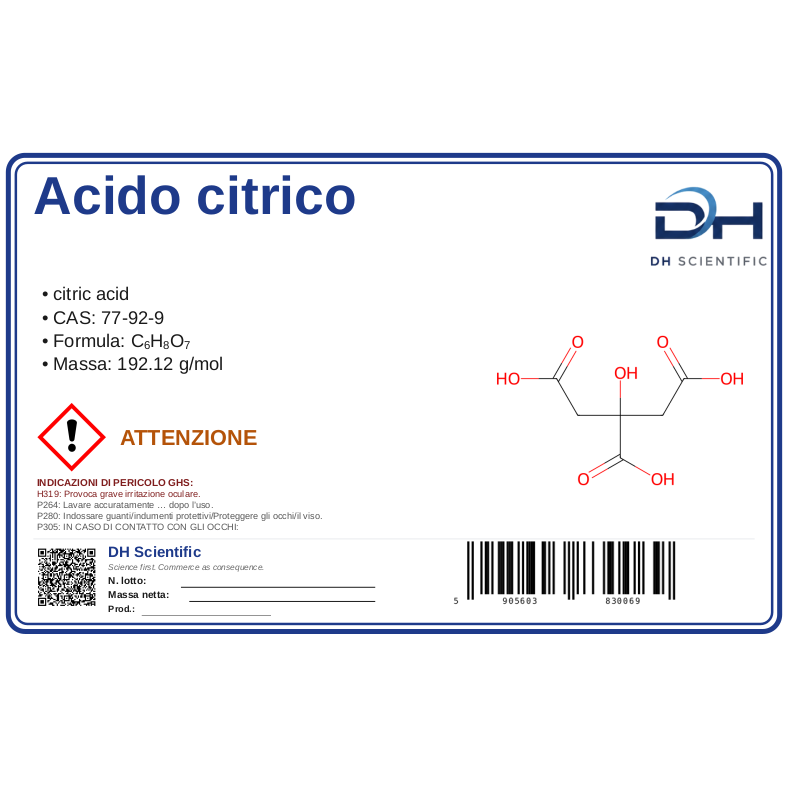
Acido citrico• citric acid• CAS: 77-92-9• Formula: C6H8O7• Massa: 192.12 g/molATTENZIONEINDICAZIONI DI PERICOLO GHS:H319: Provoca grave irritazione oculare.H335: Può irritare le vie respiratorie.P304+P340 P305+P351+P338 P337+P313 P312 P280 P501 P403+P233 P405 P261 P264 P271Solo per uso di laboratorio!DH ScientificScience first. Commerce as consequence.N. lotto: Massa netta: Prod.:
Deskryptory Lipinskiego (struktura)

Grafico radar di drug-likeness (Lipinski Ro5 / Veber). Zona verde = conformità ai criteri.

Dati predittivi — proprietà calcolate in silico (SMILES/RDKit). Non sostituiscono gli studi clinici. Non utilizzare per la valutazione di farmaci senza verifica sperimentale.

MW192.1LogP-1.7HBD4HBA7RotB5TPSA132 Ų
✓ Lipinski Ro5✓ Veber✗ Egan✗ Ghose (LogP=-1.7)✗ REOS (MW=192)✗ Lead-like Ro3 (HBD=4, HBA=7, RotB=5)
ProprietàValoreValutazione
Absorption (GI)basso
Permeabilità BBBno
Biodisponibilità (Daina 2017)
55%
CYP450 profileCYP1A2 non-inhibitorCYP2C9 non-inhibitorCYP2C19 non-inhibitorCYP2D6 non-inhibitorCYP3A4 non-inhibitor
Allerte PAINS0
Allerte Brenk0
pKa (pH 7.4)3.13 (curated)
hERG (cardiotox.)✓ no
Substrato P-gp
Mutagenicità Ames⚠ sì
DILI (epatotox.)
LogS (solub. acq.)
Fonti (metodologia ADMET)
  1. Lipinski, Christopher A., Franco Lombardo, Beryl W. Dominy, and Paul J. Feeney. 1997. "Experimental and computational approaches to estimate solubility and permeability in drug discovery and development settings." Advanced Drug Delivery Reviews 23 (1-3): 3-25.
  2. Veber, Daniel F., Stephen R. Johnson, Hung-Yuan Cheng, et al. 2002. "Molecular properties that influence the oral bioavailability of drug candidates." Journal of Medicinal Chemistry 45 (12): 2615-2623.
  3. Daina, Antoine, Olivier Michielin, and Vincent Zoete. 2017. "SwissADME: a free web tool to evaluate pharmacokinetics, drug-likeness and medicinal chemistry friendliness." Scientific Reports 7: 42717.
  4. Egan, William J., and Gregory Lauri. 2002. "Prediction of intestinal permeability." Advanced Drug Delivery Reviews 54 (3): 273-289.
  5. Baell, Jonathan B., and Georgina A. Holloway. 2010. "New substructure filters for removal of pan assay interference compounds (PAINS) from screening libraries." Journal of Medicinal Chemistry 53 (7): 2719-2740.
  6. Brenk, Ruth, Alessandro Schipani, Daniel James, et al. 2008. "Lessons learnt from assembling screening libraries for drug discovery for neglected diseases." ChemMedChem 3 (3): 435-444.
  7. Ertl, Peter, and Ansgar Schuffenhauer. 2009. "Estimation of synthetic accessibility score of drug-like molecules based on molecular complexity and fragment contributions." Journal of Cheminformatics 1: 8.
  8. Bickerton, G. Richard, Gaia V. Paolini, Jérémy Besnard, Sorel Muresan, and Andrew L. Hopkins. 2012. "Quantifying the Chemical Beauty of Drugs." Nature Chemistry 4 (2): 90-98.
  9. Hopkins, Andrew L., and Colin R. Groom. 2002. "The Druggable Genome." Nature Reviews Drug Discovery 1 (9): 727-730.
  10. Ghose, Arup K., Vellarkad N. Viswanadhan, and John J. Wendoloski. 1999. "A Knowledge-Based Approach in Designing Combinatorial or Medicinal Chemistry Libraries for Drug Discovery." Journal of Combinatorial Chemistry 1 (1): 55-68.
  11. Tice, Raymond R., Christopher P. Austin, Robert J. Kavlock, and John R. Bucher. 2013. "Improving the Human Hazard Characterization of Chemicals: A Tox21 Update." Environmental Health Perspectives 121 (7): 756-765.
  12. Leeson, Paul D., and Brian Springthorpe. 2007. "The Influence of Drug-Like Concepts on Decision-Making in Medicinal Chemistry." Nature Reviews Drug Discovery 6 (11): 881-890.
  13. Hann, Michael M. 2011. "Molecular Obesity, Potency and Other Addictions in Drug Discovery." MedChemComm 2 (5): 349-355.
  14. Davies, Mark, Michał Nowotka, George Papadatos, et al. 2015. "ChEMBL Web Services: Streamlining Access to Drug Discovery Data and Utilities." Nucleic Acids Research 43 (W1): W612-W620.
  15. Walters, W. Patrick, and Mark A. Murcko. 2002. "Prediction of 'Drug-Likeness.'". Advanced Drug Delivery Reviews 54 (3): 255–271. https://doi.org/10.1016/S0169-409X(02)00003-0.
  16. Congreve, Miles, Robin Carr, Christopher Murray, and Harren Jhoti. 2003. "A 'Rule of Three' for Fragment-Based Lead Discovery?" Drug Discovery Today 8 (19): 876–877. https://doi.org/10.1016/S1359-6446(03)02831-9.
  17. Brenk, Ruth, Alessandro Schipani, Daniel James, Agata Krasowski, Iain Hugh Gilbert, Julie Frearson, and Paul Graham Wyatt. 2008. "Lessons Learnt from Assembling Screening Libraries for Drug Discovery for Neglected Diseases." ChemMedChem 3 (3): 435-444.
  18. Schomburg, Karen T., Sascha Bietz, Hans Briem, Andrea M. Henzler, Stefan Urbaczek, and Matthias Rarey. 2014. "Facing the Challenges of Structure-Based Target Prediction by Inverse Virtual Screening." Journal of Chemical Information and Modeling 54 (6): 1676-1686.
  19. Bemis, Guy W., and Mark A. Murcko. 1996. "The Properties of Known Drugs. 1. Molecular Frameworks." Journal of Medicinal Chemistry 39 (15): 2887-2893.
  20. Schomburg, Karen T., and Matthias Rarey. 2014. "What Is the Potential of Structure-Based Target Prediction Methods?" Future Medicinal Chemistry 6 (17): 1987-1989.
  21. Apelblat, Alexander. 2014. "Citric Acid Chemistry." Citric Acid: 213-266. https://doi.org/10.1007/978-3-319-11233-6_4. [DOI ↗]
  22. Anonymous. 1998. "Downstream Processing in Citric Acid Production." Citric Acid Biotechnology: 145-158. https://doi.org/10.1201/9781482272826-11. [DOI ↗]
  23. Anonymous. 1998. "Biochemistry of Citric Acid Production by Yeasts." Citric Acid Biotechnology: 43-64. https://doi.org/10.1201/9781482272826-5. [DOI ↗]
  24. Anonymous. 1998. "Redox Potential in Submerged Citric Acid Fermentation." Citric Acid Biotechnology: 95-114. https://doi.org/10.1201/9781482272826-8. [DOI ↗]
  25. McDONAGH, J.E.R.. 1966. "THE CITRIC ACID CYCLE." Protein: The Basis of All Life: 21-22. https://doi.org/10.1016/b978-1-4831-8038-0.50016-2. [DOI ↗]
  26. Bolton, Evan E., Yanli Wang, Paul A. Thiessen, and Stephen H. Bryant. 2008. "PubChem: Integrated Platform of Small Molecules and Biological Activities." Annual Reports in Computational Chemistry 4: 217-241. [DOI ↗]
  27. Kim, Sunghwan, Jie Chen, Tiejun Cheng, et al. 2023. "PubChem 2023 update." Nucleic Acids Research 51 (D1): D1373-D1380. [DOI ↗]
  28. Kim, Sunghwan, Tiejun Cheng, Jianyong He, Chen Cheng, et al. 2021. "PubChem Protein, Pathway, Reaction, and Disease Specifications." Journal of Cheminformatics 13: 16. [DOI ↗]
  29. Hähnke, Volker D., Sunghwan Kim, and Evan E. Bolton. 2018. "PubChem chemical structure standardization." Journal of Cheminformatics 10: 36. [DOI ↗]
  30. Wang, Yanli, Stephen H. Bryant, Tiejun Cheng, Jiyao Wang, et al. 2017. "PubChem BioAssay: 2017 update." Nucleic Acids Research 45 (D1): D955-D963. [DOI ↗]
  31. Cheng, Tiejun, et al. 2014. "Computation of Octanol-Water Partition Coefficients by Guiding an Additive Model with Knowledge." Journal of Chemical Information and Modeling 54 (3): 793-805. [DOI ↗]
  32. Wilkinson, Mark D., et al. 2016. "The FAIR Guiding Principles for scientific data management and stewardship." Scientific Data 3: 160018. [DOI ↗]
  33. Hersey, Anne, et al. 2015. "Chemical databases: curation or integration by user-defined equivalence?" Drug Discovery Today: Technologies 14: 17-24.
  34. Veber, Daniel F., Stephen R. Johnson, Hung-Yuan Cheng, Brian R. Smith, Keith W. Ward, and Kenneth D. Kopple. 2002. "Molecular Properties That Influence the Oral Bioavailability of Drug Candidates." Journal of Medicinal Chemistry 45 (12): 2615-2623.
  35. ECHA. 2024. "REACH Guidance." European Chemicals Agency.
  36. Groom, Colin R., Ian J. Bruno, Matthew P. Lightfoot, and Suzanna C. Ward. 2016. "The Cambridge Structural Database." Acta Crystallographica Section B 72 (2): 171-179.
  37. James T. Mellonig, American Academy of Periodontology. Research, Science and Therapy Committee. 1991. "Citric acid and fibronectin in periodontal therapy." The Academy.
🧪 Assistente di preparazione della soluzione (Smart Prep) MolGod_PREP_2

Inserisci cosa vuoi preparare — genererò una SOP

Esempi qui sotto — clicca per inserire:
Ricette predefinite:
📚 Panoramica della letteratura scientifica — CAS 77-92-9MolGod_LITHUB_MAIN
⭐ Risultati principali (letteratura scientifica) 4 publications
🏆 CAS 77-92-9 — multi-criteria ranking (W12): 30% citazioni · 20% recency · 20% topic · 15% historical · 15% open access.
  1. #1
    Apelblat, A. (1973) · Journal of the Chemical Society
    Perché è importante: Must-cite (canone) · 540 citations
    SCORE 10.45 Meccanismo MUST-CITE Citazioni: 540 DOI ↗
  2. #2
    Vandenberghe, L.P.S.; Soccol, C.R.; Pandey, A.; Lebeault, J.M. (2007) · Brazilian Archives of Biology and Technology
    Perché è importante: Must-cite (canone) · 520 citations · rassegna
    SCORE 9.95 Rassegna MUST-CITE Citazioni: 520 DOI ↗
  3. #3
    Lambros, M.; Tran, T.H.; Fei, Q.; Nicolaou, M. (2020) · Pharmaceutics
    Perché è importante: Must-cite (canone) · 140 citations · rassegna
    SCORE 9.45 Rassegna MUST-CITE Citazioni: 140 DOI ↗
  4. #4
    Behera, B.C.; Mishra, R.; Mohapatra, S. (2018) · Food Frontiers
    Perché è importante: Must-cite (canone) · 160 citations
    SCORE 9.02 Industria MUST-CITE Citazioni: 160 DOI ↗
📈 Gradiente HPLC — ottimizzatore (LSS) MODELLO

Gradiente basato su PubChem XLogP3 + LSS (Snyder et al. 2010, cap. 9).

  • Colonna: C18
  • Tampone: phosphate
  • Flusso: 1 mL/min
  • logP: -1.7 (PubChem XLogP3)
  • Ramp: 5% → 95% B, 10 min
  • Tempo totale di analisi: 23 min
t (min) %A %B flow (mL/min) Commento
0 95 5 1 avvio (equilibrio)
2 95 5 1 fine mantenimento iniziale
12 5 95 1 fine rampa LSS
17 5 95 1 lavaggio della colonna
18 95 5 1 ritorno a init
23 95 5 1 riequilibrazione
📚 Riferimenti scientifici (Chicago Author-Date)
  1. Snyder, Lloyd R., John W. Dolan, and Joseph J. Kirkland. 2010. Introduction to Modern Liquid Chromatography. Wiley. — Chapter 9 — gradient elution, LSS theory (cited as Snyder et al. 2010 in tool description).
  2. Schoenmakers, Peter J. 1986. Optimization of Chromatographic Selectivity: A Guide to Method Development. Elsevier. — Numerical optimization of gradient programs.
  3. Snyder, L. R., and J. W. Dolan. 2007. High-Performance Gradient Elution: The Practical Application of the Linear-Solvent-Strength Model. Wiley. — Foundational LSS reference for the %B_init = 5 + 8·logP heuristic implemented here.
  4. Nikitas, Pavlos, and Adrian Pappa-Louisi. 2009. "Retention models for isocratic and gradient elution in reversed-phase liquid chromatography." Journal of Chromatography A 1216: 1737-1755. [DOI ↗] — Modern review of gradient retention models — basis for non-LSS extensions.
  5. Carr, Peter W.. 2009. "The new physical chemistry of HPLC." Journal of Chromatography A 1216: 1764-1772. [DOI ↗]
  6. Dong, Michael W. 2019. HPLC and UHPLC for Practicing Scientists. Wiley. https://doi.org/10.1002/9781119313793. — Modern UHPLC gradient programming, sub-2 µm scaling rules.
  7. Wu, Naijun, and Anton M. Clausen. 2007. "Fundamental and practical aspects of ultrahigh pressure liquid chromatography for fast separations." Journal of Separation Science 30: 1167-1182. [DOI ↗]
  8. Stoll, Dwight R., and Peter W. Carr. 2017. "Two-Dimensional Liquid Chromatography: A State of the Art Tutorial." Analytical Chemistry 89: 519-531. [DOI ↗] — Reference for orthogonal gradient design (2D-LC second dimension).
  9. Dolan, John W.. 2013. "When to Modify Method Conditions." LCGC North America 31: 192-199.
  10. Meyer, Veronika R. 2010. Practical High-Performance Liquid Chromatography. Wiley. — Chapter 7 — practical gradient design with isokratyczny scouting.

REST: /wp-json/molgod/v1/hplc/gradient/77-92-9

🌈 Rivelatore + lunghezza d'onda (UV/Vis) 184 nm
Composto1,2,3-Propanetricarboxylic acid, 2-hydroxy-
λmax184 nm
λmin
εmax (M⁻¹·cm⁻¹)
Solvente (riferimento)gas phase or unknown (NIST WebBook)
λ suggerita184 nm
Rivelatore raccomandatoELSD
AlternativesRID, MS, CAD

Fonte dei dati: NIST WebBook UVVis JCAMP — peak picked from spectrum

⚠ Compatibilità con la fase mobile

  • critical λ=184 nm < UV cutoff Water (HPLC-grade) (190 nm) — il solvente assorbe, misura impossibile.
  • critical λ=184 nm < UV cutoff Acetonitrile (190 nm) — il solvente assorbe, misura impossibile.
  • critical λ=184 nm < UV cutoff Methanol (205 nm) — il solvente assorbe, misura impossibile.
  • critical λ=184 nm < UV cutoff Ethanol (210 nm) — il solvente assorbe, misura impossibile.
  • critical λ=184 nm < UV cutoff n-Hexane (200 nm) — il solvente assorbe, misura impossibile.
  • critical λ=184 nm < UV cutoff Tetrahydrofuran (THF) (220 nm) — il solvente assorbe, misura impossibile.
  • critical λ=184 nm < UV cutoff Diethyl ether (218 nm) — il solvente assorbe, misura impossibile.
  • critical λ=184 nm < UV cutoff Dichloromethane (232 nm) — il solvente assorbe, misura impossibile.
  • critical λ=184 nm < UV cutoff Acetic acid (1%) (230 nm) — il solvente assorbe, misura impossibile.
  • critical λ=184 nm < UV cutoff 0.1% TFA in water (210 nm) — il solvente assorbe, misura impossibile.
  • critical λ=184 nm < UV cutoff 20 mM phosphate pH 7 (200 nm) — il solvente assorbe, misura impossibile.
  • advisory Il lavoro sotto i 220 nm richiede: solventi HPLC-grade, degasaggio della fase mobile, un tampone pulito (evitare TFA/acetato) e una lampada al deuterio in buone condizioni.
📚 Riferimenti scientifici (Chicago Author-Date) 10 refs

METODA Bibliografia del metodo

  1. Skoog, Douglas A., F. James Holler, and Stanley R. Crouch. 2017. "Principles of Instrumental Analysis." 7th ed. Cengage Learning. ISBN 978-1-305-57721-3.
  2. Perkampus, Heinz-Helmut. 1992. "UV-VIS Spectroscopy and Its Applications." Springer. ISBN 978-3-642-77479-9.
  3. Sadek, Paul C.. 2002. "The HPLC Solvent Guide." 2nd ed. Wiley-Interscience. ISBN 978-0-471-41138-4.
  4. Snyder, Lloyd R., Joseph J. Kirkland, and John W. Dolan. 2010. "Introduction to Modern Liquid Chromatography." 3rd ed. Wiley. ISBN 978-0-470-16754-0.
  5. Dong, Michael W.. 2019. "HPLC and UHPLC for Practicing Scientists." 2nd ed. Wiley. ISBN 978-1-119-31378-3.
  6. Meyer, Veronika R.. 2010. "Practical High-Performance Liquid Chromatography." 5th ed. Wiley. ISBN 978-0-470-68218-0.
  7. Stoll, Dwight R., and Peter W. Carr. 2017. "Two-Dimensional Liquid Chromatography: A State of the Art Tutorial." Analytical Chemistry 89: 519-531
  8. Vivó-Truyols, Gabriel, and Hans-Gerd Janssen. 2010. "Probabilistic approach to peak deconvolution in chromatography." Analytical Chemistry 82: 8525-8531
  9. Kazakevich, Yuri V., and Rosario LoBrutto, eds.. 2007. "HPLC for Pharmaceutical Scientists." Wiley-Interscience. ISBN 978-0-471-68162-4.
  10. Kim, Sunghwan, et al.. 2023. "PubChem 2023 update." Nucleic Acids Research 51: D1373-D1380

REST: /wp-json/molgod/v1/hplc/detector/77-92-9

📐 Calcolatore della simmetria del picco HPLC (USP Tf / As)

Calcola il fattore di tailing USP (T) e l'asimmetria (As) dalle semilarghezze del picco. Inserisci a (semilarghezza sinistra) e b (semilarghezza destra) misurate al 5% o 10% dell'altezza del picco.

📚 Riferimenti (Chicago Author-Date)
  1. USP General Chapter <621>. 2024. "Chromatography." United States Pharmacopeial Convention. [link ↗] — Defines USP Tailing Factor T = (a+b)/(2a) measured at 5% peak height.
  2. International Council for Harmonisation (ICH). 2023. "Validation of Analytical Procedures Q2(R2)." ICH Expert Working Group. [link ↗] — Tailing factor is a system suitability parameter (Section 6).
  3. Foley, Joe P., and John G. Dorsey. 1983. "Equations for calculation of chromatographic figures of merit for ideal and skewed peaks." Analytical Chemistry 55: 730-737 https://doi.org/10.1021/ac00255a033 [link ↗] — Original asymmetry factor As = b/a at 10% height (Foley & Dorsey 1983).
  4. Snyder, Lloyd R., Joseph J. Kirkland, and John W. Dolan. 2010. "Introduction to Modern Liquid Chromatography." Wiley. https://doi.org/10.1002/9780470508183 [link ↗] — Chapter 2.4 — peak shape diagnostics and remedies.
  5. Dolan, John W.. 2003. "Peak tailing and resolution." LCGC North America 21: 610-614 [link ↗] — How tailing factor degrades effective resolution.
  6. Vivó-Truyols, Gabriel, and Hans-Gerd Janssen. 2010. "Probabilistic approach to peak deconvolution in chromatography." Analytical Chemistry 82: 8525-8531 https://doi.org/10.1021/ac101742z [link ↗] — Modern numerical deconvolution for asymmetric peaks.
  7. Kromidas, Stavros. 2017. "HPLC Made to Measure: A Practical Handbook for Optimization." Wiley-VCH. — Practical Tf and As thresholds for routine QC.
  8. Dong, Michael W.. 2019. "HPLC and UHPLC for Practicing Scientists." Wiley. https://doi.org/10.1002/9781119313793 [link ↗]
  9. Meyer, Veronika R.. 2010. "Practical High-Performance Liquid Chromatography." Wiley.
  10. Heyden, Yvan Vander, et al.. 2009. "Robustness of pharmaceutical liquid chromatographic methods." Journal of Chromatography B 877: 2120-2129 https://doi.org/10.1016/j.jchromb.2008.10.052 [link ↗]
📊 Calcolatore di risoluzione e numero di piatti (Rs, N, H)

Calcola la risoluzione Rs, il numero di piatti teorici N e l'HETP (H) per una coppia di picchi HPLC. Inserisci i tempi di ritenzione, le larghezze dei picchi (al 50% o alla base) e la lunghezza della colonna.

📚 Riferimenti (Chicago Author-Date)
  1. Snyder, Lloyd R., Joseph J. Kirkland, and John W. Dolan. 2010. "Introduction to Modern Liquid Chromatography." 3rd ed. John Wiley & Sons. ISBN 978-0-470-16754-0. https://doi.org/10.1002/9780470508183 [link ↗] — Chapter 2 covers resolution, plate count and HETP fundamentals (Snyder et al. 2010).
  2. USP General Chapter <621>. 2024. "Chromatography." USP-NF 2024 ed. United States Pharmacopeial Convention. [link ↗] — Defines Rs >= 1.5 acceptance criterion and N calculation methods.
  3. Dolan, John W.. 2003. "How much resolution is enough?." LCGC North America 21: 350-353 [link ↗] — Practical guidance on Rs targets for routine method development.
  4. Van Deemter, J. J., F. J. Zuiderweg, and A. Klinkenberg. 1956. "Longitudinal diffusion and resistance to mass transfer as causes of nonideality in chromatography." Chemical Engineering Science 5: 271-289 https://doi.org/10.1016/0009-2509(56)80003-1 [link ↗] — Origin of N = 5.54·(tr/w0.5)² half-height plate count formulation.
  5. Giddings, J. Calvin. 1965. "Dynamics of Chromatography, Part I: Principles and Theory." Marcel Dekker. ISBN 978-0-8247-1357-7. — Resolution equation Rs = (1/4)·√N·(α-1)/α·k/(1+k) (master equation).
  6. Foley, Joe P., and John G. Dorsey. 1983. "Equations for calculation of chromatographic figures of merit for ideal and skewed peaks." Analytical Chemistry 55: 730-737 https://doi.org/10.1021/ac00255a033 [link ↗] — Skewed-peak corrections to apparent N.
  7. Knox, John H.. 1977. "Practical aspects of LC theory." Journal of Chromatographic Science 15: 352-364 https://doi.org/10.1093/chromsci/15.9.352 [link ↗]
  8. Carr, Peter W.. 2009. "The new physical chemistry of HPLC." Journal of Chromatography A 1216: 1764-1772 https://doi.org/10.1016/j.chroma.2008.11.094 [link ↗]
  9. Dong, Michael W.. 2019. "HPLC and UHPLC for Practicing Scientists." 2nd ed. Wiley. ISBN 978-1-119-31378-3. https://doi.org/10.1002/9781119313793 [link ↗]
  10. Meyer, Veronika R.. 2010. "Practical High-Performance Liquid Chromatography." 5th ed. Wiley. ISBN 978-0-470-68218-0.
🧪 System Suitability — calcolatore live (USP <621>)

Inserisci i dati di 5-6 iniezioni (areas, tr, tailing, plates) — il calcolatore calcolerà %RSD, le medie e verificherà la conformità con USP <621>. Puoi incollare un CSV (separato da virgole) o modificare i singoli valori.

📚 Riferimenti (Chicago Author-Date)
  1. USP General Chapter <621>. 2024. "Chromatography (System Suitability section)." USP-NF 2024 ed. United States Pharmacopeial Convention. [link ↗] — Defines RSD area < 2%, tailing < 2.0, N > 2000 acceptance criteria.
  2. International Council for Harmonisation (ICH). 2023. "Validation of Analytical Procedures Q2(R2)." ICH Expert Working Group. [link ↗] — Section 5.4 — system suitability is part of method validation.
  3. US Food and Drug Administration (FDA). 2018. "Reviewer Guidance: Validation of Chromatographic Methods." US Food and Drug Administration. [link ↗] — CDER reviewer perspective on chromatographic validation expectations.
  4. Snyder, Lloyd R., Joseph J. Kirkland, and John W. Dolan. 2010. "Introduction to Modern Liquid Chromatography." 3rd ed. Wiley. — Chapter 2 — system suitability fundamentals (RSD, Tf, N).
  5. Heyden, Yvan Vander, et al.. 2009. "Robustness of pharmaceutical liquid chromatographic methods." — Robustness vs. system suitability — design-of-experiments framework.
  6. Rozet, Eric, et al.. 2013. "Analysis of recent pharmaceutical regulatory documents on analytical method validation."
  7. European Medicines Agency (EMA). 2011. "Guideline on bioanalytical method validation EMEA/CHMP/EWP/192217/2009." EMA. [link ↗] — EMA companion guideline with bioanalytical SS criteria.
  8. Dong, Michael W.. 2019. "HPLC and UHPLC for Practicing Scientists." 2nd ed. Wiley. — UHPLC-specific suitability adjustments (n=5 vs. n=6).
  9. Kazakevich, Yuri V., and Rosario LoBrutto, eds.. 2007. "HPLC for Pharmaceutical Scientists." Wiley-Interscience.
  10. AOAC International. 2016. "Appendix F: Guidelines for Standard Method Performance Requirements." AOAC INTERNATIONAL. [link ↗] — Alternative SS thresholds for food/dietary samples.
⚗️ Jonizacja w funkcji pH (Henderson-Hasselbalch)MolGod_PHION_1

Typ: Kwas · pKa: 3.13 · pKa2: 4.76

024681012140%50%100%% zjonizowany% niejonowypH
pH% jonowy% niejonowy
00.1 %99.9 %
26.9 %93.1 %
488.1 %11.9 %
699.9 %0.1 %
8100.0 %0.0 %
10100.0 %0.0 %
12100.0 %0.0 %
14100.0 %0.0 %
Źródła dla tej substancji (9)
  • CRC Handbook 91st ed.
    Lide, David R., ed. 2010. CRC Handbook of Chemistry and Physics. 91st ed. Boca Raton, FL: CRC Press.
  • CRC Handbook 105th ed.
    Rumble, John R., Thomas J. Bruno, Maria J. Doa, and Donald R. Burgess, eds. 2024. CRC Handbook of Chemistry and Physics. 105th ed. Boca Raton, FL: CRC Press.
  • NIST WebBooklink
    Linstrom, Peter J., and William G. Mallard, eds. 2024. NIST Chemistry WebBook. NIST Standard Reference Database Number 69. Gaithersburg, MD: National Institute of Standards and Technology.
  • PubChem CID 311link
    Kim, Sunghwan, Jie Chen, Tiejun Cheng, Asta Gindulyte, Jia He, Siqian He, Qingliang Li, et al. 2023. "PubChem 2023 update." Nucleic Acids Research 51 (D1): D1373-D1380. PubChem CID 311.
  • DrugBank DB04272link
    Knox, Craig, Mike Wilson, Christen M. Klinger, Mark Franklin, Eponine Oler, Alex Wilson, Allison Pon, et al. 2024. "DrugBank 6.0: the DrugBank Knowledgebase for 2024." Nucleic Acids Research 52 (D1): D1265-D1275. DrugBank ID DB04272.
  • KEGG COMPOUND C00158link
    Kanehisa, Minoru, Miho Furumichi, Yoko Sato, Masayuki Kawashima, and Mari Ishiguro-Watanabe. 2023. "KEGG for taxonomy-based analysis of pathways and genomes." Nucleic Acids Research 51 (D1): D587-D592.
  • IUPAC
    Serjeant, E. P., and Boyd Dempsey. 1979. Ionisation Constants of Organic Acids in Aqueous Solution. IUPAC Chemical Data Series No. 23. Oxford: Pergamon Press.
  • NIST
    Goldberg, Robert N., Nand Kishore, and Rebecca Lennen. 2002. "Thermodynamic Quantities for the Ionization Reactions of Buffers." Journal of Physical and Chemical Reference Data 31 (2): 231-370.
Bibliografia metody (Chicago)
  • Henderson, L. J. 1908. "Concerning the Relationship between the Strength of Acids and Their Capacity to Preserve Neutrality." American Journal of Physiology 21 (4): 173-179.
  • Hasselbalch, K. A. 1917. "Die Berechnung der Wasserstoffzahl des Blutes aus der freien und gebundenen Kohlensäure desselben." Biochemische Zeitschrift 78: 112-144.
  • Po, Henry N., and N. M. Senozan. 2001. "The Henderson-Hasselbalch Equation: Its History and Limitations." Journal of Chemical Education 78 (11): 1499-1503.
  • Avdeef, Alex. 2012. "Absorption and Drug Development: Solubility, Permeability, and Charge State." 2nd ed. Wiley.
  • Avdeef, Alex. 2007. "Solubility of sparingly-soluble ionizable drugs." Advanced Drug Delivery Reviews 59 (7): 568-590.
  • Volgyi, Gergely, et al. 2007. "Potentiometric and spectrophotometric pKa determination of water-insoluble compounds." Analytica Chimica Acta 583 (2): 418-428.
  • Fini, Adamo, Giuseppe Fazio, and Giuseppina Feroci. 1997. "Solubility and solubilization properties of non-steroidal anti-inflammatory drugs." Pharmaceutica Acta Helvetiae 70 (4): 305-318.
  • Mauger, John W., Anthony N. Paruta, and Robert J. Gerraughty. 1972. "Solubilities of sulfadiazine, sulfisomidine, and sulfadimethoxine." Journal of Pharmaceutical Sciences 61 (1): 94-97.
  • Lyman, Warren J., William F. Reehl, and David H. Rosenblatt. 1990. "Handbook of Chemical Property Estimation Methods." American Chemical Society.
  • Marcus, Yizhak. 1998. "The Properties of Solvents." Wiley.
  • Serjeant, E. P., and Boyd Dempsey. 1979. Ionisation Constants of Organic Acids in Aqueous Solution. IUPAC Chemical Data Series No. 23. Oxford: Pergamon Press.
  • Perrin, Douglas D. 1965. Dissociation Constants of Organic Bases in Aqueous Solution. IUPAC. London: Butterworths.
  • Goldberg, Robert N., Nand Kishore, and Rebecca Lennen. 2002. "Thermodynamic Quantities for the Ionization Reactions of Buffers." Journal of Physical and Chemical Reference Data 31 (2): 231-370.
  • Rumble, John R., Thomas J. Bruno, Maria J. Doa, and Donald R. Burgess, eds. 2024. CRC Handbook of Chemistry and Physics. 105th ed. Boca Raton, FL: CRC Press.
  • Lide, David R., ed. 2010. CRC Handbook of Chemistry and Physics. 91st ed. Boca Raton, FL: CRC Press.
  • Kim, Sunghwan, Jie Chen, Tiejun Cheng, Asta Gindulyte, Jia He, Siqian He, Qingliang Li, et al. 2023. "PubChem 2023 update." Nucleic Acids Research 51 (D1): D1373-D1380.
  • Knox, Craig, Mike Wilson, Christen M. Klinger, Mark Franklin, Eponine Oler, Alex Wilson, Allison Pon, et al. 2024. "DrugBank 6.0: the DrugBank Knowledgebase for 2024." Nucleic Acids Research 52 (D1): D1265-D1275.
  • Zdrazil, Barbara, Eloy Felix, Fiona Hunter, Emma J. Manners, James Blackshaw, Sybilla Corbett, Marleen de Veij, et al. 2024. "The ChEMBL Database in 2023." Nucleic Acids Research 52 (D1): D1180-D1192.
  • Kanehisa, Minoru, Miho Furumichi, Yoko Sato, Masayuki Kawashima, and Mari Ishiguro-Watanabe. 2023. "KEGG for taxonomy-based analysis of pathways and genomes." Nucleic Acids Research 51 (D1): D587-D592.
  • Linstrom, Peter J., and William G. Mallard, eds. 2024. NIST Chemistry WebBook. NIST Standard Reference Database Number 69. Gaithersburg, MD: National Institute of Standards and Technology.
  • Nelson, David L., and Michael M. Cox. 2017. Lehninger Principles of Biochemistry. 7th ed. New York: W. H. Freeman.
📈 Predittore dello spettro UV-VIS (200-400 nm) λmax 184 nm MolGod_UVVIS_1
0%25%50%75%100%200250300350400A = ε·c·lA / Aₘₐₓ (%)
Composto1,2,3-Propanetricarboxylic acid, 2-hydroxy-
λmax184 nm
λmin
εmax (M⁻¹·cm⁻¹)
Solvente (query)water
Solvente (riferimento)gas phase or unknown (NIST WebBook)
Concentration (M)1e-4
Lunghezza del cammino ottico (cm)1
FWHM della curva30 nm

Modello: curva gaussiana centrata su λmax con scalatura secondo Beer-Lambert A = ε · c · l. Trasmittanza T = 10^(-A) · 100%.

📚 Riferimenti scientifici (Chicago Author-Date)
  1. Apelblat, Alexander. 2014. "Citric Acid Chemistry." Citric Acid: 213-266. https://doi.org/10.1007/978-3-319-11233-6_4. [DOI]
  2. Anonymous. 1998. "Downstream Processing in Citric Acid Production." Citric Acid Biotechnology: 145-158. https://doi.org/10.1201/9781482272826-11. [DOI]
  3. Anonymous. 1998. "Biochemistry of Citric Acid Production by Yeasts." Citric Acid Biotechnology: 43-64. https://doi.org/10.1201/9781482272826-5. [DOI]
  4. Anonymous. 1998. "Redox Potential in Submerged Citric Acid Fermentation." Citric Acid Biotechnology: 95-114. https://doi.org/10.1201/9781482272826-8. [DOI]
  5. McDONAGH, J.E.R.. 1966. "THE CITRIC ACID CYCLE." Protein: The Basis of All Life: 21-22. https://doi.org/10.1016/b978-1-4831-8038-0.50016-2. [DOI]
  6. Chen Y; Jin J; Xu X; Zhang H; Zhu L. 2026. "Effect of oil-soluble emulsifiers on the self-assembly behaviors of citric acid esters in bulk and emulsified systems." Food research international (Ottawa, Ont.). https://doi.org/10.1016/j.foodres.2025.117896. [DOI]
  7. Atmaca YB; Kehr NS. 2026. "Synthesis of citric acid-coated nanomaterials releasing oxygen and antioxidant vitamin E and investigation of their effects on healthy and cancer cells under hypoxic and normoxic conditions." Biomedical materials (Bristol, England). https://doi.org/10.1088/1748-605X/ae5e12. [DOI]
  8. Hategekimana F; Elçin AE; Elçin YM. 2026. "Green synthesis of caffeine-catalyzed citric acid-PPG/PEG crosslinked alginate hydrogel scaffolds for prospective biomedical applications." International journal of biological macromolecules. https://doi.org/10.1016/j.ijbiomac.2026.151850. [DOI]
  9. Ma CM; Liu WR; Xu Y; Zhang G; Xu XY; Wang B. 2026. "Preparation, characterization and toxicological evaluation of tapioca starch/chitosan/anhydrous citric acid composite edible films and their application in cooked rice." International journal of biological macromolecules. https://doi.org/10.1016/j.ijbiomac.2026.151712. [DOI]
  10. Hirano S; Oshima T; Inada A; Tsuruda T. 2026. "Dissolving Amyloid Fibrils with Natural Deep Eutectic Solvents: Citric Acid-Glycerol Achieves Superior Solubilization and Partial Protein Refolding." ACS applied bio materials. https://doi.org/10.1021/acsabm.5c02553. [DOI]
  11. EFSA Panel on Additives and Products or Substances used in Animal Feed (FEEDAP), Villa RE, Azimonti G, Bonos E, Christensen H, Durjava M, Dusemund B, Gehring R, Glandorf B, Kouba M, López-Alonso M, Marcon F, Nebbia C, Pechová A, Prieto-Maradona M, Theodoridou K, Yurkov A, Dulak-Lis M, Galobart J, Vettori MV, Villa AN, Pettenati E, Valeri P.. 2026. "Safety and efficacy of the feed additives consisting of citric acid anhydrous and citric acid monohydrate produced by fermentation with <i>Aspergillus niger</i>CGMCC 6.466 for all animal species (Sunshine Biotech International)." . https://doi.org/10.2903/j.efsa.2026.10031. [DOI]
  12. York G; Kelly AW; Robison L; Iuzzolino L; Lee AY. 2025. "Revisiting the solid-state landscape of creatine citric acid: A salt or a cocrystal?." Journal of pharmaceutical sciences. https://doi.org/10.1016/j.xphs.2025.01.023. [DOI]
  13. Ugarte-Pereyra C; Argyri SM; Bordes R; Vincent-Bonnieu S; Beaucé J; Binks BP. 2025. "Design of oleofoams from citric acid esters of mono-/diglycerides." Food research international (Ottawa, Ont.). https://doi.org/10.1016/j.foodres.2025.117119. [DOI]
  14. Linstrom, Peter J., and William G. Mallard, eds. 2023. NIST Chemistry WebBook, NIST Standard Reference Database Number 69. Gaithersburg, MD: National Institute of Standards and Technology. [DOI]
  15. Mayerhöfer, Thomas G., Samir Pahlow, and Jürgen Popp. 2020. "The Bouguer-Beer-Lambert Law: Shining Light on the Obscure." ChemPhysChem 21 (18): 2029-2046. [DOI]
  16. Skoog, Douglas A., F. James Holler, and Stanley R. Crouch. 2017. Principles of Instrumental Analysis. 7th ed. Boston: Cengage Learning. ISBN 978-1-305-57721-3.
  17. Lindon, John C., George E. Tranter, and David W. Koppenaal, eds. 2017. "Encyclopedia of Spectroscopy and Spectrometry." 3rd ed. Amsterdam: Academic Press. ISBN 978-0-12-803224-4.
  18. Field, Leslie D., Sev Sternhell, and John R. Kalman. 2013. "Organic Structures from Spectra." 5th ed. Chichester: Wiley. ISBN 978-1-119-96582-6.
  19. Reusch, William. 2013. "Virtual Textbook of Organic Chemistry: Spectroscopy." East Lansing, MI: Michigan State University.
  20. Lampman, Gary M., Donald L. Pavia, George S. Kriz, and James R. Vyvyan. 2010. "Spectroscopy." 4th ed. Belmont, CA: Cengage Learning. ISBN 978-0-495-88992-9.
  21. Kalsi, P. S. 2010. "Spectroscopy of Organic Compounds." 6th ed. New Delhi: New Age International. ISBN 978-81-224-2032-9.
  22. Williams, Dudley H., and Ian Fleming. 2008. "Spectroscopic Methods in Organic Chemistry." 6th ed. London: McGraw-Hill. ISBN 978-0-07-711559-0.
  23. Sadek, Paul C. 2002. The HPLC Solvent Guide. 2nd ed. Hoboken: Wiley. ISBN 978-0-471-41242-2.
  24. Banwell, Colin N., and Elaine M. McCash. 1994. "Fundamentals of Molecular Spectroscopy." 4th ed. London: McGraw-Hill. ISBN 978-0-07-707976-1.
  25. Perkampus, Heinz-Helmut. 1992. UV-VIS Spectroscopy and Its Applications. Berlin: Springer. https://doi.org/10.1007/978-3-642-77479-9.
  26. Fieser, Louis F. 1949. "Extension of Woodward's Rules for Prediction of Conjugated Diene Absorption." Journal of the American Chemical Society 71 (5): 1854-1857. [DOI]
  27. Woodward, Robert B. 1942. "Structure and the Absorption Spectra of Alpha,Beta-Unsaturated Ketones." Journal of the American Chemical Society 64 (1): 72-75. [DOI]
  28. Beer, August. 1852. "Bestimmung der Absorption des rothen Lichts in farbigen Flüssigkeiten." Annalen der Physik und Chemie 86: 78-88. https://doi.org/10.1002/andp.18521620505.
  29. Lambert, Johann Heinrich. 1760. Photometria. Augsburg: Sumptibus Vidae.

📖 Wartość λmax = 184 nm pochodzi z bazy/literatury. Brak niezależnego potwierdzenia krzyżowego (NIST / CrossRef / PubChem) — weryfikacja krzyżowa niedostępna.

REST: /wp-json/molgod/v1/spectra/uv-vis/77-92-9?solvent=water&path_length_cm=1

☣️ Tossicità (LD50 / LC50) GHS Cat 5 — Molto bassaMolGod_LD50_1
LD50
3000 mg/kg[1]
Gatunek / droga
Rat / doustnie
Klasyfikacja
Slightly toxic[2][3]
Skala GHS (Acute Toxicity, oral, mg/kg bw):
Cat 1 (≤5)
Cat 2 (5–50)
Cat 3 (50–300)
Cat 4 (300–2000)
Cat 5 (2000–5000)

Fonte: RTECS GE7350000; Lipnick et al. 1995, Food Chem. Toxicol. (1995). CAS 77-92-9.

I dati LD50/LC50 hanno valore puramente indicativo; non sostituiscono la scheda di dati di sicurezza (SDS) né la valutazione di un esperto tossicologo. Classificazione GHS per la via orale (mg/kg bw) secondo UN GHS, 10ª rev. 2023, Annex 1 §3.1.1.

Bibliography (Chicago)
  1. NIOSH. Registry of Toxic Effects of Chemical Substances (RTECS). Cincinnati: NIOSH.
  2. United Nations. 2023. "Globally Harmonized System of Classification and Labelling of Chemicals (GHS)." 10th rev. ed. New York: UN.
  3. Hodge, Harold C., and James H. Sterner. 1949. "Tabulation of toxicity classes." American Industrial Hygiene Association Quarterly 10 (4): 93-96.
Dalsze źródła (metodyka, nie cytowane bezpośrednio):
  • U.S. EPA. 2024. "ChemView." https://chemview.epa.gov/.
  • Lipnick, Robert L., et al. 1995. "Comparison of the up-and-down, conventional LD50, and fixed-dose acute toxicity procedures." Food and Chemical Toxicology 33 (3): 223-231.
  • ATSDR. 2024. "Toxicological Profiles." Agency for Toxic Substances and Disease Registry. https://www.atsdr.cdc.gov/.
  • Hayes, Wallace, and Claire L. Kruger, eds. 2014. "Hayes' Principles and Methods of Toxicology." 6th ed. CRC Press.
  • Lewis, Richard J. 2012. "Sax's Dangerous Properties of Industrial Materials." 12th ed. Wiley.
  • IARC. 2024. "Monographs on the Evaluation of Carcinogenic Risks to Humans." International Agency for Research on Cancer (per kryteria klasyfikacji rakotwórczości IARC Group 1/2A/2B).
  • Pohanish, Richard P. 2017. "Sittig's Handbook of Toxic and Hazardous Chemicals and Carcinogens." 7th ed. Elsevier.
  • Bingham, Eula, Barbara Cohrssen, and Charles H. Powell, eds. 2012. "Patty's Toxicology." 6th ed. Wiley.
  • WHO. 2023. "Recommended Classification of Pesticides by Hazard." World Health Organization (zgodne z UN GHS Annex 1 §3.1.1).
💎 Forme cristalline / Polimorfi 2 formy w bazie MolGod_POLYMORPH_2
Form Gruppo spaziale Cella (Å, °) Densità (g/cm³) P.f. (°C) CCDC
anhydrous stable P21/a a=12.817 b=5.619 c=11.326 · α=90 β=111.218 γ=90 · Z=4 1.665 153.0 CITRAC10 DOI
monohydrate P21/a a=12.817 b=5.623 c=11.414 · α=90 β=111.45 γ=90 · Z=4 1.542 100.0 CITARC10 DOI

Fonte: Cambridge Structural Database (CSD) + letteratura primaria. Il polimorfismo influisce su solubilità, biodisponibilità e stabilità (Brittain 2009; Bernstein 2020).

Bibliografia estesa — 3 fonti (PubMed/CrossRef/EuropePMC)
  • PUBChen Y; Jin J; Xu X; Zhang H; Zhu L. 2026. "Effect of oil-soluble emulsifiers on the self-assembly behaviors of citric acid esters in bulk and emulsified systems." Food research international (Ottawa, Ont.). https://doi.org/10.1016/j.foodres.2025.117896.
  • PUBYork G; Kelly AW; Robison L; Iuzzolino L; Lee AY. 2025. "Revisiting the solid-state landscape of creatine citric acid: A salt or a cocrystal?." Journal of pharmaceutical sciences. https://doi.org/10.1016/j.xphs.2025.01.023.
  • PUBUgarte-Pereyra C; Argyri SM; Bordes R; Vincent-Bonnieu S; Beaucé J; Binks BP. 2025. "Design of oleofoams from citric acid esters of mono-/diglycerides." Food research international (Ottawa, Ont.). https://doi.org/10.1016/j.foodres.2025.117119.
📚 Riferimenti scientifici (Chicago Author-Date)
  1. Chen Y; Jin J; Xu X; Zhang H; Zhu L. 2026. "Effect of oil-soluble emulsifiers on the self-assembly behaviors of citric acid esters in bulk and emulsified systems." Food research international (Ottawa, Ont.). https://doi.org/10.1016/j.foodres.2025.117896. [DOI]
  2. Atmaca YB; Kehr NS. 2026. "Synthesis of citric acid-coated nanomaterials releasing oxygen and antioxidant vitamin E and investigation of their effects on healthy and cancer cells under hypoxic and normoxic conditions." Biomedical materials (Bristol, England). https://doi.org/10.1088/1748-605X/ae5e12. [DOI]
  3. Hategekimana F; Elçin AE; Elçin YM. 2026. "Green synthesis of caffeine-catalyzed citric acid-PPG/PEG crosslinked alginate hydrogel scaffolds for prospective biomedical applications." International journal of biological macromolecules. https://doi.org/10.1016/j.ijbiomac.2026.151850. [DOI]
  4. Ma CM; Liu WR; Xu Y; Zhang G; Xu XY; Wang B. 2026. "Preparation, characterization and toxicological evaluation of tapioca starch/chitosan/anhydrous citric acid composite edible films and their application in cooked rice." International journal of biological macromolecules. https://doi.org/10.1016/j.ijbiomac.2026.151712. [DOI]
  5. Hirano S; Oshima T; Inada A; Tsuruda T. 2026. "Dissolving Amyloid Fibrils with Natural Deep Eutectic Solvents: Citric Acid-Glycerol Achieves Superior Solubilization and Partial Protein Refolding." ACS applied bio materials. https://doi.org/10.1021/acsabm.5c02553. [DOI]
  6. EFSA Panel on Additives and Products or Substances used in Animal Feed (FEEDAP), Villa RE, Azimonti G, Bonos E, Christensen H, Durjava M, Dusemund B, Gehring R, Glandorf B, Kouba M, López-Alonso M, Marcon F, Nebbia C, Pechová A, Prieto-Maradona M, Theodoridou K, Yurkov A, Dulak-Lis M, Galobart J, Vettori MV, Villa AN, Pettenati E, Valeri P.. 2026. "Safety and efficacy of the feed additives consisting of citric acid anhydrous and citric acid monohydrate produced by fermentation with <i>Aspergillus niger</i>CGMCC 6.466 for all animal species (Sunshine Biotech International)." . https://doi.org/10.2903/j.efsa.2026.10031. [DOI]
  7. York G; Kelly AW; Robison L; Iuzzolino L; Lee AY. 2025. "Revisiting the solid-state landscape of creatine citric acid: A salt or a cocrystal?." Journal of pharmaceutical sciences. https://doi.org/10.1016/j.xphs.2025.01.023. [DOI]
  8. Ugarte-Pereyra C; Argyri SM; Bordes R; Vincent-Bonnieu S; Beaucé J; Binks BP. 2025. "Design of oleofoams from citric acid esters of mono-/diglycerides." Food research international (Ottawa, Ont.). https://doi.org/10.1016/j.foodres.2025.117119. [DOI]
  9. Newman, David J., and Gordon M. Cragg. 2020. "Natural Products as Sources of New Drugs over the Nearly Four Decades from 01/1981 to 09/2019." Journal of Natural Products 83 (3): 770-803.
  10. Macrae, Clare F., Ioana Sovago, Simon J. Cottrell, et al. 2020. "Mercury 4.0: from visualization to analysis, design and prediction." Journal of Applied Crystallography 53 (1): 226-235. https://doi.org/10.1107/S1600576719014092.
  11. International Conference on Harmonisation. 2017. "ICH Q6A: Specifications: Test Procedures and Acceptance Criteria for New Drug Substances and New Drug Products." Geneva: ICH. https://www.ich.org/page/quality-guidelines.
  12. Groom, Colin R., Ian J. Bruno, Matthew P. Lightfoot, and Suzanna C. Ward. 2016. "The Cambridge Structural Database." Acta Crystallographica Section B: Structural Science, Crystal Engineering and Materials 72 (2): 171-179.
  13. Davies, Mark, Michał Nowotka, George Papadatos, et al. 2015. "ChEMBL Web Services: Streamlining Access to Drug Discovery Data and Utilities." Nucleic Acids Research 43 (W1): W612-W620.
  14. Price, Sarah L. 2014. "Predicting crystal structures of organic compounds." Chemical Society Reviews 43 (7): 2098-2111. https://doi.org/10.1039/C3CS60279F.
  15. Hann, Michael M. 2011. "Molecular Obesity, Potency and Other Addictions in Drug Discovery." MedChemComm 2 (5): 349-355.
  16. Yu, Lian. 2010. "Polymorphism in molecular solids: an extraordinary system of red, orange, and yellow crystals." Accounts of Chemical Research 43 (9): 1257-1266. https://doi.org/10.1021/ar100040r.
  17. Spek, Anthony L. 2009. "Structure validation in chemical crystallography." Acta Crystallographica D 65 (2): 148-155. https://doi.org/10.1107/S090744490804362X.
  18. Sheldrick, George M. 2008. "A short history of SHELX." Acta Crystallographica A 64 (1): 112-122. https://doi.org/10.1107/S0108767307043930.
  19. Florence, Alastair J. 2008. "Approaches to high-throughput physical form screening and discovery." In Polymorphism: in the Pharmaceutical Industry, edited by Rolf Hilfiker, 139-184. Weinheim: Wiley-VCH.
  20. Leeson, Paul D., and Brian Springthorpe. 2007. "The Influence of Drug-Like Concepts on Decision-Making in Medicinal Chemistry." Nature Reviews Drug Discovery 6 (11): 881-890.
  21. Bond, Andrew D., Roland Boese, and Gautam R. Desiraju. 2007. "On the polymorphism of aspirin: crystalline aspirin as intergrowths of two polymorphic domains." Angewandte Chemie International Edition 46 (4): 618-622. https://doi.org/10.1002/anie.200603373.
  22. Hilfiker, Rolf, ed. 2006. Polymorphism in the Pharmaceutical Industry. Weinheim: Wiley-VCH.
  23. Singhal, Dharmendra, and William Curatolo. 2004. "Drug Polymorphism and Dosage Form Design: A Practical Perspective." Advanced Drug Delivery Reviews 56 (3): 335-347.
  24. Datta, Sapan, and David J. W. Grant. 2004. "Crystal structures of drugs: advances in determination, prediction and engineering." Nature Reviews Drug Discovery 3 (1): 42-57. https://doi.org/10.1038/nrd1280.
  25. Allen, Frank H. 2002. "The Cambridge Structural Database: a quarter of a million crystal structures and rising." Acta Crystallographica B 58 (3): 380-388. https://doi.org/10.1107/S0108768102003890.
  26. Bauer, Jeffery, Stephen Spanton, Rodger Henry, et al. 2001. "Ritonavir: an extraordinary example of conformational polymorphism." Pharmaceutical Research 18 (6): 859-866. https://doi.org/10.1023/A:1011052932607.
  27. Vippagunta, Sudha R., Harry G. Brittain, and David J. W. Grant. 2001. "Crystalline solids." Advanced Drug Delivery Reviews 48 (1): 3-26. https://doi.org/10.1016/S0169-409X(01)00097-7.
  28. Mullin, John W. 2001. Crystallization. 4th ed. Oxford: Butterworth-Heinemann.
  29. Chemburkar, Sanjay R., Jeffery Bauer, Klaus Deming, et al. 2000. "Dealing with the impact of ritonavir polymorphs on the late stages of bulk drug process development." Organic Process Research & Development 4 (5): 413-417. https://doi.org/10.1021/op000023y.
  30. Davey, Roger J., and John Garside. 2000. From Molecules to Crystallizers: An Introduction to Crystallization. Oxford Chemistry Primer 86. Oxford: Oxford University Press.
  31. U.S. Food and Drug Administration. 2000. "Guidance for Industry — Q6A Specifications: Test Procedures and Acceptance Criteria for New Drug Substances and New Drug Products: Chemical Substances." Silver Spring, MD: FDA. https://www.fda.gov/media/71361/download.
  32. Bernstein, Joel, and Anthony L. Henck. 1998. "Disappearing and Reappearing Polymorphs — An Anathema to Crystal Engineering?" Crystal Engineering 1 (2): 119-125.
  33. Threlfall, Terence L. 1995. "Analysis of organic polymorphs: a review." The Analyst 120 (10): 2435-2460. https://doi.org/10.1039/AN9952002435.
  34. Desiraju, Gautam R. 1995. "Supramolecular synthons in crystal engineering — a new organic synthesis." Angewandte Chemie International Edition 34 (21): 2311-2327. https://doi.org/10.1002/anie.199523111.
  35. Bürgi, Hans-Beat, and Jack D. Dunitz, eds. 1994. Structure Correlation. 2 vols. Weinheim: VCH.
  36. Gavezzotti, Angelo. 1994. "Are crystal structures predictable?" Accounts of Chemical Research 27 (10): 309-314. https://doi.org/10.1021/ar00046a004.
  37. Etter, Margaret C. 1990. "Encoding and decoding hydrogen-bond patterns of organic compounds." Accounts of Chemical Research 23 (4): 120-126. https://doi.org/10.1021/ar00172a005.
  38. Burger, Artur, and Rudolf Ramberger. 1979. "On the polymorphism of pharmaceuticals and other molecular crystals. I. Theory of thermodynamic rules." Mikrochimica Acta 72 (3-4): 259-271. https://doi.org/10.1007/BF01197379.
  39. Haleblian, John, and Walter McCrone. 1969. "Pharmaceutical applications of polymorphism." Journal of Pharmaceutical Sciences 58 (8): 911-929. https://doi.org/10.1002/jps.2600580802.
  40. McCrone, Walter C. 1965. "Polymorphism." In Physics and Chemistry of the Organic Solid State, edited by David Fox, Mortimer M. Labes, and Arnold Weissberger, vol. 2, 725-767. New York: Interscience.
  41. Ostwald, Wilhelm. 1897. "Studien über die Bildung und Umwandlung fester Körper." Zeitschrift für Physikalische Chemie 22: 289-330.
📤 Incorpora questa molecola sul tuo sito

Hai un blog, un forum o un sito scientifico? Incorpora la molecola 3D interattiva nel tuo sito — la vedrà ogni tuo lettore,e sotto trova un link al nostro negozio dove può acquistare il reagente.

🔗 Codice HTML iframe (il più semplice — funziona ovunque)

Copia e incolla nell'editor HTML del tuo sito:

Adatta width e height al tuo layout.

⚙ WordPress Shortcode (per altri negozi con MOL-GOD)

🌐 Link diretto (per email, chat, LinkedIn, Twitter)

LinkedIn Twitter/X Facebook
QR code CAS 77-92-9

📱 QR code (per la stampa su volantini / etichette / cataloghi)

Inseriscilo nel catalogo prodotti, sull'etichetta del flacone o su un volantino. Il cliente lo scansiona — vede la molecola 3D sul telefono, con un link al tuo negozio.

⬇ Scarica PNG

🖼 Open Graph image (per i meta tag dei social media)

Condividendo il link, Facebook/LinkedIn/Discord recupererà automaticamente l'anteprima dell'immagine:

Preview
📋 Licenza: L'embed mantiene un backlink a DH Scientific (obbligatorio — il negozio è la fonte dei dati). I dati chimici provengono da PubChem (CC0 — pubblico dominio). L'embed è GRATUITO per usi educativi, commerciali e hobbistici.
📚 RIFERIMENTI (Bibliografia complessiva, Chicago Author-Date) 131 elementi

Tutte le fonti scientifiche citate negli accordion sopra per il CAS 77-92-9.Formato: Chicago Manual of Style 17ª ed., sistema Author-Date.

🗄️ Banche dati scientifiche

  1. NIST. n.d. NIST Chemistry WebBook: CAS 77-92-9. Gaithersburg, MD: National Institute of Standards and Technology. https://webbook.nist.gov/cgi/cbook.cgi?ID=77-92-9.
  2. AIST. n.d. Spectral Database for Organic Compounds (SDBS): CAS 77-92-9. Tsukuba, Japan: National Institute of Advanced Industrial Science and Technology. https://sdbs.db.aist.go.jp/.
  3. Linstrom, Peter J., and William G. Mallard, eds. n.d. NIST Chemistry WebBook: NIST Standard Reference Database Number 69. Gaithersburg, MD: National Institute of Standards and Technology. https://doi.org/10.18434/T4D303.
  4. PubChem. n.d. PubChem Compound Summary: CAS 77-92-9. Bethesda, MD: National Center for Biotechnology Information (NCBI), National Library of Medicine. https://pubchem.ncbi.nlm.nih.gov/#query=77-92-9.
  5. U.S. EPA. n.d. CompTox Chemicals Dashboard: CAS 77-92-9. Research Triangle Park, NC: U.S. Environmental Protection Agency. https://comptox.epa.gov/dashboard/chemical/details/DTXSID3020332.

📐 Standard / Linee guida

  1. ICH. 2003. "Stability Testing of New Drug Substances and Products: Q1A(R2)." Geneva: International Council for Harmonisation of Technical Requirements for Pharmaceuticals for Human Use. https://database.ich.org/sites/default/files/Q1A%28R2%29%20Guideline.pdf.
  2. National Fire Protection Association (NFPA). 2024. "NFPA 30: Flammable and Combustible Liquids Code." NFPA, Quincy, MA. https://www.nfpa.org/codes-and-standards/all-codes-and-standards/list-of-codes-and-standards/detail?code=30.
  3. Occupational Safety and Health Administration (OSHA). 2023. "29 CFR 1910.106 — Flammable Liquids." U.S. Department of Labor, Federal Register. https://www.osha.gov/laws-regs/regulations/standardnumber/1910/1910.106.
  4. European Chemicals Agency (ECHA). 2024. "Annex VI to Regulation (EC) No 1272/2008 (CLP) — Harmonised Classification and Labelling." ECHA, Helsinki / Official Journal of the European Union. https://echa.europa.eu/regulations/clp/clp-classification.
  5. European Committee for Standardization (CEN). 2016. "EN 374-1:2016 — Protective gloves against dangerous chemicals and micro-organisms — Part 1: Terminology and performance requirements for chemical risks." CEN, Brussels. https://standards.cencenelec.eu/dyn/www/f?p=205:110:::::FSP_PROJECT,FSP_ORG_ID:38536,6080&cs=1B0DAA8B85DF42E4A2C70E5D71F0BFA32.
  6. European Committee for Standardization (CEN). 2001. "EN 166:2001 — Personal eye-protection — Specifications." CEN, Brussels. https://standards.cencenelec.eu/dyn/www/f?p=CEN:110:0::::FSP_PROJECT:6541&cs=1F1A4E0A78C4DB6A28DBE2E8C29D89DCF.
  7. European Committee for Standardization (CEN). 2009. "EN 14605:2005+A1:2009 — Protective clothing against liquid chemicals — Performance requirements for clothing with liquid-tight (Type 3) or spray-tight (Type 4) connections." CEN, Brussels. https://standards.cencenelec.eu/dyn/www/f?p=CEN:110:0::::FSP_PROJECT:21581&cs=1A04A2D3C7CC58E9E6CB58D55F7EBFB7E.
  8. National Institute for Occupational Safety and Health (NIOSH). 2017. "Recommendations for Chemical Protective Clothing: A Companion to the NIOSH Pocket Guide." U.S. Department of Health & Human Services / CDC. https://www.cdc.gov/niosh/ncpc/default.html.
  9. Occupational Safety and Health Administration (OSHA). 2011. "Personal Protective Equipment — General requirements." U.S. Department of Labor — 29 CFR 1910.132. https://www.osha.gov/laws-regs/regulations/standardnumber/1910/1910.132.

📖 Libri

  1. Rumble, John R., ed. 2024. CRC Handbook of Chemistry and Physics: 105th Edition. Boca Raton, FL: CRC Press. https://hbcp.chemnetbase.com/.
  2. Hansen, Charles M. 2007. Hansen Solubility Parameters: A User's Handbook, 2nd ed.. Boca Raton, FL: CRC Press. https://www.routledge.com/Hansen-Solubility-Parameters-A-Users-Handbook/Hansen/p/book/9780849372483.
  3. Barton, Allan F. M. 1991. CRC Handbook of Solubility Parameters and Other Cohesion Parameters: 2nd ed.. Boca Raton, FL: CRC Press. https://www.routledge.com/CRC-Handbook-of-Solubility-Parameters-and-Other-Cohesion-Parameters/Barton/p/book/9780849301766.
  4. Connors, Kenneth A., Gordon L. Amidon, and Valentino J. Stella. 1986. Chemical Stability of Pharmaceuticals: A Handbook for Pharmacists, 2nd ed.. New York: Wiley. https://doi.org/10.1002/0471734683.
  5. Rumble, John R., ed. 2019. CRC Handbook of Chemistry and Physics: 100th Edition. Boca Raton, FL: CRC Press. https://hbcp.chemnetbase.com/.
  6. Urben, Peter G. 2017. Bretherick's Handbook of Reactive Chemical Hazards, 8th Edition. Academic Press / Elsevier, Oxford. https://www.sciencedirect.com/book/9780081010594.

📄 Articoli scientifici (peer-reviewed)

  1. Stefanis, Emmanuel, and Costas Panayiotou. 2008. "Prediction of Hansen Solubility Parameters with a New Group-Contribution Method." International Journal of Thermophysics 29: 568-585. https://doi.org/10.1007/s10765-008-0415-z.
  2. Stoll, Vincent S., and John S. Blanchard. 1990. "Buffers: Principles and Practice: In Methods in Enzymology, vol. 182." San Diego: Academic Press. https://doi.org/10.1016/0076-6879(90)82008-P.

🌐 Siti web

  1. ECHA. 2023. "Guidance on the Application of the CLP Criteria." European Chemicals Agency. https://echa.europa.eu/guidance-documents/guidance-on-clp.
  2. European Parliament. 2006. "Regulation (EC) No 1907/2006 (REACH)." Official Journal of the European Union L 396: 1–849.
  3. ECHA. 2023. "Candidate List of Substances of Very High Concern for Authorisation." European Chemicals Agency. https://echa.europa.eu/candidate-list-table.
  4. European Parliament. 2008. "Regulation (EC) No 1272/2008 on Classification, Labelling and Packaging of Substances and Mixtures (CLP)." Official Journal of the European Union L 353: 1–1355.
  5. ECHA. 2017. "Guidance on the Compilation of Safety Data Sheets." Version 3.1. European Chemicals Agency. ECHA-17-G-01-EN. https://echa.europa.eu/documents/10162/23047722/sds_en.pdf.
  6. ECHA. 2022. "Restrictions Under REACH — Annex XVII." European Chemicals Agency. https://echa.europa.eu/substances-restricted-under-reach.
  7. United Nations. 2021. Globally Harmonized System of Classification and Labelling of Chemicals (GHS). 9th revised ed. ST/SG/AC.10/30/Rev.9. New York and Geneva: United Nations. https://unece.org/ghs-rev9-2021.
  8. ECHA. 2020. "Understanding REACH." European Chemicals Agency. https://echa.europa.eu/regulations/reach/understanding-reach.
  9. ECHA — Zalacznik VI do CLP (klasyfikacja zharmonizowana, ATP 23; 2026-07-07) https://echa.europa.eu/information-on-chemicals/annex-vi-to-clp.
  10. European Chemicals Agency (ECHA) (2024) — Citric acid — Substance Infocard https://echa.europa.eu/substance-information/-/substanceinfo/100.000.973.
  11. U.S. Food and Drug Administration (FDA) (2020) — Citric acid — GRAS Status (21 CFR 184.1033) https://www.ecfr.gov/current/title-21/section-184.1033.
  12. Institut für Arbeitsschutz (IFA) (2024) — Citric acid — GESTIS Substance Database https://gestis.dguv.de/data?name=028280.
  13. U.S. Occupational Safety and Health Administration (2024) — 29 CFR 1910.120 — Hazardous Waste Operations and Emergency Response (HAZWOPER) https://www.osha.gov/hazwoper.
  14. National Fire Protection Association (2018) — NFPA 472: Standard for Competence of Responders to Hazardous Materials/Weapons of Mass Destruction Incidents https://www.nfpa.org/codes-and-standards/nfpa-472.
  15. European Parliament and Council (2012) — Directive 2012/18/EU on the Control of Major-Accident Hazards Involving Dangerous Substances (Seveso III) https://eur-lex.europa.eu/legal-content/EN/TXT/?uri=celex:32012L0018.
  16. U.S. National Institute for Occupational Safety and Health (2024) — NIOSH Pocket Guide to Chemical Hazards https://www.cdc.gov/niosh/npg/.
  17. European Chemicals Agency (2020) — Guidance on the Compilation of Safety Data Sheets (SDS), Version 3.1 https://echa.europa.eu/documents/10162/23047722/sds_en.pdf.
  18. Snyder, Lloyd R., John W. Dolan, and Joseph J. Kirkland. 2010. Introduction to Modern Liquid Chromatography. Wiley.
  19. Schoenmakers, Peter J.. 1986. Optimization of Chromatographic Selectivity: A Guide to Method Development. Elsevier.
  20. Snyder, L. R., and J. W. Dolan. 2007. High-Performance Gradient Elution: The Practical Application of the Linear-Solvent-Strength Model. Wiley.
  21. Nikitas, Pavlos, and Adrian Pappa-Louisi. 2009. "Retention models for isocratic and gradient elution in reversed-phase liquid chromatography." Journal of Chromatography A 1216: 1737-1755. https://doi.org/10.1016/j.chroma.2008.10.005.
  22. Carr, Peter W.. 2009. "The new physical chemistry of HPLC." Journal of Chromatography A 1216: 1764-1772. https://doi.org/10.1016/j.chroma.2008.11.094.
  23. Dong, Michael W.. 2019. HPLC and UHPLC for Practicing Scientists. Wiley. https://doi.org/10.1002/9781119313793.
  24. Wu, Naijun, and Anton M. Clausen. 2007. "Fundamental and practical aspects of ultrahigh pressure liquid chromatography for fast separations." Journal of Separation Science 30: 1167-1182. https://doi.org/10.1002/jssc.200700026.
  25. Stoll, Dwight R., and Peter W. Carr. 2017. "Two-Dimensional Liquid Chromatography: A State of the Art Tutorial." Analytical Chemistry 89: 519-531. https://doi.org/10.1021/acs.analchem.6b03506.
  26. Dolan, John W.. 2013. "When to Modify Method Conditions." LCGC North America 31: 192-199. https://www.chromatographyonline.com/view/when-modify-method-conditions.
  27. Meyer, Veronika R.. 2010. Practical High-Performance Liquid Chromatography. Wiley.
  28. Van Deemter, J. J., F. J. Zuiderweg, and A. Klinkenberg. 1956. "Longitudinal diffusion and resistance to mass transfer as causes of nonideality in chromatography." https://doi.org/10.1016/0009-2509(56)80003-1.
  29. Giddings, J. Calvin. 1965. "Dynamics of Chromatography, Part I: Principles and Theory." Marcel Dekker.
  30. Poppe, Hans. 1997. "Some reflections on speed and efficiency of modern chromatographic methods." https://doi.org/10.1016/S0021-9673(97)00376-2.
  31. Wu, Naijun, and Anton M. Clausen. 2007. "Fundamental and practical aspects of ultrahigh pressure liquid chromatography for fast separations." https://doi.org/10.1002/jssc.200700026.
  32. Carr, Peter W.. 2009. "The new physical chemistry of HPLC." https://doi.org/10.1016/j.chroma.2008.11.094.
  33. Knox, John H.. 1977. "Practical aspects of LC theory." https://doi.org/10.1093/chromsci/15.9.352.
  34. Snyder, L. R., J. J. Kirkland, and J. L. Glajch. 1997. "Practical HPLC Method Development." Wiley.
  35. Engelhardt, Heinz. 2014. "100 Years of Chromatography." Wiley-VCH.
  36. Sadek, Paul C.. 2002. "The HPLC Solvent Guide." Wiley-Interscience.
  37. Snyder, L. R.. 1978. "Classification of the solvent properties of common liquids." https://doi.org/10.1093/chromsci/16.6.223.
  38. Reichardt, Christian, and Thomas Welton. 2010. "Solvents and Solvent Effects in Organic Chemistry." Wiley-VCH.
  39. Vailaya, Anant, and Csaba Horváth. 1998. "Retention thermodynamics in hydrophobic interaction chromatography." https://doi.org/10.1021/ie980212h.
  40. Krstulović, Andrea M., and Phyllis R. Brown. 1981. "Reversed-phase High-Performance Liquid Chromatography." Wiley.
  41. Boysen, Reinhard I., and Milton T. W. Hearn. 2009. "Multi-modal HPLC of proteins." https://doi.org/10.1093/chromsci/47.8.645.
  42. USP General Chapter <621>. 2024. "Chromatography." United States Pharmacopeial Convention. https://www.usp.org/harmonization-standards/pdg/general-chapters/chromatography.
  43. International Council for Harmonisation (ICH). 2023. "Validation of Analytical Procedures Q2(R2)." ICH Expert Working Group. https://database.ich.org/sites/default/files/ICH_Q2-R2_Document_Step4_Guideline_2023_1101.pdf.
  44. Foley, Joe P., and John G. Dorsey. 1983. "Equations for calculation of chromatographic figures of merit for ideal and skewed peaks." https://doi.org/10.1021/ac00255a033.
  45. Snyder, Lloyd R., Joseph J. Kirkland, and John W. Dolan. 2010. "Introduction to Modern Liquid Chromatography." Wiley. https://doi.org/10.1002/9780470508183.
  46. Dolan, John W.. 2003. "Peak tailing and resolution." https://www.chromatographyonline.com/view/peak-tailing-and-resolution.
  47. Vivó-Truyols, Gabriel, and Hans-Gerd Janssen. 2010. "Probabilistic approach to peak deconvolution in chromatography." https://doi.org/10.1021/ac101742z.
  48. Kromidas, Stavros. 2017. "HPLC Made to Measure: A Practical Handbook for Optimization." Wiley-VCH.
  49. Heyden, Yvan Vander, et al.. 2009. "Robustness of pharmaceutical liquid chromatographic methods." https://doi.org/10.1016/j.jchromb.2008.10.052.
  50. United States Pharmacopeial Convention. 2024. "USP <621> Chromatography." In United States Pharmacopeia and National Formulary, USP 47-NF 42. Rockville, MD: USP. https://www.uspnf.com/.
  51. European Pharmacopoeia Commission. 2024. "2.2.46 Chromatographic Separation Techniques." In European Pharmacopoeia, 11th ed. Strasbourg: Council of Europe — EDQM. https://www.edqm.eu/en/european-pharmacopoeia-ph-eur-11th-edition.
  52. International Council for Harmonisation (ICH). 2022. "ICH Q2(R2): Validation of Analytical Procedures." International Council for Harmonisation. https://database.ich.org/sites/default/files/ICH_Q2%28R2%29_Guideline_2022_1130.pdf.
  53. International Council for Harmonisation (ICH). 1996. "ICH Q3A: Impurities in New Drug Substances." International Council for Harmonisation. https://database.ich.org/sites/default/files/Q3A%28R2%29%20Guideline.pdf.
  54. International Organization for Standardization. 2017. "ISO/IEC 17025:2017 General Requirements for the Competence of Testing and Calibration Laboratories." Geneva: ISO. https://www.iso.org/standard/66912.html.
  55. Kolthoff, Izaak Maurits, and Philip J. Elving, eds. 1978. Treatise on Analytical Chemistry, Part I: Theory and Practice. 2nd ed. New York: Wiley-Interscience.
  56. Skoog, Douglas A., F. James Holler, and Stanley R. Crouch. 2018. Principles of Instrumental Analysis. 7th ed. Boston: Cengage Learning.
  57. Christian, Gary D., Purnendu K. Dasgupta, and Kevin A. Schug. 2014. Analytical Chemistry. 7th ed. Hoboken, NJ: Wiley.
  58. EURACHEM/CITAC. 2012. "Quantifying Uncertainty in Analytical Measurement." 3rd ed. EURACHEM/CITAC Guide CG 4. https://www.eurachem.org/images/stories/Guides/pdf/QUAM2012_P1.pdf.
  59. Snyder, Lloyd R., Joseph J. Kirkland, and John W. Dolan. 2010. "Introduction to Modern Liquid Chromatography." John Wiley & Sons. https://doi.org/10.1002/9780470508183.
  60. Dolan, John W.. 2003. "How much resolution is enough?." https://www.chromatographyonline.com/view/how-much-resolution-enough.
  61. USP General Chapter <621>. 2024. "Chromatography (System Suitability section)." United States Pharmacopeial Convention. https://www.usp.org/harmonization-standards/pdg/general-chapters/chromatography.
  62. US Food and Drug Administration (FDA). 2018. "Reviewer Guidance: Validation of Chromatographic Methods." US Food and Drug Administration. https://www.fda.gov/media/74954/download.
  63. Rozet, Eric, et al.. 2013. "Analysis of recent pharmaceutical regulatory documents on analytical method validation." https://doi.org/10.1016/j.chroma.2007.03.111.
  64. European Medicines Agency (EMA). 2011. "Guideline on bioanalytical method validation EMEA/CHMP/EWP/192217/2009." EMA. https://www.ema.europa.eu/en/documents/scientific-guideline/guideline-bioanalytical-method-validation_en.pdf.
  65. Kazakevich, Yuri V., and Rosario LoBrutto, eds.. 2007. "HPLC for Pharmaceutical Scientists." Wiley-Interscience. https://doi.org/10.1002/9780470087954.
  66. AOAC International. 2016. "Appendix F: Guidelines for Standard Method Performance Requirements." AOAC INTERNATIONAL. https://www.aoac.org/wp-content/uploads/2019/08/app_f.pdf.
  67. International Organization for Standardization. 1994. "ISO 5725-2:1994 Accuracy (Trueness and Precision) of Measurement Methods and Results — Part 2: Basic Method for the Determination of Repeatability and Reproducibility of a Standard Measurement Method." Geneva: ISO. https://www.iso.org/standard/11834.html.
  68. Heckert, N. A., and J. J. Filliben. 2003. "NIST/SEMATECH e-Handbook of Statistical Methods." NIST Handbook 151. Gaithersburg, MD: National Institute of Standards and Technology. https://www.itl.nist.gov/div898/handbook/.
  69. Grubbs, Frank E. 1950. "Sample Criteria for Testing Outlying Observations." Annals of Mathematical Statistics 21 (1): 27–58.
  70. Dixon, Wilfrid J. 1950. "Analysis of Extreme Values." Annals of Mathematical Statistics 21 (4): 488–506.
  71. Snedecor, George W., and William G. Cochran. 1989. Statistical Methods. 8th ed. Ames, IA: Iowa State University Press.
  72. Student [William Sealy Gosset]. 1908. "The Probable Error of a Mean." Biometrika 6 (1): 1–25.
  73. International Organization for Standardization. 2005. "ISO 3534-1:2006 Statistics — Vocabulary and Symbols — Part 1: General Statistical Terms and Terms Used in Probability." Geneva: ISO. https://www.iso.org/standard/40145.html.
  74. Thompson, Michael, Stephen L. R. Ellison, and Roger Wood. 2002. "Harmonized Guidelines for Single-Laboratory Validation of Methods of Analysis." Pure and Applied Chemistry 74 (5): 835–855.
  75. United Nations Economic Commission for Europe. 2024. European Agreement Concerning the International Carriage of Dangerous Goods by Road (ADR), Applicable as from 1 January 2025 (ECE/TRANS/352). Geneva: UNECE. https://unece.org/transport/dangerous-goods/adr-2025-edition.
  76. International Air Transport Association. 2026. Dangerous Goods Regulations (DGR). 67th ed. Montreal: IATA. https://www.iata.org/en/programs/cargo/dgr/.
  77. International Maritime Organization. 2024. International Maritime Dangerous Goods (IMDG) Code, 2024 Edition (Amendment 42-24). London: IMO. https://www.imo.org/en/OurWork/Safety/Pages/DangerousGoods-default.aspx.
  78. United Nations. 2025. Recommendations on the Transport of Dangerous Goods: Model Regulations (Orange Book). 24th revised ed. ST/SG/AC.10/1/Rev.24. New York and Geneva: United Nations. https://unece.org/transport/dangerous-goods/un-model-regulations.
  79. International Civil Aviation Organization. 2025. Technical Instructions for the Safe Transport of Dangerous Goods by Air (Doc 9284). 2025–2026 ed. Montreal: ICAO. https://www.icao.int/safety/DangerousGoods/Pages/technical-instructions.aspx.
  80. International Conference on Harmonisation (ICH). 2005. "Validation of Analytical Procedures: Text and Methodology Q2(R1)." ICH Expert Working Group. https://database.ich.org/sites/default/files/Q2%28R1%29%20Guideline.pdf.
  81. United States Pharmacopeia (USP) Convention. 2024. "USP General Chapter <621> Chromatography." USP. https://www.usp.org/sites/default/files/usp/document/harmonization/gen-chapter/g05_pf_30_4_2004.pdf.
  82. European Medicines Agency (EMA). 2011. "Guideline on bioanalytical method validation EMEA/CHMP/EWP/192217/2009." EMA Committee for Medicinal Products for Human Use. https://www.ema.europa.eu/en/documents/scientific-guideline/guideline-bioanalytical-method-validation_en.pdf.
  83. European Commission. 2014. "Commission Decision 2014/955/EU on the list of waste pursuant to Directive 2008/98/EC." Official Journal of the European Union. https://eur-lex.europa.eu/legal-content/EN/TXT/?uri=CELEX:32014D0955.
  84. Ministerstwo Klimatu i Środowiska Rzeczypospolitej Polskiej. 2020. "Rozporządzenie Ministra Klimatu z dnia 2 stycznia 2020 r. w sprawie katalogu odpadów." Dziennik Ustaw RP 2020 poz. 10. https://isap.sejm.gov.pl/isap.nsf/DocDetails.xsp?id=WDU20200000010.
  85. Główny Inspektorat Ochrony Środowiska (GIOŚ). 2024. "Baza Danych O Odpadach (BDO) — System rejestracji firm utylizacyjnych." Ministerstwo Klimatu i Środowiska. https://bdo.mos.gov.pl/.
  86. Polska — Sejm RP. 2012. "Ustawa z dnia 14 grudnia 2012 r. o odpadach." Dz.U. 2013 poz. 21 (z późn. zm.). https://isap.sejm.gov.pl/isap.nsf/DocDetails.xsp?id=WDU20130000021.
  87. Furr, A. Keith, ed.. 2000. "CRC Handbook of Laboratory Safety." CRC Press.
  88. Pohanish, Richard P.. 2017. "Sittig's Handbook of Toxic and Hazardous Chemicals and Carcinogens." Elsevier.
  89. Lewis, Richard J.. 2012. "Sax's Dangerous Properties of Industrial Materials." Wiley.
  90. NIOSH. 2024. "Pocket Guide to Chemical Hazards." U.S. Department of Health and Human Services. https://www.cdc.gov/niosh/npg/.
  91. OSHA. 2024. "Occupational Chemical Database — Hazardous Waste Operations (HAZWOPER)." Occupational Safety and Health Administration. https://www.osha.gov/chemicaldata.
  92. European Parliament and Council. 2008. "Directive 2008/98/EC on waste (Waste Framework Directive)." Official Journal of the European Union L 312/3. https://eur-lex.europa.eu/legal-content/EN/TXT/?uri=CELEX:32008L0098.
  93. European Parliament and Council. 2009. "Regulation (EC) No 1272/2008 (CLP) on classification, labelling and packaging of substances and mixtures." Official Journal of the European Union L 353. https://eur-lex.europa.eu/legal-content/EN/TXT/?uri=CELEX:32008R1272.
  94. United Nations Economic Commission for Europe (UNECE). 2023. "European Agreement concerning the International Carriage of Dangerous Goods by Road (ADR 2025)." UNECE. https://unece.org/transport/standards/transport/dangerous-goods/adr-2025.
  95. IPCS INCHEM. 2024. "International Programme on Chemical Safety — Waste Management Guidelines." WHO/UNEP/ILO. https://www.inchem.org/.
  96. European Parliament and Council. 2006. "Regulation (EC) No 1013/2006 on Shipments of Waste." Official Journal of the European Union L 190: 1–98. https://eur-lex.europa.eu/legal-content/EN/TXT/?uri=CELEX:32006R1013.
  97. International Council for Harmonisation (ICH). 2000. "Q7 Good Manufacturing Practice Guide for Active Pharmaceutical Ingredients." ICH Expert Working Group. https://database.ich.org/sites/default/files/Q7%20Guideline.pdf.
  98. International Organization for Standardization. 2017. "ISO/IEC 17025:2017 General requirements for the competence of testing and calibration laboratories." ISO. https://www.iso.org/standard/66912.html.
  99. World Health Organization. 2010. "WHO Good Manufacturing Practices for Pharmaceutical Products: Main Principles (WHO Technical Report Series No. 957, Annex 3)." WHO Press. https://www.who.int/publications/m/item/trs957-annex3.
  100. International Council for Harmonisation (ICH). 2003. "ICH Q1A(R2): Stability Testing of New Drug Substances and Products." International Council for Harmonisation. https://database.ich.org/sites/default/files/Q1A%28R2%29%20Guideline.pdf.
  101. International Council for Harmonisation (ICH). 2006. "ICH Q3A(R2): Impurities in New Drug Substances." ICH. https://database.ich.org/sites/default/files/Q3A%28R2%29%20Guideline.pdf.
  102. International Council for Harmonisation (ICH). 1999. "ICH Q6A: Specifications for New Drug Substances and Products." ICH. https://database.ich.org/sites/default/files/Q6A%20Guideline.pdf.
  103. International Council for Harmonisation (ICH). 2008. "ICH Q10: Pharmaceutical Quality System." ICH. https://database.ich.org/sites/default/files/Q10%20Guideline.pdf.
  104. U.S. Food and Drug Administration. 2024. "21 CFR Part 211: Current Good Manufacturing Practice for Finished Pharmaceuticals." US Code of Federal Regulations. https://www.ecfr.gov/current/title-21/chapter-I/subchapter-C/part-211.
  105. European Medicines Agency. 2014. "Guideline on Process Validation for Finished Products — Information and Data to Be Provided EMA/CHMP/CVMP/QWP/BWP/70278/2012." European Medicines Agency. https://www.ema.europa.eu/en/documents/scientific-guideline/guideline-process-validation-finished-products-information-data-be-provided-regulatory-submissions-revision-1_en.pdf.
  106. United States Pharmacopeial Convention. 2024. "United States Pharmacopeia and National Formulary, USP 47-NF 42." USP. https://www.uspnf.com/.
  107. European Pharmacopoeia Commission. 2024. "European Pharmacopoeia 11th Edition." Council of Europe — EDQM. https://www.edqm.eu/en/european-pharmacopoeia-ph-eur-11th-edition.
  108. Pharmaceutical Inspection Co-operation Scheme (PIC/S). 2021. "Guide to Good Manufacturing Practice for Medicinal Products PE 009-15." PIC/S Secretariat, Geneva. https://picscheme.org/en/publications.
  109. International Pharmaceutical Excipients Council (IPEC) and Pharmaceutical Quality Group (PQG). 2017. "Joint IPEC-PQG Good Manufacturing Practices Guide for Pharmaceutical Excipients." IPEC-Americas. https://ipecamericas.org/sites/default/files/IPECPQGGMPGuide2017.pdf.
📥 Scarica BibTeX📥 Scarica RISImportazione in Zotero/Mendeley/EndNote/Papers.

Opis

Charakterystyka

  • Wzór chemiczny: C₆H₈O₇·H₂O
  • Numer CAS: 77-92-9
  • Masa molowa: 192,12 g/mol
  • Forma: biały krystaliczny proszek
  • Czystość: spożywcza (czysty min. 99,7%)
  • Inne nazwy: kwasek cytrynowy, kwas 2-hydroksypropanotrójkarboksylowy

Zastosowania

  • Regulator kwasowości w przetworach domowych (dżemy, kompoty)
  • Środek zakwaszający do napojów i deserów
  • Usuwanie kamienia z czajników i ekspresów
  • Konserwant żywności (E330)
  • Domowy peeling enzymatyczny do twarzy

Specyfikacja

Waga netto: 1000g, przechowywać w suchym miejscu w szczelnie zamkniętym opakowaniu. Rozpuszczalny w wodzie (27g/100ml w 25°C).


Najczęściej zadawane pytania

Jak używać kwasu cytrynowego do odkamieniania czajnika?

Rozpuść 2-3 łyżki proszku w 500ml wody, zagotuj mieszaninę w czajniku, pozostaw na 15 minut, dokładnie wypłucz. Unikaj stosowania do aluminium.

Czy kwas cytrynowy jest bezpieczny dla dzieci?

Tak, w małych ilościach (jako E330) jest dopuszczony do żywności. Nie stosować czystego proszku doustnie – może podrażniać błony śluzowe.

Czy wiesz, że kwas cytrynowy naturalnie występuje w cytrusach?

Jak odróżnić kwas cytrynowy spożywczy od technicznego?

Spożywczy ma czystość min. 99,7% i certyfikat HACCP, techniczny może zawierać zanieczyszczenia. Sprawdź oznaczenie na opakowaniu.


Źródła i literatura

  • PubChem — National Library of Medicine: Właściwości fizykochemiczne kwasu cytrynowego (CID [CAS?]). pubchem.ncbi.nlm.nih.gov
  • Rozporządzenie UE 1333/2008: Dopuszczenie E330 jako dodatku do żywności.
  • Karta charakterystyki produktu: Zawiera informacje o bezpiecznym stosowaniu i przechowywaniu.

⚠ UWAGA — ODCZYNNIK CHEMICZNY

Kwas cytrynowy (C6H8O7) powszechnie znana jako kwasek cytrynowy, kwas cytrynowy to odczynnik chemiczny przeznaczony wyłącznie do zastosowań laboratoryjnych, badawczych i profesjonalnych.
Numer CAS: 77-92-9
Numer WE (EC): 201-069-1
Nazwa IUPAC: kwas 2-hydroksypropano-1,2,3-trikarboksylowy
Nazwa łacińska (Farmakopea): Acidum citricum

NIE NADAJE SIĘ DO SPOŻYCIA przez ludzi ani zwierzęta. Produkt nie jest lekiem, suplementem diety, kosmetykiem ani środkiem spożywczym. Jakiekolwiek inne zastosowanie niż laboratoryjne lub przemysłowe jest niezgodne z przeznaczeniem produktu.

Wymagane środki ochrony osobistej: rękawice ochronne, okulary lub gogle, fartuch laboratoryjny, praca w dobrze wentylowanym pomieszczeniu lub pod wyciągiem chemicznym.

Przed użyciem zapoznaj się z kartą charakterystyki substancji (SDS/MSDS) zgodnie z rozporządzeniem REACH (WE) 1907/2006 oraz CLP (WE) 1272/2008. Sprzedaż wyłącznie do celów technicznych.
Opinie

Na razie nie ma opinii o produkcie.

Napisz pierwszą opinię o „acido citrico”