
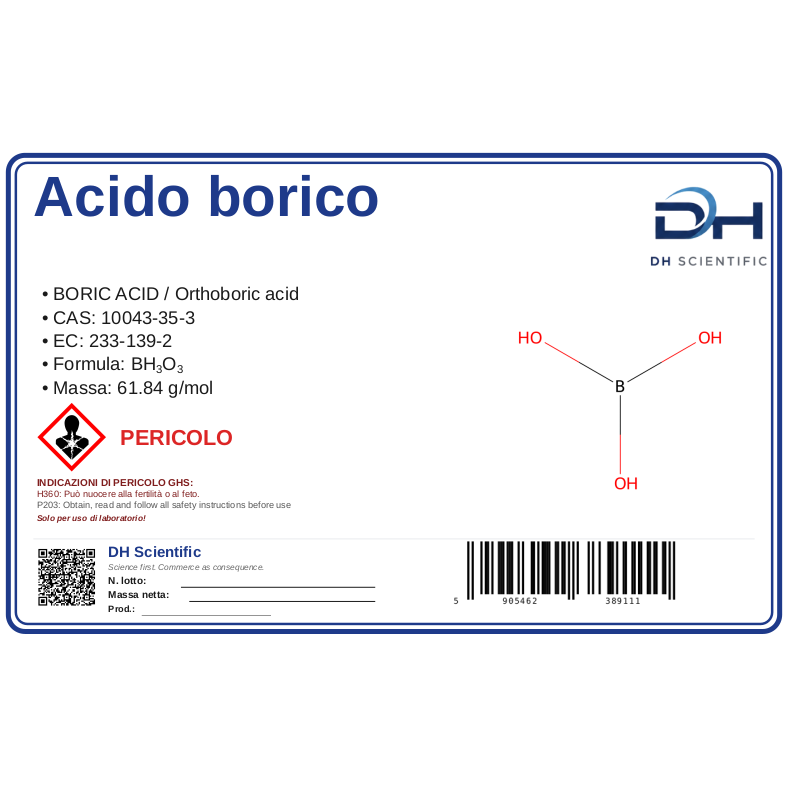
acido borico
5,99 €
Reagente chimico Kwas borowy (CAS 10043-35-3). Scheda enciclopedica completa — classificazione, proprietà e dati di sicurezza — di seguito.
🔒 Modalità demo — questo articolo non è in vendita.
Sostanza legale. dhscientific.com è una dimostrazione della piattaforma MOL-GOD — non vendiamo nulla e nessun ordine viene evaso. Le sostanze vietate vengono bloccate qui automaticamente dal canone normativo (confronta ad es. l'eptacloro).

Panoramica chimica: Boric AcidMolGod_OVERVIEW_1
| Formula molecolare | BH3O3 |
| Peso molecolare | 61.84 g/mol |
| Punto di fusione | 171 °C |
| Densità | 1.5 g/cm³ |
| Nome IUPAC | boric acid |
| SMILES | B(O)(O)O |
| InChIKey | KGBXLFKZBHKPEV-UHFFFAOYSA-N |
Sinonimi: BORIC ACID · Orthoboric acid · 10043-35-3 · Boracic acid · Borofax
Fonti dei dati: PubChem (NLM/NIH)
Ultimo aggiornamento: 2026-11-10
RICERCA SCIENTIFICA
📚 Riferimenti scientifici (Chicago Author-Date) 20 refs · 4 baz
MOLEKUŁA Bibliografia per-CAS (live da 13+ banche dati)
Fonti: db:Europe PMC (11) · db:doaj (1) · db:openalex (8)
- db:Europe PMC et al.. (2026). "Effects of Dietary Salt and Boric Acid on Milk Quality in Savak Akkaraman Sheep.". https://doi.org/10.3390/ani16020233 →
- db:Europe PMC (2026). "Effects of boric acid on 'Muscat Hamburg' and 'Balıkçı Siyahı' grapevines under salt stress". https://doi.org/10.21203/rs.3.rs-9283096/v1 →
- db:Europe PMC (2026). "Impact of Boric Acid on the Stability of Hydrogen Peroxide in Aqueous Solution.". https://doi.org/10.1021/acsomega.6c03206 →
- db:Europe PMC (2026). "Identification of a Riboflavin-Boric Acid Complex by Electrospray Ionization Mass Spectrometry.". https://doi.org/10.1007/s12011-026-05110-9 →
- db:Europe PMC et al.. (2026). "Acute Boric Acid Poisoning With Chronic Renal Failure Successfully Treated With Continuous Hemofiltration.". https://doi.org/10.7759/cureus.103795 →
- db:Europe PMC et al.. (2026). "Enhancing tuber quality, storage performance and yield response of potato to combined foliar application of zinc sulphate and boric acid.". https://doi.org/10.1038/s41598-026-46146-0 →
- db:doaj Xiaomei Zhang, Xinyu Chen, Yeersheng Jiangbaolati et al.. (2026). "Enhancing electrical conductivity of coal-derived graphite by boric acid catalysis: Correlating 2H/3R phase ratio with crystallite structure.". PLoS ONE. https://doi.org/10.1371/journal.pone.0347483 →
- db:Europe PMC et al.. (2025). "Proteomic profiling of Escherichia coli cytoplasmic proteins under sublethal boric acid stress.". https://doi.org/10.55730/1300-0152.2745 →
- db:Europe PMC et al.. (2025). "Unintentional boric acid exposure: a case report and boron level monitoring.". https://doi.org/10.1186/s12887-025-06254-8 →
- db:Europe PMC et al.. (2025). "Boric acid-functionalized bentonite nanostructures attenuated paraquat-induced pulmonary injuries in rats.". https://doi.org/10.1038/s41598-025-27334-w →
- db:Europe PMC et al.. (2025). "Nuclear quantum dynamics of boric acid as probed by a thermal-to-epithermal neutron station.". https://doi.org/10.1038/s41598-025-29342-2 →
- db:Europe PMC et al.. (2025). "Kinetic and Thermodynamic Investigation into the Formation of Diol-Boric Acid Complexes Using NMR and Computational Analysis.". https://doi.org/10.1021/acsomega.5c07314 →
- db:openalex Giulia Montagner, Silvia Dominici, Simona Piaggi et al.. (2023). "Redox Mechanisms Underlying the Cytostatic Effects of Boric Acid on Cancer Cells—An Issue Still Open". Antioxidants. https://doi.org/10.3390/antiox12061302 →
- db:openalex Qiangqiang Liu, Yubo Chai, Ni Lin et al.. (2020). "Flame Retardant Properties and Thermal Decomposition Kinetics of Wood Treated with Boric Acid Modified Silica Sol". Materials. https://doi.org/10.3390/ma13204478 →
- db:openalex AtLee T. D. Watson, Vicki Sutherland, Helen Cunny et al.. (2020). "Postnatal Effects of Gestational and Lactational Gavage Exposure to Boric Acid in the Developing Sprague Dawley Rat". Toxicological Sciences. https://doi.org/10.1093/toxsci/kfaa061 →
- db:openalex Hasan Türkez, Fatime Geyikoğlu, Suat Çolak. (2011). "The protective effect of boric acid on aluminum-induced hepatotoxicity and genotoxicity in rats". TURKISH JOURNAL OF BIOLOGY. https://doi.org/10.3906/biy-0902-11 →
- db:openalex Erhan Ayşan, Fikrettin Şahi̇n, Dilek Telci et al.. (2011). "Body Weight Reducing Effect of Oral Boric Acid Intake". International Journal of Medical Sciences. https://doi.org/10.7150/ijms.8.653 →
- db:openalex Hasan Türkez, Fatime Geyikoğlu. (2010). "Boric acid: a potential chemoprotective agent against aflatoxin b1 toxicity in human blood". Cytotechnology. https://doi.org/10.1007/s10616-010-9272-2 →
- db:openalex Amin Rostami, Jamal Akradi, Firoz Ahmad‐Jangi. (2010). "Boric acid as cost-effective and recyclable catalyst for trimethylsilyl protection and deprotection of alcohols and phenols". Journal of the Brazilian Chemical Society. https://doi.org/10.1590/s0103-50532010000800026 →
- db:openalex (1987). "NTP Toxicology and Carcinogenesis Studies of Boric Acid (CAS No. 10043-35-3) in B6C3F1 Mice (Feed Studies).". PubMed.
Proprietà fisico-chimiche
Riferimento rapido
Proprietà dettagliate
| Proprietà | Valore | Unità | Conditions | Source |
|---|---|---|---|---|
| Densità (ρ) | 1.5000 | g/cm³ | 20 °C (68 °F) | PubChem PUG-View (2026) |
| Punto di fusione (mp) | 171.00 °C (339.8 °F) | 1 atm | PubChem PUG-View (2026) | |
| Punto di ebollizione (bp) | 572 °F at 760 mmHg (decomposes) (NTP, 1992) | PubChem (NIH/NLM) ↗ | ||
| Tensione di vapore | 1.6X10⁻⁶ mm Hg at 25 °C (2.136X10⁻⁴ Pa); log P (in Pa) = 26.83 - 9094/T where T is deg K | PubChem (NIH/NLM) ↗ | ||
| Solubilità in acqua | 10 to 50 mg/mL at 66 °F (NTP, 1992) | PubChem (NIH/NLM) ↗ | ||
| Indice di rifrazione (nD) | Index of refraction: 1.337, 1.461, 1.462 | PubChem (NIH/NLM) ↗ |
🔬 Proprietà avanzate
Identificatori chimici
B(O)(O)O InChI=1S/BH3O3/c2-1(3)4/h2-4H
KGBXLFKZBHKPEV-UHFFFAOYSA-N
Fonti dei dati: PubChem, NIST Chemistry WebBook, CRC Handbook of Chemistry and Physics (103rd ed.)
Ultimo aggiornamento: 2026-06-30
📡 Spettroscopia — CAS 10043-35-3MolGod_SPECHUB_MAIN
Banche dati di spettri spettroscopici — dati inline 9 sources MolGod_SPECDB_2
Gli spettri vengono recuperati su richiesta da 9 fonti. Ogni spettro viene salvato nel nostro database — l'apertura successiva = zero richieste all'API esterna. Scarica JCAMP-DX / CSV / PNG per ogni spettro senza dover cercare.
Fonte di riferimento — nessuna API pubblica. Apri nella banca dati esterna:
🔗 IR/NMR/MS (SDBS) →Fonte di riferimento — nessuna API pubblica. Apri nella banca dati esterna:
🔗 JP Monograph →Fonte di riferimento — nessuna API pubblica. Apri nella banca dati esterna:
🔗 WHO INN →Fonte di riferimento — nessuna API pubblica. Apri nella banca dati esterna:
🔗 DOAJ →Proprietà fisico-chimiche (database) 3 campi MolGod Score: Affidabile
| Proprietà | Valore | Unità | Conditions | Source |
|---|---|---|---|---|
| Punto di fusione | 171.00 [5][6][11] | °C | 1 atm | PubChem PUG-View (2026) |
| Solubilità in acqua | 50.000 [5] | g/L | 25°C | PubChem PUG-View (2026) |
| Densità (ρ) | 1.5000 [5] | g/cm³ | 20°C | PubChem PUG-View (2026) |
📚 Riferimenti scientifici (Chicago Author-Date) (12 sources)
- Haynes, William M., ed. 2024. CRC Handbook of Chemistry and Physics. 105th ed. Boca Raton: CRC Press/Taylor & Francis. ISBN 978-1-032-55554-4. ↗
- National Institute of Standards and Technology. 2024. "NIST Chemistry WebBook, SRD 69." Gaithersburg, MD: NIST. Accessed 2025-01-01. ↗
- Yaws, Carl L. 2014. The Yaws Handbook of Physical Properties for Hydrocarbons and Chemicals. 2nd ed. Oxford: Gulf Professional Publishing.
- PubChem. 2024. "PubChem Compound Database." National Library of Medicine, National Institutes of Health. Accessed 2025-01-01. ↗
- Marrero, J., and R. Gani. 2001. "Group-Contribution Based Estimation of Pure Component Properties." Fluid Phase Equilibria 183–184: 183–208. ↗
- Joback, K. G., and R. C. Reid. 1987. "Estimation of Pure-Component Properties from Group-Contributions." Chemical Engineering Communications 57 (1–6): 233–243. ↗
- Sangster, J. 1997. Octanol-Water Partition Coefficients: Fundamentals and Physical Chemistry. Chichester: Wiley. ISBN 978-0-471-97397-3.
- Mannhold, Raimund, and Han van de Waterbeemd. 2001. "Substructure and Whole Molecule Approaches for Calculating Log P." Journal of Computer-Aided Molecular Design 15 (4): 337–354. ↗
- Perrin, Ditlev D., Boyd Dempsey, and E. P. Serjeant. 1981. pKa Prediction for Organic Acids and Bases. London: Chapman and Hall. ISBN 0-412-21090-5.
- Constantinou, Leonidas, and Rafiqul Gani. 1994. "New Group Contribution Method for Estimating Properties of Pure Compounds." AIChE Journal 40 (10): 1697–1710. ↗
- Ertl, Peter, Bernhard Rohde, and Paul Selzer. 2000. "Fast Calculation of Molecular Polar Surface Area as a Sum of Fragment-Based Contributions and Its Application to the Prediction of Drug Transport Properties." Journal of Medicinal Chemistry 43 (20): 3714–3717. ↗
🛡️ Sicurezza — CAS 10043-35-3MolGod_SAFEHUB_MAIN
Classificazione GHS/CLP — Regolamento (CE) n. 1272/2008 + UN GHS Rev. 9 (2021).

🚨 Indicazioni di pericolo (H)
- H360FD — Può nuocere alla fertilità. Può nuocere al feto.
🛡 Consigli di prudenza (P)
- P203 — Procurarsi, leggere e seguire tutte le istruzioni di sicurezza prima dell’uso.
✓ Classificazione armonizzata ai sensi dell'allegato VI del regolamento CLP (CE) 1272/2008 (classificazione ufficiale, vincolante). Numero indice: 005-007-00-2.
Riferimento (Chicago): European Chemicals Agency. "boric acid, Index No. 005-007-00-2." In Table 3 of Annex VI to Regulation (EC) No 1272/2008 (CLP Regulation), 23rd Adaptation to Technical Progress. Helsinki: European Chemicals Agency, 2026. https://echa.europa.eu/information-on-chemicals/annex-vi-to-clp.
Traduzioni: Regolamento CLP (CE) 1272/2008, Allegato III e IV. Dati: PubChem/NLM.
📚 Riferimenti scientifici consolidati — Chicago Author-Date 10 sources
Riferimenti raccolti da tutte le schede del Safety Hub. CAS: 10043-35-3 ·
PubChem ↗
- Parlament Europejski i Rada UE. 2008. "Rozporządzenie (WE) nr 1272/2008 w sprawie klasyfikacji, oznakowania i pakowania substancji (CLP)." Dz.Urz. UE L 353. [↗] GHS, Normative
- United Nations Economic Commission for Europe (UNECE). 2021. "Globally Harmonized System of Classification and Labelling of Chemicals (GHS), Ninth Revised Edition." United Nations, Geneva. [↗] GHS
- Goldfrank, Lewis R., Robert S. Hoffman, Mary Ann Howland, et al.. 2019. "Goldfrank's Toxicologic Emergencies, 11th ed.." McGraw-Hill Education, New York. ISBN 978-1-25-985961-8. Pierwsza pomoc, Toksykologia
- National Institute for Occupational Safety and Health (NIOSH). 2023. "NIOSH Pocket Guide to Chemical Hazards (DHHS Publ. 2005-149)." U.S. Department of Health and Human Services / CDC, Cincinnati, OH. [↗] Pierwsza pomoc, PPE, Toksykologia
- European Committee for Standardization (CEN). 2016. "EN 374-1:2016 — Protective gloves against dangerous chemicals and micro-organisms." CEN, Brussels. [↗] PPE
- UNECE. 2023. "European Agreement Concerning the International Carriage of Dangerous Goods by Road (ADR 2025)." United Nations, Geneva. [↗] Utylizacja, Regulacje
- National Fire Protection Association (NFPA). 2022. "NFPA 400 — Hazardous Materials Code." NFPA, Quincy, MA. [↗] Magazynowanie
- Urben, P.G. (ed.). 2017. "Bretherick's Handbook of Reactive Chemical Hazards, 8th ed.." Butterworth-Heinemann / Elsevier, Oxford. [↗] Magazynowanie
- Ministerstwo Klimatu i Środowiska RP. 2023. "Baza danych o produktach i opakowaniach oraz o gospodarce odpadami (BDO)." Ministerstwo Klimatu i Środowiska, Warszawa. [↗] Utylizacja
- International Agency for Research on Cancer (IARC / WHO). 2024. "IARC Monographs on the Identification of Carcinogenic Hazards to Humans — List of Classifications." WHO, Lyon. [↗] Toksykologia
Le schede con riferimenti propri (Emergency, PPE, Storage, Waste) contengono ulteriori voci bibliografiche all'interno delle rispettive sezioni.
Statistica analitica (t-test · RSD · Grubbs · Q-Dixon) ICH Q2
Incolla una serie di misure replicate (CSV oppure un numero per riga). Il calcolatore calcolerà la media, la deviazione standard e il 95% CI, e rileverà gli outlier (Grubbs + Dixon Q).
📐 Formule statistiche
x̄ = Σxᵢ / n— media aritmeticas² = Σ(xᵢ - x̄)² / (n-1)— varianza campionarias = √s²— deviazione standardRSD% = (s / x̄) × 100%— deviazione standard relativaCI₉₅ = x̄ ± t(0.05, n-1) × s / √n— Student's tG = |xᵢ - x̄| / s— test di GrubbsQ = |xsuspect - xnearest| / |xmax - xmin|— Dixon Q-test
Fonte: ICH Q2(R2) Validation of Analytical Procedures · ICH PDF ↗
Calcolatore di ricette per tamponi UNIQUE
Scegli un tampone dall'elenco di 20 sistemi popolari → inserisci il pH target → otterrai una ricetta esatta con le masse da pesare.
Passo 1: Scegli un sistema tampone
📜 Cronologia delle ricette (ultime 10)
🔧 Risoluzione dei problemi HPLC — albero decisionale 6 problemi comuni
Diagnostica dei 12 problemi HPLC più comuni con albero decisionale (5 passaggi per problema). Fonte: Snyder/Kirkland/Dolan 3rd ed. Chapter 17 + LCGC LC Troubleshooting columns 1989-2024.
Picchi allargati (broad peaks) medium
Sintomo: Tutti i picchi nel cromatogramma sono più larghi del previsto (FWHM > 2× della norma)
🔍 Albero diagnostico:
-
1. Verifica se tutti i picchi sono allargati o solo alcuni
→ SÌ: Tutti → problema strumentale (colonna o sistema)
→ NO: Solo alcuni → problema chimico (interazione con la colonna per analiti specifici) -
2. Sostituisci con una colonna di prova — il problema scompare?
→ SÌ: COLONNA usurata — packing danneggiato, void nei primi mm. Sostituiscila.
→ NO: Problema nel sistema LC -
3. Controllare il volume morto (dead volume) — loop di iniezione, connessioni, rivelatore
→ SÌ: Loop > 100 µL per una colonna da 4.6 mm o connessioni allentate → sostituire le ferrule, accorciare i tubi
→ NO: Continua diagnostica -
4. Test di temperatura: aumentare la colonna da 25°C a 40°C
→ SÌ: Picchi più stretti → cinetica di trasferimento di massa troppo lenta (aumentare T)
→ NO: Continue -
5. Controllare il flow rate rispetto al valore ottimale di van Deemter per questa colonna
→ SÌ: Ottimale per 4.6mm/5µm = 1.0 mL/min, per 2.1mm/3µm = 0.4 mL/min
→ NO: Continue
- Colonna usurata (>2000 iniezioni senza guard)
- Volume morto del sistema > 100 µL (loop errato, tubi lunghi, ferrule allentate)
- Temperatura troppo bassa (cinetica di trasferimento di massa)
- Flow rate al di fuori dell'ottimale di van Deemter
- Solvente del campione più forte della fase A
- ✓ Sostituire la colonna (quando >2000 iniezioni)
- ✓ Controllare tutte le connessioni — tubi il più corti possibile
- ✓ Aumentare la T della colonna a 40°C (se la sostanza è stabile)
- ✓ Ridurre il flow all'ottimale di van Deemter
- ✓ Sciogliere il campione nella fase A (non in organico puro)
Coda dei picchi (tailing, T > 1.5) high
Sintomo: I picchi presentano una "coda" prolungata sul lato di eluizione tardiva (asimmetria T = b/a > 1.5 secondo USP)
🔍 Albero diagnostico:
-
1. La sostanza contiene gruppi basici (ammino, piridina)?
→ SÌ: Sì → interazioni silanoliche! Aggiungere 0.1% TFA o 5-10 mM TEA alla fase A.
→ NO: Continue -
2. Controllare il pH della fase mobile rispetto al pKa della sostanza
→ SÌ: pH = pKa ± 1 → ionizzazione parziale, peak split. Portare il pH a ≥ 2 unità di distanza dal pKa.
→ NO: Continue -
3. Controllare l'età della colonna (>1500 iniezioni?)
→ SÌ: Sì → silanoli esposti (column bleed). Sostituire con una colonna con endcapping più elevato (XTerra, Symmetry).
→ NO: Continue -
4. Il campione contiene metalli (Fe, Cu dalle fiale di vetro)?
→ SÌ: Sì → utilizzare fiale incolori di tipo II o PFA. EDTA 0.1mM nel campione.
→ NO: Continue
- Interazioni silanoliche (analita basico + silanoli liberi del gel di silice)
- pH al limite del pKa dell'analita (peak split)
- Colonna vecchia (column bleed, elevata attività silanolica)
- Metalli nel campione (chelazione → tailing)
- Sovraccarico della colonna (>50 µg su una colonna da 4.6mm)
- ✓ Aggiungere 0.1% TFA (UV) o 0.1% acido formico (LC-MS) alla fase A
- ✓ Scegliere una colonna con endcapping ad alta purezza: Waters XBridge BEH, Phenomenex Kinetex
- ✓ Lavorare a pH ≥ 2 unità di distanza dal pKa
- ✓ EDTA 0.1mM nel campione (chelazione Fe/Cu)
- ✓ Ridurre il volume di iniezione a ≤ 20 µL per una colonna da 4.6mm
Deriva della linea di base (baseline drift) medium
Sintomo: La linea di base aumenta o diminuisce sistematicamente per >5 minuti
🔍 Albero diagnostico:
-
1. Si sta utilizzando un gradiente (B% in aumento)?
→ SÌ: Sì → assorbimento diverso delle fasi A e B a dλ. Cambio di solvente nell'UV-cutoff. Controllare l'assorbanza UV del % di organico.
→ NO: Continua (isocratico) -
2. Controllare la temperatura della colonna — è stabile a ±0.5°C?
→ SÌ: Sì (stabile) → continua
→ NO: Instabile → attivare il termostato della colonna (>25°C controllato) -
3. Test: spegnere l'autosampler, far funzionare solo pompa+colonna+rivelatore
→ SÌ: La deriva scompare → contaminazione dell'autosampler (pulire l'ago, il septum)
→ NO: Continue -
4. Controllare l'età della lampada (D2 per UV)
→ SÌ: Sì (>1500 ore) → sostituire la lampada
→ NO: Continue
- Eluizione a gradiente con UV-cutoff diverso delle fasi
- T della colonna instabile
- Contaminazione dell'ago/septum dell'autosampler
- Lampada UV vecchia (>1500h)
- Cella di flusso del rivelatore sporca
- Colonna non equilibrata (<10 volumi di colonna)
- ✓ Pre-equilibrare la colonna per 10-15 volumi di colonna al 100% A
- ✓ Termostato colonna attivo, T 30-40°C stabile
- ✓ Pulire la flow cell del rivelatore con soluzione ACN:H2O 50:50
- ✓ Sostituire la lampada D2 se >1500h
- ✓ Usare la baseline subtraction (funzione nativa Chromeleon, Empower)
Nessun picco / picco perso (no peak) critical
Sintomo: Il picco atteso dell'analita non compare nel cromatogramma
🔍 Albero diagnostico:
-
1. L'iniezione è stata effettivamente eseguita?
→ SÌ: Controllare il log dell'autocampionatore, la pressione della pompa (dovrebbe calare durante l'iniezione)
→ NO: Problema dell'autocampionatore → controllare il loop, l'ago, il campione nella fiala -
2. Il campione è nella fiala (volume corretto, non evaporato)?
→ SÌ: Continue
→ NO: Nessun campione — ri-pipettare -
3. Stabilità del campione — preparato >24h fa?
→ SÌ: Sì → degradazione. Ri-preparare un campione fresco.
→ NO: Continue -
4. Controllare la lunghezza d'onda di rilevazione rispetto al λmax della sostanza
→ SÌ: Rilevazione a λ NON corrisponde al λmax → nessun segnale. Scansione DAD 200-400nm.
→ NO: Continue -
5. Test: iniettare uno standard puro (di concentrazione nota, fresco)
→ SÌ: Lo standard dà un picco → problema con il campione (matrice, derivatizzazione)
→ NO: Nessun picco anche con lo standard → problema di sistema (colonna, fase, gradiente)
- Campione non prelevato dalla fiala (bug dell'autocampionatore)
- Campione degradato (>24h pH/temp/luce)
- Rilevazione alla lunghezza d'onda errata
- Fase mobile errata (es. TFA dimenticato)
- Colonna invertita / fase stazionaria errata
- La sostanza eluisce sul fronte (V0) → non trattenuta, non visibile
- ✓ Ri-preparare un campione fresco secondo il protocollo esatto
- ✓ Scansione UV-Vis DAD 200-400nm + ricerca del λmax
- ✓ Controllare la composizione della fase mobile — TFA aggiunto?
- ✓ Testare la direzione inversa della colonna (con cautela!)
- ✓ Per ritenzione <1 min — abbassare il % B, MeOH al posto di ACN
- ✓ Controllare la tabella "expected_rt" in wp_molgod_hplc_methods
Pressione troppo alta (pressure too high) critical
Sintomo: Pressione della pompa > 80% del massimo della colonna o shutdown del sistema con errore high-pressure
🔍 Albero diagnostico:
-
1. Controllare che la colonna sia collegata correttamente (direzione della freccia)
→ SÌ: OK
→ NO: Colonna invertita → invertirla (non lavorare mai "al contrario") -
2. Test: rimuovere la colonna dal sistema, far girare pompa+rivelatore da soli
→ SÌ: La pressione scende a <50 bar → problema nella colonna (intasata)
→ NO: La pressione rimane alta → filtro in-line intasato, frit sporco -
3. Controllare il filtro pre-colonna (frit in-line)
→ SÌ: Sporco e brunastro → sostituire
→ NO: Continue -
4. Retro-lavare la colonna con ACN:H2O 50:50 senza la colonna — scompare?
→ SÌ: Particelle bloccate nel primo mm — un flush di 30 min può recuperarla
→ NO: Sostituire la colonna
- Filtro in-line (frit) intasato da particelle
- Salting-out del buffer (precipitazione ad alto %B)
- Il campione contiene materiale in sospensione (filtrare a 0.22 µm prima dell'iniezione)
- Colonna intasata (compattazione del letto della colonna)
- Gradiente con fase buffer + molto organico → precipitazione del sale
- ✓ Filtrare SEMPRE il campione con PVDF 0.22 µm prima dell'iniezione
- ✓ Sostituire il filtro in-line ogni 100 iniezioni (o quando la pressione aumenta >20%)
- ✓ NON usare buffer fosfato >20mM + >70% ACN (il sale precipita)
- ✓ Lavare la colonna per 30 min con ACN:H2O 50:50 in direzione inversa (quando il produttore lo consente)
- ✓ Pre-colonna 4×3mm per proteggere la colonna principale
Picchi fantasma (ghost peaks) high
Sintomo: Picchi inspiegabili sul cromatogramma assenti nella calibrazione
🔍 Albero diagnostico:
-
1. Test: iniezione in bianco (solvente puro del campione)
→ SÌ: Compare un ghost → contaminazione del sistema o degli eluenti
→ NO: Compare solo con il campione → matrice -
2. Il ghost cresce con il gradiente (eluisce ad alta %B)?
→ SÌ: Sì → colonna sovraccarica o composti fortemente trattenuti dalla corsa precedente
→ NO: Indipendente dal gradiente → carryover dell'autocampionatore -
3. Increase carryover wash (between injections)
→ SÌ: Aiuta → il carryover era la causa. Protocollo di lavaggio più forte.
→ NO: Continue -
4. Iniezione di acqua pura — c'è un picco?
→ SÌ: Sì → contaminazione della fonte d'acqua (sostanze organiche dal sistema DI)
→ NO: Continue
- Carryover nell'ago/loop dell'autocampionatore
- Contaminazione dell'eluente (anche di grado HPLC)
- Componenti fortemente trattenuti da corse precedenti
- Plastica nelle fiale (ftalati, PEG dai tappi)
- Acqua DI insufficientemente purificata
- ✓ Rafforzare il protocollo di lavaggio: 100% B → 100% A → 50:50 (3 cicli)
- ✓ Lavaggio forte: DMSO 100% o MeOH 100% prima della calibrazione
- ✓ Filtrare gli eluenti con PTFE 0.22 µm in caso di dubbio
- ✓ Usare vetro ambrato + tappi con rivestimento in Teflon per i campioni
- ✓ Rampa di gradiente periodica fino a 100% B per 10 min (clean-out)
📚 Riferimenti scientifici (Chicago Author-Date) — fare clic per espandere
- Snyder, Lloyd R., Joseph J. Kirkland, and John W. Dolan. 2010. Introduction to Modern Liquid Chromatography. 3rd ed. John Wiley & Sons. Chapter 17 (Troubleshooting) pp. 559-616. ISBN 978-0-470-16754-0. https://doi.org/10.1002/9780470508183 [link ↗]
- Dolan, John W.. 2014. LC Troubleshooting (monthly column 1989-2024). LCGC North America. [link ↗] — John Dolan 35-letnia seria miesięcznych artykułów problemowych
- Kromidas, Stavros. 2017. HPLC Made to Measure: A Practical Handbook for Optimization. 2nd ed. Wiley-VCH. ISBN 978-3-527-31377-1. — Praktyczny przewodnik problem-solving dla labs analitycznych
- Dolan, John W.. 2013. When to Modify Method Conditions. 192-199. [link ↗] — Decision flow for changing flow rate / temperature / %B vs swapping columns.
- Dong, Michael W.. 2019. HPLC and UHPLC for Practicing Scientists. 2nd ed. Wiley. ISBN 978-1-119-31378-3. https://doi.org/10.1002/9781119313793 [link ↗] — Chapter 9 covers troubleshooting modern UHPLC systems (sub-2 µm particles).
- Meyer, Veronika R.. 2010. Practical High-Performance Liquid Chromatography. 5th ed. Wiley. ISBN 978-0-470-68218-0. — Solid step-by-step problem isolation chapter (eluents, columns, instruments).
- Snyder, L. R., J. J. Kirkland, and J. L. Glajch. 1997. Practical HPLC Method Development. 2nd ed. Wiley. ISBN 978-0-471-00703-6. — Method-development companion volume with troubleshooting cross-refs.
- Carr, Peter W.. 2009. The new physical chemistry of HPLC. 1764-1772. https://doi.org/10.1016/j.chroma.2008.11.094 [link ↗] — Theoretical basis for diagnosing efficiency losses (mass-transfer, eddy diffusion).
- Heyden, Yvan Vander, et al.. 2009. Robustness of pharmaceutical liquid chromatographic methods. 2120-2129. https://doi.org/10.1016/j.jchromb.2008.10.052 [link ↗] — How to diagnose method failures vs. system failures (Plackett-Burman).
- Engelhardt, Heinz. 2014. 100 Years of Chromatography. 2nd ed. Wiley-VCH. ISBN 978-3-527-33473-5. — Historical context for ghost-peak phenomenology (silica chemistry).
- Stoll, Dwight R., and Peter W. Carr. 2017. Two-Dimensional Liquid Chromatography: A State of the Art Tutorial. 519-531. https://doi.org/10.1021/acs.analchem.6b03506 [link ↗]
- Carr, Peter W.. 2009. The new physical chemistry of HPLC. 1764-1772. https://doi.org/10.1016/j.chroma.2008.11.094 [link ↗]
- Wu, Naijun, and Anton M. Clausen. 2007. Fundamental and practical aspects of ultrahigh pressure liquid chromatography for fast separations. 1167-1182. https://doi.org/10.1002/jssc.200700026 [link ↗]
- Engelhardt, Heinz. 2014. 100 Years of Chromatography. 2nd ed. Wiley-VCH. ISBN 978-3-527-33473-5.
- Vivó-Truyols, Gabriel, and Hans-Gerd Janssen. 2010. Probabilistic approach to peak deconvolution in chromatography. 8525-8531. https://doi.org/10.1021/ac101742z [link ↗]
ADMET — profilo farmacologico
🧪 Assistente di preparazione della soluzione (Smart Prep) MolGod_PREP_2
Inserisci cosa vuoi preparare — genererò una SOP
📚 Panoramica della letteratura scientifica — CAS 10043-35-3MolGod_LITHUB_MAIN
⭐ Risultati principali (letteratura scientifica) 4 publications
10043-35-3
— multi-criteria ranking (W12): 30% citazioni · 20% recency · 20% topic · 15% historical · 15% open access.
-
#1(1987) · National Toxicology Program technical report seriesPerché è importante: Selezionate tramite punteggio multi-criterio (citations + recency + topic + historical + OA).
-
#2Substance name: Boric acid EC number: 233-139-2 (234-343-4) CAS number: 10043-35-3 (11113-50-1) MEMBER STATE COMMITTEE DRAFT SUPPORT DOCUMENT FOR IDENTIFICATION OF BORIC ACID AS A SUBSTANCE OF VERY HIGH CONCERN BECAUSE OF ITS CMR PROPERTIES(2010)Perché è importante: Selezionate tramite punteggio multi-criterio (citations + recency + topic + historical + OA).SCORE 2.71 Meccanismo Citazioni: 7
-
#3(2012) · Sax's Dangerous Properties of Industrial MaterialsPerché è importante: Selezionate tramite punteggio multi-criterio (citations + recency + topic + historical + OA).
-
#4(2004) · Sax's Dangerous Properties of Industrial MaterialsPerché è importante: Selezionate tramite punteggio multi-criterio (citations + recency + topic + historical + OA).
Related products
📚 RIFERIMENTI (Bibliografia complessiva, Chicago Author-Date) 107 elementi
Tutte le fonti scientifiche citate negli accordion sopra per il CAS 10043-35-3.Formato: Chicago Manual of Style 17ª ed., sistema Author-Date.
🗄️ Banche dati scientifiche
- PubChem. 2026. PubChem Compound Summary: CAS 10043-35-3. Bethesda, MD: National Center for Biotechnology Information (NCBI), National Library of Medicine. (Accessed 2026-11-12.)
- NIST. 2026. NIST Chemistry WebBook: CAS 10043-35-3. Gaithersburg, MD: National Institute of Standards and Technology. https://webbook.nist.gov/cgi/cbook.cgi?ID=10043-35-3. (Accessed 2026-11-12.)
- AIST. 2026. Spectral Database for Organic Compounds (SDBS): CAS 10043-35-3. Tsukuba, Japan: National Institute of Advanced Industrial Science and Technology. https://sdbs.db.aist.go.jp/. (Accessed 2026-11-12.)
- ECHA. 2026. C&L Inventory and REACH Registration: CAS 10043-35-3. Helsinki: European Chemicals Agency. https://echa.europa.eu/information-on-chemicals/annex-vi-to-clp. (Accessed 2026-11-12.)
📐 Standard / Linee guida
- ICH. 2026. "ICH Harmonised Guideline: CAS 10043-35-3." Geneva: International Council for Harmonisation. https://database.ich.org/sites/default/files/Q1A%28R2%29%20Guideline.pdf. (Accessed 2026-11-12.)
- National Fire Protection Association (NFPA). 2024. "NFPA 30: Flammable and Combustible Liquids Code." NFPA, Quincy, MA. https://www.nfpa.org/codes-and-standards/all-codes-and-standards/list-of-codes-and-standards/detail?code=30.
- Occupational Safety and Health Administration (OSHA). 2023. "29 CFR 1910.106 — Flammable Liquids." U.S. Department of Labor, Federal Register. https://www.osha.gov/laws-regs/regulations/standardnumber/1910/1910.106.
- European Chemicals Agency (ECHA). 2024. "Annex VI to Regulation (EC) No 1272/2008 (CLP) — Harmonised Classification and Labelling." ECHA, Helsinki / Official Journal of the European Union. https://echa.europa.eu/regulations/clp/clp-classification.
- European Committee for Standardization (CEN). 2016. "EN 374-1:2016 — Protective gloves against dangerous chemicals and micro-organisms — Part 1: Terminology and performance requirements for chemical risks." CEN, Brussels. https://standards.cencenelec.eu/dyn/www/f?p=205:110:::::FSP_PROJECT,FSP_ORG_ID:38536,6080&cs=1B0DAA8B85DF42E4A2C70E5D71F0BFA32.
- European Committee for Standardization (CEN). 2001. "EN 166:2001 — Personal eye-protection — Specifications." CEN, Brussels. https://standards.cencenelec.eu/dyn/www/f?p=CEN:110:0::::FSP_PROJECT:6541&cs=1F1A4E0A78C4DB6A28DBE2E8C29D89DCF.
- European Committee for Standardization (CEN). 2009. "EN 14605:2005+A1:2009 — Protective clothing against liquid chemicals — Performance requirements for clothing with liquid-tight (Type 3) or spray-tight (Type 4) connections." CEN, Brussels. https://standards.cencenelec.eu/dyn/www/f?p=CEN:110:0::::FSP_PROJECT:21581&cs=1A04A2D3C7CC58E9E6CB58D55F7EBFB7E.
- National Institute for Occupational Safety and Health (NIOSH). 2017. "Recommendations for Chemical Protective Clothing: A Companion to the NIOSH Pocket Guide." U.S. Department of Health & Human Services / CDC. https://www.cdc.gov/niosh/ncpc/default.html.
- Occupational Safety and Health Administration (OSHA). 2011. "Personal Protective Equipment — General requirements." U.S. Department of Labor — 29 CFR 1910.132. https://www.osha.gov/laws-regs/regulations/standardnumber/1910/1910.132.
📖 Libri
- Hansen, Charles M. 2007. Hansen Solubility Parameters: A User's Handbook, 2nd ed.. Boca Raton, FL: CRC Press. https://www.routledge.com/Hansen-Solubility-Parameters-A-Users-Handbook/Hansen/p/book/9780849372483.
- Barton, Allan F. M. 1991. CRC Handbook of Solubility Parameters and Other Cohesion Parameters: 2nd ed.. Boca Raton, FL: CRC Press. https://www.routledge.com/CRC-Handbook-of-Solubility-Parameters-and-Other-Cohesion-Parameters/Barton/p/book/9780849301766.
- Connors, Kenneth A., Gordon L. Amidon, and Valentino J. Stella. 1986. Chemical Stability of Pharmaceuticals: A Handbook for Pharmacists, 2nd ed.. New York: Wiley. https://doi.org/10.1002/0471734683.
- Rumble, John R., ed. 2019. CRC Handbook of Chemistry and Physics: 100th Edition. Boca Raton, FL: CRC Press. https://hbcp.chemnetbase.com/.
- Urben, Peter G. 2017. Bretherick's Handbook of Reactive Chemical Hazards, 8th Edition. Academic Press / Elsevier, Oxford. https://www.sciencedirect.com/book/9780081010594.
📘 Monographs
- IARC. 2026. IARC Monographs on the Identification of Carcinogenic Hazards to Humans: CAS 10043-35-3. Lyon, France: International Agency for Research on Cancer, World Health Organization. (Accessed 2026-11-12.)
📄 Articoli scientifici (peer-reviewed)
- Stefanis, Emmanuel, and Costas Panayiotou. 2008. "Prediction of Hansen Solubility Parameters with a New Group-Contribution Method." International Journal of Thermophysics 29: 568-585. https://doi.org/10.1007/s10765-008-0415-z.
- Stoll, Vincent S., and John S. Blanchard. 1990. "Buffers: Principles and Practice: In Methods in Enzymology, vol. 182." San Diego: Academic Press. https://doi.org/10.1016/0076-6879(90)82008-P.
🌐 Siti web
- ECHA. 2023. "Guidance on the Application of the CLP Criteria." European Chemicals Agency. https://echa.europa.eu/guidance-documents/guidance-on-clp.
- European Parliament. 2006. "Regulation (EC) No 1907/2006 (REACH)." Official Journal of the European Union L 396: 1–849.
- ECHA. 2023. "Candidate List of Substances of Very High Concern for Authorisation." European Chemicals Agency. https://echa.europa.eu/candidate-list-table.
- European Parliament. 2008. "Regulation (EC) No 1272/2008 on Classification, Labelling and Packaging of Substances and Mixtures (CLP)." Official Journal of the European Union L 353: 1–1355.
- ECHA. 2017. "Guidance on the Compilation of Safety Data Sheets." Version 3.1. European Chemicals Agency. ECHA-17-G-01-EN. https://echa.europa.eu/documents/10162/23047722/sds_en.pdf.
- ECHA. 2022. "Restrictions Under REACH — Annex XVII." European Chemicals Agency. https://echa.europa.eu/substances-restricted-under-reach.
- United Nations. 2021. Globally Harmonized System of Classification and Labelling of Chemicals (GHS). 9th revised ed. ST/SG/AC.10/30/Rev.9. New York and Geneva: United Nations. https://unece.org/ghs-rev9-2021.
- ECHA. 2020. "Understanding REACH." European Chemicals Agency. https://echa.europa.eu/regulations/reach/understanding-reach.
- U.S. OSHA. 2026. "Occupational Safety and Health Guidance: CAS 10043-35-3." Washington, DC: U.S. Occupational Safety and Health Administration. https://www.osha.gov/hazwoper. (Accessed 2026-11-12.)
- National Fire Protection Association (2018) — NFPA 472: Standard for Competence of Responders to Hazardous Materials/Weapons of Mass Destruction Incidents https://www.nfpa.org/codes-and-standards/nfpa-472.
- European Union. 2026. "EUR-Lex Legal Database: CAS 10043-35-3." Luxembourg: Publications Office of the European Union. https://eur-lex.europa.eu/legal-content/EN/TXT/?uri=celex:32012L0018. (Accessed 2026-11-12.)
- U.S. National Institute for Occupational Safety and Health (2024) — NIOSH Pocket Guide to Chemical Hazards https://www.cdc.gov/niosh/npg/.
- Snyder, Lloyd R., John W. Dolan, and Joseph J. Kirkland. 2010. Introduction to Modern Liquid Chromatography. Wiley.
- Schoenmakers, Peter J.. 1986. Optimization of Chromatographic Selectivity: A Guide to Method Development. Elsevier.
- Snyder, L. R., and J. W. Dolan. 2007. High-Performance Gradient Elution: The Practical Application of the Linear-Solvent-Strength Model. Wiley.
- Nikitas, Pavlos, and Adrian Pappa-Louisi. 2009. "Retention models for isocratic and gradient elution in reversed-phase liquid chromatography." Journal of Chromatography A 1216: 1737-1755. https://doi.org/10.1016/j.chroma.2008.10.005.
- Carr, Peter W.. 2009. "The new physical chemistry of HPLC." Journal of Chromatography A 1216: 1764-1772. https://doi.org/10.1016/j.chroma.2008.11.094.
- Dong, Michael W.. 2019. HPLC and UHPLC for Practicing Scientists. Wiley. https://doi.org/10.1002/9781119313793.
- Wu, Naijun, and Anton M. Clausen. 2007. "Fundamental and practical aspects of ultrahigh pressure liquid chromatography for fast separations." Journal of Separation Science 30: 1167-1182. https://doi.org/10.1002/jssc.200700026.
- Dolan, John W.. 2013. "When to Modify Method Conditions." LCGC North America 31: 192-199. https://www.chromatographyonline.com/view/when-modify-method-conditions.
- Meyer, Veronika R.. 2010. Practical High-Performance Liquid Chromatography. Wiley.
- Engelhardt, Heinz. 2014. 100 Years of Chromatography. Wiley-VCH.
- Vivó-Truyols, Gabriel, and Hans-Gerd Janssen. 2010. "Probabilistic approach to peak deconvolution in chromatography." Analytical Chemistry 82: 8525-8531. https://doi.org/10.1021/ac101742z.
- Van Deemter, J. J., F. J. Zuiderweg, and A. Klinkenberg. 1956. "Longitudinal diffusion and resistance to mass transfer as causes of nonideality in chromatography." https://doi.org/10.1016/0009-2509(56)80003-1.
- Giddings, J. Calvin. 1965. "Dynamics of Chromatography, Part I: Principles and Theory." Marcel Dekker.
- Poppe, Hans. 1997. "Some reflections on speed and efficiency of modern chromatographic methods." https://doi.org/10.1016/S0021-9673(97)00376-2.
- Wu, Naijun, and Anton M. Clausen. 2007. "Fundamental and practical aspects of ultrahigh pressure liquid chromatography for fast separations." https://doi.org/10.1002/jssc.200700026.
- Carr, Peter W.. 2009. "The new physical chemistry of HPLC." https://doi.org/10.1016/j.chroma.2008.11.094.
- Knox, John H.. 1977. "Practical aspects of LC theory." https://doi.org/10.1093/chromsci/15.9.352.
- Snyder, L. R., J. J. Kirkland, and J. L. Glajch. 1997. "Practical HPLC Method Development." Wiley.
- Vivó-Truyols, Gabriel, and Hans-Gerd Janssen. 2010. "Probabilistic approach to peak deconvolution in chromatography." https://doi.org/10.1021/ac101742z.
- Sadek, Paul C.. 2002. "The HPLC Solvent Guide." Wiley-Interscience.
- Snyder, L. R.. 1978. "Classification of the solvent properties of common liquids." https://doi.org/10.1093/chromsci/16.6.223.
- Reichardt, Christian, and Thomas Welton. 2010. "Solvents and Solvent Effects in Organic Chemistry." Wiley-VCH.
- Vailaya, Anant, and Csaba Horváth. 1998. "Retention thermodynamics in hydrophobic interaction chromatography." https://doi.org/10.1021/ie980212h.
- Krstulović, Andrea M., and Phyllis R. Brown. 1981. "Reversed-phase High-Performance Liquid Chromatography." Wiley.
- Boysen, Reinhard I., and Milton T. W. Hearn. 2009. "Multi-modal HPLC of proteins." https://doi.org/10.1093/chromsci/47.8.645.
- USP General Chapter <621>. 2024. "Chromatography." United States Pharmacopeial Convention. https://www.usp.org/harmonization-standards/pdg/general-chapters/chromatography.
- Foley, Joe P., and John G. Dorsey. 1983. "Equations for calculation of chromatographic figures of merit for ideal and skewed peaks." https://doi.org/10.1021/ac00255a033.
- Snyder, Lloyd R., Joseph J. Kirkland, and John W. Dolan. 2010. "Introduction to Modern Liquid Chromatography." Wiley. https://doi.org/10.1002/9780470508183.
- Dolan, John W.. 2003. "Peak tailing and resolution." https://www.chromatographyonline.com/view/peak-tailing-and-resolution.
- Kromidas, Stavros. 2017. "HPLC Made to Measure: A Practical Handbook for Optimization." Wiley-VCH.
- Heyden, Yvan Vander, et al.. 2009. "Robustness of pharmaceutical liquid chromatographic methods." https://doi.org/10.1016/j.jchromb.2008.10.052.
- United States Pharmacopeial Convention. 2024. "USP <621> Chromatography." In United States Pharmacopeia and National Formulary, USP 47-NF 42. Rockville, MD: USP. https://www.uspnf.com/.
- European Pharmacopoeia Commission. 2024. "2.2.46 Chromatographic Separation Techniques." In European Pharmacopoeia, 11th ed. Strasbourg: Council of Europe — EDQM. https://www.edqm.eu/en/european-pharmacopoeia-ph-eur-11th-edition.
- International Organization for Standardization. 2017. "ISO/IEC 17025:2017 General Requirements for the Competence of Testing and Calibration Laboratories." Geneva: ISO. https://www.iso.org/standard/66912.html.
- Kolthoff, Izaak Maurits, and Philip J. Elving, eds. 1978. Treatise on Analytical Chemistry, Part I: Theory and Practice. 2nd ed. New York: Wiley-Interscience.
- Skoog, Douglas A., F. James Holler, and Stanley R. Crouch. 2018. Principles of Instrumental Analysis. 7th ed. Boston: Cengage Learning.
- Christian, Gary D., Purnendu K. Dasgupta, and Kevin A. Schug. 2014. Analytical Chemistry. 7th ed. Hoboken, NJ: Wiley.
- EURACHEM/CITAC. 2012. "Quantifying Uncertainty in Analytical Measurement." 3rd ed. EURACHEM/CITAC Guide CG 4. https://www.eurachem.org/images/stories/Guides/pdf/QUAM2012_P1.pdf.
- Snyder, Lloyd R., Joseph J. Kirkland, and John W. Dolan. 2010. "Introduction to Modern Liquid Chromatography." John Wiley & Sons. https://doi.org/10.1002/9780470508183.
- Dolan, John W.. 2003. "How much resolution is enough?." https://www.chromatographyonline.com/view/how-much-resolution-enough.
- USP General Chapter <621>. 2024. "Chromatography (System Suitability section)." United States Pharmacopeial Convention. https://www.usp.org/harmonization-standards/pdg/general-chapters/chromatography.
- U.S. FDA. 2026. "FDA Guidance and Resources: CAS 10043-35-3." Silver Spring, MD: U.S. Food and Drug Administration. https://www.fda.gov/media/74954/download. (Accessed 2026-11-12.)
- Rozet, Eric, et al.. 2013. "Analysis of recent pharmaceutical regulatory documents on analytical method validation." https://doi.org/10.1016/j.chroma.2007.03.111.
- European Medicines Agency (EMA). 2011. "Guideline on bioanalytical method validation EMEA/CHMP/EWP/192217/2009." EMA. https://www.ema.europa.eu/en/documents/scientific-guideline/guideline-bioanalytical-method-validation_en.pdf.
- Kazakevich, Yuri V., and Rosario LoBrutto, eds.. 2007. "HPLC for Pharmaceutical Scientists." Wiley-Interscience. https://doi.org/10.1002/9780470087954.
- AOAC International. 2016. "Appendix F: Guidelines for Standard Method Performance Requirements." AOAC INTERNATIONAL. https://www.aoac.org/wp-content/uploads/2019/08/app_f.pdf.
- International Organization for Standardization. 1994. "ISO 5725-2:1994 Accuracy (Trueness and Precision) of Measurement Methods and Results — Part 2: Basic Method for the Determination of Repeatability and Reproducibility of a Standard Measurement Method." Geneva: ISO. https://www.iso.org/standard/11834.html.
- Grubbs, Frank E. 1950. "Sample Criteria for Testing Outlying Observations." Annals of Mathematical Statistics 21 (1): 27–58.
- Dixon, Wilfrid J. 1950. "Analysis of Extreme Values." Annals of Mathematical Statistics 21 (4): 488–506.
- Snedecor, George W., and William G. Cochran. 1989. Statistical Methods. 8th ed. Ames, IA: Iowa State University Press.
- Student [William Sealy Gosset]. 1908. "The Probable Error of a Mean." Biometrika 6 (1): 1–25.
- International Organization for Standardization. 2005. "ISO 3534-1:2006 Statistics — Vocabulary and Symbols — Part 1: General Statistical Terms and Terms Used in Probability." Geneva: ISO. https://www.iso.org/standard/40145.html.
- Thompson, Michael, Stephen L. R. Ellison, and Roger Wood. 2002. "Harmonized Guidelines for Single-Laboratory Validation of Methods of Analysis." Pure and Applied Chemistry 74 (5): 835–855.
- United Nations Economic Commission for Europe. 2024. European Agreement Concerning the International Carriage of Dangerous Goods by Road (ADR), Applicable as from 1 January 2025 (ECE/TRANS/352). Geneva: UNECE. https://unece.org/transport/dangerous-goods/adr-2025-edition.
- International Air Transport Association. 2026. Dangerous Goods Regulations (DGR). 67th ed. Montreal: IATA. https://www.iata.org/en/programs/cargo/dgr/.
- International Maritime Organization. 2024. International Maritime Dangerous Goods (IMDG) Code, 2024 Edition (Amendment 42-24). London: IMO. https://www.imo.org/en/OurWork/Safety/Pages/DangerousGoods-default.aspx.
- United Nations. 2025. Recommendations on the Transport of Dangerous Goods: Model Regulations (Orange Book). 24th revised ed. ST/SG/AC.10/1/Rev.24. New York and Geneva: United Nations. https://unece.org/transport/dangerous-goods/un-model-regulations.
- International Civil Aviation Organization. 2025. Technical Instructions for the Safe Transport of Dangerous Goods by Air (Doc 9284). 2025–2026 ed. Montreal: ICAO. https://www.icao.int/safety/DangerousGoods/Pages/technical-instructions.aspx.
- United States Pharmacopeia (USP) Convention. 2024. "USP General Chapter <621> Chromatography." USP. https://www.usp.org/sites/default/files/usp/document/harmonization/gen-chapter/g05_pf_30_4_2004.pdf.
- European Medicines Agency (EMA). 2011. "Guideline on bioanalytical method validation EMEA/CHMP/EWP/192217/2009." EMA Committee for Medicinal Products for Human Use. https://www.ema.europa.eu/en/documents/scientific-guideline/guideline-bioanalytical-method-validation_en.pdf.
- Sejm RP. 2026. "Internetowy System Aktow Prawnych (ISAP): CAS 10043-35-3." Warszawa: Kancelaria Sejmu Rzeczypospolitej Polskiej. https://isap.sejm.gov.pl/isap.nsf/DocDetails.xsp?id=WDU20200000010. (Accessed 2026-11-12.)
- Ministerstwo Klimatu i Srodowiska. 2026. "Baza Danych o Odpadach (BDO): CAS 10043-35-3." Warszawa: Ministerstwo Klimatu i Srodowiska. https://bdo.mos.gov.pl/. (Accessed 2026-11-12.)
- Pohanish, Richard P.. 2017. "Sittig's Handbook of Toxic and Hazardous Chemicals and Carcinogens." Elsevier.
- Lewis, Richard J.. 2012. "Sax's Dangerous Properties of Industrial Materials." Wiley.
- NIOSH. 2024. "Pocket Guide to Chemical Hazards." U.S. Department of Health and Human Services. https://www.cdc.gov/niosh/npg/.
- United Nations Economic Commission for Europe (UNECE). 2023. "European Agreement concerning the International Carriage of Dangerous Goods by Road (ADR 2025)." UNECE. https://unece.org/transport/standards/transport/dangerous-goods/adr-2025.
- IPCS INCHEM. 2024. "International Programme on Chemical Safety — Waste Management Guidelines." WHO/UNEP/ILO. https://www.inchem.org/.
- International Organization for Standardization. 2017. "ISO/IEC 17025:2017 General requirements for the competence of testing and calibration laboratories." ISO. https://www.iso.org/standard/66912.html.
- World Health Organization. 2010. "WHO Good Manufacturing Practices for Pharmaceutical Products: Main Principles (WHO Technical Report Series No. 957, Annex 3)." WHO Press. https://www.who.int/publications/m/item/trs957-annex3.
- European Medicines Agency. 2014. "Guideline on Process Validation for Finished Products — Information and Data to Be Provided EMA/CHMP/CVMP/QWP/BWP/70278/2012." European Medicines Agency. https://www.ema.europa.eu/en/documents/scientific-guideline/guideline-process-validation-finished-products-information-data-be-provided-regulatory-submissions-revision-1_en.pdf.
- United States Pharmacopeial Convention. 2024. "United States Pharmacopeia and National Formulary, USP 47-NF 42." USP. https://www.uspnf.com/.
- European Pharmacopoeia Commission. 2024. "European Pharmacopoeia 11th Edition." Council of Europe — EDQM. https://www.edqm.eu/en/european-pharmacopoeia-ph-eur-11th-edition.
- Pharmaceutical Inspection Co-operation Scheme (PIC/S). 2021. "Guide to Good Manufacturing Practice for Medicinal Products PE 009-15." PIC/S Secretariat, Geneva. https://picscheme.org/en/publications.
- International Pharmaceutical Excipients Council (IPEC) and Pharmaceutical Quality Group (PQG). 2017. "Joint IPEC-PQG Good Manufacturing Practices Guide for Pharmaceutical Excipients." IPEC-Americas. https://ipecamericas.org/sites/default/files/IPECPQGGMPGuide2017.pdf.