D-glucose

2,99 

GLUKOZA DEKSTROZA – 1KG
Postać:
biały drobnokrystliczny proszek
Składniki: 100% Glukozy
Przedmiotem wymagań jest glukoza krystaliczna przeznaczona do celów spożywczych. Glukoza krystaliczna (α-D-glukoza) w postaci drobnokrystalicznej jest otrzymywana w wyniku enzymatycznej hydrolizy skrobii.
Opakowa

🔒 Demo mode — this item is not for sale.

Legal substance. dhscientific.com is a demonstration of the MOL-GOD platform — we sell nothing and no orders are fulfilled. Banned substances are blocked here automatically from the regulatory canon (compare e.g. Heptachlor).

Audit of your SDS — free → · Contact

MolGod_SDSCARD_1
REACH 2020/878
v2 · 15.07.2026
SKU: AF-DH-8264324401 Kategoria:
🧬 3D Molecule Visualizer
Loading molecule...
3D model D-Glucose, CAS 50-99-7, molecular formula C6H12O6, molar mass 180.16 g/mol

Data transcribed from regulatory registers and technical literature, with the source and edition stated. It does not replace the supplier's safety data sheet. Fields without a recorded source are marked as such.

Chemical Overview: D-GlucoseMolGod_OVERVIEW_1
Molecular formulaC6H12O6[1]
Molecular weight180.16 g/mol[1]
Melting point146 °C[1][2]
Density1.562 g/cm³[2]
LogP (lipophilicity)-2.99[1][2]
IUPAC name(3R,4S,5S,6R)-6-(hydroxymethyl)oxane-2,3,4,5-tetrol[1]
SMILESC([C@@H]1[C@H]([C@@H]([C@H](C(O1)O)O)O)O)O[1]
InChIKeyWQZGKKKJIJFFOK-GASJEMHNSA-N[1]

Synonyms: D-Glucopyranose · glucose · Glucopyranose · dextrose · Blood sugar

Data sources: PubChem (NLM/NIH), CRC Handbook 105th ed. (2024)
Last updated: 2026-06-30

📚 Scientific references (Chicago Author-Date) (2 sources)
  1. PubChem. National Center for Biotechnology Information (NIH/NLM), chemical compound database. dotyczy: Molecular formula · Molecular weight · Melting point · LogP (lipophilicity) · IUPAC name · SMILES · InChIKey
  2. Rumble, J.R., ed. CRC Handbook of Chemistry and Physics. 105th ed. Boca Raton: CRC Press, 2024. dotyczy: Melting point · Density · LogP (lipophilicity)

🎓 Badania akademickie: 50-99-7

#1🎓Central Research Institute of Dentistry and Maxillofacial Surgery📅 2026
Losev FF; Kulakov AA; Vladimirskaya OS; Abramova ES; Selifanova EI; Fomenkova AE.
#2🎓University of Pisa📅 2026
Bononi G; Bertini F; Masoni S; Stefano MD; Mosca R; Felice F.
#3🎓The Third Affiliated Hospital of Guangxi Medical University📅 2026
Zhao KS; Bi JC; Bei N; Huang JC; He MR; Yuan CL.
#4🎓Jill Roberts Institute for Research in Inflammatory Bowel Disease📅 2026
Menezes-Silva L; Jeong M; Carr C; Schneider RM; Pires S; Codo AC.
#6🎓Dalian University of Technology📅 2025
Shi T; Gao L; Cao R; Cao X; Zou W; Zhang S.

SCIENTIFIC RESEARCH

[1]PubMed2026
Zhang L; Yang J. 2026. "Inhibition of NTF4 Attenuates High Glucose-Induced Apoptosis and Inflammation in HTR-8/SVneo Cells via the PI3K/AKT Pathway." Immunity, inflammation and disease. https://doi.or
The Central Hospital of Wuhan
[2]PubMed2026
Boehm-Sturm P; Schuenke P; Foddis M; Mueller S; Koch SP; Beard DJ. 2026. "Measuring cerebral glucose metabolism by chemical exchange-sensitive spin-lock (CESL) MRI of 2-deoxy-D-glucose in rodents." Pl
Charité-Universitätsmedizin Berlin
[3]PubMed2026
Su H; Zhang L; Zhang Q; Liu L; Zhai L; Chen X. 2026. "Glucose metabolic reprogramming in systemic lupus erythematosus and lupus nephritis: theoretical foundations and therapeutic implications." Fronti
National Clinical Key Specialty Construction Program (2023)
[4]PubMed2026
Yang W; Dong P; Li G; Wu H; Li L; Gao M. 2026. "Structural characterization of a glucose-activated β-glucosidase from Bacillus thermoamylovorans." Biochemical and biophysical research communications.
Fujian Metrology Institute
📊 Physicochemical properties

Quick Reference

Formula: C6H12O6
MW: 180.16 g/mol
CAS: 50-99-7
Appearance: Colorless crystals or white granular powder
Odour: Odorless

Detailed Properties

Uzupełnienie tabeli „Właściwości fizykochemiczne (baza danych)” poniżej — powtórzone wartości pokazujemy tylko raz.

Property Value Unit Conditions Source
Boiling Point (bp) greater than 100 °C at 760 mmHg (USCG, 1999) CAMEO Chemicals ↗
Vapor Pressure 8.0X10⁻¹⁴ mm Hg at 25 °C /extrapolated from a higher solid-phase temperature range/[1] Hazardous Substances Data Bank (HSDB) ↗
Refractive Index (nD) 1.388[2] 20 °C, D-line CRC Handbook 105th ed. (2024)
🔬 Advanced Properties

Chemical Identifiers

SMILES: C([C@@H]1[C@H]([C@@H]([C@H](C(O1)O)O)O)O)O
InChI: InChI=1S/C6H12O6/c7-1-2-3(8)4(9)5(10)6(11)12-2/h2-11H,1H2/t2-,3-,4+,5-,6?/m1/s1
InChIKey: WQZGKKKJIJFFOK-GASJEMHNSA-N

Data sources: CAMEO Chemicals, Hazardous Substances Data Bank (HSDB), CRC Handbook 105th ed. (2024) (ISBN 9781032655628)

Last updated: unconfirmed

📚 Scientific references (Chicago Author-Date) (2 sources)
  1. NLM. Hazardous Substances Data Bank (HSDB). National Library of Medicine. dotyczy: Vapor Pressure
  2. Rumble, J.R., ed. CRC Handbook of Chemistry and Physics. 105th ed. Boca Raton: CRC Press, 2024. dotyczy: Refractive Index (nD)
Regulatory status of the substance
No entries for this CAS in the restriction lists checked (SVHC candidate list, REACH Annex XVII; datasets incomplete — this is not a confirmation of compliance). CLP classification and transport status (ADR): see the GHS section and the safety data sheet (SDS).
🧮 Stoichiometry CalculatorMolGod_STOICH_1
🔍 External identifiersMolGod_EXTID_1
8 of 16 ID systems50%
DatabaseIdentifierActions
CAS Registry Number50-99-7Open →
PubChem CID5793[1]Open →
InChIKeyWQZGKKKJIJFFOK-GASJEMHNSA-N[1]Open →
InChIInChI=1S/C6H12O6/c7-1-2-3(8)4(9)5(10)6(11)12-2/h…[1]
SMILESC([C@@H]1[C@H]([C@@H]([C@H](C(O1)O)O)O)O)O[1]
EC Number200-075-1[2]Open →
MeSH UID (NLM)D005947Open →
WikiData QIDQ37525Open →

Sources: PubChem (NIH), Wikidata SPARQL, KEGG, ChEMBL (EBI), CompTox CTX (EPA).

📚 Scientific references (Chicago Author-Date) (2 sources)
  1. PubChem. National Center for Biotechnology Information (NIH/NLM), chemical compound database. dotyczy: PubChem CID · InChIKey · InChI · SMILES
  2. ECHA. EC Inventory — EINECS, ELINCS, NLP and List Numbers assigned under REACH. Helsinki: European Chemicals Agency. dotyczy: EC Number
📡 Spectroscopy — CAS 50-99-7MolGod_SPECHUB_MAIN
📊 Spectroscopic spectra databases — inline data 9 sources MolGod_SPECDB_2

Spectra are fetched on demand from 9 sources. Each spectrum is stored in our database — the next time it is opened there are zero requests to the external API. Download JCAMP-DX / CSV / PNG for every spectrum without searching.

IR IR (Infrared) — NIST WebBook
Public domain (US Federal)
▶ Click to load spectrum
🔗 Source
points
📚 NIST Chemistry WebBook, SRD 69
MS (NIST) Mass Spectrum (EI) — NIST WebBook
Public domain (US Federal)
▶ Click to load spectrum
🔗 Source
points
📚 NIST Standard Reference Database 1A
UV-Vis UV/Visible Absorption — NIST WebBook
Public domain (US Federal)
▶ Click to load spectrum
🔗 Source
points
📚 NIST Chemistry WebBook, SRD 69
¹H NMR NMR (¹H, ¹³C) — NMRShiftDB
CC-BY-SA 4.0
▶ Click to load spectrum
🔗 Source
points
📚 Steinbeck C et al. (2003) J. Chem. Inf. Comput. Sci. 43(1):10–16 DOI: 10.1021/ci025588g
MS (MoNA) MoNA — MassBank of North America
CC-BY 4.0
▶ Click to load spectrum
🔗 Source
points
📚 MassBank of North America (UC Davis) DOI: 10.1002/jms.1777
IR/NMR/MS (SDBS) SDBS — Spectral Database for Organic Compounds (Japan AIST)
Free for non-commercial

Reference source — no public API. Open in an external database:

🔗 IR/NMR/MS (SDBS) →
📚 SDBSWeb: https://sdbs.db.aist.go.jp (AIST, Japan)
JP Monograph Japanese Pharmacopoeia — Monographs
Reference only

Reference source — no public API. Open in an external database:

🔗 JP Monograph →
📚 Japanese Pharmacopoeia 18th Edition (2021)
WHO INN WHO — International Nonproprietary Names
WHO Model Lists (free)

Reference source — no public API. Open in an external database:

🔗 WHO INN →
📚 WHO INN Programme
DOAJ DOAJ — Directory of Open Access Journals
OA journal index (mixed)

Reference source — no public API. Open in an external database:

🔗 DOAJ →
📚 DOAJ — doaj.org
🔬 Interactive spectra (live — NIST / MoNA / NMRShiftDB / SDBS) (2)

Data retrieved live from multiple sources (priority chain). JCAMP-DX / CSV / PNG available for download under each spectrum.

IR — Fourier-transform infrared

Loading IR — Fourier-transform infrared…

MS — Mass spectrometry (EI 70eV)

Loading MS — Mass spectrometry (EI 70eV)…

📐 Physical & Chemical Properties (DB) 7 fields MolGod Score: Primary
Property Value Unit Conditions Source
Melting point 146 [1][2] °C decomp. CRC Handbook 105th ed. (2024)
Boiling point rozkłada się [1] przed wrzeniem (decomp.) CRC Handbook 105th ed. (2024)
Water solubility 910 [1] g/L 25°C CRC Handbook 105th ed. (2024)
Density (ρ) 1.562 [1] g/cm³ 20°C CRC Handbook 105th ed. (2024)
Refractive index (n_D) 1.388 [1] 20°C, sodium D CRC Handbook 105th ed. (2024)
logP (octanol/water) -2.99 [1] CRC Handbook 105th ed. (2024)
Specific heat (cp) 1.26 [1] J/(g·K) CRC Handbook 105th ed. (2024)
📚 Scientific references (Chicago Author-Date) (2 sources)
  1. Rumble, J.R., ed. CRC Handbook of Chemistry and Physics. 105th ed. Boca Raton: CRC Press, 2024. dotyczy: Melting point · Boiling point · Water solubility · Density (ρ) · Refractive index (n_D) · logP (octanol/water) · Specific heat (cp)
  2. PubChem. National Center for Biotechnology Information (NIH/NLM), chemical compound database. dotyczy: Melting point

Physicochemical values are derived from the independent, peer-reviewed sources listed above.

🔄 Concentration unit converter LIVE MolGod_UNITCONV_1

Enter the D-Glucose concentration in any unit — the rest will be calculated automatically.

MW: 180.16 g/mol · IUPAC Gold Book ↗

⚗️ Conversion formulas + citations (per formula)
ConversionFormulaAccuracySource
% (w/v) ↔ molarityc (mol/L) = (% × 10) / MW±0.5% rel. when density ≈ 1.0 g/mLIUPAC (2019)
millimolar ↔ molarc (mol/L) = mM × 10⁻³ExactCohen ER, Cvitaš T, Frey JG, Holmström B, Kuchitsu K, Marquardt R, Mills I, Pavese F, Quack M, Stohner J, Strauss HL, Takami M, Thor AJ (2007)
molarity (mol/L)c = n/V = (m/MW)/V±0.1% (depends on MW precision)IUPAC (2019)
parts per million (mg/L) ↔ molarityc (mol/L) = ppm / (1000 × MW); equivalently ppm = mg/L for dilute aqueous±1% (density-independent for dilute solutions)IUPAC (2019)
mg/mL ↔ molarityc (mol/L) = (mg/mL × 1000) / MW / 1000 = mg/mL / MW × 1±0.2%Cohen ER, Cvitaš T, Frey JG, Holmström B, Kuchitsu K, Marquardt R, Mills I, Pavese F, Quack M, Stohner J, Strauss HL, Takami M, Thor AJ (2007)
g/L ↔ molarityc (mol/L) = (g/L) / MW±0.1% (depends on MW precision)Cohen ER, Cvitaš T, Frey JG, Holmström B, Kuchitsu K, Marquardt R, Mills I, Pavese F, Quack M, Stohner J, Strauss HL, Takami M, Thor AJ (2007)
mmol/L ↔ molarityc (mol/L) = mmol/L × 10⁻³ExactCohen ER, Cvitaš T, Frey JG, Holmström B, Kuchitsu K, Marquardt R, Mills I, Pavese F, Quack M, Stohner J, Strauss HL, Takami M, Thor AJ (2007)
Celsius ↔ KelvinT(K) = t(°C) + 273.15±0.01 K (ITS-90 scale)BIPM (Bureau International des Poids et Mesures) (2019)
Celsius ↔ FahrenheitT(°F) = T(°C) × 9/5 + 32±0.1 °FThompson A, Taylor BN (2008)
density-corrected % ↔ molarityc (mol/L) = (%w/w × ρ × 10) / MW, ρ in g/mL±0.1% when ρ known to 3 decimalsCohen ER, Cvitaš T, Frey JG, Holmström B, Kuchitsu K, Marquardt R, Mills I, Pavese F, Quack M, Stohner J, Strauss HL, Takami M, Thor AJ (2007)
📚 Bibliography (8 authoritative sources)
  1. Thompson A, Taylor BN (2008). Guide for the Use of the International System of Units (SI). NIST Special Publication 811 · DOI: 10.6028/NIST.SP.811-2008
    → Primary SI standard for US scientific usage
  2. Cohen ER, Cvitaš T, Frey JG, Holmström B, Kuchitsu K, Marquardt R, Mills I, Pavese F, Quack M, Stohner J, Strauss HL, Takami M, Thor AJ (2007). Quantities, Units and Symbols in Physical Chemistry — The IUPAC Green Book. RSC Publishing, 3rd ed. · DOI: 10.1039/9781847557889 · ISBN: 978-0-85404-433-7
    → Canonical IUPAC guide for chemistry quantities/units
  3. BIPM (Bureau International des Poids et Mesures) (2019). The International System of Units (SI), 9th edition. BIPM ·
    → International SI definitions (incl. redefined kilogram 2019)
  4. ISO/IEC (2022). Quantities and units — Part 1: General. International Organization for Standardization — ISO 80000-1:2022 ·
    → General rules for physical quantities and units
  5. ISO/IEC (2019). Quantities and units — Part 9: Physical chemistry and molecular physics. International Organization for Standardization — ISO 80000-9:2019 ·
    → Concentration / molality / amount-of-substance conventions
  6. Tiesinga E, Mohr PJ, Newell DB, Taylor BN (2021). CODATA recommended values of the fundamental physical constants: 2018. Rev. Mod. Phys. 93(2):025010 · DOI: 10.1103/RevModPhys.93.025010
    → Avogadro, gas constant, molar volume (2019 SI revision)
  7. IUPAC (2019). Compendium of Chemical Terminology — the IUPAC Gold Book (online). IUPAC · DOI: 10.1351/goldbook
    → Definitions of mass fraction, molality, normality, ppm, activity
  8. Mills IM, Cvitaš T, Homann K, Kallay N, Kuchitsu K (1988). Quantities, Units and Symbols in Physical Chemistry. Blackwell Scientific Publications, 1st ed. · ISBN: 0-632-01773-5
    → Historical predecessor of IUPAC Green Book
🧪 Solution Preparation Wizard WIZARD MolGod_PREP_1
① Select concentration
② Target volume
③ Solvent

Calculations per: IUPAC Gold Book ↗, Merck ↗

🔬 Purity Check Guide Quality control

Verify reagent purity using standardized analytical methods. Select a test method below and enter your measurement results for automated calculation.

🛡️ Safety — CAS 50-99-7MolGod_SAFEHUB_MAIN
Data limitations notice. The safety information on this page is for reference only and does not replace a full safety data sheet (SDS). Before using the product, consult the manufacturer's current safety data sheet and the GHS/CLP guidance. The CLP classification applies to the pure bulk substance, not to commercial formulations.

No harmonised GHS classification for this substance — see the supplier's current safety data sheet (SDS).

📚 Consolidated scientific references — Chicago Author-Date 10 sources

References collected from all Safety Hub tabs. CAS: 50-99-7 · PubChem ↗

  1. Parlament Europejski i Rada UE. 2008. "Rozporządzenie (WE) nr 1272/2008 w sprawie klasyfikacji, oznakowania i pakowania substancji (CLP)." Dz.Urz. UE L 353. [↗] GHS, Regulations
  2. United Nations Economic Commission for Europe (UNECE). 2021. "Globally Harmonized System of Classification and Labelling of Chemicals (GHS), Ninth Revised Edition." United Nations, Geneva. [↗] GHS
  3. Goldfrank, Lewis R., Robert S. Hoffman, Mary Ann Howland, et al.. 2019. "Goldfrank's Toxicologic Emergencies, 11th ed.." McGraw-Hill Education, New York. ISBN 978-1-25-985961-8. Pierwsza pomoc, Toksykologia
  4. National Institute for Occupational Safety and Health (NIOSH). 2023. "NIOSH Pocket Guide to Chemical Hazards (DHHS Publ. 2005-149)." U.S. Department of Health and Human Services / CDC, Cincinnati, OH. [↗] Pierwsza pomoc, PPE, Toksykologia
  5. European Committee for Standardization (CEN). 2016. "EN 374-1:2016 — Protective gloves against dangerous chemicals and micro-organisms." CEN, Brussels. [↗] PPE
  6. UNECE. 2023. "European Agreement Concerning the International Carriage of Dangerous Goods by Road (ADR 2025)." United Nations, Geneva. [↗] Utylizacja, Regulacje
  7. National Fire Protection Association (NFPA). 2022. "NFPA 400 — Hazardous Materials Code." NFPA, Quincy, MA. [↗] Magazynowanie
  8. Urben, P.G. (ed.). 2017. "Bretherick's Handbook of Reactive Chemical Hazards, 8th ed.." Butterworth-Heinemann / Elsevier, Oxford. [↗] Magazynowanie
  9. Ministerstwo Klimatu i Środowiska RP. 2023. "Baza danych o produktach i opakowaniach oraz o gospodarce odpadami (BDO)." Ministerstwo Klimatu i Środowiska, Warszawa. [↗] Utylizacja
  10. International Agency for Research on Cancer (IARC / WHO). 2024. "IARC Monographs on the Identification of Carcinogenic Hazards to Humans — List of Classifications." WHO, Lyon. [↗] Toksykologia

Tabs with their own references (Emergency, PPE, Storage, Waste) contain additional bibliographic entries within their respective sections.

📈 Analytical statistics (t-test · RSD · Grubbs · Q-Dixon) ICH Q2

Paste a series of replicate measurements (CSV, or one number per line). The calculator computes the mean, standard deviation and 95% CI, and detects outliers (Grubbs + Dixon Q).

Separator: comma, space, tab, new line. Minimum 3 measurements.
📐 Statistical formulas
  • x̄ = Σxᵢ / n — arithmetic mean
  • s² = Σ(xᵢ - x̄)² / (n-1) — sample variance
  • s = √s² — standard deviation
  • RSD% = (s / x̄) × 100% — relative standard deviation
  • CI₉₅ = x̄ ± t(0.05, n-1) × s / √n — Student's t
  • G = |xᵢ - x̄| / s — Grubbs' test
  • Q = |xsuspect - xnearest| / |xmax - xmin| — Dixon Q-test

Source: ICH Q2(R2) Validation of Analytical Procedures · ICH PDF ↗

🧪 Buffer Recipe Calculator UNIQUE

Choose a buffer from the list of 20 popular systems → enter the target pH → get an exact recipe with the masses to weigh out.

Step 1: Choose a buffer system

📜 Recipe history (last 10)
🚚 Transport classification (ADR / IATA / IMDG)
✅ Not subject to transport regulations

This substance is classified as not dangerous for road (ADR), air (IATA), and sea (IMDG) transport.

Source: ADR 2025 (Not regulated)

🛣️ ADR Road Transport

Class:
Not regulated
🧪 HPLC Methods (ready to import) (1)

C18 · purity · agilent

Method Summary

Kolumna: C18 150 × 4.6 mm, 5 μm

Runtime: 23 min · Rt: 2 min · λ: 210 nm

Column Selection

Typ: C18 · Wymiary: 150 × 4.6 mm, 5 μm

C18 daje wystarczającą retencję dla związków hydrofilowych

  • Agilent Zorbax Eclipse Plus C18
  • Waters Symmetry C18
  • Phenomenex Luna C18(2)
Mobile Phase

A: Woda + 10mM bufor wodorowęglanu amonu (pH 7, bufor NH4HCO3)

B: Acetonitryl

🔬 Dostępność + substytuty
ℹ️ Single-CAS Integrity: The following solvents are analytical tools (HPLC mobile phase)NOT the analyte. Values shown in other accordions (MW, GHS, toxicology) refer to the current molecule, not to these solvents. Exception: Single-CAS Integrity (category "solvents/buffers/analytical methods").
PhaseSolvent / CASStatusAction
AWoda + 10mM bufor wodorowęglanu amonu
CAS 7732-18-5
checking…
BAcetonitryl
CAS 75-05-8
checking…
Gradient Program
Time (min)% BFlow
0.005.01.00
2.005.01.00
15.0050.01.00
17.0050.01.00
18.005.01.00
23.005.01.00
Detection Settings

λ primary: 210 nm · reference: 310 nm · bandwidth: 4 nm

Validation Parameters

QC: Resolution ≥2.0 · Tailing ≤1.5 · RSD ≤2%

Uwagi:

  • Predykowany Rt < 3 min — rozważ wolniejszy gradient

Referencje:

  • USP <621> Chromatography
  • ICH Q2(R1) Validation of Analytical Procedures
  • Snyder LR, Kirkland JJ, Dolan JW (2010). Introduction to Modern Liquid Chromatography, 3rd ed.
Download Method
📊 HPLC method validation (ICH Q2(R1)) PARTIAL

3 of 3 critical metrics need experimental data

Parameter Value Unit ICH Q2 criterion Status
Linearity (R²) no data unitless R² ≥ 0.999 (≥0.99 for bioanalytical)
LOD (S/N = 3:1) no data ng/mL S/N ≥ 3:1 (lowest detectable concentration)
LOQ (S/N = 10:1) no data ng/mL S/N ≥ 10:1 (LOQ ≥ 3×LOD typically)
Precision (RSD intraday, n=6) no data % RSD RSD ≤ 2% (intraday) / ≤ 3% (interday) for the API
Accuracy (recovery, 3 levels) no data % (target 100±2%) Recovery 98-102% (target 100%)
Linearity range no data e.g. 0.1-100 ng/mL Min. 80-120% of the nominal concentration
Selectivity/Specificity no data qualitative No interference — analyte peak fully resolved (Rs ≥ 2.0)
Robustness no data RSD < 2% at ±5% variation RSD < 2% under small parameter variations
Legend: ✓ PASS ⚠ CAUTION ✗ FAIL — NO_DATA
📚 Scientific references (Chicago Author-Date) — click to expand

Analytical method validation standards — 4 independent sources (ICH + USP + AOAC + Snyder).

  1. International Conference on Harmonisation (ICH). 2005. Validation of Analytical Procedures: Text and Methodology Q2(R1). ICH Expert Working Group. [link ↗] — Gold-standard ICH guideline — accepted by EMA, FDA, MHLW, NMPA
  2. United States Pharmacopeia (USP) Convention. 2024. USP General Chapter <621> Chromatography. USP-NF 2024 ed. USP. [link ↗]
  3. AOAC International. 2016. Appendix F: Guidelines for Standard Method Performance Requirements. AOAC INTERNATIONAL. [link ↗] — AOAC SMPR — alternative to ICH Q2 for food/dietary supplements
  4. Snyder, Lloyd R., Joseph J. Kirkland, and John W. Dolan. 2010. Introduction to Modern Liquid Chromatography. 3rd ed. John Wiley & Sons. ISBN 978-0-470-16754-0. https://doi.org/10.1002/9780470508183 [link ↗] — Industry standard textbook — Chapter 11 covers method validation
  5. Snyder, L. R., J. J. Kirkland, and J. L. Glajch. 1997. Practical HPLC Method Development. 2nd ed. Wiley. ISBN 978-0-471-00703-6. — Classic method-development reference (DryLab heritage).
  6. Rozet, Eric, et al.. 2013. Analysis of recent pharmaceutical regulatory documents on analytical method validation. https://doi.org/10.1016/j.chroma.2007.03.111 [link ↗] — Comparison of FDA / EMA / ICH validation expectations — used for ICH Q2(R1) interpretation.
  7. Heyden, Yvan Vander, et al.. 2009. Robustness of pharmaceutical liquid chromatographic methods. https://doi.org/10.1016/j.jchromb.2008.10.052 [link ↗] — Plackett-Burman design for robustness — basis of ICH Q2 §3.7.
  8. Dong, Michael W.. 2019. HPLC and UHPLC for Practicing Scientists. 2nd ed. Wiley. ISBN 978-1-119-31378-3. https://doi.org/10.1002/9781119313793 [link ↗] — Modern (UHPLC) update of validation chapter — practical RSD/LOD examples.
  9. Meyer, Veronika R.. 2010. Practical High-Performance Liquid Chromatography. 5th ed. Wiley. ISBN 978-0-470-68218-0. — European pharmacopeial perspective — complements USP/AOAC.
  10. Kazakevich, Yuri V., and Rosario LoBrutto, eds.. 2007. HPLC for Pharmaceutical Scientists. Wiley-Interscience. ISBN 978-0-471-68162-4. https://doi.org/10.1002/9780470087954 [link ↗] — Pharma-focused validation case studies (specificity, robustness).
  11. European Medicines Agency (EMA). 2011. Guideline on bioanalytical method validation EMEA/CHMP/EWP/192217/2009. EMA Committee for Medicinal Products for Human Use. [link ↗] — EMA bioanalytical companion to ICH Q2(R1) for clinical samples.

· ⚠ SVHC/REACH regulatory warnings ↑

🔧 HPLC troubleshooting — decision tree 6 common problems

Diagnostics for the 6 most common HPLC problems with a decision tree (5 steps per problem). Source: Snyder/Kirkland/Dolan 3rd ed. Chapter 17 + LCGC LC Troubleshooting columns 1989-2024.

Broad peaks medium

Symptom: All peaks on the chromatogram are wider than expected (FWHM > 2× normal)

🔍 Diagnostic tree:
  1. 1. Check whether all peaks are broadened or only some
    → YES: All → instrumental problem (column or system)
    → NO: Only some → chemistry problem (interaction with the column for specific analytes)
  2. 2. Swap in a test column — does the problem disappear?
    → YES: COLUMN worn out — packing damaged, void in the first few mm. Replace it.
    → NO: Problem in the LC system
  3. 3. Check the dead volume — injection loop, connections, detector
    → YES: Loop > 100 µL for a 4.6 mm column or loose connections → replace ferrules, shorten tubing
    → NO: Continue diagnostics
  4. 4. Temperature test: raise the column from 25°C to 40°C
    → YES: Narrower peaks → mass-transfer kinetics too slow (increase T)
    → NO: Continue
  5. 5. Check flow rate vs the optimal van Deemter value for this column
    → YES: Optimum for 4.6mm/5µm = 1.0 mL/min, for 2.1mm/3µm = 0.4 mL/min
    → NO: Continue
⚠️ Common causes:
  • Column worn out (>2000 injections without a guard)
  • System dead volume > 100 µL (wrong loop, long tubing, loose ferrules)
  • Temperature too low (mass-transfer kinetics)
  • Flow rate outside the van Deemter optimum
  • Sample solvent stronger than mobile phase A
✓ Fixes:
  • ✓ Replace the column (when >2000 injections)
  • ✓ Check all connections — keep tubing as short as possible
  • ✓ Increase column T to 40°C (if the substance is stable)
  • ✓ Reduce flow to the van Deemter optimum
  • ✓ Dissolve the sample in mobile phase A (not in pure organic)
Peak tailing (T > 1.5) high

Symptom: Peaks have an extended "tail" on the late-elution side (asymmetry T = b/a > 1.5 per USP)

🔍 Diagnostic tree:
  1. 1. Does the substance contain basic groups (amino, pyridine)?
    → YES: Yes → silanol interactions! Add 0.1% TFA or 5-10 mM TEA to mobile phase A.
    → NO: Continue
  2. 2. Check the mobile-phase pH vs the substance pKa
    → YES: pH = pKa ± 1 → partial ionization, peak split. Move pH ≥ 2 units away from pKa.
    → NO: Continue
  3. 3. Check the column age (>1500 injections?)
    → YES: Yes → exposed silanols (column bleed). Replace with a column with higher endcapping (XTerra, Symmetry).
    → NO: Continue
  4. 4. Does the sample contain metals (Fe, Cu from glass vials)?
    → YES: Yes → use type II clear vials or PFA. Add 0.1mM EDTA to the sample.
    → NO: Continue
⚠️ Common causes:
  • Silanol interactions (basic analyte + silica gel free silanols)
  • pH at the boundary of the analyte pKa (peak split)
  • Old column (column bleed, high silanol activity)
  • Metals in the sample (chelation → tailing)
  • Column overload (>50 µg on a 4.6mm column)
✓ Fixes:
  • ✓ Add 0.1% TFA (UV) or 0.1% formic acid (LC-MS) to mobile phase A
  • ✓ Choose a column with high-purity endcapping: Waters XBridge BEH, Phenomenex Kinetex
  • ✓ Work at pH ≥ 2 units away from pKa
  • ✓ Add 0.1mM EDTA to the sample (Fe/Cu chelation)
  • ✓ Reduce the injection volume to ≤ 20 µL for a 4.6mm column
Baseline drift medium

Symptom: The baseline rises or falls systematically for >5 minutes

🔍 Diagnostic tree:
  1. 1. Are you running a gradient (B% increasing)?
    → YES: Yes → different absorption of phases A vs B at dλ. Solvent change in UV cutoff. Check the % organic UV absorbance.
    → NO: Continue (isocratic)
  2. 2. Check the column temperature — is it stable to ±0.5°C?
    → YES: Yes (stable) → continue
    → NO: Unstable → turn on the column thermostat (>25°C controlled)
  3. 3. Test: turn off the autosampler, run pump+column+detector alone
    → YES: Drift disappears → autosampler contamination (clean the needle, septum)
    → NO: Continue
  4. 4. Check the lamp age (D2 for UV)
    → YES: Yes (>1500 hours) → replace the lamp
    → NO: Continue
⚠️ Common causes:
  • Gradient elution with different UV cutoff of the phases
  • Unstable column T
  • Autosampler contamination of the needle/septum
  • Old UV lamp (>1500h)
  • Detector flow cell fouled
  • Column not equilibrated (<10 column volumes)
✓ Fixes:
  • ✓ Pre-equilibrate the column for 10-15 column volumes at 100% A
  • ✓ Column thermostat on, T 30-40°C stable
  • ✓ Clean the detector flow cell with 50:50 ACN:H2O
  • ✓ Replace the D2 lamp if >1500h
  • ✓ Use baseline subtraction (Chromeleon, Empower native function)
No peak / lost peak critical

Symptom: The expected analyte peak does not appear on the chromatogram

🔍 Diagnostic tree:
  1. 1. Did the injection actually take place?
    → YES: Check the autosampler log, pump pressure (should drop during injection)
    → NO: Autosampler problem → check the loop, needle, sample in the vial
  2. 2. Is the sample in the vial (correct volume, not evaporated)?
    → YES: Continue
    → NO: No sample — re-pipette
  3. 3. Sample stability — prepared >24h ago?
    → YES: Yes → degradation. Re-prepare a fresh sample.
    → NO: Continue
  4. 4. Check the detection wavelength vs the substance λmax
    → YES: Detection at λ does NOT match λmax → no signal. Scan DAD 200-400nm.
    → NO: Continue
  5. 5. Test: inject a pure standard (of known concentration, fresh)
    → YES: The standard gives a peak → problem with the sample (matrix, derivatization)
    → NO: No peak even with the standard → system problem (column, phase, gradient)
⚠️ Common causes:
  • Sample not drawn from the vial (autosampler bug)
  • Sample degraded (>24h pH/temp/light)
  • Detection at the wrong wavelength
  • Wrong mobile phase (e.g. forgotten TFA)
  • Column reversed / wrong stationary phase
  • Substance elutes at the front (V0) → unretained, not visible
✓ Fixes:
  • ✓ Re-prepare a fresh sample per the exact protocol
  • ✓ UV-Vis DAD scan 200-400nm + search for λmax
  • ✓ Check the mobile-phase composition — was TFA added?
  • ✓ Test the reverse column direction (carefully!)
  • ✓ For retention <1 min — lower the % B, MeOH instead of ACN
  • ✓ Check the expected retention time in the plugin method database
Pressure too high critical

Symptom: Pump pressure > 80% of the column max or system shutdown with a high-pressure error

🔍 Diagnostic tree:
  1. 1. Check that the column is connected correctly (arrow direction)
    → YES: OK
    → NO: Column reversed → flip it (never run it "backwards")
  2. 2. Test: remove the column from the system, run pump+detector alone
    → YES: Pressure drops to <50 bar → problem in the column (clogged)
    → NO: Pressure stays high → in-line filter clogged, frit fouled
  3. 3. Check the pre-column filter (in-line frit)
    → YES: Fouled and brown → replace it
    → NO: Continue
  4. 4. Back-flush the column with 50:50 ACN:H2O without the column — does it disappear?
    → YES: Particles stuck in the first mm — a 30 min flush may recover it
    → NO: Replace the column
⚠️ Common causes:
  • In-line filter (frit) clogged with particles
  • Buffer salting out (precipitation at high %B)
  • Sample contains suspended matter (filter 0.22 µm before injection)
  • Column clogged (column bed compaction)
  • Gradient with a buffer phase + high organic → salt precipitation
✓ Fixes:
  • ✓ ALWAYS filter the sample through 0.22 µm PVDF before injection
  • ✓ Replace the in-line filter every 100 injections (or when pressure rises >20%)
  • ✓ Do NOT use >20mM phosphate buffer + >70% ACN (the salt precipitates)
  • ✓ Flush the column for 30 min with 50:50 ACN:H2O in the reverse direction (when the manufacturer allows it)
  • ✓ Pre-column 4×3mm to protect the main column
Ghost peaks high

Symptom: Unexplained peaks on the chromatogram absent from the calibration

🔍 Diagnostic tree:
  1. 1. Test: blank injection (pure sample solvent)
    → YES: A ghost appears → contamination of the system or eluents
    → NO: Appears only with the sample → matrix
  2. 2. Does the ghost grow with the gradient (elutes at high %B)?
    → YES: Yes → overloaded column or strong-retained from a previous run
    → NO: Independent of the gradient → autosampler carryover
  3. 3. Increase carryover wash (between injections)
    → YES: Helps → carryover was to blame. Use a stronger wash protocol.
    → NO: Continue
  4. 4. Pure water injection — is there a peak?
    → YES: Yes → contamination of the water source (organics from the DI system)
    → NO: Continue
⚠️ Common causes:
  • Carryover in the autosampler needle/loop
  • Eluent contamination (even HPLC-grade)
  • Strong-retained components from previous runs
  • Plastic in the vials (phthalates, PEG from the caps)
  • Insufficiently purified DI water
✓ Fixes:
  • ✓ Strengthen the wash protocol: 100% B → 100% A → 50:50 (3 cycles)
  • ✓ Strong wash: 100% DMSO or 100% MeOH before calibration
  • ✓ Filter the eluents through 0.22 µm PTFE if in doubt
  • ✓ Use amber glass + Teflon-lined caps for samples
  • ✓ Periodic gradient ramp to 100% B for 10 min (clean-out)
📚 Scientific references (Chicago Author-Date) — click to expand
  1. Snyder, Lloyd R., Joseph J. Kirkland, and John W. Dolan. 2010. Introduction to Modern Liquid Chromatography. 3rd ed. John Wiley & Sons. Chapter 17 (Troubleshooting) pp. 559-616. ISBN 978-0-470-16754-0. https://doi.org/10.1002/9780470508183 [link ↗]
  2. Dolan, John W.. 2014. LC Troubleshooting (monthly column 1989-2024). LCGC North America. [link ↗] — John Dolan 35-letnia seria miesięcznych artykułów problemowych
  3. Kromidas, Stavros. 2017. HPLC Made to Measure: A Practical Handbook for Optimization. 2nd ed. Wiley-VCH. ISBN 978-3-527-31377-1. — Praktyczny przewodnik problem-solving dla labs analitycznych
  4. Dolan, John W.. 2013. When to Modify Method Conditions. 192-199. [link ↗] — Decision flow for changing flow rate / temperature / %B vs swapping columns.
  5. Dong, Michael W.. 2019. HPLC and UHPLC for Practicing Scientists. 2nd ed. Wiley. ISBN 978-1-119-31378-3. https://doi.org/10.1002/9781119313793 [link ↗] — Chapter 9 covers troubleshooting modern UHPLC systems (sub-2 µm particles).
  6. Meyer, Veronika R.. 2010. Practical High-Performance Liquid Chromatography. 5th ed. Wiley. ISBN 978-0-470-68218-0. — Solid step-by-step problem isolation chapter (eluents, columns, instruments).
  7. Snyder, L. R., J. J. Kirkland, and J. L. Glajch. 1997. Practical HPLC Method Development. 2nd ed. Wiley. ISBN 978-0-471-00703-6. — Method-development companion volume with troubleshooting cross-refs.
  8. Carr, Peter W.. 2009. The new physical chemistry of HPLC. 1764-1772. https://doi.org/10.1016/j.chroma.2008.11.094 [link ↗] — Theoretical basis for diagnosing efficiency losses (mass-transfer, eddy diffusion).
  9. Heyden, Yvan Vander, et al.. 2009. Robustness of pharmaceutical liquid chromatographic methods. 2120-2129. https://doi.org/10.1016/j.jchromb.2008.10.052 [link ↗] — How to diagnose method failures vs. system failures (Plackett-Burman).
  10. Engelhardt, Heinz. 2014. 100 Years of Chromatography. 2nd ed. Wiley-VCH. ISBN 978-3-527-33473-5. — Historical context for ghost-peak phenomenology (silica chemistry).
🧪 Solubility and solvent compatibility MolGod_SOLUB_1
Molecule
D-Glucose
Formula
C6H12O6
logP (XLogP3)
-2.60
Mass (g/mol)
180.16
Polarity
Hydrophilic (polar)

⚠️ HSP estimate (literature / group contribution). Indicative data — does not replace experimental studies.

Ra < R₀ = dobra mieszalność · Ra < 1,5×R₀ = graniczna · powyżej = słaba (R₀ — promień sfery Hansena tej molekuły) Dla tej molekuły R₀ = 20.

Solvent Compat. Ra Visual GC-MS HPLC Applications References
Water (H₂O)910 g/L (pomiar)16.1
✗ NieA (aqueous) (RP)
buffercell cultureanalyticalhydrophilic extraction
Ethanol (EtOH)+ Good15.1
✗ NieA/B modifier (RP/NP)
extractionspectroscopy (UV-Vis)synthesisHPLC modifier
Methanol (MeOH)+ Good13.3
✗ NieA/B (RP) (RP)
HPLC (eluent)LC-MSKarl FischerUV-transparent do 205 nm
Acetone~ Avg.25.2
✗ NieB modifier (NP)
GC headspacecrystallizationdegreasingsynthesis
Acetonitrile (ACN)~ Avg.26.0
✗ NieB (RP) (RP)
HPLC eluent (gold standard)LC-MS (wolny cut-off UV 190 nm)peptide analysis
DMSO~ Avg.20.0
✗ NieN/A (N/A)
NMR (d6-DMSO)cell biology (cryopreservation)drug deliverysynthesis
THF~ Avg.24.6
✗ NieB (NP) (NP)
GPC/SEC (polymer analysis)Grignard synthesisorganometallic
DCM (CH₂Cl₂)~ Avg.25.4
✓ TakB (NP) (NP)
extractionNP-HPLCGC-MScrystallization (anti-solvent)
Chloroform (CHCl₃)~ Avg.27.2
✓ TakN/A (toxic) (N/A)
NMR (CDCl3)lipid extraction (Folch method)NP-TLC
Hexane− Poor34.9
✓ TakA (NP) (NP)
NP-HPLCoil extraction (lipids)GC-MSTLC (NP)
Toluene− Poor31.1
✓ TakB (NP) (NP)
NMR (d8-toluene)synthesisDean-Stark azeotropic drying
📚 Scientific references for solvents (Chicago Author-Date) — click to expand

11 solvents · 54 full citations (NIST/CRC/IARC/Hansen/Reichardt/Smallwood/Wypych/Armarego/Snyder/GESTIS) — below.

Water (H₂O)
  1. NIST — NIST Chemistry WebBook — Water (CAS 7732-18-5)
  2. CRC — CRC Handbook of Chemistry and Physics, 104th ed., Sec. 8 (Properties of Water)
  3. IAPWS — IAPWS Release on Static Dielectric Constant of Water
  4. Reichardt 2011 — Solvents and Solvent Effects in Organic Chemistry
  5. GESTIS — GESTIS Substance Database — Water
Ethanol (EtOH)
  1. NIST — NIST Chemistry WebBook — Ethanol (CAS 64-17-5)
  2. CRC — CRC Handbook — Ethanol physical constants
  3. Snyder & Kirkland — Modern Liquid Chromatography — Ethanol eluotropic
  4. Smallwood — Handbook of Organic Solvent Properties — Ethanol
  5. GESTIS — GESTIS Substance Database — Ethanol
Methanol (MeOH)
  1. NIST — NIST Chemistry WebBook — Methanol (CAS 67-56-1)
  2. CRC — CRC Handbook — Methanol physical constants
  3. Snyder & Kirkland — Modern Liquid Chromatography — MeOH eluotropic, eo=0.95
  4. GESTIS — GESTIS Substance Database — Methanol
Acetone
  1. NIST — NIST Chemistry WebBook — Acetone (CAS 67-64-1)
  2. CRC — CRC Handbook — Acetone physical & thermodynamic constants
  3. Hansen 2007 — Hansen Solubility Parameters — Acetone (dD=15.5, dP=10.4, dH=7.0)
  4. Smallwood — Handbook of Organic Solvent Properties — Acetone
  5. GESTIS — GESTIS Substance Database — Acetone
Acetonitrile (ACN)
  1. NIST — NIST Chemistry WebBook — Acetonitrile (CAS 75-05-8)
  2. CRC — CRC Handbook — Acetonitrile constants
  3. Snyder & Kirkland — Modern Liquid Chromatography — ACN gold-standard HPLC eluent
  4. Reichardt 2011 — Solvents and Solvent Effects — ACN dipolar aprotic
  5. GESTIS — GESTIS Substance Database — Acetonitrile
DMSO
  1. NIST — NIST Chemistry WebBook — DMSO (CAS 67-68-5)
  2. Wypych 2019 — Handbook of Solvents Vol. 1 — DMSO comprehensive properties
  3. Hansen 2007 — HSP — DMSO (dD=18.4, dP=16.4, dH=10.2)
  4. Reichardt 2011 — Solvents and Solvent Effects — DMSO E_T(30)=45.1, dipolar aprotic
  5. GESTIS — GESTIS Substance Database — DMSO
THF
  1. NIST — NIST Chemistry WebBook — THF (CAS 109-99-9)
  2. Armarego 2009 — Purification of Laboratory Chemicals — THF drying & peroxide test
  3. Hansen 2007 — Hansen Solubility Parameters — THF (dD=16.8, dP=5.7, dH=8.0)
  4. Smallwood — Handbook of Organic Solvent Properties — THF
  5. GESTIS — GESTIS Substance Database — Tetrahydrofuran
DCM (CH₂Cl₂)
  1. NIST — NIST Chemistry WebBook — Dichloromethane (CAS 75-09-2)
  2. IARC 71 — IARC Monograph 71 — DCM (Group 2A carcinogen)
  3. Hansen 2007 — Hansen Solubility Parameters — DCM (dD=18.2, dP=6.3, dH=6.1)
  4. Reichardt 2011 — Solvents and Solvent Effects — DCM polarity index
  5. GESTIS — GESTIS Substance Database — Dichloromethane
Chloroform (CHCl₃)
  1. NIST — NIST Chemistry WebBook — Chloroform (CAS 67-66-3)
  2. IARC 73 — IARC Monograph 73 — Chloroform (Group 2B carcinogen)
  3. Hansen 2007 — Hansen Solubility Parameters — CHCl3 (dD=17.8, dP=3.1, dH=5.7)
  4. Reichardt 2011 — Solvents and Solvent Effects — CHCl3 H-bond donor strength
  5. GESTIS — GESTIS Substance Database — Chloroform
n-Hexane
  1. NIST — NIST Chemistry WebBook — n-Hexane (CAS 110-54-3)
  2. ATSDR n-Hexane — ATSDR Toxicological Profile for n-Hexane — neuropatia obwodowa (n-Heksan NIE jest kancerogenem IARC)
  3. Hansen 2007 — Hansen Solubility Parameters — n-Hexane (dD=14.9, dP=0, dH=0)
  4. Snyder & Kirkland — Modern Liquid Chromatography — n-Hexane NP standard, eo=0.00
  5. GESTIS — GESTIS Substance Database — n-Hexane
Toluene
  1. NIST — NIST Chemistry WebBook — Toluene (CAS 108-88-3)
  2. IARC 71 — IARC Monograph 71 — Toluene
  3. Hansen 2007 — Hansen Solubility Parameters — Toluene (dD=18.0, dP=1.4, dH=2.0)
  4. Smallwood — Handbook of Organic Solvent Properties — Toluene
  5. GESTIS — GESTIS Substance Database — Toluene
Solubility theory (applied in compatibility prediction):
  1. Yalkowsky, Samuel H., and Shri C. Valvani. 1980. "Solubility and Partitioning I: Solubility of Nonelectrolytes in Water." Journal of Pharmaceutical Sciences 69 (8): 912–922. https://doi.org/10.1002/jps.2600690814 — General Solubility Equation (GSE): logS = 0.5 − logP − 0.01(MP−25).
  2. Hansen, Charles M. 2007. Hansen Solubility Parameters: A User's Handbook. 2nd ed. CRC Press. https://doi.org/10.1201/9781420006834 — HSP triplet (dD, dP, dH) + Ra formula.
  3. Stefanis, E., and C. Panayiotou. 2008. "Prediction of Hansen Solubility Parameters with a New Group-Contribution Method." Int J Thermophys 29: 568–585. https://doi.org/10.1007/s10765-008-0415-z
  4. Reichardt, Christian, and Thomas Welton. 2011. Solvents and Solvent Effects in Organic Chemistry. 4th ed. Wiley-VCH. https://doi.org/10.1002/9783527632220 — E_T(30) polarity scale, solwatochromia.
  5. Snyder, Lloyd R., Joseph J. Kirkland, and John W. Dolan. 2010. Introduction to Modern Liquid Chromatography. 3rd ed. Wiley. https://doi.org/10.1002/9780470508183 — Eluotropic series, polarity index.
  6. Van Krevelen, D. W., and K. Te Nijenhuis. 2009. Properties of Polymers. 4th ed. Elsevier. https://doi.org/10.1016/B978-0-08-054819-7.X0001-5 — Hoftyzer–Van Krevelen group contribution dla dD/dP/dH z SMILES.
  7. Marcus, Yizhak. 1998. The Properties of Solvents. Wiley Series in Solution Chemistry, Vol. 4. ISBN 9780471983699 — Complete tabular set of 250+ solvents (ε, μ, donicity, acceptor numbers).
  8. PubChem Compound Database — CAS 50-99-7 lookup ↗ — logP (XLogP3), water solubility experimental + predicted.

Full bibliography in the REFERENCES accordion (at the bottom of the page) — Chicago Manual of Style 17th ed., Author-Date.

🧮 Laboratory calculators (8) MolGod_LABCALC_1
Dilution (C₁V₁=C₂V₂)
Molarity (M=n/V)
pH Buffer (Henderson-Hasselbalch)
Beer-Lambert (A=εcl)
Mass → Moles
Concentration % → M
ppm → mg/L
Temperature C↔F↔K

Verified formulas: IUPAC Gold Book ↗, DOI ↗

📊 Spectroscopic Databases MolGod_SPECDB_3
📋 Laboratory protocol generator MolGod_PROTOCOL_1

Protocol generated based on: GHS SDS, Aldrich Lab Guide ↗

🏷️ Label generator (QR) MolGod_LABEL_1
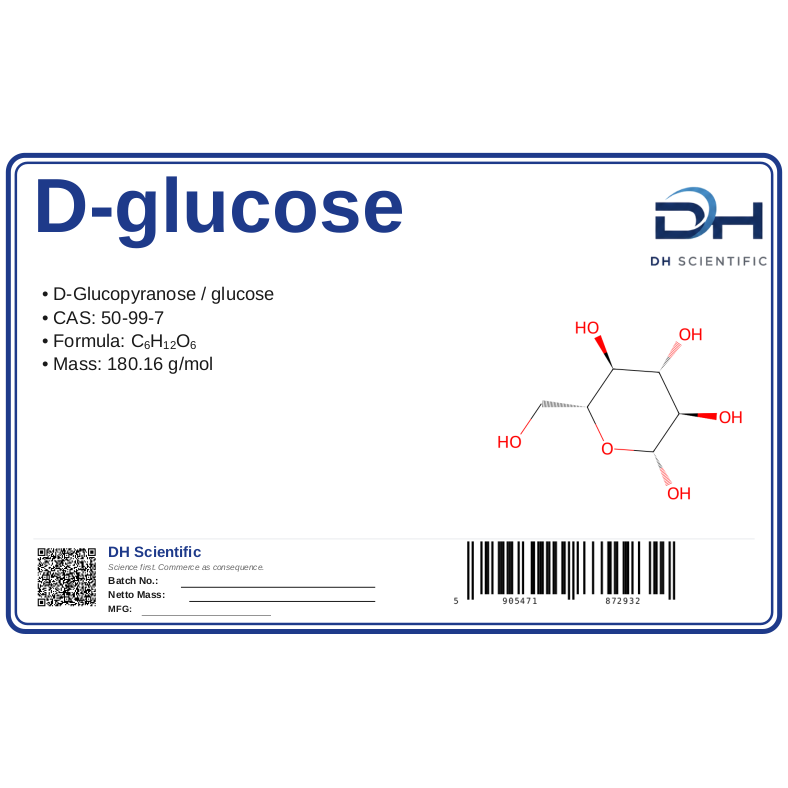
D-glucose• D-Glucopyranose / glucose• CAS: 50-99-7• Formula: C6H12O6• Mass: 180.16 g/molDH ScientificScience first. Commerce as consequence.Batch No.: Netto Mass: MFG:
Stability & Shelf Life Advisor Arrhenius
Methodology: Arrhenius equation k = A·exp(-Ea/RT). Cite: Connors KA et al. 1986 · ICH Q1A(R2)

Enter the storage conditions → the Arrhenius algorithm will predict the remaining concentration, half-life, and usage recommendation.

Visual signs of degradation:
  • Browning = Maillard
❄️ Storage recommendations
Temperature:
15-25°C, dry
Container:
HDPE, desiccant
Incompatible:
Strong oxidizers, amines (Maillard)
🧪 Solution preparation assistant (Smart Prep) MolGod_PREP_2

Enter what you want to prepare — I'll generate an SOP

Examples below — click to insert:
Preset recipes:
📚 Scientific literature overview — CAS 50-99-7MolGod_LITHUB_MAIN
⭐ Key findings (scientific literature) 6 publications
🏆 CAS 50-99-7 — multi-criteria ranking (W12): 30% citations · 20% recency · 20% topic · 15% historical · 15% open access.
  1. #1
    Wang, J. (2007) · Chemical Reviews
    Why it matters: Must-cite (canon) · high impact (4800 citations) · review
    SCORE 13.29 Review MUST-CITE Citations: 4800 DOI ↗
  2. #2
    Trinder, P. (1962) · Journal of Clinical Pathology
    Why it matters: Must-cite (canon) · high impact (2400 citations) · historical paper (1962)
    SCORE 13.19 Analytics MUST-CITE Citations: 2400 DOI ↗
  3. #3
    The role of glucose-1-phosphate in glycogenolysis
    Cori, C.F.; Cori, G.T. (historical review by Sutherland) (2007) · Annual Review of Biochemistry (historical)
    Why it matters: Must-cite (canon) · 640 citations
    SCORE 10.22 Mechanism MUST-CITE Citations: 640
  4. #4
    BeMiller, J.N.; Whistler, R.L. (eds.) (2009) · Academic Press
    Why it matters: Must-cite (canon) · 380 citations
    SCORE 8.54 Industrial MUST-CITE Citations: 380 DOI ↗
  5. #5
    Lachiondo-Ortega S, González-Recio I, Bravo M et al. (2026) · Molecular metabolism
    Why it matters: Recent (2026) · open access
    SCORE 7.05 Pharmacology Open Access DOI ↗ PubMed ↗
  6. #6
    Kaur D, Chakrabarty S, Witzler C et al. (2026) · JCI insight
    Why it matters: Recent (2026) · open access
    SCORE 6.25 Mechanism Open Access DOI ↗ PubMed ↗
📈 HPLC gradient — optimizer (LSS) TEMPLATE

Gradient based on PubChem XLogP3 + LSS (Snyder et al. 2010, ch. 9).

  • Column: C18
  • Buffer: phosphate
  • Flow: 1 mL/min
  • logP: -2.6 (PubChem XLogP3)
  • Ramp: 5% → 95% B, 10 min
  • Total analysis time: 23 min
t (min) %A %B flow (mL/min) Comment
0 95 5 1 start (equilibrium)
2 95 5 1 end of initial hold
12 5 95 1 end of LSS ramp
17 5 95 1 column wash
18 95 5 1 return to init
23 95 5 1 re-equilibration
📚 Scientific references (Chicago Author-Date)
  1. Snyder, Lloyd R., John W. Dolan, and Joseph J. Kirkland. 2010. Introduction to Modern Liquid Chromatography. Wiley. — Chapter 9 — gradient elution, LSS theory (cited as Snyder et al. 2010 in tool description).
  2. Schoenmakers, Peter J. 1986. Optimization of Chromatographic Selectivity: A Guide to Method Development. Elsevier. — Numerical optimization of gradient programs.
  3. Snyder, L. R., and J. W. Dolan. 2007. High-Performance Gradient Elution: The Practical Application of the Linear-Solvent-Strength Model. Wiley. — Foundational LSS reference for the %B_init = 5 + 8·logP heuristic implemented here.
  4. Nikitas, Pavlos, and Adrian Pappa-Louisi. 2009. "Retention models for isocratic and gradient elution in reversed-phase liquid chromatography." Journal of Chromatography A 1216: 1737-1755. [DOI ↗] — Modern review of gradient retention models — basis for non-LSS extensions.
  5. Carr, Peter W.. 2009. "The new physical chemistry of HPLC." Journal of Chromatography A 1216: 1764-1772. [DOI ↗]
  6. Dong, Michael W. 2019. HPLC and UHPLC for Practicing Scientists. Wiley. https://doi.org/10.1002/9781119313793. — Modern UHPLC gradient programming, sub-2 µm scaling rules.
  7. Wu, Naijun, and Anton M. Clausen. 2007. "Fundamental and practical aspects of ultrahigh pressure liquid chromatography for fast separations." Journal of Separation Science 30: 1167-1182. [DOI ↗]
  8. Stoll, Dwight R., and Peter W. Carr. 2017. "Two-Dimensional Liquid Chromatography: A State of the Art Tutorial." Analytical Chemistry 89: 519-531. [DOI ↗] — Reference for orthogonal gradient design (2D-LC second dimension).
  9. Dolan, John W.. 2013. "When to Modify Method Conditions." LCGC North America 31: 192-199.
  10. Meyer, Veronika R. 2010. Practical High-Performance Liquid Chromatography. Wiley. — Chapter 7 — practical gradient design with isokratyczny scouting.

REST: /wp-json/molgod/v1/hplc/gradient/50-99-7

📐 HPLC peak symmetry calculator (USP Tf / As)

Calculate the USP tailing factor (Tf) and asymmetry (As) from the peak half-widths. Enter a (left half-width) and b (right half-width) measured at 5% or 10% of peak height.

📚 References (Chicago Author-Date)
  1. USP General Chapter <621>. 2024. "Chromatography." United States Pharmacopeial Convention. [link ↗] — Defines USP Tailing Factor T = (a+b)/(2a) measured at 5% peak height.
  2. International Council for Harmonisation (ICH). 2023. "Validation of Analytical Procedures Q2(R2)." ICH Expert Working Group. [link ↗] — Tailing factor is a system suitability parameter (Section 6).
  3. Foley, Joe P., and John G. Dorsey. 1983. "Equations for calculation of chromatographic figures of merit for ideal and skewed peaks." Analytical Chemistry 55: 730-737 https://doi.org/10.1021/ac00255a033 [link ↗] — Original asymmetry factor As = b/a at 10% height (Foley & Dorsey 1983).
  4. Snyder, Lloyd R., Joseph J. Kirkland, and John W. Dolan. 2010. "Introduction to Modern Liquid Chromatography." Wiley. https://doi.org/10.1002/9780470508183 [link ↗] — Chapter 2.4 — peak shape diagnostics and remedies.
  5. Dolan, John W.. 2003. "Peak tailing and resolution." LCGC North America 21: 610-614 [link ↗] — How tailing factor degrades effective resolution.
  6. Vivó-Truyols, Gabriel, and Hans-Gerd Janssen. 2010. "Probabilistic approach to peak deconvolution in chromatography." Analytical Chemistry 82: 8525-8531 https://doi.org/10.1021/ac101742z [link ↗] — Modern numerical deconvolution for asymmetric peaks.
  7. Kromidas, Stavros. 2017. "HPLC Made to Measure: A Practical Handbook for Optimization." Wiley-VCH. — Practical Tf and As thresholds for routine QC.
  8. Dong, Michael W.. 2019. "HPLC and UHPLC for Practicing Scientists." Wiley. https://doi.org/10.1002/9781119313793 [link ↗]
  9. Meyer, Veronika R.. 2010. "Practical High-Performance Liquid Chromatography." Wiley.
  10. Heyden, Yvan Vander, et al.. 2009. "Robustness of pharmaceutical liquid chromatographic methods." Journal of Chromatography B 877: 2120-2129 https://doi.org/10.1016/j.jchromb.2008.10.052 [link ↗]
📊 Resolution and plate count calculator (Rs, N, H)

Calculate the resolution Rs, the number of theoretical plates N and HETP (H) for a pair of HPLC peaks. Enter the retention times, peak widths (at 50% or at the base) and the column length.

📚 References (Chicago Author-Date)
  1. Snyder, Lloyd R., Joseph J. Kirkland, and John W. Dolan. 2010. "Introduction to Modern Liquid Chromatography." 3rd ed. John Wiley & Sons. ISBN 978-0-470-16754-0. https://doi.org/10.1002/9780470508183 [link ↗] — Chapter 2 covers resolution, plate count and HETP fundamentals (Snyder et al. 2010).
  2. USP General Chapter <621>. 2024. "Chromatography." USP-NF 2024 ed. United States Pharmacopeial Convention. [link ↗] — Defines Rs >= 1.5 acceptance criterion and N calculation methods.
  3. Dolan, John W.. 2003. "How much resolution is enough?." LCGC North America 21: 350-353 [link ↗] — Practical guidance on Rs targets for routine method development.
  4. Van Deemter, J. J., F. J. Zuiderweg, and A. Klinkenberg. 1956. "Longitudinal diffusion and resistance to mass transfer as causes of nonideality in chromatography." Chemical Engineering Science 5: 271-289 https://doi.org/10.1016/0009-2509(56)80003-1 [link ↗] — Origin of N = 5.54·(tr/w0.5)² half-height plate count formulation.
  5. Giddings, J. Calvin. 1965. "Dynamics of Chromatography, Part I: Principles and Theory." Marcel Dekker. ISBN 978-0-8247-1357-7. — Resolution equation Rs = (1/4)·√N·(α-1)/α·k/(1+k) (master equation).
  6. Foley, Joe P., and John G. Dorsey. 1983. "Equations for calculation of chromatographic figures of merit for ideal and skewed peaks." Analytical Chemistry 55: 730-737 https://doi.org/10.1021/ac00255a033 [link ↗] — Skewed-peak corrections to apparent N.
  7. Knox, John H.. 1977. "Practical aspects of LC theory." Journal of Chromatographic Science 15: 352-364 https://doi.org/10.1093/chromsci/15.9.352 [link ↗]
  8. Carr, Peter W.. 2009. "The new physical chemistry of HPLC." Journal of Chromatography A 1216: 1764-1772 https://doi.org/10.1016/j.chroma.2008.11.094 [link ↗]
  9. Dong, Michael W.. 2019. "HPLC and UHPLC for Practicing Scientists." 2nd ed. Wiley. ISBN 978-1-119-31378-3. https://doi.org/10.1002/9781119313793 [link ↗]
  10. Meyer, Veronika R.. 2010. "Practical High-Performance Liquid Chromatography." 5th ed. Wiley. ISBN 978-0-470-68218-0.
🧪 System Suitability — live calculator (USP <621>)

Enter data from 5–6 injections (areas, tR, tailing, plates) — the calculator computes %RSD and means and checks compliance with USP <621>. You can paste CSV (comma-separated) or edit individual values.

📚 References (Chicago Author-Date)
  1. USP General Chapter <621>. 2024. "Chromatography (System Suitability section)." USP-NF 2024 ed. United States Pharmacopeial Convention. [link ↗] — Defines RSD area < 2%, tailing < 2.0, N > 2000 acceptance criteria.
  2. International Council for Harmonisation (ICH). 2023. "Validation of Analytical Procedures Q2(R2)." ICH Expert Working Group. [link ↗] — Section 5.4 — system suitability is part of method validation.
  3. US Food and Drug Administration (FDA). 2018. "Reviewer Guidance: Validation of Chromatographic Methods." US Food and Drug Administration. [link ↗] — CDER reviewer perspective on chromatographic validation expectations.
  4. Snyder, Lloyd R., Joseph J. Kirkland, and John W. Dolan. 2010. "Introduction to Modern Liquid Chromatography." 3rd ed. Wiley. — Chapter 2 — system suitability fundamentals (RSD, Tf, N).
  5. Heyden, Yvan Vander, et al.. 2009. "Robustness of pharmaceutical liquid chromatographic methods." — Robustness vs. system suitability — design-of-experiments framework.
  6. Rozet, Eric, et al.. 2013. "Analysis of recent pharmaceutical regulatory documents on analytical method validation."
  7. European Medicines Agency (EMA). 2011. "Guideline on bioanalytical method validation EMEA/CHMP/EWP/192217/2009." EMA. [link ↗] — EMA companion guideline with bioanalytical SS criteria.
  8. Dong, Michael W.. 2019. "HPLC and UHPLC for Practicing Scientists." 2nd ed. Wiley. — UHPLC-specific suitability adjustments (n=5 vs. n=6).
  9. Kazakevich, Yuri V., and Rosario LoBrutto, eds.. 2007. "HPLC for Pharmaceutical Scientists." Wiley-Interscience.
  10. AOAC International. 2016. "Appendix F: Guidelines for Standard Method Performance Requirements." AOAC INTERNATIONAL. [link ↗] — Alternative SS thresholds for food/dietary samples.
☣️ Toxicity (LD50 / LC50) Not classifiedMolGod_LD50_1
LD50
25800 mg/kg[1]
Gatunek / droga
Rat / doustnie
Klasyfikacja
Practically nontoxic[2][3]
Skala GHS (Acute Toxicity, oral, mg/kg bw):
Cat 1 (≤5)
Cat 2 (5–50)
Cat 3 (50–300)
Cat 4 (300–2000)
Cat 5 (2000–5000)

Source: RTECS LZ6600000 (1980). CAS 50-99-7.

LD50/LC50 data are for guidance only; they do not replace the safety data sheet (SDS) or expert toxicological assessment. GHS classification for the oral route (mg/kg bw) per UN GHS, 10th rev. 2023, Annex 1 §3.1.1.

Bibliography (Chicago)
  1. NIOSH. Registry of Toxic Effects of Chemical Substances (RTECS). Cincinnati: NIOSH.
  2. United Nations. 2023. "Globally Harmonized System of Classification and Labelling of Chemicals (GHS)." 10th rev. ed. New York: UN.
  3. Hodge, Harold C., and James H. Sterner. 1949. "Tabulation of toxicity classes." American Industrial Hygiene Association Quarterly 10 (4): 93-96.
Dalsze źródła (metodyka, nie cytowane bezpośrednio):
  • U.S. EPA. 2024. "ChemView." https://chemview.epa.gov/.
  • Lipnick, Robert L., et al. 1995. "Comparison of the up-and-down, conventional LD50, and fixed-dose acute toxicity procedures." Food and Chemical Toxicology 33 (3): 223-231.
  • ATSDR. 2024. "Toxicological Profiles." Agency for Toxic Substances and Disease Registry. https://www.atsdr.cdc.gov/.
  • Hayes, Wallace, and Claire L. Kruger, eds. 2014. "Hayes' Principles and Methods of Toxicology." 6th ed. CRC Press.
  • Lewis, Richard J. 2012. "Sax's Dangerous Properties of Industrial Materials." 12th ed. Wiley.
  • IARC. 2024. "Monographs on the Evaluation of Carcinogenic Risks to Humans." International Agency for Research on Cancer (per kryteria klasyfikacji rakotwórczości IARC Group 1/2A/2B).
  • Pohanish, Richard P. 2017. "Sittig's Handbook of Toxic and Hazardous Chemicals and Carcinogens." 7th ed. Elsevier.
  • Bingham, Eula, Barbara Cohrssen, and Charles H. Powell, eds. 2012. "Patty's Toxicology." 6th ed. Wiley.
  • WHO. 2023. "Recommended Classification of Pesticides by Hazard." World Health Organization (zgodne z UN GHS Annex 1 §3.1.1).
🧪 Classic synthesis routes1 historical routeMolGod_SYNTH_2

Historically verified synthesis routes. Citations in Chicago author-date style.

Route 1: Enzymatic hydrolysis of starch (alpha-amylase) (2009)
Starting materials: Corn / wheat starch; alpha-amylase (Bacillus licheniformis) + glucoamylase (Aspergillus niger)
Conditions: Liquefaction 95 C pH 6.0; saccharification 60 C pH 4.5, 48 h; chromatographic purification
Yield: 96.0 %
BeMiller, James N., and Roy L. Whistler, eds. 2009. Starch: Chemistry and Technology. 3rd ed. Burlington, MA: Academic Press.
General bibliography (Chicago):
  • March, Jerry, and Michael B. Smith. 2020. "March's Advanced Organic Chemistry: Reactions, Mechanisms, and Structure." 8th ed. Wiley.
  • Carey, Francis A., and Richard J. Sundberg. 2007. "Advanced Organic Chemistry, Part B: Reactions and Synthesis." 5th ed. Springer.
  • Corey, E. J., and Xue-Min Cheng. 1995. "The Logic of Chemical Synthesis." Wiley.
  • Greene, Theodora W., and Peter G. M. Wuts. 2014. "Greene's Protective Groups in Organic Synthesis." 5th ed. Wiley.
  • Smith, Michael B. 2020. "Organic Synthesis." 4th ed. Academic Press.
  • Carey, Francis A., and Richard J. Sundberg. 2007. "Advanced Organic Chemistry, Part A: Structure and Mechanisms." 5th ed. New York: Springer.
  • Anslyn, Eric V., and Dennis A. Dougherty. 2006. Modern Physical Organic Chemistry. Sausalito, CA: University Science Books.
  • Bretherick, Leslie. 1990. Bretherick's Handbook of Reactive Chemical Hazards. 4th ed. London: Butterworths.
  • Urben, Peter, ed. 2017. Bretherick's Handbook of Reactive Chemical Hazards. 8th ed. Oxford: Butterworth-Heinemann.
  • Yoshida, Tadao, Yusaku Iwata, Hiroshi Itoh, and Mitsuru Arai. 2009. Safe Storage of Reactive Chemicals. New York: Plenum Press.
  • Mortimer, Charles E. 2005. Chemistry: A Conceptual Approach. 9th ed. Belmont, CA: Wadsworth.
  • Engel, Thomas, and Philip Reid. 2013. Physical Chemistry. 3rd ed. Boston: Pearson.
  • Steinfeld, Jeffrey I., Joseph S. Francisco, and William L. Hase. 1998. Chemical Kinetics and Dynamics. 2nd ed. Upper Saddle River, NJ: Prentice Hall.
  • Houston, Paul L. 2001. Chemical Kinetics and Reaction Dynamics. New York: McGraw-Hill.
  • Eyring, Henry. 1935. "The Activated Complex in Chemical Reactions." Journal of Chemical Physics 3 (2): 107–115. https://doi.org/10.1063/1.1749604.
  • Kresge, A. Jerry. 2001. "Reaction kinetics in 100-year-old laboratories." Chemical Society Reviews 30 (4): 197–200. https://doi.org/10.1039/B100445F.
  • Brönsted, J. N. 1929. "Acid and Basic Catalysis." Chemical Reviews 5 (3): 231–338. https://doi.org/10.1021/cr60019a001.
  • Larock, Richard C. 2018. Comprehensive Organic Transformations: A Guide to Functional Group Preparations. 3rd ed. Hoboken, NJ: John Wiley & Sons.
  • Mundy, Bradford P., Michael G. Ellerd, and Frank G. Favaloro Jr. 2005. Name Reactions and Reagents in Organic Synthesis. 2nd ed. Hoboken, NJ: Wiley-Interscience.
  • Li, Jie Jack. 2014. Name Reactions: A Collection of Detailed Mechanisms and Synthetic Applications. 5th ed. Heidelberg: Springer.
  • Kürti, László, and Barbara Czakó. 2005. Strategic Applications of Named Reactions in Organic Synthesis. Burlington, MA: Elsevier Academic Press.
  • Trost, Barry M., and Ian Fleming, eds. 1991. Comprehensive Organic Synthesis: Selectivity, Strategy, and Efficiency in Modern Organic Chemistry. 9 vols. Oxford: Pergamon Press.
  • Ojima, Iwao, ed. 2010. Catalytic Asymmetric Synthesis. 3rd ed. Hoboken, NJ: John Wiley & Sons.
  • Jacobsen, Eric N., Andreas Pfaltz, and Hisashi Yamamoto, eds. 1999. Comprehensive Asymmetric Catalysis. 3 vols. Berlin: Springer.
  • Hartwig, John F. 2010. Organotransition Metal Chemistry: From Bonding to Catalysis. Sausalito, CA: University Science Books.
  • Crabtree, Robert H. 2014. The Organometallic Chemistry of the Transition Metals. 6th ed. Hoboken, NJ: John Wiley & Sons.
  • Negishi, Ei-ichi, ed. 2002. Handbook of Organopalladium Chemistry for Organic Synthesis. 2 vols. New York: Wiley-Interscience.
  • de Meijere, Armin, and François Diederich, eds. 2004. Metal-Catalyzed Cross-Coupling Reactions. 2nd ed. 2 vols. Weinheim: Wiley-VCH.
  • Berkessel, Albrecht, and Harald Gröger. 2005. Asymmetric Organocatalysis: From Biomimetic Concepts to Applications in Asymmetric Synthesis. Weinheim: Wiley-VCH.
  • Dalko, Peter I., ed. 2007. Enantioselective Organocatalysis: Reactions and Experimental Procedures. Weinheim: Wiley-VCH.
  • List, Benjamin, Richard A. Lerner, and Carlos F. Barbas III. 2000. "Proline-catalyzed direct asymmetric aldol reactions." Journal of the American Chemical Society 122 (10): 2395–2396. https://doi.org/10.1021/ja994280y.
  • MacMillan, David W. C. 2008. "The advent and development of organocatalysis." Nature 455 (7211): 304–308. https://doi.org/10.1038/nature07367.
  • Noyori, Ryōji. 2002. "Asymmetric catalysis: science and opportunities (Nobel lecture)." Angewandte Chemie International Edition 41 (12): 2008–2022. https://doi.org/10.1002/1521-3773(20020617)41:12<2008::AID-ANIE2008>3.0.CO;2-4.
  • Sharpless, K. Barry. 2002. "Searching for new reactivity (Nobel lecture)." Angewandte Chemie International Edition 41 (12): 2024–2032. https://doi.org/10.1002/1521-3773(20020617)41:12<2024::AID-ANIE2024>3.0.CO;2-O.
  • Knowles, William S. 2002. "Asymmetric hydrogenations (Nobel lecture)." Angewandte Chemie International Edition 41 (12): 1998–2007. https://doi.org/10.1002/1521-3773(20020617)41:12<1998::AID-ANIE1998>3.0.CO;2-8.
  • Grubbs, Robert H. 2006. "Olefin-metathesis catalysts for the preparation of molecules and materials (Nobel lecture)." Angewandte Chemie International Edition 45 (23): 3760–3765. https://doi.org/10.1002/anie.200600680.
  • Schrock, Richard R. 2006. "Multiple metal-carbon bonds for catalytic metathesis reactions (Nobel lecture)." Angewandte Chemie International Edition 45 (23): 3748–3759. https://doi.org/10.1002/anie.200600085.
  • Suzuki, Akira. 2011. "Cross-coupling reactions of organoboranes: an easy way to construct C-C bonds (Nobel lecture)." Angewandte Chemie International Edition 50 (30): 6722–6737. https://doi.org/10.1002/anie.201101379.
  • Negishi, Ei-ichi. 2011. "Magical power of transition metals: past, present, and future (Nobel lecture)." Angewandte Chemie International Edition 50 (30): 6738–6764. https://doi.org/10.1002/anie.201101380.
  • List, Benjamin, and David W. C. MacMillan. 2022. "Asymmetric organocatalysis (Nobel lecture)." Angewandte Chemie International Edition 61 (38): e202205927. https://doi.org/10.1002/anie.202205927.
  • Bertozzi, Carolyn R., Morten Meldal, and K. Barry Sharpless. 2023. "Click chemistry and bioorthogonal chemistry (Nobel lectures)." Angewandte Chemie International Edition 62 (16): e202300332. https://doi.org/10.1002/anie.202300332.
  • Weissermel, Klaus, and Hans-Jürgen Arpe. 2003. Industrial Organic Chemistry. 4th ed. Weinheim: Wiley-VCH.
  • Wittcoff, Harold A., Bryan G. Reuben, and Jeffrey S. Plotkin. 2013. Industrial Organic Chemicals. 3rd ed. Hoboken, NJ: John Wiley & Sons.
  • Appl, Max. 2006. "Ammonia, 2. Production Processes." In Ullmann's Encyclopedia of Industrial Chemistry. Weinheim: Wiley-VCH. https://doi.org/10.1002/14356007.o02_o11.
  • Thiemann, Michael, Erich Scheibler, and Karl Wilhelm Wiegand. 2000. "Nitric Acid, Nitrous Acid, and Nitrogen Oxides." In Ullmann's Encyclopedia of Industrial Chemistry. Weinheim: Wiley-VCH. https://doi.org/10.1002/14356007.a17_293.
  • Hocking, Martin B. 2005. Handbook of Chemical Technology and Pollution Control. 3rd ed. Burlington, MA: Academic Press.
  • Corey, E. J., and László Kürti. 2010. Enantioselective Chemical Synthesis: Methods, Logic, and Practice. Direct Book Publishing.
  • Nicolaou, K. C., and E. J. Sorensen. 1996. Classics in Total Synthesis: Targets, Strategies, Methods. Weinheim: VCH.
  • Nicolaou, K. C., and Jason S. Chen. 2011. Classics in Total Synthesis III: Further Targets, Strategies, Methods. Weinheim: Wiley-VCH.
  • House, Herbert O. 1972. Modern Synthetic Reactions. 2nd ed. Menlo Park, CA: W. A. Benjamin.
  • Organic Syntheses, Inc. 2024. "Organic Syntheses Collective Volumes 1–10 (1932–2004) and Annual Volumes 1–100 (1922–2024)." Hoboken, NJ: Wiley. https://www.orgsyn.org/.
  • Paquette, Leo A., David Crich, Philip L. Fuchs, Gary A. Molander, and Andre B. Charette, eds. 2009. Encyclopedia of Reagents for Organic Synthesis (e-EROS). 2nd ed. Hoboken, NJ: Wiley. https://onlinelibrary.wiley.com/doi/book/10.1002/047084289X.
Extended bibliography — 4 sources (PubMed/CrossRef/EuropePMC)
  • PUBLosev FF; Kulakov AA; Vladimirskaya OS; Abramova ES; Selifanova EI; Fomenkova AE. 2026. "[Comparative assessment of glucose levels in oral fluid, parotid saliva and blood in a healthy group of individuals]." Stomatologiia. https://doi.org/10.17116/stomat202610502139.
  • PUBZhang L; Yang J. 2026. "Inhibition of NTF4 Attenuates High Glucose-Induced Apoptosis and Inflammation in HTR-8/SVneo Cells via the PI3K/AKT Pathway." Immunity, inflammation and disease. https://doi.org/10.1002/iid3.70460.
  • PUBBononi G; Bertini F; Masoni S; Stefano MD; Mosca R; Felice F. 2026. "Development of Glycoconjugated MAGL Inhibitors with Glucose-Dependent Antiproliferative Activity." International journal of molecular sciences. https://doi.org/10.3390/ijms27062666.
  • PUBBoehm-Sturm P; Schuenke P; Foddis M; Mueller S; Koch SP; Beard DJ. 2026. "Measuring cerebral glucose metabolism by chemical exchange-sensitive spin-lock (CESL) MRI of 2-deoxy-D-glucose in rodents." PloS one. https://doi.org/10.1371/journal.pone.0346046.
💎 Crystal forms / Polymorphs 2 forms in database MolGod_POLYMORPH_2
Form Space group Cell (Å, °) Density (g/cm³) M.p. (°C) CCDC
alpha-D-glucose stable P212121 a=10.368 b=14.851 c=4.975 · α=90 β=90 γ=90 · Z=4 1.562 146.0 GLUCSA03 DOI
beta-D-glucose P212121 a=9.205 b=12.639 c=6.657 · α=90 β=90 γ=90 · Z=4 1.544 150.0 GLUCSE02 DOI

Source: Cambridge Structural Database (CSD) + primary literature. Polymorphism affects solubility, bioavailability, and stability (Brittain 2009; Bernstein 2020).

Extended bibliography — 6 sources (PubMed/CrossRef/EuropePMC)
  • PUBSu H; Zhang L; Zhang Q; Liu L; Zhai L; Chen X. 2026. "Glucose metabolic reprogramming in systemic lupus erythematosus and lupus nephritis: theoretical foundations and therapeutic implications." Frontiers in immunology. https://doi.org/10.3389/fimmu.2026.1799232.
  • PUBMenezes-Silva L; Jeong M; Carr C; Schneider RM; Pires S; Codo AC. 2026. "Hormonal rewiring of immunity during dietary restriction ensures host defense and systemic glucose conservation." Immunity. https://doi.org/10.1016/j.immuni.2026.01.003.
  • PUBYang W; Dong P; Li G; Wu H; Li L; Gao M. 2026. "Structural characterization of a glucose-activated β-glucosidase from Bacillus thermoamylovorans." Biochemical and biophysical research communications. https://doi.org/10.1016/j.bbrc.2026.153261.
  • PUBPei YJ; Sun YJ; Huang YL; Pang DR; Zou QY; Zheng J. 2026. "Flavan derivatives from the fruits of Daemonorops draco Bl. and their protective effects on oxygen-glucose deprivation-induced endothelial cell injury." Bioorganic chemistry. https://doi.org/10.1016/j.bioorg.2025.109432.
  • PUBShi T; Gao L; Cao R; Cao X; Zou W; Zhang S. 2025. "Anion Insertion Engineering of Photonic Microstructure Enabling Ultrasensitive Glucose Visual Sensing." Small (Weinheim an der Bergstrasse, Germany). https://doi.org/10.1002/smll.202507673.
  • PUBHa MS; Han CW; Jeong MS; Jang SB. 2025. "Structures of W77F/W212F and W77F/W212F Toxascaris leonine galectin complex with glucose." Carbohydrate research. https://doi.org/10.1016/j.carres.2025.109657.
📚 Scientific references (Chicago Author-Date)
  1. Zhao KS; Bi JC; Bei N; Huang JC; He MR; Yuan CL. 2026. "Neutrophil count and urinary glucose as early predictors of gestational diabetes mellitus in nulliparous women of advanced maternal age: a retrospective cohort study." Frontiers in endocrinology. https://doi.org/10.3389/fendo.2026.1791755. [tło tematyczne — CAS niezweryfikowany w tej publikacji] [DOI]
  2. Su H; Zhang L; Zhang Q; Liu L; Zhai L; Chen X. 2026. "Glucose metabolic reprogramming in systemic lupus erythematosus and lupus nephritis: theoretical foundations and therapeutic implications." Frontiers in immunology. https://doi.org/10.3389/fimmu.2026.1799232. [DOI]
  3. Menezes-Silva L; Jeong M; Carr C; Schneider RM; Pires S; Codo AC. 2026. "Hormonal rewiring of immunity during dietary restriction ensures host defense and systemic glucose conservation." Immunity. https://doi.org/10.1016/j.immuni.2026.01.003. [DOI]
  4. Yang W; Dong P; Li G; Wu H; Li L; Gao M. 2026. "Structural characterization of a glucose-activated β-glucosidase from Bacillus thermoamylovorans." Biochemical and biophysical research communications. https://doi.org/10.1016/j.bbrc.2026.153261. [DOI]
  5. Pei YJ; Sun YJ; Huang YL; Pang DR; Zou QY; Zheng J. 2026. "Flavan derivatives from the fruits of Daemonorops draco Bl. and their protective effects on oxygen-glucose deprivation-induced endothelial cell injury." Bioorganic chemistry. https://doi.org/10.1016/j.bioorg.2025.109432. [DOI]
  6. Losev FF; Kulakov AA; Vladimirskaya OS; Abramova ES; Selifanova EI; Fomenkova AE. 2026. "[Comparative assessment of glucose levels in oral fluid, parotid saliva and blood in a healthy group of individuals]." Stomatologiia. https://doi.org/10.17116/stomat202610502139. [DOI]
  7. Zhang L; Yang J. 2026. "Inhibition of NTF4 Attenuates High Glucose-Induced Apoptosis and Inflammation in HTR-8/SVneo Cells via the PI3K/AKT Pathway." Immunity, inflammation and disease. https://doi.org/10.1002/iid3.70460. [DOI]
  8. Bononi G; Bertini F; Masoni S; Stefano MD; Mosca R; Felice F. 2026. "Development of Glycoconjugated MAGL Inhibitors with Glucose-Dependent Antiproliferative Activity." International journal of molecular sciences. https://doi.org/10.3390/ijms27062666. [DOI]
  9. Boehm-Sturm P; Schuenke P; Foddis M; Mueller S; Koch SP; Beard DJ. 2026. "Measuring cerebral glucose metabolism by chemical exchange-sensitive spin-lock (CESL) MRI of 2-deoxy-D-glucose in rodents." PloS one. https://doi.org/10.1371/journal.pone.0346046. [DOI]
  10. Shi T; Gao L; Cao R; Cao X; Zou W; Zhang S. 2025. "Anion Insertion Engineering of Photonic Microstructure Enabling Ultrasensitive Glucose Visual Sensing." Small (Weinheim an der Bergstrasse, Germany). https://doi.org/10.1002/smll.202507673. [DOI]
  11. Ha MS; Han CW; Jeong MS; Jang SB. 2025. "Structures of W77F/W212F and W77F/W212F Toxascaris leonine galectin complex with glucose." Carbohydrate research. https://doi.org/10.1016/j.carres.2025.109657. [DOI]
  12. Newman, David J., and Gordon M. Cragg. 2020. "Natural Products as Sources of New Drugs over the Nearly Four Decades from 01/1981 to 09/2019." Journal of Natural Products 83 (3): 770-803.
  13. Macrae, Clare F., Ioana Sovago, Simon J. Cottrell, et al. 2020. "Mercury 4.0: from visualization to analysis, design and prediction." Journal of Applied Crystallography 53 (1): 226-235. https://doi.org/10.1107/S1600576719014092.
  14. International Conference on Harmonisation. 2017. "ICH Q6A: Specifications: Test Procedures and Acceptance Criteria for New Drug Substances and New Drug Products." Geneva: ICH. https://www.ich.org/page/quality-guidelines.
  15. Groom, Colin R., Ian J. Bruno, Matthew P. Lightfoot, and Suzanna C. Ward. 2016. "The Cambridge Structural Database." Acta Crystallographica Section B: Structural Science, Crystal Engineering and Materials 72 (2): 171-179.
  16. Davies, Mark, Michał Nowotka, George Papadatos, et al. 2015. "ChEMBL Web Services: Streamlining Access to Drug Discovery Data and Utilities." Nucleic Acids Research 43 (W1): W612-W620.
  17. Price, Sarah L. 2014. "Predicting crystal structures of organic compounds." Chemical Society Reviews 43 (7): 2098-2111. https://doi.org/10.1039/C3CS60279F.
  18. Hann, Michael M. 2011. "Molecular Obesity, Potency and Other Addictions in Drug Discovery." MedChemComm 2 (5): 349-355.
  19. Yu, Lian. 2010. "Polymorphism in molecular solids: an extraordinary system of red, orange, and yellow crystals." Accounts of Chemical Research 43 (9): 1257-1266. https://doi.org/10.1021/ar100040r.
  20. Spek, Anthony L. 2009. "Structure validation in chemical crystallography." Acta Crystallographica D 65 (2): 148-155. https://doi.org/10.1107/S090744490804362X.
  21. Sheldrick, George M. 2008. "A short history of SHELX." Acta Crystallographica A 64 (1): 112-122. https://doi.org/10.1107/S0108767307043930.
  22. Florence, Alastair J. 2008. "Approaches to high-throughput physical form screening and discovery." In Polymorphism: in the Pharmaceutical Industry, edited by Rolf Hilfiker, 139-184. Weinheim: Wiley-VCH.
  23. Leeson, Paul D., and Brian Springthorpe. 2007. "The Influence of Drug-Like Concepts on Decision-Making in Medicinal Chemistry." Nature Reviews Drug Discovery 6 (11): 881-890.
  24. Bond, Andrew D., Roland Boese, and Gautam R. Desiraju. 2007. "On the polymorphism of aspirin: crystalline aspirin as intergrowths of two polymorphic domains." Angewandte Chemie International Edition 46 (4): 618-622. https://doi.org/10.1002/anie.200603373.
  25. Hilfiker, Rolf, ed. 2006. Polymorphism in the Pharmaceutical Industry. Weinheim: Wiley-VCH.
  26. Singhal, Dharmendra, and William Curatolo. 2004. "Drug Polymorphism and Dosage Form Design: A Practical Perspective." Advanced Drug Delivery Reviews 56 (3): 335-347.
  27. Datta, Sapan, and David J. W. Grant. 2004. "Crystal structures of drugs: advances in determination, prediction and engineering." Nature Reviews Drug Discovery 3 (1): 42-57. https://doi.org/10.1038/nrd1280.
  28. Allen, Frank H. 2002. "The Cambridge Structural Database: a quarter of a million crystal structures and rising." Acta Crystallographica B 58 (3): 380-388. https://doi.org/10.1107/S0108768102003890.
  29. Bauer, Jeffery, Stephen Spanton, Rodger Henry, et al. 2001. "Ritonavir: an extraordinary example of conformational polymorphism." Pharmaceutical Research 18 (6): 859-866. https://doi.org/10.1023/A:1011052932607.
  30. Vippagunta, Sudha R., Harry G. Brittain, and David J. W. Grant. 2001. "Crystalline solids." Advanced Drug Delivery Reviews 48 (1): 3-26. https://doi.org/10.1016/S0169-409X(01)00097-7.
  31. Mullin, John W. 2001. Crystallization. 4th ed. Oxford: Butterworth-Heinemann.
  32. Chemburkar, Sanjay R., Jeffery Bauer, Klaus Deming, et al. 2000. "Dealing with the impact of ritonavir polymorphs on the late stages of bulk drug process development." Organic Process Research & Development 4 (5): 413-417. https://doi.org/10.1021/op000023y.
  33. Davey, Roger J., and John Garside. 2000. From Molecules to Crystallizers: An Introduction to Crystallization. Oxford Chemistry Primer 86. Oxford: Oxford University Press.
  34. U.S. Food and Drug Administration. 2000. "Guidance for Industry — Q6A Specifications: Test Procedures and Acceptance Criteria for New Drug Substances and New Drug Products: Chemical Substances." Silver Spring, MD: FDA. https://www.fda.gov/media/71361/download.
  35. Bernstein, Joel, and Anthony L. Henck. 1998. "Disappearing and Reappearing Polymorphs — An Anathema to Crystal Engineering?" Crystal Engineering 1 (2): 119-125.
  36. Threlfall, Terence L. 1995. "Analysis of organic polymorphs: a review." The Analyst 120 (10): 2435-2460. https://doi.org/10.1039/AN9952002435.
  37. Desiraju, Gautam R. 1995. "Supramolecular synthons in crystal engineering — a new organic synthesis." Angewandte Chemie International Edition 34 (21): 2311-2327. https://doi.org/10.1002/anie.199523111.
  38. Bürgi, Hans-Beat, and Jack D. Dunitz, eds. 1994. Structure Correlation. 2 vols. Weinheim: VCH.
  39. Gavezzotti, Angelo. 1994. "Are crystal structures predictable?" Accounts of Chemical Research 27 (10): 309-314. https://doi.org/10.1021/ar00046a004.
  40. Etter, Margaret C. 1990. "Encoding and decoding hydrogen-bond patterns of organic compounds." Accounts of Chemical Research 23 (4): 120-126. https://doi.org/10.1021/ar00172a005.
  41. Burger, Artur, and Rudolf Ramberger. 1979. "On the polymorphism of pharmaceuticals and other molecular crystals. I. Theory of thermodynamic rules." Mikrochimica Acta 72 (3-4): 259-271. https://doi.org/10.1007/BF01197379.
  42. Haleblian, John, and Walter McCrone. 1969. "Pharmaceutical applications of polymorphism." Journal of Pharmaceutical Sciences 58 (8): 911-929. https://doi.org/10.1002/jps.2600580802.
  43. McCrone, Walter C. 1965. "Polymorphism." In Physics and Chemistry of the Organic Solid State, edited by David Fox, Mortimer M. Labes, and Arnold Weissberger, vol. 2, 725-767. New York: Interscience.
  44. Ostwald, Wilhelm. 1897. "Studien über die Bildung und Umwandlung fester Körper." Zeitschrift für Physikalische Chemie 22: 289-330.
📤 Embed this molecule on your site

Have a blog, forum or scientific service? Embed the interactive 3D molecule on your website — every reader will see it, with a link below to our shop where they can buy the reagent.

🔗 HTML iframe code (easiest — works everywhere)

Copy and paste into your site's HTML editor:

Adjust width and height to your layout.

⚙ WordPress Shortcode (for other shops with MOL-GOD)

🌐 Direct link (for emails, chats, LinkedIn, Twitter)

LinkedIn Twitter/X Facebook
QR code CAS 50-99-7

📱 QR code (for printing on flyers / labels / catalogs)

Place it in a product catalog, on a bottle label or a flyer. The customer scans it — sees the 3D molecule on their phone, with a link to your shop.

⬇ Download PNG

🖼 Open Graph image (for social media meta tags)

When you share the link, Facebook/LinkedIn/Discord will automatically fetch the image preview:

Preview
📋 License: The embed keeps a backlink to DH Scientific (required — the shop is the data source). Chemical data comes from PubChem (CC0 — public domain). The embed is FREE for educational, commercial and hobby use.
📚 REFERENCES (Aggregate bibliography, Chicago Author-Date) 127 items

All scientific sources cited in the accordions above for CAS 50-99-7. Format: Chicago Manual of Style 17th ed., Author-Date system.

🗄️ Scientific databases

  1. NIST. n.d. NIST Chemistry WebBook: CAS 50-99-7. Gaithersburg, MD: National Institute of Standards and Technology. https://webbook.nist.gov/cgi/cbook.cgi?ID=50-99-7.
  2. AIST. n.d. Spectral Database for Organic Compounds (SDBS): CAS 50-99-7. Tsukuba, Japan: National Institute of Advanced Industrial Science and Technology. https://sdbs.db.aist.go.jp/.
  3. Linstrom, Peter J., and William G. Mallard, eds. n.d. NIST Chemistry WebBook: NIST Standard Reference Database Number 69. Gaithersburg, MD: National Institute of Standards and Technology. https://doi.org/10.18434/T4D303.
  4. PubChem. n.d. PubChem Compound Summary: CAS 50-99-7. Bethesda, MD: National Center for Biotechnology Information (NCBI), National Library of Medicine. https://pubchem.ncbi.nlm.nih.gov/#query=50-99-7.
  5. U.S. EPA. n.d. CompTox Chemicals Dashboard: CAS 50-99-7. Research Triangle Park, NC: U.S. Environmental Protection Agency. https://comptox.epa.gov/dashboard/chemical/details/DTXSID7022910.

📐 Standards / Guidelines

  1. ICH. 2003. "Stability Testing of New Drug Substances and Products: Q1A(R2)." Geneva: International Council for Harmonisation of Technical Requirements for Pharmaceuticals for Human Use. https://database.ich.org/sites/default/files/Q1A%28R2%29%20Guideline.pdf.
  2. National Fire Protection Association (NFPA). 2024. "NFPA 30: Flammable and Combustible Liquids Code." NFPA, Quincy, MA. https://www.nfpa.org/codes-and-standards/all-codes-and-standards/list-of-codes-and-standards/detail?code=30.
  3. Occupational Safety and Health Administration (OSHA). 2023. "29 CFR 1910.106 — Flammable Liquids." U.S. Department of Labor, Federal Register. https://www.osha.gov/laws-regs/regulations/standardnumber/1910/1910.106.
  4. European Chemicals Agency (ECHA). 2024. "Annex VI to Regulation (EC) No 1272/2008 (CLP) — Harmonised Classification and Labelling." ECHA, Helsinki / Official Journal of the European Union. https://echa.europa.eu/regulations/clp/clp-classification.
  5. European Committee for Standardization (CEN). 2016. "EN 374-1:2016 — Protective gloves against dangerous chemicals and micro-organisms — Part 1: Terminology and performance requirements for chemical risks." CEN, Brussels. https://standards.cencenelec.eu/dyn/www/f?p=205:110:::::FSP_PROJECT,FSP_ORG_ID:38536,6080&cs=1B0DAA8B85DF42E4A2C70E5D71F0BFA32.
  6. European Committee for Standardization (CEN). 2001. "EN 166:2001 — Personal eye-protection — Specifications." CEN, Brussels. https://standards.cencenelec.eu/dyn/www/f?p=CEN:110:0::::FSP_PROJECT:6541&cs=1F1A4E0A78C4DB6A28DBE2E8C29D89DCF.
  7. European Committee for Standardization (CEN). 2009. "EN 14605:2005+A1:2009 — Protective clothing against liquid chemicals — Performance requirements for clothing with liquid-tight (Type 3) or spray-tight (Type 4) connections." CEN, Brussels. https://standards.cencenelec.eu/dyn/www/f?p=CEN:110:0::::FSP_PROJECT:21581&cs=1A04A2D3C7CC58E9E6CB58D55F7EBFB7E.
  8. National Institute for Occupational Safety and Health (NIOSH). 2017. "Recommendations for Chemical Protective Clothing: A Companion to the NIOSH Pocket Guide." U.S. Department of Health & Human Services / CDC. https://www.cdc.gov/niosh/ncpc/default.html.
  9. Occupational Safety and Health Administration (OSHA). 2011. "Personal Protective Equipment — General requirements." U.S. Department of Labor — 29 CFR 1910.132. https://www.osha.gov/laws-regs/regulations/standardnumber/1910/1910.132.

📖 Books

  1. Rumble, John R., ed. 2024. CRC Handbook of Chemistry and Physics: 105th Edition. Boca Raton, FL: CRC Press. https://hbcp.chemnetbase.com/.
  2. Hansen, Charles M. 2007. Hansen Solubility Parameters: A User's Handbook, 2nd ed.. Boca Raton, FL: CRC Press. https://www.routledge.com/Hansen-Solubility-Parameters-A-Users-Handbook/Hansen/p/book/9780849372483.
  3. Barton, Allan F. M. 1991. CRC Handbook of Solubility Parameters and Other Cohesion Parameters: 2nd ed.. Boca Raton, FL: CRC Press. https://www.routledge.com/CRC-Handbook-of-Solubility-Parameters-and-Other-Cohesion-Parameters/Barton/p/book/9780849301766.
  4. Connors, Kenneth A., Gordon L. Amidon, and Valentino J. Stella. 1986. Chemical Stability of Pharmaceuticals: A Handbook for Pharmacists, 2nd ed.. New York: Wiley. https://doi.org/10.1002/0471734683.
  5. Rumble, John R., ed. 2019. CRC Handbook of Chemistry and Physics: 100th Edition. Boca Raton, FL: CRC Press. https://hbcp.chemnetbase.com/.
  6. Urben, Peter G. 2017. Bretherick's Handbook of Reactive Chemical Hazards, 8th Edition. Academic Press / Elsevier, Oxford. https://www.sciencedirect.com/book/9780081010594.

📄 Scientific articles (peer-reviewed)

  1. Stefanis, Emmanuel, and Costas Panayiotou. 2008. "Prediction of Hansen Solubility Parameters with a New Group-Contribution Method." International Journal of Thermophysics 29: 568-585. https://doi.org/10.1007/s10765-008-0415-z.
  2. Stoll, Vincent S., and John S. Blanchard. 1990. "Buffers: Principles and Practice: In Methods in Enzymology, vol. 182." San Diego: Academic Press. https://doi.org/10.1016/0076-6879(90)82008-P.

🌐 Websites

  1. ECHA. 2023. "Guidance on the Application of the CLP Criteria." European Chemicals Agency. https://echa.europa.eu/guidance-documents/guidance-on-clp.
  2. European Parliament. 2006. "Regulation (EC) No 1907/2006 (REACH)." Official Journal of the European Union L 396: 1–849.
  3. ECHA. 2023. "Candidate List of Substances of Very High Concern for Authorisation." European Chemicals Agency. https://echa.europa.eu/candidate-list-table.
  4. European Parliament. 2008. "Regulation (EC) No 1272/2008 on Classification, Labelling and Packaging of Substances and Mixtures (CLP)." Official Journal of the European Union L 353: 1–1355.
  5. ECHA. 2017. "Guidance on the Compilation of Safety Data Sheets." Version 3.1. European Chemicals Agency. ECHA-17-G-01-EN. https://echa.europa.eu/documents/10162/23047722/sds_en.pdf.
  6. ECHA. 2022. "Restrictions Under REACH — Annex XVII." European Chemicals Agency. https://echa.europa.eu/substances-restricted-under-reach.
  7. United Nations. 2021. Globally Harmonized System of Classification and Labelling of Chemicals (GHS). 9th revised ed. ST/SG/AC.10/30/Rev.9. New York and Geneva: United Nations. https://unece.org/ghs-rev9-2021.
  8. ECHA. 2020. "Understanding REACH." European Chemicals Agency. https://echa.europa.eu/regulations/reach/understanding-reach.
  9. U.S. Occupational Safety and Health Administration (2024) — 29 CFR 1910.120 — Hazardous Waste Operations and Emergency Response (HAZWOPER) https://www.osha.gov/hazwoper.
  10. National Fire Protection Association (2018) — NFPA 472: Standard for Competence of Responders to Hazardous Materials/Weapons of Mass Destruction Incidents https://www.nfpa.org/codes-and-standards/nfpa-472.
  11. European Parliament and Council (2012) — Directive 2012/18/EU on the Control of Major-Accident Hazards Involving Dangerous Substances (Seveso III) https://eur-lex.europa.eu/legal-content/EN/TXT/?uri=celex:32012L0018.
  12. U.S. National Institute for Occupational Safety and Health (2024) — NIOSH Pocket Guide to Chemical Hazards https://www.cdc.gov/niosh/npg/.
  13. European Chemicals Agency (2020) — Guidance on the Compilation of Safety Data Sheets (SDS), Version 3.1 https://echa.europa.eu/documents/10162/23047722/sds_en.pdf.
  14. Snyder, Lloyd R., John W. Dolan, and Joseph J. Kirkland. 2010. Introduction to Modern Liquid Chromatography. Wiley.
  15. Schoenmakers, Peter J.. 1986. Optimization of Chromatographic Selectivity: A Guide to Method Development. Elsevier.
  16. Snyder, L. R., and J. W. Dolan. 2007. High-Performance Gradient Elution: The Practical Application of the Linear-Solvent-Strength Model. Wiley.
  17. Nikitas, Pavlos, and Adrian Pappa-Louisi. 2009. "Retention models for isocratic and gradient elution in reversed-phase liquid chromatography." Journal of Chromatography A 1216: 1737-1755. https://doi.org/10.1016/j.chroma.2008.10.005.
  18. Carr, Peter W.. 2009. "The new physical chemistry of HPLC." Journal of Chromatography A 1216: 1764-1772. https://doi.org/10.1016/j.chroma.2008.11.094.
  19. Dong, Michael W.. 2019. HPLC and UHPLC for Practicing Scientists. Wiley. https://doi.org/10.1002/9781119313793.
  20. Wu, Naijun, and Anton M. Clausen. 2007. "Fundamental and practical aspects of ultrahigh pressure liquid chromatography for fast separations." Journal of Separation Science 30: 1167-1182. https://doi.org/10.1002/jssc.200700026.
  21. Stoll, Dwight R., and Peter W. Carr. 2017. "Two-Dimensional Liquid Chromatography: A State of the Art Tutorial." Analytical Chemistry 89: 519-531. https://doi.org/10.1021/acs.analchem.6b03506.
  22. Dolan, John W.. 2013. "When to Modify Method Conditions." LCGC North America 31: 192-199. https://www.chromatographyonline.com/view/when-modify-method-conditions.
  23. Meyer, Veronika R.. 2010. Practical High-Performance Liquid Chromatography. Wiley.
  24. Van Deemter, J. J., F. J. Zuiderweg, and A. Klinkenberg. 1956. "Longitudinal diffusion and resistance to mass transfer as causes of nonideality in chromatography." https://doi.org/10.1016/0009-2509(56)80003-1.
  25. Giddings, J. Calvin. 1965. "Dynamics of Chromatography, Part I: Principles and Theory." Marcel Dekker.
  26. Poppe, Hans. 1997. "Some reflections on speed and efficiency of modern chromatographic methods." https://doi.org/10.1016/S0021-9673(97)00376-2.
  27. Wu, Naijun, and Anton M. Clausen. 2007. "Fundamental and practical aspects of ultrahigh pressure liquid chromatography for fast separations." https://doi.org/10.1002/jssc.200700026.
  28. Carr, Peter W.. 2009. "The new physical chemistry of HPLC." https://doi.org/10.1016/j.chroma.2008.11.094.
  29. Knox, John H.. 1977. "Practical aspects of LC theory." https://doi.org/10.1093/chromsci/15.9.352.
  30. Snyder, L. R., J. J. Kirkland, and J. L. Glajch. 1997. "Practical HPLC Method Development." Wiley.
  31. Engelhardt, Heinz. 2014. "100 Years of Chromatography." Wiley-VCH.
  32. Sadek, Paul C.. 2002. "The HPLC Solvent Guide." Wiley-Interscience.
  33. Snyder, L. R.. 1978. "Classification of the solvent properties of common liquids." https://doi.org/10.1093/chromsci/16.6.223.
  34. Reichardt, Christian, and Thomas Welton. 2010. "Solvents and Solvent Effects in Organic Chemistry." Wiley-VCH.
  35. Vailaya, Anant, and Csaba Horváth. 1998. "Retention thermodynamics in hydrophobic interaction chromatography." https://doi.org/10.1021/ie980212h.
  36. Krstulović, Andrea M., and Phyllis R. Brown. 1981. "Reversed-phase High-Performance Liquid Chromatography." Wiley.
  37. Boysen, Reinhard I., and Milton T. W. Hearn. 2009. "Multi-modal HPLC of proteins." https://doi.org/10.1093/chromsci/47.8.645.
  38. USP General Chapter <621>. 2024. "Chromatography." United States Pharmacopeial Convention. https://www.usp.org/harmonization-standards/pdg/general-chapters/chromatography.
  39. International Council for Harmonisation (ICH). 2023. "Validation of Analytical Procedures Q2(R2)." ICH Expert Working Group. https://database.ich.org/sites/default/files/ICH_Q2-R2_Document_Step4_Guideline_2023_1101.pdf.
  40. Foley, Joe P., and John G. Dorsey. 1983. "Equations for calculation of chromatographic figures of merit for ideal and skewed peaks." https://doi.org/10.1021/ac00255a033.
  41. Snyder, Lloyd R., Joseph J. Kirkland, and John W. Dolan. 2010. "Introduction to Modern Liquid Chromatography." Wiley. https://doi.org/10.1002/9780470508183.
  42. Dolan, John W.. 2003. "Peak tailing and resolution." https://www.chromatographyonline.com/view/peak-tailing-and-resolution.
  43. Vivó-Truyols, Gabriel, and Hans-Gerd Janssen. 2010. "Probabilistic approach to peak deconvolution in chromatography." https://doi.org/10.1021/ac101742z.
  44. Kromidas, Stavros. 2017. "HPLC Made to Measure: A Practical Handbook for Optimization." Wiley-VCH.
  45. Heyden, Yvan Vander, et al.. 2009. "Robustness of pharmaceutical liquid chromatographic methods." https://doi.org/10.1016/j.jchromb.2008.10.052.
  46. United States Pharmacopeial Convention. 2024. "USP <621> Chromatography." In United States Pharmacopeia and National Formulary, USP 47-NF 42. Rockville, MD: USP. https://www.uspnf.com/.
  47. European Pharmacopoeia Commission. 2024. "2.2.46 Chromatographic Separation Techniques." In European Pharmacopoeia, 11th ed. Strasbourg: Council of Europe — EDQM. https://www.edqm.eu/en/european-pharmacopoeia-ph-eur-11th-edition.
  48. International Council for Harmonisation (ICH). 2022. "ICH Q2(R2): Validation of Analytical Procedures." International Council for Harmonisation. https://database.ich.org/sites/default/files/ICH_Q2%28R2%29_Guideline_2022_1130.pdf.
  49. International Council for Harmonisation (ICH). 1996. "ICH Q3A: Impurities in New Drug Substances." International Council for Harmonisation. https://database.ich.org/sites/default/files/Q3A%28R2%29%20Guideline.pdf.
  50. International Organization for Standardization. 2017. "ISO/IEC 17025:2017 General Requirements for the Competence of Testing and Calibration Laboratories." Geneva: ISO. https://www.iso.org/standard/66912.html.
  51. Kolthoff, Izaak Maurits, and Philip J. Elving, eds. 1978. Treatise on Analytical Chemistry, Part I: Theory and Practice. 2nd ed. New York: Wiley-Interscience.
  52. Skoog, Douglas A., F. James Holler, and Stanley R. Crouch. 2018. Principles of Instrumental Analysis. 7th ed. Boston: Cengage Learning.
  53. Christian, Gary D., Purnendu K. Dasgupta, and Kevin A. Schug. 2014. Analytical Chemistry. 7th ed. Hoboken, NJ: Wiley.
  54. EURACHEM/CITAC. 2012. "Quantifying Uncertainty in Analytical Measurement." 3rd ed. EURACHEM/CITAC Guide CG 4. https://www.eurachem.org/images/stories/Guides/pdf/QUAM2012_P1.pdf.
  55. Snyder, Lloyd R., Joseph J. Kirkland, and John W. Dolan. 2010. "Introduction to Modern Liquid Chromatography." John Wiley & Sons. https://doi.org/10.1002/9780470508183.
  56. Dolan, John W.. 2003. "How much resolution is enough?." https://www.chromatographyonline.com/view/how-much-resolution-enough.
  57. USP General Chapter <621>. 2024. "Chromatography (System Suitability section)." United States Pharmacopeial Convention. https://www.usp.org/harmonization-standards/pdg/general-chapters/chromatography.
  58. US Food and Drug Administration (FDA). 2018. "Reviewer Guidance: Validation of Chromatographic Methods." US Food and Drug Administration. https://www.fda.gov/media/74954/download.
  59. Rozet, Eric, et al.. 2013. "Analysis of recent pharmaceutical regulatory documents on analytical method validation." https://doi.org/10.1016/j.chroma.2007.03.111.
  60. European Medicines Agency (EMA). 2011. "Guideline on bioanalytical method validation EMEA/CHMP/EWP/192217/2009." EMA. https://www.ema.europa.eu/en/documents/scientific-guideline/guideline-bioanalytical-method-validation_en.pdf.
  61. Kazakevich, Yuri V., and Rosario LoBrutto, eds.. 2007. "HPLC for Pharmaceutical Scientists." Wiley-Interscience. https://doi.org/10.1002/9780470087954.
  62. AOAC International. 2016. "Appendix F: Guidelines for Standard Method Performance Requirements." AOAC INTERNATIONAL. https://www.aoac.org/wp-content/uploads/2019/08/app_f.pdf.
  63. International Organization for Standardization. 1994. "ISO 5725-2:1994 Accuracy (Trueness and Precision) of Measurement Methods and Results — Part 2: Basic Method for the Determination of Repeatability and Reproducibility of a Standard Measurement Method." Geneva: ISO. https://www.iso.org/standard/11834.html.
  64. Heckert, N. A., and J. J. Filliben. 2003. "NIST/SEMATECH e-Handbook of Statistical Methods." NIST Handbook 151. Gaithersburg, MD: National Institute of Standards and Technology. https://www.itl.nist.gov/div898/handbook/.
  65. Grubbs, Frank E. 1950. "Sample Criteria for Testing Outlying Observations." Annals of Mathematical Statistics 21 (1): 27–58.
  66. Dixon, Wilfrid J. 1950. "Analysis of Extreme Values." Annals of Mathematical Statistics 21 (4): 488–506.
  67. Snedecor, George W., and William G. Cochran. 1989. Statistical Methods. 8th ed. Ames, IA: Iowa State University Press.
  68. Student [William Sealy Gosset]. 1908. "The Probable Error of a Mean." Biometrika 6 (1): 1–25.
  69. International Organization for Standardization. 2005. "ISO 3534-1:2006 Statistics — Vocabulary and Symbols — Part 1: General Statistical Terms and Terms Used in Probability." Geneva: ISO. https://www.iso.org/standard/40145.html.
  70. Thompson, Michael, Stephen L. R. Ellison, and Roger Wood. 2002. "Harmonized Guidelines for Single-Laboratory Validation of Methods of Analysis." Pure and Applied Chemistry 74 (5): 835–855.
  71. United Nations Economic Commission for Europe. 2024. European Agreement Concerning the International Carriage of Dangerous Goods by Road (ADR), Applicable as from 1 January 2025 (ECE/TRANS/352). Geneva: UNECE. https://unece.org/transport/dangerous-goods/adr-2025-edition.
  72. International Air Transport Association. 2026. Dangerous Goods Regulations (DGR). 67th ed. Montreal: IATA. https://www.iata.org/en/programs/cargo/dgr/.
  73. International Maritime Organization. 2024. International Maritime Dangerous Goods (IMDG) Code, 2024 Edition (Amendment 42-24). London: IMO. https://www.imo.org/en/OurWork/Safety/Pages/DangerousGoods-default.aspx.
  74. United Nations. 2025. Recommendations on the Transport of Dangerous Goods: Model Regulations (Orange Book). 24th revised ed. ST/SG/AC.10/1/Rev.24. New York and Geneva: United Nations. https://unece.org/transport/dangerous-goods/un-model-regulations.
  75. International Civil Aviation Organization. 2025. Technical Instructions for the Safe Transport of Dangerous Goods by Air (Doc 9284). 2025–2026 ed. Montreal: ICAO. https://www.icao.int/safety/DangerousGoods/Pages/technical-instructions.aspx.
  76. International Conference on Harmonisation (ICH). 2005. "Validation of Analytical Procedures: Text and Methodology Q2(R1)." ICH Expert Working Group. https://database.ich.org/sites/default/files/Q2%28R1%29%20Guideline.pdf.
  77. United States Pharmacopeia (USP) Convention. 2024. "USP General Chapter <621> Chromatography." USP. https://www.usp.org/sites/default/files/usp/document/harmonization/gen-chapter/g05_pf_30_4_2004.pdf.
  78. European Medicines Agency (EMA). 2011. "Guideline on bioanalytical method validation EMEA/CHMP/EWP/192217/2009." EMA Committee for Medicinal Products for Human Use. https://www.ema.europa.eu/en/documents/scientific-guideline/guideline-bioanalytical-method-validation_en.pdf.
  79. European Commission. 2014. "Commission Decision 2014/955/EU on the list of waste pursuant to Directive 2008/98/EC." Official Journal of the European Union. https://eur-lex.europa.eu/legal-content/EN/TXT/?uri=CELEX:32014D0955.
  80. Ministerstwo Klimatu i Środowiska Rzeczypospolitej Polskiej. 2020. "Rozporządzenie Ministra Klimatu z dnia 2 stycznia 2020 r. w sprawie katalogu odpadów." Dziennik Ustaw RP 2020 poz. 10. https://isap.sejm.gov.pl/isap.nsf/DocDetails.xsp?id=WDU20200000010.
  81. Główny Inspektorat Ochrony Środowiska (GIOŚ). 2024. "Baza Danych O Odpadach (BDO) — System rejestracji firm utylizacyjnych." Ministerstwo Klimatu i Środowiska. https://bdo.mos.gov.pl/.
  82. Polska — Sejm RP. 2012. "Ustawa z dnia 14 grudnia 2012 r. o odpadach." Dz.U. 2013 poz. 21 (z późn. zm.). https://isap.sejm.gov.pl/isap.nsf/DocDetails.xsp?id=WDU20130000021.
  83. Furr, A. Keith, ed.. 2000. "CRC Handbook of Laboratory Safety." CRC Press.
  84. Pohanish, Richard P.. 2017. "Sittig's Handbook of Toxic and Hazardous Chemicals and Carcinogens." Elsevier.
  85. Lewis, Richard J.. 2012. "Sax's Dangerous Properties of Industrial Materials." Wiley.
  86. NIOSH. 2024. "Pocket Guide to Chemical Hazards." U.S. Department of Health and Human Services. https://www.cdc.gov/niosh/npg/.
  87. OSHA. 2024. "Occupational Chemical Database — Hazardous Waste Operations (HAZWOPER)." Occupational Safety and Health Administration. https://www.osha.gov/chemicaldata.
  88. European Parliament and Council. 2008. "Directive 2008/98/EC on waste (Waste Framework Directive)." Official Journal of the European Union L 312/3. https://eur-lex.europa.eu/legal-content/EN/TXT/?uri=CELEX:32008L0098.
  89. European Parliament and Council. 2009. "Regulation (EC) No 1272/2008 (CLP) on classification, labelling and packaging of substances and mixtures." Official Journal of the European Union L 353. https://eur-lex.europa.eu/legal-content/EN/TXT/?uri=CELEX:32008R1272.
  90. United Nations Economic Commission for Europe (UNECE). 2023. "European Agreement concerning the International Carriage of Dangerous Goods by Road (ADR 2025)." UNECE. https://unece.org/transport/standards/transport/dangerous-goods/adr-2025.
  91. IPCS INCHEM. 2024. "International Programme on Chemical Safety — Waste Management Guidelines." WHO/UNEP/ILO. https://www.inchem.org/.
  92. European Parliament and Council. 2006. "Regulation (EC) No 1013/2006 on Shipments of Waste." Official Journal of the European Union L 190: 1–98. https://eur-lex.europa.eu/legal-content/EN/TXT/?uri=CELEX:32006R1013.
  93. International Council for Harmonisation (ICH). 2000. "Q7 Good Manufacturing Practice Guide for Active Pharmaceutical Ingredients." ICH Expert Working Group. https://database.ich.org/sites/default/files/Q7%20Guideline.pdf.
  94. International Organization for Standardization. 2017. "ISO/IEC 17025:2017 General requirements for the competence of testing and calibration laboratories." ISO. https://www.iso.org/standard/66912.html.
  95. World Health Organization. 2010. "WHO Good Manufacturing Practices for Pharmaceutical Products: Main Principles (WHO Technical Report Series No. 957, Annex 3)." WHO Press. https://www.who.int/publications/m/item/trs957-annex3.
  96. International Council for Harmonisation (ICH). 2003. "ICH Q1A(R2): Stability Testing of New Drug Substances and Products." International Council for Harmonisation. https://database.ich.org/sites/default/files/Q1A%28R2%29%20Guideline.pdf.
  97. International Council for Harmonisation (ICH). 2006. "ICH Q3A(R2): Impurities in New Drug Substances." ICH. https://database.ich.org/sites/default/files/Q3A%28R2%29%20Guideline.pdf.
  98. International Council for Harmonisation (ICH). 1999. "ICH Q6A: Specifications for New Drug Substances and Products." ICH. https://database.ich.org/sites/default/files/Q6A%20Guideline.pdf.
  99. International Council for Harmonisation (ICH). 2008. "ICH Q10: Pharmaceutical Quality System." ICH. https://database.ich.org/sites/default/files/Q10%20Guideline.pdf.
  100. U.S. Food and Drug Administration. 2024. "21 CFR Part 211: Current Good Manufacturing Practice for Finished Pharmaceuticals." US Code of Federal Regulations. https://www.ecfr.gov/current/title-21/chapter-I/subchapter-C/part-211.
  101. European Medicines Agency. 2014. "Guideline on Process Validation for Finished Products — Information and Data to Be Provided EMA/CHMP/CVMP/QWP/BWP/70278/2012." European Medicines Agency. https://www.ema.europa.eu/en/documents/scientific-guideline/guideline-process-validation-finished-products-information-data-be-provided-regulatory-submissions-revision-1_en.pdf.
  102. United States Pharmacopeial Convention. 2024. "United States Pharmacopeia and National Formulary, USP 47-NF 42." USP. https://www.uspnf.com/.
  103. European Pharmacopoeia Commission. 2024. "European Pharmacopoeia 11th Edition." Council of Europe — EDQM. https://www.edqm.eu/en/european-pharmacopoeia-ph-eur-11th-edition.
  104. Pharmaceutical Inspection Co-operation Scheme (PIC/S). 2021. "Guide to Good Manufacturing Practice for Medicinal Products PE 009-15." PIC/S Secretariat, Geneva. https://picscheme.org/en/publications.
  105. International Pharmaceutical Excipients Council (IPEC) and Pharmaceutical Quality Group (PQG). 2017. "Joint IPEC-PQG Good Manufacturing Practices Guide for Pharmaceutical Excipients." IPEC-Americas. https://ipecamericas.org/sites/default/files/IPECPQGGMPGuide2017.pdf.
📥 Download BibTeX📥 Download RISImport into Zotero/Mendeley/EndNote/Papers.

Opis

GLUKOZA DEKSTROZA – 1KG

  • Postać: biały drobnokrystliczny proszek
  • Składniki: 100% Glukozy
  • Przedmiotem wymagań jest glukoza krystaliczna przeznaczona do celów spożywczych. Glukoza krystaliczna (α-D-glukoza) w postaci drobnokrystalicznej jest otrzymywana w wyniku enzymatycznej hydrolizy skrobii.
  • Opakowanie typu „doypack” pozwala na zachowanie długiej świeżości, gdyż można takie opakowanie wielokrotnie otwierać i zamykać
  • Masa netto: 1000 g

Termin ważności i kraj pochodzenia na opakowaniu produktu lub zapytaj sprzedającego poprzez formularz .

Glukoza, zwana także cukrem krwi, jest jednym z najważniejszych cukrów prostych, które stanowią źródło energii dla organizmu. Jest to monosacharyd o wzorze sumarycznym C6H12O6, który wytwarzany jest w procesie fotosyntezy przez rośliny oraz niektóre mikroorganizmy.

W organizmie ludzkim glukoza jest metabolizowana w procesie glikolizy, czyli przemiany chemicznej, która pozwala na uzyskanie energii. Glukoza jest transportowana przez krew do tkanek i komórek, gdzie jest wykorzystywana do produkcji energii, wytwarzania glikogenu, który stanowi zapas energii w organizmie, lub do syntezy innych związków, takich jak kwas mlekowy.

Poziom glukozy we krwi regulowany jest przez hormony takie jak insulinę i glukagon, które są wydzielane przez trzustkę. W przypadku nadmiernego spożycia węglowodanów, organizm magazynuje nadmiar glukozy w postaci glikogenu, który jest magazynowany w wątrobie i mięśniach.

Zastosowanie:

  • przyspiesza fermentację, korzystnie wpływa na bukiet aromatyczny i smak finalnego alkoholu
  • stosowana jest jako środek regulujący słodycz napojów wytwarzanych z udziałem koncentratów soków oraz w produkcji napojów sproszkowanych i gazowanych
  • W przemyśle mięsnym jest składnikiem zalew do szynek.

Przechowywanie: w suchym i ciemnym miejscu w temperaturze pokojowej, w miejscu niedostępnym .

Gwarantujemy, że produkt jest najwyższej jakości !

Glukoza jest powszechnie wykorzystywana w przemyśle spożywczym jako słodzik, zagęszczacz i konserwant. Poniżej przedstawiam kilka przykładów przepisów wykorzystujących glukozę:

Przepis na karmel z glukozą:

  • 200 g cukru
  • 50 g glukozy
  • 100 ml śmietanki 30%
  • szczypta soli

W rondlu o grubym dnie rozgrzej cukier i glukozę, aż się rozpuszczą i zaczną się karmelizować. W międzyczasie podgrzej śmietankę z solą, aż zacznie się gotować. Karmel z cukru i glukozy stopniowo dodawaj do gorącej śmietanki, mieszając cały czas, aż wszystko się połączy. Gotuj na małym ogniu, mieszając przez około 5 minut. Przelej do słoika i pozostaw do wystygnięcia.

Przepis na lizaki z glukozą:

  • 1 szklanka cukru
  • 1/2 szklanki wody
  • 1/4 szklanki glukozy
  • barwniki i aromaty (opcjonalnie)

W rondlu połącz cukier, wodę i glukozę. Podgrzej, mieszając, aż cukier się rozpuści. Gotuj bez mieszania, aż temperatura osiągnie około 150°C. Odstaw z ognia i dodaj barwnik i aromat, mieszając szybko. Wylej na papier do pieczenia, a następnie wsadź patyczek do lizaka. Pozostaw do stężenia i schłodzenia.

Przepis na syrop z glukozą:

  • 1 szklanka cukru
  • 1/2 szklanki wody
  • 1/2 szklanki glukozy

W rondlu połącz cukier, wodę i glukozę. Podgrzewaj mieszając, aż cukier się rozpuści i składniki się połączą. Gotuj na małym ogniu, aż syrop zgęstnieje i osiągnie pożądaną konsystencję. Odstaw z ognia i pozostaw do wystygnięcia. Możesz użyć tego syropu jako dodatek do wypieków, deserów lub napojów.

Nasze produkty pakowane są w solidne, nieprzezroczyste doypacki ze szczelną struną. Takie opakowanie skutecznie chroni zawartość przed wilgocią, światłem i utratą aromatu, a praktyczna struna umożliwia wielokrotne, wygodne zamykanie.

Boswena to polski sklep internetowy ze zdrową żywnością, działający od 2018 roku. Specjalizujemy się w sprzedaży wysokiej jakości produktów, takich jak orzechy, bakalie, oleje spożywcze, przyprawy, produkty superfoods i suplementy. Naszym celem jest dostarczanie Klientom naturalnych i wartościowych produktów w przystępnych cenach.

Każdego dnia dbamy o to, by w Twoje ręce trafiały produkty, które sami chcielibyśmy mieć w swojej kuchni.