Legale stof. dhscientific.com is een demonstratie van het MOL-GOD-platform — wij verkopen niets en er worden geen bestellingen verwerkt. Verboden stoffen worden hier automatisch geblokkeerd op basis van de regelgevingscanon (vergelijk bijv. heptachloor).
Gegevensbronnen:
PubChem, NIST Chemistry WebBook, CRC Handbook of Chemistry and Physics (103rd ed.)
Laatst bijgewerkt: 2026-07-11
Regelgevingsstatus van de stof
Deze stof is onderworpen aan reglementaire vereisten: beheer van gevaarlijke afvalstoffen (BDO-register). Details in de sectie "Regelgevingsstatus (REACH/ECHA/CLP)" en op de SDS. Regelgevingsinformatie — beperkt de aankoop in deze winkel niet.
📚 De boekbibliografie moet nog worden gegenereerd. Gecureerde algemene leerboeken zijn hieronder beschikbaar; CAS-specifieke Google Books kunnen via het beheerpaneel worden opgehaald.
National Institute of Standards and Technology. 2024. "NIST Chemistry WebBook, SRD 69." Gaithersburg, MD: NIST. Accessed 2025-01-01. ↗
Spectral Database for Organic Structure Determination (SDBS). 2024. National Institute of Advanced Industrial Science and Technology (AIST), Japan. Accessed 2025-01-01. ↗
Ulrich, Eldon L., Hideo Akutsu, John F. Doreleijers, Yoko Harano, Yannis E. Ioannidis, Jundong Lin, Miron Livny, et al. 2008. "BioMagResBank." Nucleic Acids Research 36 (D1): D402–D408. [DOI ↗]
Horai, Hisayuki, Masanori Arita, Shigehiko Kanaya, Yoshito Nihei, Tasuku Ikeda, Kazuhiro Suwa, Yuya Ojima, et al. 2010. "MassBank: A Public Repository for Sharing Mass Spectral Data for Life Sciences." Journal of Mass Spectrometry 45 (7): 703–714. [DOI ↗]
Linstrom, P.J., and W.G. Mallard, eds. 2024. NIST Chemistry WebBook, NIST Standard Reference Database Number 69. Gaithersburg, MD: National Institute of Standards and Technology. ↗
McDonald, M. Shane, Mike McAvoy, and Ajit Bhalerao. 1988. "JCAMP-DX: A Standard Form for Exchange of Infrared Spectra in Computer Readable Form." Applied Spectroscopy 42 (1): 151–162. [DOI ↗]
PubChem. 2024. "PubChem Compound Database." National Library of Medicine, National Institutes of Health. Accessed 2025-01-01. ↗
📊Databases met spectroscopische spectra — inline-gegevens9 bronnenMolGod_SPECDB_2
Spectra worden op aanvraag opgehaald uit 9 bronnen. Elk spectrum wordt opgeslagen in onze database — de volgende keer openen = geen enkele aanvraag naar de externe API. Download JCAMP-DX / CSV / PNG bij elk spectrum zonder te zoeken.
Gegevens opgehaald via MolGod_Spectra_Remote_Fetcher (JCAMP-DX-parser) en opgeslagen in de tabel wp_molgod_spectra_cache. Geen dubbele downloads, geen herhaalde aanvragen naar NIST bij volgende openingen. Licenties worden nageleefd (alleen een deep-link plus onze eigen visualisatie wordt gepubliceerd).
Becke, Axel D. 1993. "Density-Functional Thermochemistry. III. The Role of Exact Exchange." Journal of Chemical Physics 98 (7): 5648–5652. Definitie van de B3LYP-functionaal.
Scott, Anthony P., and Leo Radom. 1996. "Harmonic Vibrational Frequencies: An Evaluation of Hartree–Fock, Møller–Plesset, Quadratic Configuration Interaction, Density Functional Theory, and Semiempirical Scale Factors." Journal of Physical Chemistry 100 (41): 16502–16513. Schaalfactoren voor DFT (bijv. 0.9614 voor B3LYP/6-31G*).
Merrick, Jeffrey P., Damian Moran, and Leo Radom. 2007. "An Evaluation of Harmonic Vibrational Frequency Scale Factors." Journal of Physical Chemistry A 111 (45): 11683–11700. Update van Scott & Radom — schaalfactoren voor nieuwere DFT-functionalen.
Lee, Chengteh, Weitao Yang, and Robert G. Parr. 1988. "Development of the Colle-Salvetti Correlation-Energy Formula into a Functional of the Electron Density." Physical Review B 37 (2): 785–789. De LYP-correlatie — aanvulling op Becke 1993 voor B3LYP.
Hehre, Warren J., Robert Ditchfield, and John A. Pople. 1972. "Self-Consistent Molecular Orbital Methods. XII. Further Extensions of Gaussian-Type Basis Sets." Journal of Chemical Physics 56 (5): 2257–2261. Definitie van de 6-31G*-basisset (split-valence + polarisatie).
Johnson, Russell D., III, ed. 2022. "NIST Computational Chemistry Comparison and Benchmark Database (CCCBDB)." NIST Standard Reference Database 101, Release 22. https://cccbdb.nist.gov. Benchmark voor theoretische waarden — de fallbacklink in de widget.
Cramer, Christopher J. 2004. "Essentials of Computational Chemistry: Theories and Models." 2nd ed. Chichester: Wiley. Een handboek over DFT-methoden en berekeningen van vibratiefrequenties.
Jensen, Frank. 2017. "Introduction to Computational Chemistry." 3rd ed. Chichester: Wiley. Modern computational chemistry — basissets + methoden voor vibratiespectra.
Foresman, James B., and Æleen Frisch. 2015. "Exploring Chemistry with Electronic Structure Methods." 3rd ed. Wallingford, CT: Gaussian, Inc. Een praktische Gaussian-gids — IR + Raman + NMR met DFT.
🎓 Gids voor spectruminterpretatie (voor studenten)
Wyjaśnienia każdego pasma w widmie — dlaczego pojawia się tam, gdzie się pojawia, i co świadczy o strukturze.
IR (infrarood) (20 pieken)
Het IR (infrarood)-spectrum bevat 20 geïdentificeerde banden. De onderstaande analyse legt uit wat elk daarvan structureel betekent en waarom deze in dat bepaalde bereik verschijnt.
C–H stretch (=C–H, aromatic/olefinic)CH_arom● high
Band "C–H stretch (=C–H, aromatic/olefinic)" verschijnt in de gevallen: 3,052.3 cm⁻¹ (zwak (w)), 3,082.3 cm⁻¹ (zwak (w)), 3,097.3 cm⁻¹ (zwak (w)). Aromatische (sp²) C–H — altijd boven 3000 cm⁻¹, in tegenstelling tot alkyl-C–H.
C–H bend (CH3, CH2 — methyl/methylene)CH3/CH2● high
Band "C–H bend (CH3, CH2 — methyl/methylene)" verschijnt in de gevallen: 1,445.2 cm⁻¹ (zwak (w)). Dit is de rekvibratie van alifatische sp³ C–H-bindingen. Aanwezig in vrijwel elke organische verbinding met een alkylketen.
C–H out-of-plane bend (vinyl, alkene)C=CH_oop● medium
Band "C–H out-of-plane bend (vinyl, alkene)" verschijnt in de gevallen: 912.1 cm⁻¹ (middel (m)), 949.6 cm⁻¹ (sterk (s)), 987.2 cm⁻¹ (sterk (s)). De functionele groep wordt geïdentificeerd op basis van het karakteristieke bereik (Pavia/Silverstein) — het precieze fysische mechanisme hangt af van de dichtstbijzijnde chemische buren.
📚 Bibliografie (Chicago)
Field, Leslie D., Sev Sternhell, and John R. Kalman. 2013. "Organic Structures from Spectra." 5th ed. Chichester: Wiley. Een oefenboek met opgaven voor studenten (begeleider bij de interpretatiegids).
Williams, Dudley H., and Ian Fleming. 2008. "Spectroscopic Methods in Organic Chemistry." 6th ed. London: McGraw-Hill. Een klassieker van narratieve spectrale interpretatie — legt uit "waarom de piek hier ligt".
Crews, Phillip, Jaime Rodríguez, and Marcel Jaspars. 2009. "Organic Structure Analysis." 2nd ed. New York: Oxford University Press. Een workflow voor multiparametrische structurele interpretatie.
McLafferty, Fred W., and František Tureček. 1993. "Interpretation of Mass Spectra." 4th ed. Mill Valley, CA: University Science Books. MS-fragmentatiemechanismen — McLafferty-herschikking, m/z 29 = CHO.
Reusch, William. 2013. "Virtual Textbook of Organic Chemistry: Spectroscopy." East Lansing, MI: Michigan State University. https://www2.chemistry.msu.edu/faculty/reusch/VirtTxtJml/Spectrpy/spectro.htm. Een open didactische gids voor IR/NMR/MS/UV — ideaal om functionele groepen uit te leggen.
Hesse, Manfred, Herbert Meier, and Bernd Zeeh. 2007. "Spektroskopische Methoden in der organischen Chemie." 8th ed. Stuttgart: Thieme. Het Duitse standaardhandboek over spectrale interpretatie.
Lampman, Gary M., Donald L. Pavia, George S. Kriz, and James R. Vyvyan. 2010. "Spectroscopy." 4th ed. Belmont, CA: Cengage Learning. Een werkboek met geïntegreerde interpretatieve toelichtingen.
Kalsi, P. S. 2010. "Spectroscopy of Organic Compounds." 6th ed. New Delhi: New Age International. Een volledig handboek over de interpretatie van IR/NMR/MS/UV-spectra.
🔎 Zoeken op spectrum (JCAMP-DX)
Upload een JCAMP-DX-bestand (.jdx, .dx, .jcm) — het systeem berekent de cosinusgelijkenis met alle spectra in de database en toont de TOP 10 matches.
📚 Bibliografie (Chicago)
McLafferty, Fred W., ed. 2018. Wiley Registry of Mass Spectral Data. 11th ed. Hoboken, NJ: Wiley. Een referentie-MS-bibliotheek (~775k spectra).
Stein, Stephen E., and Donald R. Scott. 1994. "Optimization and Testing of Mass Spectral Library Search Algorithms for Compound Identification." Journal of the American Society for Mass Spectrometry 5 (9): 859–866. Het cosine- + dot-product-algoritme van NIST MS Search.
McDonald, Robert S., and Paul A. Wilks Jr. 1988. "JCAMP-DX: A Standard Form for Exchange of Infrared Spectra in Computer Readable Form." Applied Spectroscopy 42 (1): 151–162. De JCAMP-DX-specificatie (uitgebreid tot 5.01 voor NMR/MS).
McLafferty, Fred W., and František Tureček. 1993. "Interpretation of Mass Spectra." 4th ed. Mill Valley, CA: University Science Books. Cosinusgelijkenis-matching en MS-fragmentatie — het fundament van het zoekalgoritme.
Sumner, Lloyd W., Alexander Amberg, Dave Barrett, Michael H. Beale, Richard Beger, Clare A. Daykin, Teresa W.-M. Fan, et al. 2007. "Proposed Minimum Reporting Standards for Chemical Analysis." Metabolomics 3 (3): 211–221. MSI Level 1-4 — standaarden voor het betrouwbaarheidsniveau van spectrale matching.
Stein, Stephen E. 1999. "An Integrated Method for Spectrum Extraction and Compound Identification from Gas Chromatography/Mass Spectrometry Data." Journal of the American Society for Mass Spectrometry 10 (8): 770–781. Het AMDIS-algoritme — deconvolutie + library match (NIST).
Lindon, John C., George E. Tranter, and David W. Koppenaal, eds. 2017. "Encyclopedia of Spectroscopy and Spectrometry." 3rd ed. Amsterdam: Academic Press. Encyclopedische lemma's over spectral library searching.
Smith, Brian C. 2011. "Fundamentals of Fourier Transform Infrared Spectroscopy." 2nd ed. Boca Raton, FL: CRC Press. FT-IR en het JCAMP-DX-formaat voor transmissiespectra.
Larkin, Peter. 2017. "Infrared and Raman Spectroscopy: Principles and Spectral Interpretation." 2nd ed. Amsterdam: Elsevier. Principes van IR/Raman-library-matching en pieken-preprocessing.
📐Fysisch-chemische eigenschappen (database)
6 velden MolGod-score: Geen bron
Haynes, William M., ed. 2024. CRC Handbook of Chemistry and Physics. 105th ed. Boca Raton: CRC Press/Taylor & Francis. ISBN 978-1-032-55554-4. ↗
National Institute of Standards and Technology. 2024. "NIST Chemistry WebBook, SRD 69." Gaithersburg, MD: NIST. Accessed 2025-01-01. ↗
Yaws, Carl L. 2014. The Yaws Handbook of Physical Properties for Hydrocarbons and Chemicals. 2nd ed. Oxford: Gulf Professional Publishing.
PubChem. 2024. "PubChem Compound Database." National Library of Medicine, National Institutes of Health. Accessed 2025-01-01. ↗
Marrero, J., and R. Gani. 2001. "Group-Contribution Based Estimation of Pure Component Properties." Fluid Phase Equilibria 183–184: 183–208. ↗
Joback, K. G., and R. C. Reid. 1987. "Estimation of Pure-Component Properties from Group-Contributions." Chemical Engineering Communications 57 (1–6): 233–243. ↗
Sangster, J. 1997. Octanol-Water Partition Coefficients: Fundamentals and Physical Chemistry. Chichester: Wiley. ISBN 978-0-471-97397-3.
Mannhold, Raimund, and Han van de Waterbeemd. 2001. "Substructure and Whole Molecule Approaches for Calculating Log P." Journal of Computer-Aided Molecular Design 15 (4): 337–354. ↗
Perrin, Ditlev D., Boyd Dempsey, and E. P. Serjeant. 1981. pKa Prediction for Organic Acids and Bases. London: Chapman and Hall. ISBN 0-412-21090-5.
Constantinou, Leonidas, and Rafiqul Gani. 1994. "New Group Contribution Method for Estimating Properties of Pure Compounds." AIChE Journal 40 (10): 1697–1710. ↗
Ertl, Peter, Bernhard Rohde, and Paul Selzer. 2000. "Fast Calculation of Molecular Polar Surface Area as a Sum of Fragment-Based Contributions and Its Application to the Prediction of Drug Transport Properties." Journal of Medicinal Chemistry 43 (20): 3714–3717. ↗
🔄 Omrekenaar voor concentratie-eenheden LIVEMolGod_UNITCONV_1
Voer de concentratie Ethylene in een willekeurige eenheid in — de rest wordt automatisch berekend.
Cohen ER, Cvitaš T, Frey JG, Holmström B, Kuchitsu K, Marquardt R, Mills I, Pavese F, Quack M, Stohner J, Strauss HL, Takami M, Thor AJ (2007)
g/L ↔ molarity
c (mol/L) = (g/L) / MW
±0.1% (depends on MW precision)
Cohen ER, Cvitaš T, Frey JG, Holmström B, Kuchitsu K, Marquardt R, Mills I, Pavese F, Quack M, Stohner J, Strauss HL, Takami M, Thor AJ (2007)
mmol/L ↔ molarity
c (mol/L) = mmol/L × 10⁻³
Exact
Cohen ER, Cvitaš T, Frey JG, Holmström B, Kuchitsu K, Marquardt R, Mills I, Pavese F, Quack M, Stohner J, Strauss HL, Takami M, Thor AJ (2007)
Celsius ↔ Kelvin
T(K) = t(°C) + 273.15
±0.01 K (ITS-90 scale)
BIPM (Bureau International des Poids et Mesures) (2019)
Celsius ↔ Fahrenheit
T(°F) = T(°C) × 9/5 + 32
±0.1 °F
Thompson A, Taylor BN (2008)
density-corrected % ↔ molarity
c (mol/L) = (%w/w × ρ × 10) / MW, ρ in g/mL
±0.1% when ρ known to 3 decimals
Cohen ER, Cvitaš T, Frey JG, Holmström B, Kuchitsu K, Marquardt R, Mills I, Pavese F, Quack M, Stohner J, Strauss HL, Takami M, Thor AJ (2007)
📚 Bibliografie (8 gezaghebbende bronnen)
Thompson A, Taylor BN (2008). Guide for the Use of the International System of Units (SI). NIST Special Publication 811 · DOI: 10.6028/NIST.SP.811-2008 → Primary SI standard for US scientific usage
Cohen ER, Cvitaš T, Frey JG, Holmström B, Kuchitsu K, Marquardt R, Mills I, Pavese F, Quack M, Stohner J, Strauss HL, Takami M, Thor AJ (2007). Quantities, Units and Symbols in Physical Chemistry — The IUPAC Green Book. RSC Publishing, 3rd ed. · DOI: 10.1039/9781847557889 · ISBN: 978-0-85404-433-7 → Canonical IUPAC guide for chemistry quantities/units
BIPM (Bureau International des Poids et Mesures) (2019). The International System of Units (SI), 9th edition. BIPM · ↗ → International SI definitions (incl. redefined kilogram 2019)
ISO/IEC (2022). Quantities and units — Part 1: General. International Organization for Standardization — ISO 80000-1:2022 · ↗ → General rules for physical quantities and units
ISO/IEC (2019). Quantities and units — Part 9: Physical chemistry and molecular physics. International Organization for Standardization — ISO 80000-9:2019 · ↗ → Concentration / molality / amount-of-substance conventions
Tiesinga E, Mohr PJ, Newell DB, Taylor BN (2021). CODATA recommended values of the fundamental physical constants: 2018. Rev. Mod. Phys. 93(2):025010 · DOI: 10.1103/RevModPhys.93.025010 → Avogadro, gas constant, molar volume (2019 SI revision)
IUPAC (2019). Compendium of Chemical Terminology — the IUPAC Gold Book (online). IUPAC · DOI: 10.1351/goldbook → Definitions of mass fraction, molality, normality, ppm, activity
Mills IM, Cvitaš T, Homann K, Kallay N, Kuchitsu K (1988). Quantities, Units and Symbols in Physical Chemistry. Blackwell Scientific Publications, 1st ed. · ISBN: 0-632-01773-5 → Historical predecessor of IUPAC Green Book
Compatibiliteit met oplosmiddelenMolGod_SOLV_1
Schatting op basis van de oplosbaarheid in water en logP. Indicatieve gegevens — vervangen geen experimenteel onderzoek.
Rumble, John R., ed. 2023. CRC Handbook of Chemistry and Physics. 104th ed. Boca Raton, FL: CRC Press. [link ↗]
International Association for the Properties of Water and Steam (IAPWS). 1997. "Release on the Static Dielectric Constant of Ordinary Water Substance." IAPWS R8-97. [link ↗]
Reichardt, Christian, and Thomas Welton. 2011. Solvents and Solvent Effects in Organic Chemistry. 4th ed. Weinheim: Wiley-VCH. https://doi.org/10.1002/9783527632220. [link ↗]
Hansen, Charles M. 2007. Hansen Solubility Parameters: A User's Handbook. 2nd ed. Boca Raton, FL: CRC Press. https://doi.org/10.1201/9781420006834. [link ↗]
IFA. n.d. "Water." GESTIS Substance Database. Institut für Arbeitsschutz der Deutschen Gesetzlichen Unfallversicherung. Accessed April 25, 2026. [link ↗]
Rumble, John R., ed. 2023. CRC Handbook of Chemistry and Physics. 104th ed. Boca Raton, FL: CRC Press. [link ↗]
Reichardt, Christian, and Thomas Welton. 2011. Solvents and Solvent Effects in Organic Chemistry. 4th ed. Weinheim: Wiley-VCH. https://doi.org/10.1002/9783527632220. [link ↗]
Snyder, Lloyd R., Joseph J. Kirkland, and John W. Dolan. 2010. Introduction to Modern Liquid Chromatography. 3rd ed. Hoboken, NJ: Wiley. https://doi.org/10.1002/9780470508183. [link ↗]
Smallwood, Ian M. 1996. Handbook of Organic Solvent Properties. London: Arnold. https://doi.org/10.1016/B978-0-340-64578-9.X5000-9. [link ↗]
Reichardt, Christian, and Thomas Welton. 2011. Solvents and Solvent Effects in Organic Chemistry. 4th ed. Weinheim: Wiley-VCH. https://doi.org/10.1002/9783527632220. [link ↗]
Hansen, Charles M. 2007. Hansen Solubility Parameters: A User's Handbook. 2nd ed. Boca Raton, FL: CRC Press. [link ↗]
Rumble, John R., ed. 2023. CRC Handbook of Chemistry and Physics. 104th ed. Boca Raton, FL: CRC Press. [link ↗]
Smallwood, Ian M. 1996. Handbook of Organic Solvent Properties. London: Arnold. [link ↗]
National Institute of Standards and Technology. n.d. "Methane, dichloro- (CAS 75-09-2)." NIST Chemistry WebBook, SRD 69. Accessed April 25, 2026. [link ↗]
Hansen, Charles M. 2007. Hansen Solubility Parameters: A User's Handbook. 2nd ed. Boca Raton, FL: CRC Press. [link ↗]
International Agency for Research on Cancer. 1999. "Dichloromethane." IARC Monographs on the Evaluation of Carcinogenic Risks to Humans 71: 251–315. [link ↗]
Reichardt, Christian, and Thomas Welton. 2011. Solvents and Solvent Effects in Organic Chemistry. 4th ed. Weinheim: Wiley-VCH. [link ↗]
Armarego, Wilfred L. F., and Christina Li Lin Chai. 2009. Purification of Laboratory Chemicals. 6th ed. Oxford: Butterworth-Heinemann. https://doi.org/10.1016/B978-1-85617-567-8.50003-3. [link ↗]
Hansen, Charles M. 2007. Hansen Solubility Parameters: A User's Handbook. 2nd ed. Boca Raton, FL: CRC Press. [link ↗]
National Institute of Standards and Technology. n.d. "Furan, tetrahydro- (CAS 109-99-9)." NIST Chemistry WebBook. Accessed April 25, 2026. [link ↗]
Smallwood, Ian M. 1996. Handbook of Organic Solvent Properties. London: Arnold. [link ↗]
National Institute of Standards and Technology. n.d. "Hexane (CAS 110-54-3)." NIST Chemistry WebBook. Accessed April 25, 2026. [link ↗]
Hansen, Charles M. 2007. Hansen Solubility Parameters: A User's Handbook. 2nd ed. Boca Raton, FL: CRC Press. [link ↗]
Snyder, Lloyd R., Joseph J. Kirkland, and John W. Dolan. 2010. Introduction to Modern Liquid Chromatography. 3rd ed. Hoboken, NJ: Wiley. [link ↗]
Agency for Toxic Substances and Disease Registry. 1999. Toxicological Profile for n-Hexane. Atlanta, GA: U.S. Department of Health and Human Services. [link ↗]
International Agency for Research on Cancer. 1999. "Chloroform." IARC Monographs on the Evaluation of Carcinogenic Risks to Humans 73: 131–182. [link ↗]
National Institute of Standards and Technology. n.d. "Methane, trichloro- (CAS 67-66-3)." NIST Chemistry WebBook. Accessed April 25, 2026. [link ↗]
Hansen, Charles M. 2007. Hansen Solubility Parameters: A User's Handbook. 2nd ed. Boca Raton, FL: CRC Press. [link ↗]
Reichardt, Christian, and Thomas Welton. 2011. Solvents and Solvent Effects in Organic Chemistry. 4th ed. Weinheim: Wiley-VCH. [link ↗]
Oplosbaarheidstheorie (toegepast bij de voorspelling van compatibiliteit):
Yalkowsky, Samuel H., and Shri C. Valvani. 1980. "Solubility and Partitioning I: Solubility of Nonelectrolytes in Water." Journal of Pharmaceutical Sciences 69 (8): 912–922. https://doi.org/10.1002/jps.2600690814 — General Solubility Equation (GSE): logS = 0.5 − logP − 0.01(MP−25).
Hansen, Charles M. 2007. Hansen Solubility Parameters: A User's Handbook. 2nd ed. Boca Raton, FL: CRC Press. https://doi.org/10.1201/9781420006834 — HSP-triplet (dD, dP, dH) + Ra-formule.
Reichardt, Christian, and Thomas Welton. 2011. Solvents and Solvent Effects in Organic Chemistry. 4th ed. Weinheim: Wiley-VCH. https://doi.org/10.1002/9783527632220 — E_T(30) polarity scale, solwatochromia.
Snyder, Lloyd R., Joseph J. Kirkland, and John W. Dolan. 2010. Introduction to Modern Liquid Chromatography. 3rd ed. Hoboken, NJ: Wiley. https://doi.org/10.1002/9780470508183 — Eluotropic series, polarity index.
PubChem Compound Database — CAS 74-85-1 lookup ↗ — logP (XLogP3), water solubility experimental + predicted.
Volledige bibliografie in het accordeon REFERENTIES (onderaan de pagina) — Chicago Manual of Style 17th ed., Author-Date.
🛡️ Veiligheid — CAS 74-85-1MolGod_SAFEHUB_MAIN
Mededeling over gegevensbeperkingen. De veiligheidsinformatie op deze pagina is uitsluitend ter informatie en vervangt geen volledig veiligheidsinformatieblad (SDS). Raadpleeg vóór gebruik van het product het actuele veiligheidsinformatieblad van de fabrikant en de GHS/CLP-richtlijnen. De CLP-indeling geldt voor de zuivere bulkstof, niet voor commerciële formuleringen.
GHS/CLP-indeling — Verordening (EG) nr. 1272/2008 + UN GHS Rev. 9 (2021).
⚠️ Gevaar (Danger)
🔥GHS02Ontvlambaar⛽GHS04Gassen onder druk❗GHS07Irriterend / schadelijk
🚨 Gevarenaanduidingen (H)
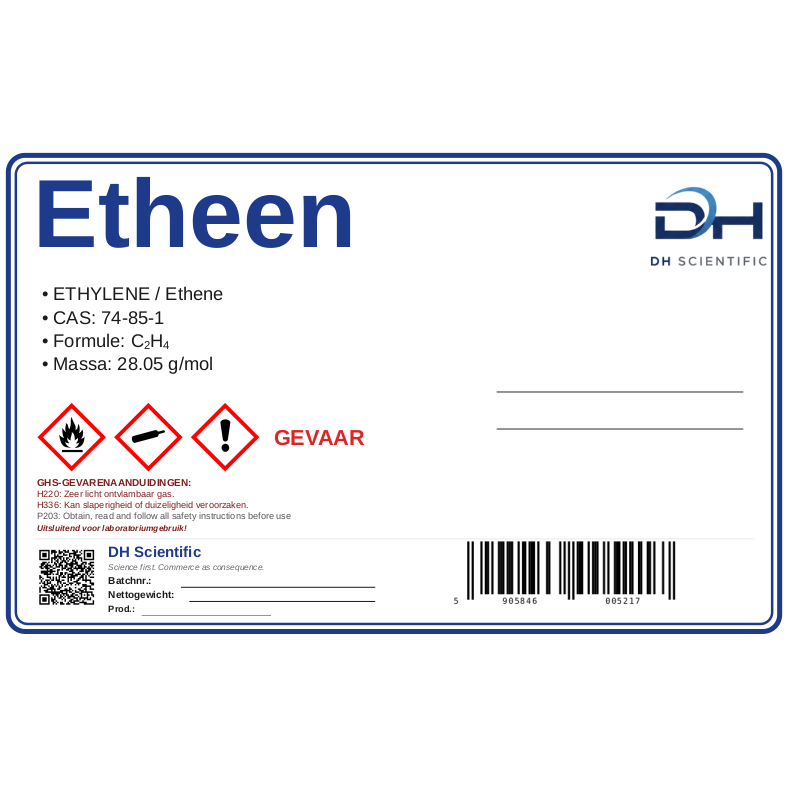
H220 — Zeer licht ontvlambaar gas.
H336 — Kan slaperigheid of duizeligheid veroorzaken.
🛡 Voorzorgsmaatregelen (P)
P203 — Vóór gebruik alle veiligheidsinstructies raadplegen, lezen en opvolgen.
✓ Geharmoniseerde indeling overeenkomstig bijlage VI bij de CLP-verordening (EG) 1272/2008 (officiële, bindende indeling). Indexnummer: 601-010-00-3.
Referentie (Chicago): European Chemicals Agency. "ethylene, Index No. 601-010-00-3." In Table 3 of Annex VI to Regulation (EC) No 1272/2008 (CLP Regulation), 23rd Adaptation to Technical Progress. Helsinki: European Chemicals Agency, 2026. https://echa.europa.eu/information-on-chemicals/annex-vi-to-clp.
⚠ IARC — Groep 3:
niet in te delen wat betreft kankerverwekkendheid voor de mens (beoordeeld door IARC).
(Onafhankelijke beoordeling van het bewijs voor kankerverwekkendheid door IARC/WHO — vult de bovenstaande CLP-indeling aan.)
Referentie (Chicago): IARC. 2026. IARC Monographs on the Identification of Carcinogenic Hazards to Humans: CAS 74-85-1. Lyon, France: International Agency for Research on Cancer, World Health Organization. https://monographs.iarc.who.int/list-of-classifications/. (Accessed 2026-11-12.)
Indeling uit de lokale MOL-GOD-lijst (snapshot) — niet geverifieerd tegen de actuele IARC-lijst. Verifiëren
Vertalingen: CLP-verordening (EG) 1272/2008, Bijlage III en IV. Gegevens: PubChem/NLM.
☢️ Toxicologische gegevens (IARC + EPA CTX)
🧬 IARC-classificatie van carcinogeniteit
IARC-classificatie:
Groep 3 [2,6]
Classificatie uit een lokale MOL-GOD-snapshot — niet geverifieerd tegen de actuele IARC-lijst (verifiëren).
🌍 Ecotoxicology & environmental fate (SDS sec. 8/12)
ℹ️ GHS-meldingen van leveranciers (zelfclassificatie — niet-bindend)
De onderstaande codes zijn aanvullende zelfclassificaties van leveranciers (zelfclassificatie, ECHA C&L-/PubChem-meldingen) — een aanvulling op de hierboven vermelde bindende geharmoniseerde classificatie van bijlage VI; ze kunnen overtollig zijn.
Hoogst gemelde waarschuwingssignaal: Danger
(volgens opgaven van kennisgevers, niet bindend)
International Agency for Research on Cancer (IARC). 2024. "IARC Monographs on the Identification of Carcinogenic Hazards to Humans." Lyon: IARC. 🔗
U.S. EPA. 2024. "ECOTOX Knowledgebase." Washington, DC: U.S. Environmental Protection Agency. 🔗
ECHA. 2024. "Chemical Safety Assessment." European Chemicals Agency. 🔗
U.S. National Toxicology Program. 2024. Report on Carcinogens. 15th ed. Research Triangle Park, NC: National Institute of Environmental Health Sciences. 🔗
GESTIS. 2024. "GESTIS Substance Database." Institute for Occupational Safety and Health of the German Social Accident Insurance (DGUV). 🔗
U.S. EPA. 2024. "CompTox Chemicals Dashboard." Washington, DC: U.S. Environmental Protection Agency. 🔗
ECHA. 2023. "Regulation (EC) No 1272/2008 on Classification, Labelling and Packaging of Substances and Mixtures (CLP), Annex VI — Harmonised Classification." European Chemicals Agency. 🔗
Leist, Marcel, et al. 2014. "Consensus Report on the Future of Animal-Free Systemic Toxicity Testing." ALTEX 31 (3): 341–356. [DOI]
Hartung, Thomas. 2009. "Toxicology for the Twenty-First Century." Nature 460 (7252): 208–212. [DOI]
Lenga, Robert E., ed. 2008. The Sigma-Aldrich Library of Chemical Safety Data. 2nd ed. Milwaukee: Sigma-Aldrich.
Slikker, William Jr., et al. 2004. "Dose-Dependent Terminal and Tissue Residues After Chronic Exposure." Toxicological Sciences 81 (2): 253–279. [DOI]
Calabrese, Edward J., and Linda A. Baldwin. 2003. "Toxicology Rethinks Its Central Belief." Nature 421 (6924): 691–692. [DOI]
Hodge, Harold C., and J. Harvey Sterner. 1949. "Tabulation of Toxicity Classes." American Industrial Hygiene Association Quarterly 10 (4): 93–96. [DOI]
🚨 Noodprocedure — morsen van chemicaliënOntvlambaar
CAS 74-85-1GHS:H220H336💨 Ventilatie
🥽 PPE — Persoonlijke beschermingsmiddelen
Handschoenen:chemisch bestendig (selectie volgens SDS sectie 8)
Veiligheidsbril:Ja
Overall:antistatische kleding
📦 Kleine morsing (<1L) — absorptiemiddel: niet-brandbaar absorptiemiddel (vermiculiet, diatomeeënaarde)
⚠️ GENERIEKE procedure afgeleid van de GHS-classificatie (geen gecureerde gegevens voor deze CAS). Volg altijd het actuele veiligheidsinformatieblad (SDS) van de leverancier.
1. Verwijder ontstekingsbronnen; geen vonken of open vuur toegestaan.
2. Ventileer om dampen te verspreiden; gebruik geaard, vonkvrij gereedschap.
3. Bestrooi met een niet-brandbaar absorptiemiddel; verzamel in een geventileerde / UN-container.
4. Was het gebied met water; behandel resten en absorptiemiddel als gevaarlijk afval.
Aanvullende eigenschappen uit GHS:
• irriterend — vermijd contact met huid/ogen en inademing van stof
🛢️ Grote morsing (>1L) ⚠️ Gevaarlijk materiaal
1. Evacueer; elimineer alle ontstekingsbronnen, controleer de dampconcentratie (LEL).
2. Volledige antistatische PPE; vonkvrije apparatuur. Blussen: schuim/poeder/CO2 — GEEN waterstraal.
3. Verzamel mechanisch in een geëtiketteerde UN-container; overhandig aan een erkend bedrijf (Poolse afvaldatabase, BDO).
4. Meld het incident volgens de veiligheidsprocedure; bij vrijkomen in het milieu, meld aan WIOŚ.
🩹 Eerste hulp
🧴 Huid
1. Trek verontreinigde kleding uit.
2. Spoel de huid met veel water gedurende ≥15 min.
👁️ Ogen
1. Spoel met water ≥15 min, oogleden opengehouden; verwijder contactlenzen.
2. Oogarts bij aanhoudende irritatie.
🫁 Inademing
1. Breng in de frisse lucht, in een comfortabele houding.
2. Bij ademnood — zuurstof / arts.
🍽️ Inslikken
1. Spoel de mond met water; wek GEEN braken op.
2. Antigifcentrum: +48 42 631 47 24.
🌍 Milieu:
Water: Gemiddeld; Bodem: Laag; ❌ Niet in de riolering laten komen; Afvalcode: 16 05 06*
European Chemicals Agency (ECHA). 2020. Guidance on the Compilation of Safety Data Sheets — Section 6: Accidental Release Measures. ECHA.
[link ↗]
European Parliament and Council. 2008. Regulation (EC) No 1272/2008 (CLP) — Hazard classes and H-statements. Official Journal of the European Union L 353.
[link ↗]
National Institute for Occupational Safety and Health (NIOSH). 2023. Pocket Guide to Chemical Hazards — NIOSH Pocket Guide to Chemical Hazards. CDC.
[link ↗]
U.S. Occupational Safety and Health Administration. 2024. 29 CFR 1910.120 — Hazardous Waste Operations and Emergency Response (HAZWOPER). U.S. Code of Federal Regulations.
[link ↗]
National Fire Protection Association. 2018. NFPA 472: Standard for Competence of Responders to Hazardous Materials/Weapons of Mass Destruction Incidents. NFPA.
[link ↗]
European Parliament and Council. 2012. Directive 2012/18/EU on the Control of Major-Accident Hazards Involving Dangerous Substances (Seveso III). Official Journal of the European Union L 197: 1–37.
[link ↗]
U.S. National Institute for Occupational Safety and Health. 2024. NIOSH Pocket Guide to Chemical Hazards. Centers for Disease Control and Prevention.
[link ↗]
European Chemicals Agency. 2020. Guidance on the Compilation of Safety Data Sheets (SDS), Version 3.1. ECHA.
[link ↗]
Bronnen: GHS/CLP-classificatie (PubChem/SDS) — generieke fallback · ECHA Guidance on SDS (sectie 6) · NIOSH Pocket Guide.
Indicatieve gegevens — volg in een noodsituatie altijd de instructies van de leverancier + de lokale arbo- en veiligheidsvoorschriften.
European Committee for Standardization (CEN). 2016. EN 374-1:2016 — Protective gloves against dangerous chemicals and micro-organisms — Part 1: Terminology and performance requirements for chemical risks. CEN, Brussels. EN 374-1:2016. [link ↗] — Classificatie van chemisch bestendige handschoenen type A/B/C; JKLPT-permeatietests
European Committee for Standardization (CEN). 2001. EN 166:2001 — Personal eye-protection — Specifications. CEN, Brussels. EN 166:2001. [link ↗] — Markeringen: B = middelhoge stootenergie, T = extreme temperaturen, 9 = gesmolten metalen en hete vaste stoffen
European Committee for Standardization (CEN). 2009. EN 14605:2005+A1:2009 — Protective clothing against liquid chemicals — Performance requirements for clothing with liquid-tight (Type 3) or spray-tight (Type 4) connections. CEN, Brussels. EN 14605:2009. [link ↗] — Type 3 (jet-tight) en Type 4 (spray-tight) bescherming tegen vloeibare chemicaliën
National Institute for Occupational Safety and Health (NIOSH). 2017. Recommendations for Chemical Protective Clothing: A Companion to the NIOSH Pocket Guide. U.S. Department of Health & Human Services / CDC. [link ↗] — Praktische gids voor de keuze van CPC (chemische beschermkleding) per stof en blootstellingsscenario
Occupational Safety and Health Administration (OSHA). 2011. Personal Protective Equipment — General requirements. U.S. Department of Labor — 29 CFR 1910.132. 29 CFR 1910.132. [link ↗] — De werkgever moet PBM + training + een schriftelijk gedocumenteerde risicobeoordeling verstrekken
♻️ Verwijdering van chemisch afval (BDO)Ontvlambaar⚠️ BDO vereist
📋 EWC-code (Europese Afvalcatalogus): 16 05 06*Laboratorium- en analysechemicaliën (reagentia) die gevaarlijke stoffen bevatten
Een code met een asterisk (*) = gevaarlijk afval dat BDO-registratie + een transportprotocol (Afvaloverdrachtskaart) vereist.
🌍Gevaar voor het milieu:
NEE
💧Risico op waterverontreiniging:
JA
🌱Risico op bodemverontreiniging:
NEE
🚫NIET in de riolering:
JA
🚛HAZMAT-transport (ADR):
JA
🏭 Tot verwijdering bevoegde bedrijven (BDO) — 8 van 8 in totaal
📋 Volledige BDO-lijst:bdo.mos.gov.pl ↗
— officieel register van het Ministerie van Klimaat en Milieu. Afvaloverdrachtskaart (KPO):BDO-sjabloon
verplicht voor elke levering van gevaarlijk afval.
European Commission. 2014. Commission Decision 2014/955/EU on the list of waste pursuant to Directive 2008/98/EC. Official Journal of the European Union. Decyzja 2014/955/UE. [link ↗] — European List of Waste (LoW) — 6-cijferige EWC-codes + asterisk voor gevaarlijk
Ministerstwo Klimatu i Środowiska Rzeczypospolitej Polskiej. 2020. Rozporządzenie Ministra Klimatu z dnia 2 stycznia 2020 r. w sprawie katalogu odpadów. Dziennik Ustaw RP 2020 poz. 10. [link ↗] — Poolse afvalcatalogus — uitvoering van Besluit 2014/955/EU
Główny Inspektorat Ochrony Środowiska (GIOŚ). 2024. Baza Danych O Odpadach (BDO) — System rejestracji firm utylizacyjnych. Ministerstwo Klimatu i Środowiska. [link ↗] — Centraal BDO-register — volledige lijst van bedrijven met vergunning voor afvalbeheer
Polska — Sejm RP. 2012. Ustawa z dnia 14 grudnia 2012 r. o odpadach. Dz.U. 2013 poz. 21 (z późn. zm.). [link ↗] — Nationale wet — definieert de verplichtingen van de afvalproducent + BDO-registratie
Furr, A. Keith, ed.. 2000. CRC Handbook of Laboratory Safety. CRC Press. — Classificatie van laboratoriumafval + scheidingsprocedures (hoofdstuk Waste Management); EN 374:2013 handschoennormen voor personen die gevaarlijk afval hanteren.
Pohanish, Richard P.. 2017. Sittig's Handbook of Toxic and Hazardous Chemicals and Carcinogens. Elsevier. — Afvalclassificatie per CAS + onverenigbaarheden — invoer voor de EWC-mapping.
Lewis, Richard J.. 2012. Sax's Dangerous Properties of Industrial Materials. Wiley. — Reactiviteit + opslagcompatibiliteit van afval (oxidatoren vs brandbare stoffen — gescheiden stromen).
NIOSH. 2024. Pocket Guide to Chemical Hazards. U.S. Department of Health and Human Services. [link ↗] — PEL/REL/IDLH per CAS — basis voor de vereiste PBM bij afvaltransport (KPO).
OSHA. 2024. Occupational Chemical Database — Hazardous Waste Operations (HAZWOPER). Occupational Safety and Health Administration. [link ↗] — 29 CFR 1910.120 — trainingen + PBM voor de omgang met gevaarlijk afval.
European Parliament and Council. 2008. Directive 2008/98/EC on waste (Waste Framework Directive). Official Journal of the European Union L 312/3. [link ↗] — Afvalbeheerhiërarchie (preventie → nuttige toepassing → verwijdering); definieert "gevaarlijk afval".
European Parliament and Council. 2009. Regulation (EC) No 1272/2008 (CLP) on classification, labelling and packaging of substances and mixtures. Official Journal of the European Union L 353. [link ↗] — CLP-classificatie van H-zinnen → mapping naar EWC * (asterisk = gevaarlijk).
United Nations Economic Commission for Europe (UNECE). 2023. European Agreement concerning the International Carriage of Dangerous Goods by Road (ADR 2025). UNECE. [link ↗] — ADR — eisen voor het transport van gevaarlijk afval (KPO + UN-nummer + klassen 1–9).
IPCS INCHEM. 2024. International Programme on Chemical Safety — Waste Management Guidelines. WHO/UNEP/ILO. [link ↗] — Internationale richtlijnen voor neutralisatie + verwijdering per CAS.
European Parliament and Council. 2006. Regulation (EC) No 1013/2006 on Shipments of Waste. Official Journal of the European Union L 190: 1–98. [link ↗] — Grensoverschrijdende overbrenging van gevaarlijk afval — kennisgevings- + toestemmingseisen vóór export
ℹ️ Checklist van regelgevende verplichtingen voor CAS 74-85-1.
Status gebaseerd op: ADR 2023 (Tabel A), REACH Bijlage XVII, CLP Bijlage VI (geharmoniseerde indeling), hazard class uit m14-spill DB, SVHC, GIS en MAC PL. Principe: geen gegevens = geen bewering (wij verklaren NIET 'geen beperkingen' zonder basis).
Hoe te voldoen: VOLDAAN — veiligheidsinformatieblad v13 (PL) beschikbaar om te downloaden op deze pagina.Vereiste: actueel SDS conform Verord. 1907/2006 (REACH) bijlage II, formaat met 16 rubrieken.
Rechtsgrondslag: Rozporządzenie (WE) 1907/2006 (REACH) Art. 31 + Aneks II
Hoe te voldoen: Het etiket moet bevatten: GHS-pictogrammen, het signaalwoord (Gevaar/Waarschuwing), gevarenaanduidingen (H) en voorzorgsmaatregelen (P), gegevens van de fabrikant. Verplicht sinds 2010 (stoffen) en 2015 (mengsels). Voor deze stof geldt een GEHARMONISEERDE INDELING (CLP bijlage VI) — zie hieronder; deze heeft voorrang op zelfindeling.
Hoe te voldoen: Laboratoriumpersoneel: initiële opleiding (algemene introductie + functiegebonden) + herhalingsopleiding elke 5 jaar (of elke 3 jaar voor ingenieurs-/technische functies). Documentatie bewaard in het personeelsdossier.
Hoe te voldoen: BDO-registratie is verplicht voor producenten van gevaarlijk afval. Voor elke levering is een afvaloverdrachtskaart (KPO) vereist. Jaarverslag uiterlijk 15 maart van het volgende jaar.
Rechtsgrondslag: Ustawa z 14 grudnia 2012 r. o odpadach (Dz.U. 2013 poz. 21)
Hoe te voldoen: Geen ADR-gegevens in de MOL-GOD-dataset voor dit CAS-nummer. Ga er NIET van uit dat er geen beperkingen zijn — verifieer vóór verzending de vervoersindeling in ADR 2023 (Tabel A) en in rubriek 14 van het veiligheidsinformatieblad (SDS).
Rechtsgrondslag: Umowa europejska ADR 2025 + Ustawa z 19 sierpnia 2011 r. o przewozie towarów niebezpiecznych
Hoe te voldoen: Importeurs/fabrikanten van ≥1 ton/jaar moeten de stof bij ECHA registreren (technisch dossier + Chemical Safety Report bij ≥10 t). Raadpleeg de ECHA Annex VI / registered substances list.
⚪REACH Bijlage XVII (beperkingen voor gebruik/marketing)niet van toepassing
Hoe te voldoen: Zweryfikowano wobec klasyfikacji zharmonizowanej (CLP Załącznik VI): substancja NIE ma klasyfikacji CMR kat. 1A/1B, więc NIE podlega ogólnemu zakazowi sprzedaży ogółowi społeczeństwa z poz. 28–30 Załącznika XVII. UWAGA: szczegółowe (nie-CMR) pozycje Załącznika XVII nie są objęte zbiorem MOL-GOD (zbiór niepełny) — przy wątpliwości sprawdź skonsolidowany Załącznik XVII na stronach ECHA.
Rechtsgrondslag: Rozporządzenie (WE) 1907/2006 (REACH) Załącznik XVII — ograniczenia produkcji/obrotu/stosowania
❓MAC — Maximale Aanvaardbare Concentratie in de werkomgevingte verifiëren
Hoe te voldoen: Geen MAC-gegevens in de MOL-GOD-verzameling (onvolledige verzameling — ~41 van ~600 stoffen op de lijst). Afwezigheid betekent GEEN afwezigheid van MAC — raadpleeg de volledige lijst Pb. 2024 pos. 1017 (Regeling MRiPS van 4 september 2024), en bij afwezigheid pas OEL uit EU-richtlijnen of aanbevolen door NIOSH/ACGIH toe.
Rechtsgrondslag: Rozp. MRiPS z 4 września 2024 r. (Dz.U. 2024 poz. 1017) — NDS i NDSCh
⚪GIS-register (precursoren / psychotropica)niet van toepassing
Hoe te voldoen: Niet opgenomen in de beschikbare werkverzameling van precursoren (onvolledige lijst). Afwezigheid is GEEN bevestiging — verifieer aan de hand van bijlage I van Verordening (EG) 273/2004 en de GIS-lijst vóór het in de handel brengen.
Rechtsgrondslag: Rozp. (WE) 273/2004 + Ustawa o przeciwdziałaniu narkomanii (Dz.U. 2005 nr 179 poz. 1485)
Hoe te voldoen: VOLDAAN — informatieblad in het Pools (v13) beschikbaar op deze pagina.Vereiste: SDS in het Pools voor handel in PL (Art. 31 REACH + Chemische Stoffenwet Art. 17).
Rechtsgrondslag: Ustawa z 25 lutego 2011 r. o substancjach chemicznych i ich mieszaninach (Dz.U. 2011 nr 63 poz. 322)
European Parliament and Council. 2008. Regulation (EC) No 1272/2008 on classification, labelling and packaging of substances and mixtures (CLP). Official Journal of the European Union L 353/1. CLP Regulation 1272/2008. [link ↗] — Indeling, etikettering en verpakking van stoffen + mengsels (GHS-implementatie in de EU)
European Parliament and Council. 2006. Regulation (EC) No 1907/2006 concerning the Registration, Evaluation, Authorisation and Restriction of Chemicals (REACH). Official Journal of the European Union L 396/1. REACH Regulation 1907/2006. [link ↗] — REACH — registratie, beoordeling en autorisatie van chemische stoffen; SVHC; SDS bijlage II
Ministerstwo Rodziny i Polityki Społecznej Rzeczypospolitej Polskiej. 2024. Rozporządzenie Ministra Rodziny i Polityki Społecznej z dnia 4 września 2024 r. w sprawie najwyższych dopuszczalnych stężeń i natężeń czynników szkodliwych dla zdrowia w środowisku pracy. Dziennik Ustaw RP 2024 poz. 1017. [link ↗] — MAC en MACpiek voor ~600 chemische stoffen — actuele Poolse beroepsblootstellingslimieten
United Nations Economic Commission for Europe (UNECE). 2023. European Agreement concerning the International Carriage of Dangerous Goods by Road (ADR), 2025 Edition. United Nations, Geneva. ADR 2025. [link ↗] — Internationale overeenkomst inzake het wegvervoer van gevaarlijke goederen — UN-nummers, klassen, verpakkingen
📚 Geconsolideerde wetenschappelijke referenties — Chicago Author-Date 10 bronnen
Referenties verzameld uit alle tabbladen van de Safety Hub. CAS: 74-85-1 ·
PubChem ↗
Parlament Europejski i Rada UE. 2008. "Rozporządzenie (WE) nr 1272/2008 w sprawie klasyfikacji, oznakowania i pakowania substancji (CLP)." Dz.Urz. UE L 353. [↗]
GHS, Regelgeving
United Nations Economic Commission for Europe (UNECE). 2021. "Globally Harmonized System of Classification and Labelling of Chemicals (GHS), Ninth Revised Edition." United Nations, Geneva. [↗]
GHS
Goldfrank, Lewis R., Robert S. Hoffman, Mary Ann Howland, et al.. 2019. "Goldfrank's Toxicologic Emergencies, 11th ed.." McGraw-Hill Education, New York. ISBN 978-1-25-985961-8.
Pierwsza pomoc, Toksykologia
National Institute for Occupational Safety and Health (NIOSH). 2023. "NIOSH Pocket Guide to Chemical Hazards (DHHS Publ. 2005-149)." U.S. Department of Health and Human Services / CDC, Cincinnati, OH. [↗]
Pierwsza pomoc, PPE, Toksykologia
European Committee for Standardization (CEN). 2016. "EN 374-1:2016 — Protective gloves against dangerous chemicals and micro-organisms." CEN, Brussels. [↗]
PPE
UNECE. 2023. "European Agreement Concerning the International Carriage of Dangerous Goods by Road (ADR 2025)." United Nations, Geneva. [↗]
Utylizacja, Regulacje
National Fire Protection Association (NFPA). 2022. "NFPA 400 — Hazardous Materials Code." NFPA, Quincy, MA. [↗]
Magazynowanie
Urben, P.G. (ed.). 2017. "Bretherick's Handbook of Reactive Chemical Hazards, 8th ed.." Butterworth-Heinemann / Elsevier, Oxford. [↗]
Magazynowanie
Ministerstwo Klimatu i Środowiska RP. 2023. "Baza danych o produktach i opakowaniach oraz o gospodarce odpadami (BDO)." Ministerstwo Klimatu i Środowiska, Warszawa. [↗]
Utylizacja
International Agency for Research on Cancer (IARC / WHO). 2024. "IARC Monographs on the Identification of Carcinogenic Hazards to Humans — List of Classifications." WHO, Lyon. [↗]
Toksykologia
Tabbladen met eigen referenties (Emergency, PPE, Storage, Waste) bevatten aanvullende bibliografische vermeldingen binnen hun respectieve secties.
Plak een reeks herhaalde metingen (CSV of één getal per regel). De calculator berekent het gemiddelde, de standaardafwijking en 95% CI, en detecteert uitschieters (Grubbs + Dixon Q).
Scheidingsteken: komma, spatie, tab, nieuwe regel. Minimaal 3 metingen.
📐 Statistische formules
x̄ = Σxᵢ / n — rekenkundig gemiddelde
s² = Σ(xᵢ - x̄)² / (n-1) — steekproefvariantie
s = √s² — standaardafwijking
RSD% = (s / x̄) × 100% — relatieve standaardafwijking
Bron: ICH Q2(R2) Validation of Analytical Procedures ·
ICH PDF ↗
🔬 HPLC/GC-methoden (3 metod)
📄
Identification of Phenolic Compounds in the Invasive Plants Staghorn Sumac and Himalayan Balsam: Impact of Time and Solvent on the Extraction of Phenolics and Extract Evaluation on Germination Inhibition
Fase: mobile phases were used to separate the phenolic compounds: A (0
Detectie: UV 530 nm
Debiet: 0.60 mL/min
Temp.: 20.0 °C
Inj.: 20 μL
Gradient: program described by Mikulic-Petkovsek et al
Mikulic-Petkovsek M, Ravnjak E, Rusjan D. Identification of Phenolic Compounds in the Invasive Plants Staghorn Sumac and Himalayan Balsam: Impact of Time and Solvent on the Extraction of Phenolics and Extract Evaluation on Germination Inhibition. Plants. 2024;13:3339. doi:10.3390/plants13233339
An HPLC-MS-DAD analysis of phenolic compounds was carried out on the extracts of staghorn sumac (Rhus typhina L.) and Himalayan balsam (Impatiens glandulifera Royle). This study focuses on the influence of solvent type and extraction time on the phenolic extraction efficiency from both invasive plants. Methanol extraction resulted in a 4.2 times higher content of hydroxybenzoic acids, a 3.7 times higher content of hydroxycinnamic acids, a 3.2 times higher content of flavanols, a 9.6 times higher content of flavanones, and an 8.7 times higher content of flavonols in the Himalayan balsam extract compared to aqueous extraction. Anthocyanins were only detected in the alcohol-based extraction. In comparison, the aqueous extraction from staghorn sumac resulted in a higher yield of total hydroxybenzoic acids, hydroxycinnamic acids, and flavonols, while the methanol extraction resulted in a 1.4-fold lower total polyphenolic content compared to the aqueous extraction. The type of solvent had no significant effect on the total content of flavanols in staghorn sumac. Extraction time considerably affected the total phenolic content in both plant extracts. After 84 h of extraction, the staghorn sumac extract showed a 3.5-fold increase in the total phenolic content compared to the initial measurement. In contrast, the Himalayan balsam extract showed a 40% decrease in the total phenolic content after 84 h. The Himalayan balsam extract reduced the germination of perennial ryegrass seeds by 55%, while the staghorn sumac extract reduced it by 80%. Both extracts also inhibited shoot and root growth of perennial ryegrass, although the Himalayan balsam extract at a concentration of 0.125 g/mL stimulated root growth of perennial ryegrass. The strategic use of invasive alien plants could be an effective approach to control their spread in the environment, potentially reducing management costs. The effectiveness of this approach depends largely on the type and content of allelochemicals pr...
Standardization of Juniperus macrocarpa Sibt. & Sm. and Juniperus excelsa M. Bieb. Extracts with Carbohydrate Digestive Enzyme Inhibitory and Antioxidant Activities
HPLCIranian Journal of Pharmaceutical Research202190% ✓CC-BYResearch method (specificity, robustness)
Kolom: CN, 5 μm
Fase: mobile phase contained 10% solvent A (acetonitrile:water: formic acid, 50:50:0
Detectie: UV 735 nm
Debiet: 1.00 mL/min
Temp.: 25.0 °C
Inj.: 20 μL
Gradient: system was started from the mobile phase contained 10% solvent…
Gök H, Orhan N, Özüpek B, Pekacar S, Selvi Ş, Orhan D. Standardization of Juniperus macrocarpa Sibt. & Sm. and Juniperus excelsa M. Bieb. Extracts with Carbohydrate Digestive Enzyme Inhibitory and Antioxidant Activities. Iranian Journal of Pharmaceutical Research : IJPR. 2021;20:441-455. doi:10.22037/ijpr.2021.114838.15055
Juniperus species growing in Turkey are used for various medicinal purposes in traditional folk medicine. We aimed to evaluate in-vitro antidiabetic (α-glucosidase and α-amylase inhibition assays), antiobesity (pancreatic lipase inhibition assay), and antioxidant (ABTS and DPPH radical scavenging activities, ferric reducing activity, metal chelating activity, and phosphomolybdenum assay) activities of the extracts obtained from branches, leaves, and fruits of Juniperus macrocarpa and Juniperus excelsa. The branch (IC50 = 67.1 ± 1.7 µg/mL) and leaf ethyl acetate extracts (IC50 = 83.4 ± 0.8 µg/mL) of J. macrocarpa exhibited the strongest activity on the α-glucosidase enzyme. Besides that, J. excelsa leaf methanol extract exerted remarkable α-amylase inhibitory activity (IC50 = 950.1 ± 3.5 µg/mL). Only J. macrocarpa branch and J. excelsa leaf ethyl acetate extract slightly inhibited pancreatic lipase enzyme with 2963.3 ± 736.4 and 2343 ± 557.8 µg/mL IC50 values, respectively. The RP-HPLC-DAD analysis results demonstrated that the more active J. macrocarpa extracts are richer in agathisflavone, amentoflavone, and umbelliferone than J. excelsa extracts. With this study, it is concluded that J. macrocarpa branch and leaf ethyl acetate extracts may be a new source of α-glucosidase enzyme inhibitory activity and agathisflavone, amentoflavone can be used in the standardization of the extracts.
Phytochemical Characterization of Saudi Mint and Its Mediating Effect on the Production of Silver Nanoparticles and Its Antimicrobial and Antioxidant Activities
Fase: mobile phase, two buffers were used: buffer A (military Q water and…
Detectie: UV 280 nm
Debiet: 0.90 mL/min
Temp.: 30.0 °C
Inj.: 5 μL
Qanash H, Bazaid A, Binsaleh N, Alharbi B, Alshammari N, Qahl S, et al. Phytochemical Characterization of Saudi Mint and Its Mediating Effect on the Production of Silver Nanoparticles and Its Antimicrobial and Antioxidant Activities. Plants. 2023;12:2177. doi:10.3390/plants12112177
The green synthesis of nanoparticles (NPs) is attracting enormous attention as a new area of study that encompasses the development and discovery of new agents for their utilization in different fields, such as pharmaceuticals and food. Nowadays, the use of plants, particularly medicinal plants, for the creation of NPs has emerged as a safe, ecofriendly, rapid, and simple approach. Therefore, the present study aimed to use the Saudi mint plant as a medicinal plant for the synthesis of silver nanoparticles (AgNPs) and to evaluate the antimicrobial and antioxidant activities of AgNPs compared to mint extract (ME). A phenolic and flavonoid analysis that was conducted by using HPLC indicated the presence of numerous compounds in the ME. Through an HPLC analysis, chlorogenic acid at a concentration of 7144.66 µg/mL was the main detected component in the ME, while catechin, gallic acid, naringenin, ellagic acid, rutin, daidzein, cinnamic acid, and hesperetin were identified in varying concentrations. AgNPs were synthesized by using ME and were confirmed via UV–visible spectroscopy at 412 nm of the maximum absorption. The mean diameter of the synthesized AgNPs was measured by TEM to be 17.77 nm. Spectra obtained by using energy-dispersive X-ray spectroscopy indicated that silver was the main element formation in the created AgNPs. The presence of various functional groups, analyzed by using Fourier transform infrared spectroscopy (FTIR), indicated that the mint extract was responsible for reducing Ag+ to Ag0. The spherical structure of the synthesized AgNPs was confirmed by X-ray diffraction (XRD). Furthermore, the ME showed reduced antimicrobial activity (a zone of inhibition of 30, 24, 27, 29, and 22 mm) compared with the synthesized AgNPs (a zone of inhibition of 33, 25, 30, 32, 32, and 27 mm) against B. subtilis, E. faecalis, E. coli, P. vulgaris, and C. albicans, respectively. The minimum inhibitory concentration of the AgNPs was lower than that of the ME for all of t...
Saudi mintplant natural productsilver nanoparticles (AgNPs)antimicrobialantioxidant
📈 Methodevalidatie (ICH Q2)
Geen validatiegegevens. Neem contact op met de auteur van de methode.
📊 Validatie van de HPLC-methode (ICH Q2(R1))PARTIAL
3 metrics need experimental data
Parameter
Waarde
Eenheid
ICH Q2-criterium
Status
Lineariteit (R²)
geen gegevens
unitless
R² ≥ 0.999 (≥0.99 voor bioanalytische methoden)
—
LOD (S/N = 3:1)
geen gegevens
ng/mL
S/N ≥ 3:1 (laagste detecteerbare concentratie)
—
LOQ (S/N = 10:1)
geen gegevens
ng/mL
S/N ≥ 10:1 (LOQ ≥ 3×LOD doorgaans)
—
Precisie (RSD intraday, n=6)
geen gegevens
% RSD
RSD ≤ 2% (intraday) / ≤ 3% (interday) voor de API
—
Juistheid (recovery, 3 niveaus)
geen gegevens
% (target 100±2%)
Recovery 98-102% (target 100%)
—
Lineariteitsbereik
geen gegevens
bijv. 0.1-100 ng/mL
Min. 80-120% van de nominale concentratie
—
Selectiviteit/Specificiteit
geen gegevens
qualitative
Geen interferentie — analytpiek volledig gescheiden (Rs ≥ 2.0)
—
Robuustheid (robustness)
geen gegevens
RSD < 2% bij ±5% variatie
RSD < 2% bij kleine parametervariaties
—
Legend:✓ PASS⚠ CAUTION✗ FAIL— NO_DATA
📚 Wetenschappelijke referenties (Chicago Author-Date) — klik om uit te klappen
Standaarden voor validatie van analytische methoden — 4 onafhankelijke bronnen (ICH + USP + AOAC + Snyder).
International Conference on Harmonisation (ICH). 2005. Validation of Analytical Procedures: Text and Methodology Q2(R1). ICH Expert Working Group. [link ↗] — Gold-standard ICH guideline — accepted by EMA, FDA, MHLW, NMPA
United States Pharmacopeia (USP) Convention. 2024. USP General Chapter <621> Chromatography. USP-NF 2024 ed. USP. [link ↗]
AOAC International. 2016. Appendix F: Guidelines for Standard Method Performance Requirements. AOAC INTERNATIONAL. [link ↗] — AOAC SMPR — alternative to ICH Q2 for food/dietary supplements
Snyder, Lloyd R., Joseph J. Kirkland, and John W. Dolan. 2010. Introduction to Modern Liquid Chromatography. 3rd ed. John Wiley & Sons. ISBN 978-0-470-16754-0. https://doi.org/10.1002/9780470508183 [link ↗] — Industry standard textbook — Chapter 11 covers method validation
Snyder, L. R., J. J. Kirkland, and J. L. Glajch. 1997. Practical HPLC Method Development. 2nd ed. Wiley. ISBN 978-0-471-00703-6. — Classic method-development reference (DryLab heritage).
Rozet, Eric, et al.. 2013. Analysis of recent pharmaceutical regulatory documents on analytical method validation. https://doi.org/10.1016/j.chroma.2007.03.111 [link ↗] — Comparison of FDA / EMA / ICH validation expectations — used for ICH Q2(R1) interpretation.
Heyden, Yvan Vander, et al.. 2009. Robustness of pharmaceutical liquid chromatographic methods. https://doi.org/10.1016/j.jchromb.2008.10.052 [link ↗] — Plackett-Burman design for robustness — basis of ICH Q2 §3.7.
Dong, Michael W.. 2019. HPLC and UHPLC for Practicing Scientists. 2nd ed. Wiley. ISBN 978-1-119-31378-3. https://doi.org/10.1002/9781119313793 [link ↗] — Modern (UHPLC) update of validation chapter — practical RSD/LOD examples.
Meyer, Veronika R.. 2010. Practical High-Performance Liquid Chromatography. 5th ed. Wiley. ISBN 978-0-470-68218-0. — European pharmacopeial perspective — complements USP/AOAC.
Kazakevich, Yuri V., and Rosario LoBrutto, eds.. 2007. HPLC for Pharmaceutical Scientists. Wiley-Interscience. ISBN 978-0-471-68162-4. https://doi.org/10.1002/9780470087954 [link ↗] — Pharma-focused validation case studies (specificity, robustness).
European Medicines Agency (EMA). 2011. Guideline on bioanalytical method validation EMEA/CHMP/EWP/192217/2009. EMA Committee for Medicinal Products for Human Use. [link ↗] — EMA bioanalytical companion to ICH Q2(R1) for clinical samples.
Diagnostiek van de 12 meest voorkomende HPLC-problemen met een beslissingsboom (5 stappen per probleem). Bron: Snyder/Kirkland/Dolan 3rd ed. Chapter 17 + LCGC LC Troubleshooting columns 1989-2024.
Verbrede pieken (broad peaks) medium
Symptoom: Alle pieken op het chromatogram zijn breder dan verwacht (FWHM > 2× normaal)
🔍 Diagnostische boom:
1. Controleer of alle pieken verbreed zijn of slechts sommige → JA: Alle → instrumenteel probleem (kolom of systeem) → NEE: Slechts sommige → chemisch probleem (interactie met de kolom voor specifieke analyten)
2. Verwissel met een testkolom — verdwijnt het probleem? → JA: KOLOM versleten — packing beschadigd, void in de eerste mm. Vervang hem. → NEE: Probleem in het LC-systeem
3. Controleer het dode volume (dead volume) — injectielus, verbindingen, detector → JA: Lus > 100 µL voor een 4.6 mm kolom of losse verbindingen → vervang de ferrules, kort de leidingen in → NEE: Diagnostiek voortzetten
4. Temperatuurtest: verhoog de kolom van 25°C naar 40°C → JA: Smallere pieken → massatransferkinetiek te traag (verhoog T) → NEE: Continue
5. Controleer het debiet t.o.v. het van Deemter-optimum voor deze kolom → JA: Optimum voor 4.6mm/5µm = 1.0 mL/min, voor 2.1mm/3µm = 0.4 mL/min → NEE: Continue
⚠️ Typische oorzaken:
Kolom versleten (>2000 injecties zonder voorkolom)
Dood volume van het systeem > 100 µL (verkeerde lus, lange leidingen, losse ferrules)
Temperatuur te laag (massatransferkinetiek)
Debiet buiten het van Deemter-optimum
Monsteroplosmiddel sterker dan mobiele fase A
✓ Oplossingen:
✓ Vervang de kolom (bij >2000 injecties)
✓ Controleer alle verbindingen — houd de leidingen zo kort mogelijk
✓ Verhoog de kolomtemperatuur naar 40°C (als de stof stabiel is)
✓ Verlaag het debiet naar het van Deemter-optimum
✓ Los het monster op in mobiele fase A (niet in puur organisch)
Piektailing (tailing, T > 1.5) high
Symptoom: Pieken hebben een verlengde "staart" aan de late-elutiezijde (asymmetrie T = b/a > 1.5 volgens USP)
🔍 Diagnostische boom:
1. Bevat de stof basische groepen (amino, pyridine)? → JA: Ja → silanolinteracties! Voeg 0.1% TFA of 5-10 mM TEA toe aan mobiele fase A. → NEE: Continue
2. Controleer de pH van de mobiele fase t.o.v. de pKa van de stof → JA: pH = pKa ± 1 → gedeeltelijke ionisatie, peak split. Verplaats de pH ≥ 2 eenheden weg van de pKa. → NEE: Continue
3. Controleer de leeftijd van de kolom (>1500 injecties?) → JA: Ja → blootgelegde silanolen (column bleed). Vervang door een kolom met hogere endcapping (XTerra, Symmetry). → NEE: Continue
4. Bevat het monster metalen (Fe, Cu uit glazen flesjes)? → JA: Ja → gebruik kleurloze type II-flesjes of PFA. Voeg 0.1mM EDTA toe aan het monster. → NEE: Continue
⚠️ Typische oorzaken:
Silanolinteracties (basische analyt + vrije silanolen van silicagel)
pH op de grens van de pKa van de analyt (peak split)
Oude kolom (column bleed, hoge silanolactiviteit)
Metalen in het monster (chelatie → tailing)
Kolomoverbelasting (>50 µg op een 4.6mm kolom)
✓ Oplossingen:
✓ Voeg 0.1% TFA (UV) of 0.1% mierenzuur (LC-MS) toe aan mobiele fase A
✓ Kies een kolom met hoogzuivere endcapping: Waters XBridge BEH, Phenomenex Kinetex
✓ Werk bij een pH ≥ 2 eenheden weg van de pKa
✓ 0.1mM EDTA aan het monster (Fe/Cu-chelatie)
✓ Verlaag het injectievolume naar ≤ 20 µL voor een 4.6mm kolom
Basislijndrift (baseline drift) medium
Symptoom: De basislijn stijgt of daalt systematisch gedurende >5 minuten
🔍 Diagnostische boom:
1. Gebruik je een gradiënt (B% neemt toe)? → JA: Ja → verschillende absorptie van fasen A vs B bij dλ. Oplosmiddelwisseling in de UV-cutoff. Controleer de UV-absorptie van het % organisch. → NEE: Verder (isocratisch)
2. Controleer de kolomtemperatuur — is deze stabiel tot ±0.5°C? → JA: Ja (stabiel) → verder → NEE: Instabiel → schakel de kolomthermostaat in (>25°C gecontroleerd)
3. Test: schakel de autosampler uit, laat alleen pomp+kolom+detector draaien → JA: De drift verdwijnt → contaminatie van de autosampler (reinig de naald, het septum) → NEE: Continue
4. Controleer de leeftijd van de lamp (D2 voor UV) → JA: Ja (>1500 uur) → vervang de lamp → NEE: Continue
⚠️ Typische oorzaken:
Gradiëntelutie met verschillende UV-cutoff van de fasen
Instabiele kolomtemperatuur
Autosampler-contaminatie van de naald/septum
UV-lamp oud (>1500h)
Detector-flowcel vervuild
Kolom niet geëquilibreerd (<10 kolomvolumes)
✓ Oplossingen:
✓ Kolom voor-equilibreren gedurende 10-15 kolomvolumes bij 100% A
✓ Kolomthermostaat aan, T 30-40°C stabiel
✓ Reinig de detector-flowcel met een 50:50 ACN:H2O-oplossing
✓ Vervang de D2-lamp indien >1500h
✓ Gebruik baseline subtraction (Chromeleon, native Empower-functie)
Geen piek / verloren piek (no peak) critical
Symptoom: De verwachte analytpiek verschijnt niet op het chromatogram
🔍 Diagnostische boom:
1. Heeft de injectie daadwerkelijk plaatsgevonden? → JA: Controleer het autosampler-log, de pompdruk (moet dalen tijdens de injectie) → NEE: Autosampler-probleem → controleer de loop, de naald, het monster in de vial
2. Zit het monster in de vial (correct volume, niet verdampt)? → JA: Continue → NEE: Geen monster — opnieuw pipetteren
3. Monsterstabiliteit — >24h geleden bereid? → JA: Ja → degradatie. Bereid een vers monster opnieuw. → NEE: Continue
4. Controleer de detectiegolflengte t.o.v. de λmax van de stof → JA: Detectie bij λ komt NIET overeen met λmax → geen signaal. Scan DAD 200-400nm. → NEE: Continue
5. Test: injecteer een zuivere standaard (van bekende concentratie, vers) → JA: De standaard geeft een piek → probleem met het monster (matrix, derivatisering) → NEE: Ook geen piek met de standaard → systeemprobleem (kolom, fase, gradiënt)
⚠️ Typische oorzaken:
Monster niet uit de vial genomen (autosampler-bug)
Monster gedegradeerd (>24h pH/temp/licht)
Detectie bij de verkeerde golflengte
Verkeerde mobiele fase (bijv. vergeten TFA)
Kolom omgekeerd / verkeerde stationaire fase
De stof elueert op het front (V0) → niet vastgehouden, niet zichtbaar
✓ Oplossingen:
✓ Bereid een vers monster opnieuw volgens het exacte protocol
✓ UV-Vis DAD-scan 200-400nm + zoeken naar λmax
✓ Controleer de samenstelling van de mobiele fase — is TFA toegevoegd?
✓ Test de omgekeerde kolomrichting (voorzichtig!)
✓ Voor retentie <1 min — verlaag de % B, MeOH in plaats van ACN
✓ Controleer de tabel "expected_rt" in wp_molgod_hplc_methods
Druk te hoog (pressure too high) critical
Symptoom: Pompdruk > 80% van het kolommaximum of systeem-shutdown met high-pressure error
🔍 Diagnostische boom:
1. Controleer of de kolom correct is aangesloten (richting van de pijl) → JA: OK → NEE: Kolom omgekeerd → draai om (nooit "achterstevoren" gebruiken)
2. Test: verwijder de kolom uit het systeem, laat alleen pomp+detector draaien → JA: Druk daalt naar <50 bar → probleem in de kolom (verstopt) → NEE: Druk blijft hoog → in-line filter verstopt, frit vervuild
3. Controleer het pre-kolomfilter (in-line frit) → JA: Vervuild en bruin → vervangen → NEE: Continue
4. Spoel de kolom terug met 50:50 ACN:H2O zonder de kolom — verdwijnt het? → JA: Deeltjes vast in de eerste mm — een flush van 30 min kan het herstellen → NEE: Vervang de kolom
Gradiënt met bufferfase + veel organisch → zoutprecipitatie
✓ Oplossingen:
✓ Filtreer het monster ALTIJD door 0.22 µm PVDF vóór injectie
✓ Vervang het in-line filter elke 100 injecties (of wanneer de druk >20% stijgt)
✓ Gebruik GEEN >20mM fosfaatbuffer + >70% ACN (het zout slaat neer)
✓ Spoel de kolom 30 min met 50:50 ACN:H2O in de omgekeerde richting (wanneer de fabrikant dit toestaat)
✓ Pre-kolom 4×3mm ter bescherming van de hoofdkolom
Spookpieken (ghost peaks) high
Symptoom: Onverklaarde pieken op het chromatogram die afwezig zijn in de kalibratie
🔍 Diagnostische boom:
1. Test: blanco injectie (zuiver monsteroplosmiddel) → JA: Er verschijnt een spookpiek → contaminatie van het systeem of de eluenten → NEE: Verschijnt alleen bij het monster → matrix
2. Groeit de spookpiek met de gradiënt (elueert bij hoog %B)? → JA: Ja → overladen kolom of sterk vastgehouden uit een vorige run → NEE: Onafhankelijk van de gradiënt → autosampler carryover
3. Increase carryover wash (between injections) → JA: Helpt → carryover was de oorzaak. Sterker wasprotocol. → NEE: Continue
4. Injectie van zuiver water — is er een piek? → JA: Ja → contaminatie van de waterbron (organische stoffen uit het DI-systeem) → NEE: Continue
⚠️ Typische oorzaken:
Carryover in de autosampler-naald/loop
Contaminatie van het eluens (zelfs HPLC-grade)
Sterk vastgehouden componenten uit vorige runs
Plastic in de vials (ftalaten, PEG uit de doppen)
DI-water onvoldoende gezuiverd
✓ Oplossingen:
✓ Versterk het wasprotocol: 100% B → 100% A → 50:50 (3 cycli)
✓ Sterke was: 100% DMSO of 100% MeOH vóór de kalibratie
✓ Filtreer de eluenten door 0.22 µm PTFE bij twijfel
✓ Gebruik amberkleurig glas + doppen met Teflon-coating voor monsters
✓ Periodieke gradiëntramp naar 100% B gedurende 10 min (clean-out)
📚 Wetenschappelijke referenties (Chicago Author-Date) — klik om uit te klappen
Snyder, Lloyd R., Joseph J. Kirkland, and John W. Dolan. 2010. Introduction to Modern Liquid Chromatography. 3rd ed. John Wiley & Sons. Chapter 17 (Troubleshooting) pp. 559-616. ISBN 978-0-470-16754-0. https://doi.org/10.1002/9780470508183 [link ↗]
Dolan, John W.. 2014. LC Troubleshooting (monthly column 1989-2024). LCGC North America. [link ↗] — John Dolan 35-letnia seria miesięcznych artykułów problemowych
Kromidas, Stavros. 2017. HPLC Made to Measure: A Practical Handbook for Optimization. 2nd ed. Wiley-VCH. ISBN 978-3-527-31377-1. — Praktyczny przewodnik problem-solving dla labs analitycznych
Dolan, John W.. 2013. When to Modify Method Conditions. 192-199. [link ↗] — Decision flow for changing flow rate / temperature / %B vs swapping columns.
Dong, Michael W.. 2019. HPLC and UHPLC for Practicing Scientists. 2nd ed. Wiley. ISBN 978-1-119-31378-3. https://doi.org/10.1002/9781119313793 [link ↗] — Chapter 9 covers troubleshooting modern UHPLC systems (sub-2 µm particles).
Snyder, L. R., J. J. Kirkland, and J. L. Glajch. 1997. Practical HPLC Method Development. 2nd ed. Wiley. ISBN 978-0-471-00703-6. — Method-development companion volume with troubleshooting cross-refs.
Carr, Peter W.. 2009. The new physical chemistry of HPLC. 1764-1772. https://doi.org/10.1016/j.chroma.2008.11.094 [link ↗] — Theoretical basis for diagnosing efficiency losses (mass-transfer, eddy diffusion).
Heyden, Yvan Vander, et al.. 2009. Robustness of pharmaceutical liquid chromatographic methods. 2120-2129. https://doi.org/10.1016/j.jchromb.2008.10.052 [link ↗] — How to diagnose method failures vs. system failures (Plackett-Burman).
Engelhardt, Heinz. 2014. 100 Years of Chromatography. 2nd ed. Wiley-VCH. ISBN 978-3-527-33473-5. — Historical context for ghost-peak phenomenology (silica chemistry).
Stoll, Dwight R., and Peter W. Carr. 2017. Two-Dimensional Liquid Chromatography: A State of the Art Tutorial. 519-531. https://doi.org/10.1021/acs.analchem.6b03506 [link ↗]
Carr, Peter W.. 2009. The new physical chemistry of HPLC. 1764-1772. https://doi.org/10.1016/j.chroma.2008.11.094 [link ↗]
Wu, Naijun, and Anton M. Clausen. 2007. Fundamental and practical aspects of ultrahigh pressure liquid chromatography for fast separations. 1167-1182. https://doi.org/10.1002/jssc.200700026 [link ↗]
Engelhardt, Heinz. 2014. 100 Years of Chromatography. 2nd ed. Wiley-VCH. ISBN 978-3-527-33473-5.
Vivó-Truyols, Gabriel, and Hans-Gerd Janssen. 2010. Probabilistic approach to peak deconvolution in chromatography. 8525-8531. https://doi.org/10.1021/ac101742z [link ↗]
📚 Technische FAQ — Ethylene (5)MolGod_TECHFAQ_1
❓ Jak przygotować roztwór standardowy etylenu (C2H4) o stężeniu 1 mM?
Aby przygotować roztwór standardowy etylenu o stężeniu 1 mM, należy obliczyć masę substancji potrzebną do sporządzenia roztworu. Masa molowa etylenu wynosi 28.05 g/mol. Dla 1 litra roztworu (1 dm³) o stężeniu 1 mM (1 mmol/dm³): masa etylenu = 1 mmol * 28.05 g/mol = 0.02805 g. Rozpuścić 0.02805 g etylenu w odpowiednim rozpuszczalniku (np. heksanie) i uzupełnić do objętości 1 litra.
Nuttig?
❓ Jak przechowywać etylen, aby zachować jego stabilność?
Etylen należy przechowywać w temperaturze poniżej -60°C (np. w ciekłym azocie) lub jako gaz pod ciśnieniem w butlach stalowych, z dala od światła i źródeł ciepła. Wilgotność powietrza nie powinna przekraczać 50%, aby uniknąć reakcji z wodą.
Nuttig?
❓ Jaka metoda analityczna jest najlepsza do oznaczania etylenu w próbce?
Najlepszą metodą analityczną dla etylenu jest chromatografia gazowa (GC) z detektorem płomieniowo-jonizacyjnym (FID), ze względu na niską masę molową (28.05 g/mol) i lotność substancji. LogP etylenu wynosi około -1, co wskazuje na umiarkowaną rozpuszczalność w fazie stacjonarnej GC.
Nuttig?
❓ Jakie są główne reakcje i niezgodności chemiczne etylenu?
Etylen jest bardzo reaktywnym alkenem. Reaguje z utleniaczami (np. nadtlenkiem wodoru), tworząc epoksydy, oraz z halogenkami (np. Cl2), dając dihalogenki. Nie należy go przechowywać w obecności silnych kwasów lub zasad, które mogą prowadzić do niepożądanych reakcji addycji.
Nuttig?
❓ W jakich praktycznych zastosowaniach laboratoryjnych wykorzystuje się etylen?
Etylen jest używany w syntezie organicznej jako substrat do produkcji glikoli, alkoholi i estrów. W laboratoriach stosuje się go również do polimeryzacji (np. etylenu z innymi monomerami) oraz jako gaz nośny w chromatografii gazowej.
Deze database bevat uitsluitend ernstige industriële en laboratoriumincidenten (CSB, EPA RMP, Bretherick). Het ontbreken van een record betekent NIET dat de stof veilig is — de database is onvolledig.
Historische incidenten (1)
1989-10-23
Pasadena, Texas, USA (Phillips 66 Houston Chemical Complex, HCC)
Catastrofaal
explosion
Podczas konserwacji reaktora HDPE settling leg (rurociag 22") doszlo do otwarcia zaworu DEMCO w trakcie procedury maintenance. Uwolnienie ~38 ton mieszaniny etylen/izobutan/wodor stworzylo chmure gazowo-powietrzna, ktora zaplonila po ~90 sekundach (zrodlo nieustalone definitywnie). VCE o sile 2.4 ton TNT, zniszczyl HDPE complex.
Grondoorzaak:
Single-block valve zamiast double-block-and-bleed. Procedury LO/TO niewlasciwe (compressed air zasilajacy aktuatory zaworow podlaczony do "open" zamiast "close" portow). Brak gas detection w okolicy reactora. Unauthorized work przy non-routine maintenance.
Geleerde lessen:
Double-block-and-bleed valve standard dla high-pressure reactor isolation. Kierunek pneumatic actuators musi byc fail-safe. OSHA PSM standard 29 CFR 1910.119 (1992) jest bezposrednim wynikiem tego incydentu.
U.S. Department of Labor, Occupational Safety and Health Administration. 1990. The Phillips 66 Company Houston Chemical Complex Explosion and Fire. Washington, DC: OSHA.
Atherton, John, and Frederic Gil. 2008. Incidents That Define Process Safety. Hoboken, NJ: Wiley-AIChE.
Khan, Faisal I., and S. A. Abbasi. 1999. "Major Accidents in Process Industries and an Analysis of Causes and Consequences." Journal of Loss Prevention in the Process Industries 12 (5): 361-378.
📚 Gegevensbronnen over incidenten
U.S. Chemical Safety and Hazard Investigation Board (CSB). 2024. "CSB Incident Investigation Reports." Washington, DC: CSB. 🔗
U.S. EPA / NOAA. 2024. "CAMEO Chemicals Database." Washington, DC: U.S. Environmental Protection Agency. 🔗
BARPI (French Bureau for Analysis of Industrial Risks and Pollutions). 2024. "ARIA Database of Industrial Accident Reports." Saint-Denis: BARPI/DGPR. 🔗
U.S. OSHA. 2024. "OSHA Accident Investigation Reports." Washington, DC: Occupational Safety and Health Administration. 🔗
Urben, Peter G., ed. 2017. Bretherick's Handbook of Reactive Chemical Hazards. 8th ed. Oxford: Elsevier. ISBN 978-0-08-100971-2.
Mannan, Sam, ed. 2005. Lees' Loss Prevention in the Process Industries. 3rd ed. Oxford: Elsevier. ISBN 978-0-7506-7555-0.
Hollnagel, Erik. 2004. Barriers and Accident Prevention. Aldershot: Ashgate. ISBN 978-0-7546-2271-9.
Kletz, Trevor A. 2003. "Lessons from Disasters — How Organizations Have No Memory and Accidents Recur." Process Safety and Environmental Protection 81 (4): 283–287. 🔗
📚 Overzicht van de wetenschappelijke literatuur — CAS 74-85-1MolGod_LITHUB_MAIN
📊 Automatisch geëxtraheerde onderwerpen uit de abstracts van 11 publicaties voor CAS 74-85-1.
Algoritme: TF-IDF (Salton & Buckley 1988) — termfrequentie × inverse documentfrequentie.
Snyder, Lloyd R., John W. Dolan, and Joseph J. Kirkland. 2010. Introduction to Modern Liquid Chromatography. Wiley. — Chapter 9 — gradient elution, LSS theory (cited as Snyder et al. 2010 in tool description).
Schoenmakers, Peter J. 1986. Optimization of Chromatographic Selectivity: A Guide to Method Development. Elsevier. — Numerical optimization of gradient programs.
Snyder, L. R., and J. W. Dolan. 2007. High-Performance Gradient Elution: The Practical Application of the Linear-Solvent-Strength Model. Wiley. — Foundational LSS reference for the %B_init = 5 + 8·logP heuristic implemented here.
Nikitas, Pavlos, and Adrian Pappa-Louisi. 2009. "Retention models for isocratic and gradient elution in reversed-phase liquid chromatography." Journal of Chromatography A 1216: 1737-1755. [DOI ↗] — Modern review of gradient retention models — basis for non-LSS extensions.
Carr, Peter W.. 2009. "The new physical chemistry of HPLC." Journal of Chromatography A 1216: 1764-1772. [DOI ↗]
Dong, Michael W. 2019. HPLC and UHPLC for Practicing Scientists. Wiley. https://doi.org/10.1002/9781119313793. — Modern UHPLC gradient programming, sub-2 µm scaling rules.
Wu, Naijun, and Anton M. Clausen. 2007. "Fundamental and practical aspects of ultrahigh pressure liquid chromatography for fast separations." Journal of Separation Science 30: 1167-1182. [DOI ↗]
Stoll, Dwight R., and Peter W. Carr. 2017. "Two-Dimensional Liquid Chromatography: A State of the Art Tutorial." Analytical Chemistry 89: 519-531. [DOI ↗] — Reference for orthogonal gradient design (2D-LC second dimension).
Dolan, John W.. 2013. "When to Modify Method Conditions." LCGC North America 31: 192-199.
Meyer, Veronika R. 2010. Practical High-Performance Liquid Chromatography. Wiley. — Chapter 7 — practical gradient design with isokratyczny scouting.
Stoll, Dwight R., and Peter W. Carr. 2017. "Two-Dimensional Liquid Chromatography: A State of the Art Tutorial." Analytical Chemistry 89: 519-531. [DOI ↗]
Carr, Peter W.. 2009. "The new physical chemistry of HPLC." Journal of Chromatography A 1216: 1764-1772. [DOI ↗]
Wu, Naijun, and Anton M. Clausen. 2007. "Fundamental and practical aspects of ultrahigh pressure liquid chromatography for fast separations." Journal of Separation Science 30: 1167-1182. [DOI ↗]
Engelhardt, Heinz. 2014. 100 Years of Chromatography. Wiley-VCH.
Vivó-Truyols, Gabriel, and Hans-Gerd Janssen. 2010. "Probabilistic approach to peak deconvolution in chromatography." Analytical Chemistry 82: 8525-8531. [DOI ↗]
REST: /wp-json/molgod/v1/hplc/gradient/74-85-1
📐 HPLC-pieksymmetriecalculator (USP Tf / As)
Bereken de USP-tailingfactor (Tf) en de asymmetrie (As) uit de piekhalfbreedtes. Voer a (linker halfbreedte) en b (rechter halfbreedte) in, gemeten op 5% of 10% van de piekhoogte.
📚 Referenties (Chicago Author-Date)
USP General Chapter <621>. 2024. "Chromatography." United States Pharmacopeial Convention. [link ↗] — Defines USP Tailing Factor T = (a+b)/(2a) measured at 5% peak height.
International Council for Harmonisation (ICH). 2023. "Validation of Analytical Procedures Q2(R2)." ICH Expert Working Group. [link ↗] — Tailing factor is a system suitability parameter (Section 6).
Foley, Joe P., and John G. Dorsey. 1983. "Equations for calculation of chromatographic figures of merit for ideal and skewed peaks." Analytical Chemistry 55: 730-737 https://doi.org/10.1021/ac00255a033 [link ↗] — Original asymmetry factor As = b/a at 10% height (Foley & Dorsey 1983).
Snyder, Lloyd R., Joseph J. Kirkland, and John W. Dolan. 2010. "Introduction to Modern Liquid Chromatography." Wiley. https://doi.org/10.1002/9780470508183 [link ↗] — Chapter 2.4 — peak shape diagnostics and remedies.
Dolan, John W.. 2003. "Peak tailing and resolution." LCGC North America 21: 610-614 [link ↗] — How tailing factor degrades effective resolution.
Vivó-Truyols, Gabriel, and Hans-Gerd Janssen. 2010. "Probabilistic approach to peak deconvolution in chromatography." Analytical Chemistry 82: 8525-8531 https://doi.org/10.1021/ac101742z [link ↗] — Modern numerical deconvolution for asymmetric peaks.
Kromidas, Stavros. 2017. "HPLC Made to Measure: A Practical Handbook for Optimization." Wiley-VCH. — Practical Tf and As thresholds for routine QC.
Dong, Michael W.. 2019. "HPLC and UHPLC for Practicing Scientists." Wiley. https://doi.org/10.1002/9781119313793 [link ↗]
Heyden, Yvan Vander, et al.. 2009. "Robustness of pharmaceutical liquid chromatographic methods." Journal of Chromatography B 877: 2120-2129 https://doi.org/10.1016/j.jchromb.2008.10.052 [link ↗]
Stoll, Dwight R., and Peter W. Carr. 2017. "Two-Dimensional Liquid Chromatography: A State of the Art Tutorial." Analytical Chemistry 89: 519-531 https://doi.org/10.1021/acs.analchem.6b03506 [link ↗]
Carr, Peter W.. 2009. "The new physical chemistry of HPLC." Journal of Chromatography A 1216: 1764-1772 https://doi.org/10.1016/j.chroma.2008.11.094 [link ↗]
Wu, Naijun, and Anton M. Clausen. 2007. "Fundamental and practical aspects of ultrahigh pressure liquid chromatography for fast separations." Journal of Separation Science 30: 1167-1182 https://doi.org/10.1002/jssc.200700026 [link ↗]
Engelhardt, Heinz. 2014. "100 Years of Chromatography." Wiley-VCH.
Vivó-Truyols, Gabriel, and Hans-Gerd Janssen. 2010. "Probabilistic approach to peak deconvolution in chromatography." Analytical Chemistry 82: 8525-8531 https://doi.org/10.1021/ac101742z [link ↗]
📊 Calculator voor resolutie en schotelgetal (Rs, N, H)
Bereken de resolutie Rs, het aantal theoretische schotels N en de HETP (H) voor een paar HPLC-pieken. Voer de retentietijden, piekbreedtes (op 50% of aan de basis) en de kolomlengte in.
📚 Referenties (Chicago Author-Date)
Snyder, Lloyd R., Joseph J. Kirkland, and John W. Dolan. 2010. "Introduction to Modern Liquid Chromatography." 3rd ed. John Wiley & Sons. ISBN 978-0-470-16754-0. https://doi.org/10.1002/9780470508183 [link ↗] — Chapter 2 covers resolution, plate count and HETP fundamentals (Snyder et al. 2010).
USP General Chapter <621>. 2024. "Chromatography." USP-NF 2024 ed. United States Pharmacopeial Convention. [link ↗] — Defines Rs >= 1.5 acceptance criterion and N calculation methods.
Dolan, John W.. 2003. "How much resolution is enough?." LCGC North America 21: 350-353 [link ↗] — Practical guidance on Rs targets for routine method development.
Van Deemter, J. J., F. J. Zuiderweg, and A. Klinkenberg. 1956. "Longitudinal diffusion and resistance to mass transfer as causes of nonideality in chromatography." Chemical Engineering Science 5: 271-289 https://doi.org/10.1016/0009-2509(56)80003-1 [link ↗] — Origin of N = 5.54·(tr/w0.5)² half-height plate count formulation.
Giddings, J. Calvin. 1965. "Dynamics of Chromatography, Part I: Principles and Theory." Marcel Dekker. ISBN 978-0-8247-1357-7. — Resolution equation Rs = (1/4)·√N·(α-1)/α·k/(1+k) (master equation).
Foley, Joe P., and John G. Dorsey. 1983. "Equations for calculation of chromatographic figures of merit for ideal and skewed peaks." Analytical Chemistry 55: 730-737 https://doi.org/10.1021/ac00255a033 [link ↗] — Skewed-peak corrections to apparent N.
Knox, John H.. 1977. "Practical aspects of LC theory." Journal of Chromatographic Science 15: 352-364 https://doi.org/10.1093/chromsci/15.9.352 [link ↗]
Carr, Peter W.. 2009. "The new physical chemistry of HPLC." Journal of Chromatography A 1216: 1764-1772 https://doi.org/10.1016/j.chroma.2008.11.094 [link ↗]
Dong, Michael W.. 2019. "HPLC and UHPLC for Practicing Scientists." 2nd ed. Wiley. ISBN 978-1-119-31378-3. https://doi.org/10.1002/9781119313793 [link ↗]
Stoll, Dwight R., and Peter W. Carr. 2017. "Two-Dimensional Liquid Chromatography: A State of the Art Tutorial." Analytical Chemistry 89: 519-531 https://doi.org/10.1021/acs.analchem.6b03506 [link ↗]
Carr, Peter W.. 2009. "The new physical chemistry of HPLC." Journal of Chromatography A 1216: 1764-1772 https://doi.org/10.1016/j.chroma.2008.11.094 [link ↗]
Wu, Naijun, and Anton M. Clausen. 2007. "Fundamental and practical aspects of ultrahigh pressure liquid chromatography for fast separations." Journal of Separation Science 30: 1167-1182 https://doi.org/10.1002/jssc.200700026 [link ↗]
Engelhardt, Heinz. 2014. "100 Years of Chromatography." 2nd ed. Wiley-VCH. ISBN 978-3-527-33473-5.
Vivó-Truyols, Gabriel, and Hans-Gerd Janssen. 2010. "Probabilistic approach to peak deconvolution in chromatography." Analytical Chemistry 82: 8525-8531 https://doi.org/10.1021/ac101742z [link ↗]
🧪 System Suitability — live calculator (USP <621>)
Voer gegevens van 5-6 injecties in (areas, tr, tailing, plates) — de calculator berekent %RSD, gemiddelden en controleert de conformiteit met USP <621>. Je kunt CSV plakken (door komma's gescheiden) of afzonderlijke waarden bewerken.
📚 Referenties (Chicago Author-Date)
USP General Chapter <621>. 2024. "Chromatography (System Suitability section)." USP-NF 2024 ed. United States Pharmacopeial Convention. [link ↗] — Defines RSD area < 2%, tailing < 2.0, N > 2000 acceptance criteria.
International Council for Harmonisation (ICH). 2023. "Validation of Analytical Procedures Q2(R2)." ICH Expert Working Group. [link ↗] — Section 5.4 — system suitability is part of method validation.
US Food and Drug Administration (FDA). 2018. "Reviewer Guidance: Validation of Chromatographic Methods." US Food and Drug Administration. [link ↗] — CDER reviewer perspective on chromatographic validation expectations.
Snyder, Lloyd R., Joseph J. Kirkland, and John W. Dolan. 2010. "Introduction to Modern Liquid Chromatography." 3rd ed. Wiley. — Chapter 2 — system suitability fundamentals (RSD, Tf, N).
Heyden, Yvan Vander, et al.. 2009. "Robustness of pharmaceutical liquid chromatographic methods." — Robustness vs. system suitability — design-of-experiments framework.
Rozet, Eric, et al.. 2013. "Analysis of recent pharmaceutical regulatory documents on analytical method validation."
European Medicines Agency (EMA). 2011. "Guideline on bioanalytical method validation EMEA/CHMP/EWP/192217/2009." EMA. [link ↗] — EMA companion guideline with bioanalytical SS criteria.
Dong, Michael W.. 2019. "HPLC and UHPLC for Practicing Scientists." 2nd ed. Wiley. — UHPLC-specific suitability adjustments (n=5 vs. n=6).
Kazakevich, Yuri V., and Rosario LoBrutto, eds.. 2007. "HPLC for Pharmaceutical Scientists." Wiley-Interscience.
AOAC International. 2016. "Appendix F: Guidelines for Standard Method Performance Requirements." AOAC INTERNATIONAL. [link ↗] — Alternative SS thresholds for food/dietary samples.
Stoll, Dwight R., and Peter W. Carr. 2017. "Two-Dimensional Liquid Chromatography: A State of the Art Tutorial."
Carr, Peter W.. 2009. "The new physical chemistry of HPLC."
Wu, Naijun, and Anton M. Clausen. 2007. "Fundamental and practical aspects of ultrahigh pressure liquid chromatography for fast separations."
Engelhardt, Heinz. 2014. "100 Years of Chromatography." 2nd ed. Wiley-VCH.
Vivó-Truyols, Gabriel, and Hans-Gerd Janssen. 2010. "Probabilistic approach to peak deconvolution in chromatography."
Heeft u een blog, forum of wetenschappelijke dienst? Voeg het interactieve 3D-molecuul in op uw website — elke lezer ziet het,met daaronder een link naar onze winkel waar hij het reagens kan kopen.
📱 QR code (voor het afdrukken op flyers / etiketten / catalogi)
Plaats het in een productcatalogus, op een fleslabel of een flyer. De klant scant het — ziet het 3D-molecuul op zijn telefoon, met een link naar uw winkel.
Wanneer u de link deelt, haalt Facebook/LinkedIn/Discord automatisch het afbeeldingsvoorbeeld op:
📋 Licentie: De embed behoudt een backlink naar DH Scientific (vereist — de winkel is de gegevensbron). Chemische gegevens zijn afkomstig van PubChem (CC0 — publiek domein). De embed is GRATIS voor educatief, commercieel en hobbygebruik.
📚 REFERENTIES (Verzamelde bibliografie, Chicago Author-Date) 107 items
Alle wetenschappelijke bronnen die in de accordeons hierboven voor CAS 74-85-1 worden geciteerd.Formaat: Chicago Manual of Style 17e ed., Author-Date-systeem.
AIST. 2026. Spectral Database for Organic Compounds (SDBS): CAS 74-85-1. Tsukuba, Japan: National Institute of Advanced Industrial Science and Technology. https://sdbs.db.aist.go.jp/. (Accessed 2026-11-12.)
PubChem. 2026. PubChem Compound Summary: CAS 74-85-1. Bethesda, MD: National Center for Biotechnology Information (NCBI), National Library of Medicine. https://pubchem.ncbi.nlm.nih.gov/#query=74-85-1. (Accessed 2026-11-12.)
European Chemicals Agency (ECHA). 2024. "Annex VI to Regulation (EC) No 1272/2008 (CLP) — Harmonised Classification and Labelling." ECHA, Helsinki / Official Journal of the European Union. https://echa.europa.eu/regulations/clp/clp-classification.
National Institute for Occupational Safety and Health (NIOSH). 2017. "Recommendations for Chemical Protective Clothing: A Companion to the NIOSH Pocket Guide." U.S. Department of Health & Human Services / CDC. https://www.cdc.gov/niosh/ncpc/default.html.
Connors, Kenneth A., Gordon L. Amidon, and Valentino J. Stella. 1986. Chemical Stability of Pharmaceuticals: A Handbook for Pharmacists, 2nd ed.. New York: Wiley. https://doi.org/10.1002/0471734683.
Rumble, John R., ed. 2019. CRC Handbook of Chemistry and Physics: 100th Edition. Boca Raton, FL: CRC Press. https://hbcp.chemnetbase.com/.
IARC. 2026. IARC Monographs on the Identification of Carcinogenic Hazards to Humans: CAS 74-85-1. Lyon, France: International Agency for Research on Cancer, World Health Organization. https://monographs.iarc.who.int/list-of-classifications/. (Accessed 2026-11-12.)
📄 Wetenschappelijke artikelen (peer-reviewed)
Stefanis, Emmanuel, and Costas Panayiotou. 2008. "Prediction of Hansen Solubility Parameters with a New Group-Contribution Method." International Journal of Thermophysics 29: 568-585. https://doi.org/10.1007/s10765-008-0415-z.
Stoll, Vincent S., and John S. Blanchard. 1990. "Buffers: Principles and Practice: In Methods in Enzymology, vol. 182." San Diego: Academic Press. https://doi.org/10.1016/0076-6879(90)82008-P.
European Parliament. 2008. "Regulation (EC) No 1272/2008 on Classification, Labelling and Packaging of Substances and Mixtures (CLP)." Official Journal of the European Union L 353: 1–1355.
United Nations. 2021. Globally Harmonized System of Classification and Labelling of Chemicals (GHS). 9th revised ed. ST/SG/AC.10/30/Rev.9. New York and Geneva: United Nations. https://unece.org/ghs-rev9-2021.
U.S. OSHA. 2026. "Occupational Safety and Health Guidance: CAS 74-85-1." Washington, DC: U.S. Occupational Safety and Health Administration. https://www.osha.gov/hazwoper. (Accessed 2026-11-12.)
National Fire Protection Association (2018) — NFPA 472: Standard for Competence of Responders to Hazardous Materials/Weapons of Mass Destruction Incidents https://www.nfpa.org/codes-and-standards/nfpa-472.
U.S. National Institute for Occupational Safety and Health (2024) — NIOSH Pocket Guide to Chemical Hazards https://www.cdc.gov/niosh/npg/.
Snyder, Lloyd R., John W. Dolan, and Joseph J. Kirkland. 2010. Introduction to Modern Liquid Chromatography. Wiley.
Schoenmakers, Peter J.. 1986. Optimization of Chromatographic Selectivity: A Guide to Method Development. Elsevier.
Snyder, L. R., and J. W. Dolan. 2007. High-Performance Gradient Elution: The Practical Application of the Linear-Solvent-Strength Model. Wiley.
Nikitas, Pavlos, and Adrian Pappa-Louisi. 2009. "Retention models for isocratic and gradient elution in reversed-phase liquid chromatography." Journal of Chromatography A 1216: 1737-1755. https://doi.org/10.1016/j.chroma.2008.10.005.
Wu, Naijun, and Anton M. Clausen. 2007. "Fundamental and practical aspects of ultrahigh pressure liquid chromatography for fast separations." Journal of Separation Science 30: 1167-1182. https://doi.org/10.1002/jssc.200700026.
Engelhardt, Heinz. 2014. 100 Years of Chromatography. Wiley-VCH.
Vivó-Truyols, Gabriel, and Hans-Gerd Janssen. 2010. "Probabilistic approach to peak deconvolution in chromatography." Analytical Chemistry 82: 8525-8531. https://doi.org/10.1021/ac101742z.
Van Deemter, J. J., F. J. Zuiderweg, and A. Klinkenberg. 1956. "Longitudinal diffusion and resistance to mass transfer as causes of nonideality in chromatography." https://doi.org/10.1016/0009-2509(56)80003-1.
Giddings, J. Calvin. 1965. "Dynamics of Chromatography, Part I: Principles and Theory." Marcel Dekker.
Wu, Naijun, and Anton M. Clausen. 2007. "Fundamental and practical aspects of ultrahigh pressure liquid chromatography for fast separations." https://doi.org/10.1002/jssc.200700026.
Snyder, L. R., J. J. Kirkland, and J. L. Glajch. 1997. "Practical HPLC Method Development." Wiley.
Vivó-Truyols, Gabriel, and Hans-Gerd Janssen. 2010. "Probabilistic approach to peak deconvolution in chromatography." https://doi.org/10.1021/ac101742z.
Sadek, Paul C.. 2002. "The HPLC Solvent Guide." Wiley-Interscience.
Foley, Joe P., and John G. Dorsey. 1983. "Equations for calculation of chromatographic figures of merit for ideal and skewed peaks." https://doi.org/10.1021/ac00255a033.
Snyder, Lloyd R., Joseph J. Kirkland, and John W. Dolan. 2010. "Introduction to Modern Liquid Chromatography." Wiley. https://doi.org/10.1002/9780470508183.
United States Pharmacopeial Convention. 2024. "USP <621> Chromatography." In United States Pharmacopeia and National Formulary, USP 47-NF 42. Rockville, MD: USP. https://www.uspnf.com/.
International Organization for Standardization. 2017. "ISO/IEC 17025:2017 General Requirements for the Competence of Testing and Calibration Laboratories." Geneva: ISO. https://www.iso.org/standard/66912.html.
Kolthoff, Izaak Maurits, and Philip J. Elving, eds. 1978. Treatise on Analytical Chemistry, Part I: Theory and Practice. 2nd ed. New York: Wiley-Interscience.
Skoog, Douglas A., F. James Holler, and Stanley R. Crouch. 2018. Principles of Instrumental Analysis. 7th ed. Boston: Cengage Learning.
Christian, Gary D., Purnendu K. Dasgupta, and Kevin A. Schug. 2014. Analytical Chemistry. 7th ed. Hoboken, NJ: Wiley.
Snyder, Lloyd R., Joseph J. Kirkland, and John W. Dolan. 2010. "Introduction to Modern Liquid Chromatography." John Wiley & Sons. https://doi.org/10.1002/9780470508183.
U.S. FDA. 2026. "FDA Guidance and Resources: CAS 74-85-1." Silver Spring, MD: U.S. Food and Drug Administration. https://www.fda.gov/media/74954/download. (Accessed 2026-11-12.)
International Organization for Standardization. 1994. "ISO 5725-2:1994 Accuracy (Trueness and Precision) of Measurement Methods and Results — Part 2: Basic Method for the Determination of Repeatability and Reproducibility of a Standard Measurement Method." Geneva: ISO. https://www.iso.org/standard/11834.html.
Grubbs, Frank E. 1950. "Sample Criteria for Testing Outlying Observations." Annals of Mathematical Statistics 21 (1): 27–58.
Dixon, Wilfrid J. 1950. "Analysis of Extreme Values." Annals of Mathematical Statistics 21 (4): 488–506.
Snedecor, George W., and William G. Cochran. 1989. Statistical Methods. 8th ed. Ames, IA: Iowa State University Press.
Student [William Sealy Gosset]. 1908. "The Probable Error of a Mean." Biometrika 6 (1): 1–25.
International Organization for Standardization. 2005. "ISO 3534-1:2006 Statistics — Vocabulary and Symbols — Part 1: General Statistical Terms and Terms Used in Probability." Geneva: ISO. https://www.iso.org/standard/40145.html.
Thompson, Michael, Stephen L. R. Ellison, and Roger Wood. 2002. "Harmonized Guidelines for Single-Laboratory Validation of Methods of Analysis." Pure and Applied Chemistry 74 (5): 835–855.
United Nations Economic Commission for Europe. 2024. European Agreement Concerning the International Carriage of Dangerous Goods by Road (ADR), Applicable as from 1 January 2025 (ECE/TRANS/352). Geneva: UNECE. https://unece.org/transport/dangerous-goods/adr-2025-edition.
Ministerstwo Klimatu i Srodowiska. 2026. "Baza Danych o Odpadach (BDO): CAS 74-85-1." Warszawa: Ministerstwo Klimatu i Srodowiska. https://bdo.mos.gov.pl/. (Accessed 2026-11-12.)
Pohanish, Richard P.. 2017. "Sittig's Handbook of Toxic and Hazardous Chemicals and Carcinogens." Elsevier.
Lewis, Richard J.. 2012. "Sax's Dangerous Properties of Industrial Materials." Wiley.
NIOSH. 2024. "Pocket Guide to Chemical Hazards." U.S. Department of Health and Human Services. https://www.cdc.gov/niosh/npg/.
IPCS INCHEM. 2024. "International Programme on Chemical Safety — Waste Management Guidelines." WHO/UNEP/ILO. https://www.inchem.org/.
International Organization for Standardization. 2017. "ISO/IEC 17025:2017 General requirements for the competence of testing and calibration laboratories." ISO. https://www.iso.org/standard/66912.html.
World Health Organization. 2010. "WHO Good Manufacturing Practices for Pharmaceutical Products: Main Principles (WHO Technical Report Series No. 957, Annex 3)." WHO Press. https://www.who.int/publications/m/item/trs957-annex3.
Pharmaceutical Inspection Co-operation Scheme (PIC/S). 2021. "Guide to Good Manufacturing Practice for Medicinal Products PE 009-15." PIC/S Secretariat, Geneva. https://picscheme.org/en/publications.
Reviews
There are no reviews yet.