neon

1,00 €

Neon, CAS 7440-01-9

🔒 Demomodus — dit artikel is niet te koop.

Legale stof. dhscientific.com is een demonstratie van het MOL-GOD-platform — wij verkopen niets en er worden geen bestellingen verwerkt. Verboden stoffen worden hier automatisch geblokkeerd op basis van de regelgevingscanon (vergelijk bijv. heptachloor).

Controle van uw VIB — gratis → · Contact

Category:
🧬 3D-molecuulvisualisator
Molecuul laden...
3D-model Neon, CAS 7440-01-9, molecuulformule Ne, molaire massa 20.180 g/mol
Chemisch overzicht: NeonMolGod_OVERVIEW_1
MolecuulformuleNe
Molecuulmassa20.180 g/mol
Smeltpunt-248.67 °C
Kookpunt-246.05 °C
SMILES[Ne]
InChIKeyGKAOGPIIYCISHV-UHFFFAOYSA-N

Synoniemen: NEON · 7440-01-9 · Neon ion beam · Neon, Elemental · 4VB4Y46AHD

Gegevensbronnen: PubChem (NLM/NIH)
Laatst bijgewerkt: 2026-11-10

📊 Fysisch-chemische eigenschappen

Snel overzicht

Formule: Ne
MW: 20.18 g/mol
CAS: 7440-01-9

Gedetailleerde eigenschappen

Eigenschap Waarde Eenheid Condities Bron
Smeltpunt (mp) -248.67 °C (-415.6 °F) 1 atm PubChem PUG-View (2026)
Kookpunt (bp) -246.05 °C (-410.9 °F) 1 atm PubChem PUG-View (2026)
🔬 Geavanceerde eigenschappen

Chemische identificatoren

SMILES: [Ne]

Gegevensbronnen: PubChem, NIST Chemistry WebBook, CRC Handbook of Chemistry and Physics (103rd ed.)

Laatst bijgewerkt: 2026-07-11

Regelgevingsstatus van de stof
Geen vermeldingen voor dit CAS in de gecontroleerde beperkingslijsten (SVHC-kandidatenlijst, REACH bijlage XVII; datasets onvolledig - dit is geen bevestiging van conformiteit). CLP-classificatie en transportstatus (ADR): zie de GHS-sectie en het veiligheidsinformatieblad (SDS).
🧮 StoichiometrierekenmachineMolGod_STOICH_1
🔍 Externe identificatorenMolGod_EXTID_1
11 van 16 ID-systemen69%
DatabaseIdentificatorActies
CAS Registry Number7440-01-9Openen →
PubChem CID23935Openen →
InChIKeyGKAOGPIIYCISHV-UHFFFAOYSA-NOpenen →
InChIInChI=1S/Ne
SMILES[Ne]
EC Number231-110-9Openen →
DrugBankDB11589Openen →
ChemSpider22377Openen →
MeSH UID (NLM)D009356Openen →
UNII (FDA)4VB4Y46AHDOpenen →
WikiData QIDQ654Openen →

Bronnen: PubChem (NIH), Wikidata SPARQL, KEGG, ChEMBL (EBI), CompTox CTX (EPA).

⚛ Atoomvisualisatie — Neon MolGod_ATOMVIZ_1
Ne
Neon
Neon
Z = 10 | Edelgas
Atoommassa
20.18 u
Smeltpunt
-248.59 °C
Kookpunt
-246.08 °C
Dichtheid
0.0009 g/cm³
Groep / Periode
18 / 2
10 protonen
10 neutronów
K: 2e⁻ L: 8e⁻
[He] 2s² 2p⁶
📡 Spectroscopie — CAS 7440-01-9MolGod_SPECHUB_MAIN
📊 Databases met spectroscopische spectra — inline-gegevens 8 bronnen MolGod_SPECDB_2

Spectra worden op aanvraag opgehaald uit 9 bronnen. Elk spectrum wordt opgeslagen in onze database — de volgende keer openen = geen enkele aanvraag naar de externe API. Download JCAMP-DX / CSV / PNG bij elk spectrum zonder te zoeken.

IR IR (Infrared) — NIST WebBook
Public domain (US Federal)
▶ Klik om het spectrum te laden
🔗 Bron
— punten
📚 NIST Chemistry WebBook, SRD 69
MS (NIST) Mass Spectrum (EI) — NIST WebBook
Public domain (US Federal)
▶ Klik om het spectrum te laden
🔗 Bron
— punten
📚 NIST Standard Reference Database 1A
UV-Vis UV/Visible Absorption — NIST WebBook
Public domain (US Federal)
▶ Klik om het spectrum te laden
🔗 Bron
— punten
📚 NIST Chemistry WebBook, SRD 69
MS (MoNA) MoNA — MassBank of North America
CC-BY 4.0
▶ Klik om het spectrum te laden
🔗 Bron
— punten
📚 MassBank of North America (UC Davis) DOI: 10.1002/jms.1777
IR/NMR/MS (SDBS) SDBS — Spectral Database for Organic Compounds (Japan AIST)
Free for non-commercial

Referentiebron — geen openbare API. Openen in een externe database:

🔗 IR/NMR/MS (SDBS) →
📚 SDBSWeb: https://sdbs.db.aist.go.jp (AIST, Japan)
JP Monograph Japanese Pharmacopoeia — Monographs
Reference only

Referentiebron — geen openbare API. Openen in een externe database:

🔗 JP Monograph →
📚 Japanese Pharmacopoeia 18th Edition (2021)
WHO INN WHO — International Nonproprietary Names
WHO Model Lists (free)

Referentiebron — geen openbare API. Openen in een externe database:

🔗 WHO INN →
📚 WHO INN Programme
DOAJ DOAJ — Directory of Open Access Journals
OA journal index (mixed)

Referentiebron — geen openbare API. Openen in een externe database:

🔗 DOAJ →
📚 DOAJ — doaj.org
🔬 Interactieve spectra (live — NIST / MoNA / NMRShiftDB / SDBS) (2)

Gegevens worden live opgehaald uit meerdere bronnen (priority-chain). JCAMP-DX / CSV / PNG beschikbaar om te downloaden onder elk spectrum.

IR — Fourier-transform infrarood

IR — Fourier-transform infrarood wordt geladen…

MS — massaspectrometrie (EI 70eV)

MS — massaspectrometrie (EI 70eV) wordt geladen…

📐 Fysisch-chemische eigenschappen (database) 2 velden MolGod-score: Betrouwbaar
Eigenschap Waarde Eenheid Conditions Source
Smeltpunt -248.67 [5][6][11] °C 1 atm PubChem PUG-View (2026)
Kookpunt -246.05 [5][6][11] °C 760 mmHg PubChem PUG-View (2026)
📚 Wetenschappelijke referenties (Chicago Author-Date) (12 bronnen)
  1. Haynes, William M., ed. 2024. CRC Handbook of Chemistry and Physics. 105th ed. Boca Raton: CRC Press/Taylor & Francis. ISBN 978-1-032-55554-4. ↗
  2. National Institute of Standards and Technology. 2024. "NIST Chemistry WebBook, SRD 69." Gaithersburg, MD: NIST. Accessed 2025-01-01. ↗
  3. Yaws, Carl L. 2014. The Yaws Handbook of Physical Properties for Hydrocarbons and Chemicals. 2nd ed. Oxford: Gulf Professional Publishing.
  4. PubChem. 2024. "PubChem Compound Database." National Library of Medicine, National Institutes of Health. Accessed 2025-01-01. ↗
  5. Marrero, J., and R. Gani. 2001. "Group-Contribution Based Estimation of Pure Component Properties." Fluid Phase Equilibria 183–184: 183–208. ↗
  6. Joback, K. G., and R. C. Reid. 1987. "Estimation of Pure-Component Properties from Group-Contributions." Chemical Engineering Communications 57 (1–6): 233–243. ↗
  7. Sangster, J. 1997. Octanol-Water Partition Coefficients: Fundamentals and Physical Chemistry. Chichester: Wiley. ISBN 978-0-471-97397-3.
  8. Mannhold, Raimund, and Han van de Waterbeemd. 2001. "Substructure and Whole Molecule Approaches for Calculating Log P." Journal of Computer-Aided Molecular Design 15 (4): 337–354. ↗
  9. Perrin, Ditlev D., Boyd Dempsey, and E. P. Serjeant. 1981. pKa Prediction for Organic Acids and Bases. London: Chapman and Hall. ISBN 0-412-21090-5.
  10. Constantinou, Leonidas, and Rafiqul Gani. 1994. "New Group Contribution Method for Estimating Properties of Pure Compounds." AIChE Journal 40 (10): 1697–1710. ↗
  11. Ertl, Peter, Bernhard Rohde, and Paul Selzer. 2000. "Fast Calculation of Molecular Polar Surface Area as a Sum of Fragment-Based Contributions and Its Application to the Prediction of Drug Transport Properties." Journal of Medicinal Chemistry 43 (20): 3714–3717. ↗
🔄 Omrekenaar voor concentratie-eenheden LIVE MolGod_UNITCONV_1

Voer de concentratie Neon in een willekeurige eenheid in — de rest wordt automatisch berekend.

MW: 20.180 g/mol · IUPAC Gold Book ↗

⚗️ Conversieformules + citaten (per formule)
ConversieFormuleNauwkeurigheidBron
% (w/v) ↔ molarityc (mol/L) = (% × 10) / MW±0.5% rel. when density ≈ 1.0 g/mLIUPAC (2019)
millimolar ↔ molarc (mol/L) = mM × 10⁻³ExactCohen ER, Cvitaš T, Frey JG, Holmström B, Kuchitsu K, Marquardt R, Mills I, Pavese F, Quack M, Stohner J, Strauss HL, Takami M, Thor AJ (2007)
molarity (mol/L)c = n/V = (m/MW)/V±0.1% (depends on MW precision)IUPAC (2019)
parts per million (mg/L) ↔ molarityc (mol/L) = ppm / (1000 × MW); equivalently ppm = mg/L for dilute aqueous±1% (density-independent for dilute solutions)IUPAC (2019)
mg/mL ↔ molarityc (mol/L) = (mg/mL × 1000) / MW / 1000 = mg/mL / MW × 1±0.2%Cohen ER, Cvitaš T, Frey JG, Holmström B, Kuchitsu K, Marquardt R, Mills I, Pavese F, Quack M, Stohner J, Strauss HL, Takami M, Thor AJ (2007)
g/L ↔ molarityc (mol/L) = (g/L) / MW±0.1% (depends on MW precision)Cohen ER, Cvitaš T, Frey JG, Holmström B, Kuchitsu K, Marquardt R, Mills I, Pavese F, Quack M, Stohner J, Strauss HL, Takami M, Thor AJ (2007)
mmol/L ↔ molarityc (mol/L) = mmol/L × 10⁻³ExactCohen ER, Cvitaš T, Frey JG, Holmström B, Kuchitsu K, Marquardt R, Mills I, Pavese F, Quack M, Stohner J, Strauss HL, Takami M, Thor AJ (2007)
Celsius ↔ KelvinT(K) = t(°C) + 273.15±0.01 K (ITS-90 scale)BIPM (Bureau International des Poids et Mesures) (2019)
Celsius ↔ FahrenheitT(°F) = T(°C) × 9/5 + 32±0.1 °FThompson A, Taylor BN (2008)
density-corrected % ↔ molarityc (mol/L) = (%w/w × ρ × 10) / MW, ρ in g/mL±0.1% when ρ known to 3 decimalsCohen ER, Cvitaš T, Frey JG, Holmström B, Kuchitsu K, Marquardt R, Mills I, Pavese F, Quack M, Stohner J, Strauss HL, Takami M, Thor AJ (2007)
📚 Bibliografie (8 gezaghebbende bronnen)
  1. Thompson A, Taylor BN (2008). Guide for the Use of the International System of Units (SI). NIST Special Publication 811 · DOI: 10.6028/NIST.SP.811-2008
    → Primary SI standard for US scientific usage
  2. Cohen ER, Cvitaš T, Frey JG, Holmström B, Kuchitsu K, Marquardt R, Mills I, Pavese F, Quack M, Stohner J, Strauss HL, Takami M, Thor AJ (2007). Quantities, Units and Symbols in Physical Chemistry — The IUPAC Green Book. RSC Publishing, 3rd ed. · DOI: 10.1039/9781847557889 · ISBN: 978-0-85404-433-7
    → Canonical IUPAC guide for chemistry quantities/units
  3. BIPM (Bureau International des Poids et Mesures) (2019). The International System of Units (SI), 9th edition. BIPM · ↗
    → International SI definitions (incl. redefined kilogram 2019)
  4. ISO/IEC (2022). Quantities and units — Part 1: General. International Organization for Standardization — ISO 80000-1:2022 · ↗
    → General rules for physical quantities and units
  5. ISO/IEC (2019). Quantities and units — Part 9: Physical chemistry and molecular physics. International Organization for Standardization — ISO 80000-9:2019 · ↗
    → Concentration / molality / amount-of-substance conventions
  6. Tiesinga E, Mohr PJ, Newell DB, Taylor BN (2021). CODATA recommended values of the fundamental physical constants: 2018. Rev. Mod. Phys. 93(2):025010 · DOI: 10.1103/RevModPhys.93.025010
    → Avogadro, gas constant, molar volume (2019 SI revision)
  7. IUPAC (2019). Compendium of Chemical Terminology — the IUPAC Gold Book (online). IUPAC · DOI: 10.1351/goldbook
    → Definitions of mass fraction, molality, normality, ppm, activity
  8. Mills IM, Cvitaš T, Homann K, Kallay N, Kuchitsu K (1988). Quantities, Units and Symbols in Physical Chemistry. Blackwell Scientific Publications, 1st ed. · ISBN: 0-632-01773-5
    → Historical predecessor of IUPAC Green Book
🛡️ Veiligheid — CAS 7440-01-9MolGod_SAFEHUB_MAIN
Mededeling over gegevensbeperkingen. De veiligheidsinformatie op deze pagina is uitsluitend ter informatie en vervangt geen volledig veiligheidsinformatieblad (SDS). Raadpleeg vóór gebruik van het product het actuele veiligheidsinformatieblad van de fabrikant en de GHS/CLP-richtlijnen. De CLP-indeling geldt voor de zuivere bulkstof, niet voor commerciële formuleringen.

GHS/CLP-indeling — Verordening (EG) nr. 1272/2008 + UN GHS Rev. 9 (2021).

⚠ Waarschuwing (Warning)
GHS04 — Gassen onder druk
GHS04 Gassen onder druk

🛡 Voorzorgsmaatregelen (P)

  • P282 — Koude-isolerende handschoenen en hetzij gelaatsbescherming hetzij oogbescherming dragen.

⚠ Indeling op basis van een consensus van bronnen (PubChem / kennisgevingen van leveranciers) — niet geverifieerd tegen de geharmoniseerde indeling in bijlage VI (CLP). De omvang van de gevaren kan ruimer zijn dan de officiële indeling; verifieer vóór gebruik aan de hand van het actuele veiligheidsinformatieblad van de leverancier.

Vertalingen: CLP-verordening (EG) 1272/2008, Bijlage III en IV. Gegevens: PubChem/NLM.

📚 Geconsolideerde wetenschappelijke referenties — Chicago Author-Date 10 bronnen

Referenties verzameld uit alle tabbladen van de Safety Hub. CAS: 7440-01-9 · PubChem ↗

  1. Parlament Europejski i Rada UE. 2008. "Rozporządzenie (WE) nr 1272/2008 w sprawie klasyfikacji, oznakowania i pakowania substancji (CLP)." Dz.Urz. UE L 353. [↗] GHS, Regelgeving
  2. United Nations Economic Commission for Europe (UNECE). 2021. "Globally Harmonized System of Classification and Labelling of Chemicals (GHS), Ninth Revised Edition." United Nations, Geneva. [↗] GHS
  3. Goldfrank, Lewis R., Robert S. Hoffman, Mary Ann Howland, et al.. 2019. "Goldfrank's Toxicologic Emergencies, 11th ed.." McGraw-Hill Education, New York. ISBN 978-1-25-985961-8. Pierwsza pomoc, Toksykologia
  4. National Institute for Occupational Safety and Health (NIOSH). 2023. "NIOSH Pocket Guide to Chemical Hazards (DHHS Publ. 2005-149)." U.S. Department of Health and Human Services / CDC, Cincinnati, OH. [↗] Pierwsza pomoc, PPE, Toksykologia
  5. European Committee for Standardization (CEN). 2016. "EN 374-1:2016 — Protective gloves against dangerous chemicals and micro-organisms." CEN, Brussels. [↗] PPE
  6. UNECE. 2023. "European Agreement Concerning the International Carriage of Dangerous Goods by Road (ADR 2025)." United Nations, Geneva. [↗] Utylizacja, Regulacje
  7. National Fire Protection Association (NFPA). 2022. "NFPA 400 — Hazardous Materials Code." NFPA, Quincy, MA. [↗] Magazynowanie
  8. Urben, P.G. (ed.). 2017. "Bretherick's Handbook of Reactive Chemical Hazards, 8th ed.." Butterworth-Heinemann / Elsevier, Oxford. [↗] Magazynowanie
  9. Ministerstwo Klimatu i Środowiska RP. 2023. "Baza danych o produktach i opakowaniach oraz o gospodarce odpadami (BDO)." Ministerstwo Klimatu i Środowiska, Warszawa. [↗] Utylizacja
  10. International Agency for Research on Cancer (IARC / WHO). 2024. "IARC Monographs on the Identification of Carcinogenic Hazards to Humans — List of Classifications." WHO, Lyon. [↗] Toksykologia

Tabbladen met eigen referenties (Emergency, PPE, Storage, Waste) bevatten aanvullende bibliografische vermeldingen binnen hun respectieve secties.

📈 Analytische statistiek (t-test · RSD · Grubbs · Q-Dixon) ICH Q2

Plak een reeks herhaalde metingen (CSV of één getal per regel). De calculator berekent het gemiddelde, de standaardafwijking en 95% CI, en detecteert uitschieters (Grubbs + Dixon Q).

Scheidingsteken: komma, spatie, tab, nieuwe regel. Minimaal 3 metingen.
📐 Statistische formules
  • x̄ = Σxᵢ / n — rekenkundig gemiddelde
  • s² = Σ(xᵢ - x̄)² / (n-1) — steekproefvariantie
  • s = √s² — standaardafwijking
  • RSD% = (s / x̄) × 100% — relatieve standaardafwijking
  • CI₉₅ = x̄ ± t(0.05, n-1) × s / √n — Student's t
  • G = |xᵢ - x̄| / s — Grubbs-test
  • Q = |xsuspect - xnearest| / |xmax - xmin| — Dixon Q-test

Bron: ICH Q2(R2) Validation of Analytical Procedures · ICH PDF ↗

🔬 HPLC/GC-methoden (1 metoda)
📄
Production and characterization of tearless and non-pungent onion
HPLCScientific Reports201687% ✓CC-BYResearch method (specificity, robustness)
Kolom: NH2, 5 μm
Fase: mobile phase was 30% methanol containing 0
Detectie: MS
Debiet: 0.60 mL/min
Temp.: 35.0 °C
Inj.: 1 μL
Kato M, Masamura N, Shono J, Okamoto D, Abe T, Imai S. Production and characterization of tearless and non-pungent onion. Scientific Reports. 2016;6:23779. doi:10.1038/srep23779
The onion lachrymatory factor (LF) is produced from trans-S-1-propenyl-L-cysteine sulfoxide (PRENCSO) through successive reactions catalyzed by alliinase (EC 4.4.1.4) and lachrymatory factor synthase (LFS), and is responsible for the tear inducing-property and the pungency of fresh onions. We developed tearless, non-pungent onions non-transgenically by irradiating seeds with neon-ion at 20 Gy. The bulbs obtained from the irradiated seeds and their offspring bulbs produced by selfing were screened by organoleptic assessment of tear-inducing property or HPLC analysis of LF production. After repeated screening and seed production by selfing, two tearless, non-pungent bulbs were identified in the third generation (M3) bulbs. Twenty M4 bulbs obtained from each of them showed no tear-inducing property or pungency when evaluated by 20 sensory panelists. The LF production levels in these bulbs were approximately 7.5-fold lower than those of the normal onion. The low LF production levels were due to reduction in alliinase activity, which was a result of low alliinase mRNA expression (less than 1% of that in the normal onion) and consequent low amounts of the alliinase protein. These tearless, non-pungent onions should be welcomed by all who tear while chopping onions and those who work in facilities where fresh onions are processed.
📈 Methodevalidatie (ICH Q2)

Geen validatiegegevens. Neem contact op met de auteur van de methode.

Parameters volgens: ICH Q2(R2) ↗

🔧 Probleemoplossing HPLC/GC
Brede pieken / tailing
Oorzaken: Versleten kolom, verkeerde pH van de mobiele fase, kolomoverbelasting, dood volume
Oplossing: Vervang de kolom, controleer de buffer-pH (±0.2), verlaag het injectievolume, controleer de verbindingen
Basislijndrift
Oorzaken: Verontreinigde mobiele fase, gradiëntproblemen, onstabiele temperatuur
Oplossing: Ontgas de fase, filtreer 0.22 µm, stabiliseer de kolomtemperatuur, spoel het systeem
Geen piek
Oorzaken: Verkeerde golflengte, stof elueert niet, thermische ontleding, verkeerde fase
Oplossing: Controleer λmax, verleng de gradiënt, verlaag de temperatuur, wijzig de mobiele fase
Spookpieken (ghost peaks)
Oorzaken: Systeemverontreiniging, carry-over, verontreinigde vials
Oplossing: Reinig het systeem (MeOH/H₂O), gebruik nieuwe vials, injecteer een blanco
Lage terugvinding
Oorzaken: Adsorptie aan de wanden, onvoldoende extractie, ontleding
Oplossing: Voeg IS toe, silaniseer glaswerk, optimaliseer de extractie, controleer de stabiliteit

Bronnen: Snyder, Kirkland & Dolan ↗, Waters ↗

📊 Validatie van de HPLC-methode (ICH Q2(R1)) PARTIAL

3 metrics need experimental data

Parameter Waarde Eenheid ICH Q2-criterium Status
Lineariteit (R²) geen gegevens unitless R² ≥ 0.999 (≥0.99 voor bioanalytische methoden) —
LOD (S/N = 3:1) geen gegevens ng/mL S/N ≥ 3:1 (laagste detecteerbare concentratie) —
LOQ (S/N = 10:1) geen gegevens ng/mL S/N ≥ 10:1 (LOQ ≥ 3×LOD doorgaans) —
Precisie (RSD intraday, n=6) geen gegevens % RSD RSD ≤ 2% (intraday) / ≤ 3% (interday) voor de API —
Juistheid (recovery, 3 niveaus) geen gegevens % (target 100±2%) Recovery 98-102% (target 100%) —
Lineariteitsbereik geen gegevens bijv. 0.1-100 ng/mL Min. 80-120% van de nominale concentratie —
Selectiviteit/Specificiteit geen gegevens qualitative Geen interferentie — analytpiek volledig gescheiden (Rs ≥ 2.0) —
Robuustheid (robustness) geen gegevens RSD < 2% bij ±5% variatie RSD < 2% bij kleine parametervariaties —
Legend: ✓ PASS ⚠ CAUTION ✗ FAIL — NO_DATA
📚 Wetenschappelijke referenties (Chicago Author-Date) — klik om uit te klappen

Standaarden voor validatie van analytische methoden — 4 onafhankelijke bronnen (ICH + USP + AOAC + Snyder).

  1. International Conference on Harmonisation (ICH). 2005. Validation of Analytical Procedures: Text and Methodology Q2(R1). ICH Expert Working Group. [link ↗] — Gold-standard ICH guideline — accepted by EMA, FDA, MHLW, NMPA
  2. United States Pharmacopeia (USP) Convention. 2024. USP General Chapter <621> Chromatography. USP-NF 2024 ed. USP. [link ↗]
  3. AOAC International. 2016. Appendix F: Guidelines for Standard Method Performance Requirements. AOAC INTERNATIONAL. [link ↗] — AOAC SMPR — alternative to ICH Q2 for food/dietary supplements
  4. Snyder, Lloyd R., Joseph J. Kirkland, and John W. Dolan. 2010. Introduction to Modern Liquid Chromatography. 3rd ed. John Wiley & Sons. ISBN 978-0-470-16754-0. https://doi.org/10.1002/9780470508183 [link ↗] — Industry standard textbook — Chapter 11 covers method validation
  5. Snyder, L. R., J. J. Kirkland, and J. L. Glajch. 1997. Practical HPLC Method Development. 2nd ed. Wiley. ISBN 978-0-471-00703-6. — Classic method-development reference (DryLab heritage).
  6. Rozet, Eric, et al.. 2013. Analysis of recent pharmaceutical regulatory documents on analytical method validation. https://doi.org/10.1016/j.chroma.2007.03.111 [link ↗] — Comparison of FDA / EMA / ICH validation expectations — used for ICH Q2(R1) interpretation.
  7. Heyden, Yvan Vander, et al.. 2009. Robustness of pharmaceutical liquid chromatographic methods. https://doi.org/10.1016/j.jchromb.2008.10.052 [link ↗] — Plackett-Burman design for robustness — basis of ICH Q2 §3.7.
  8. Dong, Michael W.. 2019. HPLC and UHPLC for Practicing Scientists. 2nd ed. Wiley. ISBN 978-1-119-31378-3. https://doi.org/10.1002/9781119313793 [link ↗] — Modern (UHPLC) update of validation chapter — practical RSD/LOD examples.
  9. Meyer, Veronika R.. 2010. Practical High-Performance Liquid Chromatography. 5th ed. Wiley. ISBN 978-0-470-68218-0. — European pharmacopeial perspective — complements USP/AOAC.
  10. Kazakevich, Yuri V., and Rosario LoBrutto, eds.. 2007. HPLC for Pharmaceutical Scientists. Wiley-Interscience. ISBN 978-0-471-68162-4. https://doi.org/10.1002/9780470087954 [link ↗] — Pharma-focused validation case studies (specificity, robustness).
  11. European Medicines Agency (EMA). 2011. Guideline on bioanalytical method validation EMEA/CHMP/EWP/192217/2009. EMA Committee for Medicinal Products for Human Use. [link ↗] — EMA bioanalytical companion to ICH Q2(R1) for clinical samples.

· ⚠ Regelgevende waarschuwingen SVHC/REACH ↑

🔧 HPLC-troubleshooting — beslissingsboom 6 veelvoorkomende problemen

Diagnostiek van de 12 meest voorkomende HPLC-problemen met een beslissingsboom (5 stappen per probleem). Bron: Snyder/Kirkland/Dolan 3rd ed. Chapter 17 + LCGC LC Troubleshooting columns 1989-2024.

Verbrede pieken (broad peaks) medium

Symptoom: Alle pieken op het chromatogram zijn breder dan verwacht (FWHM > 2× normaal)

🔍 Diagnostische boom:
  1. 1. Controleer of alle pieken verbreed zijn of slechts sommige
    → JA: Alle → instrumenteel probleem (kolom of systeem)
    → NEE: Slechts sommige → chemisch probleem (interactie met de kolom voor specifieke analyten)
  2. 2. Verwissel met een testkolom — verdwijnt het probleem?
    → JA: KOLOM versleten — packing beschadigd, void in de eerste mm. Vervang hem.
    → NEE: Probleem in het LC-systeem
  3. 3. Controleer het dode volume (dead volume) — injectielus, verbindingen, detector
    → JA: Lus > 100 µL voor een 4.6 mm kolom of losse verbindingen → vervang de ferrules, kort de leidingen in
    → NEE: Diagnostiek voortzetten
  4. 4. Temperatuurtest: verhoog de kolom van 25°C naar 40°C
    → JA: Smallere pieken → massatransferkinetiek te traag (verhoog T)
    → NEE: Continue
  5. 5. Controleer het debiet t.o.v. het van Deemter-optimum voor deze kolom
    → JA: Optimum voor 4.6mm/5µm = 1.0 mL/min, voor 2.1mm/3µm = 0.4 mL/min
    → NEE: Continue
⚠️ Typische oorzaken:
  • Kolom versleten (>2000 injecties zonder voorkolom)
  • Dood volume van het systeem > 100 µL (verkeerde lus, lange leidingen, losse ferrules)
  • Temperatuur te laag (massatransferkinetiek)
  • Debiet buiten het van Deemter-optimum
  • Monsteroplosmiddel sterker dan mobiele fase A
✓ Oplossingen:
  • ✓ Vervang de kolom (bij >2000 injecties)
  • ✓ Controleer alle verbindingen — houd de leidingen zo kort mogelijk
  • ✓ Verhoog de kolomtemperatuur naar 40°C (als de stof stabiel is)
  • ✓ Verlaag het debiet naar het van Deemter-optimum
  • ✓ Los het monster op in mobiele fase A (niet in puur organisch)
Piektailing (tailing, T > 1.5) high

Symptoom: Pieken hebben een verlengde "staart" aan de late-elutiezijde (asymmetrie T = b/a > 1.5 volgens USP)

🔍 Diagnostische boom:
  1. 1. Bevat de stof basische groepen (amino, pyridine)?
    → JA: Ja → silanolinteracties! Voeg 0.1% TFA of 5-10 mM TEA toe aan mobiele fase A.
    → NEE: Continue
  2. 2. Controleer de pH van de mobiele fase t.o.v. de pKa van de stof
    → JA: pH = pKa ± 1 → gedeeltelijke ionisatie, peak split. Verplaats de pH ≥ 2 eenheden weg van de pKa.
    → NEE: Continue
  3. 3. Controleer de leeftijd van de kolom (>1500 injecties?)
    → JA: Ja → blootgelegde silanolen (column bleed). Vervang door een kolom met hogere endcapping (XTerra, Symmetry).
    → NEE: Continue
  4. 4. Bevat het monster metalen (Fe, Cu uit glazen flesjes)?
    → JA: Ja → gebruik kleurloze type II-flesjes of PFA. Voeg 0.1mM EDTA toe aan het monster.
    → NEE: Continue
⚠️ Typische oorzaken:
  • Silanolinteracties (basische analyt + vrije silanolen van silicagel)
  • pH op de grens van de pKa van de analyt (peak split)
  • Oude kolom (column bleed, hoge silanolactiviteit)
  • Metalen in het monster (chelatie → tailing)
  • Kolomoverbelasting (>50 µg op een 4.6mm kolom)
✓ Oplossingen:
  • ✓ Voeg 0.1% TFA (UV) of 0.1% mierenzuur (LC-MS) toe aan mobiele fase A
  • ✓ Kies een kolom met hoogzuivere endcapping: Waters XBridge BEH, Phenomenex Kinetex
  • ✓ Werk bij een pH ≥ 2 eenheden weg van de pKa
  • ✓ 0.1mM EDTA aan het monster (Fe/Cu-chelatie)
  • ✓ Verlaag het injectievolume naar ≤ 20 µL voor een 4.6mm kolom
Basislijndrift (baseline drift) medium

Symptoom: De basislijn stijgt of daalt systematisch gedurende >5 minuten

🔍 Diagnostische boom:
  1. 1. Gebruik je een gradiënt (B% neemt toe)?
    → JA: Ja → verschillende absorptie van fasen A vs B bij dλ. Oplosmiddelwisseling in de UV-cutoff. Controleer de UV-absorptie van het % organisch.
    → NEE: Verder (isocratisch)
  2. 2. Controleer de kolomtemperatuur — is deze stabiel tot ±0.5°C?
    → JA: Ja (stabiel) → verder
    → NEE: Instabiel → schakel de kolomthermostaat in (>25°C gecontroleerd)
  3. 3. Test: schakel de autosampler uit, laat alleen pomp+kolom+detector draaien
    → JA: De drift verdwijnt → contaminatie van de autosampler (reinig de naald, het septum)
    → NEE: Continue
  4. 4. Controleer de leeftijd van de lamp (D2 voor UV)
    → JA: Ja (>1500 uur) → vervang de lamp
    → NEE: Continue
⚠️ Typische oorzaken:
  • Gradiëntelutie met verschillende UV-cutoff van de fasen
  • Instabiele kolomtemperatuur
  • Autosampler-contaminatie van de naald/septum
  • UV-lamp oud (>1500h)
  • Detector-flowcel vervuild
  • Kolom niet geëquilibreerd (<10 kolomvolumes)
✓ Oplossingen:
  • ✓ Kolom voor-equilibreren gedurende 10-15 kolomvolumes bij 100% A
  • ✓ Kolomthermostaat aan, T 30-40°C stabiel
  • ✓ Reinig de detector-flowcel met een 50:50 ACN:H2O-oplossing
  • ✓ Vervang de D2-lamp indien >1500h
  • ✓ Gebruik baseline subtraction (Chromeleon, native Empower-functie)
Geen piek / verloren piek (no peak) critical

Symptoom: De verwachte analytpiek verschijnt niet op het chromatogram

🔍 Diagnostische boom:
  1. 1. Heeft de injectie daadwerkelijk plaatsgevonden?
    → JA: Controleer het autosampler-log, de pompdruk (moet dalen tijdens de injectie)
    → NEE: Autosampler-probleem → controleer de loop, de naald, het monster in de vial
  2. 2. Zit het monster in de vial (correct volume, niet verdampt)?
    → JA: Continue
    → NEE: Geen monster — opnieuw pipetteren
  3. 3. Monsterstabiliteit — >24h geleden bereid?
    → JA: Ja → degradatie. Bereid een vers monster opnieuw.
    → NEE: Continue
  4. 4. Controleer de detectiegolflengte t.o.v. de λmax van de stof
    → JA: Detectie bij λ komt NIET overeen met λmax → geen signaal. Scan DAD 200-400nm.
    → NEE: Continue
  5. 5. Test: injecteer een zuivere standaard (van bekende concentratie, vers)
    → JA: De standaard geeft een piek → probleem met het monster (matrix, derivatisering)
    → NEE: Ook geen piek met de standaard → systeemprobleem (kolom, fase, gradiënt)
⚠️ Typische oorzaken:
  • Monster niet uit de vial genomen (autosampler-bug)
  • Monster gedegradeerd (>24h pH/temp/licht)
  • Detectie bij de verkeerde golflengte
  • Verkeerde mobiele fase (bijv. vergeten TFA)
  • Kolom omgekeerd / verkeerde stationaire fase
  • De stof elueert op het front (V0) → niet vastgehouden, niet zichtbaar
✓ Oplossingen:
  • ✓ Bereid een vers monster opnieuw volgens het exacte protocol
  • ✓ UV-Vis DAD-scan 200-400nm + zoeken naar λmax
  • ✓ Controleer de samenstelling van de mobiele fase — is TFA toegevoegd?
  • ✓ Test de omgekeerde kolomrichting (voorzichtig!)
  • ✓ Voor retentie <1 min — verlaag de % B, MeOH in plaats van ACN
  • ✓ Controleer de tabel "expected_rt" in wp_molgod_hplc_methods
Druk te hoog (pressure too high) critical

Symptoom: Pompdruk > 80% van het kolommaximum of systeem-shutdown met high-pressure error

🔍 Diagnostische boom:
  1. 1. Controleer of de kolom correct is aangesloten (richting van de pijl)
    → JA: OK
    → NEE: Kolom omgekeerd → draai om (nooit "achterstevoren" gebruiken)
  2. 2. Test: verwijder de kolom uit het systeem, laat alleen pomp+detector draaien
    → JA: Druk daalt naar <50 bar → probleem in de kolom (verstopt)
    → NEE: Druk blijft hoog → in-line filter verstopt, frit vervuild
  3. 3. Controleer het pre-kolomfilter (in-line frit)
    → JA: Vervuild en bruin → vervangen
    → NEE: Continue
  4. 4. Spoel de kolom terug met 50:50 ACN:H2O zonder de kolom — verdwijnt het?
    → JA: Deeltjes vast in de eerste mm — een flush van 30 min kan het herstellen
    → NEE: Vervang de kolom
⚠️ Typische oorzaken:
  • In-line filter (frit) verstopt met deeltjes
  • Buffer salting-out (precipitatie bij hoog %B)
  • Monster bevat zwevende deeltjes (filtreer 0.22 µm vóór injectie)
  • Kolom verstopt (column bed compaction)
  • Gradiënt met bufferfase + veel organisch → zoutprecipitatie
✓ Oplossingen:
  • ✓ Filtreer het monster ALTIJD door 0.22 µm PVDF vóór injectie
  • ✓ Vervang het in-line filter elke 100 injecties (of wanneer de druk >20% stijgt)
  • ✓ Gebruik GEEN >20mM fosfaatbuffer + >70% ACN (het zout slaat neer)
  • ✓ Spoel de kolom 30 min met 50:50 ACN:H2O in de omgekeerde richting (wanneer de fabrikant dit toestaat)
  • ✓ Pre-kolom 4×3mm ter bescherming van de hoofdkolom
Spookpieken (ghost peaks) high

Symptoom: Onverklaarde pieken op het chromatogram die afwezig zijn in de kalibratie

🔍 Diagnostische boom:
  1. 1. Test: blanco injectie (zuiver monsteroplosmiddel)
    → JA: Er verschijnt een spookpiek → contaminatie van het systeem of de eluenten
    → NEE: Verschijnt alleen bij het monster → matrix
  2. 2. Groeit de spookpiek met de gradiënt (elueert bij hoog %B)?
    → JA: Ja → overladen kolom of sterk vastgehouden uit een vorige run
    → NEE: Onafhankelijk van de gradiënt → autosampler carryover
  3. 3. Increase carryover wash (between injections)
    → JA: Helpt → carryover was de oorzaak. Sterker wasprotocol.
    → NEE: Continue
  4. 4. Injectie van zuiver water — is er een piek?
    → JA: Ja → contaminatie van de waterbron (organische stoffen uit het DI-systeem)
    → NEE: Continue
⚠️ Typische oorzaken:
  • Carryover in de autosampler-naald/loop
  • Contaminatie van het eluens (zelfs HPLC-grade)
  • Sterk vastgehouden componenten uit vorige runs
  • Plastic in de vials (ftalaten, PEG uit de doppen)
  • DI-water onvoldoende gezuiverd
✓ Oplossingen:
  • ✓ Versterk het wasprotocol: 100% B → 100% A → 50:50 (3 cycli)
  • ✓ Sterke was: 100% DMSO of 100% MeOH vóór de kalibratie
  • ✓ Filtreer de eluenten door 0.22 µm PTFE bij twijfel
  • ✓ Gebruik amberkleurig glas + doppen met Teflon-coating voor monsters
  • ✓ Periodieke gradiëntramp naar 100% B gedurende 10 min (clean-out)
📚 Wetenschappelijke referenties (Chicago Author-Date) — klik om uit te klappen
  1. Snyder, Lloyd R., Joseph J. Kirkland, and John W. Dolan. 2010. Introduction to Modern Liquid Chromatography. 3rd ed. John Wiley & Sons. Chapter 17 (Troubleshooting) pp. 559-616. ISBN 978-0-470-16754-0. https://doi.org/10.1002/9780470508183 [link ↗]
  2. Dolan, John W.. 2014. LC Troubleshooting (monthly column 1989-2024). LCGC North America. [link ↗] — John Dolan 35-letnia seria miesięcznych artykułów problemowych
  3. Kromidas, Stavros. 2017. HPLC Made to Measure: A Practical Handbook for Optimization. 2nd ed. Wiley-VCH. ISBN 978-3-527-31377-1. — Praktyczny przewodnik problem-solving dla labs analitycznych
  4. Dolan, John W.. 2013. When to Modify Method Conditions. 192-199. [link ↗] — Decision flow for changing flow rate / temperature / %B vs swapping columns.
  5. Dong, Michael W.. 2019. HPLC and UHPLC for Practicing Scientists. 2nd ed. Wiley. ISBN 978-1-119-31378-3. https://doi.org/10.1002/9781119313793 [link ↗] — Chapter 9 covers troubleshooting modern UHPLC systems (sub-2 µm particles).
  6. Meyer, Veronika R.. 2010. Practical High-Performance Liquid Chromatography. 5th ed. Wiley. ISBN 978-0-470-68218-0. — Solid step-by-step problem isolation chapter (eluents, columns, instruments).
  7. Snyder, L. R., J. J. Kirkland, and J. L. Glajch. 1997. Practical HPLC Method Development. 2nd ed. Wiley. ISBN 978-0-471-00703-6. — Method-development companion volume with troubleshooting cross-refs.
  8. Carr, Peter W.. 2009. The new physical chemistry of HPLC. 1764-1772. https://doi.org/10.1016/j.chroma.2008.11.094 [link ↗] — Theoretical basis for diagnosing efficiency losses (mass-transfer, eddy diffusion).
  9. Heyden, Yvan Vander, et al.. 2009. Robustness of pharmaceutical liquid chromatographic methods. 2120-2129. https://doi.org/10.1016/j.jchromb.2008.10.052 [link ↗] — How to diagnose method failures vs. system failures (Plackett-Burman).
  10. Engelhardt, Heinz. 2014. 100 Years of Chromatography. 2nd ed. Wiley-VCH. ISBN 978-3-527-33473-5. — Historical context for ghost-peak phenomenology (silica chemistry).
  11. Stoll, Dwight R., and Peter W. Carr. 2017. Two-Dimensional Liquid Chromatography: A State of the Art Tutorial. 519-531. https://doi.org/10.1021/acs.analchem.6b03506 [link ↗]
  12. Carr, Peter W.. 2009. The new physical chemistry of HPLC. 1764-1772. https://doi.org/10.1016/j.chroma.2008.11.094 [link ↗]
  13. Wu, Naijun, and Anton M. Clausen. 2007. Fundamental and practical aspects of ultrahigh pressure liquid chromatography for fast separations. 1167-1182. https://doi.org/10.1002/jssc.200700026 [link ↗]
  14. Engelhardt, Heinz. 2014. 100 Years of Chromatography. 2nd ed. Wiley-VCH. ISBN 978-3-527-33473-5.
  15. Vivó-Truyols, Gabriel, and Hans-Gerd Janssen. 2010. Probabilistic approach to peak deconvolution in chromatography. 8525-8531. https://doi.org/10.1021/ac101742z [link ↗]
📚 Technische FAQ — Neon (5) MolGod_TECHFAQ_1
❓ Jak przygotować roztwór standardowy neonu o stężeniu 10 ppm (części na milion) w rozpuszczalniku organicznym?
Aby przygotować roztwór standardowy neonu o stężeniu 10 ppm, należy obliczyć masę potrzebną do uzyskania tego stężenia w określonej objętości rozpuszczalnika. Zakładając użycie heksanu jako rozpuszczalnika i przygotowanie 1 litra roztworu (1000 ml), masa neonu potrzebna do uzyskania stężenia 10 ppm wynosi: masa = (stężenie [ppm] * objętość [ml]) / 1 000 000 = (10 * 1000) / 1 000 000 = 0.01 g. Wymagana masa neonu to 0.01 grama.
Nuttig?
❓ W jakich warunkach należy przechowywać gazowy neon, aby uniknąć jego degradacji?
Neon powinien być przechowywany w butlach ciśnieniowych wykonanych z materiałów odpornych na korozję, takich jak stal nierdzewna lub aluminium. Optymalne warunki przechowywania to temperatura pokojowa (15-25°C), w miejscu suchym i chronionym przed bezpośrednim światłem słonecznym. Wilgotność powietrza nie powinna przekraczać 50%, aby zapobiec kondensacji pary wodnej wewnątrz butli, co mogłoby prowadzić do korozji.
Nuttig?
❓ Jaka jest najbardziej odpowiednia metoda analityczna do oznaczania stężenia neonu w mieszaninach gazowych?
Najbardziej odpowiednią metodą analityczną do oznaczania stężenia neonu w mieszaninach gazowych jest spektrometria mas z jonizacją w płomieniu (ICP-MS) lub spektroskopia emisyjna ze wzbudzeniem plazmowym (ICP-OES). Te techniki są czułe i selektywne dla gazów szlachetnych, takich jak neon. Alternatywnie, można zastosować chromatografię gazową (GC) z detektorem płomieniowo-jonizacyjnym (FID) lub spektrometrią mas (MS), jeśli neon jest w postaci związanej chemicznie.
Nuttig?
❓ Czy neon reaguje z jakimikolwiek substancjami chemicznymi w warunkach laboratoryjnych?
Neon jest gazem szlachetnym i generalnie bardzo mało reaktywnym. W standardowych warunkach laboratoryjnych neon nie reaguje z większością substancji chemicznych. Jednak w ekstremalnych warunkach, takich jak bardzo wysokie ciśnienie lub temperatura, może tworzyć związki chemiczne, np. neonowe związki metaloorganiczne. W typowych warunkach laboratoryjnych neon jest chemicznie obojętny i nie wykazuje znaczącej reaktywności.
Nuttig?
❓ W jakich praktycznych zastosowaniach laboratoryjnych wykorzystuje się neon?
Neon jest wykorzystywany w laboratoriach głównie jako gaz obojętny do wypełniania przestrzeni, które muszą być wolne od tlenu i wilgoci, np. w lampach neonowych używanych do oświetlenia lub wskaźników próżni. Ponadto, neon jest stosowany jako gaz nośny w chromatografii gazowej (GC) oraz jako źródło promieniowania w spektroskopii emisyjnej do kalibracji detektorów.
Nuttig?
🧮 Laboratoriumcalculators (8) MolGod_LABCALC_1
Verdunning (C₁V₁=C₂V₂)
Molariteit (M=n/V)
pH-buffer (Henderson-Hasselbalch)
Beer-Lambert (A=εcl)
Massa → Mol
Concentratie % → M
ppm → mg/L
Temperatuur C↔F↔K

Geverifieerde formules: IUPAC Gold Book ↗, DOI ↗

📊 Spectroscopische spectradatabases MolGod_SPECDB_3
🏷️ Etikettengenerator (QR) MolGod_LABEL_1
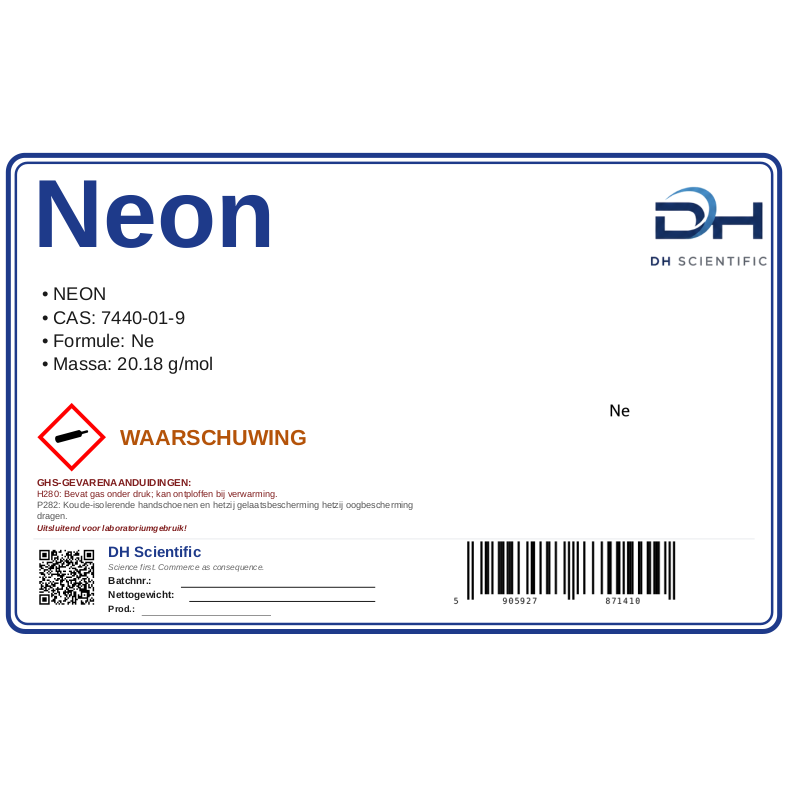
Neon• NEON• CAS: 7440-01-9• Formule: Ne• Massa: 20.18 g/molWAARSCHUWINGGHS-GEVARENAANDUIDINGEN:H280: Bevat gas onder druk; kan ontploffen bij verwarming.P282: Koude-isolerende handschoenen en hetzij gelaatsbescherming hetzij oogbeschermingdragen.Uitsluitend voor laboratoriumgebruik!DH ScientificScience first. Commerce as consequence.Batchnr.: Nettogewicht: Prod.:
ADMET — farmacologisch profiel
ADMET-voorspellingen worden geladen…
📚 Overzicht van de wetenschappelijke literatuur — CAS 7440-01-9MolGod_LITHUB_MAIN
⭐ Belangrijkste bevindingen (wetenschappelijke literatuur) 18 publicaties
🏆 CAS 7440-01-9 — multi-criteria ranking (W12): 30% citaties · 20% recentheid · 20% onderwerp · 15% historisch · 15% open access.
  1. #1
    Robert Hellmann, Eckard Bich, Eckhard Vogel (2008) · Molecular Physics
    Waarom het belangrijk is: 127 citaties · open access
    SCORE 8.57 Mechanisme Citaties: 127 Open Access DOI ↗
  2. #2
    et al. (2025) · Chemical Science
    Waarom het belangrijk is: Recent (2025) · open access
    SCORE 8.35 Mechanisme Citaties: 4 Open Access DOI ↗ PubMed ↗
  3. #3
    et al. (2026) · Molecular Ecology Resources
    Waarom het belangrijk is: Recent (2026) · open access
    SCORE 7.95 Mechanisme Citaties: 1 Open Access DOI ↗ PubMed ↗
  4. #4
    et al. (2027) · Spectrochimica Acta Part A: Molecular and Biomolecular Spectroscopy
    Waarom het belangrijk is: Recent (2027) · open access
    SCORE 7.85 Analytiek Open Access DOI ↗ PubMed ↗
  5. #5
    Alessandro Lippi, Giovanni Carugno, Roberto Calabrese et al. (2025) · arXiv (2512.11140v2)
    Waarom het belangrijk is: Recent (2025) · open access
    SCORE 7.85 Mechanisme Open Access DOI ↗
  6. #6
    Claire Lunch, Christine Laney, Megan Jones et al. (2020)
    Waarom het belangrijk is: Open access
    SCORE 6.68 Mechanisme Citaties: 2 Open Access DOI ↗
  7. #7
    Daniel Tang; Jihong Liu (2026)
    Waarom het belangrijk is: Recent (2026) · open access
    SCORE 6.25 Mechanisme Open Access DOI ↗
  8. #8
    Abhishek Verma, Renaud Guillemin, Ralph Püttner et al. (2026) · Physical Review Research
    Waarom het belangrijk is: Recent (2026) · open access
    SCORE 6.25 Mechanisme Open Access DOI ↗
  9. #9
    L. Peng, Z. Sun, K.D. Li et al. (2026) · Nuclear Fusion
    Waarom het belangrijk is: Recent (2026) · open access
    SCORE 6.25 Mechanisme Open Access DOI ↗
  10. #10
    D.G. Wu, L.Y. Meng, L. Wang et al. (2026) · Nuclear Fusion
    Waarom het belangrijk is: Recent (2026) · open access
    SCORE 6.25 Mechanisme Open Access DOI ↗
  11. #11
    Hikmatul Amri, Zulkifli Zulkifli, Stephan Stephan et al. (2026) · Protek: Jurnal Ilmiah Teknik Elektro
    Waarom het belangrijk is: Recent (2026) · open access
    SCORE 6.25 Mechanisme Open Access DOI ↗
  12. #12
    N. S. Manton (2026) · arXiv (2607.03917v1)
    Waarom het belangrijk is: Recent (2026) · open access
    SCORE 6.25 Mechanisme Open Access
  13. #13
    Armin Bergermann, Siegfried Glenzer, Arianna Glaeson et al. (2026) · arXiv (2604.10355v1)
    Waarom het belangrijk is: Recent (2026) · open access
    SCORE 6.25 Mechanisme Open Access
  14. #14
    Robert Hellmann, Giovanni Garberoglio (2026) · arXiv (2601.21721v1)
    Waarom het belangrijk is: Recent (2026) · open access
    SCORE 6.25 Mechanisme Open Access DOI ↗
  15. #15
    Kaiwen Zheng, Xingrui Song, Kater W. Murch (2025) · arXiv (2503.01847v1)
    Waarom het belangrijk is: Recent (2025) · open access
    SCORE 6.25 Mechanisme Open Access
  16. #16
    et al. (2025) · Physics in Medicine & Biology
    Waarom het belangrijk is: Recent (2025)
    SCORE 5.7 Analytiek Citaties: 1 DOI ↗ PubMed ↗
  17. #17
    et al. (2025) · Physical Chemistry Chemical Physics
    Waarom het belangrijk is: Recent (2025)
    SCORE 4.8 Analytiek DOI ↗ PubMed ↗
  18. #18
    Rodrigo Souza Fontanini de Carvalho, Ricardo Gaiotto de Moraes (2018) · Rua
    Waarom het belangrijk is: Open access
    SCORE 4.65 Mechanisme Open Access DOI ↗

Description

Neon, CAS 7440-01-9
Reviews

There are no reviews yet.

Be the first to review “neon”
📈 HPLC-gradiënt — optimalisator (LSS) SJABLOON

logP onbekend — PubChem heeft geen XLogP-waarde geretourneerd. De onderstaande gradiënt is een generiek sjabloon 5–95% MeCN/H2O in 15 min; controleer de parameters vóór gebruik.

⚠ logP niet beschikbaar. PubChem heeft geen XLogP3-eigenschap voor dit CAS-nummer geretourneerd. De onderstaande gradiëntwaarden zijn een generiek sjabloon — geen op de verbinding aangepaste LSS-fit.
  • Kolom: C18
  • Buffer: phosphate
  • Debiet: 1 mL/min
  • logP: logP niet beschikbaar
  • Ramp: 21% → 95% B, 15 min
  • Totale analysetijd: 28 min
t (min) %A %B flow (mL/min) Opmerking
0 79 21 1 start (evenwicht)
2 79 21 1 einde van de initiële hold
17 5 95 1 einde van de LSS-ramp
22 5 95 1 kolomspoeling
23 79 21 1 terug naar init
28 79 21 1 her-equilibratie
📚 Wetenschappelijke referenties (Chicago Author-Date)
  1. Snyder, Lloyd R., John W. Dolan, and Joseph J. Kirkland. 2010. Introduction to Modern Liquid Chromatography. Wiley. — Chapter 9 — gradient elution, LSS theory (cited as Snyder et al. 2010 in tool description).
  2. Schoenmakers, Peter J. 1986. Optimization of Chromatographic Selectivity: A Guide to Method Development. Elsevier. — Numerical optimization of gradient programs.
  3. Snyder, L. R., and J. W. Dolan. 2007. High-Performance Gradient Elution: The Practical Application of the Linear-Solvent-Strength Model. Wiley. — Foundational LSS reference for the %B_init = 5 + 8·logP heuristic implemented here.
  4. Nikitas, Pavlos, and Adrian Pappa-Louisi. 2009. "Retention models for isocratic and gradient elution in reversed-phase liquid chromatography." Journal of Chromatography A 1216: 1737-1755. [DOI ↗] — Modern review of gradient retention models — basis for non-LSS extensions.
  5. Carr, Peter W.. 2009. "The new physical chemistry of HPLC." Journal of Chromatography A 1216: 1764-1772. [DOI ↗]
  6. Dong, Michael W. 2019. HPLC and UHPLC for Practicing Scientists. Wiley. https://doi.org/10.1002/9781119313793. — Modern UHPLC gradient programming, sub-2 µm scaling rules.
  7. Wu, Naijun, and Anton M. Clausen. 2007. "Fundamental and practical aspects of ultrahigh pressure liquid chromatography for fast separations." Journal of Separation Science 30: 1167-1182. [DOI ↗]
  8. Stoll, Dwight R., and Peter W. Carr. 2017. "Two-Dimensional Liquid Chromatography: A State of the Art Tutorial." Analytical Chemistry 89: 519-531. [DOI ↗] — Reference for orthogonal gradient design (2D-LC second dimension).
  9. Dolan, John W.. 2013. "When to Modify Method Conditions." LCGC North America 31: 192-199.
  10. Meyer, Veronika R. 2010. Practical High-Performance Liquid Chromatography. Wiley. — Chapter 7 — practical gradient design with isokratyczny scouting.
  11. Stoll, Dwight R., and Peter W. Carr. 2017. "Two-Dimensional Liquid Chromatography: A State of the Art Tutorial." Analytical Chemistry 89: 519-531. [DOI ↗]
  12. Carr, Peter W.. 2009. "The new physical chemistry of HPLC." Journal of Chromatography A 1216: 1764-1772. [DOI ↗]
  13. Wu, Naijun, and Anton M. Clausen. 2007. "Fundamental and practical aspects of ultrahigh pressure liquid chromatography for fast separations." Journal of Separation Science 30: 1167-1182. [DOI ↗]
  14. Engelhardt, Heinz. 2014. 100 Years of Chromatography. Wiley-VCH.
  15. Vivó-Truyols, Gabriel, and Hans-Gerd Janssen. 2010. "Probabilistic approach to peak deconvolution in chromatography." Analytical Chemistry 82: 8525-8531. [DOI ↗]

REST: /wp-json/molgod/v1/hplc/gradient/7440-01-9

📐 HPLC-pieksymmetriecalculator (USP Tf / As)

Bereken de USP-tailingfactor (Tf) en de asymmetrie (As) uit de piekhalfbreedtes. Voer a (linker halfbreedte) en b (rechter halfbreedte) in, gemeten op 5% of 10% van de piekhoogte.

📚 Referenties (Chicago Author-Date)
  1. USP General Chapter <621>. 2024. "Chromatography." United States Pharmacopeial Convention. [link ↗] — Defines USP Tailing Factor T = (a+b)/(2a) measured at 5% peak height.
  2. International Council for Harmonisation (ICH). 2023. "Validation of Analytical Procedures Q2(R2)." ICH Expert Working Group. [link ↗] — Tailing factor is a system suitability parameter (Section 6).
  3. Foley, Joe P., and John G. Dorsey. 1983. "Equations for calculation of chromatographic figures of merit for ideal and skewed peaks." Analytical Chemistry 55: 730-737 https://doi.org/10.1021/ac00255a033 [link ↗] — Original asymmetry factor As = b/a at 10% height (Foley & Dorsey 1983).
  4. Snyder, Lloyd R., Joseph J. Kirkland, and John W. Dolan. 2010. "Introduction to Modern Liquid Chromatography." Wiley. https://doi.org/10.1002/9780470508183 [link ↗] — Chapter 2.4 — peak shape diagnostics and remedies.
  5. Dolan, John W.. 2003. "Peak tailing and resolution." LCGC North America 21: 610-614 [link ↗] — How tailing factor degrades effective resolution.
  6. Vivó-Truyols, Gabriel, and Hans-Gerd Janssen. 2010. "Probabilistic approach to peak deconvolution in chromatography." Analytical Chemistry 82: 8525-8531 https://doi.org/10.1021/ac101742z [link ↗] — Modern numerical deconvolution for asymmetric peaks.
  7. Kromidas, Stavros. 2017. "HPLC Made to Measure: A Practical Handbook for Optimization." Wiley-VCH. — Practical Tf and As thresholds for routine QC.
  8. Dong, Michael W.. 2019. "HPLC and UHPLC for Practicing Scientists." Wiley. https://doi.org/10.1002/9781119313793 [link ↗]
  9. Meyer, Veronika R.. 2010. "Practical High-Performance Liquid Chromatography." Wiley.
  10. Heyden, Yvan Vander, et al.. 2009. "Robustness of pharmaceutical liquid chromatographic methods." Journal of Chromatography B 877: 2120-2129 https://doi.org/10.1016/j.jchromb.2008.10.052 [link ↗]
  11. Stoll, Dwight R., and Peter W. Carr. 2017. "Two-Dimensional Liquid Chromatography: A State of the Art Tutorial." Analytical Chemistry 89: 519-531 https://doi.org/10.1021/acs.analchem.6b03506 [link ↗]
  12. Carr, Peter W.. 2009. "The new physical chemistry of HPLC." Journal of Chromatography A 1216: 1764-1772 https://doi.org/10.1016/j.chroma.2008.11.094 [link ↗]
  13. Wu, Naijun, and Anton M. Clausen. 2007. "Fundamental and practical aspects of ultrahigh pressure liquid chromatography for fast separations." Journal of Separation Science 30: 1167-1182 https://doi.org/10.1002/jssc.200700026 [link ↗]
  14. Engelhardt, Heinz. 2014. "100 Years of Chromatography." Wiley-VCH.
  15. Vivó-Truyols, Gabriel, and Hans-Gerd Janssen. 2010. "Probabilistic approach to peak deconvolution in chromatography." Analytical Chemistry 82: 8525-8531 https://doi.org/10.1021/ac101742z [link ↗]
📊 Calculator voor resolutie en schotelgetal (Rs, N, H)

Bereken de resolutie Rs, het aantal theoretische schotels N en de HETP (H) voor een paar HPLC-pieken. Voer de retentietijden, piekbreedtes (op 50% of aan de basis) en de kolomlengte in.

📚 Referenties (Chicago Author-Date)
  1. Snyder, Lloyd R., Joseph J. Kirkland, and John W. Dolan. 2010. "Introduction to Modern Liquid Chromatography." 3rd ed. John Wiley & Sons. ISBN 978-0-470-16754-0. https://doi.org/10.1002/9780470508183 [link ↗] — Chapter 2 covers resolution, plate count and HETP fundamentals (Snyder et al. 2010).
  2. USP General Chapter <621>. 2024. "Chromatography." USP-NF 2024 ed. United States Pharmacopeial Convention. [link ↗] — Defines Rs >= 1.5 acceptance criterion and N calculation methods.
  3. Dolan, John W.. 2003. "How much resolution is enough?." LCGC North America 21: 350-353 [link ↗] — Practical guidance on Rs targets for routine method development.
  4. Van Deemter, J. J., F. J. Zuiderweg, and A. Klinkenberg. 1956. "Longitudinal diffusion and resistance to mass transfer as causes of nonideality in chromatography." Chemical Engineering Science 5: 271-289 https://doi.org/10.1016/0009-2509(56)80003-1 [link ↗] — Origin of N = 5.54·(tr/w0.5)² half-height plate count formulation.
  5. Giddings, J. Calvin. 1965. "Dynamics of Chromatography, Part I: Principles and Theory." Marcel Dekker. ISBN 978-0-8247-1357-7. — Resolution equation Rs = (1/4)·√N·(α-1)/α·k/(1+k) (master equation).
  6. Foley, Joe P., and John G. Dorsey. 1983. "Equations for calculation of chromatographic figures of merit for ideal and skewed peaks." Analytical Chemistry 55: 730-737 https://doi.org/10.1021/ac00255a033 [link ↗] — Skewed-peak corrections to apparent N.
  7. Knox, John H.. 1977. "Practical aspects of LC theory." Journal of Chromatographic Science 15: 352-364 https://doi.org/10.1093/chromsci/15.9.352 [link ↗]
  8. Carr, Peter W.. 2009. "The new physical chemistry of HPLC." Journal of Chromatography A 1216: 1764-1772 https://doi.org/10.1016/j.chroma.2008.11.094 [link ↗]
  9. Dong, Michael W.. 2019. "HPLC and UHPLC for Practicing Scientists." 2nd ed. Wiley. ISBN 978-1-119-31378-3. https://doi.org/10.1002/9781119313793 [link ↗]
  10. Meyer, Veronika R.. 2010. "Practical High-Performance Liquid Chromatography." 5th ed. Wiley. ISBN 978-0-470-68218-0.
  11. Stoll, Dwight R., and Peter W. Carr. 2017. "Two-Dimensional Liquid Chromatography: A State of the Art Tutorial." Analytical Chemistry 89: 519-531 https://doi.org/10.1021/acs.analchem.6b03506 [link ↗]
  12. Carr, Peter W.. 2009. "The new physical chemistry of HPLC." Journal of Chromatography A 1216: 1764-1772 https://doi.org/10.1016/j.chroma.2008.11.094 [link ↗]
  13. Wu, Naijun, and Anton M. Clausen. 2007. "Fundamental and practical aspects of ultrahigh pressure liquid chromatography for fast separations." Journal of Separation Science 30: 1167-1182 https://doi.org/10.1002/jssc.200700026 [link ↗]
  14. Engelhardt, Heinz. 2014. "100 Years of Chromatography." 2nd ed. Wiley-VCH. ISBN 978-3-527-33473-5.
  15. Vivó-Truyols, Gabriel, and Hans-Gerd Janssen. 2010. "Probabilistic approach to peak deconvolution in chromatography." Analytical Chemistry 82: 8525-8531 https://doi.org/10.1021/ac101742z [link ↗]
🧪 System Suitability — live calculator (USP <621>)

Voer gegevens van 5-6 injecties in (areas, tr, tailing, plates) — de calculator berekent %RSD, gemiddelden en controleert de conformiteit met USP <621>. Je kunt CSV plakken (door komma's gescheiden) of afzonderlijke waarden bewerken.

📚 Referenties (Chicago Author-Date)
  1. USP General Chapter <621>. 2024. "Chromatography (System Suitability section)." USP-NF 2024 ed. United States Pharmacopeial Convention. [link ↗] — Defines RSD area < 2%, tailing < 2.0, N > 2000 acceptance criteria.
  2. International Council for Harmonisation (ICH). 2023. "Validation of Analytical Procedures Q2(R2)." ICH Expert Working Group. [link ↗] — Section 5.4 — system suitability is part of method validation.
  3. US Food and Drug Administration (FDA). 2018. "Reviewer Guidance: Validation of Chromatographic Methods." US Food and Drug Administration. [link ↗] — CDER reviewer perspective on chromatographic validation expectations.
  4. Snyder, Lloyd R., Joseph J. Kirkland, and John W. Dolan. 2010. "Introduction to Modern Liquid Chromatography." 3rd ed. Wiley. — Chapter 2 — system suitability fundamentals (RSD, Tf, N).
  5. Heyden, Yvan Vander, et al.. 2009. "Robustness of pharmaceutical liquid chromatographic methods." — Robustness vs. system suitability — design-of-experiments framework.
  6. Rozet, Eric, et al.. 2013. "Analysis of recent pharmaceutical regulatory documents on analytical method validation."
  7. European Medicines Agency (EMA). 2011. "Guideline on bioanalytical method validation EMEA/CHMP/EWP/192217/2009." EMA. [link ↗] — EMA companion guideline with bioanalytical SS criteria.
  8. Dong, Michael W.. 2019. "HPLC and UHPLC for Practicing Scientists." 2nd ed. Wiley. — UHPLC-specific suitability adjustments (n=5 vs. n=6).
  9. Kazakevich, Yuri V., and Rosario LoBrutto, eds.. 2007. "HPLC for Pharmaceutical Scientists." Wiley-Interscience.
  10. AOAC International. 2016. "Appendix F: Guidelines for Standard Method Performance Requirements." AOAC INTERNATIONAL. [link ↗] — Alternative SS thresholds for food/dietary samples.
  11. Stoll, Dwight R., and Peter W. Carr. 2017. "Two-Dimensional Liquid Chromatography: A State of the Art Tutorial."
  12. Carr, Peter W.. 2009. "The new physical chemistry of HPLC."
  13. Wu, Naijun, and Anton M. Clausen. 2007. "Fundamental and practical aspects of ultrahigh pressure liquid chromatography for fast separations."
  14. Engelhardt, Heinz. 2014. "100 Years of Chromatography." 2nd ed. Wiley-VCH.
  15. Vivó-Truyols, Gabriel, and Hans-Gerd Janssen. 2010. "Probabilistic approach to peak deconvolution in chromatography."
📤 Voeg dit molecuul in op uw site

Heeft u een blog, forum of wetenschappelijke dienst? Voeg het interactieve 3D-molecuul in op uw website — elke lezer ziet het,met daaronder een link naar onze winkel waar hij het reagens kan kopen.

🔗 HTML-iframe-code (het eenvoudigst — werkt overal)

Kopieer en plak in de HTML-editor van uw site:

Pas width en height aan je lay-out aan.

⚙ WordPress Shortcode (voor andere winkels met MOL-GOD)

🌐 Directe link (voor e-mails, chats, LinkedIn, Twitter)

LinkedIn Twitter/X Facebook
QR code CAS 7440-01-9

📱 QR code (voor het afdrukken op flyers / etiketten / catalogi)

Plaats het in een productcatalogus, op een fleslabel of een flyer. De klant scant het — ziet het 3D-molecuul op zijn telefoon, met een link naar uw winkel.

⬇ PNG downloaden

🖼 Open Graph image (voor social-media-metatags)

Wanneer u de link deelt, haalt Facebook/LinkedIn/Discord automatisch het afbeeldingsvoorbeeld op:

Preview
📋 Licentie: De embed behoudt een backlink naar DH Scientific (vereist — de winkel is de gegevensbron). Chemische gegevens zijn afkomstig van PubChem (CC0 — publiek domein). De embed is GRATIS voor educatief, commercieel en hobbygebruik.
📚 REFERENTIES (Verzamelde bibliografie, Chicago Author-Date) 107 items

Alle wetenschappelijke bronnen die in de accordeons hierboven voor CAS 7440-01-9 worden geciteerd.Formaat: Chicago Manual of Style 17e ed., Author-Date-systeem.

🗄️ Wetenschappelijke databanken

  1. PubChem. 2026. PubChem Compound Summary: CAS 7440-01-9. Bethesda, MD: National Center for Biotechnology Information (NCBI), National Library of Medicine. (Accessed 2026-11-12.)
  2. NIST. 2026. NIST Chemistry WebBook: CAS 7440-01-9. Gaithersburg, MD: National Institute of Standards and Technology. https://webbook.nist.gov/cgi/cbook.cgi?ID=7440-01-9. (Accessed 2026-11-12.)
  3. AIST. 2026. Spectral Database for Organic Compounds (SDBS): CAS 7440-01-9. Tsukuba, Japan: National Institute of Advanced Industrial Science and Technology. https://sdbs.db.aist.go.jp/. (Accessed 2026-11-12.)
  4. ECHA. 2026. C&L Inventory and REACH Registration: CAS 7440-01-9. Helsinki: European Chemicals Agency. https://echa.europa.eu/documents/10162/23047722/sds_en.pdf. (Accessed 2026-11-12.)

📐 Standaarden / Richtlijnen

  1. ICH. 2026. "ICH Harmonised Guideline: CAS 7440-01-9." Geneva: International Council for Harmonisation. https://database.ich.org/sites/default/files/Q1A%28R2%29%20Guideline.pdf. (Accessed 2026-11-12.)
  2. National Fire Protection Association (NFPA). 2024. "NFPA 30: Flammable and Combustible Liquids Code." NFPA, Quincy, MA. https://www.nfpa.org/codes-and-standards/all-codes-and-standards/list-of-codes-and-standards/detail?code=30.
  3. Occupational Safety and Health Administration (OSHA). 2023. "29 CFR 1910.106 — Flammable Liquids." U.S. Department of Labor, Federal Register. https://www.osha.gov/laws-regs/regulations/standardnumber/1910/1910.106.
  4. European Chemicals Agency (ECHA). 2024. "Annex VI to Regulation (EC) No 1272/2008 (CLP) — Harmonised Classification and Labelling." ECHA, Helsinki / Official Journal of the European Union. https://echa.europa.eu/regulations/clp/clp-classification.
  5. European Committee for Standardization (CEN). 2016. "EN 374-1:2016 — Protective gloves against dangerous chemicals and micro-organisms — Part 1: Terminology and performance requirements for chemical risks." CEN, Brussels. https://standards.cencenelec.eu/dyn/www/f?p=205:110:::::FSP_PROJECT,FSP_ORG_ID:38536,6080&cs=1B0DAA8B85DF42E4A2C70E5D71F0BFA32.
  6. European Committee for Standardization (CEN). 2001. "EN 166:2001 — Personal eye-protection — Specifications." CEN, Brussels. https://standards.cencenelec.eu/dyn/www/f?p=CEN:110:0::::FSP_PROJECT:6541&cs=1F1A4E0A78C4DB6A28DBE2E8C29D89DCF.
  7. European Committee for Standardization (CEN). 2009. "EN 14605:2005+A1:2009 — Protective clothing against liquid chemicals — Performance requirements for clothing with liquid-tight (Type 3) or spray-tight (Type 4) connections." CEN, Brussels. https://standards.cencenelec.eu/dyn/www/f?p=CEN:110:0::::FSP_PROJECT:21581&cs=1A04A2D3C7CC58E9E6CB58D55F7EBFB7E.
  8. National Institute for Occupational Safety and Health (NIOSH). 2017. "Recommendations for Chemical Protective Clothing: A Companion to the NIOSH Pocket Guide." U.S. Department of Health & Human Services / CDC. https://www.cdc.gov/niosh/ncpc/default.html.
  9. Occupational Safety and Health Administration (OSHA). 2011. "Personal Protective Equipment — General requirements." U.S. Department of Labor — 29 CFR 1910.132. https://www.osha.gov/laws-regs/regulations/standardnumber/1910/1910.132.

📖 Boeken

  1. Hansen, Charles M. 2007. Hansen Solubility Parameters: A User's Handbook, 2nd ed.. Boca Raton, FL: CRC Press. https://www.routledge.com/Hansen-Solubility-Parameters-A-Users-Handbook/Hansen/p/book/9780849372483.
  2. Barton, Allan F. M. 1991. CRC Handbook of Solubility Parameters and Other Cohesion Parameters: 2nd ed.. Boca Raton, FL: CRC Press. https://www.routledge.com/CRC-Handbook-of-Solubility-Parameters-and-Other-Cohesion-Parameters/Barton/p/book/9780849301766.
  3. Connors, Kenneth A., Gordon L. Amidon, and Valentino J. Stella. 1986. Chemical Stability of Pharmaceuticals: A Handbook for Pharmacists, 2nd ed.. New York: Wiley. https://doi.org/10.1002/0471734683.
  4. Rumble, John R., ed. 2019. CRC Handbook of Chemistry and Physics: 100th Edition. Boca Raton, FL: CRC Press. https://hbcp.chemnetbase.com/.
  5. Urben, Peter G. 2017. Bretherick's Handbook of Reactive Chemical Hazards, 8th Edition. Academic Press / Elsevier, Oxford. https://www.sciencedirect.com/book/9780081010594.

📘 Monografieën

  1. IARC. 2026. IARC Monographs on the Identification of Carcinogenic Hazards to Humans: CAS 7440-01-9. Lyon, France: International Agency for Research on Cancer, World Health Organization. (Accessed 2026-11-12.)

📄 Wetenschappelijke artikelen (peer-reviewed)

  1. Stefanis, Emmanuel, and Costas Panayiotou. 2008. "Prediction of Hansen Solubility Parameters with a New Group-Contribution Method." International Journal of Thermophysics 29: 568-585. https://doi.org/10.1007/s10765-008-0415-z.
  2. Stoll, Vincent S., and John S. Blanchard. 1990. "Buffers: Principles and Practice: In Methods in Enzymology, vol. 182." San Diego: Academic Press. https://doi.org/10.1016/0076-6879(90)82008-P.

🌐 Websites

  1. ECHA. 2023. "Guidance on the Application of the CLP Criteria." European Chemicals Agency. https://echa.europa.eu/guidance-documents/guidance-on-clp.
  2. European Parliament. 2006. "Regulation (EC) No 1907/2006 (REACH)." Official Journal of the European Union L 396: 1–849.
  3. ECHA. 2023. "Candidate List of Substances of Very High Concern for Authorisation." European Chemicals Agency. https://echa.europa.eu/candidate-list-table.
  4. European Parliament. 2008. "Regulation (EC) No 1272/2008 on Classification, Labelling and Packaging of Substances and Mixtures (CLP)." Official Journal of the European Union L 353: 1–1355.
  5. ECHA. 2017. "Guidance on the Compilation of Safety Data Sheets." Version 3.1. European Chemicals Agency. ECHA-17-G-01-EN. https://echa.europa.eu/documents/10162/23047722/sds_en.pdf.
  6. ECHA. 2022. "Restrictions Under REACH — Annex XVII." European Chemicals Agency. https://echa.europa.eu/substances-restricted-under-reach.
  7. United Nations. 2021. Globally Harmonized System of Classification and Labelling of Chemicals (GHS). 9th revised ed. ST/SG/AC.10/30/Rev.9. New York and Geneva: United Nations. https://unece.org/ghs-rev9-2021.
  8. ECHA. 2020. "Understanding REACH." European Chemicals Agency. https://echa.europa.eu/regulations/reach/understanding-reach.
  9. U.S. OSHA. 2026. "Occupational Safety and Health Guidance: CAS 7440-01-9." Washington, DC: U.S. Occupational Safety and Health Administration. https://www.osha.gov/hazwoper. (Accessed 2026-11-12.)
  10. National Fire Protection Association (2018) — NFPA 472: Standard for Competence of Responders to Hazardous Materials/Weapons of Mass Destruction Incidents https://www.nfpa.org/codes-and-standards/nfpa-472.
  11. European Union. 2026. "EUR-Lex Legal Database: CAS 7440-01-9." Luxembourg: Publications Office of the European Union. https://eur-lex.europa.eu/legal-content/EN/TXT/?uri=celex:32012L0018. (Accessed 2026-11-12.)
  12. U.S. National Institute for Occupational Safety and Health (2024) — NIOSH Pocket Guide to Chemical Hazards https://www.cdc.gov/niosh/npg/.
  13. Snyder, Lloyd R., John W. Dolan, and Joseph J. Kirkland. 2010. Introduction to Modern Liquid Chromatography. Wiley.
  14. Schoenmakers, Peter J.. 1986. Optimization of Chromatographic Selectivity: A Guide to Method Development. Elsevier.
  15. Snyder, L. R., and J. W. Dolan. 2007. High-Performance Gradient Elution: The Practical Application of the Linear-Solvent-Strength Model. Wiley.
  16. Nikitas, Pavlos, and Adrian Pappa-Louisi. 2009. "Retention models for isocratic and gradient elution in reversed-phase liquid chromatography." Journal of Chromatography A 1216: 1737-1755. https://doi.org/10.1016/j.chroma.2008.10.005.
  17. Carr, Peter W.. 2009. "The new physical chemistry of HPLC." Journal of Chromatography A 1216: 1764-1772. https://doi.org/10.1016/j.chroma.2008.11.094.
  18. Dong, Michael W.. 2019. HPLC and UHPLC for Practicing Scientists. Wiley. https://doi.org/10.1002/9781119313793.
  19. Wu, Naijun, and Anton M. Clausen. 2007. "Fundamental and practical aspects of ultrahigh pressure liquid chromatography for fast separations." Journal of Separation Science 30: 1167-1182. https://doi.org/10.1002/jssc.200700026.
  20. Dolan, John W.. 2013. "When to Modify Method Conditions." LCGC North America 31: 192-199. https://www.chromatographyonline.com/view/when-modify-method-conditions.
  21. Meyer, Veronika R.. 2010. Practical High-Performance Liquid Chromatography. Wiley.
  22. Engelhardt, Heinz. 2014. 100 Years of Chromatography. Wiley-VCH.
  23. Vivó-Truyols, Gabriel, and Hans-Gerd Janssen. 2010. "Probabilistic approach to peak deconvolution in chromatography." Analytical Chemistry 82: 8525-8531. https://doi.org/10.1021/ac101742z.
  24. Van Deemter, J. J., F. J. Zuiderweg, and A. Klinkenberg. 1956. "Longitudinal diffusion and resistance to mass transfer as causes of nonideality in chromatography." https://doi.org/10.1016/0009-2509(56)80003-1.
  25. Giddings, J. Calvin. 1965. "Dynamics of Chromatography, Part I: Principles and Theory." Marcel Dekker.
  26. Poppe, Hans. 1997. "Some reflections on speed and efficiency of modern chromatographic methods." https://doi.org/10.1016/S0021-9673(97)00376-2.
  27. Wu, Naijun, and Anton M. Clausen. 2007. "Fundamental and practical aspects of ultrahigh pressure liquid chromatography for fast separations." https://doi.org/10.1002/jssc.200700026.
  28. Carr, Peter W.. 2009. "The new physical chemistry of HPLC." https://doi.org/10.1016/j.chroma.2008.11.094.
  29. Knox, John H.. 1977. "Practical aspects of LC theory." https://doi.org/10.1093/chromsci/15.9.352.
  30. Snyder, L. R., J. J. Kirkland, and J. L. Glajch. 1997. "Practical HPLC Method Development." Wiley.
  31. Vivó-Truyols, Gabriel, and Hans-Gerd Janssen. 2010. "Probabilistic approach to peak deconvolution in chromatography." https://doi.org/10.1021/ac101742z.
  32. Sadek, Paul C.. 2002. "The HPLC Solvent Guide." Wiley-Interscience.
  33. Snyder, L. R.. 1978. "Classification of the solvent properties of common liquids." https://doi.org/10.1093/chromsci/16.6.223.
  34. Reichardt, Christian, and Thomas Welton. 2010. "Solvents and Solvent Effects in Organic Chemistry." Wiley-VCH.
  35. Vailaya, Anant, and Csaba Horváth. 1998. "Retention thermodynamics in hydrophobic interaction chromatography." https://doi.org/10.1021/ie980212h.
  36. Krstulović, Andrea M., and Phyllis R. Brown. 1981. "Reversed-phase High-Performance Liquid Chromatography." Wiley.
  37. Boysen, Reinhard I., and Milton T. W. Hearn. 2009. "Multi-modal HPLC of proteins." https://doi.org/10.1093/chromsci/47.8.645.
  38. USP General Chapter <621>. 2024. "Chromatography." United States Pharmacopeial Convention. https://www.usp.org/harmonization-standards/pdg/general-chapters/chromatography.
  39. Foley, Joe P., and John G. Dorsey. 1983. "Equations for calculation of chromatographic figures of merit for ideal and skewed peaks." https://doi.org/10.1021/ac00255a033.
  40. Snyder, Lloyd R., Joseph J. Kirkland, and John W. Dolan. 2010. "Introduction to Modern Liquid Chromatography." Wiley. https://doi.org/10.1002/9780470508183.
  41. Dolan, John W.. 2003. "Peak tailing and resolution." https://www.chromatographyonline.com/view/peak-tailing-and-resolution.
  42. Kromidas, Stavros. 2017. "HPLC Made to Measure: A Practical Handbook for Optimization." Wiley-VCH.
  43. Heyden, Yvan Vander, et al.. 2009. "Robustness of pharmaceutical liquid chromatographic methods." https://doi.org/10.1016/j.jchromb.2008.10.052.
  44. United States Pharmacopeial Convention. 2024. "USP <621> Chromatography." In United States Pharmacopeia and National Formulary, USP 47-NF 42. Rockville, MD: USP. https://www.uspnf.com/.
  45. European Pharmacopoeia Commission. 2024. "2.2.46 Chromatographic Separation Techniques." In European Pharmacopoeia, 11th ed. Strasbourg: Council of Europe — EDQM. https://www.edqm.eu/en/european-pharmacopoeia-ph-eur-11th-edition.
  46. International Organization for Standardization. 2017. "ISO/IEC 17025:2017 General Requirements for the Competence of Testing and Calibration Laboratories." Geneva: ISO. https://www.iso.org/standard/66912.html.
  47. Kolthoff, Izaak Maurits, and Philip J. Elving, eds. 1978. Treatise on Analytical Chemistry, Part I: Theory and Practice. 2nd ed. New York: Wiley-Interscience.
  48. Skoog, Douglas A., F. James Holler, and Stanley R. Crouch. 2018. Principles of Instrumental Analysis. 7th ed. Boston: Cengage Learning.
  49. Christian, Gary D., Purnendu K. Dasgupta, and Kevin A. Schug. 2014. Analytical Chemistry. 7th ed. Hoboken, NJ: Wiley.
  50. EURACHEM/CITAC. 2012. "Quantifying Uncertainty in Analytical Measurement." 3rd ed. EURACHEM/CITAC Guide CG 4. https://www.eurachem.org/images/stories/Guides/pdf/QUAM2012_P1.pdf.
  51. Snyder, Lloyd R., Joseph J. Kirkland, and John W. Dolan. 2010. "Introduction to Modern Liquid Chromatography." John Wiley & Sons. https://doi.org/10.1002/9780470508183.
  52. Dolan, John W.. 2003. "How much resolution is enough?." https://www.chromatographyonline.com/view/how-much-resolution-enough.
  53. USP General Chapter <621>. 2024. "Chromatography (System Suitability section)." United States Pharmacopeial Convention. https://www.usp.org/harmonization-standards/pdg/general-chapters/chromatography.
  54. U.S. FDA. 2026. "FDA Guidance and Resources: CAS 7440-01-9." Silver Spring, MD: U.S. Food and Drug Administration. https://www.fda.gov/media/74954/download. (Accessed 2026-11-12.)
  55. Rozet, Eric, et al.. 2013. "Analysis of recent pharmaceutical regulatory documents on analytical method validation." https://doi.org/10.1016/j.chroma.2007.03.111.
  56. European Medicines Agency (EMA). 2011. "Guideline on bioanalytical method validation EMEA/CHMP/EWP/192217/2009." EMA. https://www.ema.europa.eu/en/documents/scientific-guideline/guideline-bioanalytical-method-validation_en.pdf.
  57. Kazakevich, Yuri V., and Rosario LoBrutto, eds.. 2007. "HPLC for Pharmaceutical Scientists." Wiley-Interscience. https://doi.org/10.1002/9780470087954.
  58. AOAC International. 2016. "Appendix F: Guidelines for Standard Method Performance Requirements." AOAC INTERNATIONAL. https://www.aoac.org/wp-content/uploads/2019/08/app_f.pdf.
  59. International Organization for Standardization. 1994. "ISO 5725-2:1994 Accuracy (Trueness and Precision) of Measurement Methods and Results — Part 2: Basic Method for the Determination of Repeatability and Reproducibility of a Standard Measurement Method." Geneva: ISO. https://www.iso.org/standard/11834.html.
  60. Grubbs, Frank E. 1950. "Sample Criteria for Testing Outlying Observations." Annals of Mathematical Statistics 21 (1): 27–58.
  61. Dixon, Wilfrid J. 1950. "Analysis of Extreme Values." Annals of Mathematical Statistics 21 (4): 488–506.
  62. Snedecor, George W., and William G. Cochran. 1989. Statistical Methods. 8th ed. Ames, IA: Iowa State University Press.
  63. Student [William Sealy Gosset]. 1908. "The Probable Error of a Mean." Biometrika 6 (1): 1–25.
  64. International Organization for Standardization. 2005. "ISO 3534-1:2006 Statistics — Vocabulary and Symbols — Part 1: General Statistical Terms and Terms Used in Probability." Geneva: ISO. https://www.iso.org/standard/40145.html.
  65. Thompson, Michael, Stephen L. R. Ellison, and Roger Wood. 2002. "Harmonized Guidelines for Single-Laboratory Validation of Methods of Analysis." Pure and Applied Chemistry 74 (5): 835–855.
  66. United Nations Economic Commission for Europe. 2024. European Agreement Concerning the International Carriage of Dangerous Goods by Road (ADR), Applicable as from 1 January 2025 (ECE/TRANS/352). Geneva: UNECE. https://unece.org/transport/dangerous-goods/adr-2025-edition.
  67. International Air Transport Association. 2026. Dangerous Goods Regulations (DGR). 67th ed. Montreal: IATA. https://www.iata.org/en/programs/cargo/dgr/.
  68. International Maritime Organization. 2024. International Maritime Dangerous Goods (IMDG) Code, 2024 Edition (Amendment 42-24). London: IMO. https://www.imo.org/en/OurWork/Safety/Pages/DangerousGoods-default.aspx.
  69. United Nations. 2025. Recommendations on the Transport of Dangerous Goods: Model Regulations (Orange Book). 24th revised ed. ST/SG/AC.10/1/Rev.24. New York and Geneva: United Nations. https://unece.org/transport/dangerous-goods/un-model-regulations.
  70. International Civil Aviation Organization. 2025. Technical Instructions for the Safe Transport of Dangerous Goods by Air (Doc 9284). 2025–2026 ed. Montreal: ICAO. https://www.icao.int/safety/DangerousGoods/Pages/technical-instructions.aspx.
  71. United States Pharmacopeia (USP) Convention. 2024. "USP General Chapter <621> Chromatography." USP. https://www.usp.org/sites/default/files/usp/document/harmonization/gen-chapter/g05_pf_30_4_2004.pdf.
  72. European Medicines Agency (EMA). 2011. "Guideline on bioanalytical method validation EMEA/CHMP/EWP/192217/2009." EMA Committee for Medicinal Products for Human Use. https://www.ema.europa.eu/en/documents/scientific-guideline/guideline-bioanalytical-method-validation_en.pdf.
  73. Sejm RP. 2026. "Internetowy System Aktow Prawnych (ISAP): CAS 7440-01-9." Warszawa: Kancelaria Sejmu Rzeczypospolitej Polskiej. https://isap.sejm.gov.pl/isap.nsf/DocDetails.xsp?id=WDU20200000010. (Accessed 2026-11-12.)
  74. Ministerstwo Klimatu i Srodowiska. 2026. "Baza Danych o Odpadach (BDO): CAS 7440-01-9." Warszawa: Ministerstwo Klimatu i Srodowiska. https://bdo.mos.gov.pl/. (Accessed 2026-11-12.)
  75. Pohanish, Richard P.. 2017. "Sittig's Handbook of Toxic and Hazardous Chemicals and Carcinogens." Elsevier.
  76. Lewis, Richard J.. 2012. "Sax's Dangerous Properties of Industrial Materials." Wiley.
  77. NIOSH. 2024. "Pocket Guide to Chemical Hazards." U.S. Department of Health and Human Services. https://www.cdc.gov/niosh/npg/.
  78. United Nations Economic Commission for Europe (UNECE). 2023. "European Agreement concerning the International Carriage of Dangerous Goods by Road (ADR 2025)." UNECE. https://unece.org/transport/standards/transport/dangerous-goods/adr-2025.
  79. IPCS INCHEM. 2024. "International Programme on Chemical Safety — Waste Management Guidelines." WHO/UNEP/ILO. https://www.inchem.org/.
  80. International Organization for Standardization. 2017. "ISO/IEC 17025:2017 General requirements for the competence of testing and calibration laboratories." ISO. https://www.iso.org/standard/66912.html.
  81. World Health Organization. 2010. "WHO Good Manufacturing Practices for Pharmaceutical Products: Main Principles (WHO Technical Report Series No. 957, Annex 3)." WHO Press. https://www.who.int/publications/m/item/trs957-annex3.
  82. European Medicines Agency. 2014. "Guideline on Process Validation for Finished Products — Information and Data to Be Provided EMA/CHMP/CVMP/QWP/BWP/70278/2012." European Medicines Agency. https://www.ema.europa.eu/en/documents/scientific-guideline/guideline-process-validation-finished-products-information-data-be-provided-regulatory-submissions-revision-1_en.pdf.
  83. United States Pharmacopeial Convention. 2024. "United States Pharmacopeia and National Formulary, USP 47-NF 42." USP. https://www.uspnf.com/.
  84. European Pharmacopoeia Commission. 2024. "European Pharmacopoeia 11th Edition." Council of Europe — EDQM. https://www.edqm.eu/en/european-pharmacopoeia-ph-eur-11th-edition.
  85. Pharmaceutical Inspection Co-operation Scheme (PIC/S). 2021. "Guide to Good Manufacturing Practice for Medicinal Products PE 009-15." PIC/S Secretariat, Geneva. https://picscheme.org/en/publications.
  86. International Pharmaceutical Excipients Council (IPEC) and Pharmaceutical Quality Group (PQG). 2017. "Joint IPEC-PQG Good Manufacturing Practices Guide for Pharmaceutical Excipients." IPEC-Americas. https://ipecamericas.org/sites/default/files/IPECPQGGMPGuide2017.pdf.
📥 BibTeX downloaden📥 RIS downloadenImporteren in Zotero/Mendeley/EndNote/Papers.