méthanol
3,99 €
Réactif chimique Metanol (CAS 67-56-1). Fiche encyclopédique complète — classification, propriétés et données de sécurité — ci-dessous.
🔒 Mode démo — cet article n'est pas à vendre.
Substance légale. dhscientific.com est une démonstration de la plateforme MOL-GOD — nous ne vendons rien et aucune commande n'est traitée. Les substances interdites sont bloquées ici automatiquement à partir du canon réglementaire (comparez p. ex. l'heptachlore).

Données transcrites à partir de registres réglementaires et de la littérature spécialisée, avec indication de la source et de l'édition. Elles ne remplacent pas la fiche de données de sécurité du fournisseur. Les champs sans source enregistrée sont signalés comme tels.
Aperçu chimique: MetanolMolGod_OVERVIEW_1
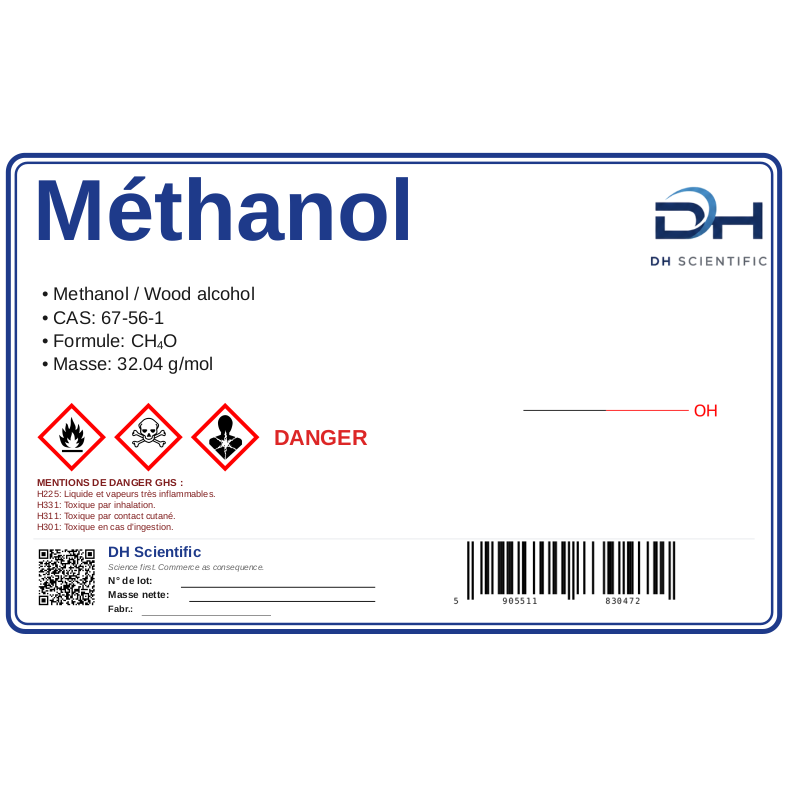
| Formule brute | CH4O[1] |
| Masse moléculaire | 32.04 g/mol[1] |
| Point de fusion | -97.53 °C[1][2] |
| Point d'ébullition | 64.7 °C (760 mmHg)[1][2] |
| Densité | 0.7918 g/cm³[1][2] |
| LogP (lipophilie) | -0.77[1] |
| pKa | 15.5 |
| Nom IUPAC | methanol[1] |
| SMILES | CO[1] |
| InChIKey | OKKJLVBELUTLKV-UHFFFAOYSA-N[1] |
Synonymes: Methanol · Wood alcohol
Sources des données : PubChem (NLM/NIH), Reid, Prausnitz, Poling 4th ed. (1987)
Dernière mise à jour : 2026-08-05
📚 Références scientifiques (Chicago Author-Date) (2 sources)
- PubChem. National Center for Biotechnology Information (NIH/NLM), chemical compound database. ↗ dotyczy: Formule brute · Masse moléculaire · Point de fusion · Point d'ébullition · Densité · LogP (lipophilie) · Nom IUPAC · SMILES · InChIKey
- DECHEMA, PTB, and BAM. CHEMSAFE - Database of Evaluated Safety Characteristics for the Avoidance of Explosions. Frankfurt am Main: DECHEMA e.V.; Braunschweig/Berlin: Physikalisch-Technische Bundesanstalt and Bundesanstalt fur Materialforschung und -prufung. ↗ dotyczy: Point de fusion · Point d'ébullition · Densité
🎓 Badania akademickie: Metanol
RECHERCHE SCIENTIFIQUE
Propriétés physicochimiques
Aperçu rapide
Propriétés détaillées
Uzupełnienie tabeli „Właściwości fizykochemiczne (baza danych)” poniżej — powtórzone wartości pokazujemy tylko raz.
| Propriété | Valeur | Unité | Conditions | Source |
|---|---|---|---|---|
| Indice de réfraction (nD) | 1.3284[1] | 20 °C, D-line | Reid, Prausnitz, Poling 4th ed. (1987) |
🔬 Propriétés avancées
Identifiants chimiques
CO Sources des données : Reid, Prausnitz, Poling 4th ed. (1987) (ISBN 9780070517998)
Dernière mise à jour : 2026-06-30
📚 Références scientifiques (Chicago Author-Date) (1 sources)
- PubChem. National Center for Biotechnology Information (NIH/NLM), chemical compound database. ↗ dotyczy: Indice de réfraction (nD)
📡 Spectroscopie — CAS 67-56-1MolGod_SPECHUB_MAIN
Bases de données de spectres spectroscopiques — données inline 9 sources MolGod_SPECDB_2
Les spectres sont récupérés à la demande depuis 9 sources. Chaque spectre est enregistré dans notre base — la prochaine ouverture = zéro requête vers l'API externe. Téléchargez JCAMP-DX / CSV / PNG pour chaque spectre sans avoir à chercher.
Source de référence — pas d'API publique. Ouvrir dans une base externe :
🔗 IR/NMR/MS (SDBS) →Source de référence — pas d'API publique. Ouvrir dans une base externe :
🔗 JP Monograph →Source de référence — pas d'API publique. Ouvrir dans une base externe :
🔗 WHO INN →Source de référence — pas d'API publique. Ouvrir dans une base externe :
🔗 DOAJ →Propriétés physico-chimiques (base de données) 23 champs Score MolGod : Primaire
| Propriété | Valeur | Unité | Conditions | Source |
|---|---|---|---|---|
| Point de fusion | -97.53 [1][2] | °C | 1 atm | Reid, Prausnitz, Poling 4th ed. (1987) |
| Point d'ébullition | 64.7 [1][2] | °C | 760 mmHg | Reid, Prausnitz, Poling 4th ed. (1987) |
| Solubilité dans l'eau | miscible | — | opis jakościowy (bez wartości liczbowej) | Reid, Prausnitz, Poling 4th ed. (1987) |
| Masse volumique (ρ) | 0.7918 [1][2] | g/cm³ | 20°C | Reid, Prausnitz, Poling 4th ed. (1987) |
| Indice de réfraction (n_D) | 1.3284 [2] | — | 20°C, sodium D | Reid, Prausnitz, Poling 4th ed. (1987) |
| Viscosité (η) | 0.544 | cP | 25°C | Reid, Prausnitz, Poling 4th ed. (1987) |
| Pression de vapeur | 127 [1] | mmHg | 25°C | Reid, Prausnitz, Poling 4th ed. (1987) |
| Point d'éclair | 11 [1] | °C | closed cup | No primary source |
| Température d'auto-inflammation | 470 | °C | in air | No primary source |
| pKa₁ | 15.5 | — | No primary source | |
| logP (octanol/eau) | -0.77 [3] | — | No primary source | |
| logD (pH 7) | -0.77 | — | pH 7 | Reid, Prausnitz, Poling 4th ed. (1987) |
| Constante diélectrique (ε) | 32.7 | — | Reid, Prausnitz, Poling 4th ed. (1987) | |
| Tension superficielle | 22.5 | mN/m | Reid, Prausnitz, Poling 4th ed. (1987) | |
| Chaleur spécifique (cp) | 2.53 | J/(g·K) | Reid, Prausnitz, Poling 4th ed. (1987) | |
| Conductivité thermique (k) | 0.202 | W/(m·K) | Reid, Prausnitz, Poling 4th ed. (1987) | |
| Moment dipolaire (μ) | 1.7 | D | Reid, Prausnitz, Poling 4th ed. (1987) | |
| ΔH de vaporisation | 35.3 | kJ/mol | Reid, Prausnitz, Poling 4th ed. (1987) | |
| ΔH de fusion | 3.18 | kJ/mol | at mp | Reid, Prausnitz, Poling 4th ed. (1987) |
| Température critique (Tc) | 239.5 | °C | critical point | Reid, Prausnitz, Poling 4th ed. (1987) |
| Pression critique (Pc) | 80.9 | bar | critical point | Reid, Prausnitz, Poling 4th ed. (1987) |
| Facteur acentrique (ω) | 0.564 | — | Pitzer | Reid, Prausnitz, Poling 4th ed. (1987) |
| Solubilité dans l'éthanol | miscible | — | opis jakościowy (bez wartości liczbowej) | Reid, Prausnitz, Poling 4th ed. (1987) |
📚 Références scientifiques (Chicago Author-Date) (3 sources)
- DECHEMA, PTB, and BAM. CHEMSAFE - Database of Evaluated Safety Characteristics for the Avoidance of Explosions. Frankfurt am Main: DECHEMA e.V.; Braunschweig/Berlin: Physikalisch-Technische Bundesanstalt and Bundesanstalt fur Materialforschung und -prufung. ↗ dotyczy: Point de fusion · Point d'ébullition · Masse volumique (ρ) · Pression de vapeur · Point d'éclair
- PubChem. National Center for Biotechnology Information (NIH/NLM), chemical compound database. ↗ dotyczy: Point de fusion · Point d'ébullition · Masse volumique (ρ) · Indice de réfraction (n_D)
- Sangster, J. "Octanol-Water Partition Coefficients of Simple Organic Compounds." Journal of Physical and Chemical Reference Data 18, no. 3 (1989): 1111-1229. ↗ dotyczy: logP (octanol/eau)
Les valeurs physicochimiques proviennent de sources indépendantes et évaluées par des pairs, mentionnées ci-dessus.
Guide de contrôle de la pureté Contrôle qualité
Vérifiez la pureté du réactif à l'aide de méthodes analytiques normalisées. Sélectionnez une méthode d'essai ci-dessous et saisissez vos résultats de mesure pour un calcul automatisé.
🛡️ Sécurité — CAS 67-56-1MolGod_SAFEHUB_MAIN
Classification GHS/CLP — Règlement (CE) n° 1272/2008 + UN GHS Rev. 9 (2021).


🚨 Mentions de danger (H)
- H225 — Liquide et vapeurs très inflammables.
- H331 — Toxique par inhalation.
- H311 — Toxique par contact cutané.
- H301 — Toxique en cas d'ingestion.
- H370 — Risque avéré d'effets graves pour les organes.
🛡 Conseils de prudence (P)
- P210 — Tenir à l'écart de la chaleur, des surfaces chaudes, des étincelles, des flammes nues et de toute autre source d'inflammation. Ne pas fumer.
- P233 — Maintenir le récipient fermé de manière étanche.
- P240 — Mise à la terre/liaison équipotentielle du récipient et du matériel de réception.
- P260 — Ne pas respirer les poussières/fumées/gaz/brouillards/vapeurs/aérosols.
- P264 — Se laver … soigneusement après manipulation.
- P270 — Ne pas manger, boire ou fumer en manipulant ce produit.
- P271 — Utiliser seulement en plein air ou dans un endroit bien ventilé.
- P280 — Porter des gants de protection/des vêtements de protection/un équipement de protection des yeux/du visage.
- P301+P310 — EN CAS D'INGESTION: Appeler immédiatement un CENTRE ANTIPOISON/un médecin/…
- P302+P352 — EN CAS DE CONTACT AVEC LA PEAU: Laver abondamment à l'eau/…
- P303+P361+P353 — EN CAS DE CONTACT AVEC LA PEAU (ou les cheveux): Enlever immédiatement tous les vêtements contaminés.; Rincer la peau à l'eau/se doucher.
- P304+P340 — EN CAS D'INHALATION: Transporter la personne à l'extérieur et la maintenir dans une position où elle peut confortablement respirer.
- P308+P311 — EN CAS d'exposition prouvée ou suspectée: Appeler un CENTRE ANTIPOISON/un médecin/…
- P311 — Appeler un CENTRE ANTIPOISON/un médecin/…
- P312 — Appeler un CENTRE ANTIPOISON/un médecin/…/en cas de malaise.
- P321 — Traitement spécifique (voir … sur cette étiquette).
- P330 — Rincer la bouche.
- P370+P378 — En cas d'incendie: Utiliser… pour l'extinction.
- P403+P235 — Stocker dans un endroit bien ventilé.: Tenir au frais.
- P403+P233 — Stocker dans un endroit bien ventilé.: Maintenir le récipient fermé de manière étanche.
- P405 — Garder sous clef.
- P501 — Éliminer le contenu/récipient dans …
✓ Classification harmonisée conformément à l'annexe VI du règlement CLP (CE) 1272/2008 (classification officielle, contraignante). Numéro d'index : 603-001-00-X.
Référence (Chicago) : European Chemicals Agency. "methanol, Index No. 603-001-00-X." In Table 3 of Annex VI to Regulation (EC) No 1272/2008 (CLP Regulation), 23rd Adaptation to Technical Progress (harmonised list as of 2026-07-07). Helsinki: European Chemicals Agency, 2026. https://echa.europa.eu/information-on-chemicals/annex-vi-to-clp.
Traductions : Règlement CLP (CE) 1272/2008, Annexe III et IV. Données : PubChem/NLM.
📚 Références scientifiques consolidées — Chicago auteur-date 10 sources
Références collectées dans tous les onglets du Safety Hub. CAS : 67-56-1 ·
PubChem ↗
- Parlament Europejski i Rada UE. 2008. "Rozporządzenie (WE) nr 1272/2008 w sprawie klasyfikacji, oznakowania i pakowania substancji (CLP)." Dz.Urz. UE L 353. [↗] GHS, Réglementations
- United Nations Economic Commission for Europe (UNECE). 2021. "Globally Harmonized System of Classification and Labelling of Chemicals (GHS), Ninth Revised Edition." United Nations, Geneva. [↗] GHS
- Goldfrank, Lewis R., Robert S. Hoffman, Mary Ann Howland, et al.. 2019. "Goldfrank's Toxicologic Emergencies, 11th ed.." McGraw-Hill Education, New York. ISBN 978-1-25-985961-8. Pierwsza pomoc, Toksykologia
- National Institute for Occupational Safety and Health (NIOSH). 2023. "NIOSH Pocket Guide to Chemical Hazards (DHHS Publ. 2005-149)." U.S. Department of Health and Human Services / CDC, Cincinnati, OH. [↗] Pierwsza pomoc, PPE, Toksykologia
- European Committee for Standardization (CEN). 2016. "EN 374-1:2016 — Protective gloves against dangerous chemicals and micro-organisms." CEN, Brussels. [↗] PPE
- UNECE. 2023. "European Agreement Concerning the International Carriage of Dangerous Goods by Road (ADR 2025)." United Nations, Geneva. [↗] Utylizacja, Regulacje
- National Fire Protection Association (NFPA). 2022. "NFPA 400 — Hazardous Materials Code." NFPA, Quincy, MA. [↗] Magazynowanie
- Urben, P.G. (ed.). 2017. "Bretherick's Handbook of Reactive Chemical Hazards, 8th ed.." Butterworth-Heinemann / Elsevier, Oxford. [↗] Magazynowanie
- Ministerstwo Klimatu i Środowiska RP. 2023. "Baza danych o produktach i opakowaniach oraz o gospodarce odpadami (BDO)." Ministerstwo Klimatu i Środowiska, Warszawa. [↗] Utylizacja
- International Agency for Research on Cancer (IARC / WHO). 2024. "IARC Monographs on the Identification of Carcinogenic Hazards to Humans — List of Classifications." WHO, Lyon. [↗] Toksykologia
Les onglets possédant leurs propres références (Emergency, PPE, Storage, Waste) contiennent des entrées bibliographiques supplémentaires au sein de leurs sections respectives.
Statistiques analytiques (test t · RSD · Grubbs · Q-Dixon) ICH Q2
Collez une série de mesures répétées (CSV ou un nombre par ligne). Le calculateur calculera la moyenne, l'écart-type, l'IC à 95 %, et détectera les valeurs aberrantes (Grubbs + Dixon Q).
📐 Formules statistiques
x̄ = Σxᵢ / n— moyenne arithmétiques² = Σ(xᵢ - x̄)² / (n-1)— variance de l'échantillons = √s²— écart-typeRSD% = (s / x̄) × 100%— écart-type relatifCI₉₅ = x̄ ± t(0.05, n-1) × s / √n— Student's tG = |xᵢ - x̄| / s— test de GrubbsQ = |xsuspect - xnearest| / |xmax - xmin|— Dixon Q-test
Source : ICH Q2(R2) Validation of Analytical Procedures · ICH PDF ↗
Calculateur de recettes de tampons UNIQUE
Choisissez un tampon dans la liste de 20 systèmes courants → saisissez le pH cible → vous obtiendrez une recette exacte avec les masses à peser.
Étape 1 : Choisissez un système tampon
📜 Historique des recettes (10 dernières)
Classification pour le transport (ADR / IATA / IMDG) UN 1230
🛣️ ADR Transport routier
- Classe:
- 3
- Dangers subsidiaires:
- 6.1
- Groupe d'emballage:
- II
- Désignation d'expédition:
- Methanol
- Code tunnel:
- (D/E)
- Limited Quantity (L):
- 1
✈️ IATA Transport aérien
- Classe:
- 3
- Instructions d'emballage:
- 352 / 364
- Quantité max (PAX):
- 1 L
- Quantité max (CAO):
- 60 L
🚢 IMDG Transport maritime
- Classe:
- 3
- EmS Code:
- F-E, S-D
Sources : ADR 2025 ↗ · IATA DGR ↗ · IMDG Code ↗
🔧 Dépannage HPLC — arbre de décision 6 problèmes courants
Diagnostic des 6 problèmes HPLC les plus courants avec un arbre de décision (5 étapes par problème). Source : Snyder/Kirkland/Dolan 3rd ed. Chapter 17 + LCGC LC Troubleshooting columns 1989-2024.
Pics élargis (broad peaks) medium
Symptôme : Tous les pics du chromatogramme sont plus larges que prévu (FWHM > 2× la normale)
🔍 Arbre diagnostique :
-
1. Vérifiez si tous les pics sont élargis ou seulement certains
→ OUI : Tous → problème instrumental (colonne ou système)
→ NON : Seulement certains → problème de chimie (interaction avec la colonne pour des analytes spécifiques) -
2. Remplacez par une colonne de test — le problème disparaît-il ?
→ OUI : COLONNE usée — garnissage endommagé, void dans les premiers mm. Remplacez-la.
→ NON : Problème dans le système LC -
3. Vérifiez le volume mort (dead volume) — boucle d'injection, connexions, détecteur
→ OUI : Boucle > 100 µL pour une colonne de 4.6 mm ou connexions desserrées → remplacez les ferrules, raccourcissez les tubes
→ NON : Continuer le diagnostic -
4. Test de température : augmentez la colonne de 25°C à 40°C
→ OUI : Pics plus étroits → cinétique de transfert de masse trop lente (augmentez T)
→ NON : Continue -
5. Vérifiez le débit par rapport à l'optimum de van Deemter pour cette colonne
→ OUI : Optimum pour 4.6mm/5µm = 1.0 mL/min, pour 2.1mm/3µm = 0.4 mL/min
→ NON : Continue
- Colonne usée (>2000 injections sans précolonne)
- Volume mort du système > 100 µL (mauvaise boucle, tubes longs, ferrules desserrées)
- Température trop basse (cinétique de transfert de masse)
- Débit hors de l'optimum de van Deemter
- Solvant d'échantillon plus fort que la phase A
- ✓ Remplacez la colonne (si >2000 injections)
- ✓ Vérifiez toutes les connexions — tubes aussi courts que possible
- ✓ Augmentez la T de la colonne à 40°C (si la substance est stable)
- ✓ Réduisez le débit à l'optimum de van Deemter
- ✓ Dissolvez l'échantillon dans la phase A (pas dans un solvant organique pur)
Traînée des pics (tailing, T > 1.5) high
Symptôme : Les pics présentent une "traînée" allongée du côté de l'élution tardive (asymétrie T = b/a > 1.5 selon l'USP)
🔍 Arbre diagnostique :
-
1. La substance contient-elle des groupes basiques (amino, pyridine) ?
→ OUI : Oui → interactions silanol ! Ajoutez 0.1% de TFA ou 5-10 mM de TEA à la phase A.
→ NON : Continue -
2. Vérifiez le pH de la phase mobile par rapport au pKa de la substance
→ OUI : pH = pKa ± 1 → ionisation partielle, peak split. Placez le pH à ≥ 2 unités du pKa.
→ NON : Continue -
3. Vérifiez l'âge de la colonne (>1500 injections ?)
→ OUI : Oui → silanols exposés (column bleed). Remplacez par une colonne à endcapping supérieur (XTerra, Symmetry).
→ NON : Continue -
4. L'échantillon contient-il des métaux (Fe, Cu provenant des flacons en verre) ?
→ OUI : Oui → utilisez des flacons incolores de type II ou en PFA. EDTA 0.1mM dans l'échantillon.
→ NON : Continue
- Interactions silanol (analyte basique + silanols libres du gel de silice)
- pH à la limite du pKa de l'analyte (peak split)
- Colonne ancienne (column bleed, activité silanol élevée)
- Métaux dans l'échantillon (chélation → traînée)
- Surcharge de la colonne (>50 µg sur une colonne de 4.6mm)
- ✓ Ajoutez 0.1% de TFA (UV) ou 0.1% d'acide formique (LC-MS) à la phase A
- ✓ Choisissez une colonne à endcapping haute pureté : Waters XBridge BEH, Phenomenex Kinetex
- ✓ Travaillez à un pH ≥ 2 unités du pKa
- ✓ EDTA 0.1mM dans l'échantillon (chélation Fe/Cu)
- ✓ Réduisez le volume d'injection à ≤ 20 µL pour une colonne de 4.6mm
Dérive de la ligne de base (baseline drift) medium
Symptôme : La ligne de base monte ou descend systématiquement pendant >5 minutes
🔍 Arbre diagnostique :
-
1. Utilisez-vous un gradient (B% augmente) ?
→ OUI : Oui → absorption différente des phases A vs B à dλ. Changement de solvant dans la coupure UV. Vérifiez l'absorbance UV du % d'organique.
→ NON : Continuer (isocratique) -
2. Vérifiez la température de la colonne — est-elle stable à ±0.5°C ?
→ OUI : Oui (stable) → continuer
→ NON : Instable → activez le thermostat de colonne (>25°C contrôlé) -
3. Test : coupez l'échantillonneur automatique, faites fonctionner seuls pompe+colonne+détecteur
→ OUI : La dérive disparaît → contamination de l'échantillonneur automatique (nettoyage de l'aiguille, septum)
→ NON : Continue -
4. Vérifiez l'âge de la lampe (D2 pour UV)
→ OUI : Oui (>1500 heures) → remplacez la lampe
→ NON : Continue
- Élution en gradient avec coupure UV différente des phases
- T de colonne instable
- Contamination de l'aiguille/septum de l'échantillonneur automatique
- Lampe UV ancienne (>1500h)
- Cellule à circulation du détecteur encrassée
- Colonne non équilibrée (<10 volumes de colonne)
- ✓ Pré-équilibrez la colonne sur 10-15 volumes de colonne à 100% A
- ✓ Thermostat de colonne activé, T 30-40°C stable
- ✓ Nettoyez la cellule à circulation du détecteur avec une solution 50:50 ACN:H2O
- ✓ Remplacez la lampe D2 si >1500h
- ✓ Utilisez la soustraction de ligne de base (Chromeleon, fonction native d'Empower)
Absence de pic / pic perdu (no peak) critical
Symptôme : Le pic d'analyte attendu n'apparaît pas sur le chromatogramme
🔍 Arbre diagnostique :
-
1. L'injection a-t-elle réellement eu lieu ?
→ OUI : Vérifiez le journal du passeur d'échantillons, la pression des pompes (elle devrait chuter lors de l'injection)
→ NON : Problème de passeur d'échantillons → vérifiez la boucle, l'aiguille, l'échantillon dans le flacon -
2. L'échantillon est-il dans le flacon (volume correct, non évaporé) ?
→ OUI : Continue
→ NON : Pas d'échantillon — repipetez -
3. Stabilité de l'échantillon — préparé il y a >24h ?
→ OUI : Oui → dégradation. Préparez un nouvel échantillon frais.
→ NON : Continue -
4. Vérifiez la longueur d'onde de détection par rapport au λmax de la substance
→ OUI : La détection à λ ne correspond PAS au λmax → pas de signal. Scannez le DAD 200-400nm.
→ NON : Continue -
5. Test : injectez un étalon pur (de concentration connue, frais)
→ OUI : L'étalon donne un pic → problème avec l'échantillon (matrice, dérivatisation)
→ NON : Pas de pic même avec l'étalon → problème du système (colonne, phase, gradient)
- Échantillon non prélevé du flacon (bug du passeur d'échantillons)
- Échantillon dégradé (>24h pH/temp/lumière)
- Détection à la mauvaise longueur d'onde
- Phase mobile incorrecte (p. ex. TFA oublié)
- Colonne inversée / phase stationnaire incorrecte
- La substance est éluée au front (V0) → non retenue, non visible
- ✓ Préparez un nouvel échantillon frais selon le protocole exact
- ✓ Scan UV-Vis DAD 200-400nm + recherche du λmax
- ✓ Vérifiez la composition de la phase mobile — le TFA a-t-il été ajouté ?
- ✓ Testez le sens inverse de la colonne (prudemment !)
- ✓ Pour une rétention <1 min — abaissez le % B, MeOH au lieu d'ACN
- ✓ Vérifiez le temps de rétention attendu dans la base de méthodes de l'extension
Pression trop élevée (pressure too high) critical
Symptôme : Pression des pompes > 80% du maximum de la colonne ou arrêt du système avec une erreur de haute pression
🔍 Arbre diagnostique :
-
1. Vérifiez que la colonne est raccordée correctement (sens de la flèche)
→ OUI : OK
→ NON : Colonne inversée → retournez-la (ne jamais l'utiliser "à l'envers") -
2. Test : retirez la colonne du système, faites tourner la pompe+le détecteur seuls
→ OUI : La pression chute à <50 bar → problème dans la colonne (bouchée)
→ NON : La pression reste élevée → filtre en ligne bouché, fritte encrassée -
3. Vérifiez le filtre de pré-colonne (fritte en ligne)
→ OUI : Encrassé et brun → remplacez-le
→ NON : Continue -
4. Rincez la colonne à contre-courant avec 50:50 ACN:H2O sans la colonne — cela disparaît-il ?
→ OUI : Particules coincées dans le premier mm — un rinçage de 30 min peut la récupérer
→ NON : Remplacez la colonne
- Filtre en ligne (fritte) bouché par des particules
- Relargage du tampon (précipitation à un % B élevé)
- L'échantillon contient des matières en suspension (filtrer à 0.22 µm avant l'injection)
- Colonne bouchée (column bed compaction)
- Gradient avec phase tampon + beaucoup d'organique → précipitation de sel
- ✓ Filtrez TOUJOURS l'échantillon à 0.22 µm PVDF avant l'injection
- ✓ Remplacez le filtre en ligne toutes les 100 injections (ou lorsque la pression augmente de >20%)
- ✓ N'utilisez PAS >20mM de tampon phosphate + >70% d'ACN (le sel précipite)
- ✓ Rincez la colonne 30 min avec 50:50 ACN:H2O en sens inverse (lorsque le fabricant l'autorise)
- ✓ Pré-colonne 4×3mm pour protéger la colonne principale
Pics fantômes (ghost peaks) high
Symptôme : Pics inexpliqués sur le chromatogramme, absents de la calibration
🔍 Arbre diagnostique :
-
1. Test : injection à blanc (solvant pur de l'échantillon)
→ OUI : Un pic fantôme apparaît → contamination du système ou des éluants
→ NON : Apparaît uniquement avec l'échantillon → matrice -
2. Le pic fantôme croît-il avec le gradient (élue à % B élevé) ?
→ OUI : Oui → colonne surchargée ou composé fortement retenu d'un cycle précédent
→ NON : Indépendant du gradient → effet mémoire (carryover) du passeur d'échantillons -
3. Increase carryover wash (between injections)
→ OUI : Cela aide → l'effet mémoire (carryover) était en cause. Protocole de lavage plus puissant.
→ NON : Continue -
4. Injection d'eau pure — y a-t-il un pic ?
→ OUI : Oui → contamination de la source d'eau (organiques provenant du système DI)
→ NON : Continue
- Effet mémoire (carryover) dans l'aiguille/la boucle du passeur d'échantillons
- Contamination de l'éluant (même de qualité HPLC)
- Composants fortement retenus de cycles précédents
- Plastique dans les flacons (phtalates, PEG des capuchons)
- Eau DI insuffisamment purifiée
- ✓ Renforcez le protocole de lavage : 100% B → 100% A → 50:50 (3 cycles)
- ✓ Lavage puissant : DMSO 100% ou MeOH 100% avant la calibration
- ✓ Filtrez les éluants à 0.22 µm PTFE en cas de doute
- ✓ Utilisez du verre ambré + des capuchons à revêtement Téflon pour les échantillons
- ✓ Rampe de gradient périodique jusqu'à 100% B pendant 10 min (nettoyage)
📚 Références scientifiques (Chicago Author-Date) — cliquez pour développer
- Snyder, Lloyd R., Joseph J. Kirkland, and John W. Dolan. 2010. Introduction to Modern Liquid Chromatography. 3rd ed. John Wiley & Sons. Chapter 17 (Troubleshooting) pp. 559-616. ISBN 978-0-470-16754-0. https://doi.org/10.1002/9780470508183 [link ↗]
- Dolan, John W.. 2014. LC Troubleshooting (monthly column 1989-2024). LCGC North America. [link ↗] — John Dolan 35-letnia seria miesięcznych artykułów problemowych
- Kromidas, Stavros. 2017. HPLC Made to Measure: A Practical Handbook for Optimization. 2nd ed. Wiley-VCH. ISBN 978-3-527-31377-1. — Praktyczny przewodnik problem-solving dla labs analitycznych
- Dolan, John W.. 2013. When to Modify Method Conditions. 192-199. [link ↗] — Decision flow for changing flow rate / temperature / %B vs swapping columns.
- Dong, Michael W.. 2019. HPLC and UHPLC for Practicing Scientists. 2nd ed. Wiley. ISBN 978-1-119-31378-3. https://doi.org/10.1002/9781119313793 [link ↗] — Chapter 9 covers troubleshooting modern UHPLC systems (sub-2 µm particles).
- Meyer, Veronika R.. 2010. Practical High-Performance Liquid Chromatography. 5th ed. Wiley. ISBN 978-0-470-68218-0. — Solid step-by-step problem isolation chapter (eluents, columns, instruments).
- Snyder, L. R., J. J. Kirkland, and J. L. Glajch. 1997. Practical HPLC Method Development. 2nd ed. Wiley. ISBN 978-0-471-00703-6. — Method-development companion volume with troubleshooting cross-refs.
- Carr, Peter W.. 2009. The new physical chemistry of HPLC. 1764-1772. https://doi.org/10.1016/j.chroma.2008.11.094 [link ↗] — Theoretical basis for diagnosing efficiency losses (mass-transfer, eddy diffusion).
- Heyden, Yvan Vander, et al.. 2009. Robustness of pharmaceutical liquid chromatographic methods. 2120-2129. https://doi.org/10.1016/j.jchromb.2008.10.052 [link ↗] — How to diagnose method failures vs. system failures (Plackett-Burman).
- Engelhardt, Heinz. 2014. 100 Years of Chromatography. 2nd ed. Wiley-VCH. ISBN 978-3-527-33473-5. — Historical context for ghost-peak phenomenology (silica chemistry).
Deskryptory Lipinskiego (struktura)
Conseiller de stabilité & durée de conservation Arrhenius
Saisissez les conditions de stockage → l'algorithme d'Arrhenius prédira la concentration restante, la demi-vie et une recommandation d'utilisation.
📐 Détails du calcul (Arrhenius + premier ordre)
Signes visuels de dégradation :
❄️ Recommandations de conservation
- Temperature:
- 15-25°C
- Light:
- Ambient
- Container:
- HDPE/glass, vented cap
- Incompatible:
- Strong oxidizers, acids, alkali metals
🧪 Assistant de préparation de solution (Smart Prep) MolGod_PREP_2
Saisissez ce que vous souhaitez préparer — je générerai un SOP
📚 Aperçu de la littérature scientifique — CAS 67-56-1MolGod_LITHUB_MAIN
⭐ Principales découvertes (littérature scientifique) 10 publications
67-56-1
— multi-criteria ranking (W12): 30% citations · 20% actualité · 20% thème · 15% historique · 15% open access.
-
#1Behrens, M.; Studt, F.; Kasatkin, I.; Kühl, S.; Hävecker, M. et al. (2014) · SciencePourquoi c'est important : Citation obligatoire (canon) · fort impact (1480 citations)
-
#2Olah, G.A. (2005) · Angewandte Chemie International EditionPourquoi c'est important : Citation obligatoire (canon) · fort impact (2400 citations)
-
#3Klier, K. (1986) · Advances in CatalysisPourquoi c'est important : Citation obligatoire (canon) · 680 citations
-
#4Synthesis of methanol from CO and H2 (BASF high-pressure process patent)BASF / Mittasch, A.; Pier, M. (1923) · German Patent DE 415686Pourquoi c'est important : Citation obligatoire (canon) · 210 citations · article historique (1923)SCORE 10.82 Historique MUST-CITE Citations : 210
-
#5Brent, J.; McMartin, K.; Phillips, S.; Aaron, C.; Kulig, K. (META Study) (2002) · New England Journal of MedicinePourquoi c'est important : Citation obligatoire (canon) · 620 citations
-
#6Schimpff, T.; Pithan, K.; Schmidt, A. (2018) · CatalystsPourquoi c'est important : Citation obligatoire (canon) · 210 citations · revue
-
#7Bertau, M.; Offermanns, H.; Plass, L.; Schmidt, F.; Wernicke, H.-J. (eds.) (2017) · SpringerPourquoi c'est important : Citation obligatoire (canon) · 280 citations
-
#8Kraut, J.A.; Kurtz, I. (2009) · Clinical Journal of the American Society of NephrologyPourquoi c'est important : Citation obligatoire (canon) · 480 citations · revue
-
#9Tephly, T.R. (1981) · Life SciencesPourquoi c'est important : Citation obligatoire (canon) · 420 citations
-
#10Wang, M.L.; Wang, J.T.; Choong, Y.M. (2002) · Journal of Food and Drug AnalysisPourquoi c'est important : Citation obligatoire (canon) · 140 citations
📚 RÉFÉRENCES (Bibliographie agrégée, Chicago Author-Date) 127 éléments
Toutes les sources scientifiques citées dans les accordéons ci-dessus pour le CAS 67-56-1. Format : Chicago Manual of Style, 17e éd., système Auteur-Date.
🗄️ Bases de données scientifiques
- NIST. n.d. NIST Chemistry WebBook: CAS 67-56-1. Gaithersburg, MD: National Institute of Standards and Technology. https://webbook.nist.gov/cgi/cbook.cgi?ID=67-56-1.
- AIST. n.d. Spectral Database for Organic Compounds (SDBS): CAS 67-56-1. Tsukuba, Japan: National Institute of Advanced Industrial Science and Technology. https://sdbs.db.aist.go.jp/.
- Linstrom, Peter J., and William G. Mallard, eds. n.d. NIST Chemistry WebBook: NIST Standard Reference Database Number 69. Gaithersburg, MD: National Institute of Standards and Technology. https://doi.org/10.18434/T4D303.
- PubChem. n.d. PubChem Compound Summary: CAS 67-56-1. Bethesda, MD: National Center for Biotechnology Information (NCBI), National Library of Medicine. https://pubchem.ncbi.nlm.nih.gov/#query=67-56-1.
- U.S. EPA. n.d. CompTox Chemicals Dashboard: CAS 67-56-1. Research Triangle Park, NC: U.S. Environmental Protection Agency. https://comptox.epa.gov/dashboard/chemical/details/DTXSID2021731.
📐 Normes / Lignes directrices
- ICH. 2003. "Stability Testing of New Drug Substances and Products: Q1A(R2)." Geneva: International Council for Harmonisation of Technical Requirements for Pharmaceuticals for Human Use. https://database.ich.org/sites/default/files/Q1A%28R2%29%20Guideline.pdf.
- National Fire Protection Association (NFPA). 2024. "NFPA 30: Flammable and Combustible Liquids Code." NFPA, Quincy, MA. https://www.nfpa.org/codes-and-standards/all-codes-and-standards/list-of-codes-and-standards/detail?code=30.
- Occupational Safety and Health Administration (OSHA). 2023. "29 CFR 1910.106 — Flammable Liquids." U.S. Department of Labor, Federal Register. https://www.osha.gov/laws-regs/regulations/standardnumber/1910/1910.106.
- European Chemicals Agency (ECHA). 2024. "Annex VI to Regulation (EC) No 1272/2008 (CLP) — Harmonised Classification and Labelling." ECHA, Helsinki / Official Journal of the European Union. https://echa.europa.eu/regulations/clp/clp-classification.
- European Committee for Standardization (CEN). 2016. "EN 374-1:2016 — Protective gloves against dangerous chemicals and micro-organisms — Part 1: Terminology and performance requirements for chemical risks." CEN, Brussels. https://standards.cencenelec.eu/dyn/www/f?p=205:110:::::FSP_PROJECT,FSP_ORG_ID:38536,6080&cs=1B0DAA8B85DF42E4A2C70E5D71F0BFA32.
- European Committee for Standardization (CEN). 2001. "EN 166:2001 — Personal eye-protection — Specifications." CEN, Brussels. https://standards.cencenelec.eu/dyn/www/f?p=CEN:110:0::::FSP_PROJECT:6541&cs=1F1A4E0A78C4DB6A28DBE2E8C29D89DCF.
- European Committee for Standardization (CEN). 2009. "EN 14605:2005+A1:2009 — Protective clothing against liquid chemicals — Performance requirements for clothing with liquid-tight (Type 3) or spray-tight (Type 4) connections." CEN, Brussels. https://standards.cencenelec.eu/dyn/www/f?p=CEN:110:0::::FSP_PROJECT:21581&cs=1A04A2D3C7CC58E9E6CB58D55F7EBFB7E.
- National Institute for Occupational Safety and Health (NIOSH). 2017. "Recommendations for Chemical Protective Clothing: A Companion to the NIOSH Pocket Guide." U.S. Department of Health & Human Services / CDC. https://www.cdc.gov/niosh/ncpc/default.html.
- Occupational Safety and Health Administration (OSHA). 2011. "Personal Protective Equipment — General requirements." U.S. Department of Labor — 29 CFR 1910.132. https://www.osha.gov/laws-regs/regulations/standardnumber/1910/1910.132.
📖 Livres
- Hansen, Charles M. 2007. Hansen Solubility Parameters: A User's Handbook, 2nd ed.. Boca Raton, FL: CRC Press. https://www.routledge.com/Hansen-Solubility-Parameters-A-Users-Handbook/Hansen/p/book/9780849372483.
- Barton, Allan F. M. 1991. CRC Handbook of Solubility Parameters and Other Cohesion Parameters: 2nd ed.. Boca Raton, FL: CRC Press. https://www.routledge.com/CRC-Handbook-of-Solubility-Parameters-and-Other-Cohesion-Parameters/Barton/p/book/9780849301766.
- Connors, Kenneth A., Gordon L. Amidon, and Valentino J. Stella. 1986. Chemical Stability of Pharmaceuticals: A Handbook for Pharmacists, 2nd ed.. New York: Wiley. https://doi.org/10.1002/0471734683.
- Rumble, John R., ed. 2019. CRC Handbook of Chemistry and Physics: 100th Edition. Boca Raton, FL: CRC Press. https://hbcp.chemnetbase.com/.
- Urben, Peter G. 2017. Bretherick's Handbook of Reactive Chemical Hazards, 8th Edition. Academic Press / Elsevier, Oxford. https://www.sciencedirect.com/book/9780081010594.
📄 Articles scientifiques (évalués par les pairs)
- Stefanis, Emmanuel, and Costas Panayiotou. 2008. "Prediction of Hansen Solubility Parameters with a New Group-Contribution Method." International Journal of Thermophysics 29: 568-585. https://doi.org/10.1007/s10765-008-0415-z.
- Stoll, Vincent S., and John S. Blanchard. 1990. "Buffers: Principles and Practice: In Methods in Enzymology, vol. 182." San Diego: Academic Press. https://doi.org/10.1016/0076-6879(90)82008-P.
🌐 Sites web
- ECHA. 2023. "Guidance on the Application of the CLP Criteria." European Chemicals Agency. https://echa.europa.eu/guidance-documents/guidance-on-clp.
- European Parliament. 2006. "Regulation (EC) No 1907/2006 (REACH)." Official Journal of the European Union L 396: 1–849.
- ECHA. 2023. "Candidate List of Substances of Very High Concern for Authorisation." European Chemicals Agency. https://echa.europa.eu/candidate-list-table.
- European Parliament. 2008. "Regulation (EC) No 1272/2008 on Classification, Labelling and Packaging of Substances and Mixtures (CLP)." Official Journal of the European Union L 353: 1–1355.
- ECHA. 2017. "Guidance on the Compilation of Safety Data Sheets." Version 3.1. European Chemicals Agency. ECHA-17-G-01-EN. https://echa.europa.eu/documents/10162/23047722/sds_en.pdf.
- ECHA. 2022. "Restrictions Under REACH — Annex XVII." European Chemicals Agency. https://echa.europa.eu/substances-restricted-under-reach.
- United Nations. 2021. Globally Harmonized System of Classification and Labelling of Chemicals (GHS). 9th revised ed. ST/SG/AC.10/30/Rev.9. New York and Geneva: United Nations. https://unece.org/ghs-rev9-2021.
- ECHA. 2020. "Understanding REACH." European Chemicals Agency. https://echa.europa.eu/regulations/reach/understanding-reach.
- ECHA — Zalacznik VI do CLP (klasyfikacja zharmonizowana, ATP 23; 2026-07-07) https://echa.europa.eu/information-on-chemicals/annex-vi-to-clp.
- U.S. Occupational Safety and Health Administration (2024) — 29 CFR 1910.120 — Hazardous Waste Operations and Emergency Response (HAZWOPER) https://www.osha.gov/hazwoper.
- National Fire Protection Association (2018) — NFPA 472: Standard for Competence of Responders to Hazardous Materials/Weapons of Mass Destruction Incidents https://www.nfpa.org/codes-and-standards/nfpa-472.
- European Parliament and Council (2012) — Directive 2012/18/EU on the Control of Major-Accident Hazards Involving Dangerous Substances (Seveso III) https://eur-lex.europa.eu/legal-content/EN/TXT/?uri=celex:32012L0018.
- U.S. National Institute for Occupational Safety and Health (2024) — NIOSH Pocket Guide to Chemical Hazards https://www.cdc.gov/niosh/npg/.
- European Chemicals Agency (2020) — Guidance on the Compilation of Safety Data Sheets (SDS), Version 3.1 https://echa.europa.eu/documents/10162/23047722/sds_en.pdf.
- Snyder, Lloyd R., John W. Dolan, and Joseph J. Kirkland. 2010. Introduction to Modern Liquid Chromatography. Wiley.
- Schoenmakers, Peter J.. 1986. Optimization of Chromatographic Selectivity: A Guide to Method Development. Elsevier.
- Snyder, L. R., and J. W. Dolan. 2007. High-Performance Gradient Elution: The Practical Application of the Linear-Solvent-Strength Model. Wiley.
- Nikitas, Pavlos, and Adrian Pappa-Louisi. 2009. "Retention models for isocratic and gradient elution in reversed-phase liquid chromatography." Journal of Chromatography A 1216: 1737-1755. https://doi.org/10.1016/j.chroma.2008.10.005.
- Carr, Peter W.. 2009. "The new physical chemistry of HPLC." Journal of Chromatography A 1216: 1764-1772. https://doi.org/10.1016/j.chroma.2008.11.094.
- Dong, Michael W.. 2019. HPLC and UHPLC for Practicing Scientists. Wiley. https://doi.org/10.1002/9781119313793.
- Wu, Naijun, and Anton M. Clausen. 2007. "Fundamental and practical aspects of ultrahigh pressure liquid chromatography for fast separations." Journal of Separation Science 30: 1167-1182. https://doi.org/10.1002/jssc.200700026.
- Stoll, Dwight R., and Peter W. Carr. 2017. "Two-Dimensional Liquid Chromatography: A State of the Art Tutorial." Analytical Chemistry 89: 519-531. https://doi.org/10.1021/acs.analchem.6b03506.
- Dolan, John W.. 2013. "When to Modify Method Conditions." LCGC North America 31: 192-199. https://www.chromatographyonline.com/view/when-modify-method-conditions.
- Meyer, Veronika R.. 2010. Practical High-Performance Liquid Chromatography. Wiley.
- Van Deemter, J. J., F. J. Zuiderweg, and A. Klinkenberg. 1956. "Longitudinal diffusion and resistance to mass transfer as causes of nonideality in chromatography." https://doi.org/10.1016/0009-2509(56)80003-1.
- Giddings, J. Calvin. 1965. "Dynamics of Chromatography, Part I: Principles and Theory." Marcel Dekker.
- Poppe, Hans. 1997. "Some reflections on speed and efficiency of modern chromatographic methods." https://doi.org/10.1016/S0021-9673(97)00376-2.
- Wu, Naijun, and Anton M. Clausen. 2007. "Fundamental and practical aspects of ultrahigh pressure liquid chromatography for fast separations." https://doi.org/10.1002/jssc.200700026.
- Carr, Peter W.. 2009. "The new physical chemistry of HPLC." https://doi.org/10.1016/j.chroma.2008.11.094.
- Knox, John H.. 1977. "Practical aspects of LC theory." https://doi.org/10.1093/chromsci/15.9.352.
- Snyder, L. R., J. J. Kirkland, and J. L. Glajch. 1997. "Practical HPLC Method Development." Wiley.
- Engelhardt, Heinz. 2014. "100 Years of Chromatography." Wiley-VCH.
- Sadek, Paul C.. 2002. "The HPLC Solvent Guide." Wiley-Interscience.
- Snyder, L. R.. 1978. "Classification of the solvent properties of common liquids." https://doi.org/10.1093/chromsci/16.6.223.
- Reichardt, Christian, and Thomas Welton. 2010. "Solvents and Solvent Effects in Organic Chemistry." Wiley-VCH.
- Vailaya, Anant, and Csaba Horváth. 1998. "Retention thermodynamics in hydrophobic interaction chromatography." https://doi.org/10.1021/ie980212h.
- Krstulović, Andrea M., and Phyllis R. Brown. 1981. "Reversed-phase High-Performance Liquid Chromatography." Wiley.
- Boysen, Reinhard I., and Milton T. W. Hearn. 2009. "Multi-modal HPLC of proteins." https://doi.org/10.1093/chromsci/47.8.645.
- USP General Chapter <621>. 2024. "Chromatography." United States Pharmacopeial Convention. https://www.usp.org/harmonization-standards/pdg/general-chapters/chromatography.
- International Council for Harmonisation (ICH). 2023. "Validation of Analytical Procedures Q2(R2)." ICH Expert Working Group. https://database.ich.org/sites/default/files/ICH_Q2-R2_Document_Step4_Guideline_2023_1101.pdf.
- Foley, Joe P., and John G. Dorsey. 1983. "Equations for calculation of chromatographic figures of merit for ideal and skewed peaks." https://doi.org/10.1021/ac00255a033.
- Snyder, Lloyd R., Joseph J. Kirkland, and John W. Dolan. 2010. "Introduction to Modern Liquid Chromatography." Wiley. https://doi.org/10.1002/9780470508183.
- Dolan, John W.. 2003. "Peak tailing and resolution." https://www.chromatographyonline.com/view/peak-tailing-and-resolution.
- Vivó-Truyols, Gabriel, and Hans-Gerd Janssen. 2010. "Probabilistic approach to peak deconvolution in chromatography." https://doi.org/10.1021/ac101742z.
- Kromidas, Stavros. 2017. "HPLC Made to Measure: A Practical Handbook for Optimization." Wiley-VCH.
- Heyden, Yvan Vander, et al.. 2009. "Robustness of pharmaceutical liquid chromatographic methods." https://doi.org/10.1016/j.jchromb.2008.10.052.
- United States Pharmacopeial Convention. 2024. "USP <621> Chromatography." In United States Pharmacopeia and National Formulary, USP 47-NF 42. Rockville, MD: USP. https://www.uspnf.com/.
- European Pharmacopoeia Commission. 2024. "2.2.46 Chromatographic Separation Techniques." In European Pharmacopoeia, 11th ed. Strasbourg: Council of Europe — EDQM. https://www.edqm.eu/en/european-pharmacopoeia-ph-eur-11th-edition.
- International Council for Harmonisation (ICH). 2022. "ICH Q2(R2): Validation of Analytical Procedures." International Council for Harmonisation. https://database.ich.org/sites/default/files/ICH_Q2%28R2%29_Guideline_2022_1130.pdf.
- International Council for Harmonisation (ICH). 1996. "ICH Q3A: Impurities in New Drug Substances." International Council for Harmonisation. https://database.ich.org/sites/default/files/Q3A%28R2%29%20Guideline.pdf.
- International Organization for Standardization. 2017. "ISO/IEC 17025:2017 General Requirements for the Competence of Testing and Calibration Laboratories." Geneva: ISO. https://www.iso.org/standard/66912.html.
- Kolthoff, Izaak Maurits, and Philip J. Elving, eds. 1978. Treatise on Analytical Chemistry, Part I: Theory and Practice. 2nd ed. New York: Wiley-Interscience.
- Skoog, Douglas A., F. James Holler, and Stanley R. Crouch. 2018. Principles of Instrumental Analysis. 7th ed. Boston: Cengage Learning.
- Christian, Gary D., Purnendu K. Dasgupta, and Kevin A. Schug. 2014. Analytical Chemistry. 7th ed. Hoboken, NJ: Wiley.
- EURACHEM/CITAC. 2012. "Quantifying Uncertainty in Analytical Measurement." 3rd ed. EURACHEM/CITAC Guide CG 4. https://www.eurachem.org/images/stories/Guides/pdf/QUAM2012_P1.pdf.
- Snyder, Lloyd R., Joseph J. Kirkland, and John W. Dolan. 2010. "Introduction to Modern Liquid Chromatography." John Wiley & Sons. https://doi.org/10.1002/9780470508183.
- Dolan, John W.. 2003. "How much resolution is enough?." https://www.chromatographyonline.com/view/how-much-resolution-enough.
- USP General Chapter <621>. 2024. "Chromatography (System Suitability section)." United States Pharmacopeial Convention. https://www.usp.org/harmonization-standards/pdg/general-chapters/chromatography.
- US Food and Drug Administration (FDA). 2018. "Reviewer Guidance: Validation of Chromatographic Methods." US Food and Drug Administration. https://www.fda.gov/media/74954/download.
- Rozet, Eric, et al.. 2013. "Analysis of recent pharmaceutical regulatory documents on analytical method validation." https://doi.org/10.1016/j.chroma.2007.03.111.
- European Medicines Agency (EMA). 2011. "Guideline on bioanalytical method validation EMEA/CHMP/EWP/192217/2009." EMA. https://www.ema.europa.eu/en/documents/scientific-guideline/guideline-bioanalytical-method-validation_en.pdf.
- Kazakevich, Yuri V., and Rosario LoBrutto, eds.. 2007. "HPLC for Pharmaceutical Scientists." Wiley-Interscience. https://doi.org/10.1002/9780470087954.
- AOAC International. 2016. "Appendix F: Guidelines for Standard Method Performance Requirements." AOAC INTERNATIONAL. https://www.aoac.org/wp-content/uploads/2019/08/app_f.pdf.
- International Organization for Standardization. 1994. "ISO 5725-2:1994 Accuracy (Trueness and Precision) of Measurement Methods and Results — Part 2: Basic Method for the Determination of Repeatability and Reproducibility of a Standard Measurement Method." Geneva: ISO. https://www.iso.org/standard/11834.html.
- Heckert, N. A., and J. J. Filliben. 2003. "NIST/SEMATECH e-Handbook of Statistical Methods." NIST Handbook 151. Gaithersburg, MD: National Institute of Standards and Technology. https://www.itl.nist.gov/div898/handbook/.
- Grubbs, Frank E. 1950. "Sample Criteria for Testing Outlying Observations." Annals of Mathematical Statistics 21 (1): 27–58.
- Dixon, Wilfrid J. 1950. "Analysis of Extreme Values." Annals of Mathematical Statistics 21 (4): 488–506.
- Snedecor, George W., and William G. Cochran. 1989. Statistical Methods. 8th ed. Ames, IA: Iowa State University Press.
- Student [William Sealy Gosset]. 1908. "The Probable Error of a Mean." Biometrika 6 (1): 1–25.
- International Organization for Standardization. 2005. "ISO 3534-1:2006 Statistics — Vocabulary and Symbols — Part 1: General Statistical Terms and Terms Used in Probability." Geneva: ISO. https://www.iso.org/standard/40145.html.
- Thompson, Michael, Stephen L. R. Ellison, and Roger Wood. 2002. "Harmonized Guidelines for Single-Laboratory Validation of Methods of Analysis." Pure and Applied Chemistry 74 (5): 835–855.
- United Nations Economic Commission for Europe. 2024. European Agreement Concerning the International Carriage of Dangerous Goods by Road (ADR), Applicable as from 1 January 2025 (ECE/TRANS/352). Geneva: UNECE. https://unece.org/transport/dangerous-goods/adr-2025-edition.
- International Air Transport Association. 2026. Dangerous Goods Regulations (DGR). 67th ed. Montreal: IATA. https://www.iata.org/en/programs/cargo/dgr/.
- International Maritime Organization. 2024. International Maritime Dangerous Goods (IMDG) Code, 2024 Edition (Amendment 42-24). London: IMO. https://www.imo.org/en/OurWork/Safety/Pages/DangerousGoods-default.aspx.
- United Nations. 2025. Recommendations on the Transport of Dangerous Goods: Model Regulations (Orange Book). 24th revised ed. ST/SG/AC.10/1/Rev.24. New York and Geneva: United Nations. https://unece.org/transport/dangerous-goods/un-model-regulations.
- International Civil Aviation Organization. 2025. Technical Instructions for the Safe Transport of Dangerous Goods by Air (Doc 9284). 2025–2026 ed. Montreal: ICAO. https://www.icao.int/safety/DangerousGoods/Pages/technical-instructions.aspx.
- International Conference on Harmonisation (ICH). 2005. "Validation of Analytical Procedures: Text and Methodology Q2(R1)." ICH Expert Working Group. https://database.ich.org/sites/default/files/Q2%28R1%29%20Guideline.pdf.
- United States Pharmacopeia (USP) Convention. 2024. "USP General Chapter <621> Chromatography." USP. https://www.usp.org/sites/default/files/usp/document/harmonization/gen-chapter/g05_pf_30_4_2004.pdf.
- European Medicines Agency (EMA). 2011. "Guideline on bioanalytical method validation EMEA/CHMP/EWP/192217/2009." EMA Committee for Medicinal Products for Human Use. https://www.ema.europa.eu/en/documents/scientific-guideline/guideline-bioanalytical-method-validation_en.pdf.
- European Commission. 2014. "Commission Decision 2014/955/EU on the list of waste pursuant to Directive 2008/98/EC." Official Journal of the European Union. https://eur-lex.europa.eu/legal-content/EN/TXT/?uri=CELEX:32014D0955.
- Ministerstwo Klimatu i Środowiska Rzeczypospolitej Polskiej. 2020. "Rozporządzenie Ministra Klimatu z dnia 2 stycznia 2020 r. w sprawie katalogu odpadów." Dziennik Ustaw RP 2020 poz. 10. https://isap.sejm.gov.pl/isap.nsf/DocDetails.xsp?id=WDU20200000010.
- Główny Inspektorat Ochrony Środowiska (GIOŚ). 2024. "Baza Danych O Odpadach (BDO) — System rejestracji firm utylizacyjnych." Ministerstwo Klimatu i Środowiska. https://bdo.mos.gov.pl/.
- Polska — Sejm RP. 2012. "Ustawa z dnia 14 grudnia 2012 r. o odpadach." Dz.U. 2013 poz. 21 (z późn. zm.). https://isap.sejm.gov.pl/isap.nsf/DocDetails.xsp?id=WDU20130000021.
- Furr, A. Keith, ed.. 2000. "CRC Handbook of Laboratory Safety." CRC Press.
- Pohanish, Richard P.. 2017. "Sittig's Handbook of Toxic and Hazardous Chemicals and Carcinogens." Elsevier.
- Lewis, Richard J.. 2012. "Sax's Dangerous Properties of Industrial Materials." Wiley.
- NIOSH. 2024. "Pocket Guide to Chemical Hazards." U.S. Department of Health and Human Services. https://www.cdc.gov/niosh/npg/.
- OSHA. 2024. "Occupational Chemical Database — Hazardous Waste Operations (HAZWOPER)." Occupational Safety and Health Administration. https://www.osha.gov/chemicaldata.
- European Parliament and Council. 2008. "Directive 2008/98/EC on waste (Waste Framework Directive)." Official Journal of the European Union L 312/3. https://eur-lex.europa.eu/legal-content/EN/TXT/?uri=CELEX:32008L0098.
- European Parliament and Council. 2009. "Regulation (EC) No 1272/2008 (CLP) on classification, labelling and packaging of substances and mixtures." Official Journal of the European Union L 353. https://eur-lex.europa.eu/legal-content/EN/TXT/?uri=CELEX:32008R1272.
- United Nations Economic Commission for Europe (UNECE). 2023. "European Agreement concerning the International Carriage of Dangerous Goods by Road (ADR 2025)." UNECE. https://unece.org/transport/standards/transport/dangerous-goods/adr-2025.
- IPCS INCHEM. 2024. "International Programme on Chemical Safety — Waste Management Guidelines." WHO/UNEP/ILO. https://www.inchem.org/.
- European Parliament and Council. 2006. "Regulation (EC) No 1013/2006 on Shipments of Waste." Official Journal of the European Union L 190: 1–98. https://eur-lex.europa.eu/legal-content/EN/TXT/?uri=CELEX:32006R1013.
- International Council for Harmonisation (ICH). 2000. "Q7 Good Manufacturing Practice Guide for Active Pharmaceutical Ingredients." ICH Expert Working Group. https://database.ich.org/sites/default/files/Q7%20Guideline.pdf.
- International Organization for Standardization. 2017. "ISO/IEC 17025:2017 General requirements for the competence of testing and calibration laboratories." ISO. https://www.iso.org/standard/66912.html.
- World Health Organization. 2010. "WHO Good Manufacturing Practices for Pharmaceutical Products: Main Principles (WHO Technical Report Series No. 957, Annex 3)." WHO Press. https://www.who.int/publications/m/item/trs957-annex3.
- International Council for Harmonisation (ICH). 2003. "ICH Q1A(R2): Stability Testing of New Drug Substances and Products." International Council for Harmonisation. https://database.ich.org/sites/default/files/Q1A%28R2%29%20Guideline.pdf.
- International Council for Harmonisation (ICH). 2006. "ICH Q3A(R2): Impurities in New Drug Substances." ICH. https://database.ich.org/sites/default/files/Q3A%28R2%29%20Guideline.pdf.
- International Council for Harmonisation (ICH). 1999. "ICH Q6A: Specifications for New Drug Substances and Products." ICH. https://database.ich.org/sites/default/files/Q6A%20Guideline.pdf.
- International Council for Harmonisation (ICH). 2008. "ICH Q10: Pharmaceutical Quality System." ICH. https://database.ich.org/sites/default/files/Q10%20Guideline.pdf.
- U.S. Food and Drug Administration. 2024. "21 CFR Part 211: Current Good Manufacturing Practice for Finished Pharmaceuticals." US Code of Federal Regulations. https://www.ecfr.gov/current/title-21/chapter-I/subchapter-C/part-211.
- European Medicines Agency. 2014. "Guideline on Process Validation for Finished Products — Information and Data to Be Provided EMA/CHMP/CVMP/QWP/BWP/70278/2012." European Medicines Agency. https://www.ema.europa.eu/en/documents/scientific-guideline/guideline-process-validation-finished-products-information-data-be-provided-regulatory-submissions-revision-1_en.pdf.
- United States Pharmacopeial Convention. 2024. "United States Pharmacopeia and National Formulary, USP 47-NF 42." USP. https://www.uspnf.com/.
- European Pharmacopoeia Commission. 2024. "European Pharmacopoeia 11th Edition." Council of Europe — EDQM. https://www.edqm.eu/en/european-pharmacopoeia-ph-eur-11th-edition.
- Pharmaceutical Inspection Co-operation Scheme (PIC/S). 2021. "Guide to Good Manufacturing Practice for Medicinal Products PE 009-15." PIC/S Secretariat, Geneva. https://picscheme.org/en/publications.
- International Pharmaceutical Excipients Council (IPEC) and Pharmaceutical Quality Group (PQG). 2017. "Joint IPEC-PQG Good Manufacturing Practices Guide for Pharmaceutical Excipients." IPEC-Americas. https://ipecamericas.org/sites/default/files/IPECPQGGMPGuide2017.pdf.