benzoëzuur

Levensmiddelenadditief: E210 (EU 1333/2008) | Codex: 210
max 500 mg/kg

6,99 

Chemisch reagens Kwas benzoesowy (CAS 65-85-0). Volledige encyclopedische kaart — classificatie, eigenschappen en veiligheidsgegevens — hieronder.

🔒 Demomodus — dit artikel is niet te koop.

Legale stof. dhscientific.com is een demonstratie van het MOL-GOD-platform — wij verkopen niets en er worden geen bestellingen verwerkt. Verboden stoffen worden hier automatisch geblokkeerd op basis van de regelgevingscanon (vergelijk bijv. heptachloor).

Controle van uw VIB — gratis → · Contact

MolGod_SDSCARD_1
REACH 2020/878
v5 · 21.07.2026
🧬 3D-molecuulvisualisator
Molecuul laden...
3D-model Benzoic Acid, CAS 65-85-0, molecuulformule C7H6O2, molaire massa 122.12 g/mol

Gegevens overgenomen uit regelgevende registers en vakliteratuur, met vermelding van bron en editie. Zij vervangen niet het veiligheidsinformatieblad van de leverancier. Velden zonder vastgelegde bron zijn als zodanig gemarkeerd.

Chemisch overzicht: Benzoic AcidMolGod_OVERVIEW_1
MolecuulformuleC7H6O2[1]
Molecuulmassa122.12 g/mol[1]
Smeltpunt122.39 °C[1][2]
Kookpunt249 °C[1][2]
Dichtheid1.3 g/cm³
LogP (lipofiliteit)1.9[1]
IUPAC-naambenzoic acid[1]
SMILESC1=CC=C(C=C1)C(=O)O[1]
InChIKeyWPYMKLBDIGXBTP-UHFFFAOYSA-N[1]

Synoniemen: benzoic acid · 65-85-0 · Dracylic acid · benzenecarboxylic acid · Benzeneformic acid

Gegevensbronnen: PubChem (NLM/NIH)
Laatst bijgewerkt: 2026-06-30

📚 Wetenschappelijke referenties (Chicago Author-Date) (2 bronnen)
  1. PubChem. National Center for Biotechnology Information (NIH/NLM), chemical compound database. dotyczy: Molecuulformule · Molecuulmassa · Smeltpunt · Kookpunt · LogP (lipofiliteit) · IUPAC-naam · SMILES · InChIKey
  2. DECHEMA, PTB, and BAM. CHEMSAFE - Database of Evaluated Safety Characteristics for the Avoidance of Explosions. Frankfurt am Main: DECHEMA e.V.; Braunschweig/Berlin: Physikalisch-Technische Bundesanstalt and Bundesanstalt fur Materialforschung und -prufung. dotyczy: Smeltpunt · Kookpunt

🎓 Badania akademickie: 65-85-0

#1🎓University of Iowa📅 2026
Kintigh PA; Singh U; Pawge G; Bashir S; Hsiao CC; Wiemer AJ.
#4🎓Faculty of Mathematical and Natural Sciences📅 2025
Hoti D; Nixha AR; Duran HE; Arslan M; Yıldıztekin G; Ece A.
#5🎓Department of Pharmaceutics and Clinical Pharmacy📅 2025
Abdel-Rheem AA; Radwan AA; Mahrous GM; Shaaban DZ; Alghaith AF; Al-Agamy MH.

WETENSCHAPPELIJK ONDERZOEK

[1]PubMed2025
Lu Z; Witek W; Ruszkowski M; Imiolczyk B; Paulish N; Joshi J. 2025. "Benzoic and salicylic acids inhibit β-substituted alanine synthase 4;1 in common bean." Plant physiology. https://doi.org/10.1093/p
London Research and Development Centre
[2]PubMed2025
Erdogan MS; Bekmezci M; Ertas NY; Bayat R; Sen F. 2025. "Development of G-Ag and C-Ag Nanoparticle-Based Biosensor for Benzoic Acid Detection." ChemistryOpen. https://doi.org/10.1002/open.202400418.
Dumlupinar University
📊 Fysisch-chemische eigenschappen

Snel overzicht

Formule: C7H6O2
MW: 122.12 g/mol
CAS: 65-85-0
Uiterlijk: Monokliene tabletten, platen, blaadjes
Geur: Geurloos of met een lichte benzaldehydegeur
🔬 Geavanceerde eigenschappen

Chemische identificatoren

SMILES: C1=CC=C(C=C1)C(=O)O

Laatst bijgewerkt: 2026-06-30

Regelgevingsstatus van de stof
Deze stof is onderworpen aan reglementaire vereisten: beheer van gevaarlijke afvalstoffen (BDO-register). Details in de sectie "Regelgevingsstatus (REACH/ECHA/CLP)" en op de SDS. Regelgevingsinformatie — beperkt de aankoop in deze winkel niet.
🧮 StoichiometrierekenmachineMolGod_STOICH_1
🔍 Externe identificatorenMolGod_EXTID_1
14 van 16 ID-systemen88%
DatabaseIdentificatorActies
CAS Registry Number65-85-0Openen →
PubChem CID243[1]Openen →
InChIKeyWPYMKLBDIGXBTP-UHFFFAOYSA-N[1]Openen →
InChIInChI=1S/C7H6O2/c8-7(9)6-4-2-1-3-5-6/h1-5H,(H,8,…[1]
SMILESC1=CC=C(C=C1)C(=O)O[1]
EC Number200-618-2[2]Openen →
DrugBankDB03793Openen →
KEGG CompoundC00180Openen →
HMDBHMDB0001870Openen →
ChemSpider238[3]Openen →
MeSH UID (NLM)D019817Openen →
UNII (FDA)8SKN0B0MIMOpenen →
NSC Number (NCI)149Openen →
WikiData QIDQ191700Openen →

Bronnen: PubChem (NIH), Wikidata SPARQL, KEGG, ChEMBL (EBI), CompTox CTX (EPA).

📚 Wetenschappelijke referenties (Chicago Author-Date) (3 bronnen)
  1. PubChem. National Center for Biotechnology Information (NIH/NLM), chemical compound database. dotyczy: PubChem CID · InChIKey · InChI · SMILES
  2. ECHA. EC Inventory — EINECS, ELINCS, NLP and List Numbers assigned under REACH. Helsinki: European Chemicals Agency. dotyczy: EC Number
  3. ChemSpider. Royal Society of Chemistry, chemical structure database. dotyczy: ChemSpider
📡 Spectroscopie — CAS 65-85-0MolGod_SPECHUB_MAIN
📊 Spectra (NMR, IR, MS, UV-Vis) (1)

Beschikbare spectrumtypen: IR

IR-spectrum (KBr, 4000-400 cm⁻¹)

440 datapunten · Bron: NIST WebBook · NIST ↗ · 📥 JCAMP-DX
🎓 Gids voor spectruminterpretatie (voor studenten)
Hoe lees je een IR-spectrum
  • 3200-3600 cm⁻¹ — O-H-rekvibratie (brede piek = waterstofbrug)
  • 2850-3000 cm⁻¹ — C-H-rekvibratie (sp³)
  • 1650-1750 cm⁻¹ — C=O-rekvibratie (ketonen, aldehyden, esters)
  • 1400-1600 cm⁻¹ — trillingen van de aromatische ring
  • 1000-1300 cm⁻¹ — C-O-rekvibratie (ethers, alcoholen)
  • Geen absorptie = geen functionele groep → vergelijk met een referentie

Bronnen: LibreTexts ↗, Silverstein (Spectrometric ID) ↗

📚 Wetenschappelijke referenties (Chicago Author-Date) (7 bronnen)
  1. National Institute of Standards and Technology. 2024. "NIST Chemistry WebBook, SRD 69." Gaithersburg, MD: NIST. Accessed 2025-01-01.
  2. Spectral Database for Organic Structure Determination (SDBS). 2024. National Institute of Advanced Industrial Science and Technology (AIST), Japan. Accessed 2025-01-01.
  3. Ulrich, Eldon L., Hideo Akutsu, John F. Doreleijers, Yoko Harano, Yannis E. Ioannidis, Jundong Lin, Miron Livny, et al. 2008. "BioMagResBank." Nucleic Acids Research 36 (D1): D402–D408. [DOI ↗]
  4. Horai, Hisayuki, Masanori Arita, Shigehiko Kanaya, Yoshito Nihei, Tasuku Ikeda, Kazuhiro Suwa, Yuya Ojima, et al. 2010. "MassBank: A Public Repository for Sharing Mass Spectral Data for Life Sciences." Journal of Mass Spectrometry 45 (7): 703–714. [DOI ↗]
  5. Linstrom, P.J., and W.G. Mallard, eds. 2024. NIST Chemistry WebBook, NIST Standard Reference Database Number 69. Gaithersburg, MD: National Institute of Standards and Technology.
  6. McDonald, M. Shane, Mike McAvoy, and Ajit Bhalerao. 1988. "JCAMP-DX: A Standard Form for Exchange of Infrared Spectra in Computer Readable Form." Applied Spectroscopy 42 (1): 151–162. [DOI ↗]
  7. PubChem. 2024. "PubChem Compound Database." National Library of Medicine, National Institutes of Health. Accessed 2025-01-01.
📐 Fysisch-chemische eigenschappen (database) 5 velden MolGod-score: Geen bron
Eigenschap Waarde Eenheid Conditions Source
Smeltpunt 122.39 [1][2] °C 1 atm No primary source
Kookpunt 249 [1][2] °C No primary source
Wateroplosbaarheid 3.4 [1] g/L 25°C No primary source
Dichtheid (ρ) 1.3 g/cm³ No primary source
logP (octanol/water) 1.9 [2][3] No primary source
📚 Wetenschappelijke referenties (Chicago Author-Date) (3 bronnen)
  1. DECHEMA, PTB, and BAM. CHEMSAFE - Database of Evaluated Safety Characteristics for the Avoidance of Explosions. Frankfurt am Main: DECHEMA e.V.; Braunschweig/Berlin: Physikalisch-Technische Bundesanstalt and Bundesanstalt fur Materialforschung und -prufung. dotyczy: Smeltpunt · Kookpunt · Wateroplosbaarheid
  2. PubChem. National Center for Biotechnology Information (NIH/NLM), chemical compound database. dotyczy: Smeltpunt · Kookpunt · logP (octanol/water)
  3. Sangster, J. "Octanol-Water Partition Coefficients of Simple Organic Compounds." Journal of Physical and Chemical Reference Data 18, no. 3 (1989): 1111-1229. dotyczy: logP (octanol/water)

De fysisch-chemische waarden zijn afkomstig van de onafhankelijke, peer-reviewed bronnen die hierboven zijn vermeld.

🔄 Omrekenaar voor concentratie-eenheden LIVE MolGod_UNITCONV_1

Voer de concentratie Benzoic Acid in een willekeurige eenheid in — de rest wordt automatisch berekend.

MW: 122.12 g/mol · IUPAC Gold Book ↗

⚗️ Conversieformules + citaten (per formule)
ConversieFormuleNauwkeurigheidBron
% (w/v) ↔ molarityc (mol/L) = (% × 10) / MW±0.5% rel. when density ≈ 1.0 g/mLIUPAC (2019)
millimolar ↔ molarc (mol/L) = mM × 10⁻³ExactCohen ER, Cvitaš T, Frey JG, Holmström B, Kuchitsu K, Marquardt R, Mills I, Pavese F, Quack M, Stohner J, Strauss HL, Takami M, Thor AJ (2007)
molarity (mol/L)c = n/V = (m/MW)/V±0.1% (depends on MW precision)IUPAC (2019)
parts per million (mg/L) ↔ molarityc (mol/L) = ppm / (1000 × MW); equivalently ppm = mg/L for dilute aqueous±1% (density-independent for dilute solutions)IUPAC (2019)
mg/mL ↔ molarityc (mol/L) = (mg/mL × 1000) / MW / 1000 = mg/mL / MW × 1±0.2%Cohen ER, Cvitaš T, Frey JG, Holmström B, Kuchitsu K, Marquardt R, Mills I, Pavese F, Quack M, Stohner J, Strauss HL, Takami M, Thor AJ (2007)
g/L ↔ molarityc (mol/L) = (g/L) / MW±0.1% (depends on MW precision)Cohen ER, Cvitaš T, Frey JG, Holmström B, Kuchitsu K, Marquardt R, Mills I, Pavese F, Quack M, Stohner J, Strauss HL, Takami M, Thor AJ (2007)
mmol/L ↔ molarityc (mol/L) = mmol/L × 10⁻³ExactCohen ER, Cvitaš T, Frey JG, Holmström B, Kuchitsu K, Marquardt R, Mills I, Pavese F, Quack M, Stohner J, Strauss HL, Takami M, Thor AJ (2007)
Celsius ↔ KelvinT(K) = t(°C) + 273.15±0.01 K (ITS-90 scale)BIPM (Bureau International des Poids et Mesures) (2019)
Celsius ↔ FahrenheitT(°F) = T(°C) × 9/5 + 32±0.1 °FThompson A, Taylor BN (2008)
density-corrected % ↔ molarityc (mol/L) = (%w/w × ρ × 10) / MW, ρ in g/mL±0.1% when ρ known to 3 decimalsCohen ER, Cvitaš T, Frey JG, Holmström B, Kuchitsu K, Marquardt R, Mills I, Pavese F, Quack M, Stohner J, Strauss HL, Takami M, Thor AJ (2007)
📚 Bibliografie (8 gezaghebbende bronnen)
  1. Thompson A, Taylor BN (2008). Guide for the Use of the International System of Units (SI). NIST Special Publication 811 · DOI: 10.6028/NIST.SP.811-2008
    → Primary SI standard for US scientific usage
  2. Cohen ER, Cvitaš T, Frey JG, Holmström B, Kuchitsu K, Marquardt R, Mills I, Pavese F, Quack M, Stohner J, Strauss HL, Takami M, Thor AJ (2007). Quantities, Units and Symbols in Physical Chemistry — The IUPAC Green Book. RSC Publishing, 3rd ed. · DOI: 10.1039/9781847557889 · ISBN: 978-0-85404-433-7
    → Canonical IUPAC guide for chemistry quantities/units
  3. BIPM (Bureau International des Poids et Mesures) (2019). The International System of Units (SI), 9th edition. BIPM ·
    → International SI definitions (incl. redefined kilogram 2019)
  4. ISO/IEC (2022). Quantities and units — Part 1: General. International Organization for Standardization — ISO 80000-1:2022 ·
    → General rules for physical quantities and units
  5. ISO/IEC (2019). Quantities and units — Part 9: Physical chemistry and molecular physics. International Organization for Standardization — ISO 80000-9:2019 ·
    → Concentration / molality / amount-of-substance conventions
  6. Tiesinga E, Mohr PJ, Newell DB, Taylor BN (2021). CODATA recommended values of the fundamental physical constants: 2018. Rev. Mod. Phys. 93(2):025010 · DOI: 10.1103/RevModPhys.93.025010
    → Avogadro, gas constant, molar volume (2019 SI revision)
  7. IUPAC (2019). Compendium of Chemical Terminology — the IUPAC Gold Book (online). IUPAC · DOI: 10.1351/goldbook
    → Definitions of mass fraction, molality, normality, ppm, activity
  8. Mills IM, Cvitaš T, Homann K, Kallay N, Kuchitsu K (1988). Quantities, Units and Symbols in Physical Chemistry. Blackwell Scientific Publications, 1st ed. · ISBN: 0-632-01773-5
    → Historical predecessor of IUPAC Green Book
🧪 Wizard voor het bereiden van oplossingen WIZARD MolGod_PREP_1
① Selecteer concentratie
② Doelvolume
③ Oplosmiddel

Berekeningen volgens: IUPAC Gold Book ↗, Merck ↗

🛡️ Veiligheid — CAS 65-85-0MolGod_SAFEHUB_MAIN
Mededeling over gegevensbeperkingen. De veiligheidsinformatie op deze pagina is uitsluitend ter informatie en vervangt geen volledig veiligheidsinformatieblad (SDS). Raadpleeg vóór gebruik van het product het actuele veiligheidsinformatieblad van de fabrikant en de GHS/CLP-richtlijnen. De CLP-indeling geldt voor de zuivere bulkstof, niet voor commerciële formuleringen.

GHS/CLP-indeling — Verordening (EG) nr. 1272/2008 + UN GHS Rev. 9 (2021).

⚠️ Gevaar (Danger)
GHS05 — Bijtend
GHS05 Bijtend
GHS07 — Irriterend / schadelijk
GHS07 Irriterend / schadelijk
GHS08 — Gezondheidsgevaar
GHS08 Gezondheidsgevaar

🚨 Gevarenaanduidingen (H)

  • H372 — Veroorzaakt schade aan organen bij langdurige of herhaalde blootstelling.
  • H315 — Veroorzaakt huidirritatie.
  • H318 — Veroorzaakt ernstig oogletsel.

🛡 Voorzorgsmaatregelen (P)

  • P260 — Stof/rook/gas/nevel/damp/spuitnevel niet inademen.
  • P264 — Na het werken met dit product … grondig wassen.
  • P280 — Beschermende handschoenen/beschermende kleding/oogbescherming/gelaatsbescherming dragen.
  • P302+P352 — BIJ CONTACT MET DE HUID: Met veel water/… wassen.
  • P305+P351+P338 — BIJ CONTACT MET DE OGEN: Voorzichtig afspoelen met water gedurende een aantal minuten.; Contactlenzen verwijderen, indien mogelijk; blijven spoelen.
  • P310 — Onmiddellijk een ANTIGIFCENTRUM/arts/… raadplegen
  • P314 — Bij onwel voelen een arts raadplegen.
  • P332+P313 — Bij huidirritatie: Een arts raadplegen.
  • P501 — Inhoud/verpakking afvoeren naar …

✓ Geharmoniseerde indeling overeenkomstig bijlage VI bij de CLP-verordening (EG) 1272/2008 (officiële, bindende indeling). Indexnummer: 607-705-00-8.

Referentie (Chicago): European Chemicals Agency. "benzoic acid, Index No. 607-705-00-8." In Table 3 of Annex VI to Regulation (EC) No 1272/2008 (CLP Regulation), 23rd Adaptation to Technical Progress (harmonised list as of 2026-07-07). Helsinki: European Chemicals Agency, 2026. https://echa.europa.eu/information-on-chemicals/annex-vi-to-clp.

Vertalingen: CLP-verordening (EG) 1272/2008, Bijlage III en IV. Gegevens: PubChem/NLM.

📚 Geconsolideerde wetenschappelijke referenties — Chicago Author-Date 10 bronnen

Referenties verzameld uit alle tabbladen van de Safety Hub. CAS: 65-85-0 · PubChem ↗

  1. Parlament Europejski i Rada UE. 2008. "Rozporządzenie (WE) nr 1272/2008 w sprawie klasyfikacji, oznakowania i pakowania substancji (CLP)." Dz.Urz. UE L 353. [↗] GHS, Regelgeving
  2. United Nations Economic Commission for Europe (UNECE). 2021. "Globally Harmonized System of Classification and Labelling of Chemicals (GHS), Ninth Revised Edition." United Nations, Geneva. [↗] GHS
  3. Goldfrank, Lewis R., Robert S. Hoffman, Mary Ann Howland, et al.. 2019. "Goldfrank's Toxicologic Emergencies, 11th ed.." McGraw-Hill Education, New York. ISBN 978-1-25-985961-8. Pierwsza pomoc, Toksykologia
  4. National Institute for Occupational Safety and Health (NIOSH). 2023. "NIOSH Pocket Guide to Chemical Hazards (DHHS Publ. 2005-149)." U.S. Department of Health and Human Services / CDC, Cincinnati, OH. [↗] Pierwsza pomoc, PPE, Toksykologia
  5. European Committee for Standardization (CEN). 2016. "EN 374-1:2016 — Protective gloves against dangerous chemicals and micro-organisms." CEN, Brussels. [↗] PPE
  6. UNECE. 2023. "European Agreement Concerning the International Carriage of Dangerous Goods by Road (ADR 2025)." United Nations, Geneva. [↗] Utylizacja, Regulacje
  7. National Fire Protection Association (NFPA). 2022. "NFPA 400 — Hazardous Materials Code." NFPA, Quincy, MA. [↗] Magazynowanie
  8. Urben, P.G. (ed.). 2017. "Bretherick's Handbook of Reactive Chemical Hazards, 8th ed.." Butterworth-Heinemann / Elsevier, Oxford. [↗] Magazynowanie
  9. Ministerstwo Klimatu i Środowiska RP. 2023. "Baza danych o produktach i opakowaniach oraz o gospodarce odpadami (BDO)." Ministerstwo Klimatu i Środowiska, Warszawa. [↗] Utylizacja
  10. International Agency for Research on Cancer (IARC / WHO). 2024. "IARC Monographs on the Identification of Carcinogenic Hazards to Humans — List of Classifications." WHO, Lyon. [↗] Toksykologia

Tabbladen met eigen referenties (Emergency, PPE, Storage, Waste) bevatten aanvullende bibliografische vermeldingen binnen hun respectieve secties.

📈 Analytische statistiek (t-test · RSD · Grubbs · Q-Dixon) ICH Q2

Plak een reeks herhaalde metingen (CSV of één getal per regel). De calculator berekent het gemiddelde, de standaardafwijking en 95% CI, en detecteert uitschieters (Grubbs + Dixon Q).

Scheidingsteken: komma, spatie, tab, nieuwe regel. Minimaal 3 metingen.
📐 Statistische formules
  • x̄ = Σxᵢ / n — rekenkundig gemiddelde
  • s² = Σ(xᵢ - x̄)² / (n-1) — steekproefvariantie
  • s = √s² — standaardafwijking
  • RSD% = (s / x̄) × 100% — relatieve standaardafwijking
  • CI₉₅ = x̄ ± t(0.05, n-1) × s / √n — Student's t
  • G = |xᵢ - x̄| / s — Grubbs-test
  • Q = |xsuspect - xnearest| / |xmax - xmin| — Dixon Q-test

Bron: ICH Q2(R2) Validation of Analytical Procedures · ICH PDF ↗

🧪 Bufferrecept-calculator UNIEK

Kies een buffer uit de lijst van 20 populaire systemen → voer de streef-pH in → ontvang een exact recept met de af te wegen massa's.

Stap 1: Kies een buffersysteem

📜 Receptgeschiedenis (laatste 10)
📊 Validatie van de HPLC-methode (ICH Q2(R1)) PARTIAL

3 of 3 critical metrics need experimental data

Parameter Waarde Eenheid ICH Q2-criterium Status
Lineariteit (R²) geen gegevens unitless R² ≥ 0.999 (≥0.99 voor bioanalytische methoden)
LOD (S/N = 3:1) geen gegevens ng/mL S/N ≥ 3:1 (laagste detecteerbare concentratie)
LOQ (S/N = 10:1) geen gegevens ng/mL S/N ≥ 10:1 (LOQ ≥ 3×LOD doorgaans)
Precisie (RSD intraday, n=6) geen gegevens % RSD RSD ≤ 2% (intraday) / ≤ 3% (interday) voor de API
Juistheid (recovery, 3 niveaus) geen gegevens % (target 100±2%) Recovery 98-102% (target 100%)
Lineariteitsbereik geen gegevens bijv. 0.1-100 ng/mL Min. 80-120% van de nominale concentratie
Selectiviteit/Specificiteit geen gegevens qualitative Geen interferentie — analytpiek volledig gescheiden (Rs ≥ 2.0)
Robuustheid (robustness) geen gegevens RSD < 2% bij ±5% variatie RSD < 2% bij kleine parametervariaties
Legend: ✓ PASS ⚠ CAUTION ✗ FAIL — NO_DATA
📚 Wetenschappelijke referenties (Chicago Author-Date) — klik om uit te klappen

Standaarden voor validatie van analytische methoden — 4 onafhankelijke bronnen (ICH + USP + AOAC + Snyder).

  1. International Conference on Harmonisation (ICH). 2005. Validation of Analytical Procedures: Text and Methodology Q2(R1). ICH Expert Working Group. [link ↗] — Gold-standard ICH guideline — accepted by EMA, FDA, MHLW, NMPA
  2. United States Pharmacopeia (USP) Convention. 2024. USP General Chapter <621> Chromatography. USP-NF 2024 ed. USP. [link ↗]
  3. AOAC International. 2016. Appendix F: Guidelines for Standard Method Performance Requirements. AOAC INTERNATIONAL. [link ↗] — AOAC SMPR — alternative to ICH Q2 for food/dietary supplements
  4. Snyder, Lloyd R., Joseph J. Kirkland, and John W. Dolan. 2010. Introduction to Modern Liquid Chromatography. 3rd ed. John Wiley & Sons. ISBN 978-0-470-16754-0. https://doi.org/10.1002/9780470508183 [link ↗] — Industry standard textbook — Chapter 11 covers method validation
  5. Snyder, L. R., J. J. Kirkland, and J. L. Glajch. 1997. Practical HPLC Method Development. 2nd ed. Wiley. ISBN 978-0-471-00703-6. — Classic method-development reference (DryLab heritage).
  6. Rozet, Eric, et al.. 2013. Analysis of recent pharmaceutical regulatory documents on analytical method validation. https://doi.org/10.1016/j.chroma.2007.03.111 [link ↗] — Comparison of FDA / EMA / ICH validation expectations — used for ICH Q2(R1) interpretation.
  7. Heyden, Yvan Vander, et al.. 2009. Robustness of pharmaceutical liquid chromatographic methods. https://doi.org/10.1016/j.jchromb.2008.10.052 [link ↗] — Plackett-Burman design for robustness — basis of ICH Q2 §3.7.
  8. Dong, Michael W.. 2019. HPLC and UHPLC for Practicing Scientists. 2nd ed. Wiley. ISBN 978-1-119-31378-3. https://doi.org/10.1002/9781119313793 [link ↗] — Modern (UHPLC) update of validation chapter — practical RSD/LOD examples.
  9. Meyer, Veronika R.. 2010. Practical High-Performance Liquid Chromatography. 5th ed. Wiley. ISBN 978-0-470-68218-0. — European pharmacopeial perspective — complements USP/AOAC.
  10. Kazakevich, Yuri V., and Rosario LoBrutto, eds.. 2007. HPLC for Pharmaceutical Scientists. Wiley-Interscience. ISBN 978-0-471-68162-4. https://doi.org/10.1002/9780470087954 [link ↗] — Pharma-focused validation case studies (specificity, robustness).
  11. European Medicines Agency (EMA). 2011. Guideline on bioanalytical method validation EMEA/CHMP/EWP/192217/2009. EMA Committee for Medicinal Products for Human Use. [link ↗] — EMA bioanalytical companion to ICH Q2(R1) for clinical samples.

· ⚠ Regelgevende waarschuwingen SVHC/REACH ↑

🔧 HPLC-troubleshooting — beslissingsboom 6 veelvoorkomende problemen

Diagnostiek van de 6 meest voorkomende HPLC-problemen met een beslissingsboom (5 stappen per probleem). Bron: Snyder/Kirkland/Dolan 3rd ed. Chapter 17 + LCGC LC Troubleshooting columns 1989-2024.

Verbrede pieken (broad peaks) medium

Symptoom: Alle pieken op het chromatogram zijn breder dan verwacht (FWHM > 2× normaal)

🔍 Diagnostische boom:
  1. 1. Controleer of alle pieken verbreed zijn of slechts sommige
    → JA: Alle → instrumenteel probleem (kolom of systeem)
    → NEE: Slechts sommige → chemisch probleem (interactie met de kolom voor specifieke analyten)
  2. 2. Verwissel met een testkolom — verdwijnt het probleem?
    → JA: KOLOM versleten — packing beschadigd, void in de eerste mm. Vervang hem.
    → NEE: Probleem in het LC-systeem
  3. 3. Controleer het dode volume (dead volume) — injectielus, verbindingen, detector
    → JA: Lus > 100 µL voor een 4.6 mm kolom of losse verbindingen → vervang de ferrules, kort de leidingen in
    → NEE: Diagnostiek voortzetten
  4. 4. Temperatuurtest: verhoog de kolom van 25°C naar 40°C
    → JA: Smallere pieken → massatransferkinetiek te traag (verhoog T)
    → NEE: Continue
  5. 5. Controleer het debiet t.o.v. het van Deemter-optimum voor deze kolom
    → JA: Optimum voor 4.6mm/5µm = 1.0 mL/min, voor 2.1mm/3µm = 0.4 mL/min
    → NEE: Continue
⚠️ Typische oorzaken:
  • Kolom versleten (>2000 injecties zonder voorkolom)
  • Dood volume van het systeem > 100 µL (verkeerde lus, lange leidingen, losse ferrules)
  • Temperatuur te laag (massatransferkinetiek)
  • Debiet buiten het van Deemter-optimum
  • Monsteroplosmiddel sterker dan mobiele fase A
✓ Oplossingen:
  • ✓ Vervang de kolom (bij >2000 injecties)
  • ✓ Controleer alle verbindingen — houd de leidingen zo kort mogelijk
  • ✓ Verhoog de kolomtemperatuur naar 40°C (als de stof stabiel is)
  • ✓ Verlaag het debiet naar het van Deemter-optimum
  • ✓ Los het monster op in mobiele fase A (niet in puur organisch)
Piektailing (tailing, T > 1.5) high

Symptoom: Pieken hebben een verlengde "staart" aan de late-elutiezijde (asymmetrie T = b/a > 1.5 volgens USP)

🔍 Diagnostische boom:
  1. 1. Bevat de stof basische groepen (amino, pyridine)?
    → JA: Ja → silanolinteracties! Voeg 0.1% TFA of 5-10 mM TEA toe aan mobiele fase A.
    → NEE: Continue
  2. 2. Controleer de pH van de mobiele fase t.o.v. de pKa van de stof
    → JA: pH = pKa ± 1 → gedeeltelijke ionisatie, peak split. Verplaats de pH ≥ 2 eenheden weg van de pKa.
    → NEE: Continue
  3. 3. Controleer de leeftijd van de kolom (>1500 injecties?)
    → JA: Ja → blootgelegde silanolen (column bleed). Vervang door een kolom met hogere endcapping (XTerra, Symmetry).
    → NEE: Continue
  4. 4. Bevat het monster metalen (Fe, Cu uit glazen flesjes)?
    → JA: Ja → gebruik kleurloze type II-flesjes of PFA. Voeg 0.1mM EDTA toe aan het monster.
    → NEE: Continue
⚠️ Typische oorzaken:
  • Silanolinteracties (basische analyt + vrije silanolen van silicagel)
  • pH op de grens van de pKa van de analyt (peak split)
  • Oude kolom (column bleed, hoge silanolactiviteit)
  • Metalen in het monster (chelatie → tailing)
  • Kolomoverbelasting (>50 µg op een 4.6mm kolom)
✓ Oplossingen:
  • ✓ Voeg 0.1% TFA (UV) of 0.1% mierenzuur (LC-MS) toe aan mobiele fase A
  • ✓ Kies een kolom met hoogzuivere endcapping: Waters XBridge BEH, Phenomenex Kinetex
  • ✓ Werk bij een pH ≥ 2 eenheden weg van de pKa
  • ✓ 0.1mM EDTA aan het monster (Fe/Cu-chelatie)
  • ✓ Verlaag het injectievolume naar ≤ 20 µL voor een 4.6mm kolom
Basislijndrift (baseline drift) medium

Symptoom: De basislijn stijgt of daalt systematisch gedurende >5 minuten

🔍 Diagnostische boom:
  1. 1. Gebruik je een gradiënt (B% neemt toe)?
    → JA: Ja → verschillende absorptie van fasen A vs B bij dλ. Oplosmiddelwisseling in de UV-cutoff. Controleer de UV-absorptie van het % organisch.
    → NEE: Verder (isocratisch)
  2. 2. Controleer de kolomtemperatuur — is deze stabiel tot ±0.5°C?
    → JA: Ja (stabiel) → verder
    → NEE: Instabiel → schakel de kolomthermostaat in (>25°C gecontroleerd)
  3. 3. Test: schakel de autosampler uit, laat alleen pomp+kolom+detector draaien
    → JA: De drift verdwijnt → contaminatie van de autosampler (reinig de naald, het septum)
    → NEE: Continue
  4. 4. Controleer de leeftijd van de lamp (D2 voor UV)
    → JA: Ja (>1500 uur) → vervang de lamp
    → NEE: Continue
⚠️ Typische oorzaken:
  • Gradiëntelutie met verschillende UV-cutoff van de fasen
  • Instabiele kolomtemperatuur
  • Autosampler-contaminatie van de naald/septum
  • UV-lamp oud (>1500h)
  • Detector-flowcel vervuild
  • Kolom niet geëquilibreerd (<10 kolomvolumes)
✓ Oplossingen:
  • ✓ Kolom voor-equilibreren gedurende 10-15 kolomvolumes bij 100% A
  • ✓ Kolomthermostaat aan, T 30-40°C stabiel
  • ✓ Reinig de detector-flowcel met een 50:50 ACN:H2O-oplossing
  • ✓ Vervang de D2-lamp indien >1500h
  • ✓ Gebruik baseline subtraction (Chromeleon, native Empower-functie)
Geen piek / verloren piek (no peak) critical

Symptoom: De verwachte analytpiek verschijnt niet op het chromatogram

🔍 Diagnostische boom:
  1. 1. Heeft de injectie daadwerkelijk plaatsgevonden?
    → JA: Controleer het autosampler-log, de pompdruk (moet dalen tijdens de injectie)
    → NEE: Autosampler-probleem → controleer de loop, de naald, het monster in de vial
  2. 2. Zit het monster in de vial (correct volume, niet verdampt)?
    → JA: Continue
    → NEE: Geen monster — opnieuw pipetteren
  3. 3. Monsterstabiliteit — >24h geleden bereid?
    → JA: Ja → degradatie. Bereid een vers monster opnieuw.
    → NEE: Continue
  4. 4. Controleer de detectiegolflengte t.o.v. de λmax van de stof
    → JA: Detectie bij λ komt NIET overeen met λmax → geen signaal. Scan DAD 200-400nm.
    → NEE: Continue
  5. 5. Test: injecteer een zuivere standaard (van bekende concentratie, vers)
    → JA: De standaard geeft een piek → probleem met het monster (matrix, derivatisering)
    → NEE: Ook geen piek met de standaard → systeemprobleem (kolom, fase, gradiënt)
⚠️ Typische oorzaken:
  • Monster niet uit de vial genomen (autosampler-bug)
  • Monster gedegradeerd (>24h pH/temp/licht)
  • Detectie bij de verkeerde golflengte
  • Verkeerde mobiele fase (bijv. vergeten TFA)
  • Kolom omgekeerd / verkeerde stationaire fase
  • De stof elueert op het front (V0) → niet vastgehouden, niet zichtbaar
✓ Oplossingen:
  • ✓ Bereid een vers monster opnieuw volgens het exacte protocol
  • ✓ UV-Vis DAD-scan 200-400nm + zoeken naar λmax
  • ✓ Controleer de samenstelling van de mobiele fase — is TFA toegevoegd?
  • ✓ Test de omgekeerde kolomrichting (voorzichtig!)
  • ✓ Voor retentie <1 min — verlaag de % B, MeOH in plaats van ACN
  • ✓ Controleer de verwachte retentietijd in de methodedatabase van de plug-in
Druk te hoog (pressure too high) critical

Symptoom: Pompdruk > 80% van het kolommaximum of systeem-shutdown met high-pressure error

🔍 Diagnostische boom:
  1. 1. Controleer of de kolom correct is aangesloten (richting van de pijl)
    → JA: OK
    → NEE: Kolom omgekeerd → draai om (nooit "achterstevoren" gebruiken)
  2. 2. Test: verwijder de kolom uit het systeem, laat alleen pomp+detector draaien
    → JA: Druk daalt naar <50 bar → probleem in de kolom (verstopt)
    → NEE: Druk blijft hoog → in-line filter verstopt, frit vervuild
  3. 3. Controleer het pre-kolomfilter (in-line frit)
    → JA: Vervuild en bruin → vervangen
    → NEE: Continue
  4. 4. Spoel de kolom terug met 50:50 ACN:H2O zonder de kolom — verdwijnt het?
    → JA: Deeltjes vast in de eerste mm — een flush van 30 min kan het herstellen
    → NEE: Vervang de kolom
⚠️ Typische oorzaken:
  • In-line filter (frit) verstopt met deeltjes
  • Buffer salting-out (precipitatie bij hoog %B)
  • Monster bevat zwevende deeltjes (filtreer 0.22 µm vóór injectie)
  • Kolom verstopt (column bed compaction)
  • Gradiënt met bufferfase + veel organisch → zoutprecipitatie
✓ Oplossingen:
  • ✓ Filtreer het monster ALTIJD door 0.22 µm PVDF vóór injectie
  • ✓ Vervang het in-line filter elke 100 injecties (of wanneer de druk >20% stijgt)
  • ✓ Gebruik GEEN >20mM fosfaatbuffer + >70% ACN (het zout slaat neer)
  • ✓ Spoel de kolom 30 min met 50:50 ACN:H2O in de omgekeerde richting (wanneer de fabrikant dit toestaat)
  • ✓ Pre-kolom 4×3mm ter bescherming van de hoofdkolom
Spookpieken (ghost peaks) high

Symptoom: Onverklaarde pieken op het chromatogram die afwezig zijn in de kalibratie

🔍 Diagnostische boom:
  1. 1. Test: blanco injectie (zuiver monsteroplosmiddel)
    → JA: Er verschijnt een spookpiek → contaminatie van het systeem of de eluenten
    → NEE: Verschijnt alleen bij het monster → matrix
  2. 2. Groeit de spookpiek met de gradiënt (elueert bij hoog %B)?
    → JA: Ja → overladen kolom of sterk vastgehouden uit een vorige run
    → NEE: Onafhankelijk van de gradiënt → autosampler carryover
  3. 3. Increase carryover wash (between injections)
    → JA: Helpt → carryover was de oorzaak. Sterker wasprotocol.
    → NEE: Continue
  4. 4. Injectie van zuiver water — is er een piek?
    → JA: Ja → contaminatie van de waterbron (organische stoffen uit het DI-systeem)
    → NEE: Continue
⚠️ Typische oorzaken:
  • Carryover in de autosampler-naald/loop
  • Contaminatie van het eluens (zelfs HPLC-grade)
  • Sterk vastgehouden componenten uit vorige runs
  • Plastic in de vials (ftalaten, PEG uit de doppen)
  • DI-water onvoldoende gezuiverd
✓ Oplossingen:
  • ✓ Versterk het wasprotocol: 100% B → 100% A → 50:50 (3 cycli)
  • ✓ Sterke was: 100% DMSO of 100% MeOH vóór de kalibratie
  • ✓ Filtreer de eluenten door 0.22 µm PTFE bij twijfel
  • ✓ Gebruik amberkleurig glas + doppen met Teflon-coating voor monsters
  • ✓ Periodieke gradiëntramp naar 100% B gedurende 10 min (clean-out)
📚 Wetenschappelijke referenties (Chicago Author-Date) — klik om uit te klappen
  1. Snyder, Lloyd R., Joseph J. Kirkland, and John W. Dolan. 2010. Introduction to Modern Liquid Chromatography. 3rd ed. John Wiley & Sons. Chapter 17 (Troubleshooting) pp. 559-616. ISBN 978-0-470-16754-0. https://doi.org/10.1002/9780470508183 [link ↗]
  2. Dolan, John W.. 2014. LC Troubleshooting (monthly column 1989-2024). LCGC North America. [link ↗] — John Dolan 35-letnia seria miesięcznych artykułów problemowych
  3. Kromidas, Stavros. 2017. HPLC Made to Measure: A Practical Handbook for Optimization. 2nd ed. Wiley-VCH. ISBN 978-3-527-31377-1. — Praktyczny przewodnik problem-solving dla labs analitycznych
  4. Dolan, John W.. 2013. When to Modify Method Conditions. 192-199. [link ↗] — Decision flow for changing flow rate / temperature / %B vs swapping columns.
  5. Dong, Michael W.. 2019. HPLC and UHPLC for Practicing Scientists. 2nd ed. Wiley. ISBN 978-1-119-31378-3. https://doi.org/10.1002/9781119313793 [link ↗] — Chapter 9 covers troubleshooting modern UHPLC systems (sub-2 µm particles).
  6. Meyer, Veronika R.. 2010. Practical High-Performance Liquid Chromatography. 5th ed. Wiley. ISBN 978-0-470-68218-0. — Solid step-by-step problem isolation chapter (eluents, columns, instruments).
  7. Snyder, L. R., J. J. Kirkland, and J. L. Glajch. 1997. Practical HPLC Method Development. 2nd ed. Wiley. ISBN 978-0-471-00703-6. — Method-development companion volume with troubleshooting cross-refs.
  8. Carr, Peter W.. 2009. The new physical chemistry of HPLC. 1764-1772. https://doi.org/10.1016/j.chroma.2008.11.094 [link ↗] — Theoretical basis for diagnosing efficiency losses (mass-transfer, eddy diffusion).
  9. Heyden, Yvan Vander, et al.. 2009. Robustness of pharmaceutical liquid chromatographic methods. 2120-2129. https://doi.org/10.1016/j.jchromb.2008.10.052 [link ↗] — How to diagnose method failures vs. system failures (Plackett-Burman).
  10. Engelhardt, Heinz. 2014. 100 Years of Chromatography. 2nd ed. Wiley-VCH. ISBN 978-3-527-33473-5. — Historical context for ghost-peak phenomenology (silica chemistry).
🧪 Oplosbaarheid en compatibiliteit met oplosmiddelen MolGod_SOLUB_1
Molecuul
Benzoic Acid
Formule
C7H6O2
logP (XLogP3)
1.90
Massa (g/mol)
122.12
Polariteit
Matig

⚠️ Compatibiliteit volgens de Hansen-parameters (δD/δP/δH) — literatuurwaarden. Indicatieve gegevens, experimenteel verifiëren.

Ra < R₀ = dobra mieszalność · Ra < 1,5×R₀ = graniczna · powyżej = słaba (R₀ — promień sfery Hansena tej molekuły) Dla tej molekuły R₀ = 9.

Oplosmiddel Compat. Ra Visueel GC-MS HPLC Toepassingen Referenties
Water (H₂O)3.4 g/L (pomiar)34.2
✗ NieA (aqueous) (RP)
buffercelkweekanalytischextractie (hydrofiel)
Ethanol (EtOH)~ Gem.10.9
✗ NieA/B modifier (RP/NP)
extractiespectroscopie (UV-Vis)syntheseHPLC-modifier
Methanol (MeOH)− Slecht14.9
✗ NieA/B (RP) (RP)
HPLC (eluent)LC-MSKarl FischerUV-transparent do 205 nm
Acetone+ Goed7.0
✗ NieB modifier (NP)
GC headspacekristallisatieontvettingsynthese
Acetonitrile (ACN)~ Gem.13.0
✗ NieB (RP) (RP)
HPLC-eluens (gouden standaard)LC-MS (wolny cut-off UV 190 nm)peptideanalyse
DMSO~ Gem.9.4
✗ NieN/A (N/A)
NMR (d6-DMSO)celbiologie (cryopreservatie)medicijnafgiftesynthese
THF+ Goed3.6
✗ NieB (NP) (NP)
GPC/SEC (polymeeranalyse)Grignard-syntheseorganometaalverbindingen
DCM (CH₂Cl₂)+ Goed3.8
✓ TakB (NP) (NP)
extractieNP-HPLCGC-MSkristallisatie (antisolvent)
Chloroform (CHCl₃)+ Goed5.7
✓ TakN/A (toxic) (N/A)
NMR (CDCl3)lipide-extractie (Folch-methode)NP-TLC
Hexane− Slecht13.7
✓ TakA (NP) (NP)
NP-HPLColie-extractie (lipiden)GC-MSTLC (NP)
Toluene~ Gem.9.6
✓ TakB (NP) (NP)
NMR (d8-toluene)syntheseDean-Stark azeotrope droging
📚 Wetenschappelijke referenties voor oplosmiddelen (Chicago Author-Date) — klik om uit te vouwen

11 oplosmiddelen · 54 volledige citaties (NIST/CRC/IARC/Hansen/Reichardt/Smallwood/Wypych/Armarego/Snyder/GESTIS) — hieronder.

Water (H₂O)
  1. NIST — NIST Chemistry WebBook — Water (CAS 7732-18-5)
  2. CRC — CRC Handbook of Chemistry and Physics, 104th ed., Sec. 8 (Properties of Water)
  3. IAPWS — IAPWS Release on Static Dielectric Constant of Water
  4. Reichardt 2011 — Solvents and Solvent Effects in Organic Chemistry
  5. GESTIS — GESTIS Substance Database — Water
Ethanol (EtOH)
  1. NIST — NIST Chemistry WebBook — Ethanol (CAS 64-17-5)
  2. CRC — CRC Handbook — Ethanol physical constants
  3. Snyder & Kirkland — Modern Liquid Chromatography — Ethanol eluotropic
  4. Smallwood — Handbook of Organic Solvent Properties — Ethanol
  5. GESTIS — GESTIS Substance Database — Ethanol
Methanol (MeOH)
  1. NIST — NIST Chemistry WebBook — Methanol (CAS 67-56-1)
  2. CRC — CRC Handbook — Methanol physical constants
  3. Snyder & Kirkland — Modern Liquid Chromatography — MeOH eluotropic, eo=0.95
  4. GESTIS — GESTIS Substance Database — Methanol
Acetone
  1. NIST — NIST Chemistry WebBook — Acetone (CAS 67-64-1)
  2. CRC — CRC Handbook — Acetone physical & thermodynamic constants
  3. Hansen 2007 — Hansen Solubility Parameters — Acetone (dD=15.5, dP=10.4, dH=7.0)
  4. Smallwood — Handbook of Organic Solvent Properties — Acetone
  5. GESTIS — GESTIS Substance Database — Acetone
Acetonitrile (ACN)
  1. NIST — NIST Chemistry WebBook — Acetonitrile (CAS 75-05-8)
  2. CRC — CRC Handbook — Acetonitrile constants
  3. Snyder & Kirkland — Modern Liquid Chromatography — ACN gold-standard HPLC eluent
  4. Reichardt 2011 — Solvents and Solvent Effects — ACN dipolar aprotic
  5. GESTIS — GESTIS Substance Database — Acetonitrile
DMSO
  1. NIST — NIST Chemistry WebBook — DMSO (CAS 67-68-5)
  2. Wypych 2019 — Handbook of Solvents Vol. 1 — DMSO comprehensive properties
  3. Hansen 2007 — HSP — DMSO (dD=18.4, dP=16.4, dH=10.2)
  4. Reichardt 2011 — Solvents and Solvent Effects — DMSO E_T(30)=45.1, dipolar aprotic
  5. GESTIS — GESTIS Substance Database — DMSO
THF
  1. NIST — NIST Chemistry WebBook — THF (CAS 109-99-9)
  2. Armarego 2009 — Purification of Laboratory Chemicals — THF drying & peroxide test
  3. Hansen 2007 — Hansen Solubility Parameters — THF (dD=16.8, dP=5.7, dH=8.0)
  4. Smallwood — Handbook of Organic Solvent Properties — THF
  5. GESTIS — GESTIS Substance Database — Tetrahydrofuran
DCM (CH₂Cl₂)
  1. NIST — NIST Chemistry WebBook — Dichloromethane (CAS 75-09-2)
  2. IARC 71 — IARC Monograph 71 — DCM (Group 2A carcinogen)
  3. Hansen 2007 — Hansen Solubility Parameters — DCM (dD=18.2, dP=6.3, dH=6.1)
  4. Reichardt 2011 — Solvents and Solvent Effects — DCM polarity index
  5. GESTIS — GESTIS Substance Database — Dichloromethane
Chloroform (CHCl₃)
  1. NIST — NIST Chemistry WebBook — Chloroform (CAS 67-66-3)
  2. IARC 73 — IARC Monograph 73 — Chloroform (Group 2B carcinogen)
  3. Hansen 2007 — Hansen Solubility Parameters — CHCl3 (dD=17.8, dP=3.1, dH=5.7)
  4. Reichardt 2011 — Solvents and Solvent Effects — CHCl3 H-bond donor strength
  5. GESTIS — GESTIS Substance Database — Chloroform
n-Hexane
  1. NIST — NIST Chemistry WebBook — n-Hexane (CAS 110-54-3)
  2. ATSDR n-Hexane — ATSDR Toxicological Profile for n-Hexane — neuropatia obwodowa (n-Heksan NIE jest kancerogenem IARC)
  3. Hansen 2007 — Hansen Solubility Parameters — n-Hexane (dD=14.9, dP=0, dH=0)
  4. Snyder & Kirkland — Modern Liquid Chromatography — n-Hexane NP standard, eo=0.00
  5. GESTIS — GESTIS Substance Database — n-Hexane
Toluene
  1. NIST — NIST Chemistry WebBook — Toluene (CAS 108-88-3)
  2. IARC 71 — IARC Monograph 71 — Toluene
  3. Hansen 2007 — Hansen Solubility Parameters — Toluene (dD=18.0, dP=1.4, dH=2.0)
  4. Smallwood — Handbook of Organic Solvent Properties — Toluene
  5. GESTIS — GESTIS Substance Database — Toluene
Oplosbaarheidstheorie (toegepast bij de voorspelling van compatibiliteit):
  1. Yalkowsky, Samuel H., and Shri C. Valvani. 1980. "Solubility and Partitioning I: Solubility of Nonelectrolytes in Water." Journal of Pharmaceutical Sciences 69 (8): 912–922. https://doi.org/10.1002/jps.2600690814 — General Solubility Equation (GSE): logS = 0.5 − logP − 0.01(MP−25).
  2. Hansen, Charles M. 2007. Hansen Solubility Parameters: A User's Handbook. 2nd ed. CRC Press. https://doi.org/10.1201/9781420006834 — HSP-triplet (dD, dP, dH) + Ra-formule.
  3. Stefanis, E., and C. Panayiotou. 2008. "Prediction of Hansen Solubility Parameters with a New Group-Contribution Method." Int J Thermophys 29: 568–585. https://doi.org/10.1007/s10765-008-0415-z
  4. Reichardt, Christian, and Thomas Welton. 2011. Solvents and Solvent Effects in Organic Chemistry. 4th ed. Wiley-VCH. https://doi.org/10.1002/9783527632220 — E_T(30) polarity scale, solwatochromia.
  5. Snyder, Lloyd R., Joseph J. Kirkland, and John W. Dolan. 2010. Introduction to Modern Liquid Chromatography. 3rd ed. Wiley. https://doi.org/10.1002/9780470508183 — Eluotropic series, polarity index.
  6. Van Krevelen, D. W., and K. Te Nijenhuis. 2009. Properties of Polymers. 4th ed. Elsevier. https://doi.org/10.1016/B978-0-08-054819-7.X0001-5 — Hoftyzer–Van Krevelen group contribution dla dD/dP/dH z SMILES.
  7. Marcus, Yizhak. 1998. The Properties of Solvents. Wiley Series in Solution Chemistry, Vol. 4. ISBN 9780471983699 — Volledige tabellarische set van 250+ oplosmiddelen (ε, μ, doniciteit, acceptorgetallen).
  8. PubChem Compound Database — CAS 65-85-0 lookup ↗ — logP (XLogP3), water solubility experimental + predicted.

Volledige bibliografie in het accordeon REFERENTIES (onderaan de pagina) — Chicago Manual of Style 17th ed., Author-Date.

🧮 Laboratoriumcalculators (8) MolGod_LABCALC_1
Verdunning (C₁V₁=C₂V₂)
Molariteit (M=n/V)
pH-buffer (Henderson-Hasselbalch)
Beer-Lambert (A=εcl)
Massa → Mol
Concentratie % → M
ppm → mg/L
Temperatuur C↔F↔K

Geverifieerde formules: IUPAC Gold Book ↗, DOI ↗

📊 Spectroscopische spectradatabases MolGod_SPECDB_3
📋 Generator van laboratoriumprotocollen MolGod_PROTOCOL_1

Protocol gegenereerd op basis van: GHS SDS, Aldrich Lab Guide ↗

🏷️ Etikettengenerator (QR) MolGod_LABEL_1
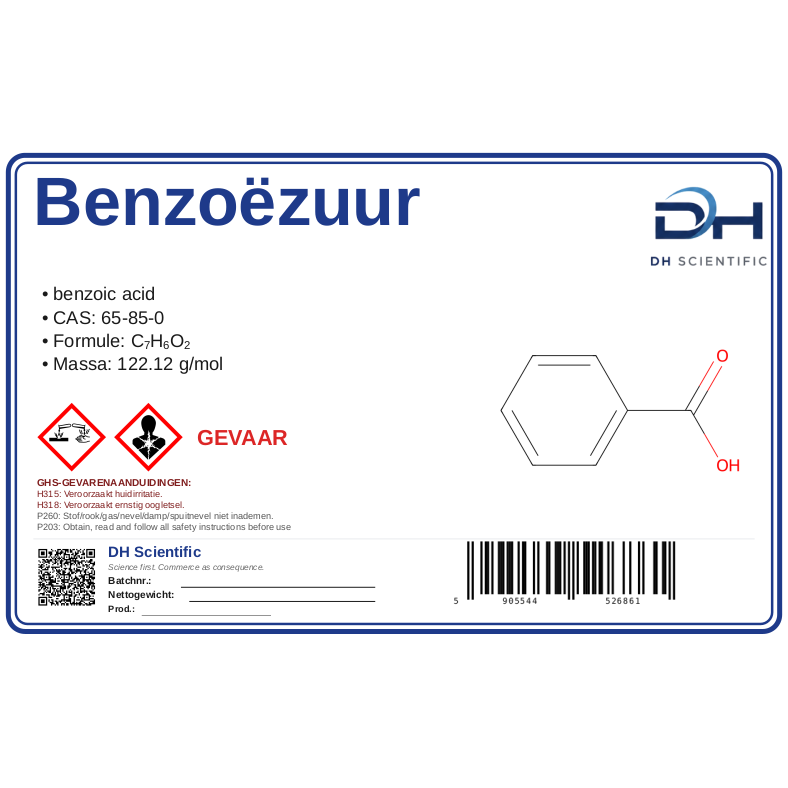
Benzoëzuur• benzoic acid• CAS: 65-85-0• Formule: C7H6O2• Massa: 122.12 g/molGEVAARGHS-GEVARENAANDUIDINGEN:H372: Veroorzaakt schade aan organen bij langdurige of herhaalde blootstelling.H315: Veroorzaakt huidirritatie.H318: Veroorzaakt ernstig oogletsel.P302+P352 P305+P351+P338 P332+P313 P310 P314 P280 P501 P260 P264DH ScientificScience first. Commerce as consequence.Batchnr.: Nettogewicht: Prod.:
Deskryptory Lipinskiego (struktura)
ADMET-voorspellingen worden geladen…
🧪 Assistent voor bereiding van oplossingen (Smart Prep) MolGod_PREP_2

Voer in wat u wilt bereiden — ik genereer een SOP

Voorbeelden hieronder — klik om in te voegen:
Voorgedefinieerde recepten:
📚 Overzicht van de wetenschappelijke literatuur — CAS 65-85-0MolGod_LITHUB_MAIN
⭐ Belangrijkste bevindingen (wetenschappelijke literatuur) 16 publicaties
🏆 CAS 65-85-0 — multi-criteria ranking (W12): 30% citaties · 20% recentheid · 20% onderwerp · 15% historisch · 15% open access.
  1. #1
    Yichen Huang, Lijuan Xiao, LI Fei-yu et al. (2018) · Molecules
    Waarom het belangrijk is: 385 citaties · overzichtsartikel · open access
    SCORE 12.41 Overzicht Citaties: 385 Open Access DOI ↗
  2. #2
    Peng Xu, Wanqi Su, Tobias Ritter (2022) · Chemical Science
    Waarom het belangrijk is: Open access
    SCORE 11.54 Mechanisme Citaties: 78 Open Access DOI ↗
  3. #3
    Hayder M. Issa; Dania H. Mohammed (2025) · Environmental Analysis Health and Toxicology
    Waarom het belangrijk is: Recent (2025) · open access
    SCORE 8.75 Industrie Citaties: 1 Open Access DOI ↗ PubMed ↗
  4. #4
    George T. Furukawa, Robert E. McCoskey, G. J. King (1951) · Journal of research of the National Bureau of Standards
    Waarom het belangrijk is: 135 citaties · historisch artikel (1951) · open access
    SCORE 8.65 Historisch Citaties: 135 Open Access DOI ↗
  5. #5
    Long Xiu-Feng; Xu Yu-Lei; Zhao Xue-Mei (2024) · Scientific Reports
    Waarom het belangrijk is: Recent (2024) · open access
    SCORE 8.48 Mechanisme Citaties: 2 Open Access DOI ↗ PubMed ↗
  6. #6
    et al. (2025) · ChemistryOpen
    Waarom het belangrijk is: Recent (2025) · open access
    SCORE 7.95 Mechanisme Citaties: 1 Open Access DOI ↗ PubMed ↗
  7. #7
    et al. (2026) · World Journal of Microbiology and Biotechnology
    Waarom het belangrijk is: Recent (2026) · open access
    SCORE 7.85 Analytiek Open Access DOI ↗ PubMed ↗
  8. #8
    Pedro H. R. Oliveira, Raísa da R. Reis (2017) · Revista Virtual de Química
    Waarom het belangrijk is: Open access
    SCORE 7.35 Mechanisme Citaties: 9 Open Access DOI ↗
  9. #9
    et al. (2026) · Food Chemistry: X
    Waarom het belangrijk is: Recent (2026) · open access
    SCORE 7.15 Industrie Citaties: 1 Open Access DOI ↗ PubMed ↗
  10. #10
    Hanan Elhaes; Medhat A. Ibrahim (2025) · Scientific Reports
    Waarom het belangrijk is: Recent (2025) · open access
    SCORE 7.15 Mechanisme Citaties: 1 Open Access DOI ↗ PubMed ↗
  11. #11
    et al. (2026) · BMC Chemistry
    Waarom het belangrijk is: Recent (2026) · open access
    SCORE 7.05 Mechanisme Open Access DOI ↗ PubMed ↗
  12. #12
    et al. (2026) · RSC Advances
    Waarom het belangrijk is: Recent (2026) · open access
    SCORE 7.05 Mechanisme Open Access DOI ↗ PubMed ↗
  13. #13
    (2025)
    Waarom het belangrijk is: Recent (2025) · open access
    SCORE 6.25 Mechanisme Open Access DOI ↗ PubMed ↗
  14. #14
    et al. (2026) · PLOS One
    Waarom het belangrijk is: Recent (2026) · open access
    SCORE 6.25 Mechanisme Open Access DOI ↗ PubMed ↗
  15. #15
    et al. (2025) · Animals
    Waarom het belangrijk is: Recent (2025) · open access
    SCORE 6.25 Mechanisme Open Access DOI ↗ PubMed ↗
  16. #16
    Api AM, Belsito D, Botelho D et al. (2022) · Food and chemical toxicology : an international journal published for the British Industrial Biological Research Association
    Waarom het belangrijk is: Geselecteerd op basis van een multicriteria-score (citaties + recentheid + onderwerp + historisch + OA).
    SCORE 5.41 Mechanisme Citaties: 3 DOI ↗ PubMed ↗
📈 HPLC-gradiënt — optimalisator (LSS) SJABLOON

Gradiënt gebaseerd op PubChem XLogP3 + LSS (Snyder et al. 2010, hfdst. 9).

  • Kolom: C18
  • Buffer: phosphate
  • Debiet: 1 mL/min
  • logP: 1.9 (PubChem XLogP3)
  • Ramp: 20% → 95% B, 15 min
  • Totale analysetijd: 28 min
t (min) %A %B flow (mL/min) Opmerking
0 80 20 1 start (evenwicht)
2 80 20 1 einde van de initiële hold
17 5 95 1 einde van de LSS-ramp
22 5 95 1 kolomspoeling
23 80 20 1 terug naar init
28 80 20 1 her-equilibratie
📚 Wetenschappelijke referenties (Chicago Author-Date)
  1. Snyder, Lloyd R., John W. Dolan, and Joseph J. Kirkland. 2010. Introduction to Modern Liquid Chromatography. Wiley. — Chapter 9 — gradient elution, LSS theory (cited as Snyder et al. 2010 in tool description).
  2. Schoenmakers, Peter J. 1986. Optimization of Chromatographic Selectivity: A Guide to Method Development. Elsevier. — Numerical optimization of gradient programs.
  3. Snyder, L. R., and J. W. Dolan. 2007. High-Performance Gradient Elution: The Practical Application of the Linear-Solvent-Strength Model. Wiley. — Foundational LSS reference for the %B_init = 5 + 8·logP heuristic implemented here.
  4. Nikitas, Pavlos, and Adrian Pappa-Louisi. 2009. "Retention models for isocratic and gradient elution in reversed-phase liquid chromatography." Journal of Chromatography A 1216: 1737-1755. [DOI ↗] — Modern review of gradient retention models — basis for non-LSS extensions.
  5. Carr, Peter W.. 2009. "The new physical chemistry of HPLC." Journal of Chromatography A 1216: 1764-1772. [DOI ↗]
  6. Dong, Michael W. 2019. HPLC and UHPLC for Practicing Scientists. Wiley. https://doi.org/10.1002/9781119313793. — Modern UHPLC gradient programming, sub-2 µm scaling rules.
  7. Wu, Naijun, and Anton M. Clausen. 2007. "Fundamental and practical aspects of ultrahigh pressure liquid chromatography for fast separations." Journal of Separation Science 30: 1167-1182. [DOI ↗]
  8. Stoll, Dwight R., and Peter W. Carr. 2017. "Two-Dimensional Liquid Chromatography: A State of the Art Tutorial." Analytical Chemistry 89: 519-531. [DOI ↗] — Reference for orthogonal gradient design (2D-LC second dimension).
  9. Dolan, John W.. 2013. "When to Modify Method Conditions." LCGC North America 31: 192-199.
  10. Meyer, Veronika R. 2010. Practical High-Performance Liquid Chromatography. Wiley. — Chapter 7 — practical gradient design with isokratyczny scouting.

REST: /wp-json/molgod/v1/hplc/gradient/65-85-0

🌈 Detector + golflengte (UV/Vis) 230 nm
VerbindingBenzoic acid
λmax230 nm
λmin270 nm
εmax (M⁻¹·cm⁻¹)11 600
Oplosmiddel (referentie)methanol
Voorgestelde λ230 nm
Aanbevolen detectorUV
AlternatievenPDA/DAD, MS, FLD

Gegevensbron: Skoog 2017, p. 372

⚠ Compatibiliteit met mobiele fase

  • critical λ=230 nm < UV-cutoff Dichloromethane (232 nm) — oplosmiddel absorbeert, meting niet mogelijk.
  • warning λ=230 nm nabij cutoff Acetic acid (1%) (230 nm) — mogelijk basislijnruis en drift, gebruik reagentia van hogere zuiverheid.
📚 Wetenschappelijke referenties (Chicago Author-Date) 10 refs

METODA Methodebibliografie

  1. Skoog, Douglas A., F. James Holler, and Stanley R. Crouch. 2017. "Principles of Instrumental Analysis." 7th ed. Cengage Learning. ISBN 978-1-305-57721-3.
  2. Perkampus, Heinz-Helmut. 1992. "UV-VIS Spectroscopy and Its Applications." Springer. ISBN 978-3-642-77479-9.
  3. Sadek, Paul C.. 2002. "The HPLC Solvent Guide." 2nd ed. Wiley-Interscience. ISBN 978-0-471-41138-4.
  4. Snyder, Lloyd R., Joseph J. Kirkland, and John W. Dolan. 2010. "Introduction to Modern Liquid Chromatography." 3rd ed. Wiley. ISBN 978-0-470-16754-0.
  5. Dong, Michael W.. 2019. "HPLC and UHPLC for Practicing Scientists." 2nd ed. Wiley. ISBN 978-1-119-31378-3.
  6. Meyer, Veronika R.. 2010. "Practical High-Performance Liquid Chromatography." 5th ed. Wiley. ISBN 978-0-470-68218-0.
  7. Stoll, Dwight R., and Peter W. Carr. 2017. "Two-Dimensional Liquid Chromatography: A State of the Art Tutorial." Analytical Chemistry 89: 519-531
  8. Vivó-Truyols, Gabriel, and Hans-Gerd Janssen. 2010. "Probabilistic approach to peak deconvolution in chromatography." Analytical Chemistry 82: 8525-8531
  9. Kazakevich, Yuri V., and Rosario LoBrutto, eds.. 2007. "HPLC for Pharmaceutical Scientists." Wiley-Interscience. ISBN 978-0-471-68162-4.
  10. Kim, Sunghwan, et al.. 2023. "PubChem 2023 update." Nucleic Acids Research 51: D1373-D1380

REST: /wp-json/molgod/v1/hplc/detector/65-85-0

📐 HPLC-pieksymmetriecalculator (USP Tf / As)

Bereken de USP-tailingfactor (Tf) en de asymmetrie (As) uit de piekhalfbreedtes. Voer a (linker halfbreedte) en b (rechter halfbreedte) in, gemeten op 5% of 10% van de piekhoogte.

📚 Referenties (Chicago Author-Date)
  1. USP General Chapter <621>. 2024. "Chromatography." United States Pharmacopeial Convention. [link ↗] — Defines USP Tailing Factor T = (a+b)/(2a) measured at 5% peak height.
  2. International Council for Harmonisation (ICH). 2023. "Validation of Analytical Procedures Q2(R2)." ICH Expert Working Group. [link ↗] — Tailing factor is a system suitability parameter (Section 6).
  3. Foley, Joe P., and John G. Dorsey. 1983. "Equations for calculation of chromatographic figures of merit for ideal and skewed peaks." Analytical Chemistry 55: 730-737 https://doi.org/10.1021/ac00255a033 [link ↗] — Original asymmetry factor As = b/a at 10% height (Foley & Dorsey 1983).
  4. Snyder, Lloyd R., Joseph J. Kirkland, and John W. Dolan. 2010. "Introduction to Modern Liquid Chromatography." Wiley. https://doi.org/10.1002/9780470508183 [link ↗] — Chapter 2.4 — peak shape diagnostics and remedies.
  5. Dolan, John W.. 2003. "Peak tailing and resolution." LCGC North America 21: 610-614 [link ↗] — How tailing factor degrades effective resolution.
  6. Vivó-Truyols, Gabriel, and Hans-Gerd Janssen. 2010. "Probabilistic approach to peak deconvolution in chromatography." Analytical Chemistry 82: 8525-8531 https://doi.org/10.1021/ac101742z [link ↗] — Modern numerical deconvolution for asymmetric peaks.
  7. Kromidas, Stavros. 2017. "HPLC Made to Measure: A Practical Handbook for Optimization." Wiley-VCH. — Practical Tf and As thresholds for routine QC.
  8. Dong, Michael W.. 2019. "HPLC and UHPLC for Practicing Scientists." Wiley. https://doi.org/10.1002/9781119313793 [link ↗]
  9. Meyer, Veronika R.. 2010. "Practical High-Performance Liquid Chromatography." Wiley.
  10. Heyden, Yvan Vander, et al.. 2009. "Robustness of pharmaceutical liquid chromatographic methods." Journal of Chromatography B 877: 2120-2129 https://doi.org/10.1016/j.jchromb.2008.10.052 [link ↗]
📊 Calculator voor resolutie en schotelgetal (Rs, N, H)

Bereken de resolutie Rs, het aantal theoretische schotels N en de HETP (H) voor een paar HPLC-pieken. Voer de retentietijden, piekbreedtes (op 50% of aan de basis) en de kolomlengte in.

📚 Referenties (Chicago Author-Date)
  1. Snyder, Lloyd R., Joseph J. Kirkland, and John W. Dolan. 2010. "Introduction to Modern Liquid Chromatography." 3rd ed. John Wiley & Sons. ISBN 978-0-470-16754-0. https://doi.org/10.1002/9780470508183 [link ↗] — Chapter 2 covers resolution, plate count and HETP fundamentals (Snyder et al. 2010).
  2. USP General Chapter <621>. 2024. "Chromatography." USP-NF 2024 ed. United States Pharmacopeial Convention. [link ↗] — Defines Rs >= 1.5 acceptance criterion and N calculation methods.
  3. Dolan, John W.. 2003. "How much resolution is enough?." LCGC North America 21: 350-353 [link ↗] — Practical guidance on Rs targets for routine method development.
  4. Van Deemter, J. J., F. J. Zuiderweg, and A. Klinkenberg. 1956. "Longitudinal diffusion and resistance to mass transfer as causes of nonideality in chromatography." Chemical Engineering Science 5: 271-289 https://doi.org/10.1016/0009-2509(56)80003-1 [link ↗] — Origin of N = 5.54·(tr/w0.5)² half-height plate count formulation.
  5. Giddings, J. Calvin. 1965. "Dynamics of Chromatography, Part I: Principles and Theory." Marcel Dekker. ISBN 978-0-8247-1357-7. — Resolution equation Rs = (1/4)·√N·(α-1)/α·k/(1+k) (master equation).
  6. Foley, Joe P., and John G. Dorsey. 1983. "Equations for calculation of chromatographic figures of merit for ideal and skewed peaks." Analytical Chemistry 55: 730-737 https://doi.org/10.1021/ac00255a033 [link ↗] — Skewed-peak corrections to apparent N.
  7. Knox, John H.. 1977. "Practical aspects of LC theory." Journal of Chromatographic Science 15: 352-364 https://doi.org/10.1093/chromsci/15.9.352 [link ↗]
  8. Carr, Peter W.. 2009. "The new physical chemistry of HPLC." Journal of Chromatography A 1216: 1764-1772 https://doi.org/10.1016/j.chroma.2008.11.094 [link ↗]
  9. Dong, Michael W.. 2019. "HPLC and UHPLC for Practicing Scientists." 2nd ed. Wiley. ISBN 978-1-119-31378-3. https://doi.org/10.1002/9781119313793 [link ↗]
  10. Meyer, Veronika R.. 2010. "Practical High-Performance Liquid Chromatography." 5th ed. Wiley. ISBN 978-0-470-68218-0.
🧪 System Suitability — live calculator (USP <621>)

Voer gegevens van 5-6 injecties in (areas, tr, tailing, plates) — de calculator berekent %RSD, gemiddelden en controleert de conformiteit met USP <621>. Je kunt CSV plakken (door komma's gescheiden) of afzonderlijke waarden bewerken.

📚 Referenties (Chicago Author-Date)
  1. USP General Chapter <621>. 2024. "Chromatography (System Suitability section)." USP-NF 2024 ed. United States Pharmacopeial Convention. [link ↗] — Defines RSD area < 2%, tailing < 2.0, N > 2000 acceptance criteria.
  2. International Council for Harmonisation (ICH). 2023. "Validation of Analytical Procedures Q2(R2)." ICH Expert Working Group. [link ↗] — Section 5.4 — system suitability is part of method validation.
  3. US Food and Drug Administration (FDA). 2018. "Reviewer Guidance: Validation of Chromatographic Methods." US Food and Drug Administration. [link ↗] — CDER reviewer perspective on chromatographic validation expectations.
  4. Snyder, Lloyd R., Joseph J. Kirkland, and John W. Dolan. 2010. "Introduction to Modern Liquid Chromatography." 3rd ed. Wiley. — Chapter 2 — system suitability fundamentals (RSD, Tf, N).
  5. Heyden, Yvan Vander, et al.. 2009. "Robustness of pharmaceutical liquid chromatographic methods." — Robustness vs. system suitability — design-of-experiments framework.
  6. Rozet, Eric, et al.. 2013. "Analysis of recent pharmaceutical regulatory documents on analytical method validation."
  7. European Medicines Agency (EMA). 2011. "Guideline on bioanalytical method validation EMEA/CHMP/EWP/192217/2009." EMA. [link ↗] — EMA companion guideline with bioanalytical SS criteria.
  8. Dong, Michael W.. 2019. "HPLC and UHPLC for Practicing Scientists." 2nd ed. Wiley. — UHPLC-specific suitability adjustments (n=5 vs. n=6).
  9. Kazakevich, Yuri V., and Rosario LoBrutto, eds.. 2007. "HPLC for Pharmaceutical Scientists." Wiley-Interscience.
  10. AOAC International. 2016. "Appendix F: Guidelines for Standard Method Performance Requirements." AOAC INTERNATIONAL. [link ↗] — Alternative SS thresholds for food/dietary samples.
⚗️ Jonizacja w funkcji pH (Henderson-Hasselbalch)MolGod_PHION_1

Typ: Kwas · pKa: 4.2

024681012140%50%100%% zjonizowany% niejonowypH
pH% jonowy% niejonowy
00.0 %100.0 %
20.6 %99.4 %
438.7 %61.3 %
698.4 %1.6 %
8100.0 %0.0 %
10100.0 %0.0 %
12100.0 %0.0 %
14100.0 %0.0 %
Źródła dla tej substancji (8)
  • CRC Handbook 91st ed.
    Lide, David R., ed. 2010. CRC Handbook of Chemistry and Physics. 91st ed. Boca Raton, FL: CRC Press.
  • CRC Handbook 105th ed.
    Rumble, John R., Thomas J. Bruno, Maria J. Doa, and Donald R. Burgess, eds. 2024. CRC Handbook of Chemistry and Physics. 105th ed. Boca Raton, FL: CRC Press.
  • NIST WebBooklink
    Linstrom, Peter J., and William G. Mallard, eds. 2024. NIST Chemistry WebBook. NIST Standard Reference Database Number 69. Gaithersburg, MD: National Institute of Standards and Technology.
  • PubChem CID 243link
    Kim, Sunghwan, Jie Chen, Tiejun Cheng, Asta Gindulyte, Jia He, Siqian He, Qingliang Li, et al. 2023. "PubChem 2023 update." Nucleic Acids Research 51 (D1): D1373-D1380. PubChem CID 243.
  • DrugBank DB03793link
    Knox, Craig, Mike Wilson, Christen M. Klinger, Mark Franklin, Eponine Oler, Alex Wilson, Allison Pon, et al. 2024. "DrugBank 6.0: the DrugBank Knowledgebase for 2024." Nucleic Acids Research 52 (D1): D1265-D1275. DrugBank ID DB03793.
  • ChEMBL CHEMBL541link
    Zdrazil, Barbara, Eloy Felix, Fiona Hunter, Emma J. Manners, James Blackshaw, Sybilla Corbett, Marleen de Veij, et al. 2024. "The ChEMBL Database in 2023." Nucleic Acids Research 52 (D1): D1180-D1192. ChEMBL ID CHEMBL541.
  • IUPAC
    Serjeant, E. P., and Boyd Dempsey. 1979. Ionisation Constants of Organic Acids in Aqueous Solution. IUPAC Chemical Data Series No. 23. Oxford: Pergamon Press.
  • NIST
    Goldberg, Robert N., Nand Kishore, and Rebecca Lennen. 2002. "Thermodynamic Quantities for the Ionization Reactions of Buffers." Journal of Physical and Chemical Reference Data 31 (2): 231-370.
Bibliografia metody (Chicago)
  • Henderson, L. J. 1908. "Concerning the Relationship between the Strength of Acids and Their Capacity to Preserve Neutrality." American Journal of Physiology 21 (4): 173-179.
  • Hasselbalch, K. A. 1917. "Die Berechnung der Wasserstoffzahl des Blutes aus der freien und gebundenen Kohlensäure desselben." Biochemische Zeitschrift 78: 112-144.
  • Po, Henry N., and N. M. Senozan. 2001. "The Henderson-Hasselbalch Equation: Its History and Limitations." Journal of Chemical Education 78 (11): 1499-1503.
  • Avdeef, Alex. 2012. "Absorption and Drug Development: Solubility, Permeability, and Charge State." 2nd ed. Wiley.
  • Avdeef, Alex. 2007. "Solubility of sparingly-soluble ionizable drugs." Advanced Drug Delivery Reviews 59 (7): 568-590.
  • Volgyi, Gergely, et al. 2007. "Potentiometric and spectrophotometric pKa determination of water-insoluble compounds." Analytica Chimica Acta 583 (2): 418-428.
  • Fini, Adamo, Giuseppe Fazio, and Giuseppina Feroci. 1997. "Solubility and solubilization properties of non-steroidal anti-inflammatory drugs." Pharmaceutica Acta Helvetiae 70 (4): 305-318.
  • Mauger, John W., Anthony N. Paruta, and Robert J. Gerraughty. 1972. "Solubilities of sulfadiazine, sulfisomidine, and sulfadimethoxine." Journal of Pharmaceutical Sciences 61 (1): 94-97.
  • Lyman, Warren J., William F. Reehl, and David H. Rosenblatt. 1990. "Handbook of Chemical Property Estimation Methods." American Chemical Society.
  • Marcus, Yizhak. 1998. "The Properties of Solvents." Wiley.
  • Serjeant, E. P., and Boyd Dempsey. 1979. Ionisation Constants of Organic Acids in Aqueous Solution. IUPAC Chemical Data Series No. 23. Oxford: Pergamon Press.
  • Perrin, Douglas D. 1965. Dissociation Constants of Organic Bases in Aqueous Solution. IUPAC. London: Butterworths.
  • Goldberg, Robert N., Nand Kishore, and Rebecca Lennen. 2002. "Thermodynamic Quantities for the Ionization Reactions of Buffers." Journal of Physical and Chemical Reference Data 31 (2): 231-370.
  • Rumble, John R., Thomas J. Bruno, Maria J. Doa, and Donald R. Burgess, eds. 2024. CRC Handbook of Chemistry and Physics. 105th ed. Boca Raton, FL: CRC Press.
  • Lide, David R., ed. 2010. CRC Handbook of Chemistry and Physics. 91st ed. Boca Raton, FL: CRC Press.
  • Kim, Sunghwan, Jie Chen, Tiejun Cheng, Asta Gindulyte, Jia He, Siqian He, Qingliang Li, et al. 2023. "PubChem 2023 update." Nucleic Acids Research 51 (D1): D1373-D1380.
  • Knox, Craig, Mike Wilson, Christen M. Klinger, Mark Franklin, Eponine Oler, Alex Wilson, Allison Pon, et al. 2024. "DrugBank 6.0: the DrugBank Knowledgebase for 2024." Nucleic Acids Research 52 (D1): D1265-D1275.
  • Zdrazil, Barbara, Eloy Felix, Fiona Hunter, Emma J. Manners, James Blackshaw, Sybilla Corbett, Marleen de Veij, et al. 2024. "The ChEMBL Database in 2023." Nucleic Acids Research 52 (D1): D1180-D1192.
  • Kanehisa, Minoru, Miho Furumichi, Yoko Sato, Masayuki Kawashima, and Mari Ishiguro-Watanabe. 2023. "KEGG for taxonomy-based analysis of pathways and genomes." Nucleic Acids Research 51 (D1): D587-D592.
  • Linstrom, Peter J., and William G. Mallard, eds. 2024. NIST Chemistry WebBook. NIST Standard Reference Database Number 69. Gaithersburg, MD: National Institute of Standards and Technology.
  • Nelson, David L., and Michael M. Cox. 2017. Lehninger Principles of Biochemistry. 7th ed. New York: W. H. Freeman.
📈 UV-VIS-spectrumvoorspeller (200-400 nm) λmax 230 nm MolGod_UVVIS_1
0%25%50%75%100%200250300350400230 nmA = ε·c·lA / Aₘₐₓ (%)
VerbindingBenzoic acid
λmax230 nm
λmin270 nm
εmax (M⁻¹·cm⁻¹)11 600
Oplosmiddel (query)water
Oplosmiddel (referentie)methanol
Concentratie (M)1e-4
Weglengte (cm)1
FWHM van de curve80 nm

Model: gausscurve gecentreerd op λmax, geschaald volgens de wet van Beer-Lambert A = ε · c · l. Transmissie T = 10^(-A) · 100%.

📚 Wetenschappelijke referenties (Chicago Author-Date)
  1. Kintigh PA; Singh U; Pawge G; Bashir S; Hsiao CC; Wiemer AJ. 2026. "Benzoic Acid Derivatives Improve Plasma Stability of Diester Butyrophilin Ligand Prodrugs." Journal of medicinal chemistry. https://doi.org/10.1021/acs.jmedchem.5c03034. [DOI]
  2. Ma Y; Mai X; Fan W; Sun X; He Y; Zhang J. 2026. "Co-exposure to benzoic acid and acesulfame K synergistically induces nephrotoxicity through the CTNNB1/STAT3 axis." Food and chemical toxicology : an international journal published for the British Industrial Biological Research Association. https://doi.org/10.1016/j.fct.2026.116004. [DOI]
  3. Lu Z; Witek W; Ruszkowski M; Imiolczyk B; Paulish N; Joshi J. 2025. "Benzoic and salicylic acids inhibit β-substituted alanine synthase 4;1 in common bean." Plant physiology. https://doi.org/10.1093/plphys/kiaf485. [DOI]
  4. Hoti D; Nixha AR; Duran HE; Arslan M; Yıldıztekin G; Ece A. 2025. "Phthalimide-benzoic acid hybrids as potent aldose reductase inhibitors: Synthesis, enzymatic kinetics, and in silico characterization." Bioorganic & medicinal chemistry. https://doi.org/10.1016/j.bmc.2025.118416. [DOI]
  5. Erdogan MS; Bekmezci M; Ertas NY; Bayat R; Sen F. 2025. "Development of G-Ag and C-Ag Nanoparticle-Based Biosensor for Benzoic Acid Detection." ChemistryOpen. https://doi.org/10.1002/open.202400418. [DOI]
  6. Abdel-Rheem AA; Radwan AA; Mahrous GM; Shaaban DZ; Alghaith AF; Al-Agamy MH. 2025. "Formulation of topical gel contains a novel benzoic acid derivative for skin infection treatment: in vitro and in vivo evaluations." Drug development and industrial pharmacy. https://doi.org/10.1080/03639045.2025.2464793. [DOI]
  7. Linstrom, Peter J., and William G. Mallard, eds. 2023. NIST Chemistry WebBook, NIST Standard Reference Database Number 69. Gaithersburg, MD: National Institute of Standards and Technology. [DOI]
  8. Mayerhöfer, Thomas G., Samir Pahlow, and Jürgen Popp. 2020. "The Bouguer-Beer-Lambert Law: Shining Light on the Obscure." ChemPhysChem 21 (18): 2029-2046. [DOI]
  9. Skoog, Douglas A., F. James Holler, and Stanley R. Crouch. 2017. Principles of Instrumental Analysis. 7th ed. Boston: Cengage Learning. ISBN 978-1-305-57721-3.
  10. Lindon, John C., George E. Tranter, and David W. Koppenaal, eds. 2017. "Encyclopedia of Spectroscopy and Spectrometry." 3rd ed. Amsterdam: Academic Press. ISBN 978-0-12-803224-4.
  11. Field, Leslie D., Sev Sternhell, and John R. Kalman. 2013. "Organic Structures from Spectra." 5th ed. Chichester: Wiley. ISBN 978-1-119-96582-6.
  12. Reusch, William. 2013. "Virtual Textbook of Organic Chemistry: Spectroscopy." East Lansing, MI: Michigan State University.
  13. Lampman, Gary M., Donald L. Pavia, George S. Kriz, and James R. Vyvyan. 2010. "Spectroscopy." 4th ed. Belmont, CA: Cengage Learning. ISBN 978-0-495-88992-9.
  14. Kalsi, P. S. 2010. "Spectroscopy of Organic Compounds." 6th ed. New Delhi: New Age International. ISBN 978-81-224-2032-9.
  15. Williams, Dudley H., and Ian Fleming. 2008. "Spectroscopic Methods in Organic Chemistry." 6th ed. London: McGraw-Hill. ISBN 978-0-07-711559-0.
  16. Sadek, Paul C. 2002. The HPLC Solvent Guide. 2nd ed. Hoboken: Wiley. ISBN 978-0-471-41242-2.
  17. Banwell, Colin N., and Elaine M. McCash. 1994. "Fundamentals of Molecular Spectroscopy." 4th ed. London: McGraw-Hill. ISBN 978-0-07-707976-1.
  18. Perkampus, Heinz-Helmut. 1992. UV-VIS Spectroscopy and Its Applications. Berlin: Springer. https://doi.org/10.1007/978-3-642-77479-9.
  19. Fieser, Louis F. 1949. "Extension of Woodward's Rules for Prediction of Conjugated Diene Absorption." Journal of the American Chemical Society 71 (5): 1854-1857. [DOI]
  20. Woodward, Robert B. 1942. "Structure and the Absorption Spectra of Alpha,Beta-Unsaturated Ketones." Journal of the American Chemical Society 64 (1): 72-75. [DOI]
  21. Beer, August. 1852. "Bestimmung der Absorption des rothen Lichts in farbigen Flüssigkeiten." Annalen der Physik und Chemie 86: 78-88. https://doi.org/10.1002/andp.18521620505.
  22. Lambert, Johann Heinrich. 1760. Photometria. Augsburg: Sumptibus Vidae.

📖 Wartość λmax = 230 nm pochodzi z bazy/literatury. Brak niezależnego potwierdzenia krzyżowego (NIST / CrossRef / PubChem) — weryfikacja krzyżowa niedostępna.

REST: /wp-json/molgod/v1/spectra/uv-vis/65-85-0?solvent=water&path_length_cm=1

🧪 Klassieke syntheseroutes1 historyczna trasaMolGod_SYNTH_2

Historisch geverifieerde syntheseroutes. Citaten in Chicago author-date-stijl.

Route 1: Cannizzaro disproportionation of benzaldehyde (gives benzoic acid + benzyl alcohol) (1853)
Naamreactie: Cannizzaro reaction
Uitgangsstoffen: Benzaldehyde (no alpha-H); concentrated NaOH (50%)
Omstandigheden: EtOH/H2O 60 C, 4 h; extract benzyl alcohol with Et2O; acidify aqueous to crystallize benzoic acid
Opbrengst: 50.0 %
Cannizzaro, Stanislao. 1853. "Ueber den der Benzoësäure entsprechenden Alkohol." Annalen der Chemie und Pharmacie 88 (1): 129-130.
Algemene bibliografie (Chicago):
  • March, Jerry, and Michael B. Smith. 2020. "March's Advanced Organic Chemistry: Reactions, Mechanisms, and Structure." 8th ed. Wiley.
  • Carey, Francis A., and Richard J. Sundberg. 2007. "Advanced Organic Chemistry, Part B: Reactions and Synthesis." 5th ed. Springer.
  • Corey, E. J., and Xue-Min Cheng. 1995. "The Logic of Chemical Synthesis." Wiley.
  • Greene, Theodora W., and Peter G. M. Wuts. 2014. "Greene's Protective Groups in Organic Synthesis." 5th ed. Wiley.
  • Smith, Michael B. 2020. "Organic Synthesis." 4th ed. Academic Press.
  • Carey, Francis A., and Richard J. Sundberg. 2007. "Advanced Organic Chemistry, Part A: Structure and Mechanisms." 5th ed. New York: Springer.
  • Anslyn, Eric V., and Dennis A. Dougherty. 2006. Modern Physical Organic Chemistry. Sausalito, CA: University Science Books.
  • Bretherick, Leslie. 1990. Bretherick's Handbook of Reactive Chemical Hazards. 4th ed. London: Butterworths.
  • Urben, Peter, ed. 2017. Bretherick's Handbook of Reactive Chemical Hazards. 8th ed. Oxford: Butterworth-Heinemann.
  • Yoshida, Tadao, Yusaku Iwata, Hiroshi Itoh, and Mitsuru Arai. 2009. Safe Storage of Reactive Chemicals. New York: Plenum Press.
  • Mortimer, Charles E. 2005. Chemistry: A Conceptual Approach. 9th ed. Belmont, CA: Wadsworth.
  • Engel, Thomas, and Philip Reid. 2013. Physical Chemistry. 3rd ed. Boston: Pearson.
  • Steinfeld, Jeffrey I., Joseph S. Francisco, and William L. Hase. 1998. Chemical Kinetics and Dynamics. 2nd ed. Upper Saddle River, NJ: Prentice Hall.
  • Houston, Paul L. 2001. Chemical Kinetics and Reaction Dynamics. New York: McGraw-Hill.
  • Eyring, Henry. 1935. "The Activated Complex in Chemical Reactions." Journal of Chemical Physics 3 (2): 107–115. https://doi.org/10.1063/1.1749604.
  • Kresge, A. Jerry. 2001. "Reaction kinetics in 100-year-old laboratories." Chemical Society Reviews 30 (4): 197–200. https://doi.org/10.1039/B100445F.
  • Brönsted, J. N. 1929. "Acid and Basic Catalysis." Chemical Reviews 5 (3): 231–338. https://doi.org/10.1021/cr60019a001.
  • Larock, Richard C. 2018. Comprehensive Organic Transformations: A Guide to Functional Group Preparations. 3rd ed. Hoboken, NJ: John Wiley & Sons.
  • Mundy, Bradford P., Michael G. Ellerd, and Frank G. Favaloro Jr. 2005. Name Reactions and Reagents in Organic Synthesis. 2nd ed. Hoboken, NJ: Wiley-Interscience.
  • Li, Jie Jack. 2014. Name Reactions: A Collection of Detailed Mechanisms and Synthetic Applications. 5th ed. Heidelberg: Springer.
  • Kürti, László, and Barbara Czakó. 2005. Strategic Applications of Named Reactions in Organic Synthesis. Burlington, MA: Elsevier Academic Press.
  • Trost, Barry M., and Ian Fleming, eds. 1991. Comprehensive Organic Synthesis: Selectivity, Strategy, and Efficiency in Modern Organic Chemistry. 9 vols. Oxford: Pergamon Press.
  • Ojima, Iwao, ed. 2010. Catalytic Asymmetric Synthesis. 3rd ed. Hoboken, NJ: John Wiley & Sons.
  • Jacobsen, Eric N., Andreas Pfaltz, and Hisashi Yamamoto, eds. 1999. Comprehensive Asymmetric Catalysis. 3 vols. Berlin: Springer.
  • Hartwig, John F. 2010. Organotransition Metal Chemistry: From Bonding to Catalysis. Sausalito, CA: University Science Books.
  • Crabtree, Robert H. 2014. The Organometallic Chemistry of the Transition Metals. 6th ed. Hoboken, NJ: John Wiley & Sons.
  • Negishi, Ei-ichi, ed. 2002. Handbook of Organopalladium Chemistry for Organic Synthesis. 2 vols. New York: Wiley-Interscience.
  • de Meijere, Armin, and François Diederich, eds. 2004. Metal-Catalyzed Cross-Coupling Reactions. 2nd ed. 2 vols. Weinheim: Wiley-VCH.
  • Berkessel, Albrecht, and Harald Gröger. 2005. Asymmetric Organocatalysis: From Biomimetic Concepts to Applications in Asymmetric Synthesis. Weinheim: Wiley-VCH.
  • Dalko, Peter I., ed. 2007. Enantioselective Organocatalysis: Reactions and Experimental Procedures. Weinheim: Wiley-VCH.
  • List, Benjamin, Richard A. Lerner, and Carlos F. Barbas III. 2000. "Proline-catalyzed direct asymmetric aldol reactions." Journal of the American Chemical Society 122 (10): 2395–2396. https://doi.org/10.1021/ja994280y.
  • MacMillan, David W. C. 2008. "The advent and development of organocatalysis." Nature 455 (7211): 304–308. https://doi.org/10.1038/nature07367.
  • Noyori, Ryōji. 2002. "Asymmetric catalysis: science and opportunities (Nobel lecture)." Angewandte Chemie International Edition 41 (12): 2008–2022. https://doi.org/10.1002/1521-3773(20020617)41:12<2008::AID-ANIE2008>3.0.CO;2-4.
  • Sharpless, K. Barry. 2002. "Searching for new reactivity (Nobel lecture)." Angewandte Chemie International Edition 41 (12): 2024–2032. https://doi.org/10.1002/1521-3773(20020617)41:12<2024::AID-ANIE2024>3.0.CO;2-O.
  • Knowles, William S. 2002. "Asymmetric hydrogenations (Nobel lecture)." Angewandte Chemie International Edition 41 (12): 1998–2007. https://doi.org/10.1002/1521-3773(20020617)41:12<1998::AID-ANIE1998>3.0.CO;2-8.
  • Grubbs, Robert H. 2006. "Olefin-metathesis catalysts for the preparation of molecules and materials (Nobel lecture)." Angewandte Chemie International Edition 45 (23): 3760–3765. https://doi.org/10.1002/anie.200600680.
  • Schrock, Richard R. 2006. "Multiple metal-carbon bonds for catalytic metathesis reactions (Nobel lecture)." Angewandte Chemie International Edition 45 (23): 3748–3759. https://doi.org/10.1002/anie.200600085.
  • Suzuki, Akira. 2011. "Cross-coupling reactions of organoboranes: an easy way to construct C-C bonds (Nobel lecture)." Angewandte Chemie International Edition 50 (30): 6722–6737. https://doi.org/10.1002/anie.201101379.
  • Negishi, Ei-ichi. 2011. "Magical power of transition metals: past, present, and future (Nobel lecture)." Angewandte Chemie International Edition 50 (30): 6738–6764. https://doi.org/10.1002/anie.201101380.
  • List, Benjamin, and David W. C. MacMillan. 2022. "Asymmetric organocatalysis (Nobel lecture)." Angewandte Chemie International Edition 61 (38): e202205927. https://doi.org/10.1002/anie.202205927.
  • Bertozzi, Carolyn R., Morten Meldal, and K. Barry Sharpless. 2023. "Click chemistry and bioorthogonal chemistry (Nobel lectures)." Angewandte Chemie International Edition 62 (16): e202300332. https://doi.org/10.1002/anie.202300332.
  • Weissermel, Klaus, and Hans-Jürgen Arpe. 2003. Industrial Organic Chemistry. 4th ed. Weinheim: Wiley-VCH.
  • Wittcoff, Harold A., Bryan G. Reuben, and Jeffrey S. Plotkin. 2013. Industrial Organic Chemicals. 3rd ed. Hoboken, NJ: John Wiley & Sons.
  • Appl, Max. 2006. "Ammonia, 2. Production Processes." In Ullmann's Encyclopedia of Industrial Chemistry. Weinheim: Wiley-VCH. https://doi.org/10.1002/14356007.o02_o11.
  • Thiemann, Michael, Erich Scheibler, and Karl Wilhelm Wiegand. 2000. "Nitric Acid, Nitrous Acid, and Nitrogen Oxides." In Ullmann's Encyclopedia of Industrial Chemistry. Weinheim: Wiley-VCH. https://doi.org/10.1002/14356007.a17_293.
  • Hocking, Martin B. 2005. Handbook of Chemical Technology and Pollution Control. 3rd ed. Burlington, MA: Academic Press.
  • Corey, E. J., and László Kürti. 2010. Enantioselective Chemical Synthesis: Methods, Logic, and Practice. Direct Book Publishing.
  • Nicolaou, K. C., and E. J. Sorensen. 1996. Classics in Total Synthesis: Targets, Strategies, Methods. Weinheim: VCH.
  • Nicolaou, K. C., and Jason S. Chen. 2011. Classics in Total Synthesis III: Further Targets, Strategies, Methods. Weinheim: Wiley-VCH.
  • House, Herbert O. 1972. Modern Synthetic Reactions. 2nd ed. Menlo Park, CA: W. A. Benjamin.
  • Organic Syntheses, Inc. 2024. "Organic Syntheses Collective Volumes 1–10 (1932–2004) and Annual Volumes 1–100 (1922–2024)." Hoboken, NJ: Wiley. https://www.orgsyn.org/.
  • Paquette, Leo A., David Crich, Philip L. Fuchs, Gary A. Molander, and Andre B. Charette, eds. 2009. Encyclopedia of Reagents for Organic Synthesis (e-EROS). 2nd ed. Hoboken, NJ: Wiley. https://onlinelibrary.wiley.com/doi/book/10.1002/047084289X.
Uitgebreide bibliografie — 7 bronnen (PubMed/CrossRef/EuropePMC)
  • PUBKintigh PA; Singh U; Pawge G; Bashir S; Hsiao CC; Wiemer AJ. 2026. "Benzoic Acid Derivatives Improve Plasma Stability of Diester Butyrophilin Ligand Prodrugs." Journal of medicinal chemistry. https://doi.org/10.1021/acs.jmedchem.5c03034.
  • PUBMa Y; Mai X; Fan W; Sun X; He Y; Zhang J. 2026. "Co-exposure to benzoic acid and acesulfame K synergistically induces nephrotoxicity through the CTNNB1/STAT3 axis." Food and chemical toxicology : an international journal published for the British Industrial Biological Research Association. https://doi.org/10.1016/j.fct.2026.116004.
  • EURGuo Y, Zhang Y, Wang R, Li Y, Wang L, Shi C, Yu X, Ma J, Zhang W, Wang P, Wen P.. 2026. "Unveiling the correlations between benzoic acid content, key microbial genera, and metabolites during the storage and transportation of raw yak milk based on multi-omics analysis." . https://doi.org/10.1016/j.fochx.2026.103556.
  • PUBLu Z; Witek W; Ruszkowski M; Imiolczyk B; Paulish N; Joshi J. 2025. "Benzoic and salicylic acids inhibit β-substituted alanine synthase 4;1 in common bean." Plant physiology. https://doi.org/10.1093/plphys/kiaf485.
  • PUBHoti D; Nixha AR; Duran HE; Arslan M; Yıldıztekin G; Ece A. 2025. "Phthalimide-benzoic acid hybrids as potent aldose reductase inhibitors: Synthesis, enzymatic kinetics, and in silico characterization." Bioorganic & medicinal chemistry. https://doi.org/10.1016/j.bmc.2025.118416.
  • PUBErdogan MS; Bekmezci M; Ertas NY; Bayat R; Sen F. 2025. "Development of G-Ag and C-Ag Nanoparticle-Based Biosensor for Benzoic Acid Detection." ChemistryOpen. https://doi.org/10.1002/open.202400418.
  • PUBAbdel-Rheem AA; Radwan AA; Mahrous GM; Shaaban DZ; Alghaith AF; Al-Agamy MH. 2025. "Formulation of topical gel contains a novel benzoic acid derivative for skin infection treatment: in vitro and in vivo evaluations." Drug development and industrial pharmacy. https://doi.org/10.1080/03639045.2025.2464793.
📤 Voeg dit molecuul in op uw site

Heeft u een blog, forum of wetenschappelijke dienst? Voeg het interactieve 3D-molecuul in op uw website — elke lezer ziet het,met daaronder een link naar onze winkel waar hij het reagens kan kopen.

🔗 HTML-iframe-code (het eenvoudigst — werkt overal)

Kopieer en plak in de HTML-editor van uw site:

Pas width en height aan je lay-out aan.

⚙ WordPress Shortcode (voor andere winkels met MOL-GOD)

🌐 Directe link (voor e-mails, chats, LinkedIn, Twitter)

LinkedIn Twitter/X Facebook
QR code CAS 65-85-0

📱 QR code (voor het afdrukken op flyers / etiketten / catalogi)

Plaats het in een productcatalogus, op een fleslabel of een flyer. De klant scant het — ziet het 3D-molecuul op zijn telefoon, met een link naar uw winkel.

⬇ PNG downloaden

🖼 Open Graph image (voor social-media-metatags)

Wanneer u de link deelt, haalt Facebook/LinkedIn/Discord automatisch het afbeeldingsvoorbeeld op:

Preview
📋 Licentie: De embed behoudt een backlink naar DH Scientific (vereist — de winkel is de gegevensbron). Chemische gegevens zijn afkomstig van PubChem (CC0 — publiek domein). De embed is GRATIS voor educatief, commercieel en hobbygebruik.
📚 REFERENTIES (Verzamelde bibliografie, Chicago Author-Date) 127 items

Alle wetenschappelijke bronnen die in de accordeons hierboven voor CAS 65-85-0 worden geciteerd.Formaat: Chicago Manual of Style 17e ed., Author-Date-systeem.

🗄️ Wetenschappelijke databanken

  1. NIST. n.d. NIST Chemistry WebBook: CAS 65-85-0. Gaithersburg, MD: National Institute of Standards and Technology. https://webbook.nist.gov/cgi/cbook.cgi?ID=65-85-0.
  2. AIST. n.d. Spectral Database for Organic Compounds (SDBS): CAS 65-85-0. Tsukuba, Japan: National Institute of Advanced Industrial Science and Technology. https://sdbs.db.aist.go.jp/.
  3. Linstrom, Peter J., and William G. Mallard, eds. n.d. NIST Chemistry WebBook: NIST Standard Reference Database Number 69. Gaithersburg, MD: National Institute of Standards and Technology. https://doi.org/10.18434/T4D303.
  4. PubChem. n.d. PubChem Compound Summary: CAS 65-85-0. Bethesda, MD: National Center for Biotechnology Information (NCBI), National Library of Medicine. https://pubchem.ncbi.nlm.nih.gov/#query=65-85-0.
  5. U.S. EPA. n.d. CompTox Chemicals Dashboard: CAS 65-85-0. Research Triangle Park, NC: U.S. Environmental Protection Agency. https://comptox.epa.gov/dashboard/chemical/details/DTXSID6020143.

📐 Standaarden / Richtlijnen

  1. ICH. 2003. "Stability Testing of New Drug Substances and Products: Q1A(R2)." Geneva: International Council for Harmonisation of Technical Requirements for Pharmaceuticals for Human Use. https://database.ich.org/sites/default/files/Q1A%28R2%29%20Guideline.pdf.
  2. National Fire Protection Association (NFPA). 2024. "NFPA 30: Flammable and Combustible Liquids Code." NFPA, Quincy, MA. https://www.nfpa.org/codes-and-standards/all-codes-and-standards/list-of-codes-and-standards/detail?code=30.
  3. Occupational Safety and Health Administration (OSHA). 2023. "29 CFR 1910.106 — Flammable Liquids." U.S. Department of Labor, Federal Register. https://www.osha.gov/laws-regs/regulations/standardnumber/1910/1910.106.
  4. European Chemicals Agency (ECHA). 2024. "Annex VI to Regulation (EC) No 1272/2008 (CLP) — Harmonised Classification and Labelling." ECHA, Helsinki / Official Journal of the European Union. https://echa.europa.eu/regulations/clp/clp-classification.
  5. European Committee for Standardization (CEN). 2016. "EN 374-1:2016 — Protective gloves against dangerous chemicals and micro-organisms — Part 1: Terminology and performance requirements for chemical risks." CEN, Brussels. https://standards.cencenelec.eu/dyn/www/f?p=205:110:::::FSP_PROJECT,FSP_ORG_ID:38536,6080&cs=1B0DAA8B85DF42E4A2C70E5D71F0BFA32.
  6. European Committee for Standardization (CEN). 2001. "EN 166:2001 — Personal eye-protection — Specifications." CEN, Brussels. https://standards.cencenelec.eu/dyn/www/f?p=CEN:110:0::::FSP_PROJECT:6541&cs=1F1A4E0A78C4DB6A28DBE2E8C29D89DCF.
  7. European Committee for Standardization (CEN). 2009. "EN 14605:2005+A1:2009 — Protective clothing against liquid chemicals — Performance requirements for clothing with liquid-tight (Type 3) or spray-tight (Type 4) connections." CEN, Brussels. https://standards.cencenelec.eu/dyn/www/f?p=CEN:110:0::::FSP_PROJECT:21581&cs=1A04A2D3C7CC58E9E6CB58D55F7EBFB7E.
  8. National Institute for Occupational Safety and Health (NIOSH). 2017. "Recommendations for Chemical Protective Clothing: A Companion to the NIOSH Pocket Guide." U.S. Department of Health & Human Services / CDC. https://www.cdc.gov/niosh/ncpc/default.html.
  9. Occupational Safety and Health Administration (OSHA). 2011. "Personal Protective Equipment — General requirements." U.S. Department of Labor — 29 CFR 1910.132. https://www.osha.gov/laws-regs/regulations/standardnumber/1910/1910.132.

📖 Boeken

  1. Hansen, Charles M. 2007. Hansen Solubility Parameters: A User's Handbook, 2nd ed.. Boca Raton, FL: CRC Press. https://www.routledge.com/Hansen-Solubility-Parameters-A-Users-Handbook/Hansen/p/book/9780849372483.
  2. Barton, Allan F. M. 1991. CRC Handbook of Solubility Parameters and Other Cohesion Parameters: 2nd ed.. Boca Raton, FL: CRC Press. https://www.routledge.com/CRC-Handbook-of-Solubility-Parameters-and-Other-Cohesion-Parameters/Barton/p/book/9780849301766.
  3. Connors, Kenneth A., Gordon L. Amidon, and Valentino J. Stella. 1986. Chemical Stability of Pharmaceuticals: A Handbook for Pharmacists, 2nd ed.. New York: Wiley. https://doi.org/10.1002/0471734683.
  4. Rumble, John R., ed. 2019. CRC Handbook of Chemistry and Physics: 100th Edition. Boca Raton, FL: CRC Press. https://hbcp.chemnetbase.com/.
  5. Urben, Peter G. 2017. Bretherick's Handbook of Reactive Chemical Hazards, 8th Edition. Academic Press / Elsevier, Oxford. https://www.sciencedirect.com/book/9780081010594.

📄 Wetenschappelijke artikelen (peer-reviewed)

  1. Stefanis, Emmanuel, and Costas Panayiotou. 2008. "Prediction of Hansen Solubility Parameters with a New Group-Contribution Method." International Journal of Thermophysics 29: 568-585. https://doi.org/10.1007/s10765-008-0415-z.
  2. Stoll, Vincent S., and John S. Blanchard. 1990. "Buffers: Principles and Practice: In Methods in Enzymology, vol. 182." San Diego: Academic Press. https://doi.org/10.1016/0076-6879(90)82008-P.

🌐 Websites

  1. ECHA. 2023. "Guidance on the Application of the CLP Criteria." European Chemicals Agency. https://echa.europa.eu/guidance-documents/guidance-on-clp.
  2. European Parliament. 2006. "Regulation (EC) No 1907/2006 (REACH)." Official Journal of the European Union L 396: 1–849.
  3. ECHA. 2023. "Candidate List of Substances of Very High Concern for Authorisation." European Chemicals Agency. https://echa.europa.eu/candidate-list-table.
  4. European Parliament. 2008. "Regulation (EC) No 1272/2008 on Classification, Labelling and Packaging of Substances and Mixtures (CLP)." Official Journal of the European Union L 353: 1–1355.
  5. ECHA. 2017. "Guidance on the Compilation of Safety Data Sheets." Version 3.1. European Chemicals Agency. ECHA-17-G-01-EN. https://echa.europa.eu/documents/10162/23047722/sds_en.pdf.
  6. ECHA. 2022. "Restrictions Under REACH — Annex XVII." European Chemicals Agency. https://echa.europa.eu/substances-restricted-under-reach.
  7. United Nations. 2021. Globally Harmonized System of Classification and Labelling of Chemicals (GHS). 9th revised ed. ST/SG/AC.10/30/Rev.9. New York and Geneva: United Nations. https://unece.org/ghs-rev9-2021.
  8. ECHA. 2020. "Understanding REACH." European Chemicals Agency. https://echa.europa.eu/regulations/reach/understanding-reach.
  9. ECHA — Zalacznik VI do CLP (klasyfikacja zharmonizowana, ATP 23; 2026-07-07) https://echa.europa.eu/information-on-chemicals/annex-vi-to-clp.
  10. U.S. Occupational Safety and Health Administration (2024) — 29 CFR 1910.120 — Hazardous Waste Operations and Emergency Response (HAZWOPER) https://www.osha.gov/hazwoper.
  11. National Fire Protection Association (2018) — NFPA 472: Standard for Competence of Responders to Hazardous Materials/Weapons of Mass Destruction Incidents https://www.nfpa.org/codes-and-standards/nfpa-472.
  12. European Parliament and Council (2012) — Directive 2012/18/EU on the Control of Major-Accident Hazards Involving Dangerous Substances (Seveso III) https://eur-lex.europa.eu/legal-content/EN/TXT/?uri=celex:32012L0018.
  13. U.S. National Institute for Occupational Safety and Health (2024) — NIOSH Pocket Guide to Chemical Hazards https://www.cdc.gov/niosh/npg/.
  14. European Chemicals Agency (2020) — Guidance on the Compilation of Safety Data Sheets (SDS), Version 3.1 https://echa.europa.eu/documents/10162/23047722/sds_en.pdf.
  15. Snyder, Lloyd R., John W. Dolan, and Joseph J. Kirkland. 2010. Introduction to Modern Liquid Chromatography. Wiley.
  16. Schoenmakers, Peter J.. 1986. Optimization of Chromatographic Selectivity: A Guide to Method Development. Elsevier.
  17. Snyder, L. R., and J. W. Dolan. 2007. High-Performance Gradient Elution: The Practical Application of the Linear-Solvent-Strength Model. Wiley.
  18. Nikitas, Pavlos, and Adrian Pappa-Louisi. 2009. "Retention models for isocratic and gradient elution in reversed-phase liquid chromatography." Journal of Chromatography A 1216: 1737-1755. https://doi.org/10.1016/j.chroma.2008.10.005.
  19. Carr, Peter W.. 2009. "The new physical chemistry of HPLC." Journal of Chromatography A 1216: 1764-1772. https://doi.org/10.1016/j.chroma.2008.11.094.
  20. Dong, Michael W.. 2019. HPLC and UHPLC for Practicing Scientists. Wiley. https://doi.org/10.1002/9781119313793.
  21. Wu, Naijun, and Anton M. Clausen. 2007. "Fundamental and practical aspects of ultrahigh pressure liquid chromatography for fast separations." Journal of Separation Science 30: 1167-1182. https://doi.org/10.1002/jssc.200700026.
  22. Stoll, Dwight R., and Peter W. Carr. 2017. "Two-Dimensional Liquid Chromatography: A State of the Art Tutorial." Analytical Chemistry 89: 519-531. https://doi.org/10.1021/acs.analchem.6b03506.
  23. Dolan, John W.. 2013. "When to Modify Method Conditions." LCGC North America 31: 192-199. https://www.chromatographyonline.com/view/when-modify-method-conditions.
  24. Meyer, Veronika R.. 2010. Practical High-Performance Liquid Chromatography. Wiley.
  25. Van Deemter, J. J., F. J. Zuiderweg, and A. Klinkenberg. 1956. "Longitudinal diffusion and resistance to mass transfer as causes of nonideality in chromatography." https://doi.org/10.1016/0009-2509(56)80003-1.
  26. Giddings, J. Calvin. 1965. "Dynamics of Chromatography, Part I: Principles and Theory." Marcel Dekker.
  27. Poppe, Hans. 1997. "Some reflections on speed and efficiency of modern chromatographic methods." https://doi.org/10.1016/S0021-9673(97)00376-2.
  28. Wu, Naijun, and Anton M. Clausen. 2007. "Fundamental and practical aspects of ultrahigh pressure liquid chromatography for fast separations." https://doi.org/10.1002/jssc.200700026.
  29. Carr, Peter W.. 2009. "The new physical chemistry of HPLC." https://doi.org/10.1016/j.chroma.2008.11.094.
  30. Knox, John H.. 1977. "Practical aspects of LC theory." https://doi.org/10.1093/chromsci/15.9.352.
  31. Snyder, L. R., J. J. Kirkland, and J. L. Glajch. 1997. "Practical HPLC Method Development." Wiley.
  32. Engelhardt, Heinz. 2014. "100 Years of Chromatography." Wiley-VCH.
  33. Sadek, Paul C.. 2002. "The HPLC Solvent Guide." Wiley-Interscience.
  34. Snyder, L. R.. 1978. "Classification of the solvent properties of common liquids." https://doi.org/10.1093/chromsci/16.6.223.
  35. Reichardt, Christian, and Thomas Welton. 2010. "Solvents and Solvent Effects in Organic Chemistry." Wiley-VCH.
  36. Vailaya, Anant, and Csaba Horváth. 1998. "Retention thermodynamics in hydrophobic interaction chromatography." https://doi.org/10.1021/ie980212h.
  37. Krstulović, Andrea M., and Phyllis R. Brown. 1981. "Reversed-phase High-Performance Liquid Chromatography." Wiley.
  38. Boysen, Reinhard I., and Milton T. W. Hearn. 2009. "Multi-modal HPLC of proteins." https://doi.org/10.1093/chromsci/47.8.645.
  39. USP General Chapter <621>. 2024. "Chromatography." United States Pharmacopeial Convention. https://www.usp.org/harmonization-standards/pdg/general-chapters/chromatography.
  40. International Council for Harmonisation (ICH). 2023. "Validation of Analytical Procedures Q2(R2)." ICH Expert Working Group. https://database.ich.org/sites/default/files/ICH_Q2-R2_Document_Step4_Guideline_2023_1101.pdf.
  41. Foley, Joe P., and John G. Dorsey. 1983. "Equations for calculation of chromatographic figures of merit for ideal and skewed peaks." https://doi.org/10.1021/ac00255a033.
  42. Snyder, Lloyd R., Joseph J. Kirkland, and John W. Dolan. 2010. "Introduction to Modern Liquid Chromatography." Wiley. https://doi.org/10.1002/9780470508183.
  43. Dolan, John W.. 2003. "Peak tailing and resolution." https://www.chromatographyonline.com/view/peak-tailing-and-resolution.
  44. Vivó-Truyols, Gabriel, and Hans-Gerd Janssen. 2010. "Probabilistic approach to peak deconvolution in chromatography." https://doi.org/10.1021/ac101742z.
  45. Kromidas, Stavros. 2017. "HPLC Made to Measure: A Practical Handbook for Optimization." Wiley-VCH.
  46. Heyden, Yvan Vander, et al.. 2009. "Robustness of pharmaceutical liquid chromatographic methods." https://doi.org/10.1016/j.jchromb.2008.10.052.
  47. United States Pharmacopeial Convention. 2024. "USP <621> Chromatography." In United States Pharmacopeia and National Formulary, USP 47-NF 42. Rockville, MD: USP. https://www.uspnf.com/.
  48. European Pharmacopoeia Commission. 2024. "2.2.46 Chromatographic Separation Techniques." In European Pharmacopoeia, 11th ed. Strasbourg: Council of Europe — EDQM. https://www.edqm.eu/en/european-pharmacopoeia-ph-eur-11th-edition.
  49. International Council for Harmonisation (ICH). 2022. "ICH Q2(R2): Validation of Analytical Procedures." International Council for Harmonisation. https://database.ich.org/sites/default/files/ICH_Q2%28R2%29_Guideline_2022_1130.pdf.
  50. International Council for Harmonisation (ICH). 1996. "ICH Q3A: Impurities in New Drug Substances." International Council for Harmonisation. https://database.ich.org/sites/default/files/Q3A%28R2%29%20Guideline.pdf.
  51. International Organization for Standardization. 2017. "ISO/IEC 17025:2017 General Requirements for the Competence of Testing and Calibration Laboratories." Geneva: ISO. https://www.iso.org/standard/66912.html.
  52. Kolthoff, Izaak Maurits, and Philip J. Elving, eds. 1978. Treatise on Analytical Chemistry, Part I: Theory and Practice. 2nd ed. New York: Wiley-Interscience.
  53. Skoog, Douglas A., F. James Holler, and Stanley R. Crouch. 2018. Principles of Instrumental Analysis. 7th ed. Boston: Cengage Learning.
  54. Christian, Gary D., Purnendu K. Dasgupta, and Kevin A. Schug. 2014. Analytical Chemistry. 7th ed. Hoboken, NJ: Wiley.
  55. EURACHEM/CITAC. 2012. "Quantifying Uncertainty in Analytical Measurement." 3rd ed. EURACHEM/CITAC Guide CG 4. https://www.eurachem.org/images/stories/Guides/pdf/QUAM2012_P1.pdf.
  56. Snyder, Lloyd R., Joseph J. Kirkland, and John W. Dolan. 2010. "Introduction to Modern Liquid Chromatography." John Wiley & Sons. https://doi.org/10.1002/9780470508183.
  57. Dolan, John W.. 2003. "How much resolution is enough?." https://www.chromatographyonline.com/view/how-much-resolution-enough.
  58. USP General Chapter <621>. 2024. "Chromatography (System Suitability section)." United States Pharmacopeial Convention. https://www.usp.org/harmonization-standards/pdg/general-chapters/chromatography.
  59. US Food and Drug Administration (FDA). 2018. "Reviewer Guidance: Validation of Chromatographic Methods." US Food and Drug Administration. https://www.fda.gov/media/74954/download.
  60. Rozet, Eric, et al.. 2013. "Analysis of recent pharmaceutical regulatory documents on analytical method validation." https://doi.org/10.1016/j.chroma.2007.03.111.
  61. European Medicines Agency (EMA). 2011. "Guideline on bioanalytical method validation EMEA/CHMP/EWP/192217/2009." EMA. https://www.ema.europa.eu/en/documents/scientific-guideline/guideline-bioanalytical-method-validation_en.pdf.
  62. Kazakevich, Yuri V., and Rosario LoBrutto, eds.. 2007. "HPLC for Pharmaceutical Scientists." Wiley-Interscience. https://doi.org/10.1002/9780470087954.
  63. AOAC International. 2016. "Appendix F: Guidelines for Standard Method Performance Requirements." AOAC INTERNATIONAL. https://www.aoac.org/wp-content/uploads/2019/08/app_f.pdf.
  64. International Organization for Standardization. 1994. "ISO 5725-2:1994 Accuracy (Trueness and Precision) of Measurement Methods and Results — Part 2: Basic Method for the Determination of Repeatability and Reproducibility of a Standard Measurement Method." Geneva: ISO. https://www.iso.org/standard/11834.html.
  65. Heckert, N. A., and J. J. Filliben. 2003. "NIST/SEMATECH e-Handbook of Statistical Methods." NIST Handbook 151. Gaithersburg, MD: National Institute of Standards and Technology. https://www.itl.nist.gov/div898/handbook/.
  66. Grubbs, Frank E. 1950. "Sample Criteria for Testing Outlying Observations." Annals of Mathematical Statistics 21 (1): 27–58.
  67. Dixon, Wilfrid J. 1950. "Analysis of Extreme Values." Annals of Mathematical Statistics 21 (4): 488–506.
  68. Snedecor, George W., and William G. Cochran. 1989. Statistical Methods. 8th ed. Ames, IA: Iowa State University Press.
  69. Student [William Sealy Gosset]. 1908. "The Probable Error of a Mean." Biometrika 6 (1): 1–25.
  70. International Organization for Standardization. 2005. "ISO 3534-1:2006 Statistics — Vocabulary and Symbols — Part 1: General Statistical Terms and Terms Used in Probability." Geneva: ISO. https://www.iso.org/standard/40145.html.
  71. Thompson, Michael, Stephen L. R. Ellison, and Roger Wood. 2002. "Harmonized Guidelines for Single-Laboratory Validation of Methods of Analysis." Pure and Applied Chemistry 74 (5): 835–855.
  72. United Nations Economic Commission for Europe. 2024. European Agreement Concerning the International Carriage of Dangerous Goods by Road (ADR), Applicable as from 1 January 2025 (ECE/TRANS/352). Geneva: UNECE. https://unece.org/transport/dangerous-goods/adr-2025-edition.
  73. International Air Transport Association. 2026. Dangerous Goods Regulations (DGR). 67th ed. Montreal: IATA. https://www.iata.org/en/programs/cargo/dgr/.
  74. International Maritime Organization. 2024. International Maritime Dangerous Goods (IMDG) Code, 2024 Edition (Amendment 42-24). London: IMO. https://www.imo.org/en/OurWork/Safety/Pages/DangerousGoods-default.aspx.
  75. United Nations. 2025. Recommendations on the Transport of Dangerous Goods: Model Regulations (Orange Book). 24th revised ed. ST/SG/AC.10/1/Rev.24. New York and Geneva: United Nations. https://unece.org/transport/dangerous-goods/un-model-regulations.
  76. International Civil Aviation Organization. 2025. Technical Instructions for the Safe Transport of Dangerous Goods by Air (Doc 9284). 2025–2026 ed. Montreal: ICAO. https://www.icao.int/safety/DangerousGoods/Pages/technical-instructions.aspx.
  77. International Conference on Harmonisation (ICH). 2005. "Validation of Analytical Procedures: Text and Methodology Q2(R1)." ICH Expert Working Group. https://database.ich.org/sites/default/files/Q2%28R1%29%20Guideline.pdf.
  78. United States Pharmacopeia (USP) Convention. 2024. "USP General Chapter <621> Chromatography." USP. https://www.usp.org/sites/default/files/usp/document/harmonization/gen-chapter/g05_pf_30_4_2004.pdf.
  79. European Medicines Agency (EMA). 2011. "Guideline on bioanalytical method validation EMEA/CHMP/EWP/192217/2009." EMA Committee for Medicinal Products for Human Use. https://www.ema.europa.eu/en/documents/scientific-guideline/guideline-bioanalytical-method-validation_en.pdf.
  80. European Commission. 2014. "Commission Decision 2014/955/EU on the list of waste pursuant to Directive 2008/98/EC." Official Journal of the European Union. https://eur-lex.europa.eu/legal-content/EN/TXT/?uri=CELEX:32014D0955.
  81. Ministerstwo Klimatu i Środowiska Rzeczypospolitej Polskiej. 2020. "Rozporządzenie Ministra Klimatu z dnia 2 stycznia 2020 r. w sprawie katalogu odpadów." Dziennik Ustaw RP 2020 poz. 10. https://isap.sejm.gov.pl/isap.nsf/DocDetails.xsp?id=WDU20200000010.
  82. Główny Inspektorat Ochrony Środowiska (GIOŚ). 2024. "Baza Danych O Odpadach (BDO) — System rejestracji firm utylizacyjnych." Ministerstwo Klimatu i Środowiska. https://bdo.mos.gov.pl/.
  83. Polska — Sejm RP. 2012. "Ustawa z dnia 14 grudnia 2012 r. o odpadach." Dz.U. 2013 poz. 21 (z późn. zm.). https://isap.sejm.gov.pl/isap.nsf/DocDetails.xsp?id=WDU20130000021.
  84. Furr, A. Keith, ed.. 2000. "CRC Handbook of Laboratory Safety." CRC Press.
  85. Pohanish, Richard P.. 2017. "Sittig's Handbook of Toxic and Hazardous Chemicals and Carcinogens." Elsevier.
  86. Lewis, Richard J.. 2012. "Sax's Dangerous Properties of Industrial Materials." Wiley.
  87. NIOSH. 2024. "Pocket Guide to Chemical Hazards." U.S. Department of Health and Human Services. https://www.cdc.gov/niosh/npg/.
  88. OSHA. 2024. "Occupational Chemical Database — Hazardous Waste Operations (HAZWOPER)." Occupational Safety and Health Administration. https://www.osha.gov/chemicaldata.
  89. European Parliament and Council. 2008. "Directive 2008/98/EC on waste (Waste Framework Directive)." Official Journal of the European Union L 312/3. https://eur-lex.europa.eu/legal-content/EN/TXT/?uri=CELEX:32008L0098.
  90. European Parliament and Council. 2009. "Regulation (EC) No 1272/2008 (CLP) on classification, labelling and packaging of substances and mixtures." Official Journal of the European Union L 353. https://eur-lex.europa.eu/legal-content/EN/TXT/?uri=CELEX:32008R1272.
  91. United Nations Economic Commission for Europe (UNECE). 2023. "European Agreement concerning the International Carriage of Dangerous Goods by Road (ADR 2025)." UNECE. https://unece.org/transport/standards/transport/dangerous-goods/adr-2025.
  92. IPCS INCHEM. 2024. "International Programme on Chemical Safety — Waste Management Guidelines." WHO/UNEP/ILO. https://www.inchem.org/.
  93. European Parliament and Council. 2006. "Regulation (EC) No 1013/2006 on Shipments of Waste." Official Journal of the European Union L 190: 1–98. https://eur-lex.europa.eu/legal-content/EN/TXT/?uri=CELEX:32006R1013.
  94. International Council for Harmonisation (ICH). 2000. "Q7 Good Manufacturing Practice Guide for Active Pharmaceutical Ingredients." ICH Expert Working Group. https://database.ich.org/sites/default/files/Q7%20Guideline.pdf.
  95. International Organization for Standardization. 2017. "ISO/IEC 17025:2017 General requirements for the competence of testing and calibration laboratories." ISO. https://www.iso.org/standard/66912.html.
  96. World Health Organization. 2010. "WHO Good Manufacturing Practices for Pharmaceutical Products: Main Principles (WHO Technical Report Series No. 957, Annex 3)." WHO Press. https://www.who.int/publications/m/item/trs957-annex3.
  97. International Council for Harmonisation (ICH). 2003. "ICH Q1A(R2): Stability Testing of New Drug Substances and Products." International Council for Harmonisation. https://database.ich.org/sites/default/files/Q1A%28R2%29%20Guideline.pdf.
  98. International Council for Harmonisation (ICH). 2006. "ICH Q3A(R2): Impurities in New Drug Substances." ICH. https://database.ich.org/sites/default/files/Q3A%28R2%29%20Guideline.pdf.
  99. International Council for Harmonisation (ICH). 1999. "ICH Q6A: Specifications for New Drug Substances and Products." ICH. https://database.ich.org/sites/default/files/Q6A%20Guideline.pdf.
  100. International Council for Harmonisation (ICH). 2008. "ICH Q10: Pharmaceutical Quality System." ICH. https://database.ich.org/sites/default/files/Q10%20Guideline.pdf.
  101. U.S. Food and Drug Administration. 2024. "21 CFR Part 211: Current Good Manufacturing Practice for Finished Pharmaceuticals." US Code of Federal Regulations. https://www.ecfr.gov/current/title-21/chapter-I/subchapter-C/part-211.
  102. European Medicines Agency. 2014. "Guideline on Process Validation for Finished Products — Information and Data to Be Provided EMA/CHMP/CVMP/QWP/BWP/70278/2012." European Medicines Agency. https://www.ema.europa.eu/en/documents/scientific-guideline/guideline-process-validation-finished-products-information-data-be-provided-regulatory-submissions-revision-1_en.pdf.
  103. United States Pharmacopeial Convention. 2024. "United States Pharmacopeia and National Formulary, USP 47-NF 42." USP. https://www.uspnf.com/.
  104. European Pharmacopoeia Commission. 2024. "European Pharmacopoeia 11th Edition." Council of Europe — EDQM. https://www.edqm.eu/en/european-pharmacopoeia-ph-eur-11th-edition.
  105. Pharmaceutical Inspection Co-operation Scheme (PIC/S). 2021. "Guide to Good Manufacturing Practice for Medicinal Products PE 009-15." PIC/S Secretariat, Geneva. https://picscheme.org/en/publications.
  106. International Pharmaceutical Excipients Council (IPEC) and Pharmaceutical Quality Group (PQG). 2017. "Joint IPEC-PQG Good Manufacturing Practices Guide for Pharmaceutical Excipients." IPEC-Americas. https://ipecamericas.org/sites/default/files/IPECPQGGMPGuide2017.pdf.
📥 BibTeX downloaden📥 RIS downloadenImporteren in Zotero/Mendeley/EndNote/Papers.