caféine

7,99 

Réactif chimique Kofeina (CAS 58-08-2). Fiche encyclopédique complète — classification, propriétés et données de sécurité — ci-dessous.

🔒 Mode démo — cet article n'est pas à vendre.

Substance légale. dhscientific.com est une démonstration de la plateforme MOL-GOD — nous ne vendons rien et aucune commande n'est traitée. Les substances interdites sont bloquées ici automatiquement à partir du canon réglementaire (comparez p. ex. l'heptachlore).

Audit de votre FDS — gratuit → · Contact

⚠️ Remarque : Cette fiche de données de sécurité est fournie en polonais (élaborée pour le marché polonais ; base juridique : art. 31 REACH ; valeurs limites nationales : PL). Version française en cours.

MolGod_SDSCARD_1
REACH 2020/878
v8 · 23.07.2026
🧬 Visualiseur de molécule 3D
Chargement de la molécule...
Modèle 3D Kofeina, CAS 58-08-2, formule brute C8H10N4O2, masse molaire 194.19 g/mol

Données transcrites à partir de registres réglementaires et de la littérature spécialisée, avec indication de la source et de l'édition. Elles ne remplacent pas la fiche de données de sécurité du fournisseur. Les champs sans source enregistrée sont signalés comme tels.

Aperçu chimique: KofeinaMolGod_OVERVIEW_1
Formule bruteC8H10N4O2[1]
Masse moléculaire194.19 g/mol[1]
Point de fusion235 °C[1][2][3]
Densité1.23 g/cm³[1][2][3]
LogP (lipophilie)-0.07[1][3]
pKa14[3]
Nom IUPAC1,3,7-trimethylpurine-2,6-dione[1]
SMILESCn1cnc2c1c(=O)n(c(=O)n2C)C[1]
InChIKeyRYYVLZVUVIJVGH-UHFFFAOYSA-N[1]

Synonymes: Caffeine · 1,3,7-Trimethylxanthine · Guaranine

Sources des données : PubChem (NLM/NIH), Merck Index 15th ed. (2013)
Dernière mise à jour : 2026-08-05

📚 Références scientifiques (Chicago Author-Date) (3 sources)
  1. PubChem. National Center for Biotechnology Information (NIH/NLM), chemical compound database. dotyczy: Formule brute · Masse moléculaire · Point de fusion · Densité · LogP (lipophilie) · Nom IUPAC · SMILES · InChIKey
  2. NLM. Hazardous Substances Data Bank (HSDB). National Library of Medicine. dotyczy: Point de fusion · Densité
  3. O'Neil, M.J., ed. The Merck Index: An Encyclopedia of Chemicals, Drugs, and Biologicals. 15th ed. Cambridge: Royal Society of Chemistry, 2013. dotyczy: Point de fusion · Densité · LogP (lipophilie) · pKa

🎓 Badania akademickie: Kofeina

#4🎓Federal University of Technology-Paraná📅 2025
Dos Santos ARP; Lima BCS; Couto GJ; Carvalho L; Magna LR; Nogueira MH.
#5🎓University of Kurdistan📅 2023
Rahimi MR; Semenova EA; Larin AK; Kulemin NA; Generozov EV; Łubkowska B.

RECHERCHE SCIENTIFIQUE

[1]EuropePMC2026
Becerra-Lovera A, Anaya-Mancipe J, Díaz-Martin R, Dias M, Souza D.. 2026. "Eugenol-Based Epoxy Vitrimers: Caffeine and Zinc Acetate as Potential Alternative Catalysts in Curing Kinetics and Dynamic Ne
[2]PubMed2025
Vignale FA; Hernandez Garcia A; Modenutti CP; Sosa EJ; Defelipe LA; Oliveira R. 2025. "Yerba mate (Ilex paraguariensis) genome provides new insights into convergent evolution of caffeine biosynthesis.
European Molecular Biology Laboratory - Hamburg Unit
[3]PubMed2024
Tan BJ; Xiao B; Tan EK. 2024. "Elevated neutrophils and uncontrolled asthma: the effects of caffeine, diet and co-morbidities." The Journal of asthma : official journal of the Association for the Care
Singapore General Hospital Campus
[4]PubMed2024
Latunra AI; Heryanto H; Tahir D; Ardiansa A. 2024. "Analytical insight into caffeine extraction from typica coffee leaves based on crystallinity enhancement, optical phonon vibration upshift, and morp
Hasanuddin University
[5]EuropePMC2024
Suenaga S, Kataoka H, Hasegawa K, Koga R, Tsunoda C, Kuwashima W, Tsuchida T, Goto S.. 2024. "How Does the Powder Mixture of Ibuprofen and Caffeine Attenuate the Solubility of Ibuprofen? Comparative S
📊 Propriétés physicochimiques

Aperçu rapide

Formule : C8H10N4O2
MW : 194.19 g/mol
CAS : 58-08-2
Aspect : Cristaux prismatiques blancs
Odeur : Inodore

Propriétés détaillées

Uzupełnienie tabeli „Właściwości fizykochemiczne (baza danych)” poniżej — powtórzone wartości pokazujemy tylko raz.

Propriété Valeur Unité Conditions Source
Point d'ébullition (bp) 177.8 °C at 760 mmHg (sublimes) (NTP, 1992) CAMEO Chemicals ↗
Pression de vapeur 0.00000001 [mmHg][1] Haz-Map, Information on Hazardous Chemicals and Occupational Diseases ↗
🔬 Propriétés avancées

Identifiants chimiques

SMILES: Cn1cnc2c1c(=O)n(c(=O)n2C)C
InChI: InChI=1S/C8H10N4O2/c1-10-4-9-6-5(10)7(13)12(3)8(14)11(6)2/h4H,1-3H3
InChIKey: RYYVLZVUVIJVGH-UHFFFAOYSA-N

Sources des données : CAMEO Chemicals, Haz-Map, Information on Hazardous Chemicals and Occupational Diseases

Dernière mise à jour : 2026-06-30

📚 Références scientifiques (Chicago Author-Date) (1 sources)
  1. PubChem. National Center for Biotechnology Information (NIH/NLM), chemical compound database. dotyczy: Pression de vapeur
Statut réglementaire de la substance
Cette substance est soumise à des exigences réglementaires : gestion des déchets dangereux (BDO). Détails dans la section « Statut réglementaire (REACH/ECHA/CLP) » et sur la FDS. Information réglementaire — ne restreint pas l'achat dans la boutique.
🧮 Calculateur stœchiométriqueMolGod_STOICH_1
🔍 Identifiants externesMolGod_EXTID_1
15 sur 16 systèmes d'ID94%
Base de donnéesIdentifiantActions
CAS Registry Number58-08-2Ouvrir →
PubChem CID2519[1]Ouvrir →
InChIKeyRYYVLZVUVIJVGH-UHFFFAOYSA-N[1]Ouvrir →
InChIInChI=1S/C8H10N4O2/c1-10-4-9-6-5(10)7(13)12(3)8(…[1]
SMILESCn1cnc2c1c(=O)n(c(=O)n2C)C[1]
EC Number200-362-1[2]Ouvrir →
DrugBankDB00201Ouvrir →
KEGG CompoundD00528Ouvrir →
HMDBHMDB0001847Ouvrir →
ChemSpider2424[3]Ouvrir →
CompTox DTXSID (EPA)DTXSID0020232[4]Ouvrir →
MeSH UID (NLM)D002110Ouvrir →
UNII (FDA)3G6A5W338EOuvrir →
NSC Number (NCI)5036Ouvrir →
WikiData QIDQ60235Ouvrir →

Sources : PubChem (NIH), Wikidata SPARQL, KEGG, ChEMBL (EBI), CompTox CTX (EPA).

📚 Références scientifiques (Chicago Author-Date) (4 sources)
  1. PubChem. National Center for Biotechnology Information (NIH/NLM), chemical compound database. dotyczy: PubChem CID · InChIKey · InChI · SMILES
  2. ECHA. EC Inventory — EINECS, ELINCS, NLP and List Numbers assigned under REACH. Helsinki: European Chemicals Agency. dotyczy: EC Number
  3. ChemSpider. Royal Society of Chemistry, chemical structure database. dotyczy: ChemSpider
  4. U.S. EPA. CompTox Chemicals Dashboard — ToxCast/Tox21 high-throughput screening bioactivity summary (testing coverage, not a hazard finding). Washington, DC: U.S. Environmental Protection Agency. dotyczy: CompTox DTXSID (EPA)
📡 Spectroscopie — CAS 58-08-2MolGod_SPECHUB_MAIN
📊 Spectres (NMR, IR, MS, UV-Vis) (1)

Types de spectres disponibles : IR

Spectre IR (KBr, 4000-400 cm⁻¹)

440 points de données · Source : NIST WebBook · NIST ↗ · 📥 JCAMP-DX
🎓 Guide d'interprétation des spectres (pour étudiants)
Comment lire un spectre IR
  • 3200-3600 cm⁻¹ — élongation O-H (pic large = liaison hydrogène)
  • 2850-3000 cm⁻¹ — élongation C-H (sp³)
  • 1650-1750 cm⁻¹ — élongation C=O (cétones, aldéhydes, esters)
  • 1400-1600 cm⁻¹ — vibrations du cycle aromatique
  • 1000-1300 cm⁻¹ — élongation C-O (éthers, alcools)
  • Aucune absorption = aucun groupe fonctionnel → comparer avec une référence

Sources : LibreTexts ↗, Silverstein (Spectrometric ID) ↗

📚 Références scientifiques (Chicago Author-Date) (7 sources)
  1. National Institute of Standards and Technology. 2024. "NIST Chemistry WebBook, SRD 69." Gaithersburg, MD: NIST. Accessed 2025-01-01.
  2. Spectral Database for Organic Structure Determination (SDBS). 2024. National Institute of Advanced Industrial Science and Technology (AIST), Japan. Accessed 2025-01-01.
  3. Ulrich, Eldon L., Hideo Akutsu, John F. Doreleijers, Yoko Harano, Yannis E. Ioannidis, Jundong Lin, Miron Livny, et al. 2008. "BioMagResBank." Nucleic Acids Research 36 (D1): D402–D408. [DOI ↗]
  4. Horai, Hisayuki, Masanori Arita, Shigehiko Kanaya, Yoshito Nihei, Tasuku Ikeda, Kazuhiro Suwa, Yuya Ojima, et al. 2010. "MassBank: A Public Repository for Sharing Mass Spectral Data for Life Sciences." Journal of Mass Spectrometry 45 (7): 703–714. [DOI ↗]
  5. Linstrom, P.J., and W.G. Mallard, eds. 2024. NIST Chemistry WebBook, NIST Standard Reference Database Number 69. Gaithersburg, MD: National Institute of Standards and Technology.
  6. McDonald, M. Shane, Mike McAvoy, and Ajit Bhalerao. 1988. "JCAMP-DX: A Standard Form for Exchange of Infrared Spectra in Computer Readable Form." Applied Spectroscopy 42 (1): 151–162. [DOI ↗]
  7. PubChem. 2024. "PubChem Compound Database." National Library of Medicine, National Institutes of Health. Accessed 2025-01-01.
📐 Propriétés physico-chimiques (base de données) 11 champs Score MolGod : Primaire
Propriété Valeur Unité Conditions Source
Point de fusion 235 [1][2][3] °C decomp. Merck Index 15th ed. (2013)
Point d'ébullition rozkłada się [1] przed wrzeniem (decomp.) Merck Index 15th ed. (2013)
Solubilité dans l'eau 21.7 [1][4] g/L 25°C Merck Index 15th ed. (2013)
Masse volumique (ρ) 1.23 [1][2][3] g/cm³ 20°C Merck Index 15th ed. (2013)
UV λmax 273 [1] nm water Merck Index 15th ed. (2013)
UV εmax 9700 [1] M⁻¹·cm⁻¹ at λmax Merck Index 15th ed. (2013)
pKa₁ 14 [1] Merck Index 15th ed. (2013)
pKa₂ -0.12 [1] Merck Index 15th ed. (2013)
logP (octanol/eau) -0.07 [1][2] Merck Index 15th ed. (2013)
logD (pH 7) -0.07 [1] pH 7 Merck Index 15th ed. (2013)
Chaleur spécifique (cp) 1.49 [1] J/(g·K) Merck Index 15th ed. (2013)
📚 Références scientifiques (Chicago Author-Date) (4 sources)
  1. O'Neil, M.J., ed. The Merck Index: An Encyclopedia of Chemicals, Drugs, and Biologicals. 15th ed. Cambridge: Royal Society of Chemistry, 2013. dotyczy: Point de fusion · Point d'ébullition · Solubilité dans l'eau · Masse volumique (ρ) · UV λmax · UV εmax · pKa₁ · pKa₂ · logP (octanol/eau) · logD (pH 7) · Chaleur spécifique (cp)
  2. NLM. Hazardous Substances Data Bank (HSDB). National Library of Medicine. dotyczy: Point de fusion · Masse volumique (ρ) · logP (octanol/eau)
  3. PubChem. National Center for Biotechnology Information (NIH/NLM), chemical compound database. dotyczy: Point de fusion · Masse volumique (ρ)
  4. ECHA. European Chemicals Agency — harmonised classification inventory (CLP Annex VI). dotyczy: Solubilité dans l'eau

Les valeurs physicochimiques proviennent de sources indépendantes et évaluées par des pairs, mentionnées ci-dessus.

🔄 Convertisseur d'unités de concentration LIVE MolGod_UNITCONV_1

Saisissez la concentration Kofeina dans n'importe quelle unité — le reste sera calculé automatiquement.

MW : 194.19 g/mol · IUPAC Gold Book ↗

⚗️ Formules de conversion + citations (par formule)
ConversionFormulePrécisionSource
% (w/v) ↔ molarityc (mol/L) = (% × 10) / MW±0.5% rel. when density ≈ 1.0 g/mLIUPAC (2019)
millimolar ↔ molarc (mol/L) = mM × 10⁻³ExactCohen ER, Cvitaš T, Frey JG, Holmström B, Kuchitsu K, Marquardt R, Mills I, Pavese F, Quack M, Stohner J, Strauss HL, Takami M, Thor AJ (2007)
molarity (mol/L)c = n/V = (m/MW)/V±0.1% (depends on MW precision)IUPAC (2019)
parts per million (mg/L) ↔ molarityc (mol/L) = ppm / (1000 × MW); equivalently ppm = mg/L for dilute aqueous±1% (density-independent for dilute solutions)IUPAC (2019)
mg/mL ↔ molarityc (mol/L) = (mg/mL × 1000) / MW / 1000 = mg/mL / MW × 1±0.2%Cohen ER, Cvitaš T, Frey JG, Holmström B, Kuchitsu K, Marquardt R, Mills I, Pavese F, Quack M, Stohner J, Strauss HL, Takami M, Thor AJ (2007)
g/L ↔ molarityc (mol/L) = (g/L) / MW±0.1% (depends on MW precision)Cohen ER, Cvitaš T, Frey JG, Holmström B, Kuchitsu K, Marquardt R, Mills I, Pavese F, Quack M, Stohner J, Strauss HL, Takami M, Thor AJ (2007)
mmol/L ↔ molarityc (mol/L) = mmol/L × 10⁻³ExactCohen ER, Cvitaš T, Frey JG, Holmström B, Kuchitsu K, Marquardt R, Mills I, Pavese F, Quack M, Stohner J, Strauss HL, Takami M, Thor AJ (2007)
Celsius ↔ KelvinT(K) = t(°C) + 273.15±0.01 K (ITS-90 scale)BIPM (Bureau International des Poids et Mesures) (2019)
Celsius ↔ FahrenheitT(°F) = T(°C) × 9/5 + 32±0.1 °FThompson A, Taylor BN (2008)
density-corrected % ↔ molarityc (mol/L) = (%w/w × ρ × 10) / MW, ρ in g/mL±0.1% when ρ known to 3 decimalsCohen ER, Cvitaš T, Frey JG, Holmström B, Kuchitsu K, Marquardt R, Mills I, Pavese F, Quack M, Stohner J, Strauss HL, Takami M, Thor AJ (2007)
📚 Bibliographie (8 sources faisant autorité)
  1. Thompson A, Taylor BN (2008). Guide for the Use of the International System of Units (SI). NIST Special Publication 811 · DOI: 10.6028/NIST.SP.811-2008
    → Primary SI standard for US scientific usage
  2. Cohen ER, Cvitaš T, Frey JG, Holmström B, Kuchitsu K, Marquardt R, Mills I, Pavese F, Quack M, Stohner J, Strauss HL, Takami M, Thor AJ (2007). Quantities, Units and Symbols in Physical Chemistry — The IUPAC Green Book. RSC Publishing, 3rd ed. · DOI: 10.1039/9781847557889 · ISBN: 978-0-85404-433-7
    → Canonical IUPAC guide for chemistry quantities/units
  3. BIPM (Bureau International des Poids et Mesures) (2019). The International System of Units (SI), 9th edition. BIPM ·
    → International SI definitions (incl. redefined kilogram 2019)
  4. ISO/IEC (2022). Quantities and units — Part 1: General. International Organization for Standardization — ISO 80000-1:2022 ·
    → General rules for physical quantities and units
  5. ISO/IEC (2019). Quantities and units — Part 9: Physical chemistry and molecular physics. International Organization for Standardization — ISO 80000-9:2019 ·
    → Concentration / molality / amount-of-substance conventions
  6. Tiesinga E, Mohr PJ, Newell DB, Taylor BN (2021). CODATA recommended values of the fundamental physical constants: 2018. Rev. Mod. Phys. 93(2):025010 · DOI: 10.1103/RevModPhys.93.025010
    → Avogadro, gas constant, molar volume (2019 SI revision)
  7. IUPAC (2019). Compendium of Chemical Terminology — the IUPAC Gold Book (online). IUPAC · DOI: 10.1351/goldbook
    → Definitions of mass fraction, molality, normality, ppm, activity
  8. Mills IM, Cvitaš T, Homann K, Kallay N, Kuchitsu K (1988). Quantities, Units and Symbols in Physical Chemistry. Blackwell Scientific Publications, 1st ed. · ISBN: 0-632-01773-5
    → Historical predecessor of IUPAC Green Book
🧪 Assistant de préparation de solution WIZARD MolGod_PREP_1
① Sélectionnez la concentration
② Volume cible
③ Solvant

Calculs selon : IUPAC Gold Book ↗, Merck ↗

🔬 Guide de contrôle de la pureté Contrôle qualité

Vérifiez la pureté du réactif à l'aide de méthodes analytiques normalisées. Sélectionnez une méthode d'essai ci-dessous et saisissez vos résultats de mesure pour un calcul automatisé.

🛡️ Sécurité — CAS 58-08-2MolGod_SAFEHUB_MAIN
Avis sur les limitations des données. Les informations de sécurité figurant sur cette page sont fournies à titre indicatif et ne remplacent pas une fiche de données de sécurité (SDS) complète. Avant d'utiliser le produit, consultez la fiche de données de sécurité actuelle du fabricant ainsi que les directives GHS/CLP. La classification CLP s'applique à la substance pure en vrac, et non aux préparations commerciales.

Classification GHS/CLP — Règlement (CE) n° 1272/2008 + UN GHS Rev. 9 (2021).

⚠ Attention (Warning)
GHS07 — Irritant / nocif
GHS07 Irritant / nocif

🚨 Mentions de danger (H)

  • H302 — Nocif en cas d'ingestion.

🛡 Conseils de prudence (P)

  • P264 — Se laver … soigneusement après manipulation.
  • P270 — Ne pas manger, boire ou fumer en manipulant ce produit.
  • P301+P312 — EN CAS D'INGESTION: Appeler un CENTRE ANTIPOISON/un médecin/…/en cas de malaise.
  • P330 — Rincer la bouche.
  • P501 — Éliminer le contenu/récipient dans …

✓ Classification harmonisée conformément à l'annexe VI du règlement CLP (CE) 1272/2008 (classification officielle, contraignante). Numéro d'index : 613-086-00-5.

Référence (Chicago) : European Chemicals Agency. "caffeine, Index No. 613-086-00-5." In Table 3 of Annex VI to Regulation (EC) No 1272/2008 (CLP Regulation), 23rd Adaptation to Technical Progress (harmonised list as of 2026-07-07). Helsinki: European Chemicals Agency, 2026. https://echa.europa.eu/information-on-chemicals/annex-vi-to-clp.

⚠ IARC — Groupe 3: inclassable quant à sa cancérogénicité pour l'homme (évalué par l'IARC). (Évaluation indépendante des preuves de cancérogénicité par l'IARC/OMS — complète la classification CLP ci-dessus.)
Référence (Chicago) : IARC. n.d. IARC Monographs on the Identification of Carcinogenic Hazards to Humans: CAS 58-08-2. Lyon, France: International Agency for Research on Cancer, World Health Organization. https://monographs.iarc.who.int/list-of-classifications/.

Traductions : Règlement CLP (CE) 1272/2008, Annexe III et IV. Données : PubChem/NLM.

📚 Références scientifiques consolidées — Chicago auteur-date 10 sources

Références collectées dans tous les onglets du Safety Hub. CAS : 58-08-2 · PubChem ↗

  1. Parlament Europejski i Rada UE. 2008. "Rozporządzenie (WE) nr 1272/2008 w sprawie klasyfikacji, oznakowania i pakowania substancji (CLP)." Dz.Urz. UE L 353. [↗] GHS, Réglementations
  2. United Nations Economic Commission for Europe (UNECE). 2021. "Globally Harmonized System of Classification and Labelling of Chemicals (GHS), Ninth Revised Edition." United Nations, Geneva. [↗] GHS
  3. Goldfrank, Lewis R., Robert S. Hoffman, Mary Ann Howland, et al.. 2019. "Goldfrank's Toxicologic Emergencies, 11th ed.." McGraw-Hill Education, New York. ISBN 978-1-25-985961-8. Pierwsza pomoc, Toksykologia
  4. National Institute for Occupational Safety and Health (NIOSH). 2023. "NIOSH Pocket Guide to Chemical Hazards (DHHS Publ. 2005-149)." U.S. Department of Health and Human Services / CDC, Cincinnati, OH. [↗] Pierwsza pomoc, PPE, Toksykologia
  5. European Committee for Standardization (CEN). 2016. "EN 374-1:2016 — Protective gloves against dangerous chemicals and micro-organisms." CEN, Brussels. [↗] PPE
  6. UNECE. 2023. "European Agreement Concerning the International Carriage of Dangerous Goods by Road (ADR 2025)." United Nations, Geneva. [↗] Utylizacja, Regulacje
  7. National Fire Protection Association (NFPA). 2022. "NFPA 400 — Hazardous Materials Code." NFPA, Quincy, MA. [↗] Magazynowanie
  8. Urben, P.G. (ed.). 2017. "Bretherick's Handbook of Reactive Chemical Hazards, 8th ed.." Butterworth-Heinemann / Elsevier, Oxford. [↗] Magazynowanie
  9. Ministerstwo Klimatu i Środowiska RP. 2023. "Baza danych o produktach i opakowaniach oraz o gospodarce odpadami (BDO)." Ministerstwo Klimatu i Środowiska, Warszawa. [↗] Utylizacja
  10. International Agency for Research on Cancer (IARC / WHO). 2024. "IARC Monographs on the Identification of Carcinogenic Hazards to Humans — List of Classifications." WHO, Lyon. [↗] Toksykologia

Les onglets possédant leurs propres références (Emergency, PPE, Storage, Waste) contiennent des entrées bibliographiques supplémentaires au sein de leurs sections respectives.

📈 Statistiques analytiques (test t · RSD · Grubbs · Q-Dixon) ICH Q2

Collez une série de mesures répétées (CSV ou un nombre par ligne). Le calculateur calculera la moyenne, l'écart-type, l'IC à 95 %, et détectera les valeurs aberrantes (Grubbs + Dixon Q).

Séparateur : virgule, espace, tabulation, nouvelle ligne. Min. 3 mesures.
📐 Formules statistiques
  • x̄ = Σxᵢ / n — moyenne arithmétique
  • s² = Σ(xᵢ - x̄)² / (n-1) — variance de l'échantillon
  • s = √s² — écart-type
  • RSD% = (s / x̄) × 100% — écart-type relatif
  • CI₉₅ = x̄ ± t(0.05, n-1) × s / √n — Student's t
  • G = |xᵢ - x̄| / s — test de Grubbs
  • Q = |xsuspect - xnearest| / |xmax - xmin| — Dixon Q-test

Source : ICH Q2(R2) Validation of Analytical Procedures · ICH PDF ↗

🧪 Calculateur de recettes de tampons UNIQUE
Références : Valeurs de pKa issues de Goldberg NIST 81 · CRC Handbook 100th ed. · Stoll & Blanchard 1990 (DOI)

Choisissez un tampon dans la liste de 20 systèmes courants → saisissez le pH cible → vous obtiendrez une recette exacte avec les masses à peser.

Étape 1 : Choisissez un système tampon

📜 Historique des recettes (10 dernières)
🚚 Classification pour le transport (ADR / IATA / IMDG)
✅ Non soumis à la réglementation des transports

Substance classée comme non dangereuse pour le transport routier (ADR), aérien (IATA) et maritime (IMDG).

Source: ADR 2025 (Not regulated)

🛣️ ADR Transport routier

Classe:
Not regulated
📊 Validation de la méthode HPLC (ICH Q2(R1)) PARTIAL

3 of 3 critical metrics need experimental data

Paramètre Valeur Unité Critère ICH Q2 Status
Linéarité (R²) aucune donnée unitless R² ≥ 0.999 (≥0.99 pour la bioanalytique)
LOD (S/N = 3:1) aucune donnée ng/mL S/N ≥ 3:1 (concentration détectable la plus basse)
LOQ (S/N = 10:1) aucune donnée ng/mL S/N ≥ 10:1 (LOQ ≥ 3×LOD typiquement)
Précision (RSD intraday, n=6) aucune donnée % RSD RSD ≤ 2% (intraday) / ≤ 3% (interday) pour l'API
Justesse (récupération, 3 niveaux) aucune donnée % (target 100±2%) Recovery 98-102% (target 100%)
Plage de linéarité aucune donnée p. ex. 0.1-100 ng/mL Min. 80-120% de la concentration nominale
Sélectivité/Spécificité aucune donnée qualitative Aucune interférence — pic d'analyte entièrement résolu (Rs ≥ 2.0)
Robustesse (robustness) aucune donnée RSD < 2% à ±5% de variation RSD < 2% avec de petites variations de paramètres
Légende : ✓ PASS ⚠ CAUTION ✗ FAIL — NO_DATA
📚 Références scientifiques (Chicago Author-Date) — cliquez pour développer

Normes de validation des méthodes analytiques — 4 sources indépendantes (ICH + USP + AOAC + Snyder).

  1. International Conference on Harmonisation (ICH). 2005. Validation of Analytical Procedures: Text and Methodology Q2(R1). ICH Expert Working Group. [link ↗] — Gold-standard ICH guideline — accepted by EMA, FDA, MHLW, NMPA
  2. United States Pharmacopeia (USP) Convention. 2024. USP General Chapter <621> Chromatography. USP-NF 2024 ed. USP. [link ↗]
  3. AOAC International. 2016. Appendix F: Guidelines for Standard Method Performance Requirements. AOAC INTERNATIONAL. [link ↗] — AOAC SMPR — alternative to ICH Q2 for food/dietary supplements
  4. Snyder, Lloyd R., Joseph J. Kirkland, and John W. Dolan. 2010. Introduction to Modern Liquid Chromatography. 3rd ed. John Wiley & Sons. ISBN 978-0-470-16754-0. https://doi.org/10.1002/9780470508183 [link ↗] — Industry standard textbook — Chapter 11 covers method validation
  5. Snyder, L. R., J. J. Kirkland, and J. L. Glajch. 1997. Practical HPLC Method Development. 2nd ed. Wiley. ISBN 978-0-471-00703-6. — Classic method-development reference (DryLab heritage).
  6. Rozet, Eric, et al.. 2013. Analysis of recent pharmaceutical regulatory documents on analytical method validation. https://doi.org/10.1016/j.chroma.2007.03.111 [link ↗] — Comparison of FDA / EMA / ICH validation expectations — used for ICH Q2(R1) interpretation.
  7. Heyden, Yvan Vander, et al.. 2009. Robustness of pharmaceutical liquid chromatographic methods. https://doi.org/10.1016/j.jchromb.2008.10.052 [link ↗] — Plackett-Burman design for robustness — basis of ICH Q2 §3.7.
  8. Dong, Michael W.. 2019. HPLC and UHPLC for Practicing Scientists. 2nd ed. Wiley. ISBN 978-1-119-31378-3. https://doi.org/10.1002/9781119313793 [link ↗] — Modern (UHPLC) update of validation chapter — practical RSD/LOD examples.
  9. Meyer, Veronika R.. 2010. Practical High-Performance Liquid Chromatography. 5th ed. Wiley. ISBN 978-0-470-68218-0. — European pharmacopeial perspective — complements USP/AOAC.
  10. Kazakevich, Yuri V., and Rosario LoBrutto, eds.. 2007. HPLC for Pharmaceutical Scientists. Wiley-Interscience. ISBN 978-0-471-68162-4. https://doi.org/10.1002/9780470087954 [link ↗] — Pharma-focused validation case studies (specificity, robustness).
  11. European Medicines Agency (EMA). 2011. Guideline on bioanalytical method validation EMEA/CHMP/EWP/192217/2009. EMA Committee for Medicinal Products for Human Use. [link ↗] — EMA bioanalytical companion to ICH Q2(R1) for clinical samples.

· ⚠ Avertissements réglementaires SVHC/REACH ↑

🔧 Dépannage HPLC — arbre de décision 6 problèmes courants

Diagnostic des 6 problèmes HPLC les plus courants avec un arbre de décision (5 étapes par problème). Source : Snyder/Kirkland/Dolan 3rd ed. Chapter 17 + LCGC LC Troubleshooting columns 1989-2024.

Pics élargis (broad peaks) medium

Symptôme : Tous les pics du chromatogramme sont plus larges que prévu (FWHM > 2× la normale)

🔍 Arbre diagnostique :
  1. 1. Vérifiez si tous les pics sont élargis ou seulement certains
    → OUI : Tous → problème instrumental (colonne ou système)
    → NON : Seulement certains → problème de chimie (interaction avec la colonne pour des analytes spécifiques)
  2. 2. Remplacez par une colonne de test — le problème disparaît-il ?
    → OUI : COLONNE usée — garnissage endommagé, void dans les premiers mm. Remplacez-la.
    → NON : Problème dans le système LC
  3. 3. Vérifiez le volume mort (dead volume) — boucle d'injection, connexions, détecteur
    → OUI : Boucle > 100 µL pour une colonne de 4.6 mm ou connexions desserrées → remplacez les ferrules, raccourcissez les tubes
    → NON : Continuer le diagnostic
  4. 4. Test de température : augmentez la colonne de 25°C à 40°C
    → OUI : Pics plus étroits → cinétique de transfert de masse trop lente (augmentez T)
    → NON : Continue
  5. 5. Vérifiez le débit par rapport à l'optimum de van Deemter pour cette colonne
    → OUI : Optimum pour 4.6mm/5µm = 1.0 mL/min, pour 2.1mm/3µm = 0.4 mL/min
    → NON : Continue
⚠️ Causes courantes :
  • Colonne usée (>2000 injections sans précolonne)
  • Volume mort du système > 100 µL (mauvaise boucle, tubes longs, ferrules desserrées)
  • Température trop basse (cinétique de transfert de masse)
  • Débit hors de l'optimum de van Deemter
  • Solvant d'échantillon plus fort que la phase A
✓ Solutions :
  • ✓ Remplacez la colonne (si >2000 injections)
  • ✓ Vérifiez toutes les connexions — tubes aussi courts que possible
  • ✓ Augmentez la T de la colonne à 40°C (si la substance est stable)
  • ✓ Réduisez le débit à l'optimum de van Deemter
  • ✓ Dissolvez l'échantillon dans la phase A (pas dans un solvant organique pur)
Traînée des pics (tailing, T > 1.5) high

Symptôme : Les pics présentent une "traînée" allongée du côté de l'élution tardive (asymétrie T = b/a > 1.5 selon l'USP)

🔍 Arbre diagnostique :
  1. 1. La substance contient-elle des groupes basiques (amino, pyridine) ?
    → OUI : Oui → interactions silanol ! Ajoutez 0.1% de TFA ou 5-10 mM de TEA à la phase A.
    → NON : Continue
  2. 2. Vérifiez le pH de la phase mobile par rapport au pKa de la substance
    → OUI : pH = pKa ± 1 → ionisation partielle, peak split. Placez le pH à ≥ 2 unités du pKa.
    → NON : Continue
  3. 3. Vérifiez l'âge de la colonne (>1500 injections ?)
    → OUI : Oui → silanols exposés (column bleed). Remplacez par une colonne à endcapping supérieur (XTerra, Symmetry).
    → NON : Continue
  4. 4. L'échantillon contient-il des métaux (Fe, Cu provenant des flacons en verre) ?
    → OUI : Oui → utilisez des flacons incolores de type II ou en PFA. EDTA 0.1mM dans l'échantillon.
    → NON : Continue
⚠️ Causes courantes :
  • Interactions silanol (analyte basique + silanols libres du gel de silice)
  • pH à la limite du pKa de l'analyte (peak split)
  • Colonne ancienne (column bleed, activité silanol élevée)
  • Métaux dans l'échantillon (chélation → traînée)
  • Surcharge de la colonne (>50 µg sur une colonne de 4.6mm)
✓ Solutions :
  • ✓ Ajoutez 0.1% de TFA (UV) ou 0.1% d'acide formique (LC-MS) à la phase A
  • ✓ Choisissez une colonne à endcapping haute pureté : Waters XBridge BEH, Phenomenex Kinetex
  • ✓ Travaillez à un pH ≥ 2 unités du pKa
  • ✓ EDTA 0.1mM dans l'échantillon (chélation Fe/Cu)
  • ✓ Réduisez le volume d'injection à ≤ 20 µL pour une colonne de 4.6mm
Dérive de la ligne de base (baseline drift) medium

Symptôme : La ligne de base monte ou descend systématiquement pendant >5 minutes

🔍 Arbre diagnostique :
  1. 1. Utilisez-vous un gradient (B% augmente) ?
    → OUI : Oui → absorption différente des phases A vs B à dλ. Changement de solvant dans la coupure UV. Vérifiez l'absorbance UV du % d'organique.
    → NON : Continuer (isocratique)
  2. 2. Vérifiez la température de la colonne — est-elle stable à ±0.5°C ?
    → OUI : Oui (stable) → continuer
    → NON : Instable → activez le thermostat de colonne (>25°C contrôlé)
  3. 3. Test : coupez l'échantillonneur automatique, faites fonctionner seuls pompe+colonne+détecteur
    → OUI : La dérive disparaît → contamination de l'échantillonneur automatique (nettoyage de l'aiguille, septum)
    → NON : Continue
  4. 4. Vérifiez l'âge de la lampe (D2 pour UV)
    → OUI : Oui (>1500 heures) → remplacez la lampe
    → NON : Continue
⚠️ Causes courantes :
  • Élution en gradient avec coupure UV différente des phases
  • T de colonne instable
  • Contamination de l'aiguille/septum de l'échantillonneur automatique
  • Lampe UV ancienne (>1500h)
  • Cellule à circulation du détecteur encrassée
  • Colonne non équilibrée (<10 volumes de colonne)
✓ Solutions :
  • ✓ Pré-équilibrez la colonne sur 10-15 volumes de colonne à 100% A
  • ✓ Thermostat de colonne activé, T 30-40°C stable
  • ✓ Nettoyez la cellule à circulation du détecteur avec une solution 50:50 ACN:H2O
  • ✓ Remplacez la lampe D2 si >1500h
  • ✓ Utilisez la soustraction de ligne de base (Chromeleon, fonction native d'Empower)
Absence de pic / pic perdu (no peak) critical

Symptôme : Le pic d'analyte attendu n'apparaît pas sur le chromatogramme

🔍 Arbre diagnostique :
  1. 1. L'injection a-t-elle réellement eu lieu ?
    → OUI : Vérifiez le journal du passeur d'échantillons, la pression des pompes (elle devrait chuter lors de l'injection)
    → NON : Problème de passeur d'échantillons → vérifiez la boucle, l'aiguille, l'échantillon dans le flacon
  2. 2. L'échantillon est-il dans le flacon (volume correct, non évaporé) ?
    → OUI : Continue
    → NON : Pas d'échantillon — repipetez
  3. 3. Stabilité de l'échantillon — préparé il y a >24h ?
    → OUI : Oui → dégradation. Préparez un nouvel échantillon frais.
    → NON : Continue
  4. 4. Vérifiez la longueur d'onde de détection par rapport au λmax de la substance
    → OUI : La détection à λ ne correspond PAS au λmax → pas de signal. Scannez le DAD 200-400nm.
    → NON : Continue
  5. 5. Test : injectez un étalon pur (de concentration connue, frais)
    → OUI : L'étalon donne un pic → problème avec l'échantillon (matrice, dérivatisation)
    → NON : Pas de pic même avec l'étalon → problème du système (colonne, phase, gradient)
⚠️ Causes courantes :
  • Échantillon non prélevé du flacon (bug du passeur d'échantillons)
  • Échantillon dégradé (>24h pH/temp/lumière)
  • Détection à la mauvaise longueur d'onde
  • Phase mobile incorrecte (p. ex. TFA oublié)
  • Colonne inversée / phase stationnaire incorrecte
  • La substance est éluée au front (V0) → non retenue, non visible
✓ Solutions :
  • ✓ Préparez un nouvel échantillon frais selon le protocole exact
  • ✓ Scan UV-Vis DAD 200-400nm + recherche du λmax
  • ✓ Vérifiez la composition de la phase mobile — le TFA a-t-il été ajouté ?
  • ✓ Testez le sens inverse de la colonne (prudemment !)
  • ✓ Pour une rétention <1 min — abaissez le % B, MeOH au lieu d'ACN
  • ✓ Vérifiez le temps de rétention attendu dans la base de méthodes de l'extension
Pression trop élevée (pressure too high) critical

Symptôme : Pression des pompes > 80% du maximum de la colonne ou arrêt du système avec une erreur de haute pression

🔍 Arbre diagnostique :
  1. 1. Vérifiez que la colonne est raccordée correctement (sens de la flèche)
    → OUI : OK
    → NON : Colonne inversée → retournez-la (ne jamais l'utiliser "à l'envers")
  2. 2. Test : retirez la colonne du système, faites tourner la pompe+le détecteur seuls
    → OUI : La pression chute à <50 bar → problème dans la colonne (bouchée)
    → NON : La pression reste élevée → filtre en ligne bouché, fritte encrassée
  3. 3. Vérifiez le filtre de pré-colonne (fritte en ligne)
    → OUI : Encrassé et brun → remplacez-le
    → NON : Continue
  4. 4. Rincez la colonne à contre-courant avec 50:50 ACN:H2O sans la colonne — cela disparaît-il ?
    → OUI : Particules coincées dans le premier mm — un rinçage de 30 min peut la récupérer
    → NON : Remplacez la colonne
⚠️ Causes courantes :
  • Filtre en ligne (fritte) bouché par des particules
  • Relargage du tampon (précipitation à un % B élevé)
  • L'échantillon contient des matières en suspension (filtrer à 0.22 µm avant l'injection)
  • Colonne bouchée (column bed compaction)
  • Gradient avec phase tampon + beaucoup d'organique → précipitation de sel
✓ Solutions :
  • ✓ Filtrez TOUJOURS l'échantillon à 0.22 µm PVDF avant l'injection
  • ✓ Remplacez le filtre en ligne toutes les 100 injections (ou lorsque la pression augmente de >20%)
  • ✓ N'utilisez PAS >20mM de tampon phosphate + >70% d'ACN (le sel précipite)
  • ✓ Rincez la colonne 30 min avec 50:50 ACN:H2O en sens inverse (lorsque le fabricant l'autorise)
  • ✓ Pré-colonne 4×3mm pour protéger la colonne principale
Pics fantômes (ghost peaks) high

Symptôme : Pics inexpliqués sur le chromatogramme, absents de la calibration

🔍 Arbre diagnostique :
  1. 1. Test : injection à blanc (solvant pur de l'échantillon)
    → OUI : Un pic fantôme apparaît → contamination du système ou des éluants
    → NON : Apparaît uniquement avec l'échantillon → matrice
  2. 2. Le pic fantôme croît-il avec le gradient (élue à % B élevé) ?
    → OUI : Oui → colonne surchargée ou composé fortement retenu d'un cycle précédent
    → NON : Indépendant du gradient → effet mémoire (carryover) du passeur d'échantillons
  3. 3. Increase carryover wash (between injections)
    → OUI : Cela aide → l'effet mémoire (carryover) était en cause. Protocole de lavage plus puissant.
    → NON : Continue
  4. 4. Injection d'eau pure — y a-t-il un pic ?
    → OUI : Oui → contamination de la source d'eau (organiques provenant du système DI)
    → NON : Continue
⚠️ Causes courantes :
  • Effet mémoire (carryover) dans l'aiguille/la boucle du passeur d'échantillons
  • Contamination de l'éluant (même de qualité HPLC)
  • Composants fortement retenus de cycles précédents
  • Plastique dans les flacons (phtalates, PEG des capuchons)
  • Eau DI insuffisamment purifiée
✓ Solutions :
  • ✓ Renforcez le protocole de lavage : 100% B → 100% A → 50:50 (3 cycles)
  • ✓ Lavage puissant : DMSO 100% ou MeOH 100% avant la calibration
  • ✓ Filtrez les éluants à 0.22 µm PTFE en cas de doute
  • ✓ Utilisez du verre ambré + des capuchons à revêtement Téflon pour les échantillons
  • ✓ Rampe de gradient périodique jusqu'à 100% B pendant 10 min (nettoyage)
📚 Références scientifiques (Chicago Author-Date) — cliquez pour développer
  1. Snyder, Lloyd R., Joseph J. Kirkland, and John W. Dolan. 2010. Introduction to Modern Liquid Chromatography. 3rd ed. John Wiley & Sons. Chapter 17 (Troubleshooting) pp. 559-616. ISBN 978-0-470-16754-0. https://doi.org/10.1002/9780470508183 [link ↗]
  2. Dolan, John W.. 2014. LC Troubleshooting (monthly column 1989-2024). LCGC North America. [link ↗] — John Dolan 35-letnia seria miesięcznych artykułów problemowych
  3. Kromidas, Stavros. 2017. HPLC Made to Measure: A Practical Handbook for Optimization. 2nd ed. Wiley-VCH. ISBN 978-3-527-31377-1. — Praktyczny przewodnik problem-solving dla labs analitycznych
  4. Dolan, John W.. 2013. When to Modify Method Conditions. 192-199. [link ↗] — Decision flow for changing flow rate / temperature / %B vs swapping columns.
  5. Dong, Michael W.. 2019. HPLC and UHPLC for Practicing Scientists. 2nd ed. Wiley. ISBN 978-1-119-31378-3. https://doi.org/10.1002/9781119313793 [link ↗] — Chapter 9 covers troubleshooting modern UHPLC systems (sub-2 µm particles).
  6. Meyer, Veronika R.. 2010. Practical High-Performance Liquid Chromatography. 5th ed. Wiley. ISBN 978-0-470-68218-0. — Solid step-by-step problem isolation chapter (eluents, columns, instruments).
  7. Snyder, L. R., J. J. Kirkland, and J. L. Glajch. 1997. Practical HPLC Method Development. 2nd ed. Wiley. ISBN 978-0-471-00703-6. — Method-development companion volume with troubleshooting cross-refs.
  8. Carr, Peter W.. 2009. The new physical chemistry of HPLC. 1764-1772. https://doi.org/10.1016/j.chroma.2008.11.094 [link ↗] — Theoretical basis for diagnosing efficiency losses (mass-transfer, eddy diffusion).
  9. Heyden, Yvan Vander, et al.. 2009. Robustness of pharmaceutical liquid chromatographic methods. 2120-2129. https://doi.org/10.1016/j.jchromb.2008.10.052 [link ↗] — How to diagnose method failures vs. system failures (Plackett-Burman).
  10. Engelhardt, Heinz. 2014. 100 Years of Chromatography. 2nd ed. Wiley-VCH. ISBN 978-3-527-33473-5. — Historical context for ghost-peak phenomenology (silica chemistry).
🧪 Solubilité et compatibilité avec les solvants MolGod_SOLUB_1
Molécule
Kofeina
Formule
C8H10N4O2
logP (XLogP3)
-0.10
Masse (g/mol)
194.19
Polarité
Hydrophile (polaire)

⚠️ Estimation HSP (littérature / contribution de groupes). Données indicatives — ne remplacent pas les études expérimentales.

Ra < R₀ = dobra mieszalność · Ra < 1,5×R₀ = graniczna · powyżej = słaba (R₀ — promień sfery Hansena tej molekuły) Dla tej molekuły R₀ = 9.

Solvant Compat. Ra Visuel GC-MS HPLC Applications Références
Water (H₂O)21.7 g/L (pomiar)30.8
✗ NieA (aqueous) (RP)
tamponculture cellulaireanalytiqueextraction (hydrophile)
Ethanol (EtOH)~ Moy.9.8
✗ NieA/B modifier (RP/NP)
extractionspectroscopie (UV-Vis)synthèsemodificateur HPLC
Methanol (MeOH)~ Moy.12.9
✗ NieA/B (RP) (RP)
HPLC (eluent)LC-MSKarl FischerUV-transparent do 205 nm
Acetone~ Moy.10.1
✗ NieB modifier (NP)
GC headspacecristallisationdégraissagesynthèse
Acetonitrile (ACN)~ Moy.13.5
✗ NieB (RP) (RP)
éluant HPLC (référence absolue)LC-MS (wolny cut-off UV 190 nm)analyse des peptides
DMSO+ Bonne7.3
✗ NieN/A (N/A)
NMR (d6-DMSO)biologie cellulaire (cryoconservation)administration de médicamentssynthèse
THF+ Bonne8.6
✗ NieB (NP) (NP)
GPC/SEC (analyse des polymères)synthèse de Grignardorganométalliques
DCM (CH₂Cl₂)+ Bonne8.4
✓ TakB (NP) (NP)
extractionNP-HPLCGC-MScristallisation (anti-solvant)
Chloroform (CHCl₃)~ Moy.10.7
✓ TakN/A (toxic) (N/A)
NMR (CDCl3)extraction des lipides (méthode de Folch)NP-TLC
Hexane− Faible18.9
✓ TakA (NP) (NP)
NP-HPLCextraction des huiles (lipides)GC-MSTLC (NP)
Toluene− Faible14.4
✓ TakB (NP) (NP)
NMR (d8-toluene)synthèseséchage azéotropique Dean-Stark
📚 Références scientifiques pour les solvants (Chicago Author-Date) — cliquez pour développer

11 solvants · 54 citations complètes (NIST/CRC/IARC/Hansen/Reichardt/Smallwood/Wypych/Armarego/Snyder/GESTIS) — ci-dessous.

Water (H₂O)
  1. NIST — NIST Chemistry WebBook — Water (CAS 7732-18-5)
  2. CRC — CRC Handbook of Chemistry and Physics, 104th ed., Sec. 8 (Properties of Water)
  3. IAPWS — IAPWS Release on Static Dielectric Constant of Water
  4. Reichardt 2011 — Solvents and Solvent Effects in Organic Chemistry
  5. GESTIS — GESTIS Substance Database — Water
Ethanol (EtOH)
  1. NIST — NIST Chemistry WebBook — Ethanol (CAS 64-17-5)
  2. CRC — CRC Handbook — Ethanol physical constants
  3. Snyder & Kirkland — Modern Liquid Chromatography — Ethanol eluotropic
  4. Smallwood — Handbook of Organic Solvent Properties — Ethanol
  5. GESTIS — GESTIS Substance Database — Ethanol
Methanol (MeOH)
  1. NIST — NIST Chemistry WebBook — Methanol (CAS 67-56-1)
  2. CRC — CRC Handbook — Methanol physical constants
  3. Snyder & Kirkland — Modern Liquid Chromatography — MeOH eluotropic, eo=0.95
  4. GESTIS — GESTIS Substance Database — Methanol
Acetone
  1. NIST — NIST Chemistry WebBook — Acetone (CAS 67-64-1)
  2. CRC — CRC Handbook — Acetone physical & thermodynamic constants
  3. Hansen 2007 — Hansen Solubility Parameters — Acetone (dD=15.5, dP=10.4, dH=7.0)
  4. Smallwood — Handbook of Organic Solvent Properties — Acetone
  5. GESTIS — GESTIS Substance Database — Acetone
Acetonitrile (ACN)
  1. NIST — NIST Chemistry WebBook — Acetonitrile (CAS 75-05-8)
  2. CRC — CRC Handbook — Acetonitrile constants
  3. Snyder & Kirkland — Modern Liquid Chromatography — ACN gold-standard HPLC eluent
  4. Reichardt 2011 — Solvents and Solvent Effects — ACN dipolar aprotic
  5. GESTIS — GESTIS Substance Database — Acetonitrile
DMSO
  1. NIST — NIST Chemistry WebBook — DMSO (CAS 67-68-5)
  2. Wypych 2019 — Handbook of Solvents Vol. 1 — DMSO comprehensive properties
  3. Hansen 2007 — HSP — DMSO (dD=18.4, dP=16.4, dH=10.2)
  4. Reichardt 2011 — Solvents and Solvent Effects — DMSO E_T(30)=45.1, dipolar aprotic
  5. GESTIS — GESTIS Substance Database — DMSO
THF
  1. NIST — NIST Chemistry WebBook — THF (CAS 109-99-9)
  2. Armarego 2009 — Purification of Laboratory Chemicals — THF drying & peroxide test
  3. Hansen 2007 — Hansen Solubility Parameters — THF (dD=16.8, dP=5.7, dH=8.0)
  4. Smallwood — Handbook of Organic Solvent Properties — THF
  5. GESTIS — GESTIS Substance Database — Tetrahydrofuran
DCM (CH₂Cl₂)
  1. NIST — NIST Chemistry WebBook — Dichloromethane (CAS 75-09-2)
  2. IARC 71 — IARC Monograph 71 — DCM (Group 2A carcinogen)
  3. Hansen 2007 — Hansen Solubility Parameters — DCM (dD=18.2, dP=6.3, dH=6.1)
  4. Reichardt 2011 — Solvents and Solvent Effects — DCM polarity index
  5. GESTIS — GESTIS Substance Database — Dichloromethane
Chloroform (CHCl₃)
  1. NIST — NIST Chemistry WebBook — Chloroform (CAS 67-66-3)
  2. IARC 73 — IARC Monograph 73 — Chloroform (Group 2B carcinogen)
  3. Hansen 2007 — Hansen Solubility Parameters — CHCl3 (dD=17.8, dP=3.1, dH=5.7)
  4. Reichardt 2011 — Solvents and Solvent Effects — CHCl3 H-bond donor strength
  5. GESTIS — GESTIS Substance Database — Chloroform
n-Hexane
  1. NIST — NIST Chemistry WebBook — n-Hexane (CAS 110-54-3)
  2. ATSDR n-Hexane — ATSDR Toxicological Profile for n-Hexane — neuropatia obwodowa (n-Heksan NIE jest kancerogenem IARC)
  3. Hansen 2007 — Hansen Solubility Parameters — n-Hexane (dD=14.9, dP=0, dH=0)
  4. Snyder & Kirkland — Modern Liquid Chromatography — n-Hexane NP standard, eo=0.00
  5. GESTIS — GESTIS Substance Database — n-Hexane
Toluene
  1. NIST — NIST Chemistry WebBook — Toluene (CAS 108-88-3)
  2. IARC 71 — IARC Monograph 71 — Toluene
  3. Hansen 2007 — Hansen Solubility Parameters — Toluene (dD=18.0, dP=1.4, dH=2.0)
  4. Smallwood — Handbook of Organic Solvent Properties — Toluene
  5. GESTIS — GESTIS Substance Database — Toluene
Théorie de la solubilité (appliquée à la prédiction de la compatibilité) :
  1. Yalkowsky, Samuel H., and Shri C. Valvani. 1980. "Solubility and Partitioning I: Solubility of Nonelectrolytes in Water." Journal of Pharmaceutical Sciences 69 (8): 912–922. https://doi.org/10.1002/jps.2600690814 — General Solubility Equation (GSE): logS = 0.5 − logP − 0.01(MP−25).
  2. Hansen, Charles M. 2007. Hansen Solubility Parameters: A User's Handbook. 2nd ed. CRC Press. https://doi.org/10.1201/9781420006834 — Triplet HSP (dD, dP, dH) + formule Ra.
  3. Stefanis, E., and C. Panayiotou. 2008. "Prediction of Hansen Solubility Parameters with a New Group-Contribution Method." Int J Thermophys 29: 568–585. https://doi.org/10.1007/s10765-008-0415-z
  4. Reichardt, Christian, and Thomas Welton. 2011. Solvents and Solvent Effects in Organic Chemistry. 4th ed. Wiley-VCH. https://doi.org/10.1002/9783527632220 — E_T(30) polarity scale, solwatochromia.
  5. Snyder, Lloyd R., Joseph J. Kirkland, and John W. Dolan. 2010. Introduction to Modern Liquid Chromatography. 3rd ed. Wiley. https://doi.org/10.1002/9780470508183 — Eluotropic series, polarity index.
  6. Van Krevelen, D. W., and K. Te Nijenhuis. 2009. Properties of Polymers. 4th ed. Elsevier. https://doi.org/10.1016/B978-0-08-054819-7.X0001-5 — Hoftyzer–Van Krevelen group contribution dla dD/dP/dH z SMILES.
  7. Marcus, Yizhak. 1998. The Properties of Solvents. Wiley Series in Solution Chemistry, Vol. 4. ISBN 9780471983699 — Ensemble tabulaire complet de 250+ solvants (ε, μ, donicité, nombres accepteurs).
  8. PubChem Compound Database — CAS 58-08-2 lookup ↗ — logP (XLogP3), water solubility experimental + predicted.

Bibliographie complète dans l'accordéon RÉFÉRENCES (en bas de la page) — Chicago Manual of Style 17th ed., Author-Date.

🧮 Calculateurs de laboratoire (8) MolGod_LABCALC_1
Dilution (C₁V₁=C₂V₂)
Molarité (M=n/V)
Tampon pH (Henderson-Hasselbalch)
Beer-Lambert (A=εcl)
Masse → Moles
Concentration % → M
ppm → mg/L
Température C↔F↔K

Formules vérifiées : IUPAC Gold Book ↗, DOI ↗

📊 Bases de spectres spectroscopiques MolGod_SPECDB_3
📋 Générateur de protocole de laboratoire MolGod_PROTOCOL_1

Protocole généré à partir de : GHS SDS, Aldrich Lab Guide ↗

🏷️ Générateur d'étiquette (QR) MolGod_LABEL_1
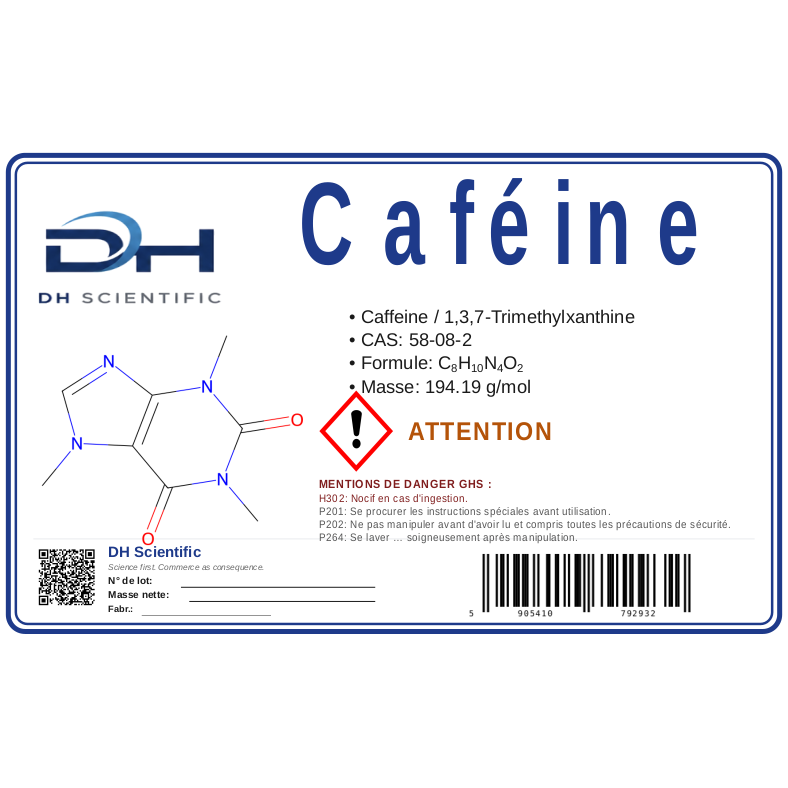
Caféine• Caffeine / 1,3,7-Trimethylxanthine• CAS: 58-08-2• Formule: C8H10N4O2• Masse: 194.19 g/molATTENTIONMENTIONS DE DANGER GHS :H302: Nocif en cas d'ingestion.P301+P312 P330 P501 P264 P270Réservé à un usage en laboratoire !DH ScientificScience first. Commerce as consequence.N° de lot: Masse nette: Fabr.:
Deskryptory Lipinskiego (struktura)
Chargement des prédictions ADMET…
Conseiller de stabilité & durée de conservation Arrhenius
Méthodologie : Arrhenius equation k = A·exp(-Ea/RT). Citation : Connors KA et al. 1986 · ICH Q1A(R2)

Saisissez les conditions de stockage → l'algorithme d'Arrhenius prédira la concentration restante, la demi-vie et une recommandation d'utilisation.

Signes visuels de dégradation :
❄️ Recommandations de conservation
Temperature:
15-25°C
Container:
HDPE/glass, dry
Incompatible:
Strong oxidizers
🧪 Assistant de préparation de solution (Smart Prep) MolGod_PREP_2

Saisissez ce que vous souhaitez préparer — je générerai un SOP

Exemples ci-dessous — cliquez pour insérer :
Recettes prédéfinies :
📚 Aperçu de la littérature scientifique — CAS 58-08-2MolGod_LITHUB_MAIN
⭐ Principales découvertes (littérature scientifique) 7 publications
🏆 CAS 58-08-2 — multi-criteria ranking (W12): 30% citations · 20% actualité · 20% thème · 15% historique · 15% open access.
  1. #1
    Nehlig, A. (2017) · Pharmacological Reviews
    Pourquoi c'est important : Citation obligatoire (canon) · 620 citations
    SCORE 13.08 Pharmacologie MUST-CITE Citations : 620 DOI ↗
  2. #2
    Actions of caffeine in the brain with special reference to factors that contribute to its widespread use
    Fredholm, B.B.; Bättig, K.; Holmén, J.; Nehlig, A.; Zvartau, E.E. (1999) · Pharmacological Reviews
    Pourquoi c'est important : Citation obligatoire (canon) · fort impact (2950 citations)
    SCORE 12.66 Mécanisme MUST-CITE Citations : 2950
  3. #3
    Wikoff, D.; Welsh, B.T.; Henderson, R.; Brorby, G.P.; Britt, J. et al. (2018) · Food and Chemical Toxicology
    Pourquoi c'est important : Citation obligatoire (canon) · 540 citations · revue
    SCORE 12.4 Revue MUST-CITE Citations : 540 DOI ↗
  4. #4
    Heckman, M.A.; Weil, J.; Gonzalez de Mejia, E. (2010) · Journal of Food Science
    Pourquoi c'est important : Citation obligatoire (canon) · 850 citations · revue
    SCORE 10.59 Revue MUST-CITE Citations : 850 DOI ↗
  5. #5
    O'Callaghan, F.; Muurlink, O.; Reid, N. (2022) · Risk Management and Healthcare Policy
    Pourquoi c'est important : Citation obligatoire (canon) · 190 citations
    SCORE 10.44 Pharmacologie MUST-CITE Citations : 190 DOI ↗
  6. #6
    Cappelletti, S.; Piacentino, D.; Sani, G.; Aromatario, M. (2010) · Current Neuropharmacology
    Pourquoi c'est important : Citation obligatoire (canon) · 480 citations
    SCORE 8.05 Pharmacologie MUST-CITE Citations : 480 DOI ↗
  7. #7
    Belay, A.; Ture, K.; Redi, M.; Asfaw, A. (2008) · Food Chemistry
    Pourquoi c'est important : Citation obligatoire (canon) · 280 citations
    SCORE 7.35 Analytique MUST-CITE Citations : 280 DOI ↗
📈 Gradient HPLC — optimiseur (LSS) MODÈLE

Gradient basé sur PubChem XLogP3 + LSS (Snyder et al. 2010, chap. 9).

  • Colonne: C18
  • Tampon: phosphate
  • Débit: 1 mL/min
  • logP: -0.1 (PubChem XLogP3)
  • Rampe: 5% → 95% B, 10 min
  • Temps d'analyse total: 23 min
t (min) %A %B flow (mL/min) Commentaire
0 95 5 1 début (équilibre)
2 95 5 1 fin du palier initial
12 5 95 1 fin de la rampe LSS
17 5 95 1 lavage de la colonne
18 95 5 1 retour à init
23 95 5 1 rééquilibrage
📚 Références scientifiques (Chicago Author-Date)
  1. Snyder, Lloyd R., John W. Dolan, and Joseph J. Kirkland. 2010. Introduction to Modern Liquid Chromatography. Wiley. — Chapter 9 — gradient elution, LSS theory (cited as Snyder et al. 2010 in tool description).
  2. Schoenmakers, Peter J. 1986. Optimization of Chromatographic Selectivity: A Guide to Method Development. Elsevier. — Numerical optimization of gradient programs.
  3. Snyder, L. R., and J. W. Dolan. 2007. High-Performance Gradient Elution: The Practical Application of the Linear-Solvent-Strength Model. Wiley. — Foundational LSS reference for the %B_init = 5 + 8·logP heuristic implemented here.
  4. Nikitas, Pavlos, and Adrian Pappa-Louisi. 2009. "Retention models for isocratic and gradient elution in reversed-phase liquid chromatography." Journal of Chromatography A 1216: 1737-1755. [DOI ↗] — Modern review of gradient retention models — basis for non-LSS extensions.
  5. Carr, Peter W.. 2009. "The new physical chemistry of HPLC." Journal of Chromatography A 1216: 1764-1772. [DOI ↗]
  6. Dong, Michael W. 2019. HPLC and UHPLC for Practicing Scientists. Wiley. https://doi.org/10.1002/9781119313793. — Modern UHPLC gradient programming, sub-2 µm scaling rules.
  7. Wu, Naijun, and Anton M. Clausen. 2007. "Fundamental and practical aspects of ultrahigh pressure liquid chromatography for fast separations." Journal of Separation Science 30: 1167-1182. [DOI ↗]
  8. Stoll, Dwight R., and Peter W. Carr. 2017. "Two-Dimensional Liquid Chromatography: A State of the Art Tutorial." Analytical Chemistry 89: 519-531. [DOI ↗] — Reference for orthogonal gradient design (2D-LC second dimension).
  9. Dolan, John W.. 2013. "When to Modify Method Conditions." LCGC North America 31: 192-199.
  10. Meyer, Veronika R. 2010. Practical High-Performance Liquid Chromatography. Wiley. — Chapter 7 — practical gradient design with isokratyczny scouting.

REST: /wp-json/molgod/v1/hplc/gradient/58-08-2

🌈 Détecteur + longueur d'onde (UV/Vis) 273 nm
ComposéCaffeine
λmax273 nm
λmin245 nm
εmax (M⁻¹·cm⁻¹)9 700
Solvant (référence)water
λ suggérée273 nm
Détecteur recommandéUV
AlternativesPDA/DAD, MS, FLD

Source de données: Skoog 2017, p. 367

📚 Références scientifiques (Chicago Author-Date) 10 refs

METODA Bibliographie de la méthode

  1. Skoog, Douglas A., F. James Holler, and Stanley R. Crouch. 2017. "Principles of Instrumental Analysis." 7th ed. Cengage Learning. ISBN 978-1-305-57721-3.
  2. Perkampus, Heinz-Helmut. 1992. "UV-VIS Spectroscopy and Its Applications." Springer. ISBN 978-3-642-77479-9.
  3. Sadek, Paul C.. 2002. "The HPLC Solvent Guide." 2nd ed. Wiley-Interscience. ISBN 978-0-471-41138-4.
  4. Snyder, Lloyd R., Joseph J. Kirkland, and John W. Dolan. 2010. "Introduction to Modern Liquid Chromatography." 3rd ed. Wiley. ISBN 978-0-470-16754-0.
  5. Dong, Michael W.. 2019. "HPLC and UHPLC for Practicing Scientists." 2nd ed. Wiley. ISBN 978-1-119-31378-3.
  6. Meyer, Veronika R.. 2010. "Practical High-Performance Liquid Chromatography." 5th ed. Wiley. ISBN 978-0-470-68218-0.
  7. Stoll, Dwight R., and Peter W. Carr. 2017. "Two-Dimensional Liquid Chromatography: A State of the Art Tutorial." Analytical Chemistry 89: 519-531
  8. Vivó-Truyols, Gabriel, and Hans-Gerd Janssen. 2010. "Probabilistic approach to peak deconvolution in chromatography." Analytical Chemistry 82: 8525-8531
  9. Kazakevich, Yuri V., and Rosario LoBrutto, eds.. 2007. "HPLC for Pharmaceutical Scientists." Wiley-Interscience. ISBN 978-0-471-68162-4.
  10. Kim, Sunghwan, et al.. 2023. "PubChem 2023 update." Nucleic Acids Research 51: D1373-D1380

REST: /wp-json/molgod/v1/hplc/detector/58-08-2

📐 Calculateur de symétrie de pic HPLC (USP Tf / As)

Calculez le facteur de traînée USP (T) et l'asymétrie (As) à partir des demi-largeurs du pic. Saisissez a (demi-largeur gauche) et b (demi-largeur droite) mesurées à 5% ou 10% de la hauteur du pic.

📚 Références (Chicago Author-Date)
  1. USP General Chapter <621>. 2024. "Chromatography." United States Pharmacopeial Convention. [link ↗] — Defines USP Tailing Factor T = (a+b)/(2a) measured at 5% peak height.
  2. International Council for Harmonisation (ICH). 2023. "Validation of Analytical Procedures Q2(R2)." ICH Expert Working Group. [link ↗] — Tailing factor is a system suitability parameter (Section 6).
  3. Foley, Joe P., and John G. Dorsey. 1983. "Equations for calculation of chromatographic figures of merit for ideal and skewed peaks." Analytical Chemistry 55: 730-737 https://doi.org/10.1021/ac00255a033 [link ↗] — Original asymmetry factor As = b/a at 10% height (Foley & Dorsey 1983).
  4. Snyder, Lloyd R., Joseph J. Kirkland, and John W. Dolan. 2010. "Introduction to Modern Liquid Chromatography." Wiley. https://doi.org/10.1002/9780470508183 [link ↗] — Chapter 2.4 — peak shape diagnostics and remedies.
  5. Dolan, John W.. 2003. "Peak tailing and resolution." LCGC North America 21: 610-614 [link ↗] — How tailing factor degrades effective resolution.
  6. Vivó-Truyols, Gabriel, and Hans-Gerd Janssen. 2010. "Probabilistic approach to peak deconvolution in chromatography." Analytical Chemistry 82: 8525-8531 https://doi.org/10.1021/ac101742z [link ↗] — Modern numerical deconvolution for asymmetric peaks.
  7. Kromidas, Stavros. 2017. "HPLC Made to Measure: A Practical Handbook for Optimization." Wiley-VCH. — Practical Tf and As thresholds for routine QC.
  8. Dong, Michael W.. 2019. "HPLC and UHPLC for Practicing Scientists." Wiley. https://doi.org/10.1002/9781119313793 [link ↗]
  9. Meyer, Veronika R.. 2010. "Practical High-Performance Liquid Chromatography." Wiley.
  10. Heyden, Yvan Vander, et al.. 2009. "Robustness of pharmaceutical liquid chromatographic methods." Journal of Chromatography B 877: 2120-2129 https://doi.org/10.1016/j.jchromb.2008.10.052 [link ↗]
📊 Calculateur de résolution et de nombre de plateaux (Rs, N, H)

Calculez la résolution Rs, le nombre de plateaux théoriques N et la HETP (H) pour une paire de pics HPLC. Saisissez les temps de rétention, les largeurs de pic (à 50% ou à la base) et la longueur de la colonne.

📚 Références (Chicago Author-Date)
  1. Snyder, Lloyd R., Joseph J. Kirkland, and John W. Dolan. 2010. "Introduction to Modern Liquid Chromatography." 3rd ed. John Wiley & Sons. ISBN 978-0-470-16754-0. https://doi.org/10.1002/9780470508183 [link ↗] — Chapter 2 covers resolution, plate count and HETP fundamentals (Snyder et al. 2010).
  2. USP General Chapter <621>. 2024. "Chromatography." USP-NF 2024 ed. United States Pharmacopeial Convention. [link ↗] — Defines Rs >= 1.5 acceptance criterion and N calculation methods.
  3. Dolan, John W.. 2003. "How much resolution is enough?." LCGC North America 21: 350-353 [link ↗] — Practical guidance on Rs targets for routine method development.
  4. Van Deemter, J. J., F. J. Zuiderweg, and A. Klinkenberg. 1956. "Longitudinal diffusion and resistance to mass transfer as causes of nonideality in chromatography." Chemical Engineering Science 5: 271-289 https://doi.org/10.1016/0009-2509(56)80003-1 [link ↗] — Origin of N = 5.54·(tr/w0.5)² half-height plate count formulation.
  5. Giddings, J. Calvin. 1965. "Dynamics of Chromatography, Part I: Principles and Theory." Marcel Dekker. ISBN 978-0-8247-1357-7. — Resolution equation Rs = (1/4)·√N·(α-1)/α·k/(1+k) (master equation).
  6. Foley, Joe P., and John G. Dorsey. 1983. "Equations for calculation of chromatographic figures of merit for ideal and skewed peaks." Analytical Chemistry 55: 730-737 https://doi.org/10.1021/ac00255a033 [link ↗] — Skewed-peak corrections to apparent N.
  7. Knox, John H.. 1977. "Practical aspects of LC theory." Journal of Chromatographic Science 15: 352-364 https://doi.org/10.1093/chromsci/15.9.352 [link ↗]
  8. Carr, Peter W.. 2009. "The new physical chemistry of HPLC." Journal of Chromatography A 1216: 1764-1772 https://doi.org/10.1016/j.chroma.2008.11.094 [link ↗]
  9. Dong, Michael W.. 2019. "HPLC and UHPLC for Practicing Scientists." 2nd ed. Wiley. ISBN 978-1-119-31378-3. https://doi.org/10.1002/9781119313793 [link ↗]
  10. Meyer, Veronika R.. 2010. "Practical High-Performance Liquid Chromatography." 5th ed. Wiley. ISBN 978-0-470-68218-0.
🧪 Conformité du système — calculateur en direct (USP <621>)

Saisissez les données de 5-6 injections (aires, tr, traînée, plateaux) — le calculateur calcule le %RSD, les moyennes et vérifie la conformité à l'USP <621>. Vous pouvez coller un CSV (séparé par des virgules) ou modifier des valeurs individuelles.

📚 Références (Chicago Author-Date)
  1. USP General Chapter <621>. 2024. "Chromatography (System Suitability section)." USP-NF 2024 ed. United States Pharmacopeial Convention. [link ↗] — Defines RSD area < 2%, tailing < 2.0, N > 2000 acceptance criteria.
  2. International Council for Harmonisation (ICH). 2023. "Validation of Analytical Procedures Q2(R2)." ICH Expert Working Group. [link ↗] — Section 5.4 — system suitability is part of method validation.
  3. US Food and Drug Administration (FDA). 2018. "Reviewer Guidance: Validation of Chromatographic Methods." US Food and Drug Administration. [link ↗] — CDER reviewer perspective on chromatographic validation expectations.
  4. Snyder, Lloyd R., Joseph J. Kirkland, and John W. Dolan. 2010. "Introduction to Modern Liquid Chromatography." 3rd ed. Wiley. — Chapter 2 — system suitability fundamentals (RSD, Tf, N).
  5. Heyden, Yvan Vander, et al.. 2009. "Robustness of pharmaceutical liquid chromatographic methods." — Robustness vs. system suitability — design-of-experiments framework.
  6. Rozet, Eric, et al.. 2013. "Analysis of recent pharmaceutical regulatory documents on analytical method validation."
  7. European Medicines Agency (EMA). 2011. "Guideline on bioanalytical method validation EMEA/CHMP/EWP/192217/2009." EMA. [link ↗] — EMA companion guideline with bioanalytical SS criteria.
  8. Dong, Michael W.. 2019. "HPLC and UHPLC for Practicing Scientists." 2nd ed. Wiley. — UHPLC-specific suitability adjustments (n=5 vs. n=6).
  9. Kazakevich, Yuri V., and Rosario LoBrutto, eds.. 2007. "HPLC for Pharmaceutical Scientists." Wiley-Interscience.
  10. AOAC International. 2016. "Appendix F: Guidelines for Standard Method Performance Requirements." AOAC INTERNATIONAL. [link ↗] — Alternative SS thresholds for food/dietary samples.
🌍 Présence dans le monde (3)MolGod_ABUND_1

Principales régions de présence naturelle ainsi que sites de production industrielle pour le CAS 58-08-2.

Bibliographie (Chicago)
  • U.S. Geological Survey. 2024. "Mineral Commodity Summaries 2024." https://pubs.usgs.gov/periodicals/mcs2024/.
  • British Geological Survey. 2023. "World Mineral Production 2018-2022." Keyworth: BGS.
  • International Energy Agency. 2023. "Critical Minerals Market Review 2023." https://www.iea.org/reports/critical-minerals-market-review-2023.
  • USGS. 2024. "Mineral Resources Online Spatial Data." U.S. Geological Survey. https://mrdata.usgs.gov/.
  • BGS. 2024. "World Mineral Statistics." British Geological Survey. https://www.bgs.ac.uk/mineralsuk/.
  • Emsley, John. 2001. "Nature's Building Blocks: An A-Z Guide to the Elements." Oxford University Press.
  • Wood, Eric J. 2013. "The Periodic Table and the Chemical Industry." Chemistry Education Research and Practice 14 (1): 5-16.
  • Tufte, Edward R. 2006. "Beautiful Evidence." Graphics Press.
  • Few, Stephen. 2009. "Now You See It: Simple Visualization Techniques for Quantitative Analysis." Analytics Press.
  • Mayer, Richard E. 2009. "Multimedia Learning." 2nd ed. Cambridge University Press.
⚗️ Jonizacja w funkcji pH (Henderson-Hasselbalch)MolGod_PHION_1

Typ: Zasada · pKa: 14

024681012140%50%100%% zjonizowany% niejonowypH
pH% jonowy% niejonowy
0100.0 %0.0 %
2100.0 %0.0 %
4100.0 %0.0 %
6100.0 %0.0 %
8100.0 %0.0 %
10100.0 %0.0 %
1299.0 %1.0 %
1450.0 %50.0 %
Źródła dla tej substancji (9)
  • CRC Handbook 91st ed.
    Lide, David R., ed. 2010. CRC Handbook of Chemistry and Physics. 91st ed. Boca Raton, FL: CRC Press.
  • CRC Handbook 105th ed.
    Rumble, John R., Thomas J. Bruno, Maria J. Doa, and Donald R. Burgess, eds. 2024. CRC Handbook of Chemistry and Physics. 105th ed. Boca Raton, FL: CRC Press.
  • NIST WebBooklink
    Linstrom, Peter J., and William G. Mallard, eds. 2024. NIST Chemistry WebBook. NIST Standard Reference Database Number 69. Gaithersburg, MD: National Institute of Standards and Technology.
  • PubChem CID 2519link
    Kim, Sunghwan, Jie Chen, Tiejun Cheng, Asta Gindulyte, Jia He, Siqian He, Qingliang Li, et al. 2023. "PubChem 2023 update." Nucleic Acids Research 51 (D1): D1373-D1380. PubChem CID 2519.
  • DrugBank DB00201link
    Knox, Craig, Mike Wilson, Christen M. Klinger, Mark Franklin, Eponine Oler, Alex Wilson, Allison Pon, et al. 2024. "DrugBank 6.0: the DrugBank Knowledgebase for 2024." Nucleic Acids Research 52 (D1): D1265-D1275. DrugBank ID DB00201.
  • ChEMBL CHEMBL113link
    Zdrazil, Barbara, Eloy Felix, Fiona Hunter, Emma J. Manners, James Blackshaw, Sybilla Corbett, Marleen de Veij, et al. 2024. "The ChEMBL Database in 2023." Nucleic Acids Research 52 (D1): D1180-D1192. ChEMBL ID CHEMBL113.
  • IUPAC
    Perrin, Douglas D. 1965. Dissociation Constants of Organic Bases in Aqueous Solution. IUPAC. London: Butterworths.
  • NIST
    Goldberg, Robert N., Nand Kishore, and Rebecca Lennen. 2002. "Thermodynamic Quantities for the Ionization Reactions of Buffers." Journal of Physical and Chemical Reference Data 31 (2): 231-370.
Bibliografia metody (Chicago)
  • Henderson, L. J. 1908. "Concerning the Relationship between the Strength of Acids and Their Capacity to Preserve Neutrality." American Journal of Physiology 21 (4): 173-179.
  • Hasselbalch, K. A. 1917. "Die Berechnung der Wasserstoffzahl des Blutes aus der freien und gebundenen Kohlensäure desselben." Biochemische Zeitschrift 78: 112-144.
  • Po, Henry N., and N. M. Senozan. 2001. "The Henderson-Hasselbalch Equation: Its History and Limitations." Journal of Chemical Education 78 (11): 1499-1503.
  • Avdeef, Alex. 2012. "Absorption and Drug Development: Solubility, Permeability, and Charge State." 2nd ed. Wiley.
  • Avdeef, Alex. 2007. "Solubility of sparingly-soluble ionizable drugs." Advanced Drug Delivery Reviews 59 (7): 568-590.
  • Volgyi, Gergely, et al. 2007. "Potentiometric and spectrophotometric pKa determination of water-insoluble compounds." Analytica Chimica Acta 583 (2): 418-428.
  • Fini, Adamo, Giuseppe Fazio, and Giuseppina Feroci. 1997. "Solubility and solubilization properties of non-steroidal anti-inflammatory drugs." Pharmaceutica Acta Helvetiae 70 (4): 305-318.
  • Mauger, John W., Anthony N. Paruta, and Robert J. Gerraughty. 1972. "Solubilities of sulfadiazine, sulfisomidine, and sulfadimethoxine." Journal of Pharmaceutical Sciences 61 (1): 94-97.
  • Lyman, Warren J., William F. Reehl, and David H. Rosenblatt. 1990. "Handbook of Chemical Property Estimation Methods." American Chemical Society.
  • Marcus, Yizhak. 1998. "The Properties of Solvents." Wiley.
  • Serjeant, E. P., and Boyd Dempsey. 1979. Ionisation Constants of Organic Acids in Aqueous Solution. IUPAC Chemical Data Series No. 23. Oxford: Pergamon Press.
  • Perrin, Douglas D. 1965. Dissociation Constants of Organic Bases in Aqueous Solution. IUPAC. London: Butterworths.
  • Goldberg, Robert N., Nand Kishore, and Rebecca Lennen. 2002. "Thermodynamic Quantities for the Ionization Reactions of Buffers." Journal of Physical and Chemical Reference Data 31 (2): 231-370.
  • Rumble, John R., Thomas J. Bruno, Maria J. Doa, and Donald R. Burgess, eds. 2024. CRC Handbook of Chemistry and Physics. 105th ed. Boca Raton, FL: CRC Press.
  • Lide, David R., ed. 2010. CRC Handbook of Chemistry and Physics. 91st ed. Boca Raton, FL: CRC Press.
  • Kim, Sunghwan, Jie Chen, Tiejun Cheng, Asta Gindulyte, Jia He, Siqian He, Qingliang Li, et al. 2023. "PubChem 2023 update." Nucleic Acids Research 51 (D1): D1373-D1380.
  • Knox, Craig, Mike Wilson, Christen M. Klinger, Mark Franklin, Eponine Oler, Alex Wilson, Allison Pon, et al. 2024. "DrugBank 6.0: the DrugBank Knowledgebase for 2024." Nucleic Acids Research 52 (D1): D1265-D1275.
  • Zdrazil, Barbara, Eloy Felix, Fiona Hunter, Emma J. Manners, James Blackshaw, Sybilla Corbett, Marleen de Veij, et al. 2024. "The ChEMBL Database in 2023." Nucleic Acids Research 52 (D1): D1180-D1192.
  • Kanehisa, Minoru, Miho Furumichi, Yoko Sato, Masayuki Kawashima, and Mari Ishiguro-Watanabe. 2023. "KEGG for taxonomy-based analysis of pathways and genomes." Nucleic Acids Research 51 (D1): D587-D592.
  • Linstrom, Peter J., and William G. Mallard, eds. 2024. NIST Chemistry WebBook. NIST Standard Reference Database Number 69. Gaithersburg, MD: National Institute of Standards and Technology.
  • Nelson, David L., and Michael M. Cox. 2017. Lehninger Principles of Biochemistry. 7th ed. New York: W. H. Freeman.
📈 Prédicteur de spectre UV-VIS (200-400 nm) λmax 273 nm MolGod_UVVIS_1
0%25%50%75%100%200250300350400273 nmA = ε·c·lA / Aₘₐₓ (%)
ComposéCaffeine
λmax273 nm
λmin245 nm
εmax (M⁻¹·cm⁻¹)9 700
Solvant (requête)water
Solvant (référence)water
Concentration (M)1e-4
Longueur du trajet optique (cm)1
FWHM de la courbe56 nm

Modèle : courbe de Gauss centrée sur λmax avec mise à l'échelle selon la loi de Beer-Lambert A = ε · c · l. Transmittance T = 10^(-A) · 100%.

📚 Références scientifiques (Chicago Author-Date)
  1. Anonymous. 2013. "Putting It All Together." Caffeine for Sports Performance: 157-172. https://doi.org/10.5040/9781492595311.ch-010. [DOI]
  2. Mansouri RA; Aboubakr EM; Alshaibi HF; Fouda WM; Banjabi AA; Al-Bazi MM. 2026. "Calcium Carbonate-Stabilized Nano-Caffeine Emulsion Attenuates Diabetic Cardiomyopathy via Antioxidant, Anti-Inflammatory, and Anti-Fibrotic Pathways in Type 2 Diabetic Rats with HPLC-Quantified Cardiac Caffeine Levels." International journal of nanomedicine. https://doi.org/10.2147/IJN.S573949. [DOI]
  3. Hategekimana F; Elçin AE; Elçin YM. 2026. "Green synthesis of caffeine-catalyzed citric acid-PPG/PEG crosslinked alginate hydrogel scaffolds for prospective biomedical applications." International journal of biological macromolecules. https://doi.org/10.1016/j.ijbiomac.2026.151850. [DOI]
  4. Becerra-Lovera A, Anaya-Mancipe J, Díaz-Martin R, Dias M, Souza D.. 2026. "Eugenol-Based Epoxy Vitrimers: Caffeine and Zinc Acetate as Potential Alternative Catalysts in Curing Kinetics and Dynamic Network Properties." .
  5. Baral AK, Talukdar M, Singh S.. 2025. "Thermo-acoustic investigation on mixtures of Tetramethyl ammonium hydroxide and caffeine in aqueous medium with the goal to understand their mutual interactions." . https://doi.org/10.1186/s13065-025-01684-y. [DOI]
  6. Dos Santos ARP; Lima BCS; Couto GJ; Carvalho L; Magna LR; Nogueira MH. 2025. "Antibiofilm effect of caffeine against Listeria monocytogenes and Escherichia coli in grape and apple fruit juices." Biofouling. https://doi.org/10.1080/08927014.2025.2515923. [DOI]
  7. Vignale FA; Hernandez Garcia A; Modenutti CP; Sosa EJ; Defelipe LA; Oliveira R. 2025. "Yerba mate (Ilex paraguariensis) genome provides new insights into convergent evolution of caffeine biosynthesis." eLife. https://doi.org/10.7554/eLife.104759. [DOI]
  8. Tan BJ; Xiao B; Tan EK. 2024. "Elevated neutrophils and uncontrolled asthma: the effects of caffeine, diet and co-morbidities." The Journal of asthma : official journal of the Association for the Care of Asthma. https://doi.org/10.1080/02770903.2024.2332924. [DOI]
  9. Latunra AI; Heryanto H; Tahir D; Ardiansa A. 2024. "Analytical insight into caffeine extraction from typica coffee leaves based on crystallinity enhancement, optical phonon vibration upshift, and morphological evolution." Journal of food science. https://doi.org/10.1111/1750-3841.17443. [DOI]
  10. Suenaga S, Kataoka H, Hasegawa K, Koga R, Tsunoda C, Kuwashima W, Tsuchida T, Goto S.. 2024. "How Does the Powder Mixture of Ibuprofen and Caffeine Attenuate the Solubility of Ibuprofen? Comparative Study for the Xanthine Derivatives to Recognize Their Intermolecular Interactions Using Fourier-Transform Infrared (FTIR) Spectra, Differential Scanning Calorimetry (DSC), and X-ray Powder Diffractometry (XRPD)." . https://doi.org/10.1021/acs.molpharmaceut.4c00429. [DOI]
  11. Rahimi MR; Semenova EA; Larin AK; Kulemin NA; Generozov EV; Łubkowska B. 2023. "The ADORA2A TT Genotype Is Associated with Anti-Inflammatory Effects of Caffeine in Response to Resistance Exercise and Habitual Coffee Intake." Nutrients. https://doi.org/10.3390/nu15071634. [DOI]
  12. Linstrom, Peter J., and William G. Mallard, eds. 2023. NIST Chemistry WebBook, NIST Standard Reference Database Number 69. Gaithersburg, MD: National Institute of Standards and Technology. [DOI]
  13. Mayerhöfer, Thomas G., Samir Pahlow, and Jürgen Popp. 2020. "The Bouguer-Beer-Lambert Law: Shining Light on the Obscure." ChemPhysChem 21 (18): 2029-2046. [DOI]
  14. Skoog, Douglas A., F. James Holler, and Stanley R. Crouch. 2017. Principles of Instrumental Analysis. 7th ed. Boston: Cengage Learning. ISBN 978-1-305-57721-3.
  15. Lindon, John C., George E. Tranter, and David W. Koppenaal, eds. 2017. "Encyclopedia of Spectroscopy and Spectrometry." 3rd ed. Amsterdam: Academic Press. ISBN 978-0-12-803224-4.
  16. Field, Leslie D., Sev Sternhell, and John R. Kalman. 2013. "Organic Structures from Spectra." 5th ed. Chichester: Wiley. ISBN 978-1-119-96582-6.
  17. Reusch, William. 2013. "Virtual Textbook of Organic Chemistry: Spectroscopy." East Lansing, MI: Michigan State University.
  18. Lampman, Gary M., Donald L. Pavia, George S. Kriz, and James R. Vyvyan. 2010. "Spectroscopy." 4th ed. Belmont, CA: Cengage Learning. ISBN 978-0-495-88992-9.
  19. Kalsi, P. S. 2010. "Spectroscopy of Organic Compounds." 6th ed. New Delhi: New Age International. ISBN 978-81-224-2032-9.
  20. Williams, Dudley H., and Ian Fleming. 2008. "Spectroscopic Methods in Organic Chemistry." 6th ed. London: McGraw-Hill. ISBN 978-0-07-711559-0.
  21. Sadek, Paul C. 2002. The HPLC Solvent Guide. 2nd ed. Hoboken: Wiley. ISBN 978-0-471-41242-2.
  22. Banwell, Colin N., and Elaine M. McCash. 1994. "Fundamentals of Molecular Spectroscopy." 4th ed. London: McGraw-Hill. ISBN 978-0-07-707976-1.
  23. Perkampus, Heinz-Helmut. 1992. UV-VIS Spectroscopy and Its Applications. Berlin: Springer. https://doi.org/10.1007/978-3-642-77479-9.
  24. Fieser, Louis F. 1949. "Extension of Woodward's Rules for Prediction of Conjugated Diene Absorption." Journal of the American Chemical Society 71 (5): 1854-1857. [DOI]
  25. Woodward, Robert B. 1942. "Structure and the Absorption Spectra of Alpha,Beta-Unsaturated Ketones." Journal of the American Chemical Society 64 (1): 72-75. [DOI]
  26. Beer, August. 1852. "Bestimmung der Absorption des rothen Lichts in farbigen Flüssigkeiten." Annalen der Physik und Chemie 86: 78-88. https://doi.org/10.1002/andp.18521620505.
  27. Lambert, Johann Heinrich. 1760. Photometria. Augsburg: Sumptibus Vidae.

📖 Wartość λmax = 273 nm pochodzi z bazy/literatury. Brak niezależnego potwierdzenia krzyżowego (NIST / CrossRef / PubChem) — weryfikacja krzyżowa niedostępna.

REST: /wp-json/molgod/v1/spectra/uv-vis/58-08-2?solvent=water&path_length_cm=1

☣️ Toxicité (LD50 / LC50) GHS Cat. 3 — ModéréeMolGod_LD50_1
LD50
192 mg/kg[1]
Gatunek / droga
Rat / doustnie
Klasyfikacja
Moderately toxic[2][3]
Skala GHS (Acute Toxicity, oral, mg/kg bw):
Cat 1 (≤5)
Cat 2 (5–50)
Cat 3 (50–300)
Cat 4 (300–2000)
Cat 5 (2000–5000)

Source : Peters 1967, Toxicol. Appl. Pharmacol.; ChemView (EPA 2024) (1967). CAS 58-08-2.

Les données DL50/CL50 sont fournies à titre indicatif uniquement ; elles ne remplacent ni la fiche de données de sécurité (FDS) ni l'évaluation d'un expert toxicologue. Classification GHS pour la voie orale (mg/kg pc) selon UN GHS, 10e rév. 2023, Annexe 1 §3.1.1.

Bibliographie (Chicago)
  1. U.S. EPA. 2024. "ChemView." Washington, DC: U.S. Environmental Protection Agency.
  2. United Nations. 2023. "Globally Harmonized System of Classification and Labelling of Chemicals (GHS)." 10th rev. ed. New York: UN.
  3. Hodge, Harold C., and James H. Sterner. 1949. "Tabulation of toxicity classes." American Industrial Hygiene Association Quarterly 10 (4): 93-96.
Dalsze źródła (metodyka, nie cytowane bezpośrednio):
  • U.S. EPA. 2024. "ChemView." https://chemview.epa.gov/.
  • Lipnick, Robert L., et al. 1995. "Comparison of the up-and-down, conventional LD50, and fixed-dose acute toxicity procedures." Food and Chemical Toxicology 33 (3): 223-231.
  • ATSDR. 2024. "Toxicological Profiles." Agency for Toxic Substances and Disease Registry. https://www.atsdr.cdc.gov/.
  • Hayes, Wallace, and Claire L. Kruger, eds. 2014. "Hayes' Principles and Methods of Toxicology." 6th ed. CRC Press.
  • Lewis, Richard J. 2012. "Sax's Dangerous Properties of Industrial Materials." 12th ed. Wiley.
  • IARC. 2024. "Monographs on the Evaluation of Carcinogenic Risks to Humans." International Agency for Research on Cancer (per kryteria klasyfikacji rakotwórczości IARC Group 1/2A/2B).
  • Pohanish, Richard P. 2017. "Sittig's Handbook of Toxic and Hazardous Chemicals and Carcinogens." 7th ed. Elsevier.
  • Bingham, Eula, Barbara Cohrssen, and Charles H. Powell, eds. 2012. "Patty's Toxicology." 6th ed. Wiley.
  • WHO. 2023. "Recommended Classification of Pesticides by Hazard." World Health Organization (zgodne z UN GHS Annex 1 §3.1.1).
⚠️ Interakcje lekowe (1)MolGod_DRUGINT_1

Znane interakcje farmakokinetyczne i farmakodynamiczne dla CAS 58-08-2 wg konsensusowych źródeł klinicznych. Niniejsze informacje są edukacyjne — nie zastępują konsultacji lekarskiej.

Skala evidence (Hansten & Horn)
A — randomized controlled trials · B — non-randomized clinical / PK studies · C — case reports · D — theoretical/mechanism-based
  • Teofilina
    UmiarkowaneEL: A
    CAS partnera: 58-55-9 · DrugBank DB00277 · PubChem 2153 · Papers: 8

    Mechanizm: Oba antagonizują receptory adenozynowe A1/A2A i hamują fosfodiesterazę (PDE3/4). Kofeina hamuje CYP1A2 i konkuruje o ten sam szlak metabolizmu co teofilina (demetylacja).

    Skutek kliniczny: Wzmożona stymulacja OUN, tachykardia, drżenia, bezsenność, ryzyko toksyczności teofiliny (drgawki, arytmie).

    Postępowanie: Ograniczyć kofeinę < 200 mg/d podczas terapii teofiliną. Monitorować stężenie teofiliny (terapeutyczne 5–15 μg/mL).

    Źródło: Stockley 2021; Indiana University P450 Table
Bibliographie (Chicago)
  • Hansten, Philip D., and John R. Horn. 2024. "The Top 100 Drug Interactions: A Guide to Patient Management." H&H Publications.
  • Stockley, Ivan H., ed. 2021. "Stockley's Drug Interactions." 12th ed. Pharmaceutical Press.
  • Indiana University. 2024. "P450 Drug Interaction Table." https://drug-interactions.medicine.iu.edu/.
  • Lexicomp. 2024. "Lexicomp Drug Interactions Database." Wolters Kluwer.
  • U.S. FDA. 2023. "Drug Development and Drug Interactions Table of Substrates, Inhibitors and Inducers." https://www.fda.gov/drugs/drug-interactions-labeling/drug-development-and-drug-interactions-table-substrates-inhibitors-and-inducers.
  • Goldfrank, Lewis R., et al. 2019. "Goldfrank's Toxicologic Emergencies." 11th ed. McGraw-Hill (rozdz. Drug Interactions — synergie + antagonizmy w zatruciach mieszanych).
  • Olson, Kent R., et al. 2018. "Poisoning & Drug Overdose." 7th ed. McGraw-Hill (kliniczne management interakcji w przedawkowaniu).
  • Dollery, Colin, ed. 1999. "Therapeutic Drugs." 2nd ed. Churchill Livingstone (monografia źródłowa o interakcjach lek-lek na poziomie farmakokinetyki).
  • Rosenstock, Linda, et al. 2005. "Textbook of Clinical Occupational and Environmental Medicine." 2nd ed. Elsevier Saunders (occupational + drug exposure interakcje).
  • Lippmann, Morton. 2009. "Environmental Toxicants: Human Exposures and Their Health Effects." 3rd ed. Wiley (modulacja CYP3A4/CYP2D6 przez ekspozycje środowiskowe).
  • Hayes, Wallace, and Claire L. Kruger, eds. 2014. "Hayes' Principles and Methods of Toxicology." 6th ed. CRC Press (in vitro screening DDI: rola P-gp, BCRP).
🧪 Voies de synthèse classiques2 historyczne trasyMolGod_SYNTH_2

Voies de synthèse vérifiées historiquement. Citations au style Chicago auteur-date.

Voie 1 : Extraction from Camellia sinensis (tea leaves) (1820)
Produits de départ : Dried tea or coffee biomass; hot water then dichloromethane partition
Conditions : Hot water decoction 95 C; CH2Cl2 liquid-liquid extraction; sublimation purification
Rendement : 3.5 %
Runge, Friedlieb Ferdinand. 1820. "Über einige neue Pflanzenstoffe." Annalen der Physik 65 (4): 449-462.
Voie 2 : Traube purine synthesis (1900)
Réaction nommée : Traube purine synthesis
Produits de départ : Urea + cyanoacetic acid; methylation with dimethyl sulfate
Conditions : Cyclization with formamide 180 C; sequential N-methylation in basic media
Rendement : 75.0 %
Traube, Wilhelm. 1900. "Der synthetische Aufbau der Harnsäure, des Xanthins, Theobromins, Theophyllins und Caffeins aus der Cyanessigsäure." Berichte der deutschen chemischen Gesellschaft 33 (3): 3035-3056.
Bibliographie générale (Chicago) :
  • March, Jerry, and Michael B. Smith. 2020. "March's Advanced Organic Chemistry: Reactions, Mechanisms, and Structure." 8th ed. Wiley.
  • Carey, Francis A., and Richard J. Sundberg. 2007. "Advanced Organic Chemistry, Part B: Reactions and Synthesis." 5th ed. Springer.
  • Corey, E. J., and Xue-Min Cheng. 1995. "The Logic of Chemical Synthesis." Wiley.
  • Greene, Theodora W., and Peter G. M. Wuts. 2014. "Greene's Protective Groups in Organic Synthesis." 5th ed. Wiley.
  • Smith, Michael B. 2020. "Organic Synthesis." 4th ed. Academic Press.
  • Carey, Francis A., and Richard J. Sundberg. 2007. "Advanced Organic Chemistry, Part A: Structure and Mechanisms." 5th ed. New York: Springer.
  • Anslyn, Eric V., and Dennis A. Dougherty. 2006. Modern Physical Organic Chemistry. Sausalito, CA: University Science Books.
  • Bretherick, Leslie. 1990. Bretherick's Handbook of Reactive Chemical Hazards. 4th ed. London: Butterworths.
  • Urben, Peter, ed. 2017. Bretherick's Handbook of Reactive Chemical Hazards. 8th ed. Oxford: Butterworth-Heinemann.
  • Yoshida, Tadao, Yusaku Iwata, Hiroshi Itoh, and Mitsuru Arai. 2009. Safe Storage of Reactive Chemicals. New York: Plenum Press.
  • Mortimer, Charles E. 2005. Chemistry: A Conceptual Approach. 9th ed. Belmont, CA: Wadsworth.
  • Engel, Thomas, and Philip Reid. 2013. Physical Chemistry. 3rd ed. Boston: Pearson.
  • Steinfeld, Jeffrey I., Joseph S. Francisco, and William L. Hase. 1998. Chemical Kinetics and Dynamics. 2nd ed. Upper Saddle River, NJ: Prentice Hall.
  • Houston, Paul L. 2001. Chemical Kinetics and Reaction Dynamics. New York: McGraw-Hill.
  • Eyring, Henry. 1935. "The Activated Complex in Chemical Reactions." Journal of Chemical Physics 3 (2): 107–115. https://doi.org/10.1063/1.1749604.
  • Kresge, A. Jerry. 2001. "Reaction kinetics in 100-year-old laboratories." Chemical Society Reviews 30 (4): 197–200. https://doi.org/10.1039/B100445F.
  • Brönsted, J. N. 1929. "Acid and Basic Catalysis." Chemical Reviews 5 (3): 231–338. https://doi.org/10.1021/cr60019a001.
  • Larock, Richard C. 2018. Comprehensive Organic Transformations: A Guide to Functional Group Preparations. 3rd ed. Hoboken, NJ: John Wiley & Sons.
  • Mundy, Bradford P., Michael G. Ellerd, and Frank G. Favaloro Jr. 2005. Name Reactions and Reagents in Organic Synthesis. 2nd ed. Hoboken, NJ: Wiley-Interscience.
  • Li, Jie Jack. 2014. Name Reactions: A Collection of Detailed Mechanisms and Synthetic Applications. 5th ed. Heidelberg: Springer.
  • Kürti, László, and Barbara Czakó. 2005. Strategic Applications of Named Reactions in Organic Synthesis. Burlington, MA: Elsevier Academic Press.
  • Trost, Barry M., and Ian Fleming, eds. 1991. Comprehensive Organic Synthesis: Selectivity, Strategy, and Efficiency in Modern Organic Chemistry. 9 vols. Oxford: Pergamon Press.
  • Ojima, Iwao, ed. 2010. Catalytic Asymmetric Synthesis. 3rd ed. Hoboken, NJ: John Wiley & Sons.
  • Jacobsen, Eric N., Andreas Pfaltz, and Hisashi Yamamoto, eds. 1999. Comprehensive Asymmetric Catalysis. 3 vols. Berlin: Springer.
  • Hartwig, John F. 2010. Organotransition Metal Chemistry: From Bonding to Catalysis. Sausalito, CA: University Science Books.
  • Crabtree, Robert H. 2014. The Organometallic Chemistry of the Transition Metals. 6th ed. Hoboken, NJ: John Wiley & Sons.
  • Negishi, Ei-ichi, ed. 2002. Handbook of Organopalladium Chemistry for Organic Synthesis. 2 vols. New York: Wiley-Interscience.
  • de Meijere, Armin, and François Diederich, eds. 2004. Metal-Catalyzed Cross-Coupling Reactions. 2nd ed. 2 vols. Weinheim: Wiley-VCH.
  • Berkessel, Albrecht, and Harald Gröger. 2005. Asymmetric Organocatalysis: From Biomimetic Concepts to Applications in Asymmetric Synthesis. Weinheim: Wiley-VCH.
  • Dalko, Peter I., ed. 2007. Enantioselective Organocatalysis: Reactions and Experimental Procedures. Weinheim: Wiley-VCH.
  • List, Benjamin, Richard A. Lerner, and Carlos F. Barbas III. 2000. "Proline-catalyzed direct asymmetric aldol reactions." Journal of the American Chemical Society 122 (10): 2395–2396. https://doi.org/10.1021/ja994280y.
  • MacMillan, David W. C. 2008. "The advent and development of organocatalysis." Nature 455 (7211): 304–308. https://doi.org/10.1038/nature07367.
  • Noyori, Ryōji. 2002. "Asymmetric catalysis: science and opportunities (Nobel lecture)." Angewandte Chemie International Edition 41 (12): 2008–2022. https://doi.org/10.1002/1521-3773(20020617)41:12<2008::AID-ANIE2008>3.0.CO;2-4.
  • Sharpless, K. Barry. 2002. "Searching for new reactivity (Nobel lecture)." Angewandte Chemie International Edition 41 (12): 2024–2032. https://doi.org/10.1002/1521-3773(20020617)41:12<2024::AID-ANIE2024>3.0.CO;2-O.
  • Knowles, William S. 2002. "Asymmetric hydrogenations (Nobel lecture)." Angewandte Chemie International Edition 41 (12): 1998–2007. https://doi.org/10.1002/1521-3773(20020617)41:12<1998::AID-ANIE1998>3.0.CO;2-8.
  • Grubbs, Robert H. 2006. "Olefin-metathesis catalysts for the preparation of molecules and materials (Nobel lecture)." Angewandte Chemie International Edition 45 (23): 3760–3765. https://doi.org/10.1002/anie.200600680.
  • Schrock, Richard R. 2006. "Multiple metal-carbon bonds for catalytic metathesis reactions (Nobel lecture)." Angewandte Chemie International Edition 45 (23): 3748–3759. https://doi.org/10.1002/anie.200600085.
  • Suzuki, Akira. 2011. "Cross-coupling reactions of organoboranes: an easy way to construct C-C bonds (Nobel lecture)." Angewandte Chemie International Edition 50 (30): 6722–6737. https://doi.org/10.1002/anie.201101379.
  • Negishi, Ei-ichi. 2011. "Magical power of transition metals: past, present, and future (Nobel lecture)." Angewandte Chemie International Edition 50 (30): 6738–6764. https://doi.org/10.1002/anie.201101380.
  • List, Benjamin, and David W. C. MacMillan. 2022. "Asymmetric organocatalysis (Nobel lecture)." Angewandte Chemie International Edition 61 (38): e202205927. https://doi.org/10.1002/anie.202205927.
  • Bertozzi, Carolyn R., Morten Meldal, and K. Barry Sharpless. 2023. "Click chemistry and bioorthogonal chemistry (Nobel lectures)." Angewandte Chemie International Edition 62 (16): e202300332. https://doi.org/10.1002/anie.202300332.
  • Weissermel, Klaus, and Hans-Jürgen Arpe. 2003. Industrial Organic Chemistry. 4th ed. Weinheim: Wiley-VCH.
  • Wittcoff, Harold A., Bryan G. Reuben, and Jeffrey S. Plotkin. 2013. Industrial Organic Chemicals. 3rd ed. Hoboken, NJ: John Wiley & Sons.
  • Appl, Max. 2006. "Ammonia, 2. Production Processes." In Ullmann's Encyclopedia of Industrial Chemistry. Weinheim: Wiley-VCH. https://doi.org/10.1002/14356007.o02_o11.
  • Thiemann, Michael, Erich Scheibler, and Karl Wilhelm Wiegand. 2000. "Nitric Acid, Nitrous Acid, and Nitrogen Oxides." In Ullmann's Encyclopedia of Industrial Chemistry. Weinheim: Wiley-VCH. https://doi.org/10.1002/14356007.a17_293.
  • Hocking, Martin B. 2005. Handbook of Chemical Technology and Pollution Control. 3rd ed. Burlington, MA: Academic Press.
  • Corey, E. J., and László Kürti. 2010. Enantioselective Chemical Synthesis: Methods, Logic, and Practice. Direct Book Publishing.
  • Nicolaou, K. C., and E. J. Sorensen. 1996. Classics in Total Synthesis: Targets, Strategies, Methods. Weinheim: VCH.
  • Nicolaou, K. C., and Jason S. Chen. 2011. Classics in Total Synthesis III: Further Targets, Strategies, Methods. Weinheim: Wiley-VCH.
  • House, Herbert O. 1972. Modern Synthetic Reactions. 2nd ed. Menlo Park, CA: W. A. Benjamin.
  • Organic Syntheses, Inc. 2024. "Organic Syntheses Collective Volumes 1–10 (1932–2004) and Annual Volumes 1–100 (1922–2024)." Hoboken, NJ: Wiley. https://www.orgsyn.org/.
  • Paquette, Leo A., David Crich, Philip L. Fuchs, Gary A. Molander, and Andre B. Charette, eds. 2009. Encyclopedia of Reagents for Organic Synthesis (e-EROS). 2nd ed. Hoboken, NJ: Wiley. https://onlinelibrary.wiley.com/doi/book/10.1002/047084289X.
Bibliographie étendue — 4 sources (PubMed/CrossRef/EuropePMC)
  • PUBMansouri RA; Aboubakr EM; Alshaibi HF; Fouda WM; Banjabi AA; Al-Bazi MM. 2026. "Calcium Carbonate-Stabilized Nano-Caffeine Emulsion Attenuates Diabetic Cardiomyopathy via Antioxidant, Anti-Inflammatory, and Anti-Fibrotic Pathways in Type 2 Diabetic Rats with HPLC-Quantified Cardiac Caffeine Levels." International journal of nanomedicine. https://doi.org/10.2147/IJN.S573949.
  • PUBHategekimana F; Elçin AE; Elçin YM. 2026. "Green synthesis of caffeine-catalyzed citric acid-PPG/PEG crosslinked alginate hydrogel scaffolds for prospective biomedical applications." International journal of biological macromolecules. https://doi.org/10.1016/j.ijbiomac.2026.151850.
  • EURBecerra-Lovera A, Anaya-Mancipe J, Díaz-Martin R, Dias M, Souza D.. 2026. "Eugenol-Based Epoxy Vitrimers: Caffeine and Zinc Acetate as Potential Alternative Catalysts in Curing Kinetics and Dynamic Network Properties." .
  • EURBaral AK, Talukdar M, Singh S.. 2025. "Thermo-acoustic investigation on mixtures of Tetramethyl ammonium hydroxide and caffeine in aqueous medium with the goal to understand their mutual interactions." . https://doi.org/10.1186/s13065-025-01684-y.
💎 Formes cristallines / Polymorphes 3 formy w bazie MolGod_POLYMORPH_2
Forme Groupe d'espace Maille (Å, °) Densité (g/cm³) P.f. (°C) CCDC
alpha (anhydrous) stable R-3c a=14.95 b=14.95 c=6.958 · α=90 β=90 γ=120 · Z=6 1.454 236.0 NIWFEE DOI
beta (monohydrate) P21/n a=14.878 b=16.718 c=3.97 · α=90 β=97.04 γ=90 · Z=4 1.425 178.0 CAFINE DOI
beta-anhydrous (high-T) P21/c a=14.942 b=6.955 c=14.652 · α=90 β=96.18 γ=90 · Z=8 1.450 235.0 NIWFEE01 DOI

Source : Cambridge Structural Database (CSD) + littérature primaire. Le polymorphisme influe sur la solubilité, la biodisponibilité et la stabilité (Brittain 2009 ; Bernstein 2020).

Bibliographie étendue — 6 sources (PubMed/CrossRef/EuropePMC)
  • PUBDos Santos ARP; Lima BCS; Couto GJ; Carvalho L; Magna LR; Nogueira MH. 2025. "Antibiofilm effect of caffeine against Listeria monocytogenes and Escherichia coli in grape and apple fruit juices." Biofouling. https://doi.org/10.1080/08927014.2025.2515923.
  • PUBVignale FA; Hernandez Garcia A; Modenutti CP; Sosa EJ; Defelipe LA; Oliveira R. 2025. "Yerba mate (Ilex paraguariensis) genome provides new insights into convergent evolution of caffeine biosynthesis." eLife. https://doi.org/10.7554/eLife.104759.
  • PUBTan BJ; Xiao B; Tan EK. 2024. "Elevated neutrophils and uncontrolled asthma: the effects of caffeine, diet and co-morbidities." The Journal of asthma : official journal of the Association for the Care of Asthma. https://doi.org/10.1080/02770903.2024.2332924.
  • PUBLatunra AI; Heryanto H; Tahir D; Ardiansa A. 2024. "Analytical insight into caffeine extraction from typica coffee leaves based on crystallinity enhancement, optical phonon vibration upshift, and morphological evolution." Journal of food science. https://doi.org/10.1111/1750-3841.17443.
  • EURSuenaga S, Kataoka H, Hasegawa K, Koga R, Tsunoda C, Kuwashima W, Tsuchida T, Goto S.. 2024. "How Does the Powder Mixture of Ibuprofen and Caffeine Attenuate the Solubility of Ibuprofen? Comparative Study for the Xanthine Derivatives to Recognize Their Intermolecular Interactions Using Fourier-Transform Infrared (FTIR) Spectra, Differential Scanning Calorimetry (DSC), and X-ray Powder Diffractometry (XRPD)." . https://doi.org/10.1021/acs.molpharmaceut.4c00429.
  • PUBRahimi MR; Semenova EA; Larin AK; Kulemin NA; Generozov EV; Łubkowska B. 2023. "The ADORA2A TT Genotype Is Associated with Anti-Inflammatory Effects of Caffeine in Response to Resistance Exercise and Habitual Coffee Intake." Nutrients. https://doi.org/10.3390/nu15071634.
📚 Références scientifiques (Chicago Author-Date)
  1. Mansouri RA; Aboubakr EM; Alshaibi HF; Fouda WM; Banjabi AA; Al-Bazi MM. 2026. "Calcium Carbonate-Stabilized Nano-Caffeine Emulsion Attenuates Diabetic Cardiomyopathy via Antioxidant, Anti-Inflammatory, and Anti-Fibrotic Pathways in Type 2 Diabetic Rats with HPLC-Quantified Cardiac Caffeine Levels." International journal of nanomedicine. https://doi.org/10.2147/IJN.S573949. [DOI]
  2. Hategekimana F; Elçin AE; Elçin YM. 2026. "Green synthesis of caffeine-catalyzed citric acid-PPG/PEG crosslinked alginate hydrogel scaffolds for prospective biomedical applications." International journal of biological macromolecules. https://doi.org/10.1016/j.ijbiomac.2026.151850. [DOI]
  3. Becerra-Lovera A, Anaya-Mancipe J, Díaz-Martin R, Dias M, Souza D.. 2026. "Eugenol-Based Epoxy Vitrimers: Caffeine and Zinc Acetate as Potential Alternative Catalysts in Curing Kinetics and Dynamic Network Properties." .
  4. Baral AK, Talukdar M, Singh S.. 2025. "Thermo-acoustic investigation on mixtures of Tetramethyl ammonium hydroxide and caffeine in aqueous medium with the goal to understand their mutual interactions." . https://doi.org/10.1186/s13065-025-01684-y. [DOI]
  5. Dos Santos ARP; Lima BCS; Couto GJ; Carvalho L; Magna LR; Nogueira MH. 2025. "Antibiofilm effect of caffeine against Listeria monocytogenes and Escherichia coli in grape and apple fruit juices." Biofouling. https://doi.org/10.1080/08927014.2025.2515923. [DOI]
  6. Vignale FA; Hernandez Garcia A; Modenutti CP; Sosa EJ; Defelipe LA; Oliveira R. 2025. "Yerba mate (Ilex paraguariensis) genome provides new insights into convergent evolution of caffeine biosynthesis." eLife. https://doi.org/10.7554/eLife.104759. [DOI]
  7. Tan BJ; Xiao B; Tan EK. 2024. "Elevated neutrophils and uncontrolled asthma: the effects of caffeine, diet and co-morbidities." The Journal of asthma : official journal of the Association for the Care of Asthma. https://doi.org/10.1080/02770903.2024.2332924. [DOI]
  8. Latunra AI; Heryanto H; Tahir D; Ardiansa A. 2024. "Analytical insight into caffeine extraction from typica coffee leaves based on crystallinity enhancement, optical phonon vibration upshift, and morphological evolution." Journal of food science. https://doi.org/10.1111/1750-3841.17443. [DOI]
  9. Suenaga S, Kataoka H, Hasegawa K, Koga R, Tsunoda C, Kuwashima W, Tsuchida T, Goto S.. 2024. "How Does the Powder Mixture of Ibuprofen and Caffeine Attenuate the Solubility of Ibuprofen? Comparative Study for the Xanthine Derivatives to Recognize Their Intermolecular Interactions Using Fourier-Transform Infrared (FTIR) Spectra, Differential Scanning Calorimetry (DSC), and X-ray Powder Diffractometry (XRPD)." . https://doi.org/10.1021/acs.molpharmaceut.4c00429. [DOI]
  10. Rahimi MR; Semenova EA; Larin AK; Kulemin NA; Generozov EV; Łubkowska B. 2023. "The ADORA2A TT Genotype Is Associated with Anti-Inflammatory Effects of Caffeine in Response to Resistance Exercise and Habitual Coffee Intake." Nutrients. https://doi.org/10.3390/nu15071634. [DOI]
  11. Newman, David J., and Gordon M. Cragg. 2020. "Natural Products as Sources of New Drugs over the Nearly Four Decades from 01/1981 to 09/2019." Journal of Natural Products 83 (3): 770-803.
  12. Macrae, Clare F., Ioana Sovago, Simon J. Cottrell, et al. 2020. "Mercury 4.0: from visualization to analysis, design and prediction." Journal of Applied Crystallography 53 (1): 226-235. https://doi.org/10.1107/S1600576719014092.
  13. International Conference on Harmonisation. 2017. "ICH Q6A: Specifications: Test Procedures and Acceptance Criteria for New Drug Substances and New Drug Products." Geneva: ICH. https://www.ich.org/page/quality-guidelines.
  14. Groom, Colin R., Ian J. Bruno, Matthew P. Lightfoot, and Suzanna C. Ward. 2016. "The Cambridge Structural Database." Acta Crystallographica Section B: Structural Science, Crystal Engineering and Materials 72 (2): 171-179.
  15. Davies, Mark, Michał Nowotka, George Papadatos, et al. 2015. "ChEMBL Web Services: Streamlining Access to Drug Discovery Data and Utilities." Nucleic Acids Research 43 (W1): W612-W620.
  16. Price, Sarah L. 2014. "Predicting crystal structures of organic compounds." Chemical Society Reviews 43 (7): 2098-2111. https://doi.org/10.1039/C3CS60279F.
  17. Hann, Michael M. 2011. "Molecular Obesity, Potency and Other Addictions in Drug Discovery." MedChemComm 2 (5): 349-355.
  18. Yu, Lian. 2010. "Polymorphism in molecular solids: an extraordinary system of red, orange, and yellow crystals." Accounts of Chemical Research 43 (9): 1257-1266. https://doi.org/10.1021/ar100040r.
  19. Spek, Anthony L. 2009. "Structure validation in chemical crystallography." Acta Crystallographica D 65 (2): 148-155. https://doi.org/10.1107/S090744490804362X.
  20. Sheldrick, George M. 2008. "A short history of SHELX." Acta Crystallographica A 64 (1): 112-122. https://doi.org/10.1107/S0108767307043930.
  21. Florence, Alastair J. 2008. "Approaches to high-throughput physical form screening and discovery." In Polymorphism: in the Pharmaceutical Industry, edited by Rolf Hilfiker, 139-184. Weinheim: Wiley-VCH.
  22. Leeson, Paul D., and Brian Springthorpe. 2007. "The Influence of Drug-Like Concepts on Decision-Making in Medicinal Chemistry." Nature Reviews Drug Discovery 6 (11): 881-890.
  23. Bond, Andrew D., Roland Boese, and Gautam R. Desiraju. 2007. "On the polymorphism of aspirin: crystalline aspirin as intergrowths of two polymorphic domains." Angewandte Chemie International Edition 46 (4): 618-622. https://doi.org/10.1002/anie.200603373.
  24. Hilfiker, Rolf, ed. 2006. Polymorphism in the Pharmaceutical Industry. Weinheim: Wiley-VCH.
  25. Singhal, Dharmendra, and William Curatolo. 2004. "Drug Polymorphism and Dosage Form Design: A Practical Perspective." Advanced Drug Delivery Reviews 56 (3): 335-347.
  26. Datta, Sapan, and David J. W. Grant. 2004. "Crystal structures of drugs: advances in determination, prediction and engineering." Nature Reviews Drug Discovery 3 (1): 42-57. https://doi.org/10.1038/nrd1280.
  27. Allen, Frank H. 2002. "The Cambridge Structural Database: a quarter of a million crystal structures and rising." Acta Crystallographica B 58 (3): 380-388. https://doi.org/10.1107/S0108768102003890.
  28. Bauer, Jeffery, Stephen Spanton, Rodger Henry, et al. 2001. "Ritonavir: an extraordinary example of conformational polymorphism." Pharmaceutical Research 18 (6): 859-866. https://doi.org/10.1023/A:1011052932607.
  29. Vippagunta, Sudha R., Harry G. Brittain, and David J. W. Grant. 2001. "Crystalline solids." Advanced Drug Delivery Reviews 48 (1): 3-26. https://doi.org/10.1016/S0169-409X(01)00097-7.
  30. Mullin, John W. 2001. Crystallization. 4th ed. Oxford: Butterworth-Heinemann.
  31. Chemburkar, Sanjay R., Jeffery Bauer, Klaus Deming, et al. 2000. "Dealing with the impact of ritonavir polymorphs on the late stages of bulk drug process development." Organic Process Research & Development 4 (5): 413-417. https://doi.org/10.1021/op000023y.
  32. Davey, Roger J., and John Garside. 2000. From Molecules to Crystallizers: An Introduction to Crystallization. Oxford Chemistry Primer 86. Oxford: Oxford University Press.
  33. U.S. Food and Drug Administration. 2000. "Guidance for Industry — Q6A Specifications: Test Procedures and Acceptance Criteria for New Drug Substances and New Drug Products: Chemical Substances." Silver Spring, MD: FDA. https://www.fda.gov/media/71361/download.
  34. Bernstein, Joel, and Anthony L. Henck. 1998. "Disappearing and Reappearing Polymorphs — An Anathema to Crystal Engineering?" Crystal Engineering 1 (2): 119-125.
  35. Threlfall, Terence L. 1995. "Analysis of organic polymorphs: a review." The Analyst 120 (10): 2435-2460. https://doi.org/10.1039/AN9952002435.
  36. Desiraju, Gautam R. 1995. "Supramolecular synthons in crystal engineering — a new organic synthesis." Angewandte Chemie International Edition 34 (21): 2311-2327. https://doi.org/10.1002/anie.199523111.
  37. Bürgi, Hans-Beat, and Jack D. Dunitz, eds. 1994. Structure Correlation. 2 vols. Weinheim: VCH.
  38. Gavezzotti, Angelo. 1994. "Are crystal structures predictable?" Accounts of Chemical Research 27 (10): 309-314. https://doi.org/10.1021/ar00046a004.
  39. Etter, Margaret C. 1990. "Encoding and decoding hydrogen-bond patterns of organic compounds." Accounts of Chemical Research 23 (4): 120-126. https://doi.org/10.1021/ar00172a005.
  40. Burger, Artur, and Rudolf Ramberger. 1979. "On the polymorphism of pharmaceuticals and other molecular crystals. I. Theory of thermodynamic rules." Mikrochimica Acta 72 (3-4): 259-271. https://doi.org/10.1007/BF01197379.
  41. Haleblian, John, and Walter McCrone. 1969. "Pharmaceutical applications of polymorphism." Journal of Pharmaceutical Sciences 58 (8): 911-929. https://doi.org/10.1002/jps.2600580802.
  42. McCrone, Walter C. 1965. "Polymorphism." In Physics and Chemistry of the Organic Solid State, edited by David Fox, Mortimer M. Labes, and Arnold Weissberger, vol. 2, 725-767. New York: Interscience.
  43. Ostwald, Wilhelm. 1897. "Studien über die Bildung und Umwandlung fester Körper." Zeitschrift für Physikalische Chemie 22: 289-330.
📤 Intégrez cette molécule sur votre site

Vous avez un blog, un forum ou un service scientifique ? Intégrez la molécule 3D interactive sur votre site — chacun de vos lecteurs la verra, avec en dessous un lien vers notre boutique où il peut acheter le réactif.

🔗 Code HTML iframe (le plus simple — fonctionne partout)

Copiez et collez dans l'éditeur HTML de votre site :

Ajustez width et height à votre mise en page.

⚙ WordPress Shortcode (pour d'autres boutiques avec MOL-GOD)

🌐 Lien direct (pour e-mails, chats, LinkedIn, Twitter)

LinkedIn Twitter/X Facebook
QR code CAS 58-08-2

📱 QR code (pour l'impression sur flyers / étiquettes / catalogues)

Placez-le dans un catalogue de produits, sur une étiquette de flacon ou un flyer. Le client le scanne — il voit la molécule 3D sur son téléphone, avec un lien vers votre boutique.

⬇ Télécharger le PNG

🖼 Open Graph image (pour les balises meta des réseaux sociaux)

En partageant le lien, Facebook/LinkedIn/Discord récupérera automatiquement l'aperçu de l'image :

Preview
📋 Licence : L'intégration conserve un lien retour vers DH Scientific (requis — la boutique est la source des données). Les données chimiques proviennent de PubChem (CC0 — domaine public). L'intégration est GRATUITE pour un usage éducatif, commercial et de loisir.
📚 RÉFÉRENCES (Bibliographie agrégée, Chicago Author-Date) 132 éléments

Toutes les sources scientifiques citées dans les accordéons ci-dessus pour le CAS 58-08-2. Format : Chicago Manual of Style, 17e éd., système Auteur-Date.

🗄️ Bases de données scientifiques

  1. NIST. n.d. NIST Chemistry WebBook: CAS 58-08-2. Gaithersburg, MD: National Institute of Standards and Technology. https://webbook.nist.gov/cgi/cbook.cgi?ID=58-08-2.
  2. AIST. n.d. Spectral Database for Organic Compounds (SDBS): CAS 58-08-2. Tsukuba, Japan: National Institute of Advanced Industrial Science and Technology. https://sdbs.db.aist.go.jp/.
  3. Linstrom, Peter J., and William G. Mallard, eds. n.d. NIST Chemistry WebBook: NIST Standard Reference Database Number 69. Gaithersburg, MD: National Institute of Standards and Technology. https://doi.org/10.18434/T4D303.
  4. PubChem. n.d. PubChem Compound Summary: CAS 58-08-2. Bethesda, MD: National Center for Biotechnology Information (NCBI), National Library of Medicine. https://pubchem.ncbi.nlm.nih.gov/#query=58-08-2.
  5. U.S. EPA. n.d. CompTox Chemicals Dashboard: CAS 58-08-2. Research Triangle Park, NC: U.S. Environmental Protection Agency. https://comptox.epa.gov/dashboard/chemical/details/DTXSID0020232.

📐 Normes / Lignes directrices

  1. ICH. 2003. "Stability Testing of New Drug Substances and Products: Q1A(R2)." Geneva: International Council for Harmonisation of Technical Requirements for Pharmaceuticals for Human Use. https://database.ich.org/sites/default/files/Q1A%28R2%29%20Guideline.pdf.
  2. National Fire Protection Association (NFPA). 2024. "NFPA 30: Flammable and Combustible Liquids Code." NFPA, Quincy, MA. https://www.nfpa.org/codes-and-standards/all-codes-and-standards/list-of-codes-and-standards/detail?code=30.
  3. Occupational Safety and Health Administration (OSHA). 2023. "29 CFR 1910.106 — Flammable Liquids." U.S. Department of Labor, Federal Register. https://www.osha.gov/laws-regs/regulations/standardnumber/1910/1910.106.
  4. European Chemicals Agency (ECHA). 2024. "Annex VI to Regulation (EC) No 1272/2008 (CLP) — Harmonised Classification and Labelling." ECHA, Helsinki / Official Journal of the European Union. https://echa.europa.eu/regulations/clp/clp-classification.
  5. European Committee for Standardization (CEN). 2016. "EN 374-1:2016 — Protective gloves against dangerous chemicals and micro-organisms — Part 1: Terminology and performance requirements for chemical risks." CEN, Brussels. https://standards.cencenelec.eu/dyn/www/f?p=205:110:::::FSP_PROJECT,FSP_ORG_ID:38536,6080&cs=1B0DAA8B85DF42E4A2C70E5D71F0BFA32.
  6. European Committee for Standardization (CEN). 2001. "EN 166:2001 — Personal eye-protection — Specifications." CEN, Brussels. https://standards.cencenelec.eu/dyn/www/f?p=CEN:110:0::::FSP_PROJECT:6541&cs=1F1A4E0A78C4DB6A28DBE2E8C29D89DCF.
  7. European Committee for Standardization (CEN). 2009. "EN 14605:2005+A1:2009 — Protective clothing against liquid chemicals — Performance requirements for clothing with liquid-tight (Type 3) or spray-tight (Type 4) connections." CEN, Brussels. https://standards.cencenelec.eu/dyn/www/f?p=CEN:110:0::::FSP_PROJECT:21581&cs=1A04A2D3C7CC58E9E6CB58D55F7EBFB7E.
  8. National Institute for Occupational Safety and Health (NIOSH). 2017. "Recommendations for Chemical Protective Clothing: A Companion to the NIOSH Pocket Guide." U.S. Department of Health & Human Services / CDC. https://www.cdc.gov/niosh/ncpc/default.html.
  9. Occupational Safety and Health Administration (OSHA). 2011. "Personal Protective Equipment — General requirements." U.S. Department of Labor — 29 CFR 1910.132. https://www.osha.gov/laws-regs/regulations/standardnumber/1910/1910.132.

📖 Livres

  1. O'Neil, Maryadele J., ed. 2013. The Merck Index: An Encyclopedia of Chemicals, Drugs, and Biologicals, 15th ed.. Cambridge: Royal Society of Chemistry.
  2. Hansen, Charles M. 2007. Hansen Solubility Parameters: A User's Handbook, 2nd ed.. Boca Raton, FL: CRC Press. https://www.routledge.com/Hansen-Solubility-Parameters-A-Users-Handbook/Hansen/p/book/9780849372483.
  3. Barton, Allan F. M. 1991. CRC Handbook of Solubility Parameters and Other Cohesion Parameters: 2nd ed.. Boca Raton, FL: CRC Press. https://www.routledge.com/CRC-Handbook-of-Solubility-Parameters-and-Other-Cohesion-Parameters/Barton/p/book/9780849301766.
  4. Connors, Kenneth A., Gordon L. Amidon, and Valentino J. Stella. 1986. Chemical Stability of Pharmaceuticals: A Handbook for Pharmacists, 2nd ed.. New York: Wiley. https://doi.org/10.1002/0471734683.
  5. Rumble, John R., ed. 2019. CRC Handbook of Chemistry and Physics: 100th Edition. Boca Raton, FL: CRC Press. https://hbcp.chemnetbase.com/.
  6. Urben, Peter G. 2017. Bretherick's Handbook of Reactive Chemical Hazards, 8th Edition. Academic Press / Elsevier, Oxford. https://www.sciencedirect.com/book/9780081010594.

📘 Monographies

  1. IARC. n.d. IARC Monographs on the Identification of Carcinogenic Hazards to Humans: CAS 58-08-2. Lyon, France: International Agency for Research on Cancer, World Health Organization.

📄 Articles scientifiques (évalués par les pairs)

  1. Stefanis, Emmanuel, and Costas Panayiotou. 2008. "Prediction of Hansen Solubility Parameters with a New Group-Contribution Method." International Journal of Thermophysics 29: 568-585. https://doi.org/10.1007/s10765-008-0415-z.
  2. Stoll, Vincent S., and John S. Blanchard. 1990. "Buffers: Principles and Practice: In Methods in Enzymology, vol. 182." San Diego: Academic Press. https://doi.org/10.1016/0076-6879(90)82008-P.

🌐 Sites web

  1. ECHA. 2023. "Guidance on the Application of the CLP Criteria." European Chemicals Agency. https://echa.europa.eu/guidance-documents/guidance-on-clp.
  2. European Parliament. 2006. "Regulation (EC) No 1907/2006 (REACH)." Official Journal of the European Union L 396: 1–849.
  3. ECHA. 2023. "Candidate List of Substances of Very High Concern for Authorisation." European Chemicals Agency. https://echa.europa.eu/candidate-list-table.
  4. European Parliament. 2008. "Regulation (EC) No 1272/2008 on Classification, Labelling and Packaging of Substances and Mixtures (CLP)." Official Journal of the European Union L 353: 1–1355.
  5. ECHA. 2017. "Guidance on the Compilation of Safety Data Sheets." Version 3.1. European Chemicals Agency. ECHA-17-G-01-EN. https://echa.europa.eu/documents/10162/23047722/sds_en.pdf.
  6. ECHA. 2022. "Restrictions Under REACH — Annex XVII." European Chemicals Agency. https://echa.europa.eu/substances-restricted-under-reach.
  7. United Nations. 2021. Globally Harmonized System of Classification and Labelling of Chemicals (GHS). 9th revised ed. ST/SG/AC.10/30/Rev.9. New York and Geneva: United Nations. https://unece.org/ghs-rev9-2021.
  8. ECHA. 2020. "Understanding REACH." European Chemicals Agency. https://echa.europa.eu/regulations/reach/understanding-reach.
  9. ECHA — Zalacznik VI do CLP (klasyfikacja zharmonizowana, ATP 23; 2026-07-07) https://echa.europa.eu/information-on-chemicals/annex-vi-to-clp.
  10. European Chemicals Agency (ECHA) (2024) — Caffeine — Substance Infocard https://echa.europa.eu/substance-information/-/substanceinfo/100.000.329.
  11. International Agency for Research on Cancer (IARC) (2018) — Caffeine — IARC Group 3 (not classifiable) (IARC Monograph Vol. 51) https://monographs.iarc.who.int/.
  12. Goldfrank, Lewis R., Neal Flomenbaum, Neal A. Lewin, Mary Ann Howland, Robert S. Hoffman, and Lewis S. Nelson (2015) — Goldfrank's Toxicologic Emergencies
  13. U.S. Occupational Safety and Health Administration (2024) — 29 CFR 1910.120 — Hazardous Waste Operations and Emergency Response (HAZWOPER) https://www.osha.gov/hazwoper.
  14. National Fire Protection Association (2018) — NFPA 472: Standard for Competence of Responders to Hazardous Materials/Weapons of Mass Destruction Incidents https://www.nfpa.org/codes-and-standards/nfpa-472.
  15. European Parliament and Council (2012) — Directive 2012/18/EU on the Control of Major-Accident Hazards Involving Dangerous Substances (Seveso III) https://eur-lex.europa.eu/legal-content/EN/TXT/?uri=celex:32012L0018.
  16. U.S. National Institute for Occupational Safety and Health (2024) — NIOSH Pocket Guide to Chemical Hazards https://www.cdc.gov/niosh/npg/.
  17. European Chemicals Agency (2020) — Guidance on the Compilation of Safety Data Sheets (SDS), Version 3.1 https://echa.europa.eu/documents/10162/23047722/sds_en.pdf.
  18. Snyder, Lloyd R., John W. Dolan, and Joseph J. Kirkland. 2010. Introduction to Modern Liquid Chromatography. Wiley.
  19. Schoenmakers, Peter J.. 1986. Optimization of Chromatographic Selectivity: A Guide to Method Development. Elsevier.
  20. Snyder, L. R., and J. W. Dolan. 2007. High-Performance Gradient Elution: The Practical Application of the Linear-Solvent-Strength Model. Wiley.
  21. Nikitas, Pavlos, and Adrian Pappa-Louisi. 2009. "Retention models for isocratic and gradient elution in reversed-phase liquid chromatography." Journal of Chromatography A 1216: 1737-1755. https://doi.org/10.1016/j.chroma.2008.10.005.
  22. Carr, Peter W.. 2009. "The new physical chemistry of HPLC." Journal of Chromatography A 1216: 1764-1772. https://doi.org/10.1016/j.chroma.2008.11.094.
  23. Dong, Michael W.. 2019. HPLC and UHPLC for Practicing Scientists. Wiley. https://doi.org/10.1002/9781119313793.
  24. Wu, Naijun, and Anton M. Clausen. 2007. "Fundamental and practical aspects of ultrahigh pressure liquid chromatography for fast separations." Journal of Separation Science 30: 1167-1182. https://doi.org/10.1002/jssc.200700026.
  25. Stoll, Dwight R., and Peter W. Carr. 2017. "Two-Dimensional Liquid Chromatography: A State of the Art Tutorial." Analytical Chemistry 89: 519-531. https://doi.org/10.1021/acs.analchem.6b03506.
  26. Dolan, John W.. 2013. "When to Modify Method Conditions." LCGC North America 31: 192-199. https://www.chromatographyonline.com/view/when-modify-method-conditions.
  27. Meyer, Veronika R.. 2010. Practical High-Performance Liquid Chromatography. Wiley.
  28. Van Deemter, J. J., F. J. Zuiderweg, and A. Klinkenberg. 1956. "Longitudinal diffusion and resistance to mass transfer as causes of nonideality in chromatography." https://doi.org/10.1016/0009-2509(56)80003-1.
  29. Giddings, J. Calvin. 1965. "Dynamics of Chromatography, Part I: Principles and Theory." Marcel Dekker.
  30. Poppe, Hans. 1997. "Some reflections on speed and efficiency of modern chromatographic methods." https://doi.org/10.1016/S0021-9673(97)00376-2.
  31. Wu, Naijun, and Anton M. Clausen. 2007. "Fundamental and practical aspects of ultrahigh pressure liquid chromatography for fast separations." https://doi.org/10.1002/jssc.200700026.
  32. Carr, Peter W.. 2009. "The new physical chemistry of HPLC." https://doi.org/10.1016/j.chroma.2008.11.094.
  33. Knox, John H.. 1977. "Practical aspects of LC theory." https://doi.org/10.1093/chromsci/15.9.352.
  34. Snyder, L. R., J. J. Kirkland, and J. L. Glajch. 1997. "Practical HPLC Method Development." Wiley.
  35. Engelhardt, Heinz. 2014. "100 Years of Chromatography." Wiley-VCH.
  36. Sadek, Paul C.. 2002. "The HPLC Solvent Guide." Wiley-Interscience.
  37. Snyder, L. R.. 1978. "Classification of the solvent properties of common liquids." https://doi.org/10.1093/chromsci/16.6.223.
  38. Reichardt, Christian, and Thomas Welton. 2010. "Solvents and Solvent Effects in Organic Chemistry." Wiley-VCH.
  39. Vailaya, Anant, and Csaba Horváth. 1998. "Retention thermodynamics in hydrophobic interaction chromatography." https://doi.org/10.1021/ie980212h.
  40. Krstulović, Andrea M., and Phyllis R. Brown. 1981. "Reversed-phase High-Performance Liquid Chromatography." Wiley.
  41. Boysen, Reinhard I., and Milton T. W. Hearn. 2009. "Multi-modal HPLC of proteins." https://doi.org/10.1093/chromsci/47.8.645.
  42. USP General Chapter <621>. 2024. "Chromatography." United States Pharmacopeial Convention. https://www.usp.org/harmonization-standards/pdg/general-chapters/chromatography.
  43. International Council for Harmonisation (ICH). 2023. "Validation of Analytical Procedures Q2(R2)." ICH Expert Working Group. https://database.ich.org/sites/default/files/ICH_Q2-R2_Document_Step4_Guideline_2023_1101.pdf.
  44. Foley, Joe P., and John G. Dorsey. 1983. "Equations for calculation of chromatographic figures of merit for ideal and skewed peaks." https://doi.org/10.1021/ac00255a033.
  45. Snyder, Lloyd R., Joseph J. Kirkland, and John W. Dolan. 2010. "Introduction to Modern Liquid Chromatography." Wiley. https://doi.org/10.1002/9780470508183.
  46. Dolan, John W.. 2003. "Peak tailing and resolution." https://www.chromatographyonline.com/view/peak-tailing-and-resolution.
  47. Vivó-Truyols, Gabriel, and Hans-Gerd Janssen. 2010. "Probabilistic approach to peak deconvolution in chromatography." https://doi.org/10.1021/ac101742z.
  48. Kromidas, Stavros. 2017. "HPLC Made to Measure: A Practical Handbook for Optimization." Wiley-VCH.
  49. Heyden, Yvan Vander, et al.. 2009. "Robustness of pharmaceutical liquid chromatographic methods." https://doi.org/10.1016/j.jchromb.2008.10.052.
  50. United States Pharmacopeial Convention. 2024. "USP <621> Chromatography." In United States Pharmacopeia and National Formulary, USP 47-NF 42. Rockville, MD: USP. https://www.uspnf.com/.
  51. European Pharmacopoeia Commission. 2024. "2.2.46 Chromatographic Separation Techniques." In European Pharmacopoeia, 11th ed. Strasbourg: Council of Europe — EDQM. https://www.edqm.eu/en/european-pharmacopoeia-ph-eur-11th-edition.
  52. International Council for Harmonisation (ICH). 2022. "ICH Q2(R2): Validation of Analytical Procedures." International Council for Harmonisation. https://database.ich.org/sites/default/files/ICH_Q2%28R2%29_Guideline_2022_1130.pdf.
  53. International Council for Harmonisation (ICH). 1996. "ICH Q3A: Impurities in New Drug Substances." International Council for Harmonisation. https://database.ich.org/sites/default/files/Q3A%28R2%29%20Guideline.pdf.
  54. International Organization for Standardization. 2017. "ISO/IEC 17025:2017 General Requirements for the Competence of Testing and Calibration Laboratories." Geneva: ISO. https://www.iso.org/standard/66912.html.
  55. Kolthoff, Izaak Maurits, and Philip J. Elving, eds. 1978. Treatise on Analytical Chemistry, Part I: Theory and Practice. 2nd ed. New York: Wiley-Interscience.
  56. Skoog, Douglas A., F. James Holler, and Stanley R. Crouch. 2018. Principles of Instrumental Analysis. 7th ed. Boston: Cengage Learning.
  57. Christian, Gary D., Purnendu K. Dasgupta, and Kevin A. Schug. 2014. Analytical Chemistry. 7th ed. Hoboken, NJ: Wiley.
  58. EURACHEM/CITAC. 2012. "Quantifying Uncertainty in Analytical Measurement." 3rd ed. EURACHEM/CITAC Guide CG 4. https://www.eurachem.org/images/stories/Guides/pdf/QUAM2012_P1.pdf.
  59. Snyder, Lloyd R., Joseph J. Kirkland, and John W. Dolan. 2010. "Introduction to Modern Liquid Chromatography." John Wiley & Sons. https://doi.org/10.1002/9780470508183.
  60. Dolan, John W.. 2003. "How much resolution is enough?." https://www.chromatographyonline.com/view/how-much-resolution-enough.
  61. USP General Chapter <621>. 2024. "Chromatography (System Suitability section)." United States Pharmacopeial Convention. https://www.usp.org/harmonization-standards/pdg/general-chapters/chromatography.
  62. US Food and Drug Administration (FDA). 2018. "Reviewer Guidance: Validation of Chromatographic Methods." US Food and Drug Administration. https://www.fda.gov/media/74954/download.
  63. Rozet, Eric, et al.. 2013. "Analysis of recent pharmaceutical regulatory documents on analytical method validation." https://doi.org/10.1016/j.chroma.2007.03.111.
  64. European Medicines Agency (EMA). 2011. "Guideline on bioanalytical method validation EMEA/CHMP/EWP/192217/2009." EMA. https://www.ema.europa.eu/en/documents/scientific-guideline/guideline-bioanalytical-method-validation_en.pdf.
  65. Kazakevich, Yuri V., and Rosario LoBrutto, eds.. 2007. "HPLC for Pharmaceutical Scientists." Wiley-Interscience. https://doi.org/10.1002/9780470087954.
  66. AOAC International. 2016. "Appendix F: Guidelines for Standard Method Performance Requirements." AOAC INTERNATIONAL. https://www.aoac.org/wp-content/uploads/2019/08/app_f.pdf.
  67. International Organization for Standardization. 1994. "ISO 5725-2:1994 Accuracy (Trueness and Precision) of Measurement Methods and Results — Part 2: Basic Method for the Determination of Repeatability and Reproducibility of a Standard Measurement Method." Geneva: ISO. https://www.iso.org/standard/11834.html.
  68. Heckert, N. A., and J. J. Filliben. 2003. "NIST/SEMATECH e-Handbook of Statistical Methods." NIST Handbook 151. Gaithersburg, MD: National Institute of Standards and Technology. https://www.itl.nist.gov/div898/handbook/.
  69. Grubbs, Frank E. 1950. "Sample Criteria for Testing Outlying Observations." Annals of Mathematical Statistics 21 (1): 27–58.
  70. Dixon, Wilfrid J. 1950. "Analysis of Extreme Values." Annals of Mathematical Statistics 21 (4): 488–506.
  71. Snedecor, George W., and William G. Cochran. 1989. Statistical Methods. 8th ed. Ames, IA: Iowa State University Press.
  72. Student [William Sealy Gosset]. 1908. "The Probable Error of a Mean." Biometrika 6 (1): 1–25.
  73. International Organization for Standardization. 2005. "ISO 3534-1:2006 Statistics — Vocabulary and Symbols — Part 1: General Statistical Terms and Terms Used in Probability." Geneva: ISO. https://www.iso.org/standard/40145.html.
  74. Thompson, Michael, Stephen L. R. Ellison, and Roger Wood. 2002. "Harmonized Guidelines for Single-Laboratory Validation of Methods of Analysis." Pure and Applied Chemistry 74 (5): 835–855.
  75. United Nations Economic Commission for Europe. 2024. European Agreement Concerning the International Carriage of Dangerous Goods by Road (ADR), Applicable as from 1 January 2025 (ECE/TRANS/352). Geneva: UNECE. https://unece.org/transport/dangerous-goods/adr-2025-edition.
  76. International Air Transport Association. 2026. Dangerous Goods Regulations (DGR). 67th ed. Montreal: IATA. https://www.iata.org/en/programs/cargo/dgr/.
  77. International Maritime Organization. 2024. International Maritime Dangerous Goods (IMDG) Code, 2024 Edition (Amendment 42-24). London: IMO. https://www.imo.org/en/OurWork/Safety/Pages/DangerousGoods-default.aspx.
  78. United Nations. 2025. Recommendations on the Transport of Dangerous Goods: Model Regulations (Orange Book). 24th revised ed. ST/SG/AC.10/1/Rev.24. New York and Geneva: United Nations. https://unece.org/transport/dangerous-goods/un-model-regulations.
  79. International Civil Aviation Organization. 2025. Technical Instructions for the Safe Transport of Dangerous Goods by Air (Doc 9284). 2025–2026 ed. Montreal: ICAO. https://www.icao.int/safety/DangerousGoods/Pages/technical-instructions.aspx.
  80. International Conference on Harmonisation (ICH). 2005. "Validation of Analytical Procedures: Text and Methodology Q2(R1)." ICH Expert Working Group. https://database.ich.org/sites/default/files/Q2%28R1%29%20Guideline.pdf.
  81. United States Pharmacopeia (USP) Convention. 2024. "USP General Chapter <621> Chromatography." USP. https://www.usp.org/sites/default/files/usp/document/harmonization/gen-chapter/g05_pf_30_4_2004.pdf.
  82. European Medicines Agency (EMA). 2011. "Guideline on bioanalytical method validation EMEA/CHMP/EWP/192217/2009." EMA Committee for Medicinal Products for Human Use. https://www.ema.europa.eu/en/documents/scientific-guideline/guideline-bioanalytical-method-validation_en.pdf.
  83. European Commission. 2014. "Commission Decision 2014/955/EU on the list of waste pursuant to Directive 2008/98/EC." Official Journal of the European Union. https://eur-lex.europa.eu/legal-content/EN/TXT/?uri=CELEX:32014D0955.
  84. Ministerstwo Klimatu i Środowiska Rzeczypospolitej Polskiej. 2020. "Rozporządzenie Ministra Klimatu z dnia 2 stycznia 2020 r. w sprawie katalogu odpadów." Dziennik Ustaw RP 2020 poz. 10. https://isap.sejm.gov.pl/isap.nsf/DocDetails.xsp?id=WDU20200000010.
  85. Główny Inspektorat Ochrony Środowiska (GIOŚ). 2024. "Baza Danych O Odpadach (BDO) — System rejestracji firm utylizacyjnych." Ministerstwo Klimatu i Środowiska. https://bdo.mos.gov.pl/.
  86. Polska — Sejm RP. 2012. "Ustawa z dnia 14 grudnia 2012 r. o odpadach." Dz.U. 2013 poz. 21 (z późn. zm.). https://isap.sejm.gov.pl/isap.nsf/DocDetails.xsp?id=WDU20130000021.
  87. Furr, A. Keith, ed.. 2000. "CRC Handbook of Laboratory Safety." CRC Press.
  88. Pohanish, Richard P.. 2017. "Sittig's Handbook of Toxic and Hazardous Chemicals and Carcinogens." Elsevier.
  89. Lewis, Richard J.. 2012. "Sax's Dangerous Properties of Industrial Materials." Wiley.
  90. NIOSH. 2024. "Pocket Guide to Chemical Hazards." U.S. Department of Health and Human Services. https://www.cdc.gov/niosh/npg/.
  91. OSHA. 2024. "Occupational Chemical Database — Hazardous Waste Operations (HAZWOPER)." Occupational Safety and Health Administration. https://www.osha.gov/chemicaldata.
  92. European Parliament and Council. 2008. "Directive 2008/98/EC on waste (Waste Framework Directive)." Official Journal of the European Union L 312/3. https://eur-lex.europa.eu/legal-content/EN/TXT/?uri=CELEX:32008L0098.
  93. European Parliament and Council. 2009. "Regulation (EC) No 1272/2008 (CLP) on classification, labelling and packaging of substances and mixtures." Official Journal of the European Union L 353. https://eur-lex.europa.eu/legal-content/EN/TXT/?uri=CELEX:32008R1272.
  94. United Nations Economic Commission for Europe (UNECE). 2023. "European Agreement concerning the International Carriage of Dangerous Goods by Road (ADR 2025)." UNECE. https://unece.org/transport/standards/transport/dangerous-goods/adr-2025.
  95. IPCS INCHEM. 2024. "International Programme on Chemical Safety — Waste Management Guidelines." WHO/UNEP/ILO. https://www.inchem.org/.
  96. European Parliament and Council. 2006. "Regulation (EC) No 1013/2006 on Shipments of Waste." Official Journal of the European Union L 190: 1–98. https://eur-lex.europa.eu/legal-content/EN/TXT/?uri=CELEX:32006R1013.
  97. International Council for Harmonisation (ICH). 2000. "Q7 Good Manufacturing Practice Guide for Active Pharmaceutical Ingredients." ICH Expert Working Group. https://database.ich.org/sites/default/files/Q7%20Guideline.pdf.
  98. International Organization for Standardization. 2017. "ISO/IEC 17025:2017 General requirements for the competence of testing and calibration laboratories." ISO. https://www.iso.org/standard/66912.html.
  99. World Health Organization. 2010. "WHO Good Manufacturing Practices for Pharmaceutical Products: Main Principles (WHO Technical Report Series No. 957, Annex 3)." WHO Press. https://www.who.int/publications/m/item/trs957-annex3.
  100. International Council for Harmonisation (ICH). 2003. "ICH Q1A(R2): Stability Testing of New Drug Substances and Products." International Council for Harmonisation. https://database.ich.org/sites/default/files/Q1A%28R2%29%20Guideline.pdf.
  101. International Council for Harmonisation (ICH). 2006. "ICH Q3A(R2): Impurities in New Drug Substances." ICH. https://database.ich.org/sites/default/files/Q3A%28R2%29%20Guideline.pdf.
  102. International Council for Harmonisation (ICH). 1999. "ICH Q6A: Specifications for New Drug Substances and Products." ICH. https://database.ich.org/sites/default/files/Q6A%20Guideline.pdf.
  103. International Council for Harmonisation (ICH). 2008. "ICH Q10: Pharmaceutical Quality System." ICH. https://database.ich.org/sites/default/files/Q10%20Guideline.pdf.
  104. U.S. Food and Drug Administration. 2024. "21 CFR Part 211: Current Good Manufacturing Practice for Finished Pharmaceuticals." US Code of Federal Regulations. https://www.ecfr.gov/current/title-21/chapter-I/subchapter-C/part-211.
  105. European Medicines Agency. 2014. "Guideline on Process Validation for Finished Products — Information and Data to Be Provided EMA/CHMP/CVMP/QWP/BWP/70278/2012." European Medicines Agency. https://www.ema.europa.eu/en/documents/scientific-guideline/guideline-process-validation-finished-products-information-data-be-provided-regulatory-submissions-revision-1_en.pdf.
  106. United States Pharmacopeial Convention. 2024. "United States Pharmacopeia and National Formulary, USP 47-NF 42." USP. https://www.uspnf.com/.
  107. European Pharmacopoeia Commission. 2024. "European Pharmacopoeia 11th Edition." Council of Europe — EDQM. https://www.edqm.eu/en/european-pharmacopoeia-ph-eur-11th-edition.
  108. Pharmaceutical Inspection Co-operation Scheme (PIC/S). 2021. "Guide to Good Manufacturing Practice for Medicinal Products PE 009-15." PIC/S Secretariat, Geneva. https://picscheme.org/en/publications.
  109. International Pharmaceutical Excipients Council (IPEC) and Pharmaceutical Quality Group (PQG). 2017. "Joint IPEC-PQG Good Manufacturing Practices Guide for Pharmaceutical Excipients." IPEC-Americas. https://ipecamericas.org/sites/default/files/IPECPQGGMPGuide2017.pdf.
📥 Télécharger BibTeX📥 Télécharger RISImport dans Zotero/Mendeley/EndNote/Papers.