
Description
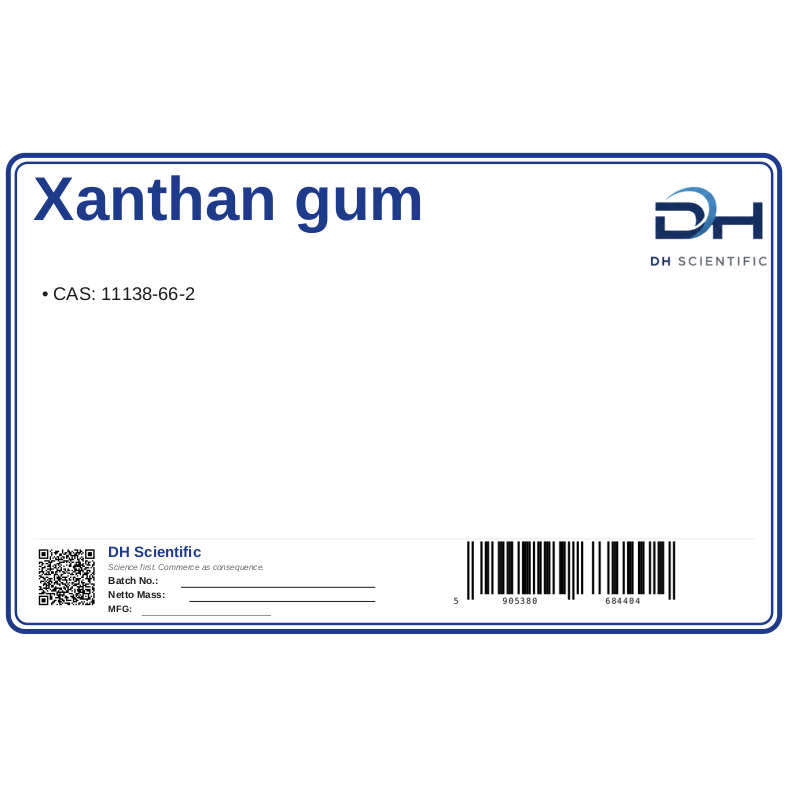
Guma ksantanowa, CAS 11138-66-2
0,99 €
Guma ksantanowa, CAS 11138-66-2
🔒 Demo mode — this item is not for sale.
Legal substance. dhscientific.com is a demonstration of the MOL-GOD platform — we sell nothing and no orders are fulfilled. Banned substances are blocked here automatically from the regulatory canon (compare e.g. Heptachlor).
Xanthan gum (CAS 11138-66-2) is a high molecular weight polysaccharide produced through fermentation by bacteria of the genus Xanthomonas. [1] This substance forms viscous aqueous solutions and is used as a thickening agent in the food industry and in oil recovery processes. [2] Its chemical structure is based on repeating glucose units with side chains of mannose and glucuronic acid. [3] Xanthan gum exhibits thermal stability and resistance to pH changes in the range typical for industrial applications.
SOURCES:
No data in our database for CAS 11138-66-2.
Check external sources:
Spectra are fetched on demand from 9 sources. Each spectrum is stored in our database — the next time it is opened there are zero requests to the external API. Download JCAMP-DX / CSV / PNG for every spectrum without searching.
Reference source — no public API. Open in an external database:
🔗 IR/NMR/MS (SDBS) →Reference source — no public API. Open in an external database:
🔗 JP Monograph →Reference source — no public API. Open in an external database:
🔗 WHO INN →Reference source — no public API. Open in an external database:
🔗 DOAJ →No data in our database for CAS 11138-66-2.
Check external sources:
No harmonised GHS classification for this substance — see the supplier's current safety data sheet (SDS).
References collected from all Safety Hub tabs. CAS: 11138-66-2 ·
PubChem ↗
Tabs with their own references (Emergency, PPE, Storage, Waste) contain additional bibliographic entries within their respective sections.
Paste a series of replicate measurements (CSV, or one number per line). The calculator computes the mean, standard deviation and 95% CI, and detects outliers (Grubbs + Dixon Q).
x̄ = Σxᵢ / n — arithmetic means² = Σ(xᵢ - x̄)² / (n-1) — sample variances = √s² — standard deviationRSD% = (s / x̄) × 100% — relative standard deviationCI₉₅ = x̄ ± t(0.05, n-1) × s / √n — Student's tG = |xᵢ - x̄| / s — Grubbs' testQ = |xsuspect - xnearest| / |xmax - xmin| — Dixon Q-testSource: ICH Q2(R2) Validation of Analytical Procedures · ICH PDF ↗
Choose a buffer from the list of 20 popular systems → enter the target pH → get an exact recipe with the masses to weigh out.
Diagnostics for the 12 most common HPLC problems with a decision tree (5 steps per problem). Source: Snyder/Kirkland/Dolan 3rd ed. Chapter 17 + LCGC LC Troubleshooting columns 1989-2024.
Symptom: All peaks on the chromatogram are wider than expected (FWHM > 2× normal)
Symptom: Peaks have an extended "tail" on the late-elution side (asymmetry T = b/a > 1.5 per USP)
Symptom: The baseline rises or falls systematically for >5 minutes
Symptom: The expected analyte peak does not appear on the chromatogram
Symptom: Pump pressure > 80% of the column max or system shutdown with a high-pressure error
Symptom: Unexplained peaks on the chromatogram absent from the calibration
11138-66-2.
Algorithm: TF-IDF (Salton & Buckley 1988) — term frequency × inverse document frequency.
| Tag | TF | DF | IDF | Score |
|---|---|---|---|---|
| uio- | 5 | 5 | 1.288 | 6.438 |
| metal organic | 2 | 2 | 1.981 | 5.546 |
| structure | 2 | 2 | 1.981 | 3.962 |
| activity | 2 | 2 | 1.981 | 3.962 |
| -uio- | 2 | 2 | 1.981 | 3.962 |
| photocatalytic | 2 | 2 | 1.981 | 3.962 |
Guma ksantanowa, CAS 11138-66-2
You must be logged in to post a review.
All scientific sources cited in the accordions above for CAS 11138-66-2. Format: Chicago Manual of Style 17th ed., Author-Date system.
© 2026 DH Scientific
Reviews
There are no reviews yet.