

Opis
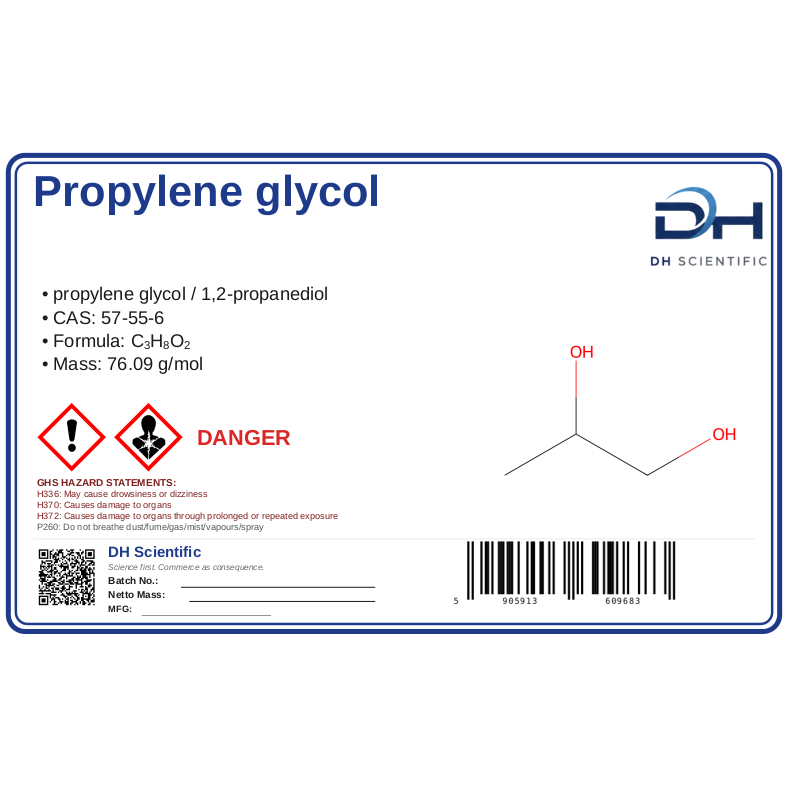
Glikol propylenowy, CAS 57-55-6
0,99 €
Glikol propylenowy, CAS 57-55-6
🔒 Demo mode — this item is not for sale.
Legal substance. dhscientific.com is a demonstration of the MOL-GOD platform — we sell nothing and no orders are fulfilled. Banned substances are blocked here automatically from the regulatory canon (compare e.g. Heptachlor).
Data transcribed from regulatory registers and technical literature, with the source and edition stated. It does not replace the supplier's safety data sheet. Fields without a recorded source are marked as such.
| Molecular formula | C3H8O2[1] |
| Molecular weight | 76.09 g/mol[1] |
| Melting point | -60 °C[1][2] |
| Boiling point | 188.2 °C (760 mmHg)[1][2][3] |
| Density | 1.0361 g/cm³[1][2][3] |
| LogP (lipophilicity) | -0.92[1] |
| pKa | 14.89 |
| IUPAC name | propane-1,2-diol[1] |
| SMILES | CC(CO)O[1] |
| InChIKey | DNIAPMSPPWPWGF-UHFFFAOYSA-N[1] |
Synonyms: propylene glycol · 1,2-propanediol · 57-55-6 · propane-1,2-diol · 1,2-Propylene glycol
Data sources: PubChem (NLM/NIH), Yaws Handbook 2nd ed. (2014)
Last updated: 2026-07-11
Uzupełnienie tabeli „Właściwości fizykochemiczne (baza danych)” poniżej — powtórzone wartości pokazujemy tylko raz.
| Property | Value | Unit | Conditions | Source |
|---|---|---|---|---|
| Viscosity (η) | 0.581 cP at 20 °C[1][2] | Hazardous Substances Data Bank (HSDB) ↗ | ||
| Refractive Index (nD) | 1.4326[1][3] | 20 °C, D-line | Yaws Handbook 2nd ed. (2014) |
CC(CO)O InChI=1S/C3H8O2/c1-3(5)2-4/h3-5H,2H2,1H3
DNIAPMSPPWPWGF-UHFFFAOYSA-N
Data sources: Hazardous Substances Data Bank (HSDB), Yaws Handbook 2nd ed. (2014)
Last updated: 2026-07-11
| Property | Value | Unit | Conditions | Source |
|---|---|---|---|---|
| Melting point | -60 [1][2] | °C | 1 atm | Yaws Handbook 2nd ed. (2014) |
| Boiling point | 188.2 [1][2][3] | °C | 760 mmHg | Yaws Handbook 2nd ed. (2014) |
| Water solubility | miscible [1] | — | opis jakościowy (bez wartości liczbowej) | Yaws Handbook 2nd ed. (2014) |
| Density (ρ) | 1.0361 [1][2][3] | g/cm³ | 20°C | Yaws Handbook 2nd ed. (2014) |
| Refractive index (n_D) | 1.4326 [1][2] | — | 20°C, sodium D | Yaws Handbook 2nd ed. (2014) |
| Viscosity (η) | 40.4 [1] | cP | 25°C | Yaws Handbook 2nd ed. (2014) |
| Vapor pressure | 0.13 [1] | mmHg | 25°C | Yaws Handbook 2nd ed. (2014) |
| Flash point | 99 [2] | °C | closed cup | No primary source |
| Autoignition temperature | 371 [2] | °C | in air | No primary source |
| pKa₁ | 14.89 | — | No primary source | |
| logP (octanol/water) | -0.92 [2] | — | No primary source | |
| logD (pH 7) | -0.92 [1] | — | pH 7 | Yaws Handbook 2nd ed. (2014) |
| Dielectric constant (ε) | 32 [1] | — | Yaws Handbook 2nd ed. (2014) | |
| Surface tension | 36 [1] | mN/m | Yaws Handbook 2nd ed. (2014) | |
| Specific heat (cp) | 2.481 [1] | J/(g·K) | Yaws Handbook 2nd ed. (2014) | |
| Thermal conductivity (k) | 0.2 [1] | W/(m·K) | Yaws Handbook 2nd ed. (2014) | |
| Dipole moment (μ) | 2.27 [1] | D | Yaws Handbook 2nd ed. (2014) | |
| ΔH vaporization | 58.5 [1] | kJ/mol | Yaws Handbook 2nd ed. (2014) | |
| ΔH fusion | 7.4 [1] | kJ/mol | at mp | Yaws Handbook 2nd ed. (2014) |
| Critical temperature (Tc) | 351 [1] | °C | critical point | Yaws Handbook 2nd ed. (2014) |
| Critical pressure (Pc) | 60 [1] | bar | critical point | Yaws Handbook 2nd ed. (2014) |
| Acentric factor (ω) | 0.52 [1] | — | Pitzer | Yaws Handbook 2nd ed. (2014) |
| Ethanol solubility | miscible [1] | — | opis jakościowy (bez wartości liczbowej) | Yaws Handbook 2nd ed. (2014) |
Physicochemical values are derived from the independent, peer-reviewed sources listed above.
GHS/CLP classification — Regulation (EC) No 1272/2008 + UN GHS Rev. 9 (2021).


⚠ Classification based on a consensus of sources (PubChem / supplier notifications) — not verified against the harmonised classification in Annex VI (CLP). The scope of hazards may be broader than the official classification; verify against the supplier's current safety data sheet before use.
Translations: CLP Regulation (EC) 1272/2008, Annexes III and IV. Data: PubChem/NLM.
References collected from all Safety Hub tabs. CAS: 57-55-6 ·
PubChem ↗
Tabs with their own references (Emergency, PPE, Storage, Waste) contain additional bibliographic entries within their respective sections.
Paste a series of replicate measurements (CSV, or one number per line). The calculator computes the mean, standard deviation and 95% CI, and detects outliers (Grubbs + Dixon Q).
x̄ = Σxᵢ / n — arithmetic means² = Σ(xᵢ - x̄)² / (n-1) — sample variances = √s² — standard deviationRSD% = (s / x̄) × 100% — relative standard deviationCI₉₅ = x̄ ± t(0.05, n-1) × s / √n — Student's tG = |xᵢ - x̄| / s — Grubbs' testQ = |xsuspect - xnearest| / |xmax - xmin| — Dixon Q-testSource: ICH Q2(R2) Validation of Analytical Procedures · ICH PDF ↗
Choose a buffer from the list of 20 popular systems → enter the target pH → get an exact recipe with the masses to weigh out.
Diagnostics for the 6 most common HPLC problems with a decision tree (5 steps per problem). Source: Snyder/Kirkland/Dolan 3rd ed. Chapter 17 + LCGC LC Troubleshooting columns 1989-2024.
Symptom: All peaks on the chromatogram are wider than expected (FWHM > 2× normal)
Symptom: Peaks have an extended "tail" on the late-elution side (asymmetry T = b/a > 1.5 per USP)
Symptom: The baseline rises or falls systematically for >5 minutes
Symptom: The expected analyte peak does not appear on the chromatogram
Symptom: Pump pressure > 80% of the column max or system shutdown with a high-pressure error
Symptom: Unexplained peaks on the chromatogram absent from the calibration
57-55-6
— multi-criteria ranking (W12): 30% citations · 20% recency · 20% topic · 15% historical · 15% open access.
All scientific sources cited in the accordions above for CAS 57-55-6. Format: Chicago Manual of Style 17th ed., Author-Date system.
Opinie
Na razie nie ma opinii o produkcie.