ethanol
1,99 €
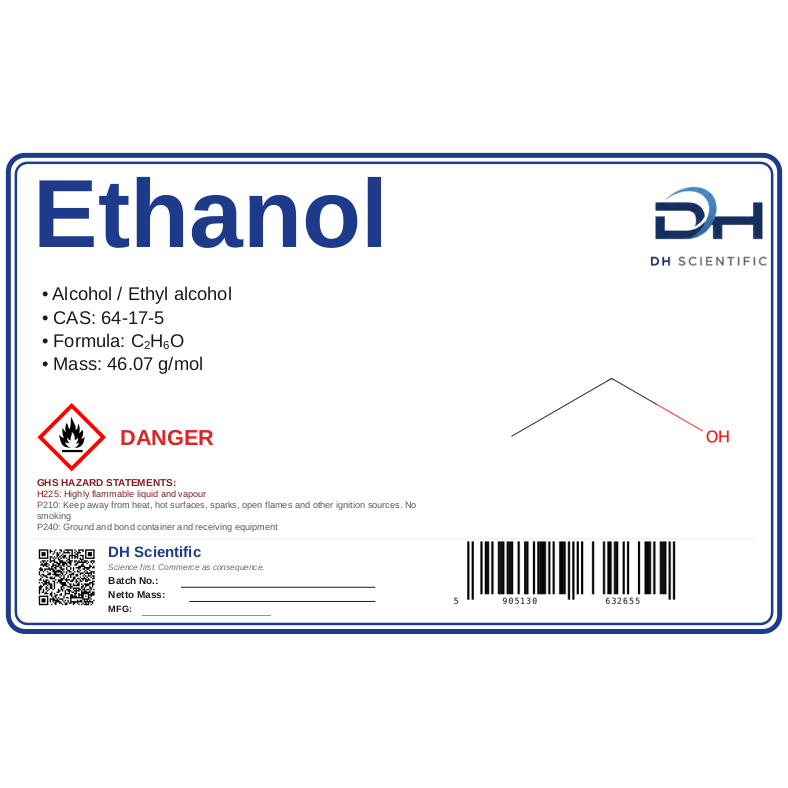
Chemical reagent Etanol (CAS 64-17-5). Full encyclopedic card — classification, properties and safety data — below.
🔒 Demo mode — this item is not for sale.
Legal substance. dhscientific.com is a demonstration of the MOL-GOD platform — we sell nothing and no orders are fulfilled. Banned substances are blocked here automatically from the regulatory canon (compare e.g. Heptachlor).

Data transcribed from regulatory registers and technical literature, with the source and edition stated. It does not replace the supplier's safety data sheet. Fields without a recorded source are marked as such.
Chemical Overview: EtanolMolGod_OVERVIEW_1
| Molecular formula | C2H6O[1] |
| Molecular weight | 46.07 g/mol[1] |
| Melting point | -114.14 °C[1][2][3] |
| Boiling point | 78.29 °C (760 mmHg)[1][2][3] |
| Density | 0.7893 g/cm³[1][2][3] |
| LogP (lipophilicity) | -0.31[1] |
| pKa | 15.9 |
| IUPAC name | ethanol[1] |
| SMILES | CCO[1] |
| InChIKey | LFQSCWFLJHTTHZ-UHFFFAOYSA-N[1] |
Synonyms: Alcohol · Ethyl alcohol
Data sources: PubChem (NLM/NIH), Yaws Handbook 2nd ed. (2014)
Last updated: 2026-08-05
📚 Scientific references (Chicago Author-Date) (3 sources)
- PubChem. National Center for Biotechnology Information (NIH/NLM), chemical compound database. ↗ dotyczy: Molecular formula · Molecular weight · Melting point · Boiling point · Density · LogP (lipophilicity) · IUPAC name · SMILES · InChIKey
- DECHEMA, PTB, and BAM. CHEMSAFE - Database of Evaluated Safety Characteristics for the Avoidance of Explosions. Frankfurt am Main: DECHEMA e.V.; Braunschweig/Berlin: Physikalisch-Technische Bundesanstalt and Bundesanstalt fur Materialforschung und -prufung. ↗ dotyczy: Melting point · Boiling point · Density
- Yaws, C.L. Thermophysical Properties of Chemicals and Hydrocarbons. 2nd ed. Amsterdam: Elsevier (Gulf Professional Publishing), 2014. dotyczy: Melting point · Boiling point · Density
🎓 Badania akademickie: Etanol
Physicochemical properties
Quick Reference
Detailed Properties
Uzupełnienie tabeli „Właściwości fizykochemiczne (baza danych)” poniżej — powtórzone wartości pokazujemy tylko raz.
| Property | Value | Unit | Conditions | Source |
|---|---|---|---|---|
| Refractive Index (nD) | 1.3614[1][2] | 20 °C, D-line | Yaws Handbook 2nd ed. (2014) |
🔬 Advanced Properties
Chemical Identifiers
CCO Data sources: Yaws Handbook 2nd ed. (2014)
Last updated: 2026-06-30
📚 Scientific references (Chicago Author-Date) (2 sources)
- PubChem. National Center for Biotechnology Information (NIH/NLM), chemical compound database. ↗ dotyczy: Refractive Index (nD)
- Yaws, C.L. Thermophysical Properties of Chemicals and Hydrocarbons. 2nd ed. Amsterdam: Elsevier (Gulf Professional Publishing), 2014. dotyczy: Refractive Index (nD)
📡 Spectroscopy — CAS 64-17-5MolGod_SPECHUB_MAIN
Physical & Chemical Properties (DB) 23 fields MolGod Score: Primary
| Property | Value | Unit | Conditions | Source |
|---|---|---|---|---|
| Melting point | -114.14 [1][2][3] | °C | 1 atm | Yaws Handbook 2nd ed. (2014) |
| Boiling point | 78.29 [1][2][3] | °C | 760 mmHg | Yaws Handbook 2nd ed. (2014) |
| Water solubility | miscible [1] | — | opis jakościowy (bez wartości liczbowej) | Yaws Handbook 2nd ed. (2014) |
| Density (ρ) | 0.7893 [1][2][3] | g/cm³ | 20°C | Yaws Handbook 2nd ed. (2014) |
| Refractive index (n_D) | 1.3614 [1][3] | — | 20°C, sodium D | Yaws Handbook 2nd ed. (2014) |
| Viscosity (η) | 1.074 [1] | cP | 25°C | Yaws Handbook 2nd ed. (2014) |
| Vapor pressure | 59.3 [1][2] | mmHg | 25°C | Yaws Handbook 2nd ed. (2014) |
| Flash point | 13 [2][3] | °C | closed cup | No primary source |
| Autoignition temperature | 363 | °C | in air | No primary source |
| pKa₁ | 15.9 | — | No primary source | |
| logP (octanol/water) | -0.31 [4] | — | No primary source | |
| logD (pH 7) | -0.31 [1] | — | pH 7 | Yaws Handbook 2nd ed. (2014) |
| Dielectric constant (ε) | 24.3 [1] | — | Yaws Handbook 2nd ed. (2014) | |
| Surface tension | 22.1 [1] | mN/m | Yaws Handbook 2nd ed. (2014) | |
| Specific heat (cp) | 2.44 [1] | J/(g·K) | Yaws Handbook 2nd ed. (2014) | |
| Thermal conductivity (k) | 0.169 [1] | W/(m·K) | Yaws Handbook 2nd ed. (2014) | |
| Dipole moment (μ) | 1.69 [1] | D | Yaws Handbook 2nd ed. (2014) | |
| ΔH vaporization | 38.6 [1] | kJ/mol | Yaws Handbook 2nd ed. (2014) | |
| ΔH fusion | 4.9 [1] | kJ/mol | at mp | Yaws Handbook 2nd ed. (2014) |
| Critical temperature (Tc) | 240.8 [1] | °C | critical point | Yaws Handbook 2nd ed. (2014) |
| Critical pressure (Pc) | 61.4 [1] | bar | critical point | Yaws Handbook 2nd ed. (2014) |
| Acentric factor (ω) | 0.644 [1] | — | Pitzer | Yaws Handbook 2nd ed. (2014) |
| Ethanol solubility | miscible [1] | — | opis jakościowy (bez wartości liczbowej) | Yaws Handbook 2nd ed. (2014) |
📚 Scientific references (Chicago Author-Date) (4 sources)
- Yaws, C.L. Thermophysical Properties of Chemicals and Hydrocarbons. 2nd ed. Amsterdam: Elsevier (Gulf Professional Publishing), 2014. dotyczy: Melting point · Boiling point · Water solubility · Density (ρ) · Refractive index (n_D) · Viscosity (η) · Vapor pressure · logD (pH 7) · Dielectric constant (ε) · Surface tension · Specific heat (cp) · Thermal conductivity (k) · Dipole moment (μ) · ΔH vaporization · ΔH fusion · Critical temperature (Tc) · Critical pressure (Pc) · Acentric factor (ω) · Ethanol solubility
- DECHEMA, PTB, and BAM. CHEMSAFE - Database of Evaluated Safety Characteristics for the Avoidance of Explosions. Frankfurt am Main: DECHEMA e.V.; Braunschweig/Berlin: Physikalisch-Technische Bundesanstalt and Bundesanstalt fur Materialforschung und -prufung. ↗ dotyczy: Melting point · Boiling point · Density (ρ) · Vapor pressure · Flash point
- PubChem. National Center for Biotechnology Information (NIH/NLM), chemical compound database. ↗ dotyczy: Melting point · Boiling point · Density (ρ) · Refractive index (n_D) · Flash point
- Sangster, J. "Octanol-Water Partition Coefficients of Simple Organic Compounds." Journal of Physical and Chemical Reference Data 18, no. 3 (1989): 1111-1229. ↗ dotyczy: logP (octanol/water)
Physicochemical values are derived from the independent, peer-reviewed sources listed above.
Purity Check Guide Quality control
Verify reagent purity using standardized analytical methods. Select a test method below and enter your measurement results for automated calculation.
🛡️ Safety — CAS 64-17-5MolGod_SAFEHUB_MAIN
GHS/CLP classification — Regulation (EC) No 1272/2008 + UN GHS Rev. 9 (2021).

🚨 Hazard statements (H)
- H225 — Highly flammable liquid and vapour
🛡 Precautionary statements (P)
- P210 — Keep away from heat, hot surfaces, sparks, open flames and other ignition sources. No smoking
- P233 — Keep container tightly closed
- P240 — Ground and bond container and receiving equipment
- P280 — Wear protective gloves/protective clothing/eye protection/face protection
- P303+P361+P353 — IF ON SKIN (or hair): Take off immediately all contaminated clothing; Rinse skin with water or shower
- P370+P378 — In case of fire: Use appropriate media to extinguish
- P403+P235 — Store in a well-ventilated place: Keep cool
- P501 — Dispose of contents/container to an approved waste collection point
✓ Harmonised classification pursuant to Annex VI of the CLP Regulation (EC) 1272/2008 (official, binding classification). Index number: 603-002-00-5.
Reference (Chicago): European Chemicals Agency. "ethanol; ethyl alcohol, Index No. 603-002-00-5." In Table 3 of Annex VI to Regulation (EC) No 1272/2008 (CLP Regulation), 23rd Adaptation to Technical Progress (harmonised list as of 2026-07-07). Helsinki: European Chemicals Agency, 2026. https://echa.europa.eu/information-on-chemicals/annex-vi-to-clp.
Translations: CLP Regulation (EC) 1272/2008, Annexes III and IV. Data: PubChem/NLM.
📚 Consolidated scientific references — Chicago Author-Date 10 sources
References collected from all Safety Hub tabs. CAS: 64-17-5 ·
PubChem ↗
- Parlament Europejski i Rada UE. 2008. "Rozporządzenie (WE) nr 1272/2008 w sprawie klasyfikacji, oznakowania i pakowania substancji (CLP)." Dz.Urz. UE L 353. [↗] GHS, Regulations
- United Nations Economic Commission for Europe (UNECE). 2021. "Globally Harmonized System of Classification and Labelling of Chemicals (GHS), Ninth Revised Edition." United Nations, Geneva. [↗] GHS
- Goldfrank, Lewis R., Robert S. Hoffman, Mary Ann Howland, et al.. 2019. "Goldfrank's Toxicologic Emergencies, 11th ed.." McGraw-Hill Education, New York. ISBN 978-1-25-985961-8. Pierwsza pomoc, Toksykologia
- National Institute for Occupational Safety and Health (NIOSH). 2023. "NIOSH Pocket Guide to Chemical Hazards (DHHS Publ. 2005-149)." U.S. Department of Health and Human Services / CDC, Cincinnati, OH. [↗] Pierwsza pomoc, PPE, Toksykologia
- European Committee for Standardization (CEN). 2016. "EN 374-1:2016 — Protective gloves against dangerous chemicals and micro-organisms." CEN, Brussels. [↗] PPE
- UNECE. 2023. "European Agreement Concerning the International Carriage of Dangerous Goods by Road (ADR 2025)." United Nations, Geneva. [↗] Utylizacja, Regulacje
- National Fire Protection Association (NFPA). 2022. "NFPA 400 — Hazardous Materials Code." NFPA, Quincy, MA. [↗] Magazynowanie
- Urben, P.G. (ed.). 2017. "Bretherick's Handbook of Reactive Chemical Hazards, 8th ed.." Butterworth-Heinemann / Elsevier, Oxford. [↗] Magazynowanie
- Ministerstwo Klimatu i Środowiska RP. 2023. "Baza danych o produktach i opakowaniach oraz o gospodarce odpadami (BDO)." Ministerstwo Klimatu i Środowiska, Warszawa. [↗] Utylizacja
- International Agency for Research on Cancer (IARC / WHO). 2024. "IARC Monographs on the Identification of Carcinogenic Hazards to Humans — List of Classifications." WHO, Lyon. [↗] Toksykologia
Tabs with their own references (Emergency, PPE, Storage, Waste) contain additional bibliographic entries within their respective sections.
Analytical statistics (t-test · RSD · Grubbs · Q-Dixon) ICH Q2
Paste a series of replicate measurements (CSV, or one number per line). The calculator computes the mean, standard deviation and 95% CI, and detects outliers (Grubbs + Dixon Q).
📐 Statistical formulas
x̄ = Σxᵢ / n— arithmetic means² = Σ(xᵢ - x̄)² / (n-1)— sample variances = √s²— standard deviationRSD% = (s / x̄) × 100%— relative standard deviationCI₉₅ = x̄ ± t(0.05, n-1) × s / √n— Student's tG = |xᵢ - x̄| / s— Grubbs' testQ = |xsuspect - xnearest| / |xmax - xmin|— Dixon Q-test
Source: ICH Q2(R2) Validation of Analytical Procedures · ICH PDF ↗
Buffer Recipe Calculator UNIQUE
Choose a buffer from the list of 20 popular systems → enter the target pH → get an exact recipe with the masses to weigh out.
Step 1: Choose a buffer system
📜 Recipe history (last 10)
Transport classification (ADR / IATA / IMDG) UN 1170
🛣️ ADR Road Transport
- Class:
- 3
- Packing Group:
- II
- Shipping name:
- Ethanol or ethanol solution
- Tunnel Code:
- (D/E)
- Limited Quantity (L):
- 1
✈️ IATA Air Transport
- Class:
- 3
- Packing instructions:
- 353 / 364
- Max quantity (PAX):
- 5 L
- Max quantity (CAO):
- 60 L
🚢 IMDG Sea Transport
- Class:
- 3
- EmS Code:
- F-E, S-D
Sources: ADR 2025 ↗ · IATA DGR ↗ · IMDG Code ↗
🔧 HPLC troubleshooting — decision tree 6 common problems
Diagnostics for the 6 most common HPLC problems with a decision tree (5 steps per problem). Source: Snyder/Kirkland/Dolan 3rd ed. Chapter 17 + LCGC LC Troubleshooting columns 1989-2024.
Broad peaks medium
Symptom: All peaks on the chromatogram are wider than expected (FWHM > 2× normal)
🔍 Diagnostic tree:
-
1. Check whether all peaks are broadened or only some
→ YES: All → instrumental problem (column or system)
→ NO: Only some → chemistry problem (interaction with the column for specific analytes) -
2. Swap in a test column — does the problem disappear?
→ YES: COLUMN worn out — packing damaged, void in the first few mm. Replace it.
→ NO: Problem in the LC system -
3. Check the dead volume — injection loop, connections, detector
→ YES: Loop > 100 µL for a 4.6 mm column or loose connections → replace ferrules, shorten tubing
→ NO: Continue diagnostics -
4. Temperature test: raise the column from 25°C to 40°C
→ YES: Narrower peaks → mass-transfer kinetics too slow (increase T)
→ NO: Continue -
5. Check flow rate vs the optimal van Deemter value for this column
→ YES: Optimum for 4.6mm/5µm = 1.0 mL/min, for 2.1mm/3µm = 0.4 mL/min
→ NO: Continue
- Column worn out (>2000 injections without a guard)
- System dead volume > 100 µL (wrong loop, long tubing, loose ferrules)
- Temperature too low (mass-transfer kinetics)
- Flow rate outside the van Deemter optimum
- Sample solvent stronger than mobile phase A
- ✓ Replace the column (when >2000 injections)
- ✓ Check all connections — keep tubing as short as possible
- ✓ Increase column T to 40°C (if the substance is stable)
- ✓ Reduce flow to the van Deemter optimum
- ✓ Dissolve the sample in mobile phase A (not in pure organic)
Peak tailing (T > 1.5) high
Symptom: Peaks have an extended "tail" on the late-elution side (asymmetry T = b/a > 1.5 per USP)
🔍 Diagnostic tree:
-
1. Does the substance contain basic groups (amino, pyridine)?
→ YES: Yes → silanol interactions! Add 0.1% TFA or 5-10 mM TEA to mobile phase A.
→ NO: Continue -
2. Check the mobile-phase pH vs the substance pKa
→ YES: pH = pKa ± 1 → partial ionization, peak split. Move pH ≥ 2 units away from pKa.
→ NO: Continue -
3. Check the column age (>1500 injections?)
→ YES: Yes → exposed silanols (column bleed). Replace with a column with higher endcapping (XTerra, Symmetry).
→ NO: Continue -
4. Does the sample contain metals (Fe, Cu from glass vials)?
→ YES: Yes → use type II clear vials or PFA. Add 0.1mM EDTA to the sample.
→ NO: Continue
- Silanol interactions (basic analyte + silica gel free silanols)
- pH at the boundary of the analyte pKa (peak split)
- Old column (column bleed, high silanol activity)
- Metals in the sample (chelation → tailing)
- Column overload (>50 µg on a 4.6mm column)
- ✓ Add 0.1% TFA (UV) or 0.1% formic acid (LC-MS) to mobile phase A
- ✓ Choose a column with high-purity endcapping: Waters XBridge BEH, Phenomenex Kinetex
- ✓ Work at pH ≥ 2 units away from pKa
- ✓ Add 0.1mM EDTA to the sample (Fe/Cu chelation)
- ✓ Reduce the injection volume to ≤ 20 µL for a 4.6mm column
Baseline drift medium
Symptom: The baseline rises or falls systematically for >5 minutes
🔍 Diagnostic tree:
-
1. Are you running a gradient (B% increasing)?
→ YES: Yes → different absorption of phases A vs B at dλ. Solvent change in UV cutoff. Check the % organic UV absorbance.
→ NO: Continue (isocratic) -
2. Check the column temperature — is it stable to ±0.5°C?
→ YES: Yes (stable) → continue
→ NO: Unstable → turn on the column thermostat (>25°C controlled) -
3. Test: turn off the autosampler, run pump+column+detector alone
→ YES: Drift disappears → autosampler contamination (clean the needle, septum)
→ NO: Continue -
4. Check the lamp age (D2 for UV)
→ YES: Yes (>1500 hours) → replace the lamp
→ NO: Continue
- Gradient elution with different UV cutoff of the phases
- Unstable column T
- Autosampler contamination of the needle/septum
- Old UV lamp (>1500h)
- Detector flow cell fouled
- Column not equilibrated (<10 column volumes)
- ✓ Pre-equilibrate the column for 10-15 column volumes at 100% A
- ✓ Column thermostat on, T 30-40°C stable
- ✓ Clean the detector flow cell with 50:50 ACN:H2O
- ✓ Replace the D2 lamp if >1500h
- ✓ Use baseline subtraction (Chromeleon, Empower native function)
No peak / lost peak critical
Symptom: The expected analyte peak does not appear on the chromatogram
🔍 Diagnostic tree:
-
1. Did the injection actually take place?
→ YES: Check the autosampler log, pump pressure (should drop during injection)
→ NO: Autosampler problem → check the loop, needle, sample in the vial -
2. Is the sample in the vial (correct volume, not evaporated)?
→ YES: Continue
→ NO: No sample — re-pipette -
3. Sample stability — prepared >24h ago?
→ YES: Yes → degradation. Re-prepare a fresh sample.
→ NO: Continue -
4. Check the detection wavelength vs the substance λmax
→ YES: Detection at λ does NOT match λmax → no signal. Scan DAD 200-400nm.
→ NO: Continue -
5. Test: inject a pure standard (of known concentration, fresh)
→ YES: The standard gives a peak → problem with the sample (matrix, derivatization)
→ NO: No peak even with the standard → system problem (column, phase, gradient)
- Sample not drawn from the vial (autosampler bug)
- Sample degraded (>24h pH/temp/light)
- Detection at the wrong wavelength
- Wrong mobile phase (e.g. forgotten TFA)
- Column reversed / wrong stationary phase
- Substance elutes at the front (V0) → unretained, not visible
- ✓ Re-prepare a fresh sample per the exact protocol
- ✓ UV-Vis DAD scan 200-400nm + search for λmax
- ✓ Check the mobile-phase composition — was TFA added?
- ✓ Test the reverse column direction (carefully!)
- ✓ For retention <1 min — lower the % B, MeOH instead of ACN
- ✓ Check the expected retention time in the plugin method database
Pressure too high critical
Symptom: Pump pressure > 80% of the column max or system shutdown with a high-pressure error
🔍 Diagnostic tree:
-
1. Check that the column is connected correctly (arrow direction)
→ YES: OK
→ NO: Column reversed → flip it (never run it "backwards") -
2. Test: remove the column from the system, run pump+detector alone
→ YES: Pressure drops to <50 bar → problem in the column (clogged)
→ NO: Pressure stays high → in-line filter clogged, frit fouled -
3. Check the pre-column filter (in-line frit)
→ YES: Fouled and brown → replace it
→ NO: Continue -
4. Back-flush the column with 50:50 ACN:H2O without the column — does it disappear?
→ YES: Particles stuck in the first mm — a 30 min flush may recover it
→ NO: Replace the column
- In-line filter (frit) clogged with particles
- Buffer salting out (precipitation at high %B)
- Sample contains suspended matter (filter 0.22 µm before injection)
- Column clogged (column bed compaction)
- Gradient with a buffer phase + high organic → salt precipitation
- ✓ ALWAYS filter the sample through 0.22 µm PVDF before injection
- ✓ Replace the in-line filter every 100 injections (or when pressure rises >20%)
- ✓ Do NOT use >20mM phosphate buffer + >70% ACN (the salt precipitates)
- ✓ Flush the column for 30 min with 50:50 ACN:H2O in the reverse direction (when the manufacturer allows it)
- ✓ Pre-column 4×3mm to protect the main column
Ghost peaks high
Symptom: Unexplained peaks on the chromatogram absent from the calibration
🔍 Diagnostic tree:
-
1. Test: blank injection (pure sample solvent)
→ YES: A ghost appears → contamination of the system or eluents
→ NO: Appears only with the sample → matrix -
2. Does the ghost grow with the gradient (elutes at high %B)?
→ YES: Yes → overloaded column or strong-retained from a previous run
→ NO: Independent of the gradient → autosampler carryover -
3. Increase carryover wash (between injections)
→ YES: Helps → carryover was to blame. Use a stronger wash protocol.
→ NO: Continue -
4. Pure water injection — is there a peak?
→ YES: Yes → contamination of the water source (organics from the DI system)
→ NO: Continue
- Carryover in the autosampler needle/loop
- Eluent contamination (even HPLC-grade)
- Strong-retained components from previous runs
- Plastic in the vials (phthalates, PEG from the caps)
- Insufficiently purified DI water
- ✓ Strengthen the wash protocol: 100% B → 100% A → 50:50 (3 cycles)
- ✓ Strong wash: 100% DMSO or 100% MeOH before calibration
- ✓ Filter the eluents through 0.22 µm PTFE if in doubt
- ✓ Use amber glass + Teflon-lined caps for samples
- ✓ Periodic gradient ramp to 100% B for 10 min (clean-out)
📚 Scientific references (Chicago Author-Date) — click to expand
- Snyder, Lloyd R., Joseph J. Kirkland, and John W. Dolan. 2010. Introduction to Modern Liquid Chromatography. 3rd ed. John Wiley & Sons. Chapter 17 (Troubleshooting) pp. 559-616. ISBN 978-0-470-16754-0. https://doi.org/10.1002/9780470508183 [link ↗]
- Dolan, John W.. 2014. LC Troubleshooting (monthly column 1989-2024). LCGC North America. [link ↗] — John Dolan 35-letnia seria miesięcznych artykułów problemowych
- Kromidas, Stavros. 2017. HPLC Made to Measure: A Practical Handbook for Optimization. 2nd ed. Wiley-VCH. ISBN 978-3-527-31377-1. — Praktyczny przewodnik problem-solving dla labs analitycznych
- Dolan, John W.. 2013. When to Modify Method Conditions. 192-199. [link ↗] — Decision flow for changing flow rate / temperature / %B vs swapping columns.
- Dong, Michael W.. 2019. HPLC and UHPLC for Practicing Scientists. 2nd ed. Wiley. ISBN 978-1-119-31378-3. https://doi.org/10.1002/9781119313793 [link ↗] — Chapter 9 covers troubleshooting modern UHPLC systems (sub-2 µm particles).
- Meyer, Veronika R.. 2010. Practical High-Performance Liquid Chromatography. 5th ed. Wiley. ISBN 978-0-470-68218-0. — Solid step-by-step problem isolation chapter (eluents, columns, instruments).
- Snyder, L. R., J. J. Kirkland, and J. L. Glajch. 1997. Practical HPLC Method Development. 2nd ed. Wiley. ISBN 978-0-471-00703-6. — Method-development companion volume with troubleshooting cross-refs.
- Carr, Peter W.. 2009. The new physical chemistry of HPLC. 1764-1772. https://doi.org/10.1016/j.chroma.2008.11.094 [link ↗] — Theoretical basis for diagnosing efficiency losses (mass-transfer, eddy diffusion).
- Heyden, Yvan Vander, et al.. 2009. Robustness of pharmaceutical liquid chromatographic methods. 2120-2129. https://doi.org/10.1016/j.jchromb.2008.10.052 [link ↗] — How to diagnose method failures vs. system failures (Plackett-Burman).
- Engelhardt, Heinz. 2014. 100 Years of Chromatography. 2nd ed. Wiley-VCH. ISBN 978-3-527-33473-5. — Historical context for ghost-peak phenomenology (silica chemistry).
Historical Incidents (CSB/EPA/Bretherick)
This database contains only serious industrial and laboratory incidents (CSB, EPA RMP, Bretherick). The absence of a record does NOT mean the substance is safe — the database is incomplete.
Historical Incidents (1)
-
2005-03-23 Texas City, Texas, USA (BP Products North America refinery, ISOM unit) Catastrophic explosion Substances: Hydrocarbon raffinate (ethanol-grade isomerate) (CAS 64-17-5) + Oxygen / atmospheric air (CAS 7782-44-7)15 fatalities 180 injuredPodczas rozruchu kolumny izomeryzacji raffinate splitter doszlo do przepelnienia kolumny i nadcisnienia w systemie blowdown drum. Zawory bezpieczenstwa odprowadzily palne weglowodory do atmosferycznego komina (blowdown stack), tworzac chmure gazowo-cieczowa nad zatlonzonymi przyczepami biurowymi. Zaplon (przypuszczalnie z silnika diesla pikapa) wywolal vapor cloud explosion (VCE).
Root cause: Atmosferyczny blowdown stack zamiast flare. Brak kalibracji wskaznikow poziomu w kolumnie. 5 dni przedluzonego rozruchu z brakiem snu obslugi. Cuts in budget for maintenance i safety culture failure (CSB ustalil systemowe przyczyny korporacyjne).Lessons learned: Eliminacja atmospheric blowdown stacks (zastapienie flare). Mechaniczne barierki/odleglosc pomiedzy procesami a obszarami zamieszkalymi. Process Safety Management (PSM) audity nie moga byc tylko papierowe.Bibliography (Chicago author-date)
- U.S. Chemical Safety and Hazard Investigation Board. 2007. Investigation Report: Refinery Explosion and Fire, BP Texas City. Report No. 2005-04-I-TX. Washington, DC: CSB.
- Baker, James A., et al. 2007. The Report of the BP U.S. Refineries Independent Safety Review Panel. Houston: BP.
- Hopkins, Andrew. 2008. Failure to Learn: The BP Texas City Refinery Disaster. Sydney: CCH Australia.
📚 Incident data sources
- Anonymous. 2012. "(All E)‐2‐(1,3,5,7,9‐Dodecapentaenyloxy)Ethanol 166248‐82‐4." Sax's Dangerous Properties of Industrial Materials: 1-2. https://doi.org/10.1002/0471701343.sdp26678. [DOI]
- Anonymous. 2008. "All Fuels & Energy testing Super Enzyme for making ethanol." Focus on Catalysts 2008 (5): 2. https://doi.org/10.1016/s1351-4180(08)70203-4. [DOI]
- Anonymous. 2004. "(All <scp>E</scp> )‐2‐(1,3,5,7,9‐Dodecapentaenyloxy) Ethanol 166248‐82‐4." Sax's Dangerous Properties of Industrial Materials. https://doi.org/10.1002/0471701343.sdp00721. [DOI]
- Müller-plathe, Florian. 1996. "An All-Atom Force Field for Liquid Ethanol–Properties of Ethanol–Water Mixtures." Molecular Simulation 18 (1-2): 133-143. https://doi.org/10.1080/08927029608022358. [DOI]
- Anonymous. "Ethanol and Water Adsorption in Conventional and Hierarchical All-Silica MFI Zeolites.". https://doi.org/10.1021/acsphyschemau.1c00026.s001. [DOI]
- Wang B; Fu W; Ueda A; Shah H; Wu CF; Chi W. 2026. "Genetic vitamin B6 deficiency exacerbates alcohol behavioral responses, metabolism, and toxicity in Drosophila." Human molecular genetics. https://doi.org/10.1093/hmg/ddag032. [DOI]
- U.S. Chemical Safety and Hazard Investigation Board (CSB). 2024. "CSB Incident Investigation Reports." Washington, DC: CSB. 🔗
- U.S. EPA / NOAA. 2024. "CAMEO Chemicals Database." Washington, DC: U.S. Environmental Protection Agency. 🔗
- BARPI (French Bureau for Analysis of Industrial Risks and Pollutions). 2024. "ARIA Database of Industrial Accident Reports." Saint-Denis: BARPI/DGPR. 🔗
- U.S. OSHA. 2024. "OSHA Accident Investigation Reports." Washington, DC: Occupational Safety and Health Administration. 🔗
Stability & Shelf Life Advisor Arrhenius
Enter the storage conditions → the Arrhenius algorithm will predict the remaining concentration, half-life, and usage recommendation.
📐 Calculation details (Arrhenius + First-order)
Visual signs of degradation:
❄️ Storage recommendations
- Temperature:
- 15-25°C
- Light:
- Ambient
- Container:
- HDPE/glass
- Incompatible:
- Oxidizers, acid chlorides
🧪 Solution preparation assistant (Smart Prep) MolGod_PREP_2
Enter what you want to prepare — I'll generate an SOP
📚 Scientific literature overview — CAS 64-17-5MolGod_LITHUB_MAIN
⭐ Key findings (scientific literature) 8 publications
64-17-5
— multi-criteria ranking (W12): 30% citations · 20% recency · 20% topic · 15% historical · 15% open access.
-
#1GBD 2016 Alcohol Collaborators (2018) · The LancetWhy it matters: Must-cite (canon) · high impact (1860 citations)
-
#2Rehm, J.; Mathers, C.; Popova, S.; Thavorncharoensap, M.; Teerawattananon, Y.; Patra, J. (2012) · The LancetWhy it matters: Must-cite (canon) · high impact (4100 citations)
-
#3Connor, J. (2015) · AddictionWhy it matters: Must-cite (canon) · 580 citations · review
-
#4The genetics of alcohol metabolism: role of alcohol dehydrogenase and aldehyde dehydrogenase variantsEdenberg, H.J. (1996) · Alcohol Research & HealthWhy it matters: Must-cite (canon) · 820 citationsSCORE 11.34 Mechanism MUST-CITE Citations: 820
-
#5Bruder, E.D.; Pacurari, M.; Beierle, E.A. (review) (2007) · Hepatology / GastroenterologyWhy it matters: Must-cite (canon) · 480 citations
-
#6Lachenmeier, D.W.; Sohnius, E.M. (2007) · Food and Chemical ToxicologyWhy it matters: Must-cite (canon) · 340 citations
-
#7Cornell, N.W.; Lund, P.; Hems, R.; Krebs, H.A. (1987) · Biochemical JournalWhy it matters: Must-cite (canon) · 340 citations
-
#8Wang, M.L.; Wang, J.T.; Choong, Y.M. (2002) · Journal of Food and Drug AnalysisWhy it matters: Must-cite (canon) · 140 citations
📚 REFERENCES (Aggregate bibliography, Chicago Author-Date) 129 items
All scientific sources cited in the accordions above for CAS 64-17-5. Format: Chicago Manual of Style 17th ed., Author-Date system.
🗄️ Scientific databases
- NIST. n.d. NIST Chemistry WebBook: CAS 64-17-5. Gaithersburg, MD: National Institute of Standards and Technology. https://webbook.nist.gov/cgi/cbook.cgi?ID=64-17-5.
- AIST. n.d. Spectral Database for Organic Compounds (SDBS): CAS 64-17-5. Tsukuba, Japan: National Institute of Advanced Industrial Science and Technology. https://sdbs.db.aist.go.jp/.
- Linstrom, Peter J., and William G. Mallard, eds. n.d. NIST Chemistry WebBook: NIST Standard Reference Database Number 69. Gaithersburg, MD: National Institute of Standards and Technology. https://doi.org/10.18434/T4D303.
- PubChem. n.d. PubChem Compound Summary: CAS 64-17-5. Bethesda, MD: National Center for Biotechnology Information (NCBI), National Library of Medicine. https://pubchem.ncbi.nlm.nih.gov/#query=64-17-5.
- U.S. EPA. n.d. CompTox Chemicals Dashboard: CAS 64-17-5. Research Triangle Park, NC: U.S. Environmental Protection Agency. https://comptox.epa.gov/dashboard/chemical/details/DTXSID9020584.
📐 Standards / Guidelines
- ICH. 2003. "Stability Testing of New Drug Substances and Products: Q1A(R2)." Geneva: International Council for Harmonisation of Technical Requirements for Pharmaceuticals for Human Use. https://database.ich.org/sites/default/files/Q1A%28R2%29%20Guideline.pdf.
- National Fire Protection Association (NFPA). 2024. "NFPA 30: Flammable and Combustible Liquids Code." NFPA, Quincy, MA. https://www.nfpa.org/codes-and-standards/all-codes-and-standards/list-of-codes-and-standards/detail?code=30.
- Occupational Safety and Health Administration (OSHA). 2023. "29 CFR 1910.106 — Flammable Liquids." U.S. Department of Labor, Federal Register. https://www.osha.gov/laws-regs/regulations/standardnumber/1910/1910.106.
- European Chemicals Agency (ECHA). 2024. "Annex VI to Regulation (EC) No 1272/2008 (CLP) — Harmonised Classification and Labelling." ECHA, Helsinki / Official Journal of the European Union. https://echa.europa.eu/regulations/clp/clp-classification.
- European Committee for Standardization (CEN). 2016. "EN 374-1:2016 — Protective gloves against dangerous chemicals and micro-organisms — Part 1: Terminology and performance requirements for chemical risks." CEN, Brussels. https://standards.cencenelec.eu/dyn/www/f?p=205:110:::::FSP_PROJECT,FSP_ORG_ID:38536,6080&cs=1B0DAA8B85DF42E4A2C70E5D71F0BFA32.
- European Committee for Standardization (CEN). 2001. "EN 166:2001 — Personal eye-protection — Specifications." CEN, Brussels. https://standards.cencenelec.eu/dyn/www/f?p=CEN:110:0::::FSP_PROJECT:6541&cs=1F1A4E0A78C4DB6A28DBE2E8C29D89DCF.
- European Committee for Standardization (CEN). 2009. "EN 14605:2005+A1:2009 — Protective clothing against liquid chemicals — Performance requirements for clothing with liquid-tight (Type 3) or spray-tight (Type 4) connections." CEN, Brussels. https://standards.cencenelec.eu/dyn/www/f?p=CEN:110:0::::FSP_PROJECT:21581&cs=1A04A2D3C7CC58E9E6CB58D55F7EBFB7E.
- National Institute for Occupational Safety and Health (NIOSH). 2017. "Recommendations for Chemical Protective Clothing: A Companion to the NIOSH Pocket Guide." U.S. Department of Health & Human Services / CDC. https://www.cdc.gov/niosh/ncpc/default.html.
- Occupational Safety and Health Administration (OSHA). 2011. "Personal Protective Equipment — General requirements." U.S. Department of Labor — 29 CFR 1910.132. https://www.osha.gov/laws-regs/regulations/standardnumber/1910/1910.132.
📖 Books
- Hansen, Charles M. 2007. Hansen Solubility Parameters: A User's Handbook, 2nd ed.. Boca Raton, FL: CRC Press. https://www.routledge.com/Hansen-Solubility-Parameters-A-Users-Handbook/Hansen/p/book/9780849372483.
- Barton, Allan F. M. 1991. CRC Handbook of Solubility Parameters and Other Cohesion Parameters: 2nd ed.. Boca Raton, FL: CRC Press. https://www.routledge.com/CRC-Handbook-of-Solubility-Parameters-and-Other-Cohesion-Parameters/Barton/p/book/9780849301766.
- Connors, Kenneth A., Gordon L. Amidon, and Valentino J. Stella. 1986. Chemical Stability of Pharmaceuticals: A Handbook for Pharmacists, 2nd ed.. New York: Wiley. https://doi.org/10.1002/0471734683.
- Rumble, John R., ed. 2019. CRC Handbook of Chemistry and Physics: 100th Edition. Boca Raton, FL: CRC Press. https://hbcp.chemnetbase.com/.
- Urben, Peter G. 2017. Bretherick's Handbook of Reactive Chemical Hazards, 8th Edition. Academic Press / Elsevier, Oxford. https://www.sciencedirect.com/book/9780081010594.
📘 Monographs
- IARC. n.d. IARC Monographs on the Identification of Carcinogenic Hazards to Humans: CAS 64-17-5. Lyon, France: International Agency for Research on Cancer, World Health Organization.
📄 Scientific articles (peer-reviewed)
- Stefanis, Emmanuel, and Costas Panayiotou. 2008. "Prediction of Hansen Solubility Parameters with a New Group-Contribution Method." International Journal of Thermophysics 29: 568-585. https://doi.org/10.1007/s10765-008-0415-z.
- Stoll, Vincent S., and John S. Blanchard. 1990. "Buffers: Principles and Practice: In Methods in Enzymology, vol. 182." San Diego: Academic Press. https://doi.org/10.1016/0076-6879(90)82008-P.
🌐 Websites
- ECHA. 2023. "Guidance on the Application of the CLP Criteria." European Chemicals Agency. https://echa.europa.eu/guidance-documents/guidance-on-clp.
- European Parliament. 2006. "Regulation (EC) No 1907/2006 (REACH)." Official Journal of the European Union L 396: 1–849.
- ECHA. 2023. "Candidate List of Substances of Very High Concern for Authorisation." European Chemicals Agency. https://echa.europa.eu/candidate-list-table.
- European Parliament. 2008. "Regulation (EC) No 1272/2008 on Classification, Labelling and Packaging of Substances and Mixtures (CLP)." Official Journal of the European Union L 353: 1–1355.
- ECHA. 2017. "Guidance on the Compilation of Safety Data Sheets." Version 3.1. European Chemicals Agency. ECHA-17-G-01-EN. https://echa.europa.eu/documents/10162/23047722/sds_en.pdf.
- ECHA. 2022. "Restrictions Under REACH — Annex XVII." European Chemicals Agency. https://echa.europa.eu/substances-restricted-under-reach.
- United Nations. 2021. Globally Harmonized System of Classification and Labelling of Chemicals (GHS). 9th revised ed. ST/SG/AC.10/30/Rev.9. New York and Geneva: United Nations. https://unece.org/ghs-rev9-2021.
- ECHA. 2020. "Understanding REACH." European Chemicals Agency. https://echa.europa.eu/regulations/reach/understanding-reach.
- Yaws Handbook 2nd ed. (2014). n.d. "Yaws Handbook 2nd ed. (2014): CAS 64-17-5."
- ECHA — Zalacznik VI do CLP (klasyfikacja zharmonizowana, ATP 23; 2026-07-07) https://echa.europa.eu/information-on-chemicals/annex-vi-to-clp.
- U.S. Occupational Safety and Health Administration (2024) — 29 CFR 1910.120 — Hazardous Waste Operations and Emergency Response (HAZWOPER) https://www.osha.gov/hazwoper.
- National Fire Protection Association (2018) — NFPA 472: Standard for Competence of Responders to Hazardous Materials/Weapons of Mass Destruction Incidents https://www.nfpa.org/codes-and-standards/nfpa-472.
- European Parliament and Council (2012) — Directive 2012/18/EU on the Control of Major-Accident Hazards Involving Dangerous Substances (Seveso III) https://eur-lex.europa.eu/legal-content/EN/TXT/?uri=celex:32012L0018.
- U.S. National Institute for Occupational Safety and Health (2024) — NIOSH Pocket Guide to Chemical Hazards https://www.cdc.gov/niosh/npg/.
- European Chemicals Agency (2020) — Guidance on the Compilation of Safety Data Sheets (SDS), Version 3.1 https://echa.europa.eu/documents/10162/23047722/sds_en.pdf.
- Snyder, Lloyd R., John W. Dolan, and Joseph J. Kirkland. 2010. Introduction to Modern Liquid Chromatography. Wiley.
- Schoenmakers, Peter J.. 1986. Optimization of Chromatographic Selectivity: A Guide to Method Development. Elsevier.
- Snyder, L. R., and J. W. Dolan. 2007. High-Performance Gradient Elution: The Practical Application of the Linear-Solvent-Strength Model. Wiley.
- Nikitas, Pavlos, and Adrian Pappa-Louisi. 2009. "Retention models for isocratic and gradient elution in reversed-phase liquid chromatography." Journal of Chromatography A 1216: 1737-1755. https://doi.org/10.1016/j.chroma.2008.10.005.
- Carr, Peter W.. 2009. "The new physical chemistry of HPLC." Journal of Chromatography A 1216: 1764-1772. https://doi.org/10.1016/j.chroma.2008.11.094.
- Dong, Michael W.. 2019. HPLC and UHPLC for Practicing Scientists. Wiley. https://doi.org/10.1002/9781119313793.
- Wu, Naijun, and Anton M. Clausen. 2007. "Fundamental and practical aspects of ultrahigh pressure liquid chromatography for fast separations." Journal of Separation Science 30: 1167-1182. https://doi.org/10.1002/jssc.200700026.
- Stoll, Dwight R., and Peter W. Carr. 2017. "Two-Dimensional Liquid Chromatography: A State of the Art Tutorial." Analytical Chemistry 89: 519-531. https://doi.org/10.1021/acs.analchem.6b03506.
- Dolan, John W.. 2013. "When to Modify Method Conditions." LCGC North America 31: 192-199. https://www.chromatographyonline.com/view/when-modify-method-conditions.
- Meyer, Veronika R.. 2010. Practical High-Performance Liquid Chromatography. Wiley.
- Van Deemter, J. J., F. J. Zuiderweg, and A. Klinkenberg. 1956. "Longitudinal diffusion and resistance to mass transfer as causes of nonideality in chromatography." https://doi.org/10.1016/0009-2509(56)80003-1.
- Giddings, J. Calvin. 1965. "Dynamics of Chromatography, Part I: Principles and Theory." Marcel Dekker.
- Poppe, Hans. 1997. "Some reflections on speed and efficiency of modern chromatographic methods." https://doi.org/10.1016/S0021-9673(97)00376-2.
- Wu, Naijun, and Anton M. Clausen. 2007. "Fundamental and practical aspects of ultrahigh pressure liquid chromatography for fast separations." https://doi.org/10.1002/jssc.200700026.
- Carr, Peter W.. 2009. "The new physical chemistry of HPLC." https://doi.org/10.1016/j.chroma.2008.11.094.
- Knox, John H.. 1977. "Practical aspects of LC theory." https://doi.org/10.1093/chromsci/15.9.352.
- Snyder, L. R., J. J. Kirkland, and J. L. Glajch. 1997. "Practical HPLC Method Development." Wiley.
- Engelhardt, Heinz. 2014. "100 Years of Chromatography." Wiley-VCH.
- Sadek, Paul C.. 2002. "The HPLC Solvent Guide." Wiley-Interscience.
- Snyder, L. R.. 1978. "Classification of the solvent properties of common liquids." https://doi.org/10.1093/chromsci/16.6.223.
- Reichardt, Christian, and Thomas Welton. 2010. "Solvents and Solvent Effects in Organic Chemistry." Wiley-VCH.
- Vailaya, Anant, and Csaba Horváth. 1998. "Retention thermodynamics in hydrophobic interaction chromatography." https://doi.org/10.1021/ie980212h.
- Krstulović, Andrea M., and Phyllis R. Brown. 1981. "Reversed-phase High-Performance Liquid Chromatography." Wiley.
- Boysen, Reinhard I., and Milton T. W. Hearn. 2009. "Multi-modal HPLC of proteins." https://doi.org/10.1093/chromsci/47.8.645.
- USP General Chapter <621>. 2024. "Chromatography." United States Pharmacopeial Convention. https://www.usp.org/harmonization-standards/pdg/general-chapters/chromatography.
- International Council for Harmonisation (ICH). 2023. "Validation of Analytical Procedures Q2(R2)." ICH Expert Working Group. https://database.ich.org/sites/default/files/ICH_Q2-R2_Document_Step4_Guideline_2023_1101.pdf.
- Foley, Joe P., and John G. Dorsey. 1983. "Equations for calculation of chromatographic figures of merit for ideal and skewed peaks." https://doi.org/10.1021/ac00255a033.
- Snyder, Lloyd R., Joseph J. Kirkland, and John W. Dolan. 2010. "Introduction to Modern Liquid Chromatography." Wiley. https://doi.org/10.1002/9780470508183.
- Dolan, John W.. 2003. "Peak tailing and resolution." https://www.chromatographyonline.com/view/peak-tailing-and-resolution.
- Vivó-Truyols, Gabriel, and Hans-Gerd Janssen. 2010. "Probabilistic approach to peak deconvolution in chromatography." https://doi.org/10.1021/ac101742z.
- Kromidas, Stavros. 2017. "HPLC Made to Measure: A Practical Handbook for Optimization." Wiley-VCH.
- Heyden, Yvan Vander, et al.. 2009. "Robustness of pharmaceutical liquid chromatographic methods." https://doi.org/10.1016/j.jchromb.2008.10.052.
- United States Pharmacopeial Convention. 2024. "USP <621> Chromatography." In United States Pharmacopeia and National Formulary, USP 47-NF 42. Rockville, MD: USP. https://www.uspnf.com/.
- European Pharmacopoeia Commission. 2024. "2.2.46 Chromatographic Separation Techniques." In European Pharmacopoeia, 11th ed. Strasbourg: Council of Europe — EDQM. https://www.edqm.eu/en/european-pharmacopoeia-ph-eur-11th-edition.
- International Council for Harmonisation (ICH). 2022. "ICH Q2(R2): Validation of Analytical Procedures." International Council for Harmonisation. https://database.ich.org/sites/default/files/ICH_Q2%28R2%29_Guideline_2022_1130.pdf.
- International Council for Harmonisation (ICH). 1996. "ICH Q3A: Impurities in New Drug Substances." International Council for Harmonisation. https://database.ich.org/sites/default/files/Q3A%28R2%29%20Guideline.pdf.
- International Organization for Standardization. 2017. "ISO/IEC 17025:2017 General Requirements for the Competence of Testing and Calibration Laboratories." Geneva: ISO. https://www.iso.org/standard/66912.html.
- Kolthoff, Izaak Maurits, and Philip J. Elving, eds. 1978. Treatise on Analytical Chemistry, Part I: Theory and Practice. 2nd ed. New York: Wiley-Interscience.
- Skoog, Douglas A., F. James Holler, and Stanley R. Crouch. 2018. Principles of Instrumental Analysis. 7th ed. Boston: Cengage Learning.
- Christian, Gary D., Purnendu K. Dasgupta, and Kevin A. Schug. 2014. Analytical Chemistry. 7th ed. Hoboken, NJ: Wiley.
- EURACHEM/CITAC. 2012. "Quantifying Uncertainty in Analytical Measurement." 3rd ed. EURACHEM/CITAC Guide CG 4. https://www.eurachem.org/images/stories/Guides/pdf/QUAM2012_P1.pdf.
- Snyder, Lloyd R., Joseph J. Kirkland, and John W. Dolan. 2010. "Introduction to Modern Liquid Chromatography." John Wiley & Sons. https://doi.org/10.1002/9780470508183.
- Dolan, John W.. 2003. "How much resolution is enough?." https://www.chromatographyonline.com/view/how-much-resolution-enough.
- USP General Chapter <621>. 2024. "Chromatography (System Suitability section)." United States Pharmacopeial Convention. https://www.usp.org/harmonization-standards/pdg/general-chapters/chromatography.
- US Food and Drug Administration (FDA). 2018. "Reviewer Guidance: Validation of Chromatographic Methods." US Food and Drug Administration. https://www.fda.gov/media/74954/download.
- Rozet, Eric, et al.. 2013. "Analysis of recent pharmaceutical regulatory documents on analytical method validation." https://doi.org/10.1016/j.chroma.2007.03.111.
- European Medicines Agency (EMA). 2011. "Guideline on bioanalytical method validation EMEA/CHMP/EWP/192217/2009." EMA. https://www.ema.europa.eu/en/documents/scientific-guideline/guideline-bioanalytical-method-validation_en.pdf.
- Kazakevich, Yuri V., and Rosario LoBrutto, eds.. 2007. "HPLC for Pharmaceutical Scientists." Wiley-Interscience. https://doi.org/10.1002/9780470087954.
- AOAC International. 2016. "Appendix F: Guidelines for Standard Method Performance Requirements." AOAC INTERNATIONAL. https://www.aoac.org/wp-content/uploads/2019/08/app_f.pdf.
- International Organization for Standardization. 1994. "ISO 5725-2:1994 Accuracy (Trueness and Precision) of Measurement Methods and Results — Part 2: Basic Method for the Determination of Repeatability and Reproducibility of a Standard Measurement Method." Geneva: ISO. https://www.iso.org/standard/11834.html.
- Heckert, N. A., and J. J. Filliben. 2003. "NIST/SEMATECH e-Handbook of Statistical Methods." NIST Handbook 151. Gaithersburg, MD: National Institute of Standards and Technology. https://www.itl.nist.gov/div898/handbook/.
- Grubbs, Frank E. 1950. "Sample Criteria for Testing Outlying Observations." Annals of Mathematical Statistics 21 (1): 27–58.
- Dixon, Wilfrid J. 1950. "Analysis of Extreme Values." Annals of Mathematical Statistics 21 (4): 488–506.
- Snedecor, George W., and William G. Cochran. 1989. Statistical Methods. 8th ed. Ames, IA: Iowa State University Press.
- Student [William Sealy Gosset]. 1908. "The Probable Error of a Mean." Biometrika 6 (1): 1–25.
- International Organization for Standardization. 2005. "ISO 3534-1:2006 Statistics — Vocabulary and Symbols — Part 1: General Statistical Terms and Terms Used in Probability." Geneva: ISO. https://www.iso.org/standard/40145.html.
- Thompson, Michael, Stephen L. R. Ellison, and Roger Wood. 2002. "Harmonized Guidelines for Single-Laboratory Validation of Methods of Analysis." Pure and Applied Chemistry 74 (5): 835–855.
- United Nations Economic Commission for Europe. 2024. European Agreement Concerning the International Carriage of Dangerous Goods by Road (ADR), Applicable as from 1 January 2025 (ECE/TRANS/352). Geneva: UNECE. https://unece.org/transport/dangerous-goods/adr-2025-edition.
- International Air Transport Association. 2026. Dangerous Goods Regulations (DGR). 67th ed. Montreal: IATA. https://www.iata.org/en/programs/cargo/dgr/.
- International Maritime Organization. 2024. International Maritime Dangerous Goods (IMDG) Code, 2024 Edition (Amendment 42-24). London: IMO. https://www.imo.org/en/OurWork/Safety/Pages/DangerousGoods-default.aspx.
- United Nations. 2025. Recommendations on the Transport of Dangerous Goods: Model Regulations (Orange Book). 24th revised ed. ST/SG/AC.10/1/Rev.24. New York and Geneva: United Nations. https://unece.org/transport/dangerous-goods/un-model-regulations.
- International Civil Aviation Organization. 2025. Technical Instructions for the Safe Transport of Dangerous Goods by Air (Doc 9284). 2025–2026 ed. Montreal: ICAO. https://www.icao.int/safety/DangerousGoods/Pages/technical-instructions.aspx.
- International Conference on Harmonisation (ICH). 2005. "Validation of Analytical Procedures: Text and Methodology Q2(R1)." ICH Expert Working Group. https://database.ich.org/sites/default/files/Q2%28R1%29%20Guideline.pdf.
- United States Pharmacopeia (USP) Convention. 2024. "USP General Chapter <621> Chromatography." USP. https://www.usp.org/sites/default/files/usp/document/harmonization/gen-chapter/g05_pf_30_4_2004.pdf.
- European Medicines Agency (EMA). 2011. "Guideline on bioanalytical method validation EMEA/CHMP/EWP/192217/2009." EMA Committee for Medicinal Products for Human Use. https://www.ema.europa.eu/en/documents/scientific-guideline/guideline-bioanalytical-method-validation_en.pdf.
- European Commission. 2014. "Commission Decision 2014/955/EU on the list of waste pursuant to Directive 2008/98/EC." Official Journal of the European Union. https://eur-lex.europa.eu/legal-content/EN/TXT/?uri=CELEX:32014D0955.
- Ministerstwo Klimatu i Środowiska Rzeczypospolitej Polskiej. 2020. "Rozporządzenie Ministra Klimatu z dnia 2 stycznia 2020 r. w sprawie katalogu odpadów." Dziennik Ustaw RP 2020 poz. 10. https://isap.sejm.gov.pl/isap.nsf/DocDetails.xsp?id=WDU20200000010.
- Główny Inspektorat Ochrony Środowiska (GIOŚ). 2024. "Baza Danych O Odpadach (BDO) — System rejestracji firm utylizacyjnych." Ministerstwo Klimatu i Środowiska. https://bdo.mos.gov.pl/.
- Polska — Sejm RP. 2012. "Ustawa z dnia 14 grudnia 2012 r. o odpadach." Dz.U. 2013 poz. 21 (z późn. zm.). https://isap.sejm.gov.pl/isap.nsf/DocDetails.xsp?id=WDU20130000021.
- Furr, A. Keith, ed.. 2000. "CRC Handbook of Laboratory Safety." CRC Press.
- Pohanish, Richard P.. 2017. "Sittig's Handbook of Toxic and Hazardous Chemicals and Carcinogens." Elsevier.
- Lewis, Richard J.. 2012. "Sax's Dangerous Properties of Industrial Materials." Wiley.
- NIOSH. 2024. "Pocket Guide to Chemical Hazards." U.S. Department of Health and Human Services. https://www.cdc.gov/niosh/npg/.
- OSHA. 2024. "Occupational Chemical Database — Hazardous Waste Operations (HAZWOPER)." Occupational Safety and Health Administration. https://www.osha.gov/chemicaldata.
- European Parliament and Council. 2008. "Directive 2008/98/EC on waste (Waste Framework Directive)." Official Journal of the European Union L 312/3. https://eur-lex.europa.eu/legal-content/EN/TXT/?uri=CELEX:32008L0098.
- European Parliament and Council. 2009. "Regulation (EC) No 1272/2008 (CLP) on classification, labelling and packaging of substances and mixtures." Official Journal of the European Union L 353. https://eur-lex.europa.eu/legal-content/EN/TXT/?uri=CELEX:32008R1272.
- United Nations Economic Commission for Europe (UNECE). 2023. "European Agreement concerning the International Carriage of Dangerous Goods by Road (ADR 2025)." UNECE. https://unece.org/transport/standards/transport/dangerous-goods/adr-2025.
- IPCS INCHEM. 2024. "International Programme on Chemical Safety — Waste Management Guidelines." WHO/UNEP/ILO. https://www.inchem.org/.
- European Parliament and Council. 2006. "Regulation (EC) No 1013/2006 on Shipments of Waste." Official Journal of the European Union L 190: 1–98. https://eur-lex.europa.eu/legal-content/EN/TXT/?uri=CELEX:32006R1013.
- International Council for Harmonisation (ICH). 2000. "Q7 Good Manufacturing Practice Guide for Active Pharmaceutical Ingredients." ICH Expert Working Group. https://database.ich.org/sites/default/files/Q7%20Guideline.pdf.
- International Organization for Standardization. 2017. "ISO/IEC 17025:2017 General requirements for the competence of testing and calibration laboratories." ISO. https://www.iso.org/standard/66912.html.
- World Health Organization. 2010. "WHO Good Manufacturing Practices for Pharmaceutical Products: Main Principles (WHO Technical Report Series No. 957, Annex 3)." WHO Press. https://www.who.int/publications/m/item/trs957-annex3.
- International Council for Harmonisation (ICH). 2003. "ICH Q1A(R2): Stability Testing of New Drug Substances and Products." International Council for Harmonisation. https://database.ich.org/sites/default/files/Q1A%28R2%29%20Guideline.pdf.
- International Council for Harmonisation (ICH). 2006. "ICH Q3A(R2): Impurities in New Drug Substances." ICH. https://database.ich.org/sites/default/files/Q3A%28R2%29%20Guideline.pdf.
- International Council for Harmonisation (ICH). 1999. "ICH Q6A: Specifications for New Drug Substances and Products." ICH. https://database.ich.org/sites/default/files/Q6A%20Guideline.pdf.
- International Council for Harmonisation (ICH). 2008. "ICH Q10: Pharmaceutical Quality System." ICH. https://database.ich.org/sites/default/files/Q10%20Guideline.pdf.
- U.S. Food and Drug Administration. 2024. "21 CFR Part 211: Current Good Manufacturing Practice for Finished Pharmaceuticals." US Code of Federal Regulations. https://www.ecfr.gov/current/title-21/chapter-I/subchapter-C/part-211.
- European Medicines Agency. 2014. "Guideline on Process Validation for Finished Products — Information and Data to Be Provided EMA/CHMP/CVMP/QWP/BWP/70278/2012." European Medicines Agency. https://www.ema.europa.eu/en/documents/scientific-guideline/guideline-process-validation-finished-products-information-data-be-provided-regulatory-submissions-revision-1_en.pdf.
- United States Pharmacopeial Convention. 2024. "United States Pharmacopeia and National Formulary, USP 47-NF 42." USP. https://www.uspnf.com/.
- European Pharmacopoeia Commission. 2024. "European Pharmacopoeia 11th Edition." Council of Europe — EDQM. https://www.edqm.eu/en/european-pharmacopoeia-ph-eur-11th-edition.
- Pharmaceutical Inspection Co-operation Scheme (PIC/S). 2021. "Guide to Good Manufacturing Practice for Medicinal Products PE 009-15." PIC/S Secretariat, Geneva. https://picscheme.org/en/publications.
- International Pharmaceutical Excipients Council (IPEC) and Pharmaceutical Quality Group (PQG). 2017. "Joint IPEC-PQG Good Manufacturing Practices Guide for Pharmaceutical Excipients." IPEC-Americas. https://ipecamericas.org/sites/default/files/IPECPQGGMPGuide2017.pdf.