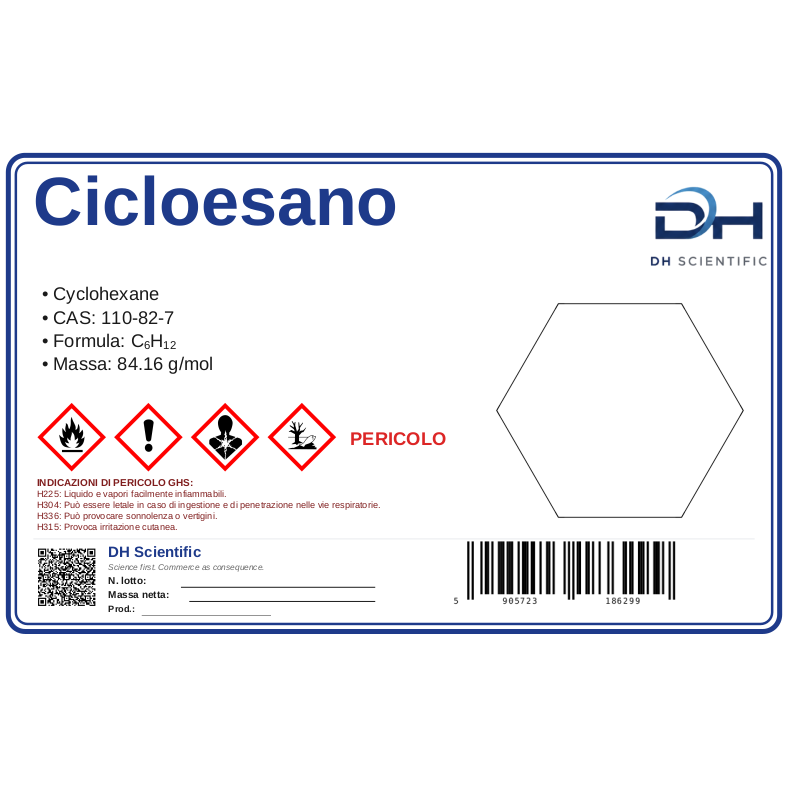
cicloesano
7,99 €
🔒 Modalità demo — questo articolo non è in vendita.
Sostanza legale. dhscientific.com è una dimostrazione della piattaforma MOL-GOD — non vendiamo nulla e nessun ordine viene evaso. Le sostanze vietate vengono bloccate qui automaticamente dal canone normativo (confronta ad es. l'eptacloro).

Dati trascritti da registri normativi e letteratura tecnica, con indicazione della fonte e dell'edizione. Non sostituiscono la scheda di dati di sicurezza del fornitore. I campi privi di fonte registrata sono contrassegnati come tali.
Panoramica chimica: CykloheksanMolGod_OVERVIEW_1
| Formula molecolare | C6H12[1] |
| Peso molecolare | 84.16 g/mol[1] |
| Punto di fusione | 6.59 °C[1][2] |
| Punto di ebollizione | 80.72 °C[1][2] |
| Densità | 0.8 g/cm³[2] |
| LogP (lipofilia) | 3.4[1] |
| Nome IUPAC | cyclohexane[1] |
| SMILES | C1CCCCC1[1] |
| InChIKey | XDTMQSROBMDMFD-UHFFFAOYSA-N[1] |
Sinonimi: Cyclohexane
Fonti dei dati: PubChem (NLM/NIH)
Ultimo aggiornamento: 2026-08-05
📚 Riferimenti scientifici (Chicago Author-Date) (2 sources)
- PubChem. National Center for Biotechnology Information (NIH/NLM), chemical compound database. ↗ dotyczy: Formula molecolare · Peso molecolare · Punto di fusione · Punto di ebollizione · LogP (lipofilia) · Nome IUPAC · SMILES · InChIKey
- DECHEMA, PTB, and BAM. CHEMSAFE - Database of Evaluated Safety Characteristics for the Avoidance of Explosions. Frankfurt am Main: DECHEMA e.V.; Braunschweig/Berlin: Physikalisch-Technische Bundesanstalt and Bundesanstalt fur Materialforschung und -prufung. ↗ dotyczy: Punto di fusione · Punto di ebollizione · Densità
RICERCA SCIENTIFICA
📚 Riferimenti scientifici (Chicago Author-Date) 8 refs · 1 baz
MOLEKUŁA Bibliografia per-CAS (live da 13+ banche dati)
Fonti: db:europepmc (8)
- db:europepmc Zubieta, CE; Aquino-Linarez, LG; Rossi-Fernández, A; Belelli, PG. 2026. "Hydroxylation effects on the DFT-modeled adsorption of benzene and cyclohexane on hematite." Journal of molecular graphics & modelling. https://doi.org/10.1016/j.jmgm.2026.109457. →
- db:europepmc Tohamy, HS. 2026. "Novel dialdehyde fullerene-like carbon nanostructures from red garlic peels for naked-eye cyclohexane gas sensing and pH." Discover nano. https://doi.org/10.1186/s11671-026-04581-y. →
- db:europepmc Strunz, C; Jamar, M; Tomas, A; Nozière, B. 2026. "A New Approach to Quantify Total Organic Nitrate Yields from RO<sub>2</sub> + NO Reactions: Application to Ethane-, Cyclohexane-, and Isoprene-Derived RO<sub>2</sub> Radicals." Environmental science & technology. https://doi.org/10.1021/acs.est.5c11407. →
- db:europepmc Zhang, X; Zhao, S; Xing, S; Liu, X. 2026. "Evidence for Spin Polarization and Lattice Oxygen Migration During Cyclohexane Oxidation Over CoO<sub>x</sub>/Fe<sub>2</sub>O<sub>3</sub>." Angewandte Chemie (International ed. in English). https://doi.org/10.1002/anie.5512890. →
- db:europepmc Pavlov, DI; Yu, X; Zhou, Z; Ryadun, AA. 2026. "Simultaneous Capture and Luminescent Detection of Trace Benzene in Cyclohexane Enabled by π-Accepting Benzothiadiazole Units in a Metal-Organic Framework." Journal of the American Chemical Society. https://doi.org/10.1021/jacs.6c02380. →
- db:europepmc Guo, M; Liu, C; Zhao, K; Li, X. 2026. "A nitrogen-doped carbon-supported cobalt catalyst for highly selective catalysis of cyclohexane amino carbonylation." Chemical communications (Cambridge, England). https://doi.org/10.1039/d6cc00564k. →
- db:europepmc Zhao, M; Ding, Z; Perveen, S; Qin, L. 2026. "Boronyl Radical-Catalyzed Intermolecular (4 + 2) Cycloaddition of Cyclobutanes and Alkenes: Synthesis of Polysubstituted Cyclohexanes." The Journal of organic chemistry. https://doi.org/10.1021/acs.joc.6c00183. →
- db:europepmc Yang, QY; Yang, Q; Song, YF; Liu, AW. 2025. "Vibrational Analysis Based on Cavity-Enhanced Raman Spectroscopy: Cyclohexane." The journal of physical chemistry. A. https://doi.org/10.1021/acs.jpca.4c07709. →
Proprietà fisico-chimiche
Riferimento rapido
🔬 Proprietà avanzate
Identificatori chimici
C1CCCCC1 Ultimo aggiornamento: 2026-06-09
📡 Spettroscopia — CAS 110-82-7MolGod_SPECHUB_MAIN
Proprietà fisico-chimiche (database) 5 campi MolGod Score: Nessuna fonte
| Proprietà | Valore | Unità | Conditions | Source |
|---|---|---|---|---|
| Punto di fusione | 6.59 [1][2] | °C | 1 atm | No primary source |
| Punto di ebollizione | 80.72 [1][2] | °C | No primary source | |
| Solubilità in acqua | 0.055 [1] | g/L | 25°C | No primary source |
| Densità (ρ) | 0.8 [1] | g/cm³ | No primary source | |
| logP (ottanolo/acqua) | 3.4 [3] | — | No primary source |
📚 Riferimenti scientifici (Chicago Author-Date) (3 sources)
- DECHEMA, PTB, and BAM. CHEMSAFE - Database of Evaluated Safety Characteristics for the Avoidance of Explosions. Frankfurt am Main: DECHEMA e.V.; Braunschweig/Berlin: Physikalisch-Technische Bundesanstalt and Bundesanstalt fur Materialforschung und -prufung. ↗ dotyczy: Punto di fusione · Punto di ebollizione · Solubilità in acqua · Densità (ρ)
- PubChem. National Center for Biotechnology Information (NIH/NLM), chemical compound database. ↗ dotyczy: Punto di fusione · Punto di ebollizione
- Sangster, J. "Octanol-Water Partition Coefficients of Simple Organic Compounds." Journal of Physical and Chemical Reference Data 18, no. 3 (1989): 1111-1229. ↗ dotyczy: logP (ottanolo/acqua)
I valori fisico-chimici provengono da fonti indipendenti e sottoposte a revisione paritaria elencate sopra.
🛡️ Sicurezza — CAS 110-82-7MolGod_SAFEHUB_MAIN
Classificazione GHS/CLP — Regolamento (CE) n. 1272/2008 + UN GHS Rev. 9 (2021).


🚨 Indicazioni di pericolo (H)
- H225 — Liquido e vapori facilmente infiammabili.
- H304 — Può essere letale in caso di ingestione e di penetrazione nelle vie respiratorie.
- H336 — Può provocare sonnolenza o vertigini.
- H315 — Provoca irritazione cutanea.
- H400 — Molto tossico per gli organismi acquatici.
- H410 — Molto tossico per gli organismi acquatici con effetti di lunga durata.
🛡 Consigli di prudenza (P)
- P210 — Tenere lontano da fonti di calore, superfici calde, scintille, fiamme libere o altre fonti di accensione. Non fumare.
- P233 — Tenere il recipiente ben chiuso.
- P240 — Mettere a terra e a massa il contenitore e il dispositivo ricevente.
- P261 — Evitare di respirare la polvere/i fumi/i gas/la nebbia/i vapori/gli aerosol.
- P264 — Lavare accuratamente … dopo l’uso.
- P271 — Utilizzare soltanto all’aperto o in luogo ben ventilato.
- P273 — Non disperdere nell’ambiente.
- P280 — Indossare guanti/indumenti protettivi/Proteggere gli occhi/il viso.
- P301+P310 — IN CASO DI INGESTIONE: Contattare immediatamente un CENTRO ANTIVELENI/un medico/…
- P302+P352 — IN CASO DI CONTATTO CON LA PELLE: Lavare abbondantemente con acqua/…
- P303+P361+P353 — IN CASO DI CONTATTO CON LA PELLE (o con i capelli): Togliere immediatamente tutti gli indumenti contaminati.; Sciacquare la pelle [o fare una doccia].
- P304+P340 — IN CASO DI INALAZIONE: Trasportare l’infortunato all’aria aperta e mantenerlo a riposo in posizione che favorisca la respirazione.
- P312 — In caso di malessere, contattare un CENTRO ANTIVELENI/un medico/…
- P331 — NON provocare il vomito.
- P332+P313 — In caso di irritazione della pelle: Consultare un medico.
- P370+P378 — In caso di incendio: Utilizzare … per estinguere.
- P391 — Raccogliere il materiale fuoriuscito.
- P403+P235 — Conservare in luogo ben ventilato.: Conservare in luogo fresco.
- P403+P233 — Conservare in luogo ben ventilato.: Tenere il recipiente ben chiuso.
- P405 — Conservare sotto chiave.
- P501 — Smaltire il prodotto/recipiente in …
✓ Classificazione armonizzata ai sensi dell'allegato VI del regolamento CLP (CE) 1272/2008 (classificazione ufficiale, vincolante). Numero indice: 601-017-00-1.
Riferimento (Chicago): European Chemicals Agency. "cyclohexane, Index No. 601-017-00-1." In Table 3 of Annex VI to Regulation (EC) No 1272/2008 (CLP Regulation), 23rd Adaptation to Technical Progress (harmonised list as of 2026-07-07). Helsinki: European Chemicals Agency, 2026. https://echa.europa.eu/information-on-chemicals/annex-vi-to-clp.
Traduzioni: Regolamento CLP (CE) 1272/2008, Allegato III e IV. Dati: PubChem/NLM.
📚 Riferimenti scientifici consolidati — Chicago Author-Date 10 sources
Riferimenti raccolti da tutte le schede del Safety Hub. CAS: 110-82-7 ·
PubChem ↗
- Parlament Europejski i Rada UE. 2008. "Rozporządzenie (WE) nr 1272/2008 w sprawie klasyfikacji, oznakowania i pakowania substancji (CLP)." Dz.Urz. UE L 353. [↗] GHS, Normative
- United Nations Economic Commission for Europe (UNECE). 2021. "Globally Harmonized System of Classification and Labelling of Chemicals (GHS), Ninth Revised Edition." United Nations, Geneva. [↗] GHS
- Goldfrank, Lewis R., Robert S. Hoffman, Mary Ann Howland, et al.. 2019. "Goldfrank's Toxicologic Emergencies, 11th ed.." McGraw-Hill Education, New York. ISBN 978-1-25-985961-8. Pierwsza pomoc, Toksykologia
- National Institute for Occupational Safety and Health (NIOSH). 2023. "NIOSH Pocket Guide to Chemical Hazards (DHHS Publ. 2005-149)." U.S. Department of Health and Human Services / CDC, Cincinnati, OH. [↗] Pierwsza pomoc, PPE, Toksykologia
- European Committee for Standardization (CEN). 2016. "EN 374-1:2016 — Protective gloves against dangerous chemicals and micro-organisms." CEN, Brussels. [↗] PPE
- UNECE. 2023. "European Agreement Concerning the International Carriage of Dangerous Goods by Road (ADR 2025)." United Nations, Geneva. [↗] Utylizacja, Regulacje
- National Fire Protection Association (NFPA). 2022. "NFPA 400 — Hazardous Materials Code." NFPA, Quincy, MA. [↗] Magazynowanie
- Urben, P.G. (ed.). 2017. "Bretherick's Handbook of Reactive Chemical Hazards, 8th ed.." Butterworth-Heinemann / Elsevier, Oxford. [↗] Magazynowanie
- Ministerstwo Klimatu i Środowiska RP. 2023. "Baza danych o produktach i opakowaniach oraz o gospodarce odpadami (BDO)." Ministerstwo Klimatu i Środowiska, Warszawa. [↗] Utylizacja
- International Agency for Research on Cancer (IARC / WHO). 2024. "IARC Monographs on the Identification of Carcinogenic Hazards to Humans — List of Classifications." WHO, Lyon. [↗] Toksykologia
Le schede con riferimenti propri (Emergency, PPE, Storage, Waste) contengono ulteriori voci bibliografiche all'interno delle rispettive sezioni.
Statistica analitica (t-test · RSD · Grubbs · Q-Dixon) ICH Q2
Incolla una serie di misure replicate (CSV oppure un numero per riga). Il calcolatore calcolerà la media, la deviazione standard e il 95% CI, e rileverà gli outlier (Grubbs + Dixon Q).
📐 Formule statistiche
x̄ = Σxᵢ / n— media aritmeticas² = Σ(xᵢ - x̄)² / (n-1)— varianza campionarias = √s²— deviazione standardRSD% = (s / x̄) × 100%— deviazione standard relativaCI₉₅ = x̄ ± t(0.05, n-1) × s / √n— Student's tG = |xᵢ - x̄| / s— test di GrubbsQ = |xsuspect - xnearest| / |xmax - xmin|— Dixon Q-test
Fonte: ICH Q2(R2) Validation of Analytical Procedures · ICH PDF ↗
Calcolatore di ricette per tamponi UNIQUE
Scegli un tampone dall'elenco di 20 sistemi popolari → inserisci il pH target → otterrai una ricetta esatta con le masse da pesare.
Passo 1: Scegli un sistema tampone
📜 Cronologia delle ricette (ultime 10)
Classificazione di trasporto (ADR / IATA / IMDG) UN 1145
🛣️ ADR Trasporto stradale
- Classe:
- 3
- Gruppo di imballaggio:
- II
- Nome di spedizione:
- Cyclohexane
Fonti: ADR 2025 ↗ · IATA DGR ↗ · IMDG Code ↗
🔧 Risoluzione dei problemi HPLC — albero decisionale 6 problemi comuni
Diagnostica dei 6 problemi HPLC più comuni con albero decisionale (5 passaggi per problema). Fonte: Snyder/Kirkland/Dolan 3rd ed. Chapter 17 + LCGC LC Troubleshooting columns 1989-2024.
Picchi allargati (broad peaks) medium
Sintomo: Tutti i picchi nel cromatogramma sono più larghi del previsto (FWHM > 2× della norma)
🔍 Albero diagnostico:
-
1. Verifica se tutti i picchi sono allargati o solo alcuni
→ SÌ: Tutti → problema strumentale (colonna o sistema)
→ NO: Solo alcuni → problema chimico (interazione con la colonna per analiti specifici) -
2. Sostituisci con una colonna di prova — il problema scompare?
→ SÌ: COLONNA usurata — packing danneggiato, void nei primi mm. Sostituiscila.
→ NO: Problema nel sistema LC -
3. Controllare il volume morto (dead volume) — loop di iniezione, connessioni, rivelatore
→ SÌ: Loop > 100 µL per una colonna da 4.6 mm o connessioni allentate → sostituire le ferrule, accorciare i tubi
→ NO: Continua diagnostica -
4. Test di temperatura: aumentare la colonna da 25°C a 40°C
→ SÌ: Picchi più stretti → cinetica di trasferimento di massa troppo lenta (aumentare T)
→ NO: Continue -
5. Controllare il flow rate rispetto al valore ottimale di van Deemter per questa colonna
→ SÌ: Ottimale per 4.6mm/5µm = 1.0 mL/min, per 2.1mm/3µm = 0.4 mL/min
→ NO: Continue
- Colonna usurata (>2000 iniezioni senza guard)
- Volume morto del sistema > 100 µL (loop errato, tubi lunghi, ferrule allentate)
- Temperatura troppo bassa (cinetica di trasferimento di massa)
- Flow rate al di fuori dell'ottimale di van Deemter
- Solvente del campione più forte della fase A
- ✓ Sostituire la colonna (quando >2000 iniezioni)
- ✓ Controllare tutte le connessioni — tubi il più corti possibile
- ✓ Aumentare la T della colonna a 40°C (se la sostanza è stabile)
- ✓ Ridurre il flow all'ottimale di van Deemter
- ✓ Sciogliere il campione nella fase A (non in organico puro)
Coda dei picchi (tailing, T > 1.5) high
Sintomo: I picchi presentano una "coda" prolungata sul lato di eluizione tardiva (asimmetria T = b/a > 1.5 secondo USP)
🔍 Albero diagnostico:
-
1. La sostanza contiene gruppi basici (ammino, piridina)?
→ SÌ: Sì → interazioni silanoliche! Aggiungere 0.1% TFA o 5-10 mM TEA alla fase A.
→ NO: Continue -
2. Controllare il pH della fase mobile rispetto al pKa della sostanza
→ SÌ: pH = pKa ± 1 → ionizzazione parziale, peak split. Portare il pH a ≥ 2 unità di distanza dal pKa.
→ NO: Continue -
3. Controllare l'età della colonna (>1500 iniezioni?)
→ SÌ: Sì → silanoli esposti (column bleed). Sostituire con una colonna con endcapping più elevato (XTerra, Symmetry).
→ NO: Continue -
4. Il campione contiene metalli (Fe, Cu dalle fiale di vetro)?
→ SÌ: Sì → utilizzare fiale incolori di tipo II o PFA. EDTA 0.1mM nel campione.
→ NO: Continue
- Interazioni silanoliche (analita basico + silanoli liberi del gel di silice)
- pH al limite del pKa dell'analita (peak split)
- Colonna vecchia (column bleed, elevata attività silanolica)
- Metalli nel campione (chelazione → tailing)
- Sovraccarico della colonna (>50 µg su una colonna da 4.6mm)
- ✓ Aggiungere 0.1% TFA (UV) o 0.1% acido formico (LC-MS) alla fase A
- ✓ Scegliere una colonna con endcapping ad alta purezza: Waters XBridge BEH, Phenomenex Kinetex
- ✓ Lavorare a pH ≥ 2 unità di distanza dal pKa
- ✓ EDTA 0.1mM nel campione (chelazione Fe/Cu)
- ✓ Ridurre il volume di iniezione a ≤ 20 µL per una colonna da 4.6mm
Deriva della linea di base (baseline drift) medium
Sintomo: La linea di base aumenta o diminuisce sistematicamente per >5 minuti
🔍 Albero diagnostico:
-
1. Si sta utilizzando un gradiente (B% in aumento)?
→ SÌ: Sì → assorbimento diverso delle fasi A e B a dλ. Cambio di solvente nell'UV-cutoff. Controllare l'assorbanza UV del % di organico.
→ NO: Continua (isocratico) -
2. Controllare la temperatura della colonna — è stabile a ±0.5°C?
→ SÌ: Sì (stabile) → continua
→ NO: Instabile → attivare il termostato della colonna (>25°C controllato) -
3. Test: spegnere l'autosampler, far funzionare solo pompa+colonna+rivelatore
→ SÌ: La deriva scompare → contaminazione dell'autosampler (pulire l'ago, il septum)
→ NO: Continue -
4. Controllare l'età della lampada (D2 per UV)
→ SÌ: Sì (>1500 ore) → sostituire la lampada
→ NO: Continue
- Eluizione a gradiente con UV-cutoff diverso delle fasi
- T della colonna instabile
- Contaminazione dell'ago/septum dell'autosampler
- Lampada UV vecchia (>1500h)
- Cella di flusso del rivelatore sporca
- Colonna non equilibrata (<10 volumi di colonna)
- ✓ Pre-equilibrare la colonna per 10-15 volumi di colonna al 100% A
- ✓ Termostato colonna attivo, T 30-40°C stabile
- ✓ Pulire la flow cell del rivelatore con soluzione ACN:H2O 50:50
- ✓ Sostituire la lampada D2 se >1500h
- ✓ Usare la baseline subtraction (funzione nativa Chromeleon, Empower)
Nessun picco / picco perso (no peak) critical
Sintomo: Il picco atteso dell'analita non compare nel cromatogramma
🔍 Albero diagnostico:
-
1. L'iniezione è stata effettivamente eseguita?
→ SÌ: Controllare il log dell'autocampionatore, la pressione della pompa (dovrebbe calare durante l'iniezione)
→ NO: Problema dell'autocampionatore → controllare il loop, l'ago, il campione nella fiala -
2. Il campione è nella fiala (volume corretto, non evaporato)?
→ SÌ: Continue
→ NO: Nessun campione — ri-pipettare -
3. Stabilità del campione — preparato >24h fa?
→ SÌ: Sì → degradazione. Ri-preparare un campione fresco.
→ NO: Continue -
4. Controllare la lunghezza d'onda di rilevazione rispetto al λmax della sostanza
→ SÌ: Rilevazione a λ NON corrisponde al λmax → nessun segnale. Scansione DAD 200-400nm.
→ NO: Continue -
5. Test: iniettare uno standard puro (di concentrazione nota, fresco)
→ SÌ: Lo standard dà un picco → problema con il campione (matrice, derivatizzazione)
→ NO: Nessun picco anche con lo standard → problema di sistema (colonna, fase, gradiente)
- Campione non prelevato dalla fiala (bug dell'autocampionatore)
- Campione degradato (>24h pH/temp/luce)
- Rilevazione alla lunghezza d'onda errata
- Fase mobile errata (es. TFA dimenticato)
- Colonna invertita / fase stazionaria errata
- La sostanza eluisce sul fronte (V0) → non trattenuta, non visibile
- ✓ Ri-preparare un campione fresco secondo il protocollo esatto
- ✓ Scansione UV-Vis DAD 200-400nm + ricerca del λmax
- ✓ Controllare la composizione della fase mobile — TFA aggiunto?
- ✓ Testare la direzione inversa della colonna (con cautela!)
- ✓ Per ritenzione <1 min — abbassare il % B, MeOH al posto di ACN
- ✓ Verifica il tempo di ritenzione atteso nel database dei metodi del plugin
Pressione troppo alta (pressure too high) critical
Sintomo: Pressione della pompa > 80% del massimo della colonna o shutdown del sistema con errore high-pressure
🔍 Albero diagnostico:
-
1. Controllare che la colonna sia collegata correttamente (direzione della freccia)
→ SÌ: OK
→ NO: Colonna invertita → invertirla (non lavorare mai "al contrario") -
2. Test: rimuovere la colonna dal sistema, far girare pompa+rivelatore da soli
→ SÌ: La pressione scende a <50 bar → problema nella colonna (intasata)
→ NO: La pressione rimane alta → filtro in-line intasato, frit sporco -
3. Controllare il filtro pre-colonna (frit in-line)
→ SÌ: Sporco e brunastro → sostituire
→ NO: Continue -
4. Retro-lavare la colonna con ACN:H2O 50:50 senza la colonna — scompare?
→ SÌ: Particelle bloccate nel primo mm — un flush di 30 min può recuperarla
→ NO: Sostituire la colonna
- Filtro in-line (frit) intasato da particelle
- Salting-out del buffer (precipitazione ad alto %B)
- Il campione contiene materiale in sospensione (filtrare a 0.22 µm prima dell'iniezione)
- Colonna intasata (compattazione del letto della colonna)
- Gradiente con fase buffer + molto organico → precipitazione del sale
- ✓ Filtrare SEMPRE il campione con PVDF 0.22 µm prima dell'iniezione
- ✓ Sostituire il filtro in-line ogni 100 iniezioni (o quando la pressione aumenta >20%)
- ✓ NON usare buffer fosfato >20mM + >70% ACN (il sale precipita)
- ✓ Lavare la colonna per 30 min con ACN:H2O 50:50 in direzione inversa (quando il produttore lo consente)
- ✓ Pre-colonna 4×3mm per proteggere la colonna principale
Picchi fantasma (ghost peaks) high
Sintomo: Picchi inspiegabili sul cromatogramma assenti nella calibrazione
🔍 Albero diagnostico:
-
1. Test: iniezione in bianco (solvente puro del campione)
→ SÌ: Compare un ghost → contaminazione del sistema o degli eluenti
→ NO: Compare solo con il campione → matrice -
2. Il ghost cresce con il gradiente (eluisce ad alta %B)?
→ SÌ: Sì → colonna sovraccarica o composti fortemente trattenuti dalla corsa precedente
→ NO: Indipendente dal gradiente → carryover dell'autocampionatore -
3. Increase carryover wash (between injections)
→ SÌ: Aiuta → il carryover era la causa. Protocollo di lavaggio più forte.
→ NO: Continue -
4. Iniezione di acqua pura — c'è un picco?
→ SÌ: Sì → contaminazione della fonte d'acqua (sostanze organiche dal sistema DI)
→ NO: Continue
- Carryover nell'ago/loop dell'autocampionatore
- Contaminazione dell'eluente (anche di grado HPLC)
- Componenti fortemente trattenuti da corse precedenti
- Plastica nelle fiale (ftalati, PEG dai tappi)
- Acqua DI insufficientemente purificata
- ✓ Rafforzare il protocollo di lavaggio: 100% B → 100% A → 50:50 (3 cicli)
- ✓ Lavaggio forte: DMSO 100% o MeOH 100% prima della calibrazione
- ✓ Filtrare gli eluenti con PTFE 0.22 µm in caso di dubbio
- ✓ Usare vetro ambrato + tappi con rivestimento in Teflon per i campioni
- ✓ Rampa di gradiente periodica fino a 100% B per 10 min (clean-out)
📚 Riferimenti scientifici (Chicago Author-Date) — fare clic per espandere
- Snyder, Lloyd R., Joseph J. Kirkland, and John W. Dolan. 2010. Introduction to Modern Liquid Chromatography. 3rd ed. John Wiley & Sons. Chapter 17 (Troubleshooting) pp. 559-616. ISBN 978-0-470-16754-0. https://doi.org/10.1002/9780470508183 [link ↗]
- Dolan, John W.. 2014. LC Troubleshooting (monthly column 1989-2024). LCGC North America. [link ↗] — John Dolan 35-letnia seria miesięcznych artykułów problemowych
- Kromidas, Stavros. 2017. HPLC Made to Measure: A Practical Handbook for Optimization. 2nd ed. Wiley-VCH. ISBN 978-3-527-31377-1. — Praktyczny przewodnik problem-solving dla labs analitycznych
- Dolan, John W.. 2013. When to Modify Method Conditions. 192-199. [link ↗] — Decision flow for changing flow rate / temperature / %B vs swapping columns.
- Dong, Michael W.. 2019. HPLC and UHPLC for Practicing Scientists. 2nd ed. Wiley. ISBN 978-1-119-31378-3. https://doi.org/10.1002/9781119313793 [link ↗] — Chapter 9 covers troubleshooting modern UHPLC systems (sub-2 µm particles).
- Meyer, Veronika R.. 2010. Practical High-Performance Liquid Chromatography. 5th ed. Wiley. ISBN 978-0-470-68218-0. — Solid step-by-step problem isolation chapter (eluents, columns, instruments).
- Snyder, L. R., J. J. Kirkland, and J. L. Glajch. 1997. Practical HPLC Method Development. 2nd ed. Wiley. ISBN 978-0-471-00703-6. — Method-development companion volume with troubleshooting cross-refs.
- Carr, Peter W.. 2009. The new physical chemistry of HPLC. 1764-1772. https://doi.org/10.1016/j.chroma.2008.11.094 [link ↗] — Theoretical basis for diagnosing efficiency losses (mass-transfer, eddy diffusion).
- Heyden, Yvan Vander, et al.. 2009. Robustness of pharmaceutical liquid chromatographic methods. 2120-2129. https://doi.org/10.1016/j.jchromb.2008.10.052 [link ↗] — How to diagnose method failures vs. system failures (Plackett-Burman).
- Engelhardt, Heinz. 2014. 100 Years of Chromatography. 2nd ed. Wiley-VCH. ISBN 978-3-527-33473-5. — Historical context for ghost-peak phenomenology (silica chemistry).
Deskryptory Lipinskiego (struktura)
Grafico radar di drug-likeness (Lipinski Ro5 / Veber). Zona verde = conformità ai criteri.
Dati predittivi — proprietà calcolate in silico (SMILES/RDKit). Non sostituiscono gli studi clinici. Non utilizzare per la valutazione di farmaci senza verifica sperimentale.
| Proprietà | Valore | Valutazione |
|---|---|---|
| Absorption (GI) | alto | ✓ |
| Permeabilità BBB | sì (attraversa) | |
| Biodisponibilità (Daina 2017) | 55% | |
| CYP450 profile | CYP1A2 non-inhibitorCYP2C9 non-inhibitorCYP2C19 non-inhibitorCYP2D6 non-inhibitorCYP3A4 non-inhibitor | |
| Allerte PAINS | 0 | ✓ |
| Allerte Brenk | 0 | ✓ |
| pKa (pH 7.4) | — | |
| hERG (cardiotox.) | ✓ no | |
| Substrato P-gp | — | |
| Mutagenicità Ames | ✓ no | |
| DILI (epatotox.) | — | |
| LogS (solub. acq.) | — | |
Fonti (metodologia ADMET)
- Lipinski, Christopher A., Franco Lombardo, Beryl W. Dominy, and Paul J. Feeney. 1997. "Experimental and computational approaches to estimate solubility and permeability in drug discovery and development settings." Advanced Drug Delivery Reviews 23 (1-3): 3-25.
- Veber, Daniel F., Stephen R. Johnson, Hung-Yuan Cheng, et al. 2002. "Molecular properties that influence the oral bioavailability of drug candidates." Journal of Medicinal Chemistry 45 (12): 2615-2623.
- Daina, Antoine, Olivier Michielin, and Vincent Zoete. 2017. "SwissADME: a free web tool to evaluate pharmacokinetics, drug-likeness and medicinal chemistry friendliness." Scientific Reports 7: 42717.
- Egan, William J., and Gregory Lauri. 2002. "Prediction of intestinal permeability." Advanced Drug Delivery Reviews 54 (3): 273-289.
- Baell, Jonathan B., and Georgina A. Holloway. 2010. "New substructure filters for removal of pan assay interference compounds (PAINS) from screening libraries." Journal of Medicinal Chemistry 53 (7): 2719-2740.
- Brenk, Ruth, Alessandro Schipani, Daniel James, et al. 2008. "Lessons learnt from assembling screening libraries for drug discovery for neglected diseases." ChemMedChem 3 (3): 435-444.
- Ertl, Peter, and Ansgar Schuffenhauer. 2009. "Estimation of synthetic accessibility score of drug-like molecules based on molecular complexity and fragment contributions." Journal of Cheminformatics 1: 8.
- Bickerton, G. Richard, Gaia V. Paolini, Jérémy Besnard, Sorel Muresan, and Andrew L. Hopkins. 2012. "Quantifying the Chemical Beauty of Drugs." Nature Chemistry 4 (2): 90-98.
- Hopkins, Andrew L., and Colin R. Groom. 2002. "The Druggable Genome." Nature Reviews Drug Discovery 1 (9): 727-730.
- Ghose, Arup K., Vellarkad N. Viswanadhan, and John J. Wendoloski. 1999. "A Knowledge-Based Approach in Designing Combinatorial or Medicinal Chemistry Libraries for Drug Discovery." Journal of Combinatorial Chemistry 1 (1): 55-68.
- Tice, Raymond R., Christopher P. Austin, Robert J. Kavlock, and John R. Bucher. 2013. "Improving the Human Hazard Characterization of Chemicals: A Tox21 Update." Environmental Health Perspectives 121 (7): 756-765.
- Leeson, Paul D., and Brian Springthorpe. 2007. "The Influence of Drug-Like Concepts on Decision-Making in Medicinal Chemistry." Nature Reviews Drug Discovery 6 (11): 881-890.
- Hann, Michael M. 2011. "Molecular Obesity, Potency and Other Addictions in Drug Discovery." MedChemComm 2 (5): 349-355.
- Davies, Mark, Michał Nowotka, George Papadatos, et al. 2015. "ChEMBL Web Services: Streamlining Access to Drug Discovery Data and Utilities." Nucleic Acids Research 43 (W1): W612-W620.
- Walters, W. Patrick, and Mark A. Murcko. 2002. "Prediction of 'Drug-Likeness.'". Advanced Drug Delivery Reviews 54 (3): 255–271. https://doi.org/10.1016/S0169-409X(02)00003-0.
- Congreve, Miles, Robin Carr, Christopher Murray, and Harren Jhoti. 2003. "A 'Rule of Three' for Fragment-Based Lead Discovery?" Drug Discovery Today 8 (19): 876–877. https://doi.org/10.1016/S1359-6446(03)02831-9.
- Brenk, Ruth, Alessandro Schipani, Daniel James, Agata Krasowski, Iain Hugh Gilbert, Julie Frearson, and Paul Graham Wyatt. 2008. "Lessons Learnt from Assembling Screening Libraries for Drug Discovery for Neglected Diseases." ChemMedChem 3 (3): 435-444.
- Schomburg, Karen T., Sascha Bietz, Hans Briem, Andrea M. Henzler, Stefan Urbaczek, and Matthias Rarey. 2014. "Facing the Challenges of Structure-Based Target Prediction by Inverse Virtual Screening." Journal of Chemical Information and Modeling 54 (6): 1676-1686.
- Bemis, Guy W., and Mark A. Murcko. 1996. "The Properties of Known Drugs. 1. Molecular Frameworks." Journal of Medicinal Chemistry 39 (15): 2887-2893.
- Schomburg, Karen T., and Matthias Rarey. 2014. "What Is the Potential of Structure-Based Target Prediction Methods?" Future Medicinal Chemistry 6 (17): 1987-1989.
- Zubieta, CE; Aquino-Linarez, LG; Rossi-Fernández, A; Belelli, PG. 2026. "Hydroxylation effects on the DFT-modeled adsorption of benzene and cyclohexane on hematite." Journal of molecular graphics & modelling. https://doi.org/10.1016/j.jmgm.2026.109457.
- Tohamy, HS. 2026. "Novel dialdehyde fullerene-like carbon nanostructures from red garlic peels for naked-eye cyclohexane gas sensing and pH." Discover nano. https://doi.org/10.1186/s11671-026-04581-y.
- Strunz, C; Jamar, M; Tomas, A; Nozière, B. 2026. "A New Approach to Quantify Total Organic Nitrate Yields from RO<sub>2</sub> + NO Reactions: Application to Ethane-, Cyclohexane-, and Isoprene-Derived RO<sub>2</sub> Radicals." Environmental science & technology. https://doi.org/10.1021/acs.est.5c11407.
- Zhang, X; Zhao, S; Xing, S; Liu, X. 2026. "Evidence for Spin Polarization and Lattice Oxygen Migration During Cyclohexane Oxidation Over CoO<sub>x</sub>/Fe<sub>2</sub>O<sub>3</sub>." Angewandte Chemie (International ed. in English). https://doi.org/10.1002/anie.5512890.
- Pavlov, DI; Yu, X; Zhou, Z; Ryadun, AA. 2026. "Simultaneous Capture and Luminescent Detection of Trace Benzene in Cyclohexane Enabled by π-Accepting Benzothiadiazole Units in a Metal-Organic Framework." Journal of the American Chemical Society. https://doi.org/10.1021/jacs.6c02380.
- Guo, M; Liu, C; Zhao, K; Li, X. 2026. "A nitrogen-doped carbon-supported cobalt catalyst for highly selective catalysis of cyclohexane amino carbonylation." Chemical communications (Cambridge, England). https://doi.org/10.1039/d6cc00564k.
- Zhao, M; Ding, Z; Perveen, S; Qin, L. 2026. "Boronyl Radical-Catalyzed Intermolecular (4 + 2) Cycloaddition of Cyclobutanes and Alkenes: Synthesis of Polysubstituted Cyclohexanes." The Journal of organic chemistry. https://doi.org/10.1021/acs.joc.6c00183.
- Yang, QY; Yang, Q; Song, YF; Liu, AW. 2025. "Vibrational Analysis Based on Cavity-Enhanced Raman Spectroscopy: Cyclohexane." The journal of physical chemistry. A. https://doi.org/10.1021/acs.jpca.4c07709.
- Anonymous. "Scalable Asymmetric Synthesis of the All Cis Triamino Cyclohexane Core of BMS-813160.". https://doi.org/10.1021/acs.joc.1c01162.s001. [DOI ↗]
- Bolton, Evan E., Yanli Wang, Paul A. Thiessen, and Stephen H. Bryant. 2008. "PubChem: Integrated Platform of Small Molecules and Biological Activities." Annual Reports in Computational Chemistry 4: 217-241. [DOI ↗]
- Kim, Sunghwan, Jie Chen, Tiejun Cheng, et al. 2023. "PubChem 2023 update." Nucleic Acids Research 51 (D1): D1373-D1380. [DOI ↗]
- Kim, Sunghwan, Tiejun Cheng, Jianyong He, Chen Cheng, et al. 2021. "PubChem Protein, Pathway, Reaction, and Disease Specifications." Journal of Cheminformatics 13: 16. [DOI ↗]
- Hähnke, Volker D., Sunghwan Kim, and Evan E. Bolton. 2018. "PubChem chemical structure standardization." Journal of Cheminformatics 10: 36. [DOI ↗]
- Wang, Yanli, Stephen H. Bryant, Tiejun Cheng, Jiyao Wang, et al. 2017. "PubChem BioAssay: 2017 update." Nucleic Acids Research 45 (D1): D955-D963. [DOI ↗]
- Cheng, Tiejun, et al. 2014. "Computation of Octanol-Water Partition Coefficients by Guiding an Additive Model with Knowledge." Journal of Chemical Information and Modeling 54 (3): 793-805. [DOI ↗]
- Wilkinson, Mark D., et al. 2016. "The FAIR Guiding Principles for scientific data management and stewardship." Scientific Data 3: 160018. [DOI ↗]
- Hersey, Anne, et al. 2015. "Chemical databases: curation or integration by user-defined equivalence?" Drug Discovery Today: Technologies 14: 17-24.
- Veber, Daniel F., Stephen R. Johnson, Hung-Yuan Cheng, Brian R. Smith, Keith W. Ward, and Kenneth D. Kopple. 2002. "Molecular Properties That Influence the Oral Bioavailability of Drug Candidates." Journal of Medicinal Chemistry 45 (12): 2615-2623.
- ECHA. 2024. "REACH Guidance." European Chemicals Agency. ↗
- Groom, Colin R., Ian J. Bruno, Matthew P. Lightfoot, and Suzanna C. Ward. 2016. "The Cambridge Structural Database." Acta Crystallographica Section B 72 (2): 171-179. ↗
- Mohsen A. Hedaya. 2003. "Basic Pharmacokinetics." mohsen A. hedaya. ↗
🧪 Assistente di preparazione della soluzione (Smart Prep) MolGod_PREP_2
Inserisci cosa vuoi preparare — genererò una SOP
📚 Panoramica della letteratura scientifica — CAS 110-82-7MolGod_LITHUB_MAIN
⭐ Risultati principali (letteratura scientifica) 1 publications
110-82-7
— multi-criteria ranking (W12): 30% citazioni · 20% recency · 20% topic · 15% historical · 15% open access.
-
#1(2012) · Sax's Dangerous Properties of Industrial MaterialsPerché è importante: Selezionate tramite punteggio multi-criterio (citations + recency + topic + historical + OA).
📚 RIFERIMENTI (Bibliografia complessiva, Chicago Author-Date) 127 elementi
Tutte le fonti scientifiche citate negli accordion sopra per il CAS 110-82-7.Formato: Chicago Manual of Style 17ª ed., sistema Author-Date.
🗄️ Banche dati scientifiche
- NIST. n.d. NIST Chemistry WebBook: CAS 110-82-7. Gaithersburg, MD: National Institute of Standards and Technology. https://webbook.nist.gov/cgi/cbook.cgi?ID=110-82-7.
- AIST. n.d. Spectral Database for Organic Compounds (SDBS): CAS 110-82-7. Tsukuba, Japan: National Institute of Advanced Industrial Science and Technology. https://sdbs.db.aist.go.jp/.
- Linstrom, Peter J., and William G. Mallard, eds. n.d. NIST Chemistry WebBook: NIST Standard Reference Database Number 69. Gaithersburg, MD: National Institute of Standards and Technology. https://doi.org/10.18434/T4D303.
- PubChem. n.d. PubChem Compound Summary: CAS 110-82-7. Bethesda, MD: National Center for Biotechnology Information (NCBI), National Library of Medicine. https://pubchem.ncbi.nlm.nih.gov/#query=110-82-7.
- U.S. EPA. n.d. CompTox Chemicals Dashboard: CAS 110-82-7. Research Triangle Park, NC: U.S. Environmental Protection Agency. https://comptox.epa.gov/dashboard/chemical/details/DTXSID4021923.
📐 Standard / Linee guida
- ICH. 2003. "Stability Testing of New Drug Substances and Products: Q1A(R2)." Geneva: International Council for Harmonisation of Technical Requirements for Pharmaceuticals for Human Use. https://database.ich.org/sites/default/files/Q1A%28R2%29%20Guideline.pdf.
- National Fire Protection Association (NFPA). 2024. "NFPA 30: Flammable and Combustible Liquids Code." NFPA, Quincy, MA. https://www.nfpa.org/codes-and-standards/all-codes-and-standards/list-of-codes-and-standards/detail?code=30.
- Occupational Safety and Health Administration (OSHA). 2023. "29 CFR 1910.106 — Flammable Liquids." U.S. Department of Labor, Federal Register. https://www.osha.gov/laws-regs/regulations/standardnumber/1910/1910.106.
- European Chemicals Agency (ECHA). 2024. "Annex VI to Regulation (EC) No 1272/2008 (CLP) — Harmonised Classification and Labelling." ECHA, Helsinki / Official Journal of the European Union. https://echa.europa.eu/regulations/clp/clp-classification.
- European Committee for Standardization (CEN). 2016. "EN 374-1:2016 — Protective gloves against dangerous chemicals and micro-organisms — Part 1: Terminology and performance requirements for chemical risks." CEN, Brussels. https://standards.cencenelec.eu/dyn/www/f?p=205:110:::::FSP_PROJECT,FSP_ORG_ID:38536,6080&cs=1B0DAA8B85DF42E4A2C70E5D71F0BFA32.
- European Committee for Standardization (CEN). 2001. "EN 166:2001 — Personal eye-protection — Specifications." CEN, Brussels. https://standards.cencenelec.eu/dyn/www/f?p=CEN:110:0::::FSP_PROJECT:6541&cs=1F1A4E0A78C4DB6A28DBE2E8C29D89DCF.
- European Committee for Standardization (CEN). 2009. "EN 14605:2005+A1:2009 — Protective clothing against liquid chemicals — Performance requirements for clothing with liquid-tight (Type 3) or spray-tight (Type 4) connections." CEN, Brussels. https://standards.cencenelec.eu/dyn/www/f?p=CEN:110:0::::FSP_PROJECT:21581&cs=1A04A2D3C7CC58E9E6CB58D55F7EBFB7E.
- National Institute for Occupational Safety and Health (NIOSH). 2017. "Recommendations for Chemical Protective Clothing: A Companion to the NIOSH Pocket Guide." U.S. Department of Health & Human Services / CDC. https://www.cdc.gov/niosh/ncpc/default.html.
- Occupational Safety and Health Administration (OSHA). 2011. "Personal Protective Equipment — General requirements." U.S. Department of Labor — 29 CFR 1910.132. https://www.osha.gov/laws-regs/regulations/standardnumber/1910/1910.132.
📖 Libri
- Hansen, Charles M. 2007. Hansen Solubility Parameters: A User's Handbook, 2nd ed.. Boca Raton, FL: CRC Press. https://www.routledge.com/Hansen-Solubility-Parameters-A-Users-Handbook/Hansen/p/book/9780849372483.
- Barton, Allan F. M. 1991. CRC Handbook of Solubility Parameters and Other Cohesion Parameters: 2nd ed.. Boca Raton, FL: CRC Press. https://www.routledge.com/CRC-Handbook-of-Solubility-Parameters-and-Other-Cohesion-Parameters/Barton/p/book/9780849301766.
- Connors, Kenneth A., Gordon L. Amidon, and Valentino J. Stella. 1986. Chemical Stability of Pharmaceuticals: A Handbook for Pharmacists, 2nd ed.. New York: Wiley. https://doi.org/10.1002/0471734683.
- Rumble, John R., ed. 2019. CRC Handbook of Chemistry and Physics: 100th Edition. Boca Raton, FL: CRC Press. https://hbcp.chemnetbase.com/.
- Urben, Peter G. 2017. Bretherick's Handbook of Reactive Chemical Hazards, 8th Edition. Academic Press / Elsevier, Oxford. https://www.sciencedirect.com/book/9780081010594.
📄 Articoli scientifici (peer-reviewed)
- Stefanis, Emmanuel, and Costas Panayiotou. 2008. "Prediction of Hansen Solubility Parameters with a New Group-Contribution Method." International Journal of Thermophysics 29: 568-585. https://doi.org/10.1007/s10765-008-0415-z.
- Stoll, Vincent S., and John S. Blanchard. 1990. "Buffers: Principles and Practice: In Methods in Enzymology, vol. 182." San Diego: Academic Press. https://doi.org/10.1016/0076-6879(90)82008-P.
🌐 Siti web
- ECHA. 2023. "Guidance on the Application of the CLP Criteria." European Chemicals Agency. https://echa.europa.eu/guidance-documents/guidance-on-clp.
- European Parliament. 2006. "Regulation (EC) No 1907/2006 (REACH)." Official Journal of the European Union L 396: 1–849.
- ECHA. 2023. "Candidate List of Substances of Very High Concern for Authorisation." European Chemicals Agency. https://echa.europa.eu/candidate-list-table.
- European Parliament. 2008. "Regulation (EC) No 1272/2008 on Classification, Labelling and Packaging of Substances and Mixtures (CLP)." Official Journal of the European Union L 353: 1–1355.
- ECHA. 2017. "Guidance on the Compilation of Safety Data Sheets." Version 3.1. European Chemicals Agency. ECHA-17-G-01-EN. https://echa.europa.eu/documents/10162/23047722/sds_en.pdf.
- ECHA. 2022. "Restrictions Under REACH — Annex XVII." European Chemicals Agency. https://echa.europa.eu/substances-restricted-under-reach.
- United Nations. 2021. Globally Harmonized System of Classification and Labelling of Chemicals (GHS). 9th revised ed. ST/SG/AC.10/30/Rev.9. New York and Geneva: United Nations. https://unece.org/ghs-rev9-2021.
- ECHA. 2020. "Understanding REACH." European Chemicals Agency. https://echa.europa.eu/regulations/reach/understanding-reach.
- ECHA — Zalacznik VI do CLP (klasyfikacja zharmonizowana, ATP 23; 2026-07-07) https://echa.europa.eu/information-on-chemicals/annex-vi-to-clp.
- U.S. Occupational Safety and Health Administration (2024) — 29 CFR 1910.120 — Hazardous Waste Operations and Emergency Response (HAZWOPER) https://www.osha.gov/hazwoper.
- National Fire Protection Association (2018) — NFPA 472: Standard for Competence of Responders to Hazardous Materials/Weapons of Mass Destruction Incidents https://www.nfpa.org/codes-and-standards/nfpa-472.
- European Parliament and Council (2012) — Directive 2012/18/EU on the Control of Major-Accident Hazards Involving Dangerous Substances (Seveso III) https://eur-lex.europa.eu/legal-content/EN/TXT/?uri=celex:32012L0018.
- U.S. National Institute for Occupational Safety and Health (2024) — NIOSH Pocket Guide to Chemical Hazards https://www.cdc.gov/niosh/npg/.
- European Chemicals Agency (2020) — Guidance on the Compilation of Safety Data Sheets (SDS), Version 3.1 https://echa.europa.eu/documents/10162/23047722/sds_en.pdf.
- Snyder, Lloyd R., John W. Dolan, and Joseph J. Kirkland. 2010. Introduction to Modern Liquid Chromatography. Wiley.
- Schoenmakers, Peter J.. 1986. Optimization of Chromatographic Selectivity: A Guide to Method Development. Elsevier.
- Snyder, L. R., and J. W. Dolan. 2007. High-Performance Gradient Elution: The Practical Application of the Linear-Solvent-Strength Model. Wiley.
- Nikitas, Pavlos, and Adrian Pappa-Louisi. 2009. "Retention models for isocratic and gradient elution in reversed-phase liquid chromatography." Journal of Chromatography A 1216: 1737-1755. https://doi.org/10.1016/j.chroma.2008.10.005.
- Carr, Peter W.. 2009. "The new physical chemistry of HPLC." Journal of Chromatography A 1216: 1764-1772. https://doi.org/10.1016/j.chroma.2008.11.094.
- Dong, Michael W.. 2019. HPLC and UHPLC for Practicing Scientists. Wiley. https://doi.org/10.1002/9781119313793.
- Wu, Naijun, and Anton M. Clausen. 2007. "Fundamental and practical aspects of ultrahigh pressure liquid chromatography for fast separations." Journal of Separation Science 30: 1167-1182. https://doi.org/10.1002/jssc.200700026.
- Stoll, Dwight R., and Peter W. Carr. 2017. "Two-Dimensional Liquid Chromatography: A State of the Art Tutorial." Analytical Chemistry 89: 519-531. https://doi.org/10.1021/acs.analchem.6b03506.
- Dolan, John W.. 2013. "When to Modify Method Conditions." LCGC North America 31: 192-199. https://www.chromatographyonline.com/view/when-modify-method-conditions.
- Meyer, Veronika R.. 2010. Practical High-Performance Liquid Chromatography. Wiley.
- Van Deemter, J. J., F. J. Zuiderweg, and A. Klinkenberg. 1956. "Longitudinal diffusion and resistance to mass transfer as causes of nonideality in chromatography." https://doi.org/10.1016/0009-2509(56)80003-1.
- Giddings, J. Calvin. 1965. "Dynamics of Chromatography, Part I: Principles and Theory." Marcel Dekker.
- Poppe, Hans. 1997. "Some reflections on speed and efficiency of modern chromatographic methods." https://doi.org/10.1016/S0021-9673(97)00376-2.
- Wu, Naijun, and Anton M. Clausen. 2007. "Fundamental and practical aspects of ultrahigh pressure liquid chromatography for fast separations." https://doi.org/10.1002/jssc.200700026.
- Carr, Peter W.. 2009. "The new physical chemistry of HPLC." https://doi.org/10.1016/j.chroma.2008.11.094.
- Knox, John H.. 1977. "Practical aspects of LC theory." https://doi.org/10.1093/chromsci/15.9.352.
- Snyder, L. R., J. J. Kirkland, and J. L. Glajch. 1997. "Practical HPLC Method Development." Wiley.
- Engelhardt, Heinz. 2014. "100 Years of Chromatography." Wiley-VCH.
- Sadek, Paul C.. 2002. "The HPLC Solvent Guide." Wiley-Interscience.
- Snyder, L. R.. 1978. "Classification of the solvent properties of common liquids." https://doi.org/10.1093/chromsci/16.6.223.
- Reichardt, Christian, and Thomas Welton. 2010. "Solvents and Solvent Effects in Organic Chemistry." Wiley-VCH.
- Vailaya, Anant, and Csaba Horváth. 1998. "Retention thermodynamics in hydrophobic interaction chromatography." https://doi.org/10.1021/ie980212h.
- Krstulović, Andrea M., and Phyllis R. Brown. 1981. "Reversed-phase High-Performance Liquid Chromatography." Wiley.
- Boysen, Reinhard I., and Milton T. W. Hearn. 2009. "Multi-modal HPLC of proteins." https://doi.org/10.1093/chromsci/47.8.645.
- USP General Chapter <621>. 2024. "Chromatography." United States Pharmacopeial Convention. https://www.usp.org/harmonization-standards/pdg/general-chapters/chromatography.
- International Council for Harmonisation (ICH). 2023. "Validation of Analytical Procedures Q2(R2)." ICH Expert Working Group. https://database.ich.org/sites/default/files/ICH_Q2-R2_Document_Step4_Guideline_2023_1101.pdf.
- Foley, Joe P., and John G. Dorsey. 1983. "Equations for calculation of chromatographic figures of merit for ideal and skewed peaks." https://doi.org/10.1021/ac00255a033.
- Snyder, Lloyd R., Joseph J. Kirkland, and John W. Dolan. 2010. "Introduction to Modern Liquid Chromatography." Wiley. https://doi.org/10.1002/9780470508183.
- Dolan, John W.. 2003. "Peak tailing and resolution." https://www.chromatographyonline.com/view/peak-tailing-and-resolution.
- Vivó-Truyols, Gabriel, and Hans-Gerd Janssen. 2010. "Probabilistic approach to peak deconvolution in chromatography." https://doi.org/10.1021/ac101742z.
- Kromidas, Stavros. 2017. "HPLC Made to Measure: A Practical Handbook for Optimization." Wiley-VCH.
- Heyden, Yvan Vander, et al.. 2009. "Robustness of pharmaceutical liquid chromatographic methods." https://doi.org/10.1016/j.jchromb.2008.10.052.
- United States Pharmacopeial Convention. 2024. "USP <621> Chromatography." In United States Pharmacopeia and National Formulary, USP 47-NF 42. Rockville, MD: USP. https://www.uspnf.com/.
- European Pharmacopoeia Commission. 2024. "2.2.46 Chromatographic Separation Techniques." In European Pharmacopoeia, 11th ed. Strasbourg: Council of Europe — EDQM. https://www.edqm.eu/en/european-pharmacopoeia-ph-eur-11th-edition.
- International Council for Harmonisation (ICH). 2022. "ICH Q2(R2): Validation of Analytical Procedures." International Council for Harmonisation. https://database.ich.org/sites/default/files/ICH_Q2%28R2%29_Guideline_2022_1130.pdf.
- International Council for Harmonisation (ICH). 1996. "ICH Q3A: Impurities in New Drug Substances." International Council for Harmonisation. https://database.ich.org/sites/default/files/Q3A%28R2%29%20Guideline.pdf.
- International Organization for Standardization. 2017. "ISO/IEC 17025:2017 General Requirements for the Competence of Testing and Calibration Laboratories." Geneva: ISO. https://www.iso.org/standard/66912.html.
- Kolthoff, Izaak Maurits, and Philip J. Elving, eds. 1978. Treatise on Analytical Chemistry, Part I: Theory and Practice. 2nd ed. New York: Wiley-Interscience.
- Skoog, Douglas A., F. James Holler, and Stanley R. Crouch. 2018. Principles of Instrumental Analysis. 7th ed. Boston: Cengage Learning.
- Christian, Gary D., Purnendu K. Dasgupta, and Kevin A. Schug. 2014. Analytical Chemistry. 7th ed. Hoboken, NJ: Wiley.
- EURACHEM/CITAC. 2012. "Quantifying Uncertainty in Analytical Measurement." 3rd ed. EURACHEM/CITAC Guide CG 4. https://www.eurachem.org/images/stories/Guides/pdf/QUAM2012_P1.pdf.
- Snyder, Lloyd R., Joseph J. Kirkland, and John W. Dolan. 2010. "Introduction to Modern Liquid Chromatography." John Wiley & Sons. https://doi.org/10.1002/9780470508183.
- Dolan, John W.. 2003. "How much resolution is enough?." https://www.chromatographyonline.com/view/how-much-resolution-enough.
- USP General Chapter <621>. 2024. "Chromatography (System Suitability section)." United States Pharmacopeial Convention. https://www.usp.org/harmonization-standards/pdg/general-chapters/chromatography.
- US Food and Drug Administration (FDA). 2018. "Reviewer Guidance: Validation of Chromatographic Methods." US Food and Drug Administration. https://www.fda.gov/media/74954/download.
- Rozet, Eric, et al.. 2013. "Analysis of recent pharmaceutical regulatory documents on analytical method validation." https://doi.org/10.1016/j.chroma.2007.03.111.
- European Medicines Agency (EMA). 2011. "Guideline on bioanalytical method validation EMEA/CHMP/EWP/192217/2009." EMA. https://www.ema.europa.eu/en/documents/scientific-guideline/guideline-bioanalytical-method-validation_en.pdf.
- Kazakevich, Yuri V., and Rosario LoBrutto, eds.. 2007. "HPLC for Pharmaceutical Scientists." Wiley-Interscience. https://doi.org/10.1002/9780470087954.
- AOAC International. 2016. "Appendix F: Guidelines for Standard Method Performance Requirements." AOAC INTERNATIONAL. https://www.aoac.org/wp-content/uploads/2019/08/app_f.pdf.
- International Organization for Standardization. 1994. "ISO 5725-2:1994 Accuracy (Trueness and Precision) of Measurement Methods and Results — Part 2: Basic Method for the Determination of Repeatability and Reproducibility of a Standard Measurement Method." Geneva: ISO. https://www.iso.org/standard/11834.html.
- Heckert, N. A., and J. J. Filliben. 2003. "NIST/SEMATECH e-Handbook of Statistical Methods." NIST Handbook 151. Gaithersburg, MD: National Institute of Standards and Technology. https://www.itl.nist.gov/div898/handbook/.
- Grubbs, Frank E. 1950. "Sample Criteria for Testing Outlying Observations." Annals of Mathematical Statistics 21 (1): 27–58.
- Dixon, Wilfrid J. 1950. "Analysis of Extreme Values." Annals of Mathematical Statistics 21 (4): 488–506.
- Snedecor, George W., and William G. Cochran. 1989. Statistical Methods. 8th ed. Ames, IA: Iowa State University Press.
- Student [William Sealy Gosset]. 1908. "The Probable Error of a Mean." Biometrika 6 (1): 1–25.
- International Organization for Standardization. 2005. "ISO 3534-1:2006 Statistics — Vocabulary and Symbols — Part 1: General Statistical Terms and Terms Used in Probability." Geneva: ISO. https://www.iso.org/standard/40145.html.
- Thompson, Michael, Stephen L. R. Ellison, and Roger Wood. 2002. "Harmonized Guidelines for Single-Laboratory Validation of Methods of Analysis." Pure and Applied Chemistry 74 (5): 835–855.
- United Nations Economic Commission for Europe. 2024. European Agreement Concerning the International Carriage of Dangerous Goods by Road (ADR), Applicable as from 1 January 2025 (ECE/TRANS/352). Geneva: UNECE. https://unece.org/transport/dangerous-goods/adr-2025-edition.
- International Air Transport Association. 2026. Dangerous Goods Regulations (DGR). 67th ed. Montreal: IATA. https://www.iata.org/en/programs/cargo/dgr/.
- International Maritime Organization. 2024. International Maritime Dangerous Goods (IMDG) Code, 2024 Edition (Amendment 42-24). London: IMO. https://www.imo.org/en/OurWork/Safety/Pages/DangerousGoods-default.aspx.
- United Nations. 2025. Recommendations on the Transport of Dangerous Goods: Model Regulations (Orange Book). 24th revised ed. ST/SG/AC.10/1/Rev.24. New York and Geneva: United Nations. https://unece.org/transport/dangerous-goods/un-model-regulations.
- International Civil Aviation Organization. 2025. Technical Instructions for the Safe Transport of Dangerous Goods by Air (Doc 9284). 2025–2026 ed. Montreal: ICAO. https://www.icao.int/safety/DangerousGoods/Pages/technical-instructions.aspx.
- International Conference on Harmonisation (ICH). 2005. "Validation of Analytical Procedures: Text and Methodology Q2(R1)." ICH Expert Working Group. https://database.ich.org/sites/default/files/Q2%28R1%29%20Guideline.pdf.
- United States Pharmacopeia (USP) Convention. 2024. "USP General Chapter <621> Chromatography." USP. https://www.usp.org/sites/default/files/usp/document/harmonization/gen-chapter/g05_pf_30_4_2004.pdf.
- European Medicines Agency (EMA). 2011. "Guideline on bioanalytical method validation EMEA/CHMP/EWP/192217/2009." EMA Committee for Medicinal Products for Human Use. https://www.ema.europa.eu/en/documents/scientific-guideline/guideline-bioanalytical-method-validation_en.pdf.
- European Commission. 2014. "Commission Decision 2014/955/EU on the list of waste pursuant to Directive 2008/98/EC." Official Journal of the European Union. https://eur-lex.europa.eu/legal-content/EN/TXT/?uri=CELEX:32014D0955.
- Ministerstwo Klimatu i Środowiska Rzeczypospolitej Polskiej. 2020. "Rozporządzenie Ministra Klimatu z dnia 2 stycznia 2020 r. w sprawie katalogu odpadów." Dziennik Ustaw RP 2020 poz. 10. https://isap.sejm.gov.pl/isap.nsf/DocDetails.xsp?id=WDU20200000010.
- Główny Inspektorat Ochrony Środowiska (GIOŚ). 2024. "Baza Danych O Odpadach (BDO) — System rejestracji firm utylizacyjnych." Ministerstwo Klimatu i Środowiska. https://bdo.mos.gov.pl/.
- Polska — Sejm RP. 2012. "Ustawa z dnia 14 grudnia 2012 r. o odpadach." Dz.U. 2013 poz. 21 (z późn. zm.). https://isap.sejm.gov.pl/isap.nsf/DocDetails.xsp?id=WDU20130000021.
- Furr, A. Keith, ed.. 2000. "CRC Handbook of Laboratory Safety." CRC Press.
- Pohanish, Richard P.. 2017. "Sittig's Handbook of Toxic and Hazardous Chemicals and Carcinogens." Elsevier.
- Lewis, Richard J.. 2012. "Sax's Dangerous Properties of Industrial Materials." Wiley.
- NIOSH. 2024. "Pocket Guide to Chemical Hazards." U.S. Department of Health and Human Services. https://www.cdc.gov/niosh/npg/.
- OSHA. 2024. "Occupational Chemical Database — Hazardous Waste Operations (HAZWOPER)." Occupational Safety and Health Administration. https://www.osha.gov/chemicaldata.
- European Parliament and Council. 2008. "Directive 2008/98/EC on waste (Waste Framework Directive)." Official Journal of the European Union L 312/3. https://eur-lex.europa.eu/legal-content/EN/TXT/?uri=CELEX:32008L0098.
- European Parliament and Council. 2009. "Regulation (EC) No 1272/2008 (CLP) on classification, labelling and packaging of substances and mixtures." Official Journal of the European Union L 353. https://eur-lex.europa.eu/legal-content/EN/TXT/?uri=CELEX:32008R1272.
- United Nations Economic Commission for Europe (UNECE). 2023. "European Agreement concerning the International Carriage of Dangerous Goods by Road (ADR 2025)." UNECE. https://unece.org/transport/standards/transport/dangerous-goods/adr-2025.
- IPCS INCHEM. 2024. "International Programme on Chemical Safety — Waste Management Guidelines." WHO/UNEP/ILO. https://www.inchem.org/.
- European Parliament and Council. 2006. "Regulation (EC) No 1013/2006 on Shipments of Waste." Official Journal of the European Union L 190: 1–98. https://eur-lex.europa.eu/legal-content/EN/TXT/?uri=CELEX:32006R1013.
- International Council for Harmonisation (ICH). 2000. "Q7 Good Manufacturing Practice Guide for Active Pharmaceutical Ingredients." ICH Expert Working Group. https://database.ich.org/sites/default/files/Q7%20Guideline.pdf.
- International Organization for Standardization. 2017. "ISO/IEC 17025:2017 General requirements for the competence of testing and calibration laboratories." ISO. https://www.iso.org/standard/66912.html.
- World Health Organization. 2010. "WHO Good Manufacturing Practices for Pharmaceutical Products: Main Principles (WHO Technical Report Series No. 957, Annex 3)." WHO Press. https://www.who.int/publications/m/item/trs957-annex3.
- International Council for Harmonisation (ICH). 2003. "ICH Q1A(R2): Stability Testing of New Drug Substances and Products." International Council for Harmonisation. https://database.ich.org/sites/default/files/Q1A%28R2%29%20Guideline.pdf.
- International Council for Harmonisation (ICH). 2006. "ICH Q3A(R2): Impurities in New Drug Substances." ICH. https://database.ich.org/sites/default/files/Q3A%28R2%29%20Guideline.pdf.
- International Council for Harmonisation (ICH). 1999. "ICH Q6A: Specifications for New Drug Substances and Products." ICH. https://database.ich.org/sites/default/files/Q6A%20Guideline.pdf.
- International Council for Harmonisation (ICH). 2008. "ICH Q10: Pharmaceutical Quality System." ICH. https://database.ich.org/sites/default/files/Q10%20Guideline.pdf.
- U.S. Food and Drug Administration. 2024. "21 CFR Part 211: Current Good Manufacturing Practice for Finished Pharmaceuticals." US Code of Federal Regulations. https://www.ecfr.gov/current/title-21/chapter-I/subchapter-C/part-211.
- European Medicines Agency. 2014. "Guideline on Process Validation for Finished Products — Information and Data to Be Provided EMA/CHMP/CVMP/QWP/BWP/70278/2012." European Medicines Agency. https://www.ema.europa.eu/en/documents/scientific-guideline/guideline-process-validation-finished-products-information-data-be-provided-regulatory-submissions-revision-1_en.pdf.
- United States Pharmacopeial Convention. 2024. "United States Pharmacopeia and National Formulary, USP 47-NF 42." USP. https://www.uspnf.com/.
- European Pharmacopoeia Commission. 2024. "European Pharmacopoeia 11th Edition." Council of Europe — EDQM. https://www.edqm.eu/en/european-pharmacopoeia-ph-eur-11th-edition.
- Pharmaceutical Inspection Co-operation Scheme (PIC/S). 2021. "Guide to Good Manufacturing Practice for Medicinal Products PE 009-15." PIC/S Secretariat, Geneva. https://picscheme.org/en/publications.
- International Pharmaceutical Excipients Council (IPEC) and Pharmaceutical Quality Group (PQG). 2017. "Joint IPEC-PQG Good Manufacturing Practices Guide for Pharmaceutical Excipients." IPEC-Americas. https://ipecamericas.org/sites/default/files/IPECPQGGMPGuide2017.pdf.