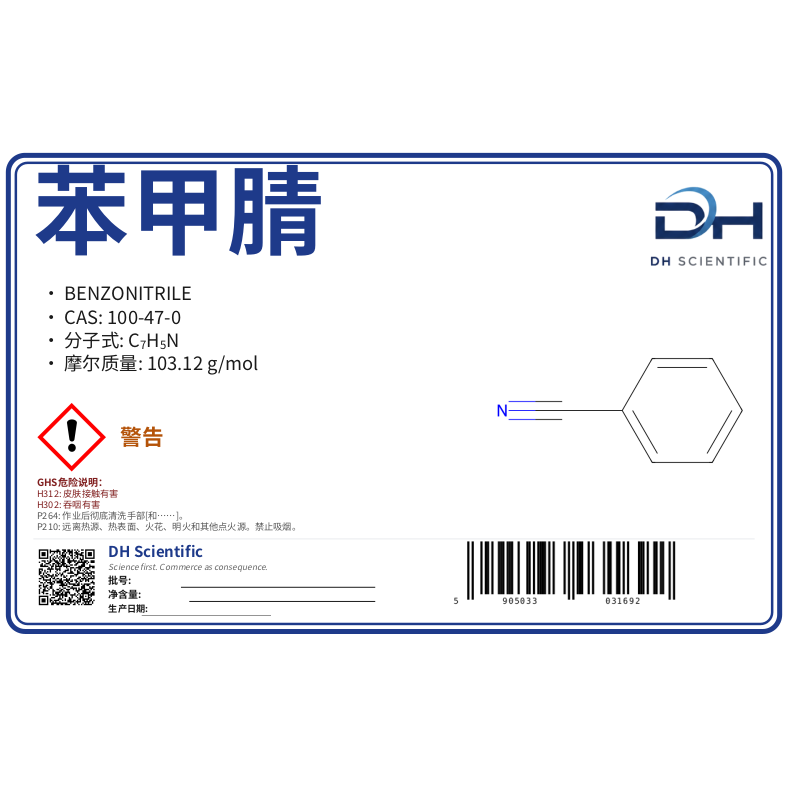
苯甲腈
4,99 €
化学品 Benzonitryl (CAS 100-47-0)。完整百科卡片 — 分类、性质和安全数据 — 如下。
🔒 演示模式 — 此商品不出售。
合法物质。dhscientific.com 是 MOL-GOD 平台的演示 — 我们不出售任何商品,也不处理订单。被禁止的物质会依据法规基准在此自动拦截(例如可参见七氯)。

数据转录自法规登记册和专业文献,并注明来源与版本。不能替代供应商的安全数据表。未记录来源的字段已作相应标注。
化学概述: BenzonitrileMolGod_OVERVIEW_1
| 分子式 | C7H5N[1] |
| 分子量 | 103.12 g/mol[1] |
| 熔点 | -12.8 °C[1][2] |
| 沸点 | 190.72 °C[1][2] |
| 密度 | 1.01 g/cm³[1][2] |
| LogP(亲脂性) | 1.6[1] |
| IUPAC名称 | benzonitrile[1] |
| SMILES | C1=CC=C(C=C1)C#N[1] |
| InChIKey | JFDZBHWFFUWGJE-UHFFFAOYSA-N[1] |
同义词: BENZONITRILE · 100-47-0 · Phenyl cyanide · Cyanobenzene · Benzenenitrile
数据来源: PubChem (NLM/NIH)
最后更新: 2026-08-07
📚 科学参考文献(芝加哥作者-日期格式) (2 来源)
- PubChem. National Center for Biotechnology Information (NIH/NLM), chemical compound database. ↗ applies to: 分子式 · 分子量 · 熔点 · 沸点 · 密度 · LogP(亲脂性) · IUPAC名称 · SMILES · InChIKey
- DECHEMA, PTB, and BAM. CHEMSAFE - Database of Evaluated Safety Characteristics for the Avoidance of Explosions. Frankfurt am Main: DECHEMA e.V.; Braunschweig/Berlin: Physikalisch-Technische Bundesanstalt and Bundesanstalt fur Materialforschung und -prufung. ↗ applies to: 熔点 · 沸点 · 密度
科学研究
📚 科学参考文献(芝加哥作者-日期格式) 13 refs · 2 baz
MOLEKUŁA 按CAS号参考文献(实时来自13+数据库)
来源: db:pubmed (12) · db:molgod_data_citations:crossref (1)
- db:pubmed Nami SYA, Hossan A. (2024). "Novel Benzothiazole-Benzonitrile-Based Fluorescent Chromophore: Synthesis, DFT, Antimicrobial Properties.". Luminescence : the journal of biological and chemical luminescence. https://doi.org/10.1002/bio.70038 →
- db:pubmed Wang RN, Yu Q, Wang XB et al.. (2023). "Bis(benzonitrile) dichloroplatinum (II) interrupts PD-1/PD-L1 interaction by binding to PD-1.". Acta pharmacologica Sinica. https://doi.org/10.1038/s41401-023-01092-9 →
- db:pubmed Quan Y, Zhou R, Yang B et al.. (2023). "Identification of an N-phenylsulfonyl-2-(piperazin-1-yl)methyl-benzonitrile derivative as Zika virus entry inhibitor.". Bioorganic chemistry. https://doi.org/10.1016/j.bioorg.2022.106265 →
- db:pubmed Wang Y, Li J, Tan J et al.. (2022). "Design, Synthesis, and Biological Evaluation of 2-((4-Bisarylmethyl-piperazin-1-yl)methyl)benzonitrile Derivatives as HCV Entry Inhibitors.". Journal of medicinal chemistry. https://doi.org/10.1021/acs.jmedchem.1c01637 →
- db:pubmed Api AM, Belsito D, Botelho D et al.. (2021). "RIFM fragrance ingredient safety assessment, benzonitrile, CAS Registry Number 100-47-0.". Food and chemical toxicology : an international journal published for the British Industrial Biological Research Association. https://doi.org/10.1016/j.fct.2021.112303 →
- db:pubmed Verma S, Kumar M, Verma AK. (2020). "Aza-Henry Reaction: Synthesis of Nitronaphthylamines from 2-(Alkynyl)benzonitriles.". Organic letters. https://doi.org/10.1021/acs.orglett.9b04045 →
- db:pubmed Nihei KI, Kubo I. (2019). "Benzonitriles as tyrosinase inhibitors with hyperbolic inhibition manner.". International journal of biological macromolecules. https://doi.org/10.1016/j.ijbiomac.2019.04.156 →
- db:pubmed Hanson MG, Olson NM, Yi Z et al.. (2017). "Nickel-Catalyzed Coupling of Azoles with Aromatic Nitriles.". Organic letters. https://doi.org/10.1021/acs.orglett.7b01938 →
- db:pubmed Lovecka P, Thimova M, Grznarova P et al.. (2015). "Study of Cytotoxic Effects of Benzonitrile Pesticides.". BioMed research international. https://doi.org/10.1155/2015/381264 →
- db:pubmed Lacroix C, Querol-Audí J, Roche M et al.. (2014). "A novel benzonitrile analogue inhibits rhinovirus replication.". The Journal of antimicrobial chemotherapy. https://doi.org/10.1093/jac/dku200 →
- db:pubmed Bonacker D, Stoiber T, Böhm KJ et al.. (2004). "Chromosomal genotoxicity of nitrobenzene and benzonitrile.". Archives of toxicology. https://doi.org/10.1007/s00204-003-0508-1 →
- db:pubmed Markus B, Kwon CH. (1994). "In vitro metabolism of aromatic nitriles.". Journal of pharmaceutical sciences. https://doi.org/10.1002/jps.2600831216 →
- db:molgod_data_citations:crossref (0). "Ultrafast Intramolecular Charge Transfer with Strongly Twisted Aminobenzonitriles: 4-(Di-tert-butylamino)benzonitrile and 3-(Di-tert-butylamino)benzonitrile.". https://doi.org/10.1021/jp7097526.s004 →
物理化学性质
快速参考
🔬 高级属性
化学标识符
C1=CC=C(C=C1)C#N 最后更新: 2026-06-30
📡 光谱学 — CAS 100-47-0MolGod_SPECHUB_MAIN
理化性质(数据库) 7 字段 MolGod评分:无来源
| 属性 | 值 | 单位 | 条件 | 来源 |
|---|---|---|---|---|
| 熔点 | -12.8 [1][2] | °C | 1 atm | No primary source |
| 沸点 | 190.72 [1][2] | °C | No primary source | |
| 水溶性 | 2 | g/L | 25°C | No primary source |
| 密度 (ρ) | 1.01 [1][2] | g/cm³ | No primary source | |
| 闪点 | 70 [2] | °C | closed cup | No primary source |
| 自燃温度 | 550 [2] | °C | in air | No primary source |
| logP (辛醇/水) | 1.6 [2][3] | — | No primary source |
📚 科学参考文献(芝加哥作者-日期格式) (3 来源)
- DECHEMA, PTB, and BAM. CHEMSAFE - Database of Evaluated Safety Characteristics for the Avoidance of Explosions. Frankfurt am Main: DECHEMA e.V.; Braunschweig/Berlin: Physikalisch-Technische Bundesanstalt and Bundesanstalt fur Materialforschung und -prufung. ↗ applies to: 熔点 · 沸点 · 密度 (ρ)
- PubChem. National Center for Biotechnology Information (NIH/NLM), chemical compound database. ↗ applies to: 熔点 · 沸点 · 密度 (ρ) · 闪点 · 自燃温度 · logP (辛醇/水)
- Sangster, J. "Octanol-Water Partition Coefficients of Simple Organic Compounds." Journal of Physical and Chemical Reference Data 18, no. 3 (1989): 1111-1229. ↗ applies to: logP (辛醇/水)
物理化学值来源于上述独立、同行评审的来源。
🛡️ 安全 — CAS 100-47-0MolGod_SAFEHUB_MAIN
GHS/CLP分类——(EC) No 1272/2008法规 + UN GHS Rev. 9 (2021)。

🚨 危险说明(H)
- H312 — 皮肤接触有害
- H302 — 吞咽有害
🛡 防范说明(P)
- P264 — 作业后彻底清洗手部[和……]。
- P270 — 使用本产品时不要进食、饮水或吸烟。
- P280 — 戴防护手套/穿防护服/戴防护眼罩/戴防护面具/戴听力保护装置……
- P301+P312 — 如误吞咽:: 如感觉不适,呼叫中毒急救中心/医生/……
- P302+P352 — 如皮肤沾染:: 用水充分清洗/……
- P312 — 如感觉不适,呼叫中毒急救中心/医生/……
- P330 — 漱口。
- P501 — 处置内装物/容器……
✓ 根据CLP法规(EC) 1272/2008附件VI的统一分类(官方、具有约束力的分类)。 索引号:608-012-00-3。
参考文献(芝加哥格式): European Chemicals Agency. "benzonitrile, Index No. 608-012-00-3." In Table 3 of Annex VI to Regulation (EC) No 1272/2008 (CLP Regulation), 23rd Adaptation to Technical Progress (harmonised list as of 2026-07-07). Helsinki: European Chemicals Agency, 2026. https://echa.europa.eu/information-on-chemicals/annex-vi-to-clp.
翻译:CLP 法规 (EC) 1272/2008,附件 III 和 IV。数据:PubChem/NLM。
📚 综合科学参考文献 — Chicago Author-Date 10 来源
从所有Safety Hub选项卡收集的参考文献。CAS号: 100-47-0 ·
PubChem ↗
- Parlament Europejski i Rada UE. 2008. "Rozporządzenie (WE) nr 1272/2008 w sprawie klasyfikacji, oznakowania i pakowania substancji (CLP)." Dz.Urz. UE L 353. [↗] GHS,法规
- United Nations Economic Commission for Europe (UNECE). 2021. "Globally Harmonized System of Classification and Labelling of Chemicals (GHS), Ninth Revised Edition." United Nations, Geneva. [↗] GHS
- Goldfrank, Lewis R., Robert S. Hoffman, Mary Ann Howland, et al.. 2019. "Goldfrank's Toxicologic Emergencies, 11th ed.." McGraw-Hill Education, New York. ISBN 978-1-25-985961-8. Pierwsza pomoc, Toksykologia
- National Institute for Occupational Safety and Health (NIOSH). 2023. "NIOSH Pocket Guide to Chemical Hazards (DHHS Publ. 2005-149)." U.S. Department of Health and Human Services / CDC, Cincinnati, OH. [↗] Pierwsza pomoc, PPE, Toksykologia
- European Committee for Standardization (CEN). 2016. "EN 374-1:2016 — Protective gloves against dangerous chemicals and micro-organisms." CEN, Brussels. [↗] PPE
- UNECE. 2023. "European Agreement Concerning the International Carriage of Dangerous Goods by Road (ADR 2025)." United Nations, Geneva. [↗] Utylizacja, Regulacje
- National Fire Protection Association (NFPA). 2022. "NFPA 400 — Hazardous Materials Code." NFPA, Quincy, MA. [↗] Magazynowanie
- Urben, P.G. (ed.). 2017. "Bretherick's Handbook of Reactive Chemical Hazards, 8th ed.." Butterworth-Heinemann / Elsevier, Oxford. [↗] Magazynowanie
- Ministerstwo Klimatu i Środowiska RP. 2023. "Baza danych o produktach i opakowaniach oraz o gospodarce odpadami (BDO)." Ministerstwo Klimatu i Środowiska, Warszawa. [↗] Utylizacja
- International Agency for Research on Cancer (IARC / WHO). 2024. "IARC Monographs on the Identification of Carcinogenic Hazards to Humans — List of Classifications." WHO, Lyon. [↗] Toksykologia
具有自身参考文献的选项卡(紧急情况、个人防护装备、储存、废物)在其各自章节中包含额外的书目条目。
分析统计(t检验·RSD·Grubbs·Q-Dixon) ICH Q2
粘贴一系列重复测量结果(CSV或每行一个数字)。计算器将计算平均值、标准差和95%置信区间,并检测异常值(Grubbs + Dixon Q)。
📐 统计公式
x̄ = Σxᵢ / n— 算术平均值s² = Σ(xᵢ - x̄)² / (n-1)— 样本方差s = √s²— 标准差RSD% = (s / x̄) × 100%— 相对标准差CI₉₅ = x̄ ± t(0.05, n-1) × s / √n— Student's tG = |xᵢ - x̄| / s— Grubbs检验Q = |xsuspect - xnearest| / |xmax - xmin|— Dixon Q-test
来源:ICH Q2(R2) 分析方法验证 · ICH PDF ↗
缓冲液配方计算器 唯一
从 20 种常用缓冲体系列表中选择 → 输入目标 pH → 获得精确配方,包括称量质量。
步骤 1:选择缓冲体系
📜 配方历史记录(最近 10 条)
🔧 HPLC故障排除——决策树 6 常见问题
6种最常见HPLC问题的诊断及决策树(每个问题5个步骤)。 来源: Snyder/Kirkland/Dolan 3rd ed. Chapter 17 + LCGC LC Troubleshooting columns 1989-2024.
宽峰 medium
症状: 色谱图上所有峰都比预期宽(半峰宽 > 2倍正常值)
🔍 诊断树:
-
1. 检查是所有峰变宽还是只有部分峰
→ 是: 所有峰→仪器问题(色谱柱或系统)
→ 否: 仅部分峰→化学问题(特定分析物与色谱柱的相互作用) -
2. 更换测试柱——问题是否消失?
→ 是: 色谱柱已耗尽——填料损坏,前几毫米有空隙。更换。
→ 否: 液相色谱系统问题 -
3. 检查死体积——进样环、连接件、检测器
→ 是: 对于4.6 mm色谱柱,进样环 > 100 µL或连接松动→更换卡套,缩短管路
→ 否: 继续诊断 -
4. 温度测试:将色谱柱从25°C升至40°C
→ 是: 峰变窄→传质动力学过慢(升高温度)
→ 否: Continue -
5. 检查流速与该色谱柱的最佳范德姆特值
→ 是: 4.6mm/5µm的最佳流速为1.0 mL/min,2.1mm/3µm的最佳流速为0.4 mL/min
→ 否: Continue
- 色谱柱已耗尽(无保护柱时超过2000次进样)
- 系统死体积 > 100 µL(错误的进样环、长管路、卡套松动)
- 温度过低(传质动力学)
- 流速超出范德姆特最佳值
- 样品溶剂比流动相A更强
- ✓ 更换色谱柱(当>2000次进样时)
- ✓ 检查所有连接——管路尽可能短
- ✓ 将色谱柱温度升至40°C(如果物质稳定)
- ✓ 将流速降至van Deemter最佳值
- ✓ 将样品溶解在流动相A中(而非纯有机相)
峰拖尾(拖尾因子T > 1.5) high
症状: 峰在晚洗脱侧有延伸的“拖尾”(根据USP,不对称度T = b/a > 1.5)
🔍 诊断树:
-
1. 物质是否含有碱性基团(氨基、吡啶)?
→ 是: 是 → 硅醇相互作用!向流动相A中添加0.1% TFA或5-10 mM TEA。
→ 否: Continue -
2. 检查流动相pH与物质pKa的关系
→ 是: pH = pKa ± 1 → 部分电离,峰分裂。使pH远离pKa ≥ 2个单位。
→ 否: Continue -
3. 检查色谱柱使用时间(>1500次进样?)
→ 是: 是 → 硅醇暴露(柱流失)。更换为具有更高封端度的色谱柱(XTerra、Symmetry)。
→ 否: Continue -
4. 样品是否含有金属(来自玻璃小瓶的Fe、Cu)?
→ 是: 是 → 使用II型无色小瓶或PFA小瓶。向样品中添加0.1mM EDTA。
→ 否: Continue
- 硅醇相互作用(碱性分析物 + 硅胶游离硅醇)
- pH处于分析物pKa边界(峰分裂)
- 旧色谱柱(柱流失,高硅醇活性)
- 样品中的金属(螯合 → 拖尾)
- 色谱柱过载(4.6mm色谱柱上>50 µg)
- ✓ 向流动相A中加入0.1% TFA(UV)或0.1%甲酸(LC-MS)
- ✓ 选择高纯度封端的色谱柱:Waters XBridge BEH、Phenomenex Kinetex
- ✓ 在pH值距离pKa ≥ 2个单位的条件下操作
- ✓ 向样品中加入0.1mM EDTA(螯合Fe/Cu)
- ✓ 对于4.6 mm色谱柱,将进样体积减少至≤ 20 µL
基线漂移 medium
症状: 基线在>5分钟内系统性上升或下降
🔍 诊断树:
-
1. 是否使用梯度(B%增加)?
→ 是: 是 → 流动相A与B在检测波长下吸收不同。溶剂更换导致UV截止波长变化。检查有机相UV吸光度百分比。
→ 否: 继续(等度) -
2. 检查色谱柱温度——是否稳定在±0.5°C?
→ 是: 是(稳定)→ 继续
→ 否: 不稳定 → 开启柱温箱(>25°C受控) -
3. 测试:关闭自动进样器,仅运行泵+色谱柱+检测器
→ 是: 漂移消失 → 自动进样器污染(清洁针头、隔垫)
→ 否: Continue -
4. 检查灯的使用时间(UV用D2灯)
→ 是: 是(>1500小时)→ 更换灯
→ 否: Continue
- 梯度洗脱,流动相UV截止值不同
- 色谱柱温度不稳定
- 自动进样器针头/隔垫污染
- UV灯老化(>1500h)
- 检测器流通池污染
- 色谱柱未平衡(<10个柱体积)
- ✓ 用100% A预平衡色谱柱10-15个柱体积
- ✓ 开启色谱柱恒温箱,温度30-40°C稳定
- ✓ 用50:50乙腈-水溶液清洗检测器流通池
- ✓ 如果D2灯使用时间>1500小时,请更换
- ✓ 使用基线扣除(Chromeleon、Empower原生功能)
无峰/丢失峰 critical
症状: 预期分析物峰未出现在色谱图上
🔍 诊断树:
-
1. 进样是否实际发生?
→ 是: 检查自动进样器日志、泵压力(进样时应下降)
→ 否: 自动进样器问题→检查定量环、进样针、样品瓶中的样品 -
2. 样品是否在样品瓶中(体积正确,未蒸发)?
→ 是: Continue
→ 否: 无样品——重新移液 -
3. 样品稳定性——制备时间是否超过24小时?
→ 是: 是→降解。重新制备新鲜样品。
→ 否: Continue -
4. 检查检测波长与物质的λmax是否匹配
→ 是: 检测波长与λmax不匹配→无信号。扫描DAD 200-400nm。
→ 否: Continue -
5. 测试:进样纯标准品(已知浓度,新鲜)
→ 是: 标准品出峰→样品问题(基质、衍生化)
→ 否: 标准品也无峰→系统问题(色谱柱、流动相、梯度)
- 样品未从样品瓶中抽取(自动进样器故障)
- 样品降解(超过24小时,pH/温度/光照)
- 检测波长错误
- 流动相错误(例如忘记加TFA)
- 色谱柱接反/固定相错误
- 物质在死时间(V0)洗脱→无保留,不可见
- ✓ 严格按照协议重新制备新鲜样品
- ✓ 紫外-可见DAD扫描200-400nm并搜索λmax
- ✓ 检查流动相组成——是否添加了TFA?
- ✓ 测试色谱柱反向(小心!)
- ✓ 对于保留时间<1分钟——降低B比例,用甲醇代替乙腈
- ✓ 在插件方法库中检查预期保留时间
压力过高 critical
症状: 泵压力>色谱柱最大压力的80%或系统因高压错误停机
🔍 诊断树:
-
1. 检查色谱柱是否连接正确(箭头方向)
→ 是: OK
→ 否: 色谱柱接反→将其翻转(切勿反向安装运行) -
2. 测试:从系统中移除色谱柱,仅运行泵+检测器
→ 是: 压力降至 <50 bar → 色谱柱问题(堵塞)
→ 否: 压力保持高位 → 在线过滤器堵塞,烧结滤片污染 -
3. 检查预柱过滤器(在线烧结滤片)
→ 是: 污染且变棕色 → 更换
→ 否: Continue -
4. 用 50:50 ACN:H2O 反向冲洗(不带色谱柱)——问题消失?
→ 是: 颗粒卡在第一毫米处——冲洗 30 分钟可能恢复
→ 否: 更换色谱柱
- 在线过滤器(烧结滤片)被颗粒堵塞
- 缓冲盐析(高 %B 时沉淀)
- 样品含有悬浮物(进样前用 0.22 µm 过滤)
- 色谱柱堵塞(柱床压实)
- 梯度含缓冲液相 + 高有机相 → 盐沉淀
- ✓ 进样前务必用0.22 µm PVDF过滤样品
- ✓ 每100次进样(或压力升高>20%时)更换在线过滤器
- ✓ 不要使用>20mM磷酸盐缓冲液+>70%乙腈(盐会析出)
- ✓ 用50:50乙腈:水反向冲洗色谱柱30分钟(如果制造商允许)
- ✓ 使用4×3mm预柱保护主色谱柱
鬼峰 high
症状: 色谱图上校准中不存在的无法解释的峰
🔍 诊断树:
-
1. 测试:空白进样(纯样品溶剂)
→ 是: 出现鬼峰 → 系统或洗脱液污染
→ 否: 仅与样品一起出现 → 基质 -
2. 鬼峰是否随梯度增大(在高 %B 下洗脱)?
→ 是: 是 → 色谱柱过载或前一次运行中的强保留物质
→ 否: 与梯度无关 → 自动进样器残留 -
3. Increase carryover wash (between injections)
→ 是: 有帮助 → 残留是原因。使用更强的清洗程序。
→ 否: Continue -
4. 纯水进样——是否有峰?
→ 是: 是 → 水源污染(来自 DI 系统的有机物)
→ 否: Continue
- 自动进样器针/定量环中的残留
- 洗脱液污染(即使是 HPLC 级)
- 前一次运行中的强保留组分
- 样品瓶中的塑料(邻苯二甲酸酯、来自瓶盖的 PEG)
- 纯化不充分的去离子水
- ✓ 加强清洗程序:100% B → 100% A → 50:50(3个循环)
- ✓ 校准前进行强清洗:100% DMSO或100%甲醇
- ✓ 如有疑问,用0.22 µm PTFE过滤洗脱液
- ✓ 使用琥珀色玻璃瓶和聚四氟乙烯内衬盖盛装样品
- ✓ 定期进行梯度升至100% B并持续10分钟(清洗)
📚 科学参考文献(芝加哥作者-日期格式)——点击展开
- Snyder, Lloyd R., Joseph J. Kirkland, and John W. Dolan. 2010. Introduction to Modern Liquid Chromatography. 3rd ed. John Wiley & Sons. Chapter 17 (Troubleshooting) pp. 559-616. ISBN 978-0-470-16754-0. https://doi.org/10.1002/9780470508183 [link ↗]
- Dolan, John W.. 2014. LC Troubleshooting (monthly column 1989-2024). LCGC North America. [link ↗] — John Dolan 35-letnia seria miesięcznych artykułów problemowych
- Kromidas, Stavros. 2017. HPLC Made to Measure: A Practical Handbook for Optimization. 2nd ed. Wiley-VCH. ISBN 978-3-527-31377-1. — Praktyczny przewodnik problem-solving dla labs analitycznych
- Dolan, John W.. 2013. When to Modify Method Conditions. 192-199. [link ↗] — Decision flow for changing flow rate / temperature / %B vs swapping columns.
- Dong, Michael W.. 2019. HPLC and UHPLC for Practicing Scientists. 2nd ed. Wiley. ISBN 978-1-119-31378-3. https://doi.org/10.1002/9781119313793 [link ↗] — Chapter 9 covers troubleshooting modern UHPLC systems (sub-2 µm particles).
- Meyer, Veronika R.. 2010. Practical High-Performance Liquid Chromatography. 5th ed. Wiley. ISBN 978-0-470-68218-0. — Solid step-by-step problem isolation chapter (eluents, columns, instruments).
- Snyder, L. R., J. J. Kirkland, and J. L. Glajch. 1997. Practical HPLC Method Development. 2nd ed. Wiley. ISBN 978-0-471-00703-6. — Method-development companion volume with troubleshooting cross-refs.
- Carr, Peter W.. 2009. The new physical chemistry of HPLC. 1764-1772. https://doi.org/10.1016/j.chroma.2008.11.094 [link ↗] — Theoretical basis for diagnosing efficiency losses (mass-transfer, eddy diffusion).
- Heyden, Yvan Vander, et al.. 2009. Robustness of pharmaceutical liquid chromatographic methods. 2120-2129. https://doi.org/10.1016/j.jchromb.2008.10.052 [link ↗] — How to diagnose method failures vs. system failures (Plackett-Burman).
- Engelhardt, Heinz. 2014. 100 Years of Chromatography. 2nd ed. Wiley-VCH. ISBN 978-3-527-33473-5. — Historical context for ghost-peak phenomenology (silica chemistry).
Deskryptory Lipinskiego (struktura)
类药性雷达图(Lipinski Ro5 / Veber)。绿色区域 = 符合标准。
预测数据 — 通过计算机模拟(SMILES/RDKit)计算的属性。不能替代临床研究。未经实验验证,不得用于药物评估。
| 属性 | 值 | 评级 |
|---|---|---|
| 吸收(GI) | 高 | ✓ |
| 血脑屏障通透性 | 是(可透过) | |
| 生物利用度(Daina 2017) | 55% | |
| CYP450概况 | CYP1A2 non-inhibitorCYP2C9 non-inhibitorCYP2C19 non-inhibitorCYP2D6 non-inhibitorCYP3A4 non-inhibitor | |
| PAINS警告 | 0 | ✓ |
| Brenk警告 | 0 | ✓ |
| pKa (pH 7.4) | 9 (predicted) | |
| hERG(心脏毒性) | ✓ 否 | |
| P-gp底物 | — | |
| Ames致突变性 | ✓ 否 | |
| DILI(肝毒性) | — | |
| LogS(水溶性) | — | |
来源(ADMET方法学)
- Lipinski, Christopher A., Franco Lombardo, Beryl W. Dominy, and Paul J. Feeney. 1997. "Experimental and computational approaches to estimate solubility and permeability in drug discovery and development settings." Advanced Drug Delivery Reviews 23 (1-3): 3-25.
- Veber, Daniel F., Stephen R. Johnson, Hung-Yuan Cheng, et al. 2002. "Molecular properties that influence the oral bioavailability of drug candidates." Journal of Medicinal Chemistry 45 (12): 2615-2623.
- Daina, Antoine, Olivier Michielin, and Vincent Zoete. 2017. "SwissADME: a free web tool to evaluate pharmacokinetics, drug-likeness and medicinal chemistry friendliness." Scientific Reports 7: 42717.
- Egan, William J., and Gregory Lauri. 2002. "Prediction of intestinal permeability." Advanced Drug Delivery Reviews 54 (3): 273-289.
- Baell, Jonathan B., and Georgina A. Holloway. 2010. "New substructure filters for removal of pan assay interference compounds (PAINS) from screening libraries." Journal of Medicinal Chemistry 53 (7): 2719-2740.
- Brenk, Ruth, Alessandro Schipani, Daniel James, et al. 2008. "Lessons learnt from assembling screening libraries for drug discovery for neglected diseases." ChemMedChem 3 (3): 435-444.
- Ertl, Peter, and Ansgar Schuffenhauer. 2009. "Estimation of synthetic accessibility score of drug-like molecules based on molecular complexity and fragment contributions." Journal of Cheminformatics 1: 8.
- Bickerton, G. Richard, Gaia V. Paolini, Jérémy Besnard, Sorel Muresan, and Andrew L. Hopkins. 2012. "Quantifying the Chemical Beauty of Drugs." Nature Chemistry 4 (2): 90-98.
- Hopkins, Andrew L., and Colin R. Groom. 2002. "The Druggable Genome." Nature Reviews Drug Discovery 1 (9): 727-730.
- Ghose, Arup K., Vellarkad N. Viswanadhan, and John J. Wendoloski. 1999. "A Knowledge-Based Approach in Designing Combinatorial or Medicinal Chemistry Libraries for Drug Discovery." Journal of Combinatorial Chemistry 1 (1): 55-68.
- Tice, Raymond R., Christopher P. Austin, Robert J. Kavlock, and John R. Bucher. 2013. "Improving the Human Hazard Characterization of Chemicals: A Tox21 Update." Environmental Health Perspectives 121 (7): 756-765.
- Leeson, Paul D., and Brian Springthorpe. 2007. "The Influence of Drug-Like Concepts on Decision-Making in Medicinal Chemistry." Nature Reviews Drug Discovery 6 (11): 881-890.
- Hann, Michael M. 2011. "Molecular Obesity, Potency and Other Addictions in Drug Discovery." MedChemComm 2 (5): 349-355.
- Davies, Mark, Michał Nowotka, George Papadatos, et al. 2015. "ChEMBL Web Services: Streamlining Access to Drug Discovery Data and Utilities." Nucleic Acids Research 43 (W1): W612-W620.
- Walters, W. Patrick, and Mark A. Murcko. 2002. "Prediction of 'Drug-Likeness.'". Advanced Drug Delivery Reviews 54 (3): 255–271. https://doi.org/10.1016/S0169-409X(02)00003-0.
- Congreve, Miles, Robin Carr, Christopher Murray, and Harren Jhoti. 2003. "A 'Rule of Three' for Fragment-Based Lead Discovery?" Drug Discovery Today 8 (19): 876–877. https://doi.org/10.1016/S1359-6446(03)02831-9.
- Brenk, Ruth, Alessandro Schipani, Daniel James, Agata Krasowski, Iain Hugh Gilbert, Julie Frearson, and Paul Graham Wyatt. 2008. "Lessons Learnt from Assembling Screening Libraries for Drug Discovery for Neglected Diseases." ChemMedChem 3 (3): 435-444.
- Schomburg, Karen T., Sascha Bietz, Hans Briem, Andrea M. Henzler, Stefan Urbaczek, and Matthias Rarey. 2014. "Facing the Challenges of Structure-Based Target Prediction by Inverse Virtual Screening." Journal of Chemical Information and Modeling 54 (6): 1676-1686.
- Bemis, Guy W., and Mark A. Murcko. 1996. "The Properties of Known Drugs. 1. Molecular Frameworks." Journal of Medicinal Chemistry 39 (15): 2887-2893.
- Schomburg, Karen T., and Matthias Rarey. 2014. "What Is the Potential of Structure-Based Target Prediction Methods?" Future Medicinal Chemistry 6 (17): 1987-1989.
- Nami SYA, Hossan A. (2024). "Novel Benzothiazole-Benzonitrile-Based Fluorescent Chromophore: Synthesis, DFT, Antimicrobial Properties.". Luminescence : the journal of biological and chemical luminescence. https://doi.org/10.1002/bio.70038
- Wang RN, Yu Q, Wang XB et al.. (2023). "Bis(benzonitrile) dichloroplatinum (II) interrupts PD-1/PD-L1 interaction by binding to PD-1.". Acta pharmacologica Sinica. https://doi.org/10.1038/s41401-023-01092-9
- Quan Y, Zhou R, Yang B et al.. (2023). "Identification of an N-phenylsulfonyl-2-(piperazin-1-yl)methyl-benzonitrile derivative as Zika virus entry inhibitor.". Bioorganic chemistry. https://doi.org/10.1016/j.bioorg.2022.106265
- Wang Y, Li J, Tan J et al.. (2022). "Design, Synthesis, and Biological Evaluation of 2-((4-Bisarylmethyl-piperazin-1-yl)methyl)benzonitrile Derivatives as HCV Entry Inhibitors.". Journal of medicinal chemistry. https://doi.org/10.1021/acs.jmedchem.1c01637
- Api AM, Belsito D, Botelho D et al.. (2021). "RIFM fragrance ingredient safety assessment, benzonitrile, CAS Registry Number 100-47-0.". Food and chemical toxicology : an international journal published for the British Industrial Biological Research Association. https://doi.org/10.1016/j.fct.2021.112303
- Verma S, Kumar M, Verma AK. (2020). "Aza-Henry Reaction: Synthesis of Nitronaphthylamines from 2-(Alkynyl)benzonitriles.". Organic letters. https://doi.org/10.1021/acs.orglett.9b04045
- Nihei KI, Kubo I. (2019). "Benzonitriles as tyrosinase inhibitors with hyperbolic inhibition manner.". International journal of biological macromolecules. https://doi.org/10.1016/j.ijbiomac.2019.04.156
- Hanson MG, Olson NM, Yi Z et al.. (2017). "Nickel-Catalyzed Coupling of Azoles with Aromatic Nitriles.". Organic letters. https://doi.org/10.1021/acs.orglett.7b01938
- Lovecka P, Thimova M, Grznarova P et al.. (2015). "Study of Cytotoxic Effects of Benzonitrile Pesticides.". BioMed research international. https://doi.org/10.1155/2015/381264
- Lacroix C, Querol-Audí J, Roche M et al.. (2014). "A novel benzonitrile analogue inhibits rhinovirus replication.". The Journal of antimicrobial chemotherapy. https://doi.org/10.1093/jac/dku200
- Bonacker D, Stoiber T, Böhm KJ et al.. (2004). "Chromosomal genotoxicity of nitrobenzene and benzonitrile.". Archives of toxicology. https://doi.org/10.1007/s00204-003-0508-1
- Markus B, Kwon CH. (1994). "In vitro metabolism of aromatic nitriles.". Journal of pharmaceutical sciences. https://doi.org/10.1002/jps.2600831216
- (0). "Ultrafast Intramolecular Charge Transfer with Strongly Twisted Aminobenzonitriles: 4-(Di-tert-butylamino)benzonitrile and 3-(Di-tert-butylamino)benzonitrile.". https://doi.org/10.1021/jp7097526.s004
- Anonymous. "Ultrafast Intramolecular Charge Transfer with Strongly Twisted Aminobenzonitriles: 4-(Di-tert-butylamino)benzonitrile and 3-(Di-tert-butylamino)benzonitrile.". https://doi.org/10.1021/jp7097526.s004. [DOI ↗]
- Bolton, Evan E., Yanli Wang, Paul A. Thiessen, and Stephen H. Bryant. 2008. "PubChem: Integrated Platform of Small Molecules and Biological Activities." Annual Reports in Computational Chemistry 4: 217-241. [DOI ↗]
- Kim, Sunghwan, Jie Chen, Tiejun Cheng, et al. 2023. "PubChem 2023 update." Nucleic Acids Research 51 (D1): D1373-D1380. [DOI ↗]
- Kim, Sunghwan, Tiejun Cheng, Jianyong He, Chen Cheng, et al. 2021. "PubChem Protein, Pathway, Reaction, and Disease Specifications." Journal of Cheminformatics 13: 16. [DOI ↗]
- Hähnke, Volker D., Sunghwan Kim, and Evan E. Bolton. 2018. "PubChem chemical structure standardization." Journal of Cheminformatics 10: 36. [DOI ↗]
- Wang, Yanli, Stephen H. Bryant, Tiejun Cheng, Jiyao Wang, et al. 2017. "PubChem BioAssay: 2017 update." Nucleic Acids Research 45 (D1): D955-D963. [DOI ↗]
- Cheng, Tiejun, et al. 2014. "Computation of Octanol-Water Partition Coefficients by Guiding an Additive Model with Knowledge." Journal of Chemical Information and Modeling 54 (3): 793-805. [DOI ↗]
- Wilkinson, Mark D., et al. 2016. "The FAIR Guiding Principles for scientific data management and stewardship." Scientific Data 3: 160018. [DOI ↗]
- Hersey, Anne, et al. 2015. "Chemical databases: curation or integration by user-defined equivalence?" Drug Discovery Today: Technologies 14: 17-24.
- Veber, Daniel F., Stephen R. Johnson, Hung-Yuan Cheng, Brian R. Smith, Keith W. Ward, and Kenneth D. Kopple. 2002. "Molecular Properties That Influence the Oral Bioavailability of Drug Candidates." Journal of Medicinal Chemistry 45 (12): 2615-2623.
- ECHA. 2024. "REACH Guidance." European Chemicals Agency. ↗
- Levitt, David. 2024. "Pharmacokinetics/pharmacodynamics of glucocorticoids: modeling the glucocorticoid receptor dynamics and dose/response of commonly prescribed glucocorticoids." ADMET and DMPK. https://doi.org/10.5599/admet.2414. [DOI ↗]
- Groom, Colin R., Ian J. Bruno, Matthew P. Lightfoot, and Suzanna C. Ward. 2016. "The Cambridge Structural Database." Acta Crystallographica Section B 72 (2): 171-179. ↗
- Mohsen A. Hedaya. 2003. "Basic Pharmacokinetics." mohsen A. hedaya. ↗
🧪 溶液配制助手(Smart Prep) MolGod_PREP_2
输入您要制备的内容——我将生成SOP
📚 科学文献概览 — CAS 100-47-0MolGod_LITHUB_MAIN
⭐ 关键发现(科学文献) 12 出版物
100-47-0
— multi-criteria ranking (W12): 30%引用·20%近期性·20%主题·15%历史·15%开放获取.
-
#1Nami SYA, Hossan A (2024) · Luminescence : the journal of biological and chemical luminescence重要性: 近期(2024) · open access
-
#2Api AM, Bartlett A, Belsito D et al. (2024) · Food and chemical toxicology : an international journal published for the British Industrial Biological Research Association重要性: 近期(2024) · 综述 · open access
-
#3Wang RN, Yu Q, Wang XB et al. (2023) · Acta pharmacologica Sinica重要性: 近期(2023) · open access
-
#4Wang Y, Li J, Tan J et al. (2022) · Journal of medicinal chemistry重要性: 通过多标准评分选择(引用+近期性+主题+历史+开放获取)。
-
#5Api AM; Belsito D; Botelho D et al. (2021) · Food and chemical toxicology : an international journal published for the British Industrial Biological Research Association重要性: 必引文献(经典) · 综述
-
#6Quan Y, Zhou R, Yang B et al. (2023) · Bioorganic chemistry重要性: 近期(2023)
-
#7Verma S; Kumar M; Verma AK (2020) · Organic letters重要性: 必引文献(经典)
-
#8Lovecka P; Thimova M; Grznarova P et al. (2015) · BioMed research international重要性: 必引文献(经典) · open access
-
#9Lacroix C, Querol-Audí J, Roche M et al. (2014) · The Journal of antimicrobial chemotherapy重要性: Open access
-
#10Nihei KI, Kubo I (2019) · International journal of biological macromolecules重要性: 通过多标准评分选择(引用+近期性+主题+历史+开放获取)。
-
#11重要性: 通过多标准评分选择(引用+近期性+主题+历史+开放获取)。
-
#12Bonacker D, Stoiber T, Böhm KJ et al. (2004) · Archives of toxicology重要性: 通过多标准评分选择(引用+近期性+主题+历史+开放获取)。
📚 参考文献(综合书目,芝加哥作者-日期格式) 127 条目
以上折叠面板中针对CAS号100-47-0引用的所有科学来源。格式: 《芝加哥格式手册》第17版,作者-日期系统.
🗄️ 科学数据库
- NIST. n.d. NIST Chemistry WebBook: CAS 100-47-0. Gaithersburg, MD: National Institute of Standards and Technology. https://webbook.nist.gov/cgi/cbook.cgi?ID=100-47-0.
- AIST. n.d. Spectral Database for Organic Compounds (SDBS): CAS 100-47-0. Tsukuba, Japan: National Institute of Advanced Industrial Science and Technology. https://sdbs.db.aist.go.jp/.
- Linstrom, Peter J., and William G. Mallard, eds. n.d. NIST Chemistry WebBook: NIST Standard Reference Database Number 69. Gaithersburg, MD: National Institute of Standards and Technology. https://doi.org/10.18434/T4D303.
- PubChem. n.d. PubChem Compound Summary: CAS 100-47-0. Bethesda, MD: National Center for Biotechnology Information (NCBI), National Library of Medicine. https://pubchem.ncbi.nlm.nih.gov/#query=100-47-0.
- U.S. EPA. n.d. CompTox Chemicals Dashboard: CAS 100-47-0. Research Triangle Park, NC: U.S. Environmental Protection Agency. https://comptox.epa.gov/dashboard/chemical/details/DTXSID7021491.
📐 标准/指南
- ICH. 2003. "Stability Testing of New Drug Substances and Products: Q1A(R2)." Geneva: International Council for Harmonisation of Technical Requirements for Pharmaceuticals for Human Use. https://database.ich.org/sites/default/files/Q1A%28R2%29%20Guideline.pdf.
- National Fire Protection Association (NFPA). 2024. "NFPA 30: Flammable and Combustible Liquids Code." NFPA, Quincy, MA. https://www.nfpa.org/codes-and-standards/all-codes-and-standards/list-of-codes-and-standards/detail?code=30.
- Occupational Safety and Health Administration (OSHA). 2023. "29 CFR 1910.106 — Flammable Liquids." U.S. Department of Labor, Federal Register. https://www.osha.gov/laws-regs/regulations/standardnumber/1910/1910.106.
- European Chemicals Agency (ECHA). 2024. "Annex VI to Regulation (EC) No 1272/2008 (CLP) — Harmonised Classification and Labelling." ECHA, Helsinki / Official Journal of the European Union. https://echa.europa.eu/regulations/clp/clp-classification.
- European Committee for Standardization (CEN). 2016. "EN 374-1:2016 — Protective gloves against dangerous chemicals and micro-organisms — Part 1: Terminology and performance requirements for chemical risks." CEN, Brussels. https://standards.cencenelec.eu/dyn/www/f?p=205:110:::::FSP_PROJECT,FSP_ORG_ID:38536,6080&cs=1B0DAA8B85DF42E4A2C70E5D71F0BFA32.
- European Committee for Standardization (CEN). 2001. "EN 166:2001 — Personal eye-protection — Specifications." CEN, Brussels. https://standards.cencenelec.eu/dyn/www/f?p=CEN:110:0::::FSP_PROJECT:6541&cs=1F1A4E0A78C4DB6A28DBE2E8C29D89DCF.
- European Committee for Standardization (CEN). 2009. "EN 14605:2005+A1:2009 — Protective clothing against liquid chemicals — Performance requirements for clothing with liquid-tight (Type 3) or spray-tight (Type 4) connections." CEN, Brussels. https://standards.cencenelec.eu/dyn/www/f?p=CEN:110:0::::FSP_PROJECT:21581&cs=1A04A2D3C7CC58E9E6CB58D55F7EBFB7E.
- National Institute for Occupational Safety and Health (NIOSH). 2017. "Recommendations for Chemical Protective Clothing: A Companion to the NIOSH Pocket Guide." U.S. Department of Health & Human Services / CDC. https://www.cdc.gov/niosh/ncpc/default.html.
- Occupational Safety and Health Administration (OSHA). 2011. "Personal Protective Equipment — General requirements." U.S. Department of Labor — 29 CFR 1910.132. https://www.osha.gov/laws-regs/regulations/standardnumber/1910/1910.132.
📖 书籍
- Hansen, Charles M. 2007. Hansen Solubility Parameters: A User's Handbook, 2nd ed.. Boca Raton, FL: CRC Press. https://www.routledge.com/Hansen-Solubility-Parameters-A-Users-Handbook/Hansen/p/book/9780849372483.
- Barton, Allan F. M. 1991. CRC Handbook of Solubility Parameters and Other Cohesion Parameters: 2nd ed.. Boca Raton, FL: CRC Press. https://www.routledge.com/CRC-Handbook-of-Solubility-Parameters-and-Other-Cohesion-Parameters/Barton/p/book/9780849301766.
- Connors, Kenneth A., Gordon L. Amidon, and Valentino J. Stella. 1986. Chemical Stability of Pharmaceuticals: A Handbook for Pharmacists, 2nd ed.. New York: Wiley. https://doi.org/10.1002/0471734683.
- Rumble, John R., ed. 2019. CRC Handbook of Chemistry and Physics: 100th Edition. Boca Raton, FL: CRC Press. https://hbcp.chemnetbase.com/.
- Urben, Peter G. 2017. Bretherick's Handbook of Reactive Chemical Hazards, 8th Edition. Academic Press / Elsevier, Oxford. https://www.sciencedirect.com/book/9780081010594.
📄 科学文章(同行评审)
- Stefanis, Emmanuel, and Costas Panayiotou. 2008. "Prediction of Hansen Solubility Parameters with a New Group-Contribution Method." International Journal of Thermophysics 29: 568-585. https://doi.org/10.1007/s10765-008-0415-z.
- Stoll, Vincent S., and John S. Blanchard. 1990. "Buffers: Principles and Practice: In Methods in Enzymology, vol. 182." San Diego: Academic Press. https://doi.org/10.1016/0076-6879(90)82008-P.
🌐 网站
- ECHA. 2023. "Guidance on the Application of the CLP Criteria." European Chemicals Agency. https://echa.europa.eu/guidance-documents/guidance-on-clp.
- European Parliament. 2006. "Regulation (EC) No 1907/2006 (REACH)." Official Journal of the European Union L 396: 1–849.
- ECHA. 2023. "Candidate List of Substances of Very High Concern for Authorisation." European Chemicals Agency. https://echa.europa.eu/candidate-list-table.
- European Parliament. 2008. "Regulation (EC) No 1272/2008 on Classification, Labelling and Packaging of Substances and Mixtures (CLP)." Official Journal of the European Union L 353: 1–1355.
- ECHA. 2017. "Guidance on the Compilation of Safety Data Sheets." Version 3.1. European Chemicals Agency. ECHA-17-G-01-EN. https://echa.europa.eu/documents/10162/23047722/sds_en.pdf.
- ECHA. 2022. "Restrictions Under REACH — Annex XVII." European Chemicals Agency. https://echa.europa.eu/substances-restricted-under-reach.
- United Nations. 2021. Globally Harmonized System of Classification and Labelling of Chemicals (GHS). 9th revised ed. ST/SG/AC.10/30/Rev.9. New York and Geneva: United Nations. https://unece.org/ghs-rev9-2021.
- ECHA. 2020. "Understanding REACH." European Chemicals Agency. https://echa.europa.eu/regulations/reach/understanding-reach.
- ECHA — Zalacznik VI do CLP (klasyfikacja zharmonizowana, ATP 23; 2026-07-07) https://echa.europa.eu/information-on-chemicals/annex-vi-to-clp.
- U.S. Occupational Safety and Health Administration (2024) — 29 CFR 1910.120 — Hazardous Waste Operations and Emergency Response (HAZWOPER) https://www.osha.gov/hazwoper.
- National Fire Protection Association (2018) — NFPA 472: Standard for Competence of Responders to Hazardous Materials/Weapons of Mass Destruction Incidents https://www.nfpa.org/codes-and-standards/nfpa-472.
- European Parliament and Council (2012) — Directive 2012/18/EU on the Control of Major-Accident Hazards Involving Dangerous Substances (Seveso III) https://eur-lex.europa.eu/legal-content/EN/TXT/?uri=celex:32012L0018.
- U.S. National Institute for Occupational Safety and Health (2024) — NIOSH Pocket Guide to Chemical Hazards https://www.cdc.gov/niosh/npg/.
- European Chemicals Agency (2020) — Guidance on the Compilation of Safety Data Sheets (SDS), Version 3.1 https://echa.europa.eu/documents/10162/23047722/sds_en.pdf.
- Snyder, Lloyd R., John W. Dolan, and Joseph J. Kirkland. 2010. Introduction to Modern Liquid Chromatography. Wiley.
- Schoenmakers, Peter J.. 1986. Optimization of Chromatographic Selectivity: A Guide to Method Development. Elsevier.
- Snyder, L. R., and J. W. Dolan. 2007. High-Performance Gradient Elution: The Practical Application of the Linear-Solvent-Strength Model. Wiley.
- Nikitas, Pavlos, and Adrian Pappa-Louisi. 2009. "Retention models for isocratic and gradient elution in reversed-phase liquid chromatography." Journal of Chromatography A 1216: 1737-1755. https://doi.org/10.1016/j.chroma.2008.10.005.
- Carr, Peter W.. 2009. "The new physical chemistry of HPLC." Journal of Chromatography A 1216: 1764-1772. https://doi.org/10.1016/j.chroma.2008.11.094.
- Dong, Michael W.. 2019. HPLC and UHPLC for Practicing Scientists. Wiley. https://doi.org/10.1002/9781119313793.
- Wu, Naijun, and Anton M. Clausen. 2007. "Fundamental and practical aspects of ultrahigh pressure liquid chromatography for fast separations." Journal of Separation Science 30: 1167-1182. https://doi.org/10.1002/jssc.200700026.
- Stoll, Dwight R., and Peter W. Carr. 2017. "Two-Dimensional Liquid Chromatography: A State of the Art Tutorial." Analytical Chemistry 89: 519-531. https://doi.org/10.1021/acs.analchem.6b03506.
- Dolan, John W.. 2013. "When to Modify Method Conditions." LCGC North America 31: 192-199. https://www.chromatographyonline.com/view/when-modify-method-conditions.
- Meyer, Veronika R.. 2010. Practical High-Performance Liquid Chromatography. Wiley.
- Van Deemter, J. J., F. J. Zuiderweg, and A. Klinkenberg. 1956. "Longitudinal diffusion and resistance to mass transfer as causes of nonideality in chromatography." https://doi.org/10.1016/0009-2509(56)80003-1.
- Giddings, J. Calvin. 1965. "Dynamics of Chromatography, Part I: Principles and Theory." Marcel Dekker.
- Poppe, Hans. 1997. "Some reflections on speed and efficiency of modern chromatographic methods." https://doi.org/10.1016/S0021-9673(97)00376-2.
- Wu, Naijun, and Anton M. Clausen. 2007. "Fundamental and practical aspects of ultrahigh pressure liquid chromatography for fast separations." https://doi.org/10.1002/jssc.200700026.
- Carr, Peter W.. 2009. "The new physical chemistry of HPLC." https://doi.org/10.1016/j.chroma.2008.11.094.
- Knox, John H.. 1977. "Practical aspects of LC theory." https://doi.org/10.1093/chromsci/15.9.352.
- Snyder, L. R., J. J. Kirkland, and J. L. Glajch. 1997. "Practical HPLC Method Development." Wiley.
- Engelhardt, Heinz. 2014. "100 Years of Chromatography." Wiley-VCH.
- Sadek, Paul C.. 2002. "The HPLC Solvent Guide." Wiley-Interscience.
- Snyder, L. R.. 1978. "Classification of the solvent properties of common liquids." https://doi.org/10.1093/chromsci/16.6.223.
- Reichardt, Christian, and Thomas Welton. 2010. "Solvents and Solvent Effects in Organic Chemistry." Wiley-VCH.
- Vailaya, Anant, and Csaba Horváth. 1998. "Retention thermodynamics in hydrophobic interaction chromatography." https://doi.org/10.1021/ie980212h.
- Krstulović, Andrea M., and Phyllis R. Brown. 1981. "Reversed-phase High-Performance Liquid Chromatography." Wiley.
- Boysen, Reinhard I., and Milton T. W. Hearn. 2009. "Multi-modal HPLC of proteins." https://doi.org/10.1093/chromsci/47.8.645.
- USP General Chapter <621>. 2024. "Chromatography." United States Pharmacopeial Convention. https://www.usp.org/harmonization-standards/pdg/general-chapters/chromatography.
- International Council for Harmonisation (ICH). 2023. "Validation of Analytical Procedures Q2(R2)." ICH Expert Working Group. https://database.ich.org/sites/default/files/ICH_Q2-R2_Document_Step4_Guideline_2023_1101.pdf.
- Foley, Joe P., and John G. Dorsey. 1983. "Equations for calculation of chromatographic figures of merit for ideal and skewed peaks." https://doi.org/10.1021/ac00255a033.
- Snyder, Lloyd R., Joseph J. Kirkland, and John W. Dolan. 2010. "Introduction to Modern Liquid Chromatography." Wiley. https://doi.org/10.1002/9780470508183.
- Dolan, John W.. 2003. "Peak tailing and resolution." https://www.chromatographyonline.com/view/peak-tailing-and-resolution.
- Vivó-Truyols, Gabriel, and Hans-Gerd Janssen. 2010. "Probabilistic approach to peak deconvolution in chromatography." https://doi.org/10.1021/ac101742z.
- Kromidas, Stavros. 2017. "HPLC Made to Measure: A Practical Handbook for Optimization." Wiley-VCH.
- Heyden, Yvan Vander, et al.. 2009. "Robustness of pharmaceutical liquid chromatographic methods." https://doi.org/10.1016/j.jchromb.2008.10.052.
- United States Pharmacopeial Convention. 2024. "USP <621> Chromatography." In United States Pharmacopeia and National Formulary, USP 47-NF 42. Rockville, MD: USP. https://www.uspnf.com/.
- European Pharmacopoeia Commission. 2024. "2.2.46 Chromatographic Separation Techniques." In European Pharmacopoeia, 11th ed. Strasbourg: Council of Europe — EDQM. https://www.edqm.eu/en/european-pharmacopoeia-ph-eur-11th-edition.
- International Council for Harmonisation (ICH). 2022. "ICH Q2(R2): Validation of Analytical Procedures." International Council for Harmonisation. https://database.ich.org/sites/default/files/ICH_Q2%28R2%29_Guideline_2022_1130.pdf.
- International Council for Harmonisation (ICH). 1996. "ICH Q3A: Impurities in New Drug Substances." International Council for Harmonisation. https://database.ich.org/sites/default/files/Q3A%28R2%29%20Guideline.pdf.
- International Organization for Standardization. 2017. "ISO/IEC 17025:2017 General Requirements for the Competence of Testing and Calibration Laboratories." Geneva: ISO. https://www.iso.org/standard/66912.html.
- Kolthoff, Izaak Maurits, and Philip J. Elving, eds. 1978. Treatise on Analytical Chemistry, Part I: Theory and Practice. 2nd ed. New York: Wiley-Interscience.
- Skoog, Douglas A., F. James Holler, and Stanley R. Crouch. 2018. Principles of Instrumental Analysis. 7th ed. Boston: Cengage Learning.
- Christian, Gary D., Purnendu K. Dasgupta, and Kevin A. Schug. 2014. Analytical Chemistry. 7th ed. Hoboken, NJ: Wiley.
- EURACHEM/CITAC. 2012. "Quantifying Uncertainty in Analytical Measurement." 3rd ed. EURACHEM/CITAC Guide CG 4. https://www.eurachem.org/images/stories/Guides/pdf/QUAM2012_P1.pdf.
- Snyder, Lloyd R., Joseph J. Kirkland, and John W. Dolan. 2010. "Introduction to Modern Liquid Chromatography." John Wiley & Sons. https://doi.org/10.1002/9780470508183.
- Dolan, John W.. 2003. "How much resolution is enough?." https://www.chromatographyonline.com/view/how-much-resolution-enough.
- USP General Chapter <621>. 2024. "Chromatography (System Suitability section)." United States Pharmacopeial Convention. https://www.usp.org/harmonization-standards/pdg/general-chapters/chromatography.
- US Food and Drug Administration (FDA). 2018. "Reviewer Guidance: Validation of Chromatographic Methods." US Food and Drug Administration. https://www.fda.gov/media/74954/download.
- Rozet, Eric, et al.. 2013. "Analysis of recent pharmaceutical regulatory documents on analytical method validation." https://doi.org/10.1016/j.chroma.2007.03.111.
- European Medicines Agency (EMA). 2011. "Guideline on bioanalytical method validation EMEA/CHMP/EWP/192217/2009." EMA. https://www.ema.europa.eu/en/documents/scientific-guideline/guideline-bioanalytical-method-validation_en.pdf.
- Kazakevich, Yuri V., and Rosario LoBrutto, eds.. 2007. "HPLC for Pharmaceutical Scientists." Wiley-Interscience. https://doi.org/10.1002/9780470087954.
- AOAC International. 2016. "Appendix F: Guidelines for Standard Method Performance Requirements." AOAC INTERNATIONAL. https://www.aoac.org/wp-content/uploads/2019/08/app_f.pdf.
- International Organization for Standardization. 1994. "ISO 5725-2:1994 Accuracy (Trueness and Precision) of Measurement Methods and Results — Part 2: Basic Method for the Determination of Repeatability and Reproducibility of a Standard Measurement Method." Geneva: ISO. https://www.iso.org/standard/11834.html.
- Heckert, N. A., and J. J. Filliben. 2003. "NIST/SEMATECH e-Handbook of Statistical Methods." NIST Handbook 151. Gaithersburg, MD: National Institute of Standards and Technology. https://www.itl.nist.gov/div898/handbook/.
- Grubbs, Frank E. 1950. "Sample Criteria for Testing Outlying Observations." Annals of Mathematical Statistics 21 (1): 27–58.
- Dixon, Wilfrid J. 1950. "Analysis of Extreme Values." Annals of Mathematical Statistics 21 (4): 488–506.
- Snedecor, George W., and William G. Cochran. 1989. Statistical Methods. 8th ed. Ames, IA: Iowa State University Press.
- Student [William Sealy Gosset]. 1908. "The Probable Error of a Mean." Biometrika 6 (1): 1–25.
- International Organization for Standardization. 2005. "ISO 3534-1:2006 Statistics — Vocabulary and Symbols — Part 1: General Statistical Terms and Terms Used in Probability." Geneva: ISO. https://www.iso.org/standard/40145.html.
- Thompson, Michael, Stephen L. R. Ellison, and Roger Wood. 2002. "Harmonized Guidelines for Single-Laboratory Validation of Methods of Analysis." Pure and Applied Chemistry 74 (5): 835–855.
- United Nations Economic Commission for Europe. 2024. European Agreement Concerning the International Carriage of Dangerous Goods by Road (ADR), Applicable as from 1 January 2025 (ECE/TRANS/352). Geneva: UNECE. https://unece.org/transport/dangerous-goods/adr-2025-edition.
- International Air Transport Association. 2026. Dangerous Goods Regulations (DGR). 67th ed. Montreal: IATA. https://www.iata.org/en/programs/cargo/dgr/.
- International Maritime Organization. 2024. International Maritime Dangerous Goods (IMDG) Code, 2024 Edition (Amendment 42-24). London: IMO. https://www.imo.org/en/OurWork/Safety/Pages/DangerousGoods-default.aspx.
- United Nations. 2025. Recommendations on the Transport of Dangerous Goods: Model Regulations (Orange Book). 24th revised ed. ST/SG/AC.10/1/Rev.24. New York and Geneva: United Nations. https://unece.org/transport/dangerous-goods/un-model-regulations.
- International Civil Aviation Organization. 2025. Technical Instructions for the Safe Transport of Dangerous Goods by Air (Doc 9284). 2025–2026 ed. Montreal: ICAO. https://www.icao.int/safety/DangerousGoods/Pages/technical-instructions.aspx.
- International Conference on Harmonisation (ICH). 2005. "Validation of Analytical Procedures: Text and Methodology Q2(R1)." ICH Expert Working Group. https://database.ich.org/sites/default/files/Q2%28R1%29%20Guideline.pdf.
- United States Pharmacopeia (USP) Convention. 2024. "USP General Chapter <621> Chromatography." USP. https://www.usp.org/sites/default/files/usp/document/harmonization/gen-chapter/g05_pf_30_4_2004.pdf.
- European Medicines Agency (EMA). 2011. "Guideline on bioanalytical method validation EMEA/CHMP/EWP/192217/2009." EMA Committee for Medicinal Products for Human Use. https://www.ema.europa.eu/en/documents/scientific-guideline/guideline-bioanalytical-method-validation_en.pdf.
- European Commission. 2014. "Commission Decision 2014/955/EU on the list of waste pursuant to Directive 2008/98/EC." Official Journal of the European Union. https://eur-lex.europa.eu/legal-content/EN/TXT/?uri=CELEX:32014D0955.
- Ministerstwo Klimatu i Środowiska Rzeczypospolitej Polskiej. 2020. "Rozporządzenie Ministra Klimatu z dnia 2 stycznia 2020 r. w sprawie katalogu odpadów." Dziennik Ustaw RP 2020 poz. 10. https://isap.sejm.gov.pl/isap.nsf/DocDetails.xsp?id=WDU20200000010.
- Główny Inspektorat Ochrony Środowiska (GIOŚ). 2024. "Baza Danych O Odpadach (BDO) — System rejestracji firm utylizacyjnych." Ministerstwo Klimatu i Środowiska. https://bdo.mos.gov.pl/.
- Polska — Sejm RP. 2012. "Ustawa z dnia 14 grudnia 2012 r. o odpadach." Dz.U. 2013 poz. 21 (z późn. zm.). https://isap.sejm.gov.pl/isap.nsf/DocDetails.xsp?id=WDU20130000021.
- Furr, A. Keith, ed.. 2000. "CRC Handbook of Laboratory Safety." CRC Press.
- Pohanish, Richard P.. 2017. "Sittig's Handbook of Toxic and Hazardous Chemicals and Carcinogens." Elsevier.
- Lewis, Richard J.. 2012. "Sax's Dangerous Properties of Industrial Materials." Wiley.
- NIOSH. 2024. "Pocket Guide to Chemical Hazards." U.S. Department of Health and Human Services. https://www.cdc.gov/niosh/npg/.
- OSHA. 2024. "Occupational Chemical Database — Hazardous Waste Operations (HAZWOPER)." Occupational Safety and Health Administration. https://www.osha.gov/chemicaldata.
- European Parliament and Council. 2008. "Directive 2008/98/EC on waste (Waste Framework Directive)." Official Journal of the European Union L 312/3. https://eur-lex.europa.eu/legal-content/EN/TXT/?uri=CELEX:32008L0098.
- European Parliament and Council. 2009. "Regulation (EC) No 1272/2008 (CLP) on classification, labelling and packaging of substances and mixtures." Official Journal of the European Union L 353. https://eur-lex.europa.eu/legal-content/EN/TXT/?uri=CELEX:32008R1272.
- United Nations Economic Commission for Europe (UNECE). 2023. "European Agreement concerning the International Carriage of Dangerous Goods by Road (ADR 2025)." UNECE. https://unece.org/transport/standards/transport/dangerous-goods/adr-2025.
- IPCS INCHEM. 2024. "International Programme on Chemical Safety — Waste Management Guidelines." WHO/UNEP/ILO. https://www.inchem.org/.
- European Parliament and Council. 2006. "Regulation (EC) No 1013/2006 on Shipments of Waste." Official Journal of the European Union L 190: 1–98. https://eur-lex.europa.eu/legal-content/EN/TXT/?uri=CELEX:32006R1013.
- International Council for Harmonisation (ICH). 2000. "Q7 Good Manufacturing Practice Guide for Active Pharmaceutical Ingredients." ICH Expert Working Group. https://database.ich.org/sites/default/files/Q7%20Guideline.pdf.
- International Organization for Standardization. 2017. "ISO/IEC 17025:2017 General requirements for the competence of testing and calibration laboratories." ISO. https://www.iso.org/standard/66912.html.
- World Health Organization. 2010. "WHO Good Manufacturing Practices for Pharmaceutical Products: Main Principles (WHO Technical Report Series No. 957, Annex 3)." WHO Press. https://www.who.int/publications/m/item/trs957-annex3.
- International Council for Harmonisation (ICH). 2003. "ICH Q1A(R2): Stability Testing of New Drug Substances and Products." International Council for Harmonisation. https://database.ich.org/sites/default/files/Q1A%28R2%29%20Guideline.pdf.
- International Council for Harmonisation (ICH). 2006. "ICH Q3A(R2): Impurities in New Drug Substances." ICH. https://database.ich.org/sites/default/files/Q3A%28R2%29%20Guideline.pdf.
- International Council for Harmonisation (ICH). 1999. "ICH Q6A: Specifications for New Drug Substances and Products." ICH. https://database.ich.org/sites/default/files/Q6A%20Guideline.pdf.
- International Council for Harmonisation (ICH). 2008. "ICH Q10: Pharmaceutical Quality System." ICH. https://database.ich.org/sites/default/files/Q10%20Guideline.pdf.
- U.S. Food and Drug Administration. 2024. "21 CFR Part 211: Current Good Manufacturing Practice for Finished Pharmaceuticals." US Code of Federal Regulations. https://www.ecfr.gov/current/title-21/chapter-I/subchapter-C/part-211.
- European Medicines Agency. 2014. "Guideline on Process Validation for Finished Products — Information and Data to Be Provided EMA/CHMP/CVMP/QWP/BWP/70278/2012." European Medicines Agency. https://www.ema.europa.eu/en/documents/scientific-guideline/guideline-process-validation-finished-products-information-data-be-provided-regulatory-submissions-revision-1_en.pdf.
- United States Pharmacopeial Convention. 2024. "United States Pharmacopeia and National Formulary, USP 47-NF 42." USP. https://www.uspnf.com/.
- European Pharmacopoeia Commission. 2024. "European Pharmacopoeia 11th Edition." Council of Europe — EDQM. https://www.edqm.eu/en/european-pharmacopoeia-ph-eur-11th-edition.
- Pharmaceutical Inspection Co-operation Scheme (PIC/S). 2021. "Guide to Good Manufacturing Practice for Medicinal Products PE 009-15." PIC/S Secretariat, Geneva. https://picscheme.org/en/publications.
- International Pharmaceutical Excipients Council (IPEC) and Pharmaceutical Quality Group (PQG). 2017. "Joint IPEC-PQG Good Manufacturing Practices Guide for Pharmaceutical Excipients." IPEC-Americas. https://ipecamericas.org/sites/default/files/IPECPQGGMPGuide2017.pdf.