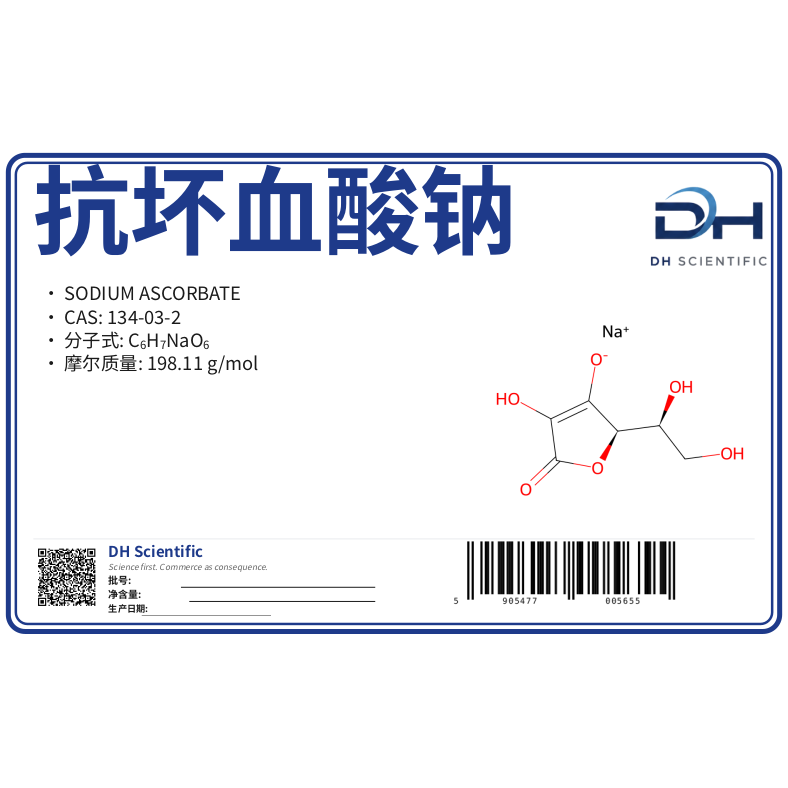
抗坏血酸钠

4,99 

ASKORBINIAN SODU 500g
Postać:
krystaliczna
Forma:
ciało stałe (proszek)
Wzór chemiczny:
C6H7O6Na
Synonimy:
sól kwasu askorbinowego i sodu. witamina C, witamina C buforowana
Opakowanie:
worek strunowy
Termin ważności
i
kraj pochodzenia
podane na etykiecie umieszczonej na opakowaniu.
Skład: askorbinia

🔒 演示模式 — 此商品不出售。

合法物质。dhscientific.com 是 MOL-GOD 平台的演示 — 我们不出售任何商品,也不处理订单。被禁止的物质会依据法规基准在此自动拦截(例如可参见七氯)。

免费审核您的安全数据表(SDS) → · 联系我们

MolGod_SDSCARD_1
REACH 2020/878
v1 · 18.07.2026
SKU: AF-DH-10759456110 Kategoria:
🧬 3D分子可视化器
正在加载分子...
3D模型Sodium Ascorbate,CAS 134-03-2,分子式C6H7NaO6, 摩尔质量 198.11 g/mol

数据转录自法规登记册和专业文献,并注明来源与版本。不能替代供应商的安全数据表。未记录来源的字段已作相应标注。

化学概述: Sodium AscorbateMolGod_OVERVIEW_1
分子式C6H7NaO6[1]
分子量198.11 g/mol[1]
熔点218 °C[1]
IUPAC名称sodium (2R)-2-[(1S)-1,2-dihydroxyethyl]-4-hydroxy-5-oxo-2H-furan-3-olate[1]
SMILESC([C@@H]([C@@H]1C(=C(C(=O)O1)O)[O-])O)O.[Na+][1]
InChIKeyPPASLZSBLFJQEF-RXSVEWSESA-M[1]

同义词: SODIUM ASCORBATE · 134-03-2 · L-Ascorbic acid sodium salt · Sodium L-ascorbate · Vitamin C sodium

数据来源: PubChem (NLM/NIH)
最后更新: 2026-06-30

📚 科学参考文献(芝加哥作者-日期格式) (1 来源)
  1. PubChem. National Center for Biotechnology Information (NIH/NLM), chemical compound database. applies to: 分子式 · 分子量 · 熔点 · IUPAC名称 · SMILES · InChIKey

科学研究

[1]EuropePMC2007
Carosio, R; Zuccari, G; Orienti, I; Mangraviti, S. 2007. "Sodium ascorbate induces apoptosis in neuroblastoma cell lines by interfering with iron uptake." Molecular cancer. https://doi.org/10.1186/147
Gaslini Institute
[2]ChemBL1994
Moreau S, Coudert P, Rubat C, Gardette D, Vallee-Goyet D, Couquelet J, Bastide P, Tronche P.. 1994. "Synthesis and anticonvulsant properties of new benzylpyridazine derivatives." J Med Chem. https://d
Laboratoire de Chimie Thérapeutique and Laboratoire de Pharmacologie et de Phar
📚 科学参考文献(芝加哥作者-日期格式) 6 refs · 2 baz

MOLEKUŁA 按CAS号参考文献(实时来自13+数据库)

来源: db:chembl (3) · db:europepmc (3)

  1. db:chembl Morieux P, Stables JP, Kohn H.. 2008. "Synthesis and anticonvulsant activities of N-benzyl (2R)-2-acetamido-3-oxysubstituted propionamide derivatives." Bioorg Med Chem. https://doi.org/10.1016/j.bmc.2008.08.055.
  2. db:chembl Marona H, Pekala E, Antkiewicz-Michaluk L, Walczak M, Szneler E.. 2008. "Anticonvulsant activity of some xanthone derivatives." Bioorg Med Chem. https://doi.org/10.1016/j.bmc.2008.06.039.
  3. db:europepmc Carosio, R; Zuccari, G; Orienti, I; Mangraviti, S. 2007. "Sodium ascorbate induces apoptosis in neuroblastoma cell lines by interfering with iron uptake." Molecular cancer. https://doi.org/10.1186/1476-4598-6-55.
  4. db:europepmc Kang, JS; Cho, D; Kim, YI; Hahm, E. 2005. "Sodium ascorbate (vitamin C) induces apoptosis in melanoma cells via the down-regulation of transferrin receptor dependent iron uptake." Journal of cellular physiology. https://doi.org/10.1002/jcp.20286.
  5. db:chembl Moreau S, Coudert P, Rubat C, Gardette D, Vallee-Goyet D, Couquelet J, Bastide P, Tronche P.. 1994. "Synthesis and anticonvulsant properties of new benzylpyridazine derivatives." J Med Chem. https://doi.org/10.1021/jm00040a006.
  6. db:europepmc Noto, V; Taper, HS; Jiang, YH; Janssens, J. 1989. "Effects of sodium ascorbate (vitamin C) and 2-methyl-1,4-naphthoquinone (vitamin K3) treatment on human tumor cell growth in vitro. I. Synergism of combined vitamin C and K3 action." Cancer. https://doi.org/10.1002/1097-0142(19890301)63:5<901::aid-cncr2820630518>3.0.co;2-g.
📊 物理化学性质

快速参考

化学式: C6H7NaO6
分子量: 198.11 g/mol
CAS号: 134-03-2
外观: 微小晶体
气味: 无味

详细性质

Uzupełnienie tabeli „Właściwości fizykochemiczne (baza danych)” poniżej — powtórzone wartości pokazujemy tylko raz.

属性 单位 条件 来源
水溶性 greater than or equal to 100 mg/mL at 17.2 °C (NTP, 1992) CAMEO Chemicals ↗
🔬 高级属性

化学标识符

SMILES: C([C@@H]([C@@H]1C(=C(C(=O)O1)O)[O-])O)O.[Na+]
InChI: InChI=1S/C6H8O6.Na/c7-1-2(8)5-3(9)4(10)6(11)12-5;/h2,5,7-10H,1H2;/q;+1/p-1/t2-,5+;/m0./s1
InChIKey: PPASLZSBLFJQEF-RXSVEWSESA-M

数据来源: CAMEO Chemicals

最后更新: 未确认

物质监管状态
在已检查的限制清单(SVHC候选清单、REACH附件XVII;数据集不完整——这不构成合规确认)中未找到该CAS号的条目。CLP分类和运输状态(ADR):请参见GHS章节及安全数据表(SDS)。
🧮 化学计量计算器MolGod_STOICH_1
🔍 外部标识符MolGod_EXTID_1
12 / 16个ID系统75%
数据库标识符操作
CAS Registry Number134-03-2打开 →
PubChem CID23667548[1]打开 →
InChIKeyPPASLZSBLFJQEF-RXSVEWSESA-M[1]打开 →
InChIInChI=1S/C6H8O6.Na/c7-1-2(8)5-3(9)4(10)6(11)12-5…[1]
SMILESC([C@@H]([C@@H]1C(=C(C(=O)O1)O)[O-])O)O.[Na+][1]
EC Number205-126-1[2]打开 →
DrugBankDB14482打开 →
KEGG CompoundD05853打开 →
ChemSpider16736174[3]打开 →
CompTox DTXSID (EPA)DTXSID0020105[4]打开 →
UNII (FDA)S033EH8359打开 →
WikiData QIDQ424551打开 →

来源:PubChem (NIH)、Wikidata SPARQL、KEGG、ChEMBL (EBI)、CompTox CTX (EPA)。

📚 科学参考文献(芝加哥作者-日期格式) (4 来源)
  1. PubChem. National Center for Biotechnology Information (NIH/NLM), chemical compound database. applies to: PubChem CID · InChIKey · InChI · SMILES
  2. ECHA. EC Inventory — EINECS, ELINCS, NLP and List Numbers assigned under REACH. Helsinki: European Chemicals Agency. applies to: EC Number
  3. ChemSpider. Royal Society of Chemistry, chemical structure database. applies to: ChemSpider
  4. U.S. EPA. CompTox Chemicals Dashboard — ToxCast/Tox21 high-throughput screening bioactivity summary (testing coverage, not a hazard finding). Washington, DC: U.S. Environmental Protection Agency. applies to: CompTox DTXSID (EPA)
📡 光谱学 — CAS 134-03-2MolGod_SPECHUB_MAIN
📊 光谱数据库 — 内联数据 9 来源 MolGod_SPECDB_2

光谱按需从9个来源获取。每个光谱都存储在我们的数据库中 — 下次打开时无需向外部API发出请求。无需搜索即可为每个光谱下载JCAMP-DX / CSV / PNG。

IR IR (Infrared) — NIST WebBook
Public domain (US Federal)
▶ 点击加载光谱
🔗 来源
📚 NIST Chemistry WebBook, SRD 69
MS (NIST) Mass Spectrum (EI) — NIST WebBook
Public domain (US Federal)
▶ 点击加载光谱
🔗 来源
📚 NIST Standard Reference Database 1A
UV-Vis UV/Visible Absorption — NIST WebBook
Public domain (US Federal)
▶ 点击加载光谱
🔗 来源
📚 NIST Chemistry WebBook, SRD 69
¹H NMR NMR (¹H, ¹³C) — NMRShiftDB
CC-BY-SA 4.0
▶ 点击加载光谱
🔗 来源
📚 Steinbeck C et al. (2003) J. Chem. Inf. Comput. Sci. 43(1):10–16 DOI: 10.1021/ci025588g
MS (MoNA) MoNA — MassBank of North America
CC-BY 4.0
▶ 点击加载光谱
🔗 来源
📚 MassBank of North America (UC Davis) DOI: 10.1002/jms.1777
IR/NMR/MS (SDBS) SDBS — Spectral Database for Organic Compounds (Japan AIST)
Free for non-commercial

参考来源 — 无公共API。在外部数据库中打开:

🔗 IR/NMR/MS (SDBS) →
📚 SDBSWeb: https://sdbs.db.aist.go.jp (AIST, Japan)
JP Monograph Japanese Pharmacopoeia — Monographs
Reference only

参考来源 — 无公共API。在外部数据库中打开:

🔗 JP Monograph →
📚 Japanese Pharmacopoeia 18th Edition (2021)
WHO INN WHO — International Nonproprietary Names
WHO Model Lists (free)

参考来源 — 无公共API。在外部数据库中打开:

🔗 WHO INN →
📚 WHO INN Programme
DOAJ DOAJ — Directory of Open Access Journals
OA journal index (mixed)

参考来源 — 无公共API。在外部数据库中打开:

🔗 DOAJ →
📚 DOAJ — doaj.org
🔬 交互式光谱(实时 — NIST / MoNA / NMRShiftDB / SDBS) (2)

数据从多个来源实时获取(优先级链)。每个光谱下可下载JCAMP-DX / CSV / PNG。

IR — 傅里叶变换红外光谱

正在加载 IR — 傅里叶变换红外光谱…

MS — 质谱(EI 70eV)

正在加载 MS — 质谱(EI 70eV)…

📐 理化性质(数据库) 2 字段 MolGod评分:可靠
属性 单位 条件 来源
熔点 218 [1] °C decomp. PubChem PUG-View (2026)
沸点 rozkłada się [1] przed wrzeniem (decomp.) PubChem PUG-View (2026)
📚 科学参考文献(芝加哥作者-日期格式) (1 来源)
  1. PubChem. National Center for Biotechnology Information (NIH/NLM), chemical compound database. applies to: 熔点 · 沸点
🔄 浓度单位转换器 实时 MolGod_UNITCONV_1

输入Sodium Ascorbate浓度(任意单位),其余将自动计算。

分子量: 198.11 g/mol · IUPAC Gold Book ↗

⚗️ 转换公式及引用(每个公式)
转换分子式准确度来源
% (w/v) ↔ molarityc (mol/L) = (% × 10) / MW±0.5% rel. when density ≈ 1.0 g/mLIUPAC (2019)
millimolar ↔ molarc (mol/L) = mM × 10⁻³ExactCohen ER, Cvitaš T, Frey JG, Holmström B, Kuchitsu K, Marquardt R, Mills I, Pavese F, Quack M, Stohner J, Strauss HL, Takami M, Thor AJ (2007)
molarity (mol/L)c = n/V = (m/MW)/V±0.1% (depends on MW precision)IUPAC (2019)
parts per million (mg/L) ↔ molarityc (mol/L) = ppm / (1000 × MW); equivalently ppm = mg/L for dilute aqueous±1% (density-independent for dilute solutions)IUPAC (2019)
mg/mL ↔ molarityc (mol/L) = (mg/mL × 1000) / MW / 1000 = mg/mL / MW × 1±0.2%Cohen ER, Cvitaš T, Frey JG, Holmström B, Kuchitsu K, Marquardt R, Mills I, Pavese F, Quack M, Stohner J, Strauss HL, Takami M, Thor AJ (2007)
g/L ↔ molarityc (mol/L) = (g/L) / MW±0.1% (depends on MW precision)Cohen ER, Cvitaš T, Frey JG, Holmström B, Kuchitsu K, Marquardt R, Mills I, Pavese F, Quack M, Stohner J, Strauss HL, Takami M, Thor AJ (2007)
mmol/L ↔ molarityc (mol/L) = mmol/L × 10⁻³ExactCohen ER, Cvitaš T, Frey JG, Holmström B, Kuchitsu K, Marquardt R, Mills I, Pavese F, Quack M, Stohner J, Strauss HL, Takami M, Thor AJ (2007)
Celsius ↔ KelvinT(K) = t(°C) + 273.15±0.01 K (ITS-90 scale)BIPM (Bureau International des Poids et Mesures) (2019)
Celsius ↔ FahrenheitT(°F) = T(°C) × 9/5 + 32±0.1 °FThompson A, Taylor BN (2008)
density-corrected % ↔ molarityc (mol/L) = (%w/w × ρ × 10) / MW, ρ in g/mL±0.1% when ρ known to 3 decimalsCohen ER, Cvitaš T, Frey JG, Holmström B, Kuchitsu K, Marquardt R, Mills I, Pavese F, Quack M, Stohner J, Strauss HL, Takami M, Thor AJ (2007)
📚 参考文献(8个权威来源)
  1. Thompson A, Taylor BN (2008). Guide for the Use of the International System of Units (SI). NIST Special Publication 811 · DOI: 10.6028/NIST.SP.811-2008
    → Primary SI standard for US scientific usage
  2. Cohen ER, Cvitaš T, Frey JG, Holmström B, Kuchitsu K, Marquardt R, Mills I, Pavese F, Quack M, Stohner J, Strauss HL, Takami M, Thor AJ (2007). Quantities, Units and Symbols in Physical Chemistry — The IUPAC Green Book. RSC Publishing, 3rd ed. · DOI: 10.1039/9781847557889 · ISBN: 978-0-85404-433-7
    → Canonical IUPAC guide for chemistry quantities/units
  3. BIPM (Bureau International des Poids et Mesures) (2019). The International System of Units (SI), 9th edition. BIPM ·
    → International SI definitions (incl. redefined kilogram 2019)
  4. ISO/IEC (2022). Quantities and units — Part 1: General. International Organization for Standardization — ISO 80000-1:2022 ·
    → General rules for physical quantities and units
  5. ISO/IEC (2019). Quantities and units — Part 9: Physical chemistry and molecular physics. International Organization for Standardization — ISO 80000-9:2019 ·
    → Concentration / molality / amount-of-substance conventions
  6. Tiesinga E, Mohr PJ, Newell DB, Taylor BN (2021). CODATA recommended values of the fundamental physical constants: 2018. Rev. Mod. Phys. 93(2):025010 · DOI: 10.1103/RevModPhys.93.025010
    → Avogadro, gas constant, molar volume (2019 SI revision)
  7. IUPAC (2019). Compendium of Chemical Terminology — the IUPAC Gold Book (online). IUPAC · DOI: 10.1351/goldbook
    → Definitions of mass fraction, molality, normality, ppm, activity
  8. Mills IM, Cvitaš T, Homann K, Kallay N, Kuchitsu K (1988). Quantities, Units and Symbols in Physical Chemistry. Blackwell Scientific Publications, 1st ed. · ISBN: 0-632-01773-5
    → Historical predecessor of IUPAC Green Book
🧪 溶液制备向导 WIZARD MolGod_PREP_1
① 选择浓度
② 目标体积
③ 溶剂

计算依据: IUPAC Gold Book ↗, Merck ↗

🛡️ 安全 — CAS 134-03-2MolGod_SAFEHUB_MAIN
数据限制说明。 本页安全信息仅供参考,不能替代完整的安全数据表(SDS)。使用产品前,请查阅制造商当前的安全数据表以及GHS/CLP指南。CLP分类适用于纯散装物质,不适用于商业制剂。

该物质无统一的GHS分类——请参阅供应商当前的安全数据表(SDS)。

📚 综合科学参考文献 — Chicago Author-Date 10 来源

从所有Safety Hub选项卡收集的参考文献。CAS号: 134-03-2 · PubChem ↗

  1. Parlament Europejski i Rada UE. 2008. "Rozporządzenie (WE) nr 1272/2008 w sprawie klasyfikacji, oznakowania i pakowania substancji (CLP)." Dz.Urz. UE L 353. [↗] GHS,法规
  2. United Nations Economic Commission for Europe (UNECE). 2021. "Globally Harmonized System of Classification and Labelling of Chemicals (GHS), Ninth Revised Edition." United Nations, Geneva. [↗] GHS
  3. Goldfrank, Lewis R., Robert S. Hoffman, Mary Ann Howland, et al.. 2019. "Goldfrank's Toxicologic Emergencies, 11th ed.." McGraw-Hill Education, New York. ISBN 978-1-25-985961-8. Pierwsza pomoc, Toksykologia
  4. National Institute for Occupational Safety and Health (NIOSH). 2023. "NIOSH Pocket Guide to Chemical Hazards (DHHS Publ. 2005-149)." U.S. Department of Health and Human Services / CDC, Cincinnati, OH. [↗] Pierwsza pomoc, PPE, Toksykologia
  5. European Committee for Standardization (CEN). 2016. "EN 374-1:2016 — Protective gloves against dangerous chemicals and micro-organisms." CEN, Brussels. [↗] PPE
  6. UNECE. 2023. "European Agreement Concerning the International Carriage of Dangerous Goods by Road (ADR 2025)." United Nations, Geneva. [↗] Utylizacja, Regulacje
  7. National Fire Protection Association (NFPA). 2022. "NFPA 400 — Hazardous Materials Code." NFPA, Quincy, MA. [↗] Magazynowanie
  8. Urben, P.G. (ed.). 2017. "Bretherick's Handbook of Reactive Chemical Hazards, 8th ed.." Butterworth-Heinemann / Elsevier, Oxford. [↗] Magazynowanie
  9. Ministerstwo Klimatu i Środowiska RP. 2023. "Baza danych o produktach i opakowaniach oraz o gospodarce odpadami (BDO)." Ministerstwo Klimatu i Środowiska, Warszawa. [↗] Utylizacja
  10. International Agency for Research on Cancer (IARC / WHO). 2024. "IARC Monographs on the Identification of Carcinogenic Hazards to Humans — List of Classifications." WHO, Lyon. [↗] Toksykologia

具有自身参考文献的选项卡(紧急情况、个人防护装备、储存、废物)在其各自章节中包含额外的书目条目。

📈 分析统计(t检验·RSD·Grubbs·Q-Dixon) ICH Q2

粘贴一系列重复测量结果(CSV或每行一个数字)。计算器将计算平均值、标准差和95%置信区间,并检测异常值(Grubbs + Dixon Q)。

分隔符:逗号、空格、制表符、换行。至少3个测量值。
📐 统计公式
  • x̄ = Σxᵢ / n — 算术平均值
  • s² = Σ(xᵢ - x̄)² / (n-1) — 样本方差
  • s = √s² — 标准差
  • RSD% = (s / x̄) × 100% — 相对标准差
  • CI₉₅ = x̄ ± t(0.05, n-1) × s / √n — Student's t
  • G = |xᵢ - x̄| / s — Grubbs检验
  • Q = |xsuspect - xnearest| / |xmax - xmin| — Dixon Q-test

来源:ICH Q2(R2) 分析方法验证 · ICH PDF ↗

🧪 缓冲液配方计算器 唯一

从 20 种常用缓冲体系列表中选择 → 输入目标 pH → 获得精确配方,包括称量质量。

步骤 1:选择缓冲体系

📜 配方历史记录(最近 10 条)
🧪 HPLC 方法(可导入) (1)

C18 · purity · agilent

Method Summary

Kolumna: C18 150 × 4.6 mm, 5 μm

Runtime: 23 min · Rt: 6.9 min · λ: 210 nm

Column Selection

Typ: C18 · Wymiary: 150 × 4.6 mm, 5 μm

C18 — idealna dla związków o umiarkowanej lipofilności

  • Agilent Zorbax Eclipse Plus C18
  • Waters XBridge C18
  • Phenomenex Kinetex C18
Mobile Phase

A: Woda + 10mM bufor wodorowęglanu amonu (pH 7, bufor NH4HCO3)

B: Acetonitryl

🔬 Dostępność + substytuty
ℹ️ Single-CAS Integrity: 以下溶剂为 分析工具(HPLC 流动相)并非分析物。 其他折叠面板中显示的值(摩尔质量、GHS、毒理学)均针对当前分子,而非这些溶剂。 例外:单CAS完整性(类别“溶剂/缓冲液/分析方法”)。
溶剂/CAS号状态操作
AWoda + 10mM bufor wodorowęglanu amonu
CAS 7732-18-5
检查中…
BAcetonitryl
CAS 75-05-8
检查中…
Gradient Program
Time (min)% BFlow
0.0015.01.00
2.0015.01.00
15.0060.01.00
17.0060.01.00
18.0015.01.00
23.0015.01.00
Detection Settings

λ primary: 210 nm · reference: 310 nm · bandwidth: 4 nm

Validation Parameters

QC: Resolution ≥2.0 · Tailing ≤1.5 · RSD ≤2%

Uwagi:

  • pKa nieznane — pH 7.0 użyte jako neutral default; rekomendacja: dodać CAS do wp_molgod_pka albo zmierzyć eksperymentalnie (Avdeef 2012)

Referencje:

  • USP <621> Chromatography
  • ICH Q2(R1) Validation of Analytical Procedures: Text and Methodology
  • Snyder LR, Kirkland JJ, Dolan JW (2010). Introduction to Modern Liquid Chromatography, 3rd ed.
  • Avdeef A. (2012). Absorption and Drug Development: Solubility, Permeability, and Charge State, 2nd ed. Wiley.
Download Method
🧪 溶解性和溶剂兼容性 MolGod_SOLUB_1
分子
Sodium Ascorbate
分子式
C6H7NaO6
logP (XLogP3)
摩尔质量(g/mol)
198.11
极性

⚠️ GC估算(Hoftyzer-Van Krevelen)。该CAS无文献HSP数据——精度±2 MPa½。请实验验证。

Tabela kompatybilności rozpuszczalników niedostępna dla tej substancji.
Parametry Hansena są poza zakresem metody, więc odległości Ra nie da się policzyć, a w bazie nie ma pomiaru rozpuszczalności, którym można by je zastąpić. Zamiast jedenastu ocen bez podstawy nie pokazujemy żadnej. Dobór rozpuszczalnika oprzyj na karcie charakterystyki i danych eksperymentalnych.
📚 溶剂科学参考文献(芝加哥作者-日期格式)——点击展开

11 种溶剂 · 54 条完整引用(NIST/CRC/IARC/Hansen/Reichardt/Smallwood/Wypych/Armarego/Snyder/GESTIS)——见下方。

Water (H₂O)
  1. NIST — NIST Chemistry WebBook — Water (CAS 7732-18-5)
  2. CRC — CRC Handbook of Chemistry and Physics, 104th ed., Sec. 8 (Properties of Water)
  3. IAPWS — IAPWS Release on Static Dielectric Constant of Water
  4. Reichardt 2011 — Solvents and Solvent Effects in Organic Chemistry
  5. GESTIS — GESTIS Substance Database — Water
Ethanol (EtOH)
  1. NIST — NIST Chemistry WebBook — Ethanol (CAS 64-17-5)
  2. CRC — CRC Handbook — Ethanol physical constants
  3. Snyder & Kirkland — Modern Liquid Chromatography — Ethanol eluotropic
  4. Smallwood — Handbook of Organic Solvent Properties — Ethanol
  5. GESTIS — GESTIS Substance Database — Ethanol
Methanol (MeOH)
  1. NIST — NIST Chemistry WebBook — Methanol (CAS 67-56-1)
  2. CRC — CRC Handbook — Methanol physical constants
  3. Snyder & Kirkland — Modern Liquid Chromatography — MeOH eluotropic, eo=0.95
  4. GESTIS — GESTIS Substance Database — Methanol
Acetone
  1. NIST — NIST Chemistry WebBook — Acetone (CAS 67-64-1)
  2. CRC — CRC Handbook — Acetone physical & thermodynamic constants
  3. Hansen 2007 — Hansen Solubility Parameters — Acetone (dD=15.5, dP=10.4, dH=7.0)
  4. Smallwood — Handbook of Organic Solvent Properties — Acetone
  5. GESTIS — GESTIS Substance Database — Acetone
Acetonitrile (ACN)
  1. NIST — NIST Chemistry WebBook — Acetonitrile (CAS 75-05-8)
  2. CRC — CRC Handbook — Acetonitrile constants
  3. Snyder & Kirkland — Modern Liquid Chromatography — ACN gold-standard HPLC eluent
  4. Reichardt 2011 — Solvents and Solvent Effects — ACN dipolar aprotic
  5. GESTIS — GESTIS Substance Database — Acetonitrile
DMSO
  1. NIST — NIST Chemistry WebBook — DMSO (CAS 67-68-5)
  2. Wypych 2019 — Handbook of Solvents Vol. 1 — DMSO comprehensive properties
  3. Hansen 2007 — HSP — DMSO (dD=18.4, dP=16.4, dH=10.2)
  4. Reichardt 2011 — Solvents and Solvent Effects — DMSO E_T(30)=45.1, dipolar aprotic
  5. GESTIS — GESTIS Substance Database — DMSO
THF
  1. NIST — NIST Chemistry WebBook — THF (CAS 109-99-9)
  2. Armarego 2009 — Purification of Laboratory Chemicals — THF drying & peroxide test
  3. Hansen 2007 — Hansen Solubility Parameters — THF (dD=16.8, dP=5.7, dH=8.0)
  4. Smallwood — Handbook of Organic Solvent Properties — THF
  5. GESTIS — GESTIS Substance Database — Tetrahydrofuran
DCM (CH₂Cl₂)
  1. NIST — NIST Chemistry WebBook — Dichloromethane (CAS 75-09-2)
  2. IARC 71 — IARC Monograph 71 — DCM (Group 2A carcinogen)
  3. Hansen 2007 — Hansen Solubility Parameters — DCM (dD=18.2, dP=6.3, dH=6.1)
  4. Reichardt 2011 — Solvents and Solvent Effects — DCM polarity index
  5. GESTIS — GESTIS Substance Database — Dichloromethane
Chloroform (CHCl₃)
  1. NIST — NIST Chemistry WebBook — Chloroform (CAS 67-66-3)
  2. IARC 73 — IARC Monograph 73 — Chloroform (Group 2B carcinogen)
  3. Hansen 2007 — Hansen Solubility Parameters — CHCl3 (dD=17.8, dP=3.1, dH=5.7)
  4. Reichardt 2011 — Solvents and Solvent Effects — CHCl3 H-bond donor strength
  5. GESTIS — GESTIS Substance Database — Chloroform
n-Hexane
  1. NIST — NIST Chemistry WebBook — n-Hexane (CAS 110-54-3)
  2. ATSDR n-Hexane — ATSDR Toxicological Profile for n-Hexane — neuropatia obwodowa (n-Heksan NIE jest kancerogenem IARC)
  3. Hansen 2007 — Hansen Solubility Parameters — n-Hexane (dD=14.9, dP=0, dH=0)
  4. Snyder & Kirkland — Modern Liquid Chromatography — n-Hexane NP standard, eo=0.00
  5. GESTIS — GESTIS Substance Database — n-Hexane
Toluene
  1. NIST — NIST Chemistry WebBook — Toluene (CAS 108-88-3)
  2. IARC 71 — IARC Monograph 71 — Toluene
  3. Hansen 2007 — Hansen Solubility Parameters — Toluene (dD=18.0, dP=1.4, dH=2.0)
  4. Smallwood — Handbook of Organic Solvent Properties — Toluene
  5. GESTIS — GESTIS Substance Database — Toluene
溶解性理论(应用于相容性预测):
  1. Yalkowsky, Samuel H., and Shri C. Valvani. 1980. "Solubility and Partitioning I: Solubility of Nonelectrolytes in Water." Journal of Pharmaceutical Sciences 69 (8): 912–922. https://doi.org/10.1002/jps.2600690814 — General Solubility Equation (GSE): logS = 0.5 − logP − 0.01(MP−25).
  2. Hansen, Charles M. 2007. Hansen Solubility Parameters: A User's Handbook. 2nd ed. CRC Press. https://doi.org/10.1201/9781420006834 — HSP三元组(dD, dP, dH)+ Ra公式。
  3. Stefanis, E., and C. Panayiotou. 2008. "Prediction of Hansen Solubility Parameters with a New Group-Contribution Method." Int J Thermophys 29: 568–585. https://doi.org/10.1007/s10765-008-0415-z
  4. Reichardt, Christian, and Thomas Welton. 2011. Solvents and Solvent Effects in Organic Chemistry. 4th ed. Wiley-VCH. https://doi.org/10.1002/9783527632220 — E_T(30) polarity scale, solwatochromia.
  5. Snyder, Lloyd R., Joseph J. Kirkland, and John W. Dolan. 2010. Introduction to Modern Liquid Chromatography. 3rd ed. Wiley. https://doi.org/10.1002/9780470508183 — Eluotropic series, polarity index.
  6. Van Krevelen, D. W., and K. Te Nijenhuis. 2009. Properties of Polymers. 4th ed. Elsevier. https://doi.org/10.1016/B978-0-08-054819-7.X0001-5 — Hoftyzer–Van Krevelen group contribution dla dD/dP/dH z SMILES.
  7. Marcus, Yizhak. 1998. The Properties of Solvents. Wiley Series in Solution Chemistry, Vol. 4. ISBN 9780471983699 — 250+溶剂的完整表格数据集(ε、μ、供体数、受体数)。
  8. PubChem Compound Database — CAS 134-03-2 lookup ↗ — logP (XLogP3), water solubility experimental + predicted.

完整参考文献位于页面底部的参考文献折叠面板——芝加哥格式手册第17版作者-日期格式。

🧮 实验室计算器(8个) MolGod_LABCALC_1
稀释(C₁V₁=C₂V₂)
摩尔浓度(M=n/V)
pH缓冲液(Henderson-Hasselbalch)
Beer-Lambert(A=εcl)
质量→摩尔
浓度%→M
ppm→mg/L
温度 C↔F↔K

已验证的配方: IUPAC Gold Book ↗, DOI ↗

📊 光谱数据库 MolGod_SPECDB_3
📋 实验室方案生成器 MolGod_PROTOCOL_1

方案基于以下内容生成: GHS SDS, Aldrich Lab Guide ↗

🏷️ 标签生成器(QR码) MolGod_LABEL_1
抗坏血酸钠• SODIUM ASCORBATE• CAS: 134-03-2• 分子式: C6H7NaO6• 摩尔质量: 198.11 g/molDH ScientificScience first. Commerce as consequence.批号: 净含量: 生产日期:
Deskryptory Lipinskiego (struktura)
正在加载ADMET预测…
🧪 溶液配制助手(Smart Prep) MolGod_PREP_2

输入您要制备的内容——我将生成SOP

示例如下——点击插入:
预设配方:
📚 科学文献概览 — CAS 134-03-2MolGod_LITHUB_MAIN
⭐ 关键发现(科学文献) 5 出版物
🏆 CAS 134-03-2 — multi-criteria ranking (W12): 30%引用·20%近期性·20%主题·15%历史·15%开放获取.
  1. #1
    Singh H; Kumar D; Khatri M et al. (2025) · Journal of fluorescence
    重要性: 必引文献(经典) · 近期(2025)
    SCORE 4 分析 MUST-CITE DOI ↗
  2. #2
    Farzanegan B; Shafigh N; Hasheminik M et al. (2025) · BMC infectious diseases
    重要性: 必引文献(经典) · 近期(2025)
    SCORE 4 药理学 MUST-CITE DOI ↗
  3. #3
    Aragón-Vela J; Huertas JR; Casuso RA (2026) · Nutrition reviews
    重要性: 必引文献(经典) · 近期(2026) · 综述
    SCORE 4 综述 MUST-CITE DOI ↗
  4. #4
    Hao J; Cheng L; Chen D et al. (2025) · Free radical biology & medicine
    重要性: 必引文献(经典) · 近期(2025)
    SCORE 4 药理学 MUST-CITE DOI ↗
  5. #5
    Xu JS; Li Y; Wei LQ (2026) · Current medical science
    重要性: 必引文献(经典) · 近期(2026) · 综述
    SCORE 4 综述 MUST-CITE DOI ↗
📐 HPLC峰对称性计算器(USP Tf / As)

根据峰半宽计算USP拖尾因子(Tf)和不对称度(As)。输入在峰高5%或10%处测量的a(左半宽)和b(右半宽)。

📚 参考文献(芝加哥作者-日期格式)
  1. USP General Chapter <621>. 2024. "Chromatography." United States Pharmacopeial Convention. [link ↗] — Defines USP Tailing Factor T = (a+b)/(2a) measured at 5% peak height.
  2. International Council for Harmonisation (ICH). 2023. "Validation of Analytical Procedures Q2(R2)." ICH Expert Working Group. [link ↗] — Tailing factor is a system suitability parameter (Section 6).
  3. Foley, Joe P., and John G. Dorsey. 1983. "Equations for calculation of chromatographic figures of merit for ideal and skewed peaks." Analytical Chemistry 55: 730-737 https://doi.org/10.1021/ac00255a033 [link ↗] — Original asymmetry factor As = b/a at 10% height (Foley & Dorsey 1983).
  4. Snyder, Lloyd R., Joseph J. Kirkland, and John W. Dolan. 2010. "Introduction to Modern Liquid Chromatography." Wiley. https://doi.org/10.1002/9780470508183 [link ↗] — Chapter 2.4 — peak shape diagnostics and remedies.
  5. Dolan, John W.. 2003. "Peak tailing and resolution." LCGC North America 21: 610-614 [link ↗] — How tailing factor degrades effective resolution.
  6. Vivó-Truyols, Gabriel, and Hans-Gerd Janssen. 2010. "Probabilistic approach to peak deconvolution in chromatography." Analytical Chemistry 82: 8525-8531 https://doi.org/10.1021/ac101742z [link ↗] — Modern numerical deconvolution for asymmetric peaks.
  7. Kromidas, Stavros. 2017. "HPLC Made to Measure: A Practical Handbook for Optimization." Wiley-VCH. — Practical Tf and As thresholds for routine QC.
  8. Dong, Michael W.. 2019. "HPLC and UHPLC for Practicing Scientists." Wiley. https://doi.org/10.1002/9781119313793 [link ↗]
  9. Meyer, Veronika R.. 2010. "Practical High-Performance Liquid Chromatography." Wiley.
  10. Heyden, Yvan Vander, et al.. 2009. "Robustness of pharmaceutical liquid chromatographic methods." Journal of Chromatography B 877: 2120-2129 https://doi.org/10.1016/j.jchromb.2008.10.052 [link ↗]
📊 分辨率和塔板数计算器(Rs, N, H)

计算一对HPLC峰的分辨率Rs、理论塔板数N和HETP(H)。输入保留时间、峰宽(在50%或基线处)和色谱柱长度。

📚 参考文献(芝加哥作者-日期格式)
  1. Snyder, Lloyd R., Joseph J. Kirkland, and John W. Dolan. 2010. "Introduction to Modern Liquid Chromatography." 3rd ed. John Wiley & Sons. ISBN 978-0-470-16754-0. https://doi.org/10.1002/9780470508183 [link ↗] — Chapter 2 covers resolution, plate count and HETP fundamentals (Snyder et al. 2010).
  2. USP General Chapter <621>. 2024. "Chromatography." USP-NF 2024 ed. United States Pharmacopeial Convention. [link ↗] — Defines Rs >= 1.5 acceptance criterion and N calculation methods.
  3. Dolan, John W.. 2003. "How much resolution is enough?." LCGC North America 21: 350-353 [link ↗] — Practical guidance on Rs targets for routine method development.
  4. Van Deemter, J. J., F. J. Zuiderweg, and A. Klinkenberg. 1956. "Longitudinal diffusion and resistance to mass transfer as causes of nonideality in chromatography." Chemical Engineering Science 5: 271-289 https://doi.org/10.1016/0009-2509(56)80003-1 [link ↗] — Origin of N = 5.54·(tr/w0.5)² half-height plate count formulation.
  5. Giddings, J. Calvin. 1965. "Dynamics of Chromatography, Part I: Principles and Theory." Marcel Dekker. ISBN 978-0-8247-1357-7. — Resolution equation Rs = (1/4)·√N·(α-1)/α·k/(1+k) (master equation).
  6. Foley, Joe P., and John G. Dorsey. 1983. "Equations for calculation of chromatographic figures of merit for ideal and skewed peaks." Analytical Chemistry 55: 730-737 https://doi.org/10.1021/ac00255a033 [link ↗] — Skewed-peak corrections to apparent N.
  7. Knox, John H.. 1977. "Practical aspects of LC theory." Journal of Chromatographic Science 15: 352-364 https://doi.org/10.1093/chromsci/15.9.352 [link ↗]
  8. Carr, Peter W.. 2009. "The new physical chemistry of HPLC." Journal of Chromatography A 1216: 1764-1772 https://doi.org/10.1016/j.chroma.2008.11.094 [link ↗]
  9. Dong, Michael W.. 2019. "HPLC and UHPLC for Practicing Scientists." 2nd ed. Wiley. ISBN 978-1-119-31378-3. https://doi.org/10.1002/9781119313793 [link ↗]
  10. Meyer, Veronika R.. 2010. "Practical High-Performance Liquid Chromatography." 5th ed. Wiley. ISBN 978-0-470-68218-0.
🧪 系统适用性——实时计算器(USP <621>)

输入5-6次进样的数据(峰面积、保留时间、拖尾因子、塔板数)——计算器将计算%RSD和平均值,并检查是否符合USP <621>。您可以粘贴CSV(逗号分隔)或编辑单个值。

📚 参考文献(芝加哥作者-日期格式)
  1. USP General Chapter <621>. 2024. "Chromatography (System Suitability section)." USP-NF 2024 ed. United States Pharmacopeial Convention. [link ↗] — Defines RSD area < 2%, tailing < 2.0, N > 2000 acceptance criteria.
  2. International Council for Harmonisation (ICH). 2023. "Validation of Analytical Procedures Q2(R2)." ICH Expert Working Group. [link ↗] — Section 5.4 — system suitability is part of method validation.
  3. US Food and Drug Administration (FDA). 2018. "Reviewer Guidance: Validation of Chromatographic Methods." US Food and Drug Administration. [link ↗] — CDER reviewer perspective on chromatographic validation expectations.
  4. Snyder, Lloyd R., Joseph J. Kirkland, and John W. Dolan. 2010. "Introduction to Modern Liquid Chromatography." 3rd ed. Wiley. — Chapter 2 — system suitability fundamentals (RSD, Tf, N).
  5. Heyden, Yvan Vander, et al.. 2009. "Robustness of pharmaceutical liquid chromatographic methods." — Robustness vs. system suitability — design-of-experiments framework.
  6. Rozet, Eric, et al.. 2013. "Analysis of recent pharmaceutical regulatory documents on analytical method validation."
  7. European Medicines Agency (EMA). 2011. "Guideline on bioanalytical method validation EMEA/CHMP/EWP/192217/2009." EMA. [link ↗] — EMA companion guideline with bioanalytical SS criteria.
  8. Dong, Michael W.. 2019. "HPLC and UHPLC for Practicing Scientists." 2nd ed. Wiley. — UHPLC-specific suitability adjustments (n=5 vs. n=6).
  9. Kazakevich, Yuri V., and Rosario LoBrutto, eds.. 2007. "HPLC for Pharmaceutical Scientists." Wiley-Interscience.
  10. AOAC International. 2016. "Appendix F: Guidelines for Standard Method Performance Requirements." AOAC INTERNATIONAL. [link ↗] — Alternative SS thresholds for food/dietary samples.
📈 UV-VIS光谱预测器(200-400 nm) λmax 265 nm MolGod_UVVIS_1
0%25%50%75%100%200250300350400265 nmA = ε·c·lA / Aₘₐₓ (%)
化合物Sodium ascorbate
λmax265 nm
λmin230 nm
εmax (M⁻¹·cm⁻¹)7 200
溶剂(查询)water
溶剂(参比)water (pH 7)
浓度(M)1e-4
光程(cm)1
曲线半峰宽70 nm

模型:以 λmax 为中心的高斯曲线,按比尔-朗伯定律 A = ε · c · l 缩放。透射率 T = 10^(-A) · 100%。

📚 科学参考文献(芝加哥作者-日期格式)
  1. Morieux P, Stables JP, Kohn H.. 2008. "Synthesis and anticonvulsant activities of N-benzyl (2R)-2-acetamido-3-oxysubstituted propionamide derivatives." Bioorg Med Chem. https://doi.org/10.1016/j.bmc.2008.08.055. [DOI]
  2. Marona H, Pekala E, Antkiewicz-Michaluk L, Walczak M, Szneler E.. 2008. "Anticonvulsant activity of some xanthone derivatives." Bioorg Med Chem. https://doi.org/10.1016/j.bmc.2008.06.039. [DOI]
  3. Carosio, R; Zuccari, G; Orienti, I; Mangraviti, S. 2007. "Sodium ascorbate induces apoptosis in neuroblastoma cell lines by interfering with iron uptake." Molecular cancer. https://doi.org/10.1186/1476-4598-6-55. [DOI]
  4. Kang, JS; Cho, D; Kim, YI; Hahm, E. 2005. "Sodium ascorbate (vitamin C) induces apoptosis in melanoma cells via the down-regulation of transferrin receptor dependent iron uptake." Journal of cellular physiology. https://doi.org/10.1002/jcp.20286. [DOI]
  5. Moreau S, Coudert P, Rubat C, Gardette D, Vallee-Goyet D, Couquelet J, Bastide P, Tronche P.. 1994. "Synthesis and anticonvulsant properties of new benzylpyridazine derivatives." J Med Chem. https://doi.org/10.1021/jm00040a006. [DOI]
  6. Noto, V; Taper, HS; Jiang, YH; Janssens, J. 1989. "Effects of sodium ascorbate (vitamin C) and 2-methyl-1,4-naphthoquinone (vitamin K3) treatment on human tumor cell growth in vitro. I. Synergism of combined vitamin C and K3 action." Cancer. https://doi.org/10.1002/1097-0142(19890301)63:5<901::aid-cncr2820630518>3.0.co;2-g. [DOI]
  7. Linstrom, Peter J., and William G. Mallard, eds. 2023. NIST Chemistry WebBook, NIST Standard Reference Database Number 69. Gaithersburg, MD: National Institute of Standards and Technology. [DOI]
  8. Mayerhöfer, Thomas G., Samir Pahlow, and Jürgen Popp. 2020. "The Bouguer-Beer-Lambert Law: Shining Light on the Obscure." ChemPhysChem 21 (18): 2029-2046. [DOI]
  9. Skoog, Douglas A., F. James Holler, and Stanley R. Crouch. 2017. Principles of Instrumental Analysis. 7th ed. Boston: Cengage Learning. ISBN 978-1-305-57721-3.
  10. Lindon, John C., George E. Tranter, and David W. Koppenaal, eds. 2017. "Encyclopedia of Spectroscopy and Spectrometry." 3rd ed. Amsterdam: Academic Press. ISBN 978-0-12-803224-4.
  11. Field, Leslie D., Sev Sternhell, and John R. Kalman. 2013. "Organic Structures from Spectra." 5th ed. Chichester: Wiley. ISBN 978-1-119-96582-6.
  12. Reusch, William. 2013. "Virtual Textbook of Organic Chemistry: Spectroscopy." East Lansing, MI: Michigan State University.
  13. Lampman, Gary M., Donald L. Pavia, George S. Kriz, and James R. Vyvyan. 2010. "Spectroscopy." 4th ed. Belmont, CA: Cengage Learning. ISBN 978-0-495-88992-9.
  14. Kalsi, P. S. 2010. "Spectroscopy of Organic Compounds." 6th ed. New Delhi: New Age International. ISBN 978-81-224-2032-9.
  15. Williams, Dudley H., and Ian Fleming. 2008. "Spectroscopic Methods in Organic Chemistry." 6th ed. London: McGraw-Hill. ISBN 978-0-07-711559-0.
  16. Sadek, Paul C. 2002. The HPLC Solvent Guide. 2nd ed. Hoboken: Wiley. ISBN 978-0-471-41242-2.
  17. Banwell, Colin N., and Elaine M. McCash. 1994. "Fundamentals of Molecular Spectroscopy." 4th ed. London: McGraw-Hill. ISBN 978-0-07-707976-1.
  18. Perkampus, Heinz-Helmut. 1992. UV-VIS Spectroscopy and Its Applications. Berlin: Springer. https://doi.org/10.1007/978-3-642-77479-9.
  19. Fieser, Louis F. 1949. "Extension of Woodward's Rules for Prediction of Conjugated Diene Absorption." Journal of the American Chemical Society 71 (5): 1854-1857. [DOI]
  20. Woodward, Robert B. 1942. "Structure and the Absorption Spectra of Alpha,Beta-Unsaturated Ketones." Journal of the American Chemical Society 64 (1): 72-75. [DOI]
  21. Beer, August. 1852. "Bestimmung der Absorption des rothen Lichts in farbigen Flüssigkeiten." Annalen der Physik und Chemie 86: 78-88. https://doi.org/10.1002/andp.18521620505.
  22. Lambert, Johann Heinrich. 1760. Photometria. Augsburg: Sumptibus Vidae.

📖 Wartość λmax = 265 nm pochodzi z bazy/literatury. Brak niezależnego potwierdzenia krzyżowego (NIST / CrossRef / PubChem) — weryfikacja krzyżowa niedostępna.

REST: /wp-json/molgod/v1/spectra/uv-vis/134-03-2?solvent=water&path_length_cm=1

📤 将此分子嵌入您的网站

有博客、论坛或科学网站吗? 将交互式3D分子嵌入到您的网站上——每位读者都能看到它,下方还有指向我们商店的链接,他们可以在那里购买试剂。

🔗 HTML iframe代码 (最简单——随处可用)

复制并粘贴到您网站的HTML编辑器中:

根据您的布局调整 widthheight

⚙ WordPress Shortcode (适用于其他使用MOL-GOD的商店)

🌐 直接链接 (用于电子邮件、聊天、LinkedIn、Twitter)

LinkedIn Twitter/X Facebook
QR code CAS 134-03-2

📱 QR code (用于印刷在传单/标签/目录上)

将其放置在产品目录、瓶标或传单上。客户扫描后,即可在手机上看到3D分子,并附有指向您商店的链接。

⬇ 下载PNG

🖼 Open Graph image (用于社交媒体元标签)

分享链接时,Facebook/LinkedIn/Discord会自动获取图像预览:

Preview
📋 许可证: 嵌入内容保留反向链接至 DH Scientific (必需——商店是数据来源)。 化学数据来源于 PubChem (CC0 — 公共领域). 嵌入内容免费用于教育、商业和业余用途。
📚 参考文献(综合书目,芝加哥作者-日期格式) 126 条目

以上折叠面板中针对CAS号134-03-2引用的所有科学来源。格式: 《芝加哥格式手册》第17版,作者-日期系统.

🗄️ 科学数据库

  1. PubChem. n.d. PubChem Compound Summary: CAS 134-03-2. Bethesda, MD: National Center for Biotechnology Information (NCBI), National Library of Medicine.
  2. NIST. n.d. NIST Chemistry WebBook: CAS 134-03-2. Gaithersburg, MD: National Institute of Standards and Technology. https://webbook.nist.gov/cgi/cbook.cgi?ID=134-03-2.
  3. AIST. n.d. Spectral Database for Organic Compounds (SDBS): CAS 134-03-2. Tsukuba, Japan: National Institute of Advanced Industrial Science and Technology. https://sdbs.db.aist.go.jp/.
  4. Linstrom, Peter J., and William G. Mallard, eds. n.d. NIST Chemistry WebBook: NIST Standard Reference Database Number 69. Gaithersburg, MD: National Institute of Standards and Technology. https://doi.org/10.18434/T4D303.
  5. U.S. EPA. n.d. CompTox Chemicals Dashboard: CAS 134-03-2. Research Triangle Park, NC: U.S. Environmental Protection Agency. https://comptox.epa.gov/dashboard/chemical/details/DTXSID0020105.

📐 标准/指南

  1. ICH. 2003. "Stability Testing of New Drug Substances and Products: Q1A(R2)." Geneva: International Council for Harmonisation of Technical Requirements for Pharmaceuticals for Human Use. https://database.ich.org/sites/default/files/Q1A%28R2%29%20Guideline.pdf.
  2. National Fire Protection Association (NFPA). 2024. "NFPA 30: Flammable and Combustible Liquids Code." NFPA, Quincy, MA. https://www.nfpa.org/codes-and-standards/all-codes-and-standards/list-of-codes-and-standards/detail?code=30.
  3. Occupational Safety and Health Administration (OSHA). 2023. "29 CFR 1910.106 — Flammable Liquids." U.S. Department of Labor, Federal Register. https://www.osha.gov/laws-regs/regulations/standardnumber/1910/1910.106.
  4. European Chemicals Agency (ECHA). 2024. "Annex VI to Regulation (EC) No 1272/2008 (CLP) — Harmonised Classification and Labelling." ECHA, Helsinki / Official Journal of the European Union. https://echa.europa.eu/regulations/clp/clp-classification.
  5. European Committee for Standardization (CEN). 2016. "EN 374-1:2016 — Protective gloves against dangerous chemicals and micro-organisms — Part 1: Terminology and performance requirements for chemical risks." CEN, Brussels. https://standards.cencenelec.eu/dyn/www/f?p=205:110:::::FSP_PROJECT,FSP_ORG_ID:38536,6080&cs=1B0DAA8B85DF42E4A2C70E5D71F0BFA32.
  6. European Committee for Standardization (CEN). 2001. "EN 166:2001 — Personal eye-protection — Specifications." CEN, Brussels. https://standards.cencenelec.eu/dyn/www/f?p=CEN:110:0::::FSP_PROJECT:6541&cs=1F1A4E0A78C4DB6A28DBE2E8C29D89DCF.
  7. European Committee for Standardization (CEN). 2009. "EN 14605:2005+A1:2009 — Protective clothing against liquid chemicals — Performance requirements for clothing with liquid-tight (Type 3) or spray-tight (Type 4) connections." CEN, Brussels. https://standards.cencenelec.eu/dyn/www/f?p=CEN:110:0::::FSP_PROJECT:21581&cs=1A04A2D3C7CC58E9E6CB58D55F7EBFB7E.
  8. National Institute for Occupational Safety and Health (NIOSH). 2017. "Recommendations for Chemical Protective Clothing: A Companion to the NIOSH Pocket Guide." U.S. Department of Health & Human Services / CDC. https://www.cdc.gov/niosh/ncpc/default.html.
  9. Occupational Safety and Health Administration (OSHA). 2011. "Personal Protective Equipment — General requirements." U.S. Department of Labor — 29 CFR 1910.132. https://www.osha.gov/laws-regs/regulations/standardnumber/1910/1910.132.

📖 书籍

  1. Hansen, Charles M. 2007. Hansen Solubility Parameters: A User's Handbook, 2nd ed.. Boca Raton, FL: CRC Press. https://www.routledge.com/Hansen-Solubility-Parameters-A-Users-Handbook/Hansen/p/book/9780849372483.
  2. Barton, Allan F. M. 1991. CRC Handbook of Solubility Parameters and Other Cohesion Parameters: 2nd ed.. Boca Raton, FL: CRC Press. https://www.routledge.com/CRC-Handbook-of-Solubility-Parameters-and-Other-Cohesion-Parameters/Barton/p/book/9780849301766.
  3. Connors, Kenneth A., Gordon L. Amidon, and Valentino J. Stella. 1986. Chemical Stability of Pharmaceuticals: A Handbook for Pharmacists, 2nd ed.. New York: Wiley. https://doi.org/10.1002/0471734683.
  4. Rumble, John R., ed. 2019. CRC Handbook of Chemistry and Physics: 100th Edition. Boca Raton, FL: CRC Press. https://hbcp.chemnetbase.com/.
  5. Urben, Peter G. 2017. Bretherick's Handbook of Reactive Chemical Hazards, 8th Edition. Academic Press / Elsevier, Oxford. https://www.sciencedirect.com/book/9780081010594.

📄 科学文章(同行评审)

  1. Stefanis, Emmanuel, and Costas Panayiotou. 2008. "Prediction of Hansen Solubility Parameters with a New Group-Contribution Method." International Journal of Thermophysics 29: 568-585. https://doi.org/10.1007/s10765-008-0415-z.
  2. Stoll, Vincent S., and John S. Blanchard. 1990. "Buffers: Principles and Practice: In Methods in Enzymology, vol. 182." San Diego: Academic Press. https://doi.org/10.1016/0076-6879(90)82008-P.

🌐 网站

  1. ECHA. 2023. "Guidance on the Application of the CLP Criteria." European Chemicals Agency. https://echa.europa.eu/guidance-documents/guidance-on-clp.
  2. European Parliament. 2006. "Regulation (EC) No 1907/2006 (REACH)." Official Journal of the European Union L 396: 1–849.
  3. ECHA. 2023. "Candidate List of Substances of Very High Concern for Authorisation." European Chemicals Agency. https://echa.europa.eu/candidate-list-table.
  4. European Parliament. 2008. "Regulation (EC) No 1272/2008 on Classification, Labelling and Packaging of Substances and Mixtures (CLP)." Official Journal of the European Union L 353: 1–1355.
  5. ECHA. 2017. "Guidance on the Compilation of Safety Data Sheets." Version 3.1. European Chemicals Agency. ECHA-17-G-01-EN. https://echa.europa.eu/documents/10162/23047722/sds_en.pdf.
  6. ECHA. 2022. "Restrictions Under REACH — Annex XVII." European Chemicals Agency. https://echa.europa.eu/substances-restricted-under-reach.
  7. United Nations. 2021. Globally Harmonized System of Classification and Labelling of Chemicals (GHS). 9th revised ed. ST/SG/AC.10/30/Rev.9. New York and Geneva: United Nations. https://unece.org/ghs-rev9-2021.
  8. ECHA. 2020. "Understanding REACH." European Chemicals Agency. https://echa.europa.eu/regulations/reach/understanding-reach.
  9. U.S. Occupational Safety and Health Administration (2024) — 29 CFR 1910.120 — Hazardous Waste Operations and Emergency Response (HAZWOPER) https://www.osha.gov/hazwoper.
  10. National Fire Protection Association (2018) — NFPA 472: Standard for Competence of Responders to Hazardous Materials/Weapons of Mass Destruction Incidents https://www.nfpa.org/codes-and-standards/nfpa-472.
  11. European Parliament and Council (2012) — Directive 2012/18/EU on the Control of Major-Accident Hazards Involving Dangerous Substances (Seveso III) https://eur-lex.europa.eu/legal-content/EN/TXT/?uri=celex:32012L0018.
  12. U.S. National Institute for Occupational Safety and Health (2024) — NIOSH Pocket Guide to Chemical Hazards https://www.cdc.gov/niosh/npg/.
  13. European Chemicals Agency (2020) — Guidance on the Compilation of Safety Data Sheets (SDS), Version 3.1 https://echa.europa.eu/documents/10162/23047722/sds_en.pdf.
  14. Snyder, Lloyd R., John W. Dolan, and Joseph J. Kirkland. 2010. Introduction to Modern Liquid Chromatography. Wiley.
  15. Schoenmakers, Peter J.. 1986. Optimization of Chromatographic Selectivity: A Guide to Method Development. Elsevier.
  16. Snyder, L. R., and J. W. Dolan. 2007. High-Performance Gradient Elution: The Practical Application of the Linear-Solvent-Strength Model. Wiley.
  17. Nikitas, Pavlos, and Adrian Pappa-Louisi. 2009. "Retention models for isocratic and gradient elution in reversed-phase liquid chromatography." Journal of Chromatography A 1216: 1737-1755. https://doi.org/10.1016/j.chroma.2008.10.005.
  18. Carr, Peter W.. 2009. "The new physical chemistry of HPLC." Journal of Chromatography A 1216: 1764-1772. https://doi.org/10.1016/j.chroma.2008.11.094.
  19. Dong, Michael W.. 2019. HPLC and UHPLC for Practicing Scientists. Wiley. https://doi.org/10.1002/9781119313793.
  20. Wu, Naijun, and Anton M. Clausen. 2007. "Fundamental and practical aspects of ultrahigh pressure liquid chromatography for fast separations." Journal of Separation Science 30: 1167-1182. https://doi.org/10.1002/jssc.200700026.
  21. Stoll, Dwight R., and Peter W. Carr. 2017. "Two-Dimensional Liquid Chromatography: A State of the Art Tutorial." Analytical Chemistry 89: 519-531. https://doi.org/10.1021/acs.analchem.6b03506.
  22. Dolan, John W.. 2013. "When to Modify Method Conditions." LCGC North America 31: 192-199. https://www.chromatographyonline.com/view/when-modify-method-conditions.
  23. Meyer, Veronika R.. 2010. Practical High-Performance Liquid Chromatography. Wiley.
  24. Van Deemter, J. J., F. J. Zuiderweg, and A. Klinkenberg. 1956. "Longitudinal diffusion and resistance to mass transfer as causes of nonideality in chromatography." https://doi.org/10.1016/0009-2509(56)80003-1.
  25. Giddings, J. Calvin. 1965. "Dynamics of Chromatography, Part I: Principles and Theory." Marcel Dekker.
  26. Poppe, Hans. 1997. "Some reflections on speed and efficiency of modern chromatographic methods." https://doi.org/10.1016/S0021-9673(97)00376-2.
  27. Wu, Naijun, and Anton M. Clausen. 2007. "Fundamental and practical aspects of ultrahigh pressure liquid chromatography for fast separations." https://doi.org/10.1002/jssc.200700026.
  28. Carr, Peter W.. 2009. "The new physical chemistry of HPLC." https://doi.org/10.1016/j.chroma.2008.11.094.
  29. Knox, John H.. 1977. "Practical aspects of LC theory." https://doi.org/10.1093/chromsci/15.9.352.
  30. Snyder, L. R., J. J. Kirkland, and J. L. Glajch. 1997. "Practical HPLC Method Development." Wiley.
  31. Engelhardt, Heinz. 2014. "100 Years of Chromatography." Wiley-VCH.
  32. Sadek, Paul C.. 2002. "The HPLC Solvent Guide." Wiley-Interscience.
  33. Snyder, L. R.. 1978. "Classification of the solvent properties of common liquids." https://doi.org/10.1093/chromsci/16.6.223.
  34. Reichardt, Christian, and Thomas Welton. 2010. "Solvents and Solvent Effects in Organic Chemistry." Wiley-VCH.
  35. Vailaya, Anant, and Csaba Horváth. 1998. "Retention thermodynamics in hydrophobic interaction chromatography." https://doi.org/10.1021/ie980212h.
  36. Krstulović, Andrea M., and Phyllis R. Brown. 1981. "Reversed-phase High-Performance Liquid Chromatography." Wiley.
  37. Boysen, Reinhard I., and Milton T. W. Hearn. 2009. "Multi-modal HPLC of proteins." https://doi.org/10.1093/chromsci/47.8.645.
  38. USP General Chapter <621>. 2024. "Chromatography." United States Pharmacopeial Convention. https://www.usp.org/harmonization-standards/pdg/general-chapters/chromatography.
  39. International Council for Harmonisation (ICH). 2023. "Validation of Analytical Procedures Q2(R2)." ICH Expert Working Group. https://database.ich.org/sites/default/files/ICH_Q2-R2_Document_Step4_Guideline_2023_1101.pdf.
  40. Foley, Joe P., and John G. Dorsey. 1983. "Equations for calculation of chromatographic figures of merit for ideal and skewed peaks." https://doi.org/10.1021/ac00255a033.
  41. Snyder, Lloyd R., Joseph J. Kirkland, and John W. Dolan. 2010. "Introduction to Modern Liquid Chromatography." Wiley. https://doi.org/10.1002/9780470508183.
  42. Dolan, John W.. 2003. "Peak tailing and resolution." https://www.chromatographyonline.com/view/peak-tailing-and-resolution.
  43. Vivó-Truyols, Gabriel, and Hans-Gerd Janssen. 2010. "Probabilistic approach to peak deconvolution in chromatography." https://doi.org/10.1021/ac101742z.
  44. Kromidas, Stavros. 2017. "HPLC Made to Measure: A Practical Handbook for Optimization." Wiley-VCH.
  45. Heyden, Yvan Vander, et al.. 2009. "Robustness of pharmaceutical liquid chromatographic methods." https://doi.org/10.1016/j.jchromb.2008.10.052.
  46. United States Pharmacopeial Convention. 2024. "USP <621> Chromatography." In United States Pharmacopeia and National Formulary, USP 47-NF 42. Rockville, MD: USP. https://www.uspnf.com/.
  47. European Pharmacopoeia Commission. 2024. "2.2.46 Chromatographic Separation Techniques." In European Pharmacopoeia, 11th ed. Strasbourg: Council of Europe — EDQM. https://www.edqm.eu/en/european-pharmacopoeia-ph-eur-11th-edition.
  48. International Council for Harmonisation (ICH). 2022. "ICH Q2(R2): Validation of Analytical Procedures." International Council for Harmonisation. https://database.ich.org/sites/default/files/ICH_Q2%28R2%29_Guideline_2022_1130.pdf.
  49. International Council for Harmonisation (ICH). 1996. "ICH Q3A: Impurities in New Drug Substances." International Council for Harmonisation. https://database.ich.org/sites/default/files/Q3A%28R2%29%20Guideline.pdf.
  50. International Organization for Standardization. 2017. "ISO/IEC 17025:2017 General Requirements for the Competence of Testing and Calibration Laboratories." Geneva: ISO. https://www.iso.org/standard/66912.html.
  51. Kolthoff, Izaak Maurits, and Philip J. Elving, eds. 1978. Treatise on Analytical Chemistry, Part I: Theory and Practice. 2nd ed. New York: Wiley-Interscience.
  52. Skoog, Douglas A., F. James Holler, and Stanley R. Crouch. 2018. Principles of Instrumental Analysis. 7th ed. Boston: Cengage Learning.
  53. Christian, Gary D., Purnendu K. Dasgupta, and Kevin A. Schug. 2014. Analytical Chemistry. 7th ed. Hoboken, NJ: Wiley.
  54. EURACHEM/CITAC. 2012. "Quantifying Uncertainty in Analytical Measurement." 3rd ed. EURACHEM/CITAC Guide CG 4. https://www.eurachem.org/images/stories/Guides/pdf/QUAM2012_P1.pdf.
  55. Snyder, Lloyd R., Joseph J. Kirkland, and John W. Dolan. 2010. "Introduction to Modern Liquid Chromatography." John Wiley & Sons. https://doi.org/10.1002/9780470508183.
  56. Dolan, John W.. 2003. "How much resolution is enough?." https://www.chromatographyonline.com/view/how-much-resolution-enough.
  57. USP General Chapter <621>. 2024. "Chromatography (System Suitability section)." United States Pharmacopeial Convention. https://www.usp.org/harmonization-standards/pdg/general-chapters/chromatography.
  58. US Food and Drug Administration (FDA). 2018. "Reviewer Guidance: Validation of Chromatographic Methods." US Food and Drug Administration. https://www.fda.gov/media/74954/download.
  59. Rozet, Eric, et al.. 2013. "Analysis of recent pharmaceutical regulatory documents on analytical method validation." https://doi.org/10.1016/j.chroma.2007.03.111.
  60. European Medicines Agency (EMA). 2011. "Guideline on bioanalytical method validation EMEA/CHMP/EWP/192217/2009." EMA. https://www.ema.europa.eu/en/documents/scientific-guideline/guideline-bioanalytical-method-validation_en.pdf.
  61. Kazakevich, Yuri V., and Rosario LoBrutto, eds.. 2007. "HPLC for Pharmaceutical Scientists." Wiley-Interscience. https://doi.org/10.1002/9780470087954.
  62. AOAC International. 2016. "Appendix F: Guidelines for Standard Method Performance Requirements." AOAC INTERNATIONAL. https://www.aoac.org/wp-content/uploads/2019/08/app_f.pdf.
  63. International Organization for Standardization. 1994. "ISO 5725-2:1994 Accuracy (Trueness and Precision) of Measurement Methods and Results — Part 2: Basic Method for the Determination of Repeatability and Reproducibility of a Standard Measurement Method." Geneva: ISO. https://www.iso.org/standard/11834.html.
  64. Heckert, N. A., and J. J. Filliben. 2003. "NIST/SEMATECH e-Handbook of Statistical Methods." NIST Handbook 151. Gaithersburg, MD: National Institute of Standards and Technology. https://www.itl.nist.gov/div898/handbook/.
  65. Grubbs, Frank E. 1950. "Sample Criteria for Testing Outlying Observations." Annals of Mathematical Statistics 21 (1): 27–58.
  66. Dixon, Wilfrid J. 1950. "Analysis of Extreme Values." Annals of Mathematical Statistics 21 (4): 488–506.
  67. Snedecor, George W., and William G. Cochran. 1989. Statistical Methods. 8th ed. Ames, IA: Iowa State University Press.
  68. Student [William Sealy Gosset]. 1908. "The Probable Error of a Mean." Biometrika 6 (1): 1–25.
  69. International Organization for Standardization. 2005. "ISO 3534-1:2006 Statistics — Vocabulary and Symbols — Part 1: General Statistical Terms and Terms Used in Probability." Geneva: ISO. https://www.iso.org/standard/40145.html.
  70. Thompson, Michael, Stephen L. R. Ellison, and Roger Wood. 2002. "Harmonized Guidelines for Single-Laboratory Validation of Methods of Analysis." Pure and Applied Chemistry 74 (5): 835–855.
  71. United Nations Economic Commission for Europe. 2024. European Agreement Concerning the International Carriage of Dangerous Goods by Road (ADR), Applicable as from 1 January 2025 (ECE/TRANS/352). Geneva: UNECE. https://unece.org/transport/dangerous-goods/adr-2025-edition.
  72. International Air Transport Association. 2026. Dangerous Goods Regulations (DGR). 67th ed. Montreal: IATA. https://www.iata.org/en/programs/cargo/dgr/.
  73. International Maritime Organization. 2024. International Maritime Dangerous Goods (IMDG) Code, 2024 Edition (Amendment 42-24). London: IMO. https://www.imo.org/en/OurWork/Safety/Pages/DangerousGoods-default.aspx.
  74. United Nations. 2025. Recommendations on the Transport of Dangerous Goods: Model Regulations (Orange Book). 24th revised ed. ST/SG/AC.10/1/Rev.24. New York and Geneva: United Nations. https://unece.org/transport/dangerous-goods/un-model-regulations.
  75. International Civil Aviation Organization. 2025. Technical Instructions for the Safe Transport of Dangerous Goods by Air (Doc 9284). 2025–2026 ed. Montreal: ICAO. https://www.icao.int/safety/DangerousGoods/Pages/technical-instructions.aspx.
  76. International Conference on Harmonisation (ICH). 2005. "Validation of Analytical Procedures: Text and Methodology Q2(R1)." ICH Expert Working Group. https://database.ich.org/sites/default/files/Q2%28R1%29%20Guideline.pdf.
  77. United States Pharmacopeia (USP) Convention. 2024. "USP General Chapter <621> Chromatography." USP. https://www.usp.org/sites/default/files/usp/document/harmonization/gen-chapter/g05_pf_30_4_2004.pdf.
  78. European Medicines Agency (EMA). 2011. "Guideline on bioanalytical method validation EMEA/CHMP/EWP/192217/2009." EMA Committee for Medicinal Products for Human Use. https://www.ema.europa.eu/en/documents/scientific-guideline/guideline-bioanalytical-method-validation_en.pdf.
  79. European Commission. 2014. "Commission Decision 2014/955/EU on the list of waste pursuant to Directive 2008/98/EC." Official Journal of the European Union. https://eur-lex.europa.eu/legal-content/EN/TXT/?uri=CELEX:32014D0955.
  80. Ministerstwo Klimatu i Środowiska Rzeczypospolitej Polskiej. 2020. "Rozporządzenie Ministra Klimatu z dnia 2 stycznia 2020 r. w sprawie katalogu odpadów." Dziennik Ustaw RP 2020 poz. 10. https://isap.sejm.gov.pl/isap.nsf/DocDetails.xsp?id=WDU20200000010.
  81. Główny Inspektorat Ochrony Środowiska (GIOŚ). 2024. "Baza Danych O Odpadach (BDO) — System rejestracji firm utylizacyjnych." Ministerstwo Klimatu i Środowiska. https://bdo.mos.gov.pl/.
  82. Polska — Sejm RP. 2012. "Ustawa z dnia 14 grudnia 2012 r. o odpadach." Dz.U. 2013 poz. 21 (z późn. zm.). https://isap.sejm.gov.pl/isap.nsf/DocDetails.xsp?id=WDU20130000021.
  83. Furr, A. Keith, ed.. 2000. "CRC Handbook of Laboratory Safety." CRC Press.
  84. Pohanish, Richard P.. 2017. "Sittig's Handbook of Toxic and Hazardous Chemicals and Carcinogens." Elsevier.
  85. Lewis, Richard J.. 2012. "Sax's Dangerous Properties of Industrial Materials." Wiley.
  86. NIOSH. 2024. "Pocket Guide to Chemical Hazards." U.S. Department of Health and Human Services. https://www.cdc.gov/niosh/npg/.
  87. OSHA. 2024. "Occupational Chemical Database — Hazardous Waste Operations (HAZWOPER)." Occupational Safety and Health Administration. https://www.osha.gov/chemicaldata.
  88. European Parliament and Council. 2008. "Directive 2008/98/EC on waste (Waste Framework Directive)." Official Journal of the European Union L 312/3. https://eur-lex.europa.eu/legal-content/EN/TXT/?uri=CELEX:32008L0098.
  89. European Parliament and Council. 2009. "Regulation (EC) No 1272/2008 (CLP) on classification, labelling and packaging of substances and mixtures." Official Journal of the European Union L 353. https://eur-lex.europa.eu/legal-content/EN/TXT/?uri=CELEX:32008R1272.
  90. United Nations Economic Commission for Europe (UNECE). 2023. "European Agreement concerning the International Carriage of Dangerous Goods by Road (ADR 2025)." UNECE. https://unece.org/transport/standards/transport/dangerous-goods/adr-2025.
  91. IPCS INCHEM. 2024. "International Programme on Chemical Safety — Waste Management Guidelines." WHO/UNEP/ILO. https://www.inchem.org/.
  92. European Parliament and Council. 2006. "Regulation (EC) No 1013/2006 on Shipments of Waste." Official Journal of the European Union L 190: 1–98. https://eur-lex.europa.eu/legal-content/EN/TXT/?uri=CELEX:32006R1013.
  93. International Council for Harmonisation (ICH). 2000. "Q7 Good Manufacturing Practice Guide for Active Pharmaceutical Ingredients." ICH Expert Working Group. https://database.ich.org/sites/default/files/Q7%20Guideline.pdf.
  94. International Organization for Standardization. 2017. "ISO/IEC 17025:2017 General requirements for the competence of testing and calibration laboratories." ISO. https://www.iso.org/standard/66912.html.
  95. World Health Organization. 2010. "WHO Good Manufacturing Practices for Pharmaceutical Products: Main Principles (WHO Technical Report Series No. 957, Annex 3)." WHO Press. https://www.who.int/publications/m/item/trs957-annex3.
  96. International Council for Harmonisation (ICH). 2003. "ICH Q1A(R2): Stability Testing of New Drug Substances and Products." International Council for Harmonisation. https://database.ich.org/sites/default/files/Q1A%28R2%29%20Guideline.pdf.
  97. International Council for Harmonisation (ICH). 2006. "ICH Q3A(R2): Impurities in New Drug Substances." ICH. https://database.ich.org/sites/default/files/Q3A%28R2%29%20Guideline.pdf.
  98. International Council for Harmonisation (ICH). 1999. "ICH Q6A: Specifications for New Drug Substances and Products." ICH. https://database.ich.org/sites/default/files/Q6A%20Guideline.pdf.
  99. International Council for Harmonisation (ICH). 2008. "ICH Q10: Pharmaceutical Quality System." ICH. https://database.ich.org/sites/default/files/Q10%20Guideline.pdf.
  100. U.S. Food and Drug Administration. 2024. "21 CFR Part 211: Current Good Manufacturing Practice for Finished Pharmaceuticals." US Code of Federal Regulations. https://www.ecfr.gov/current/title-21/chapter-I/subchapter-C/part-211.
  101. European Medicines Agency. 2014. "Guideline on Process Validation for Finished Products — Information and Data to Be Provided EMA/CHMP/CVMP/QWP/BWP/70278/2012." European Medicines Agency. https://www.ema.europa.eu/en/documents/scientific-guideline/guideline-process-validation-finished-products-information-data-be-provided-regulatory-submissions-revision-1_en.pdf.
  102. United States Pharmacopeial Convention. 2024. "United States Pharmacopeia and National Formulary, USP 47-NF 42." USP. https://www.uspnf.com/.
  103. European Pharmacopoeia Commission. 2024. "European Pharmacopoeia 11th Edition." Council of Europe — EDQM. https://www.edqm.eu/en/european-pharmacopoeia-ph-eur-11th-edition.
  104. Pharmaceutical Inspection Co-operation Scheme (PIC/S). 2021. "Guide to Good Manufacturing Practice for Medicinal Products PE 009-15." PIC/S Secretariat, Geneva. https://picscheme.org/en/publications.
  105. International Pharmaceutical Excipients Council (IPEC) and Pharmaceutical Quality Group (PQG). 2017. "Joint IPEC-PQG Good Manufacturing Practices Guide for Pharmaceutical Excipients." IPEC-Americas. https://ipecamericas.org/sites/default/files/IPECPQGGMPGuide2017.pdf.
📥 下载BibTeX📥 下载RIS导入到Zotero/Mendeley/EndNote/Papers。

Opis

ASKORBINIAN SODU 500g

  • Postać: krystaliczna
  • Forma: ciało stałe (proszek)
  • Wzór chemiczny: C6H7O6Na
  • Synonimy: sól kwasu askorbinowego i sodu. witamina C, witamina C buforowana
  • Opakowanie: worek strunowy
  • Termin ważności i kraj pochodzenia podane na etykiecie umieszczonej na opakowaniu.
  • Skład: askorbinian sodu

Zalecana dzienna porcja do spożycia: 90 mg (100% *RWS)

*RWS- Referencyjna Wartość Spożycia witamin dla przeciętnej osoby dorosłej.

Sposób użycia: Porcję produktu można rozpuścić w letniej wodzie i wypić, można też dodawać do jogurtów i zimnych napoi.

Na życzenie klienta udostępniamy atest jakości.

Askorbinian sodu, znany również jako kwas askorbinowy, jest organicznym związkiem chemicznym, który pełni rolę w organizmach żywych, w tym również ludzi. Jest to sól sodowa kwasu askorbinowego, czyli witaminy C. Askorbinian sodu często jest stosowany jako dodatek do żywności, ze względu na swoje właściwości antyutleniające, które pomagają w zapobieganiu utlenianiu się składników odżywczych w żywności, a także w utrzymaniu jej świeżości i koloru. Może być stosowany także w przemyśle farmaceutycznym i kosmetycznym, gdzie jego właściwości antyutleniające są wykorzystywane do zachowania stabilności produktów. Ponadto, askorbinian sodu może być wykorzystywany w procesach przemysłowych, np. jako substancja redukująca lub katalizator reakcji chemicznych.

Oto przykładowe zastosowanie askorbinianu sodu:

Produkcja soków owocowych: Askorbinian sodu jest dodawany do soków owocowych jako środek przeciwutleniający, który pomaga w zapobieganiu utlenianiu się witaminy C oraz innych składników odżywczych w soku. Dzięki temu sok może zachować swój świeży smak, kolor i wartość odżywczą przez dłuższy czas, co jest istotne w przypadku produktów sprzedawanych na dużą skalę oraz tych, które są przechowywane przez dłuższy czas przed spożyciem. Dodatek askorbinianu sodu pomaga również w zwiększeniu stabilności soku i zachowaniu jego jakości, co jest kluczowe dla producentów soków owocowych.

Informacje o alergenach

W zakładzie pakowane są również: Orzechy ( migdały, laskowe, włoskie, pekan, ziemne, nerkowca, makadamia, brazylijskie, pistacje)

sezam, soja i inne towary zawierające gluten. W związku z tym, pomimo starań, prezentowany produkt może zawierać śladowe ilości glutenu.

Nasze produkty pakowane są w solidne, nieprzezroczyste doypacki ze szczelną struną. Takie opakowanie skutecznie chroni zawartość przed wilgocią, światłem i utratą aromatu, a praktyczna struna umożliwia wielokrotne, wygodne zamykanie.

Boswena to polski sklep internetowy ze zdrową żywnością, działający od 2018 roku. Specjalizujemy się w sprzedaży wysokiej jakości produktów, takich jak orzechy, bakalie, oleje spożywcze, przyprawy, produkty superfoods i suplementy. Naszym celem jest dostarczanie Klientom naturalnych i wartościowych produktów w przystępnych cenach.

Każdego dnia dbamy o to, by w Twoje ręce trafiały produkty, które sami chcielibyśmy mieć w swojej kuchni.

FAQ

Jak dawkować askorbinian sodu?
Zalecana dzienna porcja to 1/4 łyżeczki (około 1-2 g) rozpuszczone w wodzie lub soku, najlepiej przyjmowana podczas posiłku.
Czy askorbinian sodu jest odpowiedni dla osób na diecie niskosodowej?
Nie, askorbinian sodu zawiera sód, dlatego osoby z nadciśnieniem lub na diecie niskosodowej powinny skonsultować jego stosowanie z lekarzem.
Jaka jest różnica między askorbinianem sodu a kwasem askorbinowym?
Askorbinian sodu jest formą buforowaną witaminy C, która jest łagodniejsza dla żołądka i ma wyższe pH niż kwas askorbinowy.