aniline

IARC Group 2A — Probably carcinogenic to humans
CAS: 62-53-3 | IARC source

2,99 

Chemical reagent Anilina (CAS 62-53-3). Full encyclopedic card — classification, properties and safety data — below.

🔒 Demo mode — this item is not for sale.

Legal substance. dhscientific.com is a demonstration of the MOL-GOD platform — we sell nothing and no orders are fulfilled. Banned substances are blocked here automatically from the regulatory canon (compare e.g. Heptachlor).

Audit of your SDS — free → · Contact

MolGod_SDSCARD_1
REACH 2020/878
v1 · 18.07.2026
🧬 3D Molecule Visualizer
Loading molecule...
3D model Aniline, CAS 62-53-3, molecular formula C6H7N, molar mass 93.13 g/mol

Data transcribed from regulatory registers and technical literature, with the source and edition stated. It does not replace the supplier's safety data sheet. Fields without a recorded source are marked as such.

Chemical Overview: AnilineMolGod_OVERVIEW_1
Molecular formulaC6H7N[1]
Molecular weight93.13 g/mol[1]
Melting point-6.3 °C[1][2][3]
Boiling point184.1 °C[1][2][3]
Density1.0217 g/cm³[1][2][3]
LogP (lipophilicity)0.9[1][3]
pKa4.6[3]
IUPAC nameaniline[1]
SMILESC1=CC=C(C=C1)N[1]
InChIKeyPAYRUJLWNCNPSJ-UHFFFAOYSA-N[1]

Synonyms: ANILINE · Benzenamine · 62-53-3 · Phenylamine · Aminobenzene

Data sources: PubChem (NLM/NIH), CRC Handbook 105th ed. (Haynes 2024)
Last updated: 2026-06-30

📚 Scientific references (Chicago Author-Date) (3 sources)
  1. PubChem. National Center for Biotechnology Information (NIH/NLM), chemical compound database. dotyczy: Molecular formula · Molecular weight · Melting point · Boiling point · Density · LogP (lipophilicity) · IUPAC name · SMILES · InChIKey
  2. DECHEMA, PTB, and BAM. CHEMSAFE - Database of Evaluated Safety Characteristics for the Avoidance of Explosions. Frankfurt am Main: DECHEMA e.V.; Braunschweig/Berlin: Physikalisch-Technische Bundesanstalt and Bundesanstalt fur Materialforschung und -prufung. dotyczy: Melting point · Boiling point · Density
  3. Rumble, J.R., ed. CRC Handbook of Chemistry and Physics. 105th ed. Boca Raton: CRC Press, 2024. dotyczy: Melting point · Boiling point · Density · LogP (lipophilicity) · pKa

SCIENTIFIC RESEARCH

[1]Europe PMC2026
et al.. (2026). "Regulating the Acidity and Pore Structure of Hβ Zeolite with Citric Acid Concentration for Optimized Aniline Condensation Catalysis.". https://doi.org/10.3390/ma19101993
[2]Europe PMC2026
et al.. (2026). "Synthesis, biological evaluation, molecular docking, molecular dynamics simulation, and ADME studies of novel carbazole-aniline hybrids as cytotoxic agents.". https://doi.org/10.1186/
[3]Europe PMC2026
et al.. (2026). "Construction of a Synthetic Aniline-Degrading Consortium Consisting of Pseudomonas sp. RF and Acidovorax sp. PH Guided by Soil Niche Information from Contaminated Sites.". https://doi
[4]Europe PMC2026
et al.. (2026). "Aniline Electropolymerization on Indium-Tin Oxide Nanofilms with Different Surface Resistivity: A Comprehensive Study.". https://doi.org/10.3390/nano16030165
[5]Europe PMC2026
(2026). "Elimination of Aniline from Aquatic Solution through Activated Carbon Prepared from Phoenix Dactylifera Kinetic and Thermodynamic Studies.". https://doi.org/10.1021/acsomega.5c06688
[6]Europe PMC2025
et al.. (2025). "Optimization of photochemical decomposition of aniline in aqueous solutions and assessment of effluent toxicity using Pseudomonas aeruginosa ATCC 27853.". https://doi.org/10.1038/s415
[7]Europe PMC2025
et al.. (2025). "Traditional and photocatalytic conversion of aniline into azocompounds - a comprehensive experimental and theoretical review.". https://doi.org/10.1039/d5ra03828f
[8]Europe PMC2025
et al.. (2025). "Integrated Physiological, Transcriptomic and Metabolomic Analyses of the Response of Rice to Aniline Toxicity.". https://doi.org/10.3390/ijms26020582
📚 Scientific references (Chicago Author-Date) 19 refs · 2 baz

MOLEKUŁA Per-CAS bibliography (live from 13+ databases)

Sources: db:Europe PMC (8) · db:openalex (12)

  1. db:Europe PMC et al.. (2026). "Regulating the Acidity and Pore Structure of Hβ Zeolite with Citric Acid Concentration for Optimized Aniline Condensation Catalysis.". https://doi.org/10.3390/ma19101993
  2. db:Europe PMC et al.. (2026). "Synthesis, biological evaluation, molecular docking, molecular dynamics simulation, and ADME studies of novel carbazole-aniline hybrids as cytotoxic agents.". https://doi.org/10.1186/s13065-026-01744-x
  3. db:Europe PMC et al.. (2026). "Construction of a Synthetic Aniline-Degrading Consortium Consisting of Pseudomonas sp. RF and Acidovorax sp. PH Guided by Soil Niche Information from Contaminated Sites.". https://doi.org/10.3390/microorganisms14030678
  4. db:Europe PMC et al.. (2026). "Aniline Electropolymerization on Indium-Tin Oxide Nanofilms with Different Surface Resistivity: A Comprehensive Study.". https://doi.org/10.3390/nano16030165
  5. db:Europe PMC (2026). "Elimination of Aniline from Aquatic Solution through Activated Carbon Prepared from Phoenix Dactylifera Kinetic and Thermodynamic Studies.". https://doi.org/10.1021/acsomega.5c06688
  6. db:Europe PMC et al.. (2025). "Optimization of photochemical decomposition of aniline in aqueous solutions and assessment of effluent toxicity using Pseudomonas aeruginosa ATCC 27853.". https://doi.org/10.1038/s41598-025-29156-2
  7. db:Europe PMC et al.. (2025). "Traditional and photocatalytic conversion of aniline into azocompounds - a comprehensive experimental and theoretical review.". https://doi.org/10.1039/d5ra03828f
  8. db:openalex Hongyan Li, Lianxin Liu, Jianguo Cui et al.. (2020). "High-efficiency adsorption and regeneration of methylene blue and aniline onto activated carbon from waste edible fungus residue and its possible mechanism". RSC Advances. https://doi.org/10.1039/d0ra01245a
  9. db:openalex Tianwei He, Chunmei Zhang, Lei Zhang et al.. (2019). "Single Pt atom decorated graphitic carbon nitride as an efficient photocatalyst for the hydrogenation of nitrobenzene into aniline". Nano Research. https://doi.org/10.1007/s12274-019-2439-z
  10. db:openalex Tarn C. Johnson, Bryony L. Elbert, Alistair J. M. Farley et al.. (2017). "Direct sulfonylation of anilines mediated by visible light". Chemical Science. https://doi.org/10.1039/c7sc03891g
  11. db:openalex Wenting Wu, Liming Zhang, Shu‐Li You. (2016). "Catalytic asymmetric dearomatization (CADA) reactions of phenol and aniline derivatives". Chemical Society Reviews. https://doi.org/10.1039/c5cs00356c
  12. db:openalex Hamideh Ahankar, Ali Ramazani, Katarzyna Ślepokura et al.. (2016). "Synthesis of pyrrolidinone derivatives from aniline, an aldehyde and diethyl acetylenedicarboxylate in an ethanolic citric acid solution under ultrasound irradiation". Green Chemistry. https://doi.org/10.1039/c6gc00157b
  13. db:openalex Tomohiro Sugahara, Kei Murakami, Hideki Yorimitsu et al.. (2014). "Palladium‐Catalyzed Amination of Aryl Sulfides with Anilines". Angewandte Chemie International Edition. https://doi.org/10.1002/anie.201404355
  14. db:openalex Irina Sapurina, M. A. Shishov. (2012). "Oxidative Polymerization of Aniline: Molecular Synthesis of Polyaniline and the Formation of Supramolecular Structures". InTech eBooks. https://doi.org/10.5772/48758
  15. db:openalex Jannis Wenk, Silvio Canonica. (2012). "Phenolic Antioxidants Inhibit the Triplet-Induced Transformation of Anilines and Sulfonamide Antibiotics in Aqueous Solution". Environmental Science & Technology. https://doi.org/10.1021/es300485u
  16. db:openalex Luana da Silva Magalhães Forezi. (2011). "Aniline (CAS No. 62-53-3)". Revista Virtual de Química. https://doi.org/10.5935/1984-6835.20110053
  17. db:openalex Xiangchun Meng, Haiyang Cheng, Yoshinari Akiyama et al.. (2009). "Selective hydrogenation of nitrobenzene to aniline in dense phase carbon dioxide over Ni/γ-Al2O3: Significance of molecular interactions". Journal of Catalysis. https://doi.org/10.1016/j.jcat.2009.03.008
  18. db:openalex D. V. Parke. (1960). "Studies in detoxication. 84. The metabolism of [14C]aniline in the rabbit and other animals". Biochemical Journal. https://doi.org/10.1042/bj0770493
  19. db:openalex R. A. M. Case, M. E. Hosker, David B. McDonald et al.. (1954). "Tumours Of The Urinary Bladder in Workmen Engaged in the Manufacture and Use Of Certain Dyestuff Intermediates In The British Chemical Industry. Part I. The Role Of Aniline, Benzidine, Alpha-Naphthylamine, And Beta-Naphthylamine". Occupational and Environmental Medicine. https://doi.org/10.1136/oem.11.2.75
📊 Physicochemical properties

Quick Reference

Formula: C6H7N
MW: 93.13 g/mol
CAS: 62-53-3
Appearance: Oily liquid; colorless when freshly distilled, darkens on exposure to air and light
Odour: Hedonic tone; pungent

Detailed Properties

Uzupełnienie tabeli „Właściwości fizykochemiczne (baza danych)” poniżej — powtórzone wartości pokazujemy tylko raz.

Property Value Unit Conditions Source
Refractive Index (nD) 1.5863[1][2] 20 °C, D-line CRC Handbook 105th ed. (Haynes 2024)
🔬 Advanced Properties

Chemical Identifiers

SMILES: C1=CC=C(C=C1)N

Data sources: CRC Handbook 105th ed. (Haynes 2024) (ISBN 9781032655628)

Last updated: 2026-06-30

📚 Scientific references (Chicago Author-Date) (2 sources)
  1. PubChem. National Center for Biotechnology Information (NIH/NLM), chemical compound database. dotyczy: Refractive Index (nD)
  2. Rumble, J.R., ed. CRC Handbook of Chemistry and Physics. 105th ed. Boca Raton: CRC Press, 2024. dotyczy: Refractive Index (nD)
Regulatory status of the substance
This substance is subject to regulatory requirements: hazardous waste management (BDO register); transport of dangerous goods (ADR/RID/IMDG). Details in the \"Regulatory Status (REACH/ECHA/CLP)\" section and on the SDS. Regulatory information — does not restrict purchase in this store.
🧮 Stoichiometry CalculatorMolGod_STOICH_1
🔍 External identifiersMolGod_EXTID_1
13 of 16 ID systems81%
DatabaseIdentifierActions
CAS Registry Number62-53-3Open →
PubChem CID6115[1]Open →
InChIKeyPAYRUJLWNCNPSJ-UHFFFAOYSA-N[1]Open →
InChIInChI=1S/C6H7N/c7-6-4-2-1-3-5-6/h1-5H,7H2[1]
SMILESC1=CC=C(C=C1)N[1]
EC Number200-539-3[2]Open →
DrugBankDB06728Open →
KEGG CompoundC00292Open →
HMDBHMDB0003012Open →
ChemSpider5889[3]Open →
MeSH UID (NLM)C023650Open →
UNII (FDA)SIR7XX2F1KOpen →
WikiData QIDQ186414Open →

Sources: PubChem (NIH), Wikidata SPARQL, KEGG, ChEMBL (EBI), CompTox CTX (EPA).

📚 Scientific references (Chicago Author-Date) (3 sources)
  1. PubChem. National Center for Biotechnology Information (NIH/NLM), chemical compound database. dotyczy: PubChem CID · InChIKey · InChI · SMILES
  2. ECHA. EC Inventory — EINECS, ELINCS, NLP and List Numbers assigned under REACH. Helsinki: European Chemicals Agency. dotyczy: EC Number
  3. ChemSpider. Royal Society of Chemistry, chemical structure database. dotyczy: ChemSpider
📡 Spectroscopy — CAS 62-53-3MolGod_SPECHUB_MAIN
📊 Spectra (NMR, IR, MS, UV-Vis) (1)

Available spectrum types: IR

IR spectrum (KBr, 4000-400 cm⁻¹)

440 data points · Source: NIST WebBook · NIST ↗ · 📥 JCAMP-DX
🎓 Spectrum interpretation guide (for students)
How to read an IR spectrum
  • 3200-3600 cm⁻¹ — O-H stretch (broad peak = hydrogen bonding)
  • 2850-3000 cm⁻¹ — C-H stretch (sp³)
  • 1650-1750 cm⁻¹ — C=O stretch (ketones, aldehydes, esters)
  • 1400-1600 cm⁻¹ — aromatic ring vibrations
  • 1000-1300 cm⁻¹ — C-O stretch (ethers, alcohols)
  • No absorption = no functional group → compare with a reference

Sources: LibreTexts ↗, Silverstein (Spectrometric ID) ↗

📚 Scientific references (Chicago Author-Date) (7 sources)
  1. National Institute of Standards and Technology. 2024. "NIST Chemistry WebBook, SRD 69." Gaithersburg, MD: NIST. Accessed 2025-01-01.
  2. Spectral Database for Organic Structure Determination (SDBS). 2024. National Institute of Advanced Industrial Science and Technology (AIST), Japan. Accessed 2025-01-01.
  3. Ulrich, Eldon L., Hideo Akutsu, John F. Doreleijers, Yoko Harano, Yannis E. Ioannidis, Jundong Lin, Miron Livny, et al. 2008. "BioMagResBank." Nucleic Acids Research 36 (D1): D402–D408. [DOI ↗]
  4. Horai, Hisayuki, Masanori Arita, Shigehiko Kanaya, Yoshito Nihei, Tasuku Ikeda, Kazuhiro Suwa, Yuya Ojima, et al. 2010. "MassBank: A Public Repository for Sharing Mass Spectral Data for Life Sciences." Journal of Mass Spectrometry 45 (7): 703–714. [DOI ↗]
  5. Linstrom, P.J., and W.G. Mallard, eds. 2024. NIST Chemistry WebBook, NIST Standard Reference Database Number 69. Gaithersburg, MD: National Institute of Standards and Technology.
  6. McDonald, M. Shane, Mike McAvoy, and Ajit Bhalerao. 1988. "JCAMP-DX: A Standard Form for Exchange of Infrared Spectra in Computer Readable Form." Applied Spectroscopy 42 (1): 151–162. [DOI ↗]
  7. PubChem. 2024. "PubChem Compound Database." National Library of Medicine, National Institutes of Health. Accessed 2025-01-01.
📐 Physical & Chemical Properties (DB) 16 fields MolGod Score: Primary
Property Value Unit Conditions Source
Melting point -6.3 [1][2][3] °C 1 atm CRC Handbook 105th ed. (Haynes 2024)
Boiling point 184.1 [1][2][3] °C CRC Handbook 105th ed. (Haynes 2024)
Water solubility 36 [1][2] g/L 25°C CRC Handbook 105th ed. (Haynes 2024)
Density (ρ) 1.0217 [1][2][3] g/cm³ 20°C CRC Handbook 105th ed. (Haynes 2024)
Refractive index (n_D) 1.5863 [1][3] 20°C, sodium D CRC Handbook 105th ed. (Haynes 2024)
Viscosity (η) 3.77 [1] cP 25°C CRC Handbook 105th ed. (Haynes 2024)
Vapor pressure 0.49 [1] mmHg 25°C CRC Handbook 105th ed. (Haynes 2024)
Flash point 70 [1][3] °C closed cup CRC Handbook 105th ed. (Haynes 2024)
Autoignition temperature 615 [1][3] °C in air CRC Handbook 105th ed. (Haynes 2024)
UV λmax 280 [1] nm methanol CRC Handbook 105th ed. (Haynes 2024)
UV εmax 1430 [1] M⁻¹·cm⁻¹ at λmax CRC Handbook 105th ed. (Haynes 2024)
pKa₁ 4.6 [1] CRC Handbook 105th ed. (Haynes 2024)
logP (octanol/water) 0.9 [1][3][4] CRC Handbook 105th ed. (Haynes 2024)
Dielectric constant (ε) 6.89 [1] CRC Handbook 105th ed. (Haynes 2024)
Surface tension 42.7 [1] mN/m CRC Handbook 105th ed. (Haynes 2024)
Specific heat (cp) 2.06 [1] J/(g·K) CRC Handbook 105th ed. (Haynes 2024)
📚 Scientific references (Chicago Author-Date) (4 sources)
  1. Rumble, J.R., ed. CRC Handbook of Chemistry and Physics. 105th ed. Boca Raton: CRC Press, 2024. dotyczy: Melting point · Boiling point · Water solubility · Density (ρ) · Refractive index (n_D) · Viscosity (η) · Vapor pressure · Flash point · Autoignition temperature · UV λmax · UV εmax · pKa₁ · logP (octanol/water) · Dielectric constant (ε) · Surface tension · Specific heat (cp)
  2. DECHEMA, PTB, and BAM. CHEMSAFE - Database of Evaluated Safety Characteristics for the Avoidance of Explosions. Frankfurt am Main: DECHEMA e.V.; Braunschweig/Berlin: Physikalisch-Technische Bundesanstalt and Bundesanstalt fur Materialforschung und -prufung. dotyczy: Melting point · Boiling point · Water solubility · Density (ρ)
  3. PubChem. National Center for Biotechnology Information (NIH/NLM), chemical compound database. dotyczy: Melting point · Boiling point · Density (ρ) · Refractive index (n_D) · Flash point · Autoignition temperature · logP (octanol/water)
  4. Sangster, J. "Octanol-Water Partition Coefficients of Simple Organic Compounds." Journal of Physical and Chemical Reference Data 18, no. 3 (1989): 1111-1229. dotyczy: logP (octanol/water)

Physicochemical values are derived from the independent, peer-reviewed sources listed above.

🔄 Concentration unit converter LIVE MolGod_UNITCONV_1

Enter the Aniline concentration in any unit — the rest will be calculated automatically.

MW: 93.13 g/mol · IUPAC Gold Book ↗

⚗️ Conversion formulas + citations (per formula)
ConversionFormulaAccuracySource
% (w/v) ↔ molarityc (mol/L) = (% × 10) / MW±0.5% rel. when density ≈ 1.0 g/mLIUPAC (2019)
millimolar ↔ molarc (mol/L) = mM × 10⁻³ExactCohen ER, Cvitaš T, Frey JG, Holmström B, Kuchitsu K, Marquardt R, Mills I, Pavese F, Quack M, Stohner J, Strauss HL, Takami M, Thor AJ (2007)
molarity (mol/L)c = n/V = (m/MW)/V±0.1% (depends on MW precision)IUPAC (2019)
parts per million (mg/L) ↔ molarityc (mol/L) = ppm / (1000 × MW); equivalently ppm = mg/L for dilute aqueous±1% (density-independent for dilute solutions)IUPAC (2019)
mg/mL ↔ molarityc (mol/L) = (mg/mL × 1000) / MW / 1000 = mg/mL / MW × 1±0.2%Cohen ER, Cvitaš T, Frey JG, Holmström B, Kuchitsu K, Marquardt R, Mills I, Pavese F, Quack M, Stohner J, Strauss HL, Takami M, Thor AJ (2007)
g/L ↔ molarityc (mol/L) = (g/L) / MW±0.1% (depends on MW precision)Cohen ER, Cvitaš T, Frey JG, Holmström B, Kuchitsu K, Marquardt R, Mills I, Pavese F, Quack M, Stohner J, Strauss HL, Takami M, Thor AJ (2007)
mmol/L ↔ molarityc (mol/L) = mmol/L × 10⁻³ExactCohen ER, Cvitaš T, Frey JG, Holmström B, Kuchitsu K, Marquardt R, Mills I, Pavese F, Quack M, Stohner J, Strauss HL, Takami M, Thor AJ (2007)
Celsius ↔ KelvinT(K) = t(°C) + 273.15±0.01 K (ITS-90 scale)BIPM (Bureau International des Poids et Mesures) (2019)
Celsius ↔ FahrenheitT(°F) = T(°C) × 9/5 + 32±0.1 °FThompson A, Taylor BN (2008)
density-corrected % ↔ molarityc (mol/L) = (%w/w × ρ × 10) / MW, ρ in g/mL±0.1% when ρ known to 3 decimalsCohen ER, Cvitaš T, Frey JG, Holmström B, Kuchitsu K, Marquardt R, Mills I, Pavese F, Quack M, Stohner J, Strauss HL, Takami M, Thor AJ (2007)
📚 Bibliography (8 authoritative sources)
  1. Thompson A, Taylor BN (2008). Guide for the Use of the International System of Units (SI). NIST Special Publication 811 · DOI: 10.6028/NIST.SP.811-2008
    → Primary SI standard for US scientific usage
  2. Cohen ER, Cvitaš T, Frey JG, Holmström B, Kuchitsu K, Marquardt R, Mills I, Pavese F, Quack M, Stohner J, Strauss HL, Takami M, Thor AJ (2007). Quantities, Units and Symbols in Physical Chemistry — The IUPAC Green Book. RSC Publishing, 3rd ed. · DOI: 10.1039/9781847557889 · ISBN: 978-0-85404-433-7
    → Canonical IUPAC guide for chemistry quantities/units
  3. BIPM (Bureau International des Poids et Mesures) (2019). The International System of Units (SI), 9th edition. BIPM ·
    → International SI definitions (incl. redefined kilogram 2019)
  4. ISO/IEC (2022). Quantities and units — Part 1: General. International Organization for Standardization — ISO 80000-1:2022 ·
    → General rules for physical quantities and units
  5. ISO/IEC (2019). Quantities and units — Part 9: Physical chemistry and molecular physics. International Organization for Standardization — ISO 80000-9:2019 ·
    → Concentration / molality / amount-of-substance conventions
  6. Tiesinga E, Mohr PJ, Newell DB, Taylor BN (2021). CODATA recommended values of the fundamental physical constants: 2018. Rev. Mod. Phys. 93(2):025010 · DOI: 10.1103/RevModPhys.93.025010
    → Avogadro, gas constant, molar volume (2019 SI revision)
  7. IUPAC (2019). Compendium of Chemical Terminology — the IUPAC Gold Book (online). IUPAC · DOI: 10.1351/goldbook
    → Definitions of mass fraction, molality, normality, ppm, activity
  8. Mills IM, Cvitaš T, Homann K, Kallay N, Kuchitsu K (1988). Quantities, Units and Symbols in Physical Chemistry. Blackwell Scientific Publications, 1st ed. · ISBN: 0-632-01773-5
    → Historical predecessor of IUPAC Green Book
🧪 Solution Preparation Wizard WIZARD MolGod_PREP_1
① Select concentration
② Target volume
③ Solvent

Calculations per: IUPAC Gold Book ↗, Merck ↗

🛡️ Safety — CAS 62-53-3MolGod_SAFEHUB_MAIN
Data limitations notice. The safety information on this page is for reference only and does not replace a full safety data sheet (SDS). Before using the product, consult the manufacturer's current safety data sheet and the GHS/CLP guidance. The CLP classification applies to the pure bulk substance, not to commercial formulations.

GHS/CLP classification — Regulation (EC) No 1272/2008 + UN GHS Rev. 9 (2021).

⚠️ Danger
GHS05 — Corrosive
GHS05 Corrosive
GHS06 — Toxic
GHS06 Toxic
GHS07 — Irritant / harmful
GHS07 Irritant / harmful
GHS08 — Health hazard
GHS08 Health hazard
GHS09 — Environmental hazard
GHS09 Environmental hazard

🚨 Hazard statements (H)

  • H351 — Suspected of causing cancer
  • H341 — Suspected of causing genetic defects
  • H331 — Toxic if inhaled
  • H311 — Toxic in contact with skin
  • H301 — Toxic if swallowed
  • H372 — Causes damage to organs through prolonged or repeated exposure
  • H318 — Causes serious eye damage
  • H317 — May cause an allergic skin reaction
  • H400 — Very toxic to aquatic life

🛡 Precautionary statements (P)

  • P201 — Obtain special instructions before use
  • P202 — Do not handle until all safety precautions have been read and understood
  • P260 — Do not breathe dust/fume/gas/mist/vapours/spray
  • P264 — Wash thoroughly after handling
  • P270 — Do not eat, drink or smoke when using this product
  • P271 — Use only outdoors or in a well-ventilated area
  • P272 — Contaminated work clothing should not be allowed out of the workplace
  • P273 — Avoid release to the environment
  • P280 — Wear protective gloves/protective clothing/eye protection/face protection
  • P301+P310 — IF SWALLOWED: Immediately call a POISON CENTER or doctor/physician
  • P302+P352 — IF ON SKIN: Wash with plenty of water
  • P304+P340 — IF INHALED: Remove person to fresh air and keep comfortable for breathing
  • P305+P351+P338 — IF IN EYES: Rinse cautiously with water for several minutes; Remove contact lenses, if present and easy to do. Continue rinsing
  • P308+P313 — IF exposed or concerned: Get medical advice/attention
  • P310 — Immediately call a POISON CENTER or doctor/physician
  • P311 — Call a POISON CENTER or doctor/physician
  • P312 — Call a POISON CENTER or doctor/physician if you feel unwell
  • P314 — Get medical advice/attention if you feel unwell
  • P321 — Specific treatment
  • P330 — Rinse mouth
  • P333+P313 — If skin irritation or rash occurs: Get medical advice/attention
  • P362+P364 — Take off contaminated clothing
  • P391 — Collect spillage
  • P403+P233 — Store in a well-ventilated place: Keep container tightly closed
  • P405 — Store locked up
  • P501 — Dispose of contents/container to an approved waste collection point

✓ Harmonised classification pursuant to Annex VI of the CLP Regulation (EC) 1272/2008 (official, binding classification). Index number: 612-008-00-7.

Reference (Chicago): European Chemicals Agency. "aniline, Index No. 612-008-00-7." In Table 3 of Annex VI to Regulation (EC) No 1272/2008 (CLP Regulation), 23rd Adaptation to Technical Progress (harmonised list as of 2026-07-07). Helsinki: European Chemicals Agency, 2026. https://echa.europa.eu/information-on-chemicals/annex-vi-to-clp.

⚠ IARC — Group 2A: probably carcinogenic to humans. (Independent assessment of carcinogenicity evidence by IARC/WHO — supplements the CLP classification above.)
Reference (Chicago): IARC. n.d. IARC Monographs on the Identification of Carcinogenic Hazards to Humans: CAS 62-53-3. Lyon, France: International Agency for Research on Cancer, World Health Organization. https://monographs.iarc.who.int/list-of-classifications/.

Translations: CLP Regulation (EC) 1272/2008, Annexes III and IV. Data: PubChem/NLM.

📚 Consolidated scientific references — Chicago Author-Date 10 sources

References collected from all Safety Hub tabs. CAS: 62-53-3 · PubChem ↗

  1. Parlament Europejski i Rada UE. 2008. "Rozporządzenie (WE) nr 1272/2008 w sprawie klasyfikacji, oznakowania i pakowania substancji (CLP)." Dz.Urz. UE L 353. [↗] GHS, Regulations
  2. United Nations Economic Commission for Europe (UNECE). 2021. "Globally Harmonized System of Classification and Labelling of Chemicals (GHS), Ninth Revised Edition." United Nations, Geneva. [↗] GHS
  3. Goldfrank, Lewis R., Robert S. Hoffman, Mary Ann Howland, et al.. 2019. "Goldfrank's Toxicologic Emergencies, 11th ed.." McGraw-Hill Education, New York. ISBN 978-1-25-985961-8. Pierwsza pomoc, Toksykologia
  4. National Institute for Occupational Safety and Health (NIOSH). 2023. "NIOSH Pocket Guide to Chemical Hazards (DHHS Publ. 2005-149)." U.S. Department of Health and Human Services / CDC, Cincinnati, OH. [↗] Pierwsza pomoc, PPE, Toksykologia
  5. European Committee for Standardization (CEN). 2016. "EN 374-1:2016 — Protective gloves against dangerous chemicals and micro-organisms." CEN, Brussels. [↗] PPE
  6. UNECE. 2023. "European Agreement Concerning the International Carriage of Dangerous Goods by Road (ADR 2025)." United Nations, Geneva. [↗] Utylizacja, Regulacje
  7. National Fire Protection Association (NFPA). 2022. "NFPA 400 — Hazardous Materials Code." NFPA, Quincy, MA. [↗] Magazynowanie
  8. Urben, P.G. (ed.). 2017. "Bretherick's Handbook of Reactive Chemical Hazards, 8th ed.." Butterworth-Heinemann / Elsevier, Oxford. [↗] Magazynowanie
  9. Ministerstwo Klimatu i Środowiska RP. 2023. "Baza danych o produktach i opakowaniach oraz o gospodarce odpadami (BDO)." Ministerstwo Klimatu i Środowiska, Warszawa. [↗] Utylizacja
  10. International Agency for Research on Cancer (IARC / WHO). 2024. "IARC Monographs on the Identification of Carcinogenic Hazards to Humans — List of Classifications." WHO, Lyon. [↗] Toksykologia

Tabs with their own references (Emergency, PPE, Storage, Waste) contain additional bibliographic entries within their respective sections.

📈 Analytical statistics (t-test · RSD · Grubbs · Q-Dixon) ICH Q2

Paste a series of replicate measurements (CSV, or one number per line). The calculator computes the mean, standard deviation and 95% CI, and detects outliers (Grubbs + Dixon Q).

Separator: comma, space, tab, new line. Minimum 3 measurements.
📐 Statistical formulas
  • x̄ = Σxᵢ / n — arithmetic mean
  • s² = Σ(xᵢ - x̄)² / (n-1) — sample variance
  • s = √s² — standard deviation
  • RSD% = (s / x̄) × 100% — relative standard deviation
  • CI₉₅ = x̄ ± t(0.05, n-1) × s / √n — Student's t
  • G = |xᵢ - x̄| / s — Grubbs' test
  • Q = |xsuspect - xnearest| / |xmax - xmin| — Dixon Q-test

Source: ICH Q2(R2) Validation of Analytical Procedures · ICH PDF ↗

🧪 Buffer Recipe Calculator UNIQUE

Choose a buffer from the list of 20 popular systems → enter the target pH → get an exact recipe with the masses to weigh out.

Step 1: Choose a buffer system

📜 Recipe history (last 10)
🚚 Transport classification (ADR / IATA / IMDG) UN 1547
UN Number
UN 1547
ANILINA
Source: Karta SDS sek.14 (kanon zmaterializowany)

🛣️ ADR Road Transport

Class:
6.1 — Materiały trujące
Packing Group:
II
Shipping name:
ANILINA
📊 HPLC method validation (ICH Q2(R1)) PARTIAL

3 of 3 critical metrics need experimental data

Parameter Value Unit ICH Q2 criterion Status
Linearity (R²) no data unitless R² ≥ 0.999 (≥0.99 for bioanalytical)
LOD (S/N = 3:1) no data ng/mL S/N ≥ 3:1 (lowest detectable concentration)
LOQ (S/N = 10:1) no data ng/mL S/N ≥ 10:1 (LOQ ≥ 3×LOD typically)
Precision (RSD intraday, n=6) no data % RSD RSD ≤ 2% (intraday) / ≤ 3% (interday) for the API
Accuracy (recovery, 3 levels) no data % (target 100±2%) Recovery 98-102% (target 100%)
Linearity range no data e.g. 0.1-100 ng/mL Min. 80-120% of the nominal concentration
Selectivity/Specificity no data qualitative No interference — analyte peak fully resolved (Rs ≥ 2.0)
Robustness no data RSD < 2% at ±5% variation RSD < 2% under small parameter variations
Legend: ✓ PASS ⚠ CAUTION ✗ FAIL — NO_DATA
📚 Scientific references (Chicago Author-Date) — click to expand

Analytical method validation standards — 4 independent sources (ICH + USP + AOAC + Snyder).

  1. International Conference on Harmonisation (ICH). 2005. Validation of Analytical Procedures: Text and Methodology Q2(R1). ICH Expert Working Group. [link ↗] — Gold-standard ICH guideline — accepted by EMA, FDA, MHLW, NMPA
  2. United States Pharmacopeia (USP) Convention. 2024. USP General Chapter <621> Chromatography. USP-NF 2024 ed. USP. [link ↗]
  3. AOAC International. 2016. Appendix F: Guidelines for Standard Method Performance Requirements. AOAC INTERNATIONAL. [link ↗] — AOAC SMPR — alternative to ICH Q2 for food/dietary supplements
  4. Snyder, Lloyd R., Joseph J. Kirkland, and John W. Dolan. 2010. Introduction to Modern Liquid Chromatography. 3rd ed. John Wiley & Sons. ISBN 978-0-470-16754-0. https://doi.org/10.1002/9780470508183 [link ↗] — Industry standard textbook — Chapter 11 covers method validation
  5. Snyder, L. R., J. J. Kirkland, and J. L. Glajch. 1997. Practical HPLC Method Development. 2nd ed. Wiley. ISBN 978-0-471-00703-6. — Classic method-development reference (DryLab heritage).
  6. Rozet, Eric, et al.. 2013. Analysis of recent pharmaceutical regulatory documents on analytical method validation. https://doi.org/10.1016/j.chroma.2007.03.111 [link ↗] — Comparison of FDA / EMA / ICH validation expectations — used for ICH Q2(R1) interpretation.
  7. Heyden, Yvan Vander, et al.. 2009. Robustness of pharmaceutical liquid chromatographic methods. https://doi.org/10.1016/j.jchromb.2008.10.052 [link ↗] — Plackett-Burman design for robustness — basis of ICH Q2 §3.7.
  8. Dong, Michael W.. 2019. HPLC and UHPLC for Practicing Scientists. 2nd ed. Wiley. ISBN 978-1-119-31378-3. https://doi.org/10.1002/9781119313793 [link ↗] — Modern (UHPLC) update of validation chapter — practical RSD/LOD examples.
  9. Meyer, Veronika R.. 2010. Practical High-Performance Liquid Chromatography. 5th ed. Wiley. ISBN 978-0-470-68218-0. — European pharmacopeial perspective — complements USP/AOAC.
  10. Kazakevich, Yuri V., and Rosario LoBrutto, eds.. 2007. HPLC for Pharmaceutical Scientists. Wiley-Interscience. ISBN 978-0-471-68162-4. https://doi.org/10.1002/9780470087954 [link ↗] — Pharma-focused validation case studies (specificity, robustness).
  11. European Medicines Agency (EMA). 2011. Guideline on bioanalytical method validation EMEA/CHMP/EWP/192217/2009. EMA Committee for Medicinal Products for Human Use. [link ↗] — EMA bioanalytical companion to ICH Q2(R1) for clinical samples.

· ⚠ SVHC/REACH regulatory warnings ↑

🔧 HPLC troubleshooting — decision tree 6 common problems

Diagnostics for the 6 most common HPLC problems with a decision tree (5 steps per problem). Source: Snyder/Kirkland/Dolan 3rd ed. Chapter 17 + LCGC LC Troubleshooting columns 1989-2024.

Broad peaks medium

Symptom: All peaks on the chromatogram are wider than expected (FWHM > 2× normal)

🔍 Diagnostic tree:
  1. 1. Check whether all peaks are broadened or only some
    → YES: All → instrumental problem (column or system)
    → NO: Only some → chemistry problem (interaction with the column for specific analytes)
  2. 2. Swap in a test column — does the problem disappear?
    → YES: COLUMN worn out — packing damaged, void in the first few mm. Replace it.
    → NO: Problem in the LC system
  3. 3. Check the dead volume — injection loop, connections, detector
    → YES: Loop > 100 µL for a 4.6 mm column or loose connections → replace ferrules, shorten tubing
    → NO: Continue diagnostics
  4. 4. Temperature test: raise the column from 25°C to 40°C
    → YES: Narrower peaks → mass-transfer kinetics too slow (increase T)
    → NO: Continue
  5. 5. Check flow rate vs the optimal van Deemter value for this column
    → YES: Optimum for 4.6mm/5µm = 1.0 mL/min, for 2.1mm/3µm = 0.4 mL/min
    → NO: Continue
⚠️ Common causes:
  • Column worn out (>2000 injections without a guard)
  • System dead volume > 100 µL (wrong loop, long tubing, loose ferrules)
  • Temperature too low (mass-transfer kinetics)
  • Flow rate outside the van Deemter optimum
  • Sample solvent stronger than mobile phase A
✓ Fixes:
  • ✓ Replace the column (when >2000 injections)
  • ✓ Check all connections — keep tubing as short as possible
  • ✓ Increase column T to 40°C (if the substance is stable)
  • ✓ Reduce flow to the van Deemter optimum
  • ✓ Dissolve the sample in mobile phase A (not in pure organic)
Peak tailing (T > 1.5) high

Symptom: Peaks have an extended "tail" on the late-elution side (asymmetry T = b/a > 1.5 per USP)

🔍 Diagnostic tree:
  1. 1. Does the substance contain basic groups (amino, pyridine)?
    → YES: Yes → silanol interactions! Add 0.1% TFA or 5-10 mM TEA to mobile phase A.
    → NO: Continue
  2. 2. Check the mobile-phase pH vs the substance pKa
    → YES: pH = pKa ± 1 → partial ionization, peak split. Move pH ≥ 2 units away from pKa.
    → NO: Continue
  3. 3. Check the column age (>1500 injections?)
    → YES: Yes → exposed silanols (column bleed). Replace with a column with higher endcapping (XTerra, Symmetry).
    → NO: Continue
  4. 4. Does the sample contain metals (Fe, Cu from glass vials)?
    → YES: Yes → use type II clear vials or PFA. Add 0.1mM EDTA to the sample.
    → NO: Continue
⚠️ Common causes:
  • Silanol interactions (basic analyte + silica gel free silanols)
  • pH at the boundary of the analyte pKa (peak split)
  • Old column (column bleed, high silanol activity)
  • Metals in the sample (chelation → tailing)
  • Column overload (>50 µg on a 4.6mm column)
✓ Fixes:
  • ✓ Add 0.1% TFA (UV) or 0.1% formic acid (LC-MS) to mobile phase A
  • ✓ Choose a column with high-purity endcapping: Waters XBridge BEH, Phenomenex Kinetex
  • ✓ Work at pH ≥ 2 units away from pKa
  • ✓ Add 0.1mM EDTA to the sample (Fe/Cu chelation)
  • ✓ Reduce the injection volume to ≤ 20 µL for a 4.6mm column
Baseline drift medium

Symptom: The baseline rises or falls systematically for >5 minutes

🔍 Diagnostic tree:
  1. 1. Are you running a gradient (B% increasing)?
    → YES: Yes → different absorption of phases A vs B at dλ. Solvent change in UV cutoff. Check the % organic UV absorbance.
    → NO: Continue (isocratic)
  2. 2. Check the column temperature — is it stable to ±0.5°C?
    → YES: Yes (stable) → continue
    → NO: Unstable → turn on the column thermostat (>25°C controlled)
  3. 3. Test: turn off the autosampler, run pump+column+detector alone
    → YES: Drift disappears → autosampler contamination (clean the needle, septum)
    → NO: Continue
  4. 4. Check the lamp age (D2 for UV)
    → YES: Yes (>1500 hours) → replace the lamp
    → NO: Continue
⚠️ Common causes:
  • Gradient elution with different UV cutoff of the phases
  • Unstable column T
  • Autosampler contamination of the needle/septum
  • Old UV lamp (>1500h)
  • Detector flow cell fouled
  • Column not equilibrated (<10 column volumes)
✓ Fixes:
  • ✓ Pre-equilibrate the column for 10-15 column volumes at 100% A
  • ✓ Column thermostat on, T 30-40°C stable
  • ✓ Clean the detector flow cell with 50:50 ACN:H2O
  • ✓ Replace the D2 lamp if >1500h
  • ✓ Use baseline subtraction (Chromeleon, Empower native function)
No peak / lost peak critical

Symptom: The expected analyte peak does not appear on the chromatogram

🔍 Diagnostic tree:
  1. 1. Did the injection actually take place?
    → YES: Check the autosampler log, pump pressure (should drop during injection)
    → NO: Autosampler problem → check the loop, needle, sample in the vial
  2. 2. Is the sample in the vial (correct volume, not evaporated)?
    → YES: Continue
    → NO: No sample — re-pipette
  3. 3. Sample stability — prepared >24h ago?
    → YES: Yes → degradation. Re-prepare a fresh sample.
    → NO: Continue
  4. 4. Check the detection wavelength vs the substance λmax
    → YES: Detection at λ does NOT match λmax → no signal. Scan DAD 200-400nm.
    → NO: Continue
  5. 5. Test: inject a pure standard (of known concentration, fresh)
    → YES: The standard gives a peak → problem with the sample (matrix, derivatization)
    → NO: No peak even with the standard → system problem (column, phase, gradient)
⚠️ Common causes:
  • Sample not drawn from the vial (autosampler bug)
  • Sample degraded (>24h pH/temp/light)
  • Detection at the wrong wavelength
  • Wrong mobile phase (e.g. forgotten TFA)
  • Column reversed / wrong stationary phase
  • Substance elutes at the front (V0) → unretained, not visible
✓ Fixes:
  • ✓ Re-prepare a fresh sample per the exact protocol
  • ✓ UV-Vis DAD scan 200-400nm + search for λmax
  • ✓ Check the mobile-phase composition — was TFA added?
  • ✓ Test the reverse column direction (carefully!)
  • ✓ For retention <1 min — lower the % B, MeOH instead of ACN
  • ✓ Check the expected retention time in the plugin method database
Pressure too high critical

Symptom: Pump pressure > 80% of the column max or system shutdown with a high-pressure error

🔍 Diagnostic tree:
  1. 1. Check that the column is connected correctly (arrow direction)
    → YES: OK
    → NO: Column reversed → flip it (never run it "backwards")
  2. 2. Test: remove the column from the system, run pump+detector alone
    → YES: Pressure drops to <50 bar → problem in the column (clogged)
    → NO: Pressure stays high → in-line filter clogged, frit fouled
  3. 3. Check the pre-column filter (in-line frit)
    → YES: Fouled and brown → replace it
    → NO: Continue
  4. 4. Back-flush the column with 50:50 ACN:H2O without the column — does it disappear?
    → YES: Particles stuck in the first mm — a 30 min flush may recover it
    → NO: Replace the column
⚠️ Common causes:
  • In-line filter (frit) clogged with particles
  • Buffer salting out (precipitation at high %B)
  • Sample contains suspended matter (filter 0.22 µm before injection)
  • Column clogged (column bed compaction)
  • Gradient with a buffer phase + high organic → salt precipitation
✓ Fixes:
  • ✓ ALWAYS filter the sample through 0.22 µm PVDF before injection
  • ✓ Replace the in-line filter every 100 injections (or when pressure rises >20%)
  • ✓ Do NOT use >20mM phosphate buffer + >70% ACN (the salt precipitates)
  • ✓ Flush the column for 30 min with 50:50 ACN:H2O in the reverse direction (when the manufacturer allows it)
  • ✓ Pre-column 4×3mm to protect the main column
Ghost peaks high

Symptom: Unexplained peaks on the chromatogram absent from the calibration

🔍 Diagnostic tree:
  1. 1. Test: blank injection (pure sample solvent)
    → YES: A ghost appears → contamination of the system or eluents
    → NO: Appears only with the sample → matrix
  2. 2. Does the ghost grow with the gradient (elutes at high %B)?
    → YES: Yes → overloaded column or strong-retained from a previous run
    → NO: Independent of the gradient → autosampler carryover
  3. 3. Increase carryover wash (between injections)
    → YES: Helps → carryover was to blame. Use a stronger wash protocol.
    → NO: Continue
  4. 4. Pure water injection — is there a peak?
    → YES: Yes → contamination of the water source (organics from the DI system)
    → NO: Continue
⚠️ Common causes:
  • Carryover in the autosampler needle/loop
  • Eluent contamination (even HPLC-grade)
  • Strong-retained components from previous runs
  • Plastic in the vials (phthalates, PEG from the caps)
  • Insufficiently purified DI water
✓ Fixes:
  • ✓ Strengthen the wash protocol: 100% B → 100% A → 50:50 (3 cycles)
  • ✓ Strong wash: 100% DMSO or 100% MeOH before calibration
  • ✓ Filter the eluents through 0.22 µm PTFE if in doubt
  • ✓ Use amber glass + Teflon-lined caps for samples
  • ✓ Periodic gradient ramp to 100% B for 10 min (clean-out)
📚 Scientific references (Chicago Author-Date) — click to expand
  1. Snyder, Lloyd R., Joseph J. Kirkland, and John W. Dolan. 2010. Introduction to Modern Liquid Chromatography. 3rd ed. John Wiley & Sons. Chapter 17 (Troubleshooting) pp. 559-616. ISBN 978-0-470-16754-0. https://doi.org/10.1002/9780470508183 [link ↗]
  2. Dolan, John W.. 2014. LC Troubleshooting (monthly column 1989-2024). LCGC North America. [link ↗] — John Dolan 35-letnia seria miesięcznych artykułów problemowych
  3. Kromidas, Stavros. 2017. HPLC Made to Measure: A Practical Handbook for Optimization. 2nd ed. Wiley-VCH. ISBN 978-3-527-31377-1. — Praktyczny przewodnik problem-solving dla labs analitycznych
  4. Dolan, John W.. 2013. When to Modify Method Conditions. 192-199. [link ↗] — Decision flow for changing flow rate / temperature / %B vs swapping columns.
  5. Dong, Michael W.. 2019. HPLC and UHPLC for Practicing Scientists. 2nd ed. Wiley. ISBN 978-1-119-31378-3. https://doi.org/10.1002/9781119313793 [link ↗] — Chapter 9 covers troubleshooting modern UHPLC systems (sub-2 µm particles).
  6. Meyer, Veronika R.. 2010. Practical High-Performance Liquid Chromatography. 5th ed. Wiley. ISBN 978-0-470-68218-0. — Solid step-by-step problem isolation chapter (eluents, columns, instruments).
  7. Snyder, L. R., J. J. Kirkland, and J. L. Glajch. 1997. Practical HPLC Method Development. 2nd ed. Wiley. ISBN 978-0-471-00703-6. — Method-development companion volume with troubleshooting cross-refs.
  8. Carr, Peter W.. 2009. The new physical chemistry of HPLC. 1764-1772. https://doi.org/10.1016/j.chroma.2008.11.094 [link ↗] — Theoretical basis for diagnosing efficiency losses (mass-transfer, eddy diffusion).
  9. Heyden, Yvan Vander, et al.. 2009. Robustness of pharmaceutical liquid chromatographic methods. 2120-2129. https://doi.org/10.1016/j.jchromb.2008.10.052 [link ↗] — How to diagnose method failures vs. system failures (Plackett-Burman).
  10. Engelhardt, Heinz. 2014. 100 Years of Chromatography. 2nd ed. Wiley-VCH. ISBN 978-3-527-33473-5. — Historical context for ghost-peak phenomenology (silica chemistry).
🧪 Solubility and solvent compatibility MolGod_SOLUB_1
Molecule
Aniline
Formula
C6H7N
logP (XLogP3)
0.90
Mass (g/mol)
93.13
Polarity
Moderate

⚠️ Compatibility per Hansen parameters (δD/δP/δH) — literature values. Indicative data; verify experimentally.

Ra < R₀ = dobra mieszalność · Ra < 1,5×R₀ = graniczna · powyżej = słaba (R₀ — promień sfery Hansena tej molekuły) Dla tej molekuły R₀ = 8.

Solvent Compat. Ra Visual GC-MS HPLC Applications References
Water (H₂O)36 g/L (pomiar)34.8
✗ NieA (aqueous) (RP)
buffercell cultureanalyticalhydrophilic extraction
Ethanol (EtOH)− Poor12.3
✗ NieA/B modifier (RP/NP)
extractionspectroscopy (UV-Vis)synthesisHPLC modifier
Methanol (MeOH)− Poor16.5
✗ NieA/B (RP) (RP)
HPLC (eluent)LC-MSKarl FischerUV-transparent do 205 nm
Acetone~ Avg.10.0
✗ NieB modifier (NP)
GC headspacecrystallizationdegreasingsynthesis
Acetonitrile (ACN)− Poor15.8
✗ NieB (RP) (RP)
HPLC eluent (gold standard)LC-MS (wolny cut-off UV 190 nm)peptide analysis
DMSO~ Avg.11.5
✗ NieN/A (N/A)
NMR (d6-DMSO)cell biology (cryopreservation)drug deliverysynthesis
THF+ Good5.7
✗ NieB (NP) (NP)
GPC/SEC (polymer analysis)Grignard synthesisorganometallic
DCM (CH₂Cl₂)+ Good4.9
✓ TakB (NP) (NP)
extractionNP-HPLCGC-MScrystallization (anti-solvent)
Chloroform (CHCl₃)+ Good5.9
✓ TakN/A (toxic) (N/A)
NMR (CDCl3)lipid extraction (Folch method)NP-TLC
Hexane− Poor14.5
✓ TakA (NP) (NP)
NP-HPLCoil extraction (lipids)GC-MSTLC (NP)
Toluene~ Avg.9.4
✓ TakB (NP) (NP)
NMR (d8-toluene)synthesisDean-Stark azeotropic drying
📚 Scientific references for solvents (Chicago Author-Date) — click to expand

11 solvents · 54 full citations (NIST/CRC/IARC/Hansen/Reichardt/Smallwood/Wypych/Armarego/Snyder/GESTIS) — below.

Water (H₂O)
  1. NIST — NIST Chemistry WebBook — Water (CAS 7732-18-5)
  2. CRC — CRC Handbook of Chemistry and Physics, 104th ed., Sec. 8 (Properties of Water)
  3. IAPWS — IAPWS Release on Static Dielectric Constant of Water
  4. Reichardt 2011 — Solvents and Solvent Effects in Organic Chemistry
  5. GESTIS — GESTIS Substance Database — Water
Ethanol (EtOH)
  1. NIST — NIST Chemistry WebBook — Ethanol (CAS 64-17-5)
  2. CRC — CRC Handbook — Ethanol physical constants
  3. Snyder & Kirkland — Modern Liquid Chromatography — Ethanol eluotropic
  4. Smallwood — Handbook of Organic Solvent Properties — Ethanol
  5. GESTIS — GESTIS Substance Database — Ethanol
Methanol (MeOH)
  1. NIST — NIST Chemistry WebBook — Methanol (CAS 67-56-1)
  2. CRC — CRC Handbook — Methanol physical constants
  3. Snyder & Kirkland — Modern Liquid Chromatography — MeOH eluotropic, eo=0.95
  4. GESTIS — GESTIS Substance Database — Methanol
Acetone
  1. NIST — NIST Chemistry WebBook — Acetone (CAS 67-64-1)
  2. CRC — CRC Handbook — Acetone physical & thermodynamic constants
  3. Hansen 2007 — Hansen Solubility Parameters — Acetone (dD=15.5, dP=10.4, dH=7.0)
  4. Smallwood — Handbook of Organic Solvent Properties — Acetone
  5. GESTIS — GESTIS Substance Database — Acetone
Acetonitrile (ACN)
  1. NIST — NIST Chemistry WebBook — Acetonitrile (CAS 75-05-8)
  2. CRC — CRC Handbook — Acetonitrile constants
  3. Snyder & Kirkland — Modern Liquid Chromatography — ACN gold-standard HPLC eluent
  4. Reichardt 2011 — Solvents and Solvent Effects — ACN dipolar aprotic
  5. GESTIS — GESTIS Substance Database — Acetonitrile
DMSO
  1. NIST — NIST Chemistry WebBook — DMSO (CAS 67-68-5)
  2. Wypych 2019 — Handbook of Solvents Vol. 1 — DMSO comprehensive properties
  3. Hansen 2007 — HSP — DMSO (dD=18.4, dP=16.4, dH=10.2)
  4. Reichardt 2011 — Solvents and Solvent Effects — DMSO E_T(30)=45.1, dipolar aprotic
  5. GESTIS — GESTIS Substance Database — DMSO
THF
  1. NIST — NIST Chemistry WebBook — THF (CAS 109-99-9)
  2. Armarego 2009 — Purification of Laboratory Chemicals — THF drying & peroxide test
  3. Hansen 2007 — Hansen Solubility Parameters — THF (dD=16.8, dP=5.7, dH=8.0)
  4. Smallwood — Handbook of Organic Solvent Properties — THF
  5. GESTIS — GESTIS Substance Database — Tetrahydrofuran
DCM (CH₂Cl₂)
  1. NIST — NIST Chemistry WebBook — Dichloromethane (CAS 75-09-2)
  2. IARC 71 — IARC Monograph 71 — DCM (Group 2A carcinogen)
  3. Hansen 2007 — Hansen Solubility Parameters — DCM (dD=18.2, dP=6.3, dH=6.1)
  4. Reichardt 2011 — Solvents and Solvent Effects — DCM polarity index
  5. GESTIS — GESTIS Substance Database — Dichloromethane
Chloroform (CHCl₃)
  1. NIST — NIST Chemistry WebBook — Chloroform (CAS 67-66-3)
  2. IARC 73 — IARC Monograph 73 — Chloroform (Group 2B carcinogen)
  3. Hansen 2007 — Hansen Solubility Parameters — CHCl3 (dD=17.8, dP=3.1, dH=5.7)
  4. Reichardt 2011 — Solvents and Solvent Effects — CHCl3 H-bond donor strength
  5. GESTIS — GESTIS Substance Database — Chloroform
n-Hexane
  1. NIST — NIST Chemistry WebBook — n-Hexane (CAS 110-54-3)
  2. ATSDR n-Hexane — ATSDR Toxicological Profile for n-Hexane — neuropatia obwodowa (n-Heksan NIE jest kancerogenem IARC)
  3. Hansen 2007 — Hansen Solubility Parameters — n-Hexane (dD=14.9, dP=0, dH=0)
  4. Snyder & Kirkland — Modern Liquid Chromatography — n-Hexane NP standard, eo=0.00
  5. GESTIS — GESTIS Substance Database — n-Hexane
Toluene
  1. NIST — NIST Chemistry WebBook — Toluene (CAS 108-88-3)
  2. IARC 71 — IARC Monograph 71 — Toluene
  3. Hansen 2007 — Hansen Solubility Parameters — Toluene (dD=18.0, dP=1.4, dH=2.0)
  4. Smallwood — Handbook of Organic Solvent Properties — Toluene
  5. GESTIS — GESTIS Substance Database — Toluene
Solubility theory (applied in compatibility prediction):
  1. Yalkowsky, Samuel H., and Shri C. Valvani. 1980. "Solubility and Partitioning I: Solubility of Nonelectrolytes in Water." Journal of Pharmaceutical Sciences 69 (8): 912–922. https://doi.org/10.1002/jps.2600690814 — General Solubility Equation (GSE): logS = 0.5 − logP − 0.01(MP−25).
  2. Hansen, Charles M. 2007. Hansen Solubility Parameters: A User's Handbook. 2nd ed. CRC Press. https://doi.org/10.1201/9781420006834 — HSP triplet (dD, dP, dH) + Ra formula.
  3. Stefanis, E., and C. Panayiotou. 2008. "Prediction of Hansen Solubility Parameters with a New Group-Contribution Method." Int J Thermophys 29: 568–585. https://doi.org/10.1007/s10765-008-0415-z
  4. Reichardt, Christian, and Thomas Welton. 2011. Solvents and Solvent Effects in Organic Chemistry. 4th ed. Wiley-VCH. https://doi.org/10.1002/9783527632220 — E_T(30) polarity scale, solwatochromia.
  5. Snyder, Lloyd R., Joseph J. Kirkland, and John W. Dolan. 2010. Introduction to Modern Liquid Chromatography. 3rd ed. Wiley. https://doi.org/10.1002/9780470508183 — Eluotropic series, polarity index.
  6. Van Krevelen, D. W., and K. Te Nijenhuis. 2009. Properties of Polymers. 4th ed. Elsevier. https://doi.org/10.1016/B978-0-08-054819-7.X0001-5 — Hoftyzer–Van Krevelen group contribution dla dD/dP/dH z SMILES.
  7. Marcus, Yizhak. 1998. The Properties of Solvents. Wiley Series in Solution Chemistry, Vol. 4. ISBN 9780471983699 — Complete tabular set of 250+ solvents (ε, μ, donicity, acceptor numbers).
  8. PubChem Compound Database — CAS 62-53-3 lookup ↗ — logP (XLogP3), water solubility experimental + predicted.

Full bibliography in the REFERENCES accordion (at the bottom of the page) — Chicago Manual of Style 17th ed., Author-Date.

🧮 Laboratory calculators (8) MolGod_LABCALC_1
Dilution (C₁V₁=C₂V₂)
Molarity (M=n/V)
pH Buffer (Henderson-Hasselbalch)
Beer-Lambert (A=εcl)
Mass → Moles
Concentration % → M
ppm → mg/L
Temperature C↔F↔K

Verified formulas: IUPAC Gold Book ↗, DOI ↗

📊 Spectroscopic Databases MolGod_SPECDB_3
📋 Laboratory protocol generator MolGod_PROTOCOL_1

Protocol generated based on: GHS SDS, Aldrich Lab Guide ↗

🏷️ Label generator (QR) MolGod_LABEL_1
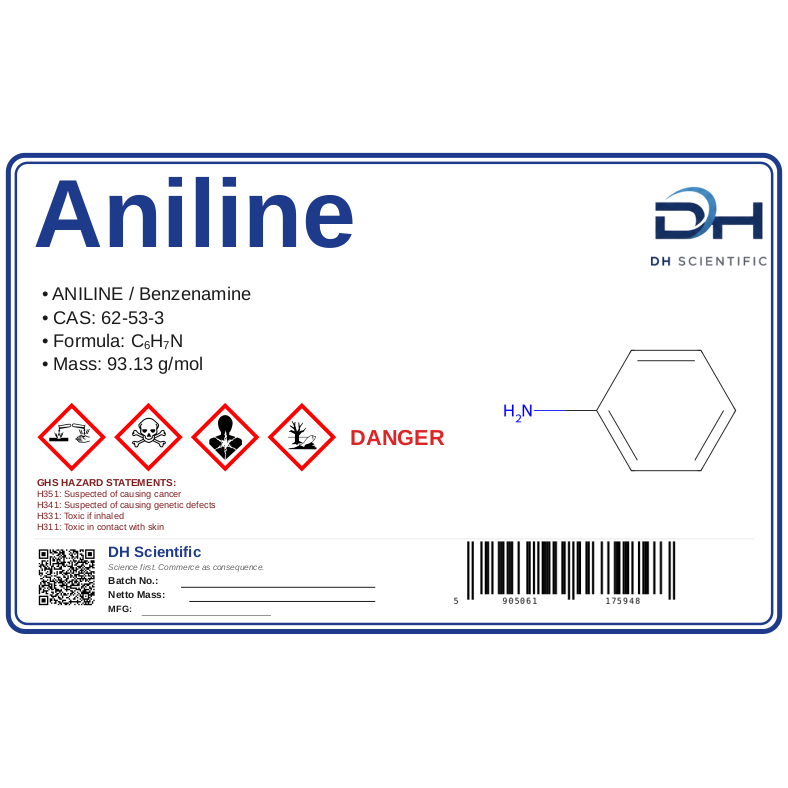
Aniline• ANILINE / Benzenamine• CAS: 62-53-3• Formula: C6H7N• Mass: 93.13 g/molDANGERGHS HAZARD STATEMENTS:H351 H341 H331 H311 H301 H372 H318 H317 H400P301+P310 P302+P352 P304+P340 P305+P351+P338 P308+P313 P333+P313 P362+P364 P310DH ScientificScience first. Commerce as consequence.Batch No.: Netto Mass: MFG:
🧪 Solution preparation assistant (Smart Prep) MolGod_PREP_2

Enter what you want to prepare — I'll generate an SOP

Examples below — click to insert:
Preset recipes:
📚 Scientific literature overview — CAS 62-53-3MolGod_LITHUB_MAIN
⭐ Key findings (scientific literature) 20 publications
🏆 CAS 62-53-3 — multi-criteria ranking (W12): 30% citations · 20% recency · 20% topic · 15% historical · 15% open access.
  1. #1
    Wenting Wu, Liming Zhang, Shu‐Li You (2016) · Chemical Society Reviews
    Why it matters: 757 citations · review · open access
    SCORE 12.69 Review Citations: 757 Open Access DOI ↗
  2. #2
    Hongyan Li, Lianxin Liu, Jianguo Cui et al. (2020) · RSC Advances
    Why it matters: 154 citations · open access
    SCORE 12.62 Mechanism Citations: 154 Open Access DOI ↗
  3. #3
    Tianwei He, Chunmei Zhang, Lei Zhang et al. (2019) · Nano Research
    Why it matters: 142 citations · open access
    SCORE 11.42 Mechanism Citations: 142 Open Access DOI ↗
  4. #4
    Hamideh Ahankar, Ali Ramazani, Katarzyna Ślepokura et al. (2016) · Green Chemistry
    Why it matters: 124 citations · open access
    SCORE 11.14 Mechanism Citations: 124 Open Access DOI ↗
  5. #5
    Irina Sapurina, M. A. Shishov (2012) · InTech eBooks
    Why it matters: 134 citations · open access
    SCORE 10.84 Mechanism Citations: 134 Open Access DOI ↗
  6. #6
    R. A. M. Case, M. E. Hosker, David B. McDonald et al. (1954) · Occupational and Environmental Medicine
    Why it matters: 419 citations · historical paper (1954) · open access
    SCORE 10.12 Historical Citations: 419 Open Access DOI ↗
  7. #7
    Tarn C. Johnson, Bryony L. Elbert, Alistair J. M. Farley et al. (2017) · Chemical Science
    Why it matters: Open access
    SCORE 9.96 Mechanism Citations: 73 Open Access DOI ↗
  8. #8
    Tomohiro Sugahara, Kei Murakami, Hideki Yorimitsu et al. (2014) · Angewandte Chemie International Edition
    Why it matters: 118 citations · open access
    SCORE 9.68 Mechanism Citations: 118 Open Access DOI ↗
  9. #9
    et al. (2026) · Materials
    Why it matters: Recent (2026) · open access
    SCORE 9.45 Mechanism Open Access DOI ↗ PubMed ↗
  10. #10
    D. V. Parke (1960) · Biochemical Journal
    Why it matters: 106 citations · historical paper (1960) · open access
    SCORE 9.14 Historical Citations: 106 Open Access DOI ↗
  11. #11
    Xiangchun Meng, Haiyang Cheng, Yoshinari Akiyama et al. (2009) · Journal of Catalysis
    Why it matters: 146 citations · open access
    SCORE 8.75 Mechanism Citations: 146 Open Access DOI ↗
  12. #12
    Jannis Wenk, Silvio Canonica (2012) · Environmental Science & Technology
    Why it matters: 222 citations
    SCORE 7.64 Mechanism Citations: 222 DOI ↗
  13. #13
    et al. (2026) · Nanomaterials
    Why it matters: Recent (2026) · open access
    SCORE 7.05 Industrial Open Access DOI ↗ PubMed ↗
  14. #14
    et al. (2026) · BMC Chemistry
    Why it matters: Recent (2026) · open access
    SCORE 7.05 Mechanism Open Access DOI ↗ PubMed ↗
  15. #15
    et al. (2025) · RSC Advances
    Why it matters: Recent (2025) · open access
    SCORE 7.05 Mechanism Open Access DOI ↗ PubMed ↗
  16. #16
    et al. (2025) · Scientific Reports
    Why it matters: Recent (2025) · open access
    SCORE 6.25 Mechanism Open Access DOI ↗ PubMed ↗
  17. #17
    et al. (2026) · Microorganisms
    Why it matters: Recent (2026) · open access
    SCORE 6.25 Mechanism Open Access DOI ↗ PubMed ↗
  18. #18
    Ali Y. Alzahrani; Dulail Nasir Hassan Algabary (2026) · ACS Omega
    Why it matters: Recent (2026) · open access
    SCORE 6.25 Mechanism Open Access DOI ↗ PubMed ↗
  19. #19
    Shi Y; Zhang K (2022) · Molecules (Basel, Switzerland)
    Why it matters: Must-cite (canon)
    SCORE 4.4 Analytics MUST-CITE DOI ↗
  20. #20
    Luana da Silva Magalhães Forezi (2011) · Revista Virtual de Química
    Why it matters: Open access
    SCORE 3.45 Mechanism Citations: 1 Open Access DOI ↗
📈 HPLC gradient — optimizer (LSS) TEMPLATE

Gradient based on PubChem XLogP3 + LSS (Snyder et al. 2010, ch. 9).

  • Column: C18
  • Buffer: phosphate
  • Flow: 1 mL/min
  • logP: 0.9 (PubChem XLogP3)
  • Ramp: 12% → 95% B, 10 min
  • Total analysis time: 23 min
t (min) %A %B flow (mL/min) Comment
0 88 12 1 start (equilibrium)
2 88 12 1 end of initial hold
12 5 95 1 end of LSS ramp
17 5 95 1 column wash
18 88 12 1 return to init
23 88 12 1 re-equilibration
📚 Scientific references (Chicago Author-Date)
  1. Snyder, Lloyd R., John W. Dolan, and Joseph J. Kirkland. 2010. Introduction to Modern Liquid Chromatography. Wiley. — Chapter 9 — gradient elution, LSS theory (cited as Snyder et al. 2010 in tool description).
  2. Schoenmakers, Peter J. 1986. Optimization of Chromatographic Selectivity: A Guide to Method Development. Elsevier. — Numerical optimization of gradient programs.
  3. Snyder, L. R., and J. W. Dolan. 2007. High-Performance Gradient Elution: The Practical Application of the Linear-Solvent-Strength Model. Wiley. — Foundational LSS reference for the %B_init = 5 + 8·logP heuristic implemented here.
  4. Nikitas, Pavlos, and Adrian Pappa-Louisi. 2009. "Retention models for isocratic and gradient elution in reversed-phase liquid chromatography." Journal of Chromatography A 1216: 1737-1755. [DOI ↗] — Modern review of gradient retention models — basis for non-LSS extensions.
  5. Carr, Peter W.. 2009. "The new physical chemistry of HPLC." Journal of Chromatography A 1216: 1764-1772. [DOI ↗]
  6. Dong, Michael W. 2019. HPLC and UHPLC for Practicing Scientists. Wiley. https://doi.org/10.1002/9781119313793. — Modern UHPLC gradient programming, sub-2 µm scaling rules.
  7. Wu, Naijun, and Anton M. Clausen. 2007. "Fundamental and practical aspects of ultrahigh pressure liquid chromatography for fast separations." Journal of Separation Science 30: 1167-1182. [DOI ↗]
  8. Stoll, Dwight R., and Peter W. Carr. 2017. "Two-Dimensional Liquid Chromatography: A State of the Art Tutorial." Analytical Chemistry 89: 519-531. [DOI ↗] — Reference for orthogonal gradient design (2D-LC second dimension).
  9. Dolan, John W.. 2013. "When to Modify Method Conditions." LCGC North America 31: 192-199.
  10. Meyer, Veronika R. 2010. Practical High-Performance Liquid Chromatography. Wiley. — Chapter 7 — practical gradient design with isokratyczny scouting.

REST: /wp-json/molgod/v1/hplc/gradient/62-53-3

🌈 Detector + wavelength (UV/Vis) 280 nm
CompoundAniline
λmax280 nm
λmin254 nm
εmax (M⁻¹·cm⁻¹)1 430
Solvent (reference)methanol
Suggested λ280 nm
Recommended detectorUV
AlternativesPDA/DAD, MS, FLD

Data source: Pavia 2014, ch. 5

📚 Scientific references (Chicago Author-Date) 29 refs · 2 baz

METODA Method Bibliography

  1. Skoog, Douglas A., F. James Holler, and Stanley R. Crouch. 2017. "Principles of Instrumental Analysis." 7th ed. Cengage Learning. ISBN 978-1-305-57721-3.
  2. Perkampus, Heinz-Helmut. 1992. "UV-VIS Spectroscopy and Its Applications." Springer. ISBN 978-3-642-77479-9.
  3. Sadek, Paul C.. 2002. "The HPLC Solvent Guide." 2nd ed. Wiley-Interscience. ISBN 978-0-471-41138-4.
  4. Snyder, Lloyd R., Joseph J. Kirkland, and John W. Dolan. 2010. "Introduction to Modern Liquid Chromatography." 3rd ed. Wiley. ISBN 978-0-470-16754-0.
  5. Dong, Michael W.. 2019. "HPLC and UHPLC for Practicing Scientists." 2nd ed. Wiley. ISBN 978-1-119-31378-3.
  6. Meyer, Veronika R.. 2010. "Practical High-Performance Liquid Chromatography." 5th ed. Wiley. ISBN 978-0-470-68218-0.
  7. Stoll, Dwight R., and Peter W. Carr. 2017. "Two-Dimensional Liquid Chromatography: A State of the Art Tutorial." Analytical Chemistry 89: 519-531
  8. Vivó-Truyols, Gabriel, and Hans-Gerd Janssen. 2010. "Probabilistic approach to peak deconvolution in chromatography." Analytical Chemistry 82: 8525-8531
  9. Kazakevich, Yuri V., and Rosario LoBrutto, eds.. 2007. "HPLC for Pharmaceutical Scientists." Wiley-Interscience. ISBN 978-0-471-68162-4.
  10. Kim, Sunghwan, et al.. 2023. "PubChem 2023 update." Nucleic Acids Research 51: D1373-D1380

MOLEKUŁA Per-CAS bibliography (live from 13+ databases)

Sources: db:Europe PMC (8) · db:openalex (12)

  1. db:Europe PMC et al.. (2026). "Regulating the Acidity and Pore Structure of Hβ Zeolite with Citric Acid Concentration for Optimized Aniline Condensation Catalysis.". https://doi.org/10.3390/ma19101993
  2. db:Europe PMC et al.. (2026). "Synthesis, biological evaluation, molecular docking, molecular dynamics simulation, and ADME studies of novel carbazole-aniline hybrids as cytotoxic agents.". https://doi.org/10.1186/s13065-026-01744-x
  3. db:Europe PMC et al.. (2026). "Construction of a Synthetic Aniline-Degrading Consortium Consisting of Pseudomonas sp. RF and Acidovorax sp. PH Guided by Soil Niche Information from Contaminated Sites.". https://doi.org/10.3390/microorganisms14030678
  4. db:Europe PMC et al.. (2026). "Aniline Electropolymerization on Indium-Tin Oxide Nanofilms with Different Surface Resistivity: A Comprehensive Study.". https://doi.org/10.3390/nano16030165
  5. db:Europe PMC (2026). "Elimination of Aniline from Aquatic Solution through Activated Carbon Prepared from Phoenix Dactylifera Kinetic and Thermodynamic Studies.". https://doi.org/10.1021/acsomega.5c06688
  6. db:Europe PMC et al.. (2025). "Optimization of photochemical decomposition of aniline in aqueous solutions and assessment of effluent toxicity using Pseudomonas aeruginosa ATCC 27853.". https://doi.org/10.1038/s41598-025-29156-2
  7. db:Europe PMC et al.. (2025). "Traditional and photocatalytic conversion of aniline into azocompounds - a comprehensive experimental and theoretical review.". https://doi.org/10.1039/d5ra03828f
  8. db:openalex Hongyan Li, Lianxin Liu, Jianguo Cui et al.. (2020). "High-efficiency adsorption and regeneration of methylene blue and aniline onto activated carbon from waste edible fungus residue and its possible mechanism". RSC Advances. https://doi.org/10.1039/d0ra01245a
  9. db:openalex Tianwei He, Chunmei Zhang, Lei Zhang et al.. (2019). "Single Pt atom decorated graphitic carbon nitride as an efficient photocatalyst for the hydrogenation of nitrobenzene into aniline". Nano Research. https://doi.org/10.1007/s12274-019-2439-z
  10. db:openalex Tarn C. Johnson, Bryony L. Elbert, Alistair J. M. Farley et al.. (2017). "Direct sulfonylation of anilines mediated by visible light". Chemical Science. https://doi.org/10.1039/c7sc03891g
  11. db:openalex Wenting Wu, Liming Zhang, Shu‐Li You. (2016). "Catalytic asymmetric dearomatization (CADA) reactions of phenol and aniline derivatives". Chemical Society Reviews. https://doi.org/10.1039/c5cs00356c
  12. db:openalex Hamideh Ahankar, Ali Ramazani, Katarzyna Ślepokura et al.. (2016). "Synthesis of pyrrolidinone derivatives from aniline, an aldehyde and diethyl acetylenedicarboxylate in an ethanolic citric acid solution under ultrasound irradiation". Green Chemistry. https://doi.org/10.1039/c6gc00157b
  13. db:openalex Tomohiro Sugahara, Kei Murakami, Hideki Yorimitsu et al.. (2014). "Palladium‐Catalyzed Amination of Aryl Sulfides with Anilines". Angewandte Chemie International Edition. https://doi.org/10.1002/anie.201404355
  14. db:openalex Irina Sapurina, M. A. Shishov. (2012). "Oxidative Polymerization of Aniline: Molecular Synthesis of Polyaniline and the Formation of Supramolecular Structures". InTech eBooks. https://doi.org/10.5772/48758
  15. db:openalex Jannis Wenk, Silvio Canonica. (2012). "Phenolic Antioxidants Inhibit the Triplet-Induced Transformation of Anilines and Sulfonamide Antibiotics in Aqueous Solution". Environmental Science & Technology. https://doi.org/10.1021/es300485u
  16. db:openalex Luana da Silva Magalhães Forezi. (2011). "Aniline (CAS No. 62-53-3)". Revista Virtual de Química. https://doi.org/10.5935/1984-6835.20110053
  17. db:openalex Xiangchun Meng, Haiyang Cheng, Yoshinari Akiyama et al.. (2009). "Selective hydrogenation of nitrobenzene to aniline in dense phase carbon dioxide over Ni/γ-Al2O3: Significance of molecular interactions". Journal of Catalysis. https://doi.org/10.1016/j.jcat.2009.03.008
  18. db:openalex D. V. Parke. (1960). "Studies in detoxication. 84. The metabolism of [14C]aniline in the rabbit and other animals". Biochemical Journal. https://doi.org/10.1042/bj0770493
  19. db:openalex R. A. M. Case, M. E. Hosker, David B. McDonald et al.. (1954). "Tumours Of The Urinary Bladder in Workmen Engaged in the Manufacture and Use Of Certain Dyestuff Intermediates In The British Chemical Industry. Part I. The Role Of Aniline, Benzidine, Alpha-Naphthylamine, And Beta-Naphthylamine". Occupational and Environmental Medicine. https://doi.org/10.1136/oem.11.2.75

REST: /wp-json/molgod/v1/hplc/detector/62-53-3

📐 HPLC peak symmetry calculator (USP Tf / As)

Calculate the USP tailing factor (Tf) and asymmetry (As) from the peak half-widths. Enter a (left half-width) and b (right half-width) measured at 5% or 10% of peak height.

📚 References (Chicago Author-Date)
  1. USP General Chapter <621>. 2024. "Chromatography." United States Pharmacopeial Convention. [link ↗] — Defines USP Tailing Factor T = (a+b)/(2a) measured at 5% peak height.
  2. International Council for Harmonisation (ICH). 2023. "Validation of Analytical Procedures Q2(R2)." ICH Expert Working Group. [link ↗] — Tailing factor is a system suitability parameter (Section 6).
  3. Foley, Joe P., and John G. Dorsey. 1983. "Equations for calculation of chromatographic figures of merit for ideal and skewed peaks." Analytical Chemistry 55: 730-737 https://doi.org/10.1021/ac00255a033 [link ↗] — Original asymmetry factor As = b/a at 10% height (Foley & Dorsey 1983).
  4. Snyder, Lloyd R., Joseph J. Kirkland, and John W. Dolan. 2010. "Introduction to Modern Liquid Chromatography." Wiley. https://doi.org/10.1002/9780470508183 [link ↗] — Chapter 2.4 — peak shape diagnostics and remedies.
  5. Dolan, John W.. 2003. "Peak tailing and resolution." LCGC North America 21: 610-614 [link ↗] — How tailing factor degrades effective resolution.
  6. Vivó-Truyols, Gabriel, and Hans-Gerd Janssen. 2010. "Probabilistic approach to peak deconvolution in chromatography." Analytical Chemistry 82: 8525-8531 https://doi.org/10.1021/ac101742z [link ↗] — Modern numerical deconvolution for asymmetric peaks.
  7. Kromidas, Stavros. 2017. "HPLC Made to Measure: A Practical Handbook for Optimization." Wiley-VCH. — Practical Tf and As thresholds for routine QC.
  8. Dong, Michael W.. 2019. "HPLC and UHPLC for Practicing Scientists." Wiley. https://doi.org/10.1002/9781119313793 [link ↗]
  9. Meyer, Veronika R.. 2010. "Practical High-Performance Liquid Chromatography." Wiley.
  10. Heyden, Yvan Vander, et al.. 2009. "Robustness of pharmaceutical liquid chromatographic methods." Journal of Chromatography B 877: 2120-2129 https://doi.org/10.1016/j.jchromb.2008.10.052 [link ↗]
📊 Resolution and plate count calculator (Rs, N, H)

Calculate the resolution Rs, the number of theoretical plates N and HETP (H) for a pair of HPLC peaks. Enter the retention times, peak widths (at 50% or at the base) and the column length.

📚 References (Chicago Author-Date)
  1. Snyder, Lloyd R., Joseph J. Kirkland, and John W. Dolan. 2010. "Introduction to Modern Liquid Chromatography." 3rd ed. John Wiley & Sons. ISBN 978-0-470-16754-0. https://doi.org/10.1002/9780470508183 [link ↗] — Chapter 2 covers resolution, plate count and HETP fundamentals (Snyder et al. 2010).
  2. USP General Chapter <621>. 2024. "Chromatography." USP-NF 2024 ed. United States Pharmacopeial Convention. [link ↗] — Defines Rs >= 1.5 acceptance criterion and N calculation methods.
  3. Dolan, John W.. 2003. "How much resolution is enough?." LCGC North America 21: 350-353 [link ↗] — Practical guidance on Rs targets for routine method development.
  4. Van Deemter, J. J., F. J. Zuiderweg, and A. Klinkenberg. 1956. "Longitudinal diffusion and resistance to mass transfer as causes of nonideality in chromatography." Chemical Engineering Science 5: 271-289 https://doi.org/10.1016/0009-2509(56)80003-1 [link ↗] — Origin of N = 5.54·(tr/w0.5)² half-height plate count formulation.
  5. Giddings, J. Calvin. 1965. "Dynamics of Chromatography, Part I: Principles and Theory." Marcel Dekker. ISBN 978-0-8247-1357-7. — Resolution equation Rs = (1/4)·√N·(α-1)/α·k/(1+k) (master equation).
  6. Foley, Joe P., and John G. Dorsey. 1983. "Equations for calculation of chromatographic figures of merit for ideal and skewed peaks." Analytical Chemistry 55: 730-737 https://doi.org/10.1021/ac00255a033 [link ↗] — Skewed-peak corrections to apparent N.
  7. Knox, John H.. 1977. "Practical aspects of LC theory." Journal of Chromatographic Science 15: 352-364 https://doi.org/10.1093/chromsci/15.9.352 [link ↗]
  8. Carr, Peter W.. 2009. "The new physical chemistry of HPLC." Journal of Chromatography A 1216: 1764-1772 https://doi.org/10.1016/j.chroma.2008.11.094 [link ↗]
  9. Dong, Michael W.. 2019. "HPLC and UHPLC for Practicing Scientists." 2nd ed. Wiley. ISBN 978-1-119-31378-3. https://doi.org/10.1002/9781119313793 [link ↗]
  10. Meyer, Veronika R.. 2010. "Practical High-Performance Liquid Chromatography." 5th ed. Wiley. ISBN 978-0-470-68218-0.
🧪 System Suitability — live calculator (USP <621>)

Enter data from 5–6 injections (areas, tR, tailing, plates) — the calculator computes %RSD and means and checks compliance with USP <621>. You can paste CSV (comma-separated) or edit individual values.

📚 References (Chicago Author-Date)
  1. USP General Chapter <621>. 2024. "Chromatography (System Suitability section)." USP-NF 2024 ed. United States Pharmacopeial Convention. [link ↗] — Defines RSD area < 2%, tailing < 2.0, N > 2000 acceptance criteria.
  2. International Council for Harmonisation (ICH). 2023. "Validation of Analytical Procedures Q2(R2)." ICH Expert Working Group. [link ↗] — Section 5.4 — system suitability is part of method validation.
  3. US Food and Drug Administration (FDA). 2018. "Reviewer Guidance: Validation of Chromatographic Methods." US Food and Drug Administration. [link ↗] — CDER reviewer perspective on chromatographic validation expectations.
  4. Snyder, Lloyd R., Joseph J. Kirkland, and John W. Dolan. 2010. "Introduction to Modern Liquid Chromatography." 3rd ed. Wiley. — Chapter 2 — system suitability fundamentals (RSD, Tf, N).
  5. Heyden, Yvan Vander, et al.. 2009. "Robustness of pharmaceutical liquid chromatographic methods." — Robustness vs. system suitability — design-of-experiments framework.
  6. Rozet, Eric, et al.. 2013. "Analysis of recent pharmaceutical regulatory documents on analytical method validation."
  7. European Medicines Agency (EMA). 2011. "Guideline on bioanalytical method validation EMEA/CHMP/EWP/192217/2009." EMA. [link ↗] — EMA companion guideline with bioanalytical SS criteria.
  8. Dong, Michael W.. 2019. "HPLC and UHPLC for Practicing Scientists." 2nd ed. Wiley. — UHPLC-specific suitability adjustments (n=5 vs. n=6).
  9. Kazakevich, Yuri V., and Rosario LoBrutto, eds.. 2007. "HPLC for Pharmaceutical Scientists." Wiley-Interscience.
  10. AOAC International. 2016. "Appendix F: Guidelines for Standard Method Performance Requirements." AOAC INTERNATIONAL. [link ↗] — Alternative SS thresholds for food/dietary samples.
⚗️ Jonizacja w funkcji pH (Henderson-Hasselbalch)MolGod_PHION_1

Typ: Zasada · pKa: 4.62

024681012140%50%100%% zjonizowany% niejonowypH
pH% jonowy% niejonowy
0100.0 %0.0 %
299.8 %0.2 %
480.7 %19.3 %
64.0 %96.0 %
80.0 %100.0 %
100.0 %100.0 %
120.0 %100.0 %
140.0 %100.0 %
Źródła dla tej substancji (7)
  • CRC Handbook 91st ed.
    Lide, David R., ed. 2010. CRC Handbook of Chemistry and Physics. 91st ed. Boca Raton, FL: CRC Press.
  • CRC Handbook 105th ed.
    Rumble, John R., Thomas J. Bruno, Maria J. Doa, and Donald R. Burgess, eds. 2024. CRC Handbook of Chemistry and Physics. 105th ed. Boca Raton, FL: CRC Press.
  • NIST WebBooklink
    Linstrom, Peter J., and William G. Mallard, eds. 2024. NIST Chemistry WebBook. NIST Standard Reference Database Number 69. Gaithersburg, MD: National Institute of Standards and Technology.
  • PubChem CID 6115link
    Kim, Sunghwan, Jie Chen, Tiejun Cheng, Asta Gindulyte, Jia He, Siqian He, Qingliang Li, et al. 2023. "PubChem 2023 update." Nucleic Acids Research 51 (D1): D1373-D1380. PubChem CID 6115.
  • ChEMBL CHEMBL538link
    Zdrazil, Barbara, Eloy Felix, Fiona Hunter, Emma J. Manners, James Blackshaw, Sybilla Corbett, Marleen de Veij, et al. 2024. "The ChEMBL Database in 2023." Nucleic Acids Research 52 (D1): D1180-D1192. ChEMBL ID CHEMBL538.
  • IUPAC
    Perrin, Douglas D. 1965. Dissociation Constants of Organic Bases in Aqueous Solution. IUPAC. London: Butterworths.
  • NIST
    Goldberg, Robert N., Nand Kishore, and Rebecca Lennen. 2002. "Thermodynamic Quantities for the Ionization Reactions of Buffers." Journal of Physical and Chemical Reference Data 31 (2): 231-370.
Bibliografia metody (Chicago)
  • Henderson, L. J. 1908. "Concerning the Relationship between the Strength of Acids and Their Capacity to Preserve Neutrality." American Journal of Physiology 21 (4): 173-179.
  • Hasselbalch, K. A. 1917. "Die Berechnung der Wasserstoffzahl des Blutes aus der freien und gebundenen Kohlensäure desselben." Biochemische Zeitschrift 78: 112-144.
  • Po, Henry N., and N. M. Senozan. 2001. "The Henderson-Hasselbalch Equation: Its History and Limitations." Journal of Chemical Education 78 (11): 1499-1503.
  • Avdeef, Alex. 2012. "Absorption and Drug Development: Solubility, Permeability, and Charge State." 2nd ed. Wiley.
  • Avdeef, Alex. 2007. "Solubility of sparingly-soluble ionizable drugs." Advanced Drug Delivery Reviews 59 (7): 568-590.
  • Volgyi, Gergely, et al. 2007. "Potentiometric and spectrophotometric pKa determination of water-insoluble compounds." Analytica Chimica Acta 583 (2): 418-428.
  • Fini, Adamo, Giuseppe Fazio, and Giuseppina Feroci. 1997. "Solubility and solubilization properties of non-steroidal anti-inflammatory drugs." Pharmaceutica Acta Helvetiae 70 (4): 305-318.
  • Mauger, John W., Anthony N. Paruta, and Robert J. Gerraughty. 1972. "Solubilities of sulfadiazine, sulfisomidine, and sulfadimethoxine." Journal of Pharmaceutical Sciences 61 (1): 94-97.
  • Lyman, Warren J., William F. Reehl, and David H. Rosenblatt. 1990. "Handbook of Chemical Property Estimation Methods." American Chemical Society.
  • Marcus, Yizhak. 1998. "The Properties of Solvents." Wiley.
  • Serjeant, E. P., and Boyd Dempsey. 1979. Ionisation Constants of Organic Acids in Aqueous Solution. IUPAC Chemical Data Series No. 23. Oxford: Pergamon Press.
  • Perrin, Douglas D. 1965. Dissociation Constants of Organic Bases in Aqueous Solution. IUPAC. London: Butterworths.
  • Goldberg, Robert N., Nand Kishore, and Rebecca Lennen. 2002. "Thermodynamic Quantities for the Ionization Reactions of Buffers." Journal of Physical and Chemical Reference Data 31 (2): 231-370.
  • Rumble, John R., Thomas J. Bruno, Maria J. Doa, and Donald R. Burgess, eds. 2024. CRC Handbook of Chemistry and Physics. 105th ed. Boca Raton, FL: CRC Press.
  • Lide, David R., ed. 2010. CRC Handbook of Chemistry and Physics. 91st ed. Boca Raton, FL: CRC Press.
  • Kim, Sunghwan, Jie Chen, Tiejun Cheng, Asta Gindulyte, Jia He, Siqian He, Qingliang Li, et al. 2023. "PubChem 2023 update." Nucleic Acids Research 51 (D1): D1373-D1380.
  • Knox, Craig, Mike Wilson, Christen M. Klinger, Mark Franklin, Eponine Oler, Alex Wilson, Allison Pon, et al. 2024. "DrugBank 6.0: the DrugBank Knowledgebase for 2024." Nucleic Acids Research 52 (D1): D1265-D1275.
  • Zdrazil, Barbara, Eloy Felix, Fiona Hunter, Emma J. Manners, James Blackshaw, Sybilla Corbett, Marleen de Veij, et al. 2024. "The ChEMBL Database in 2023." Nucleic Acids Research 52 (D1): D1180-D1192.
  • Kanehisa, Minoru, Miho Furumichi, Yoko Sato, Masayuki Kawashima, and Mari Ishiguro-Watanabe. 2023. "KEGG for taxonomy-based analysis of pathways and genomes." Nucleic Acids Research 51 (D1): D587-D592.
  • Linstrom, Peter J., and William G. Mallard, eds. 2024. NIST Chemistry WebBook. NIST Standard Reference Database Number 69. Gaithersburg, MD: National Institute of Standards and Technology.
  • Nelson, David L., and Michael M. Cox. 2017. Lehninger Principles of Biochemistry. 7th ed. New York: W. H. Freeman.
📈 UV-VIS spectrum predictor (200-400 nm) λmax 280 nm MolGod_UVVIS_1
0%25%50%75%100%200250300350400280 nmA = ε·c·lA / Aₘₐₓ (%)
CompoundAniline
λmax280 nm
λmin254 nm
εmax (M⁻¹·cm⁻¹)1 430
Solvent (query)water
Solvent (reference)methanol
Concentration (M)1e-4
Path length (cm)1
Curve FWHM52 nm

Model: Gaussian curve centered at λmax, scaled with the Beer-Lambert law A = ε · c · l. Transmittance T = 10^(-A) · 100%.

📚 Scientific references (Chicago Author-Date)
  1. Anonymous. "Automotive fuels - Information on aniline, N-methyl aniline, N-ethyl aniline, N,N di-methyl aniline and secondary-butyl acetate when used as blending components in unleaded petrol.". https://doi.org/10.3403/30406948u. [DOI]
  2. Anonymous. "Automotive fuels - Information on aniline, N-methyl aniline, N-ethyl aniline, N,N di-methyl aniline and secondary-butyl acetate when used as blending components in unleaded petrol.". https://doi.org/10.3403/30406948. [DOI]
  3. Anonymous. "From Neutral Aniline to Aniline Trication: A Computational and Experimental Study.". https://doi.org/10.1021/acs.jpca.0c00686.s001. [DOI]
  4. Anonymous. "Electrochemically Modulated Permeability of Poly(Aniline) and Composite Poly(Aniline)-Poly(Styrenesulfonate) Membranes.". https://doi.org/10.1021/la060255b.s001. [DOI]
  5. Anonymous. "Aniline.". https://doi.org/10.31003/uspnf_r1662_01_01. [DOI]
  6. et al.. (2026). "Regulating the Acidity and Pore Structure of Hβ Zeolite with Citric Acid Concentration for Optimized Aniline Condensation Catalysis.". https://doi.org/10.3390/ma19101993 [DOI]
  7. et al.. (2026). "Synthesis, biological evaluation, molecular docking, molecular dynamics simulation, and ADME studies of novel carbazole-aniline hybrids as cytotoxic agents.". https://doi.org/10.1186/s13065-026-01744-x [DOI]
  8. et al.. (2026). "Construction of a Synthetic Aniline-Degrading Consortium Consisting of Pseudomonas sp. RF and Acidovorax sp. PH Guided by Soil Niche Information from Contaminated Sites.". https://doi.org/10.3390/microorganisms14030678 [DOI]
  9. et al.. (2026). "Aniline Electropolymerization on Indium-Tin Oxide Nanofilms with Different Surface Resistivity: A Comprehensive Study.". https://doi.org/10.3390/nano16030165 [DOI]
  10. (2026). "Elimination of Aniline from Aquatic Solution through Activated Carbon Prepared from Phoenix Dactylifera Kinetic and Thermodynamic Studies.". https://doi.org/10.1021/acsomega.5c06688 [DOI]
  11. et al.. (2025). "Optimization of photochemical decomposition of aniline in aqueous solutions and assessment of effluent toxicity using Pseudomonas aeruginosa ATCC 27853.". https://doi.org/10.1038/s41598-025-29156-2 [DOI]
  12. et al.. (2025). "Traditional and photocatalytic conversion of aniline into azocompounds - a comprehensive experimental and theoretical review.". https://doi.org/10.1039/d5ra03828f [DOI]
  13. Hongyan Li, Lianxin Liu, Jianguo Cui et al.. (2020). "High-efficiency adsorption and regeneration of methylene blue and aniline onto activated carbon from waste edible fungus residue and its possible mechanism". RSC Advances. https://doi.org/10.1039/d0ra01245a [DOI]
  14. Tianwei He, Chunmei Zhang, Lei Zhang et al.. (2019). "Single Pt atom decorated graphitic carbon nitride as an efficient photocatalyst for the hydrogenation of nitrobenzene into aniline". Nano Research. https://doi.org/10.1007/s12274-019-2439-z [DOI]
  15. Tarn C. Johnson, Bryony L. Elbert, Alistair J. M. Farley et al.. (2017). "Direct sulfonylation of anilines mediated by visible light". Chemical Science. https://doi.org/10.1039/c7sc03891g [DOI]
  16. Wenting Wu, Liming Zhang, Shu‐Li You. (2016). "Catalytic asymmetric dearomatization (CADA) reactions of phenol and aniline derivatives". Chemical Society Reviews. https://doi.org/10.1039/c5cs00356c [DOI]
  17. Hamideh Ahankar, Ali Ramazani, Katarzyna Ślepokura et al.. (2016). "Synthesis of pyrrolidinone derivatives from aniline, an aldehyde and diethyl acetylenedicarboxylate in an ethanolic citric acid solution under ultrasound irradiation". Green Chemistry. https://doi.org/10.1039/c6gc00157b [DOI]
  18. Tomohiro Sugahara, Kei Murakami, Hideki Yorimitsu et al.. (2014). "Palladium‐Catalyzed Amination of Aryl Sulfides with Anilines". Angewandte Chemie International Edition. https://doi.org/10.1002/anie.201404355 [DOI]
  19. Irina Sapurina, M. A. Shishov. (2012). "Oxidative Polymerization of Aniline: Molecular Synthesis of Polyaniline and the Formation of Supramolecular Structures". InTech eBooks. https://doi.org/10.5772/48758 [DOI]
  20. Jannis Wenk, Silvio Canonica. (2012). "Phenolic Antioxidants Inhibit the Triplet-Induced Transformation of Anilines and Sulfonamide Antibiotics in Aqueous Solution". Environmental Science & Technology. https://doi.org/10.1021/es300485u [DOI]
  21. Luana da Silva Magalhães Forezi. (2011). "Aniline (CAS No. 62-53-3)". Revista Virtual de Química. https://doi.org/10.5935/1984-6835.20110053 [DOI]
  22. Xiangchun Meng, Haiyang Cheng, Yoshinari Akiyama et al.. (2009). "Selective hydrogenation of nitrobenzene to aniline in dense phase carbon dioxide over Ni/γ-Al2O3: Significance of molecular interactions". Journal of Catalysis. https://doi.org/10.1016/j.jcat.2009.03.008 [DOI]
  23. D. V. Parke. (1960). "Studies in detoxication. 84. The metabolism of [14C]aniline in the rabbit and other animals". Biochemical Journal. https://doi.org/10.1042/bj0770493 [DOI]
  24. R. A. M. Case, M. E. Hosker, David B. McDonald et al.. (1954). "Tumours Of The Urinary Bladder in Workmen Engaged in the Manufacture and Use Of Certain Dyestuff Intermediates In The British Chemical Industry. Part I. The Role Of Aniline, Benzidine, Alpha-Naphthylamine, And Beta-Naphthylamine". Occupational and Environmental Medicine. https://doi.org/10.1136/oem.11.2.75 [DOI]
  25. Linstrom, Peter J., and William G. Mallard, eds. 2023. NIST Chemistry WebBook, NIST Standard Reference Database Number 69. Gaithersburg, MD: National Institute of Standards and Technology. [DOI]
  26. Mayerhöfer, Thomas G., Samir Pahlow, and Jürgen Popp. 2020. "The Bouguer-Beer-Lambert Law: Shining Light on the Obscure." ChemPhysChem 21 (18): 2029-2046. [DOI]
  27. Skoog, Douglas A., F. James Holler, and Stanley R. Crouch. 2017. Principles of Instrumental Analysis. 7th ed. Boston: Cengage Learning. ISBN 978-1-305-57721-3.
  28. Lindon, John C., George E. Tranter, and David W. Koppenaal, eds. 2017. "Encyclopedia of Spectroscopy and Spectrometry." 3rd ed. Amsterdam: Academic Press. ISBN 978-0-12-803224-4.
  29. Field, Leslie D., Sev Sternhell, and John R. Kalman. 2013. "Organic Structures from Spectra." 5th ed. Chichester: Wiley. ISBN 978-1-119-96582-6.
  30. Reusch, William. 2013. "Virtual Textbook of Organic Chemistry: Spectroscopy." East Lansing, MI: Michigan State University.
  31. Lampman, Gary M., Donald L. Pavia, George S. Kriz, and James R. Vyvyan. 2010. "Spectroscopy." 4th ed. Belmont, CA: Cengage Learning. ISBN 978-0-495-88992-9.
  32. Kalsi, P. S. 2010. "Spectroscopy of Organic Compounds." 6th ed. New Delhi: New Age International. ISBN 978-81-224-2032-9.
  33. Williams, Dudley H., and Ian Fleming. 2008. "Spectroscopic Methods in Organic Chemistry." 6th ed. London: McGraw-Hill. ISBN 978-0-07-711559-0.
  34. Sadek, Paul C. 2002. The HPLC Solvent Guide. 2nd ed. Hoboken: Wiley. ISBN 978-0-471-41242-2.
  35. Banwell, Colin N., and Elaine M. McCash. 1994. "Fundamentals of Molecular Spectroscopy." 4th ed. London: McGraw-Hill. ISBN 978-0-07-707976-1.
  36. Perkampus, Heinz-Helmut. 1992. UV-VIS Spectroscopy and Its Applications. Berlin: Springer. https://doi.org/10.1007/978-3-642-77479-9.
  37. Fieser, Louis F. 1949. "Extension of Woodward's Rules for Prediction of Conjugated Diene Absorption." Journal of the American Chemical Society 71 (5): 1854-1857. [DOI]
  38. Woodward, Robert B. 1942. "Structure and the Absorption Spectra of Alpha,Beta-Unsaturated Ketones." Journal of the American Chemical Society 64 (1): 72-75. [DOI]
  39. Beer, August. 1852. "Bestimmung der Absorption des rothen Lichts in farbigen Flüssigkeiten." Annalen der Physik und Chemie 86: 78-88. https://doi.org/10.1002/andp.18521620505.
  40. Lambert, Johann Heinrich. 1760. Photometria. Augsburg: Sumptibus Vidae.

📖 Wartość λmax = 280 nm pochodzi z bazy/literatury. Brak niezależnego potwierdzenia krzyżowego (NIST / CrossRef / PubChem) — weryfikacja krzyżowa niedostępna.

REST: /wp-json/molgod/v1/spectra/uv-vis/62-53-3?solvent=water&path_length_cm=1

☣️ Toxicity (LD50 / LC50) GHS Cat 3 — ModerateMolGod_LD50_1
LD50
250 mg/kg[1][2]
Gatunek / droga
Rat / doustnie
Klasyfikacja
Moderately toxic[3][4]
Skala GHS (Acute Toxicity, oral, mg/kg bw):
Cat 1 (≤5)
Cat 2 (5–50)
Cat 3 (50–300)
Cat 4 (300–2000)
Cat 5 (2000–5000)

Source: RTECS BW6650000; Klaassen 2018; ATSDR Aniline 2024 (2024). CAS 62-53-3.

LD50/LC50 data are for guidance only; they do not replace the safety data sheet (SDS) or expert toxicological assessment. GHS classification for the oral route (mg/kg bw) per UN GHS, 10th rev. 2023, Annex 1 §3.1.1.

Bibliography (Chicago)
  1. NIOSH. Registry of Toxic Effects of Chemical Substances (RTECS). Cincinnati: NIOSH.
  2. Agency for Toxic Substances and Disease Registry (ATSDR). Medical Management Guidelines / Toxicological Profile. Atlanta, GA: U.S. Department of Health and Human Services.
  3. United Nations. 2023. "Globally Harmonized System of Classification and Labelling of Chemicals (GHS)." 10th rev. ed. New York: UN.
  4. Hodge, Harold C., and James H. Sterner. 1949. "Tabulation of toxicity classes." American Industrial Hygiene Association Quarterly 10 (4): 93-96.
Dalsze źródła (metodyka, nie cytowane bezpośrednio):
  • U.S. EPA. 2024. "ChemView." https://chemview.epa.gov/.
  • Lipnick, Robert L., et al. 1995. "Comparison of the up-and-down, conventional LD50, and fixed-dose acute toxicity procedures." Food and Chemical Toxicology 33 (3): 223-231.
  • ATSDR. 2024. "Toxicological Profiles." Agency for Toxic Substances and Disease Registry. https://www.atsdr.cdc.gov/.
  • Hayes, Wallace, and Claire L. Kruger, eds. 2014. "Hayes' Principles and Methods of Toxicology." 6th ed. CRC Press.
  • Lewis, Richard J. 2012. "Sax's Dangerous Properties of Industrial Materials." 12th ed. Wiley.
  • IARC. 2024. "Monographs on the Evaluation of Carcinogenic Risks to Humans." International Agency for Research on Cancer (per kryteria klasyfikacji rakotwórczości IARC Group 1/2A/2B).
  • Pohanish, Richard P. 2017. "Sittig's Handbook of Toxic and Hazardous Chemicals and Carcinogens." 7th ed. Elsevier.
  • Bingham, Eula, Barbara Cohrssen, and Charles H. Powell, eds. 2012. "Patty's Toxicology." 6th ed. Wiley.
  • WHO. 2023. "Recommended Classification of Pesticides by Hazard." World Health Organization (zgodne z UN GHS Annex 1 §3.1.1).
📤 Embed this molecule on your site

Have a blog, forum or scientific service? Embed the interactive 3D molecule on your website — every reader will see it, with a link below to our shop where they can buy the reagent.

🔗 HTML iframe code (easiest — works everywhere)

Copy and paste into your site's HTML editor:

Adjust width and height to your layout.

⚙ WordPress Shortcode (for other shops with MOL-GOD)

🌐 Direct link (for emails, chats, LinkedIn, Twitter)

LinkedIn Twitter/X Facebook
QR code CAS 62-53-3

📱 QR code (for printing on flyers / labels / catalogs)

Place it in a product catalog, on a bottle label or a flyer. The customer scans it — sees the 3D molecule on their phone, with a link to your shop.

⬇ Download PNG

🖼 Open Graph image (for social media meta tags)

When you share the link, Facebook/LinkedIn/Discord will automatically fetch the image preview:

Preview
📋 License: The embed keeps a backlink to DH Scientific (required — the shop is the data source). Chemical data comes from PubChem (CC0 — public domain). The embed is FREE for educational, commercial and hobby use.
📚 REFERENCES (Aggregate bibliography, Chicago Author-Date) 129 items

All scientific sources cited in the accordions above for CAS 62-53-3. Format: Chicago Manual of Style 17th ed., Author-Date system.

🗄️ Scientific databases

  1. NIST. n.d. NIST Chemistry WebBook: CAS 62-53-3. Gaithersburg, MD: National Institute of Standards and Technology. https://webbook.nist.gov/cgi/cbook.cgi?ID=62-53-3.
  2. AIST. n.d. Spectral Database for Organic Compounds (SDBS): CAS 62-53-3. Tsukuba, Japan: National Institute of Advanced Industrial Science and Technology. https://sdbs.db.aist.go.jp/.
  3. Linstrom, Peter J., and William G. Mallard, eds. n.d. NIST Chemistry WebBook: NIST Standard Reference Database Number 69. Gaithersburg, MD: National Institute of Standards and Technology. https://doi.org/10.18434/T4D303.
  4. PubChem. n.d. PubChem Compound Summary: CAS 62-53-3. Bethesda, MD: National Center for Biotechnology Information (NCBI), National Library of Medicine. https://pubchem.ncbi.nlm.nih.gov/#query=62-53-3.
  5. U.S. EPA. n.d. CompTox Chemicals Dashboard: CAS 62-53-3. Research Triangle Park, NC: U.S. Environmental Protection Agency. https://comptox.epa.gov/dashboard/chemical/details/DTXSID8020090.

📐 Standards / Guidelines

  1. ICH. 2003. "Stability Testing of New Drug Substances and Products: Q1A(R2)." Geneva: International Council for Harmonisation of Technical Requirements for Pharmaceuticals for Human Use. https://database.ich.org/sites/default/files/Q1A%28R2%29%20Guideline.pdf.
  2. National Fire Protection Association (NFPA). 2024. "NFPA 30: Flammable and Combustible Liquids Code." NFPA, Quincy, MA. https://www.nfpa.org/codes-and-standards/all-codes-and-standards/list-of-codes-and-standards/detail?code=30.
  3. Occupational Safety and Health Administration (OSHA). 2023. "29 CFR 1910.106 — Flammable Liquids." U.S. Department of Labor, Federal Register. https://www.osha.gov/laws-regs/regulations/standardnumber/1910/1910.106.
  4. European Chemicals Agency (ECHA). 2024. "Annex VI to Regulation (EC) No 1272/2008 (CLP) — Harmonised Classification and Labelling." ECHA, Helsinki / Official Journal of the European Union. https://echa.europa.eu/regulations/clp/clp-classification.
  5. European Committee for Standardization (CEN). 2016. "EN 374-1:2016 — Protective gloves against dangerous chemicals and micro-organisms — Part 1: Terminology and performance requirements for chemical risks." CEN, Brussels. https://standards.cencenelec.eu/dyn/www/f?p=205:110:::::FSP_PROJECT,FSP_ORG_ID:38536,6080&cs=1B0DAA8B85DF42E4A2C70E5D71F0BFA32.
  6. European Committee for Standardization (CEN). 2001. "EN 166:2001 — Personal eye-protection — Specifications." CEN, Brussels. https://standards.cencenelec.eu/dyn/www/f?p=CEN:110:0::::FSP_PROJECT:6541&cs=1F1A4E0A78C4DB6A28DBE2E8C29D89DCF.
  7. European Committee for Standardization (CEN). 2009. "EN 14605:2005+A1:2009 — Protective clothing against liquid chemicals — Performance requirements for clothing with liquid-tight (Type 3) or spray-tight (Type 4) connections." CEN, Brussels. https://standards.cencenelec.eu/dyn/www/f?p=CEN:110:0::::FSP_PROJECT:21581&cs=1A04A2D3C7CC58E9E6CB58D55F7EBFB7E.
  8. National Institute for Occupational Safety and Health (NIOSH). 2017. "Recommendations for Chemical Protective Clothing: A Companion to the NIOSH Pocket Guide." U.S. Department of Health & Human Services / CDC. https://www.cdc.gov/niosh/ncpc/default.html.
  9. Occupational Safety and Health Administration (OSHA). 2011. "Personal Protective Equipment — General requirements." U.S. Department of Labor — 29 CFR 1910.132. https://www.osha.gov/laws-regs/regulations/standardnumber/1910/1910.132.

📖 Books

  1. Rumble, John R., ed. 2024. CRC Handbook of Chemistry and Physics: 105th Edition. Boca Raton, FL: CRC Press. https://hbcp.chemnetbase.com/.
  2. Hansen, Charles M. 2007. Hansen Solubility Parameters: A User's Handbook, 2nd ed.. Boca Raton, FL: CRC Press. https://www.routledge.com/Hansen-Solubility-Parameters-A-Users-Handbook/Hansen/p/book/9780849372483.
  3. Barton, Allan F. M. 1991. CRC Handbook of Solubility Parameters and Other Cohesion Parameters: 2nd ed.. Boca Raton, FL: CRC Press. https://www.routledge.com/CRC-Handbook-of-Solubility-Parameters-and-Other-Cohesion-Parameters/Barton/p/book/9780849301766.
  4. Connors, Kenneth A., Gordon L. Amidon, and Valentino J. Stella. 1986. Chemical Stability of Pharmaceuticals: A Handbook for Pharmacists, 2nd ed.. New York: Wiley. https://doi.org/10.1002/0471734683.
  5. Rumble, John R., ed. 2019. CRC Handbook of Chemistry and Physics: 100th Edition. Boca Raton, FL: CRC Press. https://hbcp.chemnetbase.com/.
  6. Urben, Peter G. 2017. Bretherick's Handbook of Reactive Chemical Hazards, 8th Edition. Academic Press / Elsevier, Oxford. https://www.sciencedirect.com/book/9780081010594.

📘 Monographs

  1. IARC. n.d. IARC Monographs on the Identification of Carcinogenic Hazards to Humans: CAS 62-53-3. Lyon, France: International Agency for Research on Cancer, World Health Organization. https://monographs.iarc.who.int/list-of-classifications/.

📄 Scientific articles (peer-reviewed)

  1. Stefanis, Emmanuel, and Costas Panayiotou. 2008. "Prediction of Hansen Solubility Parameters with a New Group-Contribution Method." International Journal of Thermophysics 29: 568-585. https://doi.org/10.1007/s10765-008-0415-z.
  2. Stoll, Vincent S., and John S. Blanchard. 1990. "Buffers: Principles and Practice: In Methods in Enzymology, vol. 182." San Diego: Academic Press. https://doi.org/10.1016/0076-6879(90)82008-P.

🌐 Websites

  1. ECHA. 2023. "Guidance on the Application of the CLP Criteria." European Chemicals Agency. https://echa.europa.eu/guidance-documents/guidance-on-clp.
  2. European Parliament. 2006. "Regulation (EC) No 1907/2006 (REACH)." Official Journal of the European Union L 396: 1–849.
  3. ECHA. 2023. "Candidate List of Substances of Very High Concern for Authorisation." European Chemicals Agency. https://echa.europa.eu/candidate-list-table.
  4. European Parliament. 2008. "Regulation (EC) No 1272/2008 on Classification, Labelling and Packaging of Substances and Mixtures (CLP)." Official Journal of the European Union L 353: 1–1355.
  5. ECHA. 2017. "Guidance on the Compilation of Safety Data Sheets." Version 3.1. European Chemicals Agency. ECHA-17-G-01-EN. https://echa.europa.eu/documents/10162/23047722/sds_en.pdf.
  6. ECHA. 2022. "Restrictions Under REACH — Annex XVII." European Chemicals Agency. https://echa.europa.eu/substances-restricted-under-reach.
  7. United Nations. 2021. Globally Harmonized System of Classification and Labelling of Chemicals (GHS). 9th revised ed. ST/SG/AC.10/30/Rev.9. New York and Geneva: United Nations. https://unece.org/ghs-rev9-2021.
  8. ECHA. 2020. "Understanding REACH." European Chemicals Agency. https://echa.europa.eu/regulations/reach/understanding-reach.
  9. ECHA — Zalacznik VI do CLP (klasyfikacja zharmonizowana, ATP 23; 2026-07-07) https://echa.europa.eu/information-on-chemicals/annex-vi-to-clp.
  10. U.S. Occupational Safety and Health Administration (2024) — 29 CFR 1910.120 — Hazardous Waste Operations and Emergency Response (HAZWOPER) https://www.osha.gov/hazwoper.
  11. National Fire Protection Association (2018) — NFPA 472: Standard for Competence of Responders to Hazardous Materials/Weapons of Mass Destruction Incidents https://www.nfpa.org/codes-and-standards/nfpa-472.
  12. European Parliament and Council (2012) — Directive 2012/18/EU on the Control of Major-Accident Hazards Involving Dangerous Substances (Seveso III) https://eur-lex.europa.eu/legal-content/EN/TXT/?uri=celex:32012L0018.
  13. U.S. National Institute for Occupational Safety and Health (2024) — NIOSH Pocket Guide to Chemical Hazards https://www.cdc.gov/niosh/npg/.
  14. European Chemicals Agency (2020) — Guidance on the Compilation of Safety Data Sheets (SDS), Version 3.1 https://echa.europa.eu/documents/10162/23047722/sds_en.pdf.
  15. Snyder, Lloyd R., John W. Dolan, and Joseph J. Kirkland. 2010. Introduction to Modern Liquid Chromatography. Wiley.
  16. Schoenmakers, Peter J.. 1986. Optimization of Chromatographic Selectivity: A Guide to Method Development. Elsevier.
  17. Snyder, L. R., and J. W. Dolan. 2007. High-Performance Gradient Elution: The Practical Application of the Linear-Solvent-Strength Model. Wiley.
  18. Nikitas, Pavlos, and Adrian Pappa-Louisi. 2009. "Retention models for isocratic and gradient elution in reversed-phase liquid chromatography." Journal of Chromatography A 1216: 1737-1755. https://doi.org/10.1016/j.chroma.2008.10.005.
  19. Carr, Peter W.. 2009. "The new physical chemistry of HPLC." Journal of Chromatography A 1216: 1764-1772. https://doi.org/10.1016/j.chroma.2008.11.094.
  20. Dong, Michael W.. 2019. HPLC and UHPLC for Practicing Scientists. Wiley. https://doi.org/10.1002/9781119313793.
  21. Wu, Naijun, and Anton M. Clausen. 2007. "Fundamental and practical aspects of ultrahigh pressure liquid chromatography for fast separations." Journal of Separation Science 30: 1167-1182. https://doi.org/10.1002/jssc.200700026.
  22. Stoll, Dwight R., and Peter W. Carr. 2017. "Two-Dimensional Liquid Chromatography: A State of the Art Tutorial." Analytical Chemistry 89: 519-531. https://doi.org/10.1021/acs.analchem.6b03506.
  23. Dolan, John W.. 2013. "When to Modify Method Conditions." LCGC North America 31: 192-199. https://www.chromatographyonline.com/view/when-modify-method-conditions.
  24. Meyer, Veronika R.. 2010. Practical High-Performance Liquid Chromatography. Wiley.
  25. Van Deemter, J. J., F. J. Zuiderweg, and A. Klinkenberg. 1956. "Longitudinal diffusion and resistance to mass transfer as causes of nonideality in chromatography." https://doi.org/10.1016/0009-2509(56)80003-1.
  26. Giddings, J. Calvin. 1965. "Dynamics of Chromatography, Part I: Principles and Theory." Marcel Dekker.
  27. Poppe, Hans. 1997. "Some reflections on speed and efficiency of modern chromatographic methods." https://doi.org/10.1016/S0021-9673(97)00376-2.
  28. Wu, Naijun, and Anton M. Clausen. 2007. "Fundamental and practical aspects of ultrahigh pressure liquid chromatography for fast separations." https://doi.org/10.1002/jssc.200700026.
  29. Carr, Peter W.. 2009. "The new physical chemistry of HPLC." https://doi.org/10.1016/j.chroma.2008.11.094.
  30. Knox, John H.. 1977. "Practical aspects of LC theory." https://doi.org/10.1093/chromsci/15.9.352.
  31. Snyder, L. R., J. J. Kirkland, and J. L. Glajch. 1997. "Practical HPLC Method Development." Wiley.
  32. Engelhardt, Heinz. 2014. "100 Years of Chromatography." Wiley-VCH.
  33. Sadek, Paul C.. 2002. "The HPLC Solvent Guide." Wiley-Interscience.
  34. Snyder, L. R.. 1978. "Classification of the solvent properties of common liquids." https://doi.org/10.1093/chromsci/16.6.223.
  35. Reichardt, Christian, and Thomas Welton. 2010. "Solvents and Solvent Effects in Organic Chemistry." Wiley-VCH.
  36. Vailaya, Anant, and Csaba Horváth. 1998. "Retention thermodynamics in hydrophobic interaction chromatography." https://doi.org/10.1021/ie980212h.
  37. Krstulović, Andrea M., and Phyllis R. Brown. 1981. "Reversed-phase High-Performance Liquid Chromatography." Wiley.
  38. Boysen, Reinhard I., and Milton T. W. Hearn. 2009. "Multi-modal HPLC of proteins." https://doi.org/10.1093/chromsci/47.8.645.
  39. USP General Chapter <621>. 2024. "Chromatography." United States Pharmacopeial Convention. https://www.usp.org/harmonization-standards/pdg/general-chapters/chromatography.
  40. International Council for Harmonisation (ICH). 2023. "Validation of Analytical Procedures Q2(R2)." ICH Expert Working Group. https://database.ich.org/sites/default/files/ICH_Q2-R2_Document_Step4_Guideline_2023_1101.pdf.
  41. Foley, Joe P., and John G. Dorsey. 1983. "Equations for calculation of chromatographic figures of merit for ideal and skewed peaks." https://doi.org/10.1021/ac00255a033.
  42. Snyder, Lloyd R., Joseph J. Kirkland, and John W. Dolan. 2010. "Introduction to Modern Liquid Chromatography." Wiley. https://doi.org/10.1002/9780470508183.
  43. Dolan, John W.. 2003. "Peak tailing and resolution." https://www.chromatographyonline.com/view/peak-tailing-and-resolution.
  44. Vivó-Truyols, Gabriel, and Hans-Gerd Janssen. 2010. "Probabilistic approach to peak deconvolution in chromatography." https://doi.org/10.1021/ac101742z.
  45. Kromidas, Stavros. 2017. "HPLC Made to Measure: A Practical Handbook for Optimization." Wiley-VCH.
  46. Heyden, Yvan Vander, et al.. 2009. "Robustness of pharmaceutical liquid chromatographic methods." https://doi.org/10.1016/j.jchromb.2008.10.052.
  47. United States Pharmacopeial Convention. 2024. "USP <621> Chromatography." In United States Pharmacopeia and National Formulary, USP 47-NF 42. Rockville, MD: USP. https://www.uspnf.com/.
  48. European Pharmacopoeia Commission. 2024. "2.2.46 Chromatographic Separation Techniques." In European Pharmacopoeia, 11th ed. Strasbourg: Council of Europe — EDQM. https://www.edqm.eu/en/european-pharmacopoeia-ph-eur-11th-edition.
  49. International Council for Harmonisation (ICH). 2022. "ICH Q2(R2): Validation of Analytical Procedures." International Council for Harmonisation. https://database.ich.org/sites/default/files/ICH_Q2%28R2%29_Guideline_2022_1130.pdf.
  50. International Council for Harmonisation (ICH). 1996. "ICH Q3A: Impurities in New Drug Substances." International Council for Harmonisation. https://database.ich.org/sites/default/files/Q3A%28R2%29%20Guideline.pdf.
  51. International Organization for Standardization. 2017. "ISO/IEC 17025:2017 General Requirements for the Competence of Testing and Calibration Laboratories." Geneva: ISO. https://www.iso.org/standard/66912.html.
  52. Kolthoff, Izaak Maurits, and Philip J. Elving, eds. 1978. Treatise on Analytical Chemistry, Part I: Theory and Practice. 2nd ed. New York: Wiley-Interscience.
  53. Skoog, Douglas A., F. James Holler, and Stanley R. Crouch. 2018. Principles of Instrumental Analysis. 7th ed. Boston: Cengage Learning.
  54. Christian, Gary D., Purnendu K. Dasgupta, and Kevin A. Schug. 2014. Analytical Chemistry. 7th ed. Hoboken, NJ: Wiley.
  55. EURACHEM/CITAC. 2012. "Quantifying Uncertainty in Analytical Measurement." 3rd ed. EURACHEM/CITAC Guide CG 4. https://www.eurachem.org/images/stories/Guides/pdf/QUAM2012_P1.pdf.
  56. Snyder, Lloyd R., Joseph J. Kirkland, and John W. Dolan. 2010. "Introduction to Modern Liquid Chromatography." John Wiley & Sons. https://doi.org/10.1002/9780470508183.
  57. Dolan, John W.. 2003. "How much resolution is enough?." https://www.chromatographyonline.com/view/how-much-resolution-enough.
  58. USP General Chapter <621>. 2024. "Chromatography (System Suitability section)." United States Pharmacopeial Convention. https://www.usp.org/harmonization-standards/pdg/general-chapters/chromatography.
  59. US Food and Drug Administration (FDA). 2018. "Reviewer Guidance: Validation of Chromatographic Methods." US Food and Drug Administration. https://www.fda.gov/media/74954/download.
  60. Rozet, Eric, et al.. 2013. "Analysis of recent pharmaceutical regulatory documents on analytical method validation." https://doi.org/10.1016/j.chroma.2007.03.111.
  61. European Medicines Agency (EMA). 2011. "Guideline on bioanalytical method validation EMEA/CHMP/EWP/192217/2009." EMA. https://www.ema.europa.eu/en/documents/scientific-guideline/guideline-bioanalytical-method-validation_en.pdf.
  62. Kazakevich, Yuri V., and Rosario LoBrutto, eds.. 2007. "HPLC for Pharmaceutical Scientists." Wiley-Interscience. https://doi.org/10.1002/9780470087954.
  63. AOAC International. 2016. "Appendix F: Guidelines for Standard Method Performance Requirements." AOAC INTERNATIONAL. https://www.aoac.org/wp-content/uploads/2019/08/app_f.pdf.
  64. International Organization for Standardization. 1994. "ISO 5725-2:1994 Accuracy (Trueness and Precision) of Measurement Methods and Results — Part 2: Basic Method for the Determination of Repeatability and Reproducibility of a Standard Measurement Method." Geneva: ISO. https://www.iso.org/standard/11834.html.
  65. Heckert, N. A., and J. J. Filliben. 2003. "NIST/SEMATECH e-Handbook of Statistical Methods." NIST Handbook 151. Gaithersburg, MD: National Institute of Standards and Technology. https://www.itl.nist.gov/div898/handbook/.
  66. Grubbs, Frank E. 1950. "Sample Criteria for Testing Outlying Observations." Annals of Mathematical Statistics 21 (1): 27–58.
  67. Dixon, Wilfrid J. 1950. "Analysis of Extreme Values." Annals of Mathematical Statistics 21 (4): 488–506.
  68. Snedecor, George W., and William G. Cochran. 1989. Statistical Methods. 8th ed. Ames, IA: Iowa State University Press.
  69. Student [William Sealy Gosset]. 1908. "The Probable Error of a Mean." Biometrika 6 (1): 1–25.
  70. International Organization for Standardization. 2005. "ISO 3534-1:2006 Statistics — Vocabulary and Symbols — Part 1: General Statistical Terms and Terms Used in Probability." Geneva: ISO. https://www.iso.org/standard/40145.html.
  71. Thompson, Michael, Stephen L. R. Ellison, and Roger Wood. 2002. "Harmonized Guidelines for Single-Laboratory Validation of Methods of Analysis." Pure and Applied Chemistry 74 (5): 835–855.
  72. United Nations Economic Commission for Europe. 2024. European Agreement Concerning the International Carriage of Dangerous Goods by Road (ADR), Applicable as from 1 January 2025 (ECE/TRANS/352). Geneva: UNECE. https://unece.org/transport/dangerous-goods/adr-2025-edition.
  73. International Air Transport Association. 2026. Dangerous Goods Regulations (DGR). 67th ed. Montreal: IATA. https://www.iata.org/en/programs/cargo/dgr/.
  74. International Maritime Organization. 2024. International Maritime Dangerous Goods (IMDG) Code, 2024 Edition (Amendment 42-24). London: IMO. https://www.imo.org/en/OurWork/Safety/Pages/DangerousGoods-default.aspx.
  75. United Nations. 2025. Recommendations on the Transport of Dangerous Goods: Model Regulations (Orange Book). 24th revised ed. ST/SG/AC.10/1/Rev.24. New York and Geneva: United Nations. https://unece.org/transport/dangerous-goods/un-model-regulations.
  76. International Civil Aviation Organization. 2025. Technical Instructions for the Safe Transport of Dangerous Goods by Air (Doc 9284). 2025–2026 ed. Montreal: ICAO. https://www.icao.int/safety/DangerousGoods/Pages/technical-instructions.aspx.
  77. International Conference on Harmonisation (ICH). 2005. "Validation of Analytical Procedures: Text and Methodology Q2(R1)." ICH Expert Working Group. https://database.ich.org/sites/default/files/Q2%28R1%29%20Guideline.pdf.
  78. United States Pharmacopeia (USP) Convention. 2024. "USP General Chapter <621> Chromatography." USP. https://www.usp.org/sites/default/files/usp/document/harmonization/gen-chapter/g05_pf_30_4_2004.pdf.
  79. European Medicines Agency (EMA). 2011. "Guideline on bioanalytical method validation EMEA/CHMP/EWP/192217/2009." EMA Committee for Medicinal Products for Human Use. https://www.ema.europa.eu/en/documents/scientific-guideline/guideline-bioanalytical-method-validation_en.pdf.
  80. European Commission. 2014. "Commission Decision 2014/955/EU on the list of waste pursuant to Directive 2008/98/EC." Official Journal of the European Union. https://eur-lex.europa.eu/legal-content/EN/TXT/?uri=CELEX:32014D0955.
  81. Ministerstwo Klimatu i Środowiska Rzeczypospolitej Polskiej. 2020. "Rozporządzenie Ministra Klimatu z dnia 2 stycznia 2020 r. w sprawie katalogu odpadów." Dziennik Ustaw RP 2020 poz. 10. https://isap.sejm.gov.pl/isap.nsf/DocDetails.xsp?id=WDU20200000010.
  82. Główny Inspektorat Ochrony Środowiska (GIOŚ). 2024. "Baza Danych O Odpadach (BDO) — System rejestracji firm utylizacyjnych." Ministerstwo Klimatu i Środowiska. https://bdo.mos.gov.pl/.
  83. Polska — Sejm RP. 2012. "Ustawa z dnia 14 grudnia 2012 r. o odpadach." Dz.U. 2013 poz. 21 (z późn. zm.). https://isap.sejm.gov.pl/isap.nsf/DocDetails.xsp?id=WDU20130000021.
  84. Furr, A. Keith, ed.. 2000. "CRC Handbook of Laboratory Safety." CRC Press.
  85. Pohanish, Richard P.. 2017. "Sittig's Handbook of Toxic and Hazardous Chemicals and Carcinogens." Elsevier.
  86. Lewis, Richard J.. 2012. "Sax's Dangerous Properties of Industrial Materials." Wiley.
  87. NIOSH. 2024. "Pocket Guide to Chemical Hazards." U.S. Department of Health and Human Services. https://www.cdc.gov/niosh/npg/.
  88. OSHA. 2024. "Occupational Chemical Database — Hazardous Waste Operations (HAZWOPER)." Occupational Safety and Health Administration. https://www.osha.gov/chemicaldata.
  89. European Parliament and Council. 2008. "Directive 2008/98/EC on waste (Waste Framework Directive)." Official Journal of the European Union L 312/3. https://eur-lex.europa.eu/legal-content/EN/TXT/?uri=CELEX:32008L0098.
  90. European Parliament and Council. 2009. "Regulation (EC) No 1272/2008 (CLP) on classification, labelling and packaging of substances and mixtures." Official Journal of the European Union L 353. https://eur-lex.europa.eu/legal-content/EN/TXT/?uri=CELEX:32008R1272.
  91. United Nations Economic Commission for Europe (UNECE). 2023. "European Agreement concerning the International Carriage of Dangerous Goods by Road (ADR 2025)." UNECE. https://unece.org/transport/standards/transport/dangerous-goods/adr-2025.
  92. IPCS INCHEM. 2024. "International Programme on Chemical Safety — Waste Management Guidelines." WHO/UNEP/ILO. https://www.inchem.org/.
  93. European Parliament and Council. 2006. "Regulation (EC) No 1013/2006 on Shipments of Waste." Official Journal of the European Union L 190: 1–98. https://eur-lex.europa.eu/legal-content/EN/TXT/?uri=CELEX:32006R1013.
  94. International Council for Harmonisation (ICH). 2000. "Q7 Good Manufacturing Practice Guide for Active Pharmaceutical Ingredients." ICH Expert Working Group. https://database.ich.org/sites/default/files/Q7%20Guideline.pdf.
  95. International Organization for Standardization. 2017. "ISO/IEC 17025:2017 General requirements for the competence of testing and calibration laboratories." ISO. https://www.iso.org/standard/66912.html.
  96. World Health Organization. 2010. "WHO Good Manufacturing Practices for Pharmaceutical Products: Main Principles (WHO Technical Report Series No. 957, Annex 3)." WHO Press. https://www.who.int/publications/m/item/trs957-annex3.
  97. International Council for Harmonisation (ICH). 2003. "ICH Q1A(R2): Stability Testing of New Drug Substances and Products." International Council for Harmonisation. https://database.ich.org/sites/default/files/Q1A%28R2%29%20Guideline.pdf.
  98. International Council for Harmonisation (ICH). 2006. "ICH Q3A(R2): Impurities in New Drug Substances." ICH. https://database.ich.org/sites/default/files/Q3A%28R2%29%20Guideline.pdf.
  99. International Council for Harmonisation (ICH). 1999. "ICH Q6A: Specifications for New Drug Substances and Products." ICH. https://database.ich.org/sites/default/files/Q6A%20Guideline.pdf.
  100. International Council for Harmonisation (ICH). 2008. "ICH Q10: Pharmaceutical Quality System." ICH. https://database.ich.org/sites/default/files/Q10%20Guideline.pdf.
  101. U.S. Food and Drug Administration. 2024. "21 CFR Part 211: Current Good Manufacturing Practice for Finished Pharmaceuticals." US Code of Federal Regulations. https://www.ecfr.gov/current/title-21/chapter-I/subchapter-C/part-211.
  102. European Medicines Agency. 2014. "Guideline on Process Validation for Finished Products — Information and Data to Be Provided EMA/CHMP/CVMP/QWP/BWP/70278/2012." European Medicines Agency. https://www.ema.europa.eu/en/documents/scientific-guideline/guideline-process-validation-finished-products-information-data-be-provided-regulatory-submissions-revision-1_en.pdf.
  103. United States Pharmacopeial Convention. 2024. "United States Pharmacopeia and National Formulary, USP 47-NF 42." USP. https://www.uspnf.com/.
  104. European Pharmacopoeia Commission. 2024. "European Pharmacopoeia 11th Edition." Council of Europe — EDQM. https://www.edqm.eu/en/european-pharmacopoeia-ph-eur-11th-edition.
  105. Pharmaceutical Inspection Co-operation Scheme (PIC/S). 2021. "Guide to Good Manufacturing Practice for Medicinal Products PE 009-15." PIC/S Secretariat, Geneva. https://picscheme.org/en/publications.
  106. International Pharmaceutical Excipients Council (IPEC) and Pharmaceutical Quality Group (PQG). 2017. "Joint IPEC-PQG Good Manufacturing Practices Guide for Pharmaceutical Excipients." IPEC-Americas. https://ipecamericas.org/sites/default/files/IPECPQGGMPGuide2017.pdf.
📥 Download BibTeX📥 Download RISImport into Zotero/Mendeley/EndNote/Papers.