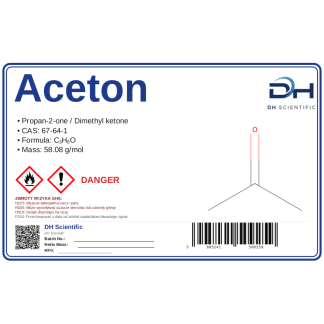
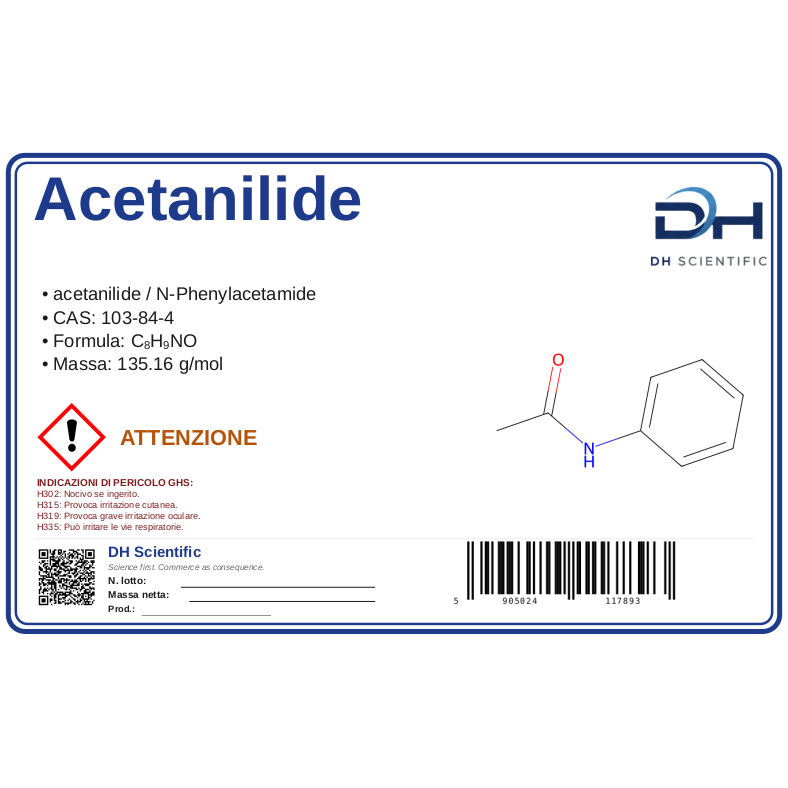
Acetanilide
4,99 €
Reagente chimico Acetanilid (CAS 103-84-4). Scheda enciclopedica completa — classificazione, proprietà e dati di sicurezza — di seguito.
🔒 Modalità demo — questo articolo non è in vendita.
Sostanza legale. dhscientific.com è una dimostrazione della piattaforma MOL-GOD — non vendiamo nulla e nessun ordine viene evaso. Le sostanze vietate vengono bloccate qui automaticamente dal canone normativo (confronta ad es. l'eptacloro).

Dati trascritti da registri normativi e letteratura tecnica, con indicazione della fonte e dell'edizione. Non sostituiscono la scheda di dati di sicurezza del fornitore. I campi privi di fonte registrata sono contrassegnati come tali.
Panoramica chimica: AcetanilideMolGod_OVERVIEW_1
| Formula molecolare | C8H9NO[1] |
| Peso molecolare | 135.16 g/mol[1] |
| Punto di fusione | 114.3 °C[1][2] |
| Punto di ebollizione | 304 °C[1][2] |
| Densità | 1.219 g/cm³[1] |
| LogP (lipofilia) | 1.2[1] |
| Nome IUPAC | N-phenylacetamide[1] |
| SMILES | CC(=O)NC1=CC=CC=C1[1] |
| InChIKey | FZERHIULMFGESH-UHFFFAOYSA-N[1] |
Sinonimi: acetanilide · N-Phenylacetamide · 103-84-4 · Antifebrin · Acetamidobenzene
Fonti dei dati: PubChem (NLM/NIH)
Ultimo aggiornamento: 2026-08-07
📚 Riferimenti scientifici (Chicago Author-Date) (2 sources)
- PubChem. National Center for Biotechnology Information (NIH/NLM), chemical compound database. ↗ dotyczy: Formula molecolare · Peso molecolare · Punto di fusione · Punto di ebollizione · Densità · LogP (lipofilia) · Nome IUPAC · SMILES · InChIKey
- DECHEMA, PTB, and BAM. CHEMSAFE - Database of Evaluated Safety Characteristics for the Avoidance of Explosions. Frankfurt am Main: DECHEMA e.V.; Braunschweig/Berlin: Physikalisch-Technische Bundesanstalt and Bundesanstalt fur Materialforschung und -prufung. ↗ dotyczy: Punto di fusione · Punto di ebollizione
RICERCA SCIENTIFICA
📚 Riferimenti scientifici (Chicago Author-Date) 10 refs · 4 baz
MOLEKUŁA Bibliografia per-CAS (live da 13+ banche dati)
Fonti: db:pubmed (1) · db:Europe PMC (7) · db:doaj (1) · db:crossref (1)
- db:pubmed Safaie E, Sayahi MH, Dastyafteh N et al.. (2025). "1-Phenyl-β-carboline-3-carboxamide-1,2,3-triazole-N-phenylacetamide hybrids as new α-glucosidase inhibitors.". Scientific reports. https://doi.org/10.1038/s41598-025-99807-x →
- db:Europe PMC et al.. (2024). "Design, synthesis, and biological evaluation of 2-(naphthalen-1-yloxy)-N-phenylacetamide derivatives as TRPM4 inhibitors for the treatment of prostate cancer.". https://doi.org/10.1016/j.bmc.2023.117584 →
- db:Europe PMC et al.. (2024). "Design, synthesis, and biological evaluation of some 2-(3-oxo-5,6-diphenyl-1,2,4-triazin-2(3H)-yl)-N-phenylacetamide hybrids as MTDLs for Alzheimer's disease therapy.". https://doi.org/10.1016/j.ejmech.2024.116409 →
- db:Europe PMC et al.. (2023). "Indole-carbohydrazide linked phenoxy-1,2,3-triazole-N-phenylacetamide derivatives as potent α-glucosidase inhibitors: design, synthesis, in vitro α-glucosidase inhibition, and computational studies.". https://doi.org/10.1186/s13065-023-00971-w →
- db:Europe PMC et al.. (2022). "Antifungal activity of 2-chloro-N-phenylacetamide, docking and molecular dynamics studies against clinical isolates of Candida tropicalis and Candida parapsilosis.". https://doi.org/10.1111/jam.15498 →
- db:Europe PMC et al.. (2022). "Antifungal activity of 2-chloro-N-phenylacetamide: a new molecule with fungicidal and antibiofilm activity against fluconazole-resistant Candida spp.". https://doi.org/10.1590/1519-6984.255080 →
- db:Europe PMC et al.. (2022). "Design, Synthesis, in Vitro, and in Silico Evaluation of N-Phenylacetamide-Oxindole-Thiosemicarbazide Hybrids as New Potential Tyrosinase Inhibitors.". https://doi.org/10.1002/cbdv.202100666 →
- db:doaj Guerrab Walid, Missioui Mohcine, Zaoui Younes et al.. (2021). "Synthesis and crystal structure of 2-azido-N-phenylacetamide, C8H8N4O". Zeitschrift für Kristallographie - New Crystal Structures. https://doi.org/10.1515/ncrs-2020-0409 →
- db:Europe PMC et al.. (2020). "New N-phenylacetamide-linked 1,2,3-triazole-tethered coumarin conjugates: Synthesis, bioevaluation, and molecular docking study.". https://doi.org/10.1002/ardp.202000164 →
- db:crossref Shi-Yue Huang, Muoi Tang, Sheau Ling Ho et al.. (2007). "Solubilities of N-phenylacetamide, 2-methyl-N-phenylacetamide and 4-methyl-N-phenylacetamide in supercritical carbon dioxide". The Journal of Supercritical Fluids. https://doi.org/10.1016/j.supflu.2007.04.001 →
Proprietà fisico-chimiche
Riferimento rapido
🔬 Proprietà avanzate
Identificatori chimici
CC(=O)NC1=CC=CC=C1 Ultimo aggiornamento: 2026-06-30
📡 Spettroscopia — CAS 103-84-4MolGod_SPECHUB_MAIN
Proprietà fisico-chimiche (database) 7 campi MolGod Score: Affidabile
| Proprietà | Valore | Unità | Conditions | Source |
|---|---|---|---|---|
| Punto di fusione | 114.3 [1][2] | °C | 1 atm | PubChem PUG-View |
| Punto di ebollizione | 304 [1][2] | °C | PubChem PUG-View | |
| Solubilità in acqua | 6.93 [1][2] | g/L | 25°C | PubChem PUG-View |
| Densità (ρ) | 1.219 [1] | g/cm³ | 15°C | PubChem PUG-View |
| Punto di infiammabilità | 169 [1] | °C | closed cup | PubChem PUG-View |
| Temperatura di autoaccensione | 540 [1][2] | °C | in air | PubChem PUG-View |
| logP (ottanolo/acqua) | 1.2 [1][3] | — | PubChem PUG-View |
📚 Riferimenti scientifici (Chicago Author-Date) (3 sources)
- PubChem. National Center for Biotechnology Information (NIH/NLM), chemical compound database. ↗ dotyczy: Punto di fusione · Punto di ebollizione · Solubilità in acqua · Densità (ρ) · Punto di infiammabilità · Temperatura di autoaccensione · logP (ottanolo/acqua)
- DECHEMA, PTB, and BAM. CHEMSAFE - Database of Evaluated Safety Characteristics for the Avoidance of Explosions. Frankfurt am Main: DECHEMA e.V.; Braunschweig/Berlin: Physikalisch-Technische Bundesanstalt and Bundesanstalt fur Materialforschung und -prufung. ↗ dotyczy: Punto di fusione · Punto di ebollizione · Solubilità in acqua · Temperatura di autoaccensione
- Sangster, J. "Octanol-Water Partition Coefficients of Simple Organic Compounds." Journal of Physical and Chemical Reference Data 18, no. 3 (1989): 1111-1229. ↗ dotyczy: logP (ottanolo/acqua)
I valori fisico-chimici provengono da fonti indipendenti e sottoposte a revisione paritaria elencate sopra.
🛡️ Sicurezza — CAS 103-84-4MolGod_SAFEHUB_MAIN
Classificazione GHS/CLP — Regolamento (CE) n. 1272/2008 + UN GHS Rev. 9 (2021).


🚨 Indicazioni di pericolo (H)
- H302 — Nocivo se ingerito.
- H315 — Provoca irritazione cutanea.
- H319 — Provoca grave irritazione oculare.
- H335 — Può irritare le vie respiratorie.
- H320 — Provoca irritazione oculare.
- H336 — Può provocare sonnolenza o vertigini.
- H361 — Sospettato di nuocere alla fertilità o al feto.
- H370 — Provoca danni agli organi.
- H372 — Provoca danni agli organi in caso di esposizione prolungata o ripetuta.
- H402 — Harmful to aquatic life
🛡 Consigli di prudenza (P)
- P261 — Evitare di respirare la polvere/i fumi/i gas/la nebbia/i vapori/gli aerosol.
- P264 — Lavare accuratamente … dopo l’uso.
- P270 — Non mangiare, né bere, né fumare durante l’uso.
- P271 — Utilizzare soltanto all’aperto o in luogo ben ventilato.
- P280 — Indossare guanti/indumenti protettivi/Proteggere gli occhi/il viso.
- P301+P312 — IN CASO DI INGESTIONE: In caso di malessere, contattare un CENTRO ANTIVELENI/un medico/…
- P302+P352 — IN CASO DI CONTATTO CON LA PELLE: Lavare abbondantemente con acqua/…
- P304+P340 — IN CASO DI INALAZIONE: Trasportare l’infortunato all’aria aperta e mantenerlo a riposo in posizione che favorisca la respirazione.
- P305+P351+P338 — IN CASO DI CONTATTO CON GLI OCCHI: Sciacquare accuratamente per parecchi minuti.; Togliere le eventuali lenti a contatto se è agevole farlo. Continuare a sciacquare.
- P312 — In caso di malessere, contattare un CENTRO ANTIVELENI/un medico/…
- P330 — Sciacquare la bocca.
- P332+P313 — In caso di irritazione della pelle: Consultare un medico.
- P337+P313 — Se l’irritazione degli occhi persiste: Consultare un medico.
- P403+P233 — Conservare in luogo ben ventilato.: Tenere il recipiente ben chiuso.
- P405 — Conservare sotto chiave.
- P501 — Smaltire il prodotto/recipiente in …
⚠ Classificazione basata sul consenso delle fonti (PubChem / notifiche dei fornitori) — non verificata rispetto alla classificazione armonizzata dell'allegato VI (CLP). L'ambito dei pericoli può essere più ampio della classificazione ufficiale; prima dell'uso verificare con la scheda di dati di sicurezza aggiornata del fornitore.
Traduzioni: Regolamento CLP (CE) 1272/2008, Allegato III e IV. Dati: PubChem/NLM.
📚 Riferimenti scientifici consolidati — Chicago Author-Date 10 sources
Riferimenti raccolti da tutte le schede del Safety Hub. CAS: 103-84-4 ·
PubChem ↗
- Parlament Europejski i Rada UE. 2008. "Rozporządzenie (WE) nr 1272/2008 w sprawie klasyfikacji, oznakowania i pakowania substancji (CLP)." Dz.Urz. UE L 353. [↗] GHS, Normative
- United Nations Economic Commission for Europe (UNECE). 2021. "Globally Harmonized System of Classification and Labelling of Chemicals (GHS), Ninth Revised Edition." United Nations, Geneva. [↗] GHS
- Goldfrank, Lewis R., Robert S. Hoffman, Mary Ann Howland, et al.. 2019. "Goldfrank's Toxicologic Emergencies, 11th ed.." McGraw-Hill Education, New York. ISBN 978-1-25-985961-8. Pierwsza pomoc, Toksykologia
- National Institute for Occupational Safety and Health (NIOSH). 2023. "NIOSH Pocket Guide to Chemical Hazards (DHHS Publ. 2005-149)." U.S. Department of Health and Human Services / CDC, Cincinnati, OH. [↗] Pierwsza pomoc, PPE, Toksykologia
- European Committee for Standardization (CEN). 2016. "EN 374-1:2016 — Protective gloves against dangerous chemicals and micro-organisms." CEN, Brussels. [↗] PPE
- UNECE. 2023. "European Agreement Concerning the International Carriage of Dangerous Goods by Road (ADR 2025)." United Nations, Geneva. [↗] Utylizacja, Regulacje
- National Fire Protection Association (NFPA). 2022. "NFPA 400 — Hazardous Materials Code." NFPA, Quincy, MA. [↗] Magazynowanie
- Urben, P.G. (ed.). 2017. "Bretherick's Handbook of Reactive Chemical Hazards, 8th ed.." Butterworth-Heinemann / Elsevier, Oxford. [↗] Magazynowanie
- Ministerstwo Klimatu i Środowiska RP. 2023. "Baza danych o produktach i opakowaniach oraz o gospodarce odpadami (BDO)." Ministerstwo Klimatu i Środowiska, Warszawa. [↗] Utylizacja
- International Agency for Research on Cancer (IARC / WHO). 2024. "IARC Monographs on the Identification of Carcinogenic Hazards to Humans — List of Classifications." WHO, Lyon. [↗] Toksykologia
Le schede con riferimenti propri (Emergency, PPE, Storage, Waste) contengono ulteriori voci bibliografiche all'interno delle rispettive sezioni.
Statistica analitica (t-test · RSD · Grubbs · Q-Dixon) ICH Q2
Incolla una serie di misure replicate (CSV oppure un numero per riga). Il calcolatore calcolerà la media, la deviazione standard e il 95% CI, e rileverà gli outlier (Grubbs + Dixon Q).
📐 Formule statistiche
x̄ = Σxᵢ / n— media aritmeticas² = Σ(xᵢ - x̄)² / (n-1)— varianza campionarias = √s²— deviazione standardRSD% = (s / x̄) × 100%— deviazione standard relativaCI₉₅ = x̄ ± t(0.05, n-1) × s / √n— Student's tG = |xᵢ - x̄| / s— test di GrubbsQ = |xsuspect - xnearest| / |xmax - xmin|— Dixon Q-test
Fonte: ICH Q2(R2) Validation of Analytical Procedures · ICH PDF ↗
Calcolatore di ricette per tamponi UNIQUE
Scegli un tampone dall'elenco di 20 sistemi popolari → inserisci il pH target → otterrai una ricetta esatta con le masse da pesare.
Passo 1: Scegli un sistema tampone
📜 Cronologia delle ricette (ultime 10)
🔧 Risoluzione dei problemi HPLC — albero decisionale 6 problemi comuni
Diagnostica dei 6 problemi HPLC più comuni con albero decisionale (5 passaggi per problema). Fonte: Snyder/Kirkland/Dolan 3rd ed. Chapter 17 + LCGC LC Troubleshooting columns 1989-2024.
Picchi allargati (broad peaks) medium
Sintomo: Tutti i picchi nel cromatogramma sono più larghi del previsto (FWHM > 2× della norma)
🔍 Albero diagnostico:
-
1. Verifica se tutti i picchi sono allargati o solo alcuni
→ SÌ: Tutti → problema strumentale (colonna o sistema)
→ NO: Solo alcuni → problema chimico (interazione con la colonna per analiti specifici) -
2. Sostituisci con una colonna di prova — il problema scompare?
→ SÌ: COLONNA usurata — packing danneggiato, void nei primi mm. Sostituiscila.
→ NO: Problema nel sistema LC -
3. Controllare il volume morto (dead volume) — loop di iniezione, connessioni, rivelatore
→ SÌ: Loop > 100 µL per una colonna da 4.6 mm o connessioni allentate → sostituire le ferrule, accorciare i tubi
→ NO: Continua diagnostica -
4. Test di temperatura: aumentare la colonna da 25°C a 40°C
→ SÌ: Picchi più stretti → cinetica di trasferimento di massa troppo lenta (aumentare T)
→ NO: Continue -
5. Controllare il flow rate rispetto al valore ottimale di van Deemter per questa colonna
→ SÌ: Ottimale per 4.6mm/5µm = 1.0 mL/min, per 2.1mm/3µm = 0.4 mL/min
→ NO: Continue
- Colonna usurata (>2000 iniezioni senza guard)
- Volume morto del sistema > 100 µL (loop errato, tubi lunghi, ferrule allentate)
- Temperatura troppo bassa (cinetica di trasferimento di massa)
- Flow rate al di fuori dell'ottimale di van Deemter
- Solvente del campione più forte della fase A
- ✓ Sostituire la colonna (quando >2000 iniezioni)
- ✓ Controllare tutte le connessioni — tubi il più corti possibile
- ✓ Aumentare la T della colonna a 40°C (se la sostanza è stabile)
- ✓ Ridurre il flow all'ottimale di van Deemter
- ✓ Sciogliere il campione nella fase A (non in organico puro)
Coda dei picchi (tailing, T > 1.5) high
Sintomo: I picchi presentano una "coda" prolungata sul lato di eluizione tardiva (asimmetria T = b/a > 1.5 secondo USP)
🔍 Albero diagnostico:
-
1. La sostanza contiene gruppi basici (ammino, piridina)?
→ SÌ: Sì → interazioni silanoliche! Aggiungere 0.1% TFA o 5-10 mM TEA alla fase A.
→ NO: Continue -
2. Controllare il pH della fase mobile rispetto al pKa della sostanza
→ SÌ: pH = pKa ± 1 → ionizzazione parziale, peak split. Portare il pH a ≥ 2 unità di distanza dal pKa.
→ NO: Continue -
3. Controllare l'età della colonna (>1500 iniezioni?)
→ SÌ: Sì → silanoli esposti (column bleed). Sostituire con una colonna con endcapping più elevato (XTerra, Symmetry).
→ NO: Continue -
4. Il campione contiene metalli (Fe, Cu dalle fiale di vetro)?
→ SÌ: Sì → utilizzare fiale incolori di tipo II o PFA. EDTA 0.1mM nel campione.
→ NO: Continue
- Interazioni silanoliche (analita basico + silanoli liberi del gel di silice)
- pH al limite del pKa dell'analita (peak split)
- Colonna vecchia (column bleed, elevata attività silanolica)
- Metalli nel campione (chelazione → tailing)
- Sovraccarico della colonna (>50 µg su una colonna da 4.6mm)
- ✓ Aggiungere 0.1% TFA (UV) o 0.1% acido formico (LC-MS) alla fase A
- ✓ Scegliere una colonna con endcapping ad alta purezza: Waters XBridge BEH, Phenomenex Kinetex
- ✓ Lavorare a pH ≥ 2 unità di distanza dal pKa
- ✓ EDTA 0.1mM nel campione (chelazione Fe/Cu)
- ✓ Ridurre il volume di iniezione a ≤ 20 µL per una colonna da 4.6mm
Deriva della linea di base (baseline drift) medium
Sintomo: La linea di base aumenta o diminuisce sistematicamente per >5 minuti
🔍 Albero diagnostico:
-
1. Si sta utilizzando un gradiente (B% in aumento)?
→ SÌ: Sì → assorbimento diverso delle fasi A e B a dλ. Cambio di solvente nell'UV-cutoff. Controllare l'assorbanza UV del % di organico.
→ NO: Continua (isocratico) -
2. Controllare la temperatura della colonna — è stabile a ±0.5°C?
→ SÌ: Sì (stabile) → continua
→ NO: Instabile → attivare il termostato della colonna (>25°C controllato) -
3. Test: spegnere l'autosampler, far funzionare solo pompa+colonna+rivelatore
→ SÌ: La deriva scompare → contaminazione dell'autosampler (pulire l'ago, il septum)
→ NO: Continue -
4. Controllare l'età della lampada (D2 per UV)
→ SÌ: Sì (>1500 ore) → sostituire la lampada
→ NO: Continue
- Eluizione a gradiente con UV-cutoff diverso delle fasi
- T della colonna instabile
- Contaminazione dell'ago/septum dell'autosampler
- Lampada UV vecchia (>1500h)
- Cella di flusso del rivelatore sporca
- Colonna non equilibrata (<10 volumi di colonna)
- ✓ Pre-equilibrare la colonna per 10-15 volumi di colonna al 100% A
- ✓ Termostato colonna attivo, T 30-40°C stabile
- ✓ Pulire la flow cell del rivelatore con soluzione ACN:H2O 50:50
- ✓ Sostituire la lampada D2 se >1500h
- ✓ Usare la baseline subtraction (funzione nativa Chromeleon, Empower)
Nessun picco / picco perso (no peak) critical
Sintomo: Il picco atteso dell'analita non compare nel cromatogramma
🔍 Albero diagnostico:
-
1. L'iniezione è stata effettivamente eseguita?
→ SÌ: Controllare il log dell'autocampionatore, la pressione della pompa (dovrebbe calare durante l'iniezione)
→ NO: Problema dell'autocampionatore → controllare il loop, l'ago, il campione nella fiala -
2. Il campione è nella fiala (volume corretto, non evaporato)?
→ SÌ: Continue
→ NO: Nessun campione — ri-pipettare -
3. Stabilità del campione — preparato >24h fa?
→ SÌ: Sì → degradazione. Ri-preparare un campione fresco.
→ NO: Continue -
4. Controllare la lunghezza d'onda di rilevazione rispetto al λmax della sostanza
→ SÌ: Rilevazione a λ NON corrisponde al λmax → nessun segnale. Scansione DAD 200-400nm.
→ NO: Continue -
5. Test: iniettare uno standard puro (di concentrazione nota, fresco)
→ SÌ: Lo standard dà un picco → problema con il campione (matrice, derivatizzazione)
→ NO: Nessun picco anche con lo standard → problema di sistema (colonna, fase, gradiente)
- Campione non prelevato dalla fiala (bug dell'autocampionatore)
- Campione degradato (>24h pH/temp/luce)
- Rilevazione alla lunghezza d'onda errata
- Fase mobile errata (es. TFA dimenticato)
- Colonna invertita / fase stazionaria errata
- La sostanza eluisce sul fronte (V0) → non trattenuta, non visibile
- ✓ Ri-preparare un campione fresco secondo il protocollo esatto
- ✓ Scansione UV-Vis DAD 200-400nm + ricerca del λmax
- ✓ Controllare la composizione della fase mobile — TFA aggiunto?
- ✓ Testare la direzione inversa della colonna (con cautela!)
- ✓ Per ritenzione <1 min — abbassare il % B, MeOH al posto di ACN
- ✓ Verifica il tempo di ritenzione atteso nel database dei metodi del plugin
Pressione troppo alta (pressure too high) critical
Sintomo: Pressione della pompa > 80% del massimo della colonna o shutdown del sistema con errore high-pressure
🔍 Albero diagnostico:
-
1. Controllare che la colonna sia collegata correttamente (direzione della freccia)
→ SÌ: OK
→ NO: Colonna invertita → invertirla (non lavorare mai "al contrario") -
2. Test: rimuovere la colonna dal sistema, far girare pompa+rivelatore da soli
→ SÌ: La pressione scende a <50 bar → problema nella colonna (intasata)
→ NO: La pressione rimane alta → filtro in-line intasato, frit sporco -
3. Controllare il filtro pre-colonna (frit in-line)
→ SÌ: Sporco e brunastro → sostituire
→ NO: Continue -
4. Retro-lavare la colonna con ACN:H2O 50:50 senza la colonna — scompare?
→ SÌ: Particelle bloccate nel primo mm — un flush di 30 min può recuperarla
→ NO: Sostituire la colonna
- Filtro in-line (frit) intasato da particelle
- Salting-out del buffer (precipitazione ad alto %B)
- Il campione contiene materiale in sospensione (filtrare a 0.22 µm prima dell'iniezione)
- Colonna intasata (compattazione del letto della colonna)
- Gradiente con fase buffer + molto organico → precipitazione del sale
- ✓ Filtrare SEMPRE il campione con PVDF 0.22 µm prima dell'iniezione
- ✓ Sostituire il filtro in-line ogni 100 iniezioni (o quando la pressione aumenta >20%)
- ✓ NON usare buffer fosfato >20mM + >70% ACN (il sale precipita)
- ✓ Lavare la colonna per 30 min con ACN:H2O 50:50 in direzione inversa (quando il produttore lo consente)
- ✓ Pre-colonna 4×3mm per proteggere la colonna principale
Picchi fantasma (ghost peaks) high
Sintomo: Picchi inspiegabili sul cromatogramma assenti nella calibrazione
🔍 Albero diagnostico:
-
1. Test: iniezione in bianco (solvente puro del campione)
→ SÌ: Compare un ghost → contaminazione del sistema o degli eluenti
→ NO: Compare solo con il campione → matrice -
2. Il ghost cresce con il gradiente (eluisce ad alta %B)?
→ SÌ: Sì → colonna sovraccarica o composti fortemente trattenuti dalla corsa precedente
→ NO: Indipendente dal gradiente → carryover dell'autocampionatore -
3. Increase carryover wash (between injections)
→ SÌ: Aiuta → il carryover era la causa. Protocollo di lavaggio più forte.
→ NO: Continue -
4. Iniezione di acqua pura — c'è un picco?
→ SÌ: Sì → contaminazione della fonte d'acqua (sostanze organiche dal sistema DI)
→ NO: Continue
- Carryover nell'ago/loop dell'autocampionatore
- Contaminazione dell'eluente (anche di grado HPLC)
- Componenti fortemente trattenuti da corse precedenti
- Plastica nelle fiale (ftalati, PEG dai tappi)
- Acqua DI insufficientemente purificata
- ✓ Rafforzare il protocollo di lavaggio: 100% B → 100% A → 50:50 (3 cicli)
- ✓ Lavaggio forte: DMSO 100% o MeOH 100% prima della calibrazione
- ✓ Filtrare gli eluenti con PTFE 0.22 µm in caso di dubbio
- ✓ Usare vetro ambrato + tappi con rivestimento in Teflon per i campioni
- ✓ Rampa di gradiente periodica fino a 100% B per 10 min (clean-out)
📚 Riferimenti scientifici (Chicago Author-Date) — fare clic per espandere
- Snyder, Lloyd R., Joseph J. Kirkland, and John W. Dolan. 2010. Introduction to Modern Liquid Chromatography. 3rd ed. John Wiley & Sons. Chapter 17 (Troubleshooting) pp. 559-616. ISBN 978-0-470-16754-0. https://doi.org/10.1002/9780470508183 [link ↗]
- Dolan, John W.. 2014. LC Troubleshooting (monthly column 1989-2024). LCGC North America. [link ↗] — John Dolan 35-letnia seria miesięcznych artykułów problemowych
- Kromidas, Stavros. 2017. HPLC Made to Measure: A Practical Handbook for Optimization. 2nd ed. Wiley-VCH. ISBN 978-3-527-31377-1. — Praktyczny przewodnik problem-solving dla labs analitycznych
- Dolan, John W.. 2013. When to Modify Method Conditions. 192-199. [link ↗] — Decision flow for changing flow rate / temperature / %B vs swapping columns.
- Dong, Michael W.. 2019. HPLC and UHPLC for Practicing Scientists. 2nd ed. Wiley. ISBN 978-1-119-31378-3. https://doi.org/10.1002/9781119313793 [link ↗] — Chapter 9 covers troubleshooting modern UHPLC systems (sub-2 µm particles).
- Meyer, Veronika R.. 2010. Practical High-Performance Liquid Chromatography. 5th ed. Wiley. ISBN 978-0-470-68218-0. — Solid step-by-step problem isolation chapter (eluents, columns, instruments).
- Snyder, L. R., J. J. Kirkland, and J. L. Glajch. 1997. Practical HPLC Method Development. 2nd ed. Wiley. ISBN 978-0-471-00703-6. — Method-development companion volume with troubleshooting cross-refs.
- Carr, Peter W.. 2009. The new physical chemistry of HPLC. 1764-1772. https://doi.org/10.1016/j.chroma.2008.11.094 [link ↗] — Theoretical basis for diagnosing efficiency losses (mass-transfer, eddy diffusion).
- Heyden, Yvan Vander, et al.. 2009. Robustness of pharmaceutical liquid chromatographic methods. 2120-2129. https://doi.org/10.1016/j.jchromb.2008.10.052 [link ↗] — How to diagnose method failures vs. system failures (Plackett-Burman).
- Engelhardt, Heinz. 2014. 100 Years of Chromatography. 2nd ed. Wiley-VCH. ISBN 978-3-527-33473-5. — Historical context for ghost-peak phenomenology (silica chemistry).
Deskryptory Lipinskiego (struktura)
🧪 Assistente di preparazione della soluzione (Smart Prep) MolGod_PREP_2
Inserisci cosa vuoi preparare — genererò una SOP
📚 Panoramica della letteratura scientifica — CAS 103-84-4MolGod_LITHUB_MAIN
⭐ Risultati principali (letteratura scientifica) 10 publications
103-84-4
— multi-criteria ranking (W12): 30% citazioni · 20% recency · 20% topic · 15% historical · 15% open access.
-
#1Guerrab Walid, Missioui Mohcine, Zaoui Younes et al. (2021) · Zeitschrift für Kristallographie - New Crystal StructuresPerché è importante: Open access
-
#2et al. (2024) · Scientific ReportsPerché è importante: Recente (2024) · open access
-
#3et al. (2023) · BMC ChemistryPerché è importante: Recente (2023) · open access
-
#4et al. (2024) · European Journal of Medicinal ChemistryPerché è importante: Recente (2024) · open access
-
#5et al. (2020) · Archiv der PharmaziePerché è importante: Selezionate tramite punteggio multi-criterio (citations + recency + topic + historical + OA).
-
#6et al. (2022) · Journal of Applied MicrobiologyPerché è importante: Open access
-
#7et al. (2022) · Brazilian Journal of BiologyPerché è importante: Open access
-
#8Safaie E, Sayahi MH, Dastyafteh N et al. (2025) · Scientific reportsPerché è importante: Recente (2025) · open access
-
#9et al. (2022) · Chemistry & BiodiversityPerché è importante: Selezionate tramite punteggio multi-criterio (citations + recency + topic + historical + OA).
-
#10et al. (2024) · Bioorganic & Medicinal ChemistryPerché è importante: Recente (2024)
📚 RIFERIMENTI (Bibliografia complessiva, Chicago Author-Date) 126 elementi
Tutte le fonti scientifiche citate negli accordion sopra per il CAS 103-84-4.Formato: Chicago Manual of Style 17ª ed., sistema Author-Date.
🗄️ Banche dati scientifiche
- NIST. n.d. NIST Chemistry WebBook: CAS 103-84-4. Gaithersburg, MD: National Institute of Standards and Technology. https://webbook.nist.gov/cgi/cbook.cgi?ID=103-84-4.
- AIST. n.d. Spectral Database for Organic Compounds (SDBS): CAS 103-84-4. Tsukuba, Japan: National Institute of Advanced Industrial Science and Technology. https://sdbs.db.aist.go.jp/.
- Linstrom, Peter J., and William G. Mallard, eds. n.d. NIST Chemistry WebBook: NIST Standard Reference Database Number 69. Gaithersburg, MD: National Institute of Standards and Technology. https://doi.org/10.18434/T4D303.
- PubChem. n.d. PubChem Compound Summary: CAS 103-84-4. Bethesda, MD: National Center for Biotechnology Information (NCBI), National Library of Medicine. https://pubchem.ncbi.nlm.nih.gov/#query=103-84-4.
- U.S. EPA. n.d. CompTox Chemicals Dashboard: CAS 103-84-4. Research Triangle Park, NC: U.S. Environmental Protection Agency. https://comptox.epa.gov/dashboard/chemical/details/DTXSID2022543.
📐 Standard / Linee guida
- ICH. 2003. "Stability Testing of New Drug Substances and Products: Q1A(R2)." Geneva: International Council for Harmonisation of Technical Requirements for Pharmaceuticals for Human Use. https://database.ich.org/sites/default/files/Q1A%28R2%29%20Guideline.pdf.
- National Fire Protection Association (NFPA). 2024. "NFPA 30: Flammable and Combustible Liquids Code." NFPA, Quincy, MA. https://www.nfpa.org/codes-and-standards/all-codes-and-standards/list-of-codes-and-standards/detail?code=30.
- Occupational Safety and Health Administration (OSHA). 2023. "29 CFR 1910.106 — Flammable Liquids." U.S. Department of Labor, Federal Register. https://www.osha.gov/laws-regs/regulations/standardnumber/1910/1910.106.
- European Chemicals Agency (ECHA). 2024. "Annex VI to Regulation (EC) No 1272/2008 (CLP) — Harmonised Classification and Labelling." ECHA, Helsinki / Official Journal of the European Union. https://echa.europa.eu/regulations/clp/clp-classification.
- European Committee for Standardization (CEN). 2016. "EN 374-1:2016 — Protective gloves against dangerous chemicals and micro-organisms — Part 1: Terminology and performance requirements for chemical risks." CEN, Brussels. https://standards.cencenelec.eu/dyn/www/f?p=205:110:::::FSP_PROJECT,FSP_ORG_ID:38536,6080&cs=1B0DAA8B85DF42E4A2C70E5D71F0BFA32.
- European Committee for Standardization (CEN). 2001. "EN 166:2001 — Personal eye-protection — Specifications." CEN, Brussels. https://standards.cencenelec.eu/dyn/www/f?p=CEN:110:0::::FSP_PROJECT:6541&cs=1F1A4E0A78C4DB6A28DBE2E8C29D89DCF.
- European Committee for Standardization (CEN). 2009. "EN 14605:2005+A1:2009 — Protective clothing against liquid chemicals — Performance requirements for clothing with liquid-tight (Type 3) or spray-tight (Type 4) connections." CEN, Brussels. https://standards.cencenelec.eu/dyn/www/f?p=CEN:110:0::::FSP_PROJECT:21581&cs=1A04A2D3C7CC58E9E6CB58D55F7EBFB7E.
- National Institute for Occupational Safety and Health (NIOSH). 2017. "Recommendations for Chemical Protective Clothing: A Companion to the NIOSH Pocket Guide." U.S. Department of Health & Human Services / CDC. https://www.cdc.gov/niosh/ncpc/default.html.
- Occupational Safety and Health Administration (OSHA). 2011. "Personal Protective Equipment — General requirements." U.S. Department of Labor — 29 CFR 1910.132. https://www.osha.gov/laws-regs/regulations/standardnumber/1910/1910.132.
📖 Libri
- Hansen, Charles M. 2007. Hansen Solubility Parameters: A User's Handbook, 2nd ed.. Boca Raton, FL: CRC Press. https://www.routledge.com/Hansen-Solubility-Parameters-A-Users-Handbook/Hansen/p/book/9780849372483.
- Barton, Allan F. M. 1991. CRC Handbook of Solubility Parameters and Other Cohesion Parameters: 2nd ed.. Boca Raton, FL: CRC Press. https://www.routledge.com/CRC-Handbook-of-Solubility-Parameters-and-Other-Cohesion-Parameters/Barton/p/book/9780849301766.
- Connors, Kenneth A., Gordon L. Amidon, and Valentino J. Stella. 1986. Chemical Stability of Pharmaceuticals: A Handbook for Pharmacists, 2nd ed.. New York: Wiley. https://doi.org/10.1002/0471734683.
- Rumble, John R., ed. 2019. CRC Handbook of Chemistry and Physics: 100th Edition. Boca Raton, FL: CRC Press. https://hbcp.chemnetbase.com/.
- Urben, Peter G. 2017. Bretherick's Handbook of Reactive Chemical Hazards, 8th Edition. Academic Press / Elsevier, Oxford. https://www.sciencedirect.com/book/9780081010594.
📄 Articoli scientifici (peer-reviewed)
- Stefanis, Emmanuel, and Costas Panayiotou. 2008. "Prediction of Hansen Solubility Parameters with a New Group-Contribution Method." International Journal of Thermophysics 29: 568-585. https://doi.org/10.1007/s10765-008-0415-z.
- Stoll, Vincent S., and John S. Blanchard. 1990. "Buffers: Principles and Practice: In Methods in Enzymology, vol. 182." San Diego: Academic Press. https://doi.org/10.1016/0076-6879(90)82008-P.
🌐 Siti web
- ECHA. 2023. "Guidance on the Application of the CLP Criteria." European Chemicals Agency. https://echa.europa.eu/guidance-documents/guidance-on-clp.
- European Parliament. 2006. "Regulation (EC) No 1907/2006 (REACH)." Official Journal of the European Union L 396: 1–849.
- ECHA. 2023. "Candidate List of Substances of Very High Concern for Authorisation." European Chemicals Agency. https://echa.europa.eu/candidate-list-table.
- European Parliament. 2008. "Regulation (EC) No 1272/2008 on Classification, Labelling and Packaging of Substances and Mixtures (CLP)." Official Journal of the European Union L 353: 1–1355.
- ECHA. 2017. "Guidance on the Compilation of Safety Data Sheets." Version 3.1. European Chemicals Agency. ECHA-17-G-01-EN. https://echa.europa.eu/documents/10162/23047722/sds_en.pdf.
- ECHA. 2022. "Restrictions Under REACH — Annex XVII." European Chemicals Agency. https://echa.europa.eu/substances-restricted-under-reach.
- United Nations. 2021. Globally Harmonized System of Classification and Labelling of Chemicals (GHS). 9th revised ed. ST/SG/AC.10/30/Rev.9. New York and Geneva: United Nations. https://unece.org/ghs-rev9-2021.
- ECHA. 2020. "Understanding REACH." European Chemicals Agency. https://echa.europa.eu/regulations/reach/understanding-reach.
- U.S. Occupational Safety and Health Administration (2024) — 29 CFR 1910.120 — Hazardous Waste Operations and Emergency Response (HAZWOPER) https://www.osha.gov/hazwoper.
- National Fire Protection Association (2018) — NFPA 472: Standard for Competence of Responders to Hazardous Materials/Weapons of Mass Destruction Incidents https://www.nfpa.org/codes-and-standards/nfpa-472.
- European Parliament and Council (2012) — Directive 2012/18/EU on the Control of Major-Accident Hazards Involving Dangerous Substances (Seveso III) https://eur-lex.europa.eu/legal-content/EN/TXT/?uri=celex:32012L0018.
- U.S. National Institute for Occupational Safety and Health (2024) — NIOSH Pocket Guide to Chemical Hazards https://www.cdc.gov/niosh/npg/.
- European Chemicals Agency (2020) — Guidance on the Compilation of Safety Data Sheets (SDS), Version 3.1 https://echa.europa.eu/documents/10162/23047722/sds_en.pdf.
- Snyder, Lloyd R., John W. Dolan, and Joseph J. Kirkland. 2010. Introduction to Modern Liquid Chromatography. Wiley.
- Schoenmakers, Peter J.. 1986. Optimization of Chromatographic Selectivity: A Guide to Method Development. Elsevier.
- Snyder, L. R., and J. W. Dolan. 2007. High-Performance Gradient Elution: The Practical Application of the Linear-Solvent-Strength Model. Wiley.
- Nikitas, Pavlos, and Adrian Pappa-Louisi. 2009. "Retention models for isocratic and gradient elution in reversed-phase liquid chromatography." Journal of Chromatography A 1216: 1737-1755. https://doi.org/10.1016/j.chroma.2008.10.005.
- Carr, Peter W.. 2009. "The new physical chemistry of HPLC." Journal of Chromatography A 1216: 1764-1772. https://doi.org/10.1016/j.chroma.2008.11.094.
- Dong, Michael W.. 2019. HPLC and UHPLC for Practicing Scientists. Wiley. https://doi.org/10.1002/9781119313793.
- Wu, Naijun, and Anton M. Clausen. 2007. "Fundamental and practical aspects of ultrahigh pressure liquid chromatography for fast separations." Journal of Separation Science 30: 1167-1182. https://doi.org/10.1002/jssc.200700026.
- Stoll, Dwight R., and Peter W. Carr. 2017. "Two-Dimensional Liquid Chromatography: A State of the Art Tutorial." Analytical Chemistry 89: 519-531. https://doi.org/10.1021/acs.analchem.6b03506.
- Dolan, John W.. 2013. "When to Modify Method Conditions." LCGC North America 31: 192-199. https://www.chromatographyonline.com/view/when-modify-method-conditions.
- Meyer, Veronika R.. 2010. Practical High-Performance Liquid Chromatography. Wiley.
- Van Deemter, J. J., F. J. Zuiderweg, and A. Klinkenberg. 1956. "Longitudinal diffusion and resistance to mass transfer as causes of nonideality in chromatography." https://doi.org/10.1016/0009-2509(56)80003-1.
- Giddings, J. Calvin. 1965. "Dynamics of Chromatography, Part I: Principles and Theory." Marcel Dekker.
- Poppe, Hans. 1997. "Some reflections on speed and efficiency of modern chromatographic methods." https://doi.org/10.1016/S0021-9673(97)00376-2.
- Wu, Naijun, and Anton M. Clausen. 2007. "Fundamental and practical aspects of ultrahigh pressure liquid chromatography for fast separations." https://doi.org/10.1002/jssc.200700026.
- Carr, Peter W.. 2009. "The new physical chemistry of HPLC." https://doi.org/10.1016/j.chroma.2008.11.094.
- Knox, John H.. 1977. "Practical aspects of LC theory." https://doi.org/10.1093/chromsci/15.9.352.
- Snyder, L. R., J. J. Kirkland, and J. L. Glajch. 1997. "Practical HPLC Method Development." Wiley.
- Engelhardt, Heinz. 2014. "100 Years of Chromatography." Wiley-VCH.
- Sadek, Paul C.. 2002. "The HPLC Solvent Guide." Wiley-Interscience.
- Snyder, L. R.. 1978. "Classification of the solvent properties of common liquids." https://doi.org/10.1093/chromsci/16.6.223.
- Reichardt, Christian, and Thomas Welton. 2010. "Solvents and Solvent Effects in Organic Chemistry." Wiley-VCH.
- Vailaya, Anant, and Csaba Horváth. 1998. "Retention thermodynamics in hydrophobic interaction chromatography." https://doi.org/10.1021/ie980212h.
- Krstulović, Andrea M., and Phyllis R. Brown. 1981. "Reversed-phase High-Performance Liquid Chromatography." Wiley.
- Boysen, Reinhard I., and Milton T. W. Hearn. 2009. "Multi-modal HPLC of proteins." https://doi.org/10.1093/chromsci/47.8.645.
- USP General Chapter <621>. 2024. "Chromatography." United States Pharmacopeial Convention. https://www.usp.org/harmonization-standards/pdg/general-chapters/chromatography.
- International Council for Harmonisation (ICH). 2023. "Validation of Analytical Procedures Q2(R2)." ICH Expert Working Group. https://database.ich.org/sites/default/files/ICH_Q2-R2_Document_Step4_Guideline_2023_1101.pdf.
- Foley, Joe P., and John G. Dorsey. 1983. "Equations for calculation of chromatographic figures of merit for ideal and skewed peaks." https://doi.org/10.1021/ac00255a033.
- Snyder, Lloyd R., Joseph J. Kirkland, and John W. Dolan. 2010. "Introduction to Modern Liquid Chromatography." Wiley. https://doi.org/10.1002/9780470508183.
- Dolan, John W.. 2003. "Peak tailing and resolution." https://www.chromatographyonline.com/view/peak-tailing-and-resolution.
- Vivó-Truyols, Gabriel, and Hans-Gerd Janssen. 2010. "Probabilistic approach to peak deconvolution in chromatography." https://doi.org/10.1021/ac101742z.
- Kromidas, Stavros. 2017. "HPLC Made to Measure: A Practical Handbook for Optimization." Wiley-VCH.
- Heyden, Yvan Vander, et al.. 2009. "Robustness of pharmaceutical liquid chromatographic methods." https://doi.org/10.1016/j.jchromb.2008.10.052.
- United States Pharmacopeial Convention. 2024. "USP <621> Chromatography." In United States Pharmacopeia and National Formulary, USP 47-NF 42. Rockville, MD: USP. https://www.uspnf.com/.
- European Pharmacopoeia Commission. 2024. "2.2.46 Chromatographic Separation Techniques." In European Pharmacopoeia, 11th ed. Strasbourg: Council of Europe — EDQM. https://www.edqm.eu/en/european-pharmacopoeia-ph-eur-11th-edition.
- International Council for Harmonisation (ICH). 2022. "ICH Q2(R2): Validation of Analytical Procedures." International Council for Harmonisation. https://database.ich.org/sites/default/files/ICH_Q2%28R2%29_Guideline_2022_1130.pdf.
- International Council for Harmonisation (ICH). 1996. "ICH Q3A: Impurities in New Drug Substances." International Council for Harmonisation. https://database.ich.org/sites/default/files/Q3A%28R2%29%20Guideline.pdf.
- International Organization for Standardization. 2017. "ISO/IEC 17025:2017 General Requirements for the Competence of Testing and Calibration Laboratories." Geneva: ISO. https://www.iso.org/standard/66912.html.
- Kolthoff, Izaak Maurits, and Philip J. Elving, eds. 1978. Treatise on Analytical Chemistry, Part I: Theory and Practice. 2nd ed. New York: Wiley-Interscience.
- Skoog, Douglas A., F. James Holler, and Stanley R. Crouch. 2018. Principles of Instrumental Analysis. 7th ed. Boston: Cengage Learning.
- Christian, Gary D., Purnendu K. Dasgupta, and Kevin A. Schug. 2014. Analytical Chemistry. 7th ed. Hoboken, NJ: Wiley.
- EURACHEM/CITAC. 2012. "Quantifying Uncertainty in Analytical Measurement." 3rd ed. EURACHEM/CITAC Guide CG 4. https://www.eurachem.org/images/stories/Guides/pdf/QUAM2012_P1.pdf.
- Snyder, Lloyd R., Joseph J. Kirkland, and John W. Dolan. 2010. "Introduction to Modern Liquid Chromatography." John Wiley & Sons. https://doi.org/10.1002/9780470508183.
- Dolan, John W.. 2003. "How much resolution is enough?." https://www.chromatographyonline.com/view/how-much-resolution-enough.
- USP General Chapter <621>. 2024. "Chromatography (System Suitability section)." United States Pharmacopeial Convention. https://www.usp.org/harmonization-standards/pdg/general-chapters/chromatography.
- US Food and Drug Administration (FDA). 2018. "Reviewer Guidance: Validation of Chromatographic Methods." US Food and Drug Administration. https://www.fda.gov/media/74954/download.
- Rozet, Eric, et al.. 2013. "Analysis of recent pharmaceutical regulatory documents on analytical method validation." https://doi.org/10.1016/j.chroma.2007.03.111.
- European Medicines Agency (EMA). 2011. "Guideline on bioanalytical method validation EMEA/CHMP/EWP/192217/2009." EMA. https://www.ema.europa.eu/en/documents/scientific-guideline/guideline-bioanalytical-method-validation_en.pdf.
- Kazakevich, Yuri V., and Rosario LoBrutto, eds.. 2007. "HPLC for Pharmaceutical Scientists." Wiley-Interscience. https://doi.org/10.1002/9780470087954.
- AOAC International. 2016. "Appendix F: Guidelines for Standard Method Performance Requirements." AOAC INTERNATIONAL. https://www.aoac.org/wp-content/uploads/2019/08/app_f.pdf.
- International Organization for Standardization. 1994. "ISO 5725-2:1994 Accuracy (Trueness and Precision) of Measurement Methods and Results — Part 2: Basic Method for the Determination of Repeatability and Reproducibility of a Standard Measurement Method." Geneva: ISO. https://www.iso.org/standard/11834.html.
- Heckert, N. A., and J. J. Filliben. 2003. "NIST/SEMATECH e-Handbook of Statistical Methods." NIST Handbook 151. Gaithersburg, MD: National Institute of Standards and Technology. https://www.itl.nist.gov/div898/handbook/.
- Grubbs, Frank E. 1950. "Sample Criteria for Testing Outlying Observations." Annals of Mathematical Statistics 21 (1): 27–58.
- Dixon, Wilfrid J. 1950. "Analysis of Extreme Values." Annals of Mathematical Statistics 21 (4): 488–506.
- Snedecor, George W., and William G. Cochran. 1989. Statistical Methods. 8th ed. Ames, IA: Iowa State University Press.
- Student [William Sealy Gosset]. 1908. "The Probable Error of a Mean." Biometrika 6 (1): 1–25.
- International Organization for Standardization. 2005. "ISO 3534-1:2006 Statistics — Vocabulary and Symbols — Part 1: General Statistical Terms and Terms Used in Probability." Geneva: ISO. https://www.iso.org/standard/40145.html.
- Thompson, Michael, Stephen L. R. Ellison, and Roger Wood. 2002. "Harmonized Guidelines for Single-Laboratory Validation of Methods of Analysis." Pure and Applied Chemistry 74 (5): 835–855.
- United Nations Economic Commission for Europe. 2024. European Agreement Concerning the International Carriage of Dangerous Goods by Road (ADR), Applicable as from 1 January 2025 (ECE/TRANS/352). Geneva: UNECE. https://unece.org/transport/dangerous-goods/adr-2025-edition.
- International Air Transport Association. 2026. Dangerous Goods Regulations (DGR). 67th ed. Montreal: IATA. https://www.iata.org/en/programs/cargo/dgr/.
- International Maritime Organization. 2024. International Maritime Dangerous Goods (IMDG) Code, 2024 Edition (Amendment 42-24). London: IMO. https://www.imo.org/en/OurWork/Safety/Pages/DangerousGoods-default.aspx.
- United Nations. 2025. Recommendations on the Transport of Dangerous Goods: Model Regulations (Orange Book). 24th revised ed. ST/SG/AC.10/1/Rev.24. New York and Geneva: United Nations. https://unece.org/transport/dangerous-goods/un-model-regulations.
- International Civil Aviation Organization. 2025. Technical Instructions for the Safe Transport of Dangerous Goods by Air (Doc 9284). 2025–2026 ed. Montreal: ICAO. https://www.icao.int/safety/DangerousGoods/Pages/technical-instructions.aspx.
- International Conference on Harmonisation (ICH). 2005. "Validation of Analytical Procedures: Text and Methodology Q2(R1)." ICH Expert Working Group. https://database.ich.org/sites/default/files/Q2%28R1%29%20Guideline.pdf.
- United States Pharmacopeia (USP) Convention. 2024. "USP General Chapter <621> Chromatography." USP. https://www.usp.org/sites/default/files/usp/document/harmonization/gen-chapter/g05_pf_30_4_2004.pdf.
- European Medicines Agency (EMA). 2011. "Guideline on bioanalytical method validation EMEA/CHMP/EWP/192217/2009." EMA Committee for Medicinal Products for Human Use. https://www.ema.europa.eu/en/documents/scientific-guideline/guideline-bioanalytical-method-validation_en.pdf.
- European Commission. 2014. "Commission Decision 2014/955/EU on the list of waste pursuant to Directive 2008/98/EC." Official Journal of the European Union. https://eur-lex.europa.eu/legal-content/EN/TXT/?uri=CELEX:32014D0955.
- Ministerstwo Klimatu i Środowiska Rzeczypospolitej Polskiej. 2020. "Rozporządzenie Ministra Klimatu z dnia 2 stycznia 2020 r. w sprawie katalogu odpadów." Dziennik Ustaw RP 2020 poz. 10. https://isap.sejm.gov.pl/isap.nsf/DocDetails.xsp?id=WDU20200000010.
- Główny Inspektorat Ochrony Środowiska (GIOŚ). 2024. "Baza Danych O Odpadach (BDO) — System rejestracji firm utylizacyjnych." Ministerstwo Klimatu i Środowiska. https://bdo.mos.gov.pl/.
- Polska — Sejm RP. 2012. "Ustawa z dnia 14 grudnia 2012 r. o odpadach." Dz.U. 2013 poz. 21 (z późn. zm.). https://isap.sejm.gov.pl/isap.nsf/DocDetails.xsp?id=WDU20130000021.
- Furr, A. Keith, ed.. 2000. "CRC Handbook of Laboratory Safety." CRC Press.
- Pohanish, Richard P.. 2017. "Sittig's Handbook of Toxic and Hazardous Chemicals and Carcinogens." Elsevier.
- Lewis, Richard J.. 2012. "Sax's Dangerous Properties of Industrial Materials." Wiley.
- NIOSH. 2024. "Pocket Guide to Chemical Hazards." U.S. Department of Health and Human Services. https://www.cdc.gov/niosh/npg/.
- OSHA. 2024. "Occupational Chemical Database — Hazardous Waste Operations (HAZWOPER)." Occupational Safety and Health Administration. https://www.osha.gov/chemicaldata.
- European Parliament and Council. 2008. "Directive 2008/98/EC on waste (Waste Framework Directive)." Official Journal of the European Union L 312/3. https://eur-lex.europa.eu/legal-content/EN/TXT/?uri=CELEX:32008L0098.
- European Parliament and Council. 2009. "Regulation (EC) No 1272/2008 (CLP) on classification, labelling and packaging of substances and mixtures." Official Journal of the European Union L 353. https://eur-lex.europa.eu/legal-content/EN/TXT/?uri=CELEX:32008R1272.
- United Nations Economic Commission for Europe (UNECE). 2023. "European Agreement concerning the International Carriage of Dangerous Goods by Road (ADR 2025)." UNECE. https://unece.org/transport/standards/transport/dangerous-goods/adr-2025.
- IPCS INCHEM. 2024. "International Programme on Chemical Safety — Waste Management Guidelines." WHO/UNEP/ILO. https://www.inchem.org/.
- European Parliament and Council. 2006. "Regulation (EC) No 1013/2006 on Shipments of Waste." Official Journal of the European Union L 190: 1–98. https://eur-lex.europa.eu/legal-content/EN/TXT/?uri=CELEX:32006R1013.
- International Council for Harmonisation (ICH). 2000. "Q7 Good Manufacturing Practice Guide for Active Pharmaceutical Ingredients." ICH Expert Working Group. https://database.ich.org/sites/default/files/Q7%20Guideline.pdf.
- International Organization for Standardization. 2017. "ISO/IEC 17025:2017 General requirements for the competence of testing and calibration laboratories." ISO. https://www.iso.org/standard/66912.html.
- World Health Organization. 2010. "WHO Good Manufacturing Practices for Pharmaceutical Products: Main Principles (WHO Technical Report Series No. 957, Annex 3)." WHO Press. https://www.who.int/publications/m/item/trs957-annex3.
- International Council for Harmonisation (ICH). 2003. "ICH Q1A(R2): Stability Testing of New Drug Substances and Products." International Council for Harmonisation. https://database.ich.org/sites/default/files/Q1A%28R2%29%20Guideline.pdf.
- International Council for Harmonisation (ICH). 2006. "ICH Q3A(R2): Impurities in New Drug Substances." ICH. https://database.ich.org/sites/default/files/Q3A%28R2%29%20Guideline.pdf.
- International Council for Harmonisation (ICH). 1999. "ICH Q6A: Specifications for New Drug Substances and Products." ICH. https://database.ich.org/sites/default/files/Q6A%20Guideline.pdf.
- International Council for Harmonisation (ICH). 2008. "ICH Q10: Pharmaceutical Quality System." ICH. https://database.ich.org/sites/default/files/Q10%20Guideline.pdf.
- U.S. Food and Drug Administration. 2024. "21 CFR Part 211: Current Good Manufacturing Practice for Finished Pharmaceuticals." US Code of Federal Regulations. https://www.ecfr.gov/current/title-21/chapter-I/subchapter-C/part-211.
- European Medicines Agency. 2014. "Guideline on Process Validation for Finished Products — Information and Data to Be Provided EMA/CHMP/CVMP/QWP/BWP/70278/2012." European Medicines Agency. https://www.ema.europa.eu/en/documents/scientific-guideline/guideline-process-validation-finished-products-information-data-be-provided-regulatory-submissions-revision-1_en.pdf.
- United States Pharmacopeial Convention. 2024. "United States Pharmacopeia and National Formulary, USP 47-NF 42." USP. https://www.uspnf.com/.
- European Pharmacopoeia Commission. 2024. "European Pharmacopoeia 11th Edition." Council of Europe — EDQM. https://www.edqm.eu/en/european-pharmacopoeia-ph-eur-11th-edition.
- Pharmaceutical Inspection Co-operation Scheme (PIC/S). 2021. "Guide to Good Manufacturing Practice for Medicinal Products PE 009-15." PIC/S Secretariat, Geneva. https://picscheme.org/en/publications.
- International Pharmaceutical Excipients Council (IPEC) and Pharmaceutical Quality Group (PQG). 2017. "Joint IPEC-PQG Good Manufacturing Practices Guide for Pharmaceutical Excipients." IPEC-Americas. https://ipecamericas.org/sites/default/files/IPECPQGGMPGuide2017.pdf.