
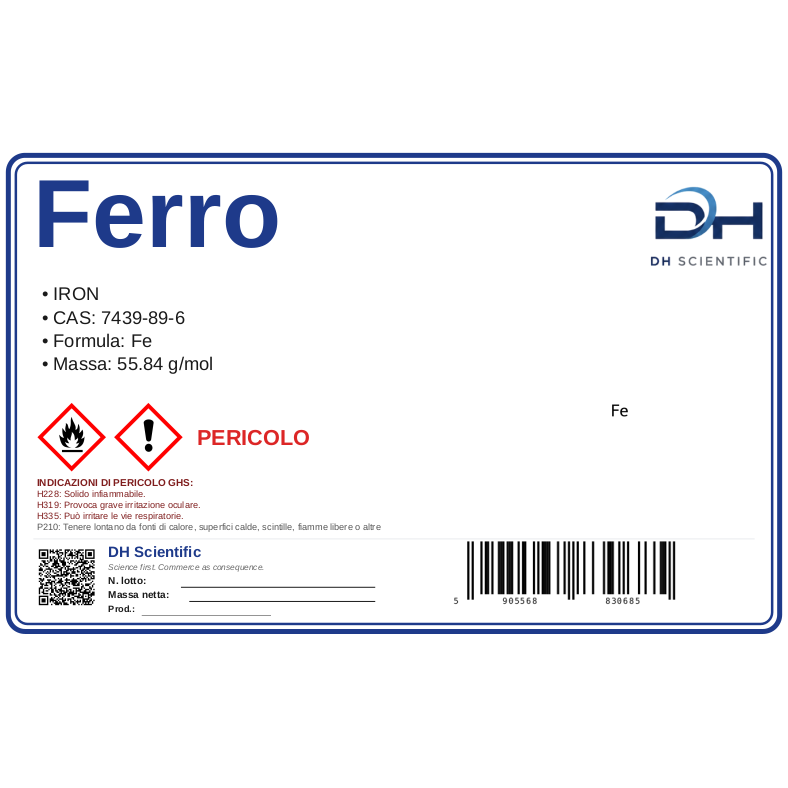
ferro
1,99 €
Reagente chimico Zelazo (CAS 7439-89-6). Scheda enciclopedica completa — classificazione, proprietà e dati di sicurezza — di seguito.
🔒 Modalità demo — questo articolo non è in vendita.
Sostanza legale. dhscientific.com è una dimostrazione della piattaforma MOL-GOD — non vendiamo nulla e nessun ordine viene evaso. Le sostanze vietate vengono bloccate qui automaticamente dal canone normativo (confronta ad es. l'eptacloro).

Panoramica chimica: IronMolGod_OVERVIEW_1
| Formula molecolare | Fe |
| Peso molecolare | 55.84 g/mol |
| Densità | 7.87 g/cm³ |
| SMILES | [Fe] |
| InChIKey | XEEYBQQBJWHFJM-UHFFFAOYSA-N |
Sinonimi: IRON · 7439-89-6 · Iron powder · Iron, elemental · ferrous iron
Fonti dei dati: PubChem (NLM/NIH)
Ultimo aggiornamento: 2026-11-10
RICERCA SCIENTIFICA
📚 Riferimenti scientifici (Chicago Author-Date) 19 refs · 7 baz
MOLEKUŁA Bibliografia per-CAS (live da 13+ banche dati)
Fonti: db:Europe PMC (5) · db:arxiv (1) · db:openalex (10) · db:pubmed (1) · db:core (1) · db:doaj (1)
- db:Europe PMC et al.. (2026). "Sustainable green synthesis of magnetic iron oxide (Fe₃O₄) nanoparticles from date seed powder for efficient dye removal: adsorption equilibrium and thermodynamic study". https://doi.org/10.21203/rs.3.rs-9808445/v1 →
- db:Europe PMC (2026). "Iron Biology in Acute Kidney Injury: Catalytic Iron, Hepcidin-Ferroportin Axis, and NGAL-A Narrative Review.". https://doi.org/10.3390/ijms27093802 →
- db:Europe PMC et al.. (2026). "Iron Oxide-Chitosan Macroporous Nanocomposite Hydrogels for Efficient Heterogeneous Electro-Fenton Degradation of Ciprofloxacin.". https://doi.org/10.3390/gels12050434 →
- db:arxiv Dongfei Wang, Jon Ortuzar, Freek Massee et al.. (2026). "Distinguishing Majorana zero modes from trivial defect states on the surface of the iron-based superconductor Fe(Te,Se)". arXiv (2606.17499v1).
- db:Europe PMC et al.. (2026). "Iron-Based Nanoparticles as Delivery Tools.". https://doi.org/10.3390/ph19050654 →
- db:openalex Douglas Kalman, Susan Hewlings, Alexis Madelyn-Adjei et al.. (2025). "Dietary Heme Iron: A Review of Efficacy, Safety and Tolerability". Nutrients. https://doi.org/10.3390/nu17132132 →
- db:Europe PMC et al.. (2025). "Gut microbiome restoring biogenic ferritin mineral as an effective oral iron supplement for iron deficiency anemia.". https://doi.org/10.1186/s12951-025-03814-z →
- db:openalex Songlin Wu, Yunjia Liu, Gordon Southam et al.. (2023). "Ecological engineering of iron ore tailings into useable soils for sustainable rehabilitation". iScience. https://doi.org/10.1016/j.isci.2023.107102 →
- db:openalex Tapos Kumar Chakraborty, Gopal Chandra Ghosh, Prianka Ghosh et al.. (2022). "Arsenic, iron, and manganese in groundwater and its associated human health risk assessment in the rural area of Jashore, Bangladesh". Journal of Water and Health. https://doi.org/10.2166/wh.2022.284 →
- db:pubmed Nemeth E, Ganz T. (2021). "Hepcidin-Ferroportin Interaction Controls Systemic Iron Homeostasis.". International journal of molecular sciences. https://doi.org/10.3390/ijms22126493 →
- db:openalex Gopal Chandra Ghosh, Md. Jahed Hassan Khan, Tapos Kumar Chakraborty et al.. (2020). "Human health risk assessment of elevated and variable iron and manganese intake with arsenic-safe groundwater in Jashore, Bangladesh". Scientific Reports. https://doi.org/10.1038/s41598-020-62187-5 →
- db:openalex Yanjiao Gao, Pascale Champagne, D. A. Blair et al.. (2020). "Activated persulfate by iron-based materials used for refractory organics degradation: a review". Water Science & Technology. https://doi.org/10.2166/wst.2020.190 →
- db:openalex Young J. Yauger, Sara Bermudez, Kasey E. Moritz et al.. (2019). "Iron accentuated reactive oxygen species release by NADPH oxidase in activated microglia contributes to oxidative stress in vitro". Journal of Neuroinflammation. https://doi.org/10.1186/s12974-019-1430-7 →
- db:openalex Jessica L. Billings, Sarah L. Gordon, Tristan Rawling et al.. (2019). "l‐3,4‐dihydroxyphenylalanine (l‐DOPA) modulates brain iron, dopaminergic neurodegeneration and motor dysfunction in iron overload and mutant alpha‐synuclein mouse models of Parkinson's disease". Journal of Neurochemistry. https://doi.org/10.1111/jnc.14676 →
- db:openalex Jin Liu, Qingyang Hu, Duck Young Kim et al.. (2017). "Hydrogen-bearing iron peroxide and the origin of ultralow-velocity zones". Nature. https://doi.org/10.1038/nature24461 →
- db:core (2012). "Iron 7439-89-6". https://doi.org/10.1002/0471701343.sdp40511 →
- db:doaj Iryna Byelinska, Taras Rybalchenko, Volodymyr Kokozay et al.. (2010). "Influence of the mixed-metal Cu/Fe complex [Cu(dmen)2][Fe(CN)5(NO)] (dmen=N,N-dimethylethylenediamine) on serum iron and copper levels in experimental anemia of rats". Current Issues in Pharmacy and Medical Sciences.
- db:openalex Lifang Chen, Juncheng Hu, Ryan M. Richards. (2008). "Catalytic Properties of Nanoscale Iron‐Doped Zirconia Solid‐Solution Aerogels". ChemPhysChem. https://doi.org/10.1002/cphc.200800041 →
- db:openalex C.H. Corliss, Jack L. Tech. (1976). "Revised lifetimes of energy levels in neutral iron". Journal of Research of the National Bureau of Standards Section A Physics and Chemistry. https://doi.org/10.6028/jres.080a.072 →
Proprietà fisico-chimiche
Riferimento rapido
Proprietà dettagliate
| Proprietà | Valore | Unità | Conditions | Source |
|---|---|---|---|---|
| Densità (ρ) | 7.8700 | g/cm³ | 20 °C (68 °F) | PubChem PUG-View (2026) |
🔬 Proprietà avanzate
Identificatori chimici
[Fe] Fonti dei dati: PubChem, NIST Chemistry WebBook, CRC Handbook of Chemistry and Physics (103rd ed.)
Ultimo aggiornamento: 2026-06-30
⚛ Visualizzazione dell'atomo — Ferro MolGod_ATOMVIZ_1
📡 Spettroscopia — CAS 7439-89-6MolGod_SPECHUB_MAIN
Banche dati di spettri spettroscopici — dati inline 8 sources MolGod_SPECDB_2
Gli spettri vengono recuperati su richiesta da 9 fonti. Ogni spettro viene salvato nel nostro database — l'apertura successiva = zero richieste all'API esterna. Scarica JCAMP-DX / CSV / PNG per ogni spettro senza dover cercare.
Fonte di riferimento — nessuna API pubblica. Apri nella banca dati esterna:
🔗 IR/NMR/MS (SDBS) →Fonte di riferimento — nessuna API pubblica. Apri nella banca dati esterna:
🔗 JP Monograph →Fonte di riferimento — nessuna API pubblica. Apri nella banca dati esterna:
🔗 WHO INN →Fonte di riferimento — nessuna API pubblica. Apri nella banca dati esterna:
🔗 DOAJ →Proprietà fisico-chimiche (database) 1 campi MolGod Score: Affidabile
| Proprietà | Valore | Unità | Conditions | Source |
|---|---|---|---|---|
| Densità (ρ) | 7.8700 [5] | g/cm³ | 20°C | PubChem PUG-View (2026) |
📚 Riferimenti scientifici (Chicago Author-Date) (12 sources)
- Haynes, William M., ed. 2024. CRC Handbook of Chemistry and Physics. 105th ed. Boca Raton: CRC Press/Taylor & Francis. ISBN 978-1-032-55554-4. ↗
- National Institute of Standards and Technology. 2024. "NIST Chemistry WebBook, SRD 69." Gaithersburg, MD: NIST. Accessed 2025-01-01. ↗
- Yaws, Carl L. 2014. The Yaws Handbook of Physical Properties for Hydrocarbons and Chemicals. 2nd ed. Oxford: Gulf Professional Publishing.
- PubChem. 2024. "PubChem Compound Database." National Library of Medicine, National Institutes of Health. Accessed 2025-01-01. ↗
- Marrero, J., and R. Gani. 2001. "Group-Contribution Based Estimation of Pure Component Properties." Fluid Phase Equilibria 183–184: 183–208. ↗
- Joback, K. G., and R. C. Reid. 1987. "Estimation of Pure-Component Properties from Group-Contributions." Chemical Engineering Communications 57 (1–6): 233–243. ↗
- Sangster, J. 1997. Octanol-Water Partition Coefficients: Fundamentals and Physical Chemistry. Chichester: Wiley. ISBN 978-0-471-97397-3.
- Mannhold, Raimund, and Han van de Waterbeemd. 2001. "Substructure and Whole Molecule Approaches for Calculating Log P." Journal of Computer-Aided Molecular Design 15 (4): 337–354. ↗
- Perrin, Ditlev D., Boyd Dempsey, and E. P. Serjeant. 1981. pKa Prediction for Organic Acids and Bases. London: Chapman and Hall. ISBN 0-412-21090-5.
- Constantinou, Leonidas, and Rafiqul Gani. 1994. "New Group Contribution Method for Estimating Properties of Pure Compounds." AIChE Journal 40 (10): 1697–1710. ↗
- Ertl, Peter, Bernhard Rohde, and Paul Selzer. 2000. "Fast Calculation of Molecular Polar Surface Area as a Sum of Fragment-Based Contributions and Its Application to the Prediction of Drug Transport Properties." Journal of Medicinal Chemistry 43 (20): 3714–3717. ↗
🛡️ Sicurezza — CAS 7439-89-6MolGod_SAFEHUB_MAIN
Classificazione GHS/CLP — Regolamento (CE) n. 1272/2008 + UN GHS Rev. 9 (2021).


🚨 Indicazioni di pericolo (H)
- H228 — Solido infiammabile.
- H319 — Provoca grave irritazione oculare.
- H335 — Può irritare le vie respiratorie.
🛡 Consigli di prudenza (P)
- P210 — Tenere lontano da fonti di calore, superfici calde, scintille, fiamme libere o altre fonti di accensione. Non fumare.
⚠ Classificazione basata sul consenso delle fonti (PubChem / notifiche dei fornitori) — non verificata rispetto alla classificazione armonizzata dell'allegato VI (CLP). L'ambito dei pericoli può essere più ampio della classificazione ufficiale; prima dell'uso verificare con la scheda di dati di sicurezza aggiornata del fornitore.
Traduzioni: Regolamento CLP (CE) 1272/2008, Allegato III e IV. Dati: PubChem/NLM.
📚 Riferimenti scientifici consolidati — Chicago Author-Date 10 sources
Riferimenti raccolti da tutte le schede del Safety Hub. CAS: 7439-89-6 ·
PubChem ↗
- Parlament Europejski i Rada UE. 2008. "Rozporządzenie (WE) nr 1272/2008 w sprawie klasyfikacji, oznakowania i pakowania substancji (CLP)." Dz.Urz. UE L 353. [↗] GHS, Normative
- United Nations Economic Commission for Europe (UNECE). 2021. "Globally Harmonized System of Classification and Labelling of Chemicals (GHS), Ninth Revised Edition." United Nations, Geneva. [↗] GHS
- Goldfrank, Lewis R., Robert S. Hoffman, Mary Ann Howland, et al.. 2019. "Goldfrank's Toxicologic Emergencies, 11th ed.." McGraw-Hill Education, New York. ISBN 978-1-25-985961-8. Pierwsza pomoc, Toksykologia
- National Institute for Occupational Safety and Health (NIOSH). 2023. "NIOSH Pocket Guide to Chemical Hazards (DHHS Publ. 2005-149)." U.S. Department of Health and Human Services / CDC, Cincinnati, OH. [↗] Pierwsza pomoc, PPE, Toksykologia
- European Committee for Standardization (CEN). 2016. "EN 374-1:2016 — Protective gloves against dangerous chemicals and micro-organisms." CEN, Brussels. [↗] PPE
- UNECE. 2023. "European Agreement Concerning the International Carriage of Dangerous Goods by Road (ADR 2025)." United Nations, Geneva. [↗] Utylizacja, Regulacje
- National Fire Protection Association (NFPA). 2022. "NFPA 400 — Hazardous Materials Code." NFPA, Quincy, MA. [↗] Magazynowanie
- Urben, P.G. (ed.). 2017. "Bretherick's Handbook of Reactive Chemical Hazards, 8th ed.." Butterworth-Heinemann / Elsevier, Oxford. [↗] Magazynowanie
- Ministerstwo Klimatu i Środowiska RP. 2023. "Baza danych o produktach i opakowaniach oraz o gospodarce odpadami (BDO)." Ministerstwo Klimatu i Środowiska, Warszawa. [↗] Utylizacja
- International Agency for Research on Cancer (IARC / WHO). 2024. "IARC Monographs on the Identification of Carcinogenic Hazards to Humans — List of Classifications." WHO, Lyon. [↗] Toksykologia
Le schede con riferimenti propri (Emergency, PPE, Storage, Waste) contengono ulteriori voci bibliografiche all'interno delle rispettive sezioni.
Statistica analitica (t-test · RSD · Grubbs · Q-Dixon) ICH Q2
Incolla una serie di misure replicate (CSV oppure un numero per riga). Il calcolatore calcolerà la media, la deviazione standard e il 95% CI, e rileverà gli outlier (Grubbs + Dixon Q).
📐 Formule statistiche
x̄ = Σxᵢ / n— media aritmeticas² = Σ(xᵢ - x̄)² / (n-1)— varianza campionarias = √s²— deviazione standardRSD% = (s / x̄) × 100%— deviazione standard relativaCI₉₅ = x̄ ± t(0.05, n-1) × s / √n— Student's tG = |xᵢ - x̄| / s— test di GrubbsQ = |xsuspect - xnearest| / |xmax - xmin|— Dixon Q-test
Fonte: ICH Q2(R2) Validation of Analytical Procedures · ICH PDF ↗
Calcolatore di ricette per tamponi UNIQUE
Scegli un tampone dall'elenco di 20 sistemi popolari → inserisci il pH target → otterrai una ricetta esatta con le masse da pesare.
Passo 1: Scegli un sistema tampone
📜 Cronologia delle ricette (ultime 10)
ADMET — profilo farmacologico
🧪 Assistente di preparazione della soluzione (Smart Prep) MolGod_PREP_2
Inserisci cosa vuoi preparare — genererò una SOP
📚 Panoramica della letteratura scientifica — CAS 7439-89-6MolGod_LITHUB_MAIN
⭐ Risultati principali (letteratura scientifica) 20 publications
7439-89-6
— multi-criteria ranking (W12): 30% citazioni · 20% recency · 20% topic · 15% historical · 15% open access.
-
#1et al. (2026) · PharmaceuticalsPerché è importante: Recente (2026) · open access
-
#2et al. (2026) · Discover NanoPerché è importante: Recente (2026) · open access
-
#3et al. (2026) · BiologyPerché è importante: Recente (2026) · open access
-
#4et al. (2026) · Journal of Cellular and Molecular MedicinePerché è importante: Recente (2026) · open access
-
#5et al. (2026) · SensorsPerché è importante: Recente (2026) · open access
-
#6et al. (2026) · Frontiers in Plant SciencePerché è importante: Recente (2026) · open access
-
#7Xiaofeng Dai; Jitian Li (2026) · MedCommPerché è importante: Recente (2026) · open access
-
#8Deandra L. Pragasam, Emma E. Brotherton, Agus R. Poerwoprajitno et al. (2026) · Nanoscale AdvancesPerché è importante: Recente (2026) · open access
-
#9Kalman D, Hewlings S, Madelyn-Adjei A et al. (2025) · NutrientsPerché è importante: Recente (2025) · rassegna · open access
-
#10et al. (2026) · Journal of MicrobiologyPerché è importante: Recente (2026) · open access
-
#11Saikat Mandal, Manideepa Maji, Arkadeep Dhali et al. (2026) · Open HeartPerché è importante: Recente (2026) · open access
-
#12A. V. Kuzikova, S. N. Barilo, R. A. Lanovsky et al. (2026) · arXiv (2611.12460v1)Perché è importante: Recente (2026) · open accessSCORE 6.25 Meccanismo Open Access
-
#13et al. (2026) · Cell Death & DiseasePerché è importante: Recente (2026) · open access
-
#14et al. (2026) · ToxicsPerché è importante: Recente (2026) · open access
-
#15et al. (2026) · AntibioticsPerché è importante: Recente (2026) · open access
-
#16et al. (2026) · Frontiers in ChemistryPerché è importante: Recente (2026) · open access
-
#17Ling-Fang Lin, Yang Zhang, Satoshi Okamoto et al. (2026) · arXiv (2610.31732v1)Perché è importante: Recente (2026) · open access
-
#18D. L. Hamilton; J. E. C. Bellamy; J. D. Valberg; L. S. Valberg (1978) · Canadian Journal of Physiology and PharmacologyPerché è importante: Selezionate tramite punteggio multi-criterio (citations + recency + topic + historical + OA).
-
#19Nemeth E, Ganz T (2021) · International journal of molecular sciencesPerché è importante: Rassegna · open access
-
#20Bell SG (2026) · Neonatal network : NNPerché è importante: Must-cite (canone) · recente (2026) · rassegna
Related products
📚 RIFERIMENTI (Bibliografia complessiva, Chicago Author-Date) 107 elementi
Tutte le fonti scientifiche citate negli accordion sopra per il CAS 7439-89-6.Formato: Chicago Manual of Style 17ª ed., sistema Author-Date.
🗄️ Banche dati scientifiche
- PubChem. 2026. PubChem Compound Summary: CAS 7439-89-6. Bethesda, MD: National Center for Biotechnology Information (NCBI), National Library of Medicine. (Accessed 2026-11-12.)
- NIST. 2026. NIST Chemistry WebBook: CAS 7439-89-6. Gaithersburg, MD: National Institute of Standards and Technology. https://webbook.nist.gov/cgi/cbook.cgi?ID=7439-89-6. (Accessed 2026-11-12.)
- AIST. 2026. Spectral Database for Organic Compounds (SDBS): CAS 7439-89-6. Tsukuba, Japan: National Institute of Advanced Industrial Science and Technology. https://sdbs.db.aist.go.jp/. (Accessed 2026-11-12.)
- ECHA. 2026. C&L Inventory and REACH Registration: CAS 7439-89-6. Helsinki: European Chemicals Agency. https://echa.europa.eu/documents/10162/23047722/sds_en.pdf. (Accessed 2026-11-12.)
📐 Standard / Linee guida
- ICH. 2026. "ICH Harmonised Guideline: CAS 7439-89-6." Geneva: International Council for Harmonisation. https://database.ich.org/sites/default/files/Q1A%28R2%29%20Guideline.pdf. (Accessed 2026-11-12.)
- National Fire Protection Association (NFPA). 2024. "NFPA 30: Flammable and Combustible Liquids Code." NFPA, Quincy, MA. https://www.nfpa.org/codes-and-standards/all-codes-and-standards/list-of-codes-and-standards/detail?code=30.
- Occupational Safety and Health Administration (OSHA). 2023. "29 CFR 1910.106 — Flammable Liquids." U.S. Department of Labor, Federal Register. https://www.osha.gov/laws-regs/regulations/standardnumber/1910/1910.106.
- European Chemicals Agency (ECHA). 2024. "Annex VI to Regulation (EC) No 1272/2008 (CLP) — Harmonised Classification and Labelling." ECHA, Helsinki / Official Journal of the European Union. https://echa.europa.eu/regulations/clp/clp-classification.
- European Committee for Standardization (CEN). 2016. "EN 374-1:2016 — Protective gloves against dangerous chemicals and micro-organisms — Part 1: Terminology and performance requirements for chemical risks." CEN, Brussels. https://standards.cencenelec.eu/dyn/www/f?p=205:110:::::FSP_PROJECT,FSP_ORG_ID:38536,6080&cs=1B0DAA8B85DF42E4A2C70E5D71F0BFA32.
- European Committee for Standardization (CEN). 2001. "EN 166:2001 — Personal eye-protection — Specifications." CEN, Brussels. https://standards.cencenelec.eu/dyn/www/f?p=CEN:110:0::::FSP_PROJECT:6541&cs=1F1A4E0A78C4DB6A28DBE2E8C29D89DCF.
- European Committee for Standardization (CEN). 2009. "EN 14605:2005+A1:2009 — Protective clothing against liquid chemicals — Performance requirements for clothing with liquid-tight (Type 3) or spray-tight (Type 4) connections." CEN, Brussels. https://standards.cencenelec.eu/dyn/www/f?p=CEN:110:0::::FSP_PROJECT:21581&cs=1A04A2D3C7CC58E9E6CB58D55F7EBFB7E.
- National Institute for Occupational Safety and Health (NIOSH). 2017. "Recommendations for Chemical Protective Clothing: A Companion to the NIOSH Pocket Guide." U.S. Department of Health & Human Services / CDC. https://www.cdc.gov/niosh/ncpc/default.html.
- Occupational Safety and Health Administration (OSHA). 2011. "Personal Protective Equipment — General requirements." U.S. Department of Labor — 29 CFR 1910.132. https://www.osha.gov/laws-regs/regulations/standardnumber/1910/1910.132.
📖 Libri
- Hansen, Charles M. 2007. Hansen Solubility Parameters: A User's Handbook, 2nd ed.. Boca Raton, FL: CRC Press. https://www.routledge.com/Hansen-Solubility-Parameters-A-Users-Handbook/Hansen/p/book/9780849372483.
- Barton, Allan F. M. 1991. CRC Handbook of Solubility Parameters and Other Cohesion Parameters: 2nd ed.. Boca Raton, FL: CRC Press. https://www.routledge.com/CRC-Handbook-of-Solubility-Parameters-and-Other-Cohesion-Parameters/Barton/p/book/9780849301766.
- Connors, Kenneth A., Gordon L. Amidon, and Valentino J. Stella. 1986. Chemical Stability of Pharmaceuticals: A Handbook for Pharmacists, 2nd ed.. New York: Wiley. https://doi.org/10.1002/0471734683.
- Rumble, John R., ed. 2019. CRC Handbook of Chemistry and Physics: 100th Edition. Boca Raton, FL: CRC Press. https://hbcp.chemnetbase.com/.
- Urben, Peter G. 2017. Bretherick's Handbook of Reactive Chemical Hazards, 8th Edition. Academic Press / Elsevier, Oxford. https://www.sciencedirect.com/book/9780081010594.
📘 Monographs
- IARC. 2026. IARC Monographs on the Identification of Carcinogenic Hazards to Humans: CAS 7439-89-6. Lyon, France: International Agency for Research on Cancer, World Health Organization. (Accessed 2026-11-12.)
📄 Articoli scientifici (peer-reviewed)
- Stefanis, Emmanuel, and Costas Panayiotou. 2008. "Prediction of Hansen Solubility Parameters with a New Group-Contribution Method." International Journal of Thermophysics 29: 568-585. https://doi.org/10.1007/s10765-008-0415-z.
- Stoll, Vincent S., and John S. Blanchard. 1990. "Buffers: Principles and Practice: In Methods in Enzymology, vol. 182." San Diego: Academic Press. https://doi.org/10.1016/0076-6879(90)82008-P.
🌐 Siti web
- ECHA. 2023. "Guidance on the Application of the CLP Criteria." European Chemicals Agency. https://echa.europa.eu/guidance-documents/guidance-on-clp.
- European Parliament. 2006. "Regulation (EC) No 1907/2006 (REACH)." Official Journal of the European Union L 396: 1–849.
- ECHA. 2023. "Candidate List of Substances of Very High Concern for Authorisation." European Chemicals Agency. https://echa.europa.eu/candidate-list-table.
- European Parliament. 2008. "Regulation (EC) No 1272/2008 on Classification, Labelling and Packaging of Substances and Mixtures (CLP)." Official Journal of the European Union L 353: 1–1355.
- ECHA. 2017. "Guidance on the Compilation of Safety Data Sheets." Version 3.1. European Chemicals Agency. ECHA-17-G-01-EN. https://echa.europa.eu/documents/10162/23047722/sds_en.pdf.
- ECHA. 2022. "Restrictions Under REACH — Annex XVII." European Chemicals Agency. https://echa.europa.eu/substances-restricted-under-reach.
- United Nations. 2021. Globally Harmonized System of Classification and Labelling of Chemicals (GHS). 9th revised ed. ST/SG/AC.10/30/Rev.9. New York and Geneva: United Nations. https://unece.org/ghs-rev9-2021.
- ECHA. 2020. "Understanding REACH." European Chemicals Agency. https://echa.europa.eu/regulations/reach/understanding-reach.
- U.S. OSHA. 2026. "Occupational Safety and Health Guidance: CAS 7439-89-6." Washington, DC: U.S. Occupational Safety and Health Administration. https://www.osha.gov/hazwoper. (Accessed 2026-11-12.)
- National Fire Protection Association (2018) — NFPA 472: Standard for Competence of Responders to Hazardous Materials/Weapons of Mass Destruction Incidents https://www.nfpa.org/codes-and-standards/nfpa-472.
- European Union. 2026. "EUR-Lex Legal Database: CAS 7439-89-6." Luxembourg: Publications Office of the European Union. https://eur-lex.europa.eu/legal-content/EN/TXT/?uri=celex:32012L0018. (Accessed 2026-11-12.)
- U.S. National Institute for Occupational Safety and Health (2024) — NIOSH Pocket Guide to Chemical Hazards https://www.cdc.gov/niosh/npg/.
- Snyder, Lloyd R., John W. Dolan, and Joseph J. Kirkland. 2010. Introduction to Modern Liquid Chromatography. Wiley.
- Schoenmakers, Peter J.. 1986. Optimization of Chromatographic Selectivity: A Guide to Method Development. Elsevier.
- Snyder, L. R., and J. W. Dolan. 2007. High-Performance Gradient Elution: The Practical Application of the Linear-Solvent-Strength Model. Wiley.
- Nikitas, Pavlos, and Adrian Pappa-Louisi. 2009. "Retention models for isocratic and gradient elution in reversed-phase liquid chromatography." Journal of Chromatography A 1216: 1737-1755. https://doi.org/10.1016/j.chroma.2008.10.005.
- Carr, Peter W.. 2009. "The new physical chemistry of HPLC." Journal of Chromatography A 1216: 1764-1772. https://doi.org/10.1016/j.chroma.2008.11.094.
- Dong, Michael W.. 2019. HPLC and UHPLC for Practicing Scientists. Wiley. https://doi.org/10.1002/9781119313793.
- Wu, Naijun, and Anton M. Clausen. 2007. "Fundamental and practical aspects of ultrahigh pressure liquid chromatography for fast separations." Journal of Separation Science 30: 1167-1182. https://doi.org/10.1002/jssc.200700026.
- Dolan, John W.. 2013. "When to Modify Method Conditions." LCGC North America 31: 192-199. https://www.chromatographyonline.com/view/when-modify-method-conditions.
- Meyer, Veronika R.. 2010. Practical High-Performance Liquid Chromatography. Wiley.
- Engelhardt, Heinz. 2014. 100 Years of Chromatography. Wiley-VCH.
- Vivó-Truyols, Gabriel, and Hans-Gerd Janssen. 2010. "Probabilistic approach to peak deconvolution in chromatography." Analytical Chemistry 82: 8525-8531. https://doi.org/10.1021/ac101742z.
- Van Deemter, J. J., F. J. Zuiderweg, and A. Klinkenberg. 1956. "Longitudinal diffusion and resistance to mass transfer as causes of nonideality in chromatography." https://doi.org/10.1016/0009-2509(56)80003-1.
- Giddings, J. Calvin. 1965. "Dynamics of Chromatography, Part I: Principles and Theory." Marcel Dekker.
- Poppe, Hans. 1997. "Some reflections on speed and efficiency of modern chromatographic methods." https://doi.org/10.1016/S0021-9673(97)00376-2.
- Wu, Naijun, and Anton M. Clausen. 2007. "Fundamental and practical aspects of ultrahigh pressure liquid chromatography for fast separations." https://doi.org/10.1002/jssc.200700026.
- Carr, Peter W.. 2009. "The new physical chemistry of HPLC." https://doi.org/10.1016/j.chroma.2008.11.094.
- Knox, John H.. 1977. "Practical aspects of LC theory." https://doi.org/10.1093/chromsci/15.9.352.
- Snyder, L. R., J. J. Kirkland, and J. L. Glajch. 1997. "Practical HPLC Method Development." Wiley.
- Vivó-Truyols, Gabriel, and Hans-Gerd Janssen. 2010. "Probabilistic approach to peak deconvolution in chromatography." https://doi.org/10.1021/ac101742z.
- Sadek, Paul C.. 2002. "The HPLC Solvent Guide." Wiley-Interscience.
- Snyder, L. R.. 1978. "Classification of the solvent properties of common liquids." https://doi.org/10.1093/chromsci/16.6.223.
- Reichardt, Christian, and Thomas Welton. 2010. "Solvents and Solvent Effects in Organic Chemistry." Wiley-VCH.
- Vailaya, Anant, and Csaba Horváth. 1998. "Retention thermodynamics in hydrophobic interaction chromatography." https://doi.org/10.1021/ie980212h.
- Krstulović, Andrea M., and Phyllis R. Brown. 1981. "Reversed-phase High-Performance Liquid Chromatography." Wiley.
- Boysen, Reinhard I., and Milton T. W. Hearn. 2009. "Multi-modal HPLC of proteins." https://doi.org/10.1093/chromsci/47.8.645.
- USP General Chapter <621>. 2024. "Chromatography." United States Pharmacopeial Convention. https://www.usp.org/harmonization-standards/pdg/general-chapters/chromatography.
- Foley, Joe P., and John G. Dorsey. 1983. "Equations for calculation of chromatographic figures of merit for ideal and skewed peaks." https://doi.org/10.1021/ac00255a033.
- Snyder, Lloyd R., Joseph J. Kirkland, and John W. Dolan. 2010. "Introduction to Modern Liquid Chromatography." Wiley. https://doi.org/10.1002/9780470508183.
- Dolan, John W.. 2003. "Peak tailing and resolution." https://www.chromatographyonline.com/view/peak-tailing-and-resolution.
- Kromidas, Stavros. 2017. "HPLC Made to Measure: A Practical Handbook for Optimization." Wiley-VCH.
- Heyden, Yvan Vander, et al.. 2009. "Robustness of pharmaceutical liquid chromatographic methods." https://doi.org/10.1016/j.jchromb.2008.10.052.
- United States Pharmacopeial Convention. 2024. "USP <621> Chromatography." In United States Pharmacopeia and National Formulary, USP 47-NF 42. Rockville, MD: USP. https://www.uspnf.com/.
- European Pharmacopoeia Commission. 2024. "2.2.46 Chromatographic Separation Techniques." In European Pharmacopoeia, 11th ed. Strasbourg: Council of Europe — EDQM. https://www.edqm.eu/en/european-pharmacopoeia-ph-eur-11th-edition.
- International Organization for Standardization. 2017. "ISO/IEC 17025:2017 General Requirements for the Competence of Testing and Calibration Laboratories." Geneva: ISO. https://www.iso.org/standard/66912.html.
- Kolthoff, Izaak Maurits, and Philip J. Elving, eds. 1978. Treatise on Analytical Chemistry, Part I: Theory and Practice. 2nd ed. New York: Wiley-Interscience.
- Skoog, Douglas A., F. James Holler, and Stanley R. Crouch. 2018. Principles of Instrumental Analysis. 7th ed. Boston: Cengage Learning.
- Christian, Gary D., Purnendu K. Dasgupta, and Kevin A. Schug. 2014. Analytical Chemistry. 7th ed. Hoboken, NJ: Wiley.
- EURACHEM/CITAC. 2012. "Quantifying Uncertainty in Analytical Measurement." 3rd ed. EURACHEM/CITAC Guide CG 4. https://www.eurachem.org/images/stories/Guides/pdf/QUAM2012_P1.pdf.
- Snyder, Lloyd R., Joseph J. Kirkland, and John W. Dolan. 2010. "Introduction to Modern Liquid Chromatography." John Wiley & Sons. https://doi.org/10.1002/9780470508183.
- Dolan, John W.. 2003. "How much resolution is enough?." https://www.chromatographyonline.com/view/how-much-resolution-enough.
- USP General Chapter <621>. 2024. "Chromatography (System Suitability section)." United States Pharmacopeial Convention. https://www.usp.org/harmonization-standards/pdg/general-chapters/chromatography.
- U.S. FDA. 2026. "FDA Guidance and Resources: CAS 7439-89-6." Silver Spring, MD: U.S. Food and Drug Administration. https://www.fda.gov/media/74954/download. (Accessed 2026-11-12.)
- Rozet, Eric, et al.. 2013. "Analysis of recent pharmaceutical regulatory documents on analytical method validation." https://doi.org/10.1016/j.chroma.2007.03.111.
- European Medicines Agency (EMA). 2011. "Guideline on bioanalytical method validation EMEA/CHMP/EWP/192217/2009." EMA. https://www.ema.europa.eu/en/documents/scientific-guideline/guideline-bioanalytical-method-validation_en.pdf.
- Kazakevich, Yuri V., and Rosario LoBrutto, eds.. 2007. "HPLC for Pharmaceutical Scientists." Wiley-Interscience. https://doi.org/10.1002/9780470087954.
- AOAC International. 2016. "Appendix F: Guidelines for Standard Method Performance Requirements." AOAC INTERNATIONAL. https://www.aoac.org/wp-content/uploads/2019/08/app_f.pdf.
- International Organization for Standardization. 1994. "ISO 5725-2:1994 Accuracy (Trueness and Precision) of Measurement Methods and Results — Part 2: Basic Method for the Determination of Repeatability and Reproducibility of a Standard Measurement Method." Geneva: ISO. https://www.iso.org/standard/11834.html.
- Grubbs, Frank E. 1950. "Sample Criteria for Testing Outlying Observations." Annals of Mathematical Statistics 21 (1): 27–58.
- Dixon, Wilfrid J. 1950. "Analysis of Extreme Values." Annals of Mathematical Statistics 21 (4): 488–506.
- Snedecor, George W., and William G. Cochran. 1989. Statistical Methods. 8th ed. Ames, IA: Iowa State University Press.
- Student [William Sealy Gosset]. 1908. "The Probable Error of a Mean." Biometrika 6 (1): 1–25.
- International Organization for Standardization. 2005. "ISO 3534-1:2006 Statistics — Vocabulary and Symbols — Part 1: General Statistical Terms and Terms Used in Probability." Geneva: ISO. https://www.iso.org/standard/40145.html.
- Thompson, Michael, Stephen L. R. Ellison, and Roger Wood. 2002. "Harmonized Guidelines for Single-Laboratory Validation of Methods of Analysis." Pure and Applied Chemistry 74 (5): 835–855.
- United Nations Economic Commission for Europe. 2024. European Agreement Concerning the International Carriage of Dangerous Goods by Road (ADR), Applicable as from 1 January 2025 (ECE/TRANS/352). Geneva: UNECE. https://unece.org/transport/dangerous-goods/adr-2025-edition.
- International Air Transport Association. 2026. Dangerous Goods Regulations (DGR). 67th ed. Montreal: IATA. https://www.iata.org/en/programs/cargo/dgr/.
- International Maritime Organization. 2024. International Maritime Dangerous Goods (IMDG) Code, 2024 Edition (Amendment 42-24). London: IMO. https://www.imo.org/en/OurWork/Safety/Pages/DangerousGoods-default.aspx.
- United Nations. 2025. Recommendations on the Transport of Dangerous Goods: Model Regulations (Orange Book). 24th revised ed. ST/SG/AC.10/1/Rev.24. New York and Geneva: United Nations. https://unece.org/transport/dangerous-goods/un-model-regulations.
- International Civil Aviation Organization. 2025. Technical Instructions for the Safe Transport of Dangerous Goods by Air (Doc 9284). 2025–2026 ed. Montreal: ICAO. https://www.icao.int/safety/DangerousGoods/Pages/technical-instructions.aspx.
- United States Pharmacopeia (USP) Convention. 2024. "USP General Chapter <621> Chromatography." USP. https://www.usp.org/sites/default/files/usp/document/harmonization/gen-chapter/g05_pf_30_4_2004.pdf.
- European Medicines Agency (EMA). 2011. "Guideline on bioanalytical method validation EMEA/CHMP/EWP/192217/2009." EMA Committee for Medicinal Products for Human Use. https://www.ema.europa.eu/en/documents/scientific-guideline/guideline-bioanalytical-method-validation_en.pdf.
- Sejm RP. 2026. "Internetowy System Aktow Prawnych (ISAP): CAS 7439-89-6." Warszawa: Kancelaria Sejmu Rzeczypospolitej Polskiej. https://isap.sejm.gov.pl/isap.nsf/DocDetails.xsp?id=WDU20200000010. (Accessed 2026-11-12.)
- Ministerstwo Klimatu i Srodowiska. 2026. "Baza Danych o Odpadach (BDO): CAS 7439-89-6." Warszawa: Ministerstwo Klimatu i Srodowiska. https://bdo.mos.gov.pl/. (Accessed 2026-11-12.)
- Pohanish, Richard P.. 2017. "Sittig's Handbook of Toxic and Hazardous Chemicals and Carcinogens." Elsevier.
- Lewis, Richard J.. 2012. "Sax's Dangerous Properties of Industrial Materials." Wiley.
- NIOSH. 2024. "Pocket Guide to Chemical Hazards." U.S. Department of Health and Human Services. https://www.cdc.gov/niosh/npg/.
- United Nations Economic Commission for Europe (UNECE). 2023. "European Agreement concerning the International Carriage of Dangerous Goods by Road (ADR 2025)." UNECE. https://unece.org/transport/standards/transport/dangerous-goods/adr-2025.
- IPCS INCHEM. 2024. "International Programme on Chemical Safety — Waste Management Guidelines." WHO/UNEP/ILO. https://www.inchem.org/.
- International Organization for Standardization. 2017. "ISO/IEC 17025:2017 General requirements for the competence of testing and calibration laboratories." ISO. https://www.iso.org/standard/66912.html.
- World Health Organization. 2010. "WHO Good Manufacturing Practices for Pharmaceutical Products: Main Principles (WHO Technical Report Series No. 957, Annex 3)." WHO Press. https://www.who.int/publications/m/item/trs957-annex3.
- European Medicines Agency. 2014. "Guideline on Process Validation for Finished Products — Information and Data to Be Provided EMA/CHMP/CVMP/QWP/BWP/70278/2012." European Medicines Agency. https://www.ema.europa.eu/en/documents/scientific-guideline/guideline-process-validation-finished-products-information-data-be-provided-regulatory-submissions-revision-1_en.pdf.
- United States Pharmacopeial Convention. 2024. "United States Pharmacopeia and National Formulary, USP 47-NF 42." USP. https://www.uspnf.com/.
- European Pharmacopoeia Commission. 2024. "European Pharmacopoeia 11th Edition." Council of Europe — EDQM. https://www.edqm.eu/en/european-pharmacopoeia-ph-eur-11th-edition.
- Pharmaceutical Inspection Co-operation Scheme (PIC/S). 2021. "Guide to Good Manufacturing Practice for Medicinal Products PE 009-15." PIC/S Secretariat, Geneva. https://picscheme.org/en/publications.
- International Pharmaceutical Excipients Council (IPEC) and Pharmaceutical Quality Group (PQG). 2017. "Joint IPEC-PQG Good Manufacturing Practices Guide for Pharmaceutical Excipients." IPEC-Americas. https://ipecamericas.org/sites/default/files/IPECPQGGMPGuide2017.pdf.