Styrol

IARC-Gruppe 2A — Wahrscheinlich krebserzeugend für den Menschen
CAS: 100-42-5 | IARC-Quelle

3,99 €

Chemisches Reagenz Styren (CAS 100-42-5). Vollständige enzyklopädische Karte — Klassifizierung, Eigenschaften und Sicherheitsdaten — unten.

🔒 Demomodus — dieser Artikel steht nicht zum Verkauf.

Legale Substanz. dhscientific.com ist eine Demonstration der MOL-GOD-Plattform — wir verkaufen nichts und es werden keine Bestellungen ausgeführt. Verbotene Substanzen werden hier automatisch anhand des regulatorischen Kanons blockiert (vgl. z. B. Heptachlor).

Prüfung Ihres Sicherheitsdatenblatts — kostenlos → · Kontakt

MolGod_SDSCARD_1
REACH 2020/878
v3 · 21.07.2026
🧬 3D-Molekül-Visualisierer
Molekül wird geladen...
3D-Modell Styrene, CAS 100-42-5, Summenformel C8H8, molare Masse 104.15 g/mol
Chemische Übersicht: StyreneMolGod_OVERVIEW_1
SummenformelC8H8
Molekulargewicht104.15 g/mol
Schmelzpunkt-30.6 °C
Dichte0.91 g/cm³
LogP (Lipophilie)2.9
IUPAC-Namestyrene
SMILESC=CC1=CC=CC=C1
InChIKeyPPBRXRYQALVLMV-UHFFFAOYSA-N

Synonyme: STYRENE · Ethenylbenzene · 100-42-5 · Phenylethylene · Vinylbenzene

Datenquellen: PubChem (NLM/NIH)
Zuletzt aktualisiert: 2026-11-10

🎓 Badania akademickie: Styrene

#1🎓Institute for Biophysical Chemistry and Center for Biomolecular Magnetic Resonan📅 2026
Seidl S; Patra AP; Li C; Becker-Baldus J; Kaiser S; Reinhart C.
#2🎓Daegu Gyeongbuk Institute of Science and Technology (DGIST)📅 2026
Maidarjav A; Nyamjav I; Lee E; Jeon S; Kim HR; Cho JH.
#4🎓Li Ka Shing Institute of Health Sciences📅 2026
Zeng Y; Huang Y; Ye S; Lau EYT; Chiu MC; Fenske L.

WISSENSCHAFTLICHE FORSCHUNG

[1]PubMed2026
Kumaran S; Heine T; Gröning JAD; Schlömann M; Albersmeier A; Busche T. 2026. "Whole-genomic and transcriptomic analyses elucidate p-cresol and styrene degradation metabolism in Rhodococcus opacus 1CP.
Faculty for Biology and Biotechnology
[2]EuropePMC2025
EFSA Panel on Food Contact Materials (FCM), Claude L, Crebelli R, Da Silva M, Grob K, Lampi E, Milana MR, Pronk M, Ščetar M, Theodoridis G, Van Hoeck E, Waegeneers N, Bolognesi C, Di Consiglio E, Meng
[3]PubMed2025
Okorafor EA; Gordon EA; Sahu ID; Shah MZ; Konkolewicz D; Lorigan GA. 2025. "Influence of lipid saturation on the structural properties of styrene maleic acid lipid nanoparticles (SMALPs)." Biochimica
Miami University
📊 Physikochemische Eigenschaften

Kurzübersicht

Formel: C8H8
MW: 104.15 g/mol
CAS: 100-42-5
Aussehen: Colorless to yellowish, oily liquid
Geruch: Characteristic, sweet, balsamic, almost floral odor that is extremely penetrating

Detaillierte Eigenschaften

Eigenschaft Wert Einheit Bedingungen Quelle
Dichte (ρ) 0.9100 g/cm³ 20 °C (68 °F)
Schmelzpunkt (mp) -30.60 °C (-23.1 °F) decomp.
Siedepunkt (bp) 293 to 295 °F at 760 mmHg (NTP, 1992) PubChem (NIH/NLM) ↗
Flammpunkt 88 °F (NTP, 1992) PubChem (NIH/NLM) ↗
Dampfdruck 4.3 mmHg at 59 °F ; 9.5 mmHg at 86 °F; 10 mmHg at 95 °F (NTP, 1992) PubChem (NIH/NLM) ↗
Wasserlöslichkeit less than 1 mg/mL at 66 °F (NTP, 1992) PubChem (NIH/NLM) ↗
Viskosität (η) 0.696 cP at 25 °C (77 °F) PubChem (NIH/NLM) ↗
Brechungsindex (nD) Index of refraction: 1.5440 at 25 °C (77 °F) PubChem (NIH/NLM) ↗
🔬 Erweiterte Eigenschaften

Chemische Kennungen

SMILES: C=CC1=CC=CC=C1
InChI: InChI=1S/C8H8/c1-2-8-6-4-3-5-7-8/h2-7H,1H2
InChIKey: PPBRXRYQALVLMV-UHFFFAOYSA-N

Datenquellen: PubChem, NIST Chemistry WebBook, CRC Handbook of Chemistry and Physics (103rd ed.)

Zuletzt aktualisiert: 2026-06-30

Regulatorischer Status der Substanz
Diese Substanz unterliegt regulatorischen Anforderungen: Bewirtschaftung gefährlicher Abfälle (BDO-Register). Details im Abschnitt "Regulatorischer Status (REACH/ECHA/CLP)" und im SDS. Regulatorische Information — schränkt den Kauf in diesem Shop nicht ein.
🧮 Stöchiometrie-RechnerMolGod_STOICH_1
🔍 Externe IdentifikatorenMolGod_EXTID_1
13 von 16 ID-Systemen81%
DatenbankIdentifikatorAktionen
CAS Registry Number100-42-5Öffnen →
PubChem CID7501Öffnen →
InChIKeyPPBRXRYQALVLMV-UHFFFAOYSA-NÖffnen →
InChIInChI=1S/C8H8/c1-2-8-6-4-3-5-7-8/h2-7H,1H2
SMILESC=CC1=CC=CC=C1
EC Number202-851-5Öffnen →
KEGG CompoundC07083Öffnen →
HMDBHMDB0034240Öffnen →
ChemSpider7220Öffnen →
MeSH UID (NLM)D020058Öffnen →
UNII (FDA)44LJ2U959VÖffnen →
NSC Number (NCI)62785Öffnen →
WikiData QIDQ28917Öffnen →

Quellen: PubChem (NIH), Wikidata SPARQL, KEGG, ChEMBL (EBI), CompTox CTX (EPA).

📡 Spektroskopie — CAS 100-42-5MolGod_SPECHUB_MAIN
📊 Spektren (NMR, IR, MS, UV-Vis) (1)

Verfügbare Spektrentypen: IR

IR-Spektrum (KBr, 4000-400 cm⁻¹)

488 Datenpunkte · Quelle: NIST WebBook · NIST ↗ · 📥 JCAMP-DX
📋 Peak-Tabelle (Peak Assignment)
Type Position Intensität Zuordnung
IR 402.49 0.5 —
IR 409.45 0.6 —
IR 416.41 0.7 —
IR 423.37 0.7 —
IR 430.33 0.7 —
IR 437.29 0.7 —
IR 444.25 0.8 —
IR 451.21 0.8 —
IR 458.17 0.9 —
IR 465.13 0.9 —
IR 472.1 0.9 —
IR 479.06 0.9 —
IR 486.02 0.9 —
IR 492.98 0.9 —
IR 499.94 0.9 —
IR 506.9 0.9 —
IR 513.86 1 —
IR 520.82 1 —
IR 527.78 1 —
IR 534.74 1 —
🎓 Leitfaden zur Spektreninterpretation (für Studierende)
Wie man ein IR-Spektrum liest
  • 3200-3600 cm⁻¹ — O-H-Streckschwingung (breiter Peak = Wasserstoffbrücke)
  • 2850-3000 cm⁻¹ — C-H-Streckschwingung (sp³)
  • 1650-1750 cm⁻¹ — C=O-Streckschwingung (Ketone, Aldehyde, Ester)
  • 1400-1600 cm⁻¹ — Schwingungen des aromatischen Rings
  • 1000-1300 cm⁻¹ — C-O-Streckschwingung (Ether, Alkohole)
  • Keine Absorption = keine funktionelle Gruppe → mit einer Referenz vergleichen

Quellen: LibreTexts ↗, Silverstein (Spectrometric ID) ↗

📚 Wissenschaftliche Referenzen (Chicago Author-Date) (9 Quellen)

📚 Die Buch-Bibliografie wartet auf ihre Erstellung. Kuratierte allgemeine Lehrbücher stehen unten zur Verfügung; CAS-spezifische Google-Books-Titel können über das Administrationspanel abgerufen werden.

  1. National Institute of Standards and Technology. 2024. "NIST Chemistry WebBook, SRD 69." Gaithersburg, MD: NIST. Accessed 2025-01-01. ↗
  2. Spectral Database for Organic Structure Determination (SDBS). 2024. National Institute of Advanced Industrial Science and Technology (AIST), Japan. Accessed 2025-01-01. ↗
  3. Ulrich, Eldon L., Hideo Akutsu, John F. Doreleijers, Yoko Harano, Yannis E. Ioannidis, Jundong Lin, Miron Livny, et al. 2008. "BioMagResBank." Nucleic Acids Research 36 (D1): D402–D408. [DOI ↗]
  4. Horai, Hisayuki, Masanori Arita, Shigehiko Kanaya, Yoshito Nihei, Tasuku Ikeda, Kazuhiro Suwa, Yuya Ojima, et al. 2010. "MassBank: A Public Repository for Sharing Mass Spectral Data for Life Sciences." Journal of Mass Spectrometry 45 (7): 703–714. [DOI ↗]
  5. Linstrom, P.J., and W.G. Mallard, eds. 2024. NIST Chemistry WebBook, NIST Standard Reference Database Number 69. Gaithersburg, MD: National Institute of Standards and Technology. ↗
  6. McDonald, M. Shane, Mike McAvoy, and Ajit Bhalerao. 1988. "JCAMP-DX: A Standard Form for Exchange of Infrared Spectra in Computer Readable Form." Applied Spectroscopy 42 (1): 151–162. [DOI ↗]
  7. PubChem. 2024. "PubChem Compound Database." National Library of Medicine, National Institutes of Health. Accessed 2025-01-01. ↗
📐 Physikalisch-chemische Eigenschaften (DB) 7 Felder MolGod-Score: Keine Quelle
Eigenschaft Wert Einheit Bedingungen Quelle
Schmelzpunkt -30.60 °C decomp.
Siedepunkt rozkłada się — przed wrzeniem (decomp.)
Wasserlöslichkeit 0.300 g/L 25°C
Dichte (ρ) 0.9100 g/cm³ 20°C
Flammpunkt 31.00 °C closed cup
Zündtemperatur 490.00 °C in air
logP (Octanol/Wasser) 2.900 — 25°C
📚 Wissenschaftliche Referenzen (Chicago Author-Date) (12 Quellen)
  1. Haynes, William M., ed. 2024. CRC Handbook of Chemistry and Physics. 105th ed. Boca Raton: CRC Press/Taylor & Francis. ISBN 978-1-032-55554-4. ↗
  2. National Institute of Standards and Technology. 2024. "NIST Chemistry WebBook, SRD 69." Gaithersburg, MD: NIST. Accessed 2025-01-01. ↗
  3. Yaws, Carl L. 2014. The Yaws Handbook of Physical Properties for Hydrocarbons and Chemicals. 2nd ed. Oxford: Gulf Professional Publishing.
  4. PubChem. 2024. "PubChem Compound Database." National Library of Medicine, National Institutes of Health. Accessed 2025-01-01. ↗
  5. Marrero, J., and R. Gani. 2001. "Group-Contribution Based Estimation of Pure Component Properties." Fluid Phase Equilibria 183–184: 183–208. ↗
  6. Joback, K. G., and R. C. Reid. 1987. "Estimation of Pure-Component Properties from Group-Contributions." Chemical Engineering Communications 57 (1–6): 233–243. ↗
  7. Sangster, J. 1997. Octanol-Water Partition Coefficients: Fundamentals and Physical Chemistry. Chichester: Wiley. ISBN 978-0-471-97397-3.
  8. Mannhold, Raimund, and Han van de Waterbeemd. 2001. "Substructure and Whole Molecule Approaches for Calculating Log P." Journal of Computer-Aided Molecular Design 15 (4): 337–354. ↗
  9. Perrin, Ditlev D., Boyd Dempsey, and E. P. Serjeant. 1981. pKa Prediction for Organic Acids and Bases. London: Chapman and Hall. ISBN 0-412-21090-5.
  10. Constantinou, Leonidas, and Rafiqul Gani. 1994. "New Group Contribution Method for Estimating Properties of Pure Compounds." AIChE Journal 40 (10): 1697–1710. ↗
  11. Ertl, Peter, Bernhard Rohde, and Paul Selzer. 2000. "Fast Calculation of Molecular Polar Surface Area as a Sum of Fragment-Based Contributions and Its Application to the Prediction of Drug Transport Properties." Journal of Medicinal Chemistry 43 (20): 3714–3717. ↗
🔄 Umrechner für Konzentrationseinheiten LIVE MolGod_UNITCONV_1

Geben Sie die Konzentration Styrene in einer beliebigen Einheit ein — der Rest wird automatisch berechnet.

MW: 104.15 g/mol · IUPAC Gold Book ↗

⚗️ Umrechnungsformeln + Zitate (pro Formel)
UmrechnungFormelGenauigkeitQuelle
% (w/v) ↔ molarityc (mol/L) = (% × 10) / MW±0.5% rel. when density ≈ 1.0 g/mLIUPAC (2019)
millimolar ↔ molarc (mol/L) = mM × 10⁻³ExactCohen ER, Cvitaš T, Frey JG, Holmström B, Kuchitsu K, Marquardt R, Mills I, Pavese F, Quack M, Stohner J, Strauss HL, Takami M, Thor AJ (2007)
molarity (mol/L)c = n/V = (m/MW)/V±0.1% (depends on MW precision)IUPAC (2019)
parts per million (mg/L) ↔ molarityc (mol/L) = ppm / (1000 × MW); equivalently ppm = mg/L for dilute aqueous±1% (density-independent for dilute solutions)IUPAC (2019)
mg/mL ↔ molarityc (mol/L) = (mg/mL × 1000) / MW / 1000 = mg/mL / MW × 1±0.2%Cohen ER, Cvitaš T, Frey JG, Holmström B, Kuchitsu K, Marquardt R, Mills I, Pavese F, Quack M, Stohner J, Strauss HL, Takami M, Thor AJ (2007)
g/L ↔ molarityc (mol/L) = (g/L) / MW±0.1% (depends on MW precision)Cohen ER, Cvitaš T, Frey JG, Holmström B, Kuchitsu K, Marquardt R, Mills I, Pavese F, Quack M, Stohner J, Strauss HL, Takami M, Thor AJ (2007)
mmol/L ↔ molarityc (mol/L) = mmol/L × 10⁻³ExactCohen ER, Cvitaš T, Frey JG, Holmström B, Kuchitsu K, Marquardt R, Mills I, Pavese F, Quack M, Stohner J, Strauss HL, Takami M, Thor AJ (2007)
Celsius ↔ KelvinT(K) = t(°C) + 273.15±0.01 K (ITS-90 scale)BIPM (Bureau International des Poids et Mesures) (2019)
Celsius ↔ FahrenheitT(°F) = T(°C) × 9/5 + 32±0.1 °FThompson A, Taylor BN (2008)
density-corrected % ↔ molarityc (mol/L) = (%w/w × ρ × 10) / MW, ρ in g/mL±0.1% when ρ known to 3 decimalsCohen ER, Cvitaš T, Frey JG, Holmström B, Kuchitsu K, Marquardt R, Mills I, Pavese F, Quack M, Stohner J, Strauss HL, Takami M, Thor AJ (2007)
📚 Bibliographie (8 autoritative Quellen)
  1. Thompson A, Taylor BN (2008). Guide for the Use of the International System of Units (SI). NIST Special Publication 811 · DOI: 10.6028/NIST.SP.811-2008
    → Primary SI standard for US scientific usage
  2. Cohen ER, Cvitaš T, Frey JG, Holmström B, Kuchitsu K, Marquardt R, Mills I, Pavese F, Quack M, Stohner J, Strauss HL, Takami M, Thor AJ (2007). Quantities, Units and Symbols in Physical Chemistry — The IUPAC Green Book. RSC Publishing, 3rd ed. · DOI: 10.1039/9781847557889 · ISBN: 978-0-85404-433-7
    → Canonical IUPAC guide for chemistry quantities/units
  3. BIPM (Bureau International des Poids et Mesures) (2019). The International System of Units (SI), 9th edition. BIPM · ↗
    → International SI definitions (incl. redefined kilogram 2019)
  4. ISO/IEC (2022). Quantities and units — Part 1: General. International Organization for Standardization — ISO 80000-1:2022 · ↗
    → General rules for physical quantities and units
  5. ISO/IEC (2019). Quantities and units — Part 9: Physical chemistry and molecular physics. International Organization for Standardization — ISO 80000-9:2019 · ↗
    → Concentration / molality / amount-of-substance conventions
  6. Tiesinga E, Mohr PJ, Newell DB, Taylor BN (2021). CODATA recommended values of the fundamental physical constants: 2018. Rev. Mod. Phys. 93(2):025010 · DOI: 10.1103/RevModPhys.93.025010
    → Avogadro, gas constant, molar volume (2019 SI revision)
  7. IUPAC (2019). Compendium of Chemical Terminology — the IUPAC Gold Book (online). IUPAC · DOI: 10.1351/goldbook
    → Definitions of mass fraction, molality, normality, ppm, activity
  8. Mills IM, Cvitaš T, Homann K, Kallay N, Kuchitsu K (1988). Quantities, Units and Symbols in Physical Chemistry. Blackwell Scientific Publications, 1st ed. · ISBN: 0-632-01773-5
    → Historical predecessor of IUPAC Green Book
🧪 Assistent zur Lösungsvorbereitung WIZARD MolGod_PREP_1
① Konzentration auswählen
② Zielvolumen
③ Lösungsmittel

Berechnungen nach: IUPAC Gold Book ↗, Merck ↗

LösungsmittelkompatibilitätMolGod_SOLV_1

Schätzung auf Basis der Wasserlöslichkeit und des logP. Richtwerte — ersetzen keine experimentellen Untersuchungen.

LösungsmittelVerträglichkeitAnmerkungenReferenzen
Water- SchwachlogP deutet auf Lipophilie hin
EtOH~ MäßigTeilweise Löslichkeit
Acetone~ MäßigTeilweise kompatibel
DCM+ GutDCM — gut für unpolare Verbindungen
DMSO~ MäßigDMSO löst die meisten organischen Verbindungen
THF+ GutTHF — breiter Löslichkeitsbereich
Hexane+ GutHexan — ideal für unpolare Verbindungen
CHCl3+ GutCHCl3 — gut für mäßig polare und unpolare Verbindungen

Datenquellen für logP/Löslichkeit: logP: 2.90

📚 Wissenschaftliche Referenzen für Lösungsmittel (Chicago Author-Date) — zum Aufklappen klicken

Jedes Lösungsmittel ist durch 5 unabhängige wissenschaftliche Quellen belegt (NIST/CRC/IARC/Hansen/Reichardt/Smallwood/GESTIS). Vollständige Zitate unten.

Water · NIST CAS lookup ↗
  1. Rumble, John R., ed. 2023. CRC Handbook of Chemistry and Physics. 104th ed. Boca Raton, FL: CRC Press. [link ↗]
  2. International Association for the Properties of Water and Steam (IAPWS). 1997. "Release on the Static Dielectric Constant of Ordinary Water Substance." IAPWS R8-97. [link ↗]
  3. Reichardt, Christian, and Thomas Welton. 2011. Solvents and Solvent Effects in Organic Chemistry. 4th ed. Weinheim: Wiley-VCH. https://doi.org/10.1002/9783527632220. [link ↗]
  4. Hansen, Charles M. 2007. Hansen Solubility Parameters: A User's Handbook. 2nd ed. Boca Raton, FL: CRC Press. https://doi.org/10.1201/9781420006834. [link ↗]
  5. IFA. n.d. "Water." GESTIS Substance Database. Institut für Arbeitsschutz der Deutschen Gesetzlichen Unfallversicherung. Accessed April 25, 2026. [link ↗]
EtOH · NIST CAS lookup ↗
  1. Rumble, John R., ed. 2023. CRC Handbook of Chemistry and Physics. 104th ed. Boca Raton, FL: CRC Press. [link ↗]
  2. Reichardt, Christian, and Thomas Welton. 2011. Solvents and Solvent Effects in Organic Chemistry. 4th ed. Weinheim: Wiley-VCH. https://doi.org/10.1002/9783527632220. [link ↗]
  3. Snyder, Lloyd R., Joseph J. Kirkland, and John W. Dolan. 2010. Introduction to Modern Liquid Chromatography. 3rd ed. Hoboken, NJ: Wiley. https://doi.org/10.1002/9780470508183. [link ↗]
  4. Smallwood, Ian M. 1996. Handbook of Organic Solvent Properties. London: Arnold. https://doi.org/10.1016/B978-0-340-64578-9.X5000-9. [link ↗]
  5. IFA. n.d. "Ethanol." GESTIS Substance Database. Accessed April 25, 2026. [link ↗]
Acetone · NIST CAS lookup ↗
  1. Reichardt, Christian, and Thomas Welton. 2011. Solvents and Solvent Effects in Organic Chemistry. 4th ed. Weinheim: Wiley-VCH. https://doi.org/10.1002/9783527632220. [link ↗]
  2. Hansen, Charles M. 2007. Hansen Solubility Parameters: A User's Handbook. 2nd ed. Boca Raton, FL: CRC Press. [link ↗]
  3. Rumble, John R., ed. 2023. CRC Handbook of Chemistry and Physics. 104th ed. Boca Raton, FL: CRC Press. [link ↗]
  4. Smallwood, Ian M. 1996. Handbook of Organic Solvent Properties. London: Arnold. [link ↗]
  5. IFA. n.d. "Acetone." GESTIS Substance Database. Accessed April 25, 2026. [link ↗]
DCM · NIST CAS lookup ↗
  1. National Institute of Standards and Technology. n.d. "Methane, dichloro- (CAS 75-09-2)." NIST Chemistry WebBook, SRD 69. Accessed April 25, 2026. [link ↗]
  2. Hansen, Charles M. 2007. Hansen Solubility Parameters: A User's Handbook. 2nd ed. Boca Raton, FL: CRC Press. [link ↗]
  3. International Agency for Research on Cancer. 1999. "Dichloromethane." IARC Monographs on the Evaluation of Carcinogenic Risks to Humans 71: 251–315. [link ↗]
  4. Reichardt, Christian, and Thomas Welton. 2011. Solvents and Solvent Effects in Organic Chemistry. 4th ed. Weinheim: Wiley-VCH. [link ↗]
  5. IFA. n.d. "Dichloromethane." GESTIS Substance Database. Accessed April 25, 2026. [link ↗]
DMSO · NIST CAS lookup ↗
  1. Wypych, George. 2019. Handbook of Solvents. Volume 1: Properties. 3rd ed. Toronto: ChemTec Publishing. https://doi.org/10.1016/C2018-0-02235-3. [link ↗]
  2. Reichardt, Christian, and Thomas Welton. 2011. Solvents and Solvent Effects in Organic Chemistry. 4th ed. Weinheim: Wiley-VCH. [link ↗]
  3. Hansen, Charles M. 2007. Hansen Solubility Parameters: A User's Handbook. 2nd ed. Boca Raton, FL: CRC Press. [link ↗]
  4. National Institute of Standards and Technology. n.d. "Methane, sulfinylbis- (CAS 67-68-5)." NIST Chemistry WebBook. Accessed April 25, 2026. [link ↗]
  5. IFA. n.d. "Dimethyl sulfoxide." GESTIS Substance Database. Accessed April 25, 2026. [link ↗]
THF · NIST CAS lookup ↗
  1. Armarego, Wilfred L. F., and Christina Li Lin Chai. 2009. Purification of Laboratory Chemicals. 6th ed. Oxford: Butterworth-Heinemann. https://doi.org/10.1016/B978-1-85617-567-8.50003-3. [link ↗]
  2. Hansen, Charles M. 2007. Hansen Solubility Parameters: A User's Handbook. 2nd ed. Boca Raton, FL: CRC Press. [link ↗]
  3. National Institute of Standards and Technology. n.d. "Furan, tetrahydro- (CAS 109-99-9)." NIST Chemistry WebBook. Accessed April 25, 2026. [link ↗]
  4. Smallwood, Ian M. 1996. Handbook of Organic Solvent Properties. London: Arnold. [link ↗]
  5. IFA. n.d. "Tetrahydrofuran." GESTIS Substance Database. Accessed April 25, 2026. [link ↗]
Hexane · NIST CAS lookup ↗
  1. National Institute of Standards and Technology. n.d. "Hexane (CAS 110-54-3)." NIST Chemistry WebBook. Accessed April 25, 2026. [link ↗]
  2. Hansen, Charles M. 2007. Hansen Solubility Parameters: A User's Handbook. 2nd ed. Boca Raton, FL: CRC Press. [link ↗]
  3. Snyder, Lloyd R., Joseph J. Kirkland, and John W. Dolan. 2010. Introduction to Modern Liquid Chromatography. 3rd ed. Hoboken, NJ: Wiley. [link ↗]
  4. Agency for Toxic Substances and Disease Registry. 1999. Toxicological Profile for n-Hexane. Atlanta, GA: U.S. Department of Health and Human Services. [link ↗]
  5. IFA. n.d. "n-Hexane." GESTIS Substance Database. Accessed April 25, 2026. [link ↗]
CHCl3 · NIST CAS lookup ↗
  1. International Agency for Research on Cancer. 1999. "Chloroform." IARC Monographs on the Evaluation of Carcinogenic Risks to Humans 73: 131–182. [link ↗]
  2. National Institute of Standards and Technology. n.d. "Methane, trichloro- (CAS 67-66-3)." NIST Chemistry WebBook. Accessed April 25, 2026. [link ↗]
  3. Hansen, Charles M. 2007. Hansen Solubility Parameters: A User's Handbook. 2nd ed. Boca Raton, FL: CRC Press. [link ↗]
  4. Reichardt, Christian, and Thomas Welton. 2011. Solvents and Solvent Effects in Organic Chemistry. 4th ed. Weinheim: Wiley-VCH. [link ↗]
  5. IFA. n.d. "Chloroform." GESTIS Substance Database. Accessed April 25, 2026. [link ↗]
Löslichkeitstheorie (angewendet in der Verträglichkeitsvorhersage):
  1. Yalkowsky, Samuel H., and Shri C. Valvani. 1980. "Solubility and Partitioning I: Solubility of Nonelectrolytes in Water." Journal of Pharmaceutical Sciences 69 (8): 912–922. https://doi.org/10.1002/jps.2600690814 — General Solubility Equation (GSE): logS = 0.5 − logP − 0.01(MP−25).
  2. Hansen, Charles M. 2007. Hansen Solubility Parameters: A User's Handbook. 2nd ed. Boca Raton, FL: CRC Press. https://doi.org/10.1201/9781420006834 — HSP-Triplett (dD, dP, dH) + Ra-Formel.
  3. Reichardt, Christian, and Thomas Welton. 2011. Solvents and Solvent Effects in Organic Chemistry. 4th ed. Weinheim: Wiley-VCH. https://doi.org/10.1002/9783527632220 — E_T(30) polarity scale, solwatochromia.
  4. Snyder, Lloyd R., Joseph J. Kirkland, and John W. Dolan. 2010. Introduction to Modern Liquid Chromatography. 3rd ed. Hoboken, NJ: Wiley. https://doi.org/10.1002/9780470508183 — Eluotropic series, polarity index.
  5. PubChem Compound Database — CAS 100-42-5 lookup ↗ — logP (XLogP3), water solubility experimental + predicted.

Vollständige Bibliografie im Akkordeon REFERENZEN (am Ende der Seite) — Chicago Manual of Style 17th ed., Author-Date.

🛡️ Sicherheit — CAS 100-42-5MolGod_SAFEHUB_MAIN
Hinweis zu Datenbeschränkungen. Die Sicherheitsinformationen auf dieser Seite dienen nur zur Information und ersetzen kein vollständiges Sicherheitsdatenblatt (SDS). Konsultieren Sie vor der Verwendung des Produkts das aktuelle Sicherheitsdatenblatt des Herstellers sowie die GHS/CLP-Leitlinien. Die CLP-Einstufung bezieht sich auf die reine Bulk-Substanz, nicht auf handelsübliche Zubereitungen.

GHS/CLP-Einstufung — Verordnung (EG) Nr. 1272/2008 + UN GHS Rev. 9 (2021).

⚠️ Gefahr (Danger)
GHS02 — Entzündbar
GHS02 Entzündbar
GHS07 — Reizend / gesundheitsschädlich
GHS07 Reizend / gesundheitsschädlich
GHS08 — Gesundheitsgefahr
GHS08 Gesundheitsgefahr

🚨 Gefahrenhinweise (H)

  • H226 — Flüssigkeit und Dampf entzündbar.
  • H361d — Kann vermutlich das Kind im Mutterleib schädigen.
  • H332 — Gesundheitsschädlich bei Einatmen.
  • H372 — Schädigt die Organe bei längerer oder wiederholter Exposition.
  • H315 — Verursacht Hautreizungen.
  • H319 — Verursacht schwere Augenreizung.

🛡 Sicherheitshinweise (P)

  • P203 — Vor Gebrauch alle Sicherheitshinweise einholen, lesen und befolgen.
  • P261 — Einatmen von Staub/Rauch/Gas/Nebel/Dampf/Aerosol vermeiden.
  • P273 — Freisetzung in die Umwelt vermeiden.

✓ Harmonisierte Einstufung gemäß Anhang VI der CLP-Verordnung (EG) 1272/2008 (amtliche, verbindliche Einstufung). Indexnummer: 601-026-00-0.

Referenz (Chicago): European Chemicals Agency. "styrene, Index No. 601-026-00-0." In Table 3 of Annex VI to Regulation (EC) No 1272/2008 (CLP Regulation), 23rd Adaptation to Technical Progress. Helsinki: European Chemicals Agency, 2026. https://echa.europa.eu/information-on-chemicals/annex-vi-to-clp.

⚠ IARC — Gruppe 2A: wahrscheinlich krebserzeugend für den Menschen. (Unabhängige Bewertung der Karzinogenitätsnachweise durch IARC/WHO — ergänzt die obige CLP-Einstufung.)
Referenz (Chicago): IARC. 2026. IARC Monographs on the Identification of Carcinogenic Hazards to Humans: CAS 100-42-5. Lyon, France: International Agency for Research on Cancer, World Health Organization. https://monographs.iarc.who.int/list-of-classifications/. (Accessed 2026-11-12.)
Einstufung aus der lokalen MOL-GOD-Liste (Snapshot) — nicht gegen die aktuelle IARC-Liste verifiziert. Überprüfen

Übersetzungen: CLP-Verordnung (EG) 1272/2008, Anhang III und IV. Daten: PubChem/NLM.

📚 Konsolidierte wissenschaftliche Referenzen — Chicago Author-Date 10 Quellen

Referenzen aus allen Safety-Hub-Registerkarten gesammelt. CAS: 100-42-5 · PubChem ↗

  1. Parlament Europejski i Rada UE. 2008. "Rozporządzenie (WE) nr 1272/2008 w sprawie klasyfikacji, oznakowania i pakowania substancji (CLP)." Dz.Urz. UE L 353. [↗] GHS, Vorschriften
  2. United Nations Economic Commission for Europe (UNECE). 2021. "Globally Harmonized System of Classification and Labelling of Chemicals (GHS), Ninth Revised Edition." United Nations, Geneva. [↗] GHS
  3. Goldfrank, Lewis R., Robert S. Hoffman, Mary Ann Howland, et al.. 2019. "Goldfrank's Toxicologic Emergencies, 11th ed.." McGraw-Hill Education, New York. ISBN 978-1-25-985961-8. Pierwsza pomoc, Toksykologia
  4. National Institute for Occupational Safety and Health (NIOSH). 2023. "NIOSH Pocket Guide to Chemical Hazards (DHHS Publ. 2005-149)." U.S. Department of Health and Human Services / CDC, Cincinnati, OH. [↗] Pierwsza pomoc, PPE, Toksykologia
  5. European Committee for Standardization (CEN). 2016. "EN 374-1:2016 — Protective gloves against dangerous chemicals and micro-organisms." CEN, Brussels. [↗] PPE
  6. UNECE. 2023. "European Agreement Concerning the International Carriage of Dangerous Goods by Road (ADR 2025)." United Nations, Geneva. [↗] Utylizacja, Regulacje
  7. National Fire Protection Association (NFPA). 2022. "NFPA 400 — Hazardous Materials Code." NFPA, Quincy, MA. [↗] Magazynowanie
  8. Urben, P.G. (ed.). 2017. "Bretherick's Handbook of Reactive Chemical Hazards, 8th ed.." Butterworth-Heinemann / Elsevier, Oxford. [↗] Magazynowanie
  9. Ministerstwo Klimatu i Środowiska RP. 2023. "Baza danych o produktach i opakowaniach oraz o gospodarce odpadami (BDO)." Ministerstwo Klimatu i Środowiska, Warszawa. [↗] Utylizacja
  10. International Agency for Research on Cancer (IARC / WHO). 2024. "IARC Monographs on the Identification of Carcinogenic Hazards to Humans — List of Classifications." WHO, Lyon. [↗] Toksykologia

Registerkarten mit eigenen Referenzen (Emergency, PPE, Storage, Waste) enthalten zusätzliche bibliografische Einträge in ihren jeweiligen Abschnitten.

📈 Analytische Statistik (t-Test · RSD · Grubbs · Q-Dixon) ICH Q2

Fügen Sie eine Serie von Messwiederholungen ein (CSV oder eine Zahl pro Zeile). Der Rechner berechnet Mittelwert, Standardabweichung und 95% CI und erkennt Ausreißer (Grubbs + Dixon Q).

Trennzeichen: Komma, Leerzeichen, Tab, Zeilenumbruch. Min. 3 Messungen.
📐 Statistische Formeln
  • x̄ = Σxᵢ / n — arithmetisches Mittel
  • s² = Σ(xᵢ - x̄)² / (n-1) — Stichprobenvarianz
  • s = √s² — Standardabweichung
  • RSD% = (s / x̄) × 100% — relative Standardabweichung
  • CI₉₅ = x̄ ± t(0.05, n-1) × s / √n — Student's t
  • G = |xᵢ - x̄| / s — Grubbs-Test
  • Q = |xsuspect - xnearest| / |xmax - xmin| — Dixon Q-test

Quelle: ICH Q2(R2) Validation of Analytical Procedures · ICH PDF ↗

🧪 Puffer-Rezept-Rechner EINZIGARTIG

Wählen Sie einen Puffer aus der Liste von 20 gängigen Systemen → geben Sie den Ziel-pH-Wert ein → Sie erhalten ein exaktes Rezept mit den einzuwiegenden Massen.

Schritt 1: Puffersystem wählen

📜 Rezeptverlauf (letzte 10)
🔬 HPLC/GC-Methoden (2 Methoden)
📄
Comparative effects of high hydrostatic pressure versus thermal processing on quality attributes and volatile profiles in non-concentrated and concentrated tomato juice
HPLCFood Chemistry: X202685% ✓OAResearch method (specificity, robustness)
Säule: C18, 5 μm
Phase: mobile phase was used, comprising 87% water (eluent A) and 13% acetonitrile…
Detektion: MS
Fluss: 0.50 mL/min
Temp.: 50.0 °C
Inj.: 1 μL
Gradient: elution program was as follows: 0–3 min, linear gradient from 5%…
Wang X, Liu C, Zheng Y, Li S, Hu X, Zhu Z. Comparative effects of high hydrostatic pressure versus thermal processing on quality attributes and volatile profiles in non-concentrated and concentrated tomato juice. Food Chemistry: X. 2026;37:104186. doi:10.1016/j.fochx.2026.104186
High hydrostatic pressure (HHP) is a commercial non-thermal technology for fruit juice, but the interactive effects of prior evaporation concentration and subsequent HHP pasteurization on juice quality have not been systematically evaluated. In this study, the effects of HHP and thermal processing on quality attributes and volatile compounds of both non-concentrated and concentrated tomato juice were comprehensively investigated using HPLC, LC–MS, and GC–MS. The results demonstrated that thermal processing caused significantly greater degradation of color, all-trans-lutein, all-trans-β-carotene, and ascorbic acid than HHP in both juice types. By contrast, total lycopene, total phenols, and caffeic acid remained stable across all processing conditions. Furthermore, the concentration step significantly altered the volatile profile of tomato juice and exerted a cumulative effect on the changes induced by subsequent HHP or HTST treatment. Collectively, these findings confirm that HHP offers distinct advantages for lightly concentrated tomato juice, thereby providing a theoretical basis for its production.
High hydrostatic pressureConcentrationTomato juiceAntioxidant componentsVolatile profile
📄
Impact of Vehicle Composition on Solubility, Autoclave Sterilization Stability, and Antibacterial Activity of Ciprofloxacin Hydrochloride Ear Drops
HPLCInternational Journal of Molecular Sciences202595% ✓CC-BYResearch method (specificity, robustness)
Säule: C18, 5 μm
Phase: mobile phase comprising acetonitrile and 0
Detektion: UV 278 nm
Fluss: 1.50 mL/min
Temp.: 121.0 °C
Inj.: 10 μL
Samee W, Tadtong S, Eiamart W, Singwiset P, Yingyomsarn S, Nunthanavanit P. Impact of Vehicle Composition on Solubility, Autoclave Sterilization Stability, and Antibacterial Activity of Ciprofloxacin Hydrochloride Ear Drops. International Journal of Molecular Sciences. 2025;26:4458. doi:10.3390/ijms26094458
This research focused on the formulation of ciprofloxacin hydrochloride ear drops for the treatment of acute otitis externa, caused by pathogens such as Staphylococcus aureus and Pseudomonas aeruginosa. The study aimed to enhance the solubility of ciprofloxacin at physiological pH and improve its stability during autoclave sterilization by employing polyalcohol vehicle systems composed of deionized water, glycerin, and propylene glycol. Formulations containing 0.33% w/v ciprofloxacin HCl were evaluated for solubility within a pH range of 4.0 to 7.0 and underwent autoclave sterilization to assess their chemical stability and antibacterial efficacy. Following sterilization, the formulations were stored at 25 °C in amber containers for a duration of 180 days. High-performance liquid chromatography (HPLC) was utilized to evaluate chemical stability, while antibacterial activity was determined using the disk diffusion method. The results demonstrated that glycerin and propylene glycol effectively inhibited ciprofloxacin precipitation at physiological pH. The ciprofloxacin content decreased by less than 3.58% while preserving antimicrobial efficacy against S. aureus and P. aeruginosa. Both formulations retained over 90% of their labeled drug content, indicating a minimum shelf life of 180 days under the specified storage conditions.
ciprofloxacinsolubilitystabilityear dropssterilizationchromatographyantibacterial
📈 Methodenvalidierung (ICH Q2)

Keine Validierungsdaten. Kontaktieren Sie den Methodenautor.

Parameter nach: ICH Q2(R2) ↗

📋 Methodenvergleich
Technik Säule Analysenzeit Detektion Mobile Phase Quelle
HPLC C18 — MS mobile phase was used, comprising 87% water (eluent… DOI ↗
HPLC C18 — UV 278 nm mobile phase comprising acetonitrile and 0 DOI ↗
🔧 Fehlerbehebung HPLC/GC
Breite Peaks / Tailing
Ursachen: Verschlissene Säule, falscher pH der mobilen Phase, Säulenüberladung, Totvolumen
Lösung: Säule austauschen, Puffer-pH prüfen (±0,2), Injektionsvolumen verringern, Verbindungen prüfen
Basisliniendrift
Ursachen: Verunreinigte mobile Phase, Gradientenprobleme, instabile Temperatur
Lösung: Phase entgasen, 0,22 µm filtrieren, Säulentemperatur stabilisieren, System spülen
Kein Peak
Ursachen: Falsche Wellenlänge, Substanz eluiert nicht, thermische Zersetzung, falsche Phase
Lösung: λmax prüfen, Gradient verlängern, Temperatur senken, mobile Phase wechseln
Geisterpeaks (ghost peaks)
Ursachen: Systemverunreinigung, Verschleppung (Carry-over), verunreinigte Vials
Lösung: System reinigen (MeOH/H₂O), neue Vials verwenden, Blank injizieren
Geringe Wiederfindung
Ursachen: Adsorption an Wänden, unzureichende Extraktion, Zersetzung
Lösung: IS zugeben, Glas silanisieren, Extraktion optimieren, Stabilität prüfen

Quellen: Snyder, Kirkland & Dolan ↗, Waters ↗

📊 HPLC-Methodenvalidierung (ICH Q2(R1)) PARTIAL

3 metrics need experimental data

Parameter Wert Einheit ICH-Q2-Kriterium Status
Linearität (R²) keine Daten unitless R² ≥ 0.999 (≥0.99 für bioanalytische) —
LOD (S/N = 3:1) keine Daten ng/mL S/N ≥ 3:1 (niedrigste nachweisbare Konzentration) —
LOQ (S/N = 10:1) keine Daten ng/mL S/N ≥ 10:1 (LOQ ≥ 3×LOD typischerweise) —
Präzision (RSD intraday, n=6) keine Daten % RSD RSD ≤ 2% (intraday) / ≤ 3% (interday) für den API —
Richtigkeit (Wiederfindung, 3 Niveaus) keine Daten % (target 100±2%) Recovery 98-102% (target 100%) —
Linearitätsbereich keine Daten z. B. 0.1-100 ng/mL Mind. 80-120% der Nominalkonzentration —
Selektivität/Spezifität keine Daten qualitative Keine Interferenz — Analyt-Peak vollständig aufgelöst (Rs ≥ 2.0) —
Robustheit (Robustness) keine Daten RSD < 2% bei ±5% Variation RSD < 2% bei kleinen Parametervariationen —
Legende: ✓ PASS ⚠ CAUTION ✗ FAIL — NO_DATA
📚 Wissenschaftliche Referenzen (Chicago Author-Date) — zum Aufklappen klicken

Standards für die Validierung analytischer Methoden — 4 unabhängige Quellen (ICH + USP + AOAC + Snyder).

  1. International Conference on Harmonisation (ICH). 2005. Validation of Analytical Procedures: Text and Methodology Q2(R1). ICH Expert Working Group. [link ↗] — Gold-standard ICH guideline — accepted by EMA, FDA, MHLW, NMPA
  2. United States Pharmacopeia (USP) Convention. 2024. USP General Chapter <621> Chromatography. USP-NF 2024 ed. USP. [link ↗]
  3. AOAC International. 2016. Appendix F: Guidelines for Standard Method Performance Requirements. AOAC INTERNATIONAL. [link ↗] — AOAC SMPR — alternative to ICH Q2 for food/dietary supplements
  4. Snyder, Lloyd R., Joseph J. Kirkland, and John W. Dolan. 2010. Introduction to Modern Liquid Chromatography. 3rd ed. John Wiley & Sons. ISBN 978-0-470-16754-0. https://doi.org/10.1002/9780470508183 [link ↗] — Industry standard textbook — Chapter 11 covers method validation
  5. Snyder, L. R., J. J. Kirkland, and J. L. Glajch. 1997. Practical HPLC Method Development. 2nd ed. Wiley. ISBN 978-0-471-00703-6. — Classic method-development reference (DryLab heritage).
  6. Rozet, Eric, et al.. 2013. Analysis of recent pharmaceutical regulatory documents on analytical method validation. https://doi.org/10.1016/j.chroma.2007.03.111 [link ↗] — Comparison of FDA / EMA / ICH validation expectations — used for ICH Q2(R1) interpretation.
  7. Heyden, Yvan Vander, et al.. 2009. Robustness of pharmaceutical liquid chromatographic methods. https://doi.org/10.1016/j.jchromb.2008.10.052 [link ↗] — Plackett-Burman design for robustness — basis of ICH Q2 §3.7.
  8. Dong, Michael W.. 2019. HPLC and UHPLC for Practicing Scientists. 2nd ed. Wiley. ISBN 978-1-119-31378-3. https://doi.org/10.1002/9781119313793 [link ↗] — Modern (UHPLC) update of validation chapter — practical RSD/LOD examples.
  9. Meyer, Veronika R.. 2010. Practical High-Performance Liquid Chromatography. 5th ed. Wiley. ISBN 978-0-470-68218-0. — European pharmacopeial perspective — complements USP/AOAC.
  10. Kazakevich, Yuri V., and Rosario LoBrutto, eds.. 2007. HPLC for Pharmaceutical Scientists. Wiley-Interscience. ISBN 978-0-471-68162-4. https://doi.org/10.1002/9780470087954 [link ↗] — Pharma-focused validation case studies (specificity, robustness).
  11. European Medicines Agency (EMA). 2011. Guideline on bioanalytical method validation EMEA/CHMP/EWP/192217/2009. EMA Committee for Medicinal Products for Human Use. [link ↗] — EMA bioanalytical companion to ICH Q2(R1) for clinical samples.

· ⚠ Regulatorische Warnungen SVHC/REACH ↑

🔧 Fehlerbehebung HPLC — Entscheidungsbaum 6 häufige Probleme

Diagnose der 12 häufigsten HPLC-Probleme mit Entscheidungsbaum (5 Schritte pro Problem). Quelle: Snyder/Kirkland/Dolan 3rd ed. Chapter 17 + LCGC LC Troubleshooting columns 1989-2024.

Verbreiterte Peaks (broad peaks) medium

Symptom: Alle Peaks im Chromatogramm sind breiter als erwartet (FWHM > 2× normal)

🔍 Diagnosebaum:
  1. 1. Prüfen Sie, ob alle Peaks verbreitert sind oder nur einige
    → JA: Alle → instrumentelles Problem (Säule oder System)
    → NEIN: Nur einige → chemisches Problem (Wechselwirkung mit der Säule bei bestimmten Analyten)
  2. 2. Tauschen Sie eine Testsäule ein — verschwindet das Problem?
    → JA: SÄULE verschlissen — Packung beschädigt, Void in den ersten mm. Ersetzen.
    → NEIN: Problem im LC-System
  3. 3. Prüfen Sie das Totvolumen (dead volume) — Injektionsschleife, Verbindungen, Detektor
    → JA: Schleife > 100 µL für eine 4.6-mm-Säule oder lose Verbindungen → Ferrulen ersetzen, Kapillaren kürzen
    → NEIN: Diagnose fortsetzen
  4. 4. Temperaturtest: Erhöhen Sie die Säule von 25°C auf 40°C
    → JA: Schmalere Peaks → Massentransferkinetik zu langsam (T erhöhen)
    → NEIN: Continue
  5. 5. Prüfen Sie die Flussrate gegenüber dem van-Deemter-Optimum für diese Säule
    → JA: Optimum für 4.6mm/5µm = 1.0 mL/min, für 2.1mm/3µm = 0.4 mL/min
    → NEIN: Continue
⚠️ Typische Ursachen:
  • Säule verschlissen (>2000 Injektionen ohne Vorsäule)
  • Totvolumen des Systems > 100 µL (falsche Schleife, lange Kapillaren, lose Ferrulen)
  • Temperatur zu niedrig (Massentransferkinetik)
  • Flussrate außerhalb des van-Deemter-Optimums
  • Probenlösungsmittel stärker als mobile Phase A
✓ Lösungen:
  • ✓ Säule ersetzen (bei >2000 Injektionen)
  • ✓ Alle Verbindungen prüfen — Kapillaren so kurz wie möglich
  • ✓ Säulentemperatur auf 40°C erhöhen (wenn die Substanz stabil ist)
  • ✓ Fluss auf das van-Deemter-Optimum reduzieren
  • ✓ Probe in mobiler Phase A lösen (nicht in reinem Organischem)
Peak-Tailing (Tailing, T > 1.5) high

Symptom: Peaks haben einen verlängerten "Schwanz" auf der Seite der späten Elution (Asymmetrie T = b/a > 1.5 gemäß USP)

🔍 Diagnosebaum:
  1. 1. Enthält die Substanz basische Gruppen (Amino, Pyridin)?
    → JA: Ja → Silanol-Wechselwirkungen! Fügen Sie 0.1% TFA oder 5-10 mM TEA zur mobilen Phase A hinzu.
    → NEIN: Continue
  2. 2. Prüfen Sie den pH der mobilen Phase gegenüber dem pKa der Substanz
    → JA: pH = pKa ± 1 → teilweise Ionisierung, Peak-Split. Gehen Sie pH ≥ 2 Einheiten vom pKa weg.
    → NEIN: Continue
  3. 3. Prüfen Sie das Alter der Säule (>1500 Injektionen?)
    → JA: Ja → freigelegte Silanole (Column Bleed). Ersetzen Sie die Säule durch eine mit höherem Endcapping (XTerra, Symmetry).
    → NEIN: Continue
  4. 4. Enthält die Probe Metalle (Fe, Cu aus Glasfläschchen)?
    → JA: Ja → verwenden Sie klare Typ-II-Fläschchen oder PFA. 0.1mM EDTA zur Probe geben.
    → NEIN: Continue
⚠️ Typische Ursachen:
  • Silanol-Wechselwirkungen (basischer Analyt + freie Silanole des Kieselgels)
  • pH an der Grenze des Analyt-pKa (Peak-Split)
  • Alte Säule (Column Bleed, hohe Silanolaktivität)
  • Metalle in der Probe (Chelatbildung → Tailing)
  • Säulenüberladung (>50 µg auf einer 4.6mm-Säule)
✓ Lösungen:
  • ✓ 0.1% TFA (UV) oder 0.1% Ameisensäure (LC-MS) zur mobilen Phase A hinzufügen
  • ✓ Wählen Sie eine Säule mit hochreinem Endcapping: Waters XBridge BEH, Phenomenex Kinetex
  • ✓ Arbeiten Sie bei pH ≥ 2 Einheiten vom pKa entfernt
  • ✓ 0.1mM EDTA zur Probe (Fe/Cu-Chelatbildung)
  • ✓ Injektionsvolumen auf ≤ 20 µL für eine 4.6mm-Säule reduzieren
Grundliniendrift (Baseline Drift) medium

Symptom: Die Grundlinie steigt oder fällt systematisch über >5 Minuten

🔍 Diagnosebaum:
  1. 1. Verwenden Sie einen Gradienten (B% steigt)?
    → JA: Ja → unterschiedliche Absorption der Phasen A vs. B bei dλ. Lösungsmittelwechsel im UV-Cutoff. Prüfen Sie die UV-Absorption des %-Organik-Anteils.
    → NEIN: Weiter (isokratisch)
  2. 2. Prüfen Sie die Säulentemperatur — ist sie auf ±0.5°C stabil?
    → JA: Ja (stabil) → weiter
    → NEIN: Instabil → Säulenthermostat einschalten (>25°C kontrolliert)
  3. 3. Test: Autosampler ausschalten, nur Pumpe+Säule+Detektor betreiben
    → JA: Drift verschwindet → Autosampler-Kontamination (Nadel, Septum reinigen)
    → NEIN: Continue
  4. 4. Prüfen Sie das Alter der Lampe (D2 für UV)
    → JA: Ja (>1500 Stunden) → Lampe ersetzen
    → NEIN: Continue
⚠️ Typische Ursachen:
  • Gradientenelution mit unterschiedlichem UV-Cutoff der Phasen
  • Instabile Säulentemperatur
  • Autosampler-Kontamination von Nadel/Septum
  • UV-Lampe alt (>1500h)
  • Detektor-Durchflusszelle verschmutzt
  • Säule nicht äquilibriert (<10 Säulenvolumina)
✓ Lösungen:
  • ✓ Säule 10-15 Säulenvolumina bei 100% A voräquilibrieren
  • ✓ Säulenthermostat ein, T 30-40°C stabil
  • ✓ Detektor-Durchflusszelle mit 50:50 ACN:H2O reinigen
  • ✓ D2-Lampe ersetzen, wenn >1500h
  • ✓ Grundlinien-Subtraktion verwenden (Chromeleon, native Empower-Funktion)
Kein Peak / verlorener Peak (no peak) critical

Symptom: Der erwartete Analyt-Peak erscheint nicht im Chromatogramm

🔍 Diagnosebaum:
  1. 1. Hat die Injektion tatsächlich stattgefunden?
    → JA: Prüfen Sie das Autosampler-Log, den Pumpendruck (sollte bei der Injektion abfallen)
    → NEIN: Autosampler-Problem → Schleife, Nadel, Probe im Fläschchen prüfen
  2. 2. Ist die Probe im Fläschchen (korrektes Volumen, nicht verdunstet)?
    → JA: Continue
    → NEIN: Keine Probe — erneut pipettieren
  3. 3. Probenstabilität — vor >24h vorbereitet?
    → JA: Ja → Degradation. Bereiten Sie eine frische Probe vor.
    → NEIN: Continue
  4. 4. Prüfen Sie die Detektionswellenlänge gegenüber dem λmax der Substanz
    → JA: Detektion bei λ entspricht NICHT dem λmax → kein Signal. DAD 200-400nm scannen.
    → NEIN: Continue
  5. 5. Test: Injizieren Sie einen reinen Standard (bekannter Konzentration, frisch)
    → JA: Standard ergibt einen Peak → Problem mit der Probe (Matrix, Derivatisierung)
    → NEIN: Kein Peak auch mit dem Standard → Systemproblem (Säule, Phase, Gradient)
⚠️ Typische Ursachen:
  • Probe nicht aus dem Fläschchen entnommen (Autosampler-Fehler)
  • Probe degradiert (>24h pH/Temp/Licht)
  • Detektion bei falscher Wellenlänge
  • Falsche mobile Phase (z. B. vergessenes TFA)
  • Säule umgekehrt / falsche stationäre Phase
  • Substanz eluiert an der Front (V0) → nicht retendiert, nicht sichtbar
✓ Lösungen:
  • ✓ Frische Probe nach dem exakten Protokoll neu vorbereiten
  • ✓ UV-Vis-DAD-Scan 200-400nm + Suche nach λmax
  • ✓ Zusammensetzung der mobilen Phase prüfen — TFA hinzugefügt?
  • ✓ Umgekehrte Säulenrichtung testen (vorsichtig!)
  • ✓ Bei Retention <1 min — % B verringern, MeOH statt ACN
  • ✓ Prüfen Sie die Tabelle "expected_rt" in wp_molgod_hplc_methods
Druck zu hoch (pressure too high) critical

Symptom: Pumpendruck > 80% des Säulenmaximums oder System-Shutdown mit High-Pressure-Fehler

🔍 Diagnosebaum:
  1. 1. Prüfen Sie, ob die Säule korrekt angeschlossen ist (Pfeilrichtung)
    → JA: OK
    → NEIN: Säule umgekehrt → umdrehen (niemals "rückwärts" betreiben)
  2. 2. Test: Säule aus dem System entfernen, nur Pumpe+Detektor betreiben
    → JA: Druck fällt auf <50 bar → Problem in der Säule (verstopft)
    → NEIN: Druck bleibt hoch → In-Line-Filter verstopft, Fritte verschmutzt
  3. 3. Prüfen Sie den Vorsäulenfilter (In-Line-Fritte)
    → JA: Verschmutzt und braun → ersetzen
    → NEIN: Continue
  4. 4. Säule rückwärts mit 50:50 ACN:H2O spülen, ohne die Säule — verschwindet es?
    → JA: Partikel im ersten mm stecken geblieben — 30 min Spülung kann sie wiederherstellen
    → NEIN: Säule ersetzen
⚠️ Typische Ursachen:
  • In-Line-Filter (Fritte) mit Partikeln verstopft
  • Puffer-Aussalzung (Ausfällung bei hohem %B)
  • Probe enthält Schwebstoffe (0.22 µm vor der Injektion filtrieren)
  • Säule verstopft (Column Bed Compaction)
  • Gradient mit Pufferphase + viel Organik → Salzausfällung
✓ Lösungen:
  • ✓ Probe IMMER durch 0.22 µm PVDF vor der Injektion filtrieren
  • ✓ In-Line-Filter alle 100 Injektionen ersetzen (oder wenn der Druck >20% steigt)
  • ✓ Verwenden Sie NICHT >20mM Phosphatpuffer + >70% ACN (das Salz fällt aus)
  • ✓ Säule 30 min mit 50:50 ACN:H2O in umgekehrter Richtung spülen (wenn vom Hersteller zugelassen)
  • ✓ Vorsäule 4×3mm zum Schutz der Hauptsäule
Geisterpeaks (Ghost Peaks) high

Symptom: Unerklärte Peaks im Chromatogramm, die in der Kalibrierung fehlen

🔍 Diagnosebaum:
  1. 1. Test: Blindinjektion (reines Probenlösungsmittel)
    → JA: Ein Geisterpeak erscheint → Kontamination des Systems oder der Eluenten
    → NEIN: Erscheint nur mit der Probe → Matrix
  2. 2. Wächst der Geisterpeak mit dem Gradienten (eluiert bei hohem %B)?
    → JA: Ja → überladene Säule oder stark retendiert aus einem vorherigen Lauf
    → NEIN: Unabhängig vom Gradienten → Autosampler-Verschleppung
  3. 3. Increase carryover wash (between injections)
    → JA: Hilft → Verschleppung war die Ursache. Stärkeres Waschprotokoll.
    → NEIN: Continue
  4. 4. Reinwasser-Injektion — gibt es einen Peak?
    → JA: Ja → Kontamination der Wasserquelle (Organik aus dem DI-System)
    → NEIN: Continue
⚠️ Typische Ursachen:
  • Verschleppung in Autosampler-Nadel/-Schleife
  • Eluent-Kontamination (auch in HPLC-Qualität)
  • Stark retendierte Komponenten aus vorherigen Läufen
  • Kunststoff in den Fläschchen (Phthalate, PEG aus den Kappen)
  • DI-Wasser unzureichend gereinigt
✓ Lösungen:
  • ✓ Waschprotokoll verstärken: 100% B → 100% A → 50:50 (3 Zyklen)
  • ✓ Starke Wäsche: 100% DMSO oder 100% MeOH vor der Kalibrierung
  • ✓ Eluenten im Zweifelsfall durch 0.22 µm PTFE filtrieren
  • ✓ Braunglas + Teflon-beschichtete Kappen für Proben verwenden
  • ✓ Periodische Gradientenrampe auf 100% B für 10 min (Reinigung)
📚 Wissenschaftliche Referenzen (Chicago Author-Date) — zum Aufklappen klicken
  1. Snyder, Lloyd R., Joseph J. Kirkland, and John W. Dolan. 2010. Introduction to Modern Liquid Chromatography. 3rd ed. John Wiley & Sons. Chapter 17 (Troubleshooting) pp. 559-616. ISBN 978-0-470-16754-0. https://doi.org/10.1002/9780470508183 [link ↗]
  2. Dolan, John W.. 2014. LC Troubleshooting (monthly column 1989-2024). LCGC North America. [link ↗] — John Dolan 35-letnia seria miesięcznych artykułów problemowych
  3. Kromidas, Stavros. 2017. HPLC Made to Measure: A Practical Handbook for Optimization. 2nd ed. Wiley-VCH. ISBN 978-3-527-31377-1. — Praktyczny przewodnik problem-solving dla labs analitycznych
  4. Dolan, John W.. 2013. When to Modify Method Conditions. 192-199. [link ↗] — Decision flow for changing flow rate / temperature / %B vs swapping columns.
  5. Dong, Michael W.. 2019. HPLC and UHPLC for Practicing Scientists. 2nd ed. Wiley. ISBN 978-1-119-31378-3. https://doi.org/10.1002/9781119313793 [link ↗] — Chapter 9 covers troubleshooting modern UHPLC systems (sub-2 µm particles).
  6. Meyer, Veronika R.. 2010. Practical High-Performance Liquid Chromatography. 5th ed. Wiley. ISBN 978-0-470-68218-0. — Solid step-by-step problem isolation chapter (eluents, columns, instruments).
  7. Snyder, L. R., J. J. Kirkland, and J. L. Glajch. 1997. Practical HPLC Method Development. 2nd ed. Wiley. ISBN 978-0-471-00703-6. — Method-development companion volume with troubleshooting cross-refs.
  8. Carr, Peter W.. 2009. The new physical chemistry of HPLC. 1764-1772. https://doi.org/10.1016/j.chroma.2008.11.094 [link ↗] — Theoretical basis for diagnosing efficiency losses (mass-transfer, eddy diffusion).
  9. Heyden, Yvan Vander, et al.. 2009. Robustness of pharmaceutical liquid chromatographic methods. 2120-2129. https://doi.org/10.1016/j.jchromb.2008.10.052 [link ↗] — How to diagnose method failures vs. system failures (Plackett-Burman).
  10. Engelhardt, Heinz. 2014. 100 Years of Chromatography. 2nd ed. Wiley-VCH. ISBN 978-3-527-33473-5. — Historical context for ghost-peak phenomenology (silica chemistry).
  11. Stoll, Dwight R., and Peter W. Carr. 2017. Two-Dimensional Liquid Chromatography: A State of the Art Tutorial. 519-531. https://doi.org/10.1021/acs.analchem.6b03506 [link ↗]
  12. Carr, Peter W.. 2009. The new physical chemistry of HPLC. 1764-1772. https://doi.org/10.1016/j.chroma.2008.11.094 [link ↗]
  13. Wu, Naijun, and Anton M. Clausen. 2007. Fundamental and practical aspects of ultrahigh pressure liquid chromatography for fast separations. 1167-1182. https://doi.org/10.1002/jssc.200700026 [link ↗]
  14. Engelhardt, Heinz. 2014. 100 Years of Chromatography. 2nd ed. Wiley-VCH. ISBN 978-3-527-33473-5.
  15. Vivó-Truyols, Gabriel, and Hans-Gerd Janssen. 2010. Probabilistic approach to peak deconvolution in chromatography. 8525-8531. https://doi.org/10.1021/ac101742z [link ↗]
🧪 Löslichkeit und Lösungsmittelkompatibilität MolGod_SOLUB_1
Molekül
Styrene
Formel
C8H8
logP
2.90
Masse (g/mol)
104.15
Polarität
Hydrophob (unpolar)

⚠️ GC-Schätzung (Hoftyzer–Van Krevelen). Keine HSP-Literaturdaten für diese CAS — Genauigkeit ±2 MPa½. Experimentell verifizieren.

Lösungsmittel Compat. Ra Visuell GC-MS HPLC Anwendungen Referenzen
Water (H₂O)− Schwach45.8
✗ NieA (aqueous) (RP)
PufferZellkulturanalytischhydrophile Extraktion
Ethanol (EtOH)− Schwach22.6
✗ NieA/B modifier (RP/NP)
ExtraktionSpektroskopie (UV-Vis)SyntheseHPLC-Modifier
Methanol (MeOH)− Schwach26.2
✗ NieA/B (RP) (RP)
HPLC (eluent)LC-MSKarl FischerUV-transparent do 205 nm
Acetone− Schwach14.4
✗ NieB modifier (NP)
GC headspaceKristallisationEntfettungSynthese
Acetonitrile (ACN)− Schwach20.1
✗ NieB (RP) (RP)
HPLC-Eluent (Goldstandard)LC-MS (wolny cut-off UV 190 nm)Peptidanalyse
DMSO− Schwach23.2
✗ NieN/A (N/A)
NMR (d6-DMSO)Zellbiologie (Kryokonservierung)ArzneimittelabgabeSynthese
THF− Schwach13.7
✗ NieB (NP) (NP)
GPC/SEC (Polymeranalyse)Grignard-Synthesemetallorganisch
DCM (CH₂Cl₂)− Schwach15.2
✓ TakB (NP) (NP)
ExtraktionNP-HPLCGC-MSKristallisation (Anti-Solvens)
Chloroform (CHCl₃)− Schwach13.3
✓ TakN/A (toxic) (N/A)
NMR (CDCl3)Lipidextraktion (Folch-Methode)NP-TLC
Hexane+ Gut5.8
✓ TakA (NP) (NP)
NP-HPLCÖlextraktion (Lipide)GC-MSTLC (NP)
Toluene− Schwach12.2
✓ TakB (NP) (NP)
NMR (d8-toluene)SyntheseDean-Stark azeotrope Trocknung
📚 Wissenschaftliche Referenzen für Lösungsmittel (Chicago Author-Date) — zum Aufklappen klicken

11 Lösungsmittel × 5 unabhängige wissenschaftliche Quellen (NIST/CRC/IARC/Hansen/Reichardt/Smallwood/Wypych/Armarego/Snyder/GESTIS). 55+ vollständige Zitate unten.

Water (H₂O)
  1. NIST — NIST Chemistry WebBook — Water (CAS 7732-18-5)
  2. CRC — CRC Handbook of Chemistry and Physics, 104th ed., Sec. 8 (Properties of Water)
  3. IAPWS — IAPWS Release on Static Dielectric Constant of Water
  4. Reichardt 2011 — Solvents and Solvent Effects in Organic Chemistry
  5. GESTIS — GESTIS Substance Database — Water
Ethanol (EtOH)
  1. NIST — NIST Chemistry WebBook — Ethanol (CAS 64-17-5)
  2. CRC — CRC Handbook — Ethanol physical constants
  3. Snyder & Kirkland — Modern Liquid Chromatography — Ethanol eluotropic
  4. Smallwood — Handbook of Organic Solvent Properties — Ethanol
  5. GESTIS — GESTIS Substance Database — Ethanol
Methanol (MeOH)
  1. NIST — NIST Chemistry WebBook — Methanol (CAS 67-56-1)
  2. CRC — CRC Handbook — Methanol physical constants
  3. Snyder & Kirkland — Modern Liquid Chromatography — MeOH eluotropic, eo=0.95
  4. GESTIS — GESTIS Substance Database — Methanol
Acetone
  1. NIST — NIST Chemistry WebBook — Acetone (CAS 67-64-1)
  2. CRC — CRC Handbook — Acetone physical & thermodynamic constants
  3. Hansen 2007 — Hansen Solubility Parameters — Acetone (dD=15.5, dP=10.4, dH=7.0)
  4. Smallwood — Handbook of Organic Solvent Properties — Acetone
  5. GESTIS — GESTIS Substance Database — Acetone
Acetonitrile (ACN)
  1. NIST — NIST Chemistry WebBook — Acetonitrile (CAS 75-05-8)
  2. CRC — CRC Handbook — Acetonitrile constants
  3. Snyder & Kirkland — Modern Liquid Chromatography — ACN gold-standard HPLC eluent
  4. Reichardt 2011 — Solvents and Solvent Effects — ACN dipolar aprotic
  5. GESTIS — GESTIS Substance Database — Acetonitrile
DMSO
  1. NIST — NIST Chemistry WebBook — DMSO (CAS 67-68-5)
  2. Wypych 2019 — Handbook of Solvents Vol. 1 — DMSO comprehensive properties
  3. Hansen 2007 — HSP — DMSO (dD=18.4, dP=16.4, dH=10.2)
  4. Reichardt 2011 — Solvents and Solvent Effects — DMSO E_T(30)=45.1, dipolar aprotic
  5. GESTIS — GESTIS Substance Database — DMSO
THF
  1. NIST — NIST Chemistry WebBook — THF (CAS 109-99-9)
  2. Armarego 2009 — Purification of Laboratory Chemicals — THF drying & peroxide test
  3. Hansen 2007 — Hansen Solubility Parameters — THF (dD=16.8, dP=5.7, dH=8.0)
  4. Smallwood — Handbook of Organic Solvent Properties — THF
  5. GESTIS — GESTIS Substance Database — Tetrahydrofuran
DCM (CH₂Cl₂)
  1. NIST — NIST Chemistry WebBook — Dichloromethane (CAS 75-09-2)
  2. IARC 71 — IARC Monograph 71 — DCM (Group 2A carcinogen)
  3. Hansen 2007 — Hansen Solubility Parameters — DCM (dD=18.2, dP=6.3, dH=6.1)
  4. Reichardt 2011 — Solvents and Solvent Effects — DCM polarity index
  5. GESTIS — GESTIS Substance Database — Dichloromethane
Chloroform (CHCl₃)
  1. NIST — NIST Chemistry WebBook — Chloroform (CAS 67-66-3)
  2. IARC 73 — IARC Monograph 73 — Chloroform (Group 2B carcinogen)
  3. Hansen 2007 — Hansen Solubility Parameters — CHCl3 (dD=17.8, dP=3.1, dH=5.7)
  4. Reichardt 2011 — Solvents and Solvent Effects — CHCl3 H-bond donor strength
  5. GESTIS — GESTIS Substance Database — Chloroform
n-Hexane
  1. NIST — NIST Chemistry WebBook — n-Hexane (CAS 110-54-3)
  2. ATSDR n-Hexane — ATSDR Toxicological Profile for n-Hexane — neuropatia obwodowa (n-Heksan NIE jest kancerogenem IARC)
  3. Hansen 2007 — Hansen Solubility Parameters — n-Hexane (dD=14.9, dP=0, dH=0)
  4. Snyder & Kirkland — Modern Liquid Chromatography — n-Hexane NP standard, eo=0.00
  5. GESTIS — GESTIS Substance Database — n-Hexane
Toluene
  1. NIST — NIST Chemistry WebBook — Toluene (CAS 108-88-3)
  2. IARC 71 — IARC Monograph 71 — Toluene
  3. Hansen 2007 — Hansen Solubility Parameters — Toluene (dD=18.0, dP=1.4, dH=2.0)
  4. Smallwood — Handbook of Organic Solvent Properties — Toluene
  5. GESTIS — GESTIS Substance Database — Toluene
Löslichkeitstheorie (angewendet in der Verträglichkeitsvorhersage):
  1. Yalkowsky, Samuel H., and Shri C. Valvani. 1980. "Solubility and Partitioning I: Solubility of Nonelectrolytes in Water." Journal of Pharmaceutical Sciences 69 (8): 912–922. https://doi.org/10.1002/jps.2600690814 — General Solubility Equation (GSE): logS = 0.5 − logP − 0.01(MP−25).
  2. Hansen, Charles M. 2007. Hansen Solubility Parameters: A User's Handbook. 2nd ed. CRC Press. https://doi.org/10.1201/9781420006834 — HSP-Triplett (dD, dP, dH) + Ra-Formel.
  3. Stefanis, E., and C. Panayiotou. 2008. "Prediction of Hansen Solubility Parameters with a New Group-Contribution Method." Int J Thermophys 29: 568–585. https://doi.org/10.1007/s10765-008-0415-z
  4. Reichardt, Christian, and Thomas Welton. 2011. Solvents and Solvent Effects in Organic Chemistry. 4th ed. Wiley-VCH. https://doi.org/10.1002/9783527632220 — E_T(30) polarity scale, solwatochromia.
  5. Snyder, Lloyd R., Joseph J. Kirkland, and John W. Dolan. 2010. Introduction to Modern Liquid Chromatography. 3rd ed. Wiley. https://doi.org/10.1002/9780470508183 — Eluotropic series, polarity index.
  6. Van Krevelen, D. W., and K. Te Nijenhuis. 2009. Properties of Polymers. 4th ed. Elsevier. https://doi.org/10.1016/B978-0-08-054819-7.X0001-5 — Hoftyzer–Van Krevelen group contribution dla dD/dP/dH z SMILES.
  7. Marcus, Yizhak. 1998. The Properties of Solvents. Wiley Series in Solution Chemistry, Vol. 4. ISBN 9780471983699 — Vollständige tabellarische Sammlung von 250+ Lösungsmitteln (ε, μ, Donizität, Akzeptorzahlen).
  8. PubChem Compound Database — CAS 100-42-5 lookup ↗ — logP (XLogP3), water solubility experimental + predicted.

Vollständige Bibliografie im Akkordeon REFERENZEN (am Ende der Seite) — Chicago Manual of Style 17th ed., Author-Date.

📚 Technische FAQ — Styrene (5) MolGod_TECHFAQ_1
❓ Jak przygotować roztwór standardowy styrenu o stężeniu 1 mM?
Aby przygotować roztwór standardowy styrenu (CAS 100-42-5) o stężeniu 1 mM, należy obliczyć masę substancji potrzebną do sporządzenia 1 litra roztworu. Masa molowa styrenu wynosi 104.15 g/mol. Stężenie 1 mM oznacza 1 mmol/L, czyli 1 mg/mL. Obliczenia: 1 mmol * 104.15 mg/mmol = 104.15 mg styrenu na 1 L roztworu. Następnie odważ 104.15 mg styrenu i rozpuść w minimalnej ilości rozpuszczalnika (np. toluen), a następnie uzupełnij do objętości 1 litra odpowiednim rozpuszczalnikiem.
Hilfreich?
❓ W jakich warunkach należy przechowywać styren, aby zachować jego stabilność?
Styren (CAS 100-42-5) powinien być przechowywany w temperaturze poniżej 25°C, w szczelnie zamkniętych pojemnikach, z dala od światła słonecznego i źródeł ciepła. Wilgotność powietrza nie powinna przekraczać 60%. Zaleca się przechowywanie w lodówce (4-8°C) dla długoterminowego zachowania stabilności.
Hilfreich?
❓ Jaka metoda analityczna jest najbardziej odpowiednia do analizy styrenu i dlaczego?
Najbardziej odpowiednią metodą analityczną dla styrenu (CAS 100-42-5) jest chromatografia gazowa (GC) z detektorem płomieniowo-jonizacyjnym (FID). Styren ma niską masę molową (104.15 g/mol) i umiarkowaną polarność, co sprawia, że jest lotny i dobrze rozdziela się na kolumnach GC. Alternatywnie, można zastosować wysokosprawną chromatografię cieczową (HPLC) z odpowiednim detektorem (np. UV) dla próbek nielotnych lub wrażliwych na temperaturę.
Hilfreich?
❓ Jakie są główne reakcje chemiczne i niezgodności styrenu, które należy uwzględnić w laboratorium?
Styren (CAS 100-42-5) jest podatny na polimeryzację pod wpływem światła i ciepła. Reaguje z silnymi utleniaczami (np. nadtlenkiem wodoru) oraz zasadami (np. NaOH), tworząc niepożądane produkty. Nie należy go mieszać z kwasami Lewisa (np. AlCl3) bez odpowiednich środków ochronnych. W laboratorium należy unikać kontaktu z wilgocią i przechowywać w suchych warunkach.
Hilfreich?
❓ W jakim praktycznym zastosowaniu laboratoryjnym wykorzystuje się styren jako odczynnik?
Styren (CAS 100-42-5) jest powszechnie stosowany jako monomer w syntezie polistyrenu oraz jako substrat w reakcjach chemicznych, takich jak addycja do związków aromatycznych. W laboratorium wykorzystuje się go również do przygotowywania standardów w analizie chromatograficznej (GC/HPLC) oraz jako rozpuszczalnik dla substancji organicznych o podobnej polarności.
Hilfreich?
🧮 Laborrechner (8) MolGod_LABCALC_1
Verdünnung (C₁V₁=C₂V₂)
Molarität (M=n/V)
pH-Puffer (Henderson-Hasselbalch)
Beer-Lambert (A=εcl)
Masse → Mol
Konzentration % → M
ppm → mg/L
Temperatur C↔F↔K

Verifizierte Formeln: IUPAC Gold Book ↗, DOI ↗

📊 Spektroskopische Spektrendatenbanken MolGod_SPECDB_3
📋 Laborprotokoll-Generator MolGod_PROTOCOL_1

Protokoll erstellt auf Grundlage von: GHS SDS, Aldrich Lab Guide ↗

🏷️ Etiketten-Generator (QR) MolGod_LABEL_1
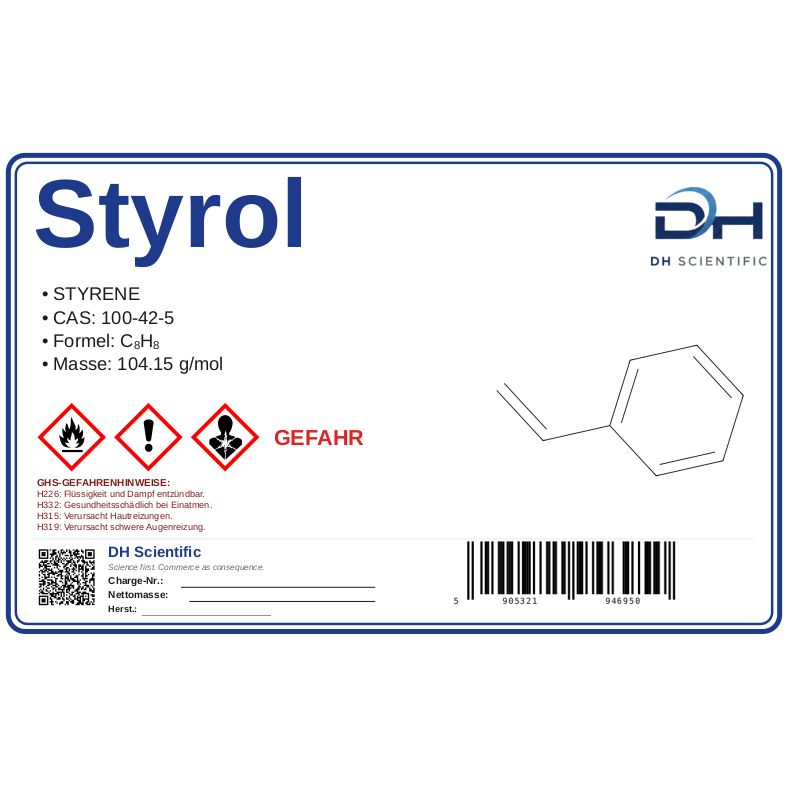
Styrol• STYRENE / Ethenylbenzene• CAS: 100-42-5• Formel: C8H8• Masse: 104.15 g/molGEFAHRGHS-GEFAHRENHINWEISE:H226: Flüssigkeit und Dampf entzündbar.H332: Gesundheitsschädlich bei Einatmen.H315: Verursacht Hautreizungen.H319: Verursacht schwere Augenreizung.DH ScientificScience first. Commerce as consequence.Charge-Nr.: Nettomasse: Herst.:
ADMET — Pharmakologisches Profil
ADMET-Vorhersagen werden geladen…
🧪 Assistent zur Lösungsherstellung (Smart Prep) MolGod_PREP_2

Geben Sie ein, was Sie zubereiten möchten — ich erstelle eine SOP

Beispiele unten — zum Einfügen anklicken:
Fertige Rezepte:
📚 Überblick über die wissenschaftliche Literatur — CAS 100-42-5MolGod_LITHUB_MAIN
⭐ Wichtigste Erkenntnisse (wissenschaftliche Literatur) 20 Publikationen
🏆 CAS 100-42-5 — multi-criteria ranking (W12): 30% Zitierungen · 20% Aktualität · 20% Thema · 15% historisch · 15% Open Access.
  1. #1
    Schloemann, M., Eulberg, D., Kaschabek, S.R. et al. (2009) · Journal of Bacteriology
    Warum es wichtig ist: 123 Zitierungen · open access
    SCORE 9.33 Pharmakologie Zitierungen: 123 Open Access DOI ↗
  2. #2
    Chunxu Zhao, Xiaohan Chen, Xian Chen (2022) · Polymers
    Warum es wichtig ist: Open access
    SCORE 7.95 Mechanismus Zitierungen: 4 Open Access DOI ↗
  3. #3
    Groning, J.A.D., Michael Schlömann, Kaschabek, S.R. et al. (2010) · American Society for Microbiology
    Warum es wichtig ist: Open access
    SCORE 7.89 Mechanismus Zitierungen: 75 Open Access DOI ↗
  4. #4
    et al. (2026) · ACS Omega
    Warum es wichtig ist: Aktuell (2026) · open access
    SCORE 7.85 Industrie Open Access DOI ↗ PubMed ↗
  5. #5
    et al. (2026) · Polymers
    Warum es wichtig ist: Aktuell (2026) · open access
    SCORE 7.85 Mechanismus Open Access DOI ↗ PubMed ↗
  6. #6
    Tianxi Li; Chaolun Pan; Dongmei Yue (2026) · Polymers
    Warum es wichtig ist: Aktuell (2026) · open access
    SCORE 7.05 Industrie Open Access DOI ↗ PubMed ↗
  7. #7
    Yanqing Cui; Qianhong Diao; Xian Liang (2026) · Materials
    Warum es wichtig ist: Aktuell (2026) · open access
    SCORE 7.05 Mechanismus Open Access DOI ↗ PubMed ↗
  8. #8
    et al. (2026) · RSC Advances
    Warum es wichtig ist: Aktuell (2026) · open access
    SCORE 6.25 Mechanismus Open Access DOI ↗ PubMed ↗
  9. #9
    et al. (2026) · Membranes
    Warum es wichtig ist: Aktuell (2026) · open access
    SCORE 6.25 Industrie Open Access DOI ↗ PubMed ↗
  10. #10
    et al. (2026) · Polymers
    Warum es wichtig ist: Aktuell (2026) · open access
    SCORE 6.25 Mechanismus Open Access DOI ↗ PubMed ↗
  11. #11
    Edirin Awana; Oyeyemi Adeyemi; Olalekan Adeyemi (2026)
    Warum es wichtig ist: Aktuell (2026) · open access
    SCORE 6.25 Industrie Open Access DOI ↗
  12. #12
    Zeng Y; Huang Y; Ye S et al. (2026) · Gut microbes
    Warum es wichtig ist: Pflichtzitat (Kanon) · aktuell (2026)
    SCORE 4 Industrie MUST-CITE DOI ↗
  13. #13
    Styrene - ToxFAQs\u2122 : CAS#: 100-42-5 [Korean]
    Warum es wichtig ist: Ausgewählt nach einem Multikriterien-Score (Zitierungen + Aktualität + Thema + historisch + OA).
    SCORE 0 Mechanismus
  14. #14
    Styrene - ToxFAQs\u2122 : CAS#: 100-42-5 [Arabic]
    Warum es wichtig ist: Ausgewählt nach einem Multikriterien-Score (Zitierungen + Aktualität + Thema + historisch + OA).
    SCORE 0 Mechanismus
  15. #15
    Styrene - ToxFAQs\u2122 : CAS#: 100-42-5 [Spanish]
    Warum es wichtig ist: Ausgewählt nach einem Multikriterien-Score (Zitierungen + Aktualität + Thema + historisch + OA).
    SCORE 0 Mechanismus
  16. #16
    Styrene - ToxFAQs\u2122 : CAS#: 100-42-5 [Hatian Creole]
    Warum es wichtig ist: Ausgewählt nach einem Multikriterien-Score (Zitierungen + Aktualität + Thema + historisch + OA).
    SCORE 0 Mechanismus
  17. #17
    Styrene - ToxFAQs\u2122 : CAS#: 100-42-5 [French]
    Warum es wichtig ist: Ausgewählt nach einem Multikriterien-Score (Zitierungen + Aktualität + Thema + historisch + OA).
    SCORE 0 Mechanismus
  18. #18
    Styrene - ToxFAQs\u2122 : CAS#: 100-42-5 [Chinese]
    Warum es wichtig ist: Ausgewählt nach einem Multikriterien-Score (Zitierungen + Aktualität + Thema + historisch + OA).
    SCORE 0 Mechanismus
  19. #19
    Styrene - ToxFAQs\u2122 : CAS#: 100-42-5 [Vietnamese]
    Warum es wichtig ist: Ausgewählt nach einem Multikriterien-Score (Zitierungen + Aktualität + Thema + historisch + OA).
    SCORE 0 Mechanismus
  20. #20
    Styrene - ToxFAQs\u2122 : CAS#: 100-42-5
    Warum es wichtig ist: Ausgewählt nach einem Multikriterien-Score (Zitierungen + Aktualität + Thema + historisch + OA).
    SCORE 0 Mechanismus
📈 HPLC-Gradient — Optimierer (LSS) VORLAGE

Gradient basierend auf PubChem XLogP3 + LSS (Snyder et al. 2010, Kap. 9).

  • Säule: C18
  • Puffer: phosphate
  • Fluss: 1 mL/min
  • logP: 2.9 (PubChem XLogP3)
  • Rampe: 28% → 95% B, 15 min
  • Gesamtanalysenzeit: 28 min
t (min) %A %B flow (mL/min) Kommentar
0 72 28 1 Start (Gleichgewicht)
2 72 28 1 Ende der Anfangshaltezeit
17 5 95 1 Ende der LSS-Rampe
22 5 95 1 Säulenspülung
23 72 28 1 Rückkehr zu init
28 72 28 1 Reäquilibrierung
📚 Wissenschaftliche Referenzen (Chicago Author-Date)
  1. Snyder, Lloyd R., John W. Dolan, and Joseph J. Kirkland. 2010. Introduction to Modern Liquid Chromatography. Wiley. — Chapter 9 — gradient elution, LSS theory (cited as Snyder et al. 2010 in tool description).
  2. Schoenmakers, Peter J. 1986. Optimization of Chromatographic Selectivity: A Guide to Method Development. Elsevier. — Numerical optimization of gradient programs.
  3. Snyder, L. R., and J. W. Dolan. 2007. High-Performance Gradient Elution: The Practical Application of the Linear-Solvent-Strength Model. Wiley. — Foundational LSS reference for the %B_init = 5 + 8·logP heuristic implemented here.
  4. Nikitas, Pavlos, and Adrian Pappa-Louisi. 2009. "Retention models for isocratic and gradient elution in reversed-phase liquid chromatography." Journal of Chromatography A 1216: 1737-1755. [DOI ↗] — Modern review of gradient retention models — basis for non-LSS extensions.
  5. Carr, Peter W.. 2009. "The new physical chemistry of HPLC." Journal of Chromatography A 1216: 1764-1772. [DOI ↗]
  6. Dong, Michael W. 2019. HPLC and UHPLC for Practicing Scientists. Wiley. https://doi.org/10.1002/9781119313793. — Modern UHPLC gradient programming, sub-2 µm scaling rules.
  7. Wu, Naijun, and Anton M. Clausen. 2007. "Fundamental and practical aspects of ultrahigh pressure liquid chromatography for fast separations." Journal of Separation Science 30: 1167-1182. [DOI ↗]
  8. Stoll, Dwight R., and Peter W. Carr. 2017. "Two-Dimensional Liquid Chromatography: A State of the Art Tutorial." Analytical Chemistry 89: 519-531. [DOI ↗] — Reference for orthogonal gradient design (2D-LC second dimension).
  9. Dolan, John W.. 2013. "When to Modify Method Conditions." LCGC North America 31: 192-199.
  10. Meyer, Veronika R. 2010. Practical High-Performance Liquid Chromatography. Wiley. — Chapter 7 — practical gradient design with isokratyczny scouting.
  11. Stoll, Dwight R., and Peter W. Carr. 2017. "Two-Dimensional Liquid Chromatography: A State of the Art Tutorial." Analytical Chemistry 89: 519-531. [DOI ↗]
  12. Carr, Peter W.. 2009. "The new physical chemistry of HPLC." Journal of Chromatography A 1216: 1764-1772. [DOI ↗]
  13. Wu, Naijun, and Anton M. Clausen. 2007. "Fundamental and practical aspects of ultrahigh pressure liquid chromatography for fast separations." Journal of Separation Science 30: 1167-1182. [DOI ↗]
  14. Engelhardt, Heinz. 2014. 100 Years of Chromatography. Wiley-VCH.
  15. Vivó-Truyols, Gabriel, and Hans-Gerd Janssen. 2010. "Probabilistic approach to peak deconvolution in chromatography." Analytical Chemistry 82: 8525-8531. [DOI ↗]

REST: /wp-json/molgod/v1/hplc/gradient/100-42-5

📐 HPLC-Peaksymmetrie-Rechner (USP Tf / As)

Berechnen Sie den USP-Tailing-Faktor (T) und die Asymmetrie (As) aus den Peak-Halbwertsbreiten. Geben Sie a (linke Halbbreite) und b (rechte Halbbreite) an, gemessen bei 5% oder 10% der Peakhöhe.

📚 Referenzen (Chicago Author-Date)
  1. USP General Chapter <621>. 2024. "Chromatography." United States Pharmacopeial Convention. [link ↗] — Defines USP Tailing Factor T = (a+b)/(2a) measured at 5% peak height.
  2. International Council for Harmonisation (ICH). 2023. "Validation of Analytical Procedures Q2(R2)." ICH Expert Working Group. [link ↗] — Tailing factor is a system suitability parameter (Section 6).
  3. Foley, Joe P., and John G. Dorsey. 1983. "Equations for calculation of chromatographic figures of merit for ideal and skewed peaks." Analytical Chemistry 55: 730-737 https://doi.org/10.1021/ac00255a033 [link ↗] — Original asymmetry factor As = b/a at 10% height (Foley & Dorsey 1983).
  4. Snyder, Lloyd R., Joseph J. Kirkland, and John W. Dolan. 2010. "Introduction to Modern Liquid Chromatography." Wiley. https://doi.org/10.1002/9780470508183 [link ↗] — Chapter 2.4 — peak shape diagnostics and remedies.
  5. Dolan, John W.. 2003. "Peak tailing and resolution." LCGC North America 21: 610-614 [link ↗] — How tailing factor degrades effective resolution.
  6. Vivó-Truyols, Gabriel, and Hans-Gerd Janssen. 2010. "Probabilistic approach to peak deconvolution in chromatography." Analytical Chemistry 82: 8525-8531 https://doi.org/10.1021/ac101742z [link ↗] — Modern numerical deconvolution for asymmetric peaks.
  7. Kromidas, Stavros. 2017. "HPLC Made to Measure: A Practical Handbook for Optimization." Wiley-VCH. — Practical Tf and As thresholds for routine QC.
  8. Dong, Michael W.. 2019. "HPLC and UHPLC for Practicing Scientists." Wiley. https://doi.org/10.1002/9781119313793 [link ↗]
  9. Meyer, Veronika R.. 2010. "Practical High-Performance Liquid Chromatography." Wiley.
  10. Heyden, Yvan Vander, et al.. 2009. "Robustness of pharmaceutical liquid chromatographic methods." Journal of Chromatography B 877: 2120-2129 https://doi.org/10.1016/j.jchromb.2008.10.052 [link ↗]
  11. Stoll, Dwight R., and Peter W. Carr. 2017. "Two-Dimensional Liquid Chromatography: A State of the Art Tutorial." Analytical Chemistry 89: 519-531 https://doi.org/10.1021/acs.analchem.6b03506 [link ↗]
  12. Carr, Peter W.. 2009. "The new physical chemistry of HPLC." Journal of Chromatography A 1216: 1764-1772 https://doi.org/10.1016/j.chroma.2008.11.094 [link ↗]
  13. Wu, Naijun, and Anton M. Clausen. 2007. "Fundamental and practical aspects of ultrahigh pressure liquid chromatography for fast separations." Journal of Separation Science 30: 1167-1182 https://doi.org/10.1002/jssc.200700026 [link ↗]
  14. Engelhardt, Heinz. 2014. "100 Years of Chromatography." Wiley-VCH.
  15. Vivó-Truyols, Gabriel, and Hans-Gerd Janssen. 2010. "Probabilistic approach to peak deconvolution in chromatography." Analytical Chemistry 82: 8525-8531 https://doi.org/10.1021/ac101742z [link ↗]
📊 Rechner für Auflösung und Bodenzahl (Rs, N, H)

Berechnen Sie die Auflösung Rs, die theoretische Bodenzahl N und HETP (H) für ein Paar von HPLC-Peaks. Geben Sie die Retentionszeiten, Peakbreiten (bei 50% oder an der Basis) und die Säulenlänge an.

📚 Referenzen (Chicago Author-Date)
  1. Snyder, Lloyd R., Joseph J. Kirkland, and John W. Dolan. 2010. "Introduction to Modern Liquid Chromatography." 3rd ed. John Wiley & Sons. ISBN 978-0-470-16754-0. https://doi.org/10.1002/9780470508183 [link ↗] — Chapter 2 covers resolution, plate count and HETP fundamentals (Snyder et al. 2010).
  2. USP General Chapter <621>. 2024. "Chromatography." USP-NF 2024 ed. United States Pharmacopeial Convention. [link ↗] — Defines Rs >= 1.5 acceptance criterion and N calculation methods.
  3. Dolan, John W.. 2003. "How much resolution is enough?." LCGC North America 21: 350-353 [link ↗] — Practical guidance on Rs targets for routine method development.
  4. Van Deemter, J. J., F. J. Zuiderweg, and A. Klinkenberg. 1956. "Longitudinal diffusion and resistance to mass transfer as causes of nonideality in chromatography." Chemical Engineering Science 5: 271-289 https://doi.org/10.1016/0009-2509(56)80003-1 [link ↗] — Origin of N = 5.54·(tr/w0.5)² half-height plate count formulation.
  5. Giddings, J. Calvin. 1965. "Dynamics of Chromatography, Part I: Principles and Theory." Marcel Dekker. ISBN 978-0-8247-1357-7. — Resolution equation Rs = (1/4)·√N·(α-1)/α·k/(1+k) (master equation).
  6. Foley, Joe P., and John G. Dorsey. 1983. "Equations for calculation of chromatographic figures of merit for ideal and skewed peaks." Analytical Chemistry 55: 730-737 https://doi.org/10.1021/ac00255a033 [link ↗] — Skewed-peak corrections to apparent N.
  7. Knox, John H.. 1977. "Practical aspects of LC theory." Journal of Chromatographic Science 15: 352-364 https://doi.org/10.1093/chromsci/15.9.352 [link ↗]
  8. Carr, Peter W.. 2009. "The new physical chemistry of HPLC." Journal of Chromatography A 1216: 1764-1772 https://doi.org/10.1016/j.chroma.2008.11.094 [link ↗]
  9. Dong, Michael W.. 2019. "HPLC and UHPLC for Practicing Scientists." 2nd ed. Wiley. ISBN 978-1-119-31378-3. https://doi.org/10.1002/9781119313793 [link ↗]
  10. Meyer, Veronika R.. 2010. "Practical High-Performance Liquid Chromatography." 5th ed. Wiley. ISBN 978-0-470-68218-0.
  11. Stoll, Dwight R., and Peter W. Carr. 2017. "Two-Dimensional Liquid Chromatography: A State of the Art Tutorial." Analytical Chemistry 89: 519-531 https://doi.org/10.1021/acs.analchem.6b03506 [link ↗]
  12. Carr, Peter W.. 2009. "The new physical chemistry of HPLC." Journal of Chromatography A 1216: 1764-1772 https://doi.org/10.1016/j.chroma.2008.11.094 [link ↗]
  13. Wu, Naijun, and Anton M. Clausen. 2007. "Fundamental and practical aspects of ultrahigh pressure liquid chromatography for fast separations." Journal of Separation Science 30: 1167-1182 https://doi.org/10.1002/jssc.200700026 [link ↗]
  14. Engelhardt, Heinz. 2014. "100 Years of Chromatography." 2nd ed. Wiley-VCH. ISBN 978-3-527-33473-5.
  15. Vivó-Truyols, Gabriel, and Hans-Gerd Janssen. 2010. "Probabilistic approach to peak deconvolution in chromatography." Analytical Chemistry 82: 8525-8531 https://doi.org/10.1021/ac101742z [link ↗]
🧪 Systemeignung — Live-Rechner (USP <621>)

Geben Sie Daten aus 5-6 Injektionen ein (Flächen, tR, Tailing, Böden) — der Rechner berechnet %RSD, Mittelwerte und prüft die Konformität mit USP <621>. Sie können CSV (kommagetrennt) einfügen oder einzelne Werte bearbeiten.

📚 Referenzen (Chicago Author-Date)
  1. USP General Chapter <621>. 2024. "Chromatography (System Suitability section)." USP-NF 2024 ed. United States Pharmacopeial Convention. [link ↗] — Defines RSD area < 2%, tailing < 2.0, N > 2000 acceptance criteria.
  2. International Council for Harmonisation (ICH). 2023. "Validation of Analytical Procedures Q2(R2)." ICH Expert Working Group. [link ↗] — Section 5.4 — system suitability is part of method validation.
  3. US Food and Drug Administration (FDA). 2018. "Reviewer Guidance: Validation of Chromatographic Methods." US Food and Drug Administration. [link ↗] — CDER reviewer perspective on chromatographic validation expectations.
  4. Snyder, Lloyd R., Joseph J. Kirkland, and John W. Dolan. 2010. "Introduction to Modern Liquid Chromatography." 3rd ed. Wiley. — Chapter 2 — system suitability fundamentals (RSD, Tf, N).
  5. Heyden, Yvan Vander, et al.. 2009. "Robustness of pharmaceutical liquid chromatographic methods." — Robustness vs. system suitability — design-of-experiments framework.
  6. Rozet, Eric, et al.. 2013. "Analysis of recent pharmaceutical regulatory documents on analytical method validation."
  7. European Medicines Agency (EMA). 2011. "Guideline on bioanalytical method validation EMEA/CHMP/EWP/192217/2009." EMA. [link ↗] — EMA companion guideline with bioanalytical SS criteria.
  8. Dong, Michael W.. 2019. "HPLC and UHPLC for Practicing Scientists." 2nd ed. Wiley. — UHPLC-specific suitability adjustments (n=5 vs. n=6).
  9. Kazakevich, Yuri V., and Rosario LoBrutto, eds.. 2007. "HPLC for Pharmaceutical Scientists." Wiley-Interscience.
  10. AOAC International. 2016. "Appendix F: Guidelines for Standard Method Performance Requirements." AOAC INTERNATIONAL. [link ↗] — Alternative SS thresholds for food/dietary samples.
  11. Stoll, Dwight R., and Peter W. Carr. 2017. "Two-Dimensional Liquid Chromatography: A State of the Art Tutorial."
  12. Carr, Peter W.. 2009. "The new physical chemistry of HPLC."
  13. Wu, Naijun, and Anton M. Clausen. 2007. "Fundamental and practical aspects of ultrahigh pressure liquid chromatography for fast separations."
  14. Engelhardt, Heinz. 2014. "100 Years of Chromatography." 2nd ed. Wiley-VCH.
  15. Vivó-Truyols, Gabriel, and Hans-Gerd Janssen. 2010. "Probabilistic approach to peak deconvolution in chromatography."
🧪 Klassische Syntheserouten1 historische RouteMolGod_SYNTH_2

Historisch verifizierte Synthesewege. Zitate im Chicago-Author-Date-Stil.

Route 1: Wittig olefination from benzaldehyde + methylenetriphenylphosphorane (1954)
Namensreaktion: Wittig reaction
Ausgangsstoffe: Benzaldehyde; methyltriphenylphosphonium bromide; n-BuLi (base) in THF
Bedingungen: -78 C ylide formation; warm to 0 C and add aldehyde; aqueous workup; distillation
Ausbeute: 70.0 %
Wittig, Georg, and Ulrich Schöllkopf. 1954. "Über Triphenyl-phosphin-methylene als olefinbildende Reagenzien." Chemische Berichte 87 (9): 1318-1330.
Allgemeine Bibliographie (Chicago):
  • March, Jerry, and Michael B. Smith. 2020. "March's Advanced Organic Chemistry: Reactions, Mechanisms, and Structure." 8th ed. Wiley.
  • Carey, Francis A., and Richard J. Sundberg. 2007. "Advanced Organic Chemistry, Part B: Reactions and Synthesis." 5th ed. Springer.
  • Corey, E. J., and Xue-Min Cheng. 1995. "The Logic of Chemical Synthesis." Wiley.
  • Greene, Theodora W., and Peter G. M. Wuts. 2014. "Greene's Protective Groups in Organic Synthesis." 5th ed. Wiley.
  • Smith, Michael B. 2020. "Organic Synthesis." 4th ed. Academic Press.
  • Carey, Francis A., and Richard J. Sundberg. 2007. "Advanced Organic Chemistry, Part A: Structure and Mechanisms." 5th ed. New York: Springer.
  • Anslyn, Eric V., and Dennis A. Dougherty. 2006. Modern Physical Organic Chemistry. Sausalito, CA: University Science Books.
  • Bretherick, Leslie. 1990. Bretherick's Handbook of Reactive Chemical Hazards. 4th ed. London: Butterworths.
  • Urben, Peter, ed. 2017. Bretherick's Handbook of Reactive Chemical Hazards. 8th ed. Oxford: Butterworth-Heinemann.
  • Yoshida, Tadao, Yusaku Iwata, Hiroshi Itoh, and Mitsuru Arai. 2009. Safe Storage of Reactive Chemicals. New York: Plenum Press.
  • Mortimer, Charles E. 2005. Chemistry: A Conceptual Approach. 9th ed. Belmont, CA: Wadsworth.
  • Engel, Thomas, and Philip Reid. 2013. Physical Chemistry. 3rd ed. Boston: Pearson.
  • Steinfeld, Jeffrey I., Joseph S. Francisco, and William L. Hase. 1998. Chemical Kinetics and Dynamics. 2nd ed. Upper Saddle River, NJ: Prentice Hall.
  • Houston, Paul L. 2001. Chemical Kinetics and Reaction Dynamics. New York: McGraw-Hill.
  • Eyring, Henry. 1935. "The Activated Complex in Chemical Reactions." Journal of Chemical Physics 3 (2): 107–115. https://doi.org/10.1063/1.1749604.
  • Kresge, A. Jerry. 2001. "Reaction kinetics in 100-year-old laboratories." Chemical Society Reviews 30 (4): 197–200. https://doi.org/10.1039/B100445F.
  • Brönsted, J. N. 1929. "Acid and Basic Catalysis." Chemical Reviews 5 (3): 231–338. https://doi.org/10.1021/cr60019a001.
  • Larock, Richard C. 2018. Comprehensive Organic Transformations: A Guide to Functional Group Preparations. 3rd ed. Hoboken, NJ: John Wiley & Sons.
  • Mundy, Bradford P., Michael G. Ellerd, and Frank G. Favaloro Jr. 2005. Name Reactions and Reagents in Organic Synthesis. 2nd ed. Hoboken, NJ: Wiley-Interscience.
  • Li, Jie Jack. 2014. Name Reactions: A Collection of Detailed Mechanisms and Synthetic Applications. 5th ed. Heidelberg: Springer.
  • Kürti, László, and Barbara Czakó. 2005. Strategic Applications of Named Reactions in Organic Synthesis. Burlington, MA: Elsevier Academic Press.
  • Trost, Barry M., and Ian Fleming, eds. 1991. Comprehensive Organic Synthesis: Selectivity, Strategy, and Efficiency in Modern Organic Chemistry. 9 vols. Oxford: Pergamon Press.
  • Ojima, Iwao, ed. 2010. Catalytic Asymmetric Synthesis. 3rd ed. Hoboken, NJ: John Wiley & Sons.
  • Jacobsen, Eric N., Andreas Pfaltz, and Hisashi Yamamoto, eds. 1999. Comprehensive Asymmetric Catalysis. 3 vols. Berlin: Springer.
  • Hartwig, John F. 2010. Organotransition Metal Chemistry: From Bonding to Catalysis. Sausalito, CA: University Science Books.
  • Crabtree, Robert H. 2014. The Organometallic Chemistry of the Transition Metals. 6th ed. Hoboken, NJ: John Wiley & Sons.
  • Negishi, Ei-ichi, ed. 2002. Handbook of Organopalladium Chemistry for Organic Synthesis. 2 vols. New York: Wiley-Interscience.
  • de Meijere, Armin, and François Diederich, eds. 2004. Metal-Catalyzed Cross-Coupling Reactions. 2nd ed. 2 vols. Weinheim: Wiley-VCH.
  • Berkessel, Albrecht, and Harald Gröger. 2005. Asymmetric Organocatalysis: From Biomimetic Concepts to Applications in Asymmetric Synthesis. Weinheim: Wiley-VCH.
  • Dalko, Peter I., ed. 2007. Enantioselective Organocatalysis: Reactions and Experimental Procedures. Weinheim: Wiley-VCH.
  • List, Benjamin, Richard A. Lerner, and Carlos F. Barbas III. 2000. "Proline-catalyzed direct asymmetric aldol reactions." Journal of the American Chemical Society 122 (10): 2395–2396. https://doi.org/10.1021/ja994280y.
  • MacMillan, David W. C. 2008. "The advent and development of organocatalysis." Nature 455 (7211): 304–308. https://doi.org/10.1038/nature07367.
  • Noyori, Ryōji. 2002. "Asymmetric catalysis: science and opportunities (Nobel lecture)." Angewandte Chemie International Edition 41 (12): 2008–2022. https://doi.org/10.1002/1521-3773(20020617)41:12<2008::AID-ANIE2008>3.0.CO;2-4.
  • Sharpless, K. Barry. 2002. "Searching for new reactivity (Nobel lecture)." Angewandte Chemie International Edition 41 (12): 2024–2032. https://doi.org/10.1002/1521-3773(20020617)41:12<2024::AID-ANIE2024>3.0.CO;2-O.
  • Knowles, William S. 2002. "Asymmetric hydrogenations (Nobel lecture)." Angewandte Chemie International Edition 41 (12): 1998–2007. https://doi.org/10.1002/1521-3773(20020617)41:12<1998::AID-ANIE1998>3.0.CO;2-8.
  • Grubbs, Robert H. 2006. "Olefin-metathesis catalysts for the preparation of molecules and materials (Nobel lecture)." Angewandte Chemie International Edition 45 (23): 3760–3765. https://doi.org/10.1002/anie.200600680.
  • Schrock, Richard R. 2006. "Multiple metal-carbon bonds for catalytic metathesis reactions (Nobel lecture)." Angewandte Chemie International Edition 45 (23): 3748–3759. https://doi.org/10.1002/anie.200600085.
  • Suzuki, Akira. 2011. "Cross-coupling reactions of organoboranes: an easy way to construct C-C bonds (Nobel lecture)." Angewandte Chemie International Edition 50 (30): 6722–6737. https://doi.org/10.1002/anie.201101379.
  • Negishi, Ei-ichi. 2011. "Magical power of transition metals: past, present, and future (Nobel lecture)." Angewandte Chemie International Edition 50 (30): 6738–6764. https://doi.org/10.1002/anie.201101380.
  • List, Benjamin, and David W. C. MacMillan. 2022. "Asymmetric organocatalysis (Nobel lecture)." Angewandte Chemie International Edition 61 (38): e202205927. https://doi.org/10.1002/anie.202205927.
  • Bertozzi, Carolyn R., Morten Meldal, and K. Barry Sharpless. 2023. "Click chemistry and bioorthogonal chemistry (Nobel lectures)." Angewandte Chemie International Edition 62 (16): e202300332. https://doi.org/10.1002/anie.202300332.
  • Weissermel, Klaus, and Hans-Jürgen Arpe. 2003. Industrial Organic Chemistry. 4th ed. Weinheim: Wiley-VCH.
  • Wittcoff, Harold A., Bryan G. Reuben, and Jeffrey S. Plotkin. 2013. Industrial Organic Chemicals. 3rd ed. Hoboken, NJ: John Wiley & Sons.
  • Appl, Max. 2006. "Ammonia, 2. Production Processes." In Ullmann's Encyclopedia of Industrial Chemistry. Weinheim: Wiley-VCH. https://doi.org/10.1002/14356007.o02_o11.
  • Thiemann, Michael, Erich Scheibler, and Karl Wilhelm Wiegand. 2000. "Nitric Acid, Nitrous Acid, and Nitrogen Oxides." In Ullmann's Encyclopedia of Industrial Chemistry. Weinheim: Wiley-VCH. https://doi.org/10.1002/14356007.a17_293.
  • Hocking, Martin B. 2005. Handbook of Chemical Technology and Pollution Control. 3rd ed. Burlington, MA: Academic Press.
  • Corey, E. J., and László Kürti. 2010. Enantioselective Chemical Synthesis: Methods, Logic, and Practice. Direct Book Publishing.
  • Nicolaou, K. C., and E. J. Sorensen. 1996. Classics in Total Synthesis: Targets, Strategies, Methods. Weinheim: VCH.
  • Nicolaou, K. C., and Jason S. Chen. 2011. Classics in Total Synthesis III: Further Targets, Strategies, Methods. Weinheim: Wiley-VCH.
  • House, Herbert O. 1972. Modern Synthetic Reactions. 2nd ed. Menlo Park, CA: W. A. Benjamin.
  • Organic Syntheses, Inc. 2024. "Organic Syntheses Collective Volumes 1–10 (1932–2004) and Annual Volumes 1–100 (1922–2024)." Hoboken, NJ: Wiley. https://www.orgsyn.org/.
  • Paquette, Leo A., David Crich, Philip L. Fuchs, Gary A. Molander, and Andre B. Charette, eds. 2009. Encyclopedia of Reagents for Organic Synthesis (e-EROS). 2nd ed. Hoboken, NJ: Wiley. https://onlinelibrary.wiley.com/doi/book/10.1002/047084289X.
Erweiterte Bibliografie — 7 Quellen (PubMed/CrossRef/EuropePMC)
  • PUBSeidl S; Patra AP; Li C; Becker-Baldus J; Kaiser S; Reinhart C. 2026. "Detection of an Antagonist Bound to the Neurokinin a Receptor in Styrene-Maleic Acid Lipid Particles by (19)F Ultrafast Magic-Angle Spinning Nuclear Magnetic Resonance Spectroscopy." Chembiochem : a European journal of chemical biology. https://doi.org/10.1002/cbic.202500963.
  • PUBMaidarjav A; Nyamjav I; Lee E; Jeon S; Kim HR; Cho JH. 2026. "Biotransformation of Acrylonitrile-Butadiene-Styrene Using Brevibacillus nitrificans isolated from Effective Microorganisms." Journal of microbiology and biotechnology. https://doi.org/10.4014/jmb.2601.01046.
  • PUBWang A; Xu J; Sun J; Ma J; Wang L; Liu X. 2026. "Enrichment and Preservation of Urine Metabolites Using Styrene Divinylbenzene Reversed Phase Sulfonate (SDB-RPS) Disks for Enhanced Biomarker Discovery and Disease Monitoring." Journal of proteome research. https://doi.org/10.1021/acs.jproteome.5c00367.
  • PUBZeng Y; Huang Y; Ye S; Lau EYT; Chiu MC; Fenske L. 2026. "Novel bacterium Enterocloster sp. M3 promotes colorectal tumorigenesis via the production of the carcinogen styrene." Gut microbes. https://doi.org/10.1080/19490976.2026.2630481.
  • PUBAdam MSS. 2025. "Synthesis and characterization of Fe(II)- and Cr(II)-complexes with isatin-aryl hydrazone ligand as bio-reactive reagents and effective catalysts for styrene epoxidation." Bioorganic chemistry. https://doi.org/10.1016/j.bioorg.2025.108625.
  • PUBNowacki M; Hoffmann M; Wałęsa-Chorab M. 2025. "Photopolymerization of Styrene-Naphthalenediimide Monomer: Formation of Pattern and Electrochromism." International journal of molecular sciences. https://doi.org/10.3390/ijms26104807.
  • PUBOkorafor EA; Gordon EA; Sahu ID; Shah MZ; Konkolewicz D; Lorigan GA. 2025. "Influence of lipid saturation on the structural properties of styrene maleic acid lipid nanoparticles (SMALPs)." Biochimica et biophysica acta. Biomembranes. https://doi.org/10.1016/j.bbamem.2025.184424.
📤 Betten Sie dieses Molekül auf Ihrer Website ein

Haben Sie einen Blog, ein Forum oder einen wissenschaftlichen Dienst? Betten Sie das interaktive 3D-Molekül auf Ihrer Website ein — jeder Ihrer Leser sieht es, und darunter gibt es einen Link zu unserem Shop, wo er das Reagenz kaufen kann.

🔗 HTML-iframe-Code (am einfachsten — funktioniert überall)

Kopieren Sie ihn und fügen Sie ihn in den HTML-Editor Ihrer Website ein:

Passen Sie width und height an Ihr Layout an.

⚙ WordPress Shortcode (für andere Shops mit MOL-GOD)

🌐 Direktlink (für E-Mails, Chats, LinkedIn, Twitter)

LinkedIn Twitter/X Facebook
QR code CAS 100-42-5

📱 QR code (zum Druck auf Flyern / Etiketten / Katalogen)

Platzieren Sie ihn in einem Produktkatalog, auf einem Flaschenetikett oder einem Flyer. Der Kunde scannt ihn — sieht das 3D-Molekül auf seinem Telefon, mit einem Link zu Ihrem Shop.

⬇ PNG herunterladen

🖼 Open Graph image (für Social-Media-Meta-Tags)

Wenn Sie den Link teilen, ruft Facebook/LinkedIn/Discord automatisch die Bildvorschau ab:

Preview
📋 Lizenz: Der Embed behält einen Backlink zu DH Scientific (erforderlich — der Shop ist die Datenquelle). Chemische Daten stammen von PubChem (CC0 — gemeinfrei). Der Embed ist KOSTENLOS für Bildungs-, kommerzielle und Hobbyzwecke.
📚 REFERENZEN (Gesammelte Bibliografie, Chicago Author-Date) 107 Einträge

Alle wissenschaftlichen Quellen, die in den Akkordeons oben für CAS 100-42-5 zitiert werden.Format: Chicago Manual of Style, 17. Aufl., Autor-Datum-System.

🗄️ Wissenschaftliche Datenbanken

  1. NIST. 2026. NIST Chemistry WebBook: CAS 100-42-5. Gaithersburg, MD: National Institute of Standards and Technology. https://webbook.nist.gov/cgi/cbook.cgi?ID=100-42-5. (Accessed 2026-11-12.)
  2. AIST. 2026. Spectral Database for Organic Compounds (SDBS): CAS 100-42-5. Tsukuba, Japan: National Institute of Advanced Industrial Science and Technology. https://sdbs.db.aist.go.jp/. (Accessed 2026-11-12.)
  3. PubChem. 2026. PubChem Compound Summary: CAS 100-42-5. Bethesda, MD: National Center for Biotechnology Information (NCBI), National Library of Medicine. https://pubchem.ncbi.nlm.nih.gov/#query=100-42-5. (Accessed 2026-11-12.)
  4. ECHA. 2026. C&L Inventory and REACH Registration: CAS 100-42-5. Helsinki: European Chemicals Agency. https://echa.europa.eu/information-on-chemicals/annex-vi-to-clp. (Accessed 2026-11-12.)

📐 Standards / Richtlinien

  1. ICH. 2026. "ICH Harmonised Guideline: CAS 100-42-5." Geneva: International Council for Harmonisation. https://database.ich.org/sites/default/files/Q1A%28R2%29%20Guideline.pdf. (Accessed 2026-11-12.)
  2. National Fire Protection Association (NFPA). 2024. "NFPA 30: Flammable and Combustible Liquids Code." NFPA, Quincy, MA. https://www.nfpa.org/codes-and-standards/all-codes-and-standards/list-of-codes-and-standards/detail?code=30.
  3. Occupational Safety and Health Administration (OSHA). 2023. "29 CFR 1910.106 — Flammable Liquids." U.S. Department of Labor, Federal Register. https://www.osha.gov/laws-regs/regulations/standardnumber/1910/1910.106.
  4. European Chemicals Agency (ECHA). 2024. "Annex VI to Regulation (EC) No 1272/2008 (CLP) — Harmonised Classification and Labelling." ECHA, Helsinki / Official Journal of the European Union. https://echa.europa.eu/regulations/clp/clp-classification.
  5. European Committee for Standardization (CEN). 2016. "EN 374-1:2016 — Protective gloves against dangerous chemicals and micro-organisms — Part 1: Terminology and performance requirements for chemical risks." CEN, Brussels. https://standards.cencenelec.eu/dyn/www/f?p=205:110:::::FSP_PROJECT,FSP_ORG_ID:38536,6080&cs=1B0DAA8B85DF42E4A2C70E5D71F0BFA32.
  6. European Committee for Standardization (CEN). 2001. "EN 166:2001 — Personal eye-protection — Specifications." CEN, Brussels. https://standards.cencenelec.eu/dyn/www/f?p=CEN:110:0::::FSP_PROJECT:6541&cs=1F1A4E0A78C4DB6A28DBE2E8C29D89DCF.
  7. European Committee for Standardization (CEN). 2009. "EN 14605:2005+A1:2009 — Protective clothing against liquid chemicals — Performance requirements for clothing with liquid-tight (Type 3) or spray-tight (Type 4) connections." CEN, Brussels. https://standards.cencenelec.eu/dyn/www/f?p=CEN:110:0::::FSP_PROJECT:21581&cs=1A04A2D3C7CC58E9E6CB58D55F7EBFB7E.
  8. National Institute for Occupational Safety and Health (NIOSH). 2017. "Recommendations for Chemical Protective Clothing: A Companion to the NIOSH Pocket Guide." U.S. Department of Health & Human Services / CDC. https://www.cdc.gov/niosh/ncpc/default.html.
  9. Occupational Safety and Health Administration (OSHA). 2011. "Personal Protective Equipment — General requirements." U.S. Department of Labor — 29 CFR 1910.132. https://www.osha.gov/laws-regs/regulations/standardnumber/1910/1910.132.

📖 Bücher

  1. Hansen, Charles M. 2007. Hansen Solubility Parameters: A User's Handbook, 2nd ed.. Boca Raton, FL: CRC Press. https://www.routledge.com/Hansen-Solubility-Parameters-A-Users-Handbook/Hansen/p/book/9780849372483.
  2. Barton, Allan F. M. 1991. CRC Handbook of Solubility Parameters and Other Cohesion Parameters: 2nd ed.. Boca Raton, FL: CRC Press. https://www.routledge.com/CRC-Handbook-of-Solubility-Parameters-and-Other-Cohesion-Parameters/Barton/p/book/9780849301766.
  3. Connors, Kenneth A., Gordon L. Amidon, and Valentino J. Stella. 1986. Chemical Stability of Pharmaceuticals: A Handbook for Pharmacists, 2nd ed.. New York: Wiley. https://doi.org/10.1002/0471734683.
  4. Rumble, John R., ed. 2019. CRC Handbook of Chemistry and Physics: 100th Edition. Boca Raton, FL: CRC Press. https://hbcp.chemnetbase.com/.
  5. Urben, Peter G. 2017. Bretherick's Handbook of Reactive Chemical Hazards, 8th Edition. Academic Press / Elsevier, Oxford. https://www.sciencedirect.com/book/9780081010594.

📘 Monografien

  1. IARC. 2026. IARC Monographs on the Identification of Carcinogenic Hazards to Humans: CAS 100-42-5. Lyon, France: International Agency for Research on Cancer, World Health Organization. https://monographs.iarc.who.int/list-of-classifications/. (Accessed 2026-11-12.)

📄 Wissenschaftliche Artikel (peer-reviewed)

  1. Stefanis, Emmanuel, and Costas Panayiotou. 2008. "Prediction of Hansen Solubility Parameters with a New Group-Contribution Method." International Journal of Thermophysics 29: 568-585. https://doi.org/10.1007/s10765-008-0415-z.
  2. Stoll, Vincent S., and John S. Blanchard. 1990. "Buffers: Principles and Practice: In Methods in Enzymology, vol. 182." San Diego: Academic Press. https://doi.org/10.1016/0076-6879(90)82008-P.

🌐 Websites

  1. ECHA. 2023. "Guidance on the Application of the CLP Criteria." European Chemicals Agency. https://echa.europa.eu/guidance-documents/guidance-on-clp.
  2. European Parliament. 2006. "Regulation (EC) No 1907/2006 (REACH)." Official Journal of the European Union L 396: 1–849.
  3. ECHA. 2023. "Candidate List of Substances of Very High Concern for Authorisation." European Chemicals Agency. https://echa.europa.eu/candidate-list-table.
  4. European Parliament. 2008. "Regulation (EC) No 1272/2008 on Classification, Labelling and Packaging of Substances and Mixtures (CLP)." Official Journal of the European Union L 353: 1–1355.
  5. ECHA. 2017. "Guidance on the Compilation of Safety Data Sheets." Version 3.1. European Chemicals Agency. ECHA-17-G-01-EN. https://echa.europa.eu/documents/10162/23047722/sds_en.pdf.
  6. ECHA. 2022. "Restrictions Under REACH — Annex XVII." European Chemicals Agency. https://echa.europa.eu/substances-restricted-under-reach.
  7. United Nations. 2021. Globally Harmonized System of Classification and Labelling of Chemicals (GHS). 9th revised ed. ST/SG/AC.10/30/Rev.9. New York and Geneva: United Nations. https://unece.org/ghs-rev9-2021.
  8. ECHA. 2020. "Understanding REACH." European Chemicals Agency. https://echa.europa.eu/regulations/reach/understanding-reach.
  9. U.S. OSHA. 2026. "Occupational Safety and Health Guidance: CAS 100-42-5." Washington, DC: U.S. Occupational Safety and Health Administration. https://www.osha.gov/hazwoper. (Accessed 2026-11-12.)
  10. National Fire Protection Association (2018) — NFPA 472: Standard for Competence of Responders to Hazardous Materials/Weapons of Mass Destruction Incidents https://www.nfpa.org/codes-and-standards/nfpa-472.
  11. European Union. 2026. "EUR-Lex Legal Database: CAS 100-42-5." Luxembourg: Publications Office of the European Union. https://eur-lex.europa.eu/legal-content/EN/TXT/?uri=celex:32012L0018. (Accessed 2026-11-12.)
  12. U.S. National Institute for Occupational Safety and Health (2024) — NIOSH Pocket Guide to Chemical Hazards https://www.cdc.gov/niosh/npg/.
  13. Snyder, Lloyd R., John W. Dolan, and Joseph J. Kirkland. 2010. Introduction to Modern Liquid Chromatography. Wiley.
  14. Schoenmakers, Peter J.. 1986. Optimization of Chromatographic Selectivity: A Guide to Method Development. Elsevier.
  15. Snyder, L. R., and J. W. Dolan. 2007. High-Performance Gradient Elution: The Practical Application of the Linear-Solvent-Strength Model. Wiley.
  16. Nikitas, Pavlos, and Adrian Pappa-Louisi. 2009. "Retention models for isocratic and gradient elution in reversed-phase liquid chromatography." Journal of Chromatography A 1216: 1737-1755. https://doi.org/10.1016/j.chroma.2008.10.005.
  17. Carr, Peter W.. 2009. "The new physical chemistry of HPLC." Journal of Chromatography A 1216: 1764-1772. https://doi.org/10.1016/j.chroma.2008.11.094.
  18. Dong, Michael W.. 2019. HPLC and UHPLC for Practicing Scientists. Wiley. https://doi.org/10.1002/9781119313793.
  19. Wu, Naijun, and Anton M. Clausen. 2007. "Fundamental and practical aspects of ultrahigh pressure liquid chromatography for fast separations." Journal of Separation Science 30: 1167-1182. https://doi.org/10.1002/jssc.200700026.
  20. Dolan, John W.. 2013. "When to Modify Method Conditions." LCGC North America 31: 192-199. https://www.chromatographyonline.com/view/when-modify-method-conditions.
  21. Meyer, Veronika R.. 2010. Practical High-Performance Liquid Chromatography. Wiley.
  22. Engelhardt, Heinz. 2014. 100 Years of Chromatography. Wiley-VCH.
  23. Vivó-Truyols, Gabriel, and Hans-Gerd Janssen. 2010. "Probabilistic approach to peak deconvolution in chromatography." Analytical Chemistry 82: 8525-8531. https://doi.org/10.1021/ac101742z.
  24. Van Deemter, J. J., F. J. Zuiderweg, and A. Klinkenberg. 1956. "Longitudinal diffusion and resistance to mass transfer as causes of nonideality in chromatography." https://doi.org/10.1016/0009-2509(56)80003-1.
  25. Giddings, J. Calvin. 1965. "Dynamics of Chromatography, Part I: Principles and Theory." Marcel Dekker.
  26. Poppe, Hans. 1997. "Some reflections on speed and efficiency of modern chromatographic methods." https://doi.org/10.1016/S0021-9673(97)00376-2.
  27. Wu, Naijun, and Anton M. Clausen. 2007. "Fundamental and practical aspects of ultrahigh pressure liquid chromatography for fast separations." https://doi.org/10.1002/jssc.200700026.
  28. Carr, Peter W.. 2009. "The new physical chemistry of HPLC." https://doi.org/10.1016/j.chroma.2008.11.094.
  29. Knox, John H.. 1977. "Practical aspects of LC theory." https://doi.org/10.1093/chromsci/15.9.352.
  30. Snyder, L. R., J. J. Kirkland, and J. L. Glajch. 1997. "Practical HPLC Method Development." Wiley.
  31. Vivó-Truyols, Gabriel, and Hans-Gerd Janssen. 2010. "Probabilistic approach to peak deconvolution in chromatography." https://doi.org/10.1021/ac101742z.
  32. Sadek, Paul C.. 2002. "The HPLC Solvent Guide." Wiley-Interscience.
  33. Snyder, L. R.. 1978. "Classification of the solvent properties of common liquids." https://doi.org/10.1093/chromsci/16.6.223.
  34. Reichardt, Christian, and Thomas Welton. 2010. "Solvents and Solvent Effects in Organic Chemistry." Wiley-VCH.
  35. Vailaya, Anant, and Csaba Horváth. 1998. "Retention thermodynamics in hydrophobic interaction chromatography." https://doi.org/10.1021/ie980212h.
  36. Krstulović, Andrea M., and Phyllis R. Brown. 1981. "Reversed-phase High-Performance Liquid Chromatography." Wiley.
  37. Boysen, Reinhard I., and Milton T. W. Hearn. 2009. "Multi-modal HPLC of proteins." https://doi.org/10.1093/chromsci/47.8.645.
  38. USP General Chapter <621>. 2024. "Chromatography." United States Pharmacopeial Convention. https://www.usp.org/harmonization-standards/pdg/general-chapters/chromatography.
  39. Foley, Joe P., and John G. Dorsey. 1983. "Equations for calculation of chromatographic figures of merit for ideal and skewed peaks." https://doi.org/10.1021/ac00255a033.
  40. Snyder, Lloyd R., Joseph J. Kirkland, and John W. Dolan. 2010. "Introduction to Modern Liquid Chromatography." Wiley. https://doi.org/10.1002/9780470508183.
  41. Dolan, John W.. 2003. "Peak tailing and resolution." https://www.chromatographyonline.com/view/peak-tailing-and-resolution.
  42. Kromidas, Stavros. 2017. "HPLC Made to Measure: A Practical Handbook for Optimization." Wiley-VCH.
  43. Heyden, Yvan Vander, et al.. 2009. "Robustness of pharmaceutical liquid chromatographic methods." https://doi.org/10.1016/j.jchromb.2008.10.052.
  44. United States Pharmacopeial Convention. 2024. "USP <621> Chromatography." In United States Pharmacopeia and National Formulary, USP 47-NF 42. Rockville, MD: USP. https://www.uspnf.com/.
  45. European Pharmacopoeia Commission. 2024. "2.2.46 Chromatographic Separation Techniques." In European Pharmacopoeia, 11th ed. Strasbourg: Council of Europe — EDQM. https://www.edqm.eu/en/european-pharmacopoeia-ph-eur-11th-edition.
  46. International Organization for Standardization. 2017. "ISO/IEC 17025:2017 General Requirements for the Competence of Testing and Calibration Laboratories." Geneva: ISO. https://www.iso.org/standard/66912.html.
  47. Kolthoff, Izaak Maurits, and Philip J. Elving, eds. 1978. Treatise on Analytical Chemistry, Part I: Theory and Practice. 2nd ed. New York: Wiley-Interscience.
  48. Skoog, Douglas A., F. James Holler, and Stanley R. Crouch. 2018. Principles of Instrumental Analysis. 7th ed. Boston: Cengage Learning.
  49. Christian, Gary D., Purnendu K. Dasgupta, and Kevin A. Schug. 2014. Analytical Chemistry. 7th ed. Hoboken, NJ: Wiley.
  50. EURACHEM/CITAC. 2012. "Quantifying Uncertainty in Analytical Measurement." 3rd ed. EURACHEM/CITAC Guide CG 4. https://www.eurachem.org/images/stories/Guides/pdf/QUAM2012_P1.pdf.
  51. Snyder, Lloyd R., Joseph J. Kirkland, and John W. Dolan. 2010. "Introduction to Modern Liquid Chromatography." John Wiley & Sons. https://doi.org/10.1002/9780470508183.
  52. Dolan, John W.. 2003. "How much resolution is enough?." https://www.chromatographyonline.com/view/how-much-resolution-enough.
  53. USP General Chapter <621>. 2024. "Chromatography (System Suitability section)." United States Pharmacopeial Convention. https://www.usp.org/harmonization-standards/pdg/general-chapters/chromatography.
  54. U.S. FDA. 2026. "FDA Guidance and Resources: CAS 100-42-5." Silver Spring, MD: U.S. Food and Drug Administration. https://www.fda.gov/media/74954/download. (Accessed 2026-11-12.)
  55. Rozet, Eric, et al.. 2013. "Analysis of recent pharmaceutical regulatory documents on analytical method validation." https://doi.org/10.1016/j.chroma.2007.03.111.
  56. European Medicines Agency (EMA). 2011. "Guideline on bioanalytical method validation EMEA/CHMP/EWP/192217/2009." EMA. https://www.ema.europa.eu/en/documents/scientific-guideline/guideline-bioanalytical-method-validation_en.pdf.
  57. Kazakevich, Yuri V., and Rosario LoBrutto, eds.. 2007. "HPLC for Pharmaceutical Scientists." Wiley-Interscience. https://doi.org/10.1002/9780470087954.
  58. AOAC International. 2016. "Appendix F: Guidelines for Standard Method Performance Requirements." AOAC INTERNATIONAL. https://www.aoac.org/wp-content/uploads/2019/08/app_f.pdf.
  59. International Organization for Standardization. 1994. "ISO 5725-2:1994 Accuracy (Trueness and Precision) of Measurement Methods and Results — Part 2: Basic Method for the Determination of Repeatability and Reproducibility of a Standard Measurement Method." Geneva: ISO. https://www.iso.org/standard/11834.html.
  60. Grubbs, Frank E. 1950. "Sample Criteria for Testing Outlying Observations." Annals of Mathematical Statistics 21 (1): 27–58.
  61. Dixon, Wilfrid J. 1950. "Analysis of Extreme Values." Annals of Mathematical Statistics 21 (4): 488–506.
  62. Snedecor, George W., and William G. Cochran. 1989. Statistical Methods. 8th ed. Ames, IA: Iowa State University Press.
  63. Student [William Sealy Gosset]. 1908. "The Probable Error of a Mean." Biometrika 6 (1): 1–25.
  64. International Organization for Standardization. 2005. "ISO 3534-1:2006 Statistics — Vocabulary and Symbols — Part 1: General Statistical Terms and Terms Used in Probability." Geneva: ISO. https://www.iso.org/standard/40145.html.
  65. Thompson, Michael, Stephen L. R. Ellison, and Roger Wood. 2002. "Harmonized Guidelines for Single-Laboratory Validation of Methods of Analysis." Pure and Applied Chemistry 74 (5): 835–855.
  66. United Nations Economic Commission for Europe. 2024. European Agreement Concerning the International Carriage of Dangerous Goods by Road (ADR), Applicable as from 1 January 2025 (ECE/TRANS/352). Geneva: UNECE. https://unece.org/transport/dangerous-goods/adr-2025-edition.
  67. International Air Transport Association. 2026. Dangerous Goods Regulations (DGR). 67th ed. Montreal: IATA. https://www.iata.org/en/programs/cargo/dgr/.
  68. International Maritime Organization. 2024. International Maritime Dangerous Goods (IMDG) Code, 2024 Edition (Amendment 42-24). London: IMO. https://www.imo.org/en/OurWork/Safety/Pages/DangerousGoods-default.aspx.
  69. United Nations. 2025. Recommendations on the Transport of Dangerous Goods: Model Regulations (Orange Book). 24th revised ed. ST/SG/AC.10/1/Rev.24. New York and Geneva: United Nations. https://unece.org/transport/dangerous-goods/un-model-regulations.
  70. International Civil Aviation Organization. 2025. Technical Instructions for the Safe Transport of Dangerous Goods by Air (Doc 9284). 2025–2026 ed. Montreal: ICAO. https://www.icao.int/safety/DangerousGoods/Pages/technical-instructions.aspx.
  71. United States Pharmacopeia (USP) Convention. 2024. "USP General Chapter <621> Chromatography." USP. https://www.usp.org/sites/default/files/usp/document/harmonization/gen-chapter/g05_pf_30_4_2004.pdf.
  72. European Medicines Agency (EMA). 2011. "Guideline on bioanalytical method validation EMEA/CHMP/EWP/192217/2009." EMA Committee for Medicinal Products for Human Use. https://www.ema.europa.eu/en/documents/scientific-guideline/guideline-bioanalytical-method-validation_en.pdf.
  73. Sejm RP. 2026. "Internetowy System Aktow Prawnych (ISAP): CAS 100-42-5." Warszawa: Kancelaria Sejmu Rzeczypospolitej Polskiej. https://isap.sejm.gov.pl/isap.nsf/DocDetails.xsp?id=WDU20200000010. (Accessed 2026-11-12.)
  74. Ministerstwo Klimatu i Srodowiska. 2026. "Baza Danych o Odpadach (BDO): CAS 100-42-5." Warszawa: Ministerstwo Klimatu i Srodowiska. https://bdo.mos.gov.pl/. (Accessed 2026-11-12.)
  75. Pohanish, Richard P.. 2017. "Sittig's Handbook of Toxic and Hazardous Chemicals and Carcinogens." Elsevier.
  76. Lewis, Richard J.. 2012. "Sax's Dangerous Properties of Industrial Materials." Wiley.
  77. NIOSH. 2024. "Pocket Guide to Chemical Hazards." U.S. Department of Health and Human Services. https://www.cdc.gov/niosh/npg/.
  78. United Nations Economic Commission for Europe (UNECE). 2023. "European Agreement concerning the International Carriage of Dangerous Goods by Road (ADR 2025)." UNECE. https://unece.org/transport/standards/transport/dangerous-goods/adr-2025.
  79. IPCS INCHEM. 2024. "International Programme on Chemical Safety — Waste Management Guidelines." WHO/UNEP/ILO. https://www.inchem.org/.
  80. International Organization for Standardization. 2017. "ISO/IEC 17025:2017 General requirements for the competence of testing and calibration laboratories." ISO. https://www.iso.org/standard/66912.html.
  81. World Health Organization. 2010. "WHO Good Manufacturing Practices for Pharmaceutical Products: Main Principles (WHO Technical Report Series No. 957, Annex 3)." WHO Press. https://www.who.int/publications/m/item/trs957-annex3.
  82. European Medicines Agency. 2014. "Guideline on Process Validation for Finished Products — Information and Data to Be Provided EMA/CHMP/CVMP/QWP/BWP/70278/2012." European Medicines Agency. https://www.ema.europa.eu/en/documents/scientific-guideline/guideline-process-validation-finished-products-information-data-be-provided-regulatory-submissions-revision-1_en.pdf.
  83. United States Pharmacopeial Convention. 2024. "United States Pharmacopeia and National Formulary, USP 47-NF 42." USP. https://www.uspnf.com/.
  84. European Pharmacopoeia Commission. 2024. "European Pharmacopoeia 11th Edition." Council of Europe — EDQM. https://www.edqm.eu/en/european-pharmacopoeia-ph-eur-11th-edition.
  85. Pharmaceutical Inspection Co-operation Scheme (PIC/S). 2021. "Guide to Good Manufacturing Practice for Medicinal Products PE 009-15." PIC/S Secretariat, Geneva. https://picscheme.org/en/publications.
  86. International Pharmaceutical Excipients Council (IPEC) and Pharmaceutical Quality Group (PQG). 2017. "Joint IPEC-PQG Good Manufacturing Practices Guide for Pharmaceutical Excipients." IPEC-Americas. https://ipecamericas.org/sites/default/files/IPECPQGGMPGuide2017.pdf.
📥 BibTeX herunterladen📥 RIS herunterladenImport in Zotero/Mendeley/EndNote/Papers.