十二烷基聚氧乙醚硫酸钠

1,00 €

Laurylosiarczan sodu-eter (SLES), CAS 9004-82-4

🔒 演示模式 — 此商品不出售。

合法物质。dhscientific.com 是 MOL-GOD 平台的演示 — 我们不出售任何商品,也不处理订单。被禁止的物质会依据法规基准在此自动拦截(例如可参见七氯)。

免费审核您的安全数据表(SDS) → · 联系我们

MolGod_SDSCARD_1
REACH 2020/878
v1 · 19.07.2026
Category:
🧬 3D分子可视化器
正在加载分子...
3D模型Sodium laureth sulfate,CAS 9004-82-4,分子式C14H29NaO5S, 摩尔质量 332.43 g/mol
化学概述: Sodium laureth sulfateMolGod_OVERVIEW_1
分子式C14H29NaO5S
分子量332.43 g/mol
IUPAC名称sodium 2-dodecoxyethyl sulfate
SMILESCCCCCCCCCCCCOCCOS(=O)(=O)[O-].[Na+]
InChIKeyASEFUFIKYOCPIJ-UHFFFAOYSA-M

同义词: Sodium laureth sulfate · 9004-82-4 · 15826-16-1 · sodium;2-dodecoxyethyl sulfate · Sodium 2-(dodecyloxy)ethyl sulphate

数据来源: PubChem (NLM/NIH)
最后更新: 2026-11-12

📊 物理化学性质

快速参考

化学式: C14H29NaO5S
分子量: 332.43 g/mol
CAS号: 9004-82-4

详细性质

属性 值 单位 条件 来源
🔬 高级属性

化学标识符

SMILES: CCCCCCCCCCCCOCCOS(=O)(=O)[O-].[Na+]

数据来源: PubChem, NIST Chemistry WebBook, CRC Handbook of Chemistry and Physics (103rd ed.)

最后更新: 2026-07-11

物质监管状态
该物质受监管要求约束: 危险废物管理(BDO登记册). 详细信息请参见“法规状态(REACH/ECHA/CLP)”章节及安全数据表。 监管信息——不限制在本店购买。
🧮 化学计量计算器MolGod_STOICH_1
🔍 外部标识符MolGod_EXTID_1
6 / 16个ID系统38%
数据库标识符操作
CAS Registry Number9004-82-4打开 →
PubChem CID23665884打开 →
InChIKeyASEFUFIKYOCPIJ-UHFFFAOYSA-M打开 →
InChIInChI=1S/C14H30O5S.Na/c1-2-3-4-5-6-7-8-9-10-11-1…
SMILESCCCCCCCCCCCCOCCOS(=O)(=O)[O-].[Na+]
WikiData QIDQ72507982打开 →

来源:PubChem (NIH)、Wikidata SPARQL、KEGG、ChEMBL (EBI)、CompTox CTX (EPA)。

📡 光谱学 — CAS 9004-82-4MolGod_SPECHUB_MAIN
📊 光谱数据库 — 内联数据 9 来源 MolGod_SPECDB_2

光谱按需从9个来源获取。每个光谱都存储在我们的数据库中 — 下次打开时无需向外部API发出请求。无需搜索即可为每个光谱下载JCAMP-DX / CSV / PNG。

IR IR (Infrared) — NIST WebBook
Public domain (US Federal)
▶ 点击加载光谱
🔗 来源
— 点
📚 NIST Chemistry WebBook, SRD 69
MS (NIST) Mass Spectrum (EI) — NIST WebBook
Public domain (US Federal)
▶ 点击加载光谱
🔗 来源
— 点
📚 NIST Standard Reference Database 1A
UV-Vis UV/Visible Absorption — NIST WebBook
Public domain (US Federal)
▶ 点击加载光谱
🔗 来源
— 点
📚 NIST Chemistry WebBook, SRD 69
¹H NMR NMR (¹H, ¹³C) — NMRShiftDB
CC-BY-SA 4.0
▶ 点击加载光谱
🔗 来源
— 点
📚 Steinbeck C et al. (2003) J. Chem. Inf. Comput. Sci. 43(1):10–16 DOI: 10.1021/ci025588g
MS (MoNA) MoNA — MassBank of North America
CC-BY 4.0
▶ 点击加载光谱
🔗 来源
— 点
📚 MassBank of North America (UC Davis) DOI: 10.1002/jms.1777
IR/NMR/MS (SDBS) SDBS — Spectral Database for Organic Compounds (Japan AIST)
Free for non-commercial

参考来源 — 无公共API。在外部数据库中打开:

🔗 IR/NMR/MS (SDBS) →
📚 SDBSWeb: https://sdbs.db.aist.go.jp (AIST, Japan)
JP Monograph Japanese Pharmacopoeia — Monographs
Reference only

参考来源 — 无公共API。在外部数据库中打开:

🔗 JP Monograph →
📚 Japanese Pharmacopoeia 18th Edition (2021)
WHO INN WHO — International Nonproprietary Names
WHO Model Lists (free)

参考来源 — 无公共API。在外部数据库中打开:

🔗 WHO INN →
📚 WHO INN Programme
DOAJ DOAJ — Directory of Open Access Journals
OA journal index (mixed)

参考来源 — 无公共API。在外部数据库中打开:

🔗 DOAJ →
📚 DOAJ — doaj.org
🔬 交互式光谱(实时 — NIST / MoNA / NMRShiftDB / SDBS) (2)

数据从多个来源实时获取(优先级链)。每个光谱下可下载JCAMP-DX / CSV / PNG。

IR — 傅里叶变换红外光谱

正在加载 IR — 傅里叶变换红外光谱…

MS — 质谱(EI 70eV)

正在加载 MS — 质谱(EI 70eV)…

我们的数据库中无CAS 9004-82-4的数据。

检查外部来源:

🔄 浓度单位转换器 实时 MolGod_UNITCONV_1

输入Sodium laureth sulfate浓度(任意单位),其余将自动计算。

分子量: 332.43 g/mol · IUPAC Gold Book ↗

⚗️ 转换公式及引用(每个公式)
转换分子式准确度来源
% (w/v) ↔ molarityc (mol/L) = (% × 10) / MW±0.5% rel. when density ≈ 1.0 g/mLIUPAC (2019)
millimolar ↔ molarc (mol/L) = mM × 10⁻³ExactCohen ER, Cvitaš T, Frey JG, Holmström B, Kuchitsu K, Marquardt R, Mills I, Pavese F, Quack M, Stohner J, Strauss HL, Takami M, Thor AJ (2007)
molarity (mol/L)c = n/V = (m/MW)/V±0.1% (depends on MW precision)IUPAC (2019)
parts per million (mg/L) ↔ molarityc (mol/L) = ppm / (1000 × MW); equivalently ppm = mg/L for dilute aqueous±1% (density-independent for dilute solutions)IUPAC (2019)
mg/mL ↔ molarityc (mol/L) = (mg/mL × 1000) / MW / 1000 = mg/mL / MW × 1±0.2%Cohen ER, Cvitaš T, Frey JG, Holmström B, Kuchitsu K, Marquardt R, Mills I, Pavese F, Quack M, Stohner J, Strauss HL, Takami M, Thor AJ (2007)
g/L ↔ molarityc (mol/L) = (g/L) / MW±0.1% (depends on MW precision)Cohen ER, Cvitaš T, Frey JG, Holmström B, Kuchitsu K, Marquardt R, Mills I, Pavese F, Quack M, Stohner J, Strauss HL, Takami M, Thor AJ (2007)
mmol/L ↔ molarityc (mol/L) = mmol/L × 10⁻³ExactCohen ER, Cvitaš T, Frey JG, Holmström B, Kuchitsu K, Marquardt R, Mills I, Pavese F, Quack M, Stohner J, Strauss HL, Takami M, Thor AJ (2007)
Celsius ↔ KelvinT(K) = t(°C) + 273.15±0.01 K (ITS-90 scale)BIPM (Bureau International des Poids et Mesures) (2019)
Celsius ↔ FahrenheitT(°F) = T(°C) × 9/5 + 32±0.1 °FThompson A, Taylor BN (2008)
density-corrected % ↔ molarityc (mol/L) = (%w/w × ρ × 10) / MW, ρ in g/mL±0.1% when ρ known to 3 decimalsCohen ER, Cvitaš T, Frey JG, Holmström B, Kuchitsu K, Marquardt R, Mills I, Pavese F, Quack M, Stohner J, Strauss HL, Takami M, Thor AJ (2007)
📚 参考文献(8个权威来源)
  1. Thompson A, Taylor BN (2008). Guide for the Use of the International System of Units (SI). NIST Special Publication 811 · DOI: 10.6028/NIST.SP.811-2008
    → Primary SI standard for US scientific usage
  2. Cohen ER, Cvitaš T, Frey JG, Holmström B, Kuchitsu K, Marquardt R, Mills I, Pavese F, Quack M, Stohner J, Strauss HL, Takami M, Thor AJ (2007). Quantities, Units and Symbols in Physical Chemistry — The IUPAC Green Book. RSC Publishing, 3rd ed. · DOI: 10.1039/9781847557889 · ISBN: 978-0-85404-433-7
    → Canonical IUPAC guide for chemistry quantities/units
  3. BIPM (Bureau International des Poids et Mesures) (2019). The International System of Units (SI), 9th edition. BIPM · ↗
    → International SI definitions (incl. redefined kilogram 2019)
  4. ISO/IEC (2022). Quantities and units — Part 1: General. International Organization for Standardization — ISO 80000-1:2022 · ↗
    → General rules for physical quantities and units
  5. ISO/IEC (2019). Quantities and units — Part 9: Physical chemistry and molecular physics. International Organization for Standardization — ISO 80000-9:2019 · ↗
    → Concentration / molality / amount-of-substance conventions
  6. Tiesinga E, Mohr PJ, Newell DB, Taylor BN (2021). CODATA recommended values of the fundamental physical constants: 2018. Rev. Mod. Phys. 93(2):025010 · DOI: 10.1103/RevModPhys.93.025010
    → Avogadro, gas constant, molar volume (2019 SI revision)
  7. IUPAC (2019). Compendium of Chemical Terminology — the IUPAC Gold Book (online). IUPAC · DOI: 10.1351/goldbook
    → Definitions of mass fraction, molality, normality, ppm, activity
  8. Mills IM, Cvitaš T, Homann K, Kallay N, Kuchitsu K (1988). Quantities, Units and Symbols in Physical Chemistry. Blackwell Scientific Publications, 1st ed. · ISBN: 0-632-01773-5
    → Historical predecessor of IUPAC Green Book
🧪 溶液制备向导 WIZARD MolGod_PREP_1
① 选择浓度
② 目标体积
③ 溶剂

计算依据: IUPAC Gold Book ↗, Merck ↗

🛡️ 安全 — CAS 9004-82-4MolGod_SAFEHUB_MAIN
数据限制说明。 本页安全信息仅供参考,不能替代完整的安全数据表(SDS)。使用产品前,请查阅制造商当前的安全数据表以及GHS/CLP指南。CLP分类适用于纯散装物质,不适用于商业制剂。

GHS/CLP分类——(EC) No 1272/2008法规 + UN GHS Rev. 9 (2021)。

⚠ 警告 (Warning)
GHS05 — 腐蚀性
GHS05 腐蚀性
GHS07 — 刺激性/有害
GHS07 刺激性/有害
GHS08 — 健康危害
GHS08 健康危害

🚨 危险说明(H)

  • H315 — 造成皮肤刺激
  • H318 — 造成严重眼损伤
  • H319 — 造成严重眼刺激
  • H302 — 吞咽有害
  • H304 — 吞咽并进入呼吸道可能致命
  • H371 — 可能对器官造成损害(或说明已知的所有受影响器官) (说明接触途径――如已确证无其他接触途径造成这一危害)

🛡 防范说明(P)

  • P264 — 作业后彻底清洗手部[和……]。
  • P260 — 不要吸入粉尘/烟/气体/气雾/蒸气/喷雾。

⚠ 基于来源共识的分类(PubChem/供应商通知)——未与附件VI(CLP)中的统一分类进行验证。危害范围可能比官方分类更广;使用前请与供应商当前的安全数据表进行验证。

翻译:CLP 法规 (EC) 1272/2008,附件 III 和 IV。数据:PubChem/NLM。

📚 综合科学参考文献 — Chicago Author-Date 10 来源

从所有Safety Hub选项卡收集的参考文献。CAS号: 9004-82-4 · PubChem ↗

  1. Parlament Europejski i Rada UE. 2008. "Rozporządzenie (WE) nr 1272/2008 w sprawie klasyfikacji, oznakowania i pakowania substancji (CLP)." Dz.Urz. UE L 353. [↗] GHS,法规
  2. United Nations Economic Commission for Europe (UNECE). 2021. "Globally Harmonized System of Classification and Labelling of Chemicals (GHS), Ninth Revised Edition." United Nations, Geneva. [↗] GHS
  3. Goldfrank, Lewis R., Robert S. Hoffman, Mary Ann Howland, et al.. 2019. "Goldfrank's Toxicologic Emergencies, 11th ed.." McGraw-Hill Education, New York. ISBN 978-1-25-985961-8. Pierwsza pomoc, Toksykologia
  4. National Institute for Occupational Safety and Health (NIOSH). 2023. "NIOSH Pocket Guide to Chemical Hazards (DHHS Publ. 2005-149)." U.S. Department of Health and Human Services / CDC, Cincinnati, OH. [↗] Pierwsza pomoc, PPE, Toksykologia
  5. European Committee for Standardization (CEN). 2016. "EN 374-1:2016 — Protective gloves against dangerous chemicals and micro-organisms." CEN, Brussels. [↗] PPE
  6. UNECE. 2023. "European Agreement Concerning the International Carriage of Dangerous Goods by Road (ADR 2025)." United Nations, Geneva. [↗] Utylizacja, Regulacje
  7. National Fire Protection Association (NFPA). 2022. "NFPA 400 — Hazardous Materials Code." NFPA, Quincy, MA. [↗] Magazynowanie
  8. Urben, P.G. (ed.). 2017. "Bretherick's Handbook of Reactive Chemical Hazards, 8th ed.." Butterworth-Heinemann / Elsevier, Oxford. [↗] Magazynowanie
  9. Ministerstwo Klimatu i Środowiska RP. 2023. "Baza danych o produktach i opakowaniach oraz o gospodarce odpadami (BDO)." Ministerstwo Klimatu i Środowiska, Warszawa. [↗] Utylizacja
  10. International Agency for Research on Cancer (IARC / WHO). 2024. "IARC Monographs on the Identification of Carcinogenic Hazards to Humans — List of Classifications." WHO, Lyon. [↗] Toksykologia

具有自身参考文献的选项卡(紧急情况、个人防护装备、储存、废物)在其各自章节中包含额外的书目条目。

📈 分析统计(t检验·RSD·Grubbs·Q-Dixon) ICH Q2

粘贴一系列重复测量结果(CSV或每行一个数字)。计算器将计算平均值、标准差和95%置信区间,并检测异常值(Grubbs + Dixon Q)。

分隔符:逗号、空格、制表符、换行。至少3个测量值。
📐 统计公式
  • x̄ = Σxᵢ / n — 算术平均值
  • s² = Σ(xᵢ - x̄)² / (n-1) — 样本方差
  • s = √s² — 标准差
  • RSD% = (s / x̄) × 100% — 相对标准差
  • CI₉₅ = x̄ ± t(0.05, n-1) × s / √n — Student's t
  • G = |xᵢ - x̄| / s — Grubbs检验
  • Q = |xsuspect - xnearest| / |xmax - xmin| — Dixon Q-test

来源:ICH Q2(R2) 分析方法验证 · ICH PDF ↗

🧪 缓冲液配方计算器 唯一

从 20 种常用缓冲体系列表中选择 → 输入目标 pH → 获得精确配方,包括称量质量。

步骤 1:选择缓冲体系

📜 配方历史记录(最近 10 条)
🧪 溶解性和溶剂兼容性 MolGod_SOLUB_1
分子
Sodium laureth sulfate
分子式
C14H29NaO5S
logP
—
摩尔质量(g/mol)
332.43
极性
—

⚠️ GC估算(Hoftyzer-Van Krevelen)。该CAS无文献HSP数据——精度±2 MPa½。请实验验证。

溶剂 兼容性 Ra 可视化 GC-MS HPLC 应用 参考文献
Water (H₂O)− 差37.7
✗ NieA (aqueous) (RP)
缓冲液细胞培养分析级亲水萃取
Ethanol (EtOH)− 差15.1
✗ NieA/B modifier (RP/NP)
萃取光谱学(UV-Vis)合成HPLC改性剂
Methanol (MeOH)− 差18.4
✗ NieA/B (RP) (RP)
HPLC (eluent)LC-MSKarl FischerUV-transparent do 205 nm
Acetone~ 平均10.3
✗ NieB modifier (NP)
GC headspace结晶脱脂合成
Acetonitrile (ACN)− 差16.6
✗ NieB (RP) (RP)
HPLC洗脱液(黄金标准)LC-MS (wolny cut-off UV 190 nm)肽分析
DMSO− 差18.8
✗ NieN/A (N/A)
NMR (d6-DMSO)细胞生物学(低温保存)药物递送合成
THF~ 平均10.0
✗ NieB (NP) (NP)
GPC/SEC(聚合物分析)格氏合成有机金属
DCM (CH₂Cl₂)− 差13.0
✓ TakB (NP) (NP)
萃取NP-HPLCGC-MS结晶(反溶剂法)
Chloroform (CHCl₃)~ 平均11.8
✓ TakN/A (toxic) (N/A)
NMR (CDCl3)脂质提取(Folch法)NP-TLC
Hexane~ 平均10.1
✓ TakA (NP) (NP)
NP-HPLC油脂提取(脂质)GC-MSTLC (NP)
Toluene− 差13.4
✓ TakB (NP) (NP)
NMR (d8-toluene)合成Dean-Stark共沸干燥
📚 溶剂科学参考文献(芝加哥作者-日期格式)——点击展开

11种溶剂 × 5个独立科学来源(NIST/CRC/IARC/Hansen/Reichardt/Smallwood/Wypych/Armarego/Snyder/GESTIS)。下方55+完整引用。

Water (H₂O)
  1. NIST — NIST Chemistry WebBook — Water (CAS 7732-18-5)
  2. CRC — CRC Handbook of Chemistry and Physics, 104th ed., Sec. 8 (Properties of Water)
  3. IAPWS — IAPWS Release on Static Dielectric Constant of Water
  4. Reichardt 2011 — Solvents and Solvent Effects in Organic Chemistry
  5. GESTIS — GESTIS Substance Database — Water
Ethanol (EtOH)
  1. NIST — NIST Chemistry WebBook — Ethanol (CAS 64-17-5)
  2. CRC — CRC Handbook — Ethanol physical constants
  3. Snyder & Kirkland — Modern Liquid Chromatography — Ethanol eluotropic
  4. Smallwood — Handbook of Organic Solvent Properties — Ethanol
  5. GESTIS — GESTIS Substance Database — Ethanol
Methanol (MeOH)
  1. NIST — NIST Chemistry WebBook — Methanol (CAS 67-56-1)
  2. CRC — CRC Handbook — Methanol physical constants
  3. Snyder & Kirkland — Modern Liquid Chromatography — MeOH eluotropic, eo=0.95
  4. GESTIS — GESTIS Substance Database — Methanol
Acetone
  1. NIST — NIST Chemistry WebBook — Acetone (CAS 67-64-1)
  2. CRC — CRC Handbook — Acetone physical & thermodynamic constants
  3. Hansen 2007 — Hansen Solubility Parameters — Acetone (dD=15.5, dP=10.4, dH=7.0)
  4. Smallwood — Handbook of Organic Solvent Properties — Acetone
  5. GESTIS — GESTIS Substance Database — Acetone
Acetonitrile (ACN)
  1. NIST — NIST Chemistry WebBook — Acetonitrile (CAS 75-05-8)
  2. CRC — CRC Handbook — Acetonitrile constants
  3. Snyder & Kirkland — Modern Liquid Chromatography — ACN gold-standard HPLC eluent
  4. Reichardt 2011 — Solvents and Solvent Effects — ACN dipolar aprotic
  5. GESTIS — GESTIS Substance Database — Acetonitrile
DMSO
  1. NIST — NIST Chemistry WebBook — DMSO (CAS 67-68-5)
  2. Wypych 2019 — Handbook of Solvents Vol. 1 — DMSO comprehensive properties
  3. Hansen 2007 — HSP — DMSO (dD=18.4, dP=16.4, dH=10.2)
  4. Reichardt 2011 — Solvents and Solvent Effects — DMSO E_T(30)=45.1, dipolar aprotic
  5. GESTIS — GESTIS Substance Database — DMSO
THF
  1. NIST — NIST Chemistry WebBook — THF (CAS 109-99-9)
  2. Armarego 2009 — Purification of Laboratory Chemicals — THF drying & peroxide test
  3. Hansen 2007 — Hansen Solubility Parameters — THF (dD=16.8, dP=5.7, dH=8.0)
  4. Smallwood — Handbook of Organic Solvent Properties — THF
  5. GESTIS — GESTIS Substance Database — Tetrahydrofuran
DCM (CH₂Cl₂)
  1. NIST — NIST Chemistry WebBook — Dichloromethane (CAS 75-09-2)
  2. IARC 71 — IARC Monograph 71 — DCM (Group 2A carcinogen)
  3. Hansen 2007 — Hansen Solubility Parameters — DCM (dD=18.2, dP=6.3, dH=6.1)
  4. Reichardt 2011 — Solvents and Solvent Effects — DCM polarity index
  5. GESTIS — GESTIS Substance Database — Dichloromethane
Chloroform (CHCl₃)
  1. NIST — NIST Chemistry WebBook — Chloroform (CAS 67-66-3)
  2. IARC 73 — IARC Monograph 73 — Chloroform (Group 2B carcinogen)
  3. Hansen 2007 — Hansen Solubility Parameters — CHCl3 (dD=17.8, dP=3.1, dH=5.7)
  4. Reichardt 2011 — Solvents and Solvent Effects — CHCl3 H-bond donor strength
  5. GESTIS — GESTIS Substance Database — Chloroform
n-Hexane
  1. NIST — NIST Chemistry WebBook — n-Hexane (CAS 110-54-3)
  2. ATSDR n-Hexane — ATSDR Toxicological Profile for n-Hexane — neuropatia obwodowa (n-Heksan NIE jest kancerogenem IARC)
  3. Hansen 2007 — Hansen Solubility Parameters — n-Hexane (dD=14.9, dP=0, dH=0)
  4. Snyder & Kirkland — Modern Liquid Chromatography — n-Hexane NP standard, eo=0.00
  5. GESTIS — GESTIS Substance Database — n-Hexane
Toluene
  1. NIST — NIST Chemistry WebBook — Toluene (CAS 108-88-3)
  2. IARC 71 — IARC Monograph 71 — Toluene
  3. Hansen 2007 — Hansen Solubility Parameters — Toluene (dD=18.0, dP=1.4, dH=2.0)
  4. Smallwood — Handbook of Organic Solvent Properties — Toluene
  5. GESTIS — GESTIS Substance Database — Toluene
溶解性理论(应用于相容性预测):
  1. Yalkowsky, Samuel H., and Shri C. Valvani. 1980. "Solubility and Partitioning I: Solubility of Nonelectrolytes in Water." Journal of Pharmaceutical Sciences 69 (8): 912–922. https://doi.org/10.1002/jps.2600690814 — General Solubility Equation (GSE): logS = 0.5 − logP − 0.01(MP−25).
  2. Hansen, Charles M. 2007. Hansen Solubility Parameters: A User's Handbook. 2nd ed. CRC Press. https://doi.org/10.1201/9781420006834 — HSP三元组(dD, dP, dH)+ Ra公式。
  3. Stefanis, E., and C. Panayiotou. 2008. "Prediction of Hansen Solubility Parameters with a New Group-Contribution Method." Int J Thermophys 29: 568–585. https://doi.org/10.1007/s10765-008-0415-z
  4. Reichardt, Christian, and Thomas Welton. 2011. Solvents and Solvent Effects in Organic Chemistry. 4th ed. Wiley-VCH. https://doi.org/10.1002/9783527632220 — E_T(30) polarity scale, solwatochromia.
  5. Snyder, Lloyd R., Joseph J. Kirkland, and John W. Dolan. 2010. Introduction to Modern Liquid Chromatography. 3rd ed. Wiley. https://doi.org/10.1002/9780470508183 — Eluotropic series, polarity index.
  6. Van Krevelen, D. W., and K. Te Nijenhuis. 2009. Properties of Polymers. 4th ed. Elsevier. https://doi.org/10.1016/B978-0-08-054819-7.X0001-5 — Hoftyzer–Van Krevelen group contribution dla dD/dP/dH z SMILES.
  7. Marcus, Yizhak. 1998. The Properties of Solvents. Wiley Series in Solution Chemistry, Vol. 4. ISBN 9780471983699 — 250+溶剂的完整表格数据集(ε、μ、供体数、受体数)。
  8. PubChem Compound Database — CAS 9004-82-4 lookup ↗ — logP (XLogP3), water solubility experimental + predicted.

完整参考文献位于页面底部的参考文献折叠面板——芝加哥格式手册第17版作者-日期格式。

📚 技术FAQ — Sodium laureth sulfate (5) MolGod_TECHFAQ_1
❓ Jak przygotować roztwór standardowy Laurylosiarczanu sodu-eteru (SLES) o stężeniu 1 mg/mL?
Aby przygotować roztwór standardowy SLES o stężeniu 1 mg/mL, należy odważyć 1 mg substancji (C14H29NaO5S, masa molowa 332.43 g/mol) i rozpuścić w 1 mL rozpuszczalnika (np. metanolu lub wody destylowanej). Masa potrzebna do przygotowania roztworu: 1 mg = 1 / 332.43 g = 0.00301 g.
有帮助吗?
❓ Jak przechowywać Laurylosiarczan sodu-eter (SLES) w laboratorium?
Laurylosiarczan sodu-eter (SLES) należy przechowywać w szczelnie zamkniętym pojemniku, w temperaturze 15-25°C, z dala od bezpośredniego światła słonecznego i źródeł ciepła. Wilgotność względna powietrza nie powinna przekraczać 60%.
有帮助吗?
❓ Jaka metoda analityczna jest zalecana do oznaczania czystości Laurylosiarczanu sodu-eteru (SLES)?
Ze względu na masę molową SLES (332.43 g/mol) i jego rozpuszczalność, zalecana jest metoda HPLC (High Performance Liquid Chromatography) z detektorem UV. Alternatywnie, można użyć GC (Gas Chromatography), jeśli próbka zostanie odpowiednio przygotowana (np. przez derywatyzację).
有帮助吗?
❓ Jakie są potencjalne niezgodności chemiczne Laurylosiarczanu sodu-eteru (SLES) w roztworach wodnych?
Laurylosiarczan sodu-eter (SLES) może reagować z silnymi kwasami lub zasadami, prowadząc do hydrolizy estru siarczanowego. Należy unikać kontaktu z utleniaczami (np. nadtlenkiem wodoru), które mogą powodować degradację związku. W roztworach wodnych SLES jest stabilny, ale może tworzyć osady w obecności jonów metali ciężkich.
有帮助吗?
❓ W jakim celu stosuje się Laurylosiarczan sodu-eter (SLES) w laboratoriach chemicznych?
Laurylosiarczan sodu-eter (SLES) jest stosowany jako środek powierzchniowo czynny w syntezach organicznych, np. do emulgowania reagentów lub oczyszczania produktów. Może być również używany jako detergent w procedurach mycia szkła laboratoryjnego.
有帮助吗?
🧮 实验室计算器(8个) MolGod_LABCALC_1
稀释(C₁V₁=C₂V₂)
摩尔浓度(M=n/V)
pH缓冲液(Henderson-Hasselbalch)
Beer-Lambert(A=εcl)
质量→摩尔
浓度%→M
ppm→mg/L
温度 C↔F↔K

已验证的配方: IUPAC Gold Book ↗, DOI ↗

📊 光谱数据库 MolGod_SPECDB_3
📋 实验室方案生成器 MolGod_PROTOCOL_1

方案基于以下内容生成: GHS SDS, Aldrich Lab Guide ↗

🏷️ 标签生成器(QR码) MolGod_LABEL_1
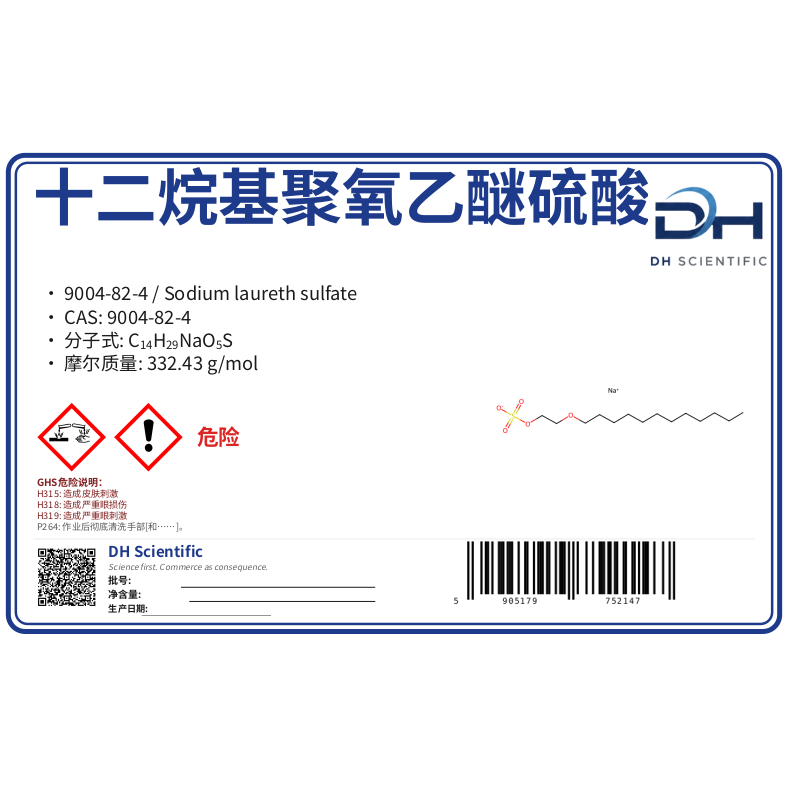
十二烷基聚氧乙醚硫酸钠• Sodium laureth sulfate• CAS: 9004-82-4• 分子式: C14H29NaO5S• 摩尔质量: 332.43 g/mol危险GHS危险说明:H315: 造成皮肤刺激H318: 造成严重眼损伤H319: 造成严重眼刺激P264: 作业后彻底清洗手部[和……]。DH ScientificScience first. Commerce as consequence.批号: 净含量: 生产日期:
ADMET — ADMET 性质
正在加载ADMET预测…
🧪 溶液配制助手(Smart Prep) MolGod_PREP_2

输入您要制备的内容——我将生成SOP

示例如下——点击插入:
预设配方:
📚 科学文献概览 — CAS 9004-82-4MolGod_LITHUB_MAIN
⭐ 关键发现(科学文献) 18 出版物
🏆 CAS 9004-82-4 — multi-criteria ranking (W12): 30%引用·20%近期性·20%主题·15%历史·15%开放获取.
  1. #1
    Kirsten van Niekerk, Robert W. M. Pott (2023) · Journal of Chemical & Engineering Data
    重要性: 近期(2023) · open access
    SCORE 8.69 机制 引用次数: 6 Open Access DOI ↗
  2. #2
    Sudirman, Sudirman, Saputro, Anjar Hermadi, Putri, Tikarahayu et al. (2021) · Center for Science & Technology of Advanced Materials - National Nuclear Energy Agency
    重要性: Open access
    SCORE 7.95 机制 Open Access DOI ↗
  3. #3
    Devita Cahyaningsih, Nina Ariesta, Rizki Amelia (2019) · Sains Natural
    重要性: Open access
    SCORE 7.85 工业 引用次数: 4 Open Access DOI ↗
  4. #4
    Zheltukhina Valentina, Kolesnichenko Elena, Morozova Tamara et al. (2025) · BIO Web of Conferences
    重要性: 近期(2025) · open access
    SCORE 7.15 机制 引用次数: 1 Open Access DOI ↗
  5. #5
    I.A. Pintilie, D.D.B. Burduhos Nergis, A.V. Sandu et al. (2026) · Archives of Metallurgy and Materials
    重要性: 近期(2026) · open access
    SCORE 7.05 工业 Open Access DOI ↗
  6. #6
    Tukhbatulin, M. N., Якубова, Т. В., Yakubova, T. V. et al. (2026) · УГЛТУ
    重要性: 近期(2026) · open access
    SCORE 7.05 机制 Open Access
  7. #7
    LAKSHMI NARASIMHA RAO KATAKAM, THIRUPATHI DONGALA (2020) · Asian Journal of Pharmaceutical and Clinical Research
    重要性: Open access
    SCORE 6.85 分析 Open Access DOI ↗
  8. #8
    H. Löffler, R. Happle (2003) · Contact Dermatitis
    重要性: 通过多标准评分选择(引用+近期性+主题+历史+开放获取)。
    SCORE 6.68 机制 引用次数: 90 DOI ↗
  9. #9
    et al. (2020) · Langmuir
    重要性: 通过多标准评分选择(引用+近期性+主题+历史+开放获取)。
    SCORE 6.66 机制 引用次数: 8 DOI ↗ PubMed ↗
  10. #10
    Benita Malinowska, Julio León Munoz Esteban, Evgeniy Pakhlov et al. (2024) · Applied Sciences
    重要性: 近期(2024) · open access
    SCORE 6.25 机制 Open Access DOI ↗
  11. #11
    Bhattacharya R, Chatterjee A, Chatterjee S et al. (2021) · Comparative biochemistry and physiology. Toxicology & pharmacology : CBP
    重要性: 通过多标准评分选择(引用+近期性+主题+历史+开放获取)。
    SCORE 6.16 药理学 引用次数: 8 DOI ↗ PubMed ↗
  12. #12
    V. Charbonnier, B.M. Morrison,, M. Paye et al. (2001) · Food and Chemical Toxicology
    重要性: 通过多标准评分选择(引用+近期性+主题+历史+开放获取)。
    SCORE 6.04 分析 引用次数: 55 DOI ↗
  13. #13
    Ariesta, Nina, Amelia, Rizki, Cahyaningsih, Devita (2019) · Universitas Nusa Bangsa
    重要性: Open access
    SCORE 5.75 工业 Open Access
  14. #14
    Blagojević, Slavica M., Blagojević, Slavica, Blagojević, Stevan et al. (2019) · Springer
    重要性: 通过多标准评分选择(引用+近期性+主题+历史+开放获取)。
    SCORE 5.31 机制 引用次数: 3 DOI ↗
  15. #15
    Ronald A. Hill, Paul W. Snyder, Valerie C. Robinson et al. (2010) · SAGE Publications
    重要性: 通过多标准评分选择(引用+近期性+主题+历史+开放获取)。
    SCORE 5.15 机制 引用次数: 51 DOI ↗
  16. #16
    Poojari Prasanna, Palanisamy Suresh Babu (2025) · Applications of Mathematics in Science and Technology
    重要性: 近期(2025)
    SCORE 4 机制 DOI ↗
  17. #17
    (1983) · Journal of the American College of Toxicology
    重要性: 通过多标准评分选择(引用+近期性+主题+历史+开放获取)。
    SCORE 3.24 机制 引用次数: 11 DOI ↗
  18. #18
    Matsuda S; Hisama M; Shibayama H et al. (2009) · Toxicology in vitro : an international journal published in association with BIBRA
    重要性: 必引文献(经典)
    SCORE 0 药理学 MUST-CITE DOI ↗

Description

Laurylosiarczan sodu-eter (SLES), CAS 9004-82-4
Reviews

There are no reviews yet.

Be the first to review “十二烷基聚氧乙醚硫酸钠”
📈 HPLC梯度——优化器(LSS) 模板

logP未知——PubChem未返回XLogP值。以下梯度为15分钟内5–95% MeCN/H2O的通用模板;使用前请验证参数。

⚠ logP不可用. PubChem未返回此CAS号的XLogP3属性。以下梯度值为通用模板——并非针对该化合物的LSS拟合。
  • 色谱柱: C18
  • 缓冲液: phosphate
  • 流速: 1 mL/min
  • logP: logP不可用
  • 斜率: 21% → 95% B, 15 min
  • 总分析时间: 28 min
t (min) %A %B flow (mL/min) 备注
0 79 21 1 开始(平衡)
2 79 21 1 初始保持结束
17 5 95 1 LSS 梯度结束
22 5 95 1 色谱柱清洗
23 79 21 1 返回初始条件
28 79 21 1 再平衡
📚 科学参考文献(芝加哥作者-日期格式)
  1. Snyder, Lloyd R., John W. Dolan, and Joseph J. Kirkland. 2010. Introduction to Modern Liquid Chromatography. Wiley. — Chapter 9 — gradient elution, LSS theory (cited as Snyder et al. 2010 in tool description).
  2. Schoenmakers, Peter J. 1986. Optimization of Chromatographic Selectivity: A Guide to Method Development. Elsevier. — Numerical optimization of gradient programs.
  3. Snyder, L. R., and J. W. Dolan. 2007. High-Performance Gradient Elution: The Practical Application of the Linear-Solvent-Strength Model. Wiley. — Foundational LSS reference for the %B_init = 5 + 8·logP heuristic implemented here.
  4. Nikitas, Pavlos, and Adrian Pappa-Louisi. 2009. "Retention models for isocratic and gradient elution in reversed-phase liquid chromatography." Journal of Chromatography A 1216: 1737-1755. [DOI ↗] — Modern review of gradient retention models — basis for non-LSS extensions.
  5. Carr, Peter W.. 2009. "The new physical chemistry of HPLC." Journal of Chromatography A 1216: 1764-1772. [DOI ↗]
  6. Dong, Michael W. 2019. HPLC and UHPLC for Practicing Scientists. Wiley. https://doi.org/10.1002/9781119313793. — Modern UHPLC gradient programming, sub-2 µm scaling rules.
  7. Wu, Naijun, and Anton M. Clausen. 2007. "Fundamental and practical aspects of ultrahigh pressure liquid chromatography for fast separations." Journal of Separation Science 30: 1167-1182. [DOI ↗]
  8. Stoll, Dwight R., and Peter W. Carr. 2017. "Two-Dimensional Liquid Chromatography: A State of the Art Tutorial." Analytical Chemistry 89: 519-531. [DOI ↗] — Reference for orthogonal gradient design (2D-LC second dimension).
  9. Dolan, John W.. 2013. "When to Modify Method Conditions." LCGC North America 31: 192-199.
  10. Meyer, Veronika R. 2010. Practical High-Performance Liquid Chromatography. Wiley. — Chapter 7 — practical gradient design with isokratyczny scouting.
  11. Stoll, Dwight R., and Peter W. Carr. 2017. "Two-Dimensional Liquid Chromatography: A State of the Art Tutorial." Analytical Chemistry 89: 519-531. [DOI ↗]
  12. Carr, Peter W.. 2009. "The new physical chemistry of HPLC." Journal of Chromatography A 1216: 1764-1772. [DOI ↗]
  13. Wu, Naijun, and Anton M. Clausen. 2007. "Fundamental and practical aspects of ultrahigh pressure liquid chromatography for fast separations." Journal of Separation Science 30: 1167-1182. [DOI ↗]
  14. Engelhardt, Heinz. 2014. 100 Years of Chromatography. Wiley-VCH.
  15. Vivó-Truyols, Gabriel, and Hans-Gerd Janssen. 2010. "Probabilistic approach to peak deconvolution in chromatography." Analytical Chemistry 82: 8525-8531. [DOI ↗]

REST: /wp-json/molgod/v1/hplc/gradient/9004-82-4

📐 HPLC峰对称性计算器(USP Tf / As)

根据峰半宽计算USP拖尾因子(Tf)和不对称度(As)。输入在峰高5%或10%处测量的a(左半宽)和b(右半宽)。

📚 参考文献(芝加哥作者-日期格式)
  1. USP General Chapter <621>. 2024. "Chromatography." United States Pharmacopeial Convention. [link ↗] — Defines USP Tailing Factor T = (a+b)/(2a) measured at 5% peak height.
  2. International Council for Harmonisation (ICH). 2023. "Validation of Analytical Procedures Q2(R2)." ICH Expert Working Group. [link ↗] — Tailing factor is a system suitability parameter (Section 6).
  3. Foley, Joe P., and John G. Dorsey. 1983. "Equations for calculation of chromatographic figures of merit for ideal and skewed peaks." Analytical Chemistry 55: 730-737 https://doi.org/10.1021/ac00255a033 [link ↗] — Original asymmetry factor As = b/a at 10% height (Foley & Dorsey 1983).
  4. Snyder, Lloyd R., Joseph J. Kirkland, and John W. Dolan. 2010. "Introduction to Modern Liquid Chromatography." Wiley. https://doi.org/10.1002/9780470508183 [link ↗] — Chapter 2.4 — peak shape diagnostics and remedies.
  5. Dolan, John W.. 2003. "Peak tailing and resolution." LCGC North America 21: 610-614 [link ↗] — How tailing factor degrades effective resolution.
  6. Vivó-Truyols, Gabriel, and Hans-Gerd Janssen. 2010. "Probabilistic approach to peak deconvolution in chromatography." Analytical Chemistry 82: 8525-8531 https://doi.org/10.1021/ac101742z [link ↗] — Modern numerical deconvolution for asymmetric peaks.
  7. Kromidas, Stavros. 2017. "HPLC Made to Measure: A Practical Handbook for Optimization." Wiley-VCH. — Practical Tf and As thresholds for routine QC.
  8. Dong, Michael W.. 2019. "HPLC and UHPLC for Practicing Scientists." Wiley. https://doi.org/10.1002/9781119313793 [link ↗]
  9. Meyer, Veronika R.. 2010. "Practical High-Performance Liquid Chromatography." Wiley.
  10. Heyden, Yvan Vander, et al.. 2009. "Robustness of pharmaceutical liquid chromatographic methods." Journal of Chromatography B 877: 2120-2129 https://doi.org/10.1016/j.jchromb.2008.10.052 [link ↗]
  11. Stoll, Dwight R., and Peter W. Carr. 2017. "Two-Dimensional Liquid Chromatography: A State of the Art Tutorial." Analytical Chemistry 89: 519-531 https://doi.org/10.1021/acs.analchem.6b03506 [link ↗]
  12. Carr, Peter W.. 2009. "The new physical chemistry of HPLC." Journal of Chromatography A 1216: 1764-1772 https://doi.org/10.1016/j.chroma.2008.11.094 [link ↗]
  13. Wu, Naijun, and Anton M. Clausen. 2007. "Fundamental and practical aspects of ultrahigh pressure liquid chromatography for fast separations." Journal of Separation Science 30: 1167-1182 https://doi.org/10.1002/jssc.200700026 [link ↗]
  14. Engelhardt, Heinz. 2014. "100 Years of Chromatography." Wiley-VCH.
  15. Vivó-Truyols, Gabriel, and Hans-Gerd Janssen. 2010. "Probabilistic approach to peak deconvolution in chromatography." Analytical Chemistry 82: 8525-8531 https://doi.org/10.1021/ac101742z [link ↗]
📊 分辨率和塔板数计算器(Rs, N, H)

计算一对HPLC峰的分辨率Rs、理论塔板数N和HETP(H)。输入保留时间、峰宽(在50%或基线处)和色谱柱长度。

📚 参考文献(芝加哥作者-日期格式)
  1. Snyder, Lloyd R., Joseph J. Kirkland, and John W. Dolan. 2010. "Introduction to Modern Liquid Chromatography." 3rd ed. John Wiley & Sons. ISBN 978-0-470-16754-0. https://doi.org/10.1002/9780470508183 [link ↗] — Chapter 2 covers resolution, plate count and HETP fundamentals (Snyder et al. 2010).
  2. USP General Chapter <621>. 2024. "Chromatography." USP-NF 2024 ed. United States Pharmacopeial Convention. [link ↗] — Defines Rs >= 1.5 acceptance criterion and N calculation methods.
  3. Dolan, John W.. 2003. "How much resolution is enough?." LCGC North America 21: 350-353 [link ↗] — Practical guidance on Rs targets for routine method development.
  4. Van Deemter, J. J., F. J. Zuiderweg, and A. Klinkenberg. 1956. "Longitudinal diffusion and resistance to mass transfer as causes of nonideality in chromatography." Chemical Engineering Science 5: 271-289 https://doi.org/10.1016/0009-2509(56)80003-1 [link ↗] — Origin of N = 5.54·(tr/w0.5)² half-height plate count formulation.
  5. Giddings, J. Calvin. 1965. "Dynamics of Chromatography, Part I: Principles and Theory." Marcel Dekker. ISBN 978-0-8247-1357-7. — Resolution equation Rs = (1/4)·√N·(α-1)/α·k/(1+k) (master equation).
  6. Foley, Joe P., and John G. Dorsey. 1983. "Equations for calculation of chromatographic figures of merit for ideal and skewed peaks." Analytical Chemistry 55: 730-737 https://doi.org/10.1021/ac00255a033 [link ↗] — Skewed-peak corrections to apparent N.
  7. Knox, John H.. 1977. "Practical aspects of LC theory." Journal of Chromatographic Science 15: 352-364 https://doi.org/10.1093/chromsci/15.9.352 [link ↗]
  8. Carr, Peter W.. 2009. "The new physical chemistry of HPLC." Journal of Chromatography A 1216: 1764-1772 https://doi.org/10.1016/j.chroma.2008.11.094 [link ↗]
  9. Dong, Michael W.. 2019. "HPLC and UHPLC for Practicing Scientists." 2nd ed. Wiley. ISBN 978-1-119-31378-3. https://doi.org/10.1002/9781119313793 [link ↗]
  10. Meyer, Veronika R.. 2010. "Practical High-Performance Liquid Chromatography." 5th ed. Wiley. ISBN 978-0-470-68218-0.
  11. Stoll, Dwight R., and Peter W. Carr. 2017. "Two-Dimensional Liquid Chromatography: A State of the Art Tutorial." Analytical Chemistry 89: 519-531 https://doi.org/10.1021/acs.analchem.6b03506 [link ↗]
  12. Carr, Peter W.. 2009. "The new physical chemistry of HPLC." Journal of Chromatography A 1216: 1764-1772 https://doi.org/10.1016/j.chroma.2008.11.094 [link ↗]
  13. Wu, Naijun, and Anton M. Clausen. 2007. "Fundamental and practical aspects of ultrahigh pressure liquid chromatography for fast separations." Journal of Separation Science 30: 1167-1182 https://doi.org/10.1002/jssc.200700026 [link ↗]
  14. Engelhardt, Heinz. 2014. "100 Years of Chromatography." 2nd ed. Wiley-VCH. ISBN 978-3-527-33473-5.
  15. Vivó-Truyols, Gabriel, and Hans-Gerd Janssen. 2010. "Probabilistic approach to peak deconvolution in chromatography." Analytical Chemistry 82: 8525-8531 https://doi.org/10.1021/ac101742z [link ↗]
🧪 系统适用性——实时计算器(USP <621>)

输入5-6次进样的数据(峰面积、保留时间、拖尾因子、塔板数)——计算器将计算%RSD和平均值,并检查是否符合USP <621>。您可以粘贴CSV(逗号分隔)或编辑单个值。

📚 参考文献(芝加哥作者-日期格式)
  1. USP General Chapter <621>. 2024. "Chromatography (System Suitability section)." USP-NF 2024 ed. United States Pharmacopeial Convention. [link ↗] — Defines RSD area < 2%, tailing < 2.0, N > 2000 acceptance criteria.
  2. International Council for Harmonisation (ICH). 2023. "Validation of Analytical Procedures Q2(R2)." ICH Expert Working Group. [link ↗] — Section 5.4 — system suitability is part of method validation.
  3. US Food and Drug Administration (FDA). 2018. "Reviewer Guidance: Validation of Chromatographic Methods." US Food and Drug Administration. [link ↗] — CDER reviewer perspective on chromatographic validation expectations.
  4. Snyder, Lloyd R., Joseph J. Kirkland, and John W. Dolan. 2010. "Introduction to Modern Liquid Chromatography." 3rd ed. Wiley. — Chapter 2 — system suitability fundamentals (RSD, Tf, N).
  5. Heyden, Yvan Vander, et al.. 2009. "Robustness of pharmaceutical liquid chromatographic methods." — Robustness vs. system suitability — design-of-experiments framework.
  6. Rozet, Eric, et al.. 2013. "Analysis of recent pharmaceutical regulatory documents on analytical method validation."
  7. European Medicines Agency (EMA). 2011. "Guideline on bioanalytical method validation EMEA/CHMP/EWP/192217/2009." EMA. [link ↗] — EMA companion guideline with bioanalytical SS criteria.
  8. Dong, Michael W.. 2019. "HPLC and UHPLC for Practicing Scientists." 2nd ed. Wiley. — UHPLC-specific suitability adjustments (n=5 vs. n=6).
  9. Kazakevich, Yuri V., and Rosario LoBrutto, eds.. 2007. "HPLC for Pharmaceutical Scientists." Wiley-Interscience.
  10. AOAC International. 2016. "Appendix F: Guidelines for Standard Method Performance Requirements." AOAC INTERNATIONAL. [link ↗] — Alternative SS thresholds for food/dietary samples.
  11. Stoll, Dwight R., and Peter W. Carr. 2017. "Two-Dimensional Liquid Chromatography: A State of the Art Tutorial."
  12. Carr, Peter W.. 2009. "The new physical chemistry of HPLC."
  13. Wu, Naijun, and Anton M. Clausen. 2007. "Fundamental and practical aspects of ultrahigh pressure liquid chromatography for fast separations."
  14. Engelhardt, Heinz. 2014. "100 Years of Chromatography." 2nd ed. Wiley-VCH.
  15. Vivó-Truyols, Gabriel, and Hans-Gerd Janssen. 2010. "Probabilistic approach to peak deconvolution in chromatography."
📤 将此分子嵌入您的网站

有博客、论坛或科学网站吗? 将交互式3D分子嵌入到您的网站上——每位读者都能看到它,下方还有指向我们商店的链接,他们可以在那里购买试剂。

🔗 HTML iframe代码 (最简单——随处可用)

复制并粘贴到您网站的HTML编辑器中:

根据您的布局调整 width 和 height。

⚙ WordPress Shortcode (适用于其他使用MOL-GOD的商店)

🌐 直接链接 (用于电子邮件、聊天、LinkedIn、Twitter)

LinkedIn Twitter/X Facebook
QR code CAS 9004-82-4

📱 QR code (用于印刷在传单/标签/目录上)

将其放置在产品目录、瓶标或传单上。客户扫描后,即可在手机上看到3D分子,并附有指向您商店的链接。

⬇ 下载PNG

🖼 Open Graph image (用于社交媒体元标签)

分享链接时,Facebook/LinkedIn/Discord会自动获取图像预览:

Preview
📋 许可证: 嵌入内容保留反向链接至 DH Scientific (必需——商店是数据来源)。 化学数据来源于 PubChem (CC0 — 公共领域). 嵌入内容免费用于教育、商业和业余用途。
📚 参考文献(综合书目,芝加哥作者-日期格式) 107 条目

以上折叠面板中针对CAS号9004-82-4引用的所有科学来源。格式: 《芝加哥格式手册》第17版,作者-日期系统.

🗄️ 科学数据库

  1. NIST. 2026. NIST Chemistry WebBook: CAS 9004-82-4. Gaithersburg, MD: National Institute of Standards and Technology. https://webbook.nist.gov/cgi/cbook.cgi?ID=9004-82-4. (Accessed 2026-11-12.)
  2. AIST. 2026. Spectral Database for Organic Compounds (SDBS): CAS 9004-82-4. Tsukuba, Japan: National Institute of Advanced Industrial Science and Technology. https://sdbs.db.aist.go.jp/. (Accessed 2026-11-12.)
  3. PubChem. 2026. PubChem Compound Summary: CAS 9004-82-4. Bethesda, MD: National Center for Biotechnology Information (NCBI), National Library of Medicine. https://pubchem.ncbi.nlm.nih.gov/#query=9004-82-4. (Accessed 2026-11-12.)
  4. ECHA. 2026. C&L Inventory and REACH Registration: CAS 9004-82-4. Helsinki: European Chemicals Agency. https://echa.europa.eu/documents/10162/23047722/sds_en.pdf. (Accessed 2026-11-12.)

📐 标准/指南

  1. ICH. 2026. "ICH Harmonised Guideline: CAS 9004-82-4." Geneva: International Council for Harmonisation. https://database.ich.org/sites/default/files/Q1A%28R2%29%20Guideline.pdf. (Accessed 2026-11-12.)
  2. National Fire Protection Association (NFPA). 2024. "NFPA 30: Flammable and Combustible Liquids Code." NFPA, Quincy, MA. https://www.nfpa.org/codes-and-standards/all-codes-and-standards/list-of-codes-and-standards/detail?code=30.
  3. Occupational Safety and Health Administration (OSHA). 2023. "29 CFR 1910.106 — Flammable Liquids." U.S. Department of Labor, Federal Register. https://www.osha.gov/laws-regs/regulations/standardnumber/1910/1910.106.
  4. European Chemicals Agency (ECHA). 2024. "Annex VI to Regulation (EC) No 1272/2008 (CLP) — Harmonised Classification and Labelling." ECHA, Helsinki / Official Journal of the European Union. https://echa.europa.eu/regulations/clp/clp-classification.
  5. European Committee for Standardization (CEN). 2016. "EN 374-1:2016 — Protective gloves against dangerous chemicals and micro-organisms — Part 1: Terminology and performance requirements for chemical risks." CEN, Brussels. https://standards.cencenelec.eu/dyn/www/f?p=205:110:::::FSP_PROJECT,FSP_ORG_ID:38536,6080&cs=1B0DAA8B85DF42E4A2C70E5D71F0BFA32.
  6. European Committee for Standardization (CEN). 2001. "EN 166:2001 — Personal eye-protection — Specifications." CEN, Brussels. https://standards.cencenelec.eu/dyn/www/f?p=CEN:110:0::::FSP_PROJECT:6541&cs=1F1A4E0A78C4DB6A28DBE2E8C29D89DCF.
  7. European Committee for Standardization (CEN). 2009. "EN 14605:2005+A1:2009 — Protective clothing against liquid chemicals — Performance requirements for clothing with liquid-tight (Type 3) or spray-tight (Type 4) connections." CEN, Brussels. https://standards.cencenelec.eu/dyn/www/f?p=CEN:110:0::::FSP_PROJECT:21581&cs=1A04A2D3C7CC58E9E6CB58D55F7EBFB7E.
  8. National Institute for Occupational Safety and Health (NIOSH). 2017. "Recommendations for Chemical Protective Clothing: A Companion to the NIOSH Pocket Guide." U.S. Department of Health & Human Services / CDC. https://www.cdc.gov/niosh/ncpc/default.html.
  9. Occupational Safety and Health Administration (OSHA). 2011. "Personal Protective Equipment — General requirements." U.S. Department of Labor — 29 CFR 1910.132. https://www.osha.gov/laws-regs/regulations/standardnumber/1910/1910.132.

📖 书籍

  1. Hansen, Charles M. 2007. Hansen Solubility Parameters: A User's Handbook, 2nd ed.. Boca Raton, FL: CRC Press. https://www.routledge.com/Hansen-Solubility-Parameters-A-Users-Handbook/Hansen/p/book/9780849372483.
  2. Barton, Allan F. M. 1991. CRC Handbook of Solubility Parameters and Other Cohesion Parameters: 2nd ed.. Boca Raton, FL: CRC Press. https://www.routledge.com/CRC-Handbook-of-Solubility-Parameters-and-Other-Cohesion-Parameters/Barton/p/book/9780849301766.
  3. Connors, Kenneth A., Gordon L. Amidon, and Valentino J. Stella. 1986. Chemical Stability of Pharmaceuticals: A Handbook for Pharmacists, 2nd ed.. New York: Wiley. https://doi.org/10.1002/0471734683.
  4. Rumble, John R., ed. 2019. CRC Handbook of Chemistry and Physics: 100th Edition. Boca Raton, FL: CRC Press. https://hbcp.chemnetbase.com/.
  5. Urben, Peter G. 2017. Bretherick's Handbook of Reactive Chemical Hazards, 8th Edition. Academic Press / Elsevier, Oxford. https://www.sciencedirect.com/book/9780081010594.

📘 专著

  1. IARC. 2026. IARC Monographs on the Identification of Carcinogenic Hazards to Humans: CAS 9004-82-4. Lyon, France: International Agency for Research on Cancer, World Health Organization. (Accessed 2026-11-12.)

📄 科学文章(同行评审)

  1. Stefanis, Emmanuel, and Costas Panayiotou. 2008. "Prediction of Hansen Solubility Parameters with a New Group-Contribution Method." International Journal of Thermophysics 29: 568-585. https://doi.org/10.1007/s10765-008-0415-z.
  2. Stoll, Vincent S., and John S. Blanchard. 1990. "Buffers: Principles and Practice: In Methods in Enzymology, vol. 182." San Diego: Academic Press. https://doi.org/10.1016/0076-6879(90)82008-P.

🌐 网站

  1. ECHA. 2023. "Guidance on the Application of the CLP Criteria." European Chemicals Agency. https://echa.europa.eu/guidance-documents/guidance-on-clp.
  2. European Parliament. 2006. "Regulation (EC) No 1907/2006 (REACH)." Official Journal of the European Union L 396: 1–849.
  3. ECHA. 2023. "Candidate List of Substances of Very High Concern for Authorisation." European Chemicals Agency. https://echa.europa.eu/candidate-list-table.
  4. European Parliament. 2008. "Regulation (EC) No 1272/2008 on Classification, Labelling and Packaging of Substances and Mixtures (CLP)." Official Journal of the European Union L 353: 1–1355.
  5. ECHA. 2017. "Guidance on the Compilation of Safety Data Sheets." Version 3.1. European Chemicals Agency. ECHA-17-G-01-EN. https://echa.europa.eu/documents/10162/23047722/sds_en.pdf.
  6. ECHA. 2022. "Restrictions Under REACH — Annex XVII." European Chemicals Agency. https://echa.europa.eu/substances-restricted-under-reach.
  7. United Nations. 2021. Globally Harmonized System of Classification and Labelling of Chemicals (GHS). 9th revised ed. ST/SG/AC.10/30/Rev.9. New York and Geneva: United Nations. https://unece.org/ghs-rev9-2021.
  8. ECHA. 2020. "Understanding REACH." European Chemicals Agency. https://echa.europa.eu/regulations/reach/understanding-reach.
  9. U.S. OSHA. 2026. "Occupational Safety and Health Guidance: CAS 9004-82-4." Washington, DC: U.S. Occupational Safety and Health Administration. https://www.osha.gov/hazwoper. (Accessed 2026-11-12.)
  10. National Fire Protection Association (2018) — NFPA 472: Standard for Competence of Responders to Hazardous Materials/Weapons of Mass Destruction Incidents https://www.nfpa.org/codes-and-standards/nfpa-472.
  11. European Union. 2026. "EUR-Lex Legal Database: CAS 9004-82-4." Luxembourg: Publications Office of the European Union. https://eur-lex.europa.eu/legal-content/EN/TXT/?uri=celex:32012L0018. (Accessed 2026-11-12.)
  12. U.S. National Institute for Occupational Safety and Health (2024) — NIOSH Pocket Guide to Chemical Hazards https://www.cdc.gov/niosh/npg/.
  13. Snyder, Lloyd R., John W. Dolan, and Joseph J. Kirkland. 2010. Introduction to Modern Liquid Chromatography. Wiley.
  14. Schoenmakers, Peter J.. 1986. Optimization of Chromatographic Selectivity: A Guide to Method Development. Elsevier.
  15. Snyder, L. R., and J. W. Dolan. 2007. High-Performance Gradient Elution: The Practical Application of the Linear-Solvent-Strength Model. Wiley.
  16. Nikitas, Pavlos, and Adrian Pappa-Louisi. 2009. "Retention models for isocratic and gradient elution in reversed-phase liquid chromatography." Journal of Chromatography A 1216: 1737-1755. https://doi.org/10.1016/j.chroma.2008.10.005.
  17. Carr, Peter W.. 2009. "The new physical chemistry of HPLC." Journal of Chromatography A 1216: 1764-1772. https://doi.org/10.1016/j.chroma.2008.11.094.
  18. Dong, Michael W.. 2019. HPLC and UHPLC for Practicing Scientists. Wiley. https://doi.org/10.1002/9781119313793.
  19. Wu, Naijun, and Anton M. Clausen. 2007. "Fundamental and practical aspects of ultrahigh pressure liquid chromatography for fast separations." Journal of Separation Science 30: 1167-1182. https://doi.org/10.1002/jssc.200700026.
  20. Dolan, John W.. 2013. "When to Modify Method Conditions." LCGC North America 31: 192-199. https://www.chromatographyonline.com/view/when-modify-method-conditions.
  21. Meyer, Veronika R.. 2010. Practical High-Performance Liquid Chromatography. Wiley.
  22. Engelhardt, Heinz. 2014. 100 Years of Chromatography. Wiley-VCH.
  23. Vivó-Truyols, Gabriel, and Hans-Gerd Janssen. 2010. "Probabilistic approach to peak deconvolution in chromatography." Analytical Chemistry 82: 8525-8531. https://doi.org/10.1021/ac101742z.
  24. Van Deemter, J. J., F. J. Zuiderweg, and A. Klinkenberg. 1956. "Longitudinal diffusion and resistance to mass transfer as causes of nonideality in chromatography." https://doi.org/10.1016/0009-2509(56)80003-1.
  25. Giddings, J. Calvin. 1965. "Dynamics of Chromatography, Part I: Principles and Theory." Marcel Dekker.
  26. Poppe, Hans. 1997. "Some reflections on speed and efficiency of modern chromatographic methods." https://doi.org/10.1016/S0021-9673(97)00376-2.
  27. Wu, Naijun, and Anton M. Clausen. 2007. "Fundamental and practical aspects of ultrahigh pressure liquid chromatography for fast separations." https://doi.org/10.1002/jssc.200700026.
  28. Carr, Peter W.. 2009. "The new physical chemistry of HPLC." https://doi.org/10.1016/j.chroma.2008.11.094.
  29. Knox, John H.. 1977. "Practical aspects of LC theory." https://doi.org/10.1093/chromsci/15.9.352.
  30. Snyder, L. R., J. J. Kirkland, and J. L. Glajch. 1997. "Practical HPLC Method Development." Wiley.
  31. Vivó-Truyols, Gabriel, and Hans-Gerd Janssen. 2010. "Probabilistic approach to peak deconvolution in chromatography." https://doi.org/10.1021/ac101742z.
  32. Sadek, Paul C.. 2002. "The HPLC Solvent Guide." Wiley-Interscience.
  33. Snyder, L. R.. 1978. "Classification of the solvent properties of common liquids." https://doi.org/10.1093/chromsci/16.6.223.
  34. Reichardt, Christian, and Thomas Welton. 2010. "Solvents and Solvent Effects in Organic Chemistry." Wiley-VCH.
  35. Vailaya, Anant, and Csaba Horváth. 1998. "Retention thermodynamics in hydrophobic interaction chromatography." https://doi.org/10.1021/ie980212h.
  36. Krstulović, Andrea M., and Phyllis R. Brown. 1981. "Reversed-phase High-Performance Liquid Chromatography." Wiley.
  37. Boysen, Reinhard I., and Milton T. W. Hearn. 2009. "Multi-modal HPLC of proteins." https://doi.org/10.1093/chromsci/47.8.645.
  38. USP General Chapter <621>. 2024. "Chromatography." United States Pharmacopeial Convention. https://www.usp.org/harmonization-standards/pdg/general-chapters/chromatography.
  39. Foley, Joe P., and John G. Dorsey. 1983. "Equations for calculation of chromatographic figures of merit for ideal and skewed peaks." https://doi.org/10.1021/ac00255a033.
  40. Snyder, Lloyd R., Joseph J. Kirkland, and John W. Dolan. 2010. "Introduction to Modern Liquid Chromatography." Wiley. https://doi.org/10.1002/9780470508183.
  41. Dolan, John W.. 2003. "Peak tailing and resolution." https://www.chromatographyonline.com/view/peak-tailing-and-resolution.
  42. Kromidas, Stavros. 2017. "HPLC Made to Measure: A Practical Handbook for Optimization." Wiley-VCH.
  43. Heyden, Yvan Vander, et al.. 2009. "Robustness of pharmaceutical liquid chromatographic methods." https://doi.org/10.1016/j.jchromb.2008.10.052.
  44. United States Pharmacopeial Convention. 2024. "USP <621> Chromatography." In United States Pharmacopeia and National Formulary, USP 47-NF 42. Rockville, MD: USP. https://www.uspnf.com/.
  45. European Pharmacopoeia Commission. 2024. "2.2.46 Chromatographic Separation Techniques." In European Pharmacopoeia, 11th ed. Strasbourg: Council of Europe — EDQM. https://www.edqm.eu/en/european-pharmacopoeia-ph-eur-11th-edition.
  46. International Organization for Standardization. 2017. "ISO/IEC 17025:2017 General Requirements for the Competence of Testing and Calibration Laboratories." Geneva: ISO. https://www.iso.org/standard/66912.html.
  47. Kolthoff, Izaak Maurits, and Philip J. Elving, eds. 1978. Treatise on Analytical Chemistry, Part I: Theory and Practice. 2nd ed. New York: Wiley-Interscience.
  48. Skoog, Douglas A., F. James Holler, and Stanley R. Crouch. 2018. Principles of Instrumental Analysis. 7th ed. Boston: Cengage Learning.
  49. Christian, Gary D., Purnendu K. Dasgupta, and Kevin A. Schug. 2014. Analytical Chemistry. 7th ed. Hoboken, NJ: Wiley.
  50. EURACHEM/CITAC. 2012. "Quantifying Uncertainty in Analytical Measurement." 3rd ed. EURACHEM/CITAC Guide CG 4. https://www.eurachem.org/images/stories/Guides/pdf/QUAM2012_P1.pdf.
  51. Snyder, Lloyd R., Joseph J. Kirkland, and John W. Dolan. 2010. "Introduction to Modern Liquid Chromatography." John Wiley & Sons. https://doi.org/10.1002/9780470508183.
  52. Dolan, John W.. 2003. "How much resolution is enough?." https://www.chromatographyonline.com/view/how-much-resolution-enough.
  53. USP General Chapter <621>. 2024. "Chromatography (System Suitability section)." United States Pharmacopeial Convention. https://www.usp.org/harmonization-standards/pdg/general-chapters/chromatography.
  54. U.S. FDA. 2026. "FDA Guidance and Resources: CAS 9004-82-4." Silver Spring, MD: U.S. Food and Drug Administration. https://www.fda.gov/media/74954/download. (Accessed 2026-11-12.)
  55. Rozet, Eric, et al.. 2013. "Analysis of recent pharmaceutical regulatory documents on analytical method validation." https://doi.org/10.1016/j.chroma.2007.03.111.
  56. European Medicines Agency (EMA). 2011. "Guideline on bioanalytical method validation EMEA/CHMP/EWP/192217/2009." EMA. https://www.ema.europa.eu/en/documents/scientific-guideline/guideline-bioanalytical-method-validation_en.pdf.
  57. Kazakevich, Yuri V., and Rosario LoBrutto, eds.. 2007. "HPLC for Pharmaceutical Scientists." Wiley-Interscience. https://doi.org/10.1002/9780470087954.
  58. AOAC International. 2016. "Appendix F: Guidelines for Standard Method Performance Requirements." AOAC INTERNATIONAL. https://www.aoac.org/wp-content/uploads/2019/08/app_f.pdf.
  59. International Organization for Standardization. 1994. "ISO 5725-2:1994 Accuracy (Trueness and Precision) of Measurement Methods and Results — Part 2: Basic Method for the Determination of Repeatability and Reproducibility of a Standard Measurement Method." Geneva: ISO. https://www.iso.org/standard/11834.html.
  60. Grubbs, Frank E. 1950. "Sample Criteria for Testing Outlying Observations." Annals of Mathematical Statistics 21 (1): 27–58.
  61. Dixon, Wilfrid J. 1950. "Analysis of Extreme Values." Annals of Mathematical Statistics 21 (4): 488–506.
  62. Snedecor, George W., and William G. Cochran. 1989. Statistical Methods. 8th ed. Ames, IA: Iowa State University Press.
  63. Student [William Sealy Gosset]. 1908. "The Probable Error of a Mean." Biometrika 6 (1): 1–25.
  64. International Organization for Standardization. 2005. "ISO 3534-1:2006 Statistics — Vocabulary and Symbols — Part 1: General Statistical Terms and Terms Used in Probability." Geneva: ISO. https://www.iso.org/standard/40145.html.
  65. Thompson, Michael, Stephen L. R. Ellison, and Roger Wood. 2002. "Harmonized Guidelines for Single-Laboratory Validation of Methods of Analysis." Pure and Applied Chemistry 74 (5): 835–855.
  66. United Nations Economic Commission for Europe. 2024. European Agreement Concerning the International Carriage of Dangerous Goods by Road (ADR), Applicable as from 1 January 2025 (ECE/TRANS/352). Geneva: UNECE. https://unece.org/transport/dangerous-goods/adr-2025-edition.
  67. International Air Transport Association. 2026. Dangerous Goods Regulations (DGR). 67th ed. Montreal: IATA. https://www.iata.org/en/programs/cargo/dgr/.
  68. International Maritime Organization. 2024. International Maritime Dangerous Goods (IMDG) Code, 2024 Edition (Amendment 42-24). London: IMO. https://www.imo.org/en/OurWork/Safety/Pages/DangerousGoods-default.aspx.
  69. United Nations. 2025. Recommendations on the Transport of Dangerous Goods: Model Regulations (Orange Book). 24th revised ed. ST/SG/AC.10/1/Rev.24. New York and Geneva: United Nations. https://unece.org/transport/dangerous-goods/un-model-regulations.
  70. International Civil Aviation Organization. 2025. Technical Instructions for the Safe Transport of Dangerous Goods by Air (Doc 9284). 2025–2026 ed. Montreal: ICAO. https://www.icao.int/safety/DangerousGoods/Pages/technical-instructions.aspx.
  71. United States Pharmacopeia (USP) Convention. 2024. "USP General Chapter <621> Chromatography." USP. https://www.usp.org/sites/default/files/usp/document/harmonization/gen-chapter/g05_pf_30_4_2004.pdf.
  72. European Medicines Agency (EMA). 2011. "Guideline on bioanalytical method validation EMEA/CHMP/EWP/192217/2009." EMA Committee for Medicinal Products for Human Use. https://www.ema.europa.eu/en/documents/scientific-guideline/guideline-bioanalytical-method-validation_en.pdf.
  73. Sejm RP. 2026. "Internetowy System Aktow Prawnych (ISAP): CAS 9004-82-4." Warszawa: Kancelaria Sejmu Rzeczypospolitej Polskiej. https://isap.sejm.gov.pl/isap.nsf/DocDetails.xsp?id=WDU20200000010. (Accessed 2026-11-12.)
  74. Ministerstwo Klimatu i Srodowiska. 2026. "Baza Danych o Odpadach (BDO): CAS 9004-82-4." Warszawa: Ministerstwo Klimatu i Srodowiska. https://bdo.mos.gov.pl/. (Accessed 2026-11-12.)
  75. Pohanish, Richard P.. 2017. "Sittig's Handbook of Toxic and Hazardous Chemicals and Carcinogens." Elsevier.
  76. Lewis, Richard J.. 2012. "Sax's Dangerous Properties of Industrial Materials." Wiley.
  77. NIOSH. 2024. "Pocket Guide to Chemical Hazards." U.S. Department of Health and Human Services. https://www.cdc.gov/niosh/npg/.
  78. United Nations Economic Commission for Europe (UNECE). 2023. "European Agreement concerning the International Carriage of Dangerous Goods by Road (ADR 2025)." UNECE. https://unece.org/transport/standards/transport/dangerous-goods/adr-2025.
  79. IPCS INCHEM. 2024. "International Programme on Chemical Safety — Waste Management Guidelines." WHO/UNEP/ILO. https://www.inchem.org/.
  80. International Organization for Standardization. 2017. "ISO/IEC 17025:2017 General requirements for the competence of testing and calibration laboratories." ISO. https://www.iso.org/standard/66912.html.
  81. World Health Organization. 2010. "WHO Good Manufacturing Practices for Pharmaceutical Products: Main Principles (WHO Technical Report Series No. 957, Annex 3)." WHO Press. https://www.who.int/publications/m/item/trs957-annex3.
  82. European Medicines Agency. 2014. "Guideline on Process Validation for Finished Products — Information and Data to Be Provided EMA/CHMP/CVMP/QWP/BWP/70278/2012." European Medicines Agency. https://www.ema.europa.eu/en/documents/scientific-guideline/guideline-process-validation-finished-products-information-data-be-provided-regulatory-submissions-revision-1_en.pdf.
  83. United States Pharmacopeial Convention. 2024. "United States Pharmacopeia and National Formulary, USP 47-NF 42." USP. https://www.uspnf.com/.
  84. European Pharmacopoeia Commission. 2024. "European Pharmacopoeia 11th Edition." Council of Europe — EDQM. https://www.edqm.eu/en/european-pharmacopoeia-ph-eur-11th-edition.
  85. Pharmaceutical Inspection Co-operation Scheme (PIC/S). 2021. "Guide to Good Manufacturing Practice for Medicinal Products PE 009-15." PIC/S Secretariat, Geneva. https://picscheme.org/en/publications.
  86. International Pharmaceutical Excipients Council (IPEC) and Pharmaceutical Quality Group (PQG). 2017. "Joint IPEC-PQG Good Manufacturing Practices Guide for Pharmaceutical Excipients." IPEC-Americas. https://ipecamericas.org/sites/default/files/IPECPQGGMPGuide2017.pdf.
📥 下载BibTeX📥 下载RIS导入到Zotero/Mendeley/EndNote/Papers。