
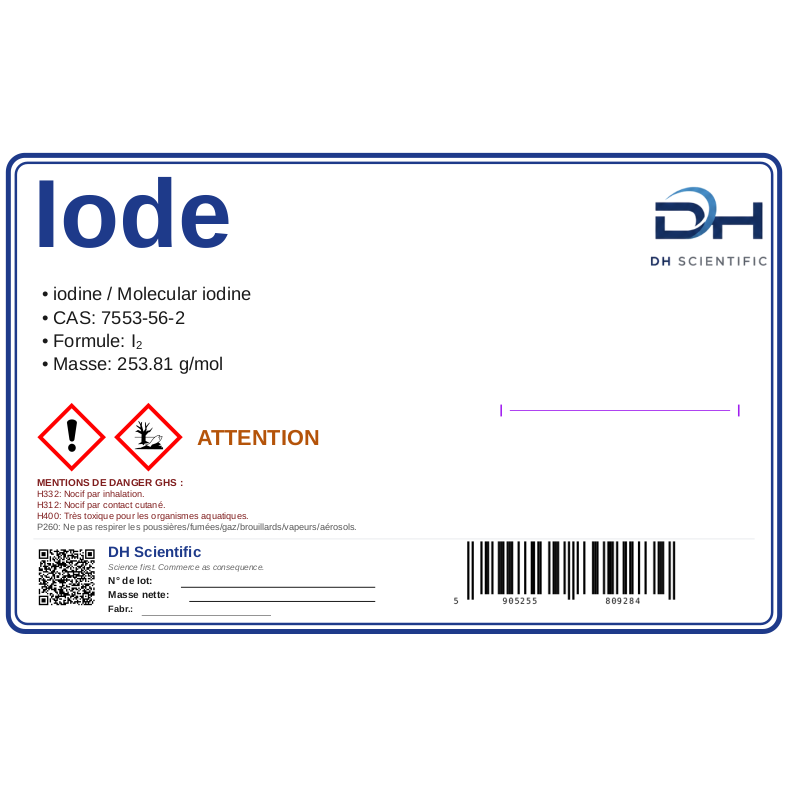
iode
5,99 €
Réactif chimique Jod (CAS 7553-56-2). Fiche encyclopédique complète — classification, propriétés et données de sécurité — ci-dessous.
🔒 Mode démo — cet article n'est pas à vendre.
Substance légale. dhscientific.com est une démonstration de la plateforme MOL-GOD — nous ne vendons rien et aucune commande n'est traitée. Les substances interdites sont bloquées ici automatiquement à partir du canon réglementaire (comparez p. ex. l'heptachlore).

Aperçu chimique: IodineMolGod_OVERVIEW_1
| Formule brute | I2 |
| Masse moléculaire | 253.8089 g/mol |
| Point de fusion | 113.6 °C |
| Point d'ébullition | 185 °C |
| Densité | 4.9 g/cm³ |
| LogP (lipophilie) | 1.7 |
| SMILES | II |
| InChIKey | PNDPGZBMCMUPRI-UHFFFAOYSA-N |
Synonymes: iodine · Molecular iodine · Diiodine · 7553-56-2 · Iodine crystals
Sources des données : PubChem (NLM/NIH)
Dernière mise à jour : 2026-11-10
RECHERCHE SCIENTIFIQUE
📚 Références scientifiques (Chicago Author-Date) 14 refs · 4 baz
MOLEKUŁA Bibliographie par CAS (en direct depuis 13+ bases de données)
Sources : db:Europe PMC (11) · db:pubmed (2) · db:openalex (1)
- db:Europe PMC (2025). "Dilute Povidone-Iodine Irrigation: The Science of Molecular Iodine (I2) Kinetics and Its Antimicrobial Activity.". https://doi.org/10.5435/jaaos-d-24-00471 →
- db:Europe PMC (2025). "Topical Molecular Iodine: An Optimal Biocide Constrained by Inadequate Formulations.". https://doi.org/10.3390/ijms26104853 →
- db:Europe PMC et al.. (2025). "Molecular Iodine Exhibited Differential Antiproliferative Actions in Progenitor and Stem Populations from Chemoresistant Cancer Cells.". https://doi.org/10.3390/ijms26094020 →
- db:Europe PMC et al.. (2025). "Transport of Molecular Iodine From Antiseptic Iodophors across Hydrophilic-lipophilic Interfaces: Influence of Phospholipids.". https://doi.org/10.1021/acsomega.5c06724 →
- db:Europe PMC et al.. (2025). "Molecular Iodine Induces Anti- and Pro-Neoplastic Effects in Prostate Cancer Models.". https://doi.org/10.3390/ijms26167800 →
- db:Europe PMC (2025). "Treatment of a Canine Oral Papilloma With Topical Molecular Iodine: A Case Report With Implications for Antiviral Therapy in Humans.". https://doi.org/10.7759/cureus.94049 →
- db:Europe PMC et al.. (2024). "Molecular Iodine Improves the Efficacy and Reduces the Side Effects of Metronomic Cyclophosphamide Treatment against Mammary Cancer Progression.". https://doi.org/10.3390/ijms25168822 →
- db:Europe PMC et al.. (2023). "Preventive Effect of Molecular Iodine in Pancreatic Disorders from Hypothyroid Rabbits.". https://doi.org/10.3390/ijms241914903 →
- db:Europe PMC et al.. (2023). "An ultrasound assisted, ionic liquid-molecular iodine synergy driven efficient green synthesis of pyrrolobenzodiazepine-triazole hybrids as potential anticancer agents.". https://doi.org/10.3389/fphar.2023.1168566 →
- db:Europe PMC et al.. (2023). "Preventive Effect of Molecular Iodine in Pancreatic Disorders from Hypothyroid Rabbits". https://doi.org/10.20944/preprints202308.0639.v1 →
- db:pubmed Yang Y, Tu C, Yin H et al.. (2022). "Molecular Iodine Capture by Covalent Organic Frameworks.". Molecules (Basel, Switzerland). https://doi.org/10.3390/molecules27249045 →
- db:Europe PMC (2022). "Molecular Iodine-Catalyzed Synthesis of Imidazo[1,2-a]Pyridines: Screening of Their In Silico Selectivity, Binding Affinity to Biological Targets, and Density Functional Theory Studies Insight.". https://doi.org/10.1021/acsomega.2c01570 →
- db:pubmed Freeman C, Duan E, Kessler J. (2022). "Molecular iodine is not responsible for cytotoxicity in iodophors.". The Journal of hospital infection. https://doi.org/10.1016/j.jhin.2022.01.015 →
- db:openalex Małgorzata Karbownik‐Lewińska, Jan Stępniak, Paulina Iwan et al.. (2022). "Iodine as a potential endocrine disruptor—a role of oxidative stress". Endocrine. https://doi.org/10.1007/s12020-022-03107-7 →
Propriétés physicochimiques
Aperçu rapide
Propriétés détaillées
| Propriété | Valeur | Unité | Conditions | Source |
|---|---|---|---|---|
| Masse volumique (ρ) | 4.9000 | g/cm³ | 20 °C (68 °F) | |
| Point de fusion (mp) | 113.60 °C (236.5 °F) | 1 atm | ||
| Point d'ébullition (bp) | 365 °F at 760 mmHg (NIOSH, 2024) | PubChem (NIH/NLM) ↗ | ||
| Pression de vapeur | 0.3 mmHg at 77 °F (NIOSH, 2024) | PubChem (NIH/NLM) ↗ | ||
| Solubilité dans l'eau | 0.01 % (NIOSH, 2024) | PubChem (NIH/NLM) ↗ | ||
| Viscosité (η) | 2.27 cP at 116 °C (240.8 °F) | PubChem (NIH/NLM) ↗ | ||
| Indice de réfraction (nD) | Index of refraction: 3.34 | PubChem (NIH/NLM) ↗ |
🔬 Propriétés avancées
Identifiants chimiques
II InChI=1S/I2/c1-2
PNDPGZBMCMUPRI-UHFFFAOYSA-N
Sources des données : PubChem, NIST Chemistry WebBook, CRC Handbook of Chemistry and Physics (103rd ed.)
Dernière mise à jour : 2026-06-30
⚛ Visualisation de l'atome — Iode MolGod_ATOMVIZ_1
📡 Spectroscopie — CAS 7553-56-2MolGod_SPECHUB_MAIN
Bases de données de spectres spectroscopiques — données inline 8 sources MolGod_SPECDB_2
Les spectres sont récupérés à la demande depuis 9 sources. Chaque spectre est enregistré dans notre base — la prochaine ouverture = zéro requête vers l'API externe. Téléchargez JCAMP-DX / CSV / PNG pour chaque spectre sans avoir à chercher.
Source de référence — pas d'API publique. Ouvrir dans une base externe :
🔗 IR/NMR/MS (SDBS) →Source de référence — pas d'API publique. Ouvrir dans une base externe :
🔗 JP Monograph →Source de référence — pas d'API publique. Ouvrir dans une base externe :
🔗 WHO INN →Source de référence — pas d'API publique. Ouvrir dans une base externe :
🔗 DOAJ →Propriétés physico-chimiques (base de données) 5 champs Score MolGod : Aucune source
| Propriété | Valeur | Unité | Conditions | Source |
|---|---|---|---|---|
| Point de fusion | 113.60 | °C | 1 atm | |
| Point d'ébullition | 185.00 | °C | 760 mmHg | |
| Solubilité dans l'eau | 0.300 | g/L | 25°C | |
| Masse volumique (ρ) | 4.9000 | g/cm³ | 20°C | |
| logP (octanol/eau) | 1.700 | — | 25°C |
📚 Références scientifiques (Chicago Author-Date) (12 sources)
- Haynes, William M., ed. 2024. CRC Handbook of Chemistry and Physics. 105th ed. Boca Raton: CRC Press/Taylor & Francis. ISBN 978-1-032-55554-4. ↗
- National Institute of Standards and Technology. 2024. "NIST Chemistry WebBook, SRD 69." Gaithersburg, MD: NIST. Accessed 2025-01-01. ↗
- Yaws, Carl L. 2014. The Yaws Handbook of Physical Properties for Hydrocarbons and Chemicals. 2nd ed. Oxford: Gulf Professional Publishing.
- PubChem. 2024. "PubChem Compound Database." National Library of Medicine, National Institutes of Health. Accessed 2025-01-01. ↗
- Marrero, J., and R. Gani. 2001. "Group-Contribution Based Estimation of Pure Component Properties." Fluid Phase Equilibria 183–184: 183–208. ↗
- Joback, K. G., and R. C. Reid. 1987. "Estimation of Pure-Component Properties from Group-Contributions." Chemical Engineering Communications 57 (1–6): 233–243. ↗
- Sangster, J. 1997. Octanol-Water Partition Coefficients: Fundamentals and Physical Chemistry. Chichester: Wiley. ISBN 978-0-471-97397-3.
- Mannhold, Raimund, and Han van de Waterbeemd. 2001. "Substructure and Whole Molecule Approaches for Calculating Log P." Journal of Computer-Aided Molecular Design 15 (4): 337–354. ↗
- Perrin, Ditlev D., Boyd Dempsey, and E. P. Serjeant. 1981. pKa Prediction for Organic Acids and Bases. London: Chapman and Hall. ISBN 0-412-21090-5.
- Constantinou, Leonidas, and Rafiqul Gani. 1994. "New Group Contribution Method for Estimating Properties of Pure Compounds." AIChE Journal 40 (10): 1697–1710. ↗
- Ertl, Peter, Bernhard Rohde, and Paul Selzer. 2000. "Fast Calculation of Molecular Polar Surface Area as a Sum of Fragment-Based Contributions and Its Application to the Prediction of Drug Transport Properties." Journal of Medicinal Chemistry 43 (20): 3714–3717. ↗
🛡️ Sécurité — CAS 7553-56-2MolGod_SAFEHUB_MAIN
Classification GHS/CLP — Règlement (CE) n° 1272/2008 + UN GHS Rev. 9 (2021).


🚨 Mentions de danger (H)
- H332 — Nocif par inhalation.
- H312 — Nocif par contact cutané.
- H400 — Très toxique pour les organismes aquatiques.
🛡 Conseils de prudence (P)
- P261 — Éviter de respirer les poussières/fumées/gaz/brouillards/vapeurs/aérosols.
- P260 — Ne pas respirer les poussières/fumées/gaz/brouillards/vapeurs/aérosols.
✓ Classification harmonisée conformément à l'annexe VI du règlement CLP (CE) 1272/2008 (classification officielle, contraignante). Numéro d'index : 053-001-00-3.
Référence (Chicago) : European Chemicals Agency. "iodine, Index No. 053-001-00-3." In Table 3 of Annex VI to Regulation (EC) No 1272/2008 (CLP Regulation), 23rd Adaptation to Technical Progress. Helsinki: European Chemicals Agency, 2026. https://echa.europa.eu/information-on-chemicals/annex-vi-to-clp.
Traductions : Règlement CLP (CE) 1272/2008, Annexe III et IV. Données : PubChem/NLM.
📚 Références scientifiques consolidées — Chicago auteur-date 10 sources
Références collectées dans tous les onglets du Safety Hub. CAS : 7553-56-2 ·
PubChem ↗
- Parlament Europejski i Rada UE. 2008. "Rozporządzenie (WE) nr 1272/2008 w sprawie klasyfikacji, oznakowania i pakowania substancji (CLP)." Dz.Urz. UE L 353. [↗] GHS, Réglementations
- United Nations Economic Commission for Europe (UNECE). 2021. "Globally Harmonized System of Classification and Labelling of Chemicals (GHS), Ninth Revised Edition." United Nations, Geneva. [↗] GHS
- Goldfrank, Lewis R., Robert S. Hoffman, Mary Ann Howland, et al.. 2019. "Goldfrank's Toxicologic Emergencies, 11th ed.." McGraw-Hill Education, New York. ISBN 978-1-25-985961-8. Pierwsza pomoc, Toksykologia
- National Institute for Occupational Safety and Health (NIOSH). 2023. "NIOSH Pocket Guide to Chemical Hazards (DHHS Publ. 2005-149)." U.S. Department of Health and Human Services / CDC, Cincinnati, OH. [↗] Pierwsza pomoc, PPE, Toksykologia
- European Committee for Standardization (CEN). 2016. "EN 374-1:2016 — Protective gloves against dangerous chemicals and micro-organisms." CEN, Brussels. [↗] PPE
- UNECE. 2023. "European Agreement Concerning the International Carriage of Dangerous Goods by Road (ADR 2025)." United Nations, Geneva. [↗] Utylizacja, Regulacje
- National Fire Protection Association (NFPA). 2022. "NFPA 400 — Hazardous Materials Code." NFPA, Quincy, MA. [↗] Magazynowanie
- Urben, P.G. (ed.). 2017. "Bretherick's Handbook of Reactive Chemical Hazards, 8th ed.." Butterworth-Heinemann / Elsevier, Oxford. [↗] Magazynowanie
- Ministerstwo Klimatu i Środowiska RP. 2023. "Baza danych o produktach i opakowaniach oraz o gospodarce odpadami (BDO)." Ministerstwo Klimatu i Środowiska, Warszawa. [↗] Utylizacja
- International Agency for Research on Cancer (IARC / WHO). 2024. "IARC Monographs on the Identification of Carcinogenic Hazards to Humans — List of Classifications." WHO, Lyon. [↗] Toksykologia
Les onglets possédant leurs propres références (Emergency, PPE, Storage, Waste) contiennent des entrées bibliographiques supplémentaires au sein de leurs sections respectives.
Statistiques analytiques (test t · RSD · Grubbs · Q-Dixon) ICH Q2
Collez une série de mesures répétées (CSV ou un nombre par ligne). Le calculateur calculera la moyenne, l'écart-type, l'IC à 95 %, et détectera les valeurs aberrantes (Grubbs + Dixon Q).
📐 Formules statistiques
x̄ = Σxᵢ / n— moyenne arithmétiques² = Σ(xᵢ - x̄)² / (n-1)— variance de l'échantillons = √s²— écart-typeRSD% = (s / x̄) × 100%— écart-type relatifCI₉₅ = x̄ ± t(0.05, n-1) × s / √n— Student's tG = |xᵢ - x̄| / s— test de GrubbsQ = |xsuspect - xnearest| / |xmax - xmin|— Dixon Q-test
Source : ICH Q2(R2) Validation of Analytical Procedures · ICH PDF ↗
Calculateur de recettes de tampons UNIQUE
Choisissez un tampon dans la liste de 20 systèmes courants → saisissez le pH cible → vous obtiendrez une recette exacte avec les masses à peser.
Étape 1 : Choisissez un système tampon
📜 Historique des recettes (10 dernières)
🔧 Dépannage HPLC — arbre de décision 6 problèmes courants
Diagnostic des 12 problèmes HPLC les plus courants avec un arbre de décision (5 étapes par problème). Source : Snyder/Kirkland/Dolan 3rd ed. Chapter 17 + LCGC LC Troubleshooting columns 1989-2024.
Pics élargis (broad peaks) medium
Symptôme : Tous les pics du chromatogramme sont plus larges que prévu (FWHM > 2× la normale)
🔍 Arbre diagnostique :
-
1. Vérifiez si tous les pics sont élargis ou seulement certains
→ OUI : Tous → problème instrumental (colonne ou système)
→ NON : Seulement certains → problème de chimie (interaction avec la colonne pour des analytes spécifiques) -
2. Remplacez par une colonne de test — le problème disparaît-il ?
→ OUI : COLONNE usée — garnissage endommagé, void dans les premiers mm. Remplacez-la.
→ NON : Problème dans le système LC -
3. Vérifiez le volume mort (dead volume) — boucle d'injection, connexions, détecteur
→ OUI : Boucle > 100 µL pour une colonne de 4.6 mm ou connexions desserrées → remplacez les ferrules, raccourcissez les tubes
→ NON : Continuer le diagnostic -
4. Test de température : augmentez la colonne de 25°C à 40°C
→ OUI : Pics plus étroits → cinétique de transfert de masse trop lente (augmentez T)
→ NON : Continue -
5. Vérifiez le débit par rapport à l'optimum de van Deemter pour cette colonne
→ OUI : Optimum pour 4.6mm/5µm = 1.0 mL/min, pour 2.1mm/3µm = 0.4 mL/min
→ NON : Continue
- Colonne usée (>2000 injections sans précolonne)
- Volume mort du système > 100 µL (mauvaise boucle, tubes longs, ferrules desserrées)
- Température trop basse (cinétique de transfert de masse)
- Débit hors de l'optimum de van Deemter
- Solvant d'échantillon plus fort que la phase A
- ✓ Remplacez la colonne (si >2000 injections)
- ✓ Vérifiez toutes les connexions — tubes aussi courts que possible
- ✓ Augmentez la T de la colonne à 40°C (si la substance est stable)
- ✓ Réduisez le débit à l'optimum de van Deemter
- ✓ Dissolvez l'échantillon dans la phase A (pas dans un solvant organique pur)
Traînée des pics (tailing, T > 1.5) high
Symptôme : Les pics présentent une "traînée" allongée du côté de l'élution tardive (asymétrie T = b/a > 1.5 selon l'USP)
🔍 Arbre diagnostique :
-
1. La substance contient-elle des groupes basiques (amino, pyridine) ?
→ OUI : Oui → interactions silanol ! Ajoutez 0.1% de TFA ou 5-10 mM de TEA à la phase A.
→ NON : Continue -
2. Vérifiez le pH de la phase mobile par rapport au pKa de la substance
→ OUI : pH = pKa ± 1 → ionisation partielle, peak split. Placez le pH à ≥ 2 unités du pKa.
→ NON : Continue -
3. Vérifiez l'âge de la colonne (>1500 injections ?)
→ OUI : Oui → silanols exposés (column bleed). Remplacez par une colonne à endcapping supérieur (XTerra, Symmetry).
→ NON : Continue -
4. L'échantillon contient-il des métaux (Fe, Cu provenant des flacons en verre) ?
→ OUI : Oui → utilisez des flacons incolores de type II ou en PFA. EDTA 0.1mM dans l'échantillon.
→ NON : Continue
- Interactions silanol (analyte basique + silanols libres du gel de silice)
- pH à la limite du pKa de l'analyte (peak split)
- Colonne ancienne (column bleed, activité silanol élevée)
- Métaux dans l'échantillon (chélation → traînée)
- Surcharge de la colonne (>50 µg sur une colonne de 4.6mm)
- ✓ Ajoutez 0.1% de TFA (UV) ou 0.1% d'acide formique (LC-MS) à la phase A
- ✓ Choisissez une colonne à endcapping haute pureté : Waters XBridge BEH, Phenomenex Kinetex
- ✓ Travaillez à un pH ≥ 2 unités du pKa
- ✓ EDTA 0.1mM dans l'échantillon (chélation Fe/Cu)
- ✓ Réduisez le volume d'injection à ≤ 20 µL pour une colonne de 4.6mm
Dérive de la ligne de base (baseline drift) medium
Symptôme : La ligne de base monte ou descend systématiquement pendant >5 minutes
🔍 Arbre diagnostique :
-
1. Utilisez-vous un gradient (B% augmente) ?
→ OUI : Oui → absorption différente des phases A vs B à dλ. Changement de solvant dans la coupure UV. Vérifiez l'absorbance UV du % d'organique.
→ NON : Continuer (isocratique) -
2. Vérifiez la température de la colonne — est-elle stable à ±0.5°C ?
→ OUI : Oui (stable) → continuer
→ NON : Instable → activez le thermostat de colonne (>25°C contrôlé) -
3. Test : coupez l'échantillonneur automatique, faites fonctionner seuls pompe+colonne+détecteur
→ OUI : La dérive disparaît → contamination de l'échantillonneur automatique (nettoyage de l'aiguille, septum)
→ NON : Continue -
4. Vérifiez l'âge de la lampe (D2 pour UV)
→ OUI : Oui (>1500 heures) → remplacez la lampe
→ NON : Continue
- Élution en gradient avec coupure UV différente des phases
- T de colonne instable
- Contamination de l'aiguille/septum de l'échantillonneur automatique
- Lampe UV ancienne (>1500h)
- Cellule à circulation du détecteur encrassée
- Colonne non équilibrée (<10 volumes de colonne)
- ✓ Pré-équilibrez la colonne sur 10-15 volumes de colonne à 100% A
- ✓ Thermostat de colonne activé, T 30-40°C stable
- ✓ Nettoyez la cellule à circulation du détecteur avec une solution 50:50 ACN:H2O
- ✓ Remplacez la lampe D2 si >1500h
- ✓ Utilisez la soustraction de ligne de base (Chromeleon, fonction native d'Empower)
Absence de pic / pic perdu (no peak) critical
Symptôme : Le pic d'analyte attendu n'apparaît pas sur le chromatogramme
🔍 Arbre diagnostique :
-
1. L'injection a-t-elle réellement eu lieu ?
→ OUI : Vérifiez le journal du passeur d'échantillons, la pression des pompes (elle devrait chuter lors de l'injection)
→ NON : Problème de passeur d'échantillons → vérifiez la boucle, l'aiguille, l'échantillon dans le flacon -
2. L'échantillon est-il dans le flacon (volume correct, non évaporé) ?
→ OUI : Continue
→ NON : Pas d'échantillon — repipetez -
3. Stabilité de l'échantillon — préparé il y a >24h ?
→ OUI : Oui → dégradation. Préparez un nouvel échantillon frais.
→ NON : Continue -
4. Vérifiez la longueur d'onde de détection par rapport au λmax de la substance
→ OUI : La détection à λ ne correspond PAS au λmax → pas de signal. Scannez le DAD 200-400nm.
→ NON : Continue -
5. Test : injectez un étalon pur (de concentration connue, frais)
→ OUI : L'étalon donne un pic → problème avec l'échantillon (matrice, dérivatisation)
→ NON : Pas de pic même avec l'étalon → problème du système (colonne, phase, gradient)
- Échantillon non prélevé du flacon (bug du passeur d'échantillons)
- Échantillon dégradé (>24h pH/temp/lumière)
- Détection à la mauvaise longueur d'onde
- Phase mobile incorrecte (p. ex. TFA oublié)
- Colonne inversée / phase stationnaire incorrecte
- La substance est éluée au front (V0) → non retenue, non visible
- ✓ Préparez un nouvel échantillon frais selon le protocole exact
- ✓ Scan UV-Vis DAD 200-400nm + recherche du λmax
- ✓ Vérifiez la composition de la phase mobile — le TFA a-t-il été ajouté ?
- ✓ Testez le sens inverse de la colonne (prudemment !)
- ✓ Pour une rétention <1 min — abaissez le % B, MeOH au lieu d'ACN
- ✓ Vérifiez la table "expected_rt" dans wp_molgod_hplc_methods
Pression trop élevée (pressure too high) critical
Symptôme : Pression des pompes > 80% du maximum de la colonne ou arrêt du système avec une erreur de haute pression
🔍 Arbre diagnostique :
-
1. Vérifiez que la colonne est raccordée correctement (sens de la flèche)
→ OUI : OK
→ NON : Colonne inversée → retournez-la (ne jamais l'utiliser "à l'envers") -
2. Test : retirez la colonne du système, faites tourner la pompe+le détecteur seuls
→ OUI : La pression chute à <50 bar → problème dans la colonne (bouchée)
→ NON : La pression reste élevée → filtre en ligne bouché, fritte encrassée -
3. Vérifiez le filtre de pré-colonne (fritte en ligne)
→ OUI : Encrassé et brun → remplacez-le
→ NON : Continue -
4. Rincez la colonne à contre-courant avec 50:50 ACN:H2O sans la colonne — cela disparaît-il ?
→ OUI : Particules coincées dans le premier mm — un rinçage de 30 min peut la récupérer
→ NON : Remplacez la colonne
- Filtre en ligne (fritte) bouché par des particules
- Relargage du tampon (précipitation à un % B élevé)
- L'échantillon contient des matières en suspension (filtrer à 0.22 µm avant l'injection)
- Colonne bouchée (column bed compaction)
- Gradient avec phase tampon + beaucoup d'organique → précipitation de sel
- ✓ Filtrez TOUJOURS l'échantillon à 0.22 µm PVDF avant l'injection
- ✓ Remplacez le filtre en ligne toutes les 100 injections (ou lorsque la pression augmente de >20%)
- ✓ N'utilisez PAS >20mM de tampon phosphate + >70% d'ACN (le sel précipite)
- ✓ Rincez la colonne 30 min avec 50:50 ACN:H2O en sens inverse (lorsque le fabricant l'autorise)
- ✓ Pré-colonne 4×3mm pour protéger la colonne principale
Pics fantômes (ghost peaks) high
Symptôme : Pics inexpliqués sur le chromatogramme, absents de la calibration
🔍 Arbre diagnostique :
-
1. Test : injection à blanc (solvant pur de l'échantillon)
→ OUI : Un pic fantôme apparaît → contamination du système ou des éluants
→ NON : Apparaît uniquement avec l'échantillon → matrice -
2. Le pic fantôme croît-il avec le gradient (élue à % B élevé) ?
→ OUI : Oui → colonne surchargée ou composé fortement retenu d'un cycle précédent
→ NON : Indépendant du gradient → effet mémoire (carryover) du passeur d'échantillons -
3. Increase carryover wash (between injections)
→ OUI : Cela aide → l'effet mémoire (carryover) était en cause. Protocole de lavage plus puissant.
→ NON : Continue -
4. Injection d'eau pure — y a-t-il un pic ?
→ OUI : Oui → contamination de la source d'eau (organiques provenant du système DI)
→ NON : Continue
- Effet mémoire (carryover) dans l'aiguille/la boucle du passeur d'échantillons
- Contamination de l'éluant (même de qualité HPLC)
- Composants fortement retenus de cycles précédents
- Plastique dans les flacons (phtalates, PEG des capuchons)
- Eau DI insuffisamment purifiée
- ✓ Renforcez le protocole de lavage : 100% B → 100% A → 50:50 (3 cycles)
- ✓ Lavage puissant : DMSO 100% ou MeOH 100% avant la calibration
- ✓ Filtrez les éluants à 0.22 µm PTFE en cas de doute
- ✓ Utilisez du verre ambré + des capuchons à revêtement Téflon pour les échantillons
- ✓ Rampe de gradient périodique jusqu'à 100% B pendant 10 min (nettoyage)
📚 Références scientifiques (Chicago Author-Date) — cliquez pour développer
- Snyder, Lloyd R., Joseph J. Kirkland, and John W. Dolan. 2010. Introduction to Modern Liquid Chromatography. 3rd ed. John Wiley & Sons. Chapter 17 (Troubleshooting) pp. 559-616. ISBN 978-0-470-16754-0. https://doi.org/10.1002/9780470508183 [link ↗]
- Dolan, John W.. 2014. LC Troubleshooting (monthly column 1989-2024). LCGC North America. [link ↗] — John Dolan 35-letnia seria miesięcznych artykułów problemowych
- Kromidas, Stavros. 2017. HPLC Made to Measure: A Practical Handbook for Optimization. 2nd ed. Wiley-VCH. ISBN 978-3-527-31377-1. — Praktyczny przewodnik problem-solving dla labs analitycznych
- Dolan, John W.. 2013. When to Modify Method Conditions. 192-199. [link ↗] — Decision flow for changing flow rate / temperature / %B vs swapping columns.
- Dong, Michael W.. 2019. HPLC and UHPLC for Practicing Scientists. 2nd ed. Wiley. ISBN 978-1-119-31378-3. https://doi.org/10.1002/9781119313793 [link ↗] — Chapter 9 covers troubleshooting modern UHPLC systems (sub-2 µm particles).
- Meyer, Veronika R.. 2010. Practical High-Performance Liquid Chromatography. 5th ed. Wiley. ISBN 978-0-470-68218-0. — Solid step-by-step problem isolation chapter (eluents, columns, instruments).
- Snyder, L. R., J. J. Kirkland, and J. L. Glajch. 1997. Practical HPLC Method Development. 2nd ed. Wiley. ISBN 978-0-471-00703-6. — Method-development companion volume with troubleshooting cross-refs.
- Carr, Peter W.. 2009. The new physical chemistry of HPLC. 1764-1772. https://doi.org/10.1016/j.chroma.2008.11.094 [link ↗] — Theoretical basis for diagnosing efficiency losses (mass-transfer, eddy diffusion).
- Heyden, Yvan Vander, et al.. 2009. Robustness of pharmaceutical liquid chromatographic methods. 2120-2129. https://doi.org/10.1016/j.jchromb.2008.10.052 [link ↗] — How to diagnose method failures vs. system failures (Plackett-Burman).
- Engelhardt, Heinz. 2014. 100 Years of Chromatography. 2nd ed. Wiley-VCH. ISBN 978-3-527-33473-5. — Historical context for ghost-peak phenomenology (silica chemistry).
- Stoll, Dwight R., and Peter W. Carr. 2017. Two-Dimensional Liquid Chromatography: A State of the Art Tutorial. 519-531. https://doi.org/10.1021/acs.analchem.6b03506 [link ↗]
- Carr, Peter W.. 2009. The new physical chemistry of HPLC. 1764-1772. https://doi.org/10.1016/j.chroma.2008.11.094 [link ↗]
- Wu, Naijun, and Anton M. Clausen. 2007. Fundamental and practical aspects of ultrahigh pressure liquid chromatography for fast separations. 1167-1182. https://doi.org/10.1002/jssc.200700026 [link ↗]
- Engelhardt, Heinz. 2014. 100 Years of Chromatography. 2nd ed. Wiley-VCH. ISBN 978-3-527-33473-5.
- Vivó-Truyols, Gabriel, and Hans-Gerd Janssen. 2010. Probabilistic approach to peak deconvolution in chromatography. 8525-8531. https://doi.org/10.1021/ac101742z [link ↗]
ADMET — Profil pharmacologique
🧪 Assistant de préparation de solution (Smart Prep) MolGod_PREP_2
Saisissez ce que vous souhaitez préparer — je générerai un SOP
📚 Aperçu de la littérature scientifique — CAS 7553-56-2MolGod_LITHUB_MAIN
⭐ Principales découvertes (littérature scientifique) 20 publications
7553-56-2
— multi-criteria ranking (W12): 30% citations · 20% actualité · 20% thème · 15% historique · 15% open access.
-
#1D. Errandonea, H. Osman, R. Turnbull et al. (2026) · arXiv (2603.00848v1)Pourquoi c'est important : Récente (2026) · open access
-
#2Nasser Amri (2026) · Beilstein Journal of Organic ChemistryPourquoi c'est important : Récente (2026) · open access
-
#3et al. (2026) · Angewandte Chemie International EditionPourquoi c'est important : Récente (2026) · open access
-
#4et al. (2025) · MoleculesPourquoi c'est important : Récente (2025) · open access
-
#5et al. (2026) · International Journal of Molecular SciencesPourquoi c'est important : Récente (2026) · open access
-
#6et al. (2026) · Review of Scientific InstrumentsPourquoi c'est important : Récente (2026) · open access
-
#7et al. (2026) · Journal of Insect SciencePourquoi c'est important : Récente (2026) · open access
-
#8et al. (2026) · PharmaceuticalsPourquoi c'est important : Récente (2026) · open access
-
#9Jiaoyan Xie; Suqin Han (2026) · LuminescencePourquoi c'est important : Récente (2026) · open access
-
#10Morten Engsvang, Jonas Elm (2025)Pourquoi c'est important : Récente (2025) · open access
-
#11Xinyu Liu, Xiangjie Li, Yuxin Liu et al. (2026) · International Journal of Electrochemical SciencePourquoi c'est important : Récente (2026) · open access
-
#12Tapala KC; Ndlangamandla NG; Ngoepe MP et al. (2024) · Bioinorganic chemistry and applicationsPourquoi c'est important : Citation obligatoire (canon) · récente (2024)
-
#13Jean-Richard, Vreni, Mohbegim Davlatmamadova, Gulzira Karimova et al. (2013) · BioMed CentralPourquoi c'est important : Open access
-
#14et al. (2026) · International Journal of NanomedicinePourquoi c'est important : Récente (2026) · open access
-
#15et al. (2026) · Chemical SciencePourquoi c'est important : Récente (2026) · open access
-
#16et al. (2026) · Advanced SciencePourquoi c'est important : Récente (2026) · open access
-
#17et al. (2025) · PLOS OnePourquoi c'est important : Récente (2025) · open access
-
#18Hao Chen, Hao Chen, Xiaoqing Chen et al. (2026) · Frontiers in EndocrinologyPourquoi c'est important : Récente (2026) · open access
-
#19Hadj-Kali, Mohamed, Carles, Philippe, Lovera, Patrick et al. (2009) · ElsevierPourquoi c'est important : Open access
-
#20Braverman KD; Pearce EN (2025) · Endocrine practice : official journal of the American College of Endocrinology and the American Association of Clinical EndocrinologistsPourquoi c'est important : Citation obligatoire (canon) · récente (2025) · revue
Related products
📚 RÉFÉRENCES (Bibliographie agrégée, Chicago Author-Date) 110 éléments
Toutes les sources scientifiques citées dans les accordéons ci-dessus pour le CAS 7553-56-2. Format : Chicago Manual of Style, 17e éd., système Auteur-Date.
🗄️ Bases de données scientifiques
- NIST. 2026. NIST Chemistry WebBook: CAS 7553-56-2. Gaithersburg, MD: National Institute of Standards and Technology. https://webbook.nist.gov/cgi/cbook.cgi?ID=7553-56-2. (Accessed 2026-11-12.)
- AIST. 2026. Spectral Database for Organic Compounds (SDBS): CAS 7553-56-2. Tsukuba, Japan: National Institute of Advanced Industrial Science and Technology. https://sdbs.db.aist.go.jp/. (Accessed 2026-11-12.)
- PubChem. 2026. PubChem Compound Summary: CAS 7553-56-2. Bethesda, MD: National Center for Biotechnology Information (NCBI), National Library of Medicine. https://pubchem.ncbi.nlm.nih.gov/#query=7553-56-2. (Accessed 2026-11-12.)
- ECHA. 2026. C&L Inventory and REACH Registration: CAS 7553-56-2. Helsinki: European Chemicals Agency. https://echa.europa.eu/information-on-chemicals/annex-vi-to-clp. (Accessed 2026-11-12.)
📐 Normes / Lignes directrices
- ICH. 2026. "ICH Harmonised Guideline: CAS 7553-56-2." Geneva: International Council for Harmonisation. https://database.ich.org/sites/default/files/Q1A%28R2%29%20Guideline.pdf. (Accessed 2026-11-12.)
- National Fire Protection Association (NFPA). 2024. "NFPA 30: Flammable and Combustible Liquids Code." NFPA, Quincy, MA. https://www.nfpa.org/codes-and-standards/all-codes-and-standards/list-of-codes-and-standards/detail?code=30.
- Occupational Safety and Health Administration (OSHA). 2023. "29 CFR 1910.106 — Flammable Liquids." U.S. Department of Labor, Federal Register. https://www.osha.gov/laws-regs/regulations/standardnumber/1910/1910.106.
- European Chemicals Agency (ECHA). 2024. "Annex VI to Regulation (EC) No 1272/2008 (CLP) — Harmonised Classification and Labelling." ECHA, Helsinki / Official Journal of the European Union. https://echa.europa.eu/regulations/clp/clp-classification.
- European Committee for Standardization (CEN). 2016. "EN 374-1:2016 — Protective gloves against dangerous chemicals and micro-organisms — Part 1: Terminology and performance requirements for chemical risks." CEN, Brussels. https://standards.cencenelec.eu/dyn/www/f?p=205:110:::::FSP_PROJECT,FSP_ORG_ID:38536,6080&cs=1B0DAA8B85DF42E4A2C70E5D71F0BFA32.
- European Committee for Standardization (CEN). 2001. "EN 166:2001 — Personal eye-protection — Specifications." CEN, Brussels. https://standards.cencenelec.eu/dyn/www/f?p=CEN:110:0::::FSP_PROJECT:6541&cs=1F1A4E0A78C4DB6A28DBE2E8C29D89DCF.
- European Committee for Standardization (CEN). 2009. "EN 14605:2005+A1:2009 — Protective clothing against liquid chemicals — Performance requirements for clothing with liquid-tight (Type 3) or spray-tight (Type 4) connections." CEN, Brussels. https://standards.cencenelec.eu/dyn/www/f?p=CEN:110:0::::FSP_PROJECT:21581&cs=1A04A2D3C7CC58E9E6CB58D55F7EBFB7E.
- National Institute for Occupational Safety and Health (NIOSH). 2017. "Recommendations for Chemical Protective Clothing: A Companion to the NIOSH Pocket Guide." U.S. Department of Health & Human Services / CDC. https://www.cdc.gov/niosh/ncpc/default.html.
- Occupational Safety and Health Administration (OSHA). 2011. "Personal Protective Equipment — General requirements." U.S. Department of Labor — 29 CFR 1910.132. https://www.osha.gov/laws-regs/regulations/standardnumber/1910/1910.132.
📖 Livres
- Hansen, Charles M. 2007. Hansen Solubility Parameters: A User's Handbook, 2nd ed.. Boca Raton, FL: CRC Press. https://www.routledge.com/Hansen-Solubility-Parameters-A-Users-Handbook/Hansen/p/book/9780849372483.
- Barton, Allan F. M. 1991. CRC Handbook of Solubility Parameters and Other Cohesion Parameters: 2nd ed.. Boca Raton, FL: CRC Press. https://www.routledge.com/CRC-Handbook-of-Solubility-Parameters-and-Other-Cohesion-Parameters/Barton/p/book/9780849301766.
- Connors, Kenneth A., Gordon L. Amidon, and Valentino J. Stella. 1986. Chemical Stability of Pharmaceuticals: A Handbook for Pharmacists, 2nd ed.. New York: Wiley. https://doi.org/10.1002/0471734683.
- Rumble, John R., ed. 2019. CRC Handbook of Chemistry and Physics: 100th Edition. Boca Raton, FL: CRC Press. https://hbcp.chemnetbase.com/.
- Urben, Peter G. 2017. Bretherick's Handbook of Reactive Chemical Hazards, 8th Edition. Academic Press / Elsevier, Oxford. https://www.sciencedirect.com/book/9780081010594.
📘 Monographies
- IARC. 2026. IARC Monographs on the Identification of Carcinogenic Hazards to Humans: CAS 7553-56-2. Lyon, France: International Agency for Research on Cancer, World Health Organization. (Accessed 2026-11-12.)
📄 Articles scientifiques (évalués par les pairs)
- Stefanis, Emmanuel, and Costas Panayiotou. 2008. "Prediction of Hansen Solubility Parameters with a New Group-Contribution Method." International Journal of Thermophysics 29: 568-585. https://doi.org/10.1007/s10765-008-0415-z.
- Stoll, Vincent S., and John S. Blanchard. 1990. "Buffers: Principles and Practice: In Methods in Enzymology, vol. 182." San Diego: Academic Press. https://doi.org/10.1016/0076-6879(90)82008-P.
🌐 Sites web
- ECHA. 2023. "Guidance on the Application of the CLP Criteria." European Chemicals Agency. https://echa.europa.eu/guidance-documents/guidance-on-clp.
- European Parliament. 2006. "Regulation (EC) No 1907/2006 (REACH)." Official Journal of the European Union L 396: 1–849.
- ECHA. 2023. "Candidate List of Substances of Very High Concern for Authorisation." European Chemicals Agency. https://echa.europa.eu/candidate-list-table.
- European Parliament. 2008. "Regulation (EC) No 1272/2008 on Classification, Labelling and Packaging of Substances and Mixtures (CLP)." Official Journal of the European Union L 353: 1–1355.
- ECHA. 2017. "Guidance on the Compilation of Safety Data Sheets." Version 3.1. European Chemicals Agency. ECHA-17-G-01-EN. https://echa.europa.eu/documents/10162/23047722/sds_en.pdf.
- ECHA. 2022. "Restrictions Under REACH — Annex XVII." European Chemicals Agency. https://echa.europa.eu/substances-restricted-under-reach.
- United Nations. 2021. Globally Harmonized System of Classification and Labelling of Chemicals (GHS). 9th revised ed. ST/SG/AC.10/30/Rev.9. New York and Geneva: United Nations. https://unece.org/ghs-rev9-2021.
- ECHA. 2020. "Understanding REACH." European Chemicals Agency. https://echa.europa.eu/regulations/reach/understanding-reach.
- National Institute for Occupational Safety and Health (NIOSH) (2023) — Iodine — NIOSH Pocket Guide to Chemical Hazards https://www.cdc.gov/niosh/npg/npgd0345.html.
- Institut für Arbeitsschutz (IFA) (2024) — Iodine — GESTIS Substance Database https://gestis.dguv.de/data?name=001150.
- Goldfrank, Lewis R., Neal Flomenbaum, Neal A. Lewin, Mary Ann Howland, Robert S. Hoffman, and Lewis S. Nelson (2015) — Goldfrank's Toxicologic Emergencies
- U.S. OSHA. 2026. "Occupational Safety and Health Guidance: CAS 7553-56-2." Washington, DC: U.S. Occupational Safety and Health Administration. https://www.osha.gov/hazwoper. (Accessed 2026-11-12.)
- National Fire Protection Association (2018) — NFPA 472: Standard for Competence of Responders to Hazardous Materials/Weapons of Mass Destruction Incidents https://www.nfpa.org/codes-and-standards/nfpa-472.
- European Union. 2026. "EUR-Lex Legal Database: CAS 7553-56-2." Luxembourg: Publications Office of the European Union. https://eur-lex.europa.eu/legal-content/EN/TXT/?uri=celex:32012L0018. (Accessed 2026-11-12.)
- U.S. National Institute for Occupational Safety and Health (2024) — NIOSH Pocket Guide to Chemical Hazards https://www.cdc.gov/niosh/npg/.
- Snyder, Lloyd R., John W. Dolan, and Joseph J. Kirkland. 2010. Introduction to Modern Liquid Chromatography. Wiley.
- Schoenmakers, Peter J.. 1986. Optimization of Chromatographic Selectivity: A Guide to Method Development. Elsevier.
- Snyder, L. R., and J. W. Dolan. 2007. High-Performance Gradient Elution: The Practical Application of the Linear-Solvent-Strength Model. Wiley.
- Nikitas, Pavlos, and Adrian Pappa-Louisi. 2009. "Retention models for isocratic and gradient elution in reversed-phase liquid chromatography." Journal of Chromatography A 1216: 1737-1755. https://doi.org/10.1016/j.chroma.2008.10.005.
- Carr, Peter W.. 2009. "The new physical chemistry of HPLC." Journal of Chromatography A 1216: 1764-1772. https://doi.org/10.1016/j.chroma.2008.11.094.
- Dong, Michael W.. 2019. HPLC and UHPLC for Practicing Scientists. Wiley. https://doi.org/10.1002/9781119313793.
- Wu, Naijun, and Anton M. Clausen. 2007. "Fundamental and practical aspects of ultrahigh pressure liquid chromatography for fast separations." Journal of Separation Science 30: 1167-1182. https://doi.org/10.1002/jssc.200700026.
- Dolan, John W.. 2013. "When to Modify Method Conditions." LCGC North America 31: 192-199. https://www.chromatographyonline.com/view/when-modify-method-conditions.
- Meyer, Veronika R.. 2010. Practical High-Performance Liquid Chromatography. Wiley.
- Engelhardt, Heinz. 2014. 100 Years of Chromatography. Wiley-VCH.
- Vivó-Truyols, Gabriel, and Hans-Gerd Janssen. 2010. "Probabilistic approach to peak deconvolution in chromatography." Analytical Chemistry 82: 8525-8531. https://doi.org/10.1021/ac101742z.
- Van Deemter, J. J., F. J. Zuiderweg, and A. Klinkenberg. 1956. "Longitudinal diffusion and resistance to mass transfer as causes of nonideality in chromatography." https://doi.org/10.1016/0009-2509(56)80003-1.
- Giddings, J. Calvin. 1965. "Dynamics of Chromatography, Part I: Principles and Theory." Marcel Dekker.
- Poppe, Hans. 1997. "Some reflections on speed and efficiency of modern chromatographic methods." https://doi.org/10.1016/S0021-9673(97)00376-2.
- Wu, Naijun, and Anton M. Clausen. 2007. "Fundamental and practical aspects of ultrahigh pressure liquid chromatography for fast separations." https://doi.org/10.1002/jssc.200700026.
- Carr, Peter W.. 2009. "The new physical chemistry of HPLC." https://doi.org/10.1016/j.chroma.2008.11.094.
- Knox, John H.. 1977. "Practical aspects of LC theory." https://doi.org/10.1093/chromsci/15.9.352.
- Snyder, L. R., J. J. Kirkland, and J. L. Glajch. 1997. "Practical HPLC Method Development." Wiley.
- Vivó-Truyols, Gabriel, and Hans-Gerd Janssen. 2010. "Probabilistic approach to peak deconvolution in chromatography." https://doi.org/10.1021/ac101742z.
- Sadek, Paul C.. 2002. "The HPLC Solvent Guide." Wiley-Interscience.
- Snyder, L. R.. 1978. "Classification of the solvent properties of common liquids." https://doi.org/10.1093/chromsci/16.6.223.
- Reichardt, Christian, and Thomas Welton. 2010. "Solvents and Solvent Effects in Organic Chemistry." Wiley-VCH.
- Vailaya, Anant, and Csaba Horváth. 1998. "Retention thermodynamics in hydrophobic interaction chromatography." https://doi.org/10.1021/ie980212h.
- Krstulović, Andrea M., and Phyllis R. Brown. 1981. "Reversed-phase High-Performance Liquid Chromatography." Wiley.
- Boysen, Reinhard I., and Milton T. W. Hearn. 2009. "Multi-modal HPLC of proteins." https://doi.org/10.1093/chromsci/47.8.645.
- USP General Chapter <621>. 2024. "Chromatography." United States Pharmacopeial Convention. https://www.usp.org/harmonization-standards/pdg/general-chapters/chromatography.
- Foley, Joe P., and John G. Dorsey. 1983. "Equations for calculation of chromatographic figures of merit for ideal and skewed peaks." https://doi.org/10.1021/ac00255a033.
- Snyder, Lloyd R., Joseph J. Kirkland, and John W. Dolan. 2010. "Introduction to Modern Liquid Chromatography." Wiley. https://doi.org/10.1002/9780470508183.
- Dolan, John W.. 2003. "Peak tailing and resolution." https://www.chromatographyonline.com/view/peak-tailing-and-resolution.
- Kromidas, Stavros. 2017. "HPLC Made to Measure: A Practical Handbook for Optimization." Wiley-VCH.
- Heyden, Yvan Vander, et al.. 2009. "Robustness of pharmaceutical liquid chromatographic methods." https://doi.org/10.1016/j.jchromb.2008.10.052.
- United States Pharmacopeial Convention. 2024. "USP <621> Chromatography." In United States Pharmacopeia and National Formulary, USP 47-NF 42. Rockville, MD: USP. https://www.uspnf.com/.
- European Pharmacopoeia Commission. 2024. "2.2.46 Chromatographic Separation Techniques." In European Pharmacopoeia, 11th ed. Strasbourg: Council of Europe — EDQM. https://www.edqm.eu/en/european-pharmacopoeia-ph-eur-11th-edition.
- International Organization for Standardization. 2017. "ISO/IEC 17025:2017 General Requirements for the Competence of Testing and Calibration Laboratories." Geneva: ISO. https://www.iso.org/standard/66912.html.
- Kolthoff, Izaak Maurits, and Philip J. Elving, eds. 1978. Treatise on Analytical Chemistry, Part I: Theory and Practice. 2nd ed. New York: Wiley-Interscience.
- Skoog, Douglas A., F. James Holler, and Stanley R. Crouch. 2018. Principles of Instrumental Analysis. 7th ed. Boston: Cengage Learning.
- Christian, Gary D., Purnendu K. Dasgupta, and Kevin A. Schug. 2014. Analytical Chemistry. 7th ed. Hoboken, NJ: Wiley.
- EURACHEM/CITAC. 2012. "Quantifying Uncertainty in Analytical Measurement." 3rd ed. EURACHEM/CITAC Guide CG 4. https://www.eurachem.org/images/stories/Guides/pdf/QUAM2012_P1.pdf.
- Snyder, Lloyd R., Joseph J. Kirkland, and John W. Dolan. 2010. "Introduction to Modern Liquid Chromatography." John Wiley & Sons. https://doi.org/10.1002/9780470508183.
- Dolan, John W.. 2003. "How much resolution is enough?." https://www.chromatographyonline.com/view/how-much-resolution-enough.
- USP General Chapter <621>. 2024. "Chromatography (System Suitability section)." United States Pharmacopeial Convention. https://www.usp.org/harmonization-standards/pdg/general-chapters/chromatography.
- U.S. FDA. 2026. "FDA Guidance and Resources: CAS 7553-56-2." Silver Spring, MD: U.S. Food and Drug Administration. https://www.fda.gov/media/74954/download. (Accessed 2026-11-12.)
- Rozet, Eric, et al.. 2013. "Analysis of recent pharmaceutical regulatory documents on analytical method validation." https://doi.org/10.1016/j.chroma.2007.03.111.
- European Medicines Agency (EMA). 2011. "Guideline on bioanalytical method validation EMEA/CHMP/EWP/192217/2009." EMA. https://www.ema.europa.eu/en/documents/scientific-guideline/guideline-bioanalytical-method-validation_en.pdf.
- Kazakevich, Yuri V., and Rosario LoBrutto, eds.. 2007. "HPLC for Pharmaceutical Scientists." Wiley-Interscience. https://doi.org/10.1002/9780470087954.
- AOAC International. 2016. "Appendix F: Guidelines for Standard Method Performance Requirements." AOAC INTERNATIONAL. https://www.aoac.org/wp-content/uploads/2019/08/app_f.pdf.
- International Organization for Standardization. 1994. "ISO 5725-2:1994 Accuracy (Trueness and Precision) of Measurement Methods and Results — Part 2: Basic Method for the Determination of Repeatability and Reproducibility of a Standard Measurement Method." Geneva: ISO. https://www.iso.org/standard/11834.html.
- Grubbs, Frank E. 1950. "Sample Criteria for Testing Outlying Observations." Annals of Mathematical Statistics 21 (1): 27–58.
- Dixon, Wilfrid J. 1950. "Analysis of Extreme Values." Annals of Mathematical Statistics 21 (4): 488–506.
- Snedecor, George W., and William G. Cochran. 1989. Statistical Methods. 8th ed. Ames, IA: Iowa State University Press.
- Student [William Sealy Gosset]. 1908. "The Probable Error of a Mean." Biometrika 6 (1): 1–25.
- International Organization for Standardization. 2005. "ISO 3534-1:2006 Statistics — Vocabulary and Symbols — Part 1: General Statistical Terms and Terms Used in Probability." Geneva: ISO. https://www.iso.org/standard/40145.html.
- Thompson, Michael, Stephen L. R. Ellison, and Roger Wood. 2002. "Harmonized Guidelines for Single-Laboratory Validation of Methods of Analysis." Pure and Applied Chemistry 74 (5): 835–855.
- United Nations Economic Commission for Europe. 2024. European Agreement Concerning the International Carriage of Dangerous Goods by Road (ADR), Applicable as from 1 January 2025 (ECE/TRANS/352). Geneva: UNECE. https://unece.org/transport/dangerous-goods/adr-2025-edition.
- International Air Transport Association. 2026. Dangerous Goods Regulations (DGR). 67th ed. Montreal: IATA. https://www.iata.org/en/programs/cargo/dgr/.
- International Maritime Organization. 2024. International Maritime Dangerous Goods (IMDG) Code, 2024 Edition (Amendment 42-24). London: IMO. https://www.imo.org/en/OurWork/Safety/Pages/DangerousGoods-default.aspx.
- United Nations. 2025. Recommendations on the Transport of Dangerous Goods: Model Regulations (Orange Book). 24th revised ed. ST/SG/AC.10/1/Rev.24. New York and Geneva: United Nations. https://unece.org/transport/dangerous-goods/un-model-regulations.
- International Civil Aviation Organization. 2025. Technical Instructions for the Safe Transport of Dangerous Goods by Air (Doc 9284). 2025–2026 ed. Montreal: ICAO. https://www.icao.int/safety/DangerousGoods/Pages/technical-instructions.aspx.
- United States Pharmacopeia (USP) Convention. 2024. "USP General Chapter <621> Chromatography." USP. https://www.usp.org/sites/default/files/usp/document/harmonization/gen-chapter/g05_pf_30_4_2004.pdf.
- European Medicines Agency (EMA). 2011. "Guideline on bioanalytical method validation EMEA/CHMP/EWP/192217/2009." EMA Committee for Medicinal Products for Human Use. https://www.ema.europa.eu/en/documents/scientific-guideline/guideline-bioanalytical-method-validation_en.pdf.
- Sejm RP. 2026. "Internetowy System Aktow Prawnych (ISAP): CAS 7553-56-2." Warszawa: Kancelaria Sejmu Rzeczypospolitej Polskiej. https://isap.sejm.gov.pl/isap.nsf/DocDetails.xsp?id=WDU20200000010. (Accessed 2026-11-12.)
- Ministerstwo Klimatu i Srodowiska. 2026. "Baza Danych o Odpadach (BDO): CAS 7553-56-2." Warszawa: Ministerstwo Klimatu i Srodowiska. https://bdo.mos.gov.pl/. (Accessed 2026-11-12.)
- Pohanish, Richard P.. 2017. "Sittig's Handbook of Toxic and Hazardous Chemicals and Carcinogens." Elsevier.
- Lewis, Richard J.. 2012. "Sax's Dangerous Properties of Industrial Materials." Wiley.
- NIOSH. 2024. "Pocket Guide to Chemical Hazards." U.S. Department of Health and Human Services. https://www.cdc.gov/niosh/npg/.
- United Nations Economic Commission for Europe (UNECE). 2023. "European Agreement concerning the International Carriage of Dangerous Goods by Road (ADR 2025)." UNECE. https://unece.org/transport/standards/transport/dangerous-goods/adr-2025.
- IPCS INCHEM. 2024. "International Programme on Chemical Safety — Waste Management Guidelines." WHO/UNEP/ILO. https://www.inchem.org/.
- International Organization for Standardization. 2017. "ISO/IEC 17025:2017 General requirements for the competence of testing and calibration laboratories." ISO. https://www.iso.org/standard/66912.html.
- World Health Organization. 2010. "WHO Good Manufacturing Practices for Pharmaceutical Products: Main Principles (WHO Technical Report Series No. 957, Annex 3)." WHO Press. https://www.who.int/publications/m/item/trs957-annex3.
- European Medicines Agency. 2014. "Guideline on Process Validation for Finished Products — Information and Data to Be Provided EMA/CHMP/CVMP/QWP/BWP/70278/2012." European Medicines Agency. https://www.ema.europa.eu/en/documents/scientific-guideline/guideline-process-validation-finished-products-information-data-be-provided-regulatory-submissions-revision-1_en.pdf.
- United States Pharmacopeial Convention. 2024. "United States Pharmacopeia and National Formulary, USP 47-NF 42." USP. https://www.uspnf.com/.
- European Pharmacopoeia Commission. 2024. "European Pharmacopoeia 11th Edition." Council of Europe — EDQM. https://www.edqm.eu/en/european-pharmacopoeia-ph-eur-11th-edition.
- Pharmaceutical Inspection Co-operation Scheme (PIC/S). 2021. "Guide to Good Manufacturing Practice for Medicinal Products PE 009-15." PIC/S Secretariat, Geneva. https://picscheme.org/en/publications.
- International Pharmaceutical Excipients Council (IPEC) and Pharmaceutical Quality Group (PQG). 2017. "Joint IPEC-PQG Good Manufacturing Practices Guide for Pharmaceutical Excipients." IPEC-Americas. https://ipecamericas.org/sites/default/files/IPECPQGGMPGuide2017.pdf.