

Description
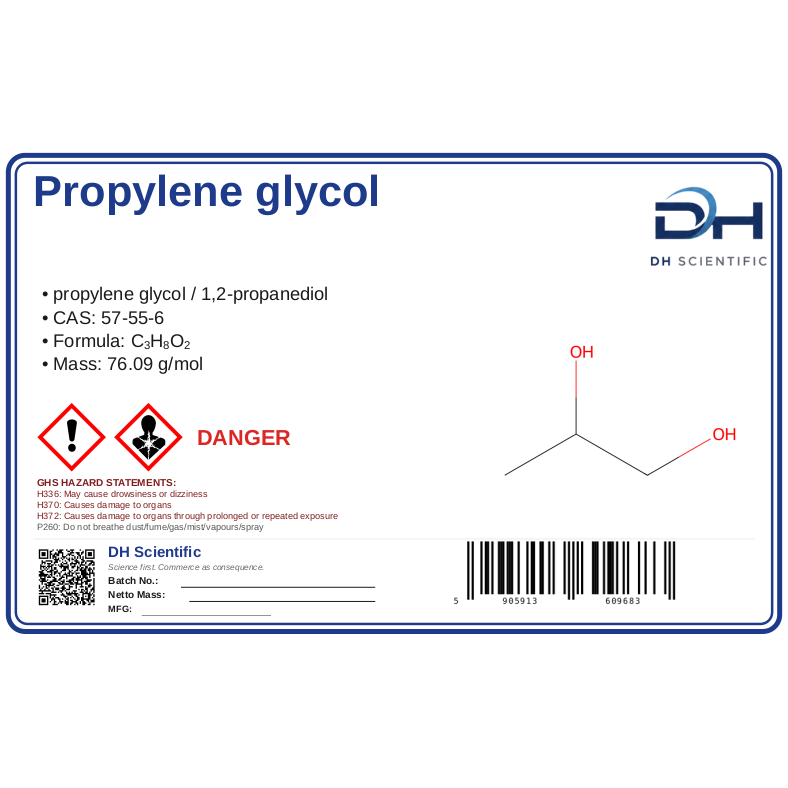
Glikol propylenowy, CAS 57-55-6
0,99 €
Glikol propylenowy, CAS 57-55-6
🔒 Demo mode — this item is not for sale.
Legal substance. dhscientific.com is a demonstration of the MOL-GOD platform — we sell nothing and no orders are fulfilled. Banned substances are blocked here automatically from the regulatory canon (compare e.g. Heptachlor).
| Molecular formula | C3H8O2 |
| Molecular weight | 76.09 g/mol |
| Melting point | -60 °C |
| Boiling point | 188.2 °C |
| Density | 1.0361 g/cm³ |
| LogP (lipophilicity) | -0.92 |
| pKa | 14.89 |
| IUPAC name | propane-1,2-diol |
| SMILES | CC(CO)O |
| InChIKey | DNIAPMSPPWPWGF-UHFFFAOYSA-N |
Synonyms: propylene glycol · 1,2-propanediol · 57-55-6 · propane-1,2-diol · 1,2-Propylene glycol
Data sources: PubChem (NLM/NIH), Yaws Handbook 2nd ed. (2014)
Last updated: 2026-11-10
| Property | Value | Unit | Conditions | Source |
|---|---|---|---|---|
| Density (ρ) | 1.0361 | g/cm³ | 20 °C (68 °F) | Yaws Handbook 2nd ed. (2014) |
| Melting Point (mp) | -60.00 °C (-76 °F) | 1 atm | Yaws Handbook 2nd ed. (2014) | |
| Boiling Point (bp) | 188.20 °C (370.8 °F) | 1 atm | Yaws Handbook 2nd ed. (2014) | |
| Flash Point | 99.00 °C (210.2 °F) | closed cup | Yaws Handbook 2nd ed. (2014) | |
| Vapor Pressure | 0.130 | mmHg | 25 °C (77 °F) | Yaws Handbook 2nd ed. (2014) |
| Water Solubility | miscible | g/L | 20 °C (68 °F) | Yaws Handbook 2nd ed. (2014) |
| Viscosity (η) | 40.400 | cP | 25 °C (77 °F) | Yaws Handbook 2nd ed. (2014) |
| Refractive Index (nD) | 1.4326 | 20 °C (68 °F), D-line | Yaws Handbook 2nd ed. (2014) | |
| pKa | 14.890 | 25 °C (77 °F) | Yaws Handbook 2nd ed. (2014) |
| Surface Tension | 36.000 mN/m | 20°C |
| Dielectric Constant (ε) | 32.000 | 25°C |
| Heat Capacity (Cp) | 2.481 J/(g·K) | 25°C |
CC(CO)O Data sources: PubChem, NIST Chemistry WebBook, CRC Handbook of Chemistry and Physics (103rd ed.)
Last updated: 2026-07-11
| Property | Value | Unit | Conditions | Source |
|---|---|---|---|---|
| Melting point | -60.00 [3][6][11] | °C | 1 atm | Yaws Handbook 2nd ed. (2014) |
| Boiling point | 188.20 [3][6][11] | °C | 760 mmHg | Yaws Handbook 2nd ed. (2014) |
| Water solubility | miscible [3] | g/L | 20°C | Yaws Handbook 2nd ed. (2014) |
| Density (ρ) | 1.0361 [3] | g/cm³ | 20°C | Yaws Handbook 2nd ed. (2014) |
| Refractive index (n_D) | 1.4326 [3] | — | 20°C, sodium D | Yaws Handbook 2nd ed. (2014) |
| Viscosity (η) | 40.400 [3] | cP | 25°C | Yaws Handbook 2nd ed. (2014) |
| Vapor pressure | 0.130 [3] | mmHg | 25°C | Yaws Handbook 2nd ed. (2014) |
| Flash point | 99.00 [3] | °C | closed cup | Yaws Handbook 2nd ed. (2014) |
| Autoignition temperature | 371.00 [3] | °C | in air | Yaws Handbook 2nd ed. (2014) |
| pKa₁ | 14.890 [3][2][10] | — | 25°C | Yaws Handbook 2nd ed. (2014) |
| logP (octanol/water) | -0.920 [3][8][9] | — | 25°C | Yaws Handbook 2nd ed. (2014) |
| logD (pH 7) | -0.920 [3][8][9] | — | pH 7.4 | Yaws Handbook 2nd ed. (2014) |
| Dielectric constant (ε) | 32.000 [3] | — | 25°C | Yaws Handbook 2nd ed. (2014) |
| Surface tension | 36.000 [3] | mN/m | 20°C | Yaws Handbook 2nd ed. (2014) |
| Specific heat (cp) | 2.481 [3] | J/(g·K) | 25°C | Yaws Handbook 2nd ed. (2014) |
| Thermal conductivity (k) | 0.2000 [3] | W/(m·K) | 25°C | Yaws Handbook 2nd ed. (2014) |
| Dipole moment (μ) | 2.270 [3] | D | gas phase | Yaws Handbook 2nd ed. (2014) |
| ΔH vaporization | 58.500 [3][4] | kJ/mol | NBP | Yaws Handbook 2nd ed. (2014) |
| ΔH fusion | 7.400 [3] | kJ/mol | at mp | Yaws Handbook 2nd ed. (2014) |
| Critical temperature (Tc) | 351.00 [3][4] | °C | critical point | Yaws Handbook 2nd ed. (2014) |
| Critical pressure (Pc) | 60.000 [3][4] | bar | critical point | Yaws Handbook 2nd ed. (2014) |
| Acentric factor (ω) | 0.5200 [3][4] | — | Pitzer | Yaws Handbook 2nd ed. (2014) |
| Ethanol solubility | miscible [3] | g/L | 25°C | Yaws Handbook 2nd ed. (2014) |
GHS/CLP classification — Regulation (EC) No 1272/2008 + UN GHS Rev. 9 (2021).


⚠ Classification based on a consensus of sources (PubChem / supplier notifications) — not verified against the harmonised classification in Annex VI (CLP). The scope of hazards may be broader than the official classification; verify against the supplier's current safety data sheet before use.
Translations: CLP Regulation (EC) 1272/2008, Annexes III and IV. Data: PubChem/NLM.
References collected from all Safety Hub tabs. CAS: 57-55-6 ·
PubChem ↗
Tabs with their own references (Emergency, PPE, Storage, Waste) contain additional bibliographic entries within their respective sections.
Paste a series of replicate measurements (CSV, or one number per line). The calculator computes the mean, standard deviation and 95% CI, and detects outliers (Grubbs + Dixon Q).
x̄ = Σxᵢ / n — arithmetic means² = Σ(xᵢ - x̄)² / (n-1) — sample variances = √s² — standard deviationRSD% = (s / x̄) × 100% — relative standard deviationCI₉₅ = x̄ ± t(0.05, n-1) × s / √n — Student's tG = |xᵢ - x̄| / s — Grubbs' testQ = |xsuspect - xnearest| / |xmax - xmin| — Dixon Q-testSource: ICH Q2(R2) Validation of Analytical Procedures · ICH PDF ↗
Choose a buffer from the list of 20 popular systems → enter the target pH → get an exact recipe with the masses to weigh out.
Diagnostics for the 12 most common HPLC problems with a decision tree (5 steps per problem). Source: Snyder/Kirkland/Dolan 3rd ed. Chapter 17 + LCGC LC Troubleshooting columns 1989-2024.
Symptom: All peaks on the chromatogram are wider than expected (FWHM > 2× normal)
Symptom: Peaks have an extended "tail" on the late-elution side (asymmetry T = b/a > 1.5 per USP)
Symptom: The baseline rises or falls systematically for >5 minutes
Symptom: The expected analyte peak does not appear on the chromatogram
Symptom: Pump pressure > 80% of the column max or system shutdown with a high-pressure error
Symptom: Unexplained peaks on the chromatogram absent from the calibration
Drug-likeness radar chart (Lipinski Ro5 / Veber). Green zone = compliance with criteria.
Predictive data — properties calculated in silico (SMILES/RDKit). These do not replace clinical studies. Do not use for drug evaluation without experimental verification.
| Property | Value | Rating |
|---|---|---|
| Absorption (GI) | high | ✓ |
| BBB permeability | yes (crosses) | |
| Bioavailability (Daina 2017) | 55% | |
| CYP450 profile | CYP1A2 non-inhibitorCYP2C9 non-inhibitorCYP2C19 non-inhibitorCYP2D6 non-inhibitorCYP3A4 non-inhibitor | |
| PAINS alerts | 0 | ✓ |
| Brenk alerts | 0 | ✓ |
| pKa (pH 7.4) | 14.8 (experimental) | |
| hERG (cardiotox.) | ✓ no | |
| P-gp substrate | — | |
| Ames mutagenicity | ✓ no | |
| DILI (hepatotox.) | — | |
| LogS (aq. solub.) | — | |
57-55-6
— multi-criteria ranking (W12): 30% citations · 20% recency · 20% topic · 15% historical · 15% open access.
Glikol propylenowy, CAS 57-55-6
You must be logged in to post a review.
All scientific sources cited in the accordions above for CAS 57-55-6. Format: Chicago Manual of Style 17th ed., Author-Date system.
© 2026 DH Scientific
Reviews
There are no reviews yet.