
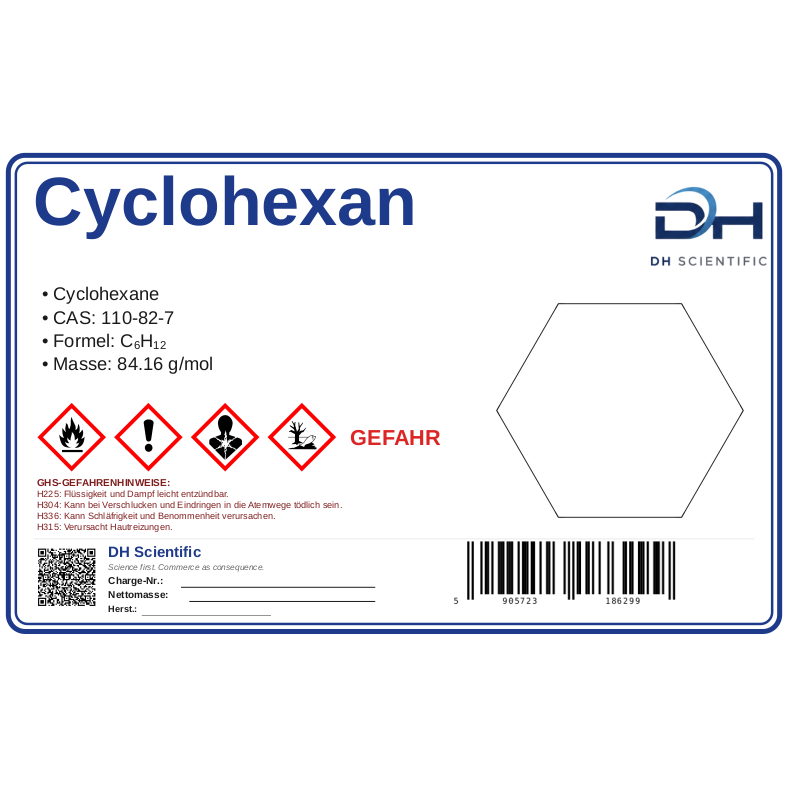
Cyclohexan
7,99 €
🔒 Demomodus — dieser Artikel steht nicht zum Verkauf.
Legale Substanz. dhscientific.com ist eine Demonstration der MOL-GOD-Plattform — wir verkaufen nichts und es werden keine Bestellungen ausgeführt. Verbotene Substanzen werden hier automatisch anhand des regulatorischen Kanons blockiert (vgl. z. B. Heptachlor).
Prüfung Ihres Sicherheitsdatenblatts — kostenlos → · Kontakt

Chemische Übersicht: CykloheksanMolGod_OVERVIEW_1
| Summenformel | C₆H₁₂ |
| Molekulargewicht | 84.16 g/mol |
| Schmelzpunkt | 6.59 °C |
| Siedepunkt | 80.72 °C |
| Dichte | 0.8 g/cm³ |
| LogP (Lipophilie) | 3.4 |
| SMILES | C1CCCCC1 |
Synonyme: Cyclohexane
Datenquellen: PubChem (NLM/NIH)
Zuletzt aktualisiert: 2026-11-10
WISSENSCHAFTLICHE FORSCHUNG
📚 Wissenschaftliche Referenzen (Chicago Author-Date) 8 refs · 2 baz
MOLEKUŁA Bibliografie pro CAS (live aus 13+ Datenbanken)
Quellen: db:europepmc (8)
- db:europepmc Zubieta, CE; Aquino-Linarez, LG; Rossi-Fernández, A; Belelli, PG. 2026. "Hydroxylation effects on the DFT-modeled adsorption of benzene and cyclohexane on hematite." Journal of molecular graphics & modelling. https://doi.org/10.1016/j.jmgm.2026.109457. →
- db:europepmc Tohamy, HS. 2026. "Novel dialdehyde fullerene-like carbon nanostructures from red garlic peels for naked-eye cyclohexane gas sensing and pH." Discover nano. https://doi.org/10.1186/s11671-026-04581-y. →
- db:europepmc Strunz, C; Jamar, M; Tomas, A; Nozière, B. 2026. "A New Approach to Quantify Total Organic Nitrate Yields from RO<sub>2</sub> + NO Reactions: Application to Ethane-, Cyclohexane-, and Isoprene-Derived RO<sub>2</sub> Radicals." Environmental science & technology. https://doi.org/10.1021/acs.est.5c11407. →
- db:europepmc Zhang, X; Zhao, S; Xing, S; Liu, X. 2026. "Evidence for Spin Polarization and Lattice Oxygen Migration During Cyclohexane Oxidation Over CoO<sub>x</sub>/Fe<sub>2</sub>O<sub>3</sub>." Angewandte Chemie (International ed. in English). https://doi.org/10.1002/anie.5512890. →
- db:europepmc Pavlov, DI; Yu, X; Zhou, Z; Ryadun, AA. 2026. "Simultaneous Capture and Luminescent Detection of Trace Benzene in Cyclohexane Enabled by π-Accepting Benzothiadiazole Units in a Metal-Organic Framework." Journal of the American Chemical Society. https://doi.org/10.1021/jacs.6c02380. →
- db:europepmc Guo, M; Liu, C; Zhao, K; Li, X. 2026. "A nitrogen-doped carbon-supported cobalt catalyst for highly selective catalysis of cyclohexane amino carbonylation." Chemical communications (Cambridge, England). https://doi.org/10.1039/d6cc00564k. →
- db:europepmc Zhao, M; Ding, Z; Perveen, S; Qin, L. 2026. "Boronyl Radical-Catalyzed Intermolecular (4 + 2) Cycloaddition of Cyclobutanes and Alkenes: Synthesis of Polysubstituted Cyclohexanes." The Journal of organic chemistry. https://doi.org/10.1021/acs.joc.6c00183. →
- db:europepmc Yang, QY; Yang, Q; Song, YF; Liu, AW. 2025. "Vibrational Analysis Based on Cavity-Enhanced Raman Spectroscopy: Cyclohexane." The journal of physical chemistry. A. https://doi.org/10.1021/acs.jpca.4c07709. →
Physikochemische Eigenschaften
Kurzübersicht
Detaillierte Eigenschaften
| Eigenschaft | Wert | Einheit | Bedingungen | Quelle |
|---|---|---|---|---|
| Dichte (ρ) | 0.8000 | g/cm³ | 20 °C (68 °F) | |
| Schmelzpunkt (mp) | 6.59 °C (43.9 °F) | 1 atm | ||
| Siedepunkt (bp) | 177.3 °F at 760 mmHg (NTP, 1992) | PubChem (NIH/NLM) ↗ | ||
| Flammpunkt | -4 °F (NTP, 1992) | PubChem (NIH/NLM) ↗ | ||
| Dampfdruck | 95 mmHg at 68 °F ; 100 mmHg at 77.9 °F (NTP, 1992) | PubChem (NIH/NLM) ↗ | ||
| Wasserlöslichkeit | less than 1 mg/mL at 63 °F (NTP, 1992) | PubChem (NIH/NLM) ↗ | ||
| Viskosität (η) | 0.977 mPa.s at 20 °C (68 °F) | PubChem (NIH/NLM) ↗ | ||
| Brechungsindex (nD) | Index of refraction: 1.42662 at 20 °C (68 °F)/D | PubChem (NIH/NLM) ↗ |
🔬 Erweiterte Eigenschaften
Chemische Kennungen
C1CCCCC1 InChI=1S/C6H12/c1-2-4-6-5-3-1/h1-6H2
XDTMQSROBMDMFD-UHFFFAOYSA-N
Datenquellen: PubChem, NIST Chemistry WebBook, CRC Handbook of Chemistry and Physics (103rd ed.)
Zuletzt aktualisiert: 2026-06-09
📡 Spektroskopie — CAS 110-82-7MolGod_SPECHUB_MAIN
Physikalisch-chemische Eigenschaften (DB) 5 Felder MolGod-Score: Keine Quelle
| Eigenschaft | Wert | Einheit | Bedingungen | Quelle |
|---|---|---|---|---|
| Schmelzpunkt | 6.59 | °C | 1 atm | |
| Siedepunkt | 80.72 | °C | 760 mmHg | |
| Wasserlöslichkeit | 0.055 | g/L | 25°C | |
| Dichte (ρ) | 0.8000 | g/cm³ | 20°C | |
| logP (Octanol/Wasser) | 3.400 | — | 25°C |
📚 Wissenschaftliche Referenzen (Chicago Author-Date) (12 Quellen)
- Haynes, William M., ed. 2024. CRC Handbook of Chemistry and Physics. 105th ed. Boca Raton: CRC Press/Taylor & Francis. ISBN 978-1-032-55554-4. ↗
- National Institute of Standards and Technology. 2024. "NIST Chemistry WebBook, SRD 69." Gaithersburg, MD: NIST. Accessed 2025-01-01. ↗
- Yaws, Carl L. 2014. The Yaws Handbook of Physical Properties for Hydrocarbons and Chemicals. 2nd ed. Oxford: Gulf Professional Publishing.
- PubChem. 2024. "PubChem Compound Database." National Library of Medicine, National Institutes of Health. Accessed 2025-01-01. ↗
- Marrero, J., and R. Gani. 2001. "Group-Contribution Based Estimation of Pure Component Properties." Fluid Phase Equilibria 183–184: 183–208. ↗
- Joback, K. G., and R. C. Reid. 1987. "Estimation of Pure-Component Properties from Group-Contributions." Chemical Engineering Communications 57 (1–6): 233–243. ↗
- Sangster, J. 1997. Octanol-Water Partition Coefficients: Fundamentals and Physical Chemistry. Chichester: Wiley. ISBN 978-0-471-97397-3.
- Mannhold, Raimund, and Han van de Waterbeemd. 2001. "Substructure and Whole Molecule Approaches for Calculating Log P." Journal of Computer-Aided Molecular Design 15 (4): 337–354. ↗
- Perrin, Ditlev D., Boyd Dempsey, and E. P. Serjeant. 1981. pKa Prediction for Organic Acids and Bases. London: Chapman and Hall. ISBN 0-412-21090-5.
- Constantinou, Leonidas, and Rafiqul Gani. 1994. "New Group Contribution Method for Estimating Properties of Pure Compounds." AIChE Journal 40 (10): 1697–1710. ↗
- Ertl, Peter, Bernhard Rohde, and Paul Selzer. 2000. "Fast Calculation of Molecular Polar Surface Area as a Sum of Fragment-Based Contributions and Its Application to the Prediction of Drug Transport Properties." Journal of Medicinal Chemistry 43 (20): 3714–3717. ↗
🛡️ Sicherheit — CAS 110-82-7MolGod_SAFEHUB_MAIN
GHS/CLP-Einstufung — Verordnung (EG) Nr. 1272/2008 + UN GHS Rev. 9 (2021).


🚨 Gefahrenhinweise (H)
- H225 — Flüssigkeit und Dampf leicht entzündbar.
- H304 — Kann bei Verschlucken und Eindringen in die Atemwege tödlich sein.
- H336 — Kann Schläfrigkeit und Benommenheit verursachen.
- H315 — Verursacht Hautreizungen.
- H400 — Sehr giftig für Wasserorganismen.
- H410 — Sehr giftig für Wasserorganismen mit langfristiger Wirkung.
🛡 Sicherheitshinweise (P)
- P210 — Von Hitze, heißen Oberflächen, Funken, offenen Flammen und anderen Zündquellenarten fernhalten. Nicht rauchen.
- P261 — Einatmen von Staub/Rauch/Gas/Nebel/Dampf/Aerosol vermeiden.
- P273 — Freisetzung in die Umwelt vermeiden.
- P280 — Schutzhandschuhe/Schutzkleidung/Augenschutz/Gesichtsschutz tragen.
✓ Harmonisierte Einstufung gemäß Anhang VI der CLP-Verordnung (EG) 1272/2008 (amtliche, verbindliche Einstufung). Indexnummer: 601-017-00-1.
Referenz (Chicago): European Chemicals Agency. "cyclohexane, Index No. 601-017-00-1." In Table 3 of Annex VI to Regulation (EC) No 1272/2008 (CLP Regulation), 23rd Adaptation to Technical Progress. Helsinki: European Chemicals Agency, 2026. https://echa.europa.eu/information-on-chemicals/annex-vi-to-clp.
Übersetzungen: CLP-Verordnung (EG) 1272/2008, Anhang III und IV. Daten: PubChem/NLM.
📚 Konsolidierte wissenschaftliche Referenzen — Chicago Author-Date 10 Quellen
Referenzen aus allen Safety-Hub-Registerkarten gesammelt. CAS: 110-82-7 ·
PubChem ↗
- Parlament Europejski i Rada UE. 2008. "Rozporządzenie (WE) nr 1272/2008 w sprawie klasyfikacji, oznakowania i pakowania substancji (CLP)." Dz.Urz. UE L 353. [↗] GHS, Vorschriften
- United Nations Economic Commission for Europe (UNECE). 2021. "Globally Harmonized System of Classification and Labelling of Chemicals (GHS), Ninth Revised Edition." United Nations, Geneva. [↗] GHS
- Goldfrank, Lewis R., Robert S. Hoffman, Mary Ann Howland, et al.. 2019. "Goldfrank's Toxicologic Emergencies, 11th ed.." McGraw-Hill Education, New York. ISBN 978-1-25-985961-8. Pierwsza pomoc, Toksykologia
- National Institute for Occupational Safety and Health (NIOSH). 2023. "NIOSH Pocket Guide to Chemical Hazards (DHHS Publ. 2005-149)." U.S. Department of Health and Human Services / CDC, Cincinnati, OH. [↗] Pierwsza pomoc, PPE, Toksykologia
- European Committee for Standardization (CEN). 2016. "EN 374-1:2016 — Protective gloves against dangerous chemicals and micro-organisms." CEN, Brussels. [↗] PPE
- UNECE. 2023. "European Agreement Concerning the International Carriage of Dangerous Goods by Road (ADR 2025)." United Nations, Geneva. [↗] Utylizacja, Regulacje
- National Fire Protection Association (NFPA). 2022. "NFPA 400 — Hazardous Materials Code." NFPA, Quincy, MA. [↗] Magazynowanie
- Urben, P.G. (ed.). 2017. "Bretherick's Handbook of Reactive Chemical Hazards, 8th ed.." Butterworth-Heinemann / Elsevier, Oxford. [↗] Magazynowanie
- Ministerstwo Klimatu i Środowiska RP. 2023. "Baza danych o produktach i opakowaniach oraz o gospodarce odpadami (BDO)." Ministerstwo Klimatu i Środowiska, Warszawa. [↗] Utylizacja
- International Agency for Research on Cancer (IARC / WHO). 2024. "IARC Monographs on the Identification of Carcinogenic Hazards to Humans — List of Classifications." WHO, Lyon. [↗] Toksykologia
Registerkarten mit eigenen Referenzen (Emergency, PPE, Storage, Waste) enthalten zusätzliche bibliografische Einträge in ihren jeweiligen Abschnitten.
Analytische Statistik (t-Test · RSD · Grubbs · Q-Dixon) ICH Q2
Fügen Sie eine Serie von Messwiederholungen ein (CSV oder eine Zahl pro Zeile). Der Rechner berechnet Mittelwert, Standardabweichung und 95% CI und erkennt Ausreißer (Grubbs + Dixon Q).
📐 Statistische Formeln
x̄ = Σxᵢ / n— arithmetisches Mittels² = Σ(xᵢ - x̄)² / (n-1)— Stichprobenvarianzs = √s²— StandardabweichungRSD% = (s / x̄) × 100%— relative StandardabweichungCI₉₅ = x̄ ± t(0.05, n-1) × s / √n— Student's tG = |xᵢ - x̄| / s— Grubbs-TestQ = |xsuspect - xnearest| / |xmax - xmin|— Dixon Q-test
Quelle: ICH Q2(R2) Validation of Analytical Procedures · ICH PDF ↗
Puffer-Rezept-Rechner EINZIGARTIG
Wählen Sie einen Puffer aus der Liste von 20 gängigen Systemen → geben Sie den Ziel-pH-Wert ein → Sie erhalten ein exaktes Rezept mit den einzuwiegenden Massen.
Schritt 1: Puffersystem wählen
📜 Rezeptverlauf (letzte 10)
🔧 Fehlerbehebung HPLC — Entscheidungsbaum 6 häufige Probleme
Diagnose der 12 häufigsten HPLC-Probleme mit Entscheidungsbaum (5 Schritte pro Problem). Quelle: Snyder/Kirkland/Dolan 3rd ed. Chapter 17 + LCGC LC Troubleshooting columns 1989-2024.
Verbreiterte Peaks (broad peaks) medium
Symptom: Alle Peaks im Chromatogramm sind breiter als erwartet (FWHM > 2× normal)
🔍 Diagnosebaum:
-
1. Prüfen Sie, ob alle Peaks verbreitert sind oder nur einige
→ JA: Alle → instrumentelles Problem (Säule oder System)
→ NEIN: Nur einige → chemisches Problem (Wechselwirkung mit der Säule bei bestimmten Analyten) -
2. Tauschen Sie eine Testsäule ein — verschwindet das Problem?
→ JA: SÄULE verschlissen — Packung beschädigt, Void in den ersten mm. Ersetzen.
→ NEIN: Problem im LC-System -
3. Prüfen Sie das Totvolumen (dead volume) — Injektionsschleife, Verbindungen, Detektor
→ JA: Schleife > 100 µL für eine 4.6-mm-Säule oder lose Verbindungen → Ferrulen ersetzen, Kapillaren kürzen
→ NEIN: Diagnose fortsetzen -
4. Temperaturtest: Erhöhen Sie die Säule von 25°C auf 40°C
→ JA: Schmalere Peaks → Massentransferkinetik zu langsam (T erhöhen)
→ NEIN: Continue -
5. Prüfen Sie die Flussrate gegenüber dem van-Deemter-Optimum für diese Säule
→ JA: Optimum für 4.6mm/5µm = 1.0 mL/min, für 2.1mm/3µm = 0.4 mL/min
→ NEIN: Continue
- Säule verschlissen (>2000 Injektionen ohne Vorsäule)
- Totvolumen des Systems > 100 µL (falsche Schleife, lange Kapillaren, lose Ferrulen)
- Temperatur zu niedrig (Massentransferkinetik)
- Flussrate außerhalb des van-Deemter-Optimums
- Probenlösungsmittel stärker als mobile Phase A
- ✓ Säule ersetzen (bei >2000 Injektionen)
- ✓ Alle Verbindungen prüfen — Kapillaren so kurz wie möglich
- ✓ Säulentemperatur auf 40°C erhöhen (wenn die Substanz stabil ist)
- ✓ Fluss auf das van-Deemter-Optimum reduzieren
- ✓ Probe in mobiler Phase A lösen (nicht in reinem Organischem)
Peak-Tailing (Tailing, T > 1.5) high
Symptom: Peaks haben einen verlängerten "Schwanz" auf der Seite der späten Elution (Asymmetrie T = b/a > 1.5 gemäß USP)
🔍 Diagnosebaum:
-
1. Enthält die Substanz basische Gruppen (Amino, Pyridin)?
→ JA: Ja → Silanol-Wechselwirkungen! Fügen Sie 0.1% TFA oder 5-10 mM TEA zur mobilen Phase A hinzu.
→ NEIN: Continue -
2. Prüfen Sie den pH der mobilen Phase gegenüber dem pKa der Substanz
→ JA: pH = pKa ± 1 → teilweise Ionisierung, Peak-Split. Gehen Sie pH ≥ 2 Einheiten vom pKa weg.
→ NEIN: Continue -
3. Prüfen Sie das Alter der Säule (>1500 Injektionen?)
→ JA: Ja → freigelegte Silanole (Column Bleed). Ersetzen Sie die Säule durch eine mit höherem Endcapping (XTerra, Symmetry).
→ NEIN: Continue -
4. Enthält die Probe Metalle (Fe, Cu aus Glasfläschchen)?
→ JA: Ja → verwenden Sie klare Typ-II-Fläschchen oder PFA. 0.1mM EDTA zur Probe geben.
→ NEIN: Continue
- Silanol-Wechselwirkungen (basischer Analyt + freie Silanole des Kieselgels)
- pH an der Grenze des Analyt-pKa (Peak-Split)
- Alte Säule (Column Bleed, hohe Silanolaktivität)
- Metalle in der Probe (Chelatbildung → Tailing)
- Säulenüberladung (>50 µg auf einer 4.6mm-Säule)
- ✓ 0.1% TFA (UV) oder 0.1% Ameisensäure (LC-MS) zur mobilen Phase A hinzufügen
- ✓ Wählen Sie eine Säule mit hochreinem Endcapping: Waters XBridge BEH, Phenomenex Kinetex
- ✓ Arbeiten Sie bei pH ≥ 2 Einheiten vom pKa entfernt
- ✓ 0.1mM EDTA zur Probe (Fe/Cu-Chelatbildung)
- ✓ Injektionsvolumen auf ≤ 20 µL für eine 4.6mm-Säule reduzieren
Grundliniendrift (Baseline Drift) medium
Symptom: Die Grundlinie steigt oder fällt systematisch über >5 Minuten
🔍 Diagnosebaum:
-
1. Verwenden Sie einen Gradienten (B% steigt)?
→ JA: Ja → unterschiedliche Absorption der Phasen A vs. B bei dλ. Lösungsmittelwechsel im UV-Cutoff. Prüfen Sie die UV-Absorption des %-Organik-Anteils.
→ NEIN: Weiter (isokratisch) -
2. Prüfen Sie die Säulentemperatur — ist sie auf ±0.5°C stabil?
→ JA: Ja (stabil) → weiter
→ NEIN: Instabil → Säulenthermostat einschalten (>25°C kontrolliert) -
3. Test: Autosampler ausschalten, nur Pumpe+Säule+Detektor betreiben
→ JA: Drift verschwindet → Autosampler-Kontamination (Nadel, Septum reinigen)
→ NEIN: Continue -
4. Prüfen Sie das Alter der Lampe (D2 für UV)
→ JA: Ja (>1500 Stunden) → Lampe ersetzen
→ NEIN: Continue
- Gradientenelution mit unterschiedlichem UV-Cutoff der Phasen
- Instabile Säulentemperatur
- Autosampler-Kontamination von Nadel/Septum
- UV-Lampe alt (>1500h)
- Detektor-Durchflusszelle verschmutzt
- Säule nicht äquilibriert (<10 Säulenvolumina)
- ✓ Säule 10-15 Säulenvolumina bei 100% A voräquilibrieren
- ✓ Säulenthermostat ein, T 30-40°C stabil
- ✓ Detektor-Durchflusszelle mit 50:50 ACN:H2O reinigen
- ✓ D2-Lampe ersetzen, wenn >1500h
- ✓ Grundlinien-Subtraktion verwenden (Chromeleon, native Empower-Funktion)
Kein Peak / verlorener Peak (no peak) critical
Symptom: Der erwartete Analyt-Peak erscheint nicht im Chromatogramm
🔍 Diagnosebaum:
-
1. Hat die Injektion tatsächlich stattgefunden?
→ JA: Prüfen Sie das Autosampler-Log, den Pumpendruck (sollte bei der Injektion abfallen)
→ NEIN: Autosampler-Problem → Schleife, Nadel, Probe im Fläschchen prüfen -
2. Ist die Probe im Fläschchen (korrektes Volumen, nicht verdunstet)?
→ JA: Continue
→ NEIN: Keine Probe — erneut pipettieren -
3. Probenstabilität — vor >24h vorbereitet?
→ JA: Ja → Degradation. Bereiten Sie eine frische Probe vor.
→ NEIN: Continue -
4. Prüfen Sie die Detektionswellenlänge gegenüber dem λmax der Substanz
→ JA: Detektion bei λ entspricht NICHT dem λmax → kein Signal. DAD 200-400nm scannen.
→ NEIN: Continue -
5. Test: Injizieren Sie einen reinen Standard (bekannter Konzentration, frisch)
→ JA: Standard ergibt einen Peak → Problem mit der Probe (Matrix, Derivatisierung)
→ NEIN: Kein Peak auch mit dem Standard → Systemproblem (Säule, Phase, Gradient)
- Probe nicht aus dem Fläschchen entnommen (Autosampler-Fehler)
- Probe degradiert (>24h pH/Temp/Licht)
- Detektion bei falscher Wellenlänge
- Falsche mobile Phase (z. B. vergessenes TFA)
- Säule umgekehrt / falsche stationäre Phase
- Substanz eluiert an der Front (V0) → nicht retendiert, nicht sichtbar
- ✓ Frische Probe nach dem exakten Protokoll neu vorbereiten
- ✓ UV-Vis-DAD-Scan 200-400nm + Suche nach λmax
- ✓ Zusammensetzung der mobilen Phase prüfen — TFA hinzugefügt?
- ✓ Umgekehrte Säulenrichtung testen (vorsichtig!)
- ✓ Bei Retention <1 min — % B verringern, MeOH statt ACN
- ✓ Prüfen Sie die Tabelle "expected_rt" in wp_molgod_hplc_methods
Druck zu hoch (pressure too high) critical
Symptom: Pumpendruck > 80% des Säulenmaximums oder System-Shutdown mit High-Pressure-Fehler
🔍 Diagnosebaum:
-
1. Prüfen Sie, ob die Säule korrekt angeschlossen ist (Pfeilrichtung)
→ JA: OK
→ NEIN: Säule umgekehrt → umdrehen (niemals "rückwärts" betreiben) -
2. Test: Säule aus dem System entfernen, nur Pumpe+Detektor betreiben
→ JA: Druck fällt auf <50 bar → Problem in der Säule (verstopft)
→ NEIN: Druck bleibt hoch → In-Line-Filter verstopft, Fritte verschmutzt -
3. Prüfen Sie den Vorsäulenfilter (In-Line-Fritte)
→ JA: Verschmutzt und braun → ersetzen
→ NEIN: Continue -
4. Säule rückwärts mit 50:50 ACN:H2O spülen, ohne die Säule — verschwindet es?
→ JA: Partikel im ersten mm stecken geblieben — 30 min Spülung kann sie wiederherstellen
→ NEIN: Säule ersetzen
- In-Line-Filter (Fritte) mit Partikeln verstopft
- Puffer-Aussalzung (Ausfällung bei hohem %B)
- Probe enthält Schwebstoffe (0.22 µm vor der Injektion filtrieren)
- Säule verstopft (Column Bed Compaction)
- Gradient mit Pufferphase + viel Organik → Salzausfällung
- ✓ Probe IMMER durch 0.22 µm PVDF vor der Injektion filtrieren
- ✓ In-Line-Filter alle 100 Injektionen ersetzen (oder wenn der Druck >20% steigt)
- ✓ Verwenden Sie NICHT >20mM Phosphatpuffer + >70% ACN (das Salz fällt aus)
- ✓ Säule 30 min mit 50:50 ACN:H2O in umgekehrter Richtung spülen (wenn vom Hersteller zugelassen)
- ✓ Vorsäule 4×3mm zum Schutz der Hauptsäule
Geisterpeaks (Ghost Peaks) high
Symptom: Unerklärte Peaks im Chromatogramm, die in der Kalibrierung fehlen
🔍 Diagnosebaum:
-
1. Test: Blindinjektion (reines Probenlösungsmittel)
→ JA: Ein Geisterpeak erscheint → Kontamination des Systems oder der Eluenten
→ NEIN: Erscheint nur mit der Probe → Matrix -
2. Wächst der Geisterpeak mit dem Gradienten (eluiert bei hohem %B)?
→ JA: Ja → überladene Säule oder stark retendiert aus einem vorherigen Lauf
→ NEIN: Unabhängig vom Gradienten → Autosampler-Verschleppung -
3. Increase carryover wash (between injections)
→ JA: Hilft → Verschleppung war die Ursache. Stärkeres Waschprotokoll.
→ NEIN: Continue -
4. Reinwasser-Injektion — gibt es einen Peak?
→ JA: Ja → Kontamination der Wasserquelle (Organik aus dem DI-System)
→ NEIN: Continue
- Verschleppung in Autosampler-Nadel/-Schleife
- Eluent-Kontamination (auch in HPLC-Qualität)
- Stark retendierte Komponenten aus vorherigen Läufen
- Kunststoff in den Fläschchen (Phthalate, PEG aus den Kappen)
- DI-Wasser unzureichend gereinigt
- ✓ Waschprotokoll verstärken: 100% B → 100% A → 50:50 (3 Zyklen)
- ✓ Starke Wäsche: 100% DMSO oder 100% MeOH vor der Kalibrierung
- ✓ Eluenten im Zweifelsfall durch 0.22 µm PTFE filtrieren
- ✓ Braunglas + Teflon-beschichtete Kappen für Proben verwenden
- ✓ Periodische Gradientenrampe auf 100% B für 10 min (Reinigung)
📚 Wissenschaftliche Referenzen (Chicago Author-Date) — zum Aufklappen klicken
- Snyder, Lloyd R., Joseph J. Kirkland, and John W. Dolan. 2010. Introduction to Modern Liquid Chromatography. 3rd ed. John Wiley & Sons. Chapter 17 (Troubleshooting) pp. 559-616. ISBN 978-0-470-16754-0. https://doi.org/10.1002/9780470508183 [link ↗]
- Dolan, John W.. 2014. LC Troubleshooting (monthly column 1989-2024). LCGC North America. [link ↗] — John Dolan 35-letnia seria miesięcznych artykułów problemowych
- Kromidas, Stavros. 2017. HPLC Made to Measure: A Practical Handbook for Optimization. 2nd ed. Wiley-VCH. ISBN 978-3-527-31377-1. — Praktyczny przewodnik problem-solving dla labs analitycznych
- Dolan, John W.. 2013. When to Modify Method Conditions. 192-199. [link ↗] — Decision flow for changing flow rate / temperature / %B vs swapping columns.
- Dong, Michael W.. 2019. HPLC and UHPLC for Practicing Scientists. 2nd ed. Wiley. ISBN 978-1-119-31378-3. https://doi.org/10.1002/9781119313793 [link ↗] — Chapter 9 covers troubleshooting modern UHPLC systems (sub-2 µm particles).
- Meyer, Veronika R.. 2010. Practical High-Performance Liquid Chromatography. 5th ed. Wiley. ISBN 978-0-470-68218-0. — Solid step-by-step problem isolation chapter (eluents, columns, instruments).
- Snyder, L. R., J. J. Kirkland, and J. L. Glajch. 1997. Practical HPLC Method Development. 2nd ed. Wiley. ISBN 978-0-471-00703-6. — Method-development companion volume with troubleshooting cross-refs.
- Carr, Peter W.. 2009. The new physical chemistry of HPLC. 1764-1772. https://doi.org/10.1016/j.chroma.2008.11.094 [link ↗] — Theoretical basis for diagnosing efficiency losses (mass-transfer, eddy diffusion).
- Heyden, Yvan Vander, et al.. 2009. Robustness of pharmaceutical liquid chromatographic methods. 2120-2129. https://doi.org/10.1016/j.jchromb.2008.10.052 [link ↗] — How to diagnose method failures vs. system failures (Plackett-Burman).
- Engelhardt, Heinz. 2014. 100 Years of Chromatography. 2nd ed. Wiley-VCH. ISBN 978-3-527-33473-5. — Historical context for ghost-peak phenomenology (silica chemistry).
- Stoll, Dwight R., and Peter W. Carr. 2017. Two-Dimensional Liquid Chromatography: A State of the Art Tutorial. 519-531. https://doi.org/10.1021/acs.analchem.6b03506 [link ↗]
- Carr, Peter W.. 2009. The new physical chemistry of HPLC. 1764-1772. https://doi.org/10.1016/j.chroma.2008.11.094 [link ↗]
- Wu, Naijun, and Anton M. Clausen. 2007. Fundamental and practical aspects of ultrahigh pressure liquid chromatography for fast separations. 1167-1182. https://doi.org/10.1002/jssc.200700026 [link ↗]
- Engelhardt, Heinz. 2014. 100 Years of Chromatography. 2nd ed. Wiley-VCH. ISBN 978-3-527-33473-5.
- Vivó-Truyols, Gabriel, and Hans-Gerd Janssen. 2010. Probabilistic approach to peak deconvolution in chromatography. 8525-8531. https://doi.org/10.1021/ac101742z [link ↗]
ADMET — Pharmakologisches Profil
🧪 Assistent zur Lösungsherstellung (Smart Prep) MolGod_PREP_2
Geben Sie ein, was Sie zubereiten möchten — ich erstelle eine SOP
📚 Überblick über die wissenschaftliche Literatur — CAS 110-82-7MolGod_LITHUB_MAIN
⭐ Wichtigste Erkenntnisse (wissenschaftliche Literatur) 1 Publikationen
110-82-7
— multi-criteria ranking (W12): 30% Zitierungen · 20% Aktualität · 20% Thema · 15% historisch · 15% Open Access.
-
#1Warum es wichtig ist: Ausgewählt nach einem Multikriterien-Score (Zitierungen + Aktualität + Thema + historisch + OA).
Related products
📚 REFERENZEN (Gesammelte Bibliografie, Chicago Author-Date) 107 Einträge
Alle wissenschaftlichen Quellen, die in den Akkordeons oben für CAS 110-82-7 zitiert werden.Format: Chicago Manual of Style, 17. Aufl., Autor-Datum-System.
🗄️ Wissenschaftliche Datenbanken
- NIST. 2026. NIST Chemistry WebBook: CAS 110-82-7. Gaithersburg, MD: National Institute of Standards and Technology. https://webbook.nist.gov/cgi/cbook.cgi?ID=110-82-7. (Accessed 2026-11-12.)
- AIST. 2026. Spectral Database for Organic Compounds (SDBS): CAS 110-82-7. Tsukuba, Japan: National Institute of Advanced Industrial Science and Technology. https://sdbs.db.aist.go.jp/. (Accessed 2026-11-12.)
- PubChem. 2026. PubChem Compound Summary: CAS 110-82-7. Bethesda, MD: National Center for Biotechnology Information (NCBI), National Library of Medicine. https://pubchem.ncbi.nlm.nih.gov/#query=110-82-7. (Accessed 2026-11-12.)
- ECHA. 2026. C&L Inventory and REACH Registration: CAS 110-82-7. Helsinki: European Chemicals Agency. https://echa.europa.eu/information-on-chemicals/annex-vi-to-clp. (Accessed 2026-11-12.)
📐 Standards / Richtlinien
- ICH. 2026. "ICH Harmonised Guideline: CAS 110-82-7." Geneva: International Council for Harmonisation. https://database.ich.org/sites/default/files/Q1A%28R2%29%20Guideline.pdf. (Accessed 2026-11-12.)
- National Fire Protection Association (NFPA). 2024. "NFPA 30: Flammable and Combustible Liquids Code." NFPA, Quincy, MA. https://www.nfpa.org/codes-and-standards/all-codes-and-standards/list-of-codes-and-standards/detail?code=30.
- Occupational Safety and Health Administration (OSHA). 2023. "29 CFR 1910.106 — Flammable Liquids." U.S. Department of Labor, Federal Register. https://www.osha.gov/laws-regs/regulations/standardnumber/1910/1910.106.
- European Chemicals Agency (ECHA). 2024. "Annex VI to Regulation (EC) No 1272/2008 (CLP) — Harmonised Classification and Labelling." ECHA, Helsinki / Official Journal of the European Union. https://echa.europa.eu/regulations/clp/clp-classification.
- European Committee for Standardization (CEN). 2016. "EN 374-1:2016 — Protective gloves against dangerous chemicals and micro-organisms — Part 1: Terminology and performance requirements for chemical risks." CEN, Brussels. https://standards.cencenelec.eu/dyn/www/f?p=205:110:::::FSP_PROJECT,FSP_ORG_ID:38536,6080&cs=1B0DAA8B85DF42E4A2C70E5D71F0BFA32.
- European Committee for Standardization (CEN). 2001. "EN 166:2001 — Personal eye-protection — Specifications." CEN, Brussels. https://standards.cencenelec.eu/dyn/www/f?p=CEN:110:0::::FSP_PROJECT:6541&cs=1F1A4E0A78C4DB6A28DBE2E8C29D89DCF.
- European Committee for Standardization (CEN). 2009. "EN 14605:2005+A1:2009 — Protective clothing against liquid chemicals — Performance requirements for clothing with liquid-tight (Type 3) or spray-tight (Type 4) connections." CEN, Brussels. https://standards.cencenelec.eu/dyn/www/f?p=CEN:110:0::::FSP_PROJECT:21581&cs=1A04A2D3C7CC58E9E6CB58D55F7EBFB7E.
- National Institute for Occupational Safety and Health (NIOSH). 2017. "Recommendations for Chemical Protective Clothing: A Companion to the NIOSH Pocket Guide." U.S. Department of Health & Human Services / CDC. https://www.cdc.gov/niosh/ncpc/default.html.
- Occupational Safety and Health Administration (OSHA). 2011. "Personal Protective Equipment — General requirements." U.S. Department of Labor — 29 CFR 1910.132. https://www.osha.gov/laws-regs/regulations/standardnumber/1910/1910.132.
📖 Bücher
- Hansen, Charles M. 2007. Hansen Solubility Parameters: A User's Handbook, 2nd ed.. Boca Raton, FL: CRC Press. https://www.routledge.com/Hansen-Solubility-Parameters-A-Users-Handbook/Hansen/p/book/9780849372483.
- Barton, Allan F. M. 1991. CRC Handbook of Solubility Parameters and Other Cohesion Parameters: 2nd ed.. Boca Raton, FL: CRC Press. https://www.routledge.com/CRC-Handbook-of-Solubility-Parameters-and-Other-Cohesion-Parameters/Barton/p/book/9780849301766.
- Connors, Kenneth A., Gordon L. Amidon, and Valentino J. Stella. 1986. Chemical Stability of Pharmaceuticals: A Handbook for Pharmacists, 2nd ed.. New York: Wiley. https://doi.org/10.1002/0471734683.
- Rumble, John R., ed. 2019. CRC Handbook of Chemistry and Physics: 100th Edition. Boca Raton, FL: CRC Press. https://hbcp.chemnetbase.com/.
- Urben, Peter G. 2017. Bretherick's Handbook of Reactive Chemical Hazards, 8th Edition. Academic Press / Elsevier, Oxford. https://www.sciencedirect.com/book/9780081010594.
📘 Monografien
- IARC. 2026. IARC Monographs on the Identification of Carcinogenic Hazards to Humans: CAS 110-82-7. Lyon, France: International Agency for Research on Cancer, World Health Organization. (Accessed 2026-11-12.)
📄 Wissenschaftliche Artikel (peer-reviewed)
- Stefanis, Emmanuel, and Costas Panayiotou. 2008. "Prediction of Hansen Solubility Parameters with a New Group-Contribution Method." International Journal of Thermophysics 29: 568-585. https://doi.org/10.1007/s10765-008-0415-z.
- Stoll, Vincent S., and John S. Blanchard. 1990. "Buffers: Principles and Practice: In Methods in Enzymology, vol. 182." San Diego: Academic Press. https://doi.org/10.1016/0076-6879(90)82008-P.
🌐 Websites
- ECHA. 2023. "Guidance on the Application of the CLP Criteria." European Chemicals Agency. https://echa.europa.eu/guidance-documents/guidance-on-clp.
- European Parliament. 2006. "Regulation (EC) No 1907/2006 (REACH)." Official Journal of the European Union L 396: 1–849.
- ECHA. 2023. "Candidate List of Substances of Very High Concern for Authorisation." European Chemicals Agency. https://echa.europa.eu/candidate-list-table.
- European Parliament. 2008. "Regulation (EC) No 1272/2008 on Classification, Labelling and Packaging of Substances and Mixtures (CLP)." Official Journal of the European Union L 353: 1–1355.
- ECHA. 2017. "Guidance on the Compilation of Safety Data Sheets." Version 3.1. European Chemicals Agency. ECHA-17-G-01-EN. https://echa.europa.eu/documents/10162/23047722/sds_en.pdf.
- ECHA. 2022. "Restrictions Under REACH — Annex XVII." European Chemicals Agency. https://echa.europa.eu/substances-restricted-under-reach.
- United Nations. 2021. Globally Harmonized System of Classification and Labelling of Chemicals (GHS). 9th revised ed. ST/SG/AC.10/30/Rev.9. New York and Geneva: United Nations. https://unece.org/ghs-rev9-2021.
- ECHA. 2020. "Understanding REACH." European Chemicals Agency. https://echa.europa.eu/regulations/reach/understanding-reach.
- U.S. OSHA. 2026. "Occupational Safety and Health Guidance: CAS 110-82-7." Washington, DC: U.S. Occupational Safety and Health Administration. https://www.osha.gov/hazwoper. (Accessed 2026-11-12.)
- National Fire Protection Association (2018) — NFPA 472: Standard for Competence of Responders to Hazardous Materials/Weapons of Mass Destruction Incidents https://www.nfpa.org/codes-and-standards/nfpa-472.
- European Union. 2026. "EUR-Lex Legal Database: CAS 110-82-7." Luxembourg: Publications Office of the European Union. https://eur-lex.europa.eu/legal-content/EN/TXT/?uri=celex:32012L0018. (Accessed 2026-11-12.)
- U.S. National Institute for Occupational Safety and Health (2024) — NIOSH Pocket Guide to Chemical Hazards https://www.cdc.gov/niosh/npg/.
- Snyder, Lloyd R., John W. Dolan, and Joseph J. Kirkland. 2010. Introduction to Modern Liquid Chromatography. Wiley.
- Schoenmakers, Peter J.. 1986. Optimization of Chromatographic Selectivity: A Guide to Method Development. Elsevier.
- Snyder, L. R., and J. W. Dolan. 2007. High-Performance Gradient Elution: The Practical Application of the Linear-Solvent-Strength Model. Wiley.
- Nikitas, Pavlos, and Adrian Pappa-Louisi. 2009. "Retention models for isocratic and gradient elution in reversed-phase liquid chromatography." Journal of Chromatography A 1216: 1737-1755. https://doi.org/10.1016/j.chroma.2008.10.005.
- Carr, Peter W.. 2009. "The new physical chemistry of HPLC." Journal of Chromatography A 1216: 1764-1772. https://doi.org/10.1016/j.chroma.2008.11.094.
- Dong, Michael W.. 2019. HPLC and UHPLC for Practicing Scientists. Wiley. https://doi.org/10.1002/9781119313793.
- Wu, Naijun, and Anton M. Clausen. 2007. "Fundamental and practical aspects of ultrahigh pressure liquid chromatography for fast separations." Journal of Separation Science 30: 1167-1182. https://doi.org/10.1002/jssc.200700026.
- Dolan, John W.. 2013. "When to Modify Method Conditions." LCGC North America 31: 192-199. https://www.chromatographyonline.com/view/when-modify-method-conditions.
- Meyer, Veronika R.. 2010. Practical High-Performance Liquid Chromatography. Wiley.
- Engelhardt, Heinz. 2014. 100 Years of Chromatography. Wiley-VCH.
- Vivó-Truyols, Gabriel, and Hans-Gerd Janssen. 2010. "Probabilistic approach to peak deconvolution in chromatography." Analytical Chemistry 82: 8525-8531. https://doi.org/10.1021/ac101742z.
- Van Deemter, J. J., F. J. Zuiderweg, and A. Klinkenberg. 1956. "Longitudinal diffusion and resistance to mass transfer as causes of nonideality in chromatography." https://doi.org/10.1016/0009-2509(56)80003-1.
- Giddings, J. Calvin. 1965. "Dynamics of Chromatography, Part I: Principles and Theory." Marcel Dekker.
- Poppe, Hans. 1997. "Some reflections on speed and efficiency of modern chromatographic methods." https://doi.org/10.1016/S0021-9673(97)00376-2.
- Wu, Naijun, and Anton M. Clausen. 2007. "Fundamental and practical aspects of ultrahigh pressure liquid chromatography for fast separations." https://doi.org/10.1002/jssc.200700026.
- Carr, Peter W.. 2009. "The new physical chemistry of HPLC." https://doi.org/10.1016/j.chroma.2008.11.094.
- Knox, John H.. 1977. "Practical aspects of LC theory." https://doi.org/10.1093/chromsci/15.9.352.
- Snyder, L. R., J. J. Kirkland, and J. L. Glajch. 1997. "Practical HPLC Method Development." Wiley.
- Vivó-Truyols, Gabriel, and Hans-Gerd Janssen. 2010. "Probabilistic approach to peak deconvolution in chromatography." https://doi.org/10.1021/ac101742z.
- Sadek, Paul C.. 2002. "The HPLC Solvent Guide." Wiley-Interscience.
- Snyder, L. R.. 1978. "Classification of the solvent properties of common liquids." https://doi.org/10.1093/chromsci/16.6.223.
- Reichardt, Christian, and Thomas Welton. 2010. "Solvents and Solvent Effects in Organic Chemistry." Wiley-VCH.
- Vailaya, Anant, and Csaba Horváth. 1998. "Retention thermodynamics in hydrophobic interaction chromatography." https://doi.org/10.1021/ie980212h.
- Krstulović, Andrea M., and Phyllis R. Brown. 1981. "Reversed-phase High-Performance Liquid Chromatography." Wiley.
- Boysen, Reinhard I., and Milton T. W. Hearn. 2009. "Multi-modal HPLC of proteins." https://doi.org/10.1093/chromsci/47.8.645.
- USP General Chapter <621>. 2024. "Chromatography." United States Pharmacopeial Convention. https://www.usp.org/harmonization-standards/pdg/general-chapters/chromatography.
- Foley, Joe P., and John G. Dorsey. 1983. "Equations for calculation of chromatographic figures of merit for ideal and skewed peaks." https://doi.org/10.1021/ac00255a033.
- Snyder, Lloyd R., Joseph J. Kirkland, and John W. Dolan. 2010. "Introduction to Modern Liquid Chromatography." Wiley. https://doi.org/10.1002/9780470508183.
- Dolan, John W.. 2003. "Peak tailing and resolution." https://www.chromatographyonline.com/view/peak-tailing-and-resolution.
- Kromidas, Stavros. 2017. "HPLC Made to Measure: A Practical Handbook for Optimization." Wiley-VCH.
- Heyden, Yvan Vander, et al.. 2009. "Robustness of pharmaceutical liquid chromatographic methods." https://doi.org/10.1016/j.jchromb.2008.10.052.
- United States Pharmacopeial Convention. 2024. "USP <621> Chromatography." In United States Pharmacopeia and National Formulary, USP 47-NF 42. Rockville, MD: USP. https://www.uspnf.com/.
- European Pharmacopoeia Commission. 2024. "2.2.46 Chromatographic Separation Techniques." In European Pharmacopoeia, 11th ed. Strasbourg: Council of Europe — EDQM. https://www.edqm.eu/en/european-pharmacopoeia-ph-eur-11th-edition.
- International Organization for Standardization. 2017. "ISO/IEC 17025:2017 General Requirements for the Competence of Testing and Calibration Laboratories." Geneva: ISO. https://www.iso.org/standard/66912.html.
- Kolthoff, Izaak Maurits, and Philip J. Elving, eds. 1978. Treatise on Analytical Chemistry, Part I: Theory and Practice. 2nd ed. New York: Wiley-Interscience.
- Skoog, Douglas A., F. James Holler, and Stanley R. Crouch. 2018. Principles of Instrumental Analysis. 7th ed. Boston: Cengage Learning.
- Christian, Gary D., Purnendu K. Dasgupta, and Kevin A. Schug. 2014. Analytical Chemistry. 7th ed. Hoboken, NJ: Wiley.
- EURACHEM/CITAC. 2012. "Quantifying Uncertainty in Analytical Measurement." 3rd ed. EURACHEM/CITAC Guide CG 4. https://www.eurachem.org/images/stories/Guides/pdf/QUAM2012_P1.pdf.
- Snyder, Lloyd R., Joseph J. Kirkland, and John W. Dolan. 2010. "Introduction to Modern Liquid Chromatography." John Wiley & Sons. https://doi.org/10.1002/9780470508183.
- Dolan, John W.. 2003. "How much resolution is enough?." https://www.chromatographyonline.com/view/how-much-resolution-enough.
- USP General Chapter <621>. 2024. "Chromatography (System Suitability section)." United States Pharmacopeial Convention. https://www.usp.org/harmonization-standards/pdg/general-chapters/chromatography.
- U.S. FDA. 2026. "FDA Guidance and Resources: CAS 110-82-7." Silver Spring, MD: U.S. Food and Drug Administration. https://www.fda.gov/media/74954/download. (Accessed 2026-11-12.)
- Rozet, Eric, et al.. 2013. "Analysis of recent pharmaceutical regulatory documents on analytical method validation." https://doi.org/10.1016/j.chroma.2007.03.111.
- European Medicines Agency (EMA). 2011. "Guideline on bioanalytical method validation EMEA/CHMP/EWP/192217/2009." EMA. https://www.ema.europa.eu/en/documents/scientific-guideline/guideline-bioanalytical-method-validation_en.pdf.
- Kazakevich, Yuri V., and Rosario LoBrutto, eds.. 2007. "HPLC for Pharmaceutical Scientists." Wiley-Interscience. https://doi.org/10.1002/9780470087954.
- AOAC International. 2016. "Appendix F: Guidelines for Standard Method Performance Requirements." AOAC INTERNATIONAL. https://www.aoac.org/wp-content/uploads/2019/08/app_f.pdf.
- International Organization for Standardization. 1994. "ISO 5725-2:1994 Accuracy (Trueness and Precision) of Measurement Methods and Results — Part 2: Basic Method for the Determination of Repeatability and Reproducibility of a Standard Measurement Method." Geneva: ISO. https://www.iso.org/standard/11834.html.
- Grubbs, Frank E. 1950. "Sample Criteria for Testing Outlying Observations." Annals of Mathematical Statistics 21 (1): 27–58.
- Dixon, Wilfrid J. 1950. "Analysis of Extreme Values." Annals of Mathematical Statistics 21 (4): 488–506.
- Snedecor, George W., and William G. Cochran. 1989. Statistical Methods. 8th ed. Ames, IA: Iowa State University Press.
- Student [William Sealy Gosset]. 1908. "The Probable Error of a Mean." Biometrika 6 (1): 1–25.
- International Organization for Standardization. 2005. "ISO 3534-1:2006 Statistics — Vocabulary and Symbols — Part 1: General Statistical Terms and Terms Used in Probability." Geneva: ISO. https://www.iso.org/standard/40145.html.
- Thompson, Michael, Stephen L. R. Ellison, and Roger Wood. 2002. "Harmonized Guidelines for Single-Laboratory Validation of Methods of Analysis." Pure and Applied Chemistry 74 (5): 835–855.
- United Nations Economic Commission for Europe. 2024. European Agreement Concerning the International Carriage of Dangerous Goods by Road (ADR), Applicable as from 1 January 2025 (ECE/TRANS/352). Geneva: UNECE. https://unece.org/transport/dangerous-goods/adr-2025-edition.
- International Air Transport Association. 2026. Dangerous Goods Regulations (DGR). 67th ed. Montreal: IATA. https://www.iata.org/en/programs/cargo/dgr/.
- International Maritime Organization. 2024. International Maritime Dangerous Goods (IMDG) Code, 2024 Edition (Amendment 42-24). London: IMO. https://www.imo.org/en/OurWork/Safety/Pages/DangerousGoods-default.aspx.
- United Nations. 2025. Recommendations on the Transport of Dangerous Goods: Model Regulations (Orange Book). 24th revised ed. ST/SG/AC.10/1/Rev.24. New York and Geneva: United Nations. https://unece.org/transport/dangerous-goods/un-model-regulations.
- International Civil Aviation Organization. 2025. Technical Instructions for the Safe Transport of Dangerous Goods by Air (Doc 9284). 2025–2026 ed. Montreal: ICAO. https://www.icao.int/safety/DangerousGoods/Pages/technical-instructions.aspx.
- United States Pharmacopeia (USP) Convention. 2024. "USP General Chapter <621> Chromatography." USP. https://www.usp.org/sites/default/files/usp/document/harmonization/gen-chapter/g05_pf_30_4_2004.pdf.
- European Medicines Agency (EMA). 2011. "Guideline on bioanalytical method validation EMEA/CHMP/EWP/192217/2009." EMA Committee for Medicinal Products for Human Use. https://www.ema.europa.eu/en/documents/scientific-guideline/guideline-bioanalytical-method-validation_en.pdf.
- Sejm RP. 2026. "Internetowy System Aktow Prawnych (ISAP): CAS 110-82-7." Warszawa: Kancelaria Sejmu Rzeczypospolitej Polskiej. https://isap.sejm.gov.pl/isap.nsf/DocDetails.xsp?id=WDU20200000010. (Accessed 2026-11-12.)
- Ministerstwo Klimatu i Srodowiska. 2026. "Baza Danych o Odpadach (BDO): CAS 110-82-7." Warszawa: Ministerstwo Klimatu i Srodowiska. https://bdo.mos.gov.pl/. (Accessed 2026-11-12.)
- Pohanish, Richard P.. 2017. "Sittig's Handbook of Toxic and Hazardous Chemicals and Carcinogens." Elsevier.
- Lewis, Richard J.. 2012. "Sax's Dangerous Properties of Industrial Materials." Wiley.
- NIOSH. 2024. "Pocket Guide to Chemical Hazards." U.S. Department of Health and Human Services. https://www.cdc.gov/niosh/npg/.
- United Nations Economic Commission for Europe (UNECE). 2023. "European Agreement concerning the International Carriage of Dangerous Goods by Road (ADR 2025)." UNECE. https://unece.org/transport/standards/transport/dangerous-goods/adr-2025.
- IPCS INCHEM. 2024. "International Programme on Chemical Safety — Waste Management Guidelines." WHO/UNEP/ILO. https://www.inchem.org/.
- International Organization for Standardization. 2017. "ISO/IEC 17025:2017 General requirements for the competence of testing and calibration laboratories." ISO. https://www.iso.org/standard/66912.html.
- World Health Organization. 2010. "WHO Good Manufacturing Practices for Pharmaceutical Products: Main Principles (WHO Technical Report Series No. 957, Annex 3)." WHO Press. https://www.who.int/publications/m/item/trs957-annex3.
- European Medicines Agency. 2014. "Guideline on Process Validation for Finished Products — Information and Data to Be Provided EMA/CHMP/CVMP/QWP/BWP/70278/2012." European Medicines Agency. https://www.ema.europa.eu/en/documents/scientific-guideline/guideline-process-validation-finished-products-information-data-be-provided-regulatory-submissions-revision-1_en.pdf.
- United States Pharmacopeial Convention. 2024. "United States Pharmacopeia and National Formulary, USP 47-NF 42." USP. https://www.uspnf.com/.
- European Pharmacopoeia Commission. 2024. "European Pharmacopoeia 11th Edition." Council of Europe — EDQM. https://www.edqm.eu/en/european-pharmacopoeia-ph-eur-11th-edition.
- Pharmaceutical Inspection Co-operation Scheme (PIC/S). 2021. "Guide to Good Manufacturing Practice for Medicinal Products PE 009-15." PIC/S Secretariat, Geneva. https://picscheme.org/en/publications.
- International Pharmaceutical Excipients Council (IPEC) and Pharmaceutical Quality Group (PQG). 2017. "Joint IPEC-PQG Good Manufacturing Practices Guide for Pharmaceutical Excipients." IPEC-Americas. https://ipecamericas.org/sites/default/files/IPECPQGGMPGuide2017.pdf.